Decision-Rule Architecture in Fungal Biomarker-Guided Antifungal Stewardship for Critically Ill Adults: A Systematic Review and Candida-Focused Randomised Meta-Analysis

 , , ,
, , ,  , , , , ,
  and
and
Abstract
1. Introduction
2. Materials and Methods
2.1. Ethics
2.2. Review Design, Registration and Reporting
2.3. Eligibility Criteria and PICO Framework
2.4. Search, Selection, and Data Extraction
2.5. Risk of Bias and Certainty
2.6. Statistical Analysis
2.7. Structured Narrative Synthesis
3. Results
3.1. Evidence Base and Synthesis Roles
3.2. Risk of Bias and Certainty Framework
3.3. Primary Randomised Candida Synthesis
3.4. Separate Mixed-Fungal Randomised Evidence
3.5. Candida-Focused and Mixed ICU Pathway Evidence
3.6. Linked Candida Diagnostic-Performance Evidence
3.7. Recent Candida Implementation Evidence
3.8. Beyond Candida: Decision Signals Without Validated Treatment Rules
4. Discussion
4.1. Clinical Interpretation Within Current Evidence Limits
4.2. How the Next Trials Should Be Designed
4.3. Beyond Candida
4.4. Strengths and Limitations
5. Conclusions
Supplementary Materials
Author Contributions
Funding
Institutional Review Board Statement
Data Availability Statement
Conflicts of Interest
Abbreviations
| ACLF | acute-on-chronic liver failure |
| BDG | β-(1→3)-D-glucan |
| CAPA | COVID-19-associated pulmonary aspergillosis |
| CI | confidence interval |
| DDD | defined daily dose |
| GRADE | Grading of Recommendations Assessment, Development and Evaluation |
| IC | invasive candidiasis |
| ICI | invasive Candida infection |
| ICU | intensive care unit |
| IFI | invasive fungal infection |
| L-AmB | liposomal amphotericin B |
| mHKSJ | modified Hartung–Knapp–Sidik–Jonkman |
| mNGS | metagenomic next-generation sequencing |
| PCR | polymerase chain reaction |
| PRISMA | Preferred Reporting Items for Systematic Reviews and Meta-Analyses |
| RCT | randomised controlled trial |
| REML | restricted maximum likelihood |
| RoB | risk of bias |
| RR | risk ratio |
| SWiM | Synthesis Without Meta-analysis |
| T2MR | T2 magnetic resonance |
References
- Martin-Loeches, I.; Cornely, O.A.; Denning, D.W.; Guinea, J.; Bassetti, M.; Maertens, J.; Hoenigl, M.; Kanj, S.S.; Slavin, M.; Ostrosky-Zeichner, L.; et al. Invasive candidiasis in intensive care medicine: Shaping the future of diagnosis and therapy. Intensive Care Med. 2025, 51, 2065–2078. [Google Scholar] [CrossRef] [Scilit] [PubMed]
- Cornely, O.A.; Sprute, R.; Bassetti, M.; Chen, S.C.; Groll, A.H.; Kurzai, O.; Lass-Florl, C.; Ostrosky-Zeichner, L.; Rautemaa-Richardson, R.; Revathi, G.; et al. Global guideline for the diagnosis and management of candidiasis: An initiative of the ecmm in cooperation with isham and asm. Lancet Infect. Dis. 2025, 25, e280–e293. [Google Scholar] [CrossRef] [Scilit] [PubMed]
- Hoenigl, M.; Enoch, D.A.; Wichmann, D.; Wyncoll, D.; Cortegiani, A. Exploring european consensus about the remaining treatment challenges and subsequent opportunities to improve the management of invasive fungal infection (ifi) in the intensive care unit. Mycopathologia 2024, 189, 41. [Google Scholar] [CrossRef] [Scilit] [PubMed]
- Pappas, P.G.; Kauffman, C.A.; Andes, D.R.; Clancy, C.J.; Marr, K.A.; Ostrosky-Zeichner, L.; Reboli, A.C.; Schuster, M.G.; Vazquez, J.A.; Walsh, T.J.; et al. Clinical practice guideline for the management of candidiasis: 2016 update by the infectious diseases society of america. Clin. Infect. Dis. 2016, 62, e1–e50. [Google Scholar] [CrossRef] [Scilit] [PubMed]
- Clancy, C.J.; Nguyen, M.H. Diagnosing invasive candidiasis. J. Clin. Microbiol. 2018, 56, e01909-17. [Google Scholar] [CrossRef] [Scilit] [PubMed]
- Mikulska, M.; Calandra, T.; Sanguinetti, M.; Poulain, D.; Viscoli, C. The use of mannan antigen and anti-mannan antibodies in the diagnosis of invasive candidiasis: Recommendations from the third european conference on infections in leukemia. Crit. Care 2010, 14, R222. [Google Scholar] [CrossRef] [Scilit] [PubMed]
- Ullah, N.; Muccio, M.; Magnasco, L.; Sepulcri, C.; Giacobbe, D.R.; Vena, A.; Bassetti, M.; Mikulska, M. Species-specific sensitivity and levels of beta-d-glucan for the diagnosis of candidemia-a systematic review and meta-analysis. J. Fungi 2025, 11, 149. [Google Scholar] [CrossRef] [Scilit] [PubMed]
- Cabanilla, M.G.; Briski, M.J.; Bruss, Z.; Saa, L.; Vasquez, P.C.; Rodriguez, C.N.; Mitchell, J.A.; Bernauer, M.L.; Argyropoulos, C.P.; Crandall, C.S.; et al. The influence of continuous renal replacement therapy on 1,3-beta-d-glucan levels in critically ill patients: A single-center retrospective propensity score study. Ren. Fail. 2023, 45, 2255680. [Google Scholar] [CrossRef] [Scilit] [PubMed]
- Finkelman, M.A. Specificity influences in (1-->3)-beta-d-glucan-supported diagnosis of invasive fungal disease. J. Fungi 2020, 7, 14. [Google Scholar]
- Mohr, J.F.; Sims, C.; Paetznick, V.; Rodriguez, J.; Finkelman, M.A.; Rex, J.H.; Ostrosky-Zeichner, L. Prospective survey of (1-->3)-beta-d-glucan and its relationship to invasive candidiasis in the surgical intensive care unit setting. J. Clin. Microbiol. 2011, 49, 58–61. [Google Scholar] [CrossRef] [Scilit] [PubMed]
- Erb, T.; Mihai, S.; Strauss, R.; Herbst, L.; Castellanos, I.; Diesch, K.; Cipa, F.; Bihlmaier, K.; Lang, A.K.; Ganslmayer, M.; et al. Beta-(1-->3)-d-glucan- and mannan-guided early termination of antifungal therapy in icu patients: A randomized controlled study. Antimicrob. Agents Chemother. 2023, 67, e0072523. [Google Scholar] [CrossRef] [Scilit] [PubMed]
- Bloos, F.; Held, J.; Kluge, S.; Simon, P.; Kogelmann, K.; de Heer, G.; Kuhn, S.O.; Jarczak, D.; Motsch, J.; Hempel, G.; et al. (1 --> 3)-beta-d-glucan-guided antifungal therapy in adults with sepsis: The candisep randomized clinical trial. Intensive Care Med. 2022, 48, 865–875. [Google Scholar] [CrossRef] [Scilit] [PubMed]
- De Pascale, G.; Posteraro, B.; D’Arrigo, S.; Spinazzola, G.; Gaspari, R.; Bello, G.; Montini, L.M.; Cutuli, S.L.; Grieco, D.L.; Di Gravio, V.; et al. (1,3)-beta-d-glucan-based empirical antifungal interruption in suspected invasive candidiasis: A randomized trial. Crit. Care 2020, 24, 550. [Google Scholar] [CrossRef] [Scilit] [PubMed]
- Rouze, A.; Loridant, S.; Poissy, J.; Dervaux, B.; Sendid, B.; Cornu, M.; Nseir, S. Biomarker-based strategy for early discontinuation of empirical antifungal treatment in critically ill patients: A randomized controlled trial. Intensive Care Med. 2017, 43, 1668–1677. [Google Scholar] [CrossRef] [Scilit] [PubMed]
- Hanson, K.E.; Pfeiffer, C.D.; Lease, E.D.; Balch, A.H.; Zaas, A.K.; Perfect, J.R.; Alexander, B.D. Beta-d-glucan surveillance with preemptive anidulafungin for invasive candidiasis in intensive care unit patients: A randomized pilot study. PLoS ONE 2012, 7, e42282. [Google Scholar] [CrossRef] [Scilit] [PubMed]
- Page, M.J.; McKenzie, J.E.; Bossuyt, P.M.; Boutron, I.; Hoffmann, T.C.; Mulrow, C.D.; Shamseer, L.; Tetzlaff, J.M.; Akl, E.A.; Brennan, S.E.; et al. The prisma 2020 statement: An updated guideline for reporting systematic reviews. BMJ 2021, 372, n71. [Google Scholar] [CrossRef] [Scilit] [PubMed]
- Rethlefsen, M.L.; Kirtley, S.; Waffenschmidt, S.; Ayala, A.P.; Moher, D.; Page, M.J.; Koffel, J.B. Prisma-s: An extension to the prisma statement for reporting literature searches in systematic reviews. Syst. Rev. 2021, 10, 39. [Google Scholar] [CrossRef] [Scilit] [PubMed]
- Sterne, J.A.C.; Savovic, J.; Page, M.J.; Elbers, R.G.; Blencowe, N.S.; Boutron, I.; Cates, C.J.; Cheng, H.Y.; Corbett, M.S.; Eldridge, S.M.; et al. Rob 2: A revised tool for assessing risk of bias in randomised trials. BMJ 2019, 366, l4898. [Google Scholar] [CrossRef] [Scilit] [PubMed]
- Sterne, J.A.; Hernan, M.A.; Reeves, B.C.; Savovic, J.; Berkman, N.D.; Viswanathan, M.; Henry, D.; Altman, D.G.; Ansari, M.T.; Boutron, I.; et al. Robins-i: A tool for assessing risk of bias in non-randomised studies of interventions. BMJ 2016, 355, i4919. [Google Scholar] [CrossRef] [Scilit] [PubMed]
- Whiting, P.F.; Tomlinson, E.; Rutjes, A.W.S.; Davenport, C.F.; Yang, B.; Westwood, M.E.; Takwoingi, Y.; Reitsma, J.B.; Hyde, C.; Bossuyt, P.M.M.; et al. Quadas-3: A revised tool for the quality assessment of diagnostic test accuracy studies. Ann. Intern. Med. 2026, 179, 548–555. [Google Scholar] [CrossRef] [Scilit] [PubMed]
- Balshem, H.; Helfand, M.; Schunemann, H.J.; Oxman, A.D.; Kunz, R.; Brozek, J.; Vist, G.E.; Falck-Ytter, Y.; Meerpohl, J.; Norris, S.; et al. Grade guidelines: 3. Rating the quality of evidence. J. Clin. Epidemiol. 2011, 64, 401–406. [Google Scholar] [CrossRef] [Scilit] [PubMed]
- Guyatt, G.; Oxman, A.D.; Akl, E.A.; Kunz, R.; Vist, G.; Brozek, J.; Norris, S.; Falck-Ytter, Y.; Glasziou, P.; DeBeer, H.; et al. Grade guidelines: 1. Introduction-grade evidence profiles and summary of findings tables. J. Clin. Epidemiol. 2011, 64, 383–394. [Google Scholar] [CrossRef] [Scilit] [PubMed]
- DerSimonian, R.; Laird, N. Meta-analysis in clinical trials. Control Clin. Trials 1986, 7, 177–188. [Google Scholar] [CrossRef] [Scilit] [PubMed]
- Rover, C.; Knapp, G.; Friede, T. Hartung-knapp-sidik-jonkman approach and its modification for random-effects meta-analysis with few studies. BMC Med. Res. Methodol. 2015, 15, 99. [Google Scholar] [CrossRef] [Scilit] [PubMed]
- IntHout, J.; Ioannidis, J.P.; Borm, G.F. The hartung-knapp-sidik-jonkman method for random effects meta-analysis is straightforward and considerably outperforms the standard dersimonian-laird method. BMC Med. Res. Methodol. 2014, 14, 25. [Google Scholar] [CrossRef] [Scilit] [PubMed]
- Sweeting, M.J.; Sutton, A.J.; Lambert, P.C. What to add to nothing? Use and avoidance of continuity corrections in meta-analysis of sparse data. Stat. Med. 2004, 23, 1351–1375. [Google Scholar] [CrossRef] [Scilit] [PubMed]
- Campbell, M.; McKenzie, J.E.; Sowden, A.; Katikireddi, S.V.; Brennan, S.E.; Ellis, S.; Hartmann-Boyce, J.; Ryan, R.; Shepperd, S.; Thomas, J.; et al. Synthesis without meta-analysis (swim) in systematic reviews: Reporting guideline. BMJ 2020, 368, l6890. [Google Scholar] [CrossRef] [Scilit] [PubMed]
- Albanell-Fernandez, M.; Tuset, M.; Vergara, A.; Villanueva, M.; Barrantes-Gonzalez, M.; Bodro, M.; Soriano, A.; Hernandez-Meneses, M.; Munoz-Rojas, G.; Herrera, S. Biomarker-driven strategy for early discontinuation of empirical antifungal treatment in critically ill patients: The role of (1-3)-beta-d-glucan using wako(r) test. J. Antimicrob. Chemother. 2026, 81, dkag226. [Google Scholar] [CrossRef] [Scilit] [PubMed]
- Abi Kheir, D.J.; Moriles, K.; Carr, A.L.; Zhang, Y.; Sniffen, K.; Alexander, J.; Lopez-Ruiz, A.; Sniffen, J.; Louzon, P.R. Impact of a pharmacy-driven (1,3)-beta-d-glucan algorithm on micafungin duration of therapy in the icu. J. Pharm. Technol. 2026, 42, 87551225261446911. [Google Scholar] [CrossRef] [Scilit] [PubMed]
- Verma, N.; Valsan, A.; Garg, P.; Sarabu, S.; Kaur, P.; Mohan, N.; De, A.; Premkumar, M.; Taneja, S.; Prinja, S.; et al. Empirical antifungal therapy improves survival in patients with acute-on-chronic liver failure with suspected invasive fungal infections: A pragmatic randomized trial. Am. J. Gastroenterol. 2025, 121, 2198–2210. [Google Scholar] [CrossRef] [Scilit] [PubMed]
- Zhao, J.; Zhuge, R.; Guo, K.; Tang, J.; Sun, Y.; Zhang, Y.; Yuan, L.; Qiu, C.; Yan, Y.; Wang, K.; et al. The clinical utility of bronchoalveolar lavage fluid metagenomic next-generation sequencing in immunocompromised critically ill patients with invasive pulmonary aspergillosis: A multicenter retrospective study. Microbiol. Spectr. 2025, 13, e0058425. [Google Scholar] [CrossRef] [Scilit] [PubMed]
- Salhotra, R.; Biswal, D.; Sarat, N.; Chawla, A.; Mangla, S.; Gupta, P.; Subramaniam, R. Evaluating the role of serum beta-d-glucan testing in safely reducing antifungal therapy in critically ill patients: A retrospective study. Indian. J. Crit. Care Med. 2025, 29, 413–417. [Google Scholar] [CrossRef] [Scilit] [PubMed]
- Rinaldi, M.; Bartoletti, M.; Bonazzetti, C.; Caroccia, N.; Gatti, M.; Tazza, B.; Horna, C.S.; Giannella, M.; Viale, P. Tolerability of pulsed high-dose l-amb as pre-emptive therapy in patients at high risk for intra-abdominal candidiasis: A phase 2 study (lambda study). Int. J. Antimicrob. Agents 2023, 62, 106998. [Google Scholar] [CrossRef] [Scilit] [PubMed]
- Carbonell, N.; Alcaraz, M.J.; Serrano-Lazaro, A.; Rodriguez-Gimillo, M.; Sanchez Ramos, D.; Ros, F.; Ferrer, J.; Blasco, M.L.; Navarro, D.; Clari, M.A. “Capa in progress”: A new real-life approach for the management of critically ill COVID-19 patients. Biomedicines 2022, 10, 1683. [Google Scholar] [CrossRef] [Scilit] [PubMed]
- Helweg-Larsen, J.; Steensen, M.; Moller Pedersen, F.; Bredahl Jensen, P.; Perch, M.; Moller, K.; Riis Olesen, B.; Soderlund, M.; Cavling Arendrup, M. Intensive care antifungal stewardship programme based on t2candida pcr and candida mannan antigen: A prospective study. J. Fungi 2021, 7, 1044. [Google Scholar] [CrossRef] [Scilit] [PubMed]
- Hare, D.; Coates, C.; Kelly, M.; Cottrell, E.; Connolly, E.; Muldoon, E.G.; O’Connell, B.; Rogers, T.R.; Talento, A.F. Antifungal stewardship in critical care: Implementing a diagnostics-driven care pathway in the management of invasive candidiasis. Infect. Prev. Pract. 2020, 2, 100047. [Google Scholar] [CrossRef] [Scilit] [PubMed]
- Gill, C.M.; Kenney, R.M.; Hencken, L.; Mlynarek, M.E.; Alangaden, G.J.; Samuel, L.P.; Davis, S.L. T2 candida versus beta-d-glucan to facilitate antifungal discontinuation in the intensive care unit. Diagn. Microbiol. Infect. Dis. 2019, 95, 162–165. [Google Scholar] [CrossRef] [Scilit] [PubMed]
- Nucci, M.; Nouer, S.A.; Esteves, P.; Guimaraes, T.; Breda, G.; de Miranda, B.G.; Queiroz-Telles, F.; Colombo, A.L. Discontinuation of empirical antifungal therapy in icu patients using 1,3-beta-d-glucan. J. Antimicrob. Chemother. 2016, 71, 2628–2633. [Google Scholar] [CrossRef] [Scilit] [PubMed]
- Posteraro, B.; Tumbarello, M.; De Pascale, G.; Liberto, E.; Vallecoccia, M.S.; De Carolis, E.; Di Gravio, V.; Trecarichi, E.M.; Sanguinetti, M.; Antonelli, M. (1,3)-beta-d-glucan-based antifungal treatment in critically ill adults at high risk of candidaemia: An observational study. J. Antimicrob. Chemother. 2016, 71, 2262–2269. [Google Scholar] [CrossRef] [Scilit] [PubMed]
- Martinez-Jimenez, M.C.; Munoz, P.; Valerio, M.; Vena, A.; Guinea, J.; Bouza, E. Combination of candida biomarkers in patients receiving empirical antifungal therapy in a spanish tertiary hospital: A potential role in reducing the duration of treatment. J. Antimicrob. Chemother. 2015, 70, 3107–3115. [Google Scholar] [CrossRef] [Scilit] [PubMed]
- Prattes, J.; Hoenigl, M.; Rabensteiner, J.; Raggam, R.B.; Prueller, F.; Zollner-Schwetz, I.; Valentin, T.; Honigl, K.; Fruhwald, S.; Krause, R. Serum 1,3-beta-d-glucan for antifungal treatment stratification at the intensive care unit and the influence of surgery. Mycoses 2014, 57, 679–686. [Google Scholar] [CrossRef] [Scilit] [PubMed]
- Standl, L.; Huber, T.; Bloos, F.; Thomas-Ruddel, D.; Trager, J.; Kluge, S.; Fichtner, F.; Simon, P.; Kogelmann, K.; de Heer, G.; et al. Diagnostic performance of beta-(1-->3)-d-glucan, two candida antigen, and five anti-candida antibody assays in icu patients with sepsis and high risk for invasive candidiasis: A secondary endpoint of the candisep randomized clinical trial. J. Clin. Microbiol. 2026, 64, e0150025. [Google Scholar] [CrossRef] [Scilit] [PubMed]
- Giacobbe, D.R.; Signori, A.; Tumbarello, M.; Ungaro, R.; Sarteschi, G.; Furfaro, E.; Mikulska, M.; Sanguinetti, M.; Posteraro, B.; Losito, A.R.; et al. Desirability of outcome ranking (door) for comparing diagnostic tools and early therapeutic choices in patients with suspected candidemia. Eur. J. Clin. Microbiol. Infect. Dis. 2019, 38, 413–417. [Google Scholar] [CrossRef] [Scilit] [PubMed]
- Vickers, A.J.; Elkin, E.B. Decision curve analysis: A novel method for evaluating prediction models. Med. Decis. Mak. 2006, 26, 565–574. [Google Scholar] [CrossRef] [Scilit] [PubMed]
- Pauker, S.G.; Kassirer, J.P. The threshold approach to clinical decision making. N. Engl. J. Med. 1980, 302, 1109–1117. [Google Scholar] [CrossRef] [Scilit] [PubMed]
- Mazza, G.; Neri, G.; Mastrangelo, H.; Russo, A.; Aquila, I.; Sacco, M.A.; Ielapi, J.; Pelaia, C.; Cannataro, M.; Lupia, C.; et al. Artificial intelligence models for mortality and outcome prediction in intensive care unit sepsis: A systematic review. J. Pers. Med. 2026, 16, 346. [Google Scholar] [CrossRef] [Scilit] [PubMed]
- Rotundo, S.; Russo, A.; Morena, R.; Garofalo, E.; Morrone, H.L.; Mazza, G.; Neri, G.; Marascio, N.; Bruni, A.; Matera, G.; et al. Early targeted therapy guided by rapid phenotypic antimicrobial susceptibility testing in critically ill patients with gram-negative bacterial bloodstream infections: A retrospective cohort study. J. Antimicrob. Chemother. 2026, 81, dkag056. [Google Scholar] [CrossRef] [Scilit] [PubMed]
- Serapide, F.; Serraino, R.; Feola, A.; Morrone, H.L.; Olivadese, V.; Neri, G.; Biamonte, E.; Bruni, A.; Garofalo, E.; Longhini, F.; et al. Invasive fungal infections during extracorporeal membrane oxygenation: A case series from intensive care unit and literature review. Diagnostics 2026, 16, 505. [Google Scholar] [CrossRef] [Scilit] [PubMed]



| Study/Reference | Design and Population | Biomarker Decision Rule | Prescribing Consequence | Patient-Important/Fungal Outcome | Contribution to Synthesis |
|---|---|---|---|---|---|
| Hanson 2012 [15] | Open-label pilot RCT. 64 randomised/analysed ICU adults at increased invasive candidiasis risk; 3:1 allocation. | Rule-in. BDG twice weekly; a subsequent value ≥ 60 pg/mL triggered pre-emptive anidulafungin. | Treatment receipt. 25/47 versus 5/17; protocol anidulafungin in 21/47. | ICU-discharge survival 85% versus 81%; exact event counts were not reported and were not reconstructed. | Rule-in treatment-receipt pool; mortality narrative only. |
| Rouzé 2017 [14] | Open-label RCT. 110 randomised; 109 analysed mixed-ICU adults already receiving empirical antifungals. | Rule-out. BDG, mannan and anti-mannan on days 0 and 4; a negative multimarker algorithm recommended stopping before day 7. | Gate and delivery. 32/54 recommendations; 29 followed. Early stop 29/54 versus 1/55; duration 6 versus 13 days. | 28-day deaths 15/54 versus 15/55; subsequent proven or probable invasive Candida 4/54 versus 1/55. | Rule-out mortality and fungal-safety pools; exposure narrative. |
| De Pascale 2020 [13] | Open-label RCT. 120 randomised; 108 included in the available-case analysis after post-randomisation exclusions. | Rule-out. BDG at enrolment and every 48–72 h; the first negative result (<80 pg/mL) triggered interruption. | Stopping. Stopped by day 5 in 37/53; median duration 2 versus 10 days. | 30-day deaths 15/53 versus 15/55; subsequent invasive Candida 0/53 versus 2/55. | Rule-out mortality and fungal-safety pools; exposure narrative. |
| CandiSep 2022 [12] | Open-label multicentre RCT. 342 randomised; 339 analysed adults with sepsis and predefined invasive Candida risk factors. | Rule-in. Two BDG samples in the first 2 study days; any value ≥ 80 pg/mL triggered initiation; discordant serial results followed protocol. | Treatment acceleration. Any trial antifungal 99/172 versus 46/167; within 96 h, 84/172 versus 10/167. | 28-day deaths 58/172 versus 51/167. | Rule-in treatment-receipt and mortality analyses; linked diagnostic report added no participants. |
| Erb 2023 [11] | Open-label RCT. All 41 randomised ICU adults analysed. | Rule-out with OR-positive veto. BDG and mannan on days 1 and 2; all four measurements needed to be negative. | Gate collapse. 32/41 had ≥1 positive early marker; 17/19 intervention patients failed the gate and only 2/19 stopped; 11.3 versus 10.5 DDD. | 28-day deaths 4/19 versus 8/22; proven Candida 6/19 versus 3/22. One stopped patient developed candidemia and restarted therapy. | Rule-out mortality and fungal-safety pools; implementation signal. |
| Verma/ACLF 2025 [30] | Pragmatic RCT. 216 adults with ACLF, multiple invasive fungal risks and very high short-term mortality. | Bundled mixed-fungal strategy. Immediate empirical treatment versus a confirmation-dependent pathway using biomarkers, cultures, imaging and prespecified criteria. | Timing and receipt. Median start 0 versus 3 days; treated 107/108 versus 89/108; median duration among treated patients 8 days in both groups. | Deaths 70/108 versus 94/108; confirmation-dependent versus empirical RR 1.34 (95% CI 1.15–1.57). | Separate high-risk randomised evidence; not pooled with Candida trials. |
| Estimand/Reference | Evidence Base | Primary Estimate | Robustness/Absolute Effect | GRADE Certainty | Decision Message |
|---|---|---|---|---|---|
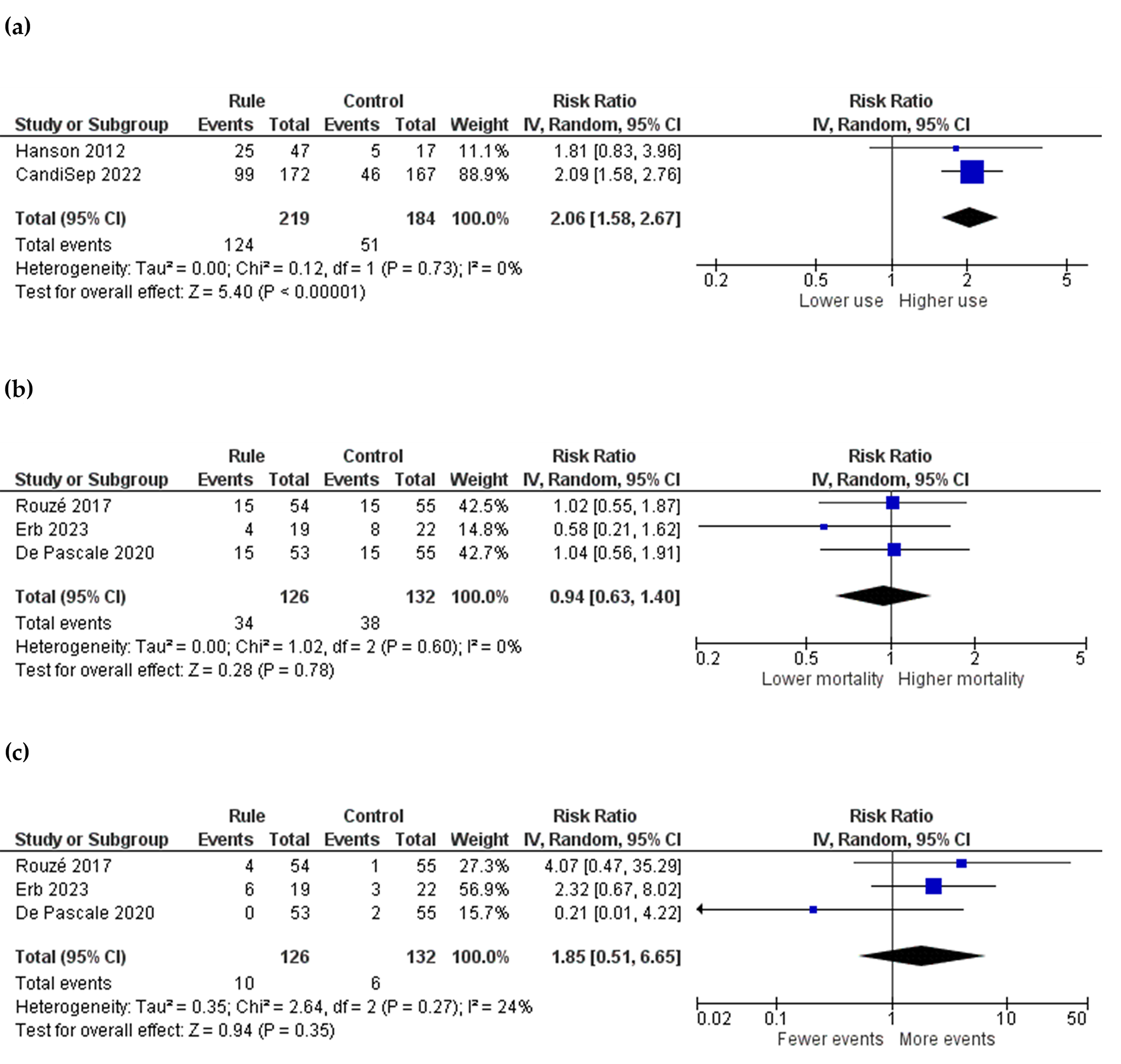
| Rule-out: short-term mortality [11,13,14] | 3 RCTs; 258 analysed; 34/126 versus 38/132 deaths | RR 0.94 (95% CI 0.63–1.40); I2 = 0% | REML/Wald 0.94 (0.63–1.40); mHKSJ 0.94 (0.39–2.26); missing-outcome bounds 0.82–1.09. | Low | Neither benefit nor harm was excluded; the stopping policy cannot be labelled mortality-neutral. |
| Rule-out: post-randomisation invasive Candida events [11,13,14] | 3 RCTs; 258 analysed; 10/126 versus 6/132 events | RR 1.85 (95% CI 0.51–6.65); I2 = 24.3% | REML/Wald 2.00 (0.72–5.50); mHKSJ 2.00 (0.15–25.80); MH RR 1.83 (0.71–4.71); DL RD +2.4% (−6.8% to +11.7%). | Very low | Only 16 events: the fungal-safety signal is highly imprecise and an acceptable safety margin has not been established. |
| Rule-in: systemic antifungal receipt [12,15] | 2 RCTs; 403 analysed; 124/219 versus 51/184 treated | RR 2.06 (95% CI 1.58–2.67); I2 = 0% | Alternative RR 2.05–2.06; mHKSJ 2.06 (0.38–11.21); +293/1000 (+162 to +463). | Moderate (direction only) | Rule-in consistently expands exposure; certainty concerns the direction of increased receipt, not the precise pooled magnitude or patient benefit. |
| CandiSep: 28-day mortality [12] | 1 RCT; 339 analysed; 58/172 versus 51/167 deaths | RR 1.10 (95% CI 0.81–1.51) | Single-study estimate; no pooling. | Low | Positive-result assignment did not demonstrate a mortality benefit. |
| CandiSep: treatment within 96 h [12] | 1 RCT; 339 analysed; 84/172 versus 10/167 treated | RR 8.16 (95% CI 4.39–15.16) | Single-study estimate; no pooling. | Not separately graded | Quantifies the treatment acceleration produced by the positive-result trigger. |
| ACLF: confirmation-dependent versus empirical [30] | 1 RCT; 216 analysed; 94/108 versus 70/108 deaths | RR 1.34 (95% CI 1.15–1.57) | RD +22.2 percentage points (+10.9 to +32.9); inverse contrast HR 0.64 (0.47–0.88). | Low | A bundled high-risk strategy effect—not an isolated assay effect; do not extrapolate to lower-risk Candida stewardship. |
| Algorithm Element | Evidence Type and Full-Text Signal | Clinical Meaning | Required Trial/Reporting Element |
|---|---|---|---|
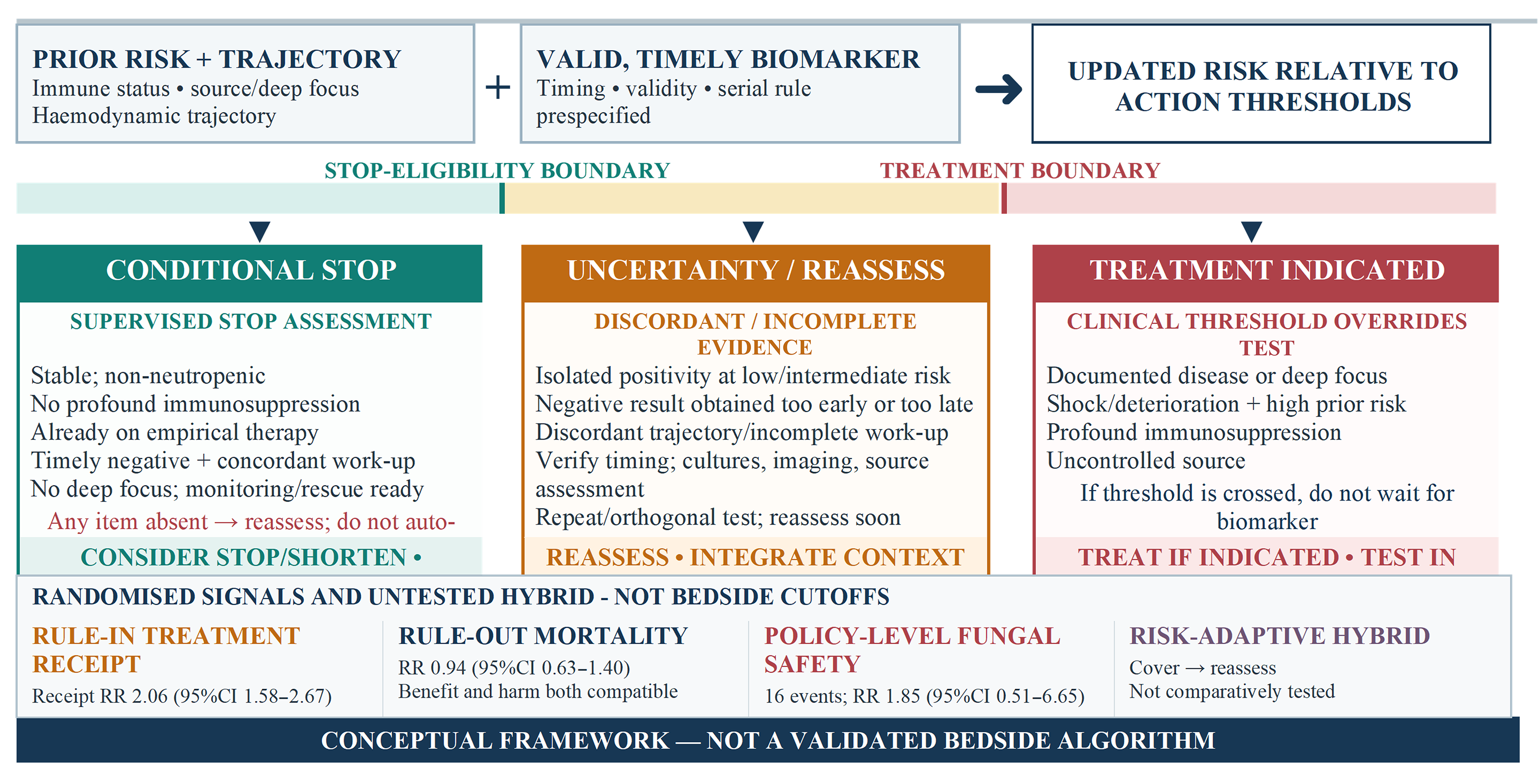
| Rule direction | RCT signal: rule-in increased treatment receipt (RR 2.06, 95% CI 1.58–2.67); Rouzé and De Pascale reduced exposure, whereas the Erb gate rarely opened [11,12,13,14,15]. | Rule-in expands exposure; rule-out reduces it only when the gate opens and the intended action is delivered. Patient benefit and fungal safety remain unestablished. | Use direction-specific estimands: appropriate early therapy/overtreatment for rule-in; exposure reduction plus a prespecified fungal-safety margin for rule-out. |
| Eligibility and spectrum | Transportability signal. CandiSep enrolled only 14.7% of screened patients; abdominal surgery predominated and may elevate BDG. [12] | Accuracy and treatment separation depend on who enters the pathway. | Report screened, eligible, sampled and analysed denominators separately. |
| Assay cutoff versus action threshold | CandiSep used BDG ≥ 80 pg/mL as a treatment trigger; a linked cohort derived > 280 pg/mL at 80% specificity but 46% sensitivity. Hanson modelled a stricter repeated-positive rule [12,15,42]. | A diagnostic operating point is not a treatment threshold; prior risk and false-positive/false-negative costs matter. | Prespecify risk stratum, treatment threshold and uncertainty zone; validate calibration and net benefit. |
| Seriality and logical operator | Erb required all four day-1/day-2 BDG and mannan results to be negative; 17/19 failed the gate and one stopped patient later developed candidemia [11]. | Seriality can detect late signal, but an any-positive veto may close the gate and delay action. | Prespecify sample number, timing and AND/OR logic; report gate-open fraction, vetoes, false-negative stops and delay. |
| Gate activation and adherence | Gate/delivery: Rouzé 29/54 stopped; De Pascale 37/53 stopped by day 5; Erb 2/19 stopped. Recent non-randomised pathways also showed variable acceptance and delivery [11,13,14,28,29]. | Exposure falls only when the gate opens and the intended action is delivered; override occurs in both directions. | Report activation, vetoes, overrides, adherence and delivered action. |
| Two decision clocks | Timing signal: T2MR versus BDG turnaround was 0.4 versus 3.8 days; in Abi Kheir, mean BDG turnaround was 60 h and timely-result comparisons were non-randomised [11,12,29,37]. | A result arriving after the target decision is inert; an early negative may precede detectability. | Separate sample-to-result from result-to-action time and define delayed/invalid handling. |
| Prior risk and confirmation cost | Prior-risk signal: the same negative combined test modelled risk from 12% to 3% but from 28% to 10%; ACLF therapy began at a median of 0 versus 3 days [30,35]. | The same result may cross a stopping threshold at one prior risk but not another; ACLF tested a bundled pathway. | Stratify prior risk and prespecify the maximum acceptable confirmation interval. |
| Risk-adaptive hybrid | LAMBDA used immediate cover then day-3 BDG reassessment in a single-arm cohort; ACLF tested a different bundled confirmation-dependent strategy [30,33]. | Cover-then-reassess was feasible in one selected cohort but is untested as a comparative risk-adaptive pathway. | Randomise the complete pathway and prespecify delay, later exposure and fungal-safety margins. |
| Policy effect and delivery | Policy pathway: eligibility → valid sample → timely result → gate → recommendation → acceptance/override → action → surveillance/rescue. Observational delivery comparisons are non-causal [11,12,13,14,28,29,36,37]. | Intention-to-treat estimates assignment to the policy; restricting the analysis to patients who stopped or adhered selects post-randomisation subgroups. | Keep intention-to-treat primary; report every denominator and interval; treat activation, adherence and rescue as mechanisms unless causal estimands are prespecified. |
Disclaimer/Publisher’s Note: The statements, opinions and data contained in all publications are solely those of the individual author(s) and contributor(s) and not of MDPI and/or the editor(s). MDPI and/or the editor(s) disclaim responsibility for any injury to people or property resulting from any ideas, methods, instructions or products referred to in the content. |
© 2026 by the authors. Licensee MDPI, Basel, Switzerland. This article is an open access article distributed under the terms and conditions of the Creative Commons Attribution (CC BY) license.
Share and Cite
Neri, G.; Mazza, G.; Ielapi, J.; Russo, A.; Serapide, F.; Mastrangelo, H.; Mesiti, A.; Caroleo, Z.; Fresilli, S.; Bruni, A.; et al. Decision-Rule Architecture in Fungal Biomarker-Guided Antifungal Stewardship for Critically Ill Adults: A Systematic Review and Candida-Focused Randomised Meta-Analysis. J. Fungi 2026, 12, 681. https://doi.org/10.3390/jof12090681
Neri G, Mazza G, Ielapi J, Russo A, Serapide F, Mastrangelo H, Mesiti A, Caroleo Z, Fresilli S, Bruni A, et al. Decision-Rule Architecture in Fungal Biomarker-Guided Antifungal Stewardship for Critically Ill Adults: A Systematic Review and Candida-Focused Randomised Meta-Analysis. Journal of Fungi. 2026; 12(9):681. https://doi.org/10.3390/jof12090681
Chicago/Turabian StyleNeri, Giuseppe, Giuseppe Mazza, Jessica Ielapi, Alessandro Russo, Francesca Serapide, Helenia Mastrangelo, Aldo Mesiti, Zaninni Caroleo, Stefano Fresilli, Andrea Bruni, and et al. 2026. "Decision-Rule Architecture in Fungal Biomarker-Guided Antifungal Stewardship for Critically Ill Adults: A Systematic Review and Candida-Focused Randomised Meta-Analysis" Journal of Fungi 12, no. 9: 681. https://doi.org/10.3390/jof12090681
APA StyleNeri, G., Mazza, G., Ielapi, J., Russo, A., Serapide, F., Mastrangelo, H., Mesiti, A., Caroleo, Z., Fresilli, S., Bruni, A., Gigliotti, S., Quirino, A., Matera, G., Longhini, F., & Garofalo, E. (2026). Decision-Rule Architecture in Fungal Biomarker-Guided Antifungal Stewardship for Critically Ill Adults: A Systematic Review and Candida-Focused Randomised Meta-Analysis. Journal of Fungi, 12(9), 681. https://doi.org/10.3390/jof12090681