Members of the Fusarium fujikuroi Species Complex Isolated from Asymptomatic Wetland Grasses in Argentina Include Previously Described Species Pathogenic on Cereal Crops and a Novel Species

 , ,
, ,  and
and
Abstract
1. Introduction
2. Materials and Methods
2.1. Fusarium Isolates
2.2. Phylogenetic Analysis and Whole-Genome Sequencing
2.3. Chemical Analysis
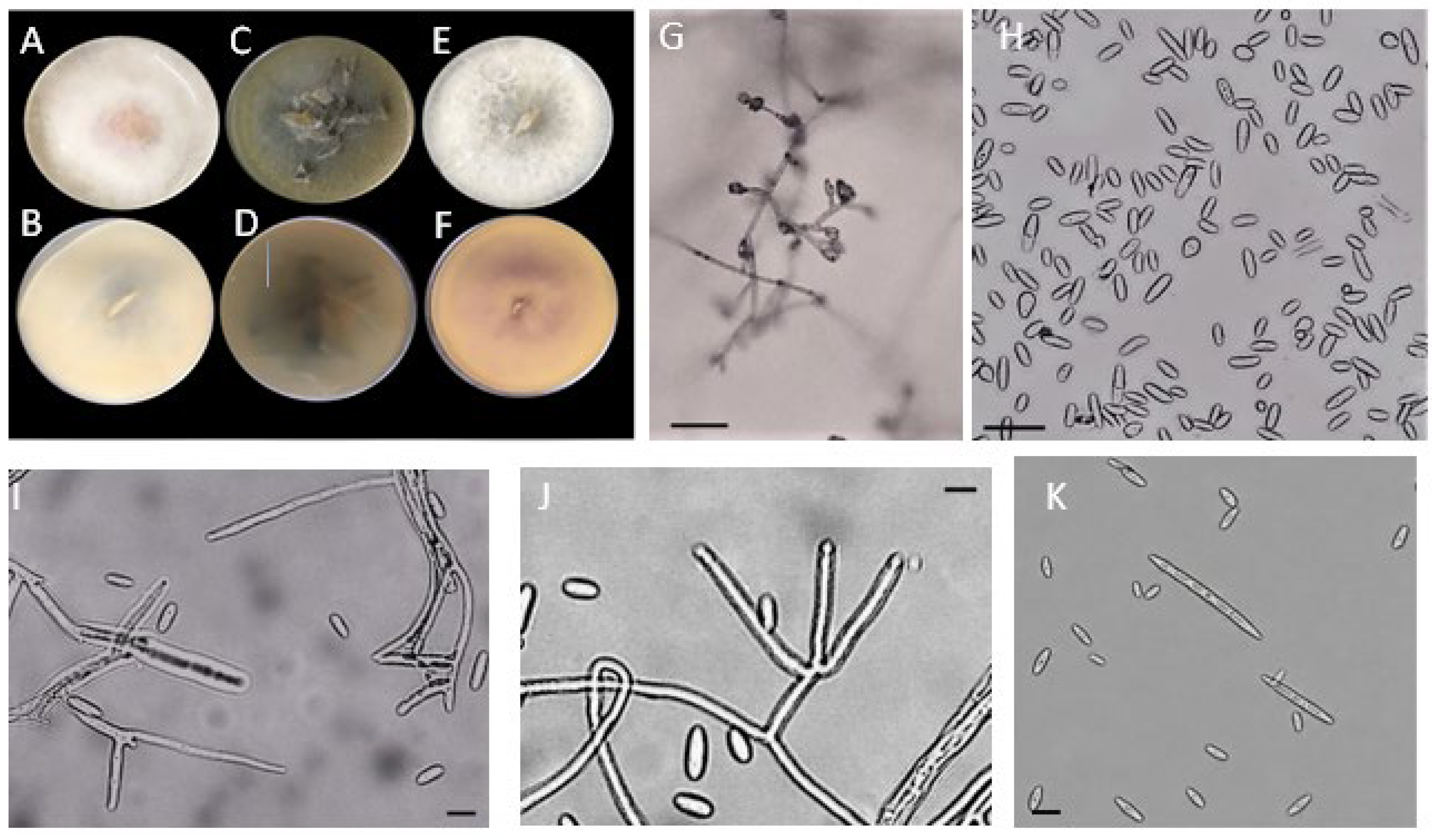
2.4. Morphological Characterization of the Novel Species
2.5. Mating Type Idiomorph and Sexual Crosses
3. Results
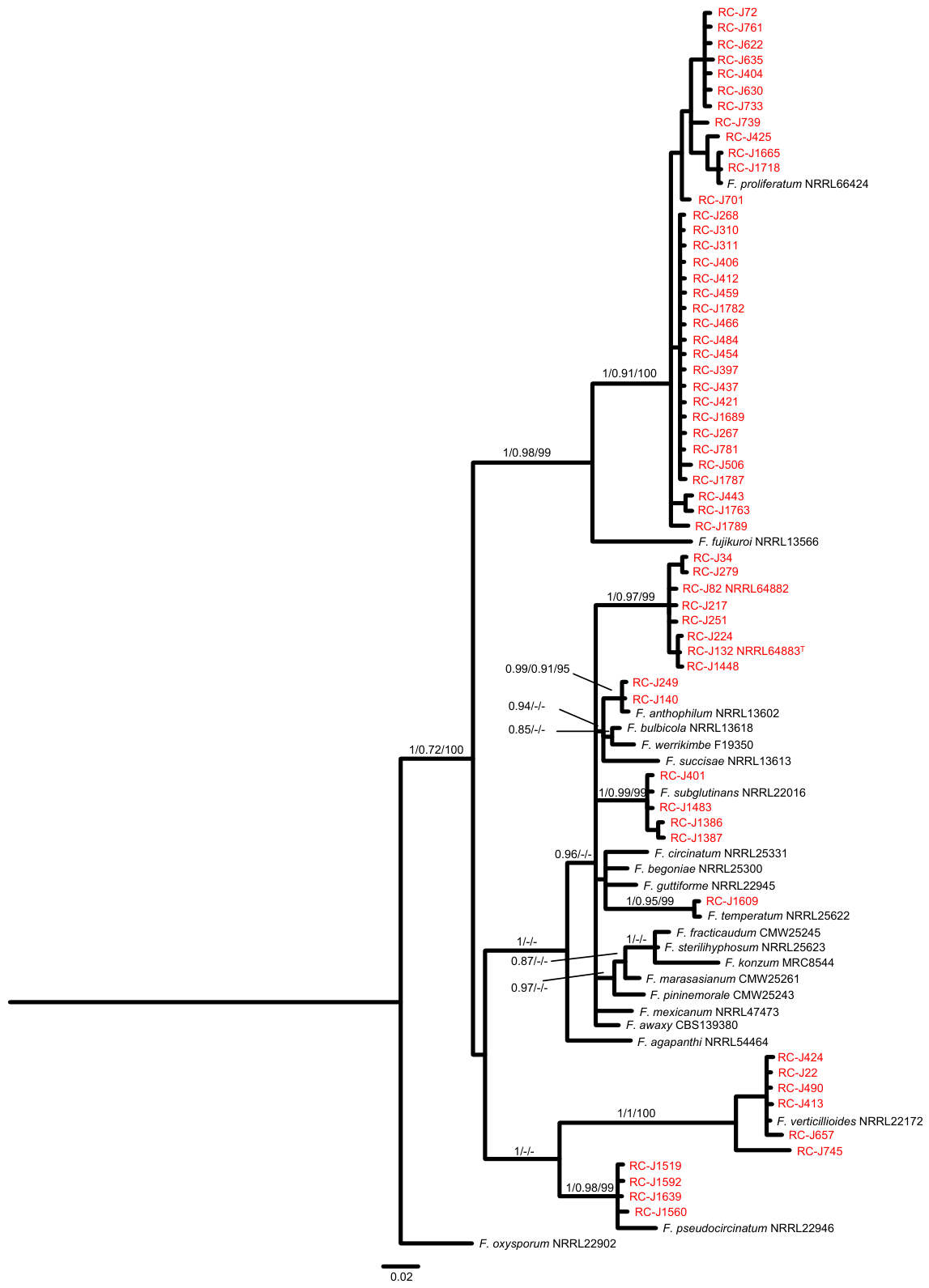
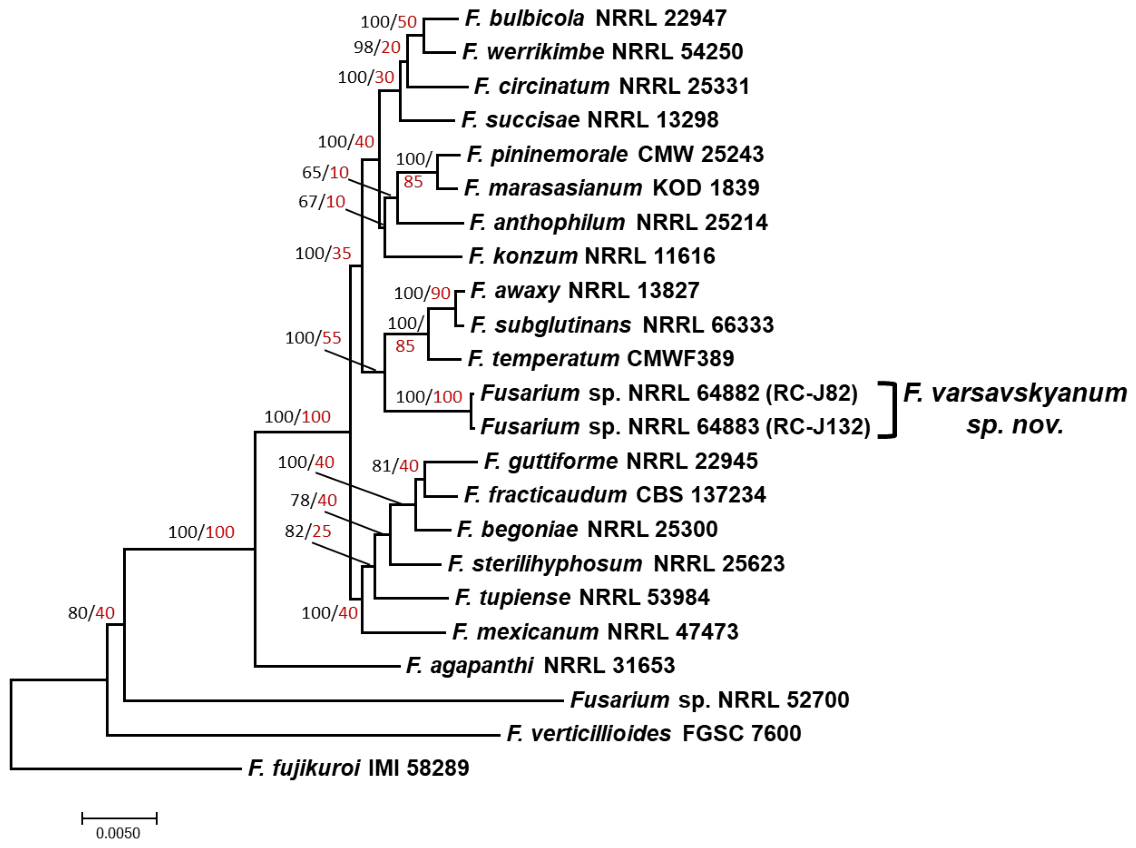
3.1. Determination of Species Identity
3.2. Distribution of Fusarium Species on Grasses
3.3. Secondary Metabolite Biosynthetic Genes
3.4. Mycotoxin and Pigment Analysis
3.5. Mating Type Identification and Sexual Stage Induction
3.6. Taxonomy
4. Discussion
Supplementary Materials
Author Contributions
Funding
Institutional Review Board Statement
Informed Consent Statement
Data Availability Statement
Acknowledgments
Conflicts of Interest
References
- GPWG I—Grass Phylogeny Working Group. Phylogeny and subfamilial classification of the grasses (Poaceae). Ann. Mo. Bot. Gard. 2001, 88, 373–457. [CrossRef]
- Arelovich, H.M.; Bravo, R.D.; Martinez, M.F. Development, characteristic, and trends for beef cattle production in Argentina. Anim. Front. 2011, 1, 37–45. [Google Scholar] [CrossRef]
- Neiff, J.J. Diversity in some tropical wetland systems of South America. In Biodiversity in Wetlands: Assessment, Function and Conservation; Gopal, B., Junk, W., Davis, J., Eds.; Backhuys Publishers: Leiden, The Netherlands, 2001; pp. 157–186. Available online: https://www.researchgate.net/publication/272418968_Diversity_in_some_tropical_wetland_systems_of_South_America (accessed on 11 June 2026).
- Nichea, M.J.; Palacios, S.A.; Chiacchiera, S.M.; Sulyok, M.; Krska, R.; Chulze, S.N.; Torres, A.M.; Ramirez, M.L. Presence of multiple mycotoxins and other fungal metabolites in native grasses from a wetland ecosystem in Argentina intended for grazing cattle. Toxins 2015, 7, 3309–3329. [Google Scholar] [CrossRef] [PubMed]
- Desjardins, A.E. Fusarium Mycotoxins Chemistry, Genetics and Biology; American Phytopathology Society Press: St. Paul, MN, USA, 2006; 260p. [Google Scholar]
- Munkvold, G.P.; Proctor, R.H.; Moretti, A. Mycotoxin production in Fusarium according to contemporary species concepts. Annu. Rev. Phytopathol. 2021, 59, 373–402. [Google Scholar] [CrossRef] [PubMed]
- Nichea, M.J.; Proctor, R.H.; Probyn, C.E.; Palacios, S.A.; Cendoya, E.; Sulyok, M.; Chulze, S.N.; Torres, A.M.; Ramirez, M.L. Fusarium chaquense, sp. nov, a novel type A trichothecene–producing species from native grasses in a wetland ecosystem in Argentina. Mycologia 2022, 114, 46–62. [Google Scholar] [CrossRef] [PubMed]
- Nichea, M.J.; Cendoya, E.; Zachetti, V.G.; Demonte, L.D.; Repetti, M.R.; Palacios, S.A.; Ramirez, M.L. Characterization of members of the Fusarium incarnatum–equiseti species complex from natural and cultivated grasses intended for grazing cattle in Argentina. J. Fungi 2026, 12, 26. [Google Scholar] [CrossRef]
- Aoki, T.; O’Donnell, K.; Geiser, D.M. Systematics of key phytopathogenic Fusarium species: Current status and future challenges. J. Gen. Plant Pathol. 2014, 80, 189–201. [Google Scholar] [CrossRef]
- O’Donnell, K.; Cigelnik, E.; Nirenberg, H.I. Molecular systematics and phylogeography of the Gibberella fujikuroi species complex. Mycologia 1998, 90, 465–493. [Google Scholar] [CrossRef]
- O’Donnell, K.; Ward, T.J.; Robert, V.A.; Crous, P.W.; Geiser, D.M.; Kang, S. DNA sequence-based identification of Fusarium: Current status and future directions. Phytoparasitica 2015, 43, 583–595. [Google Scholar] [CrossRef]
- Sandoval-Denis, M.; Guarnaccia, V.; Polizzi, G.; Crous, P.W. Symptomatic Citrus trees reveal a new pathogenic lineage in Fusarium and two new Neocosmospora species. Persoonia 2018, 40, 1–25. [Google Scholar] [CrossRef] [PubMed]
- Sandoval-Denis, M.; Swart, W.J.; Crous, P.W. New Fusarium species from the Kruger National Park, South Africa. Mycokeys 2018, 34, 63–92. [Google Scholar] [CrossRef] [PubMed]
- Al-Hatmi, A.M.S.; Sandoval-Denis, M.; Nabet, C.; Ahmed, S.A.; Demar, M.; Normand, A.C.; De Hoog, G.S. Fusarium volatile, a new potential pathogen from a human respiratory sample. Fungal Syst. Evol. 2019, 4, 71–181. [Google Scholar] [CrossRef] [PubMed]
- Yilmaz, M.; Sandoval-Denis, M.; Lombard, L.; Visagie, C.M.; Wingfield, B.D.; Crous, P.W. Redefining species limits in the Fusarium fujikuroi species complex. Persoonia 2021, 46, 129–162. [Google Scholar] [CrossRef] [PubMed]
- Nirenberg, H.I.; O’Donnell, K. New Fusarium species and combinations within the Gibberella fujikuroi species complex. Mycologia 1998, 90, 434–458. [Google Scholar] [CrossRef]
- Munkvold, G. Fusarium species and their associated mycotoxins. In Mycotoxigenic Fungi: Methods and Protocols, Methods in Molecular Biology; Moretti, A., Susca, A., Eds.; Humana Press: New York, NY, USA, 2017; pp. 51–106. [Google Scholar]
- Leslie, J.F.; Zeller, K.A.; Wohler, M.; Summerell, B.A. Interfertility of two mating populations in the Gibberella fujikuroi species complex. Eur. J. Plant Pathol. 2004, 110, 611–618. [Google Scholar] [CrossRef]
- Carter, L.L.A.; Leslie, J.F.; Webster, R.K. Population structure of Fusarium fujikuroi from California rice and water grass. Phytopathology 2008, 98, 992–998. [Google Scholar] [CrossRef] [PubMed]
- Swett, C.L.; Gordon, T.R. First report of grass species (Poaceae) as naturally occurring hosts of the pine pathogen Gibberella circinata. Plant Dis. 2012, 96, 908. [Google Scholar] [CrossRef] [PubMed]
- Swett, C.L.; Porter, B.; Fourie, G.; Steenkamp, E.T.; Gordon, T.R.; Wingfield, M.J. Association of the pitch canker pathogen Fusarium circinatum with grass hosts in commercial pine production areas of South Africa. South. For. 2014, 76, 161–166. [Google Scholar] [CrossRef]
- Maia, N.C.; Melo, M.P.; Guimarães, S.S.C.; Matos, K.S.; Moreira, S.I.; Lana, U.D.P.; Cardoso, P.G. Panicum maximum as a reservoir of a potential maize pathogen. Eur. J. Plant Pathol. 2021, 159, 95–104. [Google Scholar] [CrossRef]
- Zeller, K.A.; Summerell, B.A.; Bullock, S.; Leslie, J.F. Gibberella konza (Fusarium konzum) sp. nov. from prairie grasses, a new species in the Gibberella fujikuroi species complex. Mycologia 2003, 95, 943–954. [Google Scholar] [CrossRef]
- Laurence, M.H.; Walsh, J.L.; Shuttleworth, L.A.; Robinson, D.M.; Johansen, R.M.; Petrovic, T.; Vu, T.T.H.; Burgess, L.W.; Summerell, B.A.; Liew, E.C.Y. Six novel species of Fusarium from natural ecosystems in Australia. Fungal Divers. 2015, 77, 349–366. [Google Scholar] [CrossRef]
- Costa, M.M.; Melo, M.P.; Carmo, F.S.; Moreira, G.M.; Guimarães, E.A.; Rocha, F.S.; Costa, S.S.; Abreu, L.M.; Pfenning, L.H. Fusarium species from tropical grasses in Brazil and description of two new taxa. Mycol. Prog. 2021, 20, 61–72. [Google Scholar] [CrossRef]
- Burgess, L.W. 2011 McAlpine Memorial Lecture—A Love Affair with Fusarium. Australas. Plant Pathol. 2014, 43, 359. [Google Scholar] [CrossRef]
- Leslie, J.F.; Summerell, B.A. The Fusarium Laboratory Manual; Blackwell Professional Publishing: Ames, IA, USA, 2006; 388p. [Google Scholar]
- Thompson, J.D.; Higgins, D.G.; Gibson, T.J. CLUSTAL W: Improving the sensitivity of progressive multiple sequence alignment through sequence weighting, position-specific gap penalties and weight matrix choice. Nucleic Acids Res. 1994, 22, 4673–4680. [Google Scholar] [CrossRef] [PubMed]
- Hall, T.A. BioEdit: A user-friendly biological sequence alignment editor and analysis program for Windows 95/98/NT. Nucleic Acids Symp. Ser. 1999, 41, 95–98. Available online: https://www.semanticscholar.org/paper/BIOEDIT:-A-USER-FRIENDLY-BIOLOGICAL-SEQUENCE-EDITOR-Hall/0ae262d9cf78536754bc064e07113ab5e978f208 (accessed on 11 June 2026).
- Katoh, K.; Standley, D.M. MAFFT multiple sequence alignment software version 7: Improvements in performance and usability. Mol. Biol. Evol. 2013, 30, 772–780. [Google Scholar] [CrossRef] [PubMed]
- Goloboff, P.A.; Farris, J.S.; Nixon, K.C. TNT, a free program for phylogenetic analysis. Cladistics 2008, 24, 774–786. [Google Scholar] [CrossRef]
- Guindon, S.; Dufayard, J.-F.; Lefort, V.; Anisimova, M.; Hordijk, W.; Gascuel, O. New Algorithms and Methods to Estimate Maximum-Likelihood Phylogenies: Assessing the Performance of PhyML 3.0. Syst. Biol. 2010, 59, 307–321. [Google Scholar] [CrossRef] [PubMed]
- Ronquist, F.; Teslenko, M.; Van Der Mark, P.; Ayres, D.L.; Darling, A.; Höhna, S.; Larget, B.; Liu, L.; Suchard, M.A.; Huelsenbeck, J.P. MrBayes 3.2: Efficient Bayesian phylogenetic inference and model choice across a large model space. Syst. Biol. 2012, 61, 539–542. [Google Scholar] [CrossRef] [PubMed]
- Posada, D. jModelTest: Phylogenetic model averaging. Mol. Biol. Evol. 2008, 25, 1253–1256. [Google Scholar] [CrossRef] [PubMed]
- Sung, G.H.; Sung, J.M.; Hywel-Jones, N.L.; Spatafora, J.W. A multi-gene phylogeny of Clavicipitaceae (Ascomycota, Fungi): Identification of localized incongruence using a combinational bootstrap approach. Mol. Phylogenet. Evol. 2007, 44, 1204–1223. [Google Scholar] [CrossRef] [PubMed]
- Liu, Y.J.; Whelen, S.; Hall, B.D. Phylogenetic relationships among ascomycetes: Evidence from an RNA polymerse II subunit. Mol. Biol. Evol. 1999, 16, 1799–1808. [Google Scholar] [CrossRef] [PubMed]
- O’Donnell, K.; Nirenberg, H.I.; Aoki, T.; Cigelnik, E. A multigene phylogeny of the Gibberella fujikuroi species complex: Detection of additional phylogenetically distinct species. Mycoscience 2000, 41, 61–78. [Google Scholar] [CrossRef]
- O’Donnell, K.; Sarver, B.A.; Brandt, M.; Chang, D.C.; Noble-Wang, J.; Park, B.J.; Sutton, D.A.; Benjamin, L.; Lindsley, M.; Padhye, A.; et al. Phylogenetic diversity and microsphere array-based genotyping of human pathogenic Fusaria, including isolates from the multistate contact lens-associated U.S. keratitis outbreaks of 2005 and 2006. J. Clin. Microbial. 2007, 45, 2235–2248. [Google Scholar] [CrossRef]
- O’Donnell, K.; Cigelnik, E. Two divergent intragenomic rDNA ITS2 types within a monophyletic lineage of the fungus Fusarium are non orthologous. Mol. Phylogenet. Evol. 1997, 7, 103–116. [Google Scholar] [CrossRef] [PubMed]
- Edwards, J.; Auer, D.; De Alwis, S.K.; Summerell, B.; Aoki, T.; Proctor, R.H.; Busman, M.; O’Donnell, K. Fusarium agapanthi sp. nov., a novel bikaverin and fusarubin-producing leaf and stem spot pathogen of Agapanthus praecox (African lily) from Australia and Italy. Mycologia 2016, 108, 981–992. [Google Scholar] [CrossRef] [PubMed]
- Gräfenhan, T.; Johnston, P.R.; Vaughan, M.M.; McCormick, S.P.; Proctor, R.H.; Busman, M.; Ward, T.J.; O’Donnell, K. Fusarium praegraminearum sp. nov., a novel nivalenol mycotoxin-producing pathogen from New Zealand can induce head blight on wheat. Mycologia 2016, 108, 1229–1239. [Google Scholar] [CrossRef] [PubMed]
- Sarver, B.A.; Ward, T.J.; Gale, L.R.; Broz, K.; Kistler, H.C.; Aoki, T.; Nicholson, P.; Carter, J.; O’Donnell, K. Novel Fusarium head blight pathogens from Nepal and Louisiana revealed by multilocus genealogical concordance. Fungal Genet. Biol. 2011, 48, 1096–1107. [Google Scholar] [CrossRef] [PubMed]
- Brown, D.W.; Proctor, R.H. Insights into natural products biosynthesis from analysis of 490 polyketide synthases from Fusarium. Fungal Genet. Biol. 2016, 89, 37–51. [Google Scholar] [CrossRef] [PubMed]
- Villani, A.; Proctor, R.H.; Kim, H.S.; Brown, D.W.; Logrieco, A.F.; Amatulli, M.T.; Moretti, A.; Susca, A. Variation in secondary metabolite production potential in the Fusarium incarnatum-equiseti species complex revealed by comparative analysis of 13 genomes. BMC Genom. 2019, 20, 314. [Google Scholar] [CrossRef] [PubMed]
- Geiser, D.M.; Al-Hatmi, A.; Aoki, T.; Arie, T.; Balmas, V.; Barnes, I.; Bergstrom, G.C.; Bhattacharyya, M.K.K.; Blomquist, C.L.; Bowden, R.; et al. Phylogenomic analysis of a 55.1 kb 19-gene dataset resolves a monophyletic Fusarium that includes the Fusarium solani species complex. Phytopathology® 2021, 111, 1064–1079. [Google Scholar] [CrossRef] [PubMed]
- Altschul, S.F.; Madden, T.L.; Schaffer, A.A.; Zhang, J.; Zhang, Z.; Millwer, W.; Lipman, D.J. Gapped BLAST and PSIBLAST: A new generation of protein database search programs. Nucleic Acids Res. 1997, 25, 3389–3402. [Google Scholar] [CrossRef] [PubMed]
- Kumar, S.; Stecher, G.; Tamura, K. MEGA7: Molecular evolutionary genetics analysis version 7.0 for bigger datasets. Mol. Biol. Evol. 2016, 33, 1870–1874. [Google Scholar] [CrossRef] [PubMed]
- Minh, B.Q.; Nguyen, M.A.; von Haeseler, A. Ultrafast approximation for phylogenetic bootstrap. Mol. Biol. Evol. 2013, 30, 1188–1195. [Google Scholar] [CrossRef] [PubMed]
- Nguyen, L.-T.; Schmidt, H.A.; von Haeseler, A.; Minh, B.Q. IQ-TREE: A fast and effective stochastic algorithm for estimating maximum likelihood phylogenies. Mol. Biol. Evol. 2014, 32, 268–274. [Google Scholar] [CrossRef] [PubMed]
- Vaidya, G.; Lohman, D.J.; Meier, R. SequenceMatrix: Concatenation software for the fast assembly of multi-gene datasets with character set and codon information. Cladistics 2011, 27, 171–180. [Google Scholar] [CrossRef] [PubMed]
- Kornerup, A.; Wanscher, J.H. Methuen Handbook of Colour; Eyre Methuen: London, UK, 1984; 252p. [Google Scholar]
- Montoya-Martínez, A.C.; Rodríguez-Alvarado, G.; Fernández-Pavía, S.P.; Proctor, R.H.; Kim, H.S.; O’Donnell, K. Design and validation of a robust multiplex polymerase chain reaction assay for MAT idiomorph within the Fusarium fujikuroi species complex. Mycologia 2019, 111, 772–781. [Google Scholar] [CrossRef] [PubMed]
- Klittich, C.J.R.; Leslie, J.F. Identification of a second mating population within the Fusarium moniliforme anamorph of Gibberella fujikuroi. Mycologia 1992, 84, 541–547. [Google Scholar] [CrossRef]
- Susca, A.; Villani, A.; Haidukowski, M.; Epifani, F.; Logrieco, A.; Moretti, A. Molecular biodiversity in Fusarium subglutinans and F. temperatum: A valuable tool to distinguish the two sister species and determine the beauvericin chemotype. J. Fungi 2024, 10, 785. [Google Scholar] [CrossRef] [PubMed]
- Szécsi, Á.; Magyar, D.; Tóth, S.; Szőke, C. Poaceae: A rich source of endophytic fusaria. Acta Phytopathol. Entomol. Hung. 2013, 48, 19–32. [Google Scholar] [CrossRef]
- Steenkamp, E.T.; Wingfield, B.D.; Coutinho, T.A.; Zeller, K.A.; Wingfield, M.J.; Marasas, W.F.O.; Leslie, J.F. PCR-based identification of MAT-1 and MAT-2 in the Gibberella fujikuroi species complex. Appl. Environ. Microbiol. 2000, 66, 4378–4382. [Google Scholar] [CrossRef] [PubMed]
- Laraba, I.; Kim, H.S.; Proctor, R.H.; Busman, M.; O’Donnell, K.; Felker, F.C.; Aime, M.C.; Koch, R.A.; Wurdack, K.J. Fusarium xyrophilum, sp. nov., a member of the Fusarium fujikuroi species complex recovered from pseudoflowers on yellow-eyed grass (Xyris spp.) from Guyana. Mycologia 2020, 112, 39–51. [Google Scholar] [CrossRef] [PubMed]
- Niehaus, E.M.; Munsterkotter, M.; Proctor, R.H.; Brown, D.W.; Sharon, A.; Idan, Y.; Oren-Young, L.; Sieber, C.M.; Novak, O.; Pencik, A.; et al. Comparative “Omics” of the Fusarium fujikuroi species complex highlights differences in genetic potential and metabolite synthesis. Genome Biol. Evol. 2016, 8, 3574–3599. [Google Scholar] [CrossRef] [PubMed]
- Malonek, S.; Bömke, C.; Bornberg-Bauer, E.; Rojas, M.C.; Hedden, P.; Hopkins, P.; Tudzynski, B. Distribution of gibberellin biosynthetic genes and gibberellin production in the Gibberella fujikuroi species complex. Phytochemistry 2005, 66, 1296–1311. [Google Scholar] [CrossRef] [PubMed]
- Brown, D.W.; Kim, H.S.; McGovern, A.E.; Probyn, C.E.; Proctor, R.H. Genus-wide analysis of Fusarium polyketide synthases reveals broad chemical potential. Fungal Genet. Biol. 2022, 160, 103696. [Google Scholar] [CrossRef] [PubMed]
- Hansen, F.T.; Gardiner, D.M.; Lysoe, E.; Fuertes, P.R.; Tudzynski, B.; Wiemann, P.; Sondergaard, T.E.; Giese, H.; Brodersen, D.E.; Sorensen, J.L. An update to polyketide synthase and non-ribosomal synthetase genes and nomenclature in Fusarium. Fungal Genet. Biol. 2015, 75, 20–29. [Google Scholar] [CrossRef] [PubMed]
- Hoogendoorn, K.; Barra, L.; Waalwijk, C.; Dickschat, J.S.; van der Lee, T.A.J.; Medema, M.H. Evolution and diversity of biosynthetic gene clusters in Fusarium. Front. Microbiol. 2018, 9, 1158. [Google Scholar] [CrossRef] [PubMed]
- Son, S.W.; Kim, H.Y.; Choi, G.J.; Lim, H.K.; Jang, K.S.; Lee, S.O.; Lee, S.; Sung, N.D.; Kim, J.C. Bikaverin and fusaric acid from Fusarium oxysporum show antioomycete activity against Phytophthora infestans. J. Appl. Microbiol. 2008, 104, 692–698. [Google Scholar] [CrossRef] [PubMed]
- Gruber-Dorninger, C.; Novak, B.; Nagl, V.; Berthiller, F. Emerging mycotoxins: Beyond traditionally determined food contaminants. J. Agric. Food Chem. 2017, 65, 7052–7070. [Google Scholar] [CrossRef] [PubMed]
- Harvey, C.J.B.; Tang, M.; Schlecht, U.; Horecka, J.; Fischer, C.R.; Lin, H.C.; Li, J.; Naughton, B.; Cherry, J.; Miranda, M.; et al. HEx: A heterologous expression platform for the discovery of fungal natural products. Sci. Adv. 2018, 4, eaar5459. [Google Scholar] [CrossRef] [PubMed]
- Shi, W.; Tan, Y.; Wang, S.; Gardiner, D.M.; De Saeger, S.; Liao, Y.; Wang, C.; Fan, Y.; Wang, Z.; Wu, A. Mycotoxigenic potentials of Fusarium species in various culture matrices revealed by mycotoxin profiling. Toxins 2016, 9, 6. [Google Scholar] [CrossRef] [PubMed]
- Blacutt, A.A.; Gold, S.E.; Voss, K.A.; Gao, M.; Glenn, A.E. Fusarium verticillioides: Advancements in understanding the Toxicity, virulence, and niche adaptations of a model mycotoxigenic pathogen of maize. Phytopathology 2018, 108, 312–326. [Google Scholar] [CrossRef] [PubMed]
- Munkvold, G.P.; Desjardins, A.E. Fumonisins in maize: Can we reduce their occurrence? Plant Dis. 1997, 81, 556–565. [Google Scholar] [CrossRef] [PubMed]
- Scauflaire, J.; Gourgue, M.; Munaut, F. Fusarium temperatum sp. nov. from maize, an emergent species closely related to Fusarium subglutinans. Mycologia 2011, 103, 586–597. [Google Scholar] [CrossRef] [PubMed]
- Levic, J.; Munaut, F.; Scauflaire, J.; Stankovic, S.; Ivanovic, D.; Krnjaja, V. Polyphasic approach used for distinguishing Fusarium temperatum from Fusarium subglutinans. J. Agric. Sci. Technol. 2019, 21, 221–232. Available online: https://ror.circle-u.eu/items/d77d3977-5fac-42b3-9c28-f4dec86b2db5 (accessed on 11 June 2026).
- Van Coller, G.J.; Rose, L.J.; Boutigny, A.-L.; Ward, T.J.; Lamprecht, S.C.; Viljoen, A. The distribution and type B trichothecene chemotype of Fusarium species associated with head blight of wheat in South Africa during 2008 and 2009. PLoS ONE 2022, 17, e0275084. [Google Scholar] [CrossRef] [PubMed]
- Orina, A.S.; Gagkaeva, T.Y.; Gavrilova, O.P. Novel cruciferous plant host of Fusarium temperatum, a species mainly associated with maize. Australas. Plant Dis. Notes 2023, 18, 37. [Google Scholar] [CrossRef]
- Fumero, M.V.; Villani, A.; Susca, A.; Haidukowski, M.; Cimmarusti, M.T.; Toomajian, C.; Leslie, J.F.; Chulze, S.N.; Moretti, A. Fumonisin and beauvericin chemotypes and genotypes of the sister species Fusarium subglutinans and Fusarium temperatum. Appl. Environ. Microbiol. 2020, 86, e00133-20. [Google Scholar] [CrossRef] [PubMed]
- García-López, E.; Mora-Aguilera, J.A.; Villegas-Monter, A.; Tovar-Pedraza, J.M.; Serra, C.; Batista-Marte, C.M. First report of Fusarium pseudocircinatum causing mango malformation disease in Dominican Republic. Plant Dis. 2016, 100, 1501. [Google Scholar] [CrossRef]
- Freeman, S.; Otero-Colina, G.; Rodríguez-Alvarado, G.; Fernández-Pavía, S.; Maymon, M.; Ploetz, R.C.; Aoki, T.; O’Donnell, K. First Report of mango malformation disease caused by Fusarium pseudocircinatum in Mexico. Plant Dis. 2014, 98, 1583. [Google Scholar] [CrossRef] [PubMed]
- De Farias, O.R.; Cruz, J.M.F.L.; Silva Veloso, J.; Souza, J.T.; Duarte, I.G.; Barbosa, P.R.R.; Varanda, C.M.R.; Materatski, P.; Félix, M.D.R.F.; Oliveira, M.D.M.; et al. Fusarium pseudocircinatum causing stunting and malformation of sunflower plants in Brazil. Plant Dis. 2022. Epub ahead of print. [Google Scholar] [CrossRef] [PubMed]
- Montoya-Martínez, A.C.; O’Donnell, K.; Busman, M.; Vaughan, M.M.; McCormick, S.P.; Santillán-Mendoza, R.; Pineda-Vaca, D.; Clapes-Garduño, L.; Fernández-Pavía, S.P.; Ploetz, R.C.; et al. Weeds harbor Fusarium species that cause malformation disease of economically important trees in western Mexico. Plant Dis. 2022, 106, 612–622. [Google Scholar] [CrossRef] [PubMed]
- Summerell, B.A.; Leslie, J.F. Fifty years of Fusarium: How could nine species have ever been enough? Fungal Divers. 2011, 50, 135–144. [Google Scholar] [CrossRef]
- Victoria-Arellano, A.D.; Chaves, F.C.; Marquez-Licona, G.; Solano-Báez, A.R.; Francisco, C.M.; Dallagnol, L.J. First report of Fusarium anthophilum causing drying on Butia odorata in Rio Grande do Sul, Brazil. J. Plant Dis. Prot. 2023, 131, 627–630. [Google Scholar] [CrossRef]
- Bentley, A.R.; Petrovic, T.; Griffiths, S.P.; Burgess, L.W.; Summerell, B.A. Crop pathogens and other Fusarium species associated with Austrostipa aristiglumis. Australas. Plant Pathol. 2007, 36, 434–438. [Google Scholar] [CrossRef]
- Walsh, J.L. Fusarium Species Associated with Savanna Ecosystems in Australia: Taxonomy, Ecology and Pathogenicity. Ph.D. Dissertation, University of Sydney, Sydney, Australia, 2007. [Google Scholar]
- Herron, D.A.; Wingfield, M.J.; Fru, F.; Wingfield, B.D.; Steenkamp, E.T. Grasses as a refuge for Fusarium circinatum L.—Evidence from South Africa. South. J. For. Sci. 2020, 82, 253–262. [Google Scholar] [CrossRef]
- Mourelos, C.A.; Malbrán, I.; Balatti, P.A.; Ghiringhelli, P.D.G.; Lori, A. Gramineous and non-gramineous weed species as alternative hosts of Fusarium graminearum, causal agent of Fusarium head blight of wheat, in Argentina. Crop Prot. 2014, 65, 100–104. [Google Scholar] [CrossRef]
- Lofgren, L.A.; LeBlanc, N.R.; Certano, A.K.; Nachtigall, J.; LaBine, K.M.; Riddle, J.; Broz, K.; Dong, Y.; Bethan, B.; Kafer, C.W.; et al. Fusarium graminearum: Pathogen or endophyte of North American grasses? New Phytol. 2018, 217, 1203–1212. [Google Scholar] [CrossRef] [PubMed]



| Fusarium Species | Strain | Month Year | Host | GPS Coordinates | GenBank Accession No. | |||
|---|---|---|---|---|---|---|---|---|
| TEF1 | RPB2 | CMD1 | TUB2 | |||||
| F. anthophilum | RC-J249 | July 2011 | Poaceae | S 27°31′08.4″ W 59°04′37.6″ | MT123767 | |||
| RC-J140 | July 2011 | Poaceae | S 27°31′10.7″ W 59°04′36.3″ | MT123777 | ||||
| F. proliferatum | RC-J72 | July 2011 | Poaceae | S 27°31′09.2″ W 59°04′36.8″ | PZ453710 | |||
| RC-J268 | July 2011 | Poaceae | S 27°31′10.8″ W 59°04′34.9″ | PZ453711 | ||||
| RC-J310 | July 2011 | Poaceae | S 27°30′58.1″ W 59°05′23.7″ | PZ453712 | ||||
| RC-J311 | July 2011 | Poaceae | S 27°30′58.1″ W 59°05′23.7″ | PZ453713 | ||||
| RC-J397 | July 2011 | Poaceae | S 27°31′41.7″ W 59°04′33.1″ | PZ453714 | ||||
| RC-J406 | July 2011 | Poaceae | S 27°31′41.8″ W 59°04′32.4″ | PZ453715 | ||||
| RC-J412 | July 2011 | Poaceae | S 27°31′41.7″ W 59°04′31.6″ | PZ453716 | ||||
| RC-J437 | July 2011 | Poaceae | S 27°31′41.7″ W 59°04′32.3″ | PZ453717 | ||||
| RC-J459 | July 2011 | Poaceae | S 27°31′26.2″ W 59°05′00.4″ | PZ453718 | ||||
| RC-J484 | July 2011 | Poaceae | S 27°31′25.8″ W 59°04′59.9″ | PZ453719 | ||||
| RC-J506 | July 2011 | Poaceae | S 27°34′16.4″ W 60°23′42.4″ | PZ453720 | ||||
| RC-J701 | July 2011 | Poaceae | S 27°33′34.5″ W 60°25′02.1″ | PZ453721 | ||||
| RC-J739 | July 2011 | Poaceae | S 27°33′52.7″ W 60°24′39.6″ | PZ453722 | ||||
| RC-J761 | July 2011 | Poaceae | S 27°34′53.1″ W 60°24′43.0″ | PZ453723 | ||||
| RC-J404 | July 2011 | Poaceae | S 27°31′41.7″ W 59°04′31.6″ | PZ453724 | ||||
| RC-J1689 | February 2014 | Poaceae | S 27°31′04.1″ W 59°05′05.6″ | PZ453725 | ||||
| RC-J630 | July 2011 | Poaceae | S 27°33′28.3″ W 60°25′01.5″ | PZ453726 | ||||
| RC-J781 | July 2011 | Poaceae | S 27°33′28.8″ W 60°25′00.3″ | PZ453727 | ||||
| RC-J267 | July 2011 | Poaceae | S 27°31′10.8″ W 59°04′34.9″ | PZ453728 | ||||
| RC-J1718 | September 2014 | Leersia luziola | S 27°31′06,9″ W 59°05′01.0″ | MT123773 | ||||
| RC-J1782 | September 2014 | Paspalum notatum | S 27°30′39.0″ W 59°04′58.7″ | PZ453729 | ||||
| RC-J443 | July 2011 | Poaceae | S 27°31′41.2″ W 59°04′32.7″ | PZ453730 | ||||
| RC-J421 | July 2011 | Poaceae | S 27°31′42.9″ W 59°04′31.5″ | PZ453731 | ||||
| RC-J425 | July 2011 | Poaceae | S 27°31′42.9″ W 59°04′31.5″ | PZ453732 | ||||
| RC-J454 | July 2011 | Poaceae | S 27°31′26.8″ W 59°05′00.4″ | PZ453733 | ||||
| RC-J466 | July 2011 | Poaceae | S 27°31′25.6″ W 59°05′00.5″ | PZ453734 | ||||
| RC-J622 | July 2011 | Poaceae | S 27°33′28.2″ W 60°25′05.3″ | PZ453735 | ||||
| RC-J635 | July 2011 | Poaceae | S 27°33′28.8″ W 60°25′00.3″ | PZ453736 | ||||
| RC-J733 | July 2011 | Poaceae | S 27°33′51.7″ W 60°24′41.0″ | PZ453737 | ||||
| RC-J1665 | September 2014 | Diplacha sp. | S 27°31′07.0″ W 59°05′00.9″ | MT123775 | ||||
| RC-J1763 | September 2014 | Hymenachme sp. | S 27°30′39.0″ W 59°04′58.7″ | PZ453738 | ||||
| RC-J1787 | September 2014 | Dichantium sp. | S 27°30′34.5″ W 59°05′02.7″ | PZ453739 | ||||
| RC-J1789 | September 2014 | Dichantium sp. | S 27°30′34.5″ W 59°05′02.7″ | PZ453740 | ||||
| F. pseudocircinatum | RC-J1560 | September 2014 | Shcloris sp. | S 27°30′49.5″ W 59°05′06.1″ | MT123782 | |||
| RC-J1592 | September 2014 | Spartina sp. | S 27°30′49.5″ W 59°05′06.1″ | MT123774 | ||||
| RC-J1519 | September 2014 | Eriochloa sp. | S 27°30′49.5″ W 59°05′06.1″ | MT123771 | ||||
| RC-J1639 | September 2014 | Cynodon dactylon | S 27°30′49.5″ W 59°05′06.1″ | MT123783 | ||||
| F. subglutinans | RC-J401 | July 2011 | Poaceae | S 27°31′ 41.7″ W 59°04′33.1″ | MT123768 | |||
| RC-J1483 | September 2014 | Elionurus sp. | S 27°30′49.7″ W 59°05′06.3″ | MT123770 | ||||
| RC-J1386 | February 2014 | Panicum sp. | S 27°30′50.3″ W 59°05′06.4″ | MT123780 | ||||
| RC-J1387 | February 2014 | Panicum sp. | S 27°30′50.3″ W 59°05′06.4″ | MT123781 | ||||
| F. temperatum | RC-J1609 | September 2014 | Panicum sp. | S 27°30′50.3″ W 59°05′06.4″ | MT123772 | |||
| F. varsavskyanum sp. nov. | RC-J34 | July 2011 | Poaceae | S 27°34′ 16.4″ W 60°23′42.4″ | PZ453703 | |||
| RC-J82, NRRL 64882 | July 2011 | Poaceae | S 27°34′ 14.0″ W 60°23′47.4″ | OQ134079 | OQ134074 | OQ134084 | OQ134089 | |
| RC-J217 | July 2011 | Poaceae | S 27°34′ 02.3″ W 60°23′45.6″ | PZ453704 | ||||
| RC-J224 | July 2011 | Poaceae | S 27°34′ 02.3″ W 60°23′45.6″ | OQ134080 | OQ134075 | OQ134085 | OQ134090 | |
| RC-J251 | July 2011 | Poaceae | S 27°34′ 01.8″ W 60°23′43.2 | OQ134081 | OQ134076 | OQ134086 | OQ134091 | |
| RC-J132T, NRRL 64883 | July 2011 | Poaceae | S 27°34′ 05.7″ W 60°23′48.6″ | OQ134082 | OQ134078 | OQ134088 | OQ134093 | |
| RC-J1448 | February 2014 | Elionurus sp. | S 27°30′49.7″ W 59°05′06.3″ | OQ134083 | OQ134077 | OQ134087 | OQ134092 | |
| RC-J279 | July 2011 | Poaceae | S 27°31′ 08.2″ W 59°04′38.2″ | PZ453707 | ||||
| F. verticillioides | RC-J424 | July 2011 | Poaceae | S 27°31′42.9″ W 59°04′31.5″ | MT123769 | |||
| RC-J22 | July 2011 | Poaceae | S 27°31′10.6″ W 59°04′38.4″ | MT123776 | ||||
| RC-J413 | July 2011 | Poaceae | S 27°31′41.7″ W 59°04′31.6″ | MT123778 | ||||
| RC-J490 | July 2011 | Poaceae | S 27°31′25.9″ W 59°05′00.5″ | MT123779 | ||||
| RC-J657 | July 2011 | Poaceae | S 27°33′ 34.2″ W 60°24′59.7″ | PZ453708 | ||||
| RC-J745 | July 2011 | Poaceae | S 27°33′ 53.5″ W 60°24′36.2″ | PZ453709 | ||||
| Fusarium Species | Strain Number | Host | Origin | GenBank Accession Number TEF1 |
|---|---|---|---|---|
| F. agapanthi | NRRL 54464 | Agapanthus sp. | Australia | MN193856 |
| F. anthophilum | NRRL 13602 | Hippeastrum sp. | Germany | AF160292 |
| F. awaxy | CBS 139380 | Corn stalk | USA | MN534058 |
| F. begoniae | NRRL 25300 | Begonia elatior | Germany | AF160293 |
| F. bulbicola | NRRL 13618 | Nerine bowdenii | Germany | AF160294 |
| F. circinatum | NRRL 25331 | Pinus radiata | USA | AF160295 |
| F. fracticaudum | CMW 25245 | Pinus maximinoii | Colombia | KJ541059 |
| F. fujikuroi | NRRL 13566 | Oryza sativa | Taiwan | AF160279 |
| F. guttiforme | NRRL 22945 | Ananas comosus | England | AF160297 |
| F. konzum | MRC 8544 | Sorghastrum nuttans | USA | EU220235 |
| F. marasasianum | CMW 25261 | Pinus patula | Colombia | KJ541063 |
| F. mexicanum | NRRL 47473 | Mangifera indica inflorescence | Mexico | GU737416 |
| F. oxysporum | NRRL 22902 | Pseudotsuga menziesii | USA | AF160312 |
| F. pininemorale | CMW 25243 | Pinus tecunumanii | Colombia | KJ541064 |
| F. proliferatum | NRRL 66424 | Tropical rain forest soil | Papua New Guinea | MN534059 |
| F. pseudocircinatum | NRRL 22946 | Solanum sp. | Ghana | AF160271 |
| F. subglutinans | NRRL 22016 | Zea mays | USA | HM057336.1 |
| F. sterilihyphosum | NRRL 25623 | Mango | South Africa | AF160300 |
| F. succisae | NRRL 13613 | Succisa pratensis | Germany | AF160291 |
| F. temperatum | NRRL 25622 | Zea mays | South Africa | AF160301 |
| F. tupiense | NRRL 53984 | Mangifera indica | Brazil | GU737404 |
| F. verticillioides | NRRL 22172 | Zea mays | Germany | AF160262 |
| F. werrikimbe | F19350 = CBS 125535 | Sorghum leiocladum | Australia | EF107131 |
| F. varsavskyanum sp. nov. | F. subglutinans | F. temperatum | ||
|---|---|---|---|---|
| Metabolite Gene/Gene Cluster a | NRRL 64882 | NRRL 64883 | NRRL 66333 | CFWF389 |
| Polyketides | ||||
| 2-AOD-3-o | No | No | No | No |
| Aurofusarin | No | No | No | No |
| Bikaverin | Yes | Yes | Yes | Yes |
| Depudecin | Partial | Partial | Yes | Yes |
| Equisetin | Partial | Partial | Partial | Partial |
| Fujikurin | No | No | No | Yes |
| Fumonisin | No | No | No | No |
| Fusaric Acid | Yes | Yes | Yes | Yes |
| Fusaridione | No | No | No | No |
| Fusarielin | No | No | No | No |
| Fusarin | No | No | No | No |
| Fusarubin | Yes | Yes | Yes | Yes |
| Gibepyrone | Yes | Yes | Yes | Yes |
| Zearalenone | No | No | No | No |
| Non-ribosomal peptides | ||||
| Apicidin | No | No | No | No |
| Beauvericin/Enniatin | Yes | Yes | No | Yes |
| Ferricrocin | Yes | Yes | Yes | Yes |
| Fusarinine | Yes | Yes | Yes | Yes |
| Gramilin | No | No | No | No |
| Malonichrome | No | No | No | No |
| Polyketide-Non-ribosomal peptides | ||||
| Fusaristatin | No | No | No | No |
| W493-B | No | No | No | No |
| Terpenes | ||||
| a-Acorenol | Yes | Yes | Yes | Yes |
| Eremophilene | Yes | Yes | Yes | Yes |
| Guai-6,10(14)-diene | Yes | Yes | Yes | Yes |
| Koraiol | Yes | Yes | Yes | Yes |
| Carotenoids | Yes | Yes | Yes | Yes |
| Culmorin | No | No | No | No |
| Trichothecene | No | No | No | No |
| Pant Hormones | ||||
| Auxin | Yes | Yes | Yes | No |
| Cytokinin_Cluster 1 | Yes | Yes | Yes | Yes |
| Cytokinin_Cluster 2 | Yes | Yes | Yes | Yes |
| Gibberellin (=terpene) | Yes | Yes | Yes | Yes |
| Other metabolites | ||||
| Butenolide | No | No | No | No |
Disclaimer/Publisher’s Note: The statements, opinions and data contained in all publications are solely those of the individual author(s) and contributor(s) and not of MDPI and/or the editor(s). MDPI and/or the editor(s) disclaim responsibility for any injury to people or property resulting from any ideas, methods, instructions or products referred to in the content. |
© 2026 by the authors. Licensee MDPI, Basel, Switzerland. This article is an open access article distributed under the terms and conditions of the Creative Commons Attribution (CC BY) license.
Share and Cite
Cendoya, E.; Romero Donato, C.J.; Nichea, M.J.; Palacios, S.A.; Busman, M.; Proctor, R.H.; Ramirez, M.L. Members of the Fusarium fujikuroi Species Complex Isolated from Asymptomatic Wetland Grasses in Argentina Include Previously Described Species Pathogenic on Cereal Crops and a Novel Species. J. Fungi 2026, 12, 444. https://doi.org/10.3390/jof12060444
Cendoya E, Romero Donato CJ, Nichea MJ, Palacios SA, Busman M, Proctor RH, Ramirez ML. Members of the Fusarium fujikuroi Species Complex Isolated from Asymptomatic Wetland Grasses in Argentina Include Previously Described Species Pathogenic on Cereal Crops and a Novel Species. Journal of Fungi. 2026; 12(6):444. https://doi.org/10.3390/jof12060444
Chicago/Turabian StyleCendoya, Eugenia, Cindy J. Romero Donato, María J. Nichea, Sofía A. Palacios, Mark Busman, Robert H. Proctor, and María L. Ramirez. 2026. "Members of the Fusarium fujikuroi Species Complex Isolated from Asymptomatic Wetland Grasses in Argentina Include Previously Described Species Pathogenic on Cereal Crops and a Novel Species" Journal of Fungi 12, no. 6: 444. https://doi.org/10.3390/jof12060444
APA StyleCendoya, E., Romero Donato, C. J., Nichea, M. J., Palacios, S. A., Busman, M., Proctor, R. H., & Ramirez, M. L. (2026). Members of the Fusarium fujikuroi Species Complex Isolated from Asymptomatic Wetland Grasses in Argentina Include Previously Described Species Pathogenic on Cereal Crops and a Novel Species. Journal of Fungi, 12(6), 444. https://doi.org/10.3390/jof12060444