
Identification of Circadian Clock Homologs and Their Rhythmic Expression Differences Among Mating-Type Strains in Morchella sextelata



Abstract
1. Introduction
2. Materials and Methods
2.1. Strains Used in This Study
2.2. Growth Conditions and Sampling
2.3. Homolog Identification of Circadian Clock Genes and Acquisition of Mating-Type Genes in M. sextelata
2.4. RNA Extraction and RT-qPCR
2.5. Reference-Gene Validation for RT-qPCR Normalization
2.6. Statistical Analysis
3. Results
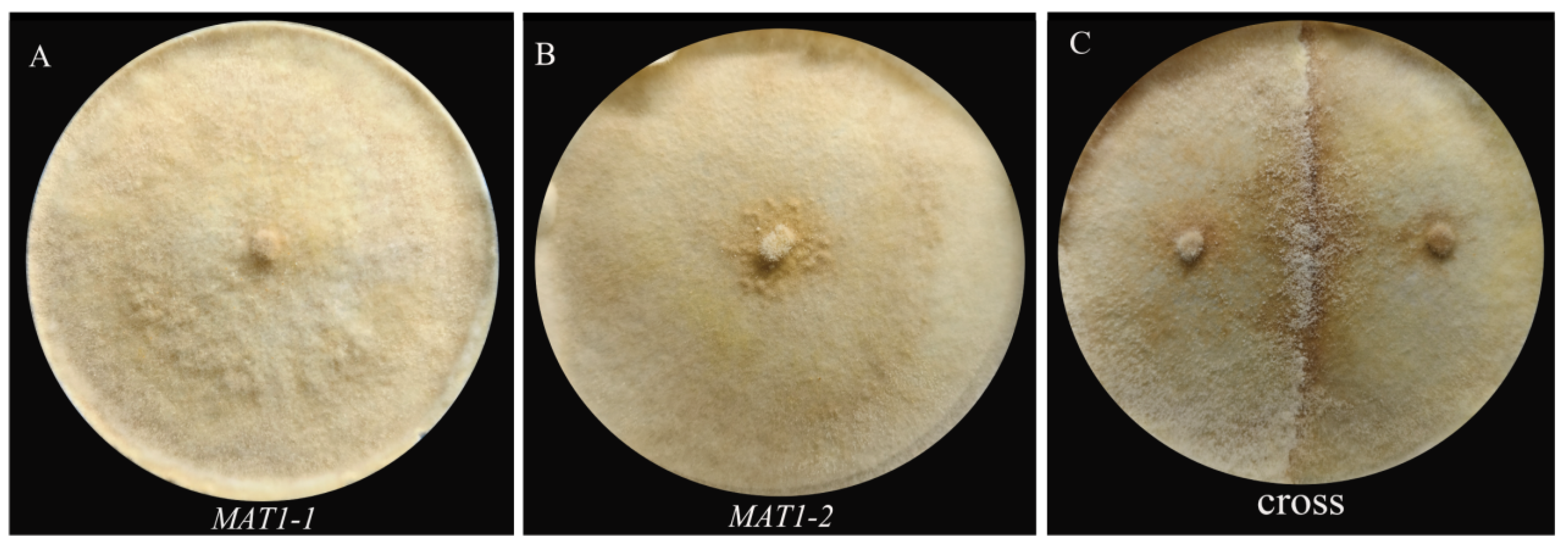
3.1. Conidiation Comparison of MAT1-1, MAT1-2 and MAT1-1 × MAT1-2 Co-Culture
3.2. Identification of Circadian Clock Gene Homologs in M. sextelata
3.3. Validation of Candidate Reference Genes for RT-qPCR Normalization
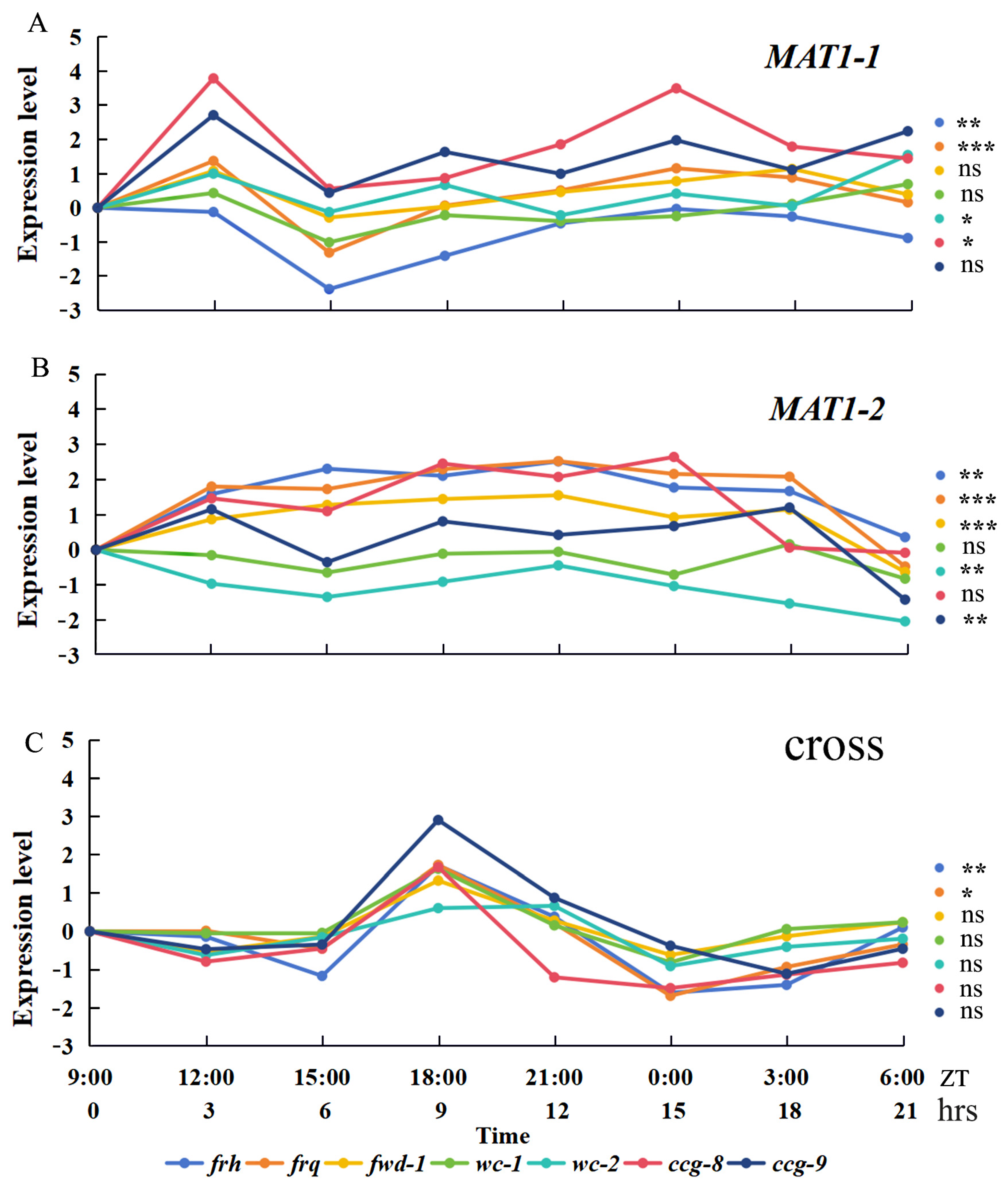
3.4. Expression Patterns of Seven Circadian Gene Homologs in MAT1-1, MAT1-2 and MAT1-1 × MAT1-2 Co-Culture
3.4.1. Expression Patterns of Seven Circadian Gene Homologs in the MAT1-1 Strain
3.4.2. Expression Patterns of Seven Circadian Gene Homologs in the MAT1-2 Strain
3.4.3. Expression Patterns of Seven Circadian Gene Homologs in the MAT1-1 × MAT1-2 Co-Culture
3.4.4. Comparison of Expression Patterns Among MAT1-1, MAT1-2 and MAT1-1 × MAT1-2 Co-Culture
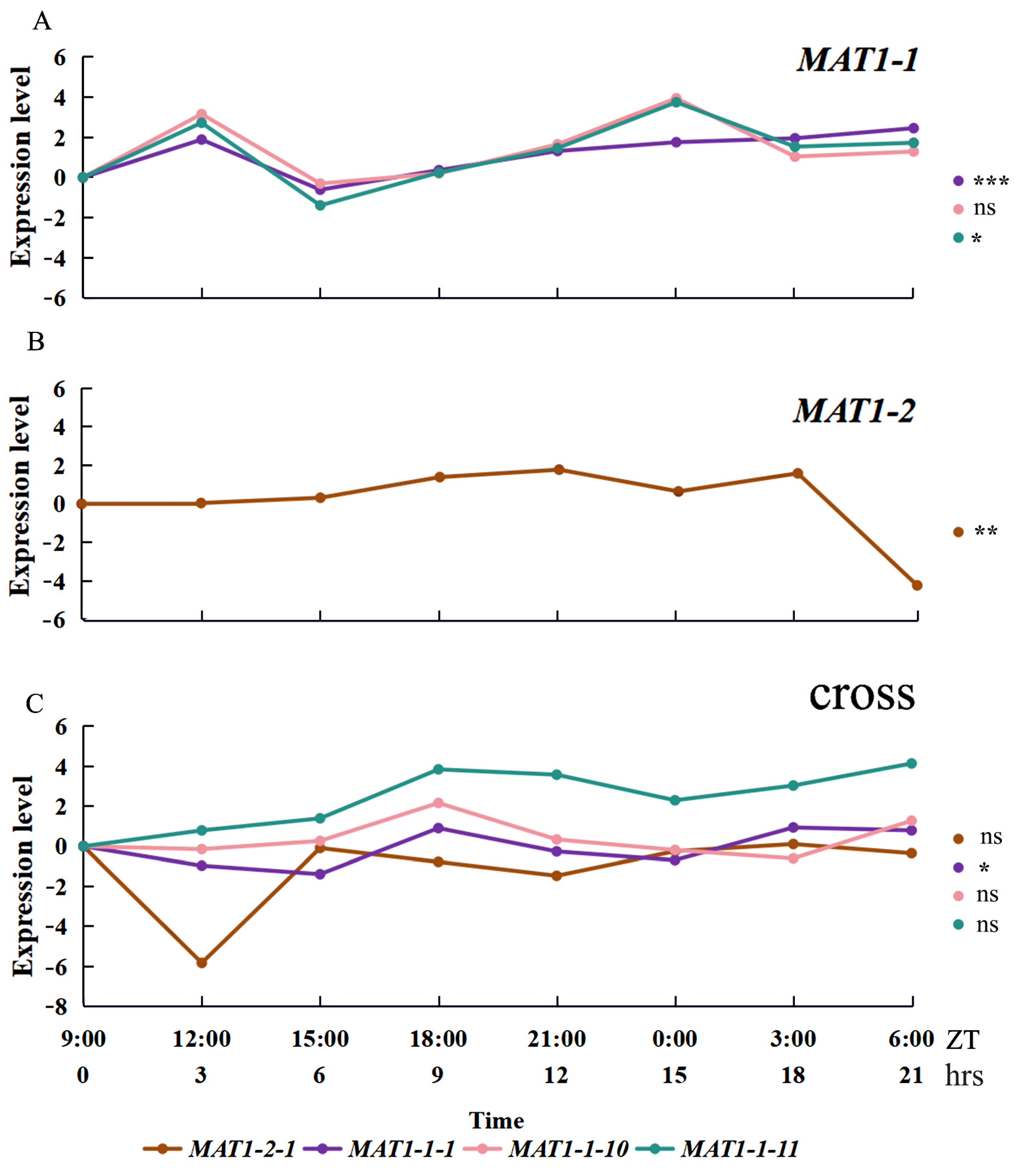
3.5. Expression Patterns of Four Mating-Type Genes in MAT1-1, MAT1-2 and MAT1-1 × MAT1-2 Co-Culture
3.5.1. Expression Patterns of Three Mating-Type Genes in the MAT1-1 Strain
3.5.2. Expression Patterns of One Mating-Type Gene in the MAT1-2 Strain
3.5.3. Expression Patterns of Four Mating-Type Genes in the MAT1-1 × MAT1-2 Co-Culture
3.5.4. Comparison of Expression Patterns Among MAT1-1, MAT1-2 and MAT1-1 × MAT1-2 Co-Culture
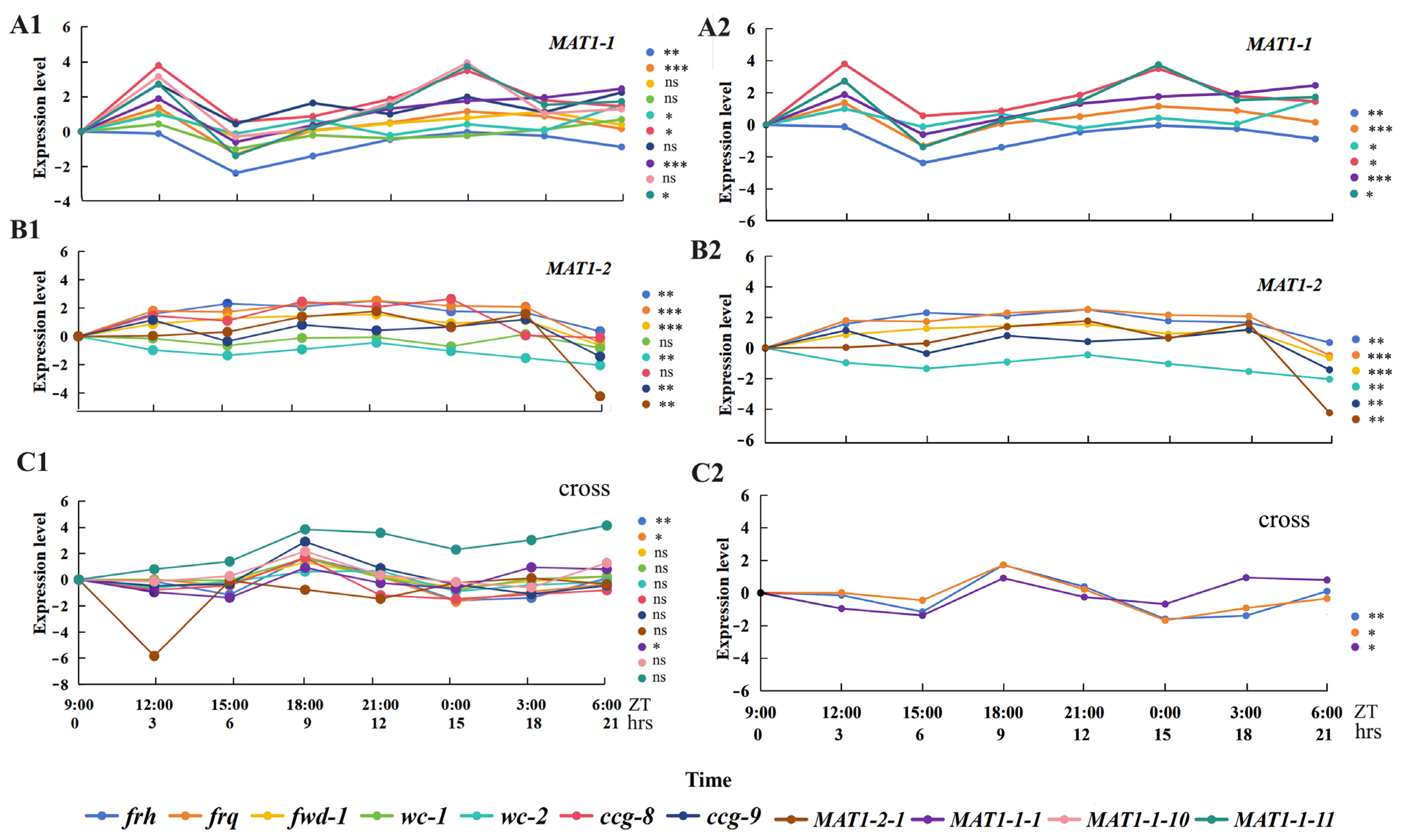
3.6. Comparison of Eleven Gene Expression Patterns Among MAT1-1, MAT1-2 and MAT1-1 × MAT1-2 Co-Culture
4. Discussions
5. Conclusions
Author Contributions
Funding
Institutional Review Board Statement
Informed Consent Statement
Data Availability Statement
Acknowledgments
Conflicts of Interest
References
- Lu, Q.; Yu, M.; Sun, X.; Zhou, X.; Zhang, R.; Zhang, Y.; Liu, X.L.; Li, Z.; Cai, L.; Liu, H.; et al. Circadian clock is critical for fungal pathogenesis by regulating zinc starvation response and secondary metabolism. Sci. Adv. 2025, 11, eads1341. [Google Scholar] [CrossRef] [PubMed]
- Larrondo, L.F. Circadian rhythms: Pervasive, and often times evasive. Philos. Trans. R. Soc. Lond. B Biol. Sci. 2025, 380, 20230477. [Google Scholar] [CrossRef] [PubMed]
- Patke, A.; Young, M.W.; Axelrod, S. Molecular mechanisms and physiological importance of circadian rhythms. Nat. Rev. Mol. Cell Biol. 2020, 21, 67–84. [Google Scholar] [CrossRef] [PubMed]
- Zhou, Z.; Zhang, R.; Zhang, Y.; Xu, Y.; Wang, R.; Chen, S.; Lv, Y.; Chen, Y.; Ren, Y.; Luo, P.; et al. Circadian disruption in cancer hallmarks: Novel insight into the molecular mechanisms of tumorigenesis and cancer treatment. Cancer Lett. 2024, 604, 217273. [Google Scholar] [CrossRef]
- Hurley, J.M.; Loros, J.J.; Dunlap, J.C. Circadian oscillators: Around the transcription-translation feedback loop and on to output. Trends Biochem. Sci. 2016, 41, 834–846. [Google Scholar] [CrossRef]
- Cox, K.H.; Takahashi, J.S. Circadian clock genes and the transcriptional architecture of the clock mechanism. J. Mol. Endocrinol. 2019, 63, R93–R102. [Google Scholar] [CrossRef]
- Castillo, K.D.; Chapa, E.D.; Lamb, T.M.; Gangopadhyay, M.; Bell-Pedersen, D. Circadian clock control of tRNA synthetases in Neurospora crassa. F1000Researsh 2022, 11, 1556. [Google Scholar] [CrossRef]
- Lane, J.M.; Qian, J.; Mignot, E.; Redline, S.; Scheer, F.; Saxena, R. Genetics of circadian rhythms and sleep in human health and disease. Nat. Rev. Genet. 2023, 24, 4–20. [Google Scholar] [CrossRef]
- Bell-Pedersen, D.; Crosthwaite, S.K.; Lakin-Thomas, P.L.; Merrow, M.; Økland, M. The Neurospora circadian clock: Simple or complex? Philos. Trans. R. Soc. Lond. B Biol. Sci. 2001, 356, 1697–1709. [Google Scholar] [CrossRef][Green Version]
- Ma, H.; Li, L.; Yan, J.; Zhang, Y.; Ma, X.; Li, Y.; Yuan, Y.; Yang, X.; Yang, L.; Guo, J. The resonance and adaptation of Neurospora crassa circadian and conidiation rhythms to short light-dark cycles. J. Fungi 2021, 8, 27. [Google Scholar] [CrossRef]
- Heintzen, C.; Liu, Y. The Neurospora crassa circadian clock. Adv. Genet. 2007, 58, 25–66. [Google Scholar]
- Vitalini, M.W.; de Paula, R.M.; Park, W.D.; Bell-Pedersen, D. The rhythms of life: Circadian output pathways in Neurospora. J. Biol. Rhythm. 2006, 21, 432–444. [Google Scholar] [CrossRef] [PubMed]
- Fuller, K.K.; Hurley, J.M.; Loros, J.J.; Dunlap, J.C. 6 Photobiology and circadian clocks in Neurospora. In Fungal Genomics; Springer: Berlin/Heidelberg, Germany, 2024; pp. 121–148. [Google Scholar]
- Dunlap, J.C.; Borkovich, K.A.; Henn, M.R.; Turner, G.E.; Sachs, M.S.; Glass, N.L.; McCluskey, K.; Plamann, M.; Galagan, J.E.; Birren, B.W.; et al. Enabling a community to dissect an organism: Overview of the Neurospora functional genomics project. Adv. Genet. 2007, 57, 49–96. [Google Scholar]
- Chen, C.H.; Dunlap, J.C.; Loros, J.J. Neurospora illuminates fungal photoreception. Fungal Genet. Biol. 2010, 47, 922–929. [Google Scholar] [CrossRef]
- Loros, J.J.; Denome, S.A.; Dunlap, J.C. Molecular cloning of genes under control of the circadian clock in Neurospora. Science 1989, 243, 385–388. [Google Scholar] [CrossRef] [PubMed]
- Loros, J.J. Principles of the animal molecular clock learned from Neurospora. Eur. J. Neurosci. 2020, 51, 19–33. [Google Scholar] [CrossRef]
- Greene, A.V.; Keller, N.; Haas, H.; Bell-Pedersen, D. A circadian oscillator in Aspergillus spp. regulates daily development and gene expression. Eukaryot. Cell. 2003, 2, 231–237. [Google Scholar] [CrossRef] [PubMed]
- Lombardi, L.M.; Brody, S. Circadian rhythms in Neurospora crassa: Clock gene homologues in fungi. Fungal Genet. Biol. 2005, 42, 887–892. [Google Scholar] [CrossRef]
- Blackwell, M. The fungi: 1, 2, 3 … 5.1 million species? Am. J. Bot. 2011, 98, 426–438. [Google Scholar] [CrossRef]
- Lewis, M.T.; Feldman, J.F. Evolution of the frequency (frq) clock locus in Ascomycete fungi. Mol. Biol. Evol. 1996, 13, 1233–1241. [Google Scholar] [CrossRef]
- Dunlap, J.C.; Loros, J.J. How fungi keep time: Circadian system in Neurospora and other fungi. Curr. Opin. Microbiol. 2006, 9, 579–587. [Google Scholar] [CrossRef]
- Lewis, M.T.; Morgan, L.W.; Feldman, J.F. Analysis of frequency (frq) clock gene homologs: Evidence for a helix-turn-helix transcription factor. Mol. Gen. Genet. 1997, 253, 401–414. [Google Scholar] [CrossRef] [PubMed]
- Du, X.H.; Yang, Z.L. Mating systems in true morels (Morchella). Microbiol. Mol. Biol. Rev. 2021, 85, e0022020. [Google Scholar] [CrossRef]
- Yue, Y.; Hao, H.; Wang, Q.; Xiao, T.; Zhang, Y.; Chen, Q.; Chen, H.; Zhang, J. Dynamics of the soil microbial community associated with Morchella cultivation: Diversity, assembly mechanism and yield prediction. Front. Microbiol. 2024, 15, 1345231. [Google Scholar] [CrossRef] [PubMed]
- Bonito, G.; Miyauchi, S.; Hayes, R.D.; Tan, H.; Kuo, A.; Robinson, A.; Wang, X.; Van Wyk, J.; Kohler, A.; Fauchery, L.; et al. Pangeneric analyses reveal the divergent genome evolution and ecologies between morels and truffles in the Morchellaceae. Curr. Biol. 2025, 35, 4135–4150.e4136. [Google Scholar] [CrossRef]
- Liu, W.; He, P.; Shi, X.; Zhang, Y.; Perez-Moreno, J.; Yu, F. Large-scale field cultivation of Morchella and relevance of basic knowledge for its steady production. J. Fungi 2023, 9, 855. [Google Scholar] [CrossRef] [PubMed]
- Kim, H.; Borkovich, K.A. Pheromones are essential for male fertility and sufficient to direct chemotropic polarized growth of trichogynes during mating in Neurospora crassa. Eukaryot. Cell. 2006, 5, 544–554. [Google Scholar] [CrossRef]
- Bobrowicz, P.; Pawlak, R.; Correa, A.; Bell-Pedersen, D.; Ebbole, D.J. The Neurospora crassa pheromone precursor genes are regulated by the mating type locus and the circadian clock. Mol. Microbiol. 2002, 45, 795–804. [Google Scholar] [CrossRef]
- Bell-Pedersen, D.; Garceau, N.Y.; Loros, J.J. Circadian rhythms in fungi. J. Genet. 1996, 75, 387–401. [Google Scholar] [CrossRef]
- Zhu, H.; Nowrousian, M.; Kupfer, D.; Colot, H.V.; Berrocal-Tito, G.; Lai, H.; Bell-Pedersen, D.; Roe, B.A.; Loros, J.J.; Dunlap, J.C. Analysis of expressed sequence tags from two starvation, time-of-day-specific libraries of Neurospora crassa reveals novel clock-controlled genes. Genetics 2001, 157, 1057–1065. [Google Scholar] [CrossRef]
- Lee, S.J.; Kong, M.; Harrison, P.; Hijri, M. Conserved proteins of the RNA interference system in the arbuscular mycorrhizal fungus Rhizoglomus irregulare provide new insight into the evolutionary history of Glomeromycota. Genome Biol. Evol. 2018, 10, 328–343. [Google Scholar] [CrossRef]
- Ye, J.; Coulouris, G.; Zaretskaya, I.; Cutcutache, I.; Rozen, S.; Madden, T.L. Primer-blast: A tool to design target-specific primers for polymerase chain reaction. BMC Bioinform. 2012, 13, 134. [Google Scholar] [CrossRef] [PubMed]
- Livak, K.J.; Schmittgen, T.D. Analysis of relative gene expression data using real-time quantitative pcr and the 2−ΔΔCT method. Methods 2001, 25, 402–408. [Google Scholar] [CrossRef]
- Zhang, Q.; Liu, W.; Cai, Y.; Lan, A.F.; Bian, Y. Validation of internal control genes for quantitative real-time pcr gene expression analysis in Morchella. Molecules 2018, 23, 2331. [Google Scholar] [CrossRef]
- Dunlap, J.C. Molecular bases for circadian clocks. Cell 1999, 96, 271–290. [Google Scholar] [CrossRef] [PubMed]
- Dunlap, J.C.; Loros, J.J. The Neurospora circadian system. J. Biol. Rhythm. 2004, 19, 414–424. [Google Scholar] [CrossRef]
- Xu, Y.; Tang, J.; Wang, Y.; He, X.; Tan, H.; Yu, Y.; Chen, Y.; Peng, W. Large-scale commercial cultivation of morels: Current state and perspectives. Appl. Microbiol. Biotechnol. 2022, 106, 4401–4412. [Google Scholar] [CrossRef]
- Dunlap, J.C.; Loros, J.J. Making time: Conservation of biological clocks from fungi to animals. Microbiol. Spectr. 2017, 5, 10-1128. [Google Scholar] [CrossRef] [PubMed]
- Akman, O.E.; Rand, D.A.; Brown, P.E.; Millar, A.J. Robustness from flexibility in the fungal circadian clock. BMC Syst. Biol. 2010, 4, 88. [Google Scholar] [CrossRef]
- Salichos, L.; Rokas, A. The diversity and evolution of circadian clock proteins in fungi. Mycologia 2010, 102, 269–278. [Google Scholar] [CrossRef]
- Costa, J.I.; Muñoz-Guzmán, F.; Larrondo, L.F. Clock regulation and fungal physiology: Molecular mechanisms underpinning the timely control of just about everything. Annu. Rev. Microbiol. 2025, 79, 191–214. [Google Scholar] [CrossRef]
- Liu, Y.; Bell-Pedersen, D. Circadian rhythms in Neurospora crassa and other filamentous fungi. Eukaryot. Cell 2006, 5, 1184–1193. [Google Scholar] [CrossRef]
- Lakin-Thomas, P.L.; Bell-Pedersen, D.; Brody, S. The genetics of circadian rhythms in Neurospora. Adv. Genet. 2011, 74, 55–103. [Google Scholar]
- Hurley, J.M.; Dasgupta, A.; Emerson, J.M.; Zhou, X.; Ringelberg, C.S.; Knabe, N.; Lipzen, A.M.; Lindquist, E.A.; Daum, C.G.; Barry, K.W.; et al. Analysis of clock-regulated genes in Neurospora reveals widespread posttranscriptional control of metabolic potential. Proc. Natl. Acad. Sci. USA 2014, 111, 16995–17002. [Google Scholar] [CrossRef]
- Loros, J.J.; Dunlap, J.C. Genetic and molecular analysis of circadian rhythms in Neurospora. Annu. Rev. Physiol. 2001, 63, 757–794. [Google Scholar] [CrossRef]
- Zhang, R.; Lahens, N.F.; Ballance, H.I.; Hughes, M.E.; Hogenesch, J.B. A circadian gene expression atlas in mammals: Implications for biology and medicine. Proc. Natl. Acad. Sci. USA 2014, 111, 16219–16224. [Google Scholar] [CrossRef] [PubMed]
- Bell-Pedersen, D.; Cassone, V.M.; Earnest, D.J.; Golden, S.S.; Hardin, P.E.; Thomas, T.L.; Zoran, M.J. Circadian rhythms from multiple oscillators: Lessons from diverse organisms. Nat. Rev. Genet. 2005, 6, 544–556. [Google Scholar] [CrossRef]
- Glass, N.L.; Rasmussen, C.; Roca, M.G.; Read, N.D. Hyphal homing, fusion and mycelial interconnectedness. Trends Microbiol. 2004, 12, 135–141. [Google Scholar] [CrossRef] [PubMed]
- Gonçalves, A.P.; Heller, J.; Rico-Ramírez, A.M.; Daskalov, A.; Rosenfield, G.; Glass, N.L. Conflict, competition, and cooperation regulate social interactions in filamentous fungi. Annu. Rev. Microbiol. 2020, 74, 693–712. [Google Scholar] [CrossRef]
- Bell-Pedersen, D.; Lewis, Z.A.; Loros, J.J.; Dunlap, J.C. The Neurospora circadian clock regulates a transcription factor that controls rhythmic expression of the output eas (ccg-2) gene. Mol. Microbiol. 2001, 41, 897–909. [Google Scholar] [CrossRef] [PubMed]



| Gene ID | Gene Name | Accession Number | Species | E Value | Identity (%) | Coverage (%) |
|---|---|---|---|---|---|---|
| H6S33_001260 | frh | NC_026502.1 | Neurospora crassa | 0 | 61.04 | 72 |
| H6S33_012933 | frq | NC_026507.1 | N. crassa | 4 × 10⁻²⁵ | 30.85 | 36 |
| H6S33_010463 | fwd-1 | NC_026507.1 | N. crassa | 4 × 10−93 | 54.28 | 25 |
| H6S33_012964 | wc-1 | NC_057368.1 | Aspergillus chevalieri | 2 × 10−150 | 45.21 | 64 |
| H6S33_003590 | wc-2 | NW_025763372.1 | A. mellus | 6 × 10⁻³¹ | 38.26 | 57 |
| H6S33_003804 | ccg-8 | NW_022157136.1 | Lachnellula hyalina | 2 × 10−70 | 38.74 | 73 |
| H6S33_008721 | ccg-9 | NC_026507.1 | N. crassa | 5 × 10−163 | 42.62 | 44 |
| H6S33_008775 | ccg-15 | NC_026505.1 | N. crassa | 1 × 10−43 | 33.33 | 24 |
| H6S33_005012 | ccg-16 | NC_026506.1 | N. crassa | 6 × 10⁻¹³ | 51.72 | 21 |
| H6S33_009409 | ccg-14 | NC_026505.1 | N. crassa | 2 × 10⁻³⁰ | 50 | 12 |
| / | ccg-1 | NC_026505.1 | N. crassa | / | / | / |
| / | ccg-4 | NW_022157138.1 | L. hyalina | / | / | / |
| / | ccg-6 | NC_026505.1 | N. crassa | / | / | / |
| / | ccg-13 | NC_026505.1 | N. crassa | / | / | / |
| / | mfa-1 | NC_026505.1 | N. crassa | / | / | / |
| / | pre-1 | NC_026503.1 | N. crassa | / | / | / |
| / | pre-2 | NC_026507.1 | N. crassa | / | / | / |
| Gene ID | Gene Name | Primer Sequence (5′→3′) | Amplicon Size (bp) |
|---|---|---|---|
| Reference gene | actin1 | Forward: GTACCCTGGTATTGCCGACC | 197 |
| Reverse: GGACGATGGAAGGACCACTC | |||
| H6S33_001260 | frh | Forward: TCCTTTGCACAACTCTCCAC | 174 |
| Reverse: GCGATGAATCCAAGACGTCT | |||
| H6S33_012933 | frq | Forward: AACACACATACCACCACACC | 150 |
| Reverse: CCGTGATGTGTAGGTTGAGG | |||
| H6S33_010463 | fwd-1 | Forward: TCTGGAATCGAGAGCAGCTA | 147 |
| Reverse: AGGTTGCTTGCTGGTTGTTA | |||
| H6S33_012964 | wc-1 | Forward: AGCGACATTGTACCGGTTAC | 192 |
| Reverse: CAACTTGTAAACCGGCCTCT | |||
| H6S33_003590 | wc-2 | Forward: GGAACATCAGCAACAACAGC | 161 |
| Reverse: GTGTAGGTTTTGCAGGTGGA | |||
| H6S33_003804 | ccg-8 | Forward: ATATGATGCAGCAGGTGAGC | 166 |
| Reverse: TCCTCCAACCCCTCAAATCT | |||
| H6S33_008721 | ccg-9 | Forward: CTTCTGCGTACACACTCTCC | 178 |
| Reverse: GCTCCATAGAAACGAAGGCA | |||
| NA * | MAT1-1-1 | Forward: CCCACCTTCTGAGTCCGT | 143 |
| Reverse: GAACCCAGATTCCACCGC | |||
| H6S33_000236 * | MAT1-2-1 | Forward: GCCAGAAATACCCGGGGAT | 135 |
| Reverse: GCTTTACGTGGTGCTCTCG | |||
| NA * | MAT1-1-10 | Forward: CGATGAGCTTGGGGATGC | 137 |
| Reverse: GATGCAGACACCCTTGGG | |||
| NA * | MAT1-1-11 | Forward: CGTTAGATGAGGCGACGC | 107 |
| Reverse: CTCAACCTGTCGTGCTGC |
| Candidate Reference Gene | Mean Ct | SD | CV (%) | Correlation with BestKeeper Index (r) | Stability Ranking/Decision |
|---|---|---|---|---|---|
| Actin1 | 22.69 | 0.80 | 3.52 | 0.925 | Lowest SD; selected as internal reference |
| Elongation factor 1-α | 21.64 | 0.88 | 4.08 | 0.926 | Stable, but not selected |
| β-tubulin | 29.07 | 0.89 | 3.05 | 0.846 | Stable, but relatively low expression and lower correlation |
Disclaimer/Publisher’s Note: The statements, opinions and data contained in all publications are solely those of the individual author(s) and contributor(s) and not of MDPI and/or the editor(s). MDPI and/or the editor(s) disclaim responsibility for any injury to people or property resulting from any ideas, methods, instructions or products referred to in the content. |
© 2026 by the authors. Licensee MDPI, Basel, Switzerland. This article is an open access article distributed under the terms and conditions of the Creative Commons Attribution (CC BY) license.
Share and Cite
Chen, M.-Q.; Liu, J.-X.; Ling, J.; Du, X.-H. Identification of Circadian Clock Homologs and Their Rhythmic Expression Differences Among Mating-Type Strains in Morchella sextelata. J. Fungi 2026, 12, 404. https://doi.org/10.3390/jof12060404
Chen M-Q, Liu J-X, Ling J, Du X-H. Identification of Circadian Clock Homologs and Their Rhythmic Expression Differences Among Mating-Type Strains in Morchella sextelata. Journal of Fungi. 2026; 12(6):404. https://doi.org/10.3390/jof12060404
Chicago/Turabian StyleChen, Meng-Qian, Jun-Xi Liu, Jia Ling, and Xi-Hui Du. 2026. "Identification of Circadian Clock Homologs and Their Rhythmic Expression Differences Among Mating-Type Strains in Morchella sextelata" Journal of Fungi 12, no. 6: 404. https://doi.org/10.3390/jof12060404
APA StyleChen, M.-Q., Liu, J.-X., Ling, J., & Du, X.-H. (2026). Identification of Circadian Clock Homologs and Their Rhythmic Expression Differences Among Mating-Type Strains in Morchella sextelata. Journal of Fungi, 12(6), 404. https://doi.org/10.3390/jof12060404