Article

In Vivo Evaluation of a Nanoemulsion-Delivered Chromium(III)–Triazole Complex Against Fluconazole-Resistant Candida albicans


by
Maria Valentina Bedoya-Florez
1,*,
Ricardo A. Murcia-Galán
2,
Martha Viviana Roa-Cordero
3,
Sandra M. Leal-Pinto
3,
Juan David Puerta-Arias
1,3,
Yair Alvarez-Ricardo
2,
John J. Hurtado
2 and
Tonny W. Naranjo
1,4,*
1
Medical and Experimental Mycology Group CIB-UPB-UdeA-UDES, Medellín 050036, Colombia
2
Research Group in Inorganic Chemistry, Catalysis, and Bioinorganic, Department of Chemistry, University of the Andes, Carrera 1 18A-12, Bogotá 111711, Colombia
3
Instituto de Investigación Masira, Facultad de Ciencias Médicas y de la Salud, Universidad de Santander, Bucaramanga 680002, Colombia
4
School of Health Sciences, Universidad Pontificia Bolivariana, Medellín 050031, Colombia
*
Authors to whom correspondence should be addressed.
J. Fungi 2026, 12(6), 403; https://doi.org/10.3390/jof12060403
Submission received: 23 April 2026 / Revised: 28 May 2026 / Accepted: 30 May 2026 / Published: 2 June 2026

Abstract

Candida albicans remains one of the leading causes of invasive fungal infections and is recognized as a critical-priority pathogen by the World Health Organization. The increasing emergence of resistance to azole antifungals such as fluconazole highlights the need for alternative therapeutic strategies. In this study, we evaluated the antifungal potential of a chromium(III)–triazole coordination complex (CrL1) against C. albicans. In vitro susceptibility testing showed that CrL1 exhibited notable antifungal activity against the fluconazole-resistant strain with low cytotoxicity in murine macrophages. To facilitate aqueous dispersion and enable in vivo administration, CrL1 was incorporated into an oil-in-water nanoemulsion (NE-CrL1). The antifungal activity of NE-CrL1 was evaluated in a murine model of invasive candidiasis. In mice infected with a fluconazole-resistant C. albicans strain, treatment with NE-CrL1 reduced renal fungal burden and was associated with attenuation of histopathological alterations and changes in local inflammatory responses. Although the present study has limitations, including the absence of mechanistic assays and additional physicochemical characterization, these results suggest in vivo antifungal activity of NE-CrL1 and warrant further preclinical evaluation against drug-resistant Candida infections.

1. Introduction

Fungal infections affect more than one billion individuals worldwide each year. Of these, 150 million cases correspond to severe and life-threatening infections, resulting in approximately 1.7 million deaths annually. This trend is driven by several factors, including extended life expectancy, widespread use of immunosuppressive therapies, and the excessive administration of antimicrobial agents, all of which contribute to a heightened risk of developing invasive fungal infections (IFIs) [1].
Among the fungal pathogens implicated in IFIs, Candida species are among the most common, with invasive candidiasis being a life-threatening disease associated with high mortality. Candida albicans is the most prevalent, accounting for over 80% of yeast isolates from mucosal surfaces such as the skin, oral cavity, vaginal tract, and gastrointestinal tract in healthy individuals [2]. Although C. albicans is typically a commensal organism, it can shift to a pathogenic state when host immune defenses or the local microbiota are compromised, leading to either superficial infections or, in severe cases, invasive candidiasis (IC) [3]. Invasive candidiasis encompasses a wide spectrum of conditions, ranging from candidemia, a bloodstream infection, to deep-seated candidiasis. The latter arises from hematogenous dissemination involving vital organs such as the kidneys, liver, and brain, or by direct inoculation of Candida species into normally sterile sites such as the peritoneum, pleural space, or joints [4].
The therapeutic management of IC is complex and involves several antifungal agents depending on the patient’s immune status, the anatomical site of infection, and disease severity. Currently, there are three main classes of antifungal drugs: polyenes, azoles, and echinocandins, with the latter being considered first-line treatment for candidemia due to their efficacy, safety, and broad activity against Candida spp. Nevertheless, azoles such as fluconazole and voriconazole remain widely used, particularly as step-down or consolidation therapy, owing to their oral bioavailability, well-characterized pharmacokinetics, and established role in both prophylaxis and treatment of susceptible infections. Polyenes, such as amphotericin B, are typically reserved for patients who cannot tolerate or fail to respond to other antifungal agents, due to their higher toxicity [5]. However, all three antifungal classes present limitations, including high toxicity, drug–drug interactions, and limited antifungal spectrum. The rising incidence of antifungal resistance, particularly among fluconazole-resistant Candida, complicates clinical management and highlights the urgent need for novel therapeutic approaches [6].
In this context, the development of metal-based coordination complexes has emerged as a promising frontier in the search for novel antimicrobial agents [7,8]. However, relatively few studies have conducted comprehensive in vitro or in vivo evaluations of metal-containing antifungal compounds [9,10,11]. Chohan et al. [10] reported the synthesis of a series of cobalt(II), copper(II), nickel(II), and zinc(II) coordination complexes with demonstrated antifungal activity. Nevertheless, several of these complexes exhibited high cytotoxicity, limiting their therapeutic applicability. More recently, Murcia-Galán et al. [11] synthesized and characterized four novel compounds based on Co(II) complexes containing a benzotriazole-derived ligand, which showed notable in vitro inhibitory effect against fluconazole-resistant Candida isolates. Similarly, the same authors reported three chromium(III) coordination complexes (CrL1, CrL2 and CrL3), each containing a distinct triazole-based ligand, which showed significant antifungal effects against fluconazole-resistant Candida strains, along with lower cytotoxicity, underscoring their potential for further preclinical studies [9].
Chromium(III) coordination complexes have garnered attention due to their ability to generate reactive oxygen species (ROS), induce ROS-mediated apoptosis, and cause DNA damage, which may contribute to their antifungal activity. Additionally, Cr(III) exhibits high thermodynamic and kinetic stability, forming octahedral complexes capable of interacting with microbial biomolecules such as DNA and proteins, thereby impairing metabolic function and promoting membrane disruption. Although their activity has been more extensively characterized in antibacterial models, several Cr(III) complexes have demonstrated promising antifungal effects, including against C. albicans, highlighting their potential as novel therapeutic agents [12,13].
Based on this background, the present study aimed to evaluate the antifungal efficacy of a chromium-based coordination complex with a triazole ligand (CrL1) in a murine model of invasive candidiasis caused by C. albicans. Specifically, we assessed its effects on fungal burden, tissue damage, and host inflammatory responses to explore its potential as an alternative antifungal strategy against drug-resistant Candida infections.

2. Materials and Methods

2.1. Chromium Coordination Complexes and Reference Drugs

Three chromium(III) coordination complexes with triazole ligands (CrL1, CrL2, CrL3) previously synthesized by Murcia et al. were used in this study [9]. Their chemical structures are shown in Figure S1. Chromium chloride hexahydrate salt (CrCl3·6H2O) was obtained from Alfa Aesar (Ward Hill, MA, USA). Fluconazole and itraconazole, both from Sigma-Aldrich (St. Louis, MO, USA) were used as reference antifungal drugs for in vitro susceptibility testing. Diflucan® (fluconazole, 2 mg/mL; Pfizer, New York, NY, USA) was used as the reference antifungal drug for in vivo treatment. For in vitro assays, the tested compounds were solubilized in dimethyl sulfoxide (DMSO).

2.2. Fungal Strains

C. albicans ATCC 90028 was obtained from the American Type Culture Collection (ATCC). The fluconazole-resistant C. albicans CAP F-13 strain used in this study is a clinical isolate deposited in the strain collection of Medical and Experimental Mycology Group at the Corporación para Investigaciones Biológicas (CIB, Medellín, Colombia). Both strains were maintained on Sabouraud Dextrose Agar (BD, Sparks, MD, USA), supplemented with 100 μg/mL streptomycin and 100 U/mL penicillin (Gibco, Thermo Fisher Scientific, Waltham, MA, USA) at 37 °C. Prior to each assay, fresh cultures were prepared, and cell suspensions were adjusted to the required cell concentration.

2.3. Minimal Inhibitory Concentration (MIC) Determination

The antifungal activity of coordination compounds, chromium salt, and triazole ligands was assessed using the broth microdilution method, in accordance with Clinical and Laboratory Standards Institute (CLSI) document M27-A4 [14]. An inoculum of 5 × 10²–2.5 × 10³ CFU/mL was exposed to serial dilutions of the test compounds (0.97–1000 µg/mL) in RPMI medium (Gibco, Thermo Fisher Scientific, Waltham, MA, USA). Microplates (96-well) were incubated at 35 °C for 24 h, after which the minimum inhibitory concentration (MIC) was visually assessed. To further assess fungicidal activity, subcultures from wells at the MIC and higher concentrations were plated on Sabouraud Dextrose Agar and incubated for 24 h at 35 °C. The minimum fungicidal concentration (MFC) was defined as the lowest concentration producing no visible growth. Fluconazole and itraconazole were included as reference antifungal drugs.

2.4. In Vitro Cytotoxicity Assay

Macrophages J774A.1 (ATCC TIB-67) were provided by the Cellular and Functional Biology and Biomolecular Engineering Group of the Universidad Antonio Nariño, Colombia. The cells were cultured in Dulbecco’s Modified Eagle Medium (D-MEM, Gibco, USA) supplemented with 10% heat-inactivated fetal bovine serum (Gibco, USA) and 1% penicillin/streptomycin solution. For cytotoxicity testing, a protocol previously used by our group was followed [9]. Briefly, J774A.1 cells (1 × 10⁵ cells/mL) were seeded into 96-well flat-bottom plates and incubated at 37 °C in a humidified 5% CO2 atmosphere for 24 h until a monolayer was formed. Cells were then treated with test compounds at concentrations ranging from 11.1 to 300 µg/mL and incubated under identical conditions. Cell viability was assessed using the MTT assay (Sigma-Aldrich, USA), according to the manufacturer’s instructions. Absorbance was measured at 590 nm using an iMark™ microplate reader (Bio-Rad, Madrid, Spain). Half-maximal cytotoxic concentration (CC50) values were calculated via sigmoidal regression using Xlfit™ 4 software (IDBS, Guilford, UK).

2.5. Preparation and Preliminary Characterization of Nanoemulsion

The complex showing the highest anti-Candida activity was encapsulated to improve its aqueous dispersion. For this purpose, an oil-in-water nanoemulsion was prepared using high-energy ultrasonic emulsification, adapted from Sugumar et al. [15], with castor oil (14% v/v) as the oil phase and Tween 80 (26% v/v) as the surfactant. The complex CrL1 was first dissolved in castor oil at temperatures below 50 °C for 20 min, followed by the gradual addition of Tween 80 under constant stirring at 50 °C for another 20 min. Subsequently, Milli-Q water was added to reach a final volume of 20 mL. Ultrasonic homogenization (Ivymen Ultrasonic System) was performed for 10 min using 60-s pulses at 90% amplitude, resulting in the formation of a transparent nanoemulsion, hereafter referred to as NE-CrL1. An Unloaded NE was prepared using the same procedure but without CrL1. Colloidal characterization of the nanoemulsion was conducted by measuring the hydrodynamic diameter (Dh), polydispersity index (PDI), and zeta potential (ZP) using dynamic light scattering (DLS) and electrophoretic light scattering (ELS) (Zetasizer ZS90, Malvern Panalytical, Malvern, UK). Nanoemulsion stability was monitored over a four-month storage period at 8 °C to assess potential changes in colloidal properties.

2.6. In Vivo Model of Invasive Candidiasis

Female BALB/c mice (8–10 weeks old) were obtained from the breeding colony at Corporación para Investigaciones Biológicas (CIB, Medellín, Colombia) and maintained under controlled conditions (21 ± 1 °C, 45–65% humidity, 12 h light/dark cycle) and with free access to sterile food and water. The animal model of systemic candidiasis was established based on protocols adapted from the National Institute of Allergy and Infectious Diseases (NIAID) [16]. Two strains of C. albicans with different fluconazole susceptibility profiles were used: fluconazole-susceptible (ATCC 90028) and fluconazole-resistant (CAP F-13). Intravenous inoculation of a yeast suspension, previously adjusted to 2.5 × 10⁶ cells/mL, was performed. Forty-five (n = 45) mice per strain were used and assigned by simple randomization to three experimental groups: infected-untreated, infected-FLZ, and infected-NE-CrL1. An additional uninfected-untreated control group was included (n = 10 per strain; 2 animals per time point). These animals were housed under identical conditions but were not inoculated. Antifungal treatment consisted of fluconazole (FLZ) 6 mg/kg/day or NE-CrL1 15 mg/kg/day, administered intraperitoneally once daily for three consecutive days, starting 2 h post-infection. The dose of NE-CrL1 was selected based on the in vitro MIC value of CrL1 against the fluconazole-resistant CAP F-13 strain (15.5 µg/mL), given that pharmacokinetic data for this novel compound are not yet established. Mice were monitored daily for clinical signs of illness, including weight loss, behavioral changes, and any signs of systemic infection.

2.7. Ethics Statement

The animal studies strictly followed the Colombian laws (Law 84/1989, Resolution No. 8430/1993) and the European Union Directive 2010/63/EU on animal care. The study was approved by the Ethics Committee of the University of Santander.

2.8. Colony Forming Units (CFU) Determination

Groups of mice were euthanized after 2, 24, 48, 72 and 96 h post-infection. Kidneys and brains were aseptically removed, weighed and homogenized using a GentleMACS Dissociator (Miltenyi Biotec, Bergisch Gladbach, Germany). Homogenization was performed in 1 mL of sterile phosphate-buffered saline (PBS) containing 100 U/mL penicillin, 100 µg/mL streptomycin, and protease inhibitor cocktail (Roche Applied Science, Mannheim, Germany). Tissue homogenates were diluted (1:1000) and 0.1 mL was plated on Sabouraud Dextrose Agar medium, followed by incubation at 37 °C. CFU counts were performed after 24 h and expressed as log10 CFU/g of tissue.

2.9. Histopathological Analysis

Kidney and brain samples were fixed in 4% formalin, paraffin-embedded, sectioned, and stained with hematoxylin and eosin (H&E). Histopathological evaluation was performed by an external certified veterinary pathology laboratory under blinded conditions, where the pathologist was unaware of the experimental group allocation. For each animal, two tissue sections per organ were analyzed. Semi-quantitative scoring was conducted using a standardized panel of twenty-four morphological parameters, graded on a severity scale from 1 (absence of lesion) to 6 (severe lesion). Two animals per experimental group per time point were included in the histological evaluation; therefore, findings are presented as descriptive observations. Representative microphotographs correspond to H&E-stained kidney sections at 96 h post-infection (final time point) and were selected based on lesion patterns consistent with the corresponding semi-quantitative scores. Higher magnification images (40×) correspond to the same fields identified at lower magnification (10×).

2.10. Determination of Immunomarkers

Kidney homogenates were centrifuged (500× g, 4 °C, 10 min), and supernatants were stored at −70 °C. Cytokine concentrations were quantified using a multiplex assay ProcartaPlex Mouse Th1/Th2 Cytokine Panel 11plex (ThermoFisher Scientific, Waltham, MA, USA) and the MAGPIX® Luminex platform (EMD Millipore, Burlington, MA, USA). The molecules analyzed were granulocyte macrophage colony-stimulating factor (GM-CSF), IFN-γ, IL-1β, IL-2, IL-4, IL-5, IL-6, IL-12p70, IL-13, IL-18 and TNF-α. Cytokine levels were normalized to total protein concentration in each sample, which was determined using the Pierce™ BCA Protein Assay Kit (ThermoFisher Scientific, USA).

2.11. Statistical Analysis

Data analysis was performed using GraphPad Prism version 8.0 (GraphPad Software, Inc., San Diego, CA, USA). Normality was assessed with the Shapiro–Wilk test, and group comparisons were conducted using two-way ANOVA followed by Tukey’s post hoc test. Differences were considered statistically significant at values of p < 0.05.

3. Results

3.1. Antifungal Activity of CrL1 Against C. albicans and Cytotoxicity in Murine Macrophages

The antifungal activity of chromium(III) complexes (CrL1, CrL2, and CrL3), their corresponding triazole ligands (L1–L3), and the precursor salt CrCl3·6H2O was evaluated against planktonic cultures of C. albicans and cell cultures of murine macrophages (cell line J774). The free ligands did not exhibit detectable antifungal activity under the conditions tested (MIC > 1000 μg/mL), whereas their corresponding chromium complexes showed measurable antifungal activity (Table 1). Among them, CrL1 exhibited the lowest MIC values, particularly against the fluconazole-resistant CAP F-13 strain (MIC: 15.5 μg/mL). Consistently, CrL1 showed low cytotoxicity in murine macrophages (CC50 > 300 μg/mL), resulting in a selectivity index of 19.4. Notably, CrL1 displayed lower activity against the fluconazole-susceptible ATCC 90028 strain (MIC: 125 μg/mL, SI = 2.4), indicating a differential response depending on the strain evaluated.
In the case of nanoemulsion formulation, NE-CrL1 exhibited antifungal activity, with slightly higher MIC values compared to the free chromium complex and no apparent cytotoxicity in J774 macrophages. The Unloaded NE showed antifungal activity only at higher concentrations (MIC = 500 μg/mL), which may reflect the contribution of formulation components.

3.2. Preliminary Physicochemical Characterization of CrL1-Loaded Nanoemulsion

To enable in vivo evaluation of CrL1, the compound was incorporated into a nanoemulsion system. As an initial characterization, the hydrodynamic diameter (Dh), polydispersity index (PDI) and zeta potential (ZP) of the nanoemulsion were evaluated throughout four months of storage at 8 °C. NE-CrL1 maintained a Dh below 86 nm and a consistent PDI of ~0.46 over time, indicating a relatively broad size distribution, compared to the Unloaded NE. Zeta potential values remained close to neutrality for NE-CrL1, with no significant variations over the evaluation period. Although the nanoemulsion remained within the measured size and PDI ranges over the storage period (Supplementary Table S1), further physicochemical characterization is required.

3.3. NE-CrL1 Reduced Renal Fungal Burden in Mice Infected with Fluconazole-Resistant C. albicans

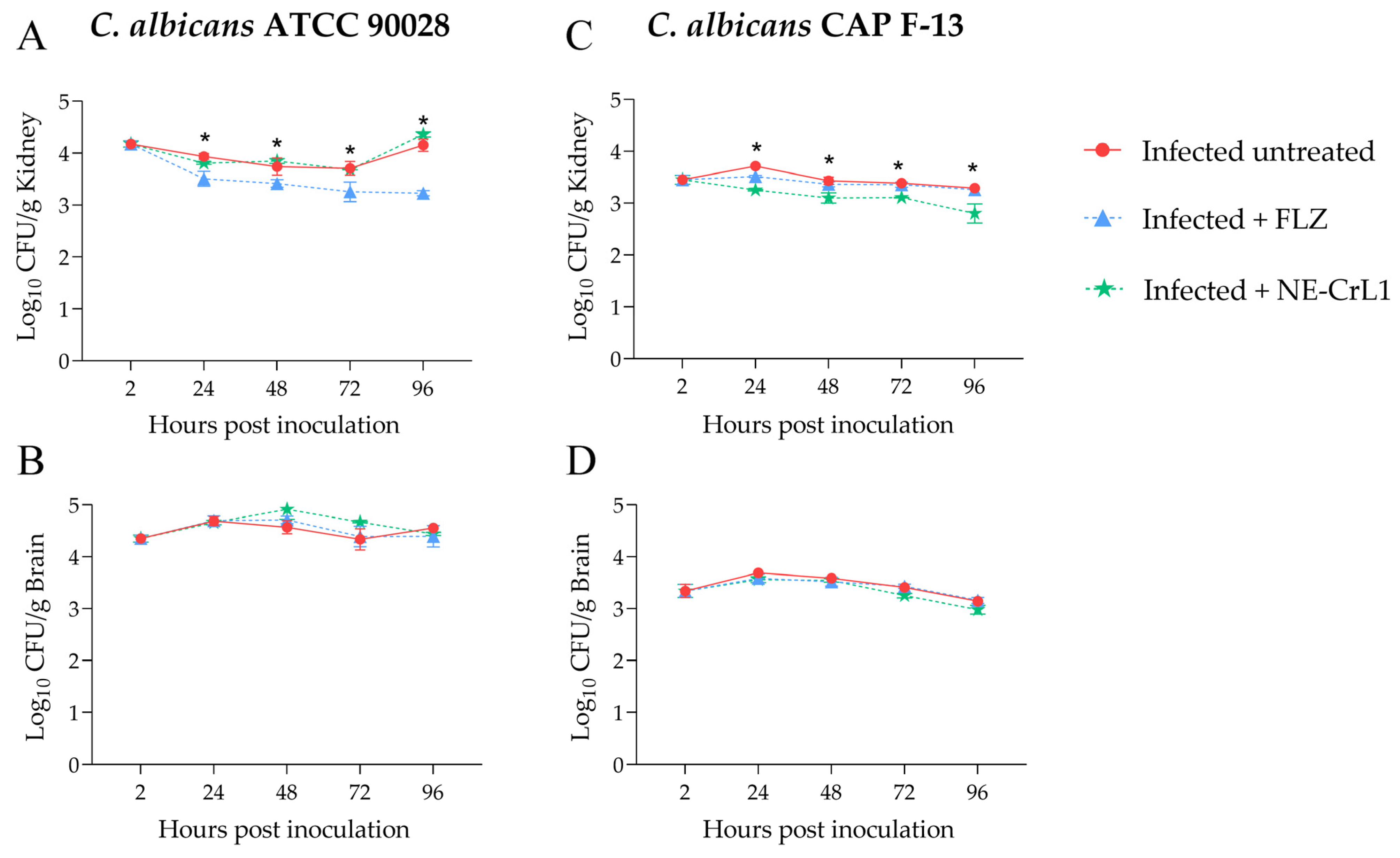
Following formulation, the antifungal activity of NE-CrL1 was evaluated in a murine model of invasive candidiasis. Fungal burden was quantified in renal and brain tissues at multiple time points in mice infected with two distinct C. albicans strains: fluconazole-susceptible (ATCC 90028) and fluconazole-resistant (CAP F-13) (Figure 1). Infection and dissemination by both strains were confirmed by detectable colony-forming unit (CFU) counts in kidney and brain tissue as early as 24 h post-infection. Mice infected with ATCC 90028 exhibited higher fungal burden in both kidney and brain at the evaluated time points compared to those infected with CAP F-13 (Figure 1).
Consistent with the susceptibility profile, mice infected with C. albicans ATCC 90028 and treated with fluconazole (FLZ) showed a reduction in kidney fungal burden from 24 h post-infection onward. Conversely, treatment with NE-CrL1 did not result in a statistically significant change in fungal burden in this strain (Figure 1A).
In contrast, in mice infected with the fluconazole-resistant CAP F-13 strain, kidney fungal burden remained comparable between untreated and FLZ-treated groups. Treatment with NE-CrL1 was associated with a reduction in kidney fungal burden throughout the infection period. Notably, at 96 h post-infection, NE-CrL1-treated mice showed lower fungal burden (2.8 log10 CFU/g tissue) compared to untreated or FLZ-treated infected mice (3.3 log10 CFU/g tissue in both) (Figure 1C). No significant differences in brain fungal burden were observed across experimental groups for either strain (Figure 1B,D).

3.4. NE-CrL1 Was Associated with Attenuation of Histopathological Alterations in a Murine Model of Invasive Candidiasis

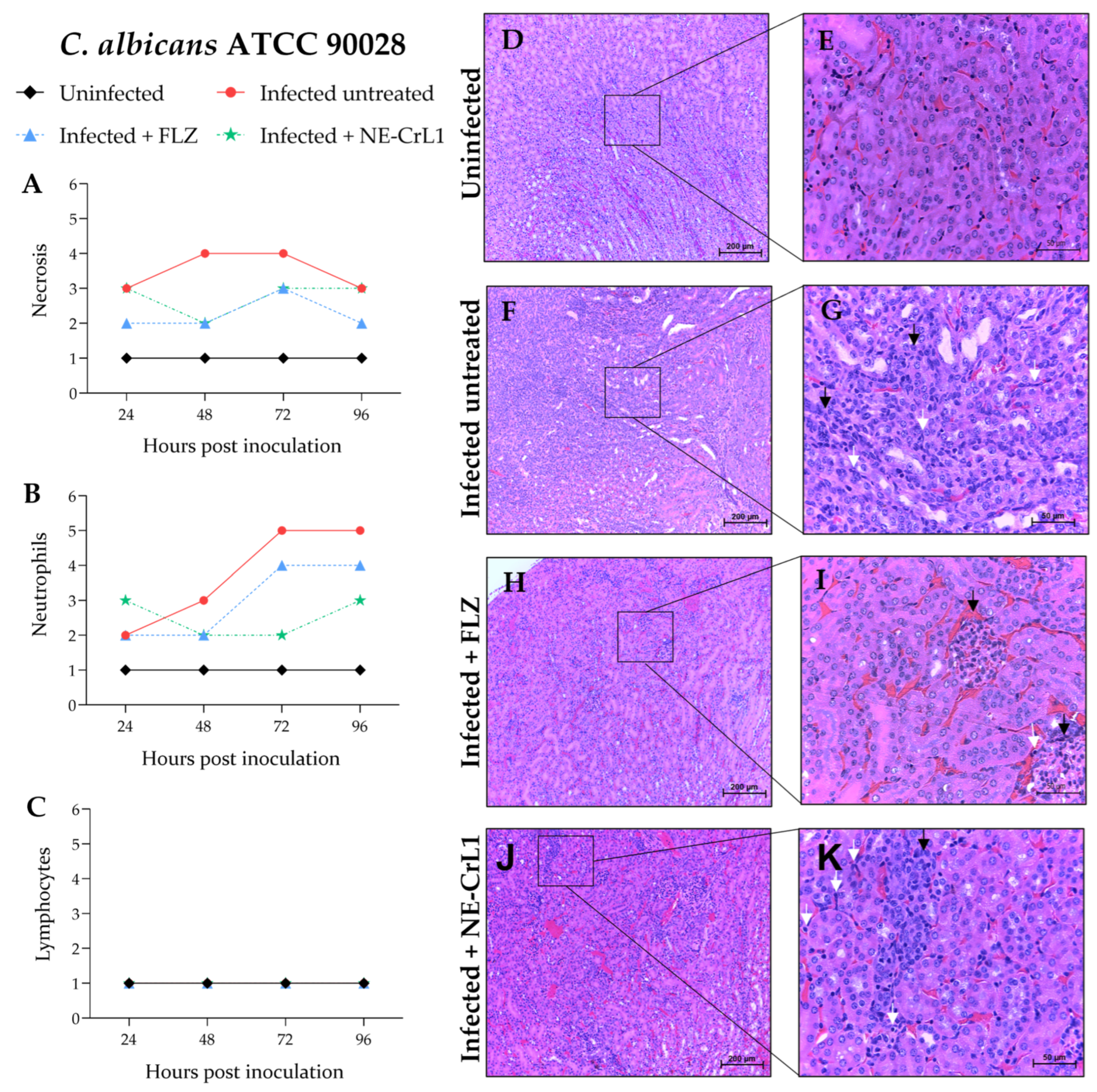
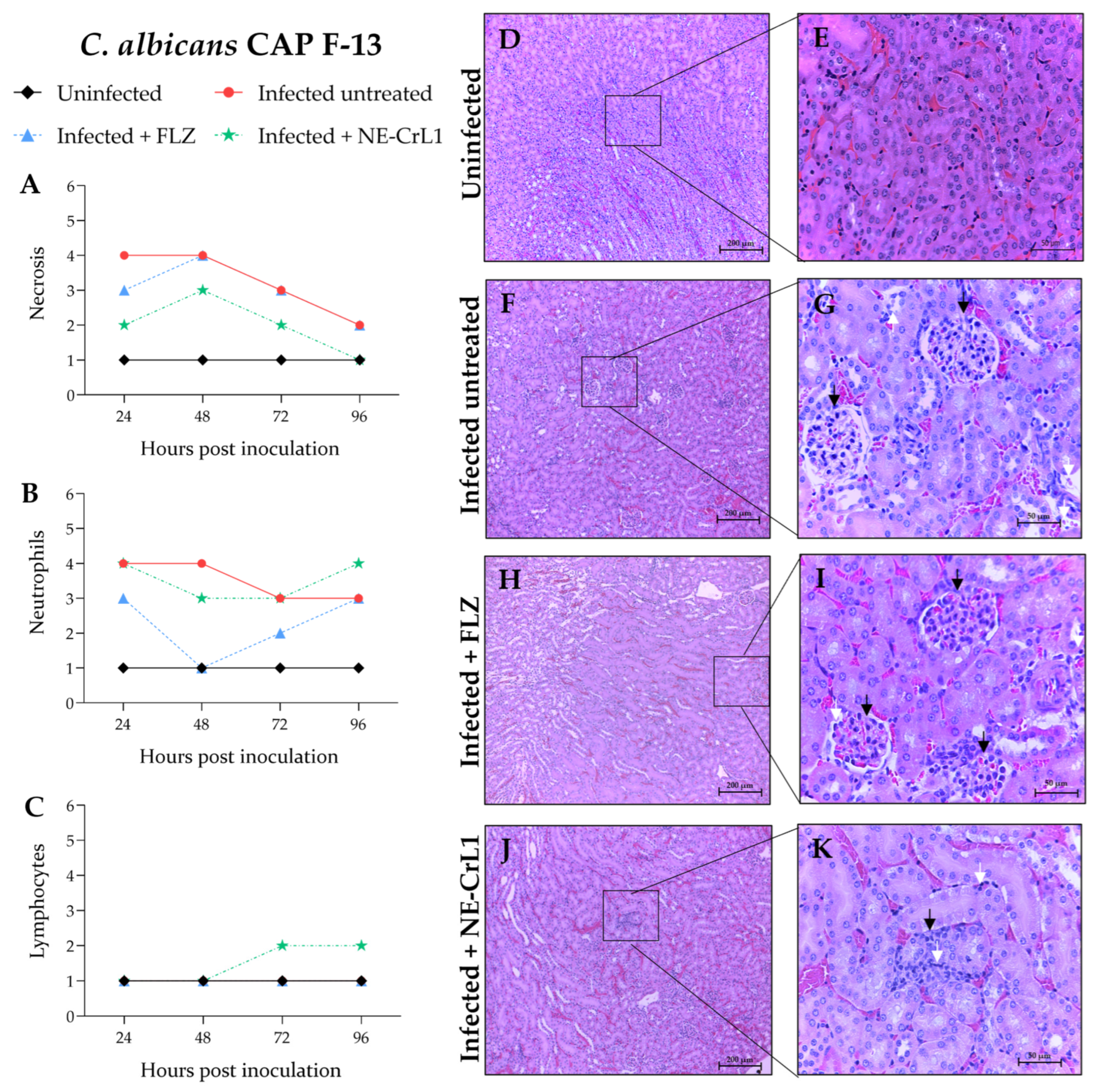
To further assess tissue-level effects, kidney and brain tissues were analyzed histopathologically to evaluate alterations associated with invasive candidiasis and their evolution following NE-CrL1 treatment. In renal tissue, uninfected animals showed preserved parenchymal architecture with no evidence of inflammatory infiltrate (Figure 2D,E). In contrast, untreated infected mice with either strain showed progressive tissue alterations, including increased necrosis and neutrophilic infiltration from 24 h post-infection (Figure 2A,B and Figure 3A,B). The infiltrate showed a predominantly diffuse interstitial pattern in ATCC 90028-infected animals (Figure 2F,G) and a periglomerular pattern with glomerular congestion in CAP F-13-infected animals (Figure 3F,G). Structures morphologically compatible with fungal elements were also observed in infected untreated animals (Figure 2G and Figure 3G; indicated by white arrows).
In ATCC 90028-infected mice, treatment with NE-CrL1 was associated with lower neutrophilic infiltration scores and a trend toward reduced necrosis between 48 and 72 h post-infection (Figure 2A,B). Fluconazole treatment showed a more pronounced reduction in these parameters, consistent with the expected antifungal activity in this susceptible strain (Figure 2A,B,H,I). In CAP F-13-infected mice, fluconazole treatment did not result in consistent attenuation of tissue alterations (Figure 3A,B,H,I). In contrast, treatment with NE-CrL1 was associated with lower necrosis scores and increased lymphocytic infiltration at later time points (Figure 3A–C). Reduced inflammatory infiltrate and relatively better preserved tubular and glomerular architecture were observed compared to untreated and FLZ-treated infected groups (Figure 3J,K).
In brain tissue, NE-CrL1-treated mice showed lower necrosis scores compared to untreated infected mice. However, increased neutrophilic infiltration was also observed in some groups, which may reflect either a protective immune response or an inflammatory process (Figure S2).

3.5. Changes in Cytokine Responses Following NE-CrL1 Treatment in Murine Invasive Candidiasis

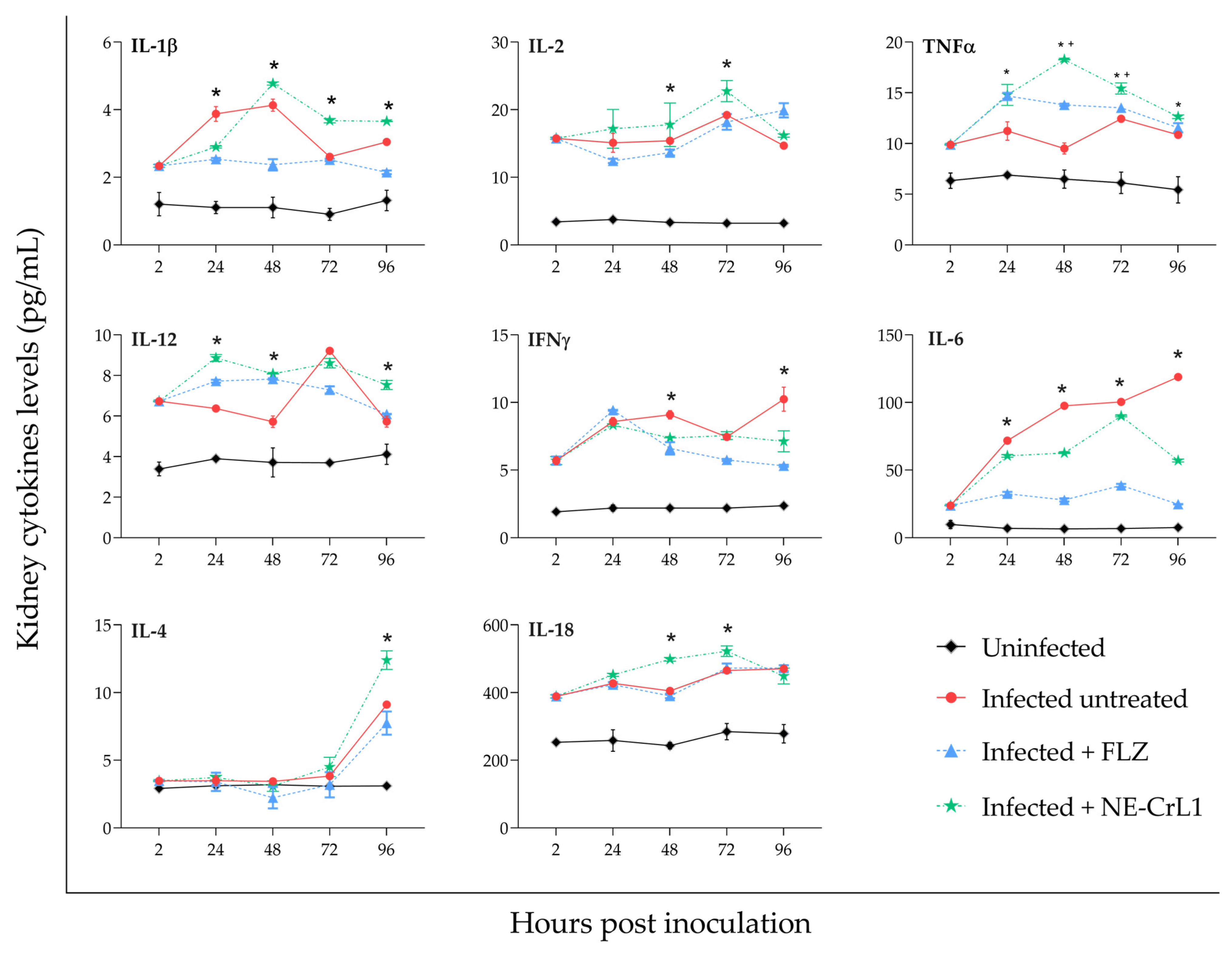
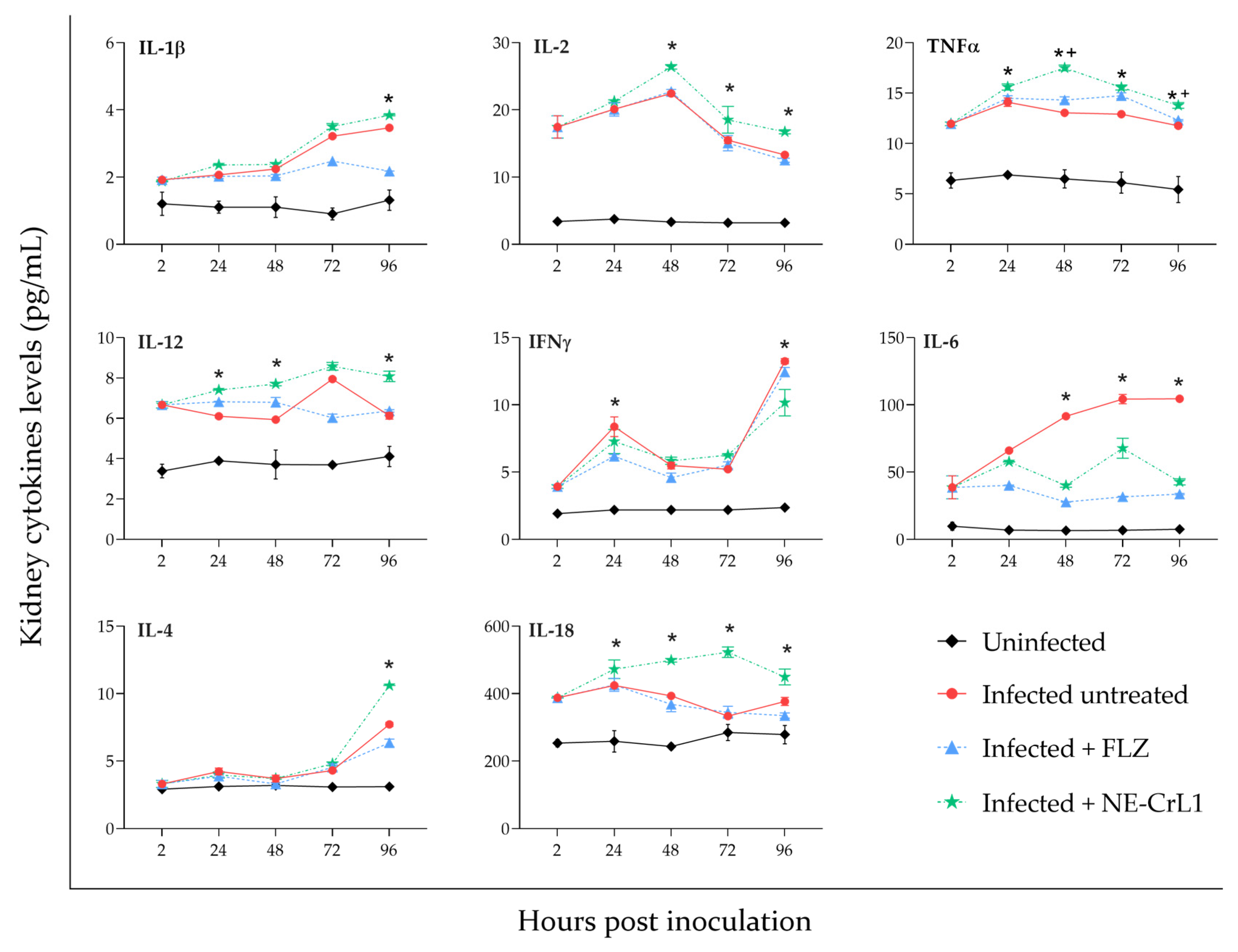
The effect of NE-CrL1 treatment on the local inflammatory response was evaluated by measuring cytokine levels in renal tissue. Elevated levels of pro-inflammatory cytokines including IL-1β, IL-2, TNF-α, IL-12, IFN-γ, IL-6, and IL-18 were detected in infected mice with either strain compared to the uninfected control (Figure 4 and Figure 5). GM-CSF, IL-5, and IL-13 were also quantified but did not show consistent changes across experimental groups and are therefore not shown.
In mice infected with the ATCC 90028 strain, fluconazole treatment was associated with reduced IL-1β and IL-6 levels from 24 h post-infection, together with increased TNF-α and IL-12 (Figure 4). Conversely, in mice infected with the CAP F-13 strain, fluconazole treatment showed limited changes in cytokine levels compared to untreated infected mice.
In contrast, treatment with NE-CrL1 resulted in an increase in IL-1β, IL-2, IL-12, IL-18, and TNF-α in infected groups (with either strain) compared with infected-untreated or FLZ-treated infected groups (Figure 4 and Figure 5). Additionally, a late-stage increase in IL-4 levels was detected in the same groups of mice.

4. Discussion

In this study, treatment with NE-CrL1 was associated with a reduction in renal fungal burden, attenuated histopathological alterations, and changes in inflammatory responses in a murine model of invasive candidiasis caused by a fluconazole-resistant C. albicans strain. These findings provide preliminary evidence of antifungal activity under physiologically relevant conditions and support the continued evaluation of metal-based coordination complexes in animal models.
Metal coordination complexes have attracted increasing interest as antimicrobial candidates. While their antibacterial properties have been extensively investigated, increasing attention has been directed toward their antifungal activity due to the physicochemical characteristics of metal ions and their potential to interact with biological targets through multiple mechanisms, including redox activity, ligand-triggered release, and multimodal interactions with cellular biomolecules [8,13,17]. Various coordination complexes incorporating metal centers such as Ni(II), Co(II), Cu(II), Cr(III) and Zn(II) have demonstrated antifungal activity [18,19,20,21,22,23,24]. Among them, Cr(III)-based complexes have shown activity against different Candida species, including C. albicans, C. tropicalis and C. parapsilosis, with MIC values ranging from 7.81 μg/mL to 125 μg/mL [9]. In addition, Predoi et al. demonstrated that chromium-doped hydroxyapatite nanocomposites inhibit C. albicans biofilm formation [25]. In the present study, CrL1 showed higher activity against the fluconazole-resistant CAP F-13 strain compared to the susceptible isolate, suggesting a possible strain-dependent response. Possible explanations include differences in membrane composition or cellular stress responses, as previously described in Candida [26,27,28,29]. However, these mechanisms were not investigated in the present study. The free triazole ligand did not exhibit detectable antifungal activity against either strain, even at high concentrations. This observation is consistent with previous reports showing that coordination of ligands to metal centers frequently enhances antimicrobial activity relative to the uncoordinated ligands, which has been associated with increased lipophilicity, improved membrane permeability, enhanced chemical stability, and stronger interactions with biological targets [30]. In addition, the CrL1 complex displayed low cytotoxicity in J774 macrophages within the tested concentration range (CC50 > 300 μg/mL), yielding a favorable in vitro selectivity index against the CAP F-13 isolate.
To date, most studies on metal-based coordination complexes remain limited to in vitro evaluations, with relatively few reports addressing their therapeutic potential in animal models of fungal infection [13,31,32]. One of the factors that may contribute to this limitation is the poor aqueous solubility frequently observed in these compounds, which can compromise their bioavailability and pharmacological performance [33]. In this context, nanoemulsion-based systems have been proposed as formulation strategies to improve the dispersion and facilitate the delivery of poorly soluble compounds in biological environments [34,35]. In the present study, the chromium complex CrL1 was incorporated into a nanoemulsion system to enable its in vivo administration. Preliminary physicochemical assessment indicated that the formulation maintained a nanometric size range and physicochemical properties over the evaluated storage period. Nevertheless, further characterization including encapsulation efficiency and drug release profile remains necessary. The Unloaded NE exhibited in vitro antifungal activity only at substantially higher concentrations (MIC = 500 μg/mL), suggesting a limited contribution of the formulation components to the observed effects. Importantly, no direct in vivo comparison between NE-CrL1 and the Unloaded NE was performed, limiting the ability to determine the specific contribution of the formulation to the observed biological effects.
Although studies evaluating metal-based coordination complexes in animal models of fungal infection remain limited, emerging evidence supports their potential in vivo activity. In this context, the reduction in fungal burden and attenuation of tissue alterations observed in the present study are consistent with previous reports. Sovari et al., using a zebrafish model of mixed C. albicans–MRSA infection, demonstrated antimicrobial and immunomodulatory effects of a rhenium complex [36]. Similarly, Rubbiani et al. described a ferrocene-bearing fluconazole derivative that reduced fungal burden and improved inflammatory pathology in a murine model of Candida infection [37]. Together, these findings support the potential of metal-based compounds as candidates for antifungal evaluation in animal models.
In vivo treatment with NE-CrL1 was associated with a reduction in renal fungal burden in mice infected with the fluconazole-resistant C. albicans strain (CAP F-13). In line with these findings, histopathological assessments showed lower necrosis and inflammatory infiltration in treated animals from 24 h post-infection, which may be consistent with attenuation of tissue alterations associated with severe invasive candidiasis [38,39]. Additional observations in brain tissue revealed that NE-CrL1-treated mice showed lower necrosis scores, despite the absence of a clear reduction in fungal burden. Notably, increased neutrophilic infiltration in some groups likely reflects the complex role of neutrophils during invasive candidiasis, which can contribute to both fungal clearance and inflammation-mediated tissue damage [40]. However, these observations should be interpreted cautiously, as histopathological evaluation was performed on a limited number of biological replicates and is presented as a descriptive analysis.
The absence of a significant reduction in brain fungal burden should be considered in this context. The biodistribution of CrL1 and NE-CrL1 was not assessed, and the blood–brain barrier remains a known limitation for the central nervous system exposure of both established and novel antifungal compounds [41]. Further studies are required to evaluate whether the formulation reaches effective concentrations in the brain.
In addition to the effects observed on fungal burden and tissue pathology, NE-CrL1-treated CAP F-13-infected mice showed increased levels of several pro-inflammatory cytokines, including IL-1β, IL-2, IL-12, IL-18 and TNF-α, together with histological evidence of lymphocytic infiltration in renal tissue. These cytokines are known to play key roles in antifungal immunity, contributing to the activation of innate immune responses and the orchestration of adaptive immunity during Candida infections. For instance, IL-1β and TNF-α are associated with early inflammatory responses and neutrophil recruitment, whereas IL-12 and IL-18 are involved in the activation of Th1-type responses, which are critical for fungal clearance. In this context, the cytokine profile observed in the present study suggests an immunologically active microenvironment, though sustained elevation of pro-inflammatory cytokines may also contribute to inflammation-mediated tissue damage during invasive candidiasis [40]. Whether this response reflects a protective or a detrimental effect, and whether it directly contributed to infection control, cannot be established from the present data. While metal-containing nanomaterials and related systems have been reported to modulate immune responses [42,43], it remains unclear whether the observed cytokine changes were directly induced by the compound or formulation, or occurred secondary to reduced fungal burden. Therefore, further studies are required to elucidate the mechanisms underlying these immunomodulatory effects.
Several limitations should be considered when interpreting these findings. The antifungal activity was evaluated against a single fluconazole-resistant clinical isolate (CAP F-13), and therefore the observed effects cannot be generalized to other resistant strains. The mechanistic basis of the observed antifungal and immunomodulatory effects was not experimentally investigated. In addition, the physicochemical characterization of the nanoemulsion remains preliminary, as encapsulation efficiency and drug release profiles were not assessed. No direct in vivo comparison between NE-CrL1 and the free CrL1 compound was performed, which limits conclusions regarding the specific contribution of the formulation. Finally, histopathological analyses were based on a limited number of biological replicates and are presented as descriptive observations.

5. Conclusions

This study provides preliminary evidence that NE-CrL1 exhibits antifungal activity in a murine model of invasive candidiasis caused by a fluconazole-resistant C. albicans strain. Treatment with NE-CrL1 reduced renal fungal burden and was associated with attenuation of histopathological features, together with changes in local inflammatory responses.
These observations support continued evaluation of CrL1 using nanoemulsion-based systems in antifungal studies against drug-resistant Candida infections. Nonetheless, clarification of the underlying mechanisms and comprehensive pharmacological characterization, including pharmacokinetics, safety, and dosing optimization, remain necessary before considering any potential translational application.

Supplementary Materials

The following supporting information can be downloaded at https://www.mdpi.com/article/10.3390/jof12060403/s1: Table S1: Colloidal characterization of nanoemulsions; Figure S1: Structural representations of triazole ligands (L1–L3) and their chromium(III) coordination complexes (CrL1–CrL3); Figure S2: Semi-quantitative histopathological scoring of brain lesions in mice infected with C. albicans.

Author Contributions

Conceptualization, M.V.R.-C., S.M.L.-P., J.J.H. and T.W.N.; Formal analysis, M.V.B.-F., J.D.P.-A. and T.W.N.; Funding acquisition, M.V.R.-C., S.M.L.-P., J.J.H. and T.W.N.; Methodology, M.V.B.-F., R.A.M.-G., J.D.P.-A. and Y.A.-R.; Project administration, S.M.L.-P.; Supervision, S.M.L.-P. and T.W.N.; Visualization, M.V.B.-F. and J.D.P.-A.; Writing—original draft, M.V.B.-F. and J.D.P.-A.; Writing—review and editing, M.V.B.-F., M.V.R.-C., S.M.L.-P., J.D.P.-A., J.J.H. and T.W.N. All authors have read and agreed to the published version of the manuscript.

Funding

This research was funded by the Ministry of Science, Technology and Innovation of Colombia (Minciencias), Contract No. 761-2018—Code N° 129980763078. The APC was funded by the Corporación para Investigaciones Biológicas-CIB (Medellín, Colombia) and Universidad de Santander (Bucaramanga-Colombia).

Institutional Review Board Statement

The animal study protocol was approved by the Institutional Review Board (Comité de Bioética de la Universidad de Santander) under protocol code Acta No. 009-CBU (approval date: 3 May 2018).

Data Availability Statement

The original contributions presented in this study are included in the article/Supplementary Material. Further inquiries can be directed to the corresponding authors.

Acknowledgments

The authors thank the Ministry of Science, Technology and Innovation of Colombia (Minciencias) for financial support through the above-mentioned project. J.J.H. would like to thank Universidad de los Andes and the Chemistry Department for providing funding project INV-2025-213-3347.

Conflicts of Interest

The authors declare no conflicts of interest. The funders had no role in the design of the study; in the collection, analyses, or interpretation of data; in the writing of the manuscript; or in the decision to publish the results.

Abbreviations

The following abbreviations are used in this manuscript:
ATCCAmerican Type Culture Collection
BCABicinchoninic Acid
CC50Half-maximal Cytotoxic Concentration
CFUColony-Forming Unit
CLSIClinical and Laboratory Standards Institute
CrL1, CrL2, CrL3Chromium(III) coordination complexes with triazole ligands 1, 2, 3
CrCl3·6H2OChromium(III) chloride hexahydrate
DhHydrodynamic Diameter
DLSDynamic Light Scattering
DMEMDulbecco’s Modified Eagle Medium
DMSODimethyl Sulfoxide
ELSElectrophoretic Light Scattering
FLZFluconazole
GM-CSFGranulocyte Macrophage Colony Stimulating Factor
H&EHematoxylin and Eosin
ICInvasive Candidiasis
IFIInvasive Fungal Infection
IFN-γInterferon Gamma
ILInterleukin
MFCMinimal Fungicidal Concentration
MICMinimal Inhibitory Concentration
NENanoemulsion
NE-CrL1CrL1-loaded Nanoemulsion
PBSPhosphate-Buffered Saline
PDIPolydispersity Index
ROSReactive Oxygen Species
RPMIRoswell Park Memorial Institute medium
SDStandard Deviation
SISelectivity Index
TNF-αTumor Necrosis Factor Alpha
Unloaded NECrL1-free Nanoemulsion
ZPZeta Potential

References

  1. Kainz, K.; Bauer, M.A.; Madeo, F.; Carmona-Gutierrez, D. Fungal infections in humans: The silent crisis. Microb. Cell 2020, 7, 143–145. [Google Scholar] [CrossRef]
  2. Papon, N.; Courdavault, V.; Clastre, M.; Bennett, R.J. Emerging and Emerged Pathogenic Candida Species: Beyond the Candida albicans Paradigm. PLoS Pathog. 2013, 9, e1003550. [Google Scholar] [CrossRef] [PubMed]
  3. Macias-Paz, I.U.; Pérez-Hernández, S.; Tavera-Tapia, A.; Luna-Arias, J.P.; Guerra-Cárdenas, J.E.; Reyna-Beltrán, E. Candida albicans the main opportunistic pathogenic fungus in humans. Rev. Argent. Microbiol. 2022, 55, 189–198. [Google Scholar] [CrossRef] [PubMed]
  4. Kullberg, B.J.; Arendrup, M.C. Invasive candidiasis. N. Engl. J. Med. 2015, 373, 1445–1456. [Google Scholar] [CrossRef] [PubMed]
  5. Cornely, O.A.; Sprute, R.; Bassetti, M.; Chen, S.C.-A.; Groll, A.H.; Kurzai, O.; Lass-Flörl, C.; Ostrosky-Zeichner, L.; Rautemaa-Richardson, R.; Revathi, G.; et al. Global guideline for the diagnosis and management of candidiasis: An initiative of the ECMM in cooperation with ISHAM and ASM. Lancet Infect. Dis. 2025, 25, e280–e293. [Google Scholar] [CrossRef]
  6. Santos, G.C.d.O.; Vasconcelos, C.C.; Lopes, A.J.O.; Cartágenes, M.d.S.d.S.; Filho, A.K.D.B.; do Nascimento, F.R.F.; Ramos, R.M.; Pires, E.R.R.B.; de Andrade, M.S.; Rocha, F.M.G.; et al. Candida infections and therapeutic strategies: Mechanisms of action for traditional and alternative agents. Front. Microbiol. 2018, 9, 1351. [Google Scholar] [CrossRef]
  7. Bouz, G.; Doležal, M. Advances in antifungal drug development: An up-to-date mini review. Pharmaceuticals 2021, 14, 1312. [Google Scholar] [CrossRef]
  8. Frei, A.; Zuegg, J.; Elliott, A.G.; Baker, M.; Braese, S.; Brown, C.; Chen, F.; Dowson, C.G.; Dujardin, G.; Jung, N.; et al. Metal complexes as a promising source for new antibiotics. Chem. Sci. 2020, 11, 2627–2639. [Google Scholar] [CrossRef]
  9. Murcia, R.A.; Leal, S.M.; Roa, M.V.; Nagles, E.; Muñoz-Castro, A.; Hurtado, J.J. Development of antibacterial and antifungal triazole chromium(III) and cobalt(II) complexes: Synthesis and biological activity evaluations. Molecules 2018, 23, 2013. [Google Scholar] [CrossRef]
  10. Chohan, Z.H.; Arif, M.; Akhtar, M.A.; Supuran, C.T. Metal-based antibacterial and antifungal agents: Synthesis, characterization, and in vitro biological evaluation of Co(II), Cu(II), Ni(II), and Zn(II) complexes with amino acid-derived compounds. Bioinorg. Chem. Appl. 2006, 2006, 83131. [Google Scholar] [CrossRef]
  11. Murcia-Galán, R.A.; Durán, S.M.; Leal-Pinto, S.M.; Roa-Cordero, M.V.; Vargas, J.D.; Herrera, L.V.; Muñoz-Castro, A.; MacLeod-Carey, D.; Naranjo, T.W.; Rodríguez-Kessler, P.L.; et al. Antifungal activity of Co(II) and Cu(II) complexes containing 1,3-bis(benzotriazol-1-yl)-propan-2-ol on the growth and virulence traits of fluconazole-resistant Candida species: Synthesis, DFT calculations, and biological activity. BMC Chem. 2023, 17, 135. [Google Scholar] [CrossRef]
  12. Vlasiou, M.C.; Pafiti, K.S. Chromium coordination compounds with antimicrobial activity: Synthetic routes, structural characteristics, and antibacterial activity. Open Med. Chem. J. 2020, 14, 1–25. [Google Scholar] [CrossRef]
  13. Lin, Y.; Betts, H.; Keller, S.; Cariou, K.; Gasser, G. Recent developments of metal-based compounds against fungal pathogens. Chem. Soc. Rev. 2021, 50, 10346–10402. [Google Scholar] [CrossRef]
  14. CLSI. M27: Reference Method for Broth Dilution Antifungal Susceptibility Testing of Yeasts, 4th ed.; Clinical and Laboratory Standards Institute: Wayne, PA, USA, 2017. [Google Scholar]
  15. Sugumar, S.; Singh, S.; Mukherjee, A.; Chandrasekaran, N. Nanoemulsion of orange oil with non ionic surfactant produced emulsion using ultrasonication technique: Evaluating against food spoilage yeast. Appl. Nanosci. 2016, 6, 113–120. [Google Scholar] [CrossRef]
  16. National Institute of Allergy and Infectious Diseases (NIAID). Standard Operating Procedure (SOP): Candida albicans Murine Invasive Candidiasis Model; NIH/NIAID Contract No. HHSN272201000038I, Task Order A13, Version 1.0. Available online: https://www.niaid.nih.gov/sites/default/files/sop-murine-model-candida-albicans.pdf (accessed on 1 February 2022).
  17. Frei, A.; Elliott, A.G.; Kan, A.; Dinh, H.; Bräse, S.; Bruce, A.E.; Bruce, M.R.; Chen, F.; Humaidy, D.; Jung, N.; et al. Metal complexes as antifungals? From a crowd-sourced compound library to the first in vivo experiments. JACS Au 2022, 2, 2277–2294. [Google Scholar] [CrossRef]
  18. Vinay Kumar, B.; Bhojya Naik, H.S.; Girija, D.; Sharath, N.; Pradeepa, S.M.; Joy Hoskeri, H.; Prabhakara, M. Synthesis, DNA-binding, DNA-photonuclease profiling and antimicrobial activity of novel tetra-aza macrocyclic Ni(II), Co(II) and Cu(II) complexes constrained by thiadiazole. Spectrochim. Acta A Mol. Biomol. Spectrosc. 2012, 94, 192–199. [Google Scholar] [CrossRef] [PubMed]
  19. Stevanović, N.L.; Aleksic, I.; Kljun, J.; Bogojevic, S.S.; Veselinovic, A.; Nikodinovic-Runic, J.; Turel, I.; Djuran, M.I.; Glišić, B.Đ. Copper(II) and zinc(II) complexes with the clinically used fluconazole: Comparison of antifungal activity and therapeutic potential. Pharmaceuticals 2021, 14, 24. [Google Scholar] [CrossRef]
  20. Frei, A.; King, A.P.; Lowe, G.J.; Cain, A.K.; Short, F.L.; Dinh, H.; Elliott, A.G.; Zuegg, J.; Wilson, J.J.; Blaskovich, M.A.T. Nontoxic cobalt(III) Schiff base complexes with broad-spectrum antifungal activity. Chem. Eur. J. 2021, 27, 2021–2029. [Google Scholar] [CrossRef]
  21. Murcia-Galán, R.A.; Leal-Pinto, S.M.; Portilla-Rodríguez, J.A.; Muñoz-Castro, A.; MacLeod-Carey, D.; Macías, M.A.; Hurtado, J.J. Evaluation of anti-Candida effect of Co(II) and Cu(II) complexes by variation of coordinating environment. Synthesis and characterization of modifying of 1,3-bis(1,2,4-triazol-1-yl)-propan-2-ol complexes. J. Mol. Struct. 2025, 1346, 143274. [Google Scholar] [CrossRef]
  22. Radha, V.P.; Jone Kirubavathy, S.; Chitra, S. Synthesis, characterization and biological investigations of novel Schiff base ligands containing imidazoline moiety and their Co(II) and Cu(II) complexes. J. Mol. Struct. 2018, 1165, 246–258. [Google Scholar] [CrossRef]
  23. Apohan, E.; Yilmaz, U.; Yilmaz, O.; Serindag, A.; Küçükbay, H.; Yesilada, O.; Baran, Y. Synthesis, cytotoxic and antimicrobial activities of novel cobalt and zinc complexes of benzimidazole derivatives. J. Organomet. Chem. 2017, 828, 52–58. [Google Scholar] [CrossRef]
  24. Chohan, Z.H.; Hanif, M. Design, synthesis, and biological properties of triazole derived compounds and their transition metal complexes. J. Enzym. Inhib. Med. Chem. 2010, 25, 737–749. [Google Scholar] [CrossRef]
  25. Predoi, D.; Iconaru, S.L.; Ciobanu, S.C.; Ţălu, Ş.; Predoi, S.A.; Buton, N.; Ramos, G.Q.; Filho, H.D.d.F.; Matos, R.S. Synthesis, characterization, and antifungal properties of chrome-doped hydroxyapatite thin films. Mater. Chem. Phys. 2024, 324, 129690. [Google Scholar] [CrossRef]
  26. Pasrija, R.; Prasad, T.; Prasad, R. Membrane raft lipid constituents affect drug susceptibilities of Candida albicans. Biochem. Soc. Trans. 2005, 33, 1219–1223. [Google Scholar] [CrossRef] [PubMed]
  27. Mukhopadhyay, K.; Prasad, T.; Saini, P.; Pucadyil, T.J.; Chattopadhyay, A.; Prasad, R. Membrane sphingolipid-ergosterol interactions are important determinants of multidrug resistance in Candida albicans. Antimicrob. Agents Chemother. 2004, 48, 1778–1787. [Google Scholar] [CrossRef] [PubMed]
  28. Mishra, N.N.; Prasad, T.; Sharma, N.; Prasad, R.; Gupta, D.K. Membrane fluidity and lipid composition in clinical isolates of Candida albicans isolated from AIDS/HIV patients. Acta Microbiol. Immunol. Hung. 2007, 54, 367–377. [Google Scholar] [CrossRef] [PubMed]
  29. Hunsaker, E.W.; Franz, K.J. Candida albicans reprioritizes metal handling during fluconazole stress. Metallomics 2019, 11, 2020. [Google Scholar] [CrossRef]
  30. Sumrra, S.H.; Suleman, A.; Chohan, Z.H.; Zafar, M.N.; Raza, M.A.; Iqbal, T. Triazole metal based complexes as antibacterial/antifungal agents. Russ. J. Gen. Chem. 2017, 87, 1281–1287. [Google Scholar] [CrossRef]
  31. Gandra, R.M.; McCarron, P.; Viganor, L.; Fernandes, M.F.; Kavanagh, K.; McCann, M.; Branquinha, M.H.; Santos, A.L.S.; Howe, O.; Devereux, M. In vivo activity of copper(II), manganese(II), and silver(I) 1,10-phenanthroline chelates against Candida haemulonii using the Galleria mellonella model. Front. Microbiol. 2020, 11, 514655. [Google Scholar] [CrossRef]
  32. Granato, M.Q.; Mello, T.P.; Nascimento, R.S.; Pereira, M.D.; Rosa, T.L.S.A.; Pessolani, M.C.V.; McCann, M.; Devereux, M.; Branquinha, M.H.; Santos, A.L.S.; et al. Silver(I) and copper(II) complexes of 1,10-phenanthroline-5,6-dione against Phialophora verrucosa: A focus on the interaction with human macrophages and Galleria mellonella larvae. Front. Microbiol. 2021, 12, 641258. [Google Scholar] [CrossRef]
  33. Xie, B.; Liu, Y.; Li, X.; Yang, P.; He, W. Solubilization techniques used for poorly water-soluble drugs. Acta Pharm. Sin. B 2024, 14, 4683–4716. [Google Scholar] [CrossRef] [PubMed]
  34. Wilson, R.J.; Li, Y.; Yang, G.; Zhao, C.X. Nanoemulsions for drug delivery. Particuology 2022, 64, 85–97. [Google Scholar] [CrossRef]
  35. Liu, Q.; Huang, H.; Chen, H.; Lin, J.; Wang, Q. Food-grade nanoemulsions: Preparation, stability and application in encapsulation of bioactive compounds. Molecules 2019, 24, 4242. [Google Scholar] [CrossRef]
  36. Sovari, S.N.; Radakovic, N.; Roch, P.; Crochet, A.; Pavic, A.; Zobi, F. Combatting AMR: A molecular approach to the discovery of potent and non-toxic rhenium complexes active against Candida albicans-MRSA co-infection. Eur. J. Med. Chem. 2021, 226, 113858. [Google Scholar] [CrossRef]
  37. Rubbiani, R.; Weil, T.; Tocci, N.; Mastrobuoni, L.; Jeger, S.; Moretto, M.; Ng, J.; Lin, Y.; Hess, J.; Ferrari, S.; et al. In vivo active organometallic-containing antimycotic agents. RSC Chem. Biol. 2021, 2, 1263–1273. [Google Scholar] [CrossRef]
  38. Lionakis, M.S.; Fischer, B.G.; Lim, J.K.; Swamydas, M.; Wan, W.; Lee, C.C.R.; Cohen, J.I.; Scheinberg, P.; Gao, J.L.; Murphy, P.M. Chemokine receptor Ccr1 drives neutrophil-mediated kidney immunopathology and mortality in invasive candidiasis. PLoS Pathog. 2012, 8, e1002865. [Google Scholar] [CrossRef]
  39. Zhang, G.; Wang, J.; Zhao, Z.; Xin, T.; Fan, X.; Shen, Q.; Raheem, A.; Lee, C.R.; Jiang, H.; Ding, J. Regulated necrosis, a proinflammatory cell death, potentially counteracts pathogenic infections. Cell Death Dis. 2022, 13, 637. [Google Scholar] [CrossRef]
  40. Lionakis, M.S.; Lim, J.K.; Lee, C.C.R.; Murphy, P.M. Organ-specific innate immune responses in a mouse model of invasive candidiasis. J. Innate Immun. 2011, 3, 180–199. [Google Scholar] [CrossRef] [PubMed]
  41. Wirth, F.; Ishida, K. Antifungal drugs: An updated review of central nervous system pharmacokinetics. Mycoses 2020, 63, 1047–1059. [Google Scholar] [CrossRef]
  42. Barik, P.; Mondal, S. Immunomodulatory effects of metal nanoparticles: Current trends and future prospects. Nanoscale 2025, 17, 10433–10461. [Google Scholar] [CrossRef] [PubMed]
  43. Luo, Y.H.; Chang, L.W.; Lin, P. Metal-based nanoparticles and the immune system: Activation, inflammation, and potential applications. BioMed. Res. Int. 2015, 2015, 143720. [Google Scholar] [CrossRef] [PubMed]
Figure 1. Fungal burden in kidney and brain tissue of infected mice. (A,B) Fluconazole-susceptible strain (ATCC 90028); (C,D) Fluconazole-resistant strain (CAP F-13). Colony-forming units (CFUs) were quantified per gram of tissue at multiple time points. * p < 0.05: vs. infected untreated mice.
Jof 12 00403 g001
Figure 2. Semi-quantitative histopathological scoring of renal lesions in mice infected with C. albicans ATCC 90028 (fluconazole-susceptible strain). Kidney was evaluated for (A) necrosis, (B) neutrophil infiltration, and (C) lymphoid infiltration. (DK). Each parameter was graded on a severity scale from 1 (no lesion) to 6 (severe lesion). Representative H&E-stained kidney sections at 96 h post-infection: uninfected (D,E), infected untreated (F,G), infected + FLZ (H,I), and infected + NE-CrL1 (J,K). Magnification 10× (D,F,H,J) and 40× (E,G,I,K); 40× images correspond to boxed areas at 10×. Uninfected control panels (D,E) are shared with Figure 3. Black arrows indicate neutrophilic infiltrates; white arrows indicate fungal structures.
Jof 12 00403 g002
Figure 3. Semi-quantitative histopathological scoring of renal lesions in mice infected with C. albicans CAP F-13 (fluconazole-resistant strain). Kidney was evaluated for (A) necrosis, (B) neutrophil infiltration, and (C) lymphoid infiltration. (DK). Each parameter was graded on a severity scale from 1 (no lesion) to 6 (severe lesion). Representative H&E-stained kidney sections at 96 h post-infection: uninfected (D,E), infected untreated (F,G), infected + FLZ (H,I), and infected + NE-CrL1 (J,K). Magnification 10× (D,F,H,J) and 40× (E,G,I,K); 40× images correspond to boxed areas at 10×. Uninfected control panels (D,E) are shared with Figure 2. Black arrows indicate neutrophilic infiltrates; white arrows indicate fungal structures.
Jof 12 00403 g003
Figure 4. Cytokine levels in renal tissue of mice infected with fluconazole-susceptible C. albicans (ATCC 90028). Measurements were performed in kidney tissue from mice uninfected or untreated, FLZ-treated or NE-CrL1-treated infected mice at multiple time points. * p < 0.05: vs. infected untreated mice; + p < 0.05: vs. uninfected group.
Jof 12 00403 g004
Figure 5. Cytokine levels in renal tissue of mice infected with fluconazole-resistant C. albicans (CAP F-13). Measurements were performed in kidney tissue from mice uninfected or untreated, FLZ-treated or NE-CrL1-treated infected mice at multiple time points. * p < 0.05: vs. infected untreated mice; + p < 0.05: vs. uninfected group.
Jof 12 00403 g005
Table 1. Antifungal and cytotoxic activity of chromium(III) complexes, their corresponding triazole ligands, nanoemulsion formulation and reference antifungal drugs.
CompoundsC. albicansMammalian Cells
ATCC 90028CAP F-13J774A.1
MIC 1MFC 2MIC 1MFC 2CC50 ± SD 3
L1>1000>1000>1000>1000>300
L2>1000>1000>1000>1000>300
L3>1000>1000>1000>1000>300
CrL1125>100015.5500>300
CrL2>1000>1000125>1000233.52 ± 13.75
CrL3>1000>100031.25500103.32 ± 10.24
CrCl3·6H2O62.2512531.25250294.44 ± 5.10
NE 4-CrL1125>100031.25500>300
Unloaded NE500>1000500>1000>300
Fluconazole0.25>64>64>64>300
Itraconazole0.03160.5>16>300
1 Minimum inhibitory concentrations (µg/mL). 2 Minimum fungicidal concentrations (µg/mL). 3 Half-maximal cytotoxic concentrations ± standard deviation (µg/mL). 4 Nanoemulsion.
Disclaimer/Publisher’s Note: The statements, opinions and data contained in all publications are solely those of the individual author(s) and contributor(s) and not of MDPI and/or the editor(s). MDPI and/or the editor(s) disclaim responsibility for any injury to people or property resulting from any ideas, methods, instructions or products referred to in the content.