
Taxonomy and Phylogeny of Stipitate Stereoid Basidiomycetes from China


Abstract
1. Introduction
2. Materials and Methods
2.1. Specimen Collection and Morphological Studies
2.2. Molecular Analysis
2.2.1. DNA Extraction and PCR
2.2.2. Sequencing and Sequence Assembly
2.3. Phylogenetic Analyses
2.4. Genetic Distance Analysis and Species Delimitation Method
3. Results
3.1. Molecular Phylogeny
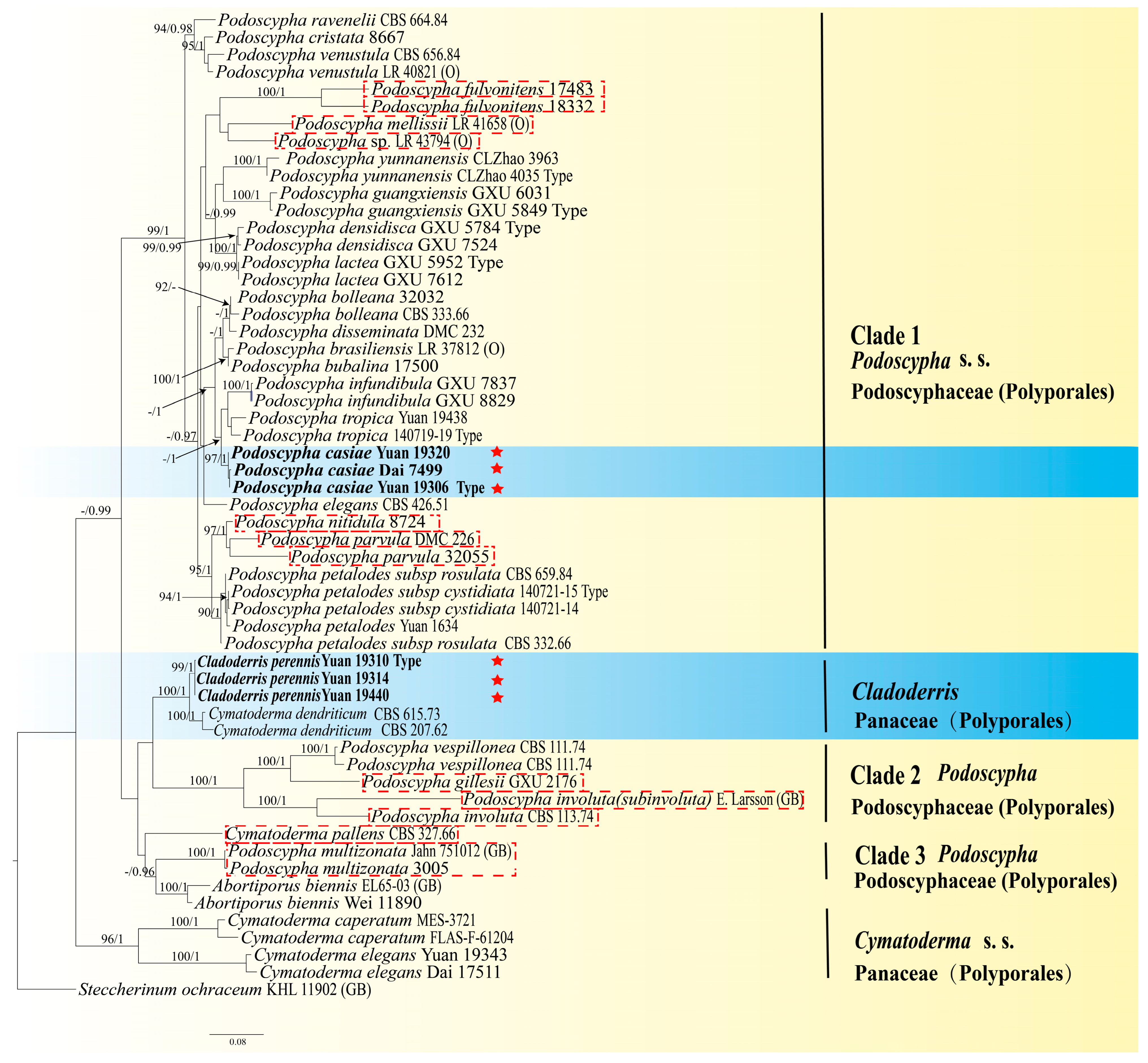
3.1.1. Podoscypha, Cymatoderma and Cladoderris
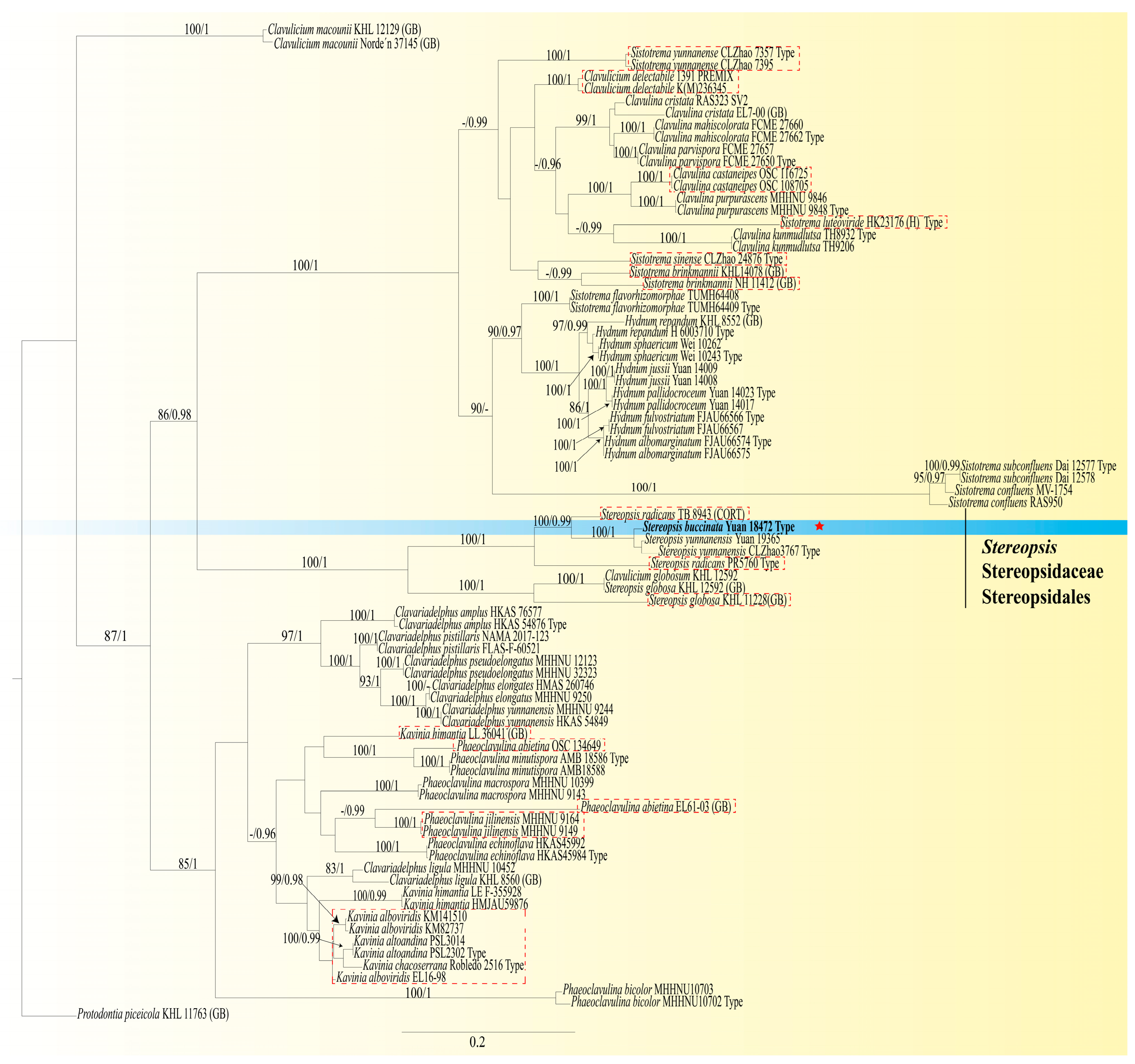
3.1.2. Stereopsis
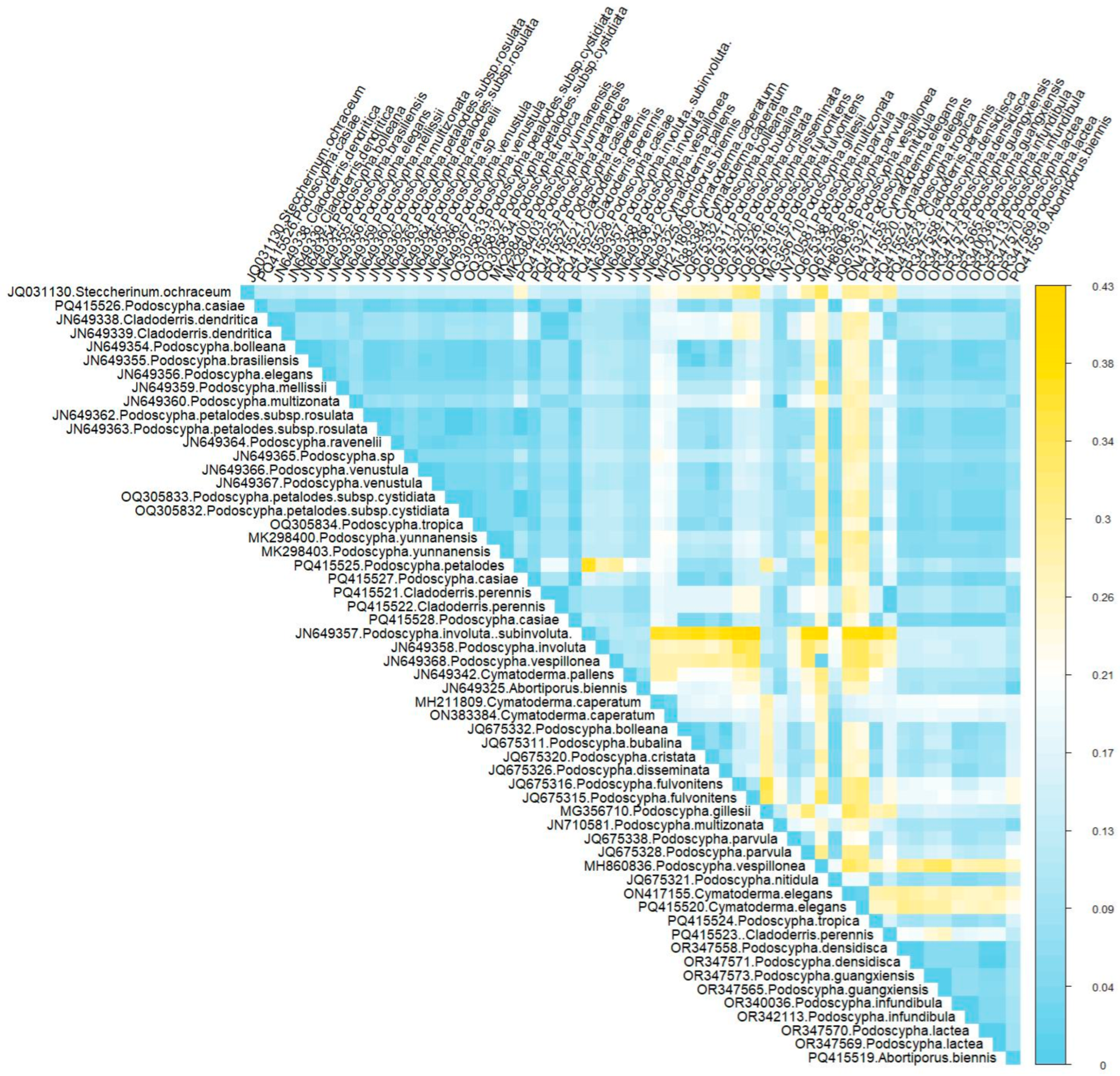
3.2. Genetic Distance Analysis
3.3. Taxonomy
3.3.1. Delimitation of the Genera
3.3.2. Resurrected Genus
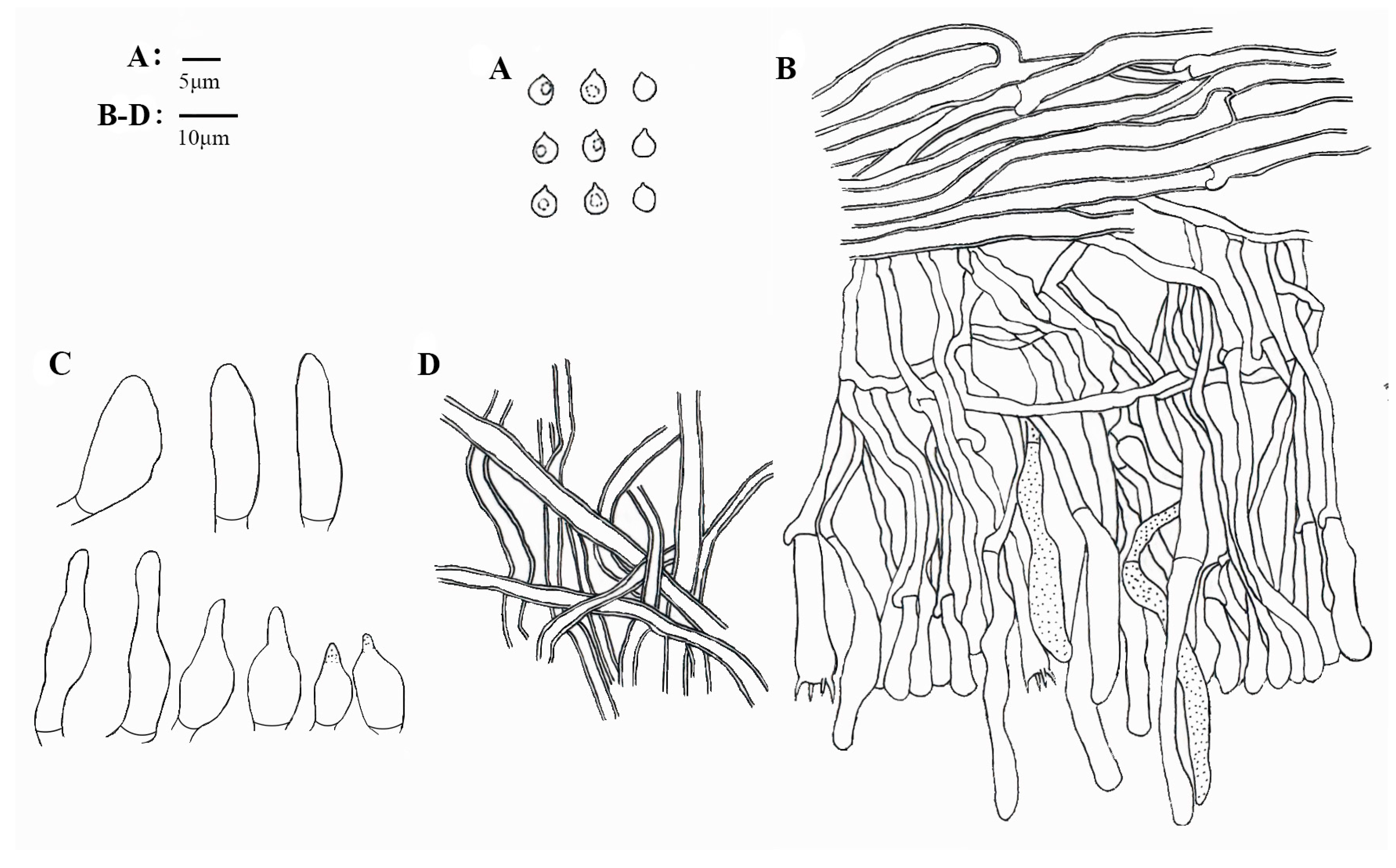
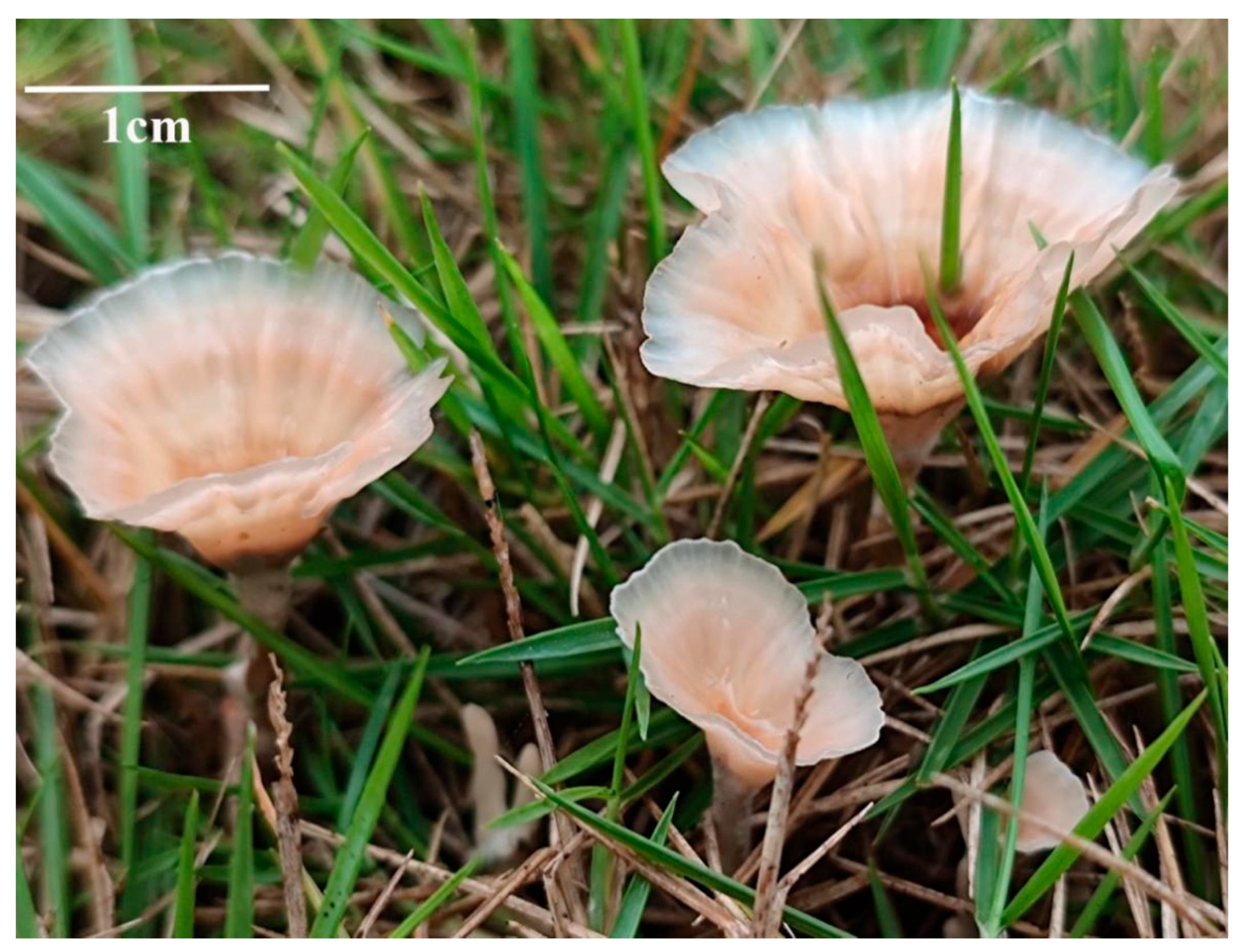
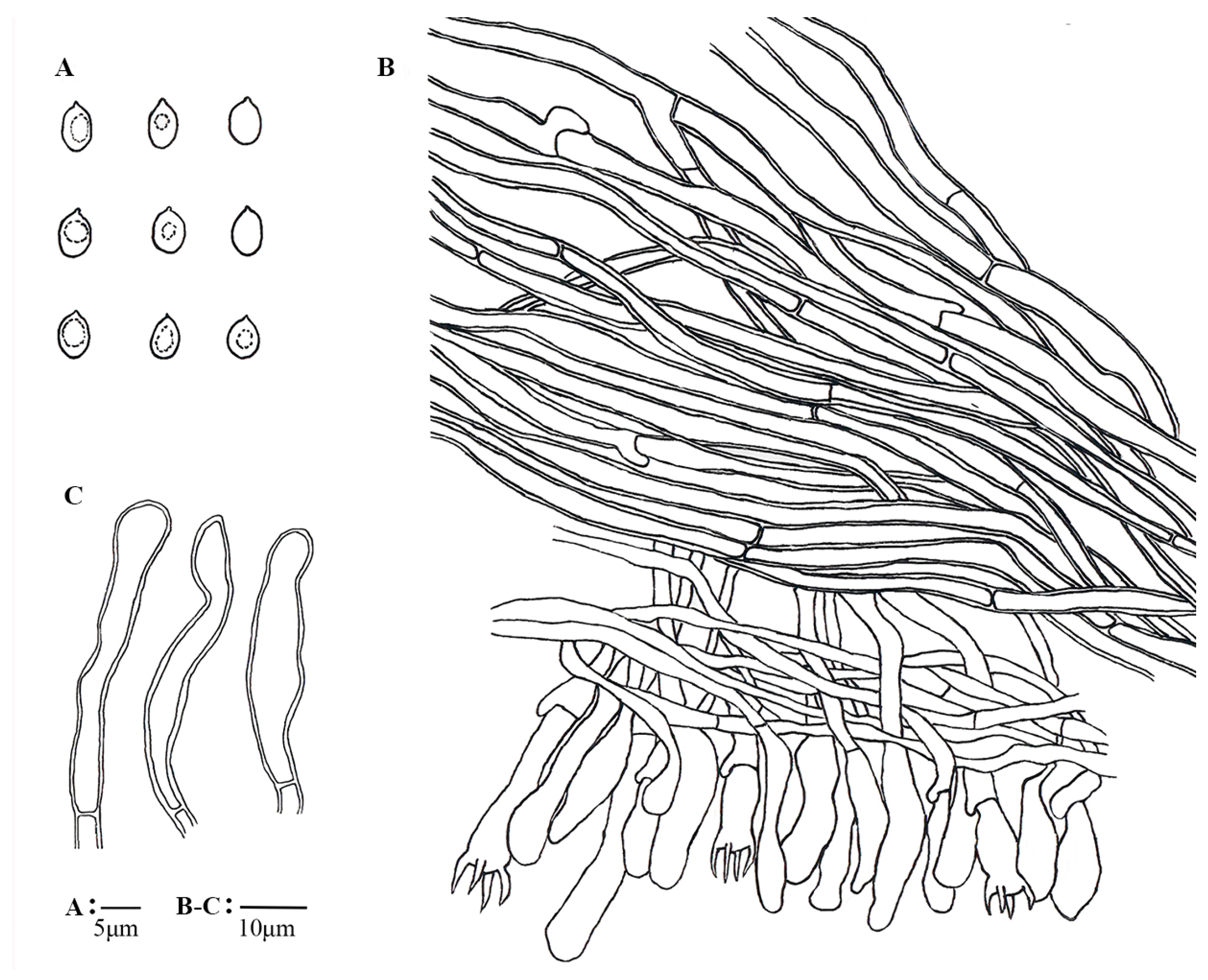
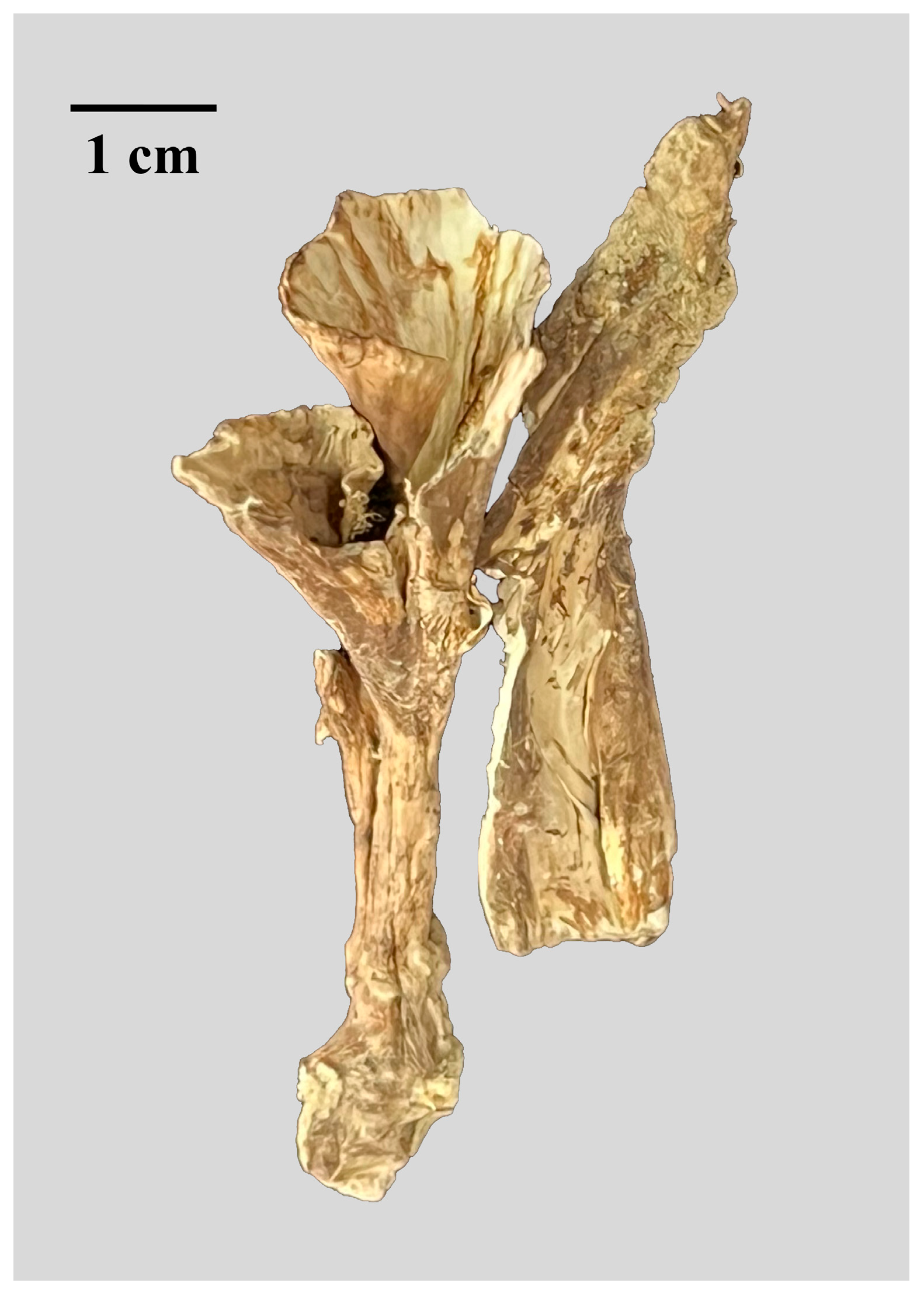
3.3.3. New Taxa
4. Discussion
- Keys to the accepted species of Podoscypha, Cymatoderma, Stereopsis and Cladoderris worldwide.
| A key to accepted species of Podoscypha |
| 1. Basidiome sessile or without a distinct stipe···································································2 |
| 1. Basidiome with a distinct stipe·························································································7 |
| 2. Basidiome effused and reflexed························································································3 |
| 2. Stipe short and rudimentary·····························································································4 |
| 3. Pileocystidia present but scattered·················································Podoscypha caespitosa |
| 3. Pileocystidia absent·················································································P. semiresupinata |
| 4. Pilei surface with radial wrinkles·····················································································5 |
| 4. Pilei surface with zones·····································································································6 |
| 5. Basidia with 4 sterigmate, 43.5 × 5.5 μm···························································P. aculeata |
| 5. Basidia with 2 or 4 sterigmate, 18–26 × 4–6 μm·········································P. multizonata |
| 6. Hymenial surface ochraceous buff in herbarium material·······························P. corneri |
| 6. Hymenial surface brownish in herbarium material··········································P. gillesii |
| 7. Basidiome infundibuliform or pseudoinfundibuliform················································8 |
| 7. Basidiome flabellate, spathulate, or (pseudo)infundibuliform···································19 |
| 8. Pileus surface tomentose···································································································9 |
| 8. Pileus surface smooth······································································································10 |
| 9. Stipe dark brown in herbarium material, with a hyphal disc··················P. infundibula |
| 9. Stipe yellowish-to-pale brown in herbarium material, smooth························P. ursina |
| 10. Hymenial surface tomentose···············································································P. casiae |
| 10. Hymenial surface smooth·····························································································11 |
| 11. Hymenial surface with an ashy-gray pruina······························································12 |
| 11. Hymenial surface without a pruina·············································································14 |
| 12. Pilei surface with minutely radial wrinkles, without zones···················P. brasiliensis |
| 12. Pilei surface with darker concentric zones··································································13 |
| 13. The width of basidiospores up to 2.2 μm··················································P. fulvonitens |
| 13. The width of basidiospores range from 2.2 μm to 3.2 μm···························P. ravenelii |
| 14. Stipe lacks a hyphal disc or a conspicuous earth ball at the base·················P. cristata |
| 14. Stipe with a hyphal disc or a conspicuous earth ball at the base······························15 |
| 15. Pileocystidia absent, caulocystidia present·································································16 |
| 15. Pileo- and caulocystidia absent····················································································17 |
| 16. Basidiospores 3.75–4.75 × 2.5–3.2 μm·····························································P. bubalina |
| 16. Basidiospores 2.5 × 2 μm··················································································P. mellissii |
| 17. The length of basidiospores exceed 6 μm························································P. thozetii |
| 17. The length of basidiospores range from 3 μm to 6 μm···············································18 |
| 18. Basidiospores up to 2.5 μm broad········································································P. curta |
| 18. Basidiospores range from 3 μm to 4 μm broad··············································P. nitidula |
| 19. Pilei surface smooth·······································································································20 |
| 19. Pilei surface tomentose··································································································31 |
| 20. Pilei surface dark, blackish brown or black in herbarium material··························21 |
| 20. Pilei surface warm brown or chestnut in herbarium material··································22 |
| 21. Pileocystidia present·····················································································P. ovalispora |
| 21. Pileocystidia absent···························································································P. moelleri |
| 22. Hymenial surface without a pruina·············································································23 |
| 22. Hymenial surface with a gray pruina··········································································26 |
| 23. Stipe tomentose, with a hyphal disc·············································································24 |
| 23. Stipe without a hyphal disc···························································································25 |
| 24. Metuloid cystidia present··················································································P. mellisii |
| 24. Metuloid cystidia absent···················································································P. elegans |
| 25. Basidiospores 4.2–6.1 × 3.3–4.6 μm···································································P. tropica |
| 25. Basidiospores 3.75–4.75 × 2.5–3.2 μm·························································P. glabrescens |
| 26. Stipe without a hyphal disc···························································································27 |
| 26. Stipe with a hyphal disc·································································································28 |
| 27. Intermediate hyphae present········································································P. venustula |
| 27. Intermediate hyphae absent··············································································P. pusilla |
| 28. Intermediate hyphae present······································································P. tomentipes |
| 28. Intermediate hyphae abesent························································································29 |
| 29. Cystidioles thick-walled, up to 52 µm long and 6 µm wide·························P. parvula |
| 29. Cystidioles absent··········································································································30 |
| 30. Skeletal hyphae 3–8 μm wide···········································································P. moselei |
| 30. Skeletal hyphae 3–5 μm wide··········································································P. bolleana |
| 31. Pilei surface without zones···························································································32 |
| 31. Pilei surface with zones·································································································34 |
| 32. Stipe without a hyphal disc···························································P. xanthopusconcinna |
| 32. Stipe with a hyphal disc·································································································33 |
| 33. Basidiospores acyanophilous, 3.3–4.3 × 2.6–3 µm·································P. guangxiensis |
| 33. Basidiospores slightly cyanophilous, 4.6–5.6 × 3–3.8 µm································P. lactea |
| 34. Pileus surface with a tobacco-brown pruina········································P. philippinensis |
| 34. Pileus surface without a pruina····················································································35 |
| 35. Hymenial surface with a pruina···················································································36 |
| 35. Hymenial surface without a pruina·············································································39 |
| 36. Stipe with a basal disc····································································································37 |
| 36. Stipe without a basal disc······························································································38 |
| 37. Pilei surface light gray, stipe light yellow······················································P. involuta |
| 37. Pilei surface brown, stipe maroon······························································P. vespillonea |
| 38. Basidiospores 3.75–5 × 2.5–3.75 µm·······························································P. petalodes |
| 38. Basidiospores 3–3.75 × 2.2–3 µm·····································································P. viridans |
| 39. Hymenial surface with radiating ribs····························································P. replicata |
| 39. Hymenial surface without radiating ribs····································································40 |
| 40. Basidiospores cyanophilous·········································································P. densidisca |
| 40. Basidiospores acyanophilous·······················································································41 |
| 41. Caulocystidia thin- to thick-walled·························································P. yunnanensis |
| 41. Caulocystidia thick-walled, encrusted with irregular crystals·············P. subinvoluta |
| A key to accepted species of Cymatoderma |
| 1. Basidiome infundibuliform or pseudoinfundibuliform···············································2 |
| 1. Basidiome flabellate or pseudoinfundibuliform····························································5 |
| 2. Stipe with a hyphal disc······························································Cymatoderma caperatum |
| 2. Stipe without a hyphal disc·······························································································3 |
| 3. Hymenial surface with radiating ribs···························································C. africanum |
| 3. Hymenial surface with radial folds··················································································4 |
| 4. Basidiospores elliptical, 8–11 × 4–5.5 μm························································C. plicatum |
| 4. Basidiospores elliptical to subcylindrical, 4–5.5 × 2–3 μm·······················C. sclerotioides |
| 5. Pilei surface glabrous····························································································C. blumei |
| 5. Pilei surface tomentose······································································································6 |
| 6. Basidiospores elliptical, 6.5–9 × 4–5 μm·····························································C. elegans |
| 6. Basidiospores oval to subglobose, 5–5.8 × 3.8–4.5 μm······································C. pallens |
| A key to accepted species of Stereopsis |
| 1. Pilei surface tomentose······································································································2 |
| 1. Pilei surface glabrous or with fibers, wrinkles, ridges···················································6 |
| 2. Hymenial surface smooth·································································································3 |
| 2. Hymenial surface tomentose or with radial ridges························································5 |
| 3. Basidiospores subglobose·································································Stereopsis humphreyi |
| 3. Basidiospores ellipsoid or cylindrical··············································································4 |
| 4. Stipe black············································································································S. nigripes |
| 4. Stipe tawny to pale brown···············································································S. straminea |
| 5. Hymenial surface with tiny radial branched ridges······························S. mussooriensis |
| 5. Hymenial surface tomentose, basidiospores 5.2–6.8 × 5–5.7 μm·············S. buccinata |
| 6. Pilei surface glabrous·········································································································7 |
| 6. Pilei surface with zones or radial fibers···········································································8 |
| 7. Basidiospores ellipsoid···········································································S. pseudocupulata |
| 7. Basidiospores subglobose·····················································································S. albida |
| 8. Cystidia present··················································································································9 |
| 8. Cystidia absent·················································································································11 |
| 9. Cystidia fusiform·························································································S. yunnanensis |
| 9. Cystidia cylindrical··········································································································10 |
| 10. Basidia with 2 sterigmata················································································S. radicans |
| 10. Basidia with 4 sterigmata···················································································S. raphiae |
| 11. Generative hyphae with clamp connections···················································S. hiscens |
| 11. Generative hyphae without clamp connections·························································12 |
| 12. Pilei surface with radial wrinkles or ridges·································································13 |
| 12. Pilei surface with radial fibers or fibrillose··································································14 |
| 13. Stipe surface glabrous················································································S. sparassoides |
| 13. Stipe surface tomentose··············································································S. cartilaginea |
| 14. Hymenial surface smooth·····························································································15 |
| 14. Hymenial surface slightly rugulose·············································································16 |
| 15. Basidiome infundibuliform, stipe surface tomentose··································S. burtiana |
| 15. Basidiome spathulate or flabelliform··························································S. malaiensis |
| 16. Basidiospores 4.5–6 × 3–4 µm···············································································S. reidii |
| 16. Basidiospores 3–4 × 2.2–2.5 µm·······································································S. vitellina |
| A key to accepted species of Cladoderris |
| 1. Binding hyphae absent·······································································Cladoderris perennis |
| 1. Binding hyphae branched, 2–2.5 μm·····························································C. dendritica |
Supplementary Materials
Author Contributions
Funding
Institutional Review Board Statement
Informed Consent Statement
Data Availability Statement
Acknowledgments
Conflicts of Interest
References
- Sjökvist, E.; Larsson, E.; Eberhardt, U.; Ryvarden, L.; Larsson, K.H. Stipitate stereoid basidiocarps have evolved multiple times. Mycologia 2012, 104, 1046–1055. [Google Scholar] [CrossRef] [PubMed]
- Reid, D.A. A Monograph of Stipitate Stereoid Fungi; Beihefte zur Nova Hedwigia: Stuttgart, Germany, 1965. [Google Scholar]
- Ryvarden, L. Synopsis Fungorum 47; Fungiflora: Oslo, Norway, 2023. [Google Scholar]
- Patouillard, N. Essai Taxonomique sur les Familles et les Genres des Hyménomycètes; Imprimerie et Lithographie Lucien Declume: Geneva, Switzerland, 1900. [Google Scholar]
- Binder, M.; Justo, A.; Riley, R.; Salamov, A.; Lopez-Giraldez, F.; Sjökvist, E.; Copeland, A.; Foster, B.; Sun, H.; Larsson, E.; et al. Phylogenetic and phylogenomic overview of the Polyporales. Mycologia 2013, 105, 1350–1373. [Google Scholar] [CrossRef] [PubMed]
- Boidin, J.; Mugnier, J.; Canales, R. Taxonomie moleculaire des Aphyllophorales. Mycotaxon 1998, 66, 445–491. [Google Scholar] [CrossRef]
- Julich, W. Higher Taxa of Basidiomycetes; Schweizerbart: Stuttgart, Germany, 1981. [Google Scholar]
- Justo, A.; Miettinen, O.; Floudas, D.; Ortiz-Santana, B.; Sjökvist, E.; Lindner, D.; Nakasone, K.; Niemelä, T.; Larsson, K.H.; Ryvarden, L.; et al. A revised family-level classification of the Polyporales (Basidiomycota). Fungal Biol. 2017, 121, 798–824. [Google Scholar] [CrossRef]
- Larsson, K.H. Re-thinking the classification of corticioid fungi. Mycol. Res. 2007, 111, 1040–1063. [Google Scholar] [CrossRef]
- Wu, Y.X.; Shen, S.; Zhao, C.L. Podoscypha yunnanensis sp. nov. (Polyporales, Basidiomycota) evidenced by morphological characters and phylogenetic analyses. Phytotaxa 2019, 387, 210–218. [Google Scholar] [CrossRef]
- Dai, Y.C. A revised checklist of corticioid and hydnoid fungi in China for 2010. Mycoscience 2011, 52, 69–79. [Google Scholar] [CrossRef]
- Huang, F.C.; Liu, B.; Wu, H.; Qin, P.S.; Li, J.F. Podoscypha (polyporales, Basidiomycota) species from Nonggang Nature Reserve of Guangxi. J. Fungal Res. 2018, 16, 205–209. [Google Scholar] [CrossRef]
- Huang, F.C.; Lin, J.T.; Zheng, H.F.; Liang, T.L.; Li, M.M.; Ding, C.P. Molecular phylogeny of Podoscypha (Basidiomycota, Podoscyphaceae) with descriptions of four new species, inferred from nuclear rDNA sequences. Mycol. Prog. 2024, 23, 31. [Google Scholar] [CrossRef]
- Shen, S.; Zhang, C.W.; Zhang, B.W. Podoscypha ahuensis sp. nov. (Polyporales, Basidiomycota) evidenced by the morphological characters and phylogenetic analyses. Phytotaxa 2024, 662, 262–270. [Google Scholar] [CrossRef]
- Si, J.; Zhang, Y.Z.; Liang, J.Q.; Li, H.J. Morphology and phylogeny identify two new species and one new subspecies of Podoscypha from Yunnan Province, southwest China. Front. Microbiol. 2023, 14, 1151365. [Google Scholar] [CrossRef] [PubMed]
- Wang, R.; Herrera, M.; Xu, W.J.; Zhang, P.; Moreno, J.P.; Colinas, C.; Yu, F.Q. Ethnomycological study on wild mushrooms in Pu’er Prefecture, Southwest Yunnan, China. J. Ethnobiol. Ethnomed. 2022, 18, 55. [Google Scholar] [CrossRef]
- Wu, S.H. Lignicolous homobasidiomycetes newly recorded from Taiwan. Mycotaxon 2003, 88, 373–376. [Google Scholar] [CrossRef]
- Persoon, C.H. Voyage de l’Uranie; Levrault: Paris, France, 1826. [Google Scholar]
- Junghuhn, F.W. Nova Genera et Species Plantarum Florae Javanicae; Luchtmans: Leiden, The Netherlands, 1840. [Google Scholar]
- Fries, E.M. Fungi Natalenses; P.A. Norstedt et Filii: Stockholm, Sweden, 1848. [Google Scholar]
- Reid, D.A. The genus Cymatoderma Jungh. (Cladoderris). Kew Bull. 1958, 13, 518–530. [Google Scholar] [CrossRef]
- Reid, D.A. Notes on fungi which have been referred to the Thelephoraceae sensu lato. Persoonia 1962, 2, 109–170. [Google Scholar]
- Zhang, M.; Huang, Y.X.; Xia, W.X.; Li, T.H.; Zhou, P.; Wang, C.Q.; Deng, W.Q. Species diversity, taxonomy, distribution and multi-gene phylogeny of chanterelles in China. Mycosphere 2025, 16, 3753–3950. [Google Scholar] [CrossRef]
- Sjökvist, E.; Pfeil, B.E.; Larsson, E.; Larsson, K.H. Stereopsidales-a new order of mushroom-forming fungi. PLoS ONE 2014, 9, e95227. [Google Scholar] [CrossRef] [PubMed]
- Yuan, Q.; Luo, K.Y.; Zhang, Y.; Zhao, C.L. Morphological characteristics and phylogenetic analyses revealed three new wood-inhabiting fungi (Agaricomycetes, Basidiomycota) in Southern China. Phytotaxa 2023, 592, 179–195. [Google Scholar] [CrossRef]
- Guo, Z.T. Stereaceae in China 3. Bull. Bot. Res. Harbin 1987, 7, 85–112. [Google Scholar]
- Ryvarden, L. Synopsis Fungorum 30; Fungiflora: Oslo, Norway, 2012. [Google Scholar]
- Karsten, P.A. Enumeratio Thelephorearum Fr. et Clavariearum Fr. Fennicarum, systemate novo dispositarum. Rev. Mycol. 1881, 3, 21–23. [Google Scholar]
- Kout, J.; Zíbarova, L. Revision of the genus Cotylidia (Basidiomycota, Hymenochaetales) in the Czech Republic. Czech Mycol. 2013, 65, 1–13. [Google Scholar] [CrossRef]
- Moncalvo, J.M.; Vilgalys, R.; Redhead, S.A.; Johnson, J.E.; James, T.Y.; Aime, M.C.; Hofstetter, V.; Verduin, S.J.W.; Larsson, E.; Baroni, T.J.; et al. One hundred and seventeen clades of euagarics. Mol. Phylogenetics Evol. 2002, 23, 357–400. [Google Scholar] [CrossRef] [PubMed]
- Ma, J.; Zhang, Y.; Liang, J.; Li, Y.; Zhao, H.; Shang, Z.; Si, J.; Li, H. Neocotylidia gen. nov. (Hymenochaetales, Basidiomycota) Segregated from Cotylidia Based on Morphological, Phylogenetic, and Ecological Evidence. J. Fungi 2025, 11, 390. [Google Scholar] [CrossRef]
- Dai, Y.C. Pathogenic wood-decaying fungi on woody plants in China. Mycosystema 2012, 31, 493–509. [Google Scholar] [CrossRef]
- Zhou, L.W.; Dai, Y.C. Chinese polypore diversities: Species, mycota and ecological functions. Biodivers. Sci. 2013, 21, 499–506. [Google Scholar] [CrossRef]
- Dai, Y.C.; Yang, Z.L.; Cui, B.K.; Wu, G.; Yuan, H.S.; Zhou, L.W.; He, S.H.; Ge, Z.W.; Wu, F.; Wei, Y.L.; et al. Diversity and systematics of the important macrofungi in Chinese forests. Mycosystema 2021, 40, 770–805. [Google Scholar] [CrossRef]
- Rayner, R.W. A Mycological Colour Chart; Commonweath Mycological Institute and British Mycological Society: Kew, UK, 1970. [Google Scholar]
- Munsell, A.H. Munsell Soil-Color Charts with Genuine Munsell Color Chips; Munsell Color: Grand Rapids, MI, USA, 2015. [Google Scholar]
- Mu, Y.H.; Hu, Y.P.; Wei, Y.L.; Yuan, H.S. Hydnaceous fungi of China 8. Morphological and molecular identification of three new species of Sarcodon and a new record from southwest China. MycoKeys 2020, 66, 83–103. [Google Scholar] [CrossRef] [PubMed]
- White, T.J.; Bruns, T.; Lee, S.; Taylor, J.W. PCR Protocols: A Guide to Methods and Applications; Academic Press: San Diego, CA, USA, 1990. [Google Scholar]
- Vilgalys, R.; Hester, M. Rapid genetic identification and mapping of enzymatically amplified ribosomal DNA from several Cryptococcus species. J. Bacteriol. 1990, 172, 4238–4246. [Google Scholar] [CrossRef]
- Sayers, E.W.; Beck, J.; Bolton, E.E.; Brister, J.R.; Chan, J.; Connor, R.; Feldgarden, M.; Fine, A.M.; Funk, K.; Hoffman, J.; et al. Database resources of the National Center for Biotechnology Information in 2025. Nucleic Acids Res. 2025, 53, D20–D29. [Google Scholar] [CrossRef]
- Thompson, J.D.; Gibson, T.J.; Plewniak, F.; Jeanmougin, F.; Higgins, D.G. The CLUSTAL_X windows interface: Flexible strategies for multiple sequence alignment aided by quality analysis tools. Nucleic Acids Res. 1997, 25, 4876–4882. [Google Scholar] [CrossRef]
- Hall, T. BioEdit, v7. 0.5; Biological Sequence Alignment Editor; Department of Microbiology, North Carolina State University: Raleigh, NC, USA, 2005; Available online: https://bioedit.software.informer.com/5.0/#google_vignette (accessed on 22 October 2024).
- Huang, H.Y.; Zhao, J.; Zhang, P.; Ge, Z.W.; Li, X.; Tang, L.P. The genus Clavariadelphus (Clavariadelphaceae, Gomphales) in China. MycoKeys 2020, 70, 89–121. [Google Scholar] [CrossRef] [PubMed]
- Li, M.J.; Deng, P.T.; Chen, Z.H.; Zhang, P. Three new species of Clavariadelphus (Clavariadelphaceae, Gomphales) from the Hengduan Mountains region, China. MycoKeys 2025, 121, 357–374. [Google Scholar] [CrossRef]
- Nilsson, R.H.; Larsson, K.H.; Larsson, E.; Kõljalg, U. Fruiting body-guided molecular identification of root-tip mantle mycelia provides strong indications of ectomycorrhizal associations in two species of Sistotrema (Basidiomycota). Mycol. Res. 2006, 110, 1426–1432. [Google Scholar] [CrossRef]
- Swenie, R.A.; Looney, B.P.; Ke, Y.H.; Alejandro Rojas, J.; Cubeta, M.A.; Langer, G.J.; Vilgalys, R.; Matheny, P.B. PacBio high-throughput multi-locus sequencing reveals high genetic diversity in mushroom-forming fungi. Mol. Ecol. Resour. 2024, 24, e13885. [Google Scholar] [CrossRef] [PubMed]
- Henkel, T.W.; Aime, M.C.; Uehling, J.K.; Smith, M.E. New species and distribution records of Clavulina (Cantharellales, Basidiomycota) from the Guiana Shield. Mycologia 2011, 103, 883–894. [Google Scholar] [CrossRef]
- Pérez-Pazos, E.; Villegas-Ríos, M.; Garibay-Orijel, R.; Salas-Lizana, R. Two new species of Clavulina and the first record of Clavulina reae from temperate Abies religiosa forests in central Mexico. Mycol. Prog. 2019, 18, 1301. [Google Scholar] [CrossRef]
- Wu, C.L.; He, Y.; Yan, J. Two new species of Clavulina (Cantharellales) from southwestern China based on morphological and molecular evidence. Mycol. Prog. 2019, 18, 1071–1078. [Google Scholar] [CrossRef]
- Liu, S.; Chen, Y.Y.; Sun, Y.F.; He, X.L.; Song, C.G.; Si, J.; Liu, D.M.; Gates, G.; Cui, B.K. Systematic classification and phylogenetic relationships of the brown-rot fungi within the Polyporales. Fungal Divers. 2023, 118, 1–94. [Google Scholar] [CrossRef]
- Tuo, Y.L.; Wang, L.; Li, X.F.; Chu, H.; Liu, M.; Hu, J.; Qi, Z.X.; Li, X.; Li, Y.; Zhang, B. New Contributions to the Species Diversity of the Genus Hydnum (Hydnaceae, Cantharellales) in China: Four New Taxa and Newly Recorded Species. J. Fungi 2025, 11, 431. [Google Scholar] [CrossRef] [PubMed]
- Cao, T.; Hu, Y.; Yu, J.; Wei, T.; Yuan, H. A phylogenetic overview of the Hydnaceae (Cantharellales, Basidiomycota) with new taxa from China. Stud. Mycol. 2021, 99, 100121. [Google Scholar] [CrossRef]
- Niskanen, T.; Liimatainen, K.; Nuytinck, J.; Kirk, P.; Ibarguren, I.O.; Garibay-Orijel, R.; Norvell, L.; Huhtinen, S.; Kytövuori, I.; Ruotsalainen, J. Identifying and naming the currently known diversity of the genus Hydnum, with an emphasis on European and North American taxa. Mycologia 2018, 110, 890–918. [Google Scholar] [CrossRef]
- Larsson, K.H.; Larsson, E.; Kõljalg, U. High phylogenetic diversity among corticioid homobasidiomycetes. Mycol. Res. 2004, 108, 983–1002. [Google Scholar] [CrossRef]
- Sandoval Leiva, P.; Calle, A.; Robledo, G.L. Kavinia altoandina (Basidiomycota, Gomphales), a new species from the Andean Mountains of northern Chile. Lilloa 2022, 59, 77–88. [Google Scholar] [CrossRef]
- Deng, P.T.; Liu, W.H.; Ge, Z.W.; Zhang, P. Three new ramarioid species of Phaeoclavulina (Gomphaceae, Gomphales) from China. MycoKeys 2024, 108, 1–14. [Google Scholar] [CrossRef] [PubMed]
- Miettinen, O.; Larsson, E.; Sjökvist, E.; Larsson, K.H. Comprehensive taxon sampling reveals unaccounted diversity and morphological plasticity in a group of dimitic polypores (Polyporales, Basidiomycota). Cladistics 2012, 28, 251–270. [Google Scholar] [CrossRef] [PubMed]
- Vu, D.; Groenewald, M.; de Vries, M.; Gehrmann, T.; Stielow, B.; Eberhardt, U.; Al-Hatmi, A.; Groenewald, J.Z.; Cardinali, G.; Houbraken, J.; et al. Large-scale generation and analysis of filamentous fungal DNA barcodes boosts coverage for kingdom fungi and reveals thresholds for fungal species and higher taxon delimitation. Stud. Mycol. 2019, 92, 135–154. [Google Scholar] [CrossRef]
- Larsson, K.H.; Parmasto, E.; Fischer, M.; Langer, E.; Nakasone, K.K.; Redhead, S.A. Hymenochaetales: A molecular phylogeny for the hymenochaetoid clade. Mycologia 2006, 98, 926–936. [Google Scholar] [CrossRef]
- Larsson, E.; Larsson, K.H. Phylogenetic relationships of russuloid Basidiomycetes with emphasis on aphyllophoralean taxa. Mycologia 2003, 95, 1037–1065. [Google Scholar] [CrossRef]
- Kotiranta, H.; Larsson, K.H. Sistotrema luteoviride sp. nov. (Cantharellales, Basidiomycota) from Finland. Acta Mycol. 2013, 48, 219–225. [Google Scholar] [CrossRef]
- Swenie, R.A.; Cubeta, M.A.; Langer, G.J.; Lawrey, J.D.; Sikaroodi, M.; Smith, M.E.; Matheny, P.B. A phylogenetic study of the Cantharellales supports recognition of four families and independent gains of biotrophic nutritional modes. Am. J. Bot. 2025, 112, e70054. [Google Scholar] [CrossRef]
- Sugawara, R.; Shirasuka, N.; Yamamoto, T.; Nagamune, K.; Oguchi, K.; Maekawa, N.; Sotome, K.; Nakagiri, A.; Ushijima, S.; Endo, N. Two new species of Sistotrema sl (Cantharellales) from Japan with descriptions of their ectomycorrhizae. Mycoscience 2022, 63, 102–117. [Google Scholar] [CrossRef]
- Zhou, Q.; Qian, C.; Zhang, C.; Su, Q.; Li, Y.; Zhang, S.; Mu, N.; Xu, T.; Zhou, H.; Zhao, C. Morphology and multigene phylogeny reveals five new species of Hydnaceae (Cantharellales, Basidiomycota) from China. MycoKeys 2025, 119, 67. [Google Scholar] [CrossRef]
- Zhou, L.W.; Qin, W.M. Sistotrema subconuens sp. nov. (Cantharellales, Basidiomycota) from Changbaishan Nature Reserve, northeastern China. Mycoscience 2013, 54, 178–182. [Google Scholar] [CrossRef]
- Cai, L.Q.; Zhao, C.L. Molecular phylogeny and morphology reveal a new wood-rotting fungal species, Sistotrema yunnanense sp. nov. from the Yunnan-Guizhou Plateau. Mycoscience 2023, 64, 101–108. [Google Scholar] [CrossRef]
- Stamatakis, A. RAxML version 8: A tool for phylogenetic analysis and post-analysis of large phylogenies. Bioinformatics 2014, 30, 1312–1313. [Google Scholar] [CrossRef]
- Edler, D.; Klein, J.; Antonelli, A.; Silvestro, D. RaxmlGUI 2.0: A graphical interface and toolkit for phylogenetic analyses using RAxML. Methods Ecol. Evol. 2021, 12, 373–377. [Google Scholar] [CrossRef]
- Ronquist, F.; Teslenko, M.; van der Mark, P.; Ayres, D.L.; Darling, A.; Höhna, S.; Larget, B.; Liu, L.; Suchard, M.A.; Huelsenbeck, J.P. MrBayes 3.2: Efficient Bayesian phylogenetic inference and model choice across a large model space. Syst. Biol. 2012, 61, 539–542. [Google Scholar] [CrossRef]
- Tamura, K.; Stecher, G.; Kumar, S. MEGA 11: Molecular Evolutionary Genetics Analysis Version 11. Mol. Biol. Evol. 2021, 38, 3022–3027. [Google Scholar] [CrossRef]
- Kimura, M. A simple method for estimating evolutionary rate of base substitutions through comparative studies of nucleotide sequences. J. Mol. Evol. 1980, 16, 111–120. [Google Scholar] [CrossRef]
- R Core Team. R: A Language and Environment for Statistical Computing, Version 4.5.2; R Foundation for Statistical Computing: Vienna, Austria, 2024. Available online: https://www.R-project.org/ (accessed on 16 February 2026).
- Kolde, R. Pheatmap: Pretty Heatmaps, R Package Version 1.0.12; Comprehensive R Archive Network (CRAN): Vienna, Austria, 2019. [CrossRef]
- Wei, T.; Simko, V. Corrplot: Visualization of a Correlation Matrix, R Package Version 0.92; Comprehensive R Archive Network (CRAN): Vienna, Austria, 2021. [CrossRef]
- Zhang, J.; Kapli, P.; Pavlidis, P.; Stamatakis, A. A general species delimitation method with applications to phylogenetic placements. Bioinformatics 2013, 29, 2869–2876. [Google Scholar] [CrossRef]
- Malavasi, V.; Škaloud, P.; Rindi, F.; Tempesta, S.; Paoletti, M.; Pasqualetti, M. DNA-Based Taxonomy in Ecologically Versatile Microalgae: A Re-Evaluation of the Species Concept within the Coccoid Green Algal Genus Coccomyxa (Trebouxiophyceae, Chlorophyta). PLoS ONE 2016, 11, e0151137. [Google Scholar] [CrossRef]
- Reid, D.A. New or interesting records of Australasian Basidiomycetes. Kew Bull. 1955, 10, 631–648. [Google Scholar] [CrossRef]
- Welden, A.L. The genus Cymatoderma (Thelephoraceae) in the Americas. Mycologia 1960, 52, 856–876. [Google Scholar] [CrossRef]



| Reagent | Volume (μL) |
|---|---|
| Double distilled water | 10 |
| 2× Taq PCR Mix | 12.5 |
| Forward primer | 1 |
| Reverse primer | 1 |
| DNA | 1 |
| Species | Specimen | Locality | ITS | nLSU | References |
|---|---|---|---|---|---|
| Abortiporus biennis | EL65-03 (GB) | Sweden | JN649325 | JN649325 | [1] |
| A. biennis | Wei 11890 | China, Jiangxi | PQ415519 | PQ415507 | Unpublished |
| Cladoderris perennis | Yuan 19310 (T) | China, Shenzhen | PQ415521 | PQ415509 | Present study |
| C. perennis | Yuan 19314 | China, Guangzhou | PQ415522 | PQ415510 | Present study |
| C. perennis | Yuan 19440 | China, Shenzhen | PQ415523 | PQ415511 | Present study |
| Clavariadelphus amplus | HKAS 76577 | China | MK705851 | MK704443 | [43] |
| C. amplus | HKAS 54876 (T) | China | MK705857 | MK704444 | [43] |
| C. elongates | HMAS 260746 | China | MK705845 | MK704441 | [43] |
| C. elongates | MHHNU 9250 | China | PV463551 | PV490604 | [44] |
| C. ligula | KHL 8560 (GB) | Sweden | JN649329 | JN649329 | [1] |
| C. ligula | MHHNU 10452 | China | PV463555 | PV490608 | [44] |
| C. pistillaris | NAMA 2017-123 | USA | MH979250 | - | Unpublished |
| C. pistillaris | FLAS-F-60521 | USA | MH281842 | - | Unpublished |
| C. pseudoelongatus | MHHNU 32323 (T) | China | PV463559 | PV490617 | [44] |
| C. pseudoelongatus | MHHNU 12123 | China | PV463560 | PV490618 | [44] |
| C. yunnanensis | MHHNU 9244 | China | PV463561 | PV490606 | [44] |
| C. yunnanensis | HKAS 54849 | China | MK705869 | MK704453 | [43] |
| Clavulicium delectabile | 1391_PREMIX | USA | OQ612508 | - | Unpublished |
| C. delectabile | K(M)236345 | United Kingdom | MZ159671 | - | Unpublished |
| C. globosum | KHL12592 | Costa Rica | KC203495 | KC203495 | [24] |
| C. macounii | Norde’n 37145 (GB) | Sweden | JN649332 | JN649332 | [1] |
| C. macounii | KHL 12129 (GB) | Sweden | JN649333 | JN649333 | [1] |
| Clavulina castaneipes | OSC 108705 | USA | EU669209 | EU669261 | Unpublished |
| C. castaneipes | OSC 116725 | USA | EU669210 | EU669262 | Unpublished |
| C. cristata | EL7-00 (GB) | Finland | - | AM259213 | [45] |
| C. cristata | RAS323 SV2 | USA | OR464380 | OR460872 | [46] |
| C. kunmudlutsa | TH9206 | Guyana | HQ680358 | HQ680358 | [47] |
| C. kunmudlutsa | TH8932 (T) | Guyana | HQ680359 | HQ680359 | [47] |
| C. mahiscolorata | FCME 27660 | Mexico | MH542551 | MN049493 | [48] |
| C. mahiscolorata | FCME 27662 (T) | Mexico | MH542554 | MN049496 | [48] |
| C. parvispora | FCME 27657 | Mexico | MH542549 | MN049491 | [48] |
| C. parvispora | FCME 27650 (T) | Mexico | NR_166245 | MN049492 | [48] |
| C. purpurascens | MHHNU 9846 | China | MK564136 | MK564126 | [49] |
| C. purpurascens | MHHNU 9848 (T) | China | MK564137 | MK564127 | [49] |
| Cymatoderma caperatum | FLAS-F-61204 | USA | MH211809 | - | Unpublished |
| C. caperatum | MES-3721 | USA | ON383384 | - | Unpublished |
| C. dendriticum | CBS 615.73 | Sri Lanka | JN649338 | JN649338 | [1] |
| C. dendriticum | CBS 207.62 | Cameroon | JN649339 | JN649339 | [1] |
| C. elegans | Dai 17511 | China | ON417155 | - | [50] |
| C. elegans | Yuan 19343 | China, Hainan | PQ415520 | PQ415508 | Unpublished |
| C. pallens | CBS 327.66 (T) | Cameroon | JN649342 | JN649342 | [1] |
| Hydnum albomarginatum | FJAU66574 (T) | China | PV329855 | PV356813 | [51] |
| H. albomarginatum | FJAU66575 | China | PV329856 | PV356814 | [51] |
| H. fulvostriatum | FJAU66566 (T) | China | PV329849 | PV356807 | [51] |
| H. fulvostriatum | FJAU66567 | China | PV329850 | PV356808 | [51] |
| H. jussii | Yuan 14008 | China | MW980553 | MW979539 | [52] |
| H. jussii | Yuan 14009 | China | MW980554 | MW979540 | [52] |
| H. pallidocroceum | Yuan 14023 (T) | China | MW980568 | MW979554 | [52] |
| H. pallidocroceum | Yuan 14017 | China | MW980569 | MW979555 | [52] |
| H. repandum | KHL 8552 (GB) | Sweden | JN649348 | JN649348 | [1] |
| H. repandum | H 6003710 (T) | Finland | NR164553 | - | [53] |
| H. sphaericum | Wei 10243 (T) | China | MW980563 | MW979549 | [52] |
| H. sphaericum | Wei 10262 | China | MW980565 | MW979551 | [52] |
| Kavinia alboviridis | KM82737 | United Kingdom | GQ981505 | - | Unpublished |
| K. alboviridis | EL16-98 | Estonia | - | AY463434 | [54] |
| K. alboviridis | KM141510 | United Kingdom | GQ981506 | - | Unpublished |
| K. altoandina | PSL2302 (T) | Chile | OP022196 | - | [1] |
| K. altoandina | PSL3014 | Chile | OP022197 | - | [55] |
| K. chacoserrana | Robledo 2516 (T) | Argentina | MF377531 | PQ453549 | Unpublished |
| K. himantia | LL 36041 (GB) | Sweden | - | AY586682 | [54] |
| K. himantia | HMJAU59876 | China | PX411731 | - | Unpublished |
| K. himantia | LE F-355928 | Russia | PV017449 | - | Unpublished |
| Phaeoclavulina abietina | OSC 134649 | USA | JX310378 | JX287478 | Unpublished |
| P. abietina | EL61-03 (GB) | Sweden | JN649369 | JN649369 | [1] |
| P. bicolor | MHHNU10702 (T) | China | PP809798 | PP800475 | [56] |
| P. bicolor | MHHNU10703 | China | PP809799 | PP800476 | [56] |
| P. echinoflava | HKAS 45984 (T) | China | PP809801 | PP800478 | [56] |
| P. echinoflava | HKAS 45992 | China | PP809800 | PP800477 | [56] |
| P. jilinensis | MHHNU9149 | China | PP809802 | PP800479 | [56] |
| P. jilinensis | MHHNU9164 | China | PP809803 | PP800480 | [56] |
| P. macrospora | MHHNU9143 | China | PP467359 | PP493649 | Unpublished |
| P. macrospora | MHHNU10399 | China | PP467360 | PP493650 | Unpublished |
| P. minutispora | AMB 18588 | Italy | MT055969 | MT053246 | Unpublished |
| P. minutispora | AMB 18586 (T) | Italy | MT055965 | MT053243 | Unpublished |
| Podoscypha bolleana | CBS 333.66 | Central African Republic | JN649354 | JN649354 | [1] |
| P. bolleana | 32032 | - | JQ675332 | - | Unpublished |
| P. brasiliensis | LR 37812 (O) | Venezuela | JN649355 | JN649355 | [1] |
| P. bubalina | 17500 | - | JQ675311 | - | Unpublished |
| P. casiae | Yuan 19306 (T) | China, Shenzhen | PQ415526 | PQ415513 | Present study |
| P. casiae | Dai 7499 | China, Shenzhen | PQ415527 | PQ415514 | Present study |
| P. casiae | Yuan 19320 | China, Shenzhen | PQ415528 | PQ415515 | Present study |
| P. cristata | 8667 | - | JQ675320 | - | Unpublished |
| P. densidisca | GXU 5784 (T) | China, Guangxi | OR347558 | OR347508 | [13] |
| P. densidisca | GXU 7524 | China, Guangxi | OR347571 | OR347572 | [13] |
| P. disseminata | DMC 232 | - | JQ675326 | - | Unpublished |
| P. elegans | CBS 426.51 | Argentina | JN649356 | JN649356 | [1] |
| P. fulvonitens | 17483 | - | JQ675315 | - | Unpublished |
| P. fulvonitens | 18332 | - | JQ675316 | - | Unpublished |
| P. gillesii | GXU 2176 | China | MG356710 | MG356793 | [12] |
| P. guangxiensis | GXU 5849 (T) | China, Guangxi | OR347573 | OR347564 | [13] |
| P. guangxiensis | GXU 6031 | China, Guangxi | OR347565 | OR347566 | [13] |
| P. infundibula | GXU 7837 (T) | China, Guangxi | OR340036 | OR340137 | [13] |
| P. infundibula | GXU 8829 | China, Guangxi | OR342113 | OR342114 | [13] |
| P. involuta | E. Larsson (GB) | Thailand | JN649357 | JN649357 | [1] |
| P. involuta | CBS 113.74 | Central African Republic | JN649358 | JN649358 | [1] |
| P. lactea | GXU 5952 (T) | China, Guangxi | OR347570 | OR347567 | [13] |
| P. lactea | GXU 7612 | China, Guangxi | OR347569 | OR347569 | [13] |
| P. mellissii | LR 41658 (O) | Jamaica | JN649359 | JN649359 | [1] |
| P. multizonata | Jahn 751012 (GB) | Germany | JN649360 | JN649360 | [1] |
| P. multizonata | 3005 | Germany | JN710581 | JN710581 | [57] |
| P. nitidula | 8724 | - | JQ675321 | - | Unpublished |
| P. parvula | 32055 | - | JQ675338 | - | Unpublished |
| P. parvula | DMC 226 | - | JQ675328 | - | Unpublished |
| P. petalodes | Yuan 1634 | China | PQ415525 | - | Unpublished |
| P. petalodes subsp. rosulata | CBS 659.84 | Pakistan | JN649362 | JN649362 | [1] |
| P. petalodes subsp. rosulata | CBS 332.66 | Pakistan | JN649363 | JN649363 | [1] |
| P. petalodes subsp. cystidiata | 140721-15 (T) | China: Yunnan | OQ305833 | OQ305828 | [15] |
| P. petalodes subsp. cystidiata | 140721-14 | China: Yunnan | OQ305832 | OQ305827 | [15] |
| P. ravenelii | CBS 664.84 | USA | JN649364 | JN649364 | [1] |
| P. sp. | LR43794 (O) | Costa Rica | JN649365 | JN649365 | [1] |
| P. tropica | 140719-19 (T) | China: Yunnan | OQ305834 | OQ305830 | [15] |
| P. tropica | Yuan 19438 | China, Jiangxi | PQ415524 | PQ415512 | Unpublished |
| P. venustula | LR40821 (O) | Venezuela | JN649366 | JN649366 | [1] |
| P. venustula | CBS 656.84 | French Guiana | JN649367 | JN649367 | [1] |
| P. vespillonea | CBS 111.74 | - | JN649368 | JN649368 | [1] |
| P. vespillonea | CBS 111.74 | - | MH860836 | - | [58] |
| P. yunnanensis | CLZhao 3963 | China | MK298400 | MK298404 | [10] |
| P. yunnanensis | CLZhao 4035 (T) | China | MK298403 | MK298407 | [10] |
| Protodontia piceicola | KHL 11763 (GB) | Sweden | DQ873660 | DQ873660 | [59] |
| Sistotrema brinkmannii | NH 11412 (GB) | Turkey | AF506473 | AF506473 | [60] |
| S. brinkmannii | KHL14078 (GB) | Sweden | KF218967 | KF218967 | [61] |
| S. confluens | MV-1754 | Sweden | PQ653462 | PQ653462 | Unpublished |
| S. confluens | RAS950 | USA | PQ050701 | PQ050699 | [62] |
| S. flavorhizomorphae | TUMH 64409 (T) | Japan | NR_178118 | NG_153858 | [63] |
| S. flavorhizomorphae | TUMH 64408 | Japan | LC642048 | LC642066 | [63] |
| S. luteoviride | HK23176 (H) (T) | Finland | KF218963 | KF218963 | [61] |
| S. sinense | CLZhao 24876 (T) | China | PQ758748 | PQ758756 | [64] |
| S. subconfluens | Dai 12577 (T) | China | - | JX076810 | [65] |
| S. subconfluens | Dai 12578 | China | - | JX076811 | [65] |
| S. yunnanense | CLZhao 7357 (T) | China | ON817194 | ON810362 | [66] |
| S. yunnanense | CLZhao 7396 | China | ON817195 | ON810363 | [66] |
| Steccherinum ochraceum | KHL 11902 (GB) | Sweden | JQ031130 | JQ031130 | [1] |
| Stereopsis buccinata | Yuan 18472 (T) | China, Guangzhou | PV190982 | PV174382 | Present study |
| S. globosa | KHL 11228 (GB) | Costa Rica | JN649330 | JN649330 | [1] |
| S. globosa | KHL 12592 (GB) | Costa Rica | JN649331 | JN649331 | [1] |
| S. radicans | PR 5760 (T) | Puerto Rico | JN649370 | JN649370 | [1] |
| S. radicans | TB 8943 (CORT) | Venezuela | JN649372 | JN649372 | [1] |
| S. yunnanensis | CLZhao 3767 (T) | China, Yunnan | NR198372 | NG243203 | [25] |
| S. yunnanensis | Yuan 19365 | China, Shenzhen | PV190983 | PV174383 | Unpublished |
Disclaimer/Publisher’s Note: The statements, opinions and data contained in all publications are solely those of the individual author(s) and contributor(s) and not of MDPI and/or the editor(s). MDPI and/or the editor(s) disclaim responsibility for any injury to people or property resulting from any ideas, methods, instructions or products referred to in the content. |
© 2026 by the authors. Licensee MDPI, Basel, Switzerland. This article is an open access article distributed under the terms and conditions of the Creative Commons Attribution (CC BY) license.
Share and Cite
Liu, J.-X.; Zhou, L.-J.; Zhu, Y.-Q.; Lee, H.B.; Yuan, H.-S. Taxonomy and Phylogeny of Stipitate Stereoid Basidiomycetes from China. J. Fungi 2026, 12, 400. https://doi.org/10.3390/jof12060400
Liu J-X, Zhou L-J, Zhu Y-Q, Lee HB, Yuan H-S. Taxonomy and Phylogeny of Stipitate Stereoid Basidiomycetes from China. Journal of Fungi. 2026; 12(6):400. https://doi.org/10.3390/jof12060400
Chicago/Turabian StyleLiu, Jia-Xue, Lin-Jiang Zhou, Ya-Quan Zhu, Hyang Burm Lee, and Hai-Sheng Yuan. 2026. "Taxonomy and Phylogeny of Stipitate Stereoid Basidiomycetes from China" Journal of Fungi 12, no. 6: 400. https://doi.org/10.3390/jof12060400
APA StyleLiu, J.-X., Zhou, L.-J., Zhu, Y.-Q., Lee, H. B., & Yuan, H.-S. (2026). Taxonomy and Phylogeny of Stipitate Stereoid Basidiomycetes from China. Journal of Fungi, 12(6), 400. https://doi.org/10.3390/jof12060400