
An Overview of Major Penicillium Species Associated with Plant Diseases

Abstract
1. Introduction
2. Major Plant-Pathogenic Penicillium
2.1. Penicillium expansum
2.2. Host Range of Penicillium expansum
2.3. Factors Contributing to the Wide Host Range of P. expansum
2.4. Mycotoxin Production of P. expansum
3. Penicillium digitatum
Secondary Metabolites of Penicillim digitatum
4. Penicillium italicum
Secondary Metabolites of P. italicum
5. Factors Contributing to Host Specificity of P. digitatum and P. italicum
5.1. Penicilllium digitatum
5.2. Penicillium italicum
6. Penicillium oxalicum
Mycotoxins and Secondary Metabolites of P. oxalicum
7. Penicillium citrinum
8. Control Measures of Penicillium Rot
8.1. Fungicides
8.2. Cultural and Sanitation Practices
8.3. Biocontrol
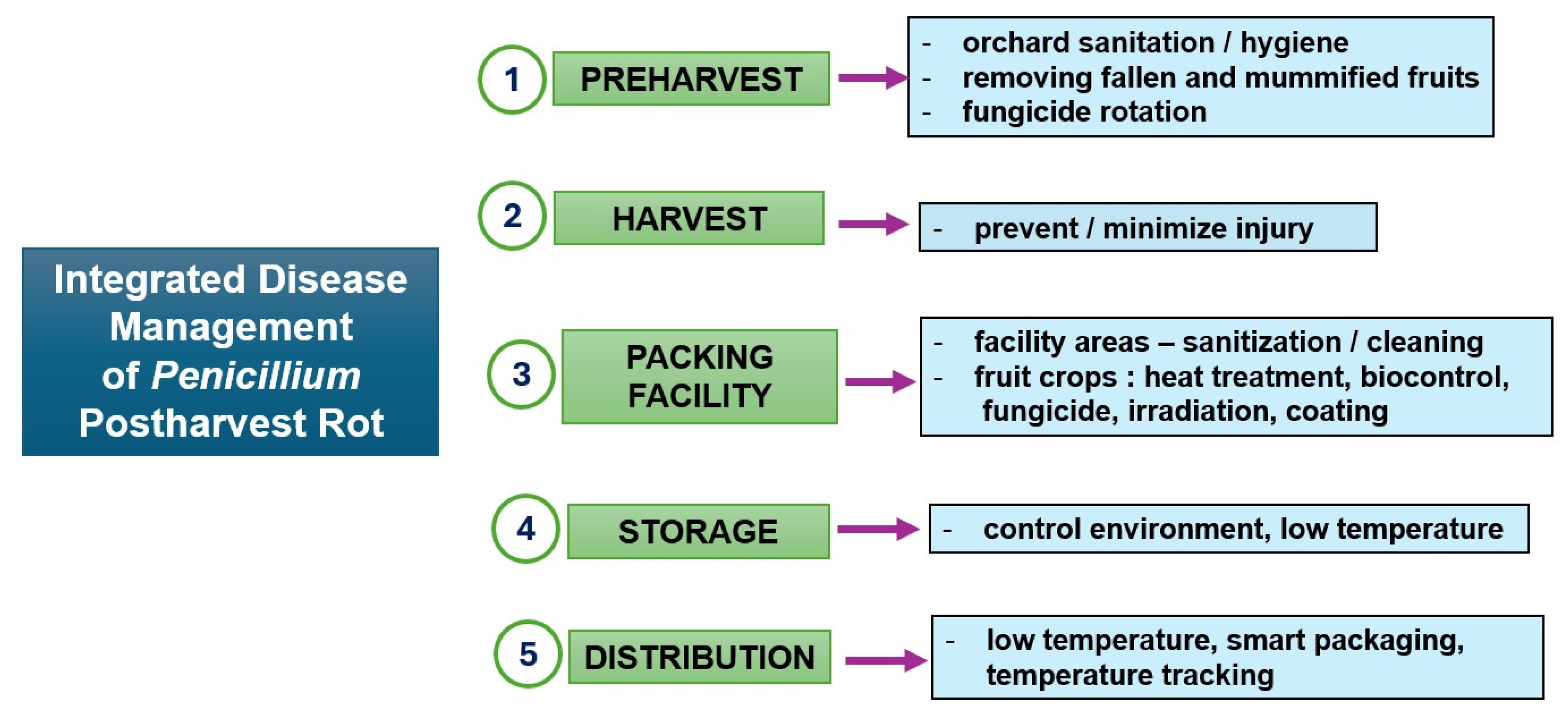
8.4. Integrated Control Measures
8.5. Nanotechnology
9. Climate Change and Its Effect on Penicillium spp.
9.1. Impact on Penicillium spp.
Geographic Expansion
9.2. Fungicide Resistance
10. Future Perspectives and Conclusions
Funding
Institutional Review Board Statement
Informed Consent Statement
Data Availability Statement
Conflicts of Interest
References
- Frisvad, J.C.; Samson, R.A. Polyphasic taxonomy of Penicillium subgenus Penicillium. A guide to identification of food and air-borne terverticillate Penicillia and their mycotoxins. Stud. Mycol. 2004, 49, 1–174. [Google Scholar]
- Pitt, J.I.; Hocking, A.D. Fungi and Food Spoilage, 3rd ed.; Springer: New York, NY, USA, 2009. [Google Scholar]
- Houbraken, J.; de Vries, R.P.; Samson, R.A. Modern taxonomy of biotechnologically important Aspergillus and Penicillium species. Adv. Appl. Microbiol. 2014, 86, 199–249. [Google Scholar] [PubMed]
- Abdelwahab, M.F.; Fouad, M.A.; Kamel, M.S.; Ozkaya, F.C.; Kalscheuer, R.; Muller, W.E.G.; Lin, W.; Liu, Z.; Ebrahim, W.; Daletos, G.; et al. Tanzawaic acid derivatives from freshwater sediment-derived fungus Penicillium sp. Fitoterapia 2018, 128, 258–264. [Google Scholar] [CrossRef] [PubMed]
- Park, M.S.; Oh, S.Y.; Fong, J.J.; Houbraken, J.; Lim, Y.W. The diversity and ecological roles of Penicillium in intertidal zones. Sci. Rep. 2019, 9, 13540. [Google Scholar] [CrossRef]
- Cruz, R.; Santos, C.; Lima, J.S.D.; Moreira, K.; Motta, C.S. Diversity of Penicillium in soil of Caatinga and Atlantic Forest areas of Pernambuco, Brazil: An ecological approach. Nova Hedwig. 2013, 97, 543–556. [Google Scholar] [CrossRef]
- Ramos, S.M.S.; Cruz, R.; Barbosa, R.D.N.; Machado, A.R.; Costa, A.D.; Motta, C.D.; Oliveira, N.D. Penicillium and Talaromyces communities of sugarcane soils (Saccharum officinarum L.): Ecological and phylogenetic aspects. J. Agricul. Sci. 2018, 10, 335–350. [Google Scholar] [CrossRef]
- Yee, T.L.; Azuddin, N.F.; Mohd, M.H.; Zakaria, L. Occurrence and identification of Penicillium and Talaromyces species from beach sand. Malays. J. Microbiol. 2022, 18, 652. [Google Scholar] [CrossRef]
- Nóbrega, J.P.; do Nascimento Barbosa, R.; Lima, J.M.D.S.; de Medeiros Bento, D.; de Souza-Motta, C.M.; Melo, R.F.R. Six new Penicillium species in the section Lanata-Divaricata from a cave in Amazon rainforest, Brazil. Mycol. Prog. 2024, 23, 71. [Google Scholar] [CrossRef]
- Araújo, K.S.; Alves, J.L.; Pereira, O.L.; de Queiroz, M.V. Five new species of endophytic Penicillium from rubber trees in the Brazilian Amazon. Braz. J. Microbiol. 2024, 55, 3051–3074. [Google Scholar] [CrossRef]
- Spotts, R.A.; Sanderson, P.G.; Lennox, C.L.; Sugar, D.; Cervantes, L.A. Wounding, wound healing and staining of mature pear fruit. Postharvest Biol. Technol. 1998, 13, 27–36. [Google Scholar] [CrossRef]
- Logrieco, A.; Bottalico, A.; Mulé, G.; Moretti, A.; Perrone, G. Epidemiology of toxigenic fungi and their associated mycotoxins for some Mediterranean crops. In Epidemiology of Mycotoxin Producing Fungi; Springer: Dordrecht, The Netherlands, 2003; pp. 645–667. [Google Scholar]
- Prusky, D.; Alkan, N.; Mengiste, T.; Fluhr, R. Quiescent and necrotrophic lifestyle choice during postharvest disease development. Annu. Rev. Phytopathol. 2013, 51, 55–176. [Google Scholar] [CrossRef] [PubMed]
- Luciano-Rosario, D.; Keller, N.P.; Jurick, W.M. Penicillium expansum: Biology, omics, and management tools for a global postharvest pathogen causing blue mould of pome fruit. Mol. Plant Pathol. 2020, 21, 1391–1404. [Google Scholar] [CrossRef] [PubMed]
- Amiri, A.; Ozturk, K. Blue Mold. WSU Plant Pathology (Online). 2020. Available online: https://treefruit.wsu.edu/crop-protection/disease-management/blue-mold/ (accessed on 23 May 2025).
- Errampalli, D. Penicillium expansum (blue mold). In Postharvest Decay; Academic Press: Cambridge, MA, USA, 2014; pp. 189–231. [Google Scholar]
- Pitt, J.I.; Hocking, A.D. Fungi and Food Spoilage, 2nd ed.; Springer: New York, NY, USA, 1997. [Google Scholar]
- Baert, K.; Devlieghere, F.; Flyps, H.; Oosterlinck, M.; Ahmed, M.M.; Rajkovic, A.; Verlinden, B.; Nicolai, B.; Devebevere, J.; De Meulenaer, B. Influence of storage conditions of apples on growth and patulin production by Penicillium expansum. Int. J. Food Microbiol. 2007, 119, 170–181. [Google Scholar] [CrossRef] [PubMed]
- Tannous, J.; Atoui, A.; El Khoury, A.; Francis, Z.; Oswald, I.P.; Puel, O.; Lteif, R. A study on the physicochemical parameters for Penicillium expansum growth and patulin production: Effect of temperature, pH, and water activity. Food Sci. Nutr. 2016, 4, 611–622. [Google Scholar] [CrossRef]
- Jimdjio, C.K.; Xue, H.; Bi, Y.; Nan, M.; Li, L.; Zhang, R.; Liu, Q.; Pu, L. Effect of ambient pH on growth, pathogenicity, and patulin production of Penicillium expansum. Toxins 2021, 13, 550. [Google Scholar] [CrossRef]
- Ballester, A.R.; Marcet-Houben, M.; Levin, E.; Sela, N.; Selma-Lázaro, C.; Carmona, L.; Wisniewski, M.; Droby, S.; González-Candelas, L.; Gabaldón, T. Genome, transcriptome, and functional analyses of Penicillium expansum provide new insights into secondary metabolism and pathogenicity. Mol. Plant-Microbe Interac 2015, 28, 232–248. [Google Scholar] [CrossRef]
- Jurick, W.M.; Peng, H.; Beard, H.S.; Garrett, W.M.; Lichtner, F.J.; Luciano-Rosario, D.; Macarisin, O.; Liu, Y.; Peter, K.A.; Gaskins, V.L.; et al. Blistering1 modulates Penicillium expansum virulence via vesicle-mediated protein secretion. Mol. Cell Proteom. 2020, 19, 344–361. [Google Scholar] [CrossRef]
- Azizi, I.G.; Rouhi, S. Determination of patulin in fruit juices and compote of apple and pear. Toxin Rev. 2013, 32, 39–42. [Google Scholar] [CrossRef]
- Zhong, L.; Carere, J.; Lu, Z.; Lu, F.; Zhou, T. Patulin in apples and apple-based food products: The burdens and the mitigation strategies. Toxins 2018, 10, 475. [Google Scholar] [CrossRef]
- Lončarić, A.; Šarkanj, B.; Gotal, A.M.; Kovač, M.; Nevistić, A.; Fruk, G.; Skendrović Babojelić, M.; Babić, J.; Miličević, B.; Kovač, T. Penicillium expansum impact and patulin accumulation on conventional and traditional apple cultivars. Toxins 2021, 13, 703. [Google Scholar] [CrossRef]
- Žebeljan, A.; Duduk, N.; Vučković, N.; Jurick, W.M.; Vico, I. Incidence, speciation, and morpho-genetic diversity of Penicillium spp. causing blue mold of stored pome fruits in Serbia. J. Fungi 2021, 7, 1019. [Google Scholar] [CrossRef] [PubMed]
- Ullah, Q.; Waqar, M.; Sajjad, N.; Awlqadr, F.H.; Arshad, M.T.; Maqsood, S.; Sağlam, K.; Maqsood, N.; Hossain, M.S.; Ikram, A.; et al. Innovative Strategies for Postharvest Disease Management in Fruits and Vegetables: A Comprehensive Treatise. Food Sci. Nutr. 2025, 13, e70850. [Google Scholar] [CrossRef] [PubMed]
- Pianzzola, M.J.; Moscatelli, M.; Vero, S. Characterization of Penicillium isolates associated with blue mold on apple in Uruguay. Plant Dis. 2004, 88, 23–28. [Google Scholar] [CrossRef] [PubMed]
- Sholberg, P.L.; Harlton, C.; Haaga, P.; L’evesque, C.A.; O’Gormana, D.; Seifert, K. Benzimidazole and diphenylamine sensitivity and identity of Penicillium spp. that cause postharvest blue mold of apples using β-tubulin gene sequences. Postharvest Biol. Technol. 2005, 36, 41–49. [Google Scholar] [CrossRef]
- Sanzani, S.M.; Susca, A.; Mastrorosa, S.; Solfrizzo, M. Patulin risk associated with blue mould of pome fruit marketed in southern Italy. Qual. Assur. Saf. Crops Foods 2017, 9, 23–29. [Google Scholar] [CrossRef]
- Yin, G.; Zhang, Y.; Pennerman, K.K.; Wu, G.; Hua, S.S.T.; Yu, J.; Jurick, W.M.; Guo, A.; Bennett, J.W. Characterization of blue mold Penicillium species isolated from stored fruits using multiple highly conserved loci. J. Fungi 2017, 3, 12. [Google Scholar] [CrossRef]
- Habib, W.; Masiello, M.; Chahine-Tsouvalakis, H.; Al Moussawi, Z.; Saab, C.; Tawk, S.T.; Piemontese, L.; Solfrizzo, M.; Logrieco, A.F.; Moretti, A.; et al. Occurrence and characterization of Penicillium species isolated from post-harvest apples in Lebanon. Toxins 2021, 13, 730. [Google Scholar] [CrossRef]
- Zholdoshbekova, S.; Özer, G.; Türkkan, M.; Erper, İ. First report of postharvest fruit rot caused by Penicillium expansum on apple in Kyrgyzstan. J. Plant Pathol. 2024, 106, 1861–1862. [Google Scholar] [CrossRef]
- Louw, J.P.; Korsten, L. Pathogenic Penicillium spp. on apple and pear. Plant Dis. 2014, 98, 590–598. [Google Scholar] [CrossRef]
- van der Walt, L.; Spotts, R.A.; Visagie, C.M.; Jacobs, K.; Smit, F.J.; McLeod, A. Penicillium species associated with preharvest wet core rot in South Africa and their pathogenicity on apple. Plant Dis. 2010, 94, 66–675. [Google Scholar] [CrossRef]
- Gao, L.L.; Zhang, Q.; Sun, X.Y.; Jiang, L.; Zhang, R.; Sun, G.Y.; Zha, Y.L.; Biggs, A.R. Etiology of moldy core, core browning, and core rot of Fuji apple in China. Plant Dis. 2013, 97, 510–516. [Google Scholar] [CrossRef] [PubMed]
- Basson, E.; Meitz-Hopkins, J.C.; Lennox, C.L. Morphological and molecular identification of fungi associated with South African apple core rot. Eur. J. Plant Pathol. 2019, 153, 849–868. [Google Scholar] [CrossRef]
- Kim, J.-H.; Lee, W.-H.; Cheong, S.-S.; Choi, J.-S.; Ryu, J.; Choi, Y.-G. Identification and characteristics of Penicillium spp. isolated from postharvest decay of pear. Res. Plant Dis. 2002, 8, 107–112. [Google Scholar] [CrossRef]
- Scholtz, I.; Korsten, L. Profile of Penicillium species in the pear supply chain. Plant Pathol. 2016, 65, 1126–1132. [Google Scholar] [CrossRef]
- Sánchez, C.V.; Serrano, C.; Conceicao Oliveira, M.; Vasilenko, P.; Santos, M.; Sousa, R.M. Differential susceptibility of Morettini pears to blue mold caused by Penicillium expansum. Emir. J. Food Agric. 2016, 28, 374–380. [Google Scholar] [CrossRef]
- Erper, İ.; Zholdoshbekova, S.; Alkan, M.; Türkkan, M.; Özer, G. First report of Penicillium expansum causing postharvest fruit rot on pear in Kyrgyzstan. J. Plant Pathol. 2023, 105, 1221–1222. [Google Scholar] [CrossRef]
- Moosa, A.; Farzand, A.; Sahi, S.T.; Gleason, M.L.; Khan, S.A.; Zhang, X. First report of postharvest fruit rot of Citrus reticulata ‘kinnow’ caused by Penicillium expansum in Pakistan. Plant Dis. 2019, 103, 155. [Google Scholar] [CrossRef]
- Khokhar, I.; Chen, J.; Wang, J.; Jia, Y.; Yan, Y.; Mukhtar, I. First report of postharvest blue mold Decay caused by Penicillium expansum on lemon (Citrus limon) fruit in China. Plant Dis. 2021, 105, 3747. [Google Scholar] [CrossRef]
- Louw, J.P.; Korsten, L. Postharvest decay of nectarine and plum caused by Penicillium spp. Eur. J. Plant Pathol. 2016, 146, 779–791. [Google Scholar] [CrossRef]
- Louw, J.P.; Korsten, L. Impact of postharvest storage on the infection and colonization of Penicillium digitatum and Penicillium expansum on nectarine. Plant Dis. 2019, 103, 1584–1594. [Google Scholar] [CrossRef]
- Serra, R.; Lourenço, A.; Alípio, P.; Venâncio, A. Influence of the region of origin on the mycobiota of grapes with emphasis on Aspergillus and Penicillium species. Mycol. Res. 2006, 110, 971–978. [Google Scholar] [CrossRef]
- Donoso, A.; Latorre, B.A. Characterization of blue mold caused by Penicillium spp. in cold stored table grapes. Cien. Inv. Agr. 2006, 33, 119–130. [Google Scholar] [CrossRef]
- Kim, W.K.; Sang, H.K.; Woo, S.K.; Park, M.S.; Paul, N.C.; Yu, S.H. Six species of Penicillium associated with blue mold of grape. Mycobiology 2007, 35, 180–185. [Google Scholar] [CrossRef] [PubMed]
- Ghuffar, S.; Irshad, G.; Naz, F.; Rosli, H.B.; Hyder, S.; Mehmood, N.; Zeshan, M.A.; Raza, M.M.; Mayer, C.G.; Gleason, M.L. First report of two Penicillium spp. causing postharvest fruit rot of grapes in Pakistan. Plant Dis. 2018, 102, 1037. [Google Scholar] [CrossRef]
- La Guerche, S.; Chamont, S.; Blancard, D.; Dubourdieu, D.; Darriet, P. Origin of (−)-geosmin on grapes: On the complementary action of two fungi, Botrytis cinerea and Penicillium expansum. Antonie Van Leeuwenhoek 2005, 88, 131–139. [Google Scholar] [CrossRef]
- Lorenzini, M.; Simonato, B.; Favati, F.; Bernardi, P.; Sbarbati, A.; Zapparoli, G. Filamentous fungi associated with natural infection of noble rot on withered grapes. Int. J. Food Microbiol. 2018, 272, 83–86. [Google Scholar] [CrossRef]
- Prodromou, I.; Thomidis, T.; Zambounis, A. First report of Penicillium expansum (Link) Thom. causing postharvest fruit rot of kiwifruit in Northern Greece. Plant Dis. 2018, 102, 1851. [Google Scholar] [CrossRef]
- Wang, C.W.; Ai, J.; Lv, H.Y.; Qin, H.Y.; Yang, Y.M.; Liu, Y.X.; Fan, S.T. First report of Penicillium expansum causing postharvest decay on stored kiwifruit (Actinidia arguta) in China. Plant Dis. 2015, 99, 1037. [Google Scholar] [CrossRef]
- Javed, S.; Javaid, A. First report of postharvest decay of Actinidia deliciosa caused by Penicillium expansum in Pakistan. Pak. J. Bot. 2022, 54, 305–307. [Google Scholar] [CrossRef]
- Feliziani, E.; Romanazzi, G. Postharvest decay of strawberry fruit: Etiology, epidemiology, and disease management. J. Berry Res. 2016, 6, 47–63. [Google Scholar] [CrossRef]
- Kanwar, Z.S.; Thakur, D.P. Post-harvest fungal diseases of pomegranate in Haryana. Indian J. Myco. Plant Patho. 1972, 2, 189–191. [Google Scholar]
- Palou, L.; Guardado, A.; Montesinos-Herrero, C. First report of Penicillium spp. and Pilidiella granati causing postharvest fruit rot of pomegranate in Spain. New Dis. Rep. 2010, 22, 21. [Google Scholar] [CrossRef]
- Palou, L.; Taberner, V.; Guardado, A.; Del Río, M.Á.; Montesinos-Herrero, C. Incidence and etiology of postharvest fungal diseases of pomegranate (Punica granatum cv. Mollar de Elche) in Spain. Phytopathol. Mediterr. 2013, 52, 478–489. [Google Scholar]
- Kim, D.H.; Park, J.Y.; Choi, H.W.; Choi, H.R.; Lee, S.H.; Hong, S.B. Blue mold rot caused by Penicillium expansum on Polygonatum odoratum var. pluriflorum. Plant Dis. 2022, 106, 2254. [Google Scholar] [CrossRef]
- Duduk, N.; Lazarević, M.; Žebeljan, A.; Vasić, M.; Vico, I. Blue mould decay of stored onion bulbs caused by Penicillium polonicum, P. glabrum and P. expansum. J. Phytopathol. 2017, 165, 662–669. [Google Scholar] [CrossRef]
- Dugan, F.M.; Lupien, S.L.; Vahling-Armstrong, C.M.; Chastagner, G.A.; Schroeder, B.K. Host ranges of Penicillium species causing blue mold of bulb crops in Washington State and Idaho. Crop Prot. 2017, 96, 265–272. [Google Scholar] [CrossRef]
- Lee, Y.H.; Park, J.C.; Paul, N.C.; Hwang, E.J.; Yoon, Y.N.; Choi, H.W. First report of postharvest tuber rot of Apios americana caused by Penicillium expansum in South Korea. Plant Dis. 2023, 107, 1944. [Google Scholar] [CrossRef]
- Wang, K.; Ngea, G.L.N.; Godana, E.A.; Shi, Y.; Lanhuang, B.; Zhang, X.; Zhao, L.; Yang, Q.; Wang, S.; Zhang, H. Recent advances in Penicillium expansum infection mechanisms and current methods in controlling P. expansum in postharvest apples. Crit. Rev. Food Sci. Nutr. 2023, 63, 2598–2611. [Google Scholar] [CrossRef]
- Li, B.; Zong, Y.; Du, Z.; Chen, Y.; Zhang, Z.; Qin, G.; Zhao, W.; Tian, S. Genomic characterization reveals insights into patulin biosynthesis and pathogenicity in Penicillium species. Mol. Plant-Microbe Interact. 2015, 28, 635–647. [Google Scholar] [CrossRef] [PubMed]
- Li, B.; Chen, Y.; Zhang, Z.; Qin, G.; Chen, T.; Tian, S. Molecular basis and regulation of pathogenicity and patulin biosynthesis in Penicillium expansum. Compr. Rev. Food Sci. Food Saf. 2020, 19, 3416–3438. [Google Scholar] [CrossRef] [PubMed]
- Marcet-Houben, M.; Ballester, A.R.; de la Fuente, B.; Harries, E.; Marcos, J.F.; González-Candelas, L.; Gabaldón, T. Genome sequence of the necrotrophic fungus Penicillium digitatum, the main postharvest pathogen of citrus. BMC Genom. 2012, 13, 646. [Google Scholar] [CrossRef] [PubMed]
- Barad, S.; Horowitz, S.B.; Kobiler, I.; Sherman, A.; Prusky, D. Accumulation of the mycotoxin patulin in the presence of gluconic acid contributes to pathogenicity of Penicillium expansum. Mol. Plant-Microbe Interac. 2014, 27, 66–77. [Google Scholar] [CrossRef]
- Snini, S.P.; Tannous, J.; Heuillard, P.; Bailly, S.; Lippi, Y.; Zehraoui, E.; Barreau, C.; Oswald, I.P.; Puel, O. Patulin is a cultivar-dependent aggressiveness factor favouring the colonization of apples by Penicillium expansum. Mol. Plant Pathol. 2016, 17, 920–930. [Google Scholar] [CrossRef]
- Qin, G.; Tian, S.; Chan, Z.; Li, B. Crucial role of antioxidant proteins and hydrolytic enzymes in pathogenicity of Penicillium expansum: Analysis based on proteomics approach. Mol. Cell Proteomic. 2007, 6, 425–438. [Google Scholar] [CrossRef]
- Mueller, O.; Kahmann, R.; Aguilar, G.; Trejo-Aguilar, B.; Wu, A.; de Vries, R.P. The secretome of the maize pathogen Ustilago maydis. Fungal Genet. Biol. 2008, 45, S63–S70. [Google Scholar] [CrossRef]
- Li, B.Q.; Wang, W.H.; Zong, Y.Y.; Qin, G.Z.; Tian, S.P. Exploring pathogenic mechanisms of Botrytis cinerea secretome under different ambient pH based on comparative proteomic analysis of secretome. J. Proteome Res. 2012, 11, 4249–4260. [Google Scholar] [CrossRef]
- Vilanova, L.; Vinas, I.; Torres, R.; Usall, J.; Buron-Moles, G.; Teixid, N. Acidification of apple and orange hosts by Penicillium digitatum and Penicillium expansum. Int. J. Food Microbiol. 2014, 178, 39–49. [Google Scholar] [CrossRef]
- Jiao, W.; Liu, X.; Li, Y.; Li, B.; Du, Y.; Zhang, Z.; Chen, Q.; Fu, M. Organic acid, a virulence factor for pathogenic fungi, causing postharvest decay in fruits. Mol. Plant Pathol. 2022, 23, 304–312. [Google Scholar] [CrossRef]
- Palmieri, D.; Miccoli, C.; Notardonato, I.; Avino, P.; Lima, G.; De Curtis, F.; Ianiri, G.; Castoria, R. Modulation of extracellular Penicillium expansum-driven acidification by Papiliotrema terrestris affects biosynthesis of patulin and has a possible role in biocontrol activity. Front. Microbiol. 2022, 13, 973670. [Google Scholar] [CrossRef]
- Frisvad, J.C.; Thrane, U.; Samson, R.A.; Pitt, J.I. Important mycotoxins and the fungi which produce them. Adv. Food Mycol. 2006, 571, 3–31. [Google Scholar]
- Gal, T.E.; Alexa, E.C.; Șumălan, R.M.; Dascălu, I.; Iordănescu, O.A. Factors affecting patulin production by Penicillium expansum in apples. Foods 2025, 14, 2310. [Google Scholar] [CrossRef] [PubMed]
- Sommer, N.F.; Buchanan, J.R.; Fortlage, R.J. Production of patulin by Penicillium expansum. Appl. Microbiol. 1974, 28, 589–593. [Google Scholar] [CrossRef] [PubMed]
- McKinley, E.R.; Carlton, W.W. Patulin. In Mycotoxins and Phytoalexins; Sharma, R.P., Salunkhe, D.K., Eds.; CRC Press: Boca Raton, FL, USA, 1991; pp. 191–236. [Google Scholar]
- Fallik, E.; Tuvia-Alkalai, S.; Feng, X.; Lurie, S. Ripening characterisation and decay development of stored apples after a short pre-storage hot water rinsing and brushing. Innov. Food Sci. Emerg. Technol. 2001, 2, 127–132. [Google Scholar] [CrossRef]
- Spadaro, D.; Garibaldi, A.; Gullino, M.L. Occurrence of patulin and its dietary intake through pear, peach, and apricot juices in Italy. Food Addit. Contam. 2008, 1, 134–139. [Google Scholar] [CrossRef]
- Lee, T.P.; Sakai, R.; Manaf, N.A.; Rodhi, A.M.; Saad, B. High performance liquid chromatography method for the determination of patulin and 5-hydroxymethylfurfural in fruit juices marketed in Malaysia. Food Cont. 2014, 38, 142–149. [Google Scholar] [CrossRef]
- Zaied, C.; Abid, S.; Hlel, W.; Bacha, H. Occurrence of patulin in apple-based-foods largely consumed in Tunisia. Food Cont. 2013, 31, 263–267. [Google Scholar] [CrossRef]
- Zouaoui, N.; Mallebrera, B.; Berrada, H.; Abid-Essefi, S.; Bacha, H.; Ruiz, M.J. Cytotoxic effects induced by patulin, sterigmatocystin and beauvericin on CHO–K1 cells. Food Chemical Toxicol. 2016, 89, 92–103. [Google Scholar] [CrossRef]
- Rahimi, E.; Rezapoor Jeiran, M. Patulin and its dietary intake by fruit juice consumption in Iran. Food Addit. Contam. B 2015, 8, 40–43. [Google Scholar] [CrossRef]
- Cho, M.K.; Kim, K.; Seo, E.; Kassim, N.; Mtenga, A.B.; Shim, W.B.; Lee, S.H.; Chung, D.W. Occurrence of patulin in various fruit juices from South Korea: An exposure assessment. Food Sci. Biotechnol. 2010, 19, 1–5. [Google Scholar] [CrossRef]
- Hussain, S.; Asi, M.R.; Iqbal, M.; Khalid, N.; Wajih-ul-Hassan, S.; Ariño, A. Patulin mycotoxin in mango and orange fruits, juices, pulps, and jams marketed in Pakistan. Toxins 2020, 12, 52. [Google Scholar] [CrossRef] [PubMed]
- Ji, X.; Li, R.; Yang, H.; Qi, P.; Xiao, Y.; Qian, M. Occurrence of patulin in various fruit products and dietary exposure assessment for consubmers in China. Food Cont. 2017, 78, 100–107. [Google Scholar] [CrossRef]
- Aslam, K.; Iqbal, S.Z.; Razis, A.F.A.; Usman, S.; Ali, N.B. Patulin Contamination of Citrus Fruits from Punjab and Northern Pakistan and estimation of associated dietary intake. Int. J. Environ. Res. Public Health 2021, 18, 2270. [Google Scholar] [CrossRef] [PubMed]
- Hamdi, M.; Bejaoui, H.; Sá-Morais, J.; Rodrigues, P. Ecophysiology of Penicillium expansum and patulin production in synthetic and olive-based media. Fungal Biol. 2021, 125, 95–102. [Google Scholar] [CrossRef]
- Acar, J.; Gökmen, V.; Taydas, E.E. The effects of processing technology on the patulin content of juice during commercial apple juice concentrate production. Z. Leb. Und-Forsch. A 1998, 207, 328–331. [Google Scholar] [CrossRef]
- Barad, S.; Sionov, E.; Prusky, D. Role of patulin in post-harvest diseases. Fungal Biol. Rev. 2016, 30, 24–32. [Google Scholar] [CrossRef]
- Damoglou, A.P.; Campbell, D.S. The effect of pH on the production of patulin in apple juice. Lett. Appl. Microbiol. 1986, 2, 9–11. [Google Scholar] [CrossRef]
- Zong, Y.; Li, B.; Tian, S. Effects of carbon, nitrogen and ambient pH on patulin production and related gene expression in Penicillium expansum. Int. J. Food Microbiol. 2015, 206, 102–108. [Google Scholar] [CrossRef]
- Viñas, I.; Dadon, J.; Sanchis, V. Citrinin-producing capacity of Penicillium expansum strains from apple packinghouses of Lerida (Spain). Int. J. Food Microbiol. 1993, 19, 153–156. [Google Scholar] [CrossRef]
- Singh, Y.; Sumbali, G. Patulin and citrinin production in apple and pear fruits by Penicillium expansum strains collected from Jammu markets. Indian Phytopathol. 2008, 61, 471–477. [Google Scholar]
- Ciegler, A.; Vesonder, R.F.; Jackson, L.K. Production and biological activity of patulin and citrinin from Penicillium expansum. Appl. Environ. Microbiol. 1977, 33, 1004–1006. [Google Scholar] [CrossRef]
- Martins, M.L.; Gimeno, A.; Martins, H.M.; Bernardo, F. Co-occurrence of patulin and citrinin in Portuguese apples with rotten spots. Food Addit. Contam. 2002, 19, 568–574. [Google Scholar] [CrossRef]
- Ostry, V.; Malir, F.; Cumova, M.; Kyrova, V.; Toman, J.; Grosse, Y.; Pospichalova, M.; Ruprich, J. Investigation of patulin and citrinin in grape must and wine from grapes naturally contaminated by strains of Penicillium expansum. Food Chem. Toxicol. 2018, 118, 805–811. [Google Scholar] [CrossRef]
- Andersen, B.; Smedsgaard, J.; Frisvad, J.C. Penicillium expansum: Consistent production of patulin, chaetoglobosins, and other secondary metabolites in culture and their natural occurrence in fruit products. J. Agric. Food Chem. 2004, 52, 2421–2428. [Google Scholar] [CrossRef] [PubMed]
- Touhami, N.; Soukup, S.T.; Schmidt-Heydt, M.; Kulling, S.E.; Geisen, R. Citrinin as an accessory establishment factor of P. expansum for the colonization of apples. Int. J. Food Microbiol. 2018, 266, 224–233. [Google Scholar] [CrossRef] [PubMed]
- Heider, E.M.; Harper, J.K.; Grant, D.M.; Hoffmann, A.; Dugan, F.; Tomer, D.P.; O’Neil, K.O. Exploring unusual antioxidant activity in a benzoic acid derivative: A proposed mechanism for citrinin. Tetrahedron 2006, 62, 1199–1208. [Google Scholar] [CrossRef]
- Watanabe, M. Production of mycotoxins by Penicillium expansum inoculated into apples. J. Food Prot. 2008, 71, 1714–1719. [Google Scholar] [CrossRef]
- Shen, Y.; Ma, N.; Liu, S.; Xu, G.; Zhang, J. Mycotoxins and secondary metabolites from fruit postharvest pathogenic Penicillium species. Food Chem. 2025, 488, 144880. [Google Scholar] [CrossRef]
- Costa, J.H.; Bazioli, J.M.; Araujo, E.D.; Vendramini, P.H.; Porto, C.M.C.D.; Eberlin, M.N.; Souza-Neto, J.A.; Fill, T.P. Monitoring indole alkaloid production by Penicillium digitatum during infection process in citrus by Mass Spectrometry Imaging and molecular networking. Fungal Biol. 2019, 123, 594–600. [Google Scholar] [CrossRef]
- Droby, S.A.M.I.R.; Eick, A.; Macarisin, D.; Cohen, L.; Rafael, G.I.N.A.T.; Stange, R.; McColum, G.; Dudai, N.; Nasser, A.; Wisniewski, M.; et al. Role of citrus volatiles in host recognition, germination and growth of Penicillium digitatum and Penicillium italicum. Postharvest Biol. Technol. 2008, 49, 386–396. [Google Scholar] [CrossRef]
- Erasmus, A.; Lennox, C.L.; Korsten, L.; Lesar, K.; Fourie, P.H. Imazalil resistance in Penicillium digitatum and P. italicum causing citrus postharvest green and blue mould: Impact and options. Postharvest Biol. Technol. 2015, 107, 66–76. [Google Scholar] [CrossRef]
- Plaza, P.; Usall, J.; Teixidó, N.; Vinas, I. Effect of water activity and temperature on germination and growth of Penicillium digitatum, P. italicum and Geotrichum candidum. J. Appl. Microbiol. 2003, 94, 549–554. [Google Scholar] [CrossRef] [PubMed]
- Yang, S.; Peng, L.; Cheng, Y.; Feng, C.; Pan, S. Control of citrus green and blue molds by Chinese propolis. Food Sci. Biotechnol. 2010, 19, 1303–1308. [Google Scholar] [CrossRef]
- Teeri, T.T.; Koivula, A.; Linder, M.; Wohlfahrt, G.; Divne, C.; A Jones, T. Trichoderma reesei cellobiohydrolases: Why so efficient on crystalline cellulose? Biochem. Soc. Trans. 1998, 26, 173–178. [Google Scholar] [CrossRef]
- Cheng, Y.; Lin, Y.; Cao, H.; Li, Z. Citrus postharvest green mold: Recent advances in fungal pathogenicity and fruit resistance. Microorganisms 2020, 8, 449. [Google Scholar] [CrossRef]
- Vilanova, L.; Viñas, I.; Torres, R.; Usall, J.; Jauset, A.M.; Teixidó, N. Infection capacities in the orange-pathogen relationship: Compatible (Penicillium digitatum) and incompatible (Penicillium expansum) interactions. Food Microbiol. 2012, 29, 56–66. [Google Scholar] [CrossRef]
- Shakeel, Q.; Bajwa, R.T.; Iftikhar, Y.; Mubeen, M.; Luqman, M.; Ashraf, W.; Rashid, I. Effective management of ginger soft rot caused by Penicillium digitatum through plant extracts. Sarhad J. Agric. 2021, 37, 714–721. [Google Scholar] [CrossRef]
- Ren, H.; Gao, Y.; Li, X.; Xing, S.J.; Gao, Y.T.; Yang, J.; Huang, Q. First Report of Penicillium digitatum causing postharvest rot of citron fruit in Kunming, China. Plant Dis. 2022, 106, 1981. [Google Scholar] [CrossRef]
- Saito, S.; Xiao, C.L. Prevalence of postharvest diseases of mandarin fruit in California. Plant Health Prog. 2017, 18, 204–210. [Google Scholar] [CrossRef]
- de Vilhena Araújo, É.; Vendramini, P.H.; Costa, J.H.; Eberlin, M.N.; Montagner, C.C.; Fill, T.P. Determination of tryptoquialanines A and C produced by Penicillium digitatum in oranges: Are we safe? Food Chem. 2019, 301, 125285. [Google Scholar] [CrossRef]
- Ariza, M.R.; Larsen, T.O.; Petersen, B.O.; Duus, J.Ø.; Barrero, A.F. Penicillium digitatum metabolites on synthetic media and citrus fruits. J. Agric. Food Chem. 2002, 50, 6361–6365. [Google Scholar] [CrossRef]
- Rovetto, E.I.; Luz, C.; La Spada, F.; Meca, G.; Riolo, M.; Cacciola, S.O. Diversity of mycotoxins and other secondary metabolites recovered from blood oranges infected by Colletotrichum, Alternaria, and Penicillium species. Toxins 2023, 15, 407. [Google Scholar] [CrossRef] [PubMed]
- Frisvad, J.C.; Smedsgaard, J.; Larsen, T.O.; Samson, R.A. Mycotoxins, drugs and other extrolites produced by species in Penicillium subgenus Penicillium. Stud. Mycol. 2004, 49, e41. [Google Scholar]
- Wang, M.; Ruan, R.; Li, H. The completed genome sequence of the pathogenic ascomycete fungus Penicillium digitatum. Genomics 2021, 113, 439–446. [Google Scholar] [CrossRef] [PubMed]
- Stošić, S.; Ristić, D.; Trkulja, N.; Živković, S. Penicillium species associated with postharvest blue mold rots of garlic in Serbia. Plant Dis. 2025, 109, 149–161. [Google Scholar] [CrossRef]
- Palou, L.; Usall, J.; Smilanick, J.L.; Aguilar, M.J.; Viñas, I. Evaluation of food additives and low-toxicity compounds as alternative chemicals for the control of Penicillium digitatum and Penicillium italicum on citrus fruit. Pest Manag. Sci. 2002, 58, 459–466. [Google Scholar] [CrossRef]
- Lahlali, R.; Serrhini, M.N.; Friel, D.; Jijakli, M.H. In vitro effects of water activity, temperature and solutes on the growth rate of P. italicum Wehmer and P. digitatum Sacc. J. Appl. Microbiol. 2006, 101, 628–636. [Google Scholar] [CrossRef]
- El Guilli, M.; Ibriz, M.; Lahlali, R.; Jijakli, M.H. Effects of temperature and relative humidity on the in vitro and in vivo radial growth of Penicillium italicum and on the biocontrol activity of Pichia guilliermondii strain Z1. Int. Symp. Biol. Control. Postharvest Dis. Chall. Oppor. 2010, 905, 233–240. [Google Scholar] [CrossRef]
- Papoutsis, K.; Mathioudakis, M.M.; Hasperué, J.H.; Ziogas, V. Non-chemical treatments for preventing the postharvest fungal rotting of citrus caused by Penicillium digitatum (green mold) and Penicillium italicum (blue mold). Trends Food Sci. Technol. 2019, 86, 479–491. [Google Scholar] [CrossRef]
- Palou, L. Penicillium digitatum, Penicillium italicum (green mold, blue mold). In Postharvest Decay; Academic Press: Cambridge, MA, USA, 2014; pp. 45–102. [Google Scholar]
- Prusky, D.; McEvoy, J.L.; Saftner, R.; Conway, W.S.; Jones, R. The relationship between host acidification and virulence of Penicillium spp. on apple and citrus fruit. Phytopathology 2004, 94, 44–51. [Google Scholar] [CrossRef] [PubMed]
- USDA Fungal Database. Available online: https://fungi.ars.usda.gov/ (accessed on 1 October 2025).
- Silva, E.; Kanashiro, A.M.; Maciel, J.R.F.; Dantas Lima Junior, R.; Botelho, M.A.F.; Pereira, A.K.; Nemesio da Silva, S.; Costa, J.H.; Pontes, J.G.M.; Ferreira da Silva, A.; et al. Decoding the Penicillium italicum-Citrus Interaction: Untargeted metabolomics sheds light on a neglected postharvest pathogen. J. Agric. Food Chem. 2025, 73, 27806–27819. [Google Scholar] [CrossRef] [PubMed]
- Larsen, T.O.; Frisvad, J.C. Characterization of volatile metabolites from 47 Penicillium taxa. Mycol. Res. 1995, 99, 1153–1166. [Google Scholar] [CrossRef]
- Kanashiro, A.M.; Akiyama, D.Y.; Kupper, K.C.; Fill, T.P. Penicillium italicum: An underexplored postharvest pathogen. Front. Microbiol. 2020, 11, 606852. [Google Scholar] [CrossRef]
- van der Does, H.C.; Rep, M. Virulence genes and the evolution of host specificity in plant-pathogenic fungi. Mol. Plant-Microbe Interact. 2007, 20, 1175–1182. [Google Scholar] [CrossRef]
- Kilaru, N.H.C.; Iruthayasamy, J.; Muthusamy, K.; Kumaresan, P.V.; Narayanan, M.B.; Rangasamy, A.; Nallusamy, S. Morphological and molecular basis of host specificity in fungal pathogens-an overview. Physio. Mol. Plant Pathol. 2025, 141, 103022. [Google Scholar] [CrossRef]
- Julca, I.; Droby, S.; Sela, N.; Marcet-Houben, M.; Gabaldon, T. Contrasting genomic diversity in two closely related postharvest pathogens: Penicillium digitatum and Penicillium expansum. Genome Biol. Evol. 2016, 8, 218–227. [Google Scholar] [CrossRef]
- López-Pérez, M.; Ballester, A.R.; González-Candelas, L. Identification and functional analysis of Penicillium digitatum genes putatively involved in virulence towards citrus fruit. Mol. Plant Pathol. 2015, 16, 262–275. [Google Scholar] [CrossRef]
- Gong, L.; Liu, Y.; Xiong, Y.; Li, T.; Yin, C.; Zhao, J.; Yu, J.; Yin, Q.; Gupta, V.K.; Jiang, Y.; et al. New insights into the evolution of host specificity of three Penicillium species and the pathogenicity of P. italicum involving the infection of Valencia orange (Citrus cinensis). Virulence 2020, 11, 748–768. [Google Scholar] [CrossRef]
- Lu, S.; Edwards, M.C. Genome-wide analysis of small secreted cysteine-rich proteins identify candidate effector proteins potentially involved in Fusarium graminearum-wheat interactions. Phytopathology 2016, 106, 166–176. [Google Scholar] [CrossRef] [PubMed]
- Li, X.; Yang, S.; Zhang, M.; Yang, Y.; Peng, L. Identification of pathogenicity-related effector proteins and the role of Piwsc1 in the virulence of Penicillium italicum on citrus fruits. J. Fungi 2022, 8, 646. [Google Scholar] [CrossRef] [PubMed]
- Li, T.; Shi, D.; Wu, Q.; Yin, C.; Li, F.; Shan, Y.; Duan, X.; Jiang, Y. Mechanism of cell wall polysaccharides modification in harvested ‘Shatangju’Mandarin (Citrus reticulate Blanco) fruit caused by Penicillium italicum. Biomolecules 2019, 9, 160. [Google Scholar] [CrossRef] [PubMed]
- Yin, C.; Zhu, H.; Jiang, Y.; Shan, Y.; Gong, L. Silencing dicer-like genes reduces virulence and sRNA generation in Penicillium italicum, the cause of citrus blue mold. Cells 2020, 9, 363. [Google Scholar] [CrossRef] [PubMed]
- Cheng, A.-P.; Platten, F.; Oberkofler, L.; Weiberg, A.; Huang, L.; Tisserant, C.; Dunker, F.; Lederer, B.; Johnson, N.R. A fungal RNA-dependent RNA polymerase is a novel player in plant infection and cross-kingdom RNA interference. PLoS Pathog. 2023, 19, e1011885. [Google Scholar] [CrossRef]
- Kubátová, A.; Hujslová, M.; Frisvad, J.C.; Chudíčková, M.; Kolařík, M. Taxonomic revision of the biotechnologically important species Penicillium oxalicum with the description of two new species from acidic and saline soils. Mycol. Prog. 2019, 18, 215–228. [Google Scholar] [CrossRef]
- Pascual, S.D.C.A.; De Cal, A.; Magan, N.; Melgarejo, P. Surface hydrophobicity, viability and efficacy in biological control of Penicillium oxalicum spores produced in aerial and submerged culture. J. Appl. Microbiol. 2000, 89, 847–853. [Google Scholar] [CrossRef]
- Du, D.; Lyu, J.; Huang, Z.; An, B.; Zhu, L.; Pu, Z.; Liu, S.; Hu, X.; Lu, L. Identification of a Penicillium oxalicum fungus isolate and its pathogenicity against Panonychus citri (McGregor). Front. Microbiol. 2025, 16, 1619976. [Google Scholar] [CrossRef]
- Zhang, Y.; Gao, H.; Zhao, D.; Chen, X.; Zhu, F.; Li, Y.; Xue, S. Microbially-driven alkaline regulation: Organic acid secretion behavior of Penicillium oxalicum and charge neutralization in bauxite residue. Environ. Res. 2024, 240, 117489. [Google Scholar] [CrossRef]
- Halfon-Meiri, A.; Solel, Z. Factors affecting seedling blight of sweet corn caused by seedborne Penicillium oxalicum. Plant Dis. 1990, 74, 36–39. [Google Scholar] [CrossRef]
- Callan, N.W.; Mathre, D.E.; Miller, J.B. Factors influencing preemergence damping-off and seedling blight of sh-2 sweet corn caused by Penicillium oxalicum. Hort Sci. 1994, 29, 743b-743. [Google Scholar] [CrossRef]
- Payne, G. Ear and kernel rots. In Compendium of Corn Diseases, White, D.G., Ed.; 3rd ed.; APS Press: Philadelphia, PA, USA, 1999; pp. 44–47. [Google Scholar]
- Pornsuriya, C.; Chitphithak, I. Blue mold caused by Penicillium oxalicum on muskmelon (Cucumis melo) in Thailand. Australas. Plant Dis. Notes 2018, 13, 46. [Google Scholar] [CrossRef]
- Tang, Y.; Li, J.F.; Wang, T.; Lin, T.; Ma, G.B.; Zhu, P.K.; Xu, L. First report of Penicillium oxalicum causing blue mold rot of muskmelon (Cucumis melo) in China. Plant Dis. 2020, 104, 1550. [Google Scholar] [CrossRef]
- Zheng, Z.; Ma, M.; Zhu, X.; Li, N.; Cao, P. First report of Penicillium oxalicum causing postharvest fruit rot on citrus in China. Plant Dis. 2022, 107, 1230. [Google Scholar] [CrossRef]
- Wu, J.B.; He, Y.B.; Chen, R.S. First report of leaf spot disease of pineapple caused by Penicillium oxalicum. Plant Dis. 2022, 106, 1065. [Google Scholar] [CrossRef]
- Han, J.X.; Ding, C.; Wang, B.; Teng, Y.M.; Huang, Y.T.; Yang, D.J.; Shi, X.C.; Herrera-Balandrano, D.D.; Wang, S.Y.; Laborda, P. First report of Penicillium oxalicum causing leaf blight on ‘Hongyang’ kiwifruit in China. Plant Dis. 2024, 108, 792. [Google Scholar] [CrossRef]
- Yan, H.; Li, Y.; Lv, Y.; Zhao, X.; Man, Z.; Chen, Z.; Guo, L.; Huo, J.; Sang, M.; Li, C.; et al. Postharvest fruit rot on blue honeysuckle (Lonicera caerulea L.) caused by Penicillium oxalicum newly reported in China. Crop Prot. 2025, 193, 107195. [Google Scholar] [CrossRef]
- Kwon, J.H.; Shen, S.S.; Jee, H.J. Occurrence of blue mold on tomato caused by Penicillium oxalicum in Korea. Plant Pathol. J. 2008, 24, 87–89. [Google Scholar] [CrossRef]
- Umemoto, S.; Odake, Y.; Takeuchi, T.; Yoshida, S.; Tsushima, S.; Koitabashi, M. Blue mold of tomato caused by Penicillium oxalicum in Japan. J. Gen. Plant Patho. 2009, 75, 399–400. [Google Scholar] [CrossRef]
- Picos-Munoz, P.A.; Garcia-Estrada, R.S.; Carrillo-Fasio, J.A.; Leon-Felix, J.; Allende-Molar, R. First report of blue mold caused by Penicillium oxalicum in tomato (Solanum lycopersicum) in Mexico. Plant Dis. 2011, 95, 1195. [Google Scholar] [CrossRef]
- Allende Molar, R.; Picos Muñoz, P.A.; Márquez Zequera, I.; Carrillo Fasio, J.A.; García Estrada, R.S.; León Félix, J. Morphological and molecular identification of Penicillium oxalicum causing stem and fruit rot in tomato. Rev. Mex. Fitopathol. 2013, 31, 13–19. [Google Scholar]
- O’Neill, T.M.; Bagabe, M.; Ann, D.M. Aspects of biology and control of a stem rot of cucumber caused by Penicillium oxalicum. Plant Pathol. 1991, 40, 78–84. [Google Scholar] [CrossRef]
- Jarvis, W.R.; Ferguson, G.M. A survey of Penicillium stem rot on greenhouse cucumbers in southwestern Ontario. Can. Plant Dis. Survey 1992, 72, 103–106. [Google Scholar]
- Menzies, J.G.; Koch, C.; Elmhirst, J.; Portree, J.D. First report of Penicillium stem rot caused by Penicillium oxalicum on long English cucumber in British Columbia greenhouses. Plant Dis. 1995, 79, 538. [Google Scholar] [CrossRef]
- Caldwell, R.W.; Tuite, J.; Carlton, W.W. Pathogenicity of Penicillia to corn ears. Phytopathology 1981, 71, 175–180. [Google Scholar] [CrossRef]
- Susca, A.; Villani, A.; Moretti, A.; Stea, G.; Logrieco, A. Identification of toxigenic fungal species associated with maize ear rot: Calmodulin as single informative gene. Int. J. Food Microbiol. 2020, 319, 108491. [Google Scholar] [CrossRef]
- Han, J.X.; Zhang, S.L.; Shi, X.C.; Herrera-Balandrano, D.D.; Wang, S.Y.; Laborda, P. First Report of Penicillium oxalicum causing leaf blight on maize in China. Plant Dis. 2023, 107, 2554. [Google Scholar] [CrossRef]
- Amusa, N.A.; Adigbite, A.A.; Muhammed, S.; Baiyewu, R.A. Yam diseases and its management in Nigeria. Afr. J. Biotechnol. 2003, 2, 497–502. [Google Scholar] [CrossRef]
- Liu, H.; Htun, A.A.; Aung, S.L.L.; Sang, H.; Deng, J.; Tao, Y. Fungal species associated with tuber rot of Foshou yam (Dioscorea esculenta) in China. J. Fungi 2025, 11, 380. [Google Scholar] [CrossRef]
- Taiga, A. Differential rate of dry rot in Dioscorea rotundata (white yam) along the tuber length due to rot causing fungi. Adv. Microbiol. 2012, 2, 452–455. [Google Scholar] [CrossRef][Green Version]
- Liu, J.T.; Gao, Y.G.; Zang, P.; Xiao, R.X.; Zhao, Y.; He, Z.M.; Zhu, H.Y.; Zhang, L.X. First report of Penicillium oxalicum causing blue mold on Astragalus membranaceus in Jilin Province, China. Plant Dis. 2018, 102, 2637. [Google Scholar] [CrossRef]
- Liu, J.T.; Zang, P.; Gao, Y.G.; Zhao, Y.; He, Z.M.; Zhu, H.Y.; Wei, X. First report of Penicillium oxalicum causing blue mold on Gastrodia elata in Jilin Province, China. Plant Dis. 2019, 103, 2469. [Google Scholar] [CrossRef]
- Larena, I.; Sabuquillo, P.; Melgarejo, P.; De Cal, A. Biocontrol of Fusarium and Verticillium wilt of tomato by Penicillium oxalicum under greenhouse and field conditions. J. Phytopathol. 2003, 151, 507–512. [Google Scholar] [CrossRef]
- Sabuquillo, P.; De Cal, A.; Melgarejo, P. Biocontrol of tomato wilt by Penicillium oxalicum formulations in different crop conditions. Biol. Control 2006, 37, 256–265. [Google Scholar] [CrossRef]
- De Cal Cortina, A.; Redondo Casero, C.; Sztejnberg, A.; Melgarejo, P. Biocontrol of powdery mildew by Penicillium oxalicum in open-field nurseries of strawberries. Biol. Control 2008, 47, 103–107. [Google Scholar] [CrossRef]
- Nigam, R. Antifungal effectiveness of Penicillium oxalicum against soil borne pathogens of pea. Biochem. Cell Arch. 2023, 23, 839. [Google Scholar] [CrossRef]
- Martinez-Beringola, M.L.; Salto, T.; Vázquez, G.; Larena, I.; Melgarejo, P.; De Cal, A. Penicillium oxalicum reduces the number of cysts and juveniles of potato cyst nematodes. J. Appl. Microbiol. 2013, 115, 199–206. [Google Scholar] [CrossRef]
- Weng, W.; Li, R.; Zhang, Y.; Pan, X.; Jiang, S.; Sun, C.; Zhang, C.; Lu, X. Polyketides isolated from an endophyte Penicillium oxalicum 2021CDF-3 inhibit pancreatic tumor growth. Front Microbiol. 2022, 13, 1033823. [Google Scholar] [CrossRef]
- Kim, D.C.; Quang, T.H.; Tien, N.T.; Kim, K.W.; Kim, Y.C.; Ngan, N.T.T.; Cuong, N.X.; Nam, N.H.; Oh, H. Anti-neuroinflammatory effect of oxaline, isorhodoptilometrin, and 5-hydroxy-7-(2′-hydroxypropyl)-2-methyl-chromone obtained from the marine fungal strain Penicillium oxalicum CLC-MF05. Arch. Pharml. Res. 2022, 45, 90–104. [Google Scholar] [CrossRef]
- Abdel Razek, M.M.M.; Elissawy, A.M.; Mostafa, N.M.; Moussa, A.Y.; Elshanawany, M.A.; Singab, A.N.B. Bioactive secondary metabolites from fungal endophytes, Penicillium oxalicum and Phoma herbarum, associated with Morus nigra and Ficus sycomorus: An in silico study. RSC Adv. 2024, 14, 36451–36460. [Google Scholar] [CrossRef]
- Ciegler, A.; Hayes, A.W.; Vesonder, R.F. Production and biological activity of secalonic acid D. Appl. Environ. Microbiol. 1980, 39, 285–287. [Google Scholar] [CrossRef] [PubMed]
- Palmgren, M.S.; Fleischhacker, D.S. Penicillium oxalicum and secalonic acid D in fresh corn. In Biodeterioration Research 1; Llewellyn, G.C., O’Rear, C.E., Eds.; Biodeterioration Research; Springer: Boston, MA, USA, 1987; Volume 1. [Google Scholar]
- Mayura, K.; Hayes, A.W.; Berndt, W.O. Teratogenicity of secalonic acid D in rats. Toxicology 1982, 25, 311–322. [Google Scholar] [CrossRef] [PubMed]
- Dhulipala, V.C.; Welshons, W.V.; Reddy, C.S. Inhibition of human embryonic palatal mesenchymal cell cycle by secalonic acid D: A probable mechanism of its cleft palate induction. Orthod. Craniofacial Res. 2004, 7, 227–236. [Google Scholar] [CrossRef] [PubMed]
- Zhang, J.Y.; Tao, L.Y.; Liang, Y.J.; Yan, Y.Y.; Dai, C.L.; Xia, X.K.; She, Z.G.; Lin, Y.C.; Fu, L.W. Secalonic acid D induced leukemia cell apoptosis and cell cycle arrest of G1 with involvement of GSK-3β/β-catenin/c-Myc pathway. Cell Cycle 2009, 8, 2444–2450. [Google Scholar] [CrossRef]
- Zhang, H.; Huang, L.; Tao, L.; Zhang, J.; Wang, F.; Zhang, X.; Fu, L. Secalonic acid D induces cell apoptosis in both sensitive and ABCG2-overexpressing multidrug resistant cancer cells through upregulating c-Jun expression. Acta Pharm. Sin. B 2019, 9, 516–525. [Google Scholar] [CrossRef]
- Tang, R.; Kimishima, A.; Setiawan, A.; Arai, M. Secalonic acid D as a selective cytotoxic substance on the cancer cells adapted to nutrient starvation. J. Nat. Med. 2020, 74, 495–500. [Google Scholar] [CrossRef]
- Cessna, S.G.; Sears, V.E.; Dickman, M.B.; Low, P.S. Oxalic acid, a pathogenicity factor for Sclerotinia sclerotiorum, suppresses the oxidative burst of the host plant. Plant Cell 2000, 12, 2191–2199. [Google Scholar] [CrossRef]
- Cheung, N.; Tian, L.; Liu, X.; Li, X. The destructive fungal pathogen Botrytis cinerea—Insights from genes studied with mutant analysis. Pathogens 2020, 9, 923. [Google Scholar] [CrossRef]
- Bi, K.; Liang, Y.; Mengiste, T.; Sharon, A. Killing softly: A roadmap of Botrytis cinerea pathogenicity. Trends Plant Sci. 2023, 28, 211–222. [Google Scholar] [CrossRef]
- Faboya, O.; Ikotun, T.; Fatoki, O.S. Production of oxalic acid by some fungi infected tubers. Z. Allg. Mikrobiol. 1983, 23, 621–624. [Google Scholar] [CrossRef] [PubMed]
- Houbraken, J.A.M.P.; Frisvad, J.C.; Samson, R.A. Taxonomy of Penicillium citrinum and related species. Fungal Divers. 2010, 44, 117–133. [Google Scholar] [CrossRef]
- Coutinho, T.C.; Ferreira, M.C.; Rosa, L.H.; de Oliveira, A.M.; de Oliveira Junior, E.N. Penicillium citrinum and Penicillium mallochii: New phytopathogens of orange fruit and their control using chitosan. Carbohydr. Polym. 2020, 234, 115918. [Google Scholar] [CrossRef] [PubMed]
- Estrada, R.R.G.; Valle, F.D.J.A.; Sánchez, J.A.R.; Santoyo, M.C. Use of a marine yeast as a biocontrol agent of the novel pathogen Penicillium citrinum on Persian lime. Emirates J. Food Agric. 2017, 29, 114–122. [Google Scholar]
- Jiang, H.; Zhang, L.; Zhang, Y.; Cheng, Y.; Chen, C.; Wang, Y.; Guan, J. Postharvest Disease Management of ‘Akizuki’ Pear in China: Identification of fungal pathogens and control efficacy of chlorine dioxide. J. Fungi 2025, 11, 694. [Google Scholar] [CrossRef]
- Mincuzzi, A.; Ippolito, A.; Montemurro, C.; Sanzani, S.M. Characterization of Penicillium ss and Aspergillus sect. Nigri causing postharvest rots of pomegranate fruit in Southern Italy. Int. J. Food Microbiol. 2020, 314, 108389. [Google Scholar] [CrossRef]
- Felšöciová, S.; Rybárik, Ľ.; Tančinová, D.; Mašková, Z. Occurrence of Penicillium species in grapes from Nitra wine region. J. Microbiol. Biotechnol. Food Sci. 2021, 2, 2136–2148. [Google Scholar]
- Hussein, M.A.; El-Said, A.H.; Yassein, A.S. Mycobiota associated with strawberry fruits, their mycotoxin potential and pectinase activity. Mycology 2020, 11, 158–166. [Google Scholar] [CrossRef] [PubMed]
- Yang, G.; Niu, B.; Zong, Z.; Wu, W.; Fang, X.; Chen, H.; Zhang, Y.; Mu, H.; Gao, H. Microbicidal effect of negative air ion against Penicillium citrinum and quality control of Chinese bayberry. Food Cont. 2024, 162, 10476. [Google Scholar] [CrossRef]
- Ji, Y.; Wang, J.; Liu, Y.; Liu, S.; Jiang, X.; Huang, H. Isolation and Identification of Postharvest Rot Pathogens in Citrus× tangelo and their potential inhibition with acidic electrolyzed water. Food Environ. Virol. 2024, 16, 409–421. [Google Scholar] [CrossRef] [PubMed]
- Johnston, C.L. Identification of Penicillium Species in the South African Litchi Export Chain; University of Pretoria: South Africa, 2008. [Google Scholar]
- Zhao, N.; Song, Y.H.; Chen, L.; Mo, Y.W. Isolation, identification and antibacterial tests on Penicillium citrinum for postharvest Shengzhou plums. Fujian J. Agric. Sci. 2018, 33, 407–412. [Google Scholar]
- Nagadesi, P.K. New fruit rot diseases caused by Penicillium citrinum Thom and Fusarium sambucinum Fukel. in star gooseberry (Phyllanthus acidus (L.) Skeels) from Andhra Pradesh, India. J. Agric. Crop Res. 2021, 9, 236–240. [Google Scholar]
- Baghel, A. Studies on Management of Fruit Rot of Aonla Caused by Penicillium citrinum Thom. Master’s Thesis, Indira Gandhi Agricultural University Krishi Vishwavidyalaya, Raipur, 2006. [Google Scholar]
- Shehu, K.; Muhammad, S. Fungi associated with storage rots of onion bulbs in Sokoto, Nigeria. Int. J. Mod. Bot. 2011, 1, 1–3. [Google Scholar] [CrossRef]
- Khan, I.H.; Javaid, A. Penicillium citrinum causing postharvest decay on stored garlic cloves in Pakistan. J. Plant Pathol. 2023, 105, 337. [Google Scholar] [CrossRef]
- Onaebi, C.N.; Ugwuja, F.; Okoro, A.C.; Amujiri, A.N.; Ivoke, M.U. Mycoflora associated with post-harvest rot of onion (Allium cepa) and garlic (Allium sativum) bulbs. Res. Crops 2020, 21, 380–389. [Google Scholar]
- Azaiki, S. Microorganisms associated with postharvest diseases of yams (Dioscorea species) in barns. Sci. Technol. 2016, 3, 108–117. [Google Scholar]
- Qin, S.; Wang, J.; Liu, S.; Tang, X.; Liu, Z.L.; Liu, R.; Wang, Y.; Song, L.; Chen, X.; Cernava, T. First report of green mold disease caused by Penicillium citrinum on Dictyophora rubrovalvata in China. Plant Dis. 2022, 107, 966. [Google Scholar] [CrossRef]
- Munkvold, G.P.; Arias, S.; Taschl, I.; Gruber-Dorninger, C. Mycotoxins in corn: Occurrence, impacts, and management. In Corn; AACC International Press: St. Paul, MN, USA, 2019; pp. 235–287. [Google Scholar]
- Davis, N.D.; Dalby, D.K.; Diener, U.L.; Sansing, G.A. Medium-scale production of citrinin by Penicillium citrinum in a semisynthetic medium. Appl. Microbiol. 1975, 29, 118–120. [Google Scholar] [CrossRef] [PubMed]
- Schmidt-Heydt, M.; Stoll, D.; Geisen, R. Whole-Genome sequencing of the fungus Penicillium citrinum reveals the biosynthesis gene cluster for the mycotoxin citrinin. Microbiol. Resour. Announce. 2019, 8, e01419-18. [Google Scholar] [CrossRef] [PubMed]
- Kamle, M.; Mahato, D.K.; Gupta, A.; Pandhi, S.; Sharma, N.; Sharma, B.; Mishra, S.; Arora, S.; Selvakumar, R.; Saurabh, V.; et al. Citrinin mycotoxin contamination in food and feed: Impact on agriculture, human health, and detection and management strategies. Toxins 2022, 14, 85. [Google Scholar] [CrossRef] [PubMed]
- Flajs, D.; Peraica, M. Toxicological properties of citrinin. Arch. Ind. Hyg. Toxicol. 2009, 60, 457–464. [Google Scholar] [CrossRef]
- Silva, L.J.G.; Pereira, A.M.P.T.; Pena, A.; Lino, C.M. Citrinin in Foods and Supplements: A review of occurrence and analytical methodologies. Foods 2021, 10, 14. [Google Scholar] [CrossRef]
- Malmstrøm, J.; Christophersen, C.; Frisvad, J.C. Secondary metabolites characteristic of Penicillium citrinum, Penicillium steckii and related species. Phytochemistry 2000, 54, 301–309. [Google Scholar] [CrossRef]
- Kozlovskii, A.G.; Zhelifonova, V.P.; Vinokurova, N.G.; Ozerskaya, S.M. Effect of microelements on the biosynthesis of secondary metabolites by the fungus Penicillium citrinum Thom VKM F-1079. Microbiology 2000, 69, 536–540. [Google Scholar] [CrossRef]
- Khan, S.A.; Hamayun, M.; Yoon, H.; Kim, H.Y.; Suh, S.J.; Hwang, S.K.; Kim, J.M.; Lee, I.J.; Choo, Y.S.; Yoon, U.H.; et al. Plant growth promotion and Penicillium citrinum. BMC Microbiol. 2008, 8, 231. [Google Scholar] [CrossRef]
- Kurjogi, M.; Basavesha, K.N.; Savalgi, V.P. Impact of potassium solubilizing fungi as biopesticides and its role in crop improvement. In Biocontrol Agents and Secondary Metabolites; Woodhead Publishing: Cambridge, UK, 2021; pp. 23–39. [Google Scholar]
- Koné, Y.; Alves, E.; Pinheiro, I.C.L.; Silveira, P.R.D.; Ferreira, A.N.; Cruz-Magalhães, V.; Tavares, D.G.; Medeiros, F.H.V.D. Potential of the biocontrol agent Penicillium citrinum in managing blast in rice and promoting plant growth under greenhouse condition. Bragantia 2025, 84, e20240025. [Google Scholar] [CrossRef]
- Sharma, H.; Rai, A.K.; Chettri, R.; Nigam, P. Bioactivites of Penicillium citrinum isolated from a medicinal plant Swertia chirayita. Arch. Microbiol. 2021, 203, 5173–5182. [Google Scholar] [CrossRef] [PubMed]
- Kartashov, M.; Voinova, T.; Shcherbakova, L.; Arslanova, L.; Chudakova, K.; Dzhavakhiya, V. A Secondary Metabolite secreted by Penicillium citrinum is able to enhance Parastagonospora nodorum sensitivity to tebuconazole and azoxystrobin. Front. Fungal Biol. 2022, 3, 889547. [Google Scholar] [CrossRef] [PubMed]
- Singh, D.; Sharma, R.R. Chapter 1: Postharvest Disease of Fruits and Vegetables and Their Management. Postharvest Disinfect. Fruits Veg. 2018, 1, 1–52. [Google Scholar]
- Shao, X.; Cao, B.; Xu, F.; Xie, S.; Yu, D.; Wang, H. Effect of postharvest application of chitosan combined with clove oil against citrus green mold. Postharvest Biol. Technol. 2015, 99, 37–43. [Google Scholar] [CrossRef]
- Cerioni, L.; Bennasar, P.B.; Lazarte, D.; Sepulveda, M.; Smilanick, J.L.; Ramallo, J.; Rapisarda, V.A. Conventional and reduced-risk fungicides to control postharvest Diplodia and Phomopsis stem-end rot on lemons. Sci. Hortic. 2017, 225, 783–787. [Google Scholar] [CrossRef]
- Samaras, A.; Ntasiou, P.; Myresiotis, C.; Karaoglanidis, G. Multidrug resistance of Penicillium expansum to fungicides: Whole transcriptome analysis of MDR strains reveals overexpression of efflux transporter genes. Int. J. Food Microbiol. 2020, 335, 108896. [Google Scholar] [CrossRef]
- Bhatta, U.K. Alternative management approaches of citrus diseases caused by Penicillium digitatum (green mold) and Penicillium italicum (blue mold). Front. Plant Sci. 2022, 12, 833328. [Google Scholar] [CrossRef]
- Xiao, C.L.; Boal, R.J. Residual activity of fludioxonil and pyrimethanil against Penicillium expansum on apple fruit. Plant Dis. 2009, 93, 1003–1008. [Google Scholar] [CrossRef]
- Montesinos-Herrero, C.; Smilanick, J.L.; Tebbets, J.S.; Walse, S.; Palou, L. Control of citrus postharvest decay by ammonia gas fumigation and its influence on the efficacy of the fungicide imazalil. Postharvest Biol. Technol. 2011, 59, 85–93. [Google Scholar] [CrossRef]
- Lichtner, F.J.; Gaskins, V.L.; Cox, K.D.; Jurick, W.M. Global transcriptomic responses orchestrate difenoconazole resistance in Penicillium spp. causing blue mold of stored apple fruit. BMC Genom. 2020, 21, 574. [Google Scholar] [CrossRef]
- Mari, M.; Di Francesco, A.; Bertolini, P. Control of fruit postharvest diseases: Old issues and innovative approaches. Stewart Postharvest Rev. 2014, 10, 1–4. [Google Scholar] [CrossRef]
- Bernat, M.; Casals, C.; Teixidó, N.; Torres, R.; Carballo, B.C.; Usall, J. Efficacy of environmental friendly disinfectants against the major postharvest pathogens of stone fruits on plastic and wood surfaces. Food Sci. Technol. Int. 2019, 25, 109–119. [Google Scholar] [CrossRef]
- Richard, W.J.; Prusky, D. Expression of an antifungal peptide in Saccharomyces, a new approach for biological control of the postharvest disease caused by Colletotrichum coccodes. Phytopathol. 2002, 92, 33–37. [Google Scholar] [CrossRef] [PubMed]
- Zhang, X.K.; Li, B.Q.; Zhang, Z.Q.; Chen, Y.; Tian, S.P. Antagonistic yeasts: A promising alternative to chemical fungicides for controlling postharvest decay of fruit. J. Fungi 2020, 6, 158. [Google Scholar] [CrossRef] [PubMed]
- Jijakli, M.H.; Lepoivre, P.; Tossut, P.; Thonard, P. Biological control of Botrytis cinerea and Penicillium expansum on postharvest apples by two antagonistic yeasts. Med. Fac. Landbouww. Univ. Gent. 1993, 58, 1349–1358. [Google Scholar]
- Ballet, N.; Souche, J.L.; Vandekerckove, P. Efficacy of Candida oleophila, strain O, in preventing postharvest diseases of fruits. III Int. Symp. Postharvest Pathol. Using Sci. Increase Food Availab. 2015, 1144, 105–112. [Google Scholar]
- Rovetto, E.I.; La Spada, F.; Taguali, S.C.; Riolo, M.; Pane, A.; Cacciola, S.O. Biological control of green mold in simulated post-harvest chain of citrus Fruit: Efficacy of Candida oleophila strain O and molecular insight into elicitation of host immune system. Biol. Control 2024, 193, 105531. [Google Scholar] [CrossRef]
- Zhang, Q.; Zhao, L.; Li, Z.; Li, C.; Li, B.; Gu, X.; Zhang, X.; Zhang, H. Screening and identification of an antagonistic yeast controlling postharvest blue mold decay of pears and the possible mechanisms involved. Biol. Control. 2019, 133, 26–33. [Google Scholar] [CrossRef]
- Parafati, L.; Vitale, A.; Restuccia, C.; Cirvilleri, G. The effect of locust bean gum (LBG)-based edible coatings carrying biocontrol yeasts against Penicillium digitatum and Penicillium italicum causal agents of postharvest decay of mandarin fruit. Food Microbiol. 2016, 58, 87–94. [Google Scholar] [CrossRef]
- Cong, L.; Li, L.; Zhang, Q.; Hu, J.; Du, J.; Shi, J. Construction of Composite Biocontrol Agent (BCA): Developing effective strategies for controlling postharvest blue mold and patulin in apples. Foods 2025, 14, 3378. [Google Scholar] [CrossRef]
- Dudaš, T.; Celano, G.; Budakov, D.; Cotugno, P.; Grahovac, M.; Incerti, O.; Stojšin, V.; De Angelis, M.; Ippolito, A.; Sanzani, S.M. Efficacy and mode of action of the biocontrol yeast Meyerozyma caribbica BBJ against blue mold and patulin production by Penicillium expansum. Int. J. Food Microbiol. 2025, 444, 111442. [Google Scholar] [CrossRef] [PubMed]
- Zhang, M.; He, Y.; Liang, L.; Dhanasekaran, S.; Hu, Y.; Zhang, X.; Li, J.; Zhao, L.; Zhang, H. Study on the biocontrol efficacy of Meyerozyma caribbica against blue mold of pears and the mechanisms involved. Food Microbiol. 2025, 134, 104917. [Google Scholar] [CrossRef] [PubMed]
- Elsherbiny, E.A.; Taher, M.A.; Abd El-Aziz, M.H.; Mohamed, S.Y. Action mechanisms and biocontrol of Purpureocillium lilacinum against green mould caused by Penicillium digitatum in orange fruit. J. Appl. Microbiol. 2021, 131, 1378–1390. [Google Scholar] [CrossRef] [PubMed]
- El-Nagar, A.; Mazrou, Y.S.; El-Fawy, M.M.; Abou-Shlell, M.K.; Seleim, M.A.; Makhlouf, A.H.; Hegazy, M.G. New Trichoderma strains suppress blue mold in oranges by damaging the cell membrane of Penicillium italicum and enhancing both enzymatic and non-enzymatic defense mechanisms in orange fruits. Horticulturae 2024, 10, 1076. [Google Scholar] [CrossRef]
- Leelasuphakul, W.; Hemmanee, P.; Chuenchitt, S. Growth inhibitory properties of Bacillus subtilis strains and their metabolites against the green mold pathogen (Penicillium digitatum Sacc.) of citrus fruit. Postharvest Biol. Technol. 2008, 48, 113–121. [Google Scholar] [CrossRef]
- Wallace, R.L.; Hirkala, D.L.; Nelson, L.M. Postharvest biological control of blue mold of apple by Pseudomonas fluorescens during commercial storage and potential modes of action. Postharvest Biol. Technol. 2017, 133, 1–11. [Google Scholar] [CrossRef]
- Wang, Z.; Mei, X.; Du, M.; Chen, K.; Jiang, M.; Wang, K.; Zalán, Z.; Kan, J. Potential modes of action of Pseudomonas fluorescens ZX during biocontrol of blue mold decay on postharvest citrus. J. Sci. Food Agric. 2020, 100, 744–754. [Google Scholar] [CrossRef]
- Bi, W.; Wang, R.; Yang, Y.; Wang, Y.; Ma, Z.; Wang, Q.; Zhang, D. Pantoea vagans strain BWL1 controls blue mold in mandarin fruit by inhibiting ergosterol biosynthesis in Penicillium expansum. Biol. Cont. 2021, 161, 104639. [Google Scholar] [CrossRef]
- Liu, F.; Gao, R.; Zhang, F.; Ren, Y.; Li, W.; He, B. Postharvest biocontrol of green mold (Penicillium digitatum) in citrus by Bacillus velezensis strain S161 and its mode of action. Biol. Cont. 2023, 187, 105392. [Google Scholar] [CrossRef]
- Song, C.; Zhang, Y.; Zhao, Q.; Chen, M.; Zhang, Y.; Gao, C.; Jia, Z.; Song, S.; Guan, J.; Shang, Z. Volatile organic compounds produced by Bacillus aryabhattai AYG1023 against Penicillium expansum causing blue mold on the Huangguan pear. Microbiol. Res. 2024, 278, 127531. [Google Scholar] [CrossRef]
- Calvo, H.; Marco, P.; Blanco, D.; Oria, R.; Venturini, M.E. Potential of a new strain of Bacillus amyloliquefaciens BUZ-14 as a biocontrol agent of postharvest fruit diseases. Food Microbiol. 2017, 63, 101–110. [Google Scholar] [CrossRef] [PubMed]
- Liao, F.; Xu, X.; Wang, H.; Huang, L.; Li, K. Antifungal lipopeptides from the marine Bacillus amyloliquefaciens HY2–1: A potential biocontrol agent exhibiting in vitro and in vivo antagonistic activities against Penicillium digitatum. Int. J. Biol. Macromol. 2025, 287, 138583. [Google Scholar] [CrossRef] [PubMed]
- Volentini, S.I.; Olmedo, G.M.; Grillo-Puertas, M.; Rapisarda, V.A.; Hebert, E.M.; Cerioni, L.; Villegas, J.M. Biological control of green and blue molds on postharvest lemon by lactic acid bacteria. Biol. Cont. 2023, 185, 105303. [Google Scholar] [CrossRef]
- Peng, S.; Duan, C.; Liu, Q.; Wang, Q.; Dai, Y.; Hao, L.; Li, K. Biocontrol potential of Streptomyces sp. N2 against green and blue mold disease in postharvest navel orange and the action mechanism. Food Microbiol. 2025, 125, 104658. [Google Scholar] [CrossRef]
- Jahantigh, S.; Oghaz, N.A.; Rahnama, K.; Hatamzadeh, S. Application of Lactobacillus spp. for the biological management of green mold (Penicillium digitatum) on sweet orange fruit under in vitro and storehouse conditions. Biocontrol Sci. Technol. 2023, 33, 567–581. [Google Scholar] [CrossRef]
- El Oirdi, S.; Lakhlifi, T.; Kachmar, M.R.; Dehmani, Y.; Houssaini, J.; Belhaj, A. Patulin removal and biopreservation of apple by three lactic acid bacteria strains isolated from foods. Biocontrol Sci. Technol. 2023, 33, 1139–1155. [Google Scholar] [CrossRef]
- Bonaterra, A.; Badosa, E.; Cabrefiga, J.; Francés, J.; Montesinos, E. Prospects and limitations of microbial pesticides for control of bacterial and fungal pome fruit tree diseases. Trees 2012, 26, 215–226. [Google Scholar] [CrossRef]
- Cárdenas, D.E.; Aguilar, C.; Bhatta, U.; Bugingo, C.; Cochran-Murray, S.; Gazis, R.; Miles, T.D.; Jurick, W.; Naegele, R.P.; Quesada-Ocampo, L.; et al. Rotten to the core: Challenges with postharvest disease management of fruit crops. Plant Dis. 2025, 109, 2009–2028. [Google Scholar] [CrossRef]
- Palou, L.; Smilanick, J.L.; Droby, S. Alternatives to conventional fungicides for the control of citrus postharvest green and blue moulds. Stewart Postharvest Rev. 2008, 2, 1–16. [Google Scholar] [CrossRef]
- Yun, Z.; Gao, H.; Liu, P.; Liu, S.; Luo, T.; Jin, S.; Xu, Q.; Xu, J.; Cheng, Y.; Deng, X. Comparative proteomic and metabolomic profiling of citrus fruit with enhancement of disease resistance by postharvest heat treatment. BMC Plant Biol. 2013, 3, 44. [Google Scholar] [CrossRef]
- Perotti, V.E.; Moreno, A.S.; Trípodi, K.; Del Vecchio, H.A.; Meier, G.; Bello, F.; Cocco, M.; Vázquez, D.; Podestá, F.E. characterization of the flavedo of heat-treated Valencia orange during postharvest cold storage. Postharvest Biol. Technol. 2015, 99, 80–87. [Google Scholar] [CrossRef]
- Sui, Y.; Wisniewski, M.; Droby, S.; Norelli, J.; Liu, J. Recent advances and current status of the use of heat treatments in postharvest disease management systems: Is it time to turn up the heat? Trends Food Sci. Technol. 2016, 51, 34–40. [Google Scholar] [CrossRef]
- Montero, C.R.S.; Antes, R.B.; Schwarz, L.L.; Dos Santos, L.C.; Dos Santos, R.P.; Bender, R.J. Complementary physical and chemical treatments as an alternative to fungicide use to control postharvest decay incidence and fruit quality of Montenegrina tangerines. Crop Prot. 2010, 29, 1076–1083. [Google Scholar] [CrossRef]
- D’Aquino, S.; Fadda, A.; Barberis, A.; Palma, A.; Angioni, A.; Schirra, M. Combined effects of potassium sorbate, hot water and thiabendazole against green mould of citrus fruit and residue levels. Food Chem. 2013, 141, 858–864. [Google Scholar] [CrossRef]
- Kaewsuksaeng, S.; Urano, Y.; Aiamla-or, S.; Shigyo, M.; Yamauchi, N. Effect of UV-B irradiation on chlorophyll-degrading enzyme activities and postharvest quality in stored lime (Citrus latifolia Tan.) fruit. Postharvest Biol. Technol. 2011, 61, 124–130. [Google Scholar] [CrossRef]
- Yamaga, I.; Kuniga, T.; Aoki, S.; Kato, M.; Kobayashi, Y. Effect of ultraviolet-B irradiation on disease development caused by Penicillium italicum in satsuma mandarin fruit. Horticulture J. 2016, 85, 86–91. [Google Scholar] [CrossRef]
- Rojas-Argudo, C.; Palou, L.; Bermejo, A.; Cano, A.; del Río, M.A.; González-Mas, M.C. Effect of X-ray irradiation on nutritional and antifungal bioactive compounds of ‘Clemenules’ clementine mandarins. Postharvest Biol. Technol. 2012, 68, 47–53. [Google Scholar] [CrossRef]
- Lu, Q.; Yang, D.; Xue, S. Effects of postharvest gamma irradiation on quality maintenance of Cara Cara navel orange (Citrus sinensis L. Osbeck) during storage. LWT 2023, 184, 115017. [Google Scholar] [CrossRef]
- Lafuente, M.T.; Alférez, F. Effect of LED blue light on Penicillium digitatum and Penicillium italicum strains. Photochem. Photobiol. 2015, 91, 1412–1421. [Google Scholar] [CrossRef]
- Ballester, A.R.; Lafuente, M.T. LED Blue Light-induced changes in phenolics and ethylene in citrus fruit: Implication in elicited resistance against Penicillium digitatum infection. Food Chem. 2017, 218, 575–583. [Google Scholar] [CrossRef]
- Rahman, M.M.; Wills, R.B.; Bowyer, M.C.; Golding, J.B.; Kirkman, T.; Pristijono, P. Efficacy of orange essential oil and citral after exposure to UV-C irradiation to inhibit Penicillium digitatum in navel oranges. Horticulturae 2020, 6, 102. [Google Scholar] [CrossRef]
- Mostafavi, H.A.; Mirmajlessi, S.M.; Fathollahi, H.; Shahbazi, S.; Mirjalili, S.M. Integrated effect of gamma radiation and biocontrol agent on quality parameters of apple fruit: An innovative commercial preservation method. Radiat. Phys. Chem. 2013, 91, 193–199. [Google Scholar] [CrossRef]
- Grande-Tovar, C.D.; Chaves-López, C.; Serio, A.; Rossi, C.; Paparella, A. Chitosan coatings enriched with essential oils: Effects on fungi involved in fruit decay and mechanisms of action. Trends Food Sci. Technol. 2018, 78, 61–71. [Google Scholar] [CrossRef]
- Shi, Z.; Wang, F.; Lu, Y.; Deng, J. Combination of chitosan and salicylic acid to control postharvest green mold caused by Penicillium digitatum in grapefruit fruit. Sci. Hortic. 2018, 233, 54–60. [Google Scholar] [CrossRef]
- El-Ghaouth, A.; Smilanick, J.L.; Wilson, C.L. Enhancement of the performance of Candida saitoana by the addition of glycolchitosan for the control of postharvest decay of apple and citrus fruit. Postharvest Biol. Technol. 2000, 19, 103–110. [Google Scholar] [CrossRef]
- Sukorini, H.; Sangchote, S.; Khewkhom, N. Control of postharvest green mold of citrus fruit with yeasts, medicinal plants, and their combination. Postharvest Biol. Technol. 2013, 79, 24–31. [Google Scholar] [CrossRef]
- Obagwu, J.; Korsten, L. Control of citrus green and blue molds with garlic extracts. Eur. J. Plant Pathol. 2003, 109, 221–225. [Google Scholar] [CrossRef]
- Aravinthkumar, A.; Raj, H.; Kumar, P.; Sharma, P.L.; Verma, S.; Sheela, J.; Parwan, S.; Shankar, S.V.; Chauhan, A.; Sharma, N. Comparative efficacy of GRAS chemicals, botanicals and yeast in controlling green mould and fruit nutritional quality enhancement in Kinnow mandarin (Citrus nobilis Lour x Citrus deliciosa Tenora). Sci. Hortic. 2025, 339, 113869. [Google Scholar] [CrossRef]
- Wang, L.; Hu, C.; Shao, L. The antimicrobial activity of nanoparticles: Present situation and prospects for the future. Int. J. Nanomed. 2017, 12, 1227–1249. [Google Scholar] [CrossRef]
- Mondal, S.K.; Chakraborty, S.; Manna, S.; Mandal, S.M. Antimicrobial nanoparticles: Current landscape and future challenges. RSC Pharm. 2024, 1, 388–402. [Google Scholar] [CrossRef]
- Baigorria, C.G.; Cerioni, L.; Debes, M.A.; Ledesma, A.E.; Alastuey, P.; Tirado, M.; Volentini, S.I.; Rapisarda, V.A. Antifungal action of metallic nanoparticles against fungicide-resistant pathogens causing main postharvest lemon diseases. J. Fungi 2024, 10, 782. [Google Scholar] [CrossRef]
- Olmedo, G.M.; Debes, M.A.; Sepúlveda, M.; Ramallo, J.; A Rapisarda, V.; Cerioni, L.; Volentini, S.I. Overcoming lemon postharvest molds caused by Penicillium spp. multi resistant isolates by the application of potassium sorbate in aqueous and wax treatments. J. Food Sci. 2023, 88, 2960–2967. [Google Scholar] [CrossRef] [PubMed]
- Abdel-Rahman, F.A.; Monir, G.A.; Hassan, M.S.; Ahmed, Y.; Refaat, M.H.; Ismail, I.A.; El-Garhy, H.A. Exogenously applied chitosan and chitosan nanoparticles improved apple fruit resistance to blue mold, upregulated defense-related genes expression, and maintained fruit quality. Horticulturae 2021, 7, 224. [Google Scholar] [CrossRef]
- Dhanasekaran, S.; Liang, L.; Gurusamy, S.; Godana, E.A.; Yang, Q.; Zhang, H. Efficacy and mechanism of chitosan nanoparticles containing lemon essential oil against blue mold decay of apples. Int. J. Biol. Macromol. 2025, 308, 142633. [Google Scholar] [CrossRef] [PubMed]
- Maswanganye, L.T.C.; Pillai, S.K.; Sivakumar, D. Chitosan coating loaded with spearmint essential oil nanoemulsion for antifungal protection in soft citrus (Citrus reticulata) fruits. Coatings 2025, 15, 105. [Google Scholar] [CrossRef]
- Riolo, M.; La Spada, F.; Farina, P.; El Boumlasy, S.; Ascrizzi, R.; Venturi, F.; Taglieri, I.; Tuccitto, N.; Pane, A.; Álvarez-García, S.; et al. Antifungal activity and sensory analyses of chitosan aromatized with essential oils for the protection of fresh oranges and apples. Postharvest Biol. Technol. 2026, 233, 114068. [Google Scholar] [CrossRef]
- Komaiko, J.; Mcclements, D.J. Low-energy formation of edible nanoemulsion by spontaneous emulsification: Factors influencing particle size. J. Food Eng. 2015, 146, 122–128. [Google Scholar] [CrossRef]
- de Oliveira Filho, J.G.; Miranda, M.; Ferreira, M.D.; Plotto, A. Nanoemulsions as edible coatings: A potential strategy for fresh fruits and vegetables preservation. Foods 2021, 10, 2438. [Google Scholar] [CrossRef]
- Shah, Y.A.; Bhatia, S.; Al-Harrasi, A.; Tarahi, M.; Khan, M.R. Chitosan-Orange (Citrus sinensis) essential oil coatings with combined treatment of KMnO4 to enhance the shelf-life and storage quality of Ercolini pears. Food Sci. Nutr. 2025, 13, 70045. [Google Scholar] [CrossRef]
- Alghuthaymi, M.A. Antifungal action of edible coating comprising artichoke-mediated nanosilver and chitosan nanoparticles for biocontrol of citrus blue mold. Polymers 2025, 17, 1671. [Google Scholar] [CrossRef]
- Tayel, A.A.; Ebaid, A.M.; Otian, A.M.; Mahrous, H.; El Rabey, H.A.; Salem, M.F. Application of edible nanocomposites from chitosan/fenugreek seed mucilage/selenium nanoparticles for protecting lemon from green mold. Int. J. Biol. Macromol. 2024, 273, 133109. [Google Scholar] [CrossRef] [PubMed]
- Das, S.; Ghosh, A.; Mukherjee, A. Nanoencapsulation-based edible coating of essential oils as a novel green strategy against fungal spoilage, mycotoxin contamination, and quality deterioration of stored fruits: An overview. Front. Microbiol. 2021, 12, 768414. [Google Scholar] [CrossRef] [PubMed]
- Naqash, F.; Ayob, O.; Nazir, S.; Dar, B.N. Scope of Nanoemulsions for Quality and Safety of Fruits and Vegetables: Nanotechnology and Essential Oils. In Quality Control in Fruit and Vegetable Processing; Apple Academic Press: Palm Bay, FL, USA, 2023; pp. 209–228. [Google Scholar]
- Wang, Y.; Shaukat, M.; Farhan, M.; Pan, J. Role of essential oil nanoemulsion and biopolymer-based edible coatings on postharvest quality preservation of fruits and vegetables during cold storage. J. Hortic. Sci. Technol. 2025, 8, 1–11. [Google Scholar] [CrossRef]
- Fadiji, A.E.; Mthiyane, D.M.N.; Onwudiwe, D.C.; Babalola, O.O. Harnessing the known and unknown impact of nanotechnology on enhancing food security and reducing postharvest losses: Constraints and future prospects. Agronomy 2022, 12, 1657. [Google Scholar] [CrossRef]
- EFSA Scientific Committee. Guidance on risk assessment of nanomaterials to be applied in the food and feed chain: Human and animal health. EFSA J. 2021, 19, 6768. [Google Scholar] [CrossRef]
- Odetayo, T.; Tesfay, S.; Ngobese, N.Z. Nanotechnology-enhanced edible coating application on climacteric fruits. Food Sci. Nutri. 2022, 10, 2149–2167. [Google Scholar] [CrossRef]
- Lawal, H.; Gaddafi, M.S.; Jamiu, A.M.; Edo, G.S.; Fremah, O.G.; El-Yakub, A.U.; Mahunu, G.K.; Wang, K.; Zhang, H.; Yang, Q. Biocontrol and nanotechnology strategies for postharvest disease management in fruits and vegetables: A Comprehensive Review. Foods 2025, 14, 2782. [Google Scholar] [CrossRef]
- Rhouma, A. Impact of climate change on post-harvest fungal pathogens: Emerging risks and adaptive strategies. Agro. Sci. J. 2025, 2, 142–156. [Google Scholar]
- IPCC 2022. Intergovernmental Panel on Climate Change. In Climate Change 2022, Impacts, Adaptation and Vulnerability; Pörtner, H.-O., Roberts, D.C., Tignor, M., Poloczanska, E.S., Mintenbeck, K., Alegría, A., Craig, M., Langsdorf, S., Löschke, S., Möller, V., et al., Eds.; Contribution of Working Group II to the Sixth Assessment Report of the Intergovernmental Panel on Climate Change; Cambridge University Press: Cambridge, UK, 2022. [Google Scholar]
- Smilanick, J.L.; Mansour, M.F. Influence of temperature and humidity on survival of Penicillium digitatum and Geotrichum citri-aurantii. Plant Dis. 2007, 91, 990–996. [Google Scholar] [CrossRef]
- Almiman, B. Identifying the optimal temperature and water activity conditions of phytopathogenic fungi recovered from Al-Baha province. J. Umm. Al-Qura Univ. Appl. Sci. 2024, 10, 640–651. [Google Scholar] [CrossRef]
- Shapiro, R.S.; Cowen, L.E. Uncovering cellular circuitry controlling temperature-dependent fungal morphogenesis. Virulence 2012, 3, 400–404. [Google Scholar] [CrossRef]
- Magan, N.; Medina, A.; Aldred, D. Possible climate-change effects on mycotoxin contamination of food crops pre-and postharvest. Plant Pathol. 2011, 60, 150–163. [Google Scholar] [CrossRef]
- Paterson, R.R.M.; Lima, N. How will climate change affect mycotoxins in food? Food Res. Int. 2010, 43, 1902–1914. [Google Scholar] [CrossRef]
- George, M.E.; Gaitor, T.T.; Cluck, D.B.; Henao-Martínez, A.F.; Sells, N.R.; Chastain, D.B. The impact of climate change on the epidemiology of fungal infections: Implications for diagnosis, treatment, and public health strategies. Ther. Adv. Infect. Dis. 2025, 12, 20499361251313841. [Google Scholar] [CrossRef]
- Velásquez, A.C.; Castroverde, C.D.M.; He, S.Y. Plant-pathogen warfare under changing climate conditions. Curr. Biol. 2018, 28, R619–R634. [Google Scholar] [CrossRef]
- Rhodes, L.A.; McCarl, B.A. An analysis of climate impacts on herbicide, insecticide, and fungicide expenditures. Agronomy 2020, 10, 745. [Google Scholar] [CrossRef]
- Sánchez-Torres, P.; Tuset, J.J. Molecular insights into fungicide resistance in sensitive and resistant Penicillium digitatum strains infecting citrus. Postharvest Biol. Technol. 2011, 59, 159–165. [Google Scholar] [CrossRef]
- Rahul, K.; Sati, I.; Gupta, R.P.; Arora, N. AI-driven innovations in postharvest management: Applications, challenges, and future directions. CABI Rev. 2026, 21, 0011. [Google Scholar] [CrossRef]
- Kiobia, D.O.; Mwitta, C.J.; Fue, K.G.; Schmidt, J.M.; Riley, D.G.; Rains, G.C. A review of successes and impeding challenges of IoT-based insect pest detection systems for estimating agroecosystem health and productivity of cotton. Sensors 2023, 23, 4127. [Google Scholar] [CrossRef]
- Tekeste, M.Z.; Guo, J.; Habtezgi, D.; He, J.H.; Waz, M. Development of a method for soil tilth quality evaluation from crumbling roller baskets using deep machine learning models. Sensors 2024, 24, 3379. [Google Scholar] [CrossRef] [PubMed]
- Rhouma, A. Innovations in post-harvest disease detection: From molecular diagnostics to AI-based imaging. Mor. J. Agric. Sci. 2025, 6, 78–84. [Google Scholar]
- Ali, Z.; Muhammad, A.; Lee, N.; Waqar, M.; Lee, S.W. Artificial Intelligence for Sustainable Agriculture: A comprehensive review of AI-driven technologies in crop production. Sustainability 2025, 17, 2281. [Google Scholar] [CrossRef]
- Heller, J.; Tudzynski, P. Reactive oxygen species in phytopathogenic fungi: Signaling, development, and disease. Annu. Rev. Phytopathol. 2011, 49, 369–390. [Google Scholar] [CrossRef]
- Li, R.; Rosado-Souza, L.; Sampathkumar, A.; Fernie, A.R. The relationship between cell wall and postharvest physiological deterioration of fresh produce. Plant Physiol. Biochemi. 2024, 210, 108568. [Google Scholar] [CrossRef]
- Rasmussen, D.A.; Grünwald, N.J. Phylogeographic approaches to characterize the emergence of plant pathogens. Phytopathology 2021, 111, 68–77. [Google Scholar] [CrossRef]
- Yang, L.N.; Ren, M.; Zhan, J. Modeling plant diseases under climate change: Evolutionary perspectives. Trend Plant Sci. 2023, 28, 519–526. [Google Scholar] [CrossRef]
- Verosloff, M.; Chappell, J.; Perry, K.L.; Thompson, J.R.; Lucks, J.B. PLANT-Dx: A molecular diagnostic for point-of-use detection of plant pathogens. ACS Synth. Biol. 2019, 8, 902–905. [Google Scholar] [CrossRef]
- Yadav, A.; Yadav, K. Portable solutions for plant pathogen diagnostics: Development, usage, and future potential. Front. Microbiol. 2025, 16, 1516723. [Google Scholar] [CrossRef]
- Mastilović, J.; Kevrešan, Ž.; Kukolj, D.; Kovač, R.; Samek, D.U.; Stankovski, S.; Ostojić, G.; Đerić, M. Sensors in postharvest technologies: Evidence from patent portfolio analysis. Postharvest Biol. Technol. 2024, 208, 112628. [Google Scholar] [CrossRef]
- Chalupowicz, D.; Veltman, B.; Droby, S.; Eltzov, E. Evaluating the use of biosensors for monitoring of Penicillium digitatum infection in citrus fruit. Sens. Actuators. B. Chem. 2020, 311, 127896. [Google Scholar] [CrossRef]
- Hasanaliyeva, G.; Si Ammour, M.; Yaseen, T.; Rossi, V.; Caffi, T. Innovations in disease detection and forecasting: A digital roadmap for sustainable management of fruit and foliar disease. Agronomy 2022, 12, 1707. [Google Scholar] [CrossRef]
- Bregaglio, S.; Savian, F.; Raparelli, E.; Morelli, D.; Epifani, R.; Pietrangeli, F.; Nigro, C.; Bugiani, R.; Pini, S.; Culatti, P.; et al. A public decision support system for the assessment of plant disease infection risk shared by Italian regions. J. Environ. Manage. 2022, 317, 115365. [Google Scholar] [CrossRef]



| Crop | Disease | Country | References |
|---|---|---|---|
| Apple | Blue mold/Fruit rot | Uruguay | [28] |
| Canada | [29] | ||
| Apulia, Italy | [30] | ||
| Pennsylvania, Oregon, USA | [31] | ||
| Mount Lebanon, Lebanon | [32] | ||
| Bishkek, Kyrgyzstan | [33] | ||
| Fruit rot | South Africa (imported apples) | [34] | |
| Wet core rot | South Africa | [35] | |
| Shaanxi Province, China. | [36] | ||
| Ceres, Grabouw, and Ermelo, South Africa | [37] | ||
| Pear | Blue mold | Korea | [38] |
| South Africa | [39] | ||
| Alcobaça, Portugal; Apulia, Italy | [40,30] | ||
| Postharvest fruit rot | Bishkek, Kyrgyzstan | [41] | |
| Citrus Kinnow mandarin (Citrus nobilis × Citrus deliciosa) | Fruit rot | Faisalabad, Pakistan | [42] |
| Lemon (Citrus limon) | Fruit rot | Beijing, China | [43] |
| Plum | Postharvest rot | South Africa | [44] |
| Nectarine | Postharvest fruit rot | South Africa | [44,45] |
| Grapes | Fruit rot/blue mold | ||
| Vineyard | Alentejo, Douro, Ribatejo and Vinhos Verdes, Portugal | [46] | |
| Storage | Copiapó and Nancagua, Chile | [47] | |
| Storage | Daejeon, Naju and Suwon, Korea | [48] | |
| Storage | Punjab province, Punjab | [49] | |
| Grapes | Noble rot | ||
| During harvest and postharvest | Me’doc, Sauternes, Beaujolais, Loire Valley, Burgundy, France | [50] | |
| Drying room | Soave, Italy | [51] | |
| Kiwifruit | Fruit rot | Prefecture of Kavala, Greece | [52] |
| Jilin Province, China | [53] | ||
| Lahore, Pakistan | [54] | ||
| Prefecture of Kavala, Greece | [52] | ||
| Strawberry | Fruit rot | Not mentioned | [55] |
| Pomegranate | Postharvest fruit rot | Haryana, India | [56] |
| Spain | [57] | ||
| Alicante, Spain | [58] | ||
| Herb Polygonatum odoratum var. pluriflorum | Blue mold | Geumsan, Republic of Korea | [59] |
| Onion | Blue mold (storage) | Serbia | [60] |
| Ornamental bulb (iris, tulip) | Bulb rot | Washington State and Idaho | [61] |
| Perennial vine legume (Apios mericana) | Tuber rot | Muan, Jeollanam-do, Republic of Korea | [62] |
| Crop | Disease | Country | References |
|---|---|---|---|
| Citrus spp. | |||
| Citron (Citrus medica) | Fruit rot | Kunming, China | [113] |
| Mandarin orange (Citrus reticulata) | Central Valley, California | [114] | |
| Nectarine | Postharvest fruit rot | South Africa | [45,44] |
| Plum | Postharvest fruit rot | South Africa | [44] |
| Ginger | Market and storage rot | Bahawalpur District, Pakistan | [112] |
| Plants/Crops | Disease | Country | References |
|---|---|---|---|
| Muskmelon (Cucumis melo) | blue mold | Songkhla Province, southern Thailand | [148] |
| Minhang district, Shanghai, China | [149] | ||
| Grapes | noble rot (in drying room) | Soave, Italy | [51] |
| Mandarin orange (Citrus reticulata) | fruit rot | Wenzhou City of Zhejiang Province, China | [150] |
| Pineapple (Ananas comosus) | leaf spot | Leizhou Peninsula, China | [151] |
| Kiwi trees (Actinidia chinensis cv. Hongyang) | leaf spot | Xuzhou municipality, Jiangsu Province, China | [152] |
| Blue honeysuckle (Lonicera caerulea) | fruit rot | Harbin, China | [153] |
| Tomato | blue mold | Gyeongsangnam-do Agricultural Research and Extension Services, South Korea | [154] |
| stem rot (blue mold) | Culiacan Valley, Mexico | [155] | |
| stem rot (blue mold) | Chiba Prefecture, Japan | [156] | |
| stem rot | Culiacan, Sinaloa, Mexico | [157] | |
| Cucumber | stem and fruit rot | Lea Valley, Essex and Isle of Wight, England | [158] |
| stem rot | Leamington area, southwestern Ontario | [159] | |
| Richmond, British Columbia, Canada | [160] | ||
| Corn | corn ears | Purdue University, USA | [161] |
| corn ears | Bari, Italy | [162] | |
| seedling blight | Bat Dagan, Israel | [145] | |
| leaf blight | Southeastern Jiangsu, Nantong Municipality, China | [163] | |
| Yam (Dioscorea spp.) | dry tuber rot | Southwestern Nigeria | [164] |
| Foshou Yam (Dioscorea esculenta) | tuber rot | Wuxue, Hubei Province, China | [165] |
| Yam (D. rotundata) | tuber rot | Idah Local Government, Kogi State, Nigeria | [166] |
| Herb (Astragalus membranaceus) | blue mold | Jilin Province, China | [167] |
| Herb (Gastrodia elata) | blue mold | Jilin Province, China | [168] |
| Plants/Crops | Disease | Country | References |
|---|---|---|---|
| Oranges (Citrus sinensis) | Fruit rot | Brazil | [189] |
| Persian lime | Postharvest rot | San Pedro Lagunillas, Nayarit, Mexico | [190] |
| Akizuki’ pear | Postharvest rot | Hebei Province, China | [191] |
| Pomegranate | Postharvest rot | Southern Italy | [192] |
| Grapes | Blue mold (Vineyard) | Alentejo, Douro, Ribatejo and Vinhos Verdes, Portugal | [46] |
| Blue mold (Storage) | Daejeon, Naju and Suwon, Republic of Korea | [48] | |
| Blue mold (Vineyard) | Nitra, Slovakia | [193] | |
| Strawberry | Fruit rot | Qena city, Egypt | [194] |
| Chinese bayberry (Myrica rubra) | Postharvest rot | China | [195] |
| Tangelo (Citrus × tangelo) | Postharvest rot | China | [196] |
| Litchi | Postharvest rot | Limpopo Province and Western Cape Province, South Africa | [197] |
| Shengzhou plum fruits (Prunus salicina var. taoxingli) | Postharvest rot | Shengzhou, Zhejiang Province, China | [198] |
| Star gooseberry (Phyllanthus acidus) | Postharvest rot | Andhra Pradesh, India | [199] |
| Aonla/India gooseberry (Phyllanthus officinalis) | Postharvest rot | Sastri Market, Raipur | [200] |
| Onion | Storage rot | Sokoto, Nigeria | [201] |
| Garlic | Postharvest rot | Sahiwal and Lahore, Pakistan | [202] |
| Onion and Garlic | Postharvest rot | Nsukka, Enugu State, Nigeria | [203] |
| Yams (Dioscorea rotundata, D. alata) | Postharvest rot | Igwuruta town, Rivers State, Nigeria | [204] |
| Mushroom (Dictyophora rubrovalvata) | Green mold | Asuo village, Baiyun District Guiyang city, Guizhou Province, China | [205] |
| Corn | Ear rot | Peoria, Illinois, USA | [206] |
| Leaf blight | Southeastern Jiangsu, Nantong Municipality, China | [163] |
| Control Method | Description | Limitations |
|---|---|---|
| Fungicides (examples: imazalil, thiabendazole, pyrimethanil) | Commonly applied to postharvest fruit crops, these treatments effectively suppress fungal growth and conidia germination. | Reduced effectiveness due to resistance development, regulatory restrictions on fungicide use, and increasing concerns about chemical residues and consumer health. |
| Physical methods (examples: hot-water dips, irradiation, controlled storage conditions) | Directly reduces pathogen load while modifying the storage environment to slow fungal growth. | May induce heat or storage stress in fruits, shows limited effectiveness when applied alone, and may require specialized equipment. |
| Biocontrol agents: Yeasts (examples: Candida oleophila, Metschnikowia spp., Pichia spp.) | Compete with the pathogen for nutrients and ecological niches while also stimulating host defense responses. | Development of fungicide-resistant strains, increasing regulatory restrictions, concerns over chemical residues, and potential risks to consumer health. |
| Biocontrol agents: Bacteria (examples: Bacillus spp., Lactobacillus spp.) | Suppress pathogen development by producing antifungal metabolites and competing for nutrients and ecological niches. | Inconsistent efficacy among fruit commodities, challenges related to storage stability, and regulatory approval requirements. |
| Essential oils/Plant extracts (examples: mint, cinnamon, orange, lemon) | Antifungal compounds inhibit spore germination and mycelial growth. | Strong aroma or flavor may affect fruit quality, efficacy may vary, and high volatility can reduce persistence. |
| Chitosan-based coatings | Forms a protective physical barrier, induces host defense responses, and can be combined with essential oils or biocontrol agents. | May alter fruit appearance or texture, show reduced efficacy if improperly applied, and involve additional cost considerations. |
| Combination of methods (examples: biocontrol agent + coating; coating + essential oil) | Synergistic effects improve the overall efficacy of disease control. | May involve complex formulations, increased costs, potential regulatory challenges, and interactions that could reduce the effectiveness of individual components. |
Disclaimer/Publisher’s Note: The statements, opinions and data contained in all publications are solely those of the individual author(s) and contributor(s) and not of MDPI and/or the editor(s). MDPI and/or the editor(s) disclaim responsibility for any injury to people or property resulting from any ideas, methods, instructions or products referred to in the content. |
© 2026 by the author. Licensee MDPI, Basel, Switzerland. This article is an open access article distributed under the terms and conditions of the Creative Commons Attribution (CC BY) license.
Share and Cite
Zakaria, L. An Overview of Major Penicillium Species Associated with Plant Diseases. J. Fungi 2026, 12, 286. https://doi.org/10.3390/jof12040286
Zakaria L. An Overview of Major Penicillium Species Associated with Plant Diseases. Journal of Fungi. 2026; 12(4):286. https://doi.org/10.3390/jof12040286
Chicago/Turabian StyleZakaria, Latiffah. 2026. "An Overview of Major Penicillium Species Associated with Plant Diseases" Journal of Fungi 12, no. 4: 286. https://doi.org/10.3390/jof12040286
APA StyleZakaria, L. (2026). An Overview of Major Penicillium Species Associated with Plant Diseases. Journal of Fungi, 12(4), 286. https://doi.org/10.3390/jof12040286