
Chromatic Variants of Pityriasis Versicolor and Molecular Species Identification Using Polymerase Chain Reaction-Restriction Fragment Length Polymorphism (PCR-RFLP)

 , , , , , and
Abstract
1. Introduction
2. Material and Methods
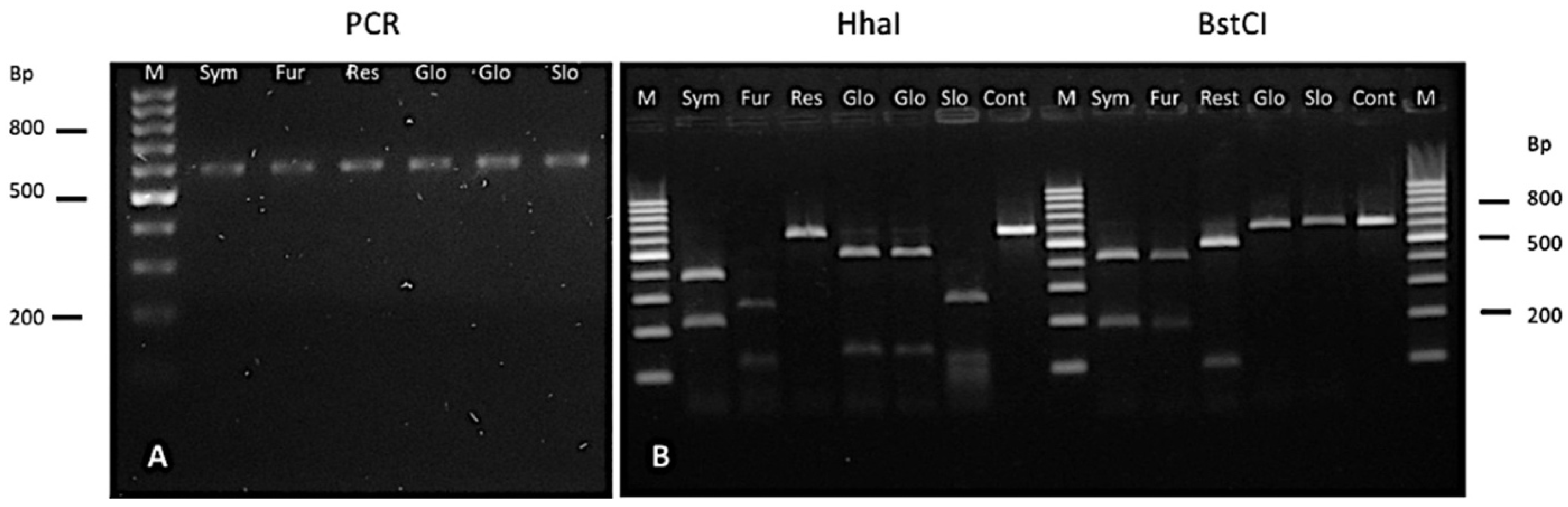
2.1. DNA Extraction and PCR
2.2. Restriction Fragment Length Polymorphism (RFLP)
2.3. Statistical Analysis
3. Results
3.1. Epidemiological Data
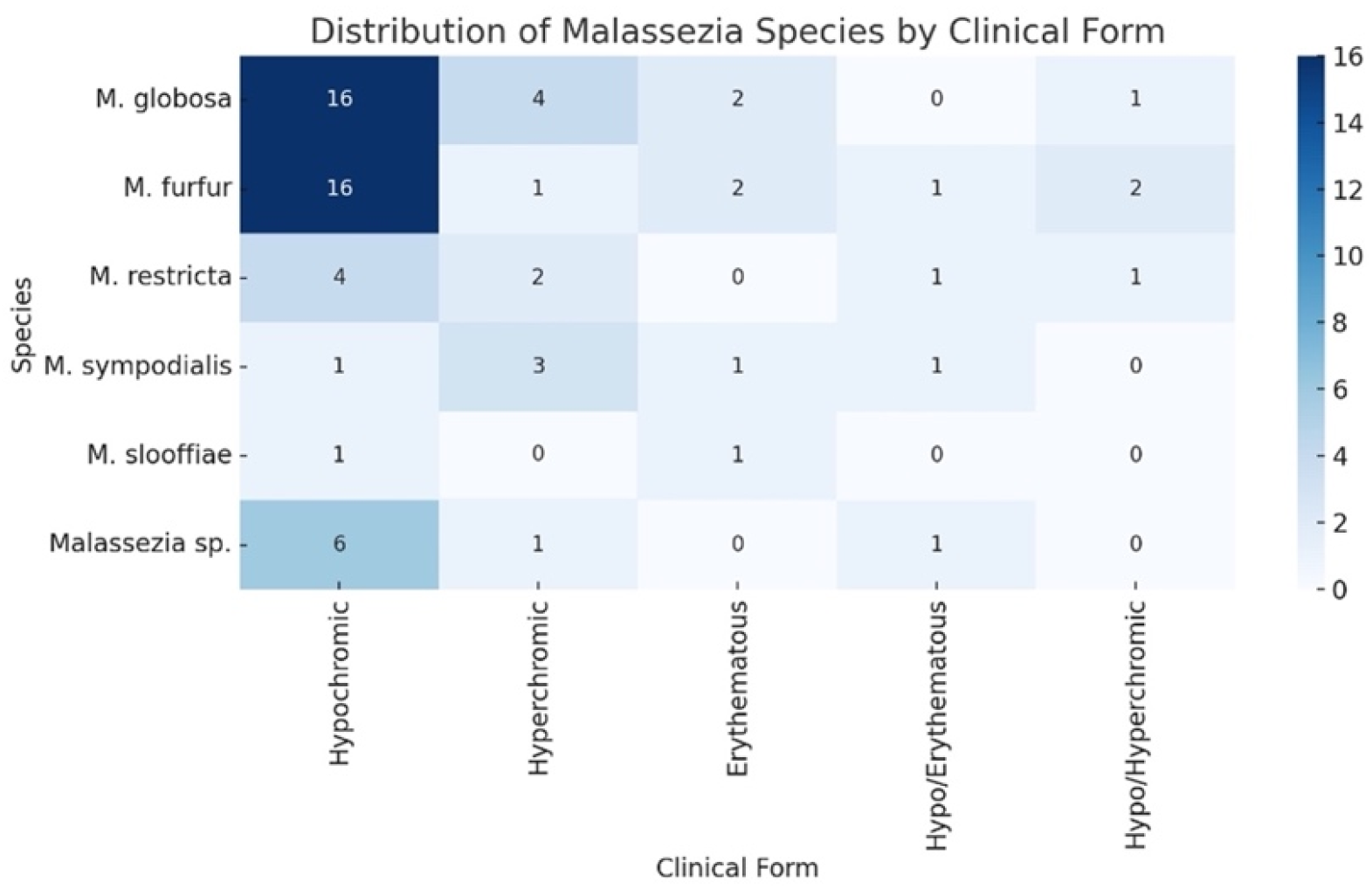
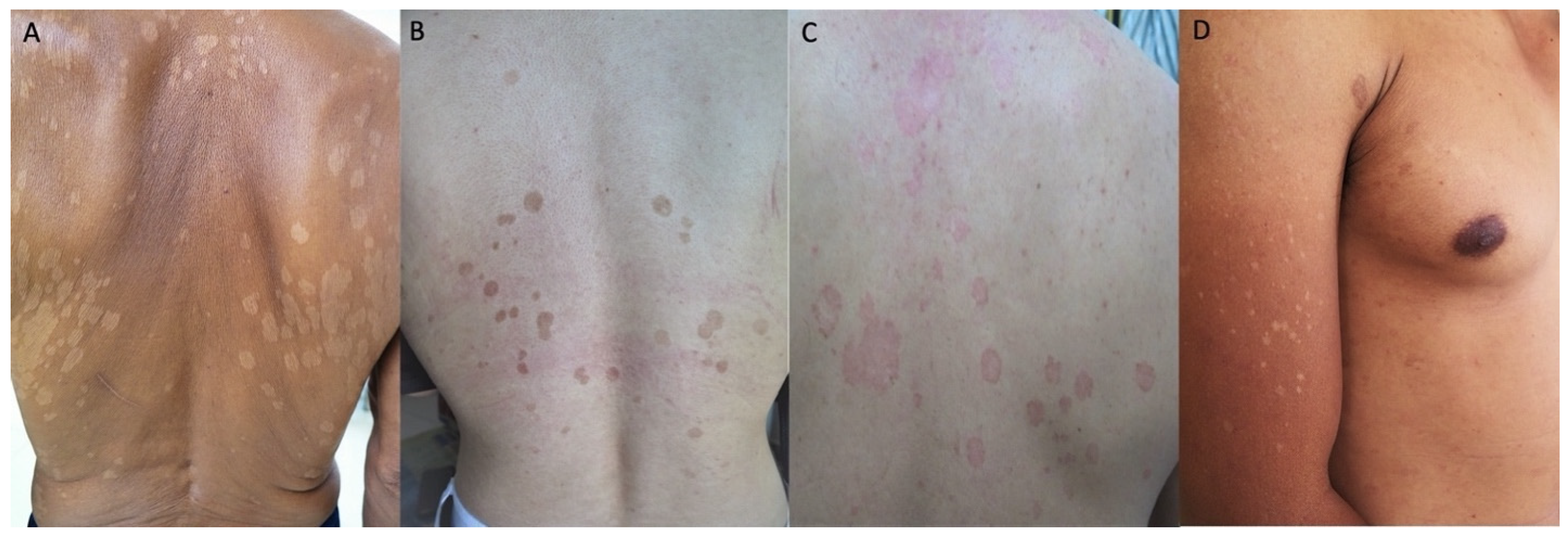
3.2. Clinical Type of Pityriasis Versicolor Associated with Malassezia Species
3.3. Clinical Type of Pityriasis Versicolor Associated with Gender
3.4. Association Between Malassezia Species and Gender
4. Discussion
5. Conclusions
Author Contributions
Funding
Institutional Review Board Statement
Informed Consent Statement
Data Availability Statement
Acknowledgments
Conflicts of Interest
Abbreviations
| 26S rDNA | 26S ribosomal DNA |
| 580 bp | 580 base pairs |
| DNA | Deoxyribonucleic Acid |
| HhaI and BstCI enzymes | Restriction endonucleases HhaI and BstCI |
| ITS | Internal Transcribed Spacer |
| M. | Malassezia |
| PCR | Polymerase Chain Reaction |
| PCR-RFLP | Polymerase Chain Reaction–Restriction Fragment Length Polymorphism |
References
- Leung, A.K.; Barankin, B.; Lam, J.M.; Leong, K.F.; Hon, K.L. Tinea versicolor: An updated review. Drugs Context 2022, 11, 2022-9-2. [Google Scholar] [CrossRef] [Scilit]
- Nguyen, B.D.; Vo, H.T.T.; Thanh, M.D.T.; Van Vu, T.; Lai, T.T.T.; Nguyen, M.T.; Bui, A.T.H.; Van Trinh, K.; Cao, L.B.; Trieu, S.T.; et al. Epidemiological characterization of pityriasis versicolor and distribution of Malassezia species among students in Hai Phong city, Vietnam. Curr. Med. Mycol. 2020, 6, 11–17. [Google Scholar]
- Archana, B.R.; Beena, P.M.; Kumar, S. Study of the Distribution of Malassezia Species in Patients with Pityriasis Versicolor in Kolar Region, Karnataka. Indian J. Dermatol. 2015, 60, 321. [Google Scholar] [CrossRef] [Scilit] [PubMed]
- Gupta, A.K.; Bluhm, R.; Summerbell, R. Pityriasis versicolor. J. Eur. Acad. Dermatol. Venereol. 2002, 16, 19–33. [Google Scholar] [CrossRef] [Scilit]
- Hernández, H.F.; Méndez Tovar, L.J.; Bazán, M.E.; Arévalo, L.A.; Valera, B.A.; López, M.R. Especies de Malassezia asociadas a diversas dermatosis y a piel sana en población mexicana. Rev. Iberoam. De Micol. 2003, 20, 141–144. [Google Scholar]
- Guého, E.; Midgley, G.; Guillot, J. The genus Malassezia with description of four new species. Antonie Van Leeuwenhoek 1996, 69, 337–355. [Google Scholar] [CrossRef] [Scilit]
- Blin, N.; Stafford, D.W. A general method for isolation of high molecular weight DNA from eukaryotes. Nucleic Acids Res. 1976, 3, 2303–2308. [Google Scholar] [CrossRef] [Scilit]
- Elshabrawy, W.O.; Saudy, N.; Sallam, M. Molecular and Phenotypic Identification and Speciation of Malassezia Yeasts Isolated from Egyptian Patients with Pityriasis Versicolor. J. Clin. Diagn. Res. 2017, 11, DC12–DC17. [Google Scholar] [CrossRef] [Scilit]
- Li, W.; Zhang, Z.W.; Luo, Y.; Liang, N.; Pi, X.X.; Fan, Y.M. Molecular epidemiology, in vitro susceptibility and exoenzyme screening of Malassezia clinical isolates. J. Med. Microbiol. 2020, 69, 436–442. [Google Scholar] [CrossRef] [Scilit] [PubMed]
- Honnavar, P.; Dogra, S.; Handa, S.; Chakrabarti, A.; Rudramurthy, S.M. Molecular Identification and Quantification of Malassezia Species Isolated from Pityriasis Versicolor. Indian Dermatol. Online J. 2020, 11, 167–170. [Google Scholar] [CrossRef] [Scilit]
- Awad, A.K.; Al-Ezzy, A.I.A.; Jameel, G.H. Phenotypic Identification and Molecular Characterization of Malassezia Spp. Isolated from Pityriasis Versicolor Patients with Special Emphasis to Risk Factors in Diyala Province, Iraq. Open Access Maced. J. Med. Sci. 2019, 7, 707–714. [Google Scholar] [CrossRef] [Scilit]
- Talaee, R.; Katiraee, F.; Ghaderi, M.; Erami, M.; Kazemi Alavi, A.; Nazeri, M. Molecular identification and prevalence of malassezia species in pityriasis versicolor patients from kashan, iran. Jundishapur J. Microbiol. 2014, 7, e11561. [Google Scholar] [CrossRef] [Scilit]
- Eghtedarnejad, E.; Khajeh, S.; Zomorodian, K.; Ghasemi, Z.; Yazdanpanah, S.; Motamedi, M. Direct molecular analysis of Malassezia species from the clinical samples of patients with pityriasis versicolor. Curr. Med. Mycol. 2023, 9, 28–31. [Google Scholar]
- Vuran, E.; Karaarslan, A.; Karasartova, D.; Turegun, B.; Sahin, F. Identification of Malassezia species from pityriasis versicolor lesions with a new multiplex PCR method. Mycopathologia 2014, 177, 41–49. [Google Scholar] [CrossRef] [Scilit]
- Didehdar, M.; Mehbod, A.S.; Eslamirad, Z.; Mosayebi, M.; Hajihossein, R.; Ghorbanzade, B.; Khazaei, M.R. Identification of Malassezia Species Isolated from Patients with Pityriasis Versicolor Using PCR-RFLP Method in Markazi Province, Central Iran. Iran J. Public Health 2014, 43, 682–686. [Google Scholar] [PubMed]
- Jagielski, T.; Rup, E.; Ziolkowska, A.; Roeske, K.; Macura, A.B.; Bielecki, J. Distribution of Malassezia species on the skin of patients with atopic dermatitis, psoriasis, and healthy volunteers assessed by conventional and molecular identification methods. BMC Dermatol. 2014, 14, 3. [Google Scholar] [CrossRef] [Scilit] [PubMed]
- Ilahi, A.; Hadrich, I.; Neji, S.; Trabelsi, H.; Makni, F.; Ayadi, A. Real-Time PCR Identification of Six Malassezia Species. Curr. Microbiol. 2017, 74, 671–677. [Google Scholar] [CrossRef] [Scilit] [PubMed]
- Affes, M.; Ben Salah, S.; Makni, F.; Sellami, H.; Ayadi, A. Molecular identification of Malassezia species isolated from dermatitis affections. Mycoses 2009, 52, 251–256. [Google Scholar] [CrossRef] [Scilit] [PubMed]
- Theelen, B.; Christinaki, A.C.; Dawson, T.L.; Boekhout, T.; Kouvelis, V.N. Comparative analysis of Malassezia furfur mitogenomes and the development of a mitochondria-based typing approach. FEMS Yeast Res. 2021, 21, foab051. [Google Scholar] [CrossRef] [Scilit] [PubMed]
- Sasikumar, J.; Ebrahim, R.A.; Das, S.P. Diverse Colonisation and Disease Associations of the Human Commensal Malassezia: Our Body’s Secret Tenant. Mycoses 2025, 68, e70014. [Google Scholar] [CrossRef] [Scilit]
- Gaitanis, G.; Velegraki, A.; Frangoulis, E.; Mitroussia, A.; Tsigonia, A.; Tzimogianni, A.; Katsambas, A.; Legakis, N.J. Identification of Malassezia species from patient skin scales by PCR-RFLP. Clin. Microbiol. Infect. 2002, 8, 162–173. [Google Scholar] [CrossRef] [Scilit] [PubMed]
- Kiran, K.; Rudresh, S.M.; Raksha, Y.; Ragunatha, S.; Jyoti, G.; Shivaprakash, M.R. Molecular identification of Malassezia from the skin scrapings of clinically suspected cases of pityriasis versicolor. Indian J. Pathol. Microbiol. 2024, 68, 354–359. [Google Scholar] [CrossRef] [Scilit] [PubMed]
- Giusiano, G.; Sosa Mde, L.; Rojas, F.; Vanacore, S.T.; Mangiaterra, M. Prevalence of Malassezia species in pityriasis versicolor lesions in northeast Argentina. Rev. Iberoam. Micol. 2010, 27, 71–74. [Google Scholar] [CrossRef] [Scilit]
- Santana, J.O.; Azevedo, F.L.; Campos Filho, P.C. Pityriasis versicolor: Clinical-epidemiological characterization of patients in the urban area of Buerarema-BA, Brazil. An. Bras. Dermatol. 2013, 88, 216–221. [Google Scholar] [CrossRef] [Scilit]
- Morais, P.M.; Cunha Mda, G.; Frota, M.Z. Clinical aspects of patients with pityriasis versicolor seen at a referral center for tropical dermatology in Manaus, Amazonas, Brazil. An. Bras. Dermatol. 2010, 85, 797–803. [Google Scholar] [CrossRef] [Scilit]
- Heidrich, D.; Daboit, T.C.; Stopiglia, C.D.; Magagnin, C.M.; Vetoratto, G.; Amaro, T.G.; Scroferneker, M.L. Sixteen Years of Pityriasis Versicolor in Metropolitan Area of Porto Alegre, Southern Brazil. Rev. Inst. Med. Trop. S. Paulo 2015, 57, 277–280. [Google Scholar] [CrossRef] [Scilit]
- Łabędź, N.; Navarrete-Dechent, C.; Kubisiak-Rzepczyk, H.; Bowszyc-Dmochowska, M.; Pogorzelska-Antkowiak, A.; Pietkiewicz, P. Pityriasis Versicolor-A Narrative Review on the Diagnosis and Management. Life 2023, 13, 2097. [Google Scholar] [CrossRef] [Scilit]
- Gaitanis, G.; Velegraki, A.; Alexopoulos, E.C.; Chasapi, V.; Tsigonia, A.; Katsambas, A. Distribution of Malassezia species in pityriasis versicolor and seborrhoeic dermatitis in Greece. Typing of the major pityriasis versicolor isolate M. globosa. Br. J. Dermatol. 2006, 154, 854–859. [Google Scholar] [CrossRef] [Scilit] [PubMed]
- Shokohi, T.; Afshar, P.; Barzgar, A. Distribution of Malassezia species in patients with pityriasis versicolor in Northern Iran. Indian J. Med. Microbiol. 2009, 27, 321–324. [Google Scholar] [CrossRef] [Scilit]
- Makimura, K.; Tamura, Y.; Kudo, M.; Uchida, K.; Saito, H.; Yamaguchi, H. Species identification and strain typing of Malassezia species stock strains and clinical isolates based on the DNA sequences of nuclear ribosomal internal transcribed spacer 1 regions. J. Med. Microbiol. 2000, 49, 29–35. [Google Scholar] [CrossRef] [Scilit] [PubMed]
- Ch, R.; Vieille, P.; Giusiano, G.; Sosa, M.d.l.Á. Pitiriasis Versicolor por Malassezia Pachydermatis: Caso Clínico. Bol. Micol. 2010, 25, 37–41. [Google Scholar]
- Lyakhovitsky, A.; Shemer, A.; Amichai, B. Molecular analysis of Malassezia species isolated from Israeli patients with pityriasis versicolor. Int. J. Dermatol. 2013, 52, 231–233. [Google Scholar] [CrossRef] [Scilit]
- Xie, Z.; Ran, Y.; Zhang, H.; Zhang, M.; Wan, H.; Li, C. An analysis of the Malassezia species distribution in the skin of patients with pityriasis versicolor in Chengdu, China. Sci. World J. 2014, 2014, 182596. [Google Scholar] [CrossRef] [Scilit]
- Park, H.J.; Lee, Y.W.; Choe, Y.B.; Ahn, K.J. Skin Characteristics in Patients with Pityriasis Versicolor Using Non-Invasive Method, MPA5. Ann. Dermatol. 2012, 24, 444–452. [Google Scholar] [CrossRef] [Scilit] [PubMed]
- Krisanty, R.I.; Bramono, K.; Made Wisnu, I. Identification of Malassezia species from pityriasis versicolor in Indonesia and its relationship with clinical characteristics. Mycoses 2009, 52, 257–262. [Google Scholar] [CrossRef] [Scilit] [PubMed]
- Boekhout, T.; Kamp, M.; Gueho, E. Molecular typing of Malassezia species with PFGE and RAPD. Med. Mycol. 1998, 36, 365–372. [Google Scholar] [CrossRef] [Scilit] [PubMed]
- Petruccelli, R.; Cosio, T.; Camicia, V.; Fiorilla, C.; Gaziano, R.; D’Agostini, C. Malassezia furfur bloodstream infection: Still a diagnostic challenge in clinical practice. Med. Mycol. Case Rep. 2024, 45, 100657. [Google Scholar] [CrossRef] [Scilit]



| Age Range (Years) | Males | Females | Total (n, %) |
|---|---|---|---|
| 0–10 | 9 | 3 | 12 (17.4) |
| 11–20 | 17 | 7 | 24 (34.8) |
| 21–30 | 6 | 7 | 13 (18.9) |
| 31–40 | 4 | 4 | 8 (11.6) |
| 41–50 | 4 | 1 | 5 (7.2) |
| 51–60 | 3 | 0 | 3 (4.3) |
| 61–70 | 3 | 0 | 3 (4.3) |
| >70 | 1 | 0 | 1 (1.5) |
| Total (n, %) | 47 (68.1) | 22 (31.9) | 69 (100) |
| Clinical Form | Total | M. globosa | M. furfur | M. restricta | M. sympodialis | M. slooffiae | Malassezia spp. | p-Value |
|---|---|---|---|---|---|---|---|---|
| n = 69 | n = 23 | n = 22 | n = 8 | n = 6 | n = 2 | n = 8 | ||
| Hypochromic, n (%) | 44 (63.8) | 16 (69.6) | 16 (72.7) | 4 (50.0) | 1 (16.7) | 1 (50.0) | 6 (75.0) | 0.140 * |
| Hyperchromic, n (%) | 11 (15.9) | 4 (17.4) | 1 (4.6) | 2 (25.0) | 3 (50.0) | 0 (0.0) | 1 (12.5) | 0.122 * |
| Erythematous, n (%) | 6 (8.7) | 2 (8.7) | 2 (9.1) | 0 (0.0) | 1 (16.7) | 1 (50.0) | 0 (0.0) | 0.338 * |
| Hypochromic–Erythematous, n (%) | 4 (5.8) | 0 (0.0) | 1 (4.6) | 1 (12.5) | 1 (16.7) | 0 (0.0) | 1 (12.5) | 0.224 * |
| Hypochromic–Hyperchromic, n (%) | 4 (5.8) | 1 (4.4) | 2 (9.1) | 1 (12.5) | 0 (0.0) | 0 (0.0) | 0 (0.0) | 0.829 * |
| Clinical Form | Total (n = 69) | Males (n = 47) | Females (n = 22) | p-Value |
|---|---|---|---|---|
| Hypochromic, n (%) | 44 (63.8) | 32 (68.1) | 12 (54.6) | 0.276 |
| Hyperchromic, n (%) | 11 (15.9) | 6 (12.8) | 5 (22.7) | 0.310 * |
| Erythematous, n (%) | 6 (8.7) | 3 (6.4) | 3 (13.6) | 0.375 * |
| Hypochromic–Erythematous, n (%) | 4 (5.8) | 4 (8.5) | 0 (0.0) | 0.299 * |
| Hypochromic–Hyperchromic, n (%) | 4 (5.8) | 2 (4.3) | 2 (9.1) | 0.587 * |
| Species | Total (n = 69) | Males (n = 47) | Females (n = 22) | p-Value |
|---|---|---|---|---|
| M. globosa | 23 (33.3) | 14 (29.8) | 9 (40.9) | 0.316 * |
| M. furfur | 22 (31.9) | 17 (36.2) | 5 (22.7) | |
| M. restricta | 8 (11.6) | 6 (12.8) | 2 (9.1) | |
| M. sympodialis | 6 (8.7) | 5 (10.6) | 1 (4.6) | |
| M. slooffiae | 2 (2.9) | 0 (0) | 2 (9.1) | |
| Malassezia spp. | 8 (11.6) | 5 (10.6) | 3 (13.6) |
Disclaimer/Publisher’s Note: The statements, opinions and data contained in all publications are solely those of the individual author(s) and contributor(s) and not of MDPI and/or the editor(s). MDPI and/or the editor(s) disclaim responsibility for any injury to people or property resulting from any ideas, methods, instructions or products referred to in the content. |
© 2026 by the authors. Licensee MDPI, Basel, Switzerland. This article is an open access article distributed under the terms and conditions of the Creative Commons Attribution (CC BY) license.
Share and Cite
Romero-Navarrete, M.; Hernández-Hernández, F.; Arenas, R.; Castillo-Solana, A.; Martínez-Aguilar, L.M.; Córdova-Martínez, E.; Herrera-Ramírez, B.S.; Plangsiri, S.; Rattananukrom, T. Chromatic Variants of Pityriasis Versicolor and Molecular Species Identification Using Polymerase Chain Reaction-Restriction Fragment Length Polymorphism (PCR-RFLP). J. Fungi 2026, 12, 202. https://doi.org/10.3390/jof12030202
Romero-Navarrete M, Hernández-Hernández F, Arenas R, Castillo-Solana A, Martínez-Aguilar LM, Córdova-Martínez E, Herrera-Ramírez BS, Plangsiri S, Rattananukrom T. Chromatic Variants of Pityriasis Versicolor and Molecular Species Identification Using Polymerase Chain Reaction-Restriction Fragment Length Polymorphism (PCR-RFLP). Journal of Fungi. 2026; 12(3):202. https://doi.org/10.3390/jof12030202
Chicago/Turabian StyleRomero-Navarrete, Marina, Francisca Hernández-Hernández, Roberto Arenas, Aureliano Castillo-Solana, Lizbeth Magnolia Martínez-Aguilar, Erika Córdova-Martínez, Brianda Stephanie Herrera-Ramírez, Settanan Plangsiri, and Teerapong Rattananukrom. 2026. "Chromatic Variants of Pityriasis Versicolor and Molecular Species Identification Using Polymerase Chain Reaction-Restriction Fragment Length Polymorphism (PCR-RFLP)" Journal of Fungi 12, no. 3: 202. https://doi.org/10.3390/jof12030202
APA StyleRomero-Navarrete, M., Hernández-Hernández, F., Arenas, R., Castillo-Solana, A., Martínez-Aguilar, L. M., Córdova-Martínez, E., Herrera-Ramírez, B. S., Plangsiri, S., & Rattananukrom, T. (2026). Chromatic Variants of Pityriasis Versicolor and Molecular Species Identification Using Polymerase Chain Reaction-Restriction Fragment Length Polymorphism (PCR-RFLP). Journal of Fungi, 12(3), 202. https://doi.org/10.3390/jof12030202