
The FoPLT Gene of Fusarium oxysporum Affects Conidial Development and Pathogenicity

Abstract
1. Introduction
2. Materials and Methods
2.1. Tested Strains and Plasmids
2.2. Screening of Virulence-Weakening Mutants of F. oxysporum
2.3. Bioinformatics Analysis
2.4. Construction of Knockout and Complementation Strains
2.5. Observation of Biological Phenotypes of F. oxysporum
2.6. Mung Bean Inoculation and Infection
2.7. Potted M. robusta Seedlings
3. Results
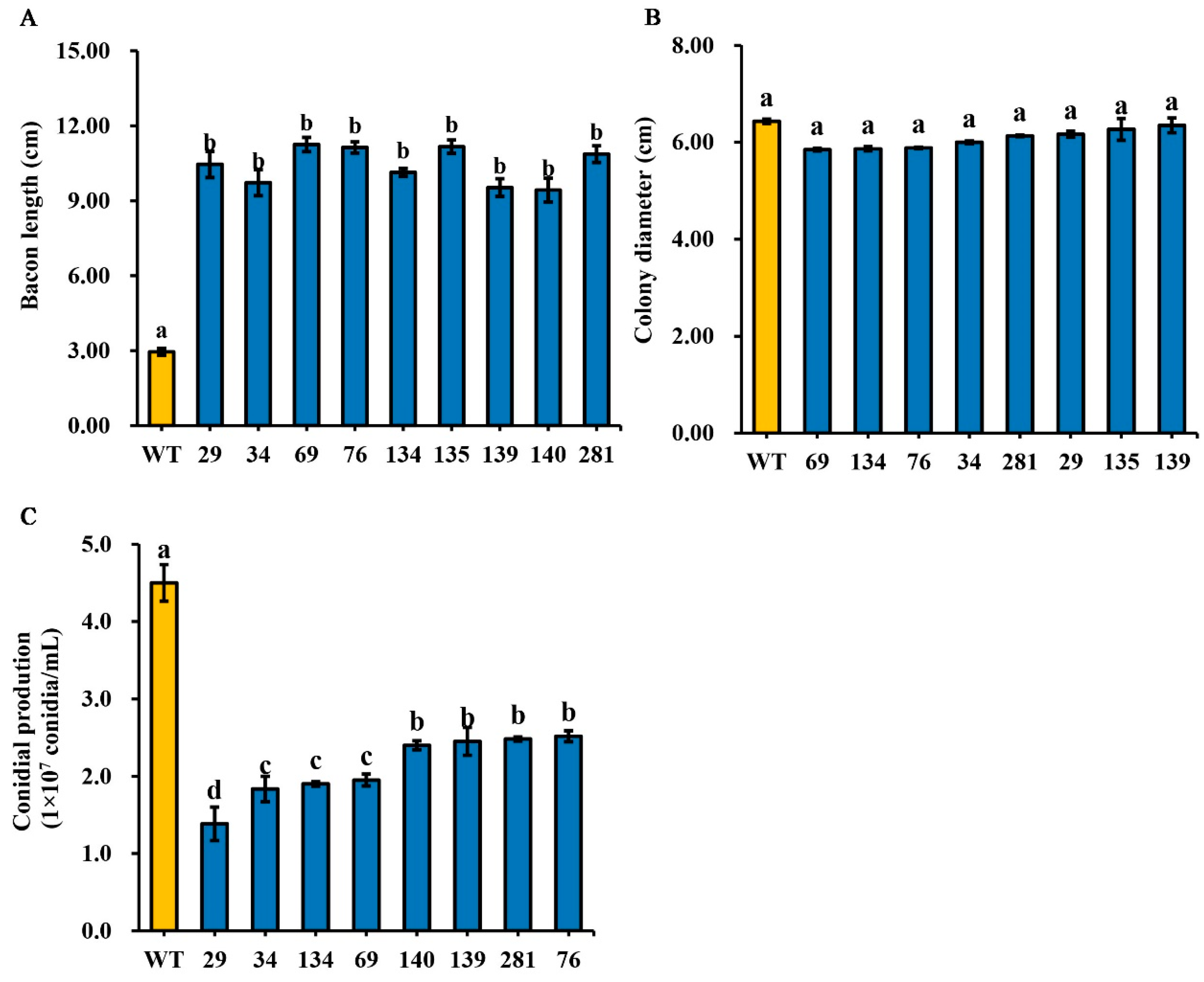
3.1. Screening and Identification of the FoPLT Gene in F. oxysporum
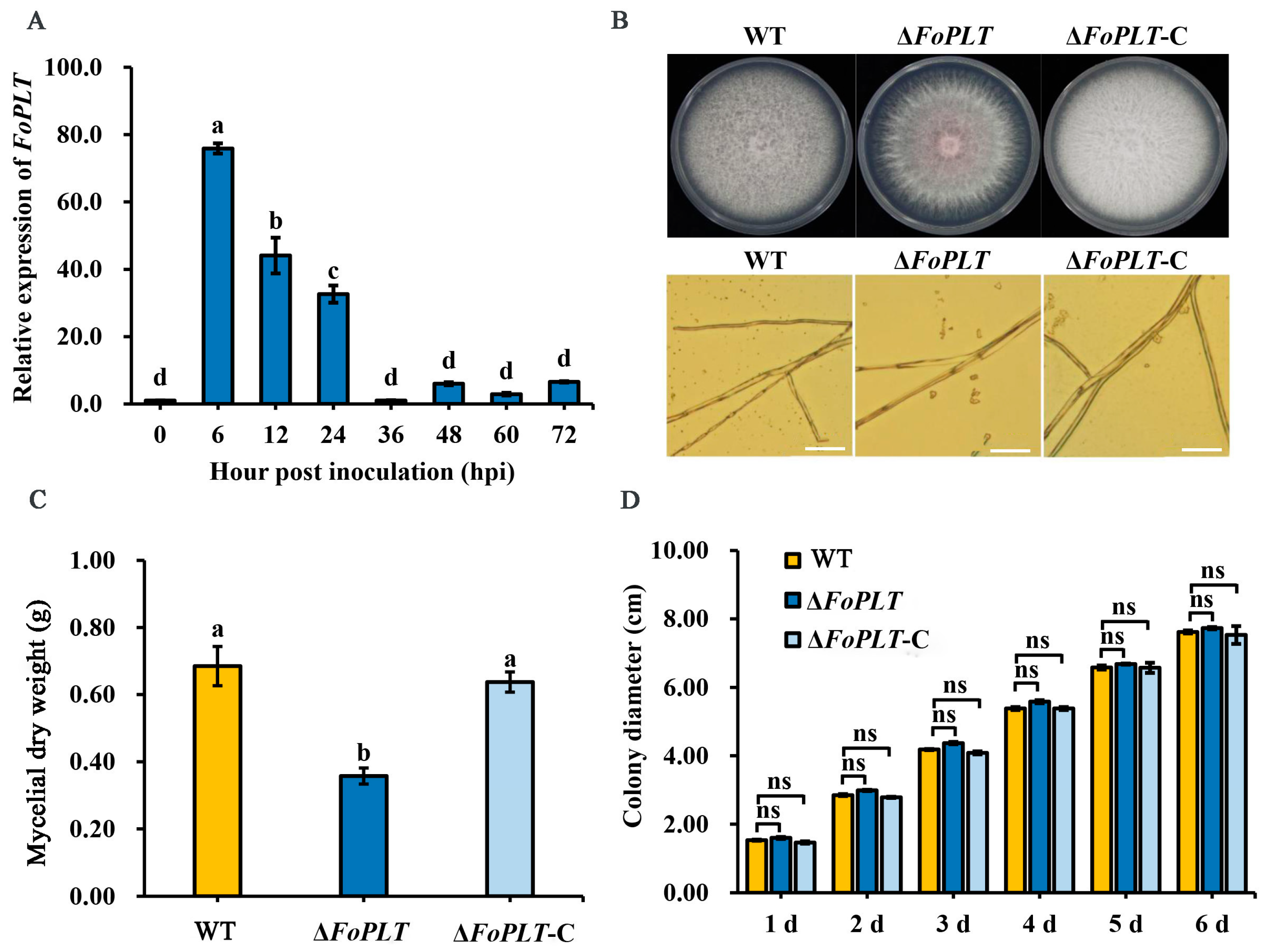
3.2. FoPLT Is Involved in F. oxysporum Vegetative Growth
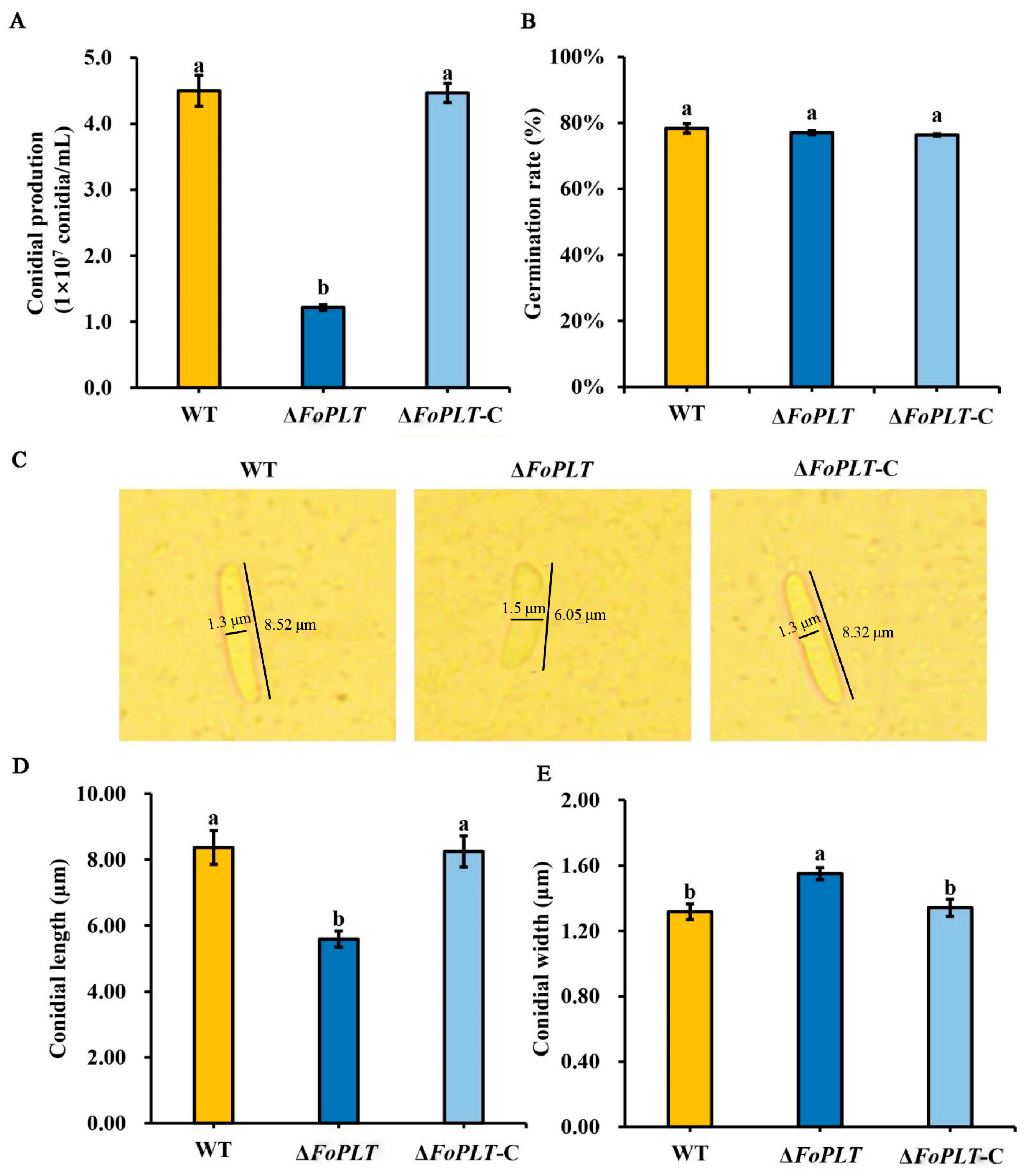
3.3. FoPLT Affects Conidial Formation of F. oxysporum
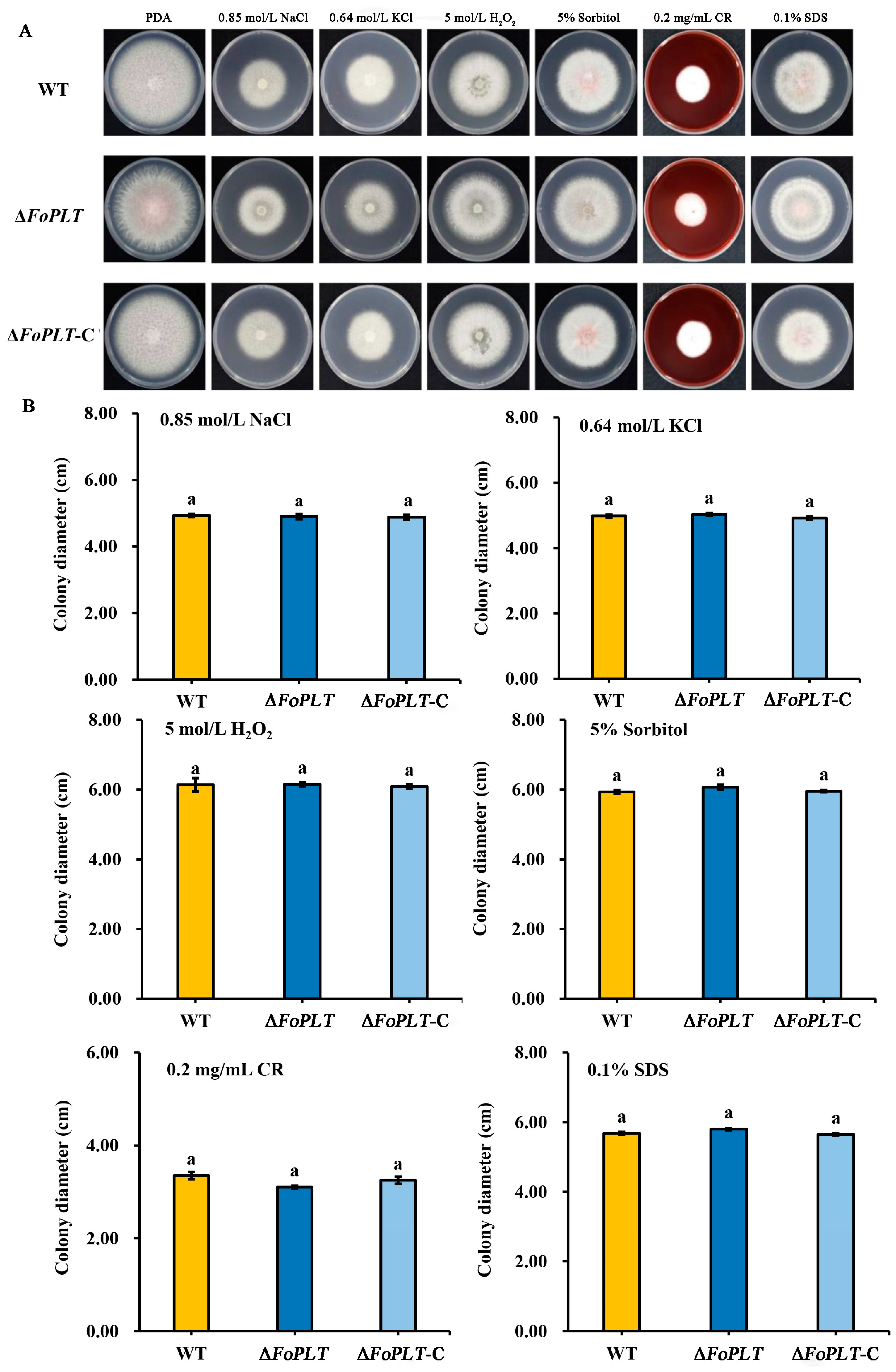
3.4. FoPLT Does Not Affect Cell Wall Integrity
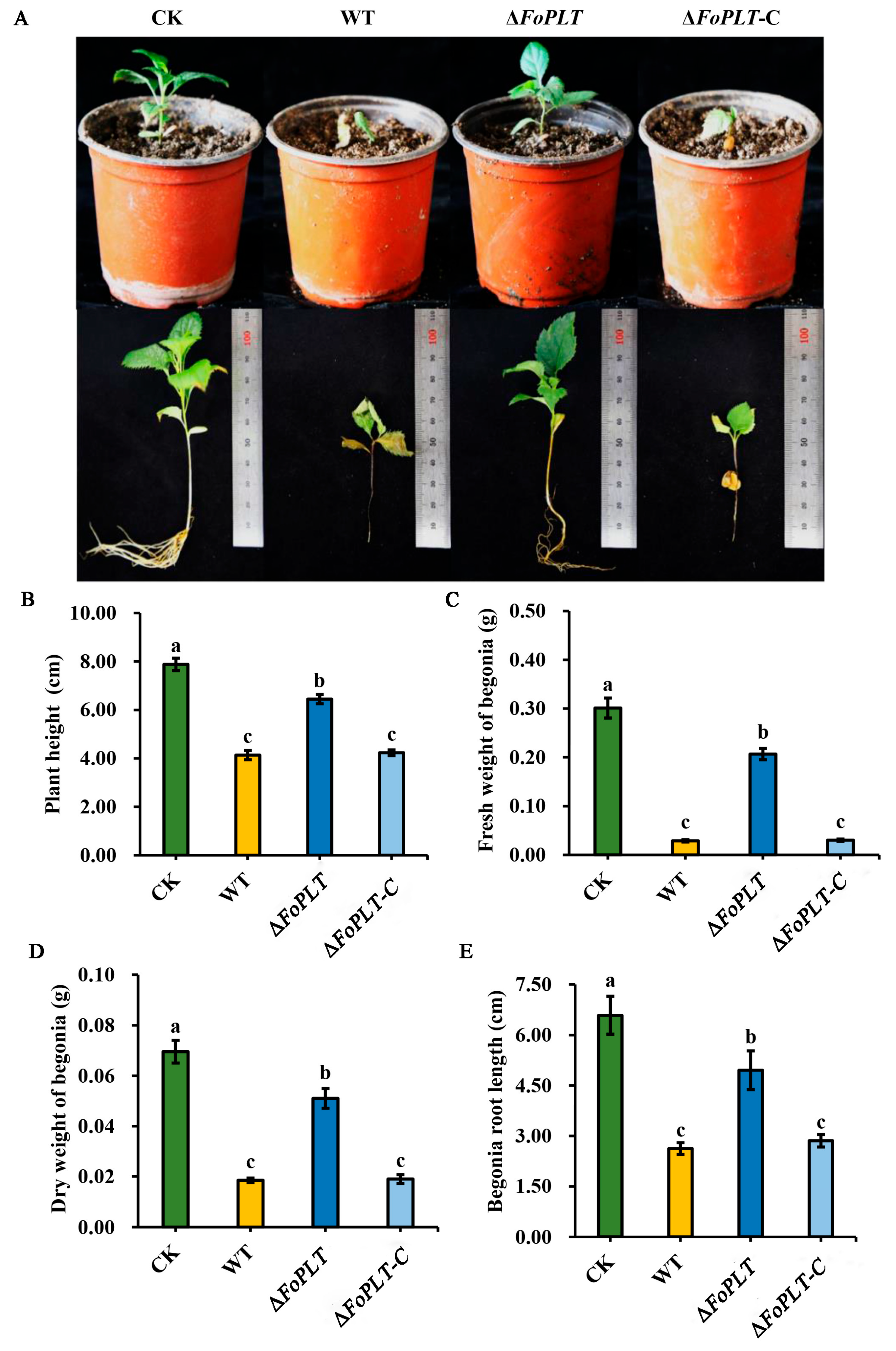
3.5. FoPLT Affects the Pathogenicity of F. oxysporum Strain HS2
4. Discussion
5. Conclusions
Supplementary Materials
Author Contributions
Funding
Institutional Review Board Statement
Informed Consent Statement
Data Availability Statement
Acknowledgments
Conflicts of Interest
Abbreviations
References
- Mazzola, M.; Manici, L.M. Apple replant disease: Role of microbial ecology in cause and control. Annu. Rev. Phytopathol. 2012, 50, 45–65. [Google Scholar] [CrossRef]
- Bai, R.; Ma, F.; Liang, D.; Zhao, X. Phthalic acid induces oxidative stress and alters the activity of some antioxidant enzymes in roots of Malus prunifolia. J. Chem. Ecol. 2009, 35, 488–494. [Google Scholar] [CrossRef]
- Tewoldemedhin, Y.T.; Mazzola, M.; Labuschagne, I.; Mostert, L.; McLeod, A. A multi-phasic approach reveals that apple replant disease is caused by multiple biological agents, with some agents acting synergistically. Soil Biol. Biochem. 2011, 43, 1917–1927. [Google Scholar] [CrossRef]
- Kelderer, M.; Manici, L.M.; Caputo, F.; Thalheimer, M.; Nicoletti, F.; Schmitt, A.O. Planting in the “inter-row” to overcome replant disease in apple orchards: A study on the effectiveness of the practice based on microbial indicators. Plant Soil 2012, 357, 381–393. [Google Scholar] [CrossRef]
- Martinez, R.; Aguilar, M.I.; Guirado, M.L.; Gomez, J.; Armengol, J.; Garcia-Jimenez, J. First report of Fusarium wilt of cucumber caused by Fusarium oxysporum in Spain. Plant Pathol. 2014, 98, 1435. [Google Scholar] [CrossRef]
- Damodaran, T.; Rajan, S.; Mishra, V.K.; Gautam, R.K.; Jha, S.K.; Sharma, P.C. First report of Fusarium wilt in banana caused by Fusarium oxysporum f. sp. Cubense tropical race 4 in India. Plant Dis. 2019, 103, 1022. [Google Scholar] [CrossRef]
- Halpern, H.C.; Bell, A.A.; Wagner, T.A.; Liu, J.; Creswell, T.; Wheeler, T.A. First report of Fusarium wilt of cotton caused by Fusarium oxysporum f. sp. Vasinfectum race 4 in Texas, USA. Plant Dis. 2018, 102, 446. [Google Scholar] [CrossRef]
- Singh, V.K.; Singh, H.B.; Upadhyay, R.S. Role of fusaric acid in the development of Fusarium wilt symptoms in tomato: Physiological, biochemical and proteomic perspectives. Plant Physiol. Biochem. 2017, 118, 320–332. [Google Scholar] [CrossRef] [PubMed]
- Bravo Ruiz, G.; Di Pietro, A.; Roncero, M.I.G. Combined action of the major secreted exo- and endopolygalacturonases is required for full virulence of Fusarium oxysporum. Mol. Plant Pathol. 2016, 17, 339–353. [Google Scholar] [CrossRef]
- Liu, S.; Li, J.; Zhang, Y.; Liu, N.; Viljoen, A.; Mostert, D. Fusaric acid instigates the invasion of banana by Fusarium oxysporum f. sp. Cubense TR4. New Phytol. 2020, 225, 913–929. [Google Scholar] [CrossRef]
- Liu, N.; Ma, X.; Sun, Y.; Hou, Y.; Zhang, X.; Chen, Q. Necrotizing activity of Verticillium dahlia and Fusarium oxysporum f. sp. Vasinfectum endopolygalacturonases in cotton. Plant Dis. 2017, 101, 1128–1138. [Google Scholar] [CrossRef] [PubMed]
- Crickmore, N.; Nicholls, C.; Earp, D.J. The construction of Bacillus thuringiensis strains expressing novel entomocidal δ-endotoxin combinations. Biochem. J. 1990, 270, 133–136. [Google Scholar] [CrossRef]
- Niño-Sánchez, J.; Casado-Del Castillo, V.; Tello, V.; De Vega-Bartol, J.; Ramos, B.; Sukno, S. The FTF gene family regulates virulence and expression of SIX effectors in Fusarium oxysporum. Mol. Plant Pathol. 2016, 17, 1124–1139. [Google Scholar] [CrossRef]
- Qin, J.; Wu, M.; Zhou, S. FgEaf6 regulates virulence, asexual/sexual development and conidial septation in Fusarium graminearum. Curr. Genet. 2020, 66, 517–529. [Google Scholar] [CrossRef] [PubMed]
- Ospina-Giraldo, M.D.; Mullins, E.; Kang, S. Loss of function of the Fusarium oxysporum SNF1 gene reduces virulence on cabbage and Arabidopsis. Curr. Genet. 2003, 44, 49–57. [Google Scholar] [CrossRef]
- Husaini, A.M.; Sakina, A.; Cambay, S.R. Host–pathogen interaction in Fusarium oxysporum infections: Where do we stand? Mol. Plant-Microbe Interact. 2018, 31, 889–898. [Google Scholar] [CrossRef]
- Dong, Z.; Luo, M.; Wang, Z. An exo-polygalacturonase Pgc4 regulates aerial hyphal growth and virulence in Fusarium oxysporum f. sp. Cubense race 4. Int. J. Mol. Sci. 2020, 21, 5886. [Google Scholar] [CrossRef]
- Yan, Y.; Tang, J.; Yuan, Q.; Peng, Y.L.; Li, D.W.; Yang, J. ChCDC25 regulates infection-related morphogenesis and pathogenicity of the crucifer anthracnose fungus Colletotrichum higginsianum. Front. Microbiol. 2020, 11, 763. [Google Scholar] [CrossRef]
- Kleinboelting, N.; Huep, G.; Appelhagen, I.; Viehoever, P.; Li, Y.; Mueller-Roeber, B. The structural features of thousands of T-DNA insertion sites are consistent with a double-strand break repair-based insertion mechanism. Mol. Plant. 2015, 8, 1651–1664. [Google Scholar] [CrossRef]
- Li, J.; Staiger, C.J. Understanding cytoskeletal dynamics during the plant immune response. Annu. Rev. Phytopathol. 2018, 56, 513–533. [Google Scholar] [CrossRef] [PubMed]
- Gilbert, M.J.; Thornton, C.R.; Wakley, G.E.; Talbot, N.J. A P-type ATPase required for rice blast disease and induction of host resistance. Nature 2006, 440, 535–539. [Google Scholar] [CrossRef]
- Yi, M.; Chi, M.H.; Khang, C.H.; Park, S.Y.; Kang, S.; Valent, B. The ER chaperone LHS1 is involved in asexual development and rice infection by the blast fungus Magnaporthe oryzae. Plant Cell 2009, 21, 681–695. [Google Scholar] [CrossRef] [PubMed]
- Chen, Y.; Zuo, R.; Zhu, Q.; Sun, Y.; Li, M.; Yu, Y. MoLys2 is necessary for growth, conidiogenesis, lysine biosynthesis, and pathogenicity in Magnaporthe oryzae. Fungal Genet. Biol. 2014, 67, 5–57. [Google Scholar] [CrossRef]
- Suda, Y.; Neiman, A.M. The Predicted Structure of S. cerevisiae Ssp1 Reveals Parallel Evolution in the Pil1 BAR Domain Family Proteins of Ascomycetes. J. Fungi 2025, 11, 661. [Google Scholar] [CrossRef] [PubMed]
- Yao, Z.; Zou, C.; Zhou, H.; Hu, X.; Qiu, M.; Yang, R. Δ1-Pyrroline-5-carboxylate/glutamate biogenesis is required for fungal virulence and sporulation. PLoS ONE 2013, 8, e73483. [Google Scholar]
- Yan, X.; Que, Y.W.; Wang, H.; Liu, X.F.; Gao, Z.M.; Zhang, H.F. The MET13 methylenetetrahydrofolate reductase gene is essential for infection-related morphogenesis in the rice blast fungus Magnaporthe oryzae. PLoS ONE 2013, 8, e76914. [Google Scholar] [CrossRef]
- Que, Y.; Yue, X.; Yang, N.; Xu, L.; Liu, H.; Li, Z. Leucine biosynthesis is required for infection-related morphogenesis and pathogenicity in the rice blast fungus Magnaporthe oryzae. Curr. Genet. 2020, 66, 155–171. [Google Scholar] [CrossRef]
- Stanchev, L.D.; Rizzo, J.; Peschel, R.; Pazurek, L.A.; Bredegaard, L.; Veit, S.; Laerbusch, S.; Rodrigues, M.L.; López-Marqués, R.L.; Günther Pomorski, T. P-Type ATPase Apt1 of the Fungal Pathogen Cryptococcus neoformans Is a Lipid Flippase of Broad Substrate Specificity. J. Fungi 2021, 7, 843. [Google Scholar] [CrossRef] [PubMed]
- Veit, S.; Laerbusch, S.; López-Marqués, R.L.; Günther Pomorski, T. Functional Analysis of the P-Type ATPases Apt2-4 from Cryptococcus neoformans by Heterologous Expression in Saccharomyces cerevisiae. J. Fungi 2023, 9, 202. [Google Scholar] [CrossRef]
- Zhao, C.-R.; You, Z.-L.; Bai, L. Fungal Plasma Membrane H+-ATPase: Structure, Mechanism, and Drug Discovery. J. Fungi 2024, 10, 273. [Google Scholar] [CrossRef]


Disclaimer/Publisher’s Note: The statements, opinions and data contained in all publications are solely those of the individual author(s) and contributor(s) and not of MDPI and/or the editor(s). MDPI and/or the editor(s) disclaim responsibility for any injury to people or property resulting from any ideas, methods, instructions or products referred to in the content. |
© 2026 by the authors. Licensee MDPI, Basel, Switzerland. This article is an open access article distributed under the terms and conditions of the Creative Commons Attribution (CC BY) license.
Share and Cite
Han, X.; Zhang, Y.; Fu, T.; Liu, Y.; Zhu, Y.; Wang, Y.; Meng, X.; Dai, P.; Cao, K.; Li, B.; et al. The FoPLT Gene of Fusarium oxysporum Affects Conidial Development and Pathogenicity. J. Fungi 2026, 12, 194. https://doi.org/10.3390/jof12030194
Han X, Zhang Y, Fu T, Liu Y, Zhu Y, Wang Y, Meng X, Dai P, Cao K, Li B, et al. The FoPLT Gene of Fusarium oxysporum Affects Conidial Development and Pathogenicity. Journal of Fungi. 2026; 12(3):194. https://doi.org/10.3390/jof12030194
Chicago/Turabian StyleHan, Xiaoqi, Yanglin Zhang, Tianhao Fu, Yinuo Liu, Yanzhao Zhu, Yanan Wang, Xianglong Meng, Pengbo Dai, Keqiang Cao, Bo Li, and et al. 2026. "The FoPLT Gene of Fusarium oxysporum Affects Conidial Development and Pathogenicity" Journal of Fungi 12, no. 3: 194. https://doi.org/10.3390/jof12030194
APA StyleHan, X., Zhang, Y., Fu, T., Liu, Y., Zhu, Y., Wang, Y., Meng, X., Dai, P., Cao, K., Li, B., & Wang, S. (2026). The FoPLT Gene of Fusarium oxysporum Affects Conidial Development and Pathogenicity. Journal of Fungi, 12(3), 194. https://doi.org/10.3390/jof12030194