
Early Antifungal Treatment in Immunocompromised Patients, Including Hematological and Critically Ill Patients

 , , , , , , and
Abstract
1. Introduction
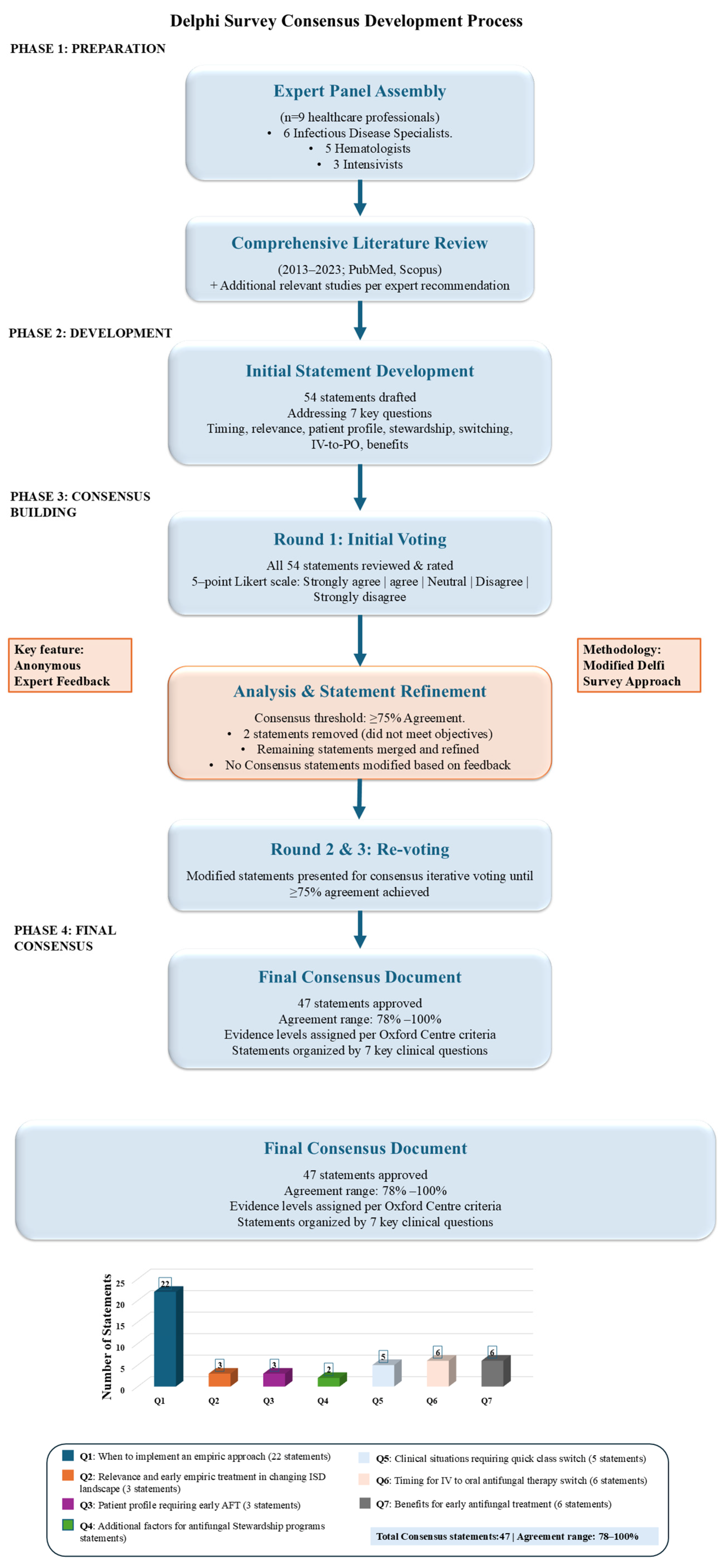
2. Materials and Methods
- When is the empiric approach appropriate and should be implemented (what types of centers, diagnostic tools, and clinical situations)?
- Relevance of early empiric treatment approach in the changing IFD landscape (including epidemiology, between clinical guidelines and clinical practice).
- What are the clinical situations or patients’ profiles when AF treatment should be prescribed early?
- Should additional factors (local epidemiology, antifungal prophylaxis) be considered when choosing an antifungal for empiric therapy to form antifungal stewardship programs?
- What are the clinical situations or patient profiles that require a quick class switch? (Indications for switching between the antifungal classes).
- What is the best time to switch from intravenous (IV) to per os (PO) antifungal therapy? What are the clinical signs and symptoms that may trigger a switch from IV to PO?
- What are the benefits of early antifungal treatment in reducing mortality rate, hospital/ICU stay, and time to clinical improvement in different patient populations?
3. Results
- a.
- Hematology patients:
- b.
- Non-neutropenic ICU patients:
- a.
- Hematology Patients:
- b.
- ICU Patients:

| Number | Statement/Recommendation | Percentage of Agreement | Level of Evidence |
|---|---|---|---|
| Q7. Benefits of early antifungal treatmentin reducing mortality rate, hospital/ICU stay, and time to clinical improvement in different patient populations. | |||
| Hematology patients: | |||
| 42. | In the case of mucormycosis, the application of early, multidisciplinary treatment approaches, including aggressive surgical debridement, improves the survival rate, particularly in patients with hematological malignancies. | 100% | IV |
| 43. | The use of empiric antifungal therapy in neutropenic patients with persistent fever reduces the incidence and morbidity of invasive fungal diseases | 100% | I |
| 44. | Voriconazole use is associated with higher survival rates of hematology patients suffering from acute respiratory failure and invasive pulmonary aspergillosis | 78% | IV |
| ICU patients: | |||
| 45. | Early empiric treatment in high-risk populations is associated with a low incidence of invasive candidiasis in critically ill patients | 78% | IV |
| 46. | Invasive aspergillosis is associated with a high mortality rate in critically ill patients if not adequately treated | 100% | V |
| 47. | Early antifungal treatment may be used to decrease the morbidity and mortality of critically ill patients and immunocompromised patients | 89% | V |
4. Conclusions
Author Contributions
Funding
Institutional Review Board Statement
Informed Consent Statement
Data Availability Statement
Acknowledgments
Conflicts of Interest
Abbreviations
| AFT | Antifungal Therapy |
| AML | Acute Myeloid Leukemia |
| APACHE | Acute Physiology and Chronic Health Evaluation II |
| AST-IDCOP | American Society of Transplantation Infectious Diseases Community of Practice |
| BAL | Bronchoalveolar Lavage |
| BDG | β-(1,3)-d-glucan |
| CAGTA | C. albicans Germ Tube Antibody |
| cfDNA | Cell-Free DNA |
| CFW | Calcofluor White Stain |
| CT | Computed Tomography |
| EAT | Empiric Antimicrobial Therapy |
| ECIL | The European Conference on Infections in Leukemia |
| GM | Galactomannan Antigen |
| HCPs | Healthcare Professionals |
| HSCT | Hematopoietic Stem Cell Transplant |
| IA | Invasive Aspergillosis |
| IC | Invasive Candidiasis |
| ICU | Intensive Care Unit |
| IDSA | Infectious Diseases Society of America |
| IFDs | Invasive Fungal Diseases |
| IM | Invasive Mucormycosis |
| IPA | Invasive Pulmonary Aspergillosis |
| IV | Intravenous |
| PCR | Polymerase Chain Reaction |
| PO | Per Os |
Appendix A
| Levels of Evidence | |
|---|---|
| I | Evidence from at least one large randomized, controlled trial of good methodological quality (low potential for bias) or meta-analyses of well-conducted randomized trials without heterogeneity |
| II | Small randomized trials or large randomized trials with a suspicion of bias (lower methodological quality) or meta-analyses of such trials or trials demonstrating heterogeneity |
| III | Prospective cohort studies |
| IV | Retrospective cohort studies or case–control studies |
| V | Studies without a control group, case reports, or expert opinions |
References
- Caira, M.; Girmenia, C.; Fadda, R.M.; Mitra, M.E.; Picardi, M.; Van Lint, M.T.; Nosari, A.; Candoni, A.; Bonini, A.; Mattei, D. Invasive fungal infections in patients with acute myeloid leukemia and in those submitted to allogeneic hemopoietic stem cell transplant: Who is at highest risk? Eur. J. Haematol. 2008, 81, 242–243. [Google Scholar] [CrossRef] [PubMed]
- Sipsas, N.V.; Lewis, R.E.; Tarrand, J.; Hachem, R.; Rolston, K.V.; Raad, I.I.; Kontoyiannis, D.P. Candidemia in patients with hematologic malignancies in the era of new antifungal agents (2001–2007) Stable incidence but changing epidemiology of a still frequently lethal infection. Cancer 2009, 115, 4745–4752. [Google Scholar] [CrossRef] [PubMed]
- Chamilos, G.; Luna, M.; Lewis, R.E.; Bodey, G.P.; Chemaly, R.; Tarrand, J.J.; Safdar, A.; Kontoyiannis, D.P. Invasive fungal infections in patients with hematologic malignancies in a tertiary care cancer center: An autopsy study over a 15-year period (1989–2003). Haematologica 2006, 91, 986–989. [Google Scholar] [PubMed]
- Latgé, J.-P. Aspergillus fumigatus and aspergillosis. Clin. Microbiol. Rev. 1999, 12, 310–350. [Google Scholar] [CrossRef]
- Janssens, I.; Lambrecht, B.N.; Van Braeckel, E. Aspergillus and the Lung. Semin. Respir. Crit. Care Med. 2024, 45, 3–20. [Google Scholar] [CrossRef]
- Silva, S.; Negri, M.; Henriques, M.; Oliveira, R.; Williams, D.W.; Azeredo, J. Candida glabrata, Candida parapsilosis and Candida tropicalis: Biology, epidemiology, pathogenicity and antifungal resistance. FEMS Microbiol. Rev. 2012, 36, 288–305. [Google Scholar] [CrossRef]
- Steinbrink, J.M.; Miceli, M.H. Mucormycosis. Infect. Dis. Clin. North Am. 2021, 35, 435–452. [Google Scholar] [CrossRef]
- Nguyen, M.H.; Leather, H.; Clancy, C.J.; Cline, C.; Jantz, M.A.; Kulkarni, V.; Wheat, L.J.; Wingard, J.R. Galactomannan testing in bronchoalveolar lavage fluid facilitates the diagnosis of invasive pulmonary aspergillosis in patients with hematologic malignancies and stem cell transplant recipients. Biol. Blood Marrow Transplant. 2011, 17, 1043–1050. [Google Scholar] [CrossRef]
- Caillot, D.; Latrabe, V.; Thiébaut, A.; Herbrecht, R.; De Botton, S.; Pigneux, A.; Monchecourt, F.; Mahi, L.; Alfandari, S.; Couaillier, J.-F. Computer tomography in pulmonary invasive aspergillosis in hematological patients with neutropenia: An useful tool for diagnosis and assessment of outcome in clinical trials. Eur. J. Radiol. 2010, 74, e172–e175. [Google Scholar] [CrossRef]
- Cuenca-Estrella, M.; Bassetti, M.; Lass-Flörl, C.; Ráčil, Z.; Richardson, M.; Rogers, T.R. Detection and investigation of invasive mould disease. J. Antimicrob. Chemother. 2011, 66, i15–i24. [Google Scholar] [CrossRef]
- Clancy, C.J.; Nguyen, M.H. Diagnosing Invasive Candidiasis. J. Clin. Microbiol. 2018, 56, e01909-17. [Google Scholar] [CrossRef] [PubMed]
- Pemán, J.; Ruiz-Gaitán, A. Diagnosing invasive fungal infections in the laboratory today: It’s all good news? Rev. Iberoam. Micol. 2025, 42, 1–14. [Google Scholar] [CrossRef] [PubMed]
- Huang, Q.Y.; Li, P.C.; Yue, J.R. Diagnostic performance of serum galactomannan and β-D-glucan for invasive aspergillosis in suspected patients: A meta-analysis. Medicine 2024, 103, e37067. [Google Scholar] [CrossRef] [PubMed]
- Eades, C.P.; Bakri, A.R.B.A.; Lau, J.C.Y.; Moore, C.B.; Novak-Frazer, L.; Richardson, M.D.; Rautemaa-Richardson, R. Comparison of β-1-3-D-Glucan and Candida Mannan Biomarker Assays with Serological Tests for the Diagnosis of Candidemia. J. Fungi 2023, 9, 813. [Google Scholar] [CrossRef]
- Haydour, Q.; Hage, C.A.; Carmona, E.M.; Epelbaum, O.; Evans, S.E.; Gabe, L.M.; Knox, K.S.; Kolls, J.K.; Wengenack, N.L.; Prokop, L.J.; et al. Diagnosis of Fungal Infections. A Systematic Review and Meta-Analysis Supporting American Thoracic Society Practice Guideline. Ann. Am. Thorac. Soc. 2019, 16, 1179–1188. [Google Scholar] [CrossRef]
- Christner, M.; Abdennadher, B.; Wichmann, D.; Kluge, S.; Pepić, A.; Aepfelbacher, M.; Rohde, H.; Olearo, F. The added value of (1,3)-β-D-glucan for the diagnosis of Invasive Candidiasis in ICU patients: A prospective cohort study. Infection 2024, 52, 73–81. [Google Scholar] [CrossRef]
- Ullah, N.; Muccio, M.; Magnasco, L.; Sepulcri, C.; Giacobbe, D.R.; Vena, A.; Bassetti, M.; Mikulska, M. Species-Specific Sensitivity and Levels of Beta-D-Glucan for the Diagnosis of Candidemia—A Systematic Review and Meta-Analysis. J. Fungi 2025, 11, 149. [Google Scholar] [CrossRef]
- Senchyna, F.; Hogan, C.A.; Murugesan, K.; Moreno, A.; Ho, D.Y.; Subramanian, A.; Schwenk, H.T.; Budvytiene, I.; Costa, H.A.; Gombar, S.; et al. Clinical Accuracy and Impact of Plasma Cell-Free DNA Fungal Polymerase Chain Reaction Panel for Noninvasive Diagnosis of Fungal Infection. Clin. Infect. Dis. 2021, 73, 1677–1684. [Google Scholar] [CrossRef]
- Mah, J.; Nicholas, V.; Tayyar, R.; Moreno, A.; Murugesan, K.; Budvytiene, I.; Banaei, N. Superior Accuracy of Aspergillus Plasma Cell-Free DNA Polymerase Chain Reaction Over Serum Galactomannan for the Diagnosis of Invasive Aspergillosis. Clin. Infect. Dis. 2023, 77, 1282–1290. [Google Scholar] [CrossRef]
- Lieu, A.; Zimmet, A.N.; Pozdol, J.; Kushner, L.E.; Ho, D.; Banaei, N. Concordance of Noninvasive Plasma Cell-free DNA with Invasive Diagnostics for Diagnosis of Invasive Fungal Disease. Clin. Infect. Dis. 2025, 80, 1095–1102. [Google Scholar] [CrossRef]
- Valentine, J.C.; Morrissey, C.O.; Tacey, M.A.; Liew, D.; Patil, S.; Ananda-Rajah, M. A population-based analysis of attributable hospitalisation costs of invasive fungal diseases in haematological malignancy patients using data linkage of state-wide registry and costing databases: 2009–2015. Mycoses 2020, 63, 162–171. [Google Scholar] [CrossRef] [PubMed]
- Ananda-Rajah, M.R.; Cheng, A.; Morrissey, C.O.; Spelman, T.; Dooley, M.; Neville, A.M.; Slavin, M. Attributable hospital cost and antifungal treatment of invasive fungal diseases in high-risk hematology patients: An economic modeling approach. Antimicrob. Agents Chemother. 2011, 55, 1953–1960. [Google Scholar] [CrossRef] [PubMed]
- Pritzkuleit, R.; Beske, F.; Katalinic, A. Demographic change and cancer. Onkologie 2010, 33, 19–24. [Google Scholar] [CrossRef] [PubMed]
- Gross, B.N.; Steib-Bauert, M.; Kern, W.V.; Knoth, H.; Borde, J.P.; Krebs, S.; Hug, M.J.; Rothe, U.; Maier, L.; de With, K. Hospital use of systemic antifungal drugs: A multi-center surveillance update from Germany. Infection 2015, 43, 423–429. [Google Scholar] [CrossRef]
- Ferlay, J.; Soerjomataram, I.; Dikshit, R.; Eser, S.; Mathers, C.; Rebelo, M.; Parkin, D.M.; Forman, D.; Bray, F. Cancer incidence and mortality worldwide: Sources, methods and major patterns in GLOBOCAN 2012. Int. J. Cancer 2015, 136, E359–E386. [Google Scholar] [CrossRef]
- Pana, Z.D.; Roilides, E.; Warris, A.; Groll, A.H.; Zaoutis, T. Epidemiology of invasive fungal disease in children. J. Pediatr. Infect. Dis. Soc. 2017, 6, S3–S11. [Google Scholar] [CrossRef]
- Hovi, L.; Saarinen-Pihkala, U.M.; Vettenranta, K.; Saxen, H. Invasive fungal infections in pediatric bone marrow transplant recipients: Single center experience of 10 years. Bone Marrow Transplant. 2000, 26, 999–1004. [Google Scholar] [CrossRef]
- Groll, A.H.; Kurz, M.; Schneider, W.; Witt, V.; Schmidt, H.; Schneider, M.; Schwabe, D. Five-year-survey of invasive aspergillosis in a paediatric cancer centre. Epidemiology, management and long-term survival. Mycoses 1999, 42, 431–442. [Google Scholar] [CrossRef]
- Groll, A.H.; Jaeger, G.; Allendorf, A.; Herrmann, G.; Schloesser, R.; von Loewenich, V. Invasive pulmonary aspergillosis in a critically ill neonate: Case report and review of invasive aspergillosis during the first 3 months of life. Clin. Infect. Dis. 1998, 27, 437–452. [Google Scholar] [CrossRef]
- Broenen, E.; Mavinkurve-Groothuis, A.; Kamphuis-van Ulzen, K.; Brüggemann, R.; Verweij, P.; Warris, A. Screening of the central nervous system in children with invasive pulmonary aspergillosis. Med. Mycol. Case Rep. 2014, 4, 8–11. [Google Scholar] [CrossRef]
- Papouli, M.; Roilides, E.; Bibashi, E.; Andreou, A. Primary cutaneous aspergillosis in neonates: Case report and review. Clin. Infect. Dis. 1996, 22, 1102–1104. [Google Scholar] [CrossRef]
- Husain, S.A.-O.; Camargo, J.A.-O. Invasive Aspergillosis in solid-organ transplant recipients: Guidelines from the American Society of Transplantation Infectious Diseases Community of Practice. Clin. Transpl. 2019, 33, e13544. [Google Scholar] [CrossRef] [PubMed]
- Pappas, P.G.; Kauffman, C.A.; Andes, D.R.; Clancy, C.J.; Marr, K.A.; Ostrosky-Zeichner, L.; Reboli, A.C.; Schuster, M.G.; Vazquez, J.A.; Walsh, T.J.; et al. Clinical Practice Guideline for the Management of Candidiasis: 2016 Update by the Infectious Diseases Society of America. Clin. Infect. Dis. 2016, 62, e1–e50. [Google Scholar] [CrossRef] [PubMed]
- Groll, A.H.; Pana, D.; Lanternier, F.; Mesini, A.; Ammann, R.A.; Averbuch, D.; Castagnola, E.; Cesaro, S.; Engelhard, D.; Garcia-Vidal, C.; et al. 8th European Conference on Infections in Leukaemia: 2020 guidelines for the diagnosis, prevention, and treatment of invasive fungal diseases in paediatric patients with cancer or post-haematopoietic cell transplantation. Lancet Oncol 2021, 22, e254–e269. [Google Scholar] [CrossRef] [PubMed]
- Freifeld, A.G.; Bow, E.J.; Sepkowitz, K.A.; Boeckh, M.J.; Ito, J.I.; Mullen, C.A.; Raad, I.I.; Rolston, K.V.; Young, J.-A.H.; Wingard, J.R. Clinical practice guideline for the use of antimicrobial agents in neutropenic patients with cancer: 2010 update by the Infectious Diseases Society of America. Clin. Infect. Dis. 2011, 52, e56–e93. [Google Scholar] [CrossRef]
- Tissot, F.; Agrawal, S.; Pagano, L.; Petrikkos, G.; Groll, A.H.; Skiada, A.; Lass-Flörl, C.; Calandra, T.; Viscoli, C.; Herbrecht, R. ECIL-6 guidelines for the treatment of invasive candidiasis, aspergillosis and mucormycosis in leukemia and hematopoietic stem cell transplant patients. Haematologica 2017, 102, 433–444. [Google Scholar] [CrossRef]
- Linstone, H.; Turoff, M. The Delphi Method: Techniques and Applications; Addison-Wesley: Boston, MA, USA, 1975; Volume 18. [Google Scholar]
- Arendrup, M.C.; Bille, J.; Dannaoui, E.; Ruhnke, M.; Heussel, C.P.; Kibbler, C. ECIL-3 classical diagnostic procedures for the diagnosis of invasive fungal diseases in patients with leukaemia. Bone Marrow Transplant. 2012, 47, 1030–1045. [Google Scholar] [CrossRef]
- Segal, B.H.; Herbrecht, R.; Stevens, D.A.; Ostrosky-Zeichner, L.; Sobel, J.; Viscoli, C.; Walsh, T.J.; Maertens, J.; Patterson, T.F.; Perfect, J.R.; et al. Defining responses to therapy and study outcomes in clinical trials of invasive fungal diseases: Mycoses Study Group and European Organization for Research and Treatment of Cancer consensus criteria. Clin. Infect. Dis. 2008, 47, 674–683. [Google Scholar] [CrossRef]
- Diamond, I.R.; Grant, R.C.; Feldman, B.M.; Pencharz, P.B.; Ling, S.C.; Moore, A.M.; Wales, P.W. Defining consensus: A systematic review recommends methodologic criteria for reporting of Delphi studies. J. Clin. Epidemiol. 2014, 67, 401–409. [Google Scholar] [CrossRef]
- Dykewicz, C.A. Guidelines for preventing opportunistic infections among hematopoietic stem cell transplant recipients: Focus on community respiratory virus infections. Biol. Blood Marrow Transpl. 2001, 7, 19S–22S. [Google Scholar] [CrossRef][Green Version]
- Morrissey, C.O.; Gilroy, N.M.; Macesic, N.; Walker, P.; Ananda-Rajah, M.; May, M.; Heath, C.H.; Grigg, A.; Bardy, P.G.; Kwan, J.; et al. Consensus guidelines for the use of empiric and diagnostic-driven antifungal treatment strategies in haematological malignancy, 2014. Intern. Med. J. 2014, 44, 1298–1314. [Google Scholar] [CrossRef] [PubMed]
- Ko, B.S.; Chen, W.T.; Kung, H.C.; Wu, U.I.; Tang, J.L.; Yao, M.; Chen, Y.C.; Tien, H.F.; Chang, S.C.; Chuang, Y.C.; et al. 2016 guideline strategies for the use of antifungal agents in patients with hematological malignancies or hematopoietic stem cell transplantation recipients in Taiwan. J. Microbiol. Immunol. Infect. 2018, 51, 287–301. [Google Scholar] [CrossRef] [PubMed]
- Garcia-Vidal, C.; Alastruey-Izquierdo, A.; Aguilar-Guisado, M.; Carratalà, J.; Castro, C.; Fernández-Ruiz, M.; Aguado, J.M.; Fernández, J.M.; Fortún, J.; Garnacho-Montero, J.; et al. Executive summary of clinical practice guideline for the management of invasive diseases caused by Aspergillus: 2018 Update by the GEMICOMED-SEIMC/REIPI. Enferm. Infecc. Microbiol. Clin. (Engl. Ed.) 2019, 37, 535–541. [Google Scholar] [CrossRef] [PubMed]
- Prakash, R.; Prashanth, H.V.; Ragunatha, S.; Kapoor, M.; Anitha, T.K.; Krishnamurthy, V. Comparative study of efficacy, rapidity of detection, and cost-effectiveness of potassium hydroxide, calcofluor white, and Chicago sky blue stains in the diagnosis of dermatophytoses. Int. J. Dermatol. 2016, 55, e172–e175. [Google Scholar] [CrossRef]
- Zhang, S.; Chen, Z.; Deng, Z.; Fu, P.; Yu, Y.; Zhuang, Q.; Yu, X.; Chen, H.; Li, A.; Zheng, L. The value of calcofluor white in the diagnosis of invasive fungal diseases. Diagn. Microbiol. Infect. Dis. 2024, 108, 116186. [Google Scholar] [CrossRef]
- Ullmann, A.J.; Aguado, J.M.; Arikan-Akdagli, S.; Denning, D.W.; Groll, A.H.; Lagrou, K.; Lass-Flörl, C.; Lewis, R.E.; Munoz, P.; Verweij, P.E.; et al. Diagnosis and management of Aspergillus diseases: Executive summary of the 2017 ESCMID-ECMM-ERS guideline. Clin. Microbiol. Infect. 2018, 24, e1–e38. [Google Scholar] [CrossRef]
- Patterson, T.F.; Thompson, G.R., 3rd; Denning, D.W.; Fishman, J.A.; Hadley, S.; Herbrecht, R.; Kontoyiannis, D.P.; Marr, K.A.; Morrison, V.A.; Nguyen, M.H.; et al. Practice Guidelines for the Diagnosis and Management of Aspergillosis: 2016 Update by the Infectious Diseases Society of America. Clin. Infect. Dis. 2016, 63, e1–e60. [Google Scholar] [CrossRef]
- Lehrnbecher, T.; Robinson, P.D.; Ammann, R.A.; Fisher, B.; Patel, P.; Phillips, R.; Beauchemin, M.P.; Carlesse, F.; Castagnola, E.; Davis, B.L.; et al. Guideline for the Management of Fever and Neutropenia in Pediatric Patients With Cancer and Hematopoietic Cell Transplantation Recipients: 2023 Update. J. Clin. Oncol. 2023, 41, 1774–1785. [Google Scholar] [CrossRef]
- Groll, A.H.; Castagnola, E.; Cesaro, S.; Dalle, J.H.; Engelhard, D.; Hope, W.; Roilides, E.; Styczynski, J.; Warris, A.; Lehrnbecher, T. Fourth European Conference on Infections in Leukaemia (ECIL-4): Guidelines for diagnosis, prevention, and treatment of invasive fungal diseases in paediatric patients with cancer or allogeneic haemopoietic stem-cell transplantation. Lancet Oncol. 2014, 15, e327–e340. [Google Scholar] [CrossRef]
- Santolaya, M.E.; Alvarez, A.M.; Acuña, M.; Avilés, C.L.; Salgado, C.; Tordecilla, J.; Varas, M.; Venegas, M.; Villarroel, M.; Zubieta, M.; et al. Efficacy of pre-emptive versus empirical antifungal therapy in children with cancer and high-risk febrile neutropenia: A randomized clinical trial. J. Antimicrob. Chemother. 2018, 73, 2860–2866. [Google Scholar] [CrossRef]
- Döring, M.; Hartmann, U.; Erbacher, A.; Lang, P.; Handgretinger, R.; Müller, I. Caspofungin as antifungal prophylaxis in pediatric patients undergoing allogeneic hematopoietic stem cell transplantation: A retrospective analysis. BMC Infect. Dis. 2012, 12, 151. [Google Scholar] [CrossRef] [PubMed]
- Maertens, J.A.; Madero, L.; Reilly, A.F.; Lehrnbecher, T.; Groll, A.H.; Jafri, H.S.; Green, M.; Nania, J.J.; Bourque, M.R.; Wise, B.A.; et al. A randomized, double-blind, multicenter study of caspofungin versus liposomal amphotericin B for empiric antifungal therapy in pediatric patients with persistent fever and neutropenia. Pediatr. Infect. Dis. J. 2010, 29, 415–420. [Google Scholar] [CrossRef] [PubMed]
- Meersseman, W.; Lagrou, K.; Maertens, J.; Wilmer, A.; Hermans, G.; Vanderschueren, S.; Spriet, I.; Verbeken, E.; Van Wijngaerden, E. Galactomannan in bronchoalveolar lavage fluid: A tool for diagnosing aspergillosis in intensive care unit patients. Am. J. Respir. Crit. Care Med. 2008, 177, 27–34. [Google Scholar] [CrossRef]
- Wu, Z.; Wang, L.; Tan, L.; Wu, J.; Chen, Z.; Hu, M. Diagnostic value of galactomannan in serum and bronchoalveolar lavage fluid for invasive pulmonary aspergillosis in non-neutropenic patients. Diagn. Microbiol. Infect. Dis. 2021, 99, 115274. [Google Scholar] [CrossRef] [PubMed]
- Martin-Loeches, I.; Antonelli, M.; Cuenca-Estrella, M.; Dimopoulos, G.; Einav, S.; De Waele, J.J.; Garnacho-Montero, J.; Kanj, S.S.; Machado, F.R.; Montravers, P.; et al. ESICM/ESCMID task force on practical management of invasive candidiasis in critically ill patients. Intensive Care Med. 2019, 45, 789–805. [Google Scholar] [CrossRef]
- Chen, S.C.; Sorrell, T.C.; Chang, C.C.; Paige, E.K.; Bryant, P.A.; Slavin, M.A. Consensus guidelines for the treatment of yeast infections in the haematology, oncology and intensive care setting, 2014. Intern. Med. J. 2014, 44, 1315–1332. [Google Scholar] [CrossRef]
- Chaves, F.; Garnacho-Montero, J.; Del Pozo, J.L.; Bouza, E.; Capdevila, J.A.; de Cueto, M.; Domínguez, M.; Esteban, J.; Fernández-Hidalgo, N.; Fernández Sampedro, M.; et al. Executive summary: Diagnosis and Treatment of Catheter-Related Bloodstream Infection: Clinical Guidelines of the Spanish Society of Clinical Microbiology and Infectious Diseases (SEIMC) and the Spanish Society of Intensive Care Medicine and Coronary Units (SEMICYUC). Enferm. Infecc. Microbiol. Clin. (Engl. Ed.) 2018, 36, 112–119. [Google Scholar] [CrossRef]
- Geersing, T.H.; Franssen, E.J.F.; Spronk, P.E.; van Kan, H.J.M.; den Reijer, M.; van der Voort, P.H.J. Nephrotoxicity of continuous amphotericin B in critically ill patients with abdominal sepsis: A retrospective analysis with propensity score matching. J. Antimicrob. Chemother. 2021, 77, 246–252. [Google Scholar] [CrossRef]
- Kilpatrick, R.; Scarrow, E.; Hornik, C.; Greenberg, R.G. Neonatal invasive candidiasis: Updates on clinical management and prevention. Lancet Child Adolesc. Health 2022, 6, 60–70. [Google Scholar] [CrossRef]
- Fang, W.; Wu, J.; Cheng, M.; Zhu, X.; Du, M.; Chen, C.; Liao, W.; Zhi, K.; Pan, W. Diagnosis of invasive fungal infections: Challenges and recent developments. J. Biomed. Sci. 2023, 30, 42. [Google Scholar] [CrossRef] [PubMed]
- Warris, A.; Lehrnbecher, T.; Roilides, E.; Castagnola, E.; Brüggemann, R.J.M.; Groll, A.H. ESCMID-ECMM guideline: Diagnosis and management of invasive aspergillosis in neonates and children. Clin. Microbiol. Infect. 2019, 25, 1096–1113. [Google Scholar] [CrossRef] [PubMed]
- Cornely, O.A.; Arikan-Akdagli, S.; Dannaoui, E.; Groll, A.H.; Lagrou, K.; Chakrabarti, A.; Lanternier, F.; Pagano, L.; Skiada, A.; Akova, M.; et al. ESCMID and ECMM joint clinical guidelines for the diagnosis and management of mucormycosis 2013. Clin. Microbiol. Infect. 2014, 20, 5–26. [Google Scholar] [CrossRef] [PubMed]
- Rosam, K.; Steixner, S.; Bauer, A.; Lass-Flörl, C. Non-conventional diagnostic methods for invasive fungal infections. Expert Rev. Mol. Diagn. 2025, 25, 313–327. [Google Scholar] [CrossRef]
- Gupta, M.K.; Kumar, N.; Dhameja, N.; Sharma, A.; Tilak, R. Laboratory diagnosis of mucormycosis: Present perspective. J. Fam. Med. Prim. Care 2022, 11, 1664–1671. [Google Scholar] [CrossRef]
- Douglas, A.P.; Smibert, O.C.; Bajel, A.; Halliday, C.L.; Lavee, O.; McMullan, B.; Yong, M.K.; van Hal, S.J.; Chen, S.C. Consensus guidelines for the diagnosis and management of invasive aspergillosis, 2021. Intern. Med. J. 2021, 51, 143–176. [Google Scholar] [CrossRef]
- Walsh, T.J.; Groll, A.; Hiemenz, J.; Fleming, R.; Roilides, E.; Anaissie, E. Infections due to emerging and uncommon medically important fungal pathogens. Clin. Microbiol. Infect. 2004, 10, 48–66. [Google Scholar] [CrossRef]
- Keighley, C.; Cooley, L.; Morris, A.J.; Ritchie, D.; Clark, J.E.; Boan, P.; Worth, L.J. Consensus guidelines for the diagnosis and management of invasive candidiasis in haematology, oncology and intensive care settings, 2021. Intern. Med. J. 2021, 51, 89–117. [Google Scholar] [CrossRef]
- Mermel, L.A.; Allon, M.; Bouza, E.; Craven, D.E.; Flynn, P.; O’Grady, N.P.; Raad, I.I.; Rijnders, B.J.; Sherertz, R.J.; Warren, D.K. Clinical practice guidelines for the diagnosis and management of intravascular catheter-related infection: 2009 Update by the Infectious Diseases Society of America. Clin. Infect. Dis. 2009, 49, 1–45. [Google Scholar] [CrossRef]
- Medical Mycology Society of Chinese Medicine and Education Association; Chinese Mucormycosis Expert Consensus Group. Expert consensus on diagnosis and management of mucormycosis in China. Zhonghua Nei Ke Za Zhi 2023, 62, 597–605. [Google Scholar] [CrossRef]
- Yang, N.; Zhang, L.; Feng, S. Clinical Features and Treatment Progress of Invasive Mucormycosis in Patients with Hematological Malignancies. J. Fungi 2023, 9, 592. [Google Scholar] [CrossRef] [PubMed]
- Elitzur, S.; Arad-Cohen, N.; Barg, A.; Litichever, N.; Bielorai, B.; Elhasid, R.; Fischer, S.; Fruchtman, Y.; Gilad, G.; Kapelushnik, J.; et al. Mucormycosis in children with haematological malignancies is a salvageable disease: A report from the Israeli Study Group of Childhood Leukemia. Br. J. Haematol. 2020, 189, 339–350. [Google Scholar] [CrossRef] [PubMed]
- Miller, M.A.; Molina, K.C.; Gutman, J.A.; Scherger, S.; Lum, J.M.; Mossad, S.B.; Burgess, M.; Cheng, M.P.; Chuang, S.T.; Jacobs, S.E.; et al. Mucormycosis in Hematopoietic Cell Transplant Recipients and in Patients With Hematological Malignancies in the Era of New Antifungal Agents. Open Forum Infect. Dis. 2021, 8, ofaa646. [Google Scholar] [CrossRef]
- Goldberg, E.; Gafter-Gvili, A.; Robenshtok, E.; Leibovici, L.; Paul, M. Empirical antifungal therapy for patients with neutropenia and persistent fever: Systematic review and meta-analysis. Eur. J. Cancer 2008, 44, 2192–2203. [Google Scholar] [CrossRef]
- Chen, K.; Wang, Q.; Pleasants, R.A.; Ge, L.; Liu, W.; Peng, K.; Zhai, S. Empiric treatment against invasive fungal diseases in febrile neutropenic patients: A systematic review and network meta-analysis. BMC Infect. Dis. 2017, 17, 159. [Google Scholar] [CrossRef]
- Pardo, E.; Lemiale, V.; Mokart, D.; Stoclin, A.; Moreau, A.S.; Kerhuel, L.; Calvet, L.; Valade, S.; De Jong, A.; Darmon, M.; et al. Invasive pulmonary aspergillosis in critically ill patients with hematological malignancies. Intensive Care Med. 2019, 45, 1732–1741. [Google Scholar] [CrossRef]
- Colaneri, M.; Giusti, E.M.; Genovese, C.; Galli, L.; Lombardi, A.; Gori, A. Mortality of Patients With Candidemia and COVID-19: A Systematic Review With Meta-analysis. Open Forum Infect. Dis. 2023, 10, ofad358. [Google Scholar] [CrossRef]
- Feys, S.; Carvalho, A.; Clancy, C.J.; Gangneux, J.P.; Hoenigl, M.; Lagrou, K.; Rijnders, B.J.A.; Seldeslachts, L.; Vanderbeke, L.; van de Veerdonk, F.L.; et al. Influenza-associated and COVID-19-associated pulmonary aspergillosis in critically ill patients. Lancet. Respir. Med. 2024, 12, 728–742. [Google Scholar] [CrossRef]
- Hasan, M.J.; Neelotpol, S.; Rabbani, R. Early Empirical Anidulafungin Reduces the Prevalence of Invasive Candidiasis in Critically Ill Patients: A Case-control Study. J. Crit. Care Med. 2022, 8, 89–99. [Google Scholar] [CrossRef]
- O’Keeffe, J.C.; Singh, N.; Slavin, M.A. Approach to diagnostic evaluation and prevention of invasive fungal disease in patients prior to allogeneic hematopoietic stem cell transplant. Transpl. Infect. Dis. 2023, 25, e14197. [Google Scholar] [CrossRef]
- Muñoz, P.; Burillo, A.; Bouza, E. Environmental surveillance and other control measures in the prevention of nosocomial fungal infections. Clin. Microbiol. Infect. 2001, 7, 38–45. [Google Scholar] [CrossRef]
- Sathitakorn, O.; Chaononghin, S.; Katawethiwong, P.; Pientong, T.; Weber, D.J.; Warren, D.K.; Apisarnthanarak, P.; Apisarnthanarak, A. Strategies to limit invasive fungal infection in a coronavirus disease 2019 (COVID-19) intensive care unit: The role of infection prevention for renovation and construction in resource-limited settings. Antimicrob. Steward. Healthc. Epidemiol. 2022, 2, e74. [Google Scholar] [CrossRef]

| Number | Statement/Recommendation | Percentage of Agreement | Level of Evidence |
|---|---|---|---|
| Q1. When is the empiric approach appropriate and should be implemented (what types of centers, diagnostic tools, and clinical situations)? | |||
| Hematology patients: | |||
| 1. | It is recommended to investigate the presence of invasive fungal disease using appropriate diagnostic approaches before initiating empiric antifungal therapy | 100% | V |
| 2. | The recommended diagnostic approach for neutropenic patients with suspicion of invasive aspergillosis (IA) is a chest computed tomography (CT) scan, serum and/or bronchoalveolar lavage (BAL) galactomannan antigen (GM) detection | 100% | V |
| 3. | Whenever possible, the microscopy examination with fluorescent brighteners that are used as enhancing methods for the detection of fungal elements, such as Calcofluor White (CFW) and Blankophor, in BAL specimens and histopathologic examination of tissues and fluid specimens’ cultures are recommended in case of suspected IA | 100% | IV |
| 4. | Empiric therapy may be recommended in those settings where diagnostic abilities are not easily available | 89% | V |
| 5. | If empiric therapy is indicated in hematology patients, liposomal amphotericin B, caspofungin, micafungin, or isavuconazole may be used. Voriconazole is recommended in cases of suspected invasive aspergillosis | 78% | V |
| 6. | Empiric antifungal therapy is not recommended for patients who are anticipated to have short durations of neutropenia (less than 10 days) unless other findings indicate a suspected invasive fungal infection | 89% | V |
| 7. | In patients with suspected breakthrough invasive fungal infection, antifungal therapy should be initiated using an antifungal agent of a different class until the diagnosis is confirmed and response to treatment can be documented | 100% | V |
| 8. | The diagnostic approaches for pediatric patients are the same as those for adults | 89% | V |
| 9. | Empiric antifungal therapy (if chosen as a strategy) may be recommended for children with acute myeloid leukemia, high-risk lymphoblastic leukemia or relapsed acute leukemia with prolonged neutropenia; on high-dose steroids and underwent allogeneic hematopoietic stem cell transplantation (HSCT) after four to seven days of fever with unclear reason and unresponsive to broad-spectrum antibacterial agents. | 100% | V |
| 10. | Caspofungin (50 mg/m2 per day; day 1, 70 mg/m2; maximum 70 mg per day) and liposomal amphotericin B (3 mg/kg per day) are recommended as empiric treatment for pediatric patients | 89% | II |
| 11. | Empiric antifungal therapy should be continued in children with granulocytopenia until recovery from neutropenia, even in the absence of suspected or documented invasive fungal disease | 88% | V |
| Non-neutropenic ICU patients: | |||
| 12. | Bronchoscopy with fungal cultures and GM in BAL are recommended diagnostic tools in critically ill patients with suspected IA | 100% | V |
| 13. | Serum GM is not routinely recommended in case of non-neutropenic critically ill patients with suspicion of IA | 78% | IV |
| 14. | Incorporating the conventional culture-based tests and the non-culture-based tests (serological tests, miniaturized-magnetic resonance-based technology, and PCR-based tests) is recommended as part of the diagnostic approach for IC | 89% | V |
| 15. | Antifungal therapy may be considered in critically ill patients with one or more of the following characteristics: multi-organ failure, septic shock, prolonged ICU stay, high Acute Physiology and Chronic Health Evaluation II (APACHE II) scores, multifocal candida colonization, and no identifiable cause of fever. It should be based on a clinical assessment of risk factors, supported by one or more surrogate markers (beta-D-glucan, Candida PCR, and T2Candida panel) for invasive candidiasis, and culture data from non-sterile sites (at least two extra-intestinal sites of Candida colonization). | 89% | V |
| 16. | Echinocandin is considered the preferred antifungal for empiric therapy for invasive candidiasis in non-neutropenic patients in the ICU | 100% | V |
| 17. | Amphotericin B deoxycholate is not recommended as empiric therapy because of its nephrotoxicity and high rates of infusion-related reactions | 89% | IV |
| 18. | Antifungal therapy in ICU patients with catheter-related candidemia should be started, along with catheter removal | 100% | V |
| 19. | Empiric antifungal therapy for candidiasis may be recommended for ICU patients with intra-abdominal infection not responding to the broad-spectrum antibiotics | 78% | V |
| 20. | Empiric antifungal therapy for candidiasis may be recommended in cases of necrotizing enterocolitis, prematurity, and low birth weight for the neonatal ICU | 78% | V |
| 21. | GM detection in serum is less sensitive in non-neutropenic patients for diagnosis of IA than in bronchoalveolar lavage, compared with neutropenic patients | 100% | V |
| 22. | If an abnormality is detected on a CT scan and the microbiological tests are negative, it is suggested to perform a biopsy to confirm IA and exclude other infections | 89% | V |
| Q2. Relevance of early empiric treatment approach in the changing IFD landscape (including epidemiology, between clinical guidelines and clinical practice). | |||
| 23. | The early rationalization of empiric therapy is based on access to on-site, rapid, and timely fungal diagnostic modalities, including antigen testing and molecular strategies, leading to improved antifungal prescribing quality | 100% | V |
| 24. | It is recommended to promote antifungal stewardship programs to optimize the use of antifungal therapy. (best practice statement) | 100% | V |
| 25. | In those settings with a high incidence of IFD and with limited diagnostic facilities, empiric antifungal therapy is a reasonable and pragmatic alternative in hematology patients with neutropenia and persistent fever. | 89% | V |
| Q3. What are the clinical situations or patient profiles that require the early use of AFT? | |||
| 26. | It is recommended to initiate the antifungal treatment early in adult patients with hematological malignancies and with strongly suspected invasive pulmonary aspergillosis (IPA) while a diagnostic evaluation is conducted | 100% | V |
| 27. | Early antifungal treatment is considered in pediatric hematological patients with at least one positive clinical, imaging, or microbiologic feature suggesting invasive aspergillosis | 100% | V |
| 28. | Immediate initiation of treatment in immunocompromised adult patients with suspected mucormycosis is recommended to increase the survival rate | 100% | V |
| Q4. Should additional factors (local epidemiology, antifungal prophylaxis) be considered when choosing an antifungal for empiric therapy in the formation of antifungal stewardship programs? | |||
| 29. | Empiric strategies should be selected based on patient- or hospital-related factors. These include accessibility to diagnostic tools and drugs, feasibility, local epidemiology, prior AFT, prevalence of antifungal resistance, risk of IFD, adverse effects, and pharmacoeconomic issues | 100% | V |
| 30. | The choice of empiric antifungal agents may be based on the type of antifungal drug used for primary prophylaxis in hematology patients | 100% | V |
| Number | Statement/Recommendation | Percentage of Agreement | Level of Evidence |
|---|---|---|---|
| Q5. What are the clinical situations or patient profiles that require a quick class switch? (Indications for switching between the antifungal classes) | |||
| Invasive Aspergillosis | |||
| 31. | In case of refractory invasive aspergillosis, switching to antifungal agents from a different class is recommended | 100% | V |
| 32. | Switching to liposomal amphotericin B is considered in case of breakthrough invasive aspergillosis occurring on triazole (except for fluconazole, as it has no activity against IA) prophylaxis or treatment | 100% | III |
| 33. | For the management of invasive aspergillosis, switching to a different antifungal class is recommended in patients who experience an adverse event attributable to the current antifungal agent | 89% | V |
| Invasive Mucormycosis | |||
| 34. | In case of refractory mucormycosis, combination therapy may be considered. | 89% | V |
| 35. | In case of toxicity of first-line regimens (nephrotoxicity and hepatoxicity, which are related to amphotericin B), switching to azole drugs (such as isavuconazole and posaconazole) is recommended | 89% | V |
| Q6. What is the best time to switch from intravenous (IV) to per os (PO) antifungal therapy? What are the clinical signs and symptoms that may trigger a switch from IV to PO? | |||
| 36. | Switching from IV to PO antifungal therapy should be considered in centers where drug monitoring is available and in patients who show satisfactory clinical and/or microbiological response, have good enteric absorption | 100% | V |
| Invasive Aspergillosis | |||
| 37. | Voriconazole, posaconazole, and isavuconazole can be used interchangeably based on the availability of therapeutic drug monitoring | 78% | V |
| 38. | Switching from intravenous to oral therapy should be recommended for patients who are clinically stable and have a reliable enteric absorption | 100% | V |
| Invasive Candidiasis | |||
| 39. | Switching from echinocandin to oral fluconazole or voriconazole is considered in non-neutropenic patients with hemodynamic stability, who are afebrile for more than 24 h, can tolerate oral therapy, and have Candida cleared from the bloodstream, and when the isolate is confirmed susceptible to the chosen azole agent | 78% | V |
| 40. | It is recommended to step down to oral azole as early as possible once the patient is clinically stable and blood cultures have become negative | 89% | V |
| Invasive Mucormycosis | |||
| 41. | Intravenous treatment with high-dose (5–10 mg/kg/day) liposomal amphotericin B is recommended until the disease is stable. When switching to oral therapy, the use of isavuconazole or posaconazole is recommended | 100% | V |
| Risk Category | Clinical Characteristics | Associated IFDs |
|---|---|---|
| COVID-19-associated | Severe COVID-19 requiring ICU admission, prolonged mechanical ventilation, corticosteroid therapy, tocilizumab use | COVID-19-associated pulmonary aspergillosis (CAPA), candidemia |
| Septic shock/Multi-organ failure | APACHE II score >20, vasopressor requirement, multiple organ dysfunction | Invasive candidiasis, breakthrough aspergillosis |
| Post-surgical/Trauma | Abdominal surgery, necrotizing pancreatitis, major trauma with prolonged ICU stay | Intra-abdominal candidiasis, surgical site infections |
| Immunosuppressed ICU patients | Solid organ transplant recipients, chronic corticosteroids, immunomodulatory therapy | Invasive aspergillosis, mucormycosis, candidiasis |
Disclaimer/Publisher’s Note: The statements, opinions and data contained in all publications are solely those of the individual author(s) and contributor(s) and not of MDPI and/or the editor(s). MDPI and/or the editor(s) disclaim responsibility for any injury to people or property resulting from any ideas, methods, instructions or products referred to in the content. |
© 2026 by the authors. Licensee MDPI, Basel, Switzerland. This article is an open access article distributed under the terms and conditions of the Creative Commons Attribution (CC BY) license.
Share and Cite
Klyasova, G.; Solopova, G.; Abdalla, J.; Popova, M.; Ar, M.C.; Sungur, M.; Fakih, R.E.; Almaghrabi, R.S.; Akova, M. Early Antifungal Treatment in Immunocompromised Patients, Including Hematological and Critically Ill Patients. J. Fungi 2026, 12, 59. https://doi.org/10.3390/jof12010059
Klyasova G, Solopova G, Abdalla J, Popova M, Ar MC, Sungur M, Fakih RE, Almaghrabi RS, Akova M. Early Antifungal Treatment in Immunocompromised Patients, Including Hematological and Critically Ill Patients. Journal of Fungi. 2026; 12(1):59. https://doi.org/10.3390/jof12010059
Chicago/Turabian StyleKlyasova, Galina, Galina Solopova, Jehad Abdalla, Marina Popova, Muhlis Cem Ar, Murat Sungur, Riad El Fakih, Reem S. Almaghrabi, and Murat Akova. 2026. "Early Antifungal Treatment in Immunocompromised Patients, Including Hematological and Critically Ill Patients" Journal of Fungi 12, no. 1: 59. https://doi.org/10.3390/jof12010059
APA StyleKlyasova, G., Solopova, G., Abdalla, J., Popova, M., Ar, M. C., Sungur, M., Fakih, R. E., Almaghrabi, R. S., & Akova, M. (2026). Early Antifungal Treatment in Immunocompromised Patients, Including Hematological and Critically Ill Patients. Journal of Fungi, 12(1), 59. https://doi.org/10.3390/jof12010059