
Analysis of the Mating-Type Distribution and Fertility Variation in Magnaporthe oryzae Populations in China



Abstract
1. Introduction
2. Materials and Methods
2.1. Establishment of Disease Nursery and Sample Collection
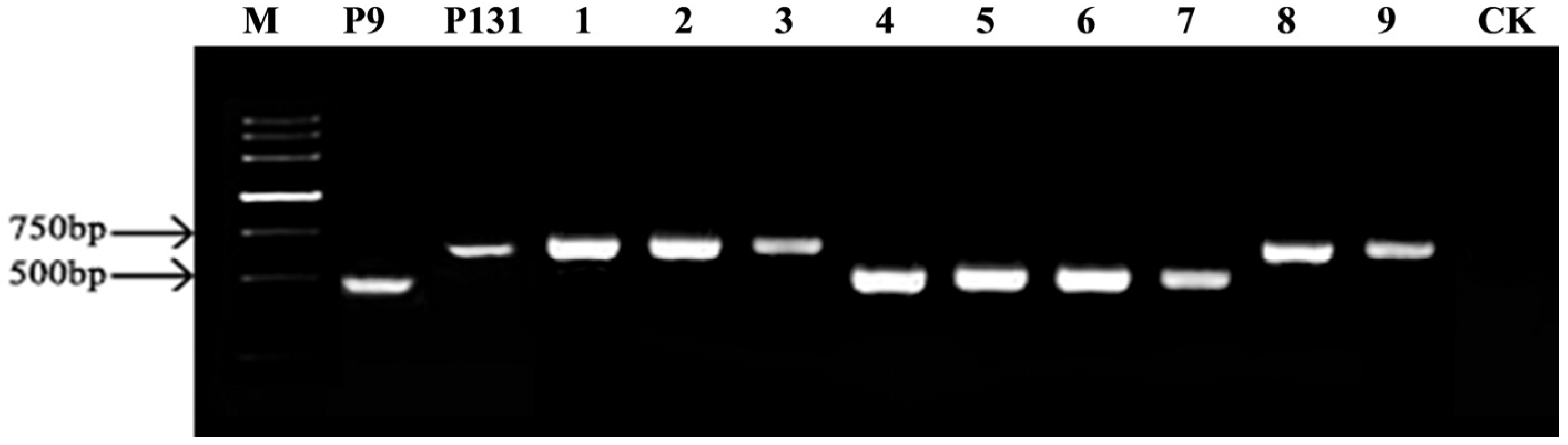
2.2. Identification of M. oryzae Mating-Type
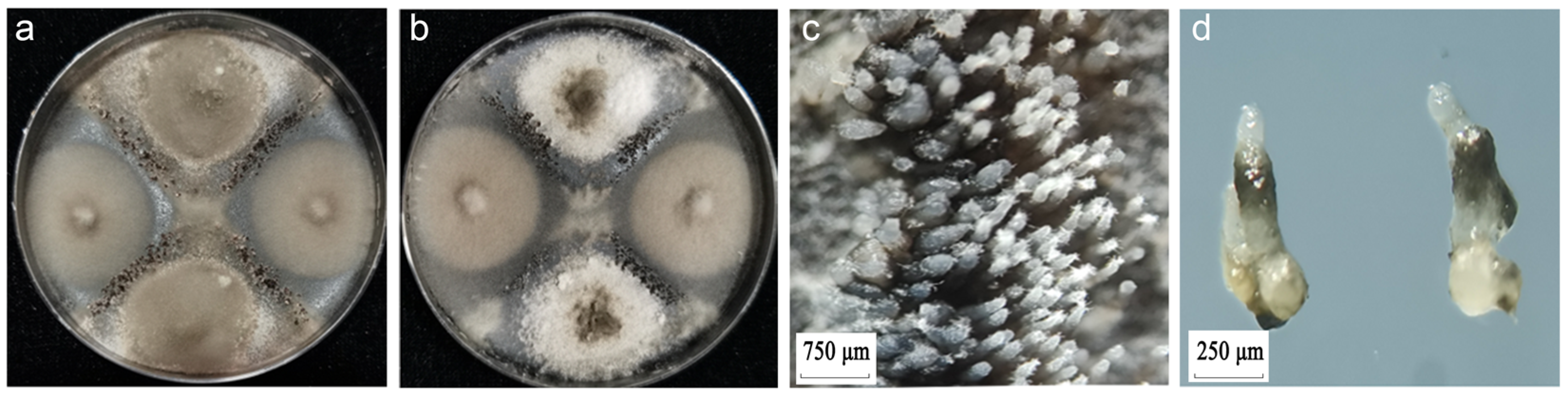
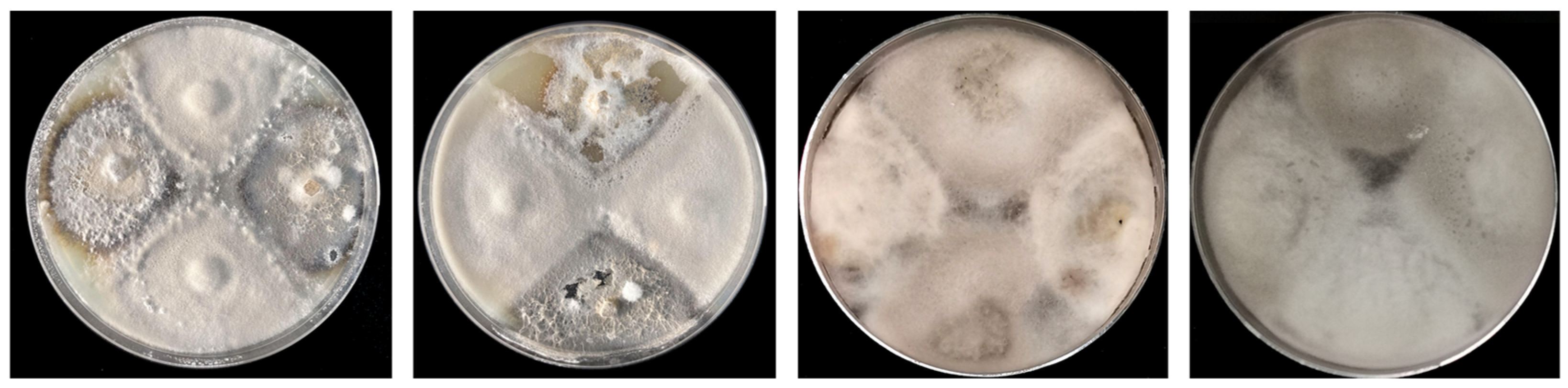
2.3. M. oryzae Fertility Assessment
2.4. Statistics
3. Results
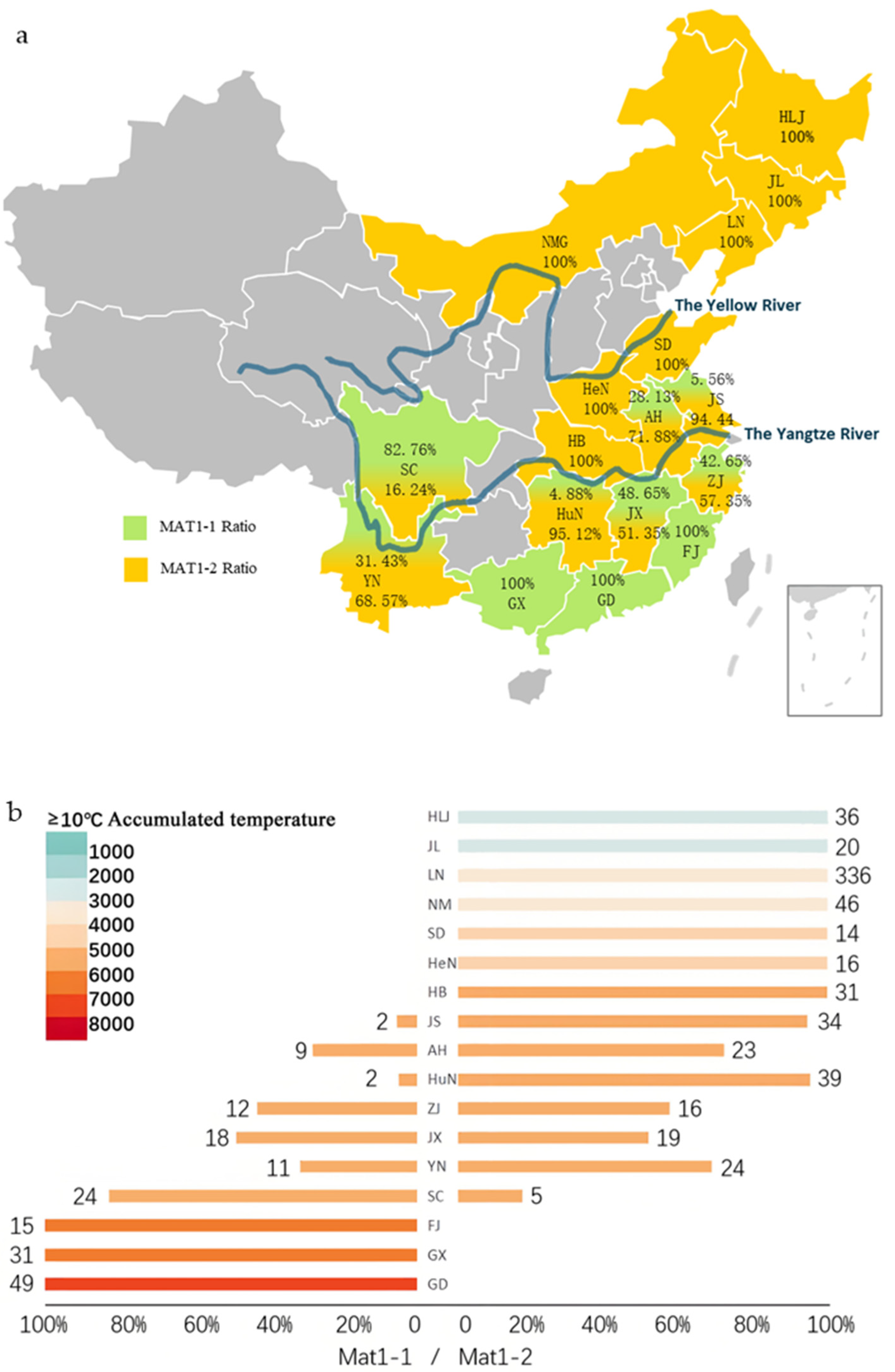
3.1. Geographical Distribution of Mating Types in M. oryzae
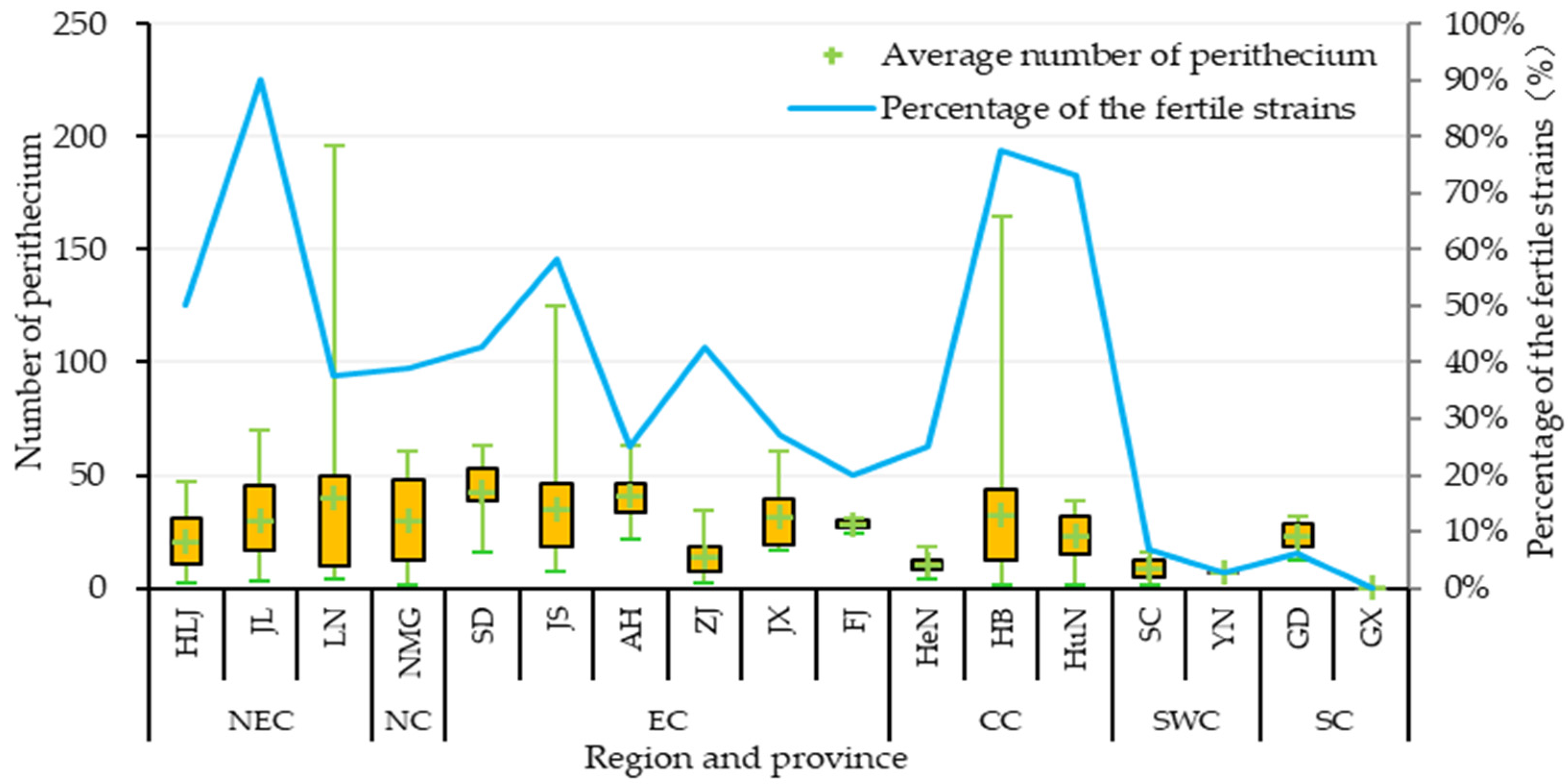
3.2. Variation in Fertility of M. oryzae
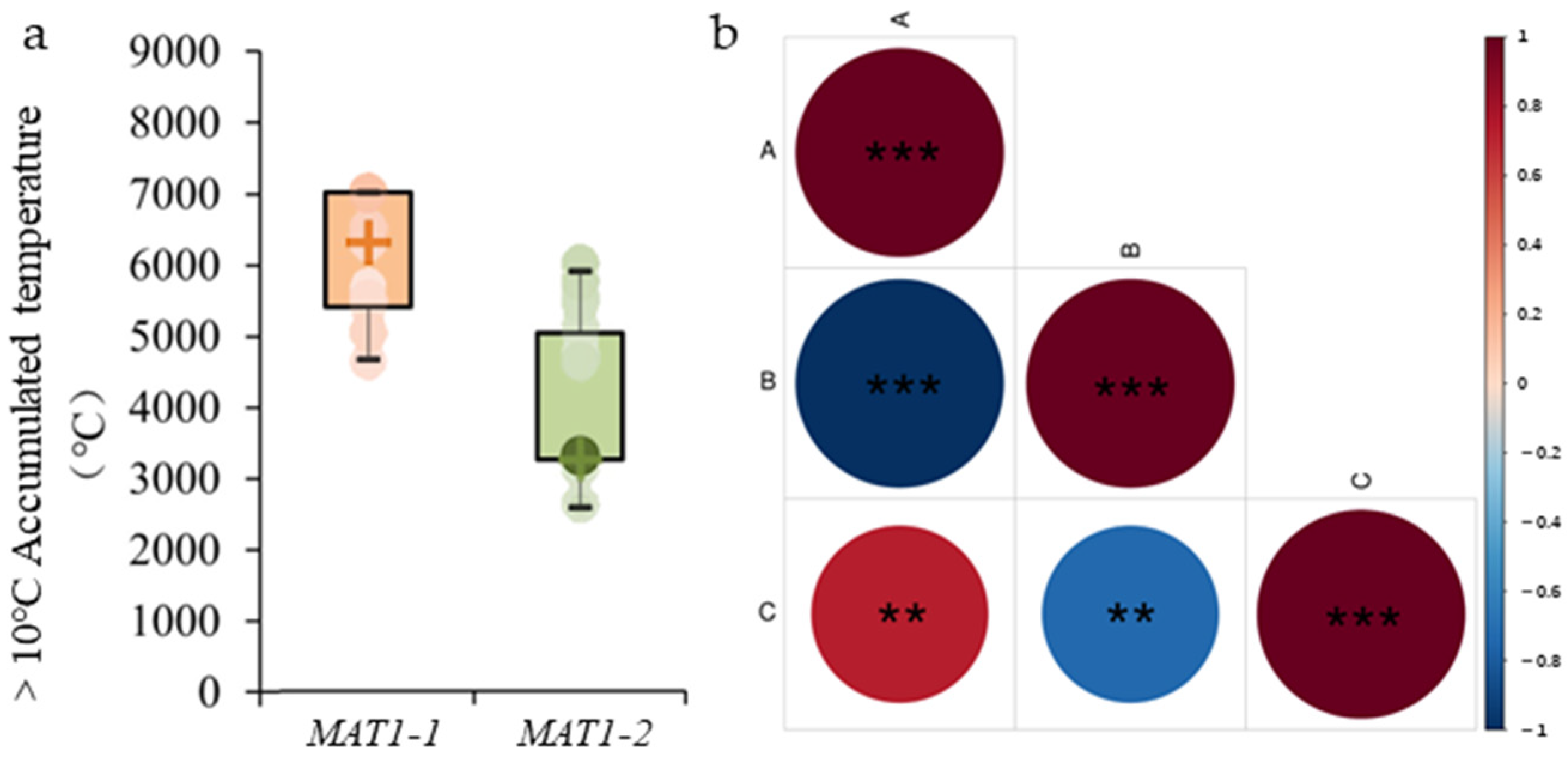
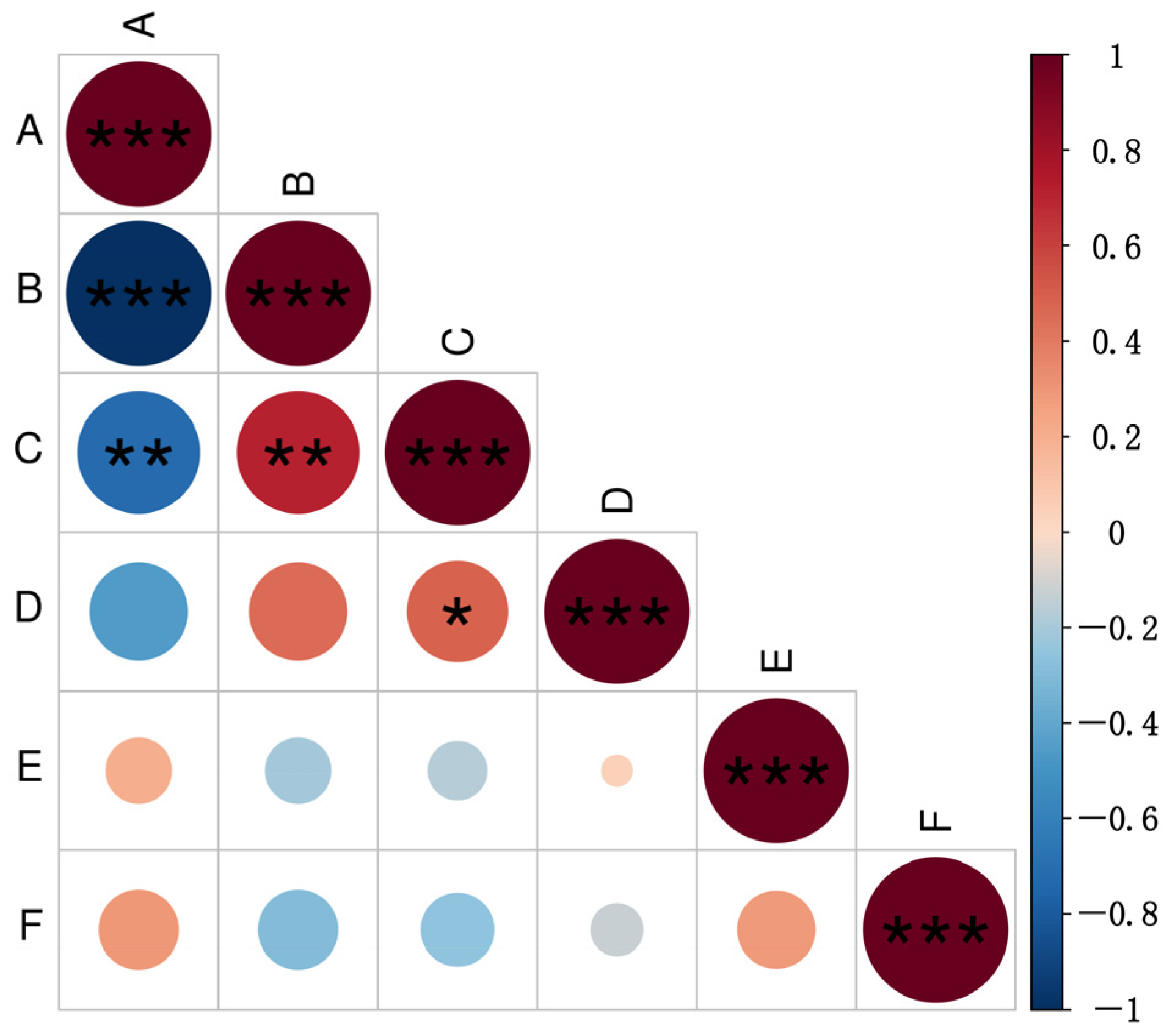
3.3. Correlation Analysis Between Mating-Type and Fertility in M. oryzae
4. Discussion
5. Conclusions
Author Contributions
Funding
Institutional Review Board Statement
Informed Consent Statement
Data Availability Statement
Conflicts of Interest
Appendix A

| Region | Province | Accumulated Temperature | No. of Isolates | MAT1-1 | MAT1-2 | ||
|---|---|---|---|---|---|---|---|
| ≥10 °C | Quantity | Proportion | Quantity | Proportion | |||
| NEC | HLJ | 2500 | 36 | 0 | 0.00% | 36 | 100.00% |
| JL | 2500 | 20 | 0 | 0.00% | 20 | 100.00% | |
| LN | 3270 | 336 | 0 | 0.00% | 336 | 100.00% | |
| NC | NM | 3100 | 46 | 0 | 0.00% | 46 | 100.00% |
| EC | SD | 4570 | 14 | 0 | 0.00% | 14 | 100.00% |
| JS | 5050 | 36 | 2 | 5.56% | 34 | 94.44% | |
| AH | 4950 | 32 | 9 | 28.12% | 23 | 71.88% | |
| ZJ | 5500 | 28 | 12 | 42.86% | 16 | 57.14% | |
| JX | 5500 | 37 | 18 | 48.65% | 19 | 51.35% | |
| FJ | 6300 | 15 | 15 | 100.00% | 0 | 0.00% | |
| CC | HeN | 4700 | 16 | 0 | 0.00% | 16 | 100.00% |
| HB | 5400 | 31 | 0 | 0.00% | 31 | 100.00% | |
| HuN | 5700 | 41 | 2 | 4.88% | 39 | 95.12% | |
| SWC | SC | 5050 | 29 | 24 | 82.76% | 5 | 17.24% |
| YN | 5400 | 35 | 11 | 31.43% | 24 | 68.57% | |
| SC | GD | 7000 | 49 | 49 | 100.00% | 0 | 0.00% |
| GX | 6500 | 31 | 31 | 100.00% | 0 | 0.00% | |
| Total | - | 832 | 173 | 20.79% | 659 | 79.21% | |
| Region | Province | No. of Isolates | Fertile Isolates | Perithecia | Mature Perithecium Rate | Spore Germination Rate | ||||
|---|---|---|---|---|---|---|---|---|---|---|
| Quantity | Proportion | 1–50 | 51–100 | >100 | ||||||
| NEC | HLJ | 36 | 18 | 50.00% | 41.33% | 18 | 0 | 0 | 86.67%(13/15) | 14.42%(15/104) |
| JL | 20 | 18 | 90.00% | 15 | 0 | 3 | 80.00%(12/15) | 15.63%(15/96) | ||
| LN | 336 | 126 | 37.50% | 96 | 16 | 14 | 86.67%(13/15) | 18.10%(19/105) | ||
| NC | NM | 46 | 18 | 39.13% | 39.13% | 14 | 3 | 1 | 80.00%(12/15) | 16.33%(16/98) |
| EC | SD | 14 | 6 | 42.86% | 37.04% | 2 | 0 | 4 | 80.00%(12/15) | 8.33%(8/96) |
| JS | 36 | 21 | 58.33% | 16 | 3 | 2 | 86.67%(13/15) | 13.73%(14/102) | ||
| AH | 32 | 8 | 25.00% | 6 | 1 | 1 | 80.00%(12/15) | 15.46%(15/97) | ||
| ZJ | 28 | 12 | 42.86% | 9 | 0 | 3 | 73.33%(11/15) | 14.74%(14/95) | ||
| JX | 37 | 10 | 27.03% | 8 | 2 | 0 | 93.33%(14/15) | 16.96%(19/112) | ||
| FJ | 15 | 3 | 20.00% | 3 | 0 | 0 | 80.00%(12/15) | 13.13%(13/99) | ||
| CC | HeN | 16 | 4 | 25.00% | 65.91% | 3 | 0 | 1 | 80.00%(12/15) | 13.86%(14/101) |
| HB | 31 | 24 | 77.42% | 20 | 4 | 0 | 86.67%(13/15) | 20.19%(21/104) | ||
| HuN | 41 | 30 | 73.17% | 29 | 0 | 1 | 80.00%(12/15) | 14.29%(14/98) | ||
| SWC | SC | 29 | 2 | 6.90% | 4.69% | 2 | 0 | 0 | 86.67%(13/15) | 18.63%(19/102) |
| YN | 35 | 1 | 2.86% | 1 | 0 | 0 | 86.67%(13/15) | 21.15%(22/104) | ||
| SC | GD | 49 | 3 | 6.12% | 3.75% | 3 | 0 | 0 | 80.00%(12/15) | 18.75%(18/96) |
| GX | 31 | 0 | 0.00% | - | - | - | - | - | ||
| Total | 832 | 304 | 36.54% | 245 | 29 | 30 | - | - | ||
| Primer | Sequences (5′ to 3′) |
|---|---|
| MAT1-1F | AGCCTACTACGCTGGCATCT |
| MAT1-1R | GGTGACAGAGCTGTCTTCCA |
| MAT1-2F | GCATCAACCAGGTCTCAGTC |
| MAT1-2R | ATCCTCAGGTTCATCGACAG |


References
- Dean, R.; Kan, J.A.L.V.; Pretorius, Z.A.; Hammond-Kosack, K.E.; Pietro, A.D.; Spanu, P.D.; Rudd, J.J.; Dickman, M.; Kahmann, R.; Ellis, J.; et al. The Top 10 fungal pathogens in molecular plant pathology. Mol. Plant Pathol. 2012, 13, 804. [Google Scholar] [CrossRef]
- Serge, S.; Laetitia, W.; Jane, P.S.; Paul, E.; Neil, M.; Andy, N. The global burden of pathogens and pests on major food crops. Nat. Ecol. Evol. 2019, 3, 430–439. [Google Scholar] [CrossRef]
- Liu, W.C.; Liu, Z.D.; Huang, C.; Lu, M.H.; Liu, J.; Yang, Q.P. Statistics and analysis of the crop yield losses by main diseases and insect pests in recent 10 years. Plant Prot. 2016, 42, 1–9+46. (In Chinese) [Google Scholar]
- Shi, X.X.; Wang, J.Y.; Wang, Y.L.; Sun, G.C. Mating type genes in ascomycetes: A review. Microbiology 2020, 47, 1572–1581. (In Chinese) [Google Scholar]
- Talbot, N.J. On the trail of a cereal killer: Exploring the Biology of Magnaporthe grisea. Annu. Rev. Microbiol. 2003, 57, 177–202. [Google Scholar] [CrossRef]
- Couch, B.C.; Fudal, I.; Lebrun, M.-H.; Tharreau, D.; Valent, B.; van Kim, P.; Nottéghem, J.-L.; Kohn, L.M. Origins of host-specific populations of the blast pathogen Magnaporthe oryzae in crop domestication with subsequent expansion of pandemic clones on rice and weeds of rice. Genet. Med. 2005, 170, 613–630. [Google Scholar] [CrossRef]
- Hebert, T.T. The perfect stage of Pyricularia grisea. Phytopathology 1971, 61, 83–87. [Google Scholar] [CrossRef]
- Valent, B.; Crawford, M.S.; Weaver, C.G.; Chumley, F.G. Genetic studies of fertility and pathogenicity in Magnaporthe grisea. Iowa State J. Res. 1986, 60, 569–594. [Google Scholar]
- Kato, H.; Yamaguchi, T. The perfect state of Pyricularia oryzae Cav. from rice plants in culture. Jpn. J. Phytopathol. 1976, 48, 607–612. [Google Scholar] [CrossRef]
- Kang, S.C.; Chumley, F.G.; Valent, B. Isolation of the mating type genes of the phytopathogenic fungus Magnaporthe grisea using genomic subtraction. Genetics 1994, 138, 289–296. [Google Scholar] [CrossRef]
- Shen, Y.; Joelle, M.; Yuan, X.P.; Henry, A.; Wang, Y.L.; Jean, L.N.; Didier, T. Mating Type Alleles, Female Fertility and Genetic Diversity of Magnaporthe grisea Populations Pathogenic to Rice from Some Asian Countries. Agric. Sci. China 2003, 2, 1221–1226. [Google Scholar]
- Jagadeesh, D.; Prasanna, K.M.K.; Devaki, N.S. Population analysis of Magnaporthe oryzae by using endogenous repetitive DNA sequences and mating-type alleles in different districts of Karnataka, India. J. Appl. Genet. 2018, 59, 365–375. [Google Scholar] [CrossRef] [PubMed]
- Yaegashi, H.; Yamada, M. Pathogenic Race and Mating Type of Pyricularia oryzae from Soviet Union, China, Nepal, Thailand, Indonesia and Colombia. Ann. Phytopathol. Soc. Jpn. 1986, 52, 225–234. [Google Scholar] [CrossRef]
- Consolo, V.F.; Cordo, C.A.; Salerno, G.L. Mating type distribution and fertility status in Magnaporthe grisea populations from Argentina. Mycopathologia 2005, 160, 285–290. [Google Scholar] [CrossRef]
- Glass, N.L.; Kuldau, G.A. Mating type and vegetative incompatibility in filamentous ascomycetes. Annu. Rev. Phytopathol. 1992, 30, 201. [Google Scholar] [CrossRef]
- Kolmer, J.A.; Ellingboe, A.H. Genetic relationships between fertility and pathogenicity and virulence to rice in Magnaporthe grisea. Can. J. Bot. 1988, 66, 891–897. [Google Scholar] [CrossRef]
- Chao, C.C.; Ellingboe, A.H. Selection for mating competence in Magnaporthe grisea pathogenic to rice. Can. J. Bot. 1991, 69, 2130–2134. [Google Scholar] [CrossRef]
- Fei, L.W.; Lu, W.B.; Xu, X.; Yan, F.C.; Zhang, L.W.; Liu, J.T.; Baoi, Y.J.; Li, Z.Y.; Zhao, W.S.; Yang, J.; et al. A rapid approach for isolating a single fungal spore from rice blast diseased leaves. J. Integr. Agric. 2018, 18, 1415–1418. [Google Scholar] [CrossRef]
- He, Y.Q. An improved protocol for fungal DNA preparation. Mycosystema 2000, 19, 434. [Google Scholar]
- Xu, J.R.; Hamer, J.E. Assessment of Magnaporthe grisea mating type by spore PCR. Fungal Genet. Newsl. 1995, 42, 80. [Google Scholar] [CrossRef]
- Hayashi, N.; Li, C.Y.; Li, J.L.; Naito, H. In vitro production on rice plants of perithecia of Magnaporthe grisea from Yunnan, China. Mycol. Res. 1997, 101, 1308–1310. [Google Scholar] [CrossRef]
- Saleh, D.; Milazzo, J.; Adreit, H.; Tharreau, D.; Fournier, E. Asexual reproduction induces a rapid and permanent loss of sexual reproduction capacity in the rice fungal pathogen Magnaporthe oryzae: Results of in vitro experimental evolution assays. BMC Evol. Biol. 2012, 12, 42. [Google Scholar] [CrossRef] [PubMed]
- Valent, B. Dynamic Gene-for-Gene Interactions Undermine Durable Resistance. Mol. Plant Microbe Interact. 2025, 38, 104–117. [Google Scholar] [CrossRef]
- Rahnama, M.; Condon, B.; Ascari, J.P.; Dupuis, J.R.; Del Ponte, E.M.; Pedley, K.F.; Martinez, S.; Valent, B.; Farman, M.L. Recent co-evolution of two pandemic plant diseases in a multi-hybrid swarm. Nat. Ecol. Evol. 2023, 7, 26. [Google Scholar] [CrossRef] [PubMed]
- Maud, T.; Florian, C.; Joëlle, M.; Henri, A.; Sébastien, R.; Sandrine, C.; Sonia, B.; Violaine, S.; Thomas, K.; Renaud, I.; et al. Maintenance of divergent lineages of the Rice Blast Fungus Pyricularia oryzae through niche separation, loss of sex and post-mating genetic incompatibilities. PLoS Pathog. 2022, 18, e1010687. [Google Scholar]
- Notteghem, J.L.; Silué, D. Distribution of the mating type alleles in Magnaporthe grisea populations pathogenic on rice. Phytopathology 1992, 82, 412–424. [Google Scholar] [CrossRef]
- Chen, Q.H.; Wang, Y.C.; Zheng, X.B. Mating Type Distribution and Fertility Status of Magnaporthe grisea Populations in Main Regions of China. Sci. Agric. Sin. 2004, 37, 840–845. (In Chinese) [Google Scholar]
- Shen, Y.; Notteghem, J.L.; Milazzo, J.; Yuan, Y.P.; Adreit, H.; Zhao, X.H.; Wang, Y.L.; Tharreau, D. Geographic Distribution of Mating Type in Magnaporthe grisea and Its Relationship Between Fertile Isolates in China. Sci. Agric. Sin. 2002, 35, 256–263. (In Chinese) [Google Scholar]
- Dong, L.Y.; Zhou, W.M.; Liu, S.F.; Zhao, X.L.; Yang, Z.L.; Li, Q.Y.; Li, X.D.; Yang, Q.Z. Determination of mating type and pathogenicity of Magnaporthe oryzae isolates collected from upland rice of two counties of Yunnan, Southwest China. Mycosystema 2021, 40, 2056–2064. (In Chinese) [Google Scholar]
- Hemmati, R.; Javan-Nikkhahi, M.; Hedjaroude, G.A.; Okhovvat, S.M.; Moosanejad, S. Fertility status and distribution of mating type alleles of the rice blast fungus, Magnaporthe grisea in northern Iran. Commun. Agric. Appl. Biol. Sci. 2004, 69, 537–539. [Google Scholar]
- Li, W.Q.; Wang, Y.C.; Zheng, X.B. Mating Type and Fertility of Magnaporthe grisea Populations from Rice in Ning xia Hui Autonomous Region, China. Chin. J. Rice Sci. 2007, 21, 650–656. (In Chinese) [Google Scholar]
- Lu, F.; Zheng, X.B.; Wang, F.M.; Zhang, W.H.; Liu, Y.F.; Fan, Y.J. Genetic analysis on segregation of pathogenicity in sexual progeny from a cross of Magnaporthe grisea isolates from rice field. J. Nanjing Agric. Univ. 2000, 23, 41–45. (In Chinese) [Google Scholar]
- Zhang, X.Y.; Zhang, Y.L.; Jin, X.H.; Zhou, Y.L.; Meng, F.; Wu, J.J. Analysis of the fertility and mating type of rice blast fungus Magnaporthe oryzae in Heilongjiang Province. J. Plant Prot. 2020, 47, 93–100. (In Chinese) [Google Scholar]
- Wessels, B.A.; Lamprecht, S.C.; Linde, C.C.; Fourie, P.H.; Mostert, L. Characterization of the genetic variation and fungicide resistance in Botrytis cinerea populations on rooibos seedlings in the Western Cape of South Africa. Eur. J. Plant Pathol. 2013, 136, 407–417. [Google Scholar] [CrossRef]
- Dai, Y.L.; Gan, L.; Ruan, H.; Shi, N.N.; Du, Y.X.; Chen, F.R.; Yang, X.J. Characterization of Natural Isolates of Bipolaris maydis Associated with Mating Types, Genetic Diversity, and Pathogenicity in Fujian Province, China. Plant Dis. 2020, 104, 323–329. [Google Scholar] [CrossRef]
- Wang, J.Y.; Wang, S.Z.; Zhang, Z.; Hao, Z.N.; Shi, X.X.; Li, L.; Zhu, X.M.; Qiu, H.P.; Chai, R.Y.; Wang, Y.L.; et al. MAT Loci Play Crucial Roles in Sexual Development but Are Dispensable for Asexual Reproduction and Pathogenicity in Rice Blast Fungus Magnaporthe oryzae. J. Fungi 2021, 7, 858. [Google Scholar] [CrossRef]


Disclaimer/Publisher’s Note: The statements, opinions and data contained in all publications are solely those of the individual author(s) and contributor(s) and not of MDPI and/or the editor(s). MDPI and/or the editor(s) disclaim responsibility for any injury to people or property resulting from any ideas, methods, instructions or products referred to in the content. |
© 2026 by the authors. Licensee MDPI, Basel, Switzerland. This article is an open access article distributed under the terms and conditions of the Creative Commons Attribution (CC BY) license.
Share and Cite
Yan, H.; Liu, J.; Xu, H.; Yang, J.; Dong, H. Analysis of the Mating-Type Distribution and Fertility Variation in Magnaporthe oryzae Populations in China. J. Fungi 2026, 12, 40. https://doi.org/10.3390/jof12010040
Yan H, Liu J, Xu H, Yang J, Dong H. Analysis of the Mating-Type Distribution and Fertility Variation in Magnaporthe oryzae Populations in China. Journal of Fungi. 2026; 12(1):40. https://doi.org/10.3390/jof12010040
Chicago/Turabian StyleYan, Han, Jintao Liu, Han Xu, Jun Yang, and Hai Dong. 2026. "Analysis of the Mating-Type Distribution and Fertility Variation in Magnaporthe oryzae Populations in China" Journal of Fungi 12, no. 1: 40. https://doi.org/10.3390/jof12010040
APA StyleYan, H., Liu, J., Xu, H., Yang, J., & Dong, H. (2026). Analysis of the Mating-Type Distribution and Fertility Variation in Magnaporthe oryzae Populations in China. Journal of Fungi, 12(1), 40. https://doi.org/10.3390/jof12010040