


Abstract
This study reports the first molecularly confirmed occurrence of Phlegmacium herculeum in Algeria, identified through morphological features and ITS sequence analysis (GenBank accession: PQ133121). Phytochemical profiling revealed a diverse composition of metabolites. SPME–GC–MS analysis detected volatile aldehydes (butanal, pentanal), organic acids (butanoic, pentanoic), terpenoids (limonene, 1,8-cineole), phenolics, and long-chain alkanes. Furthermore, the macrofungus has been extracted with organic solvents, and the obtained extracts have been analyzed via NMR and GC–MS, revealing the presence of organic acids (lactic, succinic, azelaic), fatty acids (palmitic, linoleic), and phenolic acids (protocatechuic, 4-hydroxybenzoic). DPPH-based analysis indicated that the antioxidant response of the crude extracts strengthened as the dose increased, with the ethyl acetate (EtOAc) extract exhibiting the highest inhibition and lowest IC50, attributed to its rich phenolic content. The chloroform (CHCl3) extract showed moderate activity, consistent with its composition of less polar metabolites such as fatty acids and terpenoids. Antibacterial assays revealed extract-specific effects: CHCl3 strongly inhibited Staphylococcus aureus (18 mm), while EtOAc was more effective against Gram-negative strains, including Escherichia coli (18 mm) and Pseudomonas aeruginosa (13 mm). Cytotoxicity testing using Saccharomyces cerevisiae confirmed that both extracts were non-toxic, maintaining ≥90% cell viability. These findings highlight P. herculeum as a novel source of bioactive metabolites with antioxidant and antibacterial potential.
1. Introduction
Fungi represent an abundant source of structurally diverse secondary metabolites with remarkable ecological and pharmacological significance [1,2]. Among them, macrofungi have long been recognized as prolific producers of volatile and non-volatile compounds that contribute not only to their survival in complex ecosystems but also to their potential as sources of natural therapeutic agents [3,4]. Mycorrhizal fungi, in particular, play a crucial role in forest ecosystems by forming symbiotic associations with plant roots, which enhance nutrient uptake and strengthen plant tolerance to both biotic and abiotic stresses. These ecological interactions often influence the production of secondary metabolites, many of which exhibit potent biological activities, including antioxidant, antimicrobial, and anticancer properties [5,6,7].
The genus Phlegmacium (family Cortinariaceae) includes ectomycorrhizal fungi commonly associated with deciduous and coniferous trees such as Quercus, Pinus, and Fagus species. These fungi contribute significantly to nutrient cycling and soil health, forming part of the ecological balance in forested environments [8,9]. Despite their ecological importance, chemical and biological studies on Phlegmacium species remain extremely limited. To date, only a few investigations have explored their metabolomic profiles, and virtually no reports have described the bioactive potential of Phlegmacium herculeum, particularly from North African ecosystems. Algeria, with its diverse climatic and ecological zones, offers a unique habitat for a wide variety of macrofungi, yet the chemical diversity and biological potential of its mycorrhizal species remain largely unexplored [10,11,12].
Volatile organic compounds (VOCs) from macrofungi are known to include a broad spectrum of chemical classes such as alcohols, aldehydes, terpenoids, and fatty acids. These compounds are integral to fungal biology, playing essential roles in defense mechanisms by deterring predators and inhibiting competing microorganisms [13,14]. Additionally, VOCs serve as chemical signals facilitating intra- and interspecies communication, thus enabling fungi to adapt and respond dynamically to their environment. Furthermore, these volatiles participate in ecological adaptation processes such as spore dispersal and interactions with plant hosts and other soil organisms, underscoring their multifunctional ecological roles [15,16]. Furthermore, fungi produce several metabolites, including fatty acids, phenolic acids, and organic acids, which are primarily responsible for many of their pharmacological properties. These metabolites exhibit strong antioxidant activities, scavenging free radicals and protecting cells from oxidative damage. They also possess antibacterial properties, limiting the growth of pathogens, and display cytotoxic effects against cancer cells, making them promising candidates for drug development [17,18,19]. The comprehensive characterization of fungal metabolites not only sheds light on fungal chemical ecology but also opens avenues for the discovery of novel natural products with significant biomedical and agricultural applications [20,21].
The present work aimed to conduct a comprehensive analyses and characterization of metabolites produced by the Algerian mycorrhizal macrofungus Phlegmacium herculeum using NMR and GC-MS, alongside the evaluation of its biological activities. Specifically, the research aimed to identify and semi-quantify volatile organic compounds using SPME–GC–MS, and to determine metabolites of the fruiting bodies extracts via NMR and GC-MS. In addition, the antioxidant, antibacterial, and cytotoxicity properties of these extracts were assessed in order to establish correlations between chemical composition and biological potential. Ultimately, this study seeks to highlight the ecological and biotechnological importance of P. herculeum as a valuable source of natural bioactive compounds within Algerian forest ecosystems.
2. Materials and Methods
2.1. Sample Collection and Identification
Fruit bodies of the macrofungus P. herculeum were collected in January 2018 by Dr. R. Zatout from the Djebel El Ouahch Forest, Constantine, northeastern Algeria [22]. The specimens were found growing under Pinus trees, suggesting a possible ectomycorrhizal association with Cedrus atlantica roots. Morphological identification was conducted based on macroscopic characteristics using standard mycological keys [23]. For molecular identification, genomic DNA was isolated from the dried specimens following a modified CTAB extraction method. The internal transcribed spacer (ITS) rDNA region was amplified with primers ITS1F and ITS4, and PCR products were sequenced. Resulting sequences were compared to reference sequences in the NCBI GenBank database for taxonomic confirmation and deposited under accession number PQ133121 [24].
2.2. Preparation of Extracts of Phlegmacium herculeum
The dried fruiting bodies finely powdered (100 g) was extracted twice with chloroform (CHCl3) and ethyl acetate (EtOAc). Each extraction involved maceration in 500 mL solvent for 24 h under continuous stirring at ambient temperature. Extracts were filtered and concentrated under reduced pressure at 40 °C using a rotary evaporator. The resulting crude extracts were weighed, stored in sealed glass vials, and kept at 4 °C until further NMR, GC–MS analyses and biological assays [25].
2.3. SPME–GC–MS Analysis of Volatile Compounds
The freshly harvested fruit bodies were cleaned, cut and air-dried at room temperature and finally pulverized. To investigate the volatile chemical profile of P. herculeum, a small amount of the powdered sample (about 0.5 g) was placed inside a 4 mL glass vial with PTFE-coated silicone septum. For the extraction of volatiles, a SPME device from Supelco (Bellefonte, PA, USA) with 1 cm fiber coated with 50/30 μm DVB/CAR/PDMS (divinylbenzene/carboxen/polydimethylsiloxane) was used. After reaching the equilibration phase (at 60 °C for 15 min), the fiber was exposed to the headspace of the samples for 20 min to capture and concentrate the volatiles. Lastly, the analytes were desorbed thermally in the GC injector maintained at 250 °C for 2 min in splitless mode. The analysis was carried out on Clarus 500 model Perkin Elmer (Waltham, MA, USA) gas chromatograph coupled with a mass spectrometer equipped. The capillary column was a Varian Factor Four VF-5. To characterize the volatile composition of the sample, the operative conditions were set as follows: from 45 °C to 220 °C at 6°/min and finally held for 10 min. Helium was used as carrier gas at a constant rate of 1 mL/min. MS scans were recorded within the range 35–500 m/z using EI ionization (energy 70 eV). Identification of compounds was based on the comparison of the mass spectra of pure components stored in the Wiley 2.2 and Nist 11 libraries database and on the comparison of the Linear Retention Indices (LRIs) calculated using a series of alkane standards (C8–C25 n-alkanes) with that available retention data reported in the literature. The relative amounts of the identified components were calculated as percentages of the signal peak area to the total peak area. No internal standards or correction factors were applied. All analyses were performed in triplicate.
2.4. NMR and GC–MS Characterization of Crude Extracts
1H NMR spectra of the crude extracts were recorded on a Bruker (Karlsruhe, Germany) Anova Advance spectrometer at 400 MHz. Deuterated methanol was used as solvent and as internal standard. All the solvents and reagents were supplied by Sigma-Aldrich Co. (St. Louis, MO, USA).
GC-MS analyses were performed with an Agilent 6850 GC (Milan, Italy) on crude extracts after trimethylsilylation with N,O-bis(trimethylsilyl)trifluoroacetamide (BSTFA) (Fluka, Buchs, Switzerland) as previously reported [26]. The compounds present in the organic extracts were identified by comparing their EI mass spectra at 70 eV with mass spectra collected in the NIST 20 mass spectral library (available at https://www.nist.gov/srd/nist-standard-reference-database-1a; accessed on 14 October 2025). Moreover, the identification was supported by the LRIs calculated for each analyte as reported in the previous section.
2.5. Antioxidant Assay
The antioxidant capacity of P. herculeum organic extracts, prepared with chloroform (CHCl3) and ethyl acetate (EtOAc), was evaluated in vitro via the DPPH (2,2-diphenyl-1-picrylhydrazyl) free radical scavenging assay. Ascorbic acid (Vitamin C) served as the positive control. A fresh 0.1 mM DPPH solution was prepared by dissolving 0.91 mg of DPPH powder (Sigma-Aldrich) in 23 mL of absolute ethanol (EtOH, analytical grade), ensuring complete dissolution and radical stability. The fungal extracts were emulsified in a 1:1 (v/v) mixture of 0.1 M acetate buffer (pH 5.5) and ethanol to enhance dispersion and miscibility.
Starting from an initial concentration of 8 mg/mL, each extract was subjected to five successive two-fold (1:2) serial dilutions, reaching a final test concentration equivalent to 2−8 of the original stock, thereby covering a broad dynamic range for evaluating dose-dependent antioxidant effects. The assay was performed in a 96-well microplate format, where 100 µL of the DPPH solution was mixed with 100 µL of each extract dilution or control solution. Each experimental condition, including blanks and controls, was performed in triplicate to ensure reproducibility.
The plate was incubated at room temperature (25 ± 2 °C) for 30 min in the dark to prevent photodegradation of the DPPH radical. Following incubation, the decrease in absorbance was measured at 517 nm using a UV-Visible microplate spectrophotometer. The radical scavenging activity (RSA) was expressed as a percentage of inhibition, calculated using the following equation:
where A0 is the absorbance of the DPPH control (without extract), and As is the absorbance in the presence of the fungal extract.
% Inhibition = ((A0 − As)/A0) × 100
The IC50 values (the concentration required to inhibit 50% of DPPH radicals) were determined graphically by plotting the percentage of inhibition against the logarithm of extract concentration. Vitamin C was used under the same conditions as a positive control to benchmark the antioxidant capacity of each tested plant lipid extract under standardized experimental conditions [27,28].
2.6. Antibacterial Assay
The antibacterial activity of the two organic extracts chloroform (CHCl3) and ethyl acetate (EtOAc) of P. herculeum was evaluated using the standard disk diffusion method with slight modifications [29]. Four bacterial strains were selected for testing: Escherichia coli (NCTC 10538), Staphylococcus aureus (ATCC 6538), Pseudomonas aeruginosa (NCIMB 8626), and Bacillus spizizenii (ATCC 6633). Each strain was cultured in Mueller–Hinton broth and incubated at 37 °C for 18–24 h. The bacterial suspensions were then adjusted to match the 0.5 McFarland standard, corresponding to approximately 1.5 × 10⁸ CFU/mL.
Sterile filter paper disks (6 mm diameter) were impregnated with 10 µL of each fungal extract at concentrations of 25 and 50 mg/mL. The extracts were dissolved in DMSO, which was also used alone in negative control disks. All disks were dried under sterile conditions in a laminar flow cabinet. Mueller–Hinton agar plates were inoculated by evenly swabbing the surface with the standardized bacterial suspension using a sterile cotton swab. The extract-impregnated disks, along with a negative control disk (containing only the respective solvent), were placed onto the inoculated plates. All disks were gently pressed to ensure full contact with the agar surface. The plates were then incubated at 37 °C for 24 h.
After incubation, antibacterial activity was assessed by measuring the diameter of the inhibition zones (including the disk diameter) in millimeters (mm). All experiments were conducted in triplicate, and results were expressed as mean ± standard deviation (SD).
2.7. Cytotoxicity Assay
The growth-inhibitory potential of the two organic extracts chloroform (CHCl3) and ethyl acetate (EtOAc) of P. herculeum was evaluated against Saccharomyces cerevisiae using a semi-quantitative spot assay. Stock solutions of each extract were prepared in sterile distilled water containing 1% dimethyl sulfoxide (DMSO) to a final concentration of 8 mg/mL, followed by five two-fold serial dilutions to obtain a final concentration range from 2−2 to 2−8 of the initial stock, thereby covering a broad gradient of exposure.
A yeast cell suspension was prepared from an overnight culture grown in YPD broth. The cells were then washed and resuspended in 100 mM potassium phosphate buffer (pH 7.0) to a final concentration of 2 × 10⁷ cells/mL. For the assay, equal volumes (1:1) of the yeast suspension and each extract dilution were mixed in the wells of a sterile, flat-bottom 96-well microplate. The mixtures were incubated at 37 °C for 30 min to allow interaction between the extract and the yeast cells.
After incubation, 3.0 µL of each treated culture was carefully spotted onto YPD agar plates containing 2% glucose—either supplemented with the corresponding extract concentration or left untreated (for recovery assessment). Control wells containing only yeast cells without fungal extract served as the negative control. The plates were incubated at 37 °C for 48 h, after which yeast growth was documented using a flatbed scanner (Epson® V370, Epson, Suwa, Japan).
The extent of cytotoxicity or growth inhibition was assessed visually by comparing spot intensity and colony formation in treated samples relative to the control. This assay enabled the determination of growth inhibition thresholds and cytotoxic effects of the CHCl3 and EtOAc extracts across a defined concentration gradient under standardized conditions [30].
2.8. Statistical Analysis
All experiments were performed in triplicate, and data are presented as mean ± standard deviation (SD). Differences between groups were assessed using one-way ANOVA followed by Tukey’s post hoc test, performed with GraphPad Prism 9.0 version 9.0 (GraphPad Software, Boston, MA, USA). A p-value less than 0.05 was considered statistically significant
3. Results and Discussion
3.1. Morphological, Molecular, and Taxonomic Description of the Macrofungus
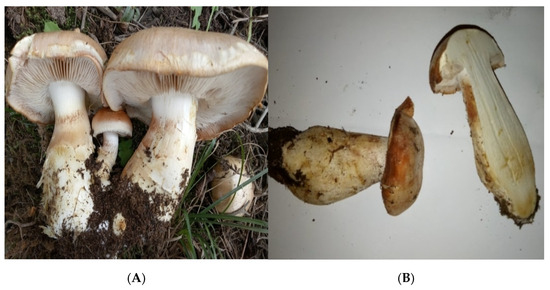
The collected basidiomata of P. herculeum (formerly Cortinarius herculeus) (Figure 1) were medium-sized, with convex to plano-convex pilei measuring 3–6 cm in diameter, displaying a cream to brown coloration when fresh, fading to white cream upon drying. The lamellae were adnate to slightly decurrent, initially pale cream and becoming lighter with age. The stipe was cylindrical, 4–8 cm long and 0.5–1 cm thick, with a fibrillose surface and faint cream tones toward the apex. The context was firm, whitish to pale cream, and emitted a faint fungal odor. The pileus surface was viscous when moist [31,32].
Figure 1.
Basidiomata of Phlegmacium herculeum at different developmental stages. Photographs by R. Zatout (January 2018) (A); Longitudinal section of the basidioma showing the internal structure (cross-section), displayed beside the intact lower part (external view) (B).
To corroborate the morphological observations, molecular characterization was performed by analyzing the internal transcribed spacer (ITS) region of ribosomal DNA. The ITS sequence obtained from the Algerian specimen showed a high similarity (≥99%) with reference sequences of P. hertulceum deposited in the NCBI GenBank database under number session PQ133121.
This represents, to our knowledge, the first molecularly confirmed record of P. herculeum from Algeria, expanding the known geographical distribution of this species to North Africa. Its occurrence in this region contributes valuable data to the biogeography of Phelgmacium species and suggests that North African coniferous forests may harbor greater fungal diversity than previously reported [33].
3.2. Analysis of Volatile Compounds by SPME–GC–MS
By SPME-GC-MS twenty-one compounds were detected and identified (Table 1). Propanedioic acid propyl-; (17.5%), 3-methylbutanoic acid (12.6%) and 3-methylbutanoic acid (10.5%) were the most abundant volatiles. 2-Methylbutanal (8.0%), nonadecane (7.8%), 3-methylbutanal (7.2%), cis-β-ocimene (6.4%) and trans-1,10-dimethyl-trans-9-decalinol (5.1%) were present with a relevant percentage mean value. The other compounds detected covered a relative amount range from 0.5% to 3.8%.
Table 1.
List of volatile compounds of Phelgmacium herculeum by SPME–GC–MS (percentage mean values).
The constituent propyl propanedioate, followed by 3-methylpentanoic acid and 3-methylbutanoic acid, represent short-chain fatty acids known as fungal metabolites that contribute to the characteristic mushroom-like aroma [34,35] which have been reported to exhibit antimicrobial potential in several basidiomycetes [36].
Among aldehydes, 2-methylbutanal and 3-methylbutanal were the most abundant. These branched aldehydes, which originate from amino acid catabolism, are responsible for pleasant fruity odors and have been detected in other species of Cortinarius and Russula, suggesting their possible ecological and defensive roles [37,38,39].
Hydrocarbons such as nonadecane and 2,3,5,8-tetramethyldecane were also detected at notable levels. These long-chain alkanes are commonly associated with the outer tissue layer of fruiting bodies and may function as protective agents against desiccation and environmental stress [40].
Terpenoid compounds, including cis-β-ocimene, limonene, 1,8-cineole, elemol, and farnesane, were also identified. The presence of these mono- and sesquiterpenes is consistent with previous findings in Phlegmacium species, reflecting their metabolic capacity to synthesize volatile terpenes with potential ecological and biological significance [41,42].
Additionally, the oxygenated sesquiterpenoid trans-1,10-dimethyl-trans-9-decalinol and the phenolic compound 3,5-di-tert-butylphenol were found. The latter has been described as a potent antioxidant and antimicrobial agent in various fungi, suggesting a possible protective role in P. herculeum [43,44].
Overall, the volatile composition of P. herculeum reveals a chemically diverse mixture dominated by fatty acids and aldehydes, complemented by significant contributions from terpenes and hydrocarbons. Such diversity indicates a high degree of metabolic plasticity and may reflect adaptive responses to its ecological niche.
Notably, the specimens were collected from Djebel El Ouahch Forest (Constantine, northeastern Algeria), where the fungus grows beneath Cedrus atlantica. This mountainous, humid, and organic-rich environment provides favorable conditions for the biosynthesis of a wide range of volatiles. The predominance of fatty acids, aldehydes, and terpenoids may result from metabolic interactions between the fungus, its host plants, and soil microorganisms [45,46].
These findings support the hypothesis that local environmental factors—especially vegetation type and organic matter content—strongly influence the volatile composition of basidiomycetes, endowing them with unique chemical signatures and potential biological activities.
3.3. Characterization of the Crude Extracts
The 1H NMR spectra of the CHCl3 and EtOAc extracts of P. herculeum (Figures S1 and S2) revealed signals indicating the presence of several metabolites belonging to different classes of natural compounds. The organic extracts were also analyzed via GC-MS after derivatization with N,O-bis(trimethylsilyl)trifluoroacetamide (BSTFA) to enhance volatility and improve detection of specific compounds present in the samples. As can be seen from Table 2, the list of compounds detected in the crude extracts includes several organic acids (e.g., lactic acid, succinic acid, fumaric acid) and fatty acids (e.g., palmitic acid, linoleic acid).
Table 2.
List of compounds detected via GC-MS after trimethylsilylation in CHCl3 and EtOAc extracts of P. herculeum. LRI represents linear retention index and TMS is the trimethylsilyl function, (CH3)3Si-.
3.4. Antioxidant Activity
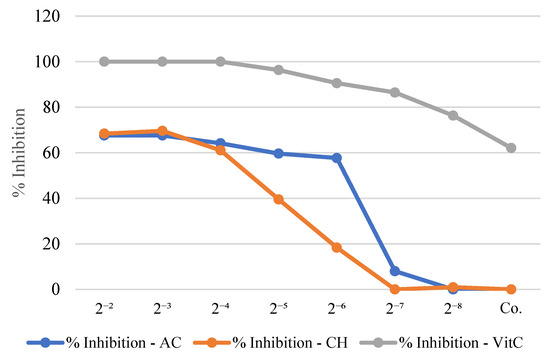
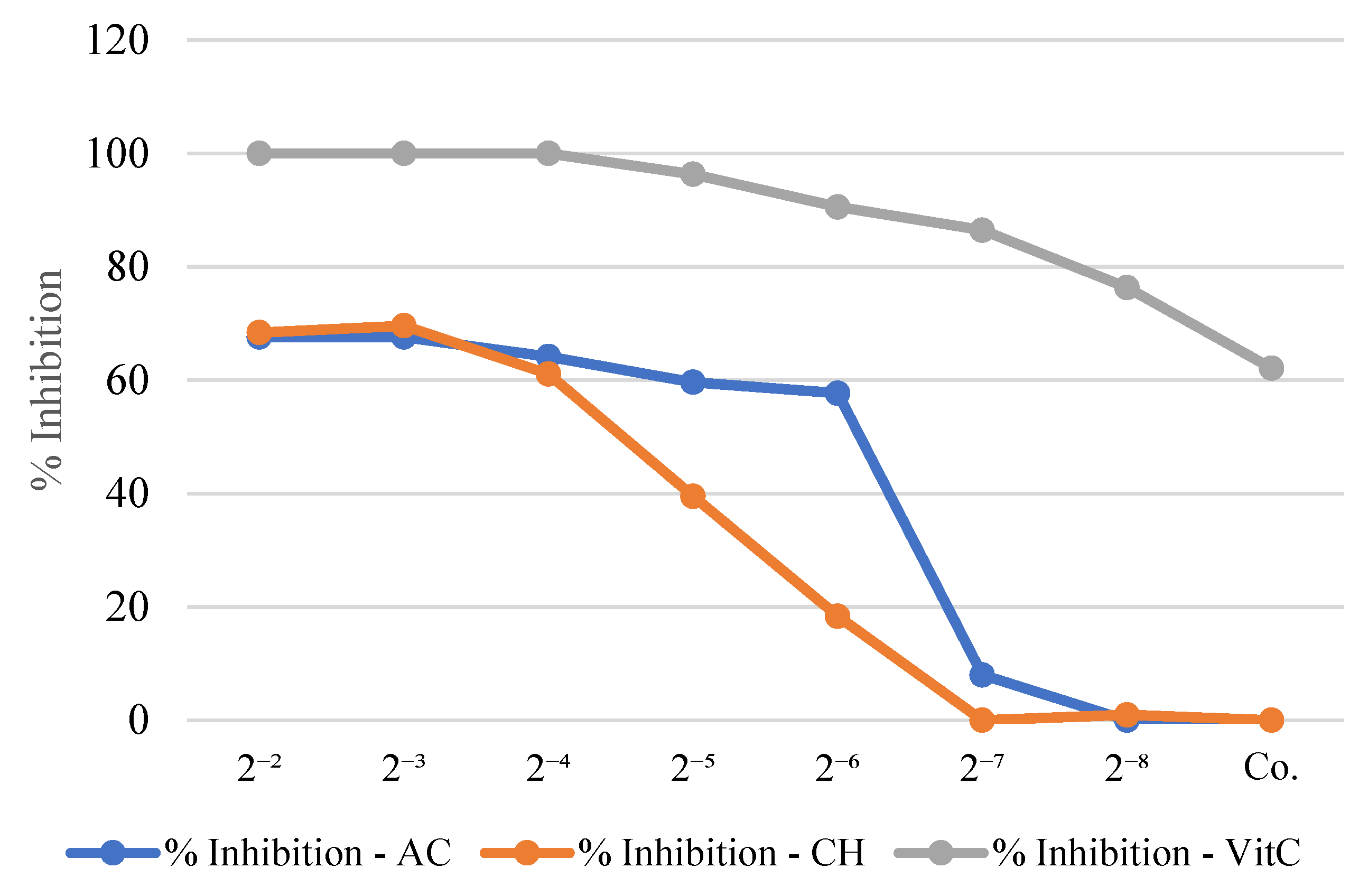
Both the chloroform (CHCl3) and ethyl acetate (EtOAc) extracts exhibited dose-dependent activity, as shown by the progressive increase in radical inhibition with increasing concentrations (Figure 2). Among them, the EtOAc extract demonstrated the strongest antioxidant effect, achieving the highest DPPH scavenging percentage at 8 mg·mL−1 and the lowest IC50 value, indicating greater hydrogen- or electron-donating capacity [34].
Figure 2.
Percentage inhibition of DPPH radical by chloroform (CHCl3), ethyl acetate (EtOAc) extracts, and vitamin C across different concentrations.
This enhanced activity correlates with its rich composition of phenolic and aromatic compounds, particularly protocatechuic acid and 4-hydroxybenzoic acid, which are known for their free radical-stabilizing properties. Additional polar metabolites, including hydroxy acids and phenylacetic derivatives, may also contribute synergistically to the overall antioxidant effect [47].
In contrast, the CHCl3 extract exhibited moderate scavenging potential, consistent with its content of less polar compounds such as long-chain fatty acids (e.g., palmitic and linoleic acids) and dicarboxylic acids, which generally show weaker radical-quenching activity. Its volatile fraction includes terpenoids (α-pinene, camphene, limonene), phenolic volatiles (2,4-di-tert-butylphenol), and minor ketones and aldehydes. Although these are less potent than polar phenolics, they may still contribute to antioxidant capacity through rapid radical interactions or transient stabilization [48,49,50].
These results align with previous findings on basidiomycetes, where phenolic metabolites are the primary contributors to antioxidant activity. While the activity was lower than that of ascorbic acid, P. herculeum—particularly its EtOAc-soluble fraction—emerges as a promising natural source of antioxidant agents [51,52].
3.5. Antibacterial Activity
The antibacterial activity of P. herculeum extracts was assessed against four bacterial strains: Escherichia coli (NCTC 10538), Pseudomonas aeruginosa (NCIMB 8626), Bacillus spizizenii (ATCC 6633), and Staphylococcus aureus (ATCC 6538) using the agar well diffusion method. The inhibition zones varied according to the extract type and bacterial strain (Table 3).
Table 3.
Antibacterial activity of Phlegmacium herculeum extracts (CHCl3 and EtOAc) against selected bacterial strains.
The chloroform (CHCl3) extract showed strong antibacterial effects, particularly against Gram-positive bacteria like Staphylococcus aureus, with an inhibition zone of approximately 18 mm. This activity can be attributed to several non-polar and semi-polar compounds identified in the extract, including benzoic acid, phenylacetic acid, palmitic acid, and linoleic acid, all known for their ability to disrupt bacterial membranes and inhibit growth [42]. Fatty acids such as palmitic acid and linoleic acid also contribute significantly due to their well-documented antimicrobial activities by disrupting membrane integrity and function [53]. Additionally, volatile components such as terpenoids and minor phenolic compounds may enhance this antibacterial effect by increasing membrane permeability or inducing stress responses in bacterial cells [54,55].
Conversely, the ethyl acetate (EtOAc) extract exhibited more pronounced activity against Gram-negative bacteria, with inhibition zones of around 18 mm for E. coli and 13 mm for P. aeruginosa. This effect aligns with the presence of polar phenolic acids like protocatechuic acid, 4-hydroxybenzoic acid, and 4-hydroxyphenylacetic acid, which possess functional groups capable of interfering with bacterial enzymes, cell wall synthesis, and other vital metabolic pathways [56,57]. Although volatile compounds are present in this extract, their contribution to antibacterial activity appears less dominant compared to phenolic metabolites.
Overall, both extracts demonstrate significant antibacterial potential, reflecting a broad spectrum of bioactive metabolites. The combined action of non-polar, polar, and volatile compounds likely contributes to their complementary antibacterial mechanisms, varying with the bacterial strain. These results support P. herculeum as a promising source of natural antibacterial agents for further research and development [58,59].
3.6. Cytotoxicity Activity
The cytotoxic effects of both the CHCl3 and EtOAc extracts were evaluated using a spot-test assay on Saccharomyces cerevisiae across dilutions ranging from 2−2 to 2−8 compared to an untreated control (Table 4). In contrast to preliminary qualitative observations, the quantitative viability assay (Table 4) clearly demonstrates that both extracts maintained 100% cell viability at all tested concentrations, with mortality values ranging between 0–10%, indicating no detectable cytotoxicity under the tested conditions.
Table 4.
Assessment of the effect of CHCl3 and EtOAc extracts on cell viability and mortality.
These results confirm that the extracts do not exert nonspecific cytotoxic effects on eukaryotic cells such as S. cerevisiae. Importantly, the absence of cytotoxicity does not contradict their potential relevance in anticancer research. In fact, several studies emphasize that natural products with low general cytotoxicity are highly valuable because they may act through selective anticancer mechanisms, such as modulation of signaling pathways, inhibition of angiogenesis, antioxidant activity, or enhancement of apoptosis specifically in malignant cells while sparing healthy tissue [60,61].
This selective behavior is widely documented for compounds such as adenosine and fatty acids including linoleic and azelaic acids, which show anticancer selectivity without broad cytotoxicity toward noncancerous cells [62,63,64].
4. Conclusions
This research represents a significant step in the molecular identification of Phlegmacium herculeum in Algeria, expanding knowledge of its geographical distribution and emphasizing the importance of molecular tools for accurate fungal taxonomy. Chemical analyses revealed a wide diversity of volatile and non-volatile compounds, many of which possess notable biological activities. The strong antioxidant potential demonstrated by the extracts indicates the species’ capacity to mitigate oxidative stress, supporting its possible use in health-related applications. Antibacterial assays confirmed its inhibitory effect against several clinically relevant bacterial strains, underscoring its promise as a natural source for antimicrobial agents. Cytotoxicity evaluation showed that the extracts did not exhibit harmful effects under the tested conditions. This indicates a safe profile for the extracts and supports their suitability for further biological studies, without implying direct anticancer activity.
Overall, P. herculeum stands as a valuable source of bioactive metabolites with potential pharmaceutical and biotechnological applications. Further research should focus on isolating and characterizing the active compounds, exploring their molecular mechanisms, and evaluating their safety and efficacy in more complex models. Such comprehensive studies could pave the way for the development of innovative natural compounds that contribute effectively and safely to modern drug discovery.
Supplementary Materials
The following supporting information can be downloaded at https://www.mdpi.com/article/10.3390/jof11120894/s1: Figure S1. 1H NMR spectrum of chloroform extract, recorded at 400 MHz in CD3OD; Figure S2. 1H NMR spectrum of ethyl acetate extract, recorded at 400 MHz in CD3OD.
Author Contributions
Conceptualization, R.Z. and M.M.; methodology, R.Z., S.G., L.Y.K., O.A., M.M., M.M.S. and A.A.; software, R.Z. and O.A.; validation, R.Z., S.G., M.M.S. and M.M.; formal analysis, R.Z. and M.M.; investigation, R.Z., S.G., O.A., M.M.S. and M.M.; resources, R.Z., M.M.S. and M.M.; data curation, R.Z., M.M.S. and M.M.; writing—original draft preparation, R.Z., S.G., M.M.S. and M.M.; writing—review and editing, R.Z., M.M.S., M.M. and A.C.; supervision, A.C. and M.M.; project administration, R.Z.; funding acquisition, R.Z. and A.C. All authors have read and agreed to the published version of the manuscript.
Funding
This research received no external funding.
Institutional Review Board Statement
Not applicable.
Informed Consent Statement
Not applicable.
Data Availability Statement
The original contributions presented in this study are included in the article/Supplementary Material. Further inquiries can be directed to the corresponding authors.
Acknowledgments
The authors would like to express their sincere gratitude to the Algerian Ministry of Higher Education and Scientific Research (MESRS, DGRSDT) for their valuable support.
Conflicts of Interest
The authors declare no conflicts of interest.
Abbreviations
The following abbreviations are used in this manuscript:
| P.herculeum | Phlegmacium herculeum |
| CHCl3, CH | Chloroform |
| EtOAc, AC | Ethyl acetate |
| VitC | Vitamin C |
| Co. | Concentration |
References
- Bills, G.F.; Gloer, J.B. Biologically active secondary metabolites from the fungi. Microbiol. Spectr. 2016, 4, 10–1128. [Google Scholar] [CrossRef] [Scilit] [PubMed]
- Zatout, R. Potential Bio-Control Substances Produced by Fungi and Plants of Different Mediterranean Basin Ecosystems. Doctoral Dissertation, Université Frères Mentouri-Constantine 1, Constantine, Algeria, 2021. [Google Scholar]
- Salwan, R.; Katoch, S.; Sharma, V. Recent developments in shiitake mushrooms and their nutraceutical importance. In Fungi in Sustainable Food Production; Springer: Cham, Switzerland, 2021; pp. 165–180. [Google Scholar]
- Sun, X.; Shi, Y.; Shi, D.; Tu, Y.; Liu, L. Biological activities of secondary metabolites from the edible-medicinal macrofungi. J. Fungi 2024, 10, 144. [Google Scholar] [CrossRef] [Scilit]
- Diagne, N.; Ngom, M.; Djighaly, P.I.; Fall, D.; Hocher, V.; Svistoonoff, S. Roles of arbuscular mycorrhizal fungi on plant growth and performance: Importance in biotic and abiotic stressed regulation. Diversity 2020, 12, 370. [Google Scholar] [CrossRef] [Scilit]
- Zhao, Y.; Cartabia, A.; Lalaymia, I.; Declerck, S. Arbuscular mycorrhizal fungi and production of secondary metabolites in medicinal plants. Mycorrhiza 2022, 32, 221–256. [Google Scholar] [CrossRef] [Scilit] [PubMed]
- Khan, Y.; Shah, S.; Tian, H. The roles of arbuscular mycorrhizal fungi in influencing plant nutrients, photosynthesis, and metabolites of cereal crops—A review. Agronomy 2022, 12, 2191. [Google Scholar] [CrossRef] [Scilit]
- Liimatainen, K.; Niskanen, T.; Dima, B.; Kytövuori, I.; Ammirati, J.F.; Frøslev, T.G. The largest type study of Agaricales species to date: Bringing identification and nomenclature of Phlegmacium (Cortinarius) into the DNA era. Persoonia 2014, 33, 98–140. [Google Scholar] [CrossRef] [Scilit] [PubMed]
- Mrak, T.; Brailey-Crane, P.A.; Šibanc, N.; Martinović, T.; Gričar, J.; Kraigher, H. Mycelial communities associated with Ostrya carpinifolia, Quercus pubescens and Pinus nigra in a patchy Sub-Mediterranean Karst woodland. Mycorrhiza 2025, 35, 46. [Google Scholar] [CrossRef] [Scilit]
- Mesfek, F.; Fortas, Z.; Dib, S. Inventory and ecology of macrofungi and plants in a North-Western Algerian forest. J. Biodivers. Conserv. Bioresour. Manag. 2021, 7, 33–46. [Google Scholar] [CrossRef] [Scilit]
- Ait Hamadouche, Y.; Soulef, D.I.B.; Mechouet, O. Mycochemical contents of higher fungi and their in vitro effect on plant growth. Not. Bot. Horti Agrobot. Cluj-Napoca 2024, 52, 13358. [Google Scholar] [CrossRef] [Scilit]
- Zatout, R.; Cimmino, A.; Cherfia, R.; Chaouche, N.K. Isolation of tyrosol the main phytotoxic metabolite produced by the edible fungus Agaricus litoralis. Egypt. J. Chem. 2021, 64, 5741–5745. [Google Scholar] [CrossRef] [Scilit]
- Minerdi, D.; Maggini, V.; Fani, R. Volatile organic compounds: From figurants to leading actors in fungal symbiosis. FEMS Microbiol. Ecol. 2021, 97, fiab067. [Google Scholar] [CrossRef] [Scilit] [PubMed]
- El Jaddaoui, I.; Rangel, D.E.; Bennett, J.W. Fungal volatiles have physiological properties. Fungal Biol. 2023, 127, 1231–1240. [Google Scholar] [CrossRef] [Scilit]
- Effmert, U.; Kalderás, J.; Warnke, R.; Piechulla, B. Volatile mediated interactions between bacteria and fungi in the soil. J. Chem. Ecol. 2012, 38, 665–703. [Google Scholar] [CrossRef] [Scilit]
- Hung, R.; Lee, S.; Bennett, J.W. Fungal volatile organic compounds and their role in ecosystems. Appl. Microbiol. Biotechnol. 2015, 99, 3395–3405. [Google Scholar] [CrossRef] [Scilit]
- Heleno, S.A.; Martins, A.; Queiroz, M.J.R.; Ferreira, I.C. Bioactivity of phenolic acids: Metabolites versus parent compounds: A review. Food Chem. 2015, 173, 501–513. [Google Scholar] [CrossRef] [Scilit]
- He, M.; Peng, Q.; Xu, X.; Shi, B.; Qiao, Y. Antioxidant capacities and non-volatile metabolites changes after solid-state fermentation of soybean using oyster mushroom (Pleurotus ostreatus) mycelium. Front. Nutr. 2024, 11, 1509341. [Google Scholar] [CrossRef] [Scilit]
- Sureshkumar, S.; Merlin, I.; Prasai, J.R.; Rajapriya, P.; Pandi, M. Antioxidant, antibacterial, cytotoxicity, and phytochemical potentials of fungal bioactive secondary metabolites. J. Basic Microbiol. 2022, 62, 1379–1392. [Google Scholar] [CrossRef] [Scilit]
- Wadhwa, K.; Kapoor, N.; Kaur, H.; Abu-Seer, E.A.; Tariq, M.; Siddiqui, S.; Alghamdi, S. A comprehensive review of the diversity of fungal secondary metabolites and their emerging applications in healthcare and environment. Mycobiology 2024, 52, 335–387. [Google Scholar] [CrossRef] [Scilit] [PubMed]
- Bhattarai, K.; Kabir, M.E.; Bastola, R.; Baral, B. Fungal natural products galaxy: Biochemistry and molecular genetics toward blockbuster drugs discovery. Adv. Genet. 2021, 107, 193–284. [Google Scholar] [CrossRef] [Scilit] [PubMed]
- Zatout, R.; Christopher, B.; Cherfia, R.; Chaoua, S.; Chaouche, N.K. A new record of Agaricus litoralis, a rare edible macro-fungus from Eastern Algeria. Mycopath 2023, 20, 51–56. [Google Scholar]
- Bon, M. Guía de Campo de los Hongos de Europa; Omega: Barcelona, Spain, 1987; 368p. [Google Scholar]
- Zatout, R.; Benslama, O.; Makhlouf, F.Z.; Cimmino, A.; Salvatore, M.M.; Andolfi, A.; Masi, M. Exploring the potential of Genista ulicina phytochemicals as natural biocontrol agents: A comparative in vitro and in silico analysis. Toxins 2025, 17, 452. [Google Scholar] [CrossRef] [Scilit]
- Zatout, R.; Kacem Chaouche, N. Antibacterial activity screening of an edible mushroom Agaricus litoralis. Int. J. Bot. Stud. 2023, 8, 49–52. [Google Scholar]
- Salvatore, M.M.; Pappalardo, C.; Suarez, E.G.P.; Salvatore, F.; Andolfi, A.; Gesuele, R.; Galdiero, E.; Libralato, G.; Guida, M.; Siciliano, A. Ecotoxicological and metabolomic investigation of chronic exposure of Daphnia magna (Straus, 1820) to yttrium environmental concentrations. Aquat. Toxicol. 2024, 276, 107117. [Google Scholar] [CrossRef] [Scilit] [PubMed]
- Blois, M.S. Antioxidant determinations by the use of a stable free radical. Nature 1958, 181, 1199–1200. [Google Scholar] [CrossRef] [Scilit]
- Brand-Williams, W.; Cuvelier, M.E.; Berset, C.L.W.T. Use of a free radical method to evaluate antioxidant activity. LWT-Food Sci. Technol. 1995, 28, 25–30. [Google Scholar] [CrossRef] [Scilit]
- Balouiri, M.; Sadiki, M.; Ibnsouda, S.K. Methods for in vitro evaluating antimicrobial activity: A review. J. Pharm. Anal. 2016, 6, 71–79. [Google Scholar] [CrossRef] [Scilit]
- Ben Amor, A.; Hemmami, H.; Gherbi, M.T.; Seghir, B.B.; Zeghoud, S.; Gharbi, A.H.; Barhoum, A. Synthesis of spherical carbon nanoparticles from orange peel and their surface modification with chitosan: Evaluation of optical properties, biocompatibility, antioxidant and anti-hemolytic activity. Biomass Convers. Biorefin. 2025, 15, 11345–11358. [Google Scholar] [CrossRef] [Scilit]
- Liimatainen, K.; Kim, J.T.; Pokorny, L.; Kirk, P.M.; Dentinger, B.; Niskanen, T. Taming the beast: A revised classification of Cortinariaceae based on genomic data. Fungal Divers. 2022, 112, 89–170. [Google Scholar] [CrossRef] [Scilit]
- Høiland, K.; Danielsen, J.S.; Gulden, G.; Marthinsen, G.; Tjessem, I.V. Web caps Cortinarius and Phlegmacium (Agaricales, Cortinariaceae) in Svalbard and on Bear Island. AGARICA 2025, 45, 1–71. [Google Scholar] [CrossRef] [Scilit]
- Blanco, O.; Crespo, A.; Divakar, P.K.; Elix, J.A.; Lumbsch, H.T. Molecular phylogeny of parmotremoid lichens (Ascomycota, Parmeliaceae). Mycologia 2005, 97, 150–159. [Google Scholar] [CrossRef]
- Gómez, I.; Lavega González, R.; Tejedor-Calvo, E.; Pérez Clavijo, M.; Carrasco, J. Odor profile of four cultivated and freeze-dried edible mushrooms by using sensory panel, electronic nose and GC-MS. J. Fungi 2022, 8, 953. [Google Scholar] [CrossRef] [Scilit]
- Deng, G.; Li, J.; Liu, H.; Wang, Y. Volatile compounds and aroma characteristics of mushrooms: A review. Crit. Rev. Food Sci. Nutr. 2024, 64, 13175–13192. [Google Scholar] [CrossRef] [Scilit]
- Guimarães, A.; Venâncio, A. The potential of fatty acids and their derivatives as antifungal agents: A review. Toxins 2022, 14, 188. [Google Scholar] [CrossRef] [Scilit] [PubMed]
- Tian, R.; Liang, Z.Q.; Wang, Y.; Zeng, N.K. Analysis of aromatic components of two edible mushrooms, Phlebopus portentosus and Cantharellus yunnanensis using HS-SPME/GC-MS. Results Chem. 2022, 4, 100282. [Google Scholar] [CrossRef] [Scilit]
- Kitajima, S.; Maruyama, Y.; Kuroda, M. Volatile short-chain aliphatic aldehydes act as taste modulators through the orally expressed calcium-sensing receptor CaSR. Molecules 2023, 28, 4585. [Google Scholar] [CrossRef] [Scilit]
- Aisala, H.; Manninen, H.; Laaksonen, T.; Linderborg, K.M.; Myoda, T.; Hopia, A.; Sandell, M. Linking volatile and non-volatile compounds to sensory profiles and consumer liking of wild edible Nordic mushrooms. Food Chem. 2020, 304, 125403. [Google Scholar] [CrossRef] [Scilit] [PubMed]
- Ladygina, N.; Dedyukhina, E.G.; Vainshtein, M.B. A review on microbial synthesis of hydrocarbons. Process Biochem. 2006, 41, 1001–1014. [Google Scholar] [CrossRef] [Scilit]
- Farré-Armengol, G.; Filella, I.; Llusià, J.; Peñuelas, J. β-Ocimene, a key floral and foliar volatile involved in multiple interactions between plants and other organisms. Molecules 2017, 22, 1148. [Google Scholar] [CrossRef] [Scilit] [PubMed]
- Ji, W.; Ji, X. Comparative analysis of volatile terpenes and terpenoids in the leaves of Pinus species—A potentially abundant renewable resource. Molecules 2021, 26, 5244. [Google Scholar] [CrossRef] [Scilit]
- Rathna, J.; Bakkiyaraj, D.; Pandian, S.K. Anti-biofilm mechanisms of 3,5-di-tert-butylphenol against clinically relevant fungal pathogens. Biofouling 2016, 32, 979–993. [Google Scholar] [CrossRef] [Scilit]
- Zhao, F.; Wang, P.; Lucardi, R.D.; Su, Z.; Li, S. Natural sources and bioactivities of 2,4-di-tert-butylphenol and its analogs. Toxins 2020, 12, 35. [Google Scholar] [CrossRef] [Scilit]
- Duc, N.H.; Vo, H.T.; van Doan, C.; Hamow, K.A.; Le, K.H.; Posta, K. Volatile organic compounds shape belowground plant–fungi interactions. Front. Plant Sci. 2022, 13, 1046685. [Google Scholar] [CrossRef] [Scilit] [PubMed]
- Rocco, M.; Kammer, J.; Santonja, M.; Temime-Roussel, B.; Saignol, C.; Lecareux, C.; Ormeño, E. Is litter biomass a driver of soil volatile organic compound fluxes in Mediterranean forest? Biogeosciences 2025, 22, 3661–3680. [Google Scholar] [CrossRef] [Scilit]
- Kim, W.; Lee, B.; Park, J.; Kim, H.J.; Cheong, H. Comparative antioxidant activity and structural feature of protocatechuic acid and phenolic acid derivatives by DPPH and intracellular ROS. Lett. Drug Des. Discov. 2018, 15, 612–620. [Google Scholar] [CrossRef] [Scilit]
- Gülcin, I. Antioxidant activity of food constituents: An overview. Arch. Toxicol. 2012, 86, 345–391. [Google Scholar] [CrossRef] [Scilit]
- Szczepańska, P.; Rychlicka, M.; Groborz, S.; Kruszyńska, A.; Ledesma-Amaro, R.; Rapak, A.; Lazar, Z. Studies on the anticancer and antioxidant activities of resveratrol and long-chain fatty acid esters. Int. J. Mol. Sci. 2023, 24, 7167. [Google Scholar] [CrossRef] [Scilit]
- Heer, A.; Guleria, S.; Razdan, V.K. Chemical composition, antioxidant and antimicrobial activities and characterization of bioactive compounds from essential oil of Cinnamomum tamala grown in north-western Himalaya. J. Plant Biochem. Biotechnol. 2017, 26, 191–198. [Google Scholar] [CrossRef] [Scilit]
- Ghasemzadeh, A.; Jaafar, H.Z.; Rahmat, A. Antioxidant activities, total phenolics and flavonoids content in two varieties of Malaysia young ginger (Zingiber officinale Roscoe). Molecules 2010, 15, 4324–4333. [Google Scholar] [CrossRef] [Scilit]
- Zatout, R.; Benarbia, R.; Yalla, I. Phytochemical profiles and antimicrobial activities of Phellinus mushroom: Implications for agricultural health and crop protection. Agric. Res. J. 2024, 61, 340–345. [Google Scholar] [CrossRef] [Scilit]
- Ferreira, I.C.; Barros, L.; Abreu, R. Antioxidants in wild mushrooms. Curr. Med. Chem. 2009, 16, 1543–1560. [Google Scholar] [CrossRef] [Scilit]
- Burt, S. Essential oils: Their antibacterial properties and potential applications in foods—A review. Int. J. Food Microbiol. 2004, 94, 223–253. [Google Scholar] [CrossRef] [Scilit] [PubMed]
- Stephane, F.F.Y. Terpenoids as Important Bioactive Constituents of Essential Oils. In Essential Oils: Bioactive Compounds, New Perspectives and Applications; Intechopen: London, UK, 2020; Volume 75. [Google Scholar]
- Cho, J.Y.; Moon, J.H.; Seong, K.Y.; Park, K.H. Antimicrobial activity of 4-hydroxybenzoic acid and trans 4-hydroxycinnamic acid isolated and identified from rice hull. Biosci. Biotechnol. Biochem. 1998, 62, 2273–2276. [Google Scholar] [CrossRef] [Scilit] [PubMed]
- Sánchez–Maldonado, A.F.; Schieber, A.; Gänzle, M.G. Structure–function relationships of the antibacterial activity of phenolic acids and their metabolism by lactic acid bacteria. J. Appl. Microbiol. 2011, 111, 1176–1184. [Google Scholar] [CrossRef] [Scilit] [PubMed]
- Borges, A.; Ferreira, C.; Saavedra, M.J.; Simões, M. Antibacterial activity and mode of action of ferulic and gallic acids against pathogenic bacteria. Microb. Drug Resist. 2013, 19, 256–265. [Google Scholar] [CrossRef] [Scilit]
- Alves, M.J.; Ferreira, I.C.; Dias, J.; Teixeira, V.; Martins, A.; Pintado, M. A review on antimicrobial activity of mushroom (Basidiomycetes) extracts and isolated compounds. Planta Medica 2012, 78, 1707–1718. [Google Scholar] [CrossRef] [Scilit]
- Jia, S.; Li, L.; Yu, C.; Peng, F. Natural products’ antiangiogenic roles in gynecological cancer. Front. Pharmacol. 2024, 15, 1353056. [Google Scholar] [CrossRef] [Scilit]
- Oraibi, A.I.; Dawood, A.H.; Trabelsi, G.; Mahamat, O.B.; Chekir-Ghedira, L.; Kilani-Jaziri, S. Antioxidant activity and selective cytotoxicity in HCT-116 and WI-38 cell lines of LC-MS/MS profiled extract from Capparis spinosa L. Front. Chem. 2025, 13, 1540174. [Google Scholar] [CrossRef] [Scilit]
- Virtanen, S.S.; Kukkonen-Macchi, A.; Vainio, M.; Elima, K.; Härkönen, P.L.; Jalkanen, S.; Yegutkin, G.G. Adenosine inhibits tumor cell invasion via receptor-independent mechanisms. Mol. Cancer Res. 2014, 12, 1863–1874. [Google Scholar] [CrossRef] [Scilit]
- Qiu, J.; Zhao, Z.; Suo, H.; Paraghamian, S.E.; Hawkins, G.M.; Sun, W.; Bae-Jump, V. Linoleic acid exhibits anti-proliferative and anti-invasive activities in endometrial cancer cells and a transgenic model of endometrial cancer. Cancer Biol. Ther. 2024, 25, 2325130. [Google Scholar] [CrossRef] [Scilit]
- Dongdong, Z.; Jin, Y.; Yang, T.; Yang, Q.; Wu, B.; Chen, Y.; Zhou, F. Antiproliferative and immunoregulatory effects of azelaic acid against acute myeloid leukemia via the activation of notch signaling pathway. Front. Pharmacol. 2019, 10, 1396. [Google Scholar] [CrossRef] [Scilit] [PubMed]

Disclaimer/Publisher’s Note: The statements, opinions and data contained in all publications are solely those of the individual author(s) and contributor(s) and not of MDPI and/or the editor(s). MDPI and/or the editor(s) disclaim responsibility for any injury to people or property resulting from any ideas, methods, instructions or products referred to in the content. |
© 2025 by the authors. Licensee MDPI, Basel, Switzerland. This article is an open access article distributed under the terms and conditions of the Creative Commons Attribution (CC BY) license (https://creativecommons.org/licenses/by/4.0/).