
Microdochium majus Isolated from Grapevine Is a Mycoparasite of Botrytis cinerea

 ,
, 
 , ,
, ,  ,
,  ,
, Abstract
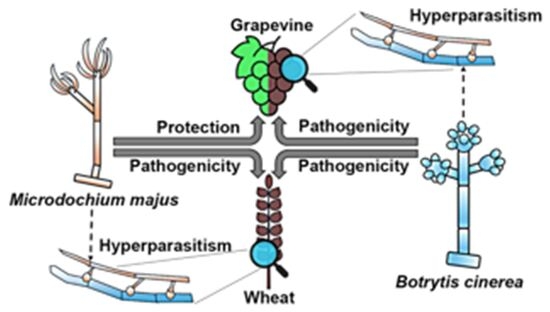
Share and Cite
Váczy, K.Z.; Szabó, D.; Molnár, N.; Kiss, T.; Kiss, L.; Tan, Y.P.; Novák, Á.; Pálfi, X.; Gomba-Tóth, A.; Karácsony, Z. Microdochium majus Isolated from Grapevine Is a Mycoparasite of Botrytis cinerea. J. Fungi 2025, 11, 31. https://doi.org/10.3390/jof11010031
Váczy KZ, Szabó D, Molnár N, Kiss T, Kiss L, Tan YP, Novák Á, Pálfi X, Gomba-Tóth A, Karácsony Z. Microdochium majus Isolated from Grapevine Is a Mycoparasite of Botrytis cinerea. Journal of Fungi. 2025; 11(1):31. https://doi.org/10.3390/jof11010031
Chicago/Turabian StyleVáczy, Kálmán Zoltán, Dóra Szabó, Nikolett Molnár, Tibor Kiss, Levente Kiss, Yu Pei Tan, Ádám Novák, Xénia Pálfi, Adrienn Gomba-Tóth, and Zoltán Karácsony. 2025. "Microdochium majus Isolated from Grapevine Is a Mycoparasite of Botrytis cinerea" Journal of Fungi 11, no. 1: 31. https://doi.org/10.3390/jof11010031
APA StyleVáczy, K. Z., Szabó, D., Molnár, N., Kiss, T., Kiss, L., Tan, Y. P., Novák, Á., Pálfi, X., Gomba-Tóth, A., & Karácsony, Z. (2025). Microdochium majus Isolated from Grapevine Is a Mycoparasite of Botrytis cinerea. Journal of Fungi, 11(1), 31. https://doi.org/10.3390/jof11010031