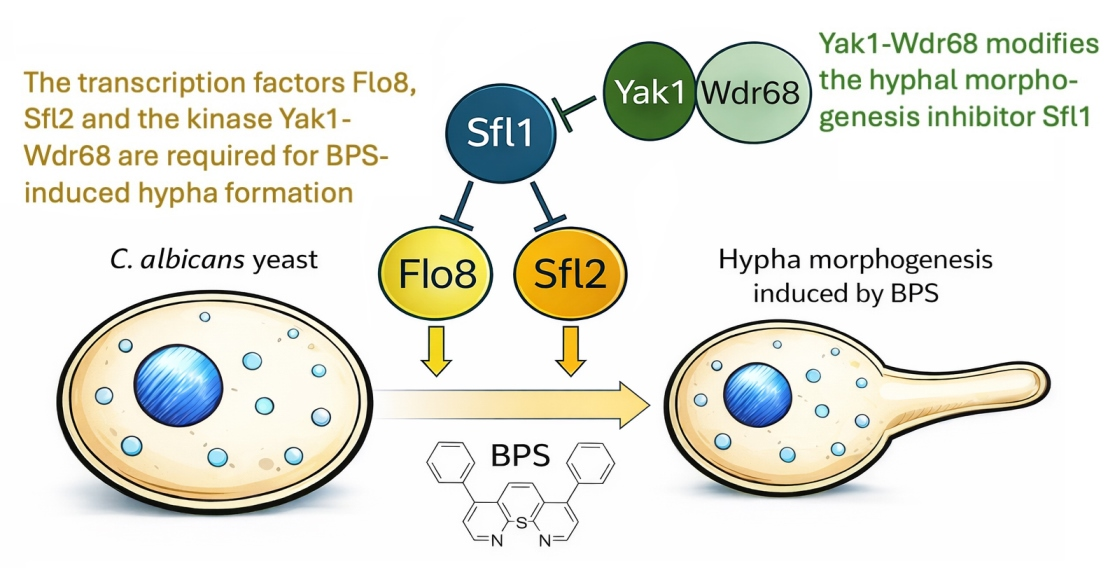

Genetic Analysis of Candida albicans Filamentation by the Iron Chelator BPS Reveals a Role for a Conserved Kinase—WD40 Protein Pair


Abstract
Share and Cite
Pinsky, M.; Kornitzer, D. Genetic Analysis of Candida albicans Filamentation by the Iron Chelator BPS Reveals a Role for a Conserved Kinase—WD40 Protein Pair. J. Fungi 2024, 10, 83. https://doi.org/10.3390/jof10010083
Pinsky M, Kornitzer D. Genetic Analysis of Candida albicans Filamentation by the Iron Chelator BPS Reveals a Role for a Conserved Kinase—WD40 Protein Pair. Journal of Fungi. 2024; 10(1):83. https://doi.org/10.3390/jof10010083
Chicago/Turabian StylePinsky, Mariel, and Daniel Kornitzer. 2024. "Genetic Analysis of Candida albicans Filamentation by the Iron Chelator BPS Reveals a Role for a Conserved Kinase—WD40 Protein Pair" Journal of Fungi 10, no. 1: 83. https://doi.org/10.3390/jof10010083
APA StylePinsky, M., & Kornitzer, D. (2024). Genetic Analysis of Candida albicans Filamentation by the Iron Chelator BPS Reveals a Role for a Conserved Kinase—WD40 Protein Pair. Journal of Fungi, 10(1), 83. https://doi.org/10.3390/jof10010083