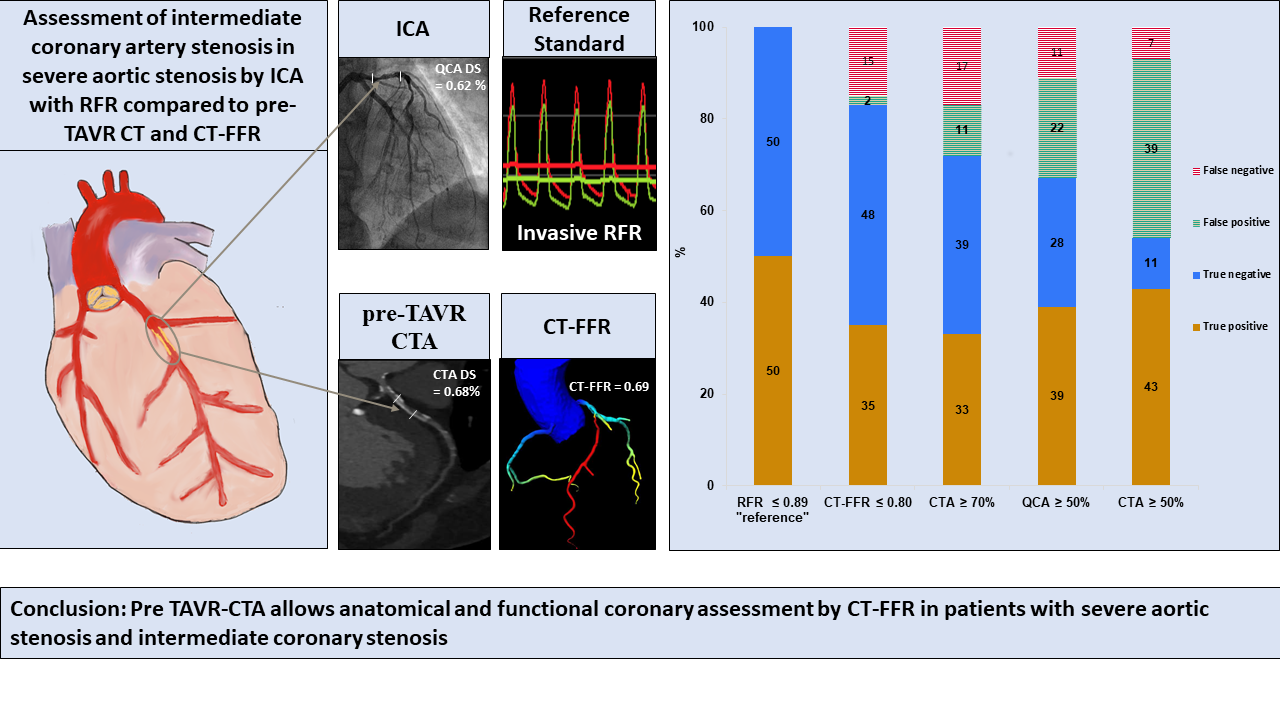

Feasibility and Comparison of Resting Full-Cycle Ratio and Computed Tomography Fractional Flow Reserve in Patients with Severe Aortic Valve Stenosis
 , , ,
, , , 
Abstract
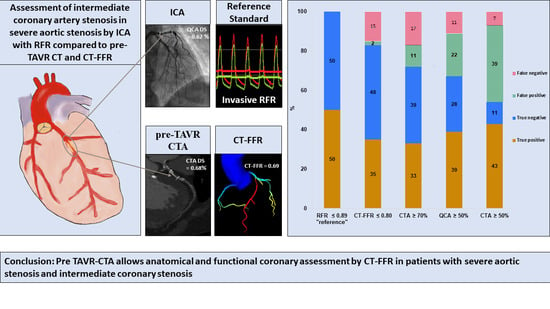
Share and Cite
Wienemann, H.; Langenbach, M.C.; Mauri, V.; Banazadeh, M.; Klein, K.; Hohmann, C.; Lee, S.; Breidert, I.; Hof, A.; Eghbalzadeh, K.; et al. Feasibility and Comparison of Resting Full-Cycle Ratio and Computed Tomography Fractional Flow Reserve in Patients with Severe Aortic Valve Stenosis. J. Cardiovasc. Dev. Dis. 2022, 9, 116. https://doi.org/10.3390/jcdd9040116
Wienemann H, Langenbach MC, Mauri V, Banazadeh M, Klein K, Hohmann C, Lee S, Breidert I, Hof A, Eghbalzadeh K, et al. Feasibility and Comparison of Resting Full-Cycle Ratio and Computed Tomography Fractional Flow Reserve in Patients with Severe Aortic Valve Stenosis. Journal of Cardiovascular Development and Disease. 2022; 9(4):116. https://doi.org/10.3390/jcdd9040116
Chicago/Turabian StyleWienemann, Hendrik, Marcel C. Langenbach, Victor Mauri, Maryam Banazadeh, Konstantin Klein, Christopher Hohmann, Samuel Lee, Isabel Breidert, Alexander Hof, Kaveh Eghbalzadeh, and et al. 2022. "Feasibility and Comparison of Resting Full-Cycle Ratio and Computed Tomography Fractional Flow Reserve in Patients with Severe Aortic Valve Stenosis" Journal of Cardiovascular Development and Disease 9, no. 4: 116. https://doi.org/10.3390/jcdd9040116
APA StyleWienemann, H., Langenbach, M. C., Mauri, V., Banazadeh, M., Klein, K., Hohmann, C., Lee, S., Breidert, I., Hof, A., Eghbalzadeh, K., Kuhn, E., Halbach, M., Maintz, D., Baldus, S., Bunck, A., & Adam, M. (2022). Feasibility and Comparison of Resting Full-Cycle Ratio and Computed Tomography Fractional Flow Reserve in Patients with Severe Aortic Valve Stenosis. Journal of Cardiovascular Development and Disease, 9(4), 116. https://doi.org/10.3390/jcdd9040116