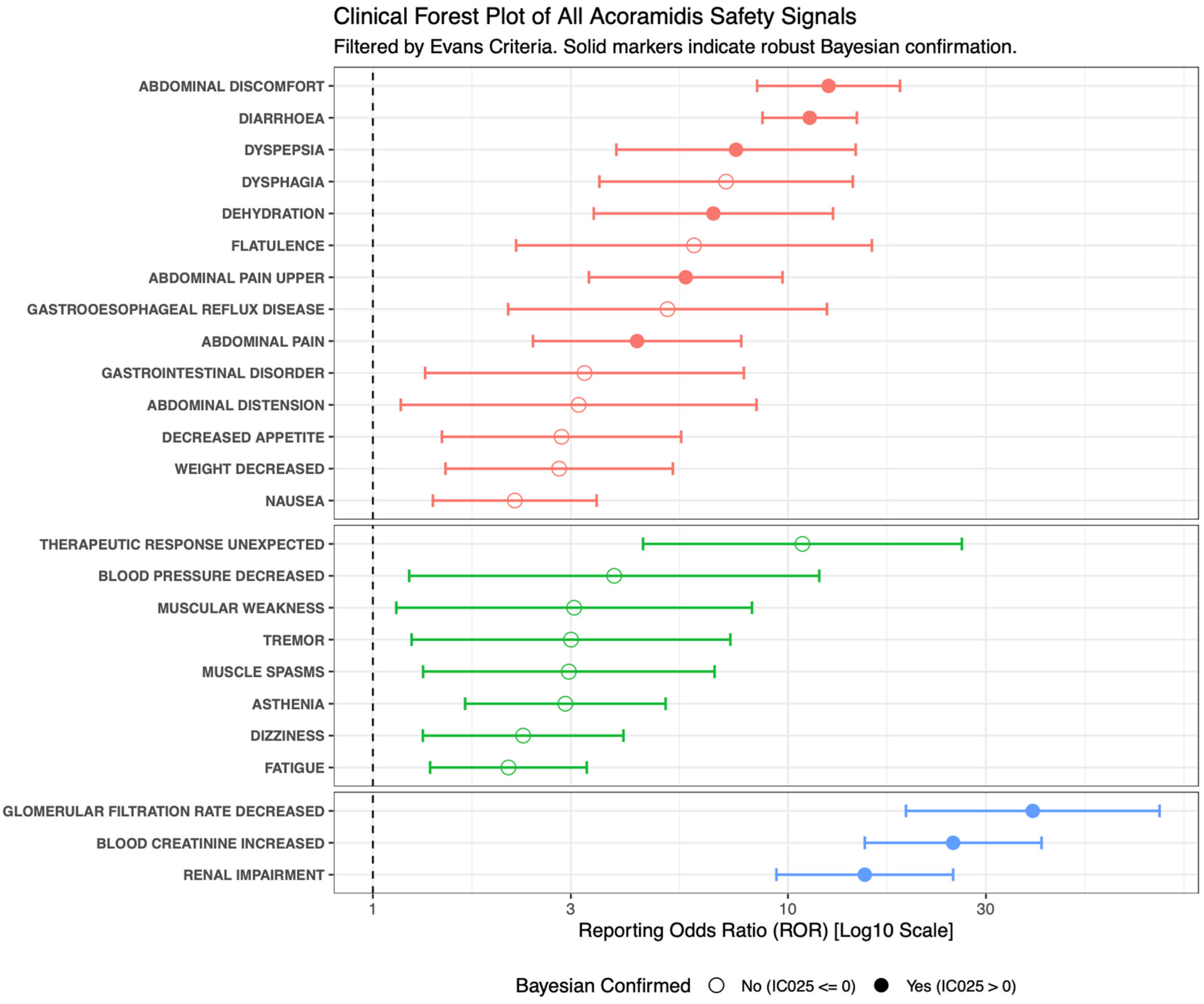

Real-World Safety of Acoramidis in Transthyretin Amyloid Cardiomyopathy: A Pharmacovigilance Study


Abstract
1. Introduction
2. Materials and Methods
3. Results
3.1. Patient Clinical Characteristics
3.2. Disproportionality Analysis
3.3. Gastrointestinal and Nutritional Signals
3.4. Renal and Clearance Signals
3.5. General, Neurological and Musculoskeletal Signals
4. Discussion
4.1. Renal Effects
4.2. Gastrointestinal and Systemic Tolerability
4.3. Neuromuscular and Systemic Signals
4.4. Strengths and Limitations
5. Conclusions
Supplementary Materials
Author Contributions
Funding
Institutional Review Board Statement
Informed Consent Statement
Data Availability Statement
Conflicts of Interest
Abbreviations
| ADR | Adverse Drug Reaction |
| AEs | Adverse events |
| ATTR | Transthyretin amyloidosis |
| ATTR-CM | Transthyretin amyloid cardiomyopathy |
| BCPNN | Bayesian Confidence Propagation Neural Network |
| CI | Confidence interval |
| FAERS | Food and Drug Administration Adverse Event Reporting System |
| GFR | Glomerular filtration rate |
| GI | Gastrointestinal |
| IC | Information component |
| PRR | Proportional Reporting Ratio |
| PT | Preferred Term |
| RAAS | Renin-angiotensin-aldosterone-system |
| ROR | Reporting odds ratio |
| SOC | System Organ Class |
| TTR | Transthyretin |
References
- Shams, P.; Ahmed, I. Cardiac Amyloidosis. In StatPearls; StatPearls Publishing: Treasure Island, FL, USA, 2025. [Google Scholar]
- Maurer, M.S.; Schwartz, J.H.; Gundapaneni, B.; Elliott, P.M.; Merlini, G.; Waddington-Cruz, M.; Kristen, A.V.; Grogan, M.; Witteles, R.; Damy, T.; et al. Tafamidis Treatment for Patients with Transthyretin Amyloid Cardiomyopathy. N. Engl. J. Med. 2018, 379, 1007–1016. [Google Scholar] [CrossRef] [Scilit] [PubMed]
- Tomasoni, D.; Bonfioli, G.B.; Aimo, A.; Adamo, M.; Canepa, M.; Inciardi, R.M.; Lombardi, C.M.; Nardi, M.; Pagnesi, M.; Riccardi, M.; et al. Treating Amyloid Transthyretin Cardiomyopathy: Lessons Learned from Clinical Trials. Front. Cardiovasc. Med. 2023, 10, 1154594. [Google Scholar] [CrossRef] [Scilit] [PubMed]
- Gillmore, J.D.; Judge, D.P.; Cappelli, F.; Fontana, M.; Garcia-Pavia, P.; Gibbs, S.; Grogan, M.; Hanna, M.; Hoffman, J.; Masri, A.; et al. Efficacy and Safety of Acoramidis in Transthyretin Amyloid Cardiomyopathy. N. Engl. J. Med. 2024, 390, 132–142. [Google Scholar] [CrossRef] [Scilit] [PubMed]
- Ngcobo, N.N. Polypharmacy and Deprescribing among Geriatric Patients. Aging Health Res. 2025, 5, 100256. [Google Scholar] [CrossRef] [Scilit]
- Kendir, C.; van den Akker, M.; Vos, R.; Metsemakers, J. Cardiovascular Disease Patients Have Increased Risk for Comorbidity: A Cross-Sectional Study in the Netherlands. Eur. J. Gen. Pract. 2017, 24, 45–50. [Google Scholar] [CrossRef] [Scilit] [PubMed]
- Ye, G.; Ding, L.; Zhou, Q. Remimazolam’s Clinical Application and Safety: A Signal Detection Analysis Based on FAERS Data and Literature Support. PLoS ONE 2025, 20, e0330769. [Google Scholar] [CrossRef] [Scilit] [PubMed]
- Raue, A.; Kreutz, C.; Theis, F.J.; Timmer, J. Joining Forces of Bayesian and Frequentist Methodology: A Study for Inference in the Presence of Non-Identifiability. Philos. Trans. A Math. Phys. Eng. Sci. 2013, 371, 20110544. [Google Scholar] [CrossRef] [Scilit] [PubMed]
- Evans, S.J.; Waller, P.C.; Davis, S. Use of Proportional Reporting Ratios (PRRs) for Signal Generation from Spontaneous Adverse Drug Reaction Reports. Pharmacoepidemiol. Drug Saf. 2001, 10, 483–486. [Google Scholar] [CrossRef] [Scilit] [PubMed]
- Bate, A.; Lindquist, M.; Edwards, I.R.; Olsson, S.; Orre, R.; Lansner, A.; De Freitas, R.M. A Bayesian Neural Network Method for Adverse Drug Reaction Signal Generation. Eur. J. Clin. Pharmacol. 1998, 54, 315–321. [Google Scholar] [CrossRef] [Scilit] [PubMed]
- Norén, G.N.; Bate, A.; Orre, R.; Edwards, I.R. Extending the Methods Used to Screen the WHO Drug Safety Database towards Analysis of Complex Associations and Improved Accuracy for Rare Events. Stat. Med. 2006, 25, 3740–3757. [Google Scholar] [CrossRef] [Scilit] [PubMed]
- BridgeBio Pharma, Inc. ATTRUBYTM (Acoramidis) Tablets, for Oral Administration, Initial U.S. Approval: 2024; U.S. Food and Drug Administration: Silver Spring, MD, USA, 2024. [Google Scholar]
- Shams, P.; Malik, A.; Chhabra, L. Heart Failure (Congestive Heart Failure). In StatPearls; StatPearls Publishing: Treasure Island, FL, USA, 2026. [Google Scholar]
- KDIGO Work Group. Kidney Disease: Improving Global Outcomes (KDIGO) CKD Work Group KDIGO 2024 Clinical Practice Guideline for the Evaluation and Management of Chronic Kidney Disease. Kidney Int. 2024, 105, S117–S314. [Google Scholar] [CrossRef] [Scilit] [PubMed]
- Ji, A.X.; Betz, A.; Sinha, U. Differential Binding Affinities and Kinetics of Transthyretin Stabilizers. J. Cardiovasc. Pharmacol. 2025, 86, 204–209. [Google Scholar] [CrossRef] [Scilit] [PubMed]
- Kittleson, M.M.; Ruberg, F.L.; Ambardekar, A.V.; Brannagan, T.H.; Cheng, R.K.; Clarke, J.O.; Dember, L.M.; Frantz, J.G.; Hershberger, R.E.; Maurer, M.S.; et al. 2023 ACC Expert Consensus Decision Pathway on Comprehensive Multidisciplinary Care for the Patient with Cardiac Amyloidosis. J. Am. Coll. Cardiol. 2023, 81, 1076–1126. [Google Scholar] [CrossRef] [Scilit] [PubMed]
- Siemer, J.M.; Grote-Levi, L.; Hänselmann, A.; Sassmann, M.L.; Nay, S.; Ratuszny, D.; Körner, S.; Seeliger, T.; Hümmert, M.W.; Dohrn, M.F.; et al. Polyneuropathy in Hereditary and Wildtype Transthyretin Amyloidosis, Comparison of Key Clinical Features and Red Flags. Sci. Rep. 2025, 15, 35028. [Google Scholar] [CrossRef] [Scilit] [PubMed]
- Docherty, N.G.; Delles, C.; D’Haese, P.; Layton, A.T.; Martínez-Salgado, C.; Vervaet, B.A.; López-Hernández, F.J. Haemodynamic Frailty—A Risk Factor for Acute Kidney Injury in the Elderly. Ageing Res. Rev. 2021, 70, 101408. [Google Scholar] [CrossRef] [Scilit] [PubMed]
- Maddox, T.M.; Januzzi, J.L.; Allen, L.A.; Breathett, K.; Brouse, S.; Butler, J.; Davis, L.L.; Fonarow, G.C.; Ibrahim, N.E.; Lindenfeld, J.; et al. 2024 ACC Expert Consensus Decision Pathway for Treatment of Heart Failure with Reduced Ejection Fraction. J. Am. Coll. Cardiol. 2024, 83, 1444–1488. [Google Scholar] [CrossRef] [Scilit] [PubMed]
- Ruberg, F.L.; Maurer, M.S. Cardiac Amyloidosis Due to Transthyretin Protein: A Review. JAMA 2024, 331, 778–791. [Google Scholar] [CrossRef] [Scilit] [PubMed]


| Characteristic | n (%) |
|---|---|
| Total Events (N) | 290 |
| Mean Age (Years) ± SD | 75.7 ± 11.3 |
| Sex | |
| Male | 27 (9.3) |
| Female | 10 (3.4) |
| Not-specified | 253 (87.2) |
| Reporting Location | |
| United States | 235 (81.0) |
| Japan | 30 (10.3) |
| Europe | 13 (4.5) |
| Germany | 2 (0.7) |
| Belgium | 1 (0.3) |
| Switzerland | 1 (0.3) |
| Not Specified | 8 (2.8) |
| Reporting Year | |
| 2024 | 2 (0.7) |
| 2025 | 288 (99.3) |
Disclaimer/Publisher’s Note: The statements, opinions and data contained in all publications are solely those of the individual author(s) and contributor(s) and not of MDPI and/or the editor(s). MDPI and/or the editor(s) disclaim responsibility for any injury to people or property resulting from any ideas, methods, instructions or products referred to in the content. |
© 2026 by the authors. Licensee MDPI, Basel, Switzerland. This article is an open access article distributed under the terms and conditions of the Creative Commons Attribution (CC BY) license.
Share and Cite
Chai, G.W.; Phi, Q.; Delgado, D.H. Real-World Safety of Acoramidis in Transthyretin Amyloid Cardiomyopathy: A Pharmacovigilance Study. J. Cardiovasc. Dev. Dis. 2026, 13, 349. https://doi.org/10.3390/jcdd13080349
Chai GW, Phi Q, Delgado DH. Real-World Safety of Acoramidis in Transthyretin Amyloid Cardiomyopathy: A Pharmacovigilance Study. Journal of Cardiovascular Development and Disease. 2026; 13(8):349. https://doi.org/10.3390/jcdd13080349
Chicago/Turabian StyleChai, Gregory W., Quynh Phi, and Diego Herman Delgado. 2026. "Real-World Safety of Acoramidis in Transthyretin Amyloid Cardiomyopathy: A Pharmacovigilance Study" Journal of Cardiovascular Development and Disease 13, no. 8: 349. https://doi.org/10.3390/jcdd13080349
APA StyleChai, G. W., Phi, Q., & Delgado, D. H. (2026). Real-World Safety of Acoramidis in Transthyretin Amyloid Cardiomyopathy: A Pharmacovigilance Study. Journal of Cardiovascular Development and Disease, 13(8), 349. https://doi.org/10.3390/jcdd13080349