This is an early access version, the complete PDF, HTML, and XML versions will be available soon.
Open AccessArticle
Patients with Restless Leg Syndrome Have Lower Coronary Flow Velocity Reserve Compared to Healthy Controls: Case–Control Study
by
Göksel Güz
 Göksel Güz
Rasim Onur Karaoğlu
Rasim Onur Karaoğlu
Sezen Kumaş Solak
Sezen Kumaş Solak
Serdar Demirgan
Serdar Demirgan
1
Department of Cardiology, Medicana International Hospital, 34520 Istanbul, Turkey
2
Department of Anesthesiology and Reanimation, Bagcılar Training Research Hospital, University of Health Sciences, 34200 Istanbul, Turkey
*
Author to whom correspondence should be addressed.
J. Cardiovasc. Dev. Dis. 2026, 13(6), 270; https://doi.org/10.3390/jcdd13060270 (registering DOI)
Submission received: 4 April 2026
/
Revised: 6 June 2026
/
Accepted: 9 June 2026
/
Published: 15 June 2026
Abstract
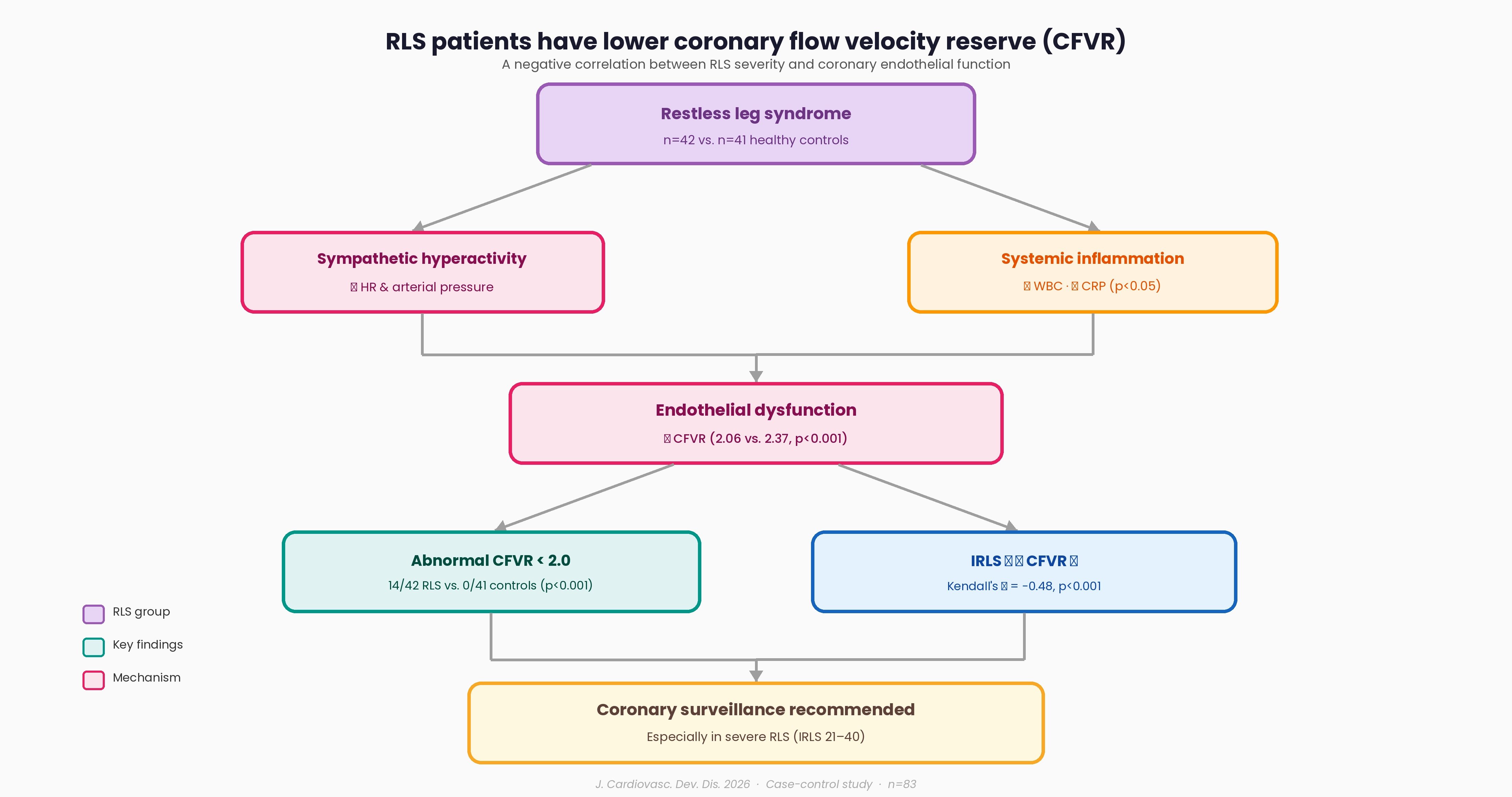
Objective: Restless leg syndrome (RLS) has been associated with an increased risk of vascular disorders, which suggests that endothelial dysfunction plays an important role in the pathogenesis of RLS. In this study, we aimed to evaluate coronary endothelial dysfunction in RLS patients using coronary flow velocity reserve (CFVR) and compared it with healthy controls. Methodology: In this study, the participants were divided into two groups as group RLS (n = 42) and group HC (n = 41). The primary outcome was the CFVR compared between groups. The number of participants with a CFVR value below 2.0 was also evaluated. In addition, a correlation between the international restless legs scale (IRLS) and CFVR, white-blood-cell-count (WBC), and C-reactive protein (CRP) was analyzed. Secondary outcomes were the WBC, hemoglobin, CRP, blood glucose, high-density lipoprotein (HDL), low-density lipoprotein (LDL), and creatinine compared between the two groups. Results: In the group RLS, CFVR was measured lower than healthy controls (p < 0.001). When the groups were compared in terms of the number of participants with a CFVR less than 2.0, the difference between the groups was significant (p < 0.001, 0/41 in group HC and 14/42 in group RLS). Patients with RLS had higher WBC and CRP values. There was a negative correlation between CFVR and IRLS (p < 0.001). The relationship between WBC, CRP, and IRLS was not statistically significant (p = 0.691). Conclusions: In this exploratory study, RLS patients had lower CFVR compared with healthy controls and a negative correlation was observed between RLS severity and CFVR. These findings warrant confirmation in larger, prospectively designed studies with multivariable adjustment. Therefore, we think that it may be beneficial to follow-up patients with RLS in terms of coronary heart disease. Clinical trial number: not applicable.
Share and Cite
MDPI and ACS Style
Güz, G.; Karaoğlu, R.O.; Kumaş Solak, S.; Demirgan, S.
Patients with Restless Leg Syndrome Have Lower Coronary Flow Velocity Reserve Compared to Healthy Controls: Case–Control Study. J. Cardiovasc. Dev. Dis. 2026, 13, 270.
https://doi.org/10.3390/jcdd13060270
AMA Style
Güz G, Karaoğlu RO, Kumaş Solak S, Demirgan S.
Patients with Restless Leg Syndrome Have Lower Coronary Flow Velocity Reserve Compared to Healthy Controls: Case–Control Study. Journal of Cardiovascular Development and Disease. 2026; 13(6):270.
https://doi.org/10.3390/jcdd13060270
Chicago/Turabian Style
Güz, Göksel, Rasim Onur Karaoğlu, Sezen Kumaş Solak, and Serdar Demirgan.
2026. "Patients with Restless Leg Syndrome Have Lower Coronary Flow Velocity Reserve Compared to Healthy Controls: Case–Control Study" Journal of Cardiovascular Development and Disease 13, no. 6: 270.
https://doi.org/10.3390/jcdd13060270
APA Style
Güz, G., Karaoğlu, R. O., Kumaş Solak, S., & Demirgan, S.
(2026). Patients with Restless Leg Syndrome Have Lower Coronary Flow Velocity Reserve Compared to Healthy Controls: Case–Control Study. Journal of Cardiovascular Development and Disease, 13(6), 270.
https://doi.org/10.3390/jcdd13060270
Note that from the first issue of 2016, this journal uses article numbers instead of page numbers. See further details
here.
Article Metrics
Article Access Statistics
For more information on the journal statistics, click
here.
Multiple requests from the same IP address are counted as one view.