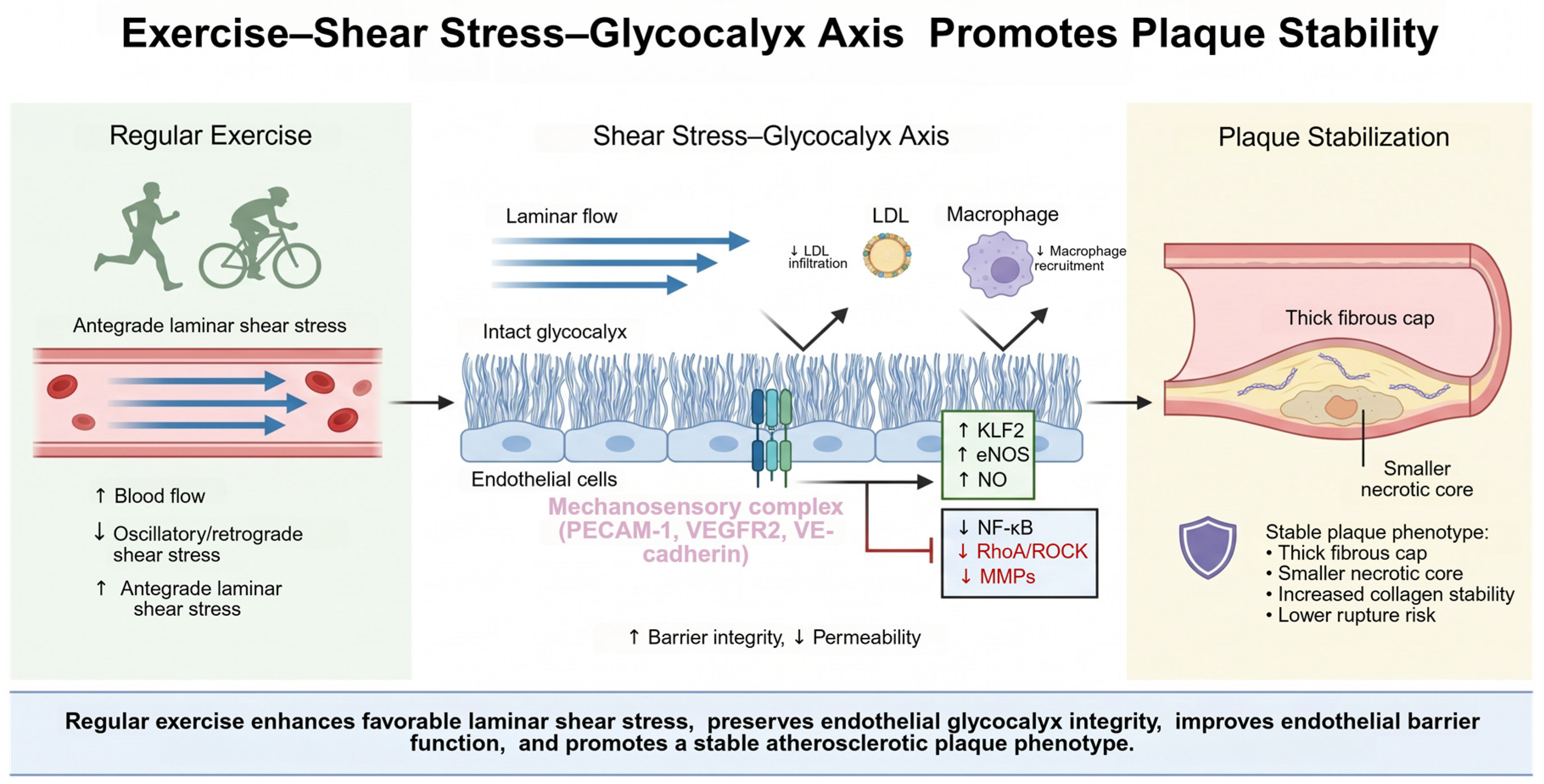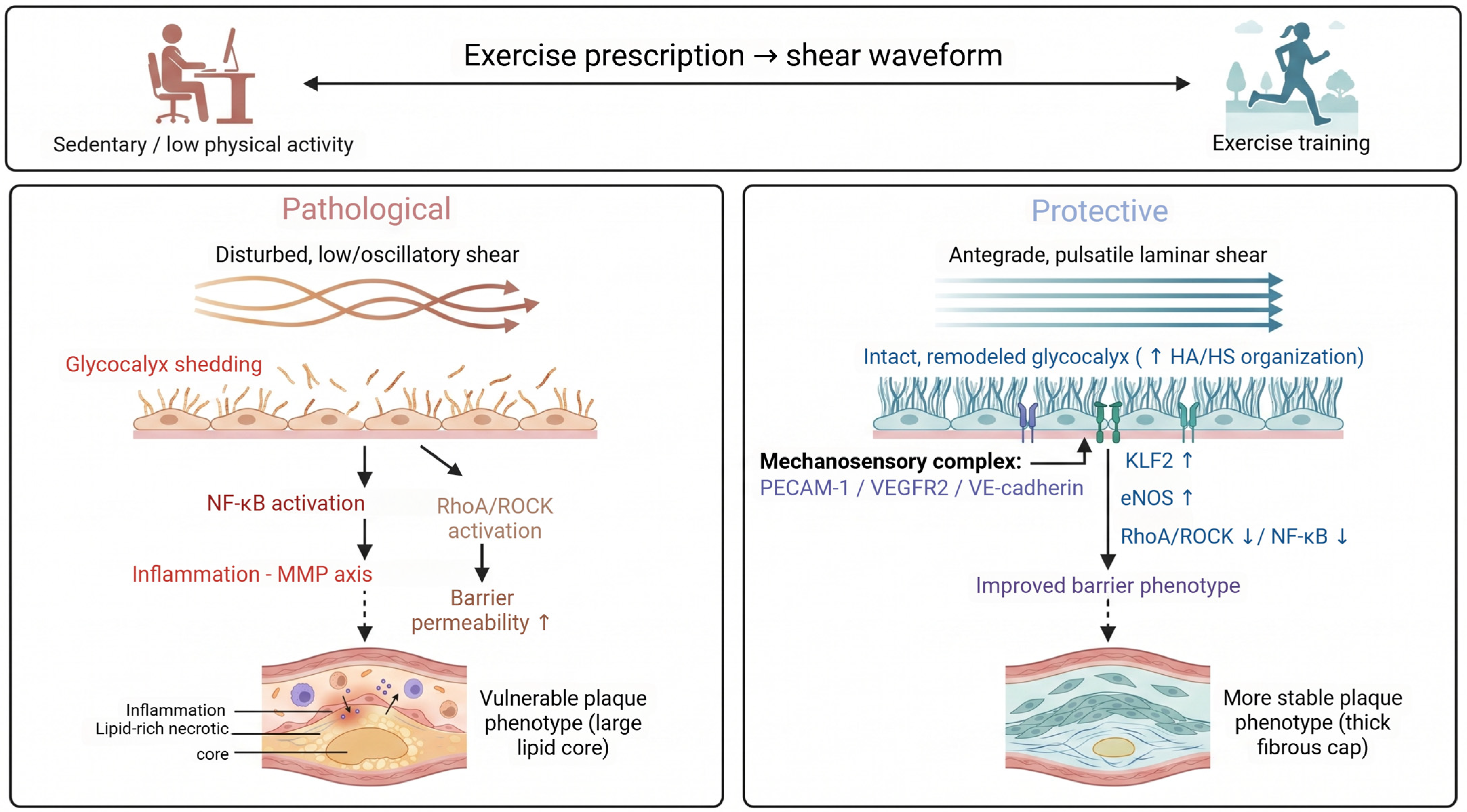

Exercise-Induced Shear Stress, Endothelial Glycocalyx Remodeling, and Atherosclerotic Plaque Stability: A Mechanistic Review

 , , and
Abstract
1. Introduction
2. Hemodynamic Characteristics of Exercise-Induced Shear Stress and Glycocalyx Responses
2.1. Heterogeneity of Shear Stress and Plaque Susceptibility
2.2. Exercise Modalities and Shear Waveforms
3. Composition, Barrier Function, and Shear Sensitivity of the Glycocalyx
3.1. The Glycocalyx as a Permeability Barrier and Mechanosensory Interface
3.2. Shear Stress-Driven Glycocalyx Remodeling
4. Coupling Mechanisms of Glycocalyx-Mediated Mechanotransduction and Endothelial Barrier Execution
4.1. The Glycocalyx as the Interface for Shear Stress Sensation and Initial Transduction
4.2. Cytoskeletal Reorganization and Tension Redistribution Driven by Glycocalyx Remodeling
4.3. Junctional Complex Reprogramming and Increased Paracellular Permeability
4.4. Shear Pattern-Dependent Integration of Key Signaling Axes
5. Alterations in Endothelial Permeability and the Stable Phenotype of Atherosclerotic Plaques
5.1. Endothelial Hyperpermeability, Lipid Deposition, and Inflammatory Cell Infiltration
5.2. Key Phenotypic Differences Between Stable and Vulnerable Plaques
5.3. The Integrated Mechanistic Chain from Local Flow Patterns to Plaque Stability
6. Controversial Points and Discussion
7. Conclusions and Perspectives
Author Contributions
Funding
Institutional Review Board Statement
Informed Consent Statement
Data Availability Statement
Acknowledgments
Conflicts of Interest
References
- Virmani, R.; Burke, A.P.; Farb, A.; Kolodgie, F.D. Pathology of the vulnerable plaque. J. Am. Coll. Cardiol. 2006, 47, C13–C18. [Google Scholar] [CrossRef]
- Milusev, A.; Rieben, R.; Sorvillo, N. The endothelial glycocalyx: A possible therapeutic target in cardiovascular disorders. Front. Cardiovasc. Med. 2022, 9, 897087. [Google Scholar] [CrossRef]
- Dollery, C.M.; Libby, P. Atherosclerosis and proteinase activation. Cardiovasc. Res. 2006, 69, 625–635. [Google Scholar] [CrossRef]
- Mundi, S.; Massaro, M.; Scoditti, E.; Carluccio, M.A.; Van Hinsbergh, V.W.; Iruela-Arispe, M.L.; De Caterina, R. Endothelial permeability, LDL deposition, and cardiovascular risk factors—A review. Cardiovasc. Res. 2018, 114, 35–52. [Google Scholar] [CrossRef]
- Herrington, W.; Lacey, B.; Sherliker, P.; Armitage, J.; Lewington, S. Epidemiology of atherosclerosis and the potential to reduce the global burden of atherothrombotic disease. Circ. Res. 2016, 118, 535–546. [Google Scholar] [CrossRef] [PubMed]
- Peng, Z.; Shu, B.; Zhang, Y.; Wang, M. Endothelial response to pathophysiological stress. Arterioscler. Thromb. Vasc. Biol. 2019, 39, e233–e243. [Google Scholar] [CrossRef]
- Biernat, K.; Kuciel, N.; Mazurek, J.; Hap, K. Is it possible to train the endothelium?—A narrative literature review. Life 2024, 14, 616. [Google Scholar] [CrossRef]
- Lear, S.A.; Hu, W.; Rangarajan, S.; Gasevic, D.; Leong, D.; Iqbal, R.; Casanova, A.; Swaminathan, S.; Anjana, R.M.; Kumar, R.; et al. The effect of physical activity on mortality and cardiovascular disease in 130,000 people from 17 high-income, middle-income, and low-income countries: The PURE study. Lancet 2017, 390, 2643–2654. [Google Scholar] [CrossRef] [PubMed]
- Tao, X.; Chen, Y.; Zhen, K.; Ren, S.; Lv, Y.; Yu, L. Effect of continuous aerobic exercise on endothelial function: A systematic review and meta-analysis of randomized controlled trials. Front. Physiol. 2023, 14, 1043108. [Google Scholar] [CrossRef] [PubMed]
- Mongrain, R.; Rodés-Cabau, J. Role of shear stress in atherosclerosis and restenosis after coronary stent implantation. Rev. Esp. Cardiol. 2006, 59, 1–4. [Google Scholar] [CrossRef] [PubMed]
- Green, D.J.; Hopman, M.T.; Padilla, J.; Laughlin, M.H.; Thijssen, D.H. Vascular adaptation to exercise in humans: Role of hemodynamic stimuli. Physiol. Rev. 2017, 97, 495–528. [Google Scholar] [CrossRef]
- Niebauer, J.; Cooke, J.P. Cardiovascular effects of exercise: Role of endothelial shear stress. J. Am. Coll. Cardiol. 1996, 28, 1652–1660. [Google Scholar] [CrossRef]
- Tinken, T.M.; Thijssen, D.H.; Hopkins, N.; Dawson, E.A.; Cable, N.T.; Green, D.J. Shear stress mediates endothelial adaptations to exercise training in humans. Hypertension 2010, 55, 312–318. [Google Scholar] [CrossRef]
- Saz-Lara, A.; Cavero-Redondo, I.; Del Saz-Lara, A.; Rodríguez-Gutiérrez, E.; Bizzozero-Peroni, B.; Pascual-Morena, C. The acute effect of exercise on the endothelial glycocalyx in healthy adults: A systematic review and meta-analysis. Eur. J. Clin. Investig. 2024, 54, e14240. [Google Scholar] [CrossRef] [PubMed]
- Vittum, Z.; Cocchiaro, S.; Mensah, S.A. Basal endothelial glycocalyx’s response to shear stress: A review of structure, function, and clinical implications. Front. Cell Dev. Biol. 2024, 12, 1371769. [Google Scholar] [CrossRef] [PubMed]
- Chiu, J.-J.; Chien, S. Effects of disturbed flow on vascular endothelium: Pathophysiological basis and clinical perspectives. Physiol. Rev. 2011, 91, 327–387. [Google Scholar] [CrossRef]
- Foote, C.A.; Soares, R.N.; Ramirez-Perez, F.I.; Ghiarone, T.; Aroor, A.; Manrique-Acevedo, C.; Padilla, J.; Martinez-Lemus, L. Endothelial glycocalyx. Compr. Physiol. 2022, 12, 3781–3811. [Google Scholar] [CrossRef] [PubMed]
- Reitsma, S.; Slaaf, D.W.; Vink, H.; Van Zandvoort, M.A.; Oude Egbrink, M.G. The endothelial glycocalyx: Composition, functions, and visualization. Pflügers Arch.-Eur. J. Physiol. 2007, 454, 345–359. [Google Scholar] [CrossRef]
- Peiffer, V.; Sherwin, S.J.; Weinberg, P.D. Does low and oscillatory wall shear stress correlate spatially with early atherosclerosis? A systematic review. Cardiovasc. Res. 2013, 99, 242–250. [Google Scholar] [CrossRef]
- Curry, F.E.; Adamson, R.H. Endothelial glycocalyx: Permeability barrier and mechanosensor. Ann. Biomed. Eng. 2012, 40, 828–839. [Google Scholar] [CrossRef]
- Wang, G.; Kostidis, S.; Tiemeier, G.L.; Sol, W.; de Vries, M.R.; Giera, M.; Carmeliet, P.; van den Berg, B.M.; Rabelink, T.J. Shear Stress Regulation of Endothelial Glycocalyx Structure Is Determined by Glucobiosynthesis. Arterioscler. Thromb. Vasc. Biol. 2020, 40, 350–364. [Google Scholar] [CrossRef]
- Tzima, E.; Irani-Tehrani, M.; Kiosses, W.B.; Dejana, E.; Schultz, D.A.; Engelhardt, B.; Cao, G.; DeLisser, H.; Schwartz, M.A. A mechanosensory complex that mediates the endothelial cell response to fluid shear stress. Nature 2005, 437, 426–431. [Google Scholar] [CrossRef]
- Zhang, X.; Sun, D.; Song, J.W.; Zullo, J.; Lipphardt, M.; Coneh-Gould, L.; Goligorsky, M.S. Endothelial cell dysfunction and glycocalyx—A vicious circle. Matrix Biol. 2018, 71–72, 421–431. [Google Scholar] [CrossRef]
- Chatzizisis, Y.S.; Coskun, A.U.; Jonas, M.; Edelman, E.R.; Feldman, C.L.; Stone, P.H. Role of endothelial shear stress in the natural history of coronary atherosclerosis and vascular remodeling: Molecular, cellular, and vascular behavior. J. Am. Coll. Cardiol. 2007, 49, 2379–2393. [Google Scholar] [CrossRef]
- Chen, L.; Qu, H.; Liu, B.; Chen, B.C.; Yang, Z.; Shi, D.Z.; Zhang, Y. Low or oscillatory shear stress and endothelial permeability in atherosclerosis. Front. Physiol. 2024, 15, 1432719. [Google Scholar] [CrossRef]
- Yamashiro, Y.; Yanagisawa, H. The molecular mechanism of mechanotransduction in vascular homeostasis and disease. Clin. Sci. 2020, 134, 2399–2418. [Google Scholar] [CrossRef]
- Cecchi, E.; Giglioli, C.; Valente, S.; Lazzeri, C.; Gensini, G.F.; Abbate, R.; Mannini, L. Role of hemodynamic shear stress in cardiovascular disease. Atherosclerosis 2011, 214, 249–256. [Google Scholar] [CrossRef]
- Souilhol, C.; Serbanovic-Canic, J.; Fragiadaki, M.; Chico, T.J.; Ridger, V.; Roddie, H.; Evans, P.C. Endothelial responses to shear stress in atherosclerosis: A novel role for developmental genes. Nat. Rev. Cardiol. 2020, 17, 52–63. [Google Scholar] [CrossRef]
- Thijssen, D.H.; Dawson, E.A.; Tinken, T.M.; Cable, N.T.; Green, D.J. Retrograde flow and shear rate acutely impair endothelial function in humans. Hypertension 2009, 53, 986–992. [Google Scholar] [CrossRef]
- Zhou, M.; Yu, Y.; Chen, R.; Liu, X.; Hu, Y.; Ma, Z.; Gao, L.; Jian, W.; Wang, L. Wall shear stress and its role in atherosclerosis. Front. Cardiovasc. Med. 2023, 10, 1083547. [Google Scholar] [CrossRef]
- Liu, Y.; Sun, Z.; Chen, T.; Yang, C. Does exercise training improve the function of vascular smooth muscle? A systematic review and meta-analysis. Res. Sports Med. 2022, 30, 577–592. [Google Scholar] [CrossRef]
- Birk, G.K.; Dawson, E.A.; Atkinson, C.; Haynes, A.; Cable, N.T.; Thijssen, D.H.; Green, D.J. Brachial artery adaptation to lower limb exercise training: Role of shear stress. J. Appl. Physiol. 2012, 112, 1653–1658. [Google Scholar] [CrossRef]
- Newcomer, S.C.; Thijssen, D.H.; Green, D.J. Effects of exercise on endothelium and endothelium/smooth muscle cross talk: Role of exercise-induced hemodynamics. J. Appl. Physiol. 2011, 111, 311–320. [Google Scholar] [CrossRef]
- Simmons, G.H.; Padilla, J.; Young, C.N.; Wong, B.J.; Lang, J.A.; Davis, M.J.; Laughlin, M.H.; Fadel, P.J. Increased brachial artery retrograde shear rate at exercise onset is abolished during prolonged cycling: Role of thermoregulatory vasodilation. J. Appl. Physiol. 2011, 110, 389–397. [Google Scholar] [CrossRef]
- Kwak, B.R.; Bäck, M.; Bochaton-Piallat, M.L.; Caligiuri, G.; Daemen, M.J.; Davies, P.F.; Hoefer, I.E.; Holvoet, P.; Jo, H.; Krams, R.; et al. Biomechanical factors in atherosclerosis: Mechanisms and clinical implications. Eur. Heart J. 2014, 35, 3013–3020, 3020a–3020d. [Google Scholar] [CrossRef]
- Johnson, B.D.; Mather, K.J.; Newcomer, S.C.; Mickleborough, T.D.; Wallace, J.P. Brachial artery flow-mediated dilation following exercise with augmented oscillatory and retrograde shear rate. Cardiovasc. Ultrasound 2012, 10, 34. [Google Scholar] [CrossRef]
- Ghardashi Afousi, A.; Izadi, M.R.; Rakhshan, K.; Mafi, F.; Biglari, S.; Gandomkar Bagheri, H. Improved brachial artery shear patterns and increased flow-mediated dilatation after low-volume high-intensity interval training in type 2 diabetes. Exp. Physiol. 2018, 103, 1264–1276. [Google Scholar] [CrossRef]
- Tanahashi, K.; Kosaki, K.; Sawano, Y.; Yoshikawa, T.; Tagawa, K.; Kumagai, H.; Akazawa, N.; Maeda, S. Impact of Age and Aerobic Exercise Training on Conduit Artery Wall Thickness: Role of the Shear Pattern. J. Vasc. Res. 2017, 54, 272–279. [Google Scholar] [CrossRef]
- Lyall, G.K.; Davies, M.J.; Ferguson, C.; Porter, K.E.; Birch, K.M. In-exercise vascular shear rate during acute continuous and interval exercise: Impact on endothelial function and miR-21. J. Appl. Physiol. 2019, 127, 1754–1762. [Google Scholar] [CrossRef]
- Majerczak, J.; Grandys, M.; Duda, K.; Zakrzewska, A.; Balcerczyk, A.; Kolodziejski, L.; Szymoniak-Chochol, D.; Smolenski, R.T.; Bartosz, G.; Chlopicki, S.; et al. Moderate-intensity endurance training improves endothelial glycocalyx layer integrity in healthy young men. Exp. Physiol. 2017, 102, 70–85. [Google Scholar] [CrossRef]
- Schmitz, B.; Niehues, H.; Lenders, M.; Thorwesten, L.; Klose, A.; Krüger, M.; Brand, E.; Brand, S.M. Effects of high-intensity interval training on microvascular glycocalyx and associated microRNAs. Am. J. Physiol. Heart Circ. Physiol. 2019, 316, H1538–H1551. [Google Scholar] [CrossRef]
- Fuchs, A.; Neumann, T.; Drinhaus, H.; Herrmann, A.; Vink, H.; Annecke, T. Effects of a single aerobic exercise on perfused boundary region and microvascular perfusion: A field study. J. Clin. Monit. Comput. 2022, 36, 371–377. [Google Scholar] [CrossRef]
- Tarbell, J.M.; Pahakis, M.Y. Mechanotransduction and the glycocalyx. J. Intern. Med. 2006, 259, 339–350. [Google Scholar] [CrossRef]
- Alphonsus, C.S.; Rodseth, R.N. The endothelial glycocalyx: A review of the vascular barrier. Anaesthesia 2014, 69, 777–784. [Google Scholar] [CrossRef]
- Mochizuki, S.; Vink, H.; Hiramatsu, O.; Kajita, T.; Shigeto, F.; Spaan, J.A.; Kajiya, F. Role of hyaluronic acid glycosaminoglycans in shear-induced endothelium-derived nitric oxide release. Am. J. Physiol. Heart Circ. Physiol. 2003, 285, H722–H726. [Google Scholar] [CrossRef]
- Zeng, Y.; Tarbell, J.M. The adaptive remodeling of endothelial glycocalyx in response to fluid shear stress. PLoS ONE 2014, 9, e86249. [Google Scholar] [CrossRef]
- Bai, K.; Wang, W. Shear stress-induced redistribution of the glycocalyx on endothelial cells in vitro. Biomech. Model. Mechanobiol. 2014, 13, 303–311. [Google Scholar] [CrossRef]
- Yao, Y.; Rabodzey, A.; Dewey, C.F., Jr. Glycocalyx modulates the motility and proliferative response of vascular endothelium to fluid shear stress. Am. J. Physiol. Heart Circ. Physiol. 2007, 293, H1023–H1030. [Google Scholar] [CrossRef]
- Johnson, B.D.; Mather, K.J.; Wallace, J.P. Mechanotransduction of shear in the endothelium: Basic studies and clinical implications. Vasc. Med. 2011, 16, 365–377. [Google Scholar] [CrossRef]
- Weinbaum, S.; Tarbell, J.M.; Damiano, E.R. The structure and function of the endothelial glycocalyx layer. Annu. Rev. Biomed. Eng. 2007, 9, 121–167. [Google Scholar] [CrossRef]
- Yang, H.; Zhu, L.; Chao, Y.; Gu, Y.; Kong, X.; Chen, M.; Ye, P.; Luo, J.; Chen, S. Hyaluronidase2 (Hyal2) modulates low shear stress-induced glycocalyx impairment via the LKB1/AMPK/NADPH oxidase-dependent pathway. J. Cell. Physiol. 2018, 233, 9701–9715. [Google Scholar] [CrossRef]
- Fu, B.M.; Tarbell, J.M. Mechano-sensing and transduction by endothelial surface glycocalyx: Composition, structure, and function. Wiley Interdiscip. Rev. Syst. Biol. Med. 2013, 5, 381–390. [Google Scholar] [CrossRef]
- Florian, J.A.; Kosky, J.R.; Ainslie, K.; Pang, Z.; Dull, R.O.; Tarbell, J.M. Heparan sulfate proteoglycan is a mechanosensor on endothelial cells. Circ. Res. 2003, 93, e136–e142. [Google Scholar] [CrossRef]
- Tarbell, J.M. Shear stress and the endothelial transport barrier. Cardiovasc. Res. 2010, 87, 320–330. [Google Scholar] [CrossRef]
- Tamargo, I.A.; Baek, K.I.; Kim, Y.; Park, C.; Jo, H. Flow-induced reprogramming of endothelial cells in atherosclerosis. Nat. Rev. Cardiol. 2023, 20, 738–753. [Google Scholar] [CrossRef]
- Zeng, Y.; Waters, M.; Andrews, A.; Honarmandi, P.; Ebong, E.E.; Rizzo, V.; Tarbell, J.M. Fluid shear stress induces the clustering of heparan sulfate via mobility of glypican-1 in lipid rafts. Am. J. Physiol. Heart Circ. Physiol. 2013, 305, H811–H820. [Google Scholar] [CrossRef]
- Zeng, Y.; Liu, J. Role of glypican-1 in endothelial NOS activation under various steady shear stress magnitudes. Exp. Cell Res. 2016, 348, 184–189. [Google Scholar] [CrossRef]
- Zeng, Y.; Adamson, R.H.; Curry, F.R.; Tarbell, J.M. Sphingosine-1-phosphate protects endothelial glycocalyx by inhibiting syndecan-1 shedding. Am. J. Physiol. Heart Circ. Physiol. 2014, 306, H363–H372. [Google Scholar] [CrossRef]
- Giannotta, M.; Trani, M.; Dejana, E. VE-cadherin and endothelial adherens junctions: Active guardians of vascular integrity. Dev. Cell 2013, 26, 441–454. [Google Scholar] [CrossRef]
- Huveneers, S.; Oldenburg, J.; Spanjaard, E.; van der Krogt, G.; Grigoriev, I.; Akhmanova, A.; Rehmann, H.; de Rooij, J. Vinculin associates with endothelial VE-cadherin junctions to control force-dependent remodeling. J. Cell Biol. 2012, 196, 641–652. [Google Scholar] [CrossRef]
- Dejana, E.; Tournier-Lasserve, E.; Weinstein, B.M. The control of vascular integrity by endothelial cell junctions: Molecular basis and pathological implications. Dev. Cell 2009, 16, 209–221. [Google Scholar] [CrossRef]
- Lampugnani, M.G. Endothelial cell-to-cell junctions: Adhesion and signaling in physiology and pathology. Cold Spring Harb. Perspect. Med. 2012, 2, a006528. [Google Scholar] [CrossRef]
- Dejana, E.; Orsenigo, F.; Molendini, C.; Baluk, P.; McDonald, D.M. Organization and signaling of endothelial cell-to-cell junctions in various regions of the blood and lymphatic vascular trees. Cell Tissue Res. 2009, 335, 17–25. [Google Scholar] [CrossRef]
- Rickman, M.; Ghim, M.; Pang, K.; von Huelsen Rocha, A.C.; Drudi, E.M.; Sureda-Vives, M.; Ayoub, N.; Tajadura-Ortega, V.; George, S.J.; Weinberg, P.D.; et al. Disturbed flow increases endothelial inflammation and permeability via a Frizzled-4-β-catenin-dependent pathway. J. Cell Sci. 2023, 136, jcs260449. [Google Scholar] [CrossRef]
- Alfaidi, M.; Bhattarai, U.; Orr, A.W. Nck1, But Not Nck2, Mediates Disturbed Flow-Induced p21-Activated Kinase Activation and Endothelial Permeability. J. Am. Heart Assoc. 2020, 9, e016099. [Google Scholar] [CrossRef]
- Richards, M.; Nwadozi, E.; Pal, S.; Martinsson, P.; Kaakinen, M.; Gloger, M.; Sjöberg, E.; Koltowska, K.; Betsholtz, C.; Eklund, L.; et al. Claudin5 protects the peripheral endothelial barrier in an organ and vessel-type-specific manner. Elife 2022, 11, e78517. [Google Scholar] [CrossRef]
- Clark, P.R.; Kim, R.K.; Pober, J.S.; Kluger, M.S. Tumor necrosis factor disrupts claudin-5 endothelial tight junction barriers in two distinct NF-κB-dependent phases. PLoS ONE 2015, 10, e0120075. [Google Scholar] [CrossRef]
- van der Stoel, M.M.; Kotini, M.P.; Schoon, R.M.; Affolter, M.; Belting, H.G.; Huveneers, S. Vinculin strengthens the endothelial barrier during vascular development. Vasc. Biol. 2023, 5, e220012. [Google Scholar] [CrossRef]
- Gimbrone, M.A., Jr.; García-Cardeña, G. Endothelial Cell Dysfunction and the Pathobiology of Atherosclerosis. Circ. Res. 2016, 118, 620–636. [Google Scholar] [CrossRef]
- Tamargo, I.A.; Baek, K.I.; Xu, C.; Kang, D.W.; Kim, Y.; Andueza, A.; Williams, D.; Demos, C.; Villa-Roel, N.; Kumar, S.; et al. HEG1 Protects Against Atherosclerosis by Regulating Stable Flow-Induced KLF2/4 Expression in Endothelial Cells. Circulation 2024, 149, 1183–1201. [Google Scholar] [CrossRef]
- Joshi, D.; Coon, B.G.; Chakraborty, R.; Deng, H.; Yang, Z.; Babar, M.U.; Fernandez-Tussy, P.; Meredith, E.; Attanasio, J.; Joshi, N.; et al. Endothelial γ-protocadherins inhibit KLF2 and KLF4 to promote atherosclerosis. Nat. Cardiovasc. Res. 2024, 3, 1035–1048. [Google Scholar] [CrossRef]
- Thijssen, D.H.; Dawson, E.A.; Black, M.A.; Hopman, M.T.; Cable, N.T.; Green, D.J. Brachial artery blood flow responses to different modalities of lower limb exercise. Med. Sci. Sports Exerc. 2009, 41, 1072–1079. [Google Scholar] [CrossRef]
- Kraehling, J.R.; Chidlow, J.H.; Rajagopal, C.; Sugiyama, M.G.; Fowler, J.W.; Lee, M.Y.; Zhang, X.; Ramírez, C.M.; Park, E.J.; Tao, B.; et al. Genome-wide RNAi screen reveals ALK1 mediates LDL uptake and transcytosis in endothelial cells. Nat. Commun. 2016, 7, 13516. [Google Scholar] [CrossRef]
- Huang, L.; Chambliss, K.L.; Gao, X.; Yuhanna, I.S.; Behling-Kelly, E.; Bergaya, S.; Ahmed, M.; Michaely, P.; Luby-Phelps, K.; Darehshouri, A.; et al. SR-B1 drives endothelial cell LDL transcytosis via DOCK4 to promote atherosclerosis. Nature 2019, 569, 565–569. [Google Scholar] [CrossRef]
- Psefteli, P.M.; Kitscha, P.; Vizcay, G.; Fleck, R.; Chapple, S.J.; Mann, G.E.; Fowler, M.; Siow, R.C. Glycocalyx sialic acids regulate Nrf2-mediated signaling by fluid shear stress in human endothelial cells. Redox Biol. 2021, 38, 101816. [Google Scholar] [CrossRef]
- Kolodgie, F.D.; Burke, A.P.; Farb, A.; Gold, H.K.; Yuan, J.; Narula, J.; Finn, A.V.; Virmani, R. The thin-cap fibroatheroma: A type of vulnerable plaque: The major precursor lesion to acute coronary syndromes. Curr. Opin. Cardiol. 2001, 16, 285–292. [Google Scholar] [CrossRef]
- Hajra, L.; Evans, A.I.; Chen, M.; Hyduk, S.J.; Collins, T.; Cybulsky, M.I. The NF-kappa B signal transduction pathway in aortic endothelial cells is primed for activation in regions predisposed to atherosclerotic lesion formation. Proc. Natl. Acad. Sci. USA 2000, 97, 9052–9057. [Google Scholar] [CrossRef]
- Ghim, M.; Pang, K.T.; Burnap, S.A.; Baig, F.; Yin, X.; Arshad, M.; Mayr, M.; Weinberg, P.D. Endothelial cells exposed to atheroprotective flow secrete follistatin-like 1 protein which reduces transcytosis and inflammation. Atherosclerosis 2021, 333, 56–66. [Google Scholar] [CrossRef]
- Pellegrin, M.; Aubert, J.F.; Bouzourène, K.; Amstutz, C.; Mazzolai, L. Voluntary Exercise Stabilizes Established Angiotensin II-Dependent Atherosclerosis in Mice through Systemic Anti-Inflammatory Effects. PLoS ONE 2015, 10, e0143536. [Google Scholar] [CrossRef]
- Libby, P.; Tabas, I.; Fredman, G.; Fisher, E.A. Inflammation and its resolution as determinants of acute coronary syndromes. Circ. Res. 2014, 114, 1867–1879. [Google Scholar] [CrossRef]
- Kadoglou, N.P.; Moustardas, P.; Kapelouzou, A.; Katsimpoulas, M.; Giagini, A.; Dede, E.; Kostomitsopoulos, N.; Karayannacos, P.E.; Kostakis, A.; Liapis, C.D. The anti-inflammatory effects of exercise training promote atherosclerotic plaque stabilization in apolipoprotein E knockout mice with diabetic atherosclerosis. Eur. J. Histochem. 2013, 57, e3. [Google Scholar] [CrossRef]
- Stanton, K.M.; Liu, H.; Kienzle, V.; Bursill, C.; Bao, S.; Celermajer, D.S. The Effects of Exercise on Plaque Volume and Composition in a Mouse Model of Early and Late Life Atherosclerosis. Front. Cardiovasc. Med. 2022, 9, 837371. [Google Scholar] [CrossRef]
- Kadoglou, N.P.; Kostomitsopoulos, N.; Kapelouzou, A.; Moustardas, P.; Katsimpoulas, M.; Giagini, A.; Dede, E.; Boudoulas, H.; Konstantinides, S.; Karayannacos, P.E.; et al. Effects of exercise training on the severity and composition of atherosclerotic plaque in apoE-deficient mice. J. Vasc. Res. 2011, 48, 347–356. [Google Scholar] [CrossRef]
- Guo, W.; Wang, J.; Chang, Z.; Lin, S.; Sha, G.; Wang, S.; Huang, J.; Hu, M.; Xia, J. Treadmill exercise ameliorates atherogenesis and vascular inflammation in ApoE(-/-) mice via circulating exosome-derived let-7c-5p. Sci. Rep. 2025, 16, 585. [Google Scholar] [CrossRef]
- Lenk, K.; Uhlemann, M.; Schuler, G.; Adams, V. Role of endothelial progenitor cells in the beneficial effects of physical exercise on atherosclerosis and coronary artery disease. J. Appl. Physiol. 2011, 111, 321–328. [Google Scholar] [CrossRef]
- Rehman, J.; Li, J.; Parvathaneni, L.; Karlsson, G.; Panchal, V.R.; Temm, C.J.; Mahenthiran, J.; March, K.L. Exercise acutely increases circulating endothelial progenitor cells and monocyte-/macrophage-derived angiogenic cells. J. Am. Coll. Cardiol. 2004, 43, 2314–2318. [Google Scholar] [CrossRef]
- Matsumoto, A.; Manthey, H.D.; Marsh, S.A.; Fassett, R.G.; de Haan, J.B.; Rolfe, B.E.; Coombes, J.S. Effects of exercise training and RhoA/ROCK inhibition on plaque in ApoE-/- mice. Int. J. Cardiol. 2013, 167, 1282–1288. [Google Scholar] [CrossRef]
- Cardinot, T.M.; Lima, T.M.; Moretti, A.I.; Koike, M.K.; Nunes, V.S.; Cazita, P.M.; Krieger, M.H.; Brum, P.C.; Souza, H.P. Preventive and therapeutic moderate aerobic exercise programs convert atherosclerotic plaques into a more stable phenotype. Life Sci. 2016, 153, 163–170. [Google Scholar] [CrossRef]
- Wu, W.Q.; Peng, S.; Wan, X.Q.; Lin, S.; Li, L.Y.; Song, Z.Y. Physical exercise inhibits atherosclerosis development by regulating the expression of neuropeptide Y in apolipoprotein E-deficient mice. Life Sci. 2019, 237, 116896. [Google Scholar] [CrossRef]
- Xu, Z.; Zhang, M.; Li, X.; Wang, Y.; Du, R. Exercise Ameliorates Atherosclerosis via Up-Regulating Serum β-Hydroxybutyrate Levels. Int. J. Mol. Sci. 2022, 23, 3788. [Google Scholar] [CrossRef]
- Huang, W.C.; Tung, C.L.; Yang, Y.S.H.; Lin, I.H.; Ng, X.E.; Tung, Y.T. Endurance exercise ameliorates Western diet-induced atherosclerosis through modulation of microbiota and its metabolites. Sci. Rep. 2022, 12, 3612. [Google Scholar] [CrossRef]
- Wang, Y.; Liu, Y.; Zhang, S.; Li, N.; Xing, C.; Wang, C.; Wang, J.; Wei, M.; Yang, G.; Yuan, L. Exercise Improves Metabolism and Alleviates Atherosclerosis via Muscle-Derived Extracellular Vesicles. Aging Dis. 2023, 14, 952–965. [Google Scholar] [CrossRef]
- Yang, Q.; Chen, S.; Wang, X.; Yang, X.; Chen, L.; Huang, T.; Zheng, Y.; Zheng, X.; Wu, X.; Sun, Y.; et al. Exercise Mitigates Endothelial Pyroptosis and Atherosclerosis by Downregulating NEAT1 Through N6-Methyladenosine Modifications. Arter. Thromb. Vasc. Biol. 2023, 43, 910–926. [Google Scholar] [CrossRef]


| Shear Stress Category | Typical Quantitative Range | Physiological/Experimental Context |
|---|---|---|
| Physiological/Atheroprotective WSS | >15 dyn/cm2 (Typically 15–70 dyn/cm2) | Characteristic of straight, unbranched segments of human large conduit arteries (e.g., normal aorta, carotid). Associated with quiescent, anti-inflammatory endothelial phenotypes. |
| Pathological Low WSS (In vivo) | <4 dyn/cm2 (often 0–4 dyn/cm2) | Found at arterial bifurcations, inner curves, and post-stenotic regions. Strongly correlates with plaque initiation and endothelial dysfunction. |
| “Low” WSS (In vitro models) | Highly variable (e.g., 2–12 dyn/cm2) | Experimentally defined relative to high-shear controls. Values like 12 dyn/cm2 may be “low” in specific flow chamber setups but remain within the normal physiological range for certain human vascular beds. |
| Pathologically Extreme High WSS | >70 dyn/cm2 (can exceed 100 dyn/cm2) | Localized at the throat or upstream shoulder of pre-existing severe stenotic plaques. Associated with fibrous cap thinning, high-risk remodeling, and plaque rupture. |
| Study | Study Type/Subjects | Key Exposure or Intervention | Primary Endpoints | Core Conclusions |
|---|---|---|---|---|
| Tinken et al., 2010 [13] | Human training intervention study; healthy adults | Exercise training with manipulation of shear stress via localized cuffing | FMD, vascular remodeling | Endothelial adaptation induced by exercise was significantly attenuated when the shear stimulus was dampened, supporting that “shear stress is a key proximal stimulus for exercise-induced vascular adaptation.” |
| Birk et al., 2012 [32] | Human training study; observed upper limb conduit arteries following lower limb training | Shear stress associated with lower limb exercise training | Adaptive changes in the brachial artery | Supports that training-related hemodynamic stimuli can drive adaptive changes in conduit arteries. |
| Thijssen et al., 2009 [29] | Human experimental flow manipulation study | Enhanced retrograde flow/retrograde shear rate | Endothelial function | Retrograde shear acutely impairs endothelial function, suggesting that the “direction of shear” intrinsically possesses biological significance. |
| Simmons et al., 2011 [34] | Human acute exercise study | Retrograde shear changes during the onset and sustained phases of cycling | Dynamics of brachial artery retrograde shear rate | Retrograde shear during exercise is not constant; it declines with thermoregulatory vasodilation, demonstrating that the exercise shear waveform is dynamic. |
| Johnson et al., 2012 [36] | Human post-exercise flow manipulation study | Augmented oscillatory/retrograde shear post-exercise | FMD | If detrimental oscillatory/retrograde shear is superimposed after exercise, the benefits to endothelial function are attenuated. |
| Ghardashi Afousi et al., 2018 [37] | Human randomized controlled training study; patients with type 2 diabetes | 12 weeks of low-volume high-intensity interval training (LV-HIIT) or continuous moderate-intensity training (CMIT), 3 times/week | Brachial artery FMD, artery diameter, antegrade/retrograde shear rate, oscillatory shear index (OSI), NOx | Compared with CMIT and controls, LV-HIIT more significantly improved FMD, increased antegrade shear, and decreased retrograde shear; both modalities reduced OSI, but NOx elevation was more pronounced in LV-HIIT, suggesting that LV-HIIT may more effectively optimize shear patterns and improve endothelial function. |
| Tanahashi et al., 2017 [38] | Human study (cross-sectional + intervention); middle-aged and older adults | 12-week aerobic training (intervention portion) | Brachial artery antegrade/retrograde shear rate patterns, brachial artery intima-media thickness (IMT) | Aerobic training increased antegrade shear, decreased retrograde shear, and improved brachial IMT, suggesting that training-related shear pattern remodeling may participate in vascular wall adaptation. |
| Lyall et al., 2019 [39] | Human acute crossover study; healthy participants | Comparison of a single bout of continuous vs. interval exercise | In-exercise antegrade/retrograde shear rate, OSI, pre- and post-exercise FMD, circulating miR-21 | Continuous and interval exercise generated distinct in-exercise shear patterns, but the magnitude of acute FMD improvement was similar. |
| Majerczak et al., 2017 [40] | Human pre-post controlled training study; healthy young men | 20-week moderate-intensity endurance training | Serum glycocalyx damage markers (syndecan-1, heparan sulfate), oxidative stress indices, antioxidant defense-related markers | Long-term moderate-intensity endurance training reduced glycocalyx damage markers accompanied by attenuated oxidative stress, supporting its protective role in glycocalyx integrity. |
| Schmitz et al., 2019 [41] | Human pre-post controlled training study; healthy adults | 4-week running-based HIIT | Sublingual microvascular glycocalyx barrier indices, including PBR, where higher PBR generally indicates reduced glycocalyx exclusion capacity, perfused vessel density, related miRNAs | HIIT was associated with improvements in microvascular glycocalyx-related indices, suggesting that short-term training can rapidly induce early vascular protective adaptations. |
| Fuchs et al., 2022 [42] | Human observational study; healthy adults | Single 10 km run | Sublingual microcirculation PBR, RBC filling percentage | No significant immediate changes in glycocalyx-related indices were observed after a single aerobic run, suggesting that acute effects may depend on the time window and measurement methods. |
| Study | Model/Subjects | Key Exposure or Condition | Primary Endpoints | Core Conclusions |
|---|---|---|---|---|
| Florian et al., 2003 [53] | Endothelial cells in vitro | Shear stimulus + heparan sulfate proteoglycan intervention | NO-related mechanical responses | Heparan sulfate proteoglycans are crucial mechanosensing elements on the endothelial surface, not merely passive overlays. |
| Mochizuki et al., 2003 [45] | Isolated canine femoral artery perfusion | Flow/shear stimulus + hyaluronidase pre-treatment | Shear-induced NO production | Hyaluronic acid-related glycosaminoglycans play a key role in detecting and amplifying flow shear to trigger endothelial NO release. |
| Tzima et al., 2005 [22] | Endothelial cells/animal mechanistic study | Fluid shear stimulus | Mechanosensory complex, downstream signaling | Identified the PECAM-1/VE-cadherin/VEGFR2 mechanosensory complex, establishing the “luminal force-to-junctional signaling” framework. |
| Zeng et al., 2013 [56] | Endothelial cells | Fluid shear stimulus | Clustering of glypican-1 and heparan sulfate | Shear can induce the rearrangement and clustering of key glycocalyx components within lipid rafts. |
| Zeng & Liu, 2016 [57] | Endothelial cells | Varied steady shear magnitudes | eNOS activation | Glypican-1 is involved in eNOS activation under different shear magnitudes, suggesting the glycocalyx also encodes “shear quality”. |
| Bai & Wang, 2014 [47] | Endothelial cells in vitro | Shear stimulus and post-removal recovery observation | Spatial distribution/rearrangement of glycocalyx | Shear stimulus can induce spatial redistribution of the glycocalyx, supporting that the glycocalyx is a dynamically remodeling interface rather than a static structure. |
| Wang et al., 2020 [21] | Endothelial cells + in vivo validation | Comparison of laminar vs. oscillatory flow | Glycocalyx structure, hyaluronic acid, HAS2 membrane localization, glucobiosynthesis | Laminar flow promotes surface hyaluronic acid maintenance and stabilizes glycocalyx structure via the KLF2–HAS2–glucobiosynthesis axis, whereas oscillatory flow impairs this process. |
| Yang et al., 2018 [51] | Endothelial cells | Low shear stress | Hyal2, LKB1/AMPK/NADPH oxidase, glycocalyx impairment | Low shear can promote glycocalyx damage via Hyal2-related pathways. |
| Kraehling et al., 2016 [73] | Endothelium/animal study | Mechanisms of LDL uptake and transendothelial transport | ALK1-mediated LDL uptake and transendothelial transport | Lipid entry into the intima does not necessitate “complete rupture” of the barrier; ALK1-mediated active LDL uptake and transport can occur preemptively. |
| Huang et al., 2019 [74] | Endothelium/mice/atherosclerosis study | SR-B1–DOCK4-mediated transendothelial LDL transport | LDL transport, atherosclerosis | The SR-B1–DOCK4 axis drives transendothelial LDL transport and promotes atherosclerosis. |
| Tamargo et al., 2024 [70] | Mice, HAECs, human arteries | Comparison of steady vs. disturbed flow | HEG1, KLF2/KLF4, permeability, adhesion | Steady flow maintains the protective endothelial phenotype and suppresses permeability/adhesion via the HEG1–KLF2/KLF4 axis. |
| Joshi et al., 2024 [71] | Mouse and human endothelial systems | Flow-sensitive transcriptional regulation | γ-protocadherins, KLF2/KLF4 | γ-protocadherins can inhibit KLF2/KLF4 and promote atherosclerosis. |
| Study | Model/Subjects | Exercise Intervention | Primary Lesion/Plaque Endpoints | Core Conclusions | Level of Evidence |
|---|---|---|---|---|---|
| Kadoglou et al., 2011 [83] | ApoE-/- mice | Exercise training | Plaque area, collagen/elastin fibers, macrophages, MMP-9, TIMP-1 | Exercise training attenuates lesion burden and improves plaque composition, associated with MMP inhibition, providing core direct evidence that “exercise improves plaque phenotypes.” | Animal model (in vivo) |
| Kadoglou et al., 2013 [81] | Diabetic atherosclerotic ApoE-/- mice | Exercise training | Plaque stabilization, inflammatory modulators, MMP-2/3, TIMP-2, fibrous cap phenotypes | Exercise training reduces and stabilizes atherosclerotic plaques in a diabetic context, suggesting its anti-inflammatory effects are closely linked to plaque stabilization. | Animal model (in vivo) |
| Cardinot et al., 2016 [88] | Atherosclerotic mouse models | Preventive or therapeutic moderate-intensity aerobic exercise | Plaque characteristics, collagen content, CD40–CD40L signaling | Moderate aerobic exercise converts plaques to a more stable phenotype, manifested by increased collagen, accompanied by decreased CD40–CD40L pathway activity in preventive protocols. | Animal model (in vivo) |
| Wu et al., 2019 [89] | ApoE-/- mice | Regular or occasional exercise (8 weeks) | Plaque burden, collagen, SMCs, lipids, macrophages, NPY/receptor expression | Exercise reduces plaque burden and enhances stability, shown by increased collagen/SMCs and decreased lipids/macrophages; this effect is at least partially related to the downregulation of NPY and its receptors. | Animal model (in vivo) |
| Stanton et al., 2022 [82] | Early and late-stage atherosclerotic ApoE-/- mice | 10-week exercise intervention at different disease stages | Plaque stenosis degree, volume, composition, lipids, and matrix indices | Whether initiated at early or late stages, exercise mitigates lesion stenosis; earlier intervention yields more pronounced improvements in lipids and plaque composition. | Animal model (in vivo) |
| Xu et al., 2022 [90] | Western diet-induced ApoE-/- mice | 12-week treadmill exercise | Aortic root/total aorta lesion area, lipid deposition, foam cells, BHB, cholesterol efflux proteins | Regular treadmill exercise reduces lipid deposition and foam cell formation, inhibiting atherosclerosis progression, associated with elevated serum β-hydroxybutyrate and enhanced cholesterol efflux. | Animal model (in vivo) |
| Huang et al., 2022 [91] | Western diet-induced ApoE-/- mice | Endurance exercise | Comprehensive atherosclerotic phenotypes, inflammation/chemokine signals, SCFAs | Endurance exercise mitigates Western diet-induced atherosclerosis, accompanied by improvements in obesity, inflammation, and chemokines; this effect is linked to gut microbiota and derived SCFAs. | Animal model (in vivo) |
| Wang et al., 2023 [92] | Obese WT and ApoE-/- mice | 12-week swimming training; evaluation of exercise-derived skeletal muscle EVs | Atherosclerosis progression, PWV, metabolic phenotypes, EV-mediated effects | Exercise inhibits atherosclerosis progression in ApoE-/- mice; its protective effect at least partially relies on metabolic remodeling mediated by skeletal muscle-derived extracellular vesicles. | Animal model (in vivo) |
| Yang et al., 2023 [93] | Clinical cohorts and mouse models (including NEAT1-/-) | Exercise intervention | Atherosclerosis progression, endothelial pyroptosis, NEAT1/m6A/METTL14/KLF4-NLRP3 pathway | Exercise inhibits endothelial pyroptosis and delays atherosclerosis by downregulating NEAT1 and its m6A modification, providing evidence bridging “downstream lesion endpoints + endothelial mechanisms.” | Clinical cohorts and Animal model (in vivo) |
| Guo et al., 2025 [84] | ApoE-/- mice | 10-week treadmill exercise | Lesion area, vascular inflammation, circulating exosomal let-7c-5p/TIMP-3/MMP-9 changes | Treadmill exercise mitigates atherosclerosis and vascular inflammation, offering a new translational mechanism via the downregulation of circulating exosomal let-7c-5p and upregulation of TIMP-3. | Animal model (in vivo) |
Disclaimer/Publisher’s Note: The statements, opinions and data contained in all publications are solely those of the individual author(s) and contributor(s) and not of MDPI and/or the editor(s). MDPI and/or the editor(s) disclaim responsibility for any injury to people or property resulting from any ideas, methods, instructions or products referred to in the content. |
© 2026 by the authors. Licensee MDPI, Basel, Switzerland. This article is an open access article distributed under the terms and conditions of the Creative Commons Attribution (CC BY) license.
Share and Cite
Qi, Z.; Zhang, C.; Shi, H.; Li, W.; Xia, Y.; Yan, X.; Zhou, X.; Ling, J.; Liu, G. Exercise-Induced Shear Stress, Endothelial Glycocalyx Remodeling, and Atherosclerotic Plaque Stability: A Mechanistic Review. J. Cardiovasc. Dev. Dis. 2026, 13, 265. https://doi.org/10.3390/jcdd13060265
Qi Z, Zhang C, Shi H, Li W, Xia Y, Yan X, Zhou X, Ling J, Liu G. Exercise-Induced Shear Stress, Endothelial Glycocalyx Remodeling, and Atherosclerotic Plaque Stability: A Mechanistic Review. Journal of Cardiovascular Development and Disease. 2026; 13(6):265. https://doi.org/10.3390/jcdd13060265
Chicago/Turabian StyleQi, Zihong, Chenggang Zhang, Huilin Shi, Wen Li, Yuqing Xia, Xiaofeng Yan, Xiyan Zhou, Jiaqi Ling, and Guochun Liu. 2026. "Exercise-Induced Shear Stress, Endothelial Glycocalyx Remodeling, and Atherosclerotic Plaque Stability: A Mechanistic Review" Journal of Cardiovascular Development and Disease 13, no. 6: 265. https://doi.org/10.3390/jcdd13060265
APA StyleQi, Z., Zhang, C., Shi, H., Li, W., Xia, Y., Yan, X., Zhou, X., Ling, J., & Liu, G. (2026). Exercise-Induced Shear Stress, Endothelial Glycocalyx Remodeling, and Atherosclerotic Plaque Stability: A Mechanistic Review. Journal of Cardiovascular Development and Disease, 13(6), 265. https://doi.org/10.3390/jcdd13060265