1. Introduction
Pulmonary embolism (PE) is a major manifestation of venous thromboembolism and a significant cause of cardiovascular morbidity and mortality. Although contemporary risk stratification integrates clinical parameters, imaging findings, and biomarkers to identify patients at risk of early deterioration, interindividual variability in clinical severity and early progression suggests that underlying biological determinants may influence disease severity [
1,
2,
3,
4,
5,
6,
7,
8,
9].
ABO blood group is an established genetic risk factor for venous thromboembolism. Individuals with non-O blood groups exhibit higher circulating levels of von Willebrand factor (vWF) and factor VIII due to reduced proteolytic clearance, resulting in a prothrombotic phenotype and a 1.5- to 2-fold increased risk of VTE compared with blood group O. While the association between ABO blood group and VTE incidence is well documented, its impact on the clinical severity and short-term outcomes of acute PE remains incompletely characterized [
10,
11,
12,
13,
14,
15,
16].
SARS-CoV-2 infection is associated with endothelial activation, systemic inflammation, and dysregulated coagulation, with marked elevations in vWF and increased thrombotic risk. Given that both non-O blood group status and COVID-19 infection modulate vWF-mediated and endothelial pathways, a biologically plausible interaction could amplify thrombotic severity in patients presenting with acute PE [
17,
18,
19,
20,
21,
22,
23].
Despite these mechanistic links, data evaluating potential effect modification between ABO blood group and COVID-19 infection in patients with established acute PE are limited. Whether COVID-19 amplifies the prothrombotic phenotype associated with non-O blood groups, thereby influencing early deterioration, remains unknown.
The present study aimed to evaluate whether COVID-19 status modifies the association between ABO blood group and early in-hospital outcomes among patients admitted with a first episode of acute pulmonary embolism.
2. Materials and Methods
2.1. Study Design and Setting
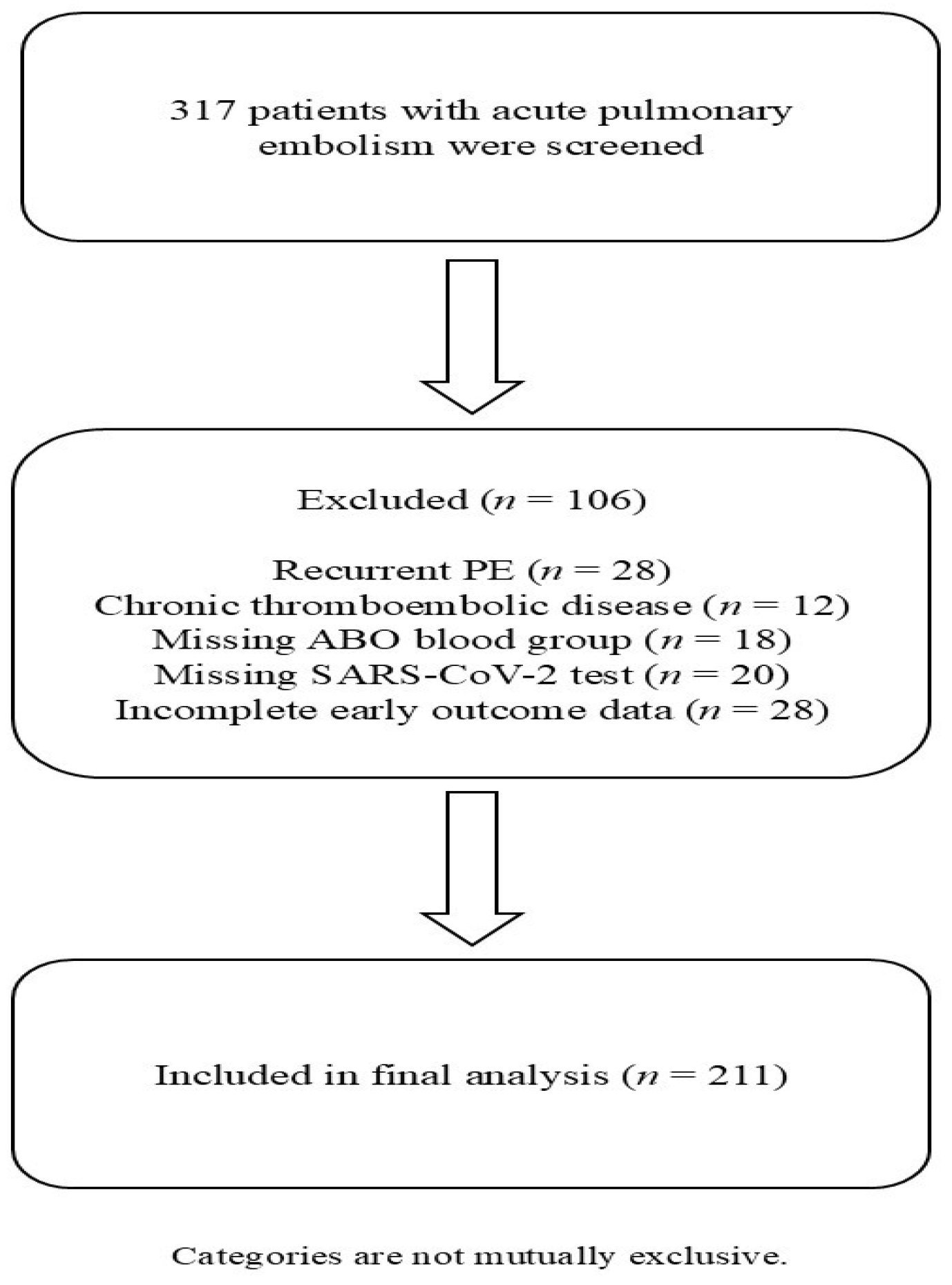
This retrospective, observational, single-center cohort study included consecutive adult patients meeting predefined inclusion criteria who were admitted with a first episode of acute pulmonary embolism (PE) to the Municipal Hospital of Timișoara, Romania, between 1 April 2020, and 3 June 2023. The study flow diagram is presented in
Figure 1.
During the study period, patients hospitalized for acute PE underwent systematic screening for SARS-CoV-2 infection at admission according to institutional protocols. Based on the admission screening result, patients were classified as COVID-19-positive or COVID-19-negative. The study was approved by the Ethics Committee of the Victor Babeș University of Medicine and Pharmacy Timișoara (Approval No. 96/04.10.2021, revised 26 October 2025), and was conducted in accordance with the Declaration of Helsinki. Owing to the retrospective nature of the study and the use of anonymized data, the requirement for informed consent was waived.
The objective was to assess whether ABO blood group modifies the association between COVID-19 status and early in-hospital outcomes in acute pulmonary embolism.
Inclusion Criteria: Patients were eligible if they met all of the following criteria: age ≥ 18 years; acute PE confirmed by computed tomography pulmonary angiography (CTPA); clinical presentation compatible with acute PE; first documented episode of PE in the patient’s medical history, verified using national and hospital databases; availability of documented SARS-CoV-2 testing at admission using RT-PCR.
Exclusion Criteria: Patients were excluded if they had a history of recurrent PE; chronic thromboembolic disease, including previously diagnosed chronic thromboembolic pulmonary hypertension (CTEPH); absence of documented ABO blood group in hospital medical records; absence of documented SARS-CoV-2 test result at admission; or incomplete documentation of early in-hospital outcomes.
After applying inclusion and exclusion criteria, 211 patients were included in the final analysis, while 106 were excluded.
2.2. Outcome Definitions
ABO blood group was coded a priori as non-O (A/B/AB) versus O. Early in-hospital outcomes were defined as events occurring within the first 24 h after admission. The focus on 24 h outcomes was chosen to capture early clinical deterioration and acute respiratory failure occurring shortly after hospital admission. The primary endpoint was 24 h in-hospital mortality, defined as death from any cause occurring within 24 h of hospital admission for acute pulmonary embolism. Secondary endpoints included requirement for systemic thrombolysis within 24 h of admission, defined as administration of intravenous fibrinolytic therapy for acute PE, and requirement for invasive mechanical ventilation (IMV) within 24 h of admission, defined as endotracheal intubation with mechanical ventilatory support. All outcomes were ascertained from medical records and hospital documentation.
2.3. Data Collection and Variables
Data were extracted from electronic and paper medical records, hospital discharge summaries, and the institutional laboratory database. The ABO blood group was obtained from the hospital laboratory information system. Data extraction was independently performed by two investigators, with discrepancies resolved by consensus. No imputation of missing data was performed.
Acute PE was confirmed by contrast-enhanced multidetector CTPA performed using standardized pulmonary embolism acquisition protocols on Siemens multidetector CT systems (Somatom Definition Edge and Somatom go platforms; Siemens Healthineers, Erlangen, Germany). Image interpretation and thrombus localization were performed by board-certified radiologists as part of routine clinical practice.
Collected variables included demographic characteristics (age and sex) and comorbidities documented prior to admission, including chronic venous insufficiency, chronic obstructive pulmonary disease, pulmonary hypertension, cancer, heart failure, hypertension, atrial fibrillation, prior myocardial infarction, prior stroke, hematologic diseases, diabetes mellitus, and obesity. Hematologic diseases were defined as previously diagnosed disorders of the hematopoietic system, including chronic anemia, myeloproliferative or myelodysplastic syndromes, leukemia, lymphoma, inherited or acquired coagulopathies, and other chronic hematologic conditions documented in the medical record. Obesity was defined as a documented diagnosis or body mass index ≥ 30 kg/m2.
Collected clinical variables included mortality, Pulmonary Embolism Severity Index (PESI) score at admission, requirement for systemic thrombolysis, and requirement for invasive mechanical ventilation. COVID-19 status was defined by RT-PCR testing performed at admission. PESI was extracted from admission documentation and analyzed descriptively as a continuous variable and according to established risk classes (I–V). Admission to the intensive care unit (ICU) was not used as an outcome because it may reflect institutional policies and resource availability rather than disease severity. Patients were followed throughout hospitalization until discharge, transfer, or death, although the present analysis focused on outcomes occurring within the first 24 h after admission.
Laboratory analyses were performed in the hospital’s central laboratory using standardized automated platforms, including hematology analyzers (Sysmex XN-1000, Sysmex Corporation, Kobe, Japan; Nihon Kohden MEK-9100, Nihon Kohden Corporation, Tokyo, Japan), coagulation analyzers (Sysmex CS-2500, Sysmex Corporation, Kobe, Japan), and biochemistry analyzers (Cobas 6000 c501, Roche Diagnostics, Mannheim, Germany; Dimension EXL 200, Siemens Healthineers, Erlangen, Germany). All assays were conducted according to the manufacturers’ instructions and internal quality control procedures in place during the study period. SARS-CoV-2 infection was determined by RT-PCR testing of nasopharyngeal swab samples performed at admission.
2.4. Statistical Analysis
Continuous variables were assessed for distribution and are presented as mean ± standard deviation (SD) for approximately normally distributed variables or median with interquartile range (IQR) otherwise. Categorical variables are presented as absolute counts and percentages. Between group comparisons were performed using the independent samples t-test or Mann–Whitney U test for continuous variables, as appropriate, and the χ2 test or Fisher’s exact test for categorical variables depending on expected cell counts. Analyses were conducted using complete case data; no imputation of missing values was performed. All tests were two-sided, with statistical significance defined as p < 0.05 for the primary endpoint. Statistical analyses were performed using Python 3.14.0 with the matplotlib and statsmodels libraries.
ABO blood group was analyzed primarily as O versus non-O (A, B, AB). The interaction between ABO blood group and COVID-19 status was evaluated using multivariable logistic regression models including the main effects of COVID-19 status and ABO group and a multiplicative interaction term (COVID-19 × non-O blood group). Multivariable logistic regression models included COVID-19 status, ABO blood group (non-O vs. O), and their interaction term, and were adjusted for pulmonary embolism severity using the Pulmonary Embolism Severity Index (PESI) class. Statistical interaction was assessed using the Wald test for the interaction term (reported as the “p for interaction”).
Separate models were constructed for each clinical outcome. Multivariable models were adjusted for pulmonary embolism severity using the Pulmonary Embolism Severity Index (PESI) class, modeled as an ordinal variable. Additional adjustment for individual comorbidities was not performed because several of these variables are components of the PESI score and their simultaneous inclusion could introduce collinearity. Covariates were selected a priori based on clinical relevance. Pulmonary embolism severity was accounted for using the Pulmonary Embolism Severity Index (PESI), a validated composite score. Univariate screening was not used for variable selection in order to avoid data-driven bias, overfitting, and model instability, particularly in the context of interaction analyses.
Firth penalized logistic regression was used for the primary endpoint and for thrombolysis models when separation was observed. Standard logistic regression was used for invasive mechanical ventilation models. Results are reported as adjusted odds ratios (aORs) with 95% confidence intervals (CIs). For interpretability, stratum specific estimates for the association between non-O blood group and each endpoint were derived within COVID-negative and COVID-positive strata from the fitted interaction models. Adjusted predicted probabilities were additionally computed for the four exposure groups (O/COVID−, non-O/COVID−, O/COVID+, non-O/COVID+). Sensitivity analyses evaluated ABO as a four-level categorical variable (O, A, B, AB) using O as the reference category.
To assess the robustness of regression coefficient estimates and the potential impact of model instability, bootstrap resampling with 1000 iterations was performed as a supplementary sensitivity analysis. In each iteration, the full dataset was resampled with replacement at the patient level while preserving the original sample size, and the regression model was refitted. Bootstrap mean coefficient estimates and bootstrap-derived 95% confidence intervals were obtained from the empirical distribution of the resampled coefficients. The original model coefficients were compared with the bootstrap mean estimates to assess potential bias related to model instability.
3. Results
A total of 317 patients with acute pulmonary embolism were screened during the study period. After applying inclusion and exclusion criteria, 211 patients were included in the final analysis and 106 were excluded. Among included patients, 95 (45.0%) were COVID-19-positive and 116 (55.0%) were COVID-19-negative. The distribution of ABO blood groups in the study cohort was as follows: O (
n = 54, 25.6%), A (
n = 88, 41.7%), B (
n = 41, 19.4%), and AB (
n = 28, 13.3%). Baseline characteristics according to COVID-19 status are presented in
Table 1.
Early in-hospital outcomes according to COVID-19 status are presented in
Table 2. Patients with COVID-19 had significantly higher rates of 24 h mortality and higher requirement for invasive mechanical ventilation compared with COVID-19-negative patients. The use of systemic thrombolysis within the first 24 h was also more frequent among COVID-19-positive patients.
Crude event rates according to combined ABO blood group and COVID-19 exposure groups are presented in
Table 3. The highest rates of invasive mechanical ventilation were observed among patients with non-O blood groups and COVID-19 infection.
Multivariable logistic regression models including an interaction term between ABO blood group (non-O vs O) and COVID-19 infection, adjusted for PESI class, are presented in
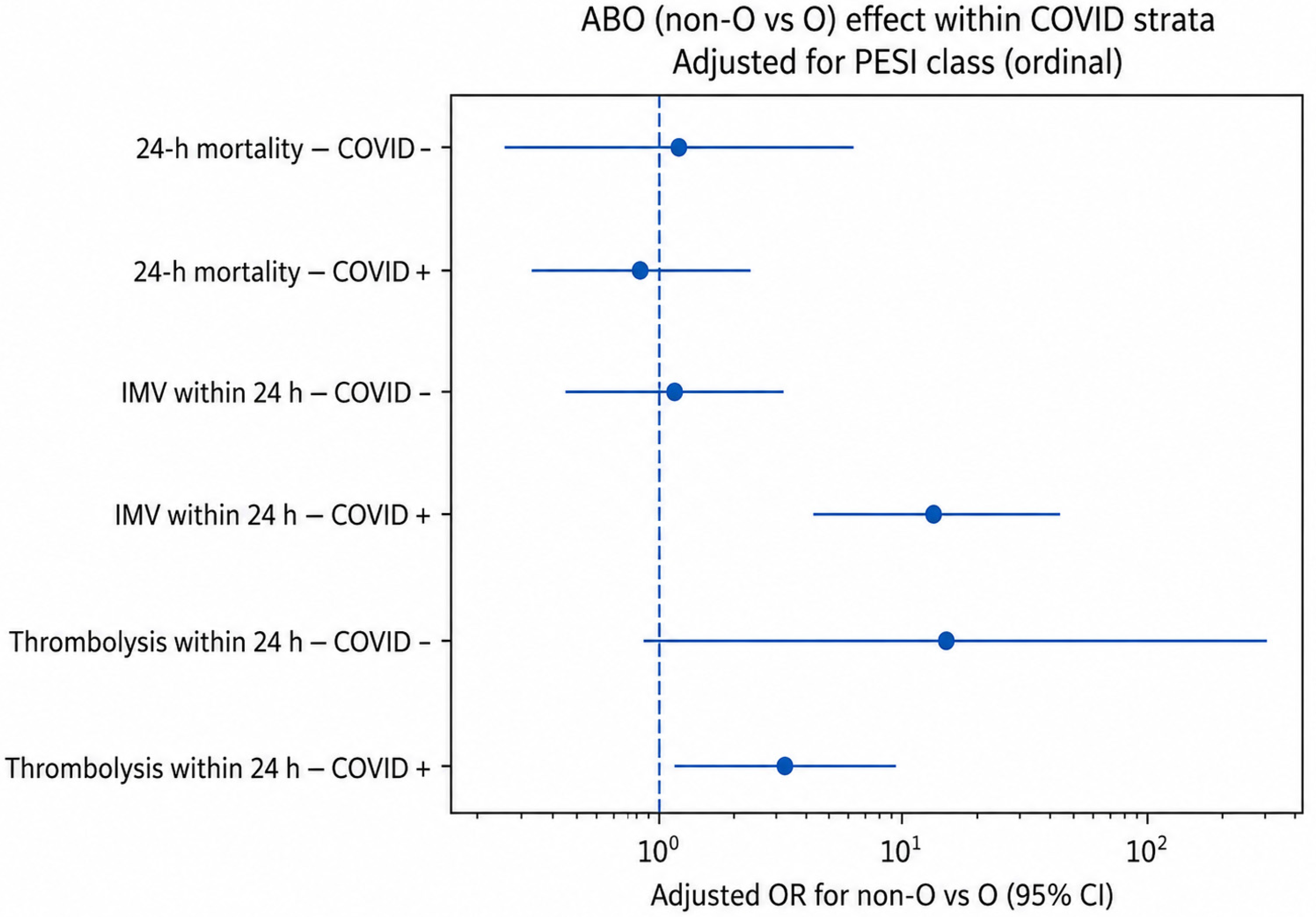
Table 4. A significant interaction between ABO blood group and COVID-19 infection was observed for invasive mechanical ventilation (
p for interaction = 0.002). Among COVID-19-positive patients, non-O blood groups were associated with substantially higher odds of invasive mechanical ventilation compared with group O (aOR 12.87, 95% CI 4.17–39.75), whereas no association was observed among COVID-19-negative patients (aOR 1.20, 95% CI 0.45–3.23). No statistically significant interaction between ABO blood group and COVID-19 infection was observed for 24 h mortality (
p for interaction = 0.721) or systemic thrombolysis (
p for interaction = 0.306). In all models, higher PESI class was independently associated with increased odds of adverse outcomes.
Figure 2 illustrates the adjusted association between non-O blood group and early outcomes within COVID-negative and COVID-positive strata.
Sensitivity analyses modeling ABO as a four-level categorical variable (O, A, B, AB) yielded similar results and did not materially change the interaction estimates.
As a supplementary sensitivity analysis using discharge-based in-hospital mortality, death occurred in 12/116 (10.3%) COVID-negative patients and 39/95 (41.1%) COVID-positive patients (p < 0.001). In multivariable Firth logistic regression models adjusted for PESI class, no significant interaction between COVID-19 status and non-O blood group was observed for in-hospital mortality (interaction aOR~0.68, 95% CI crossing unity; p for interaction non-significant).
To assess coefficient stability, bootstrap resampling with 1000 iterations was performed for the regression models. For the invasive mechanical ventilation model, the bootstrap mean estimate for the COVID × non-O interaction term was similar to the original coefficient (original beta 2.371; bootstrap mean beta 2.450), and the bootstrap-derived 95% confidence interval remained above the null value (0.879 to 3.970), supporting the robustness of this interaction despite limited precision. For mortality, bootstrap analyses confirmed broad uncertainty around the interaction estimate.
4. Discussion
In this retrospective cohort study including 211 patients hospitalized with acute pulmonary embolism, we evaluated whether ABO blood group modifies the association between COVID-19 infection and early in-hospital outcomes. The relatively high proportion of COVID-19-positive patients and the elevated rates of early mortality and invasive mechanical ventilation observed in this cohort likely reflect the inclusion of a high-risk hospitalized population during the COVID-19 pandemic. These rates exceed those reported in large registries such as the RIETE registry, where short-term mortality is substantially lower. Similarly, rates of invasive mechanical ventilation in contemporary pulmonary embolism cohorts are considerably lower than those observed in the present study. This discrepancy reflects the specific clinical context of the present study and limits the generalizability of the findings to broader, non-pandemic PE populations. A significant interaction between ABO blood group and COVID-19 infection was observed for invasive mechanical ventilation. Among COVID-19-positive patients, non-O blood groups were associated with substantially higher odds of invasive mechanical ventilation compared with group O, whereas no association was observed among COVID-19-negative patients. No interaction was identified for 24 h mortality or systemic thrombolysis despite the established prothrombotic effects of both non-O blood groups and SARS-CoV-2 infection [
17,
18,
19,
20,
21,
22,
23]. These findings suggest that ABO-related thrombotic mechanisms may preferentially contribute to pulmonary microvascular dysfunction and respiratory deterioration rather than directly influencing early mortality. Early endpoints may be particularly relevant in the context of COVID-19-associated pulmonary vascular dysfunction, where rapid clinical deterioration can occur within the first hours of hospitalization. In all models, higher PESI class was independently associated with an increased risk of adverse outcomes.
Because 24 h mortality is an unconventional endpoint in acute pulmonary embolism studies, we additionally evaluated in-hospital mortality based on discharge data. This supplementary analysis did not identify a significant interaction between ABO blood group and COVID-19 status for mortality, consistent with the primary findings. Bootstrap resampling further demonstrated that the interaction observed for invasive mechanical ventilation remained directionally robust, although the wide confidence intervals reflect limited precision.
The hypothesis of effect modification is biologically plausible. Non-O blood groups are associated with higher circulating levels of von Willebrand factor (vWF) and factor VIII, partly due to reduced proteolytic clearance of vWF in individuals lacking the O antigen. Elevated vWF levels promote platelet adhesion, thrombin generation, and endothelial activation, mechanisms that increase the risk of venous thromboembolism. Consistent with these mechanisms, non-O blood groups have repeatedly been associated with a higher incidence of deep vein thrombosis and pulmonary embolism [
10,
11,
12,
13,
14,
15,
16].
SARS-CoV-2 infection induces a distinct prothrombotic state characterized by endothelial activation, increased release of von Willebrand factor, platelet activation, and dysregulated coagulation. Severe COVID-19 has been associated with markedly elevated vWF levels, markers of endothelial injury, and pulmonary microvascular thrombosis. Because both non-O blood group status and SARS-CoV-2 infection influence vWF-mediated pathways and endothelial dysfunction, a synergistic interaction may amplify thrombotic and microvascular injury in patients presenting with acute pulmonary embolism [
17,
18,
19,
20,
21,
22,
23,
24,
25].
These mechanisms may contribute to pulmonary vascular obstruction beyond the embolic clot burden detected on imaging and may partly explain the higher risk of respiratory deterioration observed in COVID-19-positive patients.
To our knowledge, few studies have specifically evaluated the interaction between ABO blood group and COVID-19 infection in determining the clinical severity of acute pulmonary embolism. The absence of a significant interaction for mortality may reflect the multifactorial determinants of early mortality in acute pulmonary embolism, which are largely captured by established severity indices such as PESI.
Our study has several methodological strengths. First, it included a consecutive cohort of patients with objectively confirmed acute pulmonary embolism, reducing selection bias and improving cohort comparability. COVID-19 status was determined systematically at admission using RT-PCR testing, minimizing the risk of exposure misclassification. Early outcomes were predefined within a 24 h window, which limited heterogeneity related to differences in subsequent in-hospital management. Multivariable models were prespecified and adjusted for clinically relevant covariates without automated variable selection, improving transparency and reproducibility. In addition, the use of Firth penalized logistic regression for mortality and thrombolysis addressed sparse event data and quasi-separation, thereby improving the stability of the estimated effects. Importantly, the study design directly evaluated effect modification through interaction modeling rather than relying solely on subgroup analyses.
This study also has several limitations that should be acknowledged. First, it was a single-center retrospective study, which may limit generalizability and leaves the possibility of residual confounding despite multivariable adjustment. Second, the sample size and event distribution limited statistical power for detecting interaction effects, particularly for early mortality. Interaction analyses typically require larger sample sizes than main effect analyses, and the present study may therefore be underpowered to detect more modest effect modification. The magnitude of the observed association between non-O blood groups and invasive mechanical ventilation should also be interpreted cautiously given the relatively small subgroup sizes and wide confidence intervals. In addition, changes in SARS-CoV-2 variants and evolving clinical management strategies during the study period may have influenced outcomes. These findings should therefore be interpreted cautiously, as the precision of the estimates is limited and model stability cannot be fully ensured. Vaccination status, inflammatory biomarkers, and longitudinal laboratory parameters were not available, precluding a more detailed mechanistic exploration of endothelial activation and coagulation pathways. Importantly, objective measures of COVID-19 severity were not consistently available, and therefore residual confounding related to the severity of SARS-CoV-2 infection cannot be excluded and may have influenced early respiratory outcomes. ABO blood group was analyzed primarily as a binary exposure in the main models, which may obscure subtle subtype-specific effects. Finally, outcomes were restricted to the first 24 h of hospitalization and therefore do not capture later clinical deterioration. The use of 24 h outcomes may limit comparability with major clinical trials that report longer-term endpoints such as 7-day or 30-day mortality, and therefore these findings should be interpreted as reflecting very early clinical deterioration rather than overall prognosis. Therefore, the present findings should be considered hypothesis-generating and require confirmation in larger, prospective studies.
5. Clinical Implications
The findings of this study suggest that ABO blood group, particularly non-O status, may contribute to early respiratory deterioration in patients with acute pulmonary embolism in the context of COVID-19. Although these results should be interpreted cautiously, they raise the possibility that ABO blood group could serve as an additional biological marker in early risk stratification. The identification of patients at higher risk of requiring invasive mechanical ventilation may support closer monitoring and timely escalation of care. Further studies are needed to validate these findings and to determine their potential role in clinical decision-making.
6. Conclusions
In this cohort of patients hospitalized with acute pulmonary embolism, ABO blood group modified the association between COVID-19 infection and early respiratory outcomes. Non-O blood groups were associated with substantially higher odds of invasive mechanical ventilation among COVID-19-positive patients, whereas no such association was observed among COVID-19-negative patients. No interaction between ABO blood group and COVID-19 infection was detected for early mortality or systemic thrombolysis. These findings suggest that ABO-related differences in coagulation and endothelial biology may contribute to pulmonary vascular dysfunction and influence the clinical expression of COVID-associated pulmonary embolism. Further studies are warranted to confirm these observations and to clarify their potential clinical implications.
Author Contributions
Conceptualization, A.J.E. and O.E.T.; methodology, S.-I.S.; software, A.J.E.; validation, O.E.T., I.M.M. and S.-I.S.; formal analysis, A.J.E. and A.D.D.; investigation, A.J.E.; resources, A.J.E. and A.D.D.; data curation, A.J.E.; writing—original draft preparation, A.J.E.; writing—review and editing, A.D.D. and D.N.; visualization, O.E.T., I.M.M., S.-I.S. and D.N.; supervision, O.E.T., I.M.M. and S.-I.S.; project administration, A.J.E. and S.-I.S. All authors have read and agreed to the published version of the manuscript.
Funding
This research received no external funding.
Institutional Review Board Statement
The study was conducted in accordance with the Declaration of Helsinki and approved by the Ethics Committee of Victor Babeș University of Medicine and Pharmacy Timișoara, Romania (Approval No. 96/04.10.2021, revised 26 October 2025).
Informed Consent Statement
The requirement for informed consent was waived due to the retrospective design and use of anonymized data.
Data Availability Statement
The data supporting the findings of this study are available from the corresponding author upon reasonable request, in accordance with institutional and ethical regulations.
Acknowledgments
We would like to acknowledge Victor Babes University of Medicine and Pharmacy Timisoara for their support in covering the costs of publication for this research paper.
Conflicts of Interest
The authors declare no conflict of interest.
Abbreviations
The following abbreviations are used in this manuscript:
| ABO | ABO blood group system |
| aOR | Adjusted odds ratio |
| CI | Confidence interval |
| COVID-19 | Coronavirus disease 2019 |
| CTEPH | Chronic thromboembolic pulmonary hypertension |
| CTPA | Computed tomography pulmonary angiography |
| ICU | Intensive care unit |
| IMV | Invasive mechanical ventilation |
| PE | Pulmonary embolism |
| PESI | Pulmonary Embolism Severity Index |
| RT-PCR | Reverse transcription polymerase chain reaction |
| SARS-CoV-2 | Severe acute respiratory syndrome coronavirus 2 |
| VTE | Venous thromboembolism |
| vWF | Von Willebrand factor |
References
- Erythropoulou-Kaltsidou, A.; Alkagiet, S.; Tziomalos, K. New guidelines for the diagnosis and management of pulmonary embolism: Key changes. World J. Cardiol. 2020, 12, 161–166. [Google Scholar] [CrossRef] [Scilit] [PubMed]
- Goldhaber, S.Z.; Bounameaux, H. Pulmonary embolism and deep vein thrombosis. Lancet 2012, 379, 1835–1846. [Google Scholar] [CrossRef] [Scilit] [PubMed]
- Jiménez, D.; Bikdeli, B.; Barrios, D.; Morillo, R.; Nieto, R.; Guerassimova, I.; Muriel, A.; Jara-Palomares, L.; Moores, L.; Tapson, V.; et al. Management appropriateness and outcomes of patients with acute pulmonary embolism. Eur. Respir. J. 2018, 51, 1702115. [Google Scholar] [CrossRef] [Scilit]
- Dentali, F.; Ageno, W.; Pomero, F.; Fenoglio, L.; Squizzato, A.; Bonzini, M. Time trends and case fatality rate of in-hospital treated pulmonary embolism during 11 years of observation in North-western Italy. Thromb. Haemost. 2016, 115, 399–405. [Google Scholar] [PubMed]
- Lehnert, P.; Lange, T.; Møller, C.H.; Olsen, P.S.; Carlsen, J. Acute pulmonary embolism in a national Danish cohort: Increasing incidence and decreasing mortality. Thromb. Haemost. 2018, 118, 539–546. [Google Scholar] [CrossRef] [Scilit]
- Jiménez, D.; de Miguel-Díez, J.; Guijarro, R.; Trujillo-Santos, J.; Otero, R.; Barba, R.; Muriel, A.; Meyer, G.; Yusen, R.D.; Monreal, M. Trends in the management and outcomes of acute pulmonary embolism: Analysis from the RIETE Registry. J. Am. Coll. Cardiol. 2016, 67, 162–170. [Google Scholar] [CrossRef] [Scilit]
- Patel, P.; Patel, P.; Bhatt, M.; Braun, C.; Begum, H.; Nieuwlaat, R.; Khatib, R.; Martins, C.C.; Zhang, Y.; Etxeandia-Ikobaltzeta, I.; et al. Systematic review and meta-analysis of outcomes in patients with suspected pulmonary embolism. Blood Adv. 2021, 5, 2237–2244. [Google Scholar] [CrossRef] [Scilit]
- Silver, M.J.; Giri, J.; Duffy, Á.; Jaber, W.A.; Khandhar, S.; Ouriel, K.; Toma, C.; Tu, T.; Horowitz, J.M. Incidence of mortality and complications in high-risk pulmonary embolism: A systematic review and meta-analysis. J. Soc. Cardiovasc. Angiogr. Interv. 2023, 2, 100079. [Google Scholar] [CrossRef] [Scilit]
- Vyas, V.; Sankari, A.; Goyal, A. Acute pulmonary embolism. In StatPearls; StatPearls Publishing: Treasure Island, FL, USA, 2024. [Google Scholar]
- Hajizadeh, R.; Kavandi, H.; Nadiri, M.; Ghaffari, S. Association of ABO blood group with incidence and outcome of acute pulmonary embolism. Turk. Kardiyol. Dern. Ars. 2016, 44, 397–403. [Google Scholar] [CrossRef] [Scilit]
- Gallinaro, L.; Cattini, M.G.; Sztukowska, M.; Padrini, R.; Sartorello, F.; Pontara, E.; Bertomoro, A.; Daidone, V.; Pagnan, A.; Casonato, A. A shorter von Willebrand factor survival in O blood group subjects explains how ABO determinants influence plasma von Willebrand factor. Blood 2008, 111, 3540–3545. [Google Scholar] [CrossRef] [Scilit]
- Dentali, F.; Sironi, A.P.; Ageno, W.; Turato, S.; Bonfanti, C.; Frattini, F.; Crestani, S.; Franchini, M. Non-O blood type is the commonest genetic risk factor for venous thromboembolism: Results from a meta-analysis. Semin. Thromb. Hemost. 2012, 38, 535–548. [Google Scholar]
- O’Donnell, J.; Laffan, M.A. The relationship between ABO histo-blood group, factor VIII and von Willebrand factor. Transfus. Med. 2001, 11, 343–351. [Google Scholar] [CrossRef] [Scilit]
- Bawazir, W.M. Systematic review and meta-analysis of the susceptibility of ABO blood groups to venous thromboembolism in individuals with factor V Leiden. Diagnostics 2022, 12, 1936. [Google Scholar] [CrossRef] [Scilit]
- Larson, N.B.; Bell, E.J.; Decker, P.A.; Pike, M.; Wassel, C.L.; Tsai, M.Y.; Pankow, J.S.; Tang, W.; Hanson, N.Q.; Alexander, K.; et al. ABO blood group associations with markers of endothelial dysfunction in the Multi-Ethnic Study of Atherosclerosis. Atherosclerosis 2016, 251, 422–429. [Google Scholar] [CrossRef] [Scilit]
- Sun, X.; Feng, J.; Wu, W.; Peng, M.; Yang, C.; Yang, L.; Li, Y.; Zhang, Y.; Yang, Y.; Zhang, X.; et al. ABO blood types associated with the risk of venous thromboembolism in Han Chinese people: A hospital-based study of 200,000 patients. Sci. Rep. 2017, 7, 42925. [Google Scholar] [CrossRef] [Scilit]
- Klok, F.A.; Kruip, M.J.H.A.; van der Meer, N.J.M.; Arbous, M.S.; Gommers, D.A.M.P.J.; Kant, K.M.; Kaptein, F.H.J.; van Paassen, J.; Stals, M.A.M.; Huisman, M.V.; et al. Incidence of thrombotic complications in critically ill ICU patients with COVID-19. Thromb. Res. 2020, 191, 145–147. [Google Scholar] [CrossRef] [Scilit] [PubMed]
- Helms, J.; Tacquard, C.; Severac, F.; Leonard-Lorant, I.; Ohana, M.; Delabranche, X.; Merdji, H.; Clere-Jehl, R.; Schenck, M.; Fagot Gandet, F.; et al. High risk of thrombosis in patients with severe SARS-CoV-2 infection: A multicenter prospective cohort study. Intensive Care Med. 2020, 46, 1089–1098. [Google Scholar] [CrossRef] [Scilit]
- Jiménez, D.; García-Sanchez, A.; Rali, P.; Muriel, A.; Bikdeli, B.; Ruiz-Artacho, P.; Le Mao, R.; Rodríguez, C.; Hunt, B.J.; Monreal, M. Incidence of VTE and bleeding among hospitalized patients with coronavirus disease 2019: A systematic review and meta-analysis. Chest 2021, 159, 1182–1196. [Google Scholar] [CrossRef] [Scilit] [PubMed]
- Mai, V.; Tan, B.K.; Mainbourg, S.; Potus, F.; Cucherat, M.; Lega, J.C.; Provencher, S. Venous thromboembolism in COVID-19 compared to non-COVID-19 cohorts: A systematic review with meta-analysis. Vasc. Pharmacol. 2021, 139, 106882. [Google Scholar] [CrossRef] [Scilit] [PubMed]
- Cui, L.Y.; Cheng, W.W.; Mou, Z.W.; Xiao, D.; Li, Y.Y.; Li, Y.J.; Li, W.T.; Chen, Z.M. Risk factors for pulmonary embolism in patients with COVID-19: A systematic review and meta-analysis. Int. J. Infect. Dis. 2021, 111, 154–163. [Google Scholar] [CrossRef] [Scilit]
- Wu, Z.; Li, Y.; Chen, J.; Zhang, Y.; Wang, L.; Zhou, X.; Liu, H.; Zhao, Q. The occurrence of thromboembolism among patients with coronavirus disease 2019: A systematic review and meta-analysis. Sci. Rep. 2025, 15, 44783. [Google Scholar] [CrossRef] [Scilit]
- Ackermann, M.; Verleden, S.E.; Kuehnel, M.; Haverich, A.; Welte, T.; Laenger, F.; Vanstapel, A.; Werlein, C.; Stark, H.; Tzankov, A.; et al. Pulmonary vascular endothelialitis, thrombosis, and angiogenesis in COVID-19. N. Engl. J. Med. 2020, 383, 120–128. [Google Scholar] [CrossRef] [Scilit]
- Gratz, J.; Wiegele, M.; Maleczek, M.; Herkner, H.; Schoechl, H.; Chwala, E.; Knoebl, P.; Schaden, E. Risk of clinically relevant venous thromboembolism in critically ill patients with COVID-19: A systematic review and meta-analysis. Front. Med. 2021, 8, 647917. [Google Scholar] [CrossRef] [Scilit]
- Kaptein, F.H.J.; Stals, M.; Grootenboers, M.; Braken, S.; Burggraaf, J.; van Bussel, B.; Cannegieter, S.; Cate, H.T.; Endeman, H.; Gommers, D.; et al. Incidence of thrombotic complications and overall survival in hospitalized patients with COVID-19 in the second and first wave. Thromb. Res. 2021, 199, 143–148. [Google Scholar] [CrossRef] [Scilit]
| Disclaimer/Publisher’s Note: The statements, opinions and data contained in all publications are solely those of the individual author(s) and contributor(s) and not of MDPI and/or the editor(s). MDPI and/or the editor(s) disclaim responsibility for any injury to people or property resulting from any ideas, methods, instructions or products referred to in the content. |



 ,
,