
Sporting Careers After ICD Implantation in Elite Athletes



Abstract
1. Introduction
2. Materials and Methods
2.1. Study Design
2.2. Search Strategy
2.3. Inclusion Criteria
- Level of competition: The athlete must have competed at a professional, Olympic, or elite national/international level. Professional competition was defined as participation under formal contract and/or salaried employment within a recognized top-tier league or federation. Elite status was defined as sustained involvement in top-division leagues, international championships, or official representation of a national team. This definition was applied consistently across all included cases and served as a mandatory eligibility criterion for study inclusion. Collegiate athletes were excluded unless they also met one of the above criteria. Reports lacking a clear classification of competitive level were excluded.
- Documentation of ICD implantation: ICD placement had to be explicitly verified through reputable media coverage or publicly available institutional statements.
- Data availability: Sufficient clinical and career information needed to be accessible for analysis, including the athlete’s age at implantation, year of implantation, clinical indication, and post-ICD career trajectory.
2.4. Data Verification
3. Results
3.1. Diagnosis and Etiology
3.2. Post-ICD Outcomes
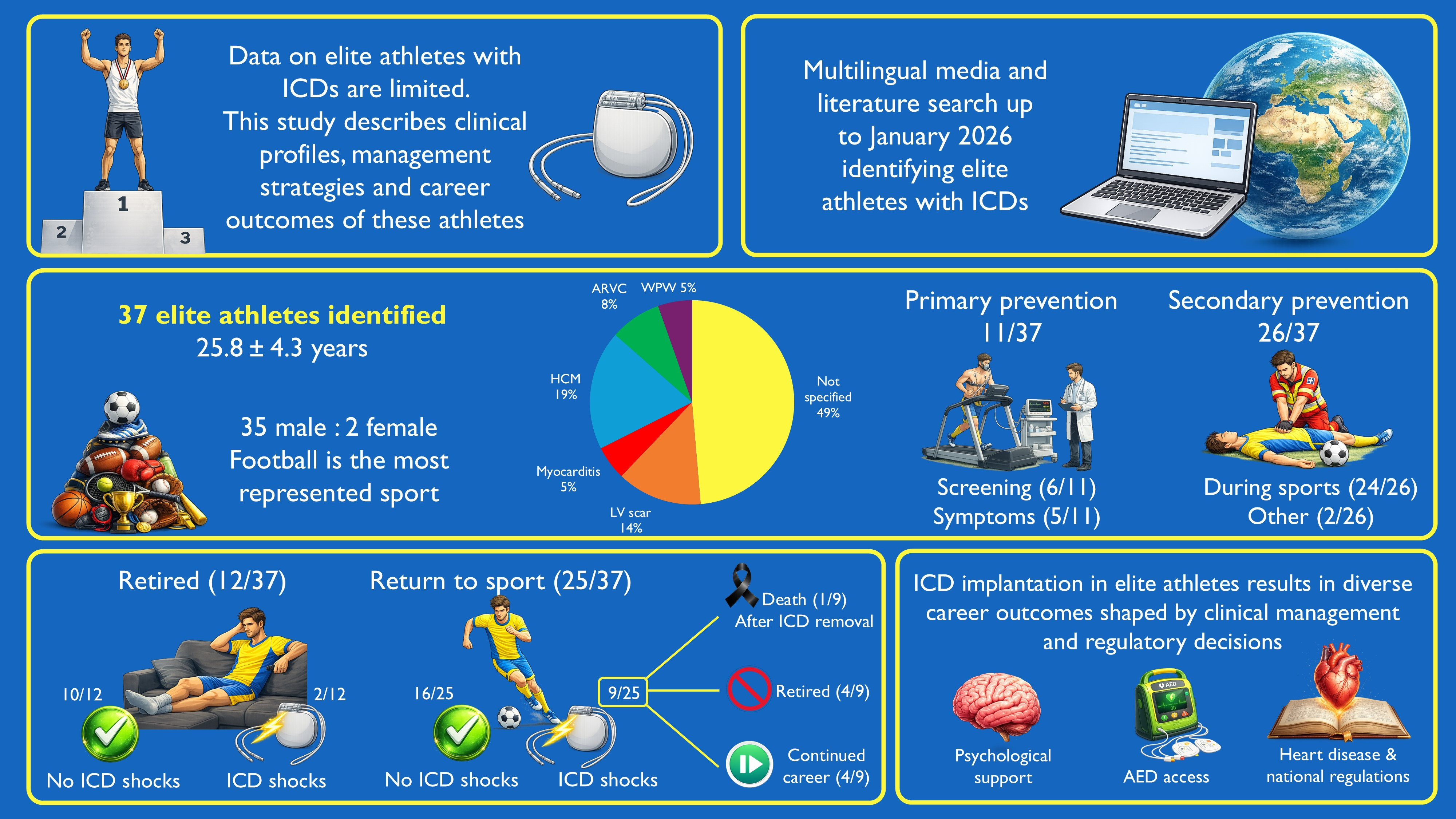
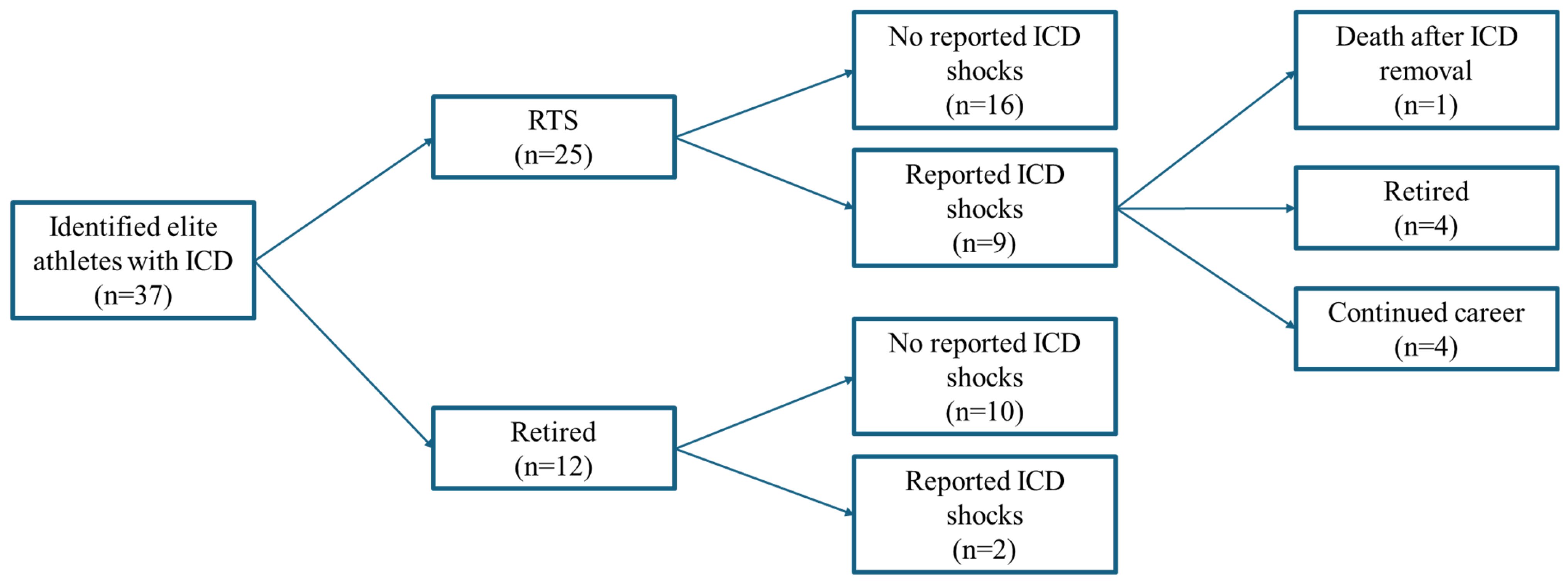
- A total of 25 athletes (68%) returned to competitive sport. Of these, 24 resumed at the elite/professional level, while one returned to the amateur level (football). Nine experienced one or more ICD discharges. In four of these nine cases, recurrent episodes and/or medical advice ultimately led to restriction or cessation of athletic activity. One athlete died approximately 22 months after voluntarily explanting the previously implanted ICD.
- A total of 12 athletes (32%) permanently retired from competitive sport immediately after SCA without attempting a return to competitive activity. In two of these athletes, an ICD shock was documented: one occurred during an official match while serving as a coach, and the other during non-competitive physical activity.
3.3. Clinical Presentation
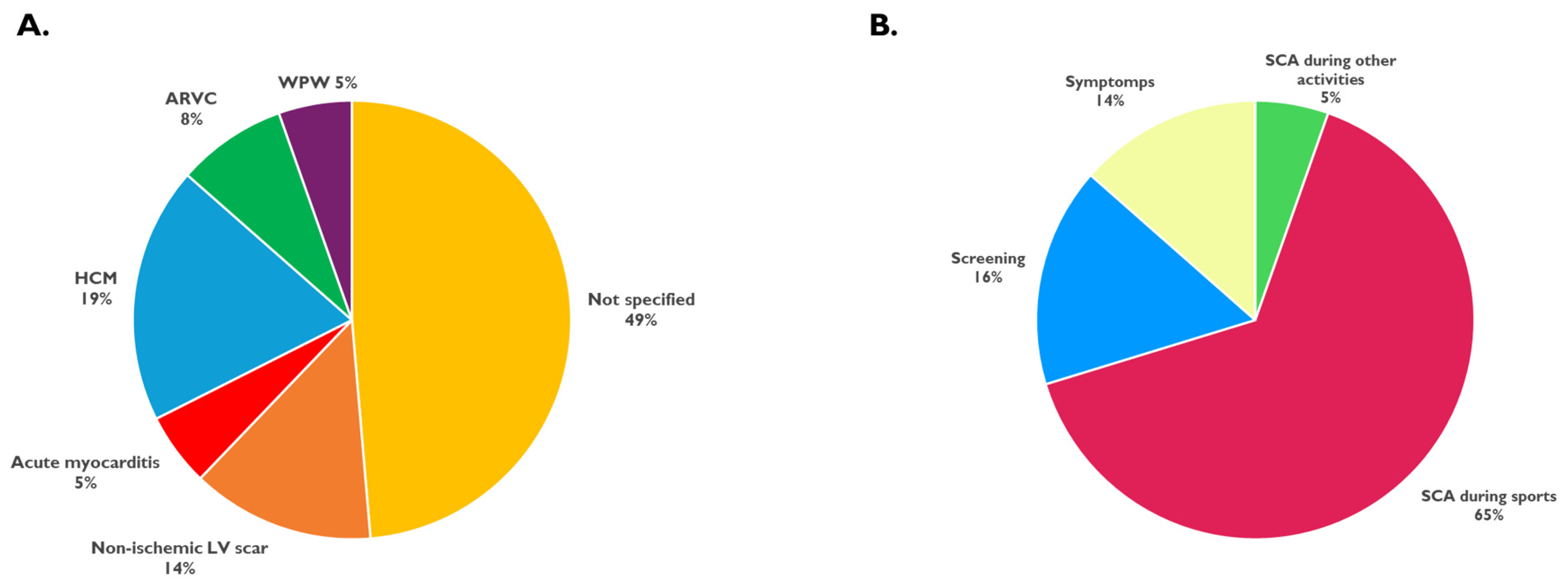
- Twenty-six athletes (70%) experienced a documented SCA with 24 being sports-related SCA during official competition or training, and two during non-sporting activities (while driving and during sleep, respectively). Two athletes who experienced SCA had previously received a medical diagnosis of a high-risk cardiac condition, identified through pre-participation screening, without undergone ICD implantation.
- Eleven athletes (30%) received an ICD without a prior SCA due to diagnosis of a high-risk proarrhythmic cardiac condition. Six athletes were identified during routine cardiac screening (two due to resting ECG abnormalities, two due to exercise-induced arrhythmias, and two for non-specified findings), while five were diagnosed due to symptoms (one for syncope, two for palpitations, two for exercise-induced dizziness).
3.4. Regulatory and Legal Considerations
4. Discussion
4.1. Epidemiological Considerations
4.2. Return to Sport and Legal Barriers
4.3. Focus on Sports
4.4. Are Elite Athletes with ICD Different from the Other Athletes with ICD?
4.5. Long-Term Outcomes and Psychological Impact
4.6. Importance of Early Recognition, AED Access, and Education
4.7. Methodological Considerations
5. Conclusions
Supplementary Materials
Author Contributions
Funding
Institutional Review Board Statement
Informed Consent Statement
Data Availability Statement
Acknowledgments
Conflicts of Interest
References
- Finocchiaro, G.; Westaby, J.; Sheppard, M.N.; Papadakis, M.; Sharma, S. Sudden Cardiac Death in Young Athletes: JACC State-of-the-Art Review. J. Am. Coll. Cardiol. 2024, 83, 350–370. [Google Scholar] [CrossRef] [PubMed]
- Lampert, R. Sport Participation in Patients with Implantable Cardioverter-Defibrillators. Curr. Treat. Options Cardiovasc. Med. 2019, 21, 66. [Google Scholar] [CrossRef] [PubMed]
- Heidbuchel, H.; Arbelo, E.; D’ascenzi, F.; Borjesson, M.; Boveda, S.; Castelletti, S.; Miljoen, H.; Mont, L.; Niebauer, J.; Papadakis, M.; et al. Recommendations for participation in leisure-time physical activity and competitive sports of patients with arrhythmias and potentially arrhythmogenic conditions. Part 2: Ventricular arrhythmias, channelopathies, and implantable defibrillators. EP Eur. 2021, 23, 147–148. [Google Scholar] [CrossRef] [PubMed]
- Corrado, D.; Migliore, F.; Zorzi, A. Sport activity in patients with implantable defibrillator: Playing with death? Eur. J. Prev. Cardiol. 2019, 26, 760–763. [Google Scholar] [CrossRef]
- Isaksen, K.; Morken, I.M.; Munk, P.S.; Larsen, A.I. Exercise training and cardiac rehabilitation in patients with implantable cardioverter defibrillators: A review of current literature focusing on safety, effects of exercise training, and the psychological impact of programme participation. Eur. J. Prev. Cardiol. 2012, 19, 804–812. [Google Scholar] [CrossRef]
- Lampert, R.; Cannom, D. Sports participation for athletes with implantable cardioverter-defibrillators should be an individualized risk-benefit decision. Heart Rhythm 2008, 5, 861–863. [Google Scholar] [CrossRef]
- Marijon, E.; Tafflet, M.; Celermajer, D.S.; Dumas, F.; Perier, M.C.; Mustafic, H.; Toussaint, J.-F.; Desnos, M.; Rieu, M.; Benameur, N.; et al. Sports-related sudden death in the general population. Circulation 2011, 124, 672–681. [Google Scholar] [CrossRef]
- Torell, M.F.; Strömsöe, A.; Zagerholm, E.; Herlitz, J.; Claesson, A.; Svensson, L.; Börjesson, M. Higher survival rates in exercise-related out-of-hospital cardiac arrests, compared to non-exercise-related—A study from the Swedish Register of Cardiopulmonary Resuscitation. Eur. J. Prev. Cardiol. 2017, 24, 1673–1679. [Google Scholar] [CrossRef]
- Mitchell, A.; Janssens, K.; Howden, E.J.; La Gerche, A.; Orchard, J.J. Ms-represented: Strategies to increase female representation in sports cardiology research. Br. J. Sports Med. 2023, 58, 122–124. [Google Scholar] [CrossRef]
- D’Ascenzi, F.; Cavigli, L.; Marchese, A.; Taddeucci, S.; Cappelli, E.; Roselli, A.; Bastone, G.; Lemme, E.; Serdoz, A.; Maestrini, V.; et al. Electrical and structural remodelling in female athlete’s heart: A comparative study in women vs men athletes and controls. Int. J. Cardiol. 2024, 400, 131808. [Google Scholar] [CrossRef]
- Harmon, K.G.; Asif, I.M.; Klossner, D.; Drezner, J.A. Incidence of sudden cardiac death in national collegiate athletic association athletes. Circulation 2011, 123, 1594–1600. [Google Scholar] [CrossRef]
- Egger, F.; Scharhag, J.; Kästner, A.; Dvořak, J.; Bohm, P.; Meyer, T. FIFA Sudden Death Registry (FIFA-SDR): A prospective, observational study of sudden death in worldwide football from 2014 to 2018. Br. J. Sports Med. 2022, 56, 80–87. [Google Scholar] [CrossRef] [PubMed]
- Sarto, P.; Zorzi, A.; Merlo, L.; Vessella, T.; Pegoraro, C.; Giorgiano, F.; Graziano, F.; Basso, C.; A Drezner, J.; Corrado, D. Value of screening for the risk of sudden cardiac death in young competitive athletes. Eur. Heart J. 2023, 44, 1084–1092. [Google Scholar] [CrossRef] [PubMed]
- Squeo, M.R.; Ferrera, A.; Di Gioia, G.; Mango, F.; Maestrini, V.; Monosilio, S.; Lemme, E.; Crotta, S.; Spinelli, A.; Serdoz, A.; et al. Pre-participation Cardiovascular Evaluation for Paris 2024 Olympic Games in Elite Athletes: The Italian Experience. High Blood Press. Cardiovasc. Prev. 2025, 32, 299–309. [Google Scholar] [CrossRef] [PubMed]
- Vecchiato, M.; Quinto, G.; Borasio, N.; Palermi, S.; Berton, G.; Battista, F.; Gasperetti, A.; Ermolao, A.; Neunhaeuserer, D. The Fragmented QRS Complex in Lead V1: Time for an Update of the Athlete’s ECG? J. Cardiovasc. Transl. Res. 2024, 17, 24–32. [Google Scholar] [CrossRef]
- Vecchiato, M.; Baioccato, V.; Adami, P.E.; Quinto, G.; Foccardi, G.; Slanzi, G.; Battista, F.; Neunhaeuserer, D.; Ermolao, A. Early repolarization in adolescent athletes: A gender comparison of ECG and echocardiographic characteristics. Scand. J. Med. Sci. Sports 2022, 32, 1581–1591. [Google Scholar] [CrossRef]
- Vecchiato, M.; Neunhaeuserer, D.; Degano, G.; Battista, F.; Ortolan, S.; Gasperetti, A.; Di Giulio, P.; Baioccato, V.; Borasio, N.; Palermi, S.; et al. The diagnostic value of including an exercise session during 24-h ambulatory ECG monitoring in athletes. Int. J. Cardiol. 2026, 446, 134098. [Google Scholar] [CrossRef]
- Palermi, S.; Cavarretta, E.; D’Ascenzi, F.; Castelletti, S.; Ricci, F.; Vecchiato, M.; Serio, A.; Cavigli, L.; Bossone, E.; Limongelli, G.; et al. Athlete’s Heart: A Cardiovascular Step-By-Step Multimodality Approach. Rev. Cardiovasc. Med. 2023, 24, 151. [Google Scholar] [CrossRef]
- Brosnan, M.; La Gerche, A.; Kalman, J.; Lo, W.; Fallon, K.; MacIsaac, A.; Prior, D. The Seattle Criteria increase the specificity of preparticipation ECG screening among elite athletes. Br. J. Sports Med. 2014, 48, 1144–1150. [Google Scholar] [CrossRef]
- Palermi, S.; Vecchiato, M.; Saglietto, A.; Niederseer, D.; Oxborough, D.; Ortega-Martorell, S.; Olier, I.; Castelletti, S.; Baggish, A.; Maffessanti, F.; et al. Unlocking the potential of artificial intelligence in sports cardiology: Does it have a role in evaluating athlete’s heart? Eur. J. Prev. Cardiol. 2024, 31, 470–482. [Google Scholar] [CrossRef]
- Palermi, S.; Vecchiato, M.; Ng, F.S.; Attia, Z.; Cho, Y.; Anselmino, M.; De Ferrari, G.M.; Saglietto, A.; Sau, A.; Chiu, I.-M.; et al. Artificial intelligence and the electrocardiogram: A modern renaissance. Eur. J. Intern. Med. 2025, 140, 106329. [Google Scholar] [CrossRef] [PubMed]
- Catto, V.; Dessanai, M.A.; Sommariva, E.; Tondo, C.; Russo, A.D. S-ICD is effective in preventing sudden death in arrhythmogenic cardiomyopathy athletes during exercise. Pacing Clin. Electrophysiol. 2019, 42, 1269–1272. [Google Scholar] [CrossRef] [PubMed]
- Huang, A.L.; MacNamara, J.; Link, M.S.; Martinez, M.; Dearani, J.A.; Cannon, B.C.; Levine, B.D.; Ackerman, M.J. Asymptomatic Apical Hypertrophic Cardiomyopathy in an Elite Competitive Athlete. JACC Case Rep. 2023, 6, 101705. [Google Scholar] [CrossRef] [PubMed]
- Laszlo, R.; Steinacker, J.M. Certification of competitive sports participation of a professional soccer player with hypertrophic cardiomyopathy and implanted ICD. Clin. Res. Cardiol. 2016, 105, 710–713. [Google Scholar] [CrossRef]
- Lahti, A.; Ljungström, E.; Mörtsell, D.; Jorstad, H. Return to professional football after ICD implantation in athlete with apical hypertrophic cardiomyopathy. BMJ Case Rep. 2024, 17, e261255. [Google Scholar] [CrossRef]
- Ackerman, M.J.; Zipes, D.P.; Kovacs, R.J.; Maron, B.J. Eligibility and Disqualification Recommendations for Competitive Athletes with Cardiovascular Abnormalities: Task Force 10: The Cardiac Channelopathies: A Scientific Statement from the American Heart Association and American College of Cardiology. Circulation 2015, 132, e326–e329. [Google Scholar] [CrossRef]
- Edenfield, K.M.; Clugston, J.R.; Martinez, M.W. Shared decision making for participation in elite athletes with cardiovascular conditions. Where are we now? Am. Heart J. Plus Cardiol. Res. Pract. 2024, 43, 100401. [Google Scholar] [CrossRef]
- Baggish, A.L.; Ackerman, M.J.; Putukian, M.; Lampert, R. Shared decision making for athletes with cardiovascular disease: Practical considerations. Curr. Sports Med. Rep. 2019, 18, 76–81. [Google Scholar] [CrossRef]
- Ajax Star Blind Collapses on the Pitch During Friendly Amid Fears Over Heart Condition. Available online: https://www.goal.com/en/news/ajax-star-blind-collapses-on-pitch-during-friendly/1avqoiyi14xca1l2tlioyh0e1b (accessed on 12 June 2025).
- Lampert, R.; Olshansky, B.; Heidbuchel, H.; Lawless, C.; Saarel, E.; Ackerman, M.; Calkins, H.; Estes, N.A.M.; Link, M.S.; Maron, B.J.; et al. Safety of Sports for Athletes with Implantable Cardioverter-Defibrillators: Long-Term Results of a Prospective Multinational Registry. Circulation 2017, 135, 2310–2312. [Google Scholar] [CrossRef]
- Heidbuchel, H.; Willems, R.; Jordaens, L.; Olshansky, B.; Carre, F.; Lozano, I.F.; Wilhelm, M.; Müssigbrodt, A.; Huybrechts, W.; Morgan, J.; et al. Intensive recreational athletes in the prospective multinational ICD Sports Safety Registry: Results from the European cohort. Eur. J. Prev. Cardiol. 2019, 26, 764–775. [Google Scholar] [CrossRef]
- Gasperetti, A.; Schiavone, M.; Vogler, J.; Compagnucci, P.; Laredo, M.; Breitenstein, A.; Gulletta, S.; Martinek, M.; Kaiser, L.; Lavalle, C.; et al. Long-Term Performance of Subcutaneous Implantable Defibrillators in Athletes: A Multicenter, Real-World Analysis of Sport Activities from the iSUSI Registry. Heart Rhythm 2024, 22, 1782–1789. [Google Scholar] [CrossRef] [PubMed]
- Pelliccia, A.; Sharma, S.; Gati, S.; Bäck, M.; Börjesson, M.; Caselli, S.; Collet, J.-P.; Corrado, D.; Drezner, J.A.; Halle, M.; et al. 2020 ESC Guidelines on sports cardiology and exercise in patients with cardiovascular disease. Eur. Heart J. 2020, 42, 17–96. [Google Scholar] [CrossRef] [PubMed]
- Kay, B.; Lampert, R. Devices and Athletics: Decision-Making Around Return to Play. Cardiol. Clin. 2023, 41, 81–92. [Google Scholar] [PubMed]
- Lampert, R.; Chung, E.H.; Ackerman, M.J.; Arroyo, A.R.; Darden, D.; Deo, R.; Dolan, J.; Etheridge, S.P.; Gray, B.R.; Harmon, K.G.; et al. 2024 HRS expert consensus statement on arrhythmias in the athlete: Evaluation, treatment, and return to play. Heart Rhythm 2024, 21, e151–e252. [Google Scholar] [CrossRef]
- Carrington, M.; Providência, R.; Chahal, C.A.A.; D’Ascenzi, F.; Cipriani, A.; Ricci, F.; Khanji, M.Y. Cardiopulmonary Resuscitation and Defibrillator Use in Sports. Front. Cardiovasc. Med. 2022, 9, 819609. [Google Scholar] [CrossRef]
- Ungaro, S.; Truglio, T.S.; Zorzi, A.; Solberg, E.E.; Caniglia, A.; Panhuyzen-Goedkoop, N.M.; Chukumerije, M.; Marijon, E.; A Drezner, J. Sports-related sudden cardiac arrest: A video analysis of presenting features, management and outcomes. Br. J. Sports Med. 2025, 60, 20–27. [Google Scholar] [CrossRef]
- Vecchiato, M.; Ermolao, A.; Da Col, M.; Aghi, A.; Berton, G.; Palermi, S.; Battista, F.; Savino, S.; Drezner, J.; Zorzi, A.; et al. Mortality in male bodybuilding athletes. Eur. Heart J. 2025, 46, 3006–3016. [Google Scholar] [CrossRef]
- Vecchiato, M.; Ermolao, A.; Zane, L.; Giagio, S.; Aghi, A.; Palermi, S.; Borasio, N.; Zorzi, A.; Neunhaeuserer, D. Mortality in female bodybuilding athletes. Eur. Heart J. 2025, 47, 373–375. [Google Scholar] [CrossRef]



| ID# | Sex | Sport | Nation | Age at Implantation | Year of ICD Implantation | Cardiac Disease | Circumstances | Post-ICD Career Outcome |
|---|---|---|---|---|---|---|---|---|
| 1 | M | Football | Denmark | 29 | 2021 | Not specified | Collapsed during a match in June 2021; successfully resuscitated and received an ICD. | Returned to professional football in early 2022; continues to play at a competitive level, including appearances for the national team. Transferred to another country due to national law regulations. |
| 2 | M | Football | Netherlands | 29 | 2019 | Myocarditis | Experienced dizziness during a match in December 2019; diagnosed with myocarditis and received a subcutaneous ICD. | Returned to professional football in early 2020; continues to play at a competitive level, including appearances for the national team. In August 2020, ICD activation during a friendly match; no further major incidents reported. |
| 3 | M | Football | UK | 23 | 2012 | HCM | SCA during a match in March 2012; heart stopped for 78 min; successfully resuscitated and received an ICD. | Retired due to persistent arrhythmias in August 2012 following medical advice. |
| 4 | M | Football | Germany | 24 | 2013 | Myocarditis | SCA during a match in July 2013; diagnosed with myocarditis and chronic arrhythmia. Underwent four heart surgeries, including ICD implantation. | Returned to professional football in November 2014, becoming the first professional player in Germany to play with an ICD. Continued playing professionally until 2017; retired in 2018 after experiencing multiple ICD shocks. Serves as a public ambassador for SCA awareness and prevention. |
| 5 | M | Football | Belgium | 21 | 2008 | HCM | Diagnosed with cardiac arrhythmia in 2008; received an ICD. In June 2009, the ICD successfully intervened during a match after he collapsed on the field. In May 2018, experienced another collapse during a game; ICD activated. | Continued professional football career post-ICD implantation until November 2018, when he retired due to recurrent cardiac events. |
| 6 | M | Football | Ghana | 24 | 2018 | Not specified | Diagnosed with unspecified heart condition in 2017; underwent ICD implantation in January 2020. | Continued professional football career despite medical advice to retire. Collapsed during a match in October 2021; ICD intervened successfully. In 2022, his ICD was reportedly removed. On 11 November 2023, suffered SCA during a match and was pronounced dead upon arrival at the hospital. |
| 7 | M | Football | Wales | 28 | 2023 | Accessory pathway—WPW | Collapsed during a match in May 2023 due to atrial fibrillation; underwent corrective surgery. In December 2023, suffered a SCA during a Premier League match; successfully resuscitated and received an ICD. | Returned to competitive football at lower professional level, following individualized medical clearance and rehabilitation. |
| 8 | M | Football | UK | 28 | 2021 | Not specified | Suffered SCA during training in November 2021; successfully resuscitated and received ICD implantation. | Returned to professional football in 2022; continues to play at a competitive level without further reported events. In March 2022, experienced another cardiac event during training, with successful ICD intervention. |
| 9 | M | Football | Serbia | 25 | 2023 | Not specified | Suffered SCA during a match in March 2023; successfully resuscitated and underwent ICD implantation. | Experienced a second collapse during play in December 2023. Returned to professional football after ICD implantation but permanently retired in July 2024 following recurrent collapse and medical advice. |
| 10 | M | Football | Senegal | 28 | 2004 | Not specified | Diagnosed with unspecified heart condition in 2003; did not make any official appearances for the club. In October 2004, collapsed during warm-up before a match; subsequently received an ICD. | Returned to professional football post-ICD implantation, playing for various clubs. Continued his career until retiring in 2011. |
| 11 | M | Football | Senegal | 20 | 2024 | Myocarditis-induced ventricular arrhythmia with myocardial scarring | Diagnosed with heart rhythm irregularities in 2023; contract terminated due to national policies. In November 2024, collapsed during a match; diagnosed with arrhythmia and received an ICD. | In 2025 returned to professional football; no official retirement announced. |
| 12 | M | Football | Netherlands | 23 | 2010 | Not specified | SCA during a match in September 2010; successfully resuscitated and received an ICD. | Continued professional football career post-ICD implantation. In September 2012, experienced another cardiac arrest during a match; ICD intervened successfully. Retired in 2018 after playing for various clubs. |
| 13 | M | Football | Italy | 21 | 2024 | Non-ischemic LV scar | SCA during a match in December 2024; successfully resuscitated and received an ICD. | Returned to professional football in early 2026. Transferred to another country due to national law regulations. |
| 14 | M | Cycling | Italy | 31 | 2022 | Not specified | SCA after finishing second in a race in March 2022; successfully resuscitated and received an ICD. | Retired from professional cycling in October 2022 due to medical advice and national regulations prohibiting competition with an ICD. |
| 15 | M | Cycling | Belgium | 27 | 2023 | Not specified heart wall disease. | SCA while driving, leading to a multi-car accident in September 2023; successfully resuscitated and hospitalized. Subsequent tests revealed a heart muscle anomaly causing arrhythmia and received an ICD implantation. | Retired from professional cycling in September 2023 following ICD implantation |
| 16 | M | Athletics | Jamaica | 28 | 2019 | Not specified | SCA while pacing the men’s 3000 m race on February 2019; successfully resuscitated and received an ICD. | Retired from professional running in September 2019 following medical advice; currently involved in coaching and raising awareness about heart health. |
| 17 | F | Athletics | Germany | 28 | 2019 | Unspecified congenital cardiac arrhythmia | Diagnosed with congenital cardiac arrhythmia, she experienced episodes of abnormally fast heartbeats from a young age. In October 2018, she received a subcutaneous ICD to manage her condition. | Continued her professional pole-vaulting career post-ICD implantation, including participation in the Olympics. As of 2025, she remains active in athletics and serves as an advocate for heart rhythm awareness. |
| 18 | F | Handball | Danmark | 30 | 1999 | Not specified | SCA on court in 1999. Received an ICD implantation. Collapsed again in 2003 while coaching a Champions League match. | Retired from professional handball; transitioned to a successful coaching career. |
| 19 | M | Ice Hockey | Canada | 23 | 2012 | Not specified | SCA during a recreational hockey game in July 2012; successfully resuscitated and received an ICD. | Retired from professional hockey. Subsequently became an advocate for CPR and AED awareness, collaborating with organizations like the Heart and Stroke Foundation. |
| 20 | M | Ice Hockey | Canada | 26 | 2016 | Not specified | SCA during pre-game warm-up in November 2016. Resuscitated using extracorporeal membrane oxygenation and underwent emergency surgery. Due to complications, underwent left leg amputation below the knee. | Retired from professional hockey. Transitioned to a scouting role. Founded the All Heart Foundation to promote cardiac screening and awareness. |
| 21 | M | Ice Hockey | Canada | 31 | 2014 | Accessory pathway—WPW | SCA on the bench during an NHL game in March 2014; successfully resuscitated, underwent ablation and received an ICD. | Retired from professional hockey in September 2015. Transitioned to a player development role. Founded an initiative to promote heart health awareness and AED accessibility. |
| 22 | M | Volleyball | Belgium | 19 | 2022 | Not specified | SCA during a match in October 2022; resuscitated and received an ICD. | In February 2024, collapsed again during a Belgian league match; ICD successfully intervened. Announced retirement from professional volleyball in February 2024 following medical advice after the second cardiac event. |
| 23 | M | Volleyball | Belgium | 33 | 2013 | Not specified | SCA during a training session in August 2009 and was placed in an induced coma. He received an ICD following the incident. | Transferred to another country due to national law regulations. New SCA in 2013 during a match; ICD successfully intervened. Retired from volleyball in 2019. |
| 24 | M | Rugby | Wales | 22 | 2023 | Not specified | SCA during sleep in August 2023; resuscitated after 17 min. Received an S-ICD. | Returned to rugby; became an advocate for CPR and heart health awareness. |
| 25 | M | Ice Hockey | Canada | 36 | 2020 | Not specified | SCA on the bench during an NHL game in February 2020; revived with CPR and AED. Received an ICD. | Retired from professional hockey in January 2021; no return to competition. |
| 26 | M | Football | Denmark | 33 | 2023 | Apical HCM with fibrosis and fat infiltration | Experienced dizziness during training in May 2023; diagnosed with a heart condition and received an ICD. | Returned to competitive play in April 2024 after an 11-month hiatus. |
| 27 | M | Football | Germany (likely) | 23 | 2015 (likely) | HCM (mid-ventricular/apical) | Diagnosed during evaluation for abnormal ECG; ICD implanted for primary prevention. | Returned to professional football with close monitoring and individualized clearance. |
| 28 | M | N/A | USA | 21 | N/A (2021–2022) | Apical HCM (MYBPC3 mutation) | Diagnosed after abnormal ECG at age 17; progressive hypertrophy and LGE at CMR led to ICD implantation. | Returned to professional sport with ICD; remains asymptomatic under close follow-up. |
| 29 | M | Basketball | Italy | 21 | N/A (2017–2018) | ARVC (PKP2 mutation + variant in RYR2) | VF during a match treated with CPR and 7 external shocks; S-ICD implanted for secondary prevention. | Disqualified from competitive sports. One year later, experienced VT during basketball activity, successfully terminated by S-ICD activation. |
| 30 | M | Cycling | Italy | 20 | N/A (2018 likely) | ARVC | Palpitations, presyncope, and documented NSVT during cycling competition; diagnosed based on imaging and biopsy. S-ICD implanted for primary prevention. | Disqualified from competitive sports. |
| 31 | M | Football | Sweden (likely) | 30 | N/A (2024 likely) | Apical HCM with aneurysm, fibrosis and fat infiltration | Syncope during training in early 2024; prior abnormal ECG since adolescence. ICD implanted following shared decision making. | Returned to professional football after 7-month encapsulated rehabilitation; continues under close cardiac monitoring. |
| 32 | M | Football | England/Nigeria | 22 | 2022 | Non-ischemic LV scar | Diagnosed in early 2021 during medicals checks with myocarditis followed by fibrotic scar; S-ICD implanted in September 2022. | Returned to professional football in March 2024 after three-year hiatus. |
| 33 | M | Basketball | USA | N/A | 2017 | HCM | Diagnosed in 2018 during pre-college screening; ICD implanted subsequently. | Continues professional basketball career in the NBA under regular cardiac monitoring. |
| 34 | M | Football | Jordan | 23 | 2022 | ARVC | SCA during warm up in 2022. VF for 15 min, converted after 7 shocks; ICD implanted subsequently. No permanent complications. | Retired. No further details. |
| 35 | M | Football | France/Algeria | 29 | 2024 | Non-ischemic LV scar | SCA during a match in June 2024. Reanimated with AED by his teammates and received ICD. He received regular screening until May 2024. Only a sequalae on MRI. | Returned to professional football in February 2025 and scored in his comeback match. |
| 36 | M | Futsal | New Zealand | 24 | 2017 | Not identified | Collapsed during futsal training. CPR by player who was a doctor and reanimated with AED. 3 days ICU and intensive investigations without finding a cause. ICD implanted. | Returned to competitive futsal and football. |
| 37 | M | Futsal | Australia | 30 | 2016 | Not specified | SCA immediately after coming off the field. CPR by paramedics and AED discharge efficiently. ICD was implanted. | Returned to competitive futsal. |
Disclaimer/Publisher’s Note: The statements, opinions and data contained in all publications are solely those of the individual author(s) and contributor(s) and not of MDPI and/or the editor(s). MDPI and/or the editor(s) disclaim responsibility for any injury to people or property resulting from any ideas, methods, instructions or products referred to in the content. |
© 2026 by the authors. Licensee MDPI, Basel, Switzerland. This article is an open access article distributed under the terms and conditions of the Creative Commons Attribution (CC BY) license.
Share and Cite
Vecchiato, M.; Egger, F.; Palermi, S. Sporting Careers After ICD Implantation in Elite Athletes. J. Cardiovasc. Dev. Dis. 2026, 13, 97. https://doi.org/10.3390/jcdd13020097
Vecchiato M, Egger F, Palermi S. Sporting Careers After ICD Implantation in Elite Athletes. Journal of Cardiovascular Development and Disease. 2026; 13(2):97. https://doi.org/10.3390/jcdd13020097
Chicago/Turabian StyleVecchiato, Marco, Florian Egger, and Stefano Palermi. 2026. "Sporting Careers After ICD Implantation in Elite Athletes" Journal of Cardiovascular Development and Disease 13, no. 2: 97. https://doi.org/10.3390/jcdd13020097
APA StyleVecchiato, M., Egger, F., & Palermi, S. (2026). Sporting Careers After ICD Implantation in Elite Athletes. Journal of Cardiovascular Development and Disease, 13(2), 97. https://doi.org/10.3390/jcdd13020097