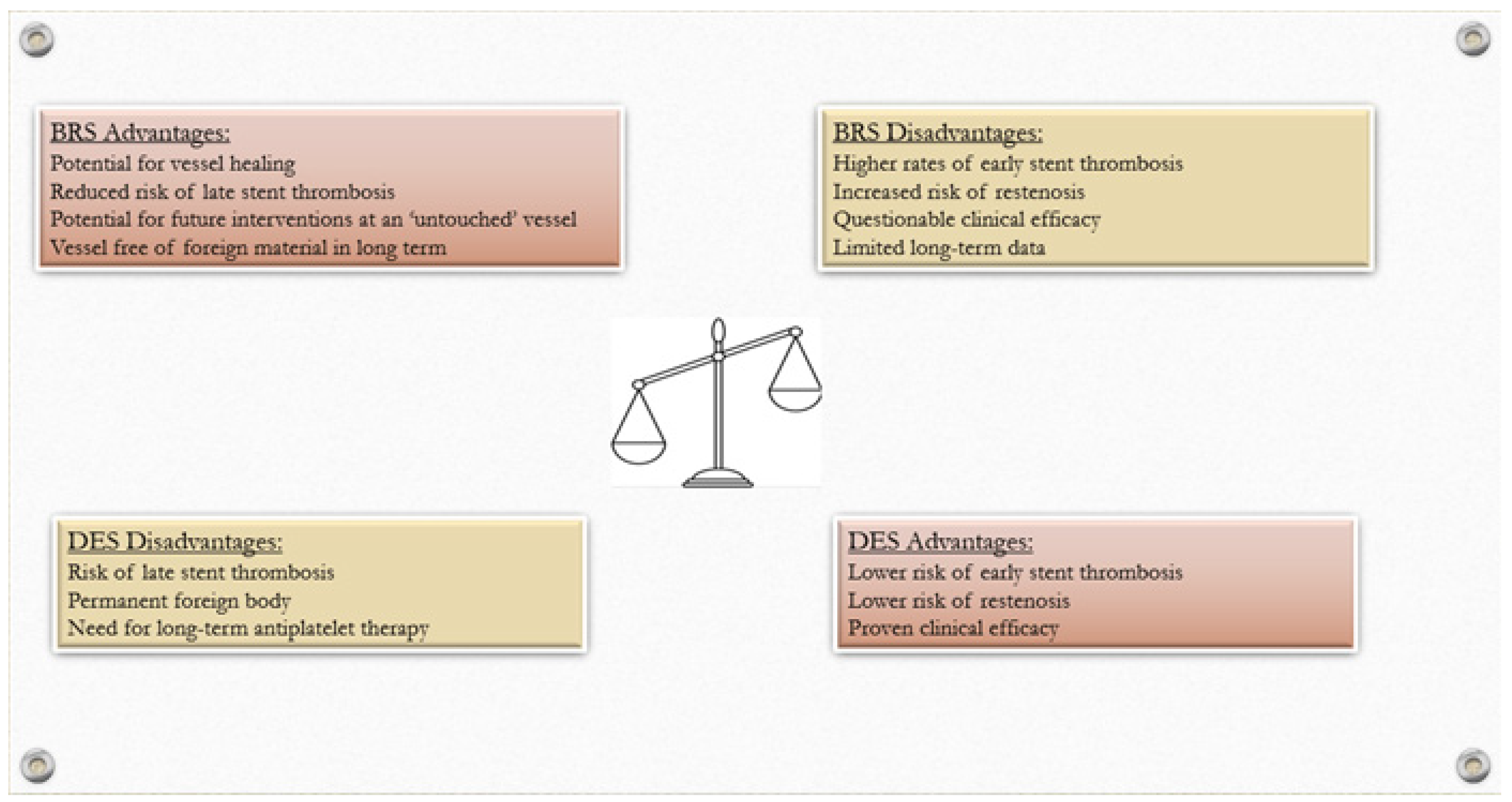

Bioresorbable Scaffolds for Coronary Revascularization: From Concept to Clinical Maturity

 ,
,  ,
,  , , , , and
Abstract
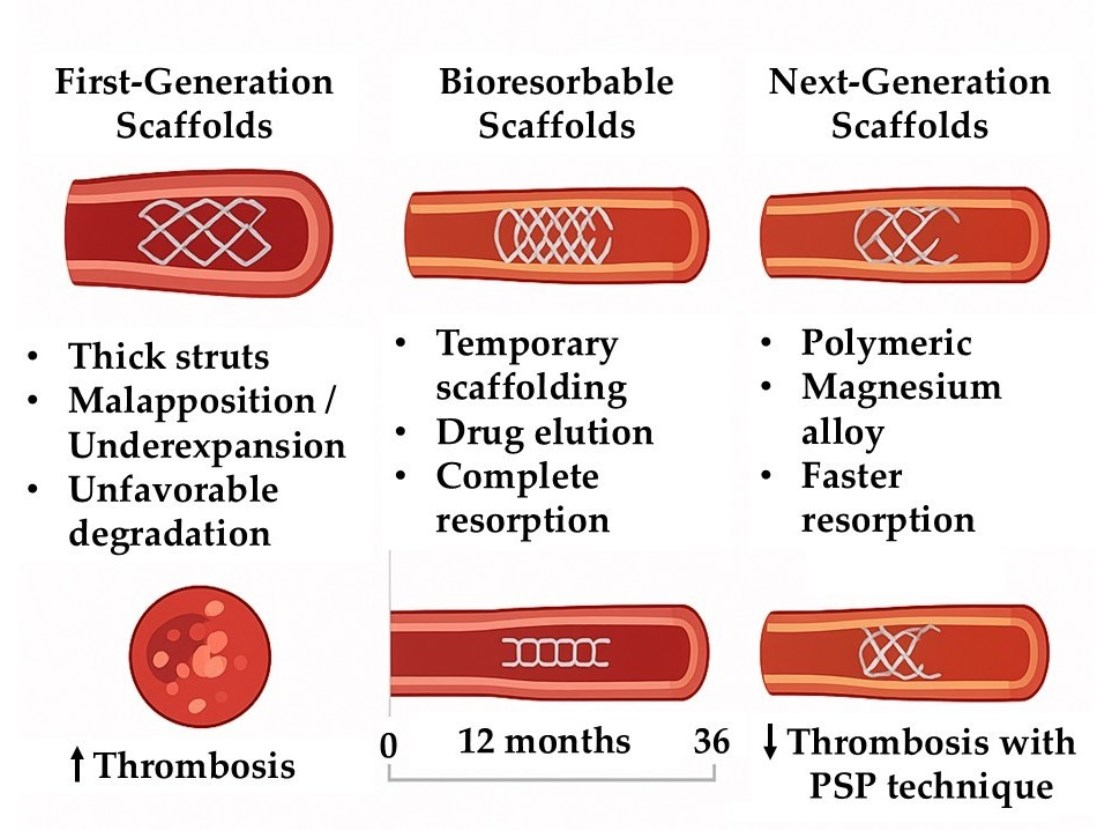
1. Introduction
2. Stent Construction
3. BRS Complications
3.1. Scaffold Thrombosis
3.2. In-Scaffold Restenosis and Neoatherosclerosis
3.3. Inflammation and Delayed Vascular Healing
3.4. Device Malapposition and Mechanical Complications
3.5. Procedural and Patient-Related Factors
4. Trials Comparing BVS with DESs
5. Comparative Clinical Outcomes and Meta-Analytic Insights
5.1. Evidence from Randomized Clinical Trials
5.2. Meta-Analyses and Long-Term Comparative Insights
5.3. Lessons and Implications
6. Current Challenges and Lessons Learned
7. Next-Generation Scaffolds and Future Directions
8. Conclusions
Author Contributions
Funding
Data Availability Statement
Conflicts of Interest
References
- Malik, T.F.; Tivakaran, V.S. Percutaneous Transluminal Coronary Angioplasty; StatPearls Publishing: Treasure Island, FL, USA, 2024. Available online: https://www.ncbi.nlm.nih.gov/books/NBK535417 (accessed on 10 October 2025).
- Nicolas, J.; Pivato, C.A.; Chiarito, M.; Beerkens, F.; Cao, D.; Mehran, R. Evolution of drug-eluting coronary stents: A back-and-forth journey from the bench to bedside. Cardiovasc. Res. 2022, 119, 631–646. [Google Scholar] [CrossRef]
- Charpentier, E.; Barna, A.; Guillevin, L.; Juliard, J.-M. Fully bioresorbable drug-eluting coronary scaffolds: A review. Arch. Cardiovasc. Dis. 2015, 108, 385–397. [Google Scholar] [CrossRef]
- Wu, X.; Wu, S.; Kawashima, H.; Hara, H.; Ono, M.; Gao, C.; Wang, R.; Lunardi, M.; Sharif, F.; Wijns, W.; et al. Current perspectives on bioresorbable scaffolds in coronary intervention and other fields. Expert Rev. Med. Devices 2021, 18, 351–366. [Google Scholar] [CrossRef]
- Onuma, Y.; Serruys, P.W. Bioresorbable scaffold: The advent of a new era in percutaneous coronary and peripheral revascularization? Circulation 2011, 123, 779–797. [Google Scholar] [CrossRef]
- Kereiakes, D.J.; Onuma, Y.; Serruys, P.W.; Stone, G.W. Bioresorbable vascular scaffolds for coronary revascularization: A case for renewed optimism. Circulation 2016, 134, 168–182. [Google Scholar] [CrossRef]
- Capodanno, D.; Gori, T.; Nef, H.; Latib, A.; Mehilli, J.; Lesiak, M.; Caramanno, G.; Naber, C.; Di Mario, C.; Colombo, A.; et al. Percutaneous coronary intervention with everolimus-eluting bioresorbable vascular scaffolds in routine clinical practice: Early and midterm outcomes from the European multicentre GHOST-EU registry. EuroIntervention 2015, 10, 1144–1153. [Google Scholar] [CrossRef]
- Wykrzykowska, J.J.; Kraak, R.P.; Hofma, S.H.; van der Schaaf, R.J.; Arkenbout, E.K.; Ijsselmuiden, A.J.; Elias, J.; van Dongen, I.M.; Tijssen, R.Y.; Koch, K.T.; et al. Bioresorbable Scaffolds versus Metallic Stents in Routine PCI. N. Engl. J. Med. 2017, 376, 2319–2328. [Google Scholar] [CrossRef]
- Gallinoro, E.; Almendarez, M.; Alvarez-Velasco, R.; Barbato, E.; Avanzas, P. Bioresorbable stents: Is the game over? Int. J. Cardiol. 2022, 361, 20–28. [Google Scholar] [CrossRef]
- Jinnouchi, H.; Torii, S.; Sakamoto, A.; Kolodgie, F.D.; Virmani, R.; Finn, A.V. Fully bioresorbable vascular scaffolds: Lessons learned and future directions. Nat. Rev. Cardiol. 2018, 16, 286–304. [Google Scholar] [CrossRef]
- Iglesias, J.F.; Muller, O.; Losdat, S.; Roffi, M.; Kurz, D.J.; Weilenmann, D.; Kaiser, C.; Heg, D.; Windecker, S.; Pilgrim, T. Complex primary percutaneous coronary intervention with ultrathin-strut biodegradable versus thin-strut durable polymer drug-eluting stents in patients with ST-segment elevation myocardial infarction: A subgroup analysis from the BIOSTEMI randomized trial. Catheter. Cardiovasc. Interv. 2023, 101, 687–700. [Google Scholar] [CrossRef]
- Leone, A.; Simonetti, F.; Avvedimento, M.; Angellotti, D.; Molaro, M.I.; Franzone, A.; Esposito, G.; Piccolo, R. Ultrathin Struts Drug-Eluting Stents: A State-of-the-Art Review. J. Pers. Med. 2022, 12, 1378. [Google Scholar] [CrossRef]
- Kumar, G.; Preetam, S.; Pandey, A.; Birbilis, N.; Al-Saadi, S.; Pasbakhsh, P.; Zheludkevich, M.; Balan, P. Advances in magnesium-based bioresorbable cardiovascular stents: Surface engineering and clinical prospects. J. Magnes. Alloys 2025, 13, 948–981. [Google Scholar] [CrossRef]
- Wiebe, J.; Nef, H.M.; Hamm, C.W. Current Status of Bioresorbable Scaffolds in the Treatment of Coronary Artery Disease. JACC 2014, 64, 2541–2551. [Google Scholar] [CrossRef] [PubMed]
- Felix, C.; Everaert, B.; Jepson, N.; Tamburino, C.; van Geuns, R.-J. Treatment of bioresorbable scaffold failure. EuroIntervention 2015, 11, V175–V180. [Google Scholar] [CrossRef] [PubMed][Green Version]
- Seth, A.; Onuma, Y.; Chandra, P.; Bahl, V.K.; Manjunath, C.N.; Mahajan, A.U.; Kumar, V.; Goel, P.K.; Wander, G.S.; Kaul, U.; et al. Three-year clinical and two-year multimodality imaging outcomes of a thin-strut sirolimus-eluting bioresorbable vascular scaffold: MeRes-1 trial. EuroIntervention 2019, 15, 607–614. [Google Scholar] [CrossRef] [PubMed]
- Waksman, R.; Zumstein, P.; Pritsch, M.; Wittchow, E.; Haude, M.; Lapointe-Corriveau, C.; Leclerc, G.; Joner, M. Second-generation magnesium scaffold Magmaris: Device design and preclinical evaluation in a porcine coronary artery model. EuroIntervention 2017, 13, 440–449. [Google Scholar] [CrossRef]
- Zheng, Y.F.; Gu, X.N.; Witte, F. Biodegradable metals. Nat. Rev. Mater. 2021, 6, 1073–1093. [Google Scholar] [CrossRef]
- Ozair, H.; Baluch, A.H.; Rehman, M.A.U.; Wadood, A. Shape Memory Hybrid Composites. ACS Omega 2022, 7, 36052–36069. [Google Scholar] [CrossRef]
- Chiastra, C.; Morlacchi, S.; Gallo, D.; Morbiducci, U.; Cárdenes, R.; Larrabide, I.; Migliavacca, F. Computational fluid dynamic simulations of image-based stented coronary bifurcation models. J. R. Soc. Interface 2013, 10, 20130193. [Google Scholar] [CrossRef]
- Wells, C.M.; Harris, M.; Choi, L.; Murali, V.P.; Guerra, F.D.; Jennings, J.A. Stimuli-responsive drug release from smart polymers. J. Funct. Biomater. 2019, 10, 34. [Google Scholar] [CrossRef]
- Joner, M.; Finn, A.V.; Farb, A.; Mont, E.K.; Kolodgie, F.D.; Ladich, E.; Kutys, R.; Skorija, K.; Gold, H.K.; Virmani, R. Pathology of Drug-Eluting Stents in Humans. JACC 2006, 48, 193–202. [Google Scholar] [CrossRef] [PubMed]
- Iqbal, J.; Onuma, Y.; Ormiston, J.; Abizaid, A.; Waksman, R.; Serruys, P. Bioresorbable scaffolds: Rationale, current status, challenges, and future. Eur. Heart J. 2013, 35, 765–776. [Google Scholar] [CrossRef] [PubMed]
- Heublein, B.; Rohde, R.; Kaese, V.; Niemeyer, M.; Hartung, W.; Haverich, A. Biocorrosion of magnesium alloys: A new principle in cardiovascular implant technology? Heart 2003, 89, 651–656. [Google Scholar] [CrossRef] [PubMed]
- Ortega-Paz, L.; Brugaletta, S.; Sabaté, M. Impact of PSP Technique on Clinical Outcomes Following Bioresorbable Scaffolds Implantation. J. Clin. Med. 2018, 7, 27. [Google Scholar] [CrossRef]
- Räber, L.; Brugaletta, S.; Yamaji, K.; O’sUllivan, C.J.; Otsuki, S.; Koppara, T.; Taniwaki, M.; Onuma, Y.; Freixa, X.; Eberli, F.R.; et al. Very Late Scaffold Thrombosis. JACC 2015, 66, 1901–1914. [Google Scholar] [CrossRef]
- Otsuka, F.; Byrne, R.A.; Yahagi, K.; Mori, H.; Ladich, E.; Fowler, D.R.; Kutys, R.; Xhepa, E.; Kastrati, A.; Virmani, R.; et al. Neoatherosclerosis: Overview of histopathologic findings and implications for intravascular imaging assessment. Eur. Heart J. 2015, 36, 2147–2159. [Google Scholar] [CrossRef]
- Yamaji, K.; Ueki, Y.; Souteyrand, G.; Daemen, J.; Wiebe, J.; Nef, H.; Adriaenssens, T.; Loh, J.P.; Lattuca, B.; Wykrzykowska, J.J.; et al. Mechanisms of Very Late Bioresorbable Scaffold Thrombosis. JACC 2017, 70, 2330–2344. [Google Scholar] [CrossRef]
- Tada, T.; Byrne, R.A.; Simunovic, I.; King, L.A.; Cassese, S.; Joner, M.; Fusaro, M.; Schneider, S.; Schulz, S.; Ibrahim, T.; et al. Histopathologic analysis of biodegradable polymer drug-eluting stents in humans: Focus on inflammation and vascular healing. J. Am. Coll. Cardiol. 2013, 62, 2330–2338. [Google Scholar]
- Venkatraman, S.; Boey, F.; Lao, L.L. Implanted cardiovascular polymers: Natural, synthetic and bio-inspired. Prog. Polym. Sci. 2008, 33, 853–874. [Google Scholar] [CrossRef]
- Ormiston, J.A.; Serruys, P.W.; Onuma, Y.; van Geuns, R.J.; de Bruyne, B.; Dudek, D.; Thuesen, L.; Smits, P.C.; Chevalier, B.; McClean, D.; et al. First serial assessment at 6 months and 2 years of the second generation of absorb everolimus-eluting bioresorbable vascular scaffold: Multi-imaging modality evaluation with quantitative coronary angiography, IVUS, and OCT in the ABSORB B trial. EuroIntervention 2012, 7, 1060–1071. [Google Scholar]
- Puricel, S.; Arroyo, D.; Corpataux, N.; Baeriswyl, G.; Lehmann, S.; Kallinikou, Z.; Muller, O.; Allard, L.; Stauffer, J.-C.; Togni, M.; et al. Comparison of Everolimus- and Biolimus-Eluting Coronary Stents With Everolimus-Eluting Bioresorbable Vascular Scaffolds. JACC 2015, 65, 791–801. [Google Scholar] [CrossRef]
- Kolandaivelu, K.; Swaminathan, R.; Gibson, W.J.; Kolachalama, V.B.; Nguyen-Ehrenreich, K.-L.; Giddings, V.L.; Coleman, L.; Wong, G.K.; Edelman, E.R. Stent Thrombogenicity Early in High-Risk Interventional Settings Is Driven by Stent Design and Deployment and Protected by Polymer-Drug Coatings. Circulation 2011, 123, 1400–1409. [Google Scholar] [CrossRef] [PubMed]
- Ali, Z.A.; Maehara, A.; Généreux, P.; Shlofmitz, R.A.; Fabbiocchi, F.; Nazif, T.M.; Guagliumi, G.; Meraj, P.M.; Alfonso, F.; Samady, H.; et al. Optical coherence tomography compared with intravascular ultrasound and with angiography to guide coronary stent implantation (ILUMIEN III: OPTIMIZE PCI): A randomised controlled trial. Lancet 2016, 388, 2618–2628. [Google Scholar] [CrossRef] [PubMed]
- Kumbasar, D.; Akyurek, O.; Oral, D. Bifurcation lesion treated with a single stent: A new technique. Catheter. Cardiovasc. Interv. 2005, 66, 213–216. [Google Scholar] [CrossRef] [PubMed]
- Eggebrecht, H.; Haude, M.; von Birgelen, C.; Oldenburg, O.; Baumgart, D.; Herrmann, J.; Welge, D.; Bartel, T.; Dagres, N.; Erbel, R. Nonsurgical retrieval of embolized coronary stents. Catheter. Cardiovasc. Interv. 2000, 51, 432–440. [Google Scholar] [CrossRef]
- Tamburino, C.; Latib, A.; van Geuns, R.-J.; Sabate, M.; Mehilli, J.; Gori, T.; Achenbach, S.; Alvarez, M.P.; Nef, H.; Lesiak, M.; et al. Contemporary practice and technical aspects in coronary intervention with bioresorbable scaffolds: A European perspective. EuroIntervention 2015, 11, 45–52. [Google Scholar] [CrossRef]
- Stefanini, G.G.; Holmes, D.R., Jr. Drug-Eluting Coronary-Artery Stents. N. Engl. J. Med. 2013, 368, 254–265. [Google Scholar] [CrossRef]
- Keteyian, S.J.; Patel, M.; Kraus, W.E.; Brawner, C.A.; McConnell, T.R.; Piña, I.L.; Leifer, E.S.; Fleg, J.L.; Blackburn, G.; Fonarow, G.C.; et al. Variables Measured During Cardiopulmonary Exercise Testing as Predictors of Mortality in Chronic Systolic Heart Failure. JACC 2016, 67, 780–789. [Google Scholar] [CrossRef]
- Haude, M.; Ince, H.; Abizaid, A.; Toelg, R.; Lemos, P.A.; von Birgelen, C.; Christiansen, E.H.; Wijns, W.; Neumann, F.-J.; Kaiser, C.; et al. Sustained safety and performance of the second-generation drug-eluting absorbable metal scaffold in patients with de novo coronary lesions: 12-month clinical results and angiographic findings of the BIOSOLVE-II first-in-man trial. Eur. Heart J. 2016, 37, 2701–2709. [Google Scholar] [CrossRef]
- Carrie, D. ABSORB EXTEND: AN INTERIM REPORT ON THE 24-MONTH CLINICAL OUTCOMES FROM THE FIRST 450 PATIENTS ENROLLED. JACC 2014, 63, A1882. [Google Scholar] [CrossRef][Green Version]
- Gao, R.; Yang, Y.; Han, Y.; Huo, Y.; Chen, J.; Yu, B.; Su, X.; Li, L.; Kuo, H.-C.; Ying, S.-W.; et al. Bioresorbable Vascular Scaffolds Versus Metallic Stents in Patients With Coronary Artery Disease. JACC 2015, 66, 2298–2309. [Google Scholar] [CrossRef]
- Chevalier, B.; Onuma, Y.; van Boven, A.; Piek, J.; Sabaté, M.; Helqvist, S.; Baumbach, A.; Smits, P.; Kumar, R.; Wasungu, L.; et al. Randomised comparison of a bioresorbable everolimus-eluting scaffold with a metallic everolimus-eluting stent for ischaemic heart disease caused by de novo native coronary artery lesions: The 2-year clinical outcomes of the ABSORB II trial. EuroIntervention 2016, 12, 1102–1107. [Google Scholar] [CrossRef] [PubMed]
- Collet, C.; Asano, T.; Miyazaki, Y.; Tenekecioglu, E.; Katagiri, Y.; Sotomi, Y.; Cavalcante, R.; de Winter, R.J.; Kimura, T.; Gao, R.; et al. Late thrombotic events after bioresorbable scaffold implantation: A systematic review and meta-analysis of randomized clinical trials. Eur. Heart J. 2017, 38, 2559–2566. [Google Scholar] [CrossRef] [PubMed]
- Stone, G.W.; Kereiakes, D.J.; Gori, T.; Metzger, D.C.; Stein, B.; Erickson, M.; Torzewski, J.; Kabour, A.; Piegari, G.; Cavendish, J.; et al. 5-Year Outcomes After Bioresorbable Coronary Scaffolds Implanted With Improved Technique. JACC 2023, 82, 183–195. [Google Scholar] [CrossRef] [PubMed]
- Kimura, T.; Kozuma, K.; Tanabe, K.; Nakamura, S.; Yamane, M.; Muramatsu, T.; Saito, S.; Yajima, J.; Hagiwara, N.; Mitsudo, K.; et al. A randomized trial evaluating everolimus-eluting Absorb bioresorbable scaffolds vs. everolimus-eluting metallic stents in patients with coronary artery disease: ABSORB Japan. Eur. Heart J. 2015, 36, 3332–3342. [Google Scholar] [CrossRef]
- Toušek, P.; Lazarák, T.; Varvařovský, I.; Nováčková, M.; Neuberg, M.; Kočka, V. Comparison of a Bioresorbable, Magnesium-Based Sirolimus-Eluting Stent with a Permanent, Everolimus-Eluting Metallic Stent for Treating Patients with Acute Coronary Syndrome: The PRAGUE-22 Study. Cardiovasc. Drugs Ther. 2021, 36, 1129–1136. [Google Scholar] [CrossRef]
- Verheye, S.; Wlodarczak, A.; Montorsi, P.; Torzewski, J.; Bennett, J.; Haude, M.; Starmer, G.; Buck, T.; Wiemer, M.; Nuruddin, A.A.B.; et al. BIOSOLVE-IV-registry: Safety and performance of the Magmaris scaffold: 12-month outcomes of the first cohort of 1,075 patients. Catheter. Cardiovasc. Interv. 2020, 98, E1–E8. [Google Scholar] [CrossRef]
- Xu, K.; Xu, B.; Fu, G.; Wang, X.; Tao, L.; Li, L.; Hou, Y.; Su, X.; Fang, Q.; Liu, H.; et al. TCT-111 Comparison Between a Novel Sirolimus-Eluting Bioresorbable Scaffold With Everolimus-Eluting Metallic Stent in Patients With Coronary Artery Disease: Three-Year Follow-Up From the NeoVas RCT Study. JACC 2021, 78, B47. [Google Scholar] [CrossRef]
- Han, Y.; Xu, B.; Fu, G.; Wang, X.; Xu, K.; Jin, C.; Tao, L.; Li, L.; Hou, Y.; Su, X.; et al. A Randomized Trial Comparing the NeoVas Sirolimus-Eluting Bioresorbable Scaffold and Metallic Everolimus-Eluting Stents. JACC Cardiovasc. Interv. 2018, 11, 260–272. [Google Scholar] [CrossRef]
- Dan, K.; Garcia-Garcia, H.M.; Kolm, P.; Windecker, S.; Saito, S.; Kandzari, D.E.; Waksman, R. Comparison of Ultrathin, Bioresorbable-Polymer Sirolimus-Eluting Stents and Thin, Durable-Polymer Everolimus-Eluting Stents in Calcified or Small Vessel Lesions. Circ. Cardiovasc. Interv. 2020, 13, e009189. [Google Scholar] [CrossRef]
- Madhavan, M.V.; Howard, J.P.; Naqvi, A.; Ben-Yehuda, O.; Redfors, B.; Prasad, M.; Shahim, B.; Leon, M.B.; Bangalore, S.; Stone, G.W.; et al. Long-term follow-up after ultrathin vs. conventional 2nd-generation drug-eluting stents: A systematic review and meta-analysis of randomized controlled trials. Eur. Heart J. 2021, 42, 2643–2654. [Google Scholar] [CrossRef] [PubMed]
- Kobo, O.; Abramov, D.; Fudim, M.; Sharma, G.; Bang, V.; Deshpande, A.; Wadhera, R.K.; Mamas, M.A. Has the first year of the COVID-19 pandemic reversed the trends in CV mortality between 1999 and 2019 in the United States? Eur. Heart J.-Qual. Care Clin. Outcomes 2022, 9, 367–376. [Google Scholar] [CrossRef] [PubMed]
- Pilgrim, T.; Heg, D.; Roffi, M.; Tüller, D.; Muller, O.; Vuilliomenet, A.; Cook, S.; Weilenmann, D.; Kaiser, C.; Jamshidi, P.; et al. Ultrathin strut biodegradable polymer sirolimus-eluting stent versus durable polymer everolimus-eluting stent for percutaneous coronary revascularisation (BIOSCIENCE): A randomised, single-blind, non-inferiority trial. Lancet 2014, 384, 2111–2122. [Google Scholar] [CrossRef] [PubMed]
- Lim, G.B. Preparticipation screening reduces SCD in young athletes. Nat. Rev. Cardiol. 2023, 20, 212. [Google Scholar] [CrossRef]
- Song, L.; Guan, C.; Yu, M.; Sun, Z.; Fu, G.; He, Y.; Jia, S.; Chen, J.; Qi, F.; Bai, J.; et al. Sirolimus-eluting iron bioresorbable scaffold versus cobalt-chromium everolimus-eluting stents in patients with coronary artery disease: Rationale and design of the IRONMAN-II trial. Am. Heart J. 2024, 275, 53–61. [Google Scholar] [CrossRef]
- Ellis, S.G.; Kereiakes, D.J.; Metzger, D.C.; Caputo, R.P.; Rizik, D.G.; Teirstein, P.S.; Litt, M.R.; Kini, A.; Kabour, A.; Marx, S.O.; et al. Everolimus-Eluting Bioresorbable Scaffolds for Coronary Artery Disease. N. Engl. J. Med. 2015, 373, 1905–1915. [Google Scholar] [CrossRef]
- Kereiakes, D.J.; Ellis, S.G.; Metzger, C.; Caputo, R.P.; Rizik, D.G.; Teirstein, P.S.; Litt, M.R.; Kini, A.; Kabour, A.; Marx, S.O.; et al. 3-Year Clinical Outcomes With Everolimus-Eluting Bioresorbable Coronary Scaffolds. JACC 2017, 70, 2852–2862. [Google Scholar] [CrossRef]
- Wlodarczak, A.; Montorsi, P.; Torzewski, J.; Bennett, J.; Starmer, G.; Buck, T.; Haude, M.; Moccetti, M.; Wiemer, M.; Lee, M.K.-Y.; et al. One- and two-year clinical outcomes of treatment with resorbable magnesium scaffolds for coronary artery disease the prospective, international, multicentre BIOSOLVE-IV registry. EuroIntervention 2023, 19, 232–239. [Google Scholar] [CrossRef]
- Häner, J.D.; Rohla, M.; Losdat, S.; Iglesias, J.F.; Muller, O.; Eeckhout, E.; Kurz, D.; Weilenmann, D.; Kaiser, C.; Tapponnier, M.; et al. Ultrathin-strut vs thin-strut drug-eluting stents for multi and single-stent lesions: A lesion-level subgroup analysis of 2 randomized trials. Am. Heart J. 2023, 263, 73–84. [Google Scholar] [CrossRef]
- Kandzari, D.E.; Koolen, J.J.; Doros, G.; Garcia-Garcia, H.M.; Bennett, J.; Roguin, A.; Gharib, E.G.; Cutlip, D.E.; Waksman, R. Ultrathin Bioresorbable Polymer Sirolimus-Eluting Stents Versus Durable Polymer Everolimus-Eluting Stents. JACC Cardiovasc. Interv. 2022, 15, 1852–1860. [Google Scholar] [CrossRef]
- Rodrigues, A.C.L.F.; Khialani, B.; Iwańczyk, S.; Wańha, W.; Woźniak, P.; Cortese, B. TCT-432 Long-Term Outcomes of Ultrathin Struts Biodegradable Polymer Sirolimus-Eluting Stent for Percutaneous Coronary Interventions: A Systematic Review and Meta-Analysis of Randomized Controlled Trials. JACC 2024, 84, B128. [Google Scholar] [CrossRef]
- Monjur, M.R.; Said, C.F.; Bamford, P.; Parkinson, M.; Szirt, R.; Ford, T. Ultrathin-strut biodegradable polymer versus durable polymer drug-eluting stents: A meta-analysis. Open Heart 2020, 7, e001394. [Google Scholar] [CrossRef] [PubMed]
- Rehman, A.; Ahmed, I.E.; Nouman, A.; Irfan, R.; Rehman, Q.; Syed, A.R.S.; Zakir, S.J.; Mehdi, S.; Khosa, M.M.; Kumar, S.; et al. Comparison of long-term clinical outcomes of bioabsorbable polymer versus durable polymer drug-eluting stents: A systematic review and meta-analysis. Egypt. Heart J. 2024, 76, 91. [Google Scholar] [CrossRef] [PubMed]
- Ang, H.Y.; Bulluck, H.; Wong, P.; Venkatraman, S.S.; Huang, Y.; Foin, N. Bioresorbable stents: Current and upcoming bioresorbable technologies. Int. J. Cardiol. 2017, 228, 931–939. [Google Scholar] [CrossRef] [PubMed]
- Serruys, P.W.; Chevalier, B.; Sotomi, Y.; Cequier, A.; Carrié, D.; Piek, J.J.; Van Boven, A.J.; Dominici, M.; Dudek, D.; McClean, D.; et al. Comparison of an everolimus-eluting bioresorbable scaffold with an everolimus-eluting metallic stent for the treatment of coronary artery stenosis (ABSORB II): A 3 year, randomised, controlled, single-blind, multicentre clinical trial. Lancet 2016, 388, 2479–2491. [Google Scholar] [CrossRef]
- Choi, K.H.; Kim, C.J.; Lee, J.M.; Bin Song, Y.; Lee, J.-Y.; Lee, S.-J.; Lee, S.Y.; Kim, S.M.; Yun, K.H.; Cho, J.Y.; et al. Impact of Intravascular Imaging-Guided Stent Optimization According to Clinical Presentation in Patients Undergoing Complex PCI. JACC Cardiovasc. Interv. 2024, 17, 1231–1243. [Google Scholar] [CrossRef]
- Tonet, E.; Amantea, V.; Lapolla, D.; Assabbi, P.; Boccadoro, A.; Berloni, M.L.; Micillo, M.; Marchini, F.; Chiarello, S.; Cossu, A.; et al. Cardiac Computed Tomography in Monitoring Revascularization. J. Clin. Med. 2023, 12, 7104. [Google Scholar] [CrossRef]
- Bertolone, D.T.; Gallinoro, E.; Esposito, G.; Paolisso, P.; Bermpeis, K.; De Colle, C.; Fabbricatore, D.; Mileva, N.; Valeriano, C.; Munhoz, D.; et al. Contemporary Management of Stable Coronary Artery Disease. High Blood Press. Cardiovasc. Prev. 2022, 29, 207–219. [Google Scholar] [CrossRef]
- Yang, H.; Lin, W.; Zheng, Y. Advances and perspective on the translational medicine of biodegradable metals. BMT 2021, 2, 177–187. [Google Scholar] [CrossRef]
- Drelich, A.J.; Zhao, S.; Guillory, R.J.; Drelich, J.W.; Goldman, J. Long-term surveillance of zinc implant in murine artery: Surprisingly steady biocorrosion rate. Acta Biomater. 2017, 58, 539–549. [Google Scholar] [CrossRef]
- Prow, T.W.; Mandinova, A. Drug delivery progress in benign and malignant lesions of aging skin. Adv. Drug Deliv. Rev. 2020, 153, 1. [Google Scholar] [CrossRef]
- Redfors, B.; Kirtane, A.J.; Liu, M.; Musikantow, D.R.; Witzenbichler, B.; Rinaldi, M.J.; Metzger, D.C.; Weisz, G.; Stuckey, T.D.; Brodie, B.R.; et al. Dual Antiplatelet Therapy Discontinuation, Platelet Reactivity, and Adverse Outcomes After Successful Percutaneous Coronary Intervention. JACC Cardiovasc. Interv. 2022, 15, 797–806. [Google Scholar] [CrossRef] [PubMed]
- Valgimigli, M.; Bueno, H.; Byrne, R.; Collet, J.-P.; Costa, F.; Jeppsson, A.; Jüni, P.; Kastrati, A.; Kolh, P.; Mauri, L.; et al. 2017 ESC focused update on dual antiplatelet therapy in coronary artery disease developed in collaboration with EACTS. Eur. Heart J. 2017, 39, 213–260. [Google Scholar] [CrossRef] [PubMed]
- Abizaid, A.; Costa, J.R.; Bartorelli, A.L.; Whitbourn, R.; van Geuns, R.J.; Chevalier, B.; Patel, T.; Seth, A.; Stuteville, M.; Dorange, C.; et al. The ABSORB EXTEND study: Preliminary report of the twelve-month clinical outcomes in the first 512 patients enrolled. EuroIntervention 2015, 10, 1396–1401. [Google Scholar] [CrossRef] [PubMed]
- Kachel, M.; Melo, P.H.C.; Cheng, Y.; Conditt, G.B.; Gram, D.; Anderson, J.; Rousselle, S.D.; Parikh, S.A.; Granada, J.F.; Kaluza, G.L. The preclinical study of biocompatibility of tyrosine polycarbonate bioresorbable scaffold in small caliber porcine peripheral arteries. Sci. Rep. 2025, 15, 10624. [Google Scholar] [CrossRef]
- Shin, D.; Sami, Z.; Cannata, M.; Ciftcikal, Y.; Caron, E.; Thomas, S.V.; Porter, C.R.; Tsioulias, A.; Gujja, M.; Sakai, K.; et al. Artificial Intelligence in Intravascular Imaging for Percutaneous Coronary Interventions: A New Era of Precision. J. Soc. Cardiovasc. Angiogr. Interv. 2025, 4, 102506. [Google Scholar] [CrossRef]
- Kubo, T.; Shinke, T.; Okamura, T.; Hibi, K.; Nakazawa, G.; Morino, Y.; Shite, J.; Fusazaki, T.; Otake, H.; Kozuma, K.; et al. Optical frequency domain imaging vs. intravascular ultrasound in percutaneous coronary intervention (OPINION trial): One-year angiographic and clinical results. Eur. Heart J. 2017, 38, 3139–3147. [Google Scholar] [CrossRef]
- Molenaar, M.A.; Selder, J.L.; Nicolas, J.; Claessen, B.E.; Mehran, R.; Bescós, J.O.; Schuuring, M.J.; Bouma, B.J.; Verouden, N.J.; Chamuleau, S.A.J. Current State and Future Perspectives of Artificial Intelligence for Automated Coronary Angiography Imaging Analysis in Patients with Ischemic Heart Disease. Curr. Cardiol. Rep. 2022, 24, 365–376. [Google Scholar] [CrossRef]
- Wang, S.-M.; Wu, J.-X.; Gunawan, H.; Tu, R.-Q. Optimization of Machining Parameters for Corner Accuracy Improvement for WEDM Processing. Appl. Sci. 2023, 12, 10324. [Google Scholar] [CrossRef]
- Power, D.A.; Camaj, A.; Kereiakes, D.J.; Ellis, S.G.; Gao, R.; Kimura, T.; Ali, Z.A.; Stockelman, K.A.; Dressler, O.; Onuma, Y.; et al. Early and Late Outcomes With the Absorb Bioresorbable Vascular Scaffold. JACC Cardiovasc. Interv. 2025, 18, 1–11. [Google Scholar] [CrossRef]
- Serruys, P.W.; Hara, H.; Garg, S.; Kawashima, H.; Nørgaard, B.L.; Dweck, M.R.; Bax, J.J.; Knuuti, J.; Nieman, K.; Leipsic, J.A.; et al. Coronary Computed Tomographic Angiography for Complete Assessment of Coronary Artery Disease. JACC 2021, 78, 713–736. [Google Scholar] [CrossRef]


| Platform | Backbone Material | Drug | Nominal Strut Thickness | Key Features/Considerations |
|---|---|---|---|---|
| Absorb BVS | PLLA + PDLLA coating | Everolimus | ~156 μm | First-generation polymeric BRS; thick struts; learning-curve dependent |
| MeRes-100 | PLLA | Sirolimus | ~100 μm | Thinner struts vs. Absorb; imaging-guided optimization recommended |
| Magmaris | Mg alloy | Sirolimus | ~150 μm (design-dependent) | Second-generation metallic BRS; favorable handling; registry data supportive |
| NeoVas | PLLA (modified) | Sirolimus | ~100–120 μm | New-generation PLLA BRS; 5-year outcomes vs. CoCr-EES comparable in noncomplex lesions |
| Iron-based BRS | Fe alloy | Sirolimus (some) | Under study | Robust radial support; ongoing RCTs (e.g., IRONMAN-II) |
| Study | Design/n | Population | Comparator(s) | Main Findings |
|---|---|---|---|---|
| ABSORB III | RCT, n = 2008 | CAD | Absorb vs. CoCr-EES | 1-y non-inferiority; ↑ events at 3 y (TV-MI, thrombosis); plateau after ~3 y |
| ABSORB Japan | RCT, n = 400 | De novo lesions | Absorb vs. CoCr-EES | Similar TLF/LLL; low thrombosis with optimized technique |
| AIDA | All-comers RCT, n = 1845 | Routine PCI | Absorb vs. CoCr-EES | No TVF difference; ↑ definite/probable thrombosis with BRS |
| PRAGUE-22 | RCT, ACS | ACS | Magmaris vs. Xience | ↑ late lumen loss with Mg-BRS |
| BIOSOLVE-IV | Registry, n = 1075 | Real-world | Magmaris | TLF 4.3%; thrombosis ~0.5%; high device/procedural success |
| NeoVas RCT | RCT, n = 560 | Single de novo | NeoVas vs. CoCr-EES | Non-inferior 1-y LLL; 5-y TLF comparable; ~72% resorption at 3 y |
| BIOSTEMI | RCT, n = 1300 | STEMI (pPCI) | BP-SES vs. DP-EES | ↓ TLF with BP-SES (driven by TLR); similar death/MI/thrombosis |
| Meta-analysis 1 | RCTs, n ≈ 16,000 | PCI (mixed) | Ultrathin BP-SES vs. DP-EES | Comparable long-term outcomes; STEMI signal favoring BP-SES |
| Meta-analysis 2 | RCTs, n = 7522 | ACS only | Ultrathin BP-SES vs. thin DP-DES | Comparable TLF, CD, TV-MI, CD-TLR |
| Challenge | Mechanism/Manifestation | Mitigation Strategies |
|---|---|---|
| Thick struts and flow disturbance | Delayed endothelialization, thrombosis | Thinner struts; optimized alloy/polymer; smoother profiles |
| Underexpansion/malapposition | Edge dissections, tissue prolapse | PSP technique; routine OCT/IVUS for sizing and optimization |
| Unfavorable degradation kinetics | Local acidity/inflammation (polymers) | Copolymers/blends; buffering layers; corrosion-controlled metals |
| Insufficient radial strength in complex lesions | Recoil/fracture risk | Patient/lesion selection; hybrid designs; staged PCI |
| Late neoatherosclerosis | Lipid-rich neointima | Pro-healing coatings; sustained/targeted drug elution |
| DAPT management | Early cessation → events | Protocolized DAPT; risk-tailored duration; patient education |
Disclaimer/Publisher’s Note: The statements, opinions and data contained in all publications are solely those of the individual author(s) and contributor(s) and not of MDPI and/or the editor(s). MDPI and/or the editor(s) disclaim responsibility for any injury to people or property resulting from any ideas, methods, instructions or products referred to in the content. |
© 2025 by the authors. Licensee MDPI, Basel, Switzerland. This article is an open access article distributed under the terms and conditions of the Creative Commons Attribution (CC BY) license.
Share and Cite
Bourazana, A.; Briasoulis, A.; Kourek, C.; Kuno, T.; Leventis, I.; Pantsios, C.; Androutsopoulou, V.; Spiliopoulos, K.; Giamouzis, G.; Skoularigis, J.; et al. Bioresorbable Scaffolds for Coronary Revascularization: From Concept to Clinical Maturity. J. Cardiovasc. Dev. Dis. 2026, 13, 2. https://doi.org/10.3390/jcdd13010002
Bourazana A, Briasoulis A, Kourek C, Kuno T, Leventis I, Pantsios C, Androutsopoulou V, Spiliopoulos K, Giamouzis G, Skoularigis J, et al. Bioresorbable Scaffolds for Coronary Revascularization: From Concept to Clinical Maturity. Journal of Cardiovascular Development and Disease. 2026; 13(1):2. https://doi.org/10.3390/jcdd13010002
Chicago/Turabian StyleBourazana, Angeliki, Alexandros Briasoulis, Christos Kourek, Toshiki Kuno, Ioannis Leventis, Chris Pantsios, Vasiliki Androutsopoulou, Kyriakos Spiliopoulos, Grigorios Giamouzis, John Skoularigis, and et al. 2026. "Bioresorbable Scaffolds for Coronary Revascularization: From Concept to Clinical Maturity" Journal of Cardiovascular Development and Disease 13, no. 1: 2. https://doi.org/10.3390/jcdd13010002
APA StyleBourazana, A., Briasoulis, A., Kourek, C., Kuno, T., Leventis, I., Pantsios, C., Androutsopoulou, V., Spiliopoulos, K., Giamouzis, G., Skoularigis, J., & Xanthopoulos, A. (2026). Bioresorbable Scaffolds for Coronary Revascularization: From Concept to Clinical Maturity. Journal of Cardiovascular Development and Disease, 13(1), 2. https://doi.org/10.3390/jcdd13010002