
Article

Prevalence, Risk Factors, Prognosis, and Management of Pericardial Effusion in COVID-19

1
Department of Cardiology, Erzurum City Hospital, Erzurum 25010, Turkey
2
Department of Emergency Medicine, Erzurum City Hospital, Erzurum 25010, Turkey
3
Department of Radiology, Giresun University Research Hospital, Giresun 28200, Turkey
*
Author to whom correspondence should be addressed.
J. Cardiovasc. Dev. Dis. 2023, 10(9), 368; https://doi.org/10.3390/jcdd10090368
Submission received: 3 June 2023 / Revised: 20 August 2023 / Accepted: 21 August 2023 / Published: 27 August 2023
(This article belongs to the Special Issue Epidemiology and Risk of Cardiovascular Disease)

Abstract

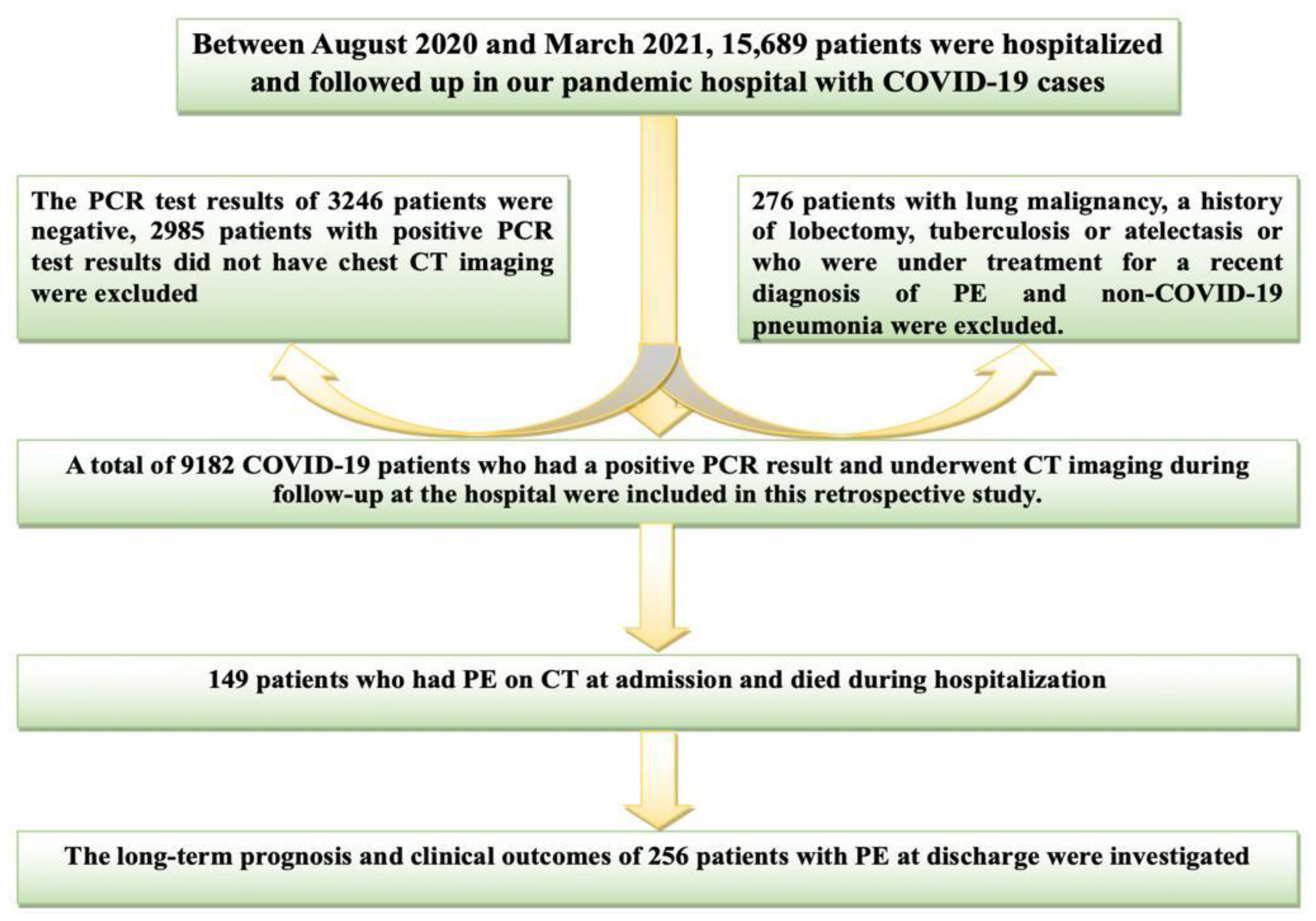
Background: There is limited data in the literature about the clinical importance and prognosis of pericardial effusion (PE) in patients discharged after recovering from COVID-19, but large-scale studies have yet to be available. This study investigated the prevalence, risk factors, prognosis, late clinical outcomes, and management of PE in COVID-19. Materials and Methods: Between August 2020 and March 2021, 15,689 patients were followed up in our pandemic hospital due to COVID-19. Patients with positive polymerase chain reaction (PCR) test results and PE associated with COVID-19 in computed tomography (CT) were included in the study. The patients were divided into three groups according to PE size (mild, moderate, and large). Transthoracic echocardiography (TTE) records, laboratory data, clinical outcomes, and medical treatments of patients discharged from the hospital were retrospectively reviewed. Results: According to the PE size (mild, moderate, large) of 256 patients with PE at admission or discharge, the mean age was 62.17 ± 16.34, 69.12 ± 12.52, and 72.44 ± 15.26, respectively. The mean follow-up period of the patients was 25.2 ± 5.12 months. Of the patients in the study population, 53.5% were in the mild group, 30.4% in the moderate group, and 16.1% in the large group. PE became chronic in a total of 178 (69.6%) patients at the end of the mean three months, and chronicity increased as PE size increased. Despite the different anti-inflammatory treatments for PE in the acute phase, similar chronicity was observed. In addition, as the PE size increased, the patients’ frequency of hospitalization, complications, and mortality rates showed statistical significance between the groups. Conclusions: The clinical prognosis of patients presenting with PE was quite poor; as PE in size increased, cardiac and noncardiac events and mortality rates were significantly higher. Patients with large PE associated with COVID-19 at discharge should be monitored at close intervals due to the chronicity of PE and the increased risk of tamponade.
Keywords: pericardial effusion; prevalence; prognosis; management; COVID-19 pericardial effusion; prevalence; prognosis; management; COVID-19