1. Introduction
Bisphosphonates are the cornerstone of treatment of osteoporosis, with well-established efficacy in reducing fracture risk, particularly in older populations [
1]. However, their use is associated with adverse effects, including oesophageal ulceration and osteonecrosis of the jaw [
2]. Less widely recognised is direct injury to the oral mucosa. Nitrogen-containing bisphosphonates are strongly acidic and chemically caustic in solution; when a tablet is retained in the mouth rather than swallowed promptly with adequate water, prolonged contact produces a chemical burn of the epithelium [
3]. Local inhibition of farnesyl pyrophosphate synthase within keratinocytes is thought to compound this insult by impairing epithelial turnover and delaying repair so that a superficial injury evolves into a persistent ulcer [
4]. Correct administration—an upright posture, a full glass of plain water, and no recumbency or oral intake for the following 60 min—is therefore critical to mitigating these risks [
5].
We present a case of bisphosphonate-induced oral ulceration in a patient with advanced dementia, underscoring the risks associated with impaired administration and highlighting the need for tailored prescribing practices in cognitively impaired populations.
2. Case History
A 73-year-old female nursing home resident was referred to an Irish emergency department with acute oral pain, reduced oral intake and lethargy for 24 h. She had been a resident in the nursing home for two years. Relevant past medical history included advanced vascular dementia, epilepsy and hypothyroidism. She was severely cognitively impaired, with limited verbal fluency. She required full assistance with activities of daily living (washing, dressing, feeding, toileting). Baseline mobility status was supervision with a walking aid. Nursing staff noted the resident had variable engagement with oral care routines. Oral bisphosphonate therapy had been commenced 2 years previously following a diagnosis of osteoporosis on DEXA imaging. She had been prescribed monthly oral ibandronic acid 150 mg for the preceding two years and had taken the most recent dose forty-eight hours prior to symptom onset. Concurrent medication comprised aspirin, bisoprolol, escitalopram, levetiracetam, carbamazepine, eltroxin, triazolam and quetiapine. There was no documented history of methotrexate, nicorandil or regular non-steroidal anti-inflammatory use.
Nursing staff noted frequent resistance to taking medications and difficulty swallowing tablets. A formal swallowing assessment by speech and language therapy services had not occurred during the previous two years. A recorded weight was not documented in nursing transfer or hospital medical notes. The patient was edentulous and did not wear full dentures. She was not known to have xerostomia, although several of her regular medications, including escitalopram, quetiapine and triazolam, carry recognised xerostomic potential. Nursing home staff contacted a family member the day of transfer to the emergency department to advise they had noted a new left-sided facial swelling.
2.1. Clinical Examination
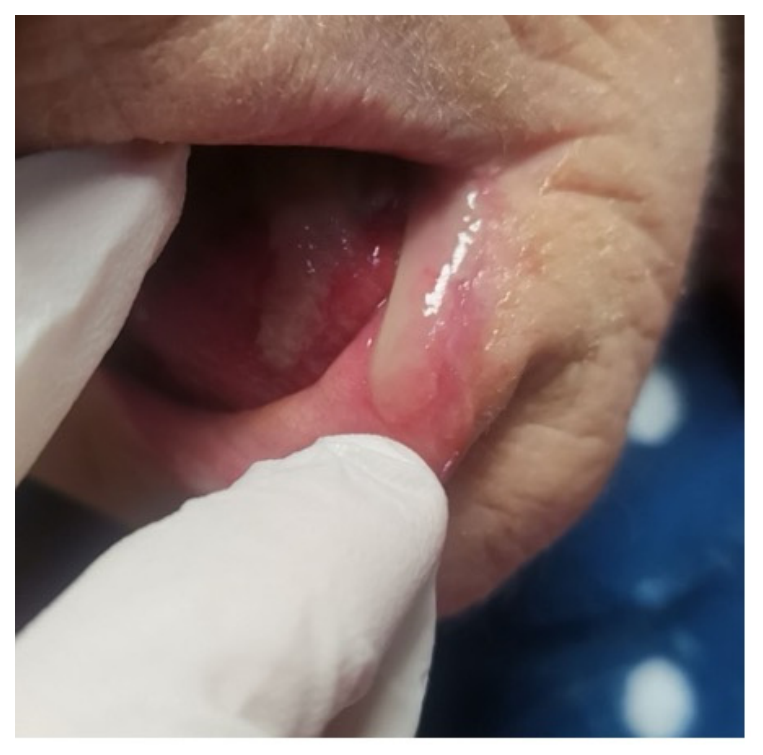
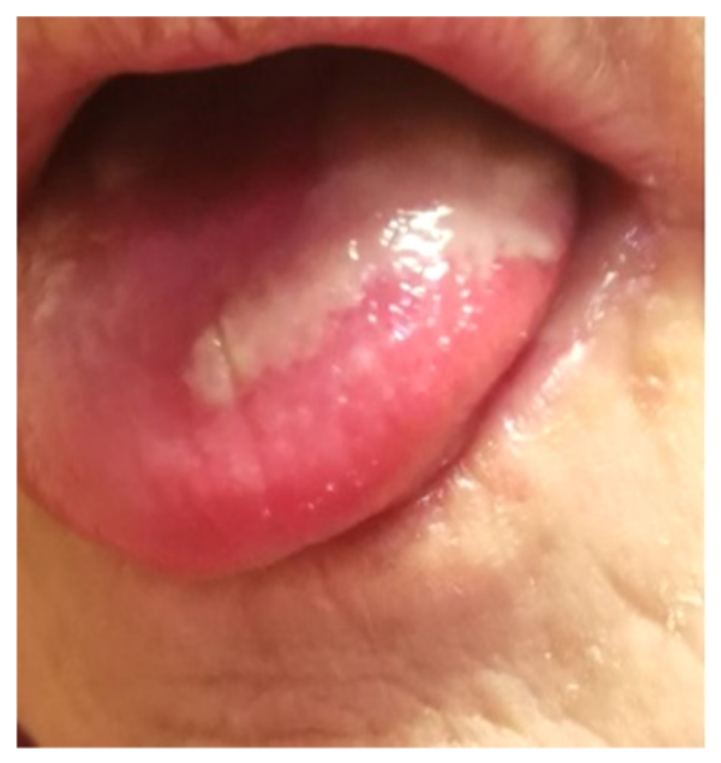
Clinical examination in the emergency department revealed two areas of mucosal ulceration: one involving the left lower lip and another on the left anterior tongue (
Figure 1 and
Figure 2). Mild left lower lip and oral vestibule swelling was present.
The patient indicated she had a painful mouth and was initially reluctant to allow oral examination. No retained food, tablets or retained root fragments were identified. There was no cervical lymphadenopathy, and no extraoral mucosal ulceration or other mucosal involvement was noted. Vital signs were within normal parameters.
2.2. Diagnostic Assessment and Management
Blood results within the previous three months did not indicate anaemia or haematinic deficiency. Plain film X-ray imaging of the jaw demonstrated no evidence of mandibular osteonecrosis, sequestration or other bony abnormality. Assessment was directed at excluding infective, traumatic and neoplastic causes of oral ulceration and whether medication administration had contributed to the lesions. The clinical differential for acute oral ulceration in a frail older adult is broad, and the diagnosis in this case was one of exclusion, supported by a clear temporal relationship to drug administration and by resolution on withdrawal.
Traumatic ulceration was the leading alternative diagnosis, given the patient’s cognitive impairment, dependence for feeding and oral care, and potential for inadvertent mechanical trauma. However, no obvious traumatic source was identified, and the distribution of the lesions, together with the temporal relationship to the recent ibandronate dose, favoured a medication-related process.
Medication-related mucosal disease was considered given the patient’s medication regime. However, there had been no recent medication changes, and there was no documented history of recurrent ulceration associated with her regular medications. A drug-related lichenoid reaction was considered less likely because there were no characteristic reticular mucosal changes.
Vesiculobullous disease, including mucous membrane pemphigoid, pemphigus vulgaris and erosive lichen planus, characteristically produces multifocal, chronic or relapsing disease with desquamative gingivitis and frequently extraoral involvement. This diagnosis was considered unlikely because no vesicles or bullae were identified and there was no involvement of other oral or extraoral mucosal surfaces, and the clinical course was inconsistent with chronic vesiculobullous disease.
Oral malignancy, principally squamous cell carcinoma, was considered because persistent ulceration of the tongue or lip warrants appropriate clinical vigilance. However, the acute onset, absence of induration or cervical lymphadenopathy, temporal relationship with ibandronate administration and complete clinical resolution within three weeks made malignancy unlikely. Biopsy was not undertaken due to the rapid resolution. Persistent or recurrent ulceration would have warranted further investigation, including biopsy where clinically indicated.
Following review by the hospital dental service, the clinical diagnosis was bisphosphonate-associated chemical mucosal injury, most likely resulting from prolonged contact between ibandronic acid and the oral mucosa. The presumed mechanism was retention of the tablet in the setting of advanced cognitive impairment and probable oropharyngeal dysfunction.
The patient had a short inpatient admission under a geriatric medicine team. Ibandronic acid was discontinued. Symptomatic management consisted of benzydamine hydrochloride spray three times a day for two weeks and topical lidocaine-containing mouthwash twice a day for two weeks. At three-week follow-up, the ulcers had resolved, and the patient had resumed an adequate oral intake. No recurrent lesions were reported.
The geriatric medicine team undertook an osteoporosis medication review and implemented an alternative antiresorptive strategy. Denosumab was chosen as the alternative agent, taking into account the patients’ cognitive status, swallowing ability and ability to comply with administration requirements.
3. Discussion
Oral bisphosphonate-associated mucosal ulceration is an uncommon but clinically important adverse effect. It is particularly relevant in older adults who have cognitive impairment, dysphagia or dependence on carers for medication administration.
A scoping review by Psimma et al. [
6] identified 56 reported cases of oral adverse events associated with oral bisphosphonates, comprising 22 case reports, one case series and three reviews. Oral ulceration was the predominant presentation, accounting for approximately 80% of reported mucosal adverse events. Eighty-eight percent of reported patients were women; however, this should not be interpreted as evidence of a biological female predisposition to bisphosphonate-induced mucosal ulceration. The apparent predominance may reflect the epidemiology of osteoporosis and the greater use of oral bisphosphonates among older women [
7]. Importantly, inappropriate administration was considered the most likely cause in more than half of cases, with physical impairment and dysphagia specifically identified as contributors to incorrect administration. The tongue and lower lip were among the most frequently affected sites.
McLean et al. have similarly described severe oral ulceration following incorrect use of alendronate [
8], and Gonzalez-Moles reported patients experiencing chemical burns due to retaining tablets in the mouth [
9].
The present case shares several features with these reports. The patient was an older woman with substantial cognitive impairment, difficulty swallowing tablets and dependence on carers for medication administration. She had received a monthly oral bisphosphonate and developed painful oral ulceration shortly after her most recent dose. The location of the lesions on the lower lip and tongue is also consistent with the distribution reported in the published literature.
The present case differs from many previously reported cases in that the patient was receiving ibandronic acid rather than alendronic acid. The relative paucity of reported ibandronate-associated oral mucosal lesions may reflect the less frequent use of this preparation rather than an absence of risk. Importantly, the current ibandronate product information explicitly states that tablets should be swallowed whole and should not be chewed or sucked because of the potential for oropharyngeal ulceration [
10]. It also recommends that patients remain upright for at least 60 min and advises caution in patients with dysphagia or other upper gastrointestinal disorders. There is insufficient evidence to establish reliable recurrence for oral bisphosphonate-associated ulceration, as the published literature consists predominantly of isolated case reports and small case series [
11]. Clinical review until complete healing is appropriate, particularly when ulceration is associated with pain, dysphagia or reduced oral intake. However, persistent, recurrent or indurated ulceration should prompt reassessment and consideration of further investigation.
The United Kingdom and European osteoporosis guidelines offer general advice to consider alternative treatment options if first-line therapies are unsuitable or not tolerated regarding gastrointestinal side effects, including intravenous therapies or denosumab [
5,
12]. However, neither European nor international guidelines explicitly address swallowing impairment, cognition, or posture in prescribing decisions, meaning there is a gap in the osteoporosis management literature. Oral care researchers have emphasised the crucial role of multidisciplinary collaboration in addressing the oral and swallowing health needs of older adults in care homes. Recent multinational analyses show that coordinated management involving physicians, dentists, speech and language therapists, and nursing staff improves outcomes where oral and systemic health intersect [
13]. Published guidance from the UK Royal College of Speech and Language Therapy highlights various signs and symptoms which suggest a person is having swallowing difficulties, such as coughing or throat clearing after eating or drinking, food staying in the mouth after chewing and declining food and drink [
14]. If noted, the advice is to refer the person for speech and language assessment.
The Health Service Executive (HSE) in Ireland provides public health and social care services, manages hospitals and community care, and implements national health policies. In 2025, the HSE published a guidance document, titled “Supporting Smiles”, on provision of oral care for adults in acute and community care facilities with dementia-specific oral care guidance [
15]. This document is supported by a national staff training programme, led by dental hygienist “champions” in regional centres. UK approaches based on NICE guidance have incorporated oral-health assessment, individualised oral-care plans, staff training, designated oral-health champions and access to dental services [
16]. Australian residential care initiatives have similarly explored structured oral-health assessment and nurse-led individualised oral care planning following staff training [
17].
Our case indicates that it is prudent for healthcare staff supervising adults with dementia to undertake an osteoporosis medication review, particularly if new swallowing issues or retention of food or tablets in oral tissues are noted by carers.
4. Limitations
This is a single case, and causality is inferred from temporal association and resolution on withdrawal rather than a histopathological diagnosis or rechallenge. Some potentially relevant baseline information was unavailable or not documented. The absence of these data limits the generalization of our conclusions to all older adults on oral bisphosphonate therapy.
5. Conclusions
This case highlights important prescribing considerations, namely that an older person’s ability to swallow and safely administer an oral bisphosphonate should be assessed before treatment is initiated and reassessed if cognition, swallowing function or functional status declines.
Amongst older adults who cannot reliably comply with administration requirements, continued prescribing of an oral bisphosphonate may expose them to avoidable mucosal and oesophageal injury. New oral pain, reduced oral intake, unexplained ulceration or facial swelling should prompt an examination of the oral cavity and medication review. In suspected cases of bisphosphonate-associated oral ulceration, withdrawal of therapy should be considered alongside osteoporosis risk assessment. Alternative antiresorptive strategies may be appropriate when oral treatment is impractical.
Medication safety in frail, older adults must encompass not just a drug dose, but the formulation, swallowing ability, cognitive status, patient positioning, supervision and practical ability to administer the drug.
Author Contributions
Conceptualization (K.M., E.M. (Elizabeth Moloney), K.O. and E.M. (Eleanor Marks)); methodology (K.M. and E.M. (Elizabeth Moloney)); software (E.M. (Eleanor Marks)); validation (K.O. and E.M. (Elizabeth Moloney)) writing—original draft preparation (K.M., E.M. (Eleanor Marks) and K.O.); Writing—review and editing (E.M. (Elizabeth Moloney), K.O., K.M. and E.M. (Eleanor Marks)); supervision (E.M. (Elizabeth Moloney) and K.O.). All authors have read and agreed to the published version of the manuscript.
Funding
This research received no external funding.
Institutional Review Board Statement
Ethical review and approval was waived as this was not a clinical research study.
Informed Consent Statement
Written consent was obtained from the guardian in this case for use of images and details. Written informed consent has been obtained from the patient(s) to publish this paper.
Data Availability Statement
The original contributions presented in this study are included in the article. Further inquiries can be directed to the corresponding author.
Acknowledgments
The authors would like to thank the patient and family for their involvement in this case report.
Conflicts of Interest
The authors declare no conflict of interest.
References
- Ullah, M.; Arshad, J.; Anwar, U.; Khan, S.; Amjad, A.; Zeb, A.; Majid, M. Efficacy of Bisphosphonates in Reducing Fracture Risk Among Postmenopausal Women With Osteoporosis. Cureus 2024, 16, e74542. [Google Scholar] [CrossRef] [Scilit] [PubMed] [PubMed Central]
- Diniz-Freitas, M.; Lopez-Cedrun, J.; Fernandez-Sanroman, J.; Garcia-Garcia, A.; Fernandez-Feijoo, J.; Diz-Dios, P. Oral bisphosphonate-related osteonecrosis of the jaws: Clinical characteristics of a series of 20 cases in Spain. Med. Oral Patol. Oral Y Cir. Bucal 2012, 17, e751–e758. [Google Scholar] [CrossRef] [Scilit] [PubMed]
- Landesberg, R.; Cozin, M.; Cremers, S.; Woo, V.; Kousteni, S.; Sinha, S.; Garrett-Sinha, L.; Raghavan, S. Inhibition of Oral Mucosal Cell Wound Healing by Bisphosphonates. J. Oral Maxillofac. Surg. 2008, 66, 839–847. [Google Scholar] [CrossRef] [Scilit] [PubMed]
- Vukelic, S.; Stojadinovic, O.; Pastar, I.; Vouthounis, C.; Krzyzanowska, A.; Das, S.; Samuels, H.H.; Tomic-Canic, M. Farnesyl Pyrophosphate Inhibits Epithelialization and Wound Healing through the Glucocorticoid Receptor. J. Biol. Chem. 2010, 285, 1980–1988. [Google Scholar] [CrossRef] [Scilit] [PubMed]
- Gregson, C.L.; Armstrong, D.J.; Avgerinou, C.; Bowden, J.; Cooper, C.; Douglas, L.; Edwards, J.; Gittoes, N.J.L.; Harvey, N.C.; Kanis, J.A.; et al. The 2024 UK clinical guideline for the prevention and treatment of osteoporosis. Arch. Osteoporos. 2025, 20, 119. [Google Scholar] [CrossRef] [Scilit] [PubMed]
- Psimma, C.; Psimma, Z.; Willems, H.C.; Klüter, W.J.; van der Maarel-Wierink, C.D. Oral bisphosphonates: Adverse effects on the oral mucosa not related to the jaw bones. A scoping review. Gerodontology 2021, 39, 330–338. [Google Scholar] [CrossRef] [Scilit] [PubMed]
- Kirk, J.M.; Rathbun, A.M.; Gruber-Baldini, A.L.; Hochberg, M.C.; Magaziner, J.; Shardell, M.D.; Orwig, D. Sex differences and predictors of anti-osteoporosis medication use in the 12 months after hip fracture surgery in adults 65 or older. Osteoporos. Int. 2024, 35, 1943–1950. [Google Scholar] [CrossRef] [Scilit] [PubMed]
- McLean, S.; Kelly, R.; Rajlawat, B.; Field, A. Alendronic acid-induced oral mucosal ulceration: Two case reports. Oral Surg. 2020, 14, 255–258. [Google Scholar] [CrossRef] [Scilit]
- Gonzalez-Moles, M.A.; Bagan-Sebastian, J.V. Alendronate-related oral mucosa ulcerations. J. Oral Pathol. Med. 2000, 29, 514–518. [Google Scholar] [CrossRef] [Scilit] [PubMed]
- European Medicines Agency. Ibandronic Acid Teva. 2015. Available online: https://www.ema.europa.eu/en/medicines/human/EPAR/ibandronic-acid-teva (accessed on 20 August 2026).
- Kharazmi, M.; Sjöqvist, K.; Warfvinge, G. Oral Ulcers, a Little Known Adverse Effect of Alendronate: Review of the Literature. J. Oral Maxillofac. Surg. 2012, 70, 830–836. [Google Scholar] [CrossRef] [Scilit] [PubMed]
- Kanis, J.A.; Cooper, C.; Rizzoli, R.; Reginster, J.-Y. European Guidance for the Diagnosis and Management of Osteoporosis in Postmenopausal Women. Osteoporos. Int. 2019, 30, 3–44. [Google Scholar] [CrossRef] [PubMed]
- Bellander, L.; Wijk, H.; Andersson, P.; Hägglin, C. Oral health care for frail older adults in nursing homes from a management perspective: A survey-based study. BMC Oral Health 2025, 25, 1903. [Google Scholar] [CrossRef] [Scilit] [PubMed]
- Royal College of Speech and Language Therapy. Dementia Guidance Position Paper. 2024. Available online: https://www.rcslt.org/wp-content/uploads/2024/05/Dementia-guidance_position-paper_2024.pdf (accessed on 20 May 2026).
- Health Service Executive. Health Service Executive National Oral Care Guideline (Supporting Smiles) for Health and Social Care Teams Supporting Daily Oral Care for Adults Who Require Assistance. 2025. Available online: https://www2.healthservice.hse.ie/organisation/national-pppgs/hse-national-oral-care-guideline-supporting-smiles-for-health-and-social-care-teams-supporting-daily-oral-care-for-adults-who-require-assistance/ (accessed on 10 November 2025).
- National Institute of Clinical Excellence (NICE). Oral Health for Adults in Care Homes. 2016. Available online: https://www.nice.org.uk/guidance/ng48 (accessed on 19 August 2026).
- AIHW (Australian Institute of Health and Welfare). Caring for Oral Health in Australian Residential Care. 2009. Available online: https://www.aihw.gov.au/reports/aged-care/caring-for-oral-health-in-australian-residential-c/summary (accessed on 20 August 2026).
| Disclaimer/Publisher’s Note: The statements, opinions and data contained in all publications are solely those of the individual author(s) and contributor(s) and not of MDPI and/or the editor(s). MDPI and/or the editor(s) disclaim responsibility for any injury to people or property resulting from any ideas, methods, instructions or products referred to in the content. |