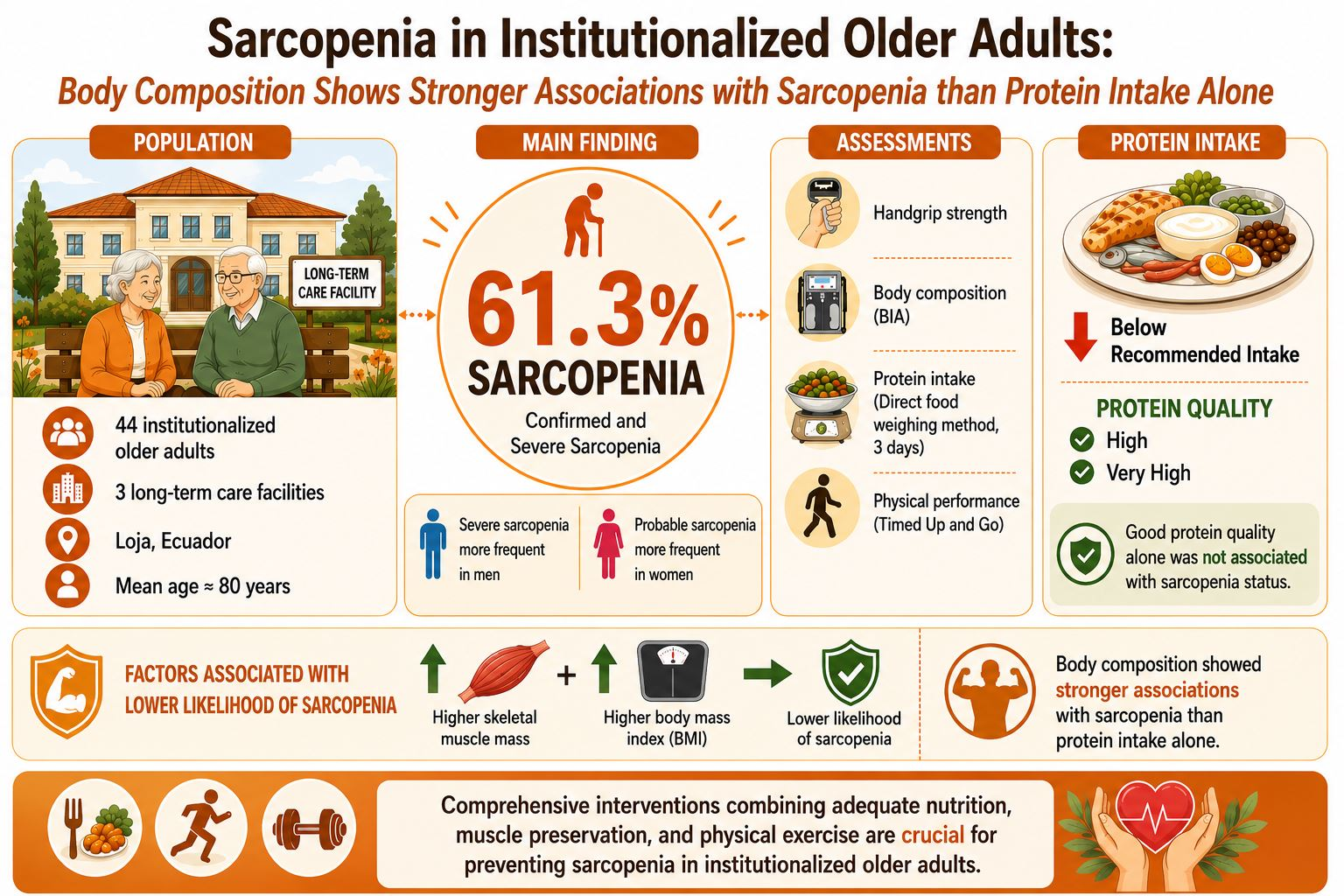

Prevalence of Sarcopenia and Factors Associated with Body Composition and Protein Intake in Institutionalized Older Adults from Three Long-Term Care Facilities in Loja, Ecuador: A Cross-Sectional Study


Abstract
1. Introduction
2. Materials and Methods
2.1. Study Design and Setting
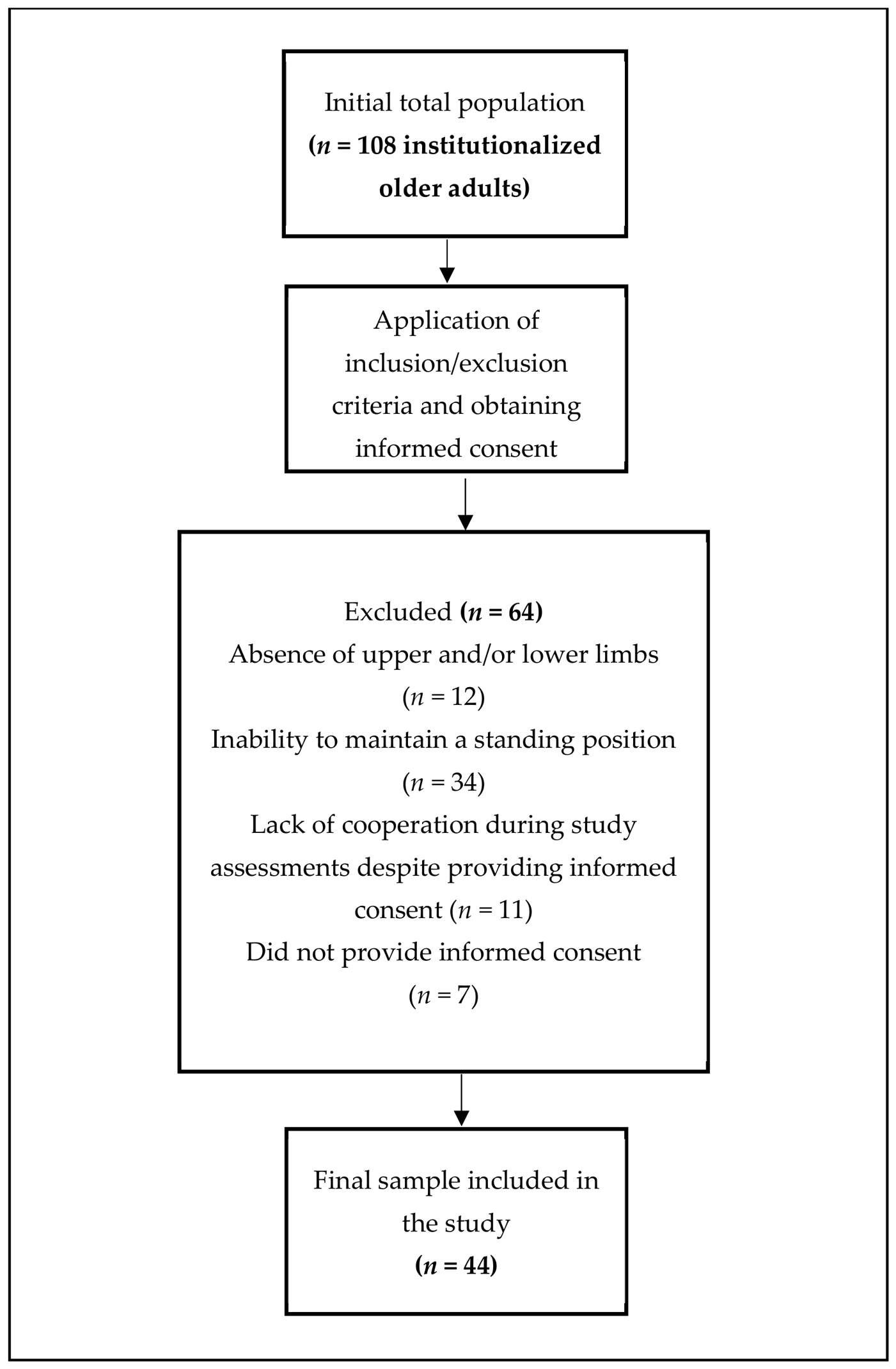
2.2. Study Population and Sample
2.3. Inclusion and Exclusion Criteria
2.4. Variables
- -
- Demographic variables: Age, sex, and educational level.
- -
- Clinical variable: Presence of sarcopenia.
- -
- Functional variables: Muscle strength and physical performance.
- -
- Anthropometric variables: Height, knee height, body weight, body mass index (BMI), appendicular skeletal muscle mass (ASM), ASM adjusted for height squared (ASM/height2 or skeletal muscle index), and body fat mass.
- -
- Nutritional variables: Protein intake (quantity), protein quality (based on biological value), and total daily energy intake.
2.5. Data Collection and Procedures
2.5.1. Sarcopenia Assessment
- -
- Probable sarcopenia: Low handgrip strength (<27 kg in men, <16 kg in women).
- -
- Confirmed sarcopenia: Low muscle strength plus low muscle mass (ASM/height2 <7 kg/m2 in men, <5.5 kg/m2 in women).
- -
2.5.2. Muscle Strength Assessment
2.5.3. Body Composition Assessment
2.5.4. Physical Performance Assessment
2.5.5. Protein Intake Assessment
2.5.6. Protein Quality Assessment
2.6. Statistical Analysis
3. Results
3.1. Participant Characteristics
3.2. Prevalence of Sarcopenia
3.3. Comparison According to Sarcopenia Status in Men
3.4. Comparison According to Sarcopenia Status in Women
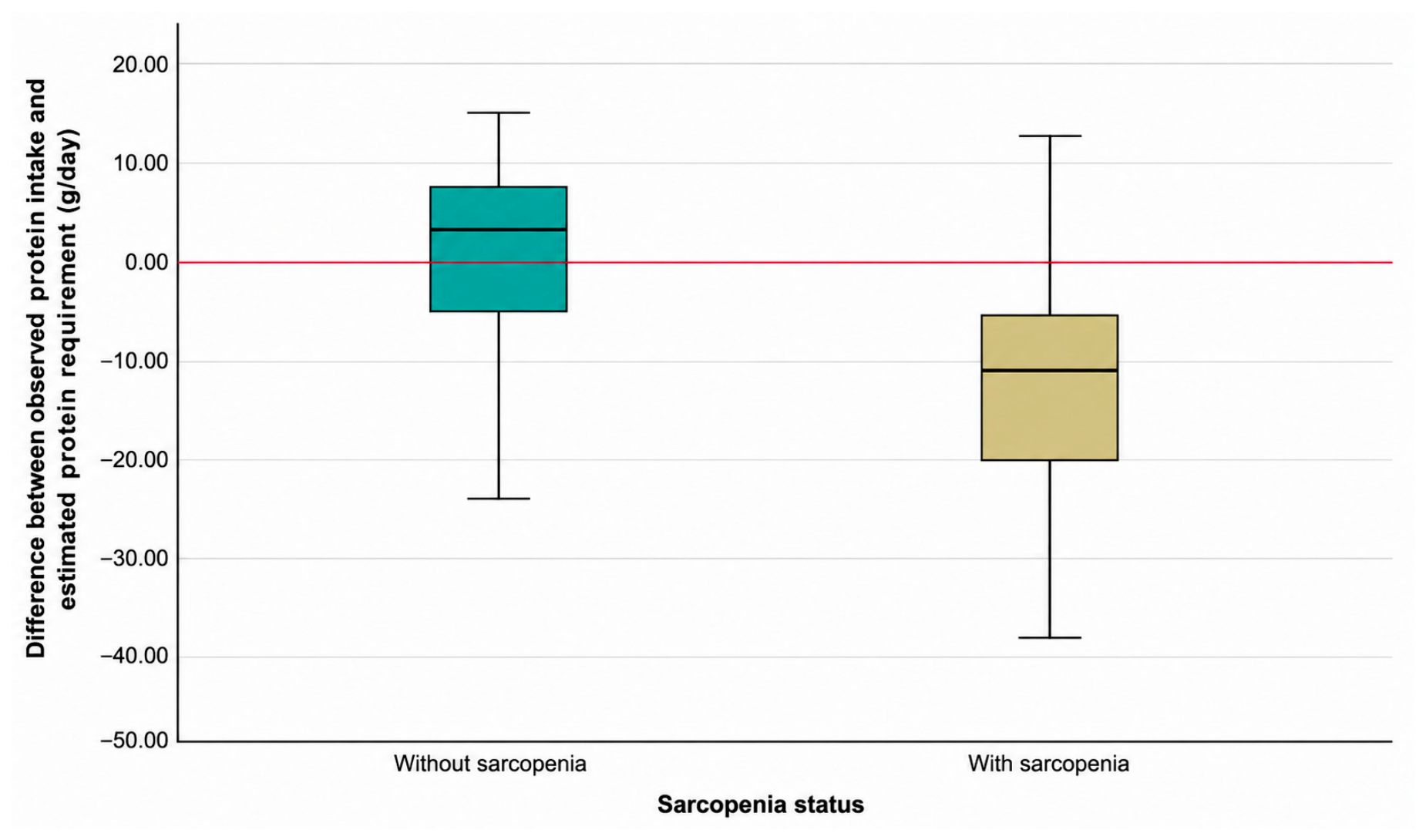
3.5. Protein Intake According to Sarcopenia Status
3.6. Factors Associated with Sarcopenia
4. Discussion
Limitations and Strengths
5. Conclusions
Author Contributions
Funding
Institutional Review Board Statement
Informed Consent Statement
Data Availability Statement
Acknowledgments
Conflicts of Interest
References
- Chew, S.; Tey, S.; Yalawar, M.; Liu, Z.; Baggs, G.; How, C.; Cheong, M.; Chow, W.L.; Low, Y.L.; Huynh, D.T.T.; et al. Prevalence and associated factors of sarcopenia in community-dwelling older adults at risk of malnutrition. BMC Geriatr. 2022, 22, 997. [Google Scholar] [CrossRef] [Scilit]
- Yuan, S.; Larsson, S. Epidemiology of sarcopenia: Prevalence, risk factors, and consequences. Metabolism 2023, 144, 155533. [Google Scholar] [CrossRef] [Scilit]
- Ramos, M.; Guevara, M. Importancia nutricional en el manejo de sarcopenia en adultos mayores. Rev. Vive 2023, 14, 337–353. [Google Scholar] [CrossRef] [Scilit]
- Qiu, W.; Cai, A.; Li, L.; Feng, Y. Trend in prevalence, associated risk factors, and longitudinal outcomes of sarcopenia in China: A national cohort study. J. Intern. Med. 2024, 296, 156–167. [Google Scholar] [CrossRef] [Scilit]
- Stoodley, I.; Berthon, B.; Scott, H.; Williams, E.; Baines, P.; Knox, H.; Wood, S.; Paradzayi, B.; Cameron-Smith, D.; Wood, L.G. Protein Intake and Physical Activity Levels as Determinants of Sarcopenia Risk in Community-Dwelling Older Adults. Nutrients 2024, 16, 1380. [Google Scholar] [CrossRef] [Scilit]
- Granic, A.; Sayer, A.; Cooper, R.; Sian, R. Nutrition in the prevention and treatment of skeletal muscle ageing and sarcopenia: A single nutrient, a whole food and a whole diet approach. Proc. Nutr. Soc. 2025, 84, 340–355. [Google Scholar] [CrossRef] [Scilit]
- Zeng, Y.; He, X.; Peng, X.; Zhao, L.; Yin, C.; Mao, S. Combined Nutrition with Exercise: Fueling the Fight Against Sarcopenia Through a Bibliometric Analysis and Review. Int. J. Gen. Med. 2024, 3, 1861–1876. [Google Scholar] [CrossRef] [Scilit]
- Raymond, J.; Morrow, K. Krause. Mahan. Dietoterapia, 15th ed.; Elsevier: Amsterdam, The Netherlands, 2021. [Google Scholar]
- Murphy, C.; McCarthy, S.; Roche, H. Nutrition strategies to counteract sarcopenia: A focus on protein, LC n-3 PUFA and precision nutrition. Proc. Nutr. Soc. 2023, 82, 419–431. [Google Scholar] [CrossRef] [Scilit]
- Campbell, W.; Deutz, N.; Volpi, E.; Apovian, C. Nutritional Interventions: Dietary Protein Needs and Influences on Skeletal Muscle of Older Adults. J. Gerontol. A Biol. Sci. Med. Sci. 2023, 16, 67–72. [Google Scholar] [CrossRef] [Scilit]
- Sánchez, L.; Miranda, B.; Gracia, C.; Peñarranda, A.; Mas, S.; López, A.; Villoria-González, S.; Pereira-García, M.; Ortiz, A.; González-Parra, E. Sarcopenia evaluada mediante EWGSOP2 de 4 pasos en pacientes ancianos en hemodiálisis: Viabilidad y limitaciones. PLoS ONE 2022, 17, e0261459. [Google Scholar] [CrossRef] [Scilit]
- Benz, E.; Pinel, A.; Guillet, C.; Capel, F.; Pereira, B.; De Antonio, M.; Pouget, M.; Cruz-Jentoft, A.J.; Eglseer, D.; Topinkova, E.; et al. Sarcopenia y obesidad sarcopénica y mortalidad en personas mayores. JAMA Netw. Open 2024, 7, e243604. [Google Scholar] [CrossRef] [Scilit]
- Cruz, A.; Bahat, G.; Bauer, J.; Boirie, Y.; Bruyère, O.; Cederholm, T.; Cooper, C.; Landi, F.; Rolland, Y.; Sayer, A.A.; et al. Sarcopenia: Revised European consensus on definition and diagnosis. Age Ageing 2019, 48, 16–31, Erratum in Age Ageing 2019, 48, 601. https://doi.org/10.1093/ageing/afz046. [Google Scholar] [CrossRef] [Scilit]
- Dupertuis, Y.; Jimaja, W.; Beardsley, C.; Genton, L. Instrumentos de análisis de impedancia bioeléctrica: ¿en qué se diferencian, qué necesitamos para la evaluación clínica? Curr. Opin. Clin. Nutr. Metab. Care 2025, 28, 379–387. [Google Scholar] [CrossRef] [Scilit]
- Koo, B.K. Assessment of Muscle Quantity, Quality and Function. J. Obes. Metab. Syndr. 2022, 31, 9. [Google Scholar] [CrossRef] [Scilit] [PubMed]
- Navarro, K.H. Alimentación: Estrategias de evaluación. In El ABCD de la Evaluación del Estado de Nutrición, 2nd ed.; Fernández, A., Navarro, K., Eds.; McGrawHill: Columbus, OH, USA, 2023; pp. 225–251. [Google Scholar]
- Carbajal, Á. Universidad Complutense De Madrid. Manual De Nutrición y Dietética. 2013. Available online: https://www.ucm.es/nutricioncarbajal/ (accessed on 28 May 2024).
- Liu, J.; Zhu, Y.; Tan, J.; Hasra, A.; Haty, N.; Ibrahim, R. Factors Associated with Sarcopenia among Elderly Individuals Residing in Community and Nursing Home Settings: A Systematic Review with a Meta-Analysis. Nutrients 2023, 15, 4335. [Google Scholar] [CrossRef] [Scilit]
- Papadopoulou, S.K.; Tsintavis, P.; Potsaki, G.; Papandreou, D. Differences in the Prevalence of Sarcopenia in Community-Dwelling, Nursing Home and Hospitalized Individuals. A Systematic Review and Meta-Analysis. J. Nutr. Health Aging 2020, 24, 83–90. [Google Scholar] [CrossRef] [Scilit]
- Tasar, P.T.; Sahin, S.; Karaman, E.; Ulusoy, M.G.; Duman, S.; Berdeli, A.; Akcicek, F. Prevalence and risk factors of sarcopenia in elderly nursing home residents. Eur. Geriatr. Med. 2015, 6, 214–219. [Google Scholar] [CrossRef] [Scilit]
- Rodríguez-Rejón, A.I.; Ruiz-López, M.D.; Wanden-Berghe, C.; Artacho, R. Prevalence and Diagnosis of Sarcopenia in Residential Facilities: A Systematic Review. Adv. Nutr. 2019, 10, 51–58. [Google Scholar] [CrossRef] [Scilit]
- Petermann-Rocha, F.; Balntzi, V.; Gray, S.R.; Lara, J.; Ho, F.K.; Pell, J.P.; Celis-Morales, C. Global prevalence of sarcopenia and severe sarcopenia: A systematic review and meta-analysis. J. Cachexia Sarcopenia Muscle 2022, 13, 86–99. [Google Scholar] [CrossRef] [Scilit] [PubMed]
- Escribà-Salvans, A.; Jerez-Roig, J.; Molas-Tuneu, M.; Farrés-Godayol, P.; Moreno-Martin, P.; Goutan-Roura, E.; Güell-Masramon, H.; Amblàs-Novellas, J.; de Souza, D.L.B.; Skelton, D.A.; et al. Sarcopenia and associated factors according to the EWGSOP2 criteria in older people living in nursing homes: A cross-sectional study. BMC Geriatr. 2022, 22, 350. [Google Scholar] [CrossRef] [Scilit]
- Bravo-José, P.; Moreno, E.; Espert, M.; Romeu, M.; Martínez, P.; Navarro, C. Prevalence of sarcopenia and associated factors in institutionalised older adult patients. Clin. Nutr. ESPEN 2018, 27, 113–119, Erratum in Clin. Nutr. ESPEN 2021, 42, 416. https://doi.org/10.1016/j.clnesp.2021.01.001. [Google Scholar] [CrossRef] [Scilit]
- Riviati, N.; Indra, B. Relationship between muscle mass and muscle strength with physical performance in older adults: A systematic review. SAGE Open Med. 2023, 11, 20503121231214650. [Google Scholar] [CrossRef] [Scilit]
- Fernández, V.; Domínguez, E.; Vázquez, B.; Acosta, A.; Díaz, C.; Navarro, D. Sarcopenia y factores relacionados en mujeres mayores de 40 años. Rev. Cuba. Endocrinol. 2021, 31, 1–11. [Google Scholar]
- Coelho-Junior, H.; Calvani, R.; Azzolino, D.; Picca, A.; Tosato, M.; Landi, F.; Cesari, M.; Marzetti, E. Protein Intake and Sarcopenia in Older Adults: A Systematic Review and Meta-Analysis. Int. J. Environ. Res. Public Health 2022, 19, 8718. [Google Scholar] [CrossRef] [Scilit]
- Han, M.; Woo, K.; Kim, K. Association of Protein Intake with Sarcopenia and Related Indicators Among Korean Older Adults: A Systematic Review and Meta-Analysis. Nutrients 2024, 16, 4350. [Google Scholar] [CrossRef] [Scilit]
- Taylor, K.; Shaw, N.; Long, S.; Dholakia, R.; Badakhshan, U.; Nassrallah, A.; Adesuyi, T.; Hope, S.; Goodwin, V. Determinantes modificables del consumo de proteínas en adultos mayores que viven en la comunidad: Una revisión sistemática. Proc. Nutr. Soc. 2025, 84, E312. [Google Scholar] [CrossRef] [Scilit]
- Phillips, S.M.; Martinson, W. Nutrient-rich, high-quality, protein-containing dairy foods in combination with exercise in aging persons to mitigate sarcopenia. Nutr. Rev. 2018, 77, 216–229. [Google Scholar] [CrossRef] [Scilit]
- Millan-Domingo, F.; Garcia-Dominguez, E.; Gambini, J.; Olaso-Gonzalez, G.; Viña, J.; Gomez-Cabrera, M.C. Diet and exercise in frailty and sarcopenia. Molecular aspects. Mol. Asp. Med. 2024, 100, 101322. [Google Scholar] [CrossRef] [Scilit]
- Hou, V.; Madden, K. Assessing the Effects of Dietary Protein Supplementation on Sarcopenia in Community-Dwelling Older Adults. Can. Geriatr. J. 2022, 25, 390–403. [Google Scholar] [CrossRef] [Scilit]
- Cailleaux, P.E.; Déchelotte, P.; Coëffier, M. Novel dietary strategies to manage sarcopenia. Curr. Opin. Clin. Nutr. Metab. Care 2024, 27, 234–243. [Google Scholar] [CrossRef] [Scilit]
- Wu, X.; Li, X.; Xu, M.; Zhang, Z.; He, L.; Li, Y. Sarcopenia prevalence and associated factors among older Chinese population: Findings from the China Health and Retirement Longitudinal Study. PLoS ONE 2021, 16, e0247617. [Google Scholar] [CrossRef] [Scilit]
- Escamilla Rosales, M.F.; Ariza Ortega, J.A.; Cruz Cansino Ndel, S.; Ramírez Moreno, E. Efecto del tratamiento no farmacológico en adultos mayores con sarcopenia. Educ. Salud Bol. Científico Inst. Cienc. Salud Univ. Autónoma Estado Hidalgo 2022, 10, 188–196. [Google Scholar] [CrossRef] [Scilit]
- Calderón, P.; Jima Gavilanes, D.; Vivanco-Zárate, A.S.; Sarango-González, K.P. The role of protein quality and amino acid composition in preventing sarcopenia and functional decline in older adults. Front. Nutr. 2026, 13, 1817891. [Google Scholar] [CrossRef] [Scilit]
- Veronese, N.; Maggi, S.; Noale, M.; De Rui, M.; Bolzetta, F.; Zambon, S.; Corti, M.C.; Sartori, L.; Musacchio, E.; Baggio, G.; et al. Serum 25-Hydroxyvitamin D and Osteoarthritis in Older People: The Progetto Veneto Anziani Study. Rejuvenation Res. 2015, 18, 543–553. [Google Scholar] [CrossRef] [Scilit]



| Variable | Category/Statistic | Sex | p-Value | |
|---|---|---|---|---|
| Men n (17) | Women n (27) | |||
| Sociodemographic indicators | ||||
| Age (years) | Mean (SD) | 80.35 (7.74) | 79.96 (8.95) | 0.883 |
| Education level | No formal education F (%) | 5 (29.4%) | 3 (11.1%) | 0.007 |
| Primary education F (%) | 7 (41.2%) | 4 (14.8%) | ||
| Secondary education F (%) | 2 (11.8%) | 3 (11.1%) | ||
| Higher education F (%) | 3 (17.6%) | 3 (11.1%) | ||
| Unknown F (%) | 0 (0.0%) | 14 (51.9%) | ||
| Body composition indicators | ||||
| BMI (kg/m2) | Men (SD) | 25.21 (3.16) | 26.11 (4.89) | 0.503 |
| Skeletal muscle mass (kg) | Men (SD) | 23.28 (3.31) | 16.19 (2.92) | <0.001 |
| Skeletal muscle index (kg/m2) | Men (SD) | 6.49 (0.72) | 5.58 (1.17) | 0.006 |
| Body fat mass (kg) | Men (SD) | 20.07 (7.60) | 19.37 (7.67) | 0.771 |
| Functional capacity indicators | ||||
| Muscle strength (kg) | Men (SD) | 14.09 (6.75) | 9.55 (5.05) | 0.015 |
| Physical performance (s) | Men (SD) | 26.41 (16.64) | 30.57 (21.41) | 0.500 |
| Dietary intake indicators | ||||
| Energy intake | Hypocaloric F (%) | 0 (0.0%) | 0 (0.0%) | 0.005 |
| Normocaloric F (%) | 6 (35.3%) | 1 (3.7%) | ||
| Hypercaloric F (%) | 11 (64.7%) | 26 (96.3%) | ||
| Protein intake | Low protein intake F (%) | 13 (76.5%) | 15 (55.6%) | 0.057 |
| Adequate protein intake F (%) | 3 (17.6%) | 2 (7.4%) | ||
| High protein intake F (%) | 1 (5.9%) | 10 (37.0%) | ||
| Protein quality | Moderate-quality F (%) | 1 (5.9%) | 9 (33.3%) | 0.056 |
| High-quality F (%) | 11 (64.7%) | 9 (33.3%) | ||
| Very-high-quality F (%) | 5 (29.4%) | 9 (33.3%) | ||
| Sarcopenia | ||||||
|---|---|---|---|---|---|---|
| Probable Sarcopenia | Confirmed Sarcopenia | Severe Sarcopenia | No Sarcopenia | p-Value | ||
| Sex | Men F (%) | 5 (29.4%) | 3 (17.6%) | 8 (47.1%) | 1 (5.9%) | 0.508 |
| Women F (%) | 11 (40.7%) | 7 (25.9%) | 9 (33.3%) | 0 (0.0%) | ||
| Total | F (%) | 16 (36.4%) | 10 (22.7%) | 17 (38.6%) | 1 (2.3%) | |
| Sarcopenia | ||||||
|---|---|---|---|---|---|---|
| No Sarcopenia | Sarcopenia | Mean Difference | p-Value | Hedges’ g | ||
| Sociodemographic indicator | ||||||
| Age (years) | Mean (SD) | 79.83 (8.49) | 80.64 (7.72) | −0.803 | 0.846 | −0.095 |
| Body composition indicators | ||||||
| BMI (kg/m2) | Mean (SD) | 26.31 (3.78) | 24.60 (2.77) | 1.707 | 0.302 | 0.514 |
| Skeletal muscle mass (kg) | Mean (SD) | 26.61 (2.85) | 21.46 (1.79) | 5.153 | <0.001 | 2.222 |
| Skeletal muscle index (kg/m2) | Mean (SD) | 7.19 (0.53) | 6.12 (0.50) | 1.068 | 0.001 | 1.982 |
| Body fat mass (kg) | Mean (SD) | 21.03 (9.43) | 19.54 (6.87) | 1.487 | 0.713 | 0.181 |
| Functional capacity indicators | ||||||
| Muscle strength (kg) | Mean (SD) | 18.61 (7.09) | 11.62 (5.38) | 6.989 | 0.037 | 1.104 |
| Physical performance (s) | Mean (SD) | 17.98 (11.76) | 31.00 (17.56) | −13.021 | 0.127 | −0.779 |
| Protein intake indicators | ||||||
| Protein intake (g/day) | Mean (SD) | 66.87 (12.52) | 66.17 (10.43) | 0.696 | 0.904 | 0.059 |
| Recommended protein requirement (g/day) | Mean (SD) | 72.63 (6.32) | 87.67(6.95) | −15.027 | 0.001 | −2.112 |
| Protein adequacy (%) | Mean (SD) | 92.58 (18.33) | 76.14 (14.37) | 16.443 | 0.058 | 0.987 |
| Protein quality | Moderate-quality F (%) | 0 (0.00) | 1 (5.88) | 0.599 | 0.741 | |
| High-quality F (%) | 4 (23.53) | 7 (41.18) | ||||
| Very-high-quality F (%) | 2 (11.76) | 3 (17.65) | ||||
| Sarcopenia | ||||||
|---|---|---|---|---|---|---|
| No Sarcopenia | Sarcopenia | Mean Difference | p-Value | Hedges’ g | ||
| Sociodemographic indicator | ||||||
| Age (years) | Mean (SD) | 78.45 (9.44) | 81.00 (8.75) | −2.545 | 0.479 | −0.273 |
| Body composition indicators | ||||||
| BMI (kg/m2) | Mean (SD) | 29.58 (4.47) | 23.73 (3.64) | 5.850 | 0.001 | 1.419 |
| Skeletal muscle mass (kg) | Mean (SD) | 18.23 (2.40) | 14.78 (2.41) | 3.448 | 0.001 | 1.386 |
| Skeletal muscle index (kg/m2) | Mean (SD) | 6.62 (0.74) | 4.87 (0.83) | 1.750 | <0.001 | 2.123 |
| Body fat mass (kg) | Mean (SD) | 23.94 (8.83) | 16.23 (4.90) | 7.707 | 0.007 | 1.106 |
| Functional capacity indicators | ||||||
| Muscle strength (kg) | Mean (SD) | 10.30 (6.51) | 9.04 (3,90) | 1.265 | 0.533 | 0.240 |
| Physical performance (s) | Mean (SD) | 29.48 (25.67) | 31.31 (18.81) | −1.834 | 0.832 | −0.082 |
| Protein intake indicators | ||||||
| Protein intake (g/day) | Mean (SD) | 60.16 (11.60) | 57.32 (6.95) | −8.420 | 0.470 | 0.303 |
| Recommended protein requirement (g/day) | Mean (SD) | 57.42 (6.39) | 65.26 (9.49) | −7.841 | 0.025 | −0.906 |
| Protein adequacy (%) | Mean (SD) | 104.69 (15.90) | 89.60 (17.30) | 15.096 | 0.030 | 0.873 |
| Protein quality | Moderate-quality F (%) | 5 (18.50) | 4 (14.80) | 1.227 | 0.541 | |
| High-quality F (%) | 3 (11.10) | 6 (22.20) | ||||
| Very-high-quality F (%) | 3 (11.10) | 6 (22.20) | ||||
| 95% CI | 95% CI | |||||||
|---|---|---|---|---|---|---|---|---|
| Crude OR | p-Value | Lower | Upper | Adjusted OR | p-Value | Lower | Upper | |
| Age (years) | 1.028 | 0.461 | 0.954 | 1.108 | 1.006 | 0.911 | 0.903 | 1.121 |
| Skeletal muscle mass (kg) | 0.365 | 0.017 | 0.160 | 0.833 | 0.771 | 0.017 | 0.622 | 0.954 |
| BMI (kg/m2) | 0.229 | 0.010 | 0.075 | 0.706 | 0.684 | 0.008 | 0.517 | 0.907 |
| Protein quality | 0.000 | 0.043 | 0.000 | 0.788 | 2.153 | 0.260 | 0.567 | 8.177 |
Disclaimer/Publisher’s Note: The statements, opinions and data contained in all publications are solely those of the individual author(s) and contributor(s) and not of MDPI and/or the editor(s). MDPI and/or the editor(s) disclaim responsibility for any injury to people or property resulting from any ideas, methods, instructions or products referred to in the content. |
© 2026 by the authors. Licensee MDPI, Basel, Switzerland. This article is an open access article distributed under the terms and conditions of the Creative Commons Attribution (CC BY) license.
Share and Cite
Vivanco-Zárate, A.S.; Sánchez-Sánchez, M.J.; Bautista-Valarezo, E. Prevalence of Sarcopenia and Factors Associated with Body Composition and Protein Intake in Institutionalized Older Adults from Three Long-Term Care Facilities in Loja, Ecuador: A Cross-Sectional Study. Geriatrics 2026, 11, 115. https://doi.org/10.3390/geriatrics11050115
Vivanco-Zárate AS, Sánchez-Sánchez MJ, Bautista-Valarezo E. Prevalence of Sarcopenia and Factors Associated with Body Composition and Protein Intake in Institutionalized Older Adults from Three Long-Term Care Facilities in Loja, Ecuador: A Cross-Sectional Study. Geriatrics. 2026; 11(5):115. https://doi.org/10.3390/geriatrics11050115
Chicago/Turabian StyleVivanco-Zárate, Ana Sofía, Mateo Julián Sánchez-Sánchez, and Estefanía Bautista-Valarezo. 2026. "Prevalence of Sarcopenia and Factors Associated with Body Composition and Protein Intake in Institutionalized Older Adults from Three Long-Term Care Facilities in Loja, Ecuador: A Cross-Sectional Study" Geriatrics 11, no. 5: 115. https://doi.org/10.3390/geriatrics11050115
APA StyleVivanco-Zárate, A. S., Sánchez-Sánchez, M. J., & Bautista-Valarezo, E. (2026). Prevalence of Sarcopenia and Factors Associated with Body Composition and Protein Intake in Institutionalized Older Adults from Three Long-Term Care Facilities in Loja, Ecuador: A Cross-Sectional Study. Geriatrics, 11(5), 115. https://doi.org/10.3390/geriatrics11050115