
Frailty, Sarcopenia, and Cognitive Risk in Senior Living Communities: Associations with Relocation Reasons and Fitness Amenity Utilization

 , , and
Abstract
1. Introduction
2. Methods
2.1. Design and Participant Recruitment
2.2. Survey Description
2.3. Data Analysis
3. Results
3.1. Push and Pull Factors for Relocation
3.2. Physical Activity and Fitness Amenity Use
3.3. Frailty, Sarcopenia, and Cognitive Function
4. Discussion
5. Limitations
6. Conclusions
Author Contributions
Funding
Institutional Review Board Statement
Informed Consent Statement
Data Availability Statement
Acknowledgments
Conflicts of Interest
References
- Li, S.; Hu, W.; Guo, F. Recent relocation patterns among older adults in the United States: Who, why, and where. J. Am. Plan. Assoc. 2022, 88, 15–29. [Google Scholar] [CrossRef]
- Glass, A.P.; Skinner, J. Retirement communities: We know what they are … or do we? J. Hous. Elder. 2013, 27, 61–88. [Google Scholar] [CrossRef]
- The National Investment Center for Seniors Housing & Care. Occupancy Rate for Senior Living Communities Increased in 2025 as Construction Stalled. 2026. Available online: https://www.nic.org/news-press/occupancy-rate-for-senior-living-communities-increased-in-2025-as-construction-stalled/ (accessed on 22 March 2026).
- Bekhet, A.K.; Zauszniewski, J.A.; Nakhla, W.E. Reasons for relocation to retirement communities: A qualitative study. West. J. Nurs. Res. 2009, 31, 462–479. [Google Scholar] [CrossRef]
- Chaulagain, S.; Pizam, A.; Wang, Y.; Severt, D.; Oetjen, R. Factors affecting seniors’ decision to relocate to senior living communities. Int. J. Hosp. Manag. 2021, 95, 102920. [Google Scholar] [CrossRef]
- Franco, B.B.; Randle, J.; Crutchlow, L.; Heng, J.; Afzal, A.; Heckman, G.A.; Boscart, V. Push and pull factors surrounding older adults’ relocation to supportive housing: A scoping review. Can. J. Aging Rev. Can. Vieil. 2021, 40, 263–281. [Google Scholar] [CrossRef] [PubMed]
- Lebrusán, I.; Gómez, M.V. The importance of place attachment in the understanding of ageing in place: “The stones know me”. Int. J. Environ. Res. Public Health 2022, 19, 17052. [Google Scholar] [CrossRef] [PubMed]
- Oswald, F.; Wahl, H.W. Dimensions of the meaning of home in later life. In Home and Identity in Late Life: International Perspectives; Rowles, G.D., Chaudhury, H., Eds.; Springer: New York, NY, USA, 2005; pp. 21–45. [Google Scholar]
- Krout, J.A.; Moen, P.; Holmes, H.H.; Oggins, J.; Bowen, N. Reasons for relocation to a continuing care retirement community. J. Appl. Gerontol. 2002, 21, 236–256. [Google Scholar] [CrossRef]
- Stoeckel, K.J.; Porell, F. Do older adults anticipate relocating?: The relationship between housing relocation expectations and falls. J. Appl. Gerontol. 2010, 29, 231–250. [Google Scholar] [CrossRef]
- Shinan-Altman, S.; Gum, A.M.; Ayalon, L. Moving to a continuing care retirement community or staying in the community? A comparison between American and Israeli older adults. J. Appl. Gerontol. 2020, 39, 1221–1229. [Google Scholar] [CrossRef] [PubMed]
- Jensen-Battaglia, M.; Loh, K.P.; Wang, Y.; Block, R.C.; Mohile, S.G.; Agree, E.M.; Seplaki, C.L. Residential relocation of community-dwelling older adults: The role of physical function and the housing environment. J. Aging Health 2025, 37, 654–668. [Google Scholar] [CrossRef] [PubMed]
- Cobden, J.; de Noronha, M.; Kingsley, M. Prevalence of frailty and mobility disability in older people living in retirement villages. Australas. J. Ageing 2022, 41, 222–228. [Google Scholar] [CrossRef] [PubMed]
- Hunt, D.; Gropper, S.; Miller, K.; Tymczyszyn, B.; Chapa, D. Prevalence of older adults with low muscle mass living in a residential continuing care retirement community in Florida. Clin. Nurs. Stud. 2018, 7, 83. [Google Scholar] [CrossRef]
- Van Patten, R.; Mahmood, Z.; Nguyen, T.T.; Maye, J.E.; Kim, H.C.; Jeste, D.V.; Twamley, E.W. Rates of cognitive and functional impairments in older adults residing in a continuing care senior housing community. J. Int. Neuropsychol. Soc. 2022, 28, 62–73. [Google Scholar] [CrossRef] [PubMed] [PubMed Central]
- Harvey, J.A.; Chastin, S.F.M.; Skelton, D.A. How sedentary are older people? A systematic review of the amount of sedentary behavior. J. Aging Phys. Act. 2015, 23, 471–487. [Google Scholar] [CrossRef] [PubMed]
- Matthews, C.E.; Chen, K.Y.; Freedson, P.S.; Buchowski, M.S.; Beech, B.M.; Pate, R.R.; Troiano, R.P. Amount of time spent in sedentary behaviors in the United States, 2003–2004. Am. J. Epidemiol. 2008, 167, 875–881. [Google Scholar] [CrossRef] [PubMed] [PubMed Central]
- Sebastião, E.; Pak, J.; Benner, D.; Nakamura, P.M.; Papini, C.B. Magnitude and composition of sedentary behavior in older adults living in a retirement community. J. Community Health 2019, 44, 805–814. [Google Scholar] [CrossRef] [PubMed]
- Rosenberg, D.E.; Bellettiere, J.; Gardiner, P.A.; Villarreal, V.N.; Crist, K.; Kerr, J. Independent associations between sedentary behaviors and mental, cognitive, physical, and functional health among older adults in retirement communities. J. Gerontol. Ser. A 2016, 71, 78–83. [Google Scholar] [CrossRef] [PubMed]
- Sebastião, E.; Henert, S.; Siqueira, V.A.A.A. Physical activity and physical function in older adults living in a retirement community: A cross-sectional analysis focusing on self-rated health. Am. J. Lifestyle Med. 2021, 15, 279–285. [Google Scholar] [CrossRef] [PubMed]
- Raichlen, D.A.; Aslan, D.H.; Sayre, M.K.; Bharadwaj, P.K.; Ally, M.; Maltagliati, S.; Lai, M.H.C.; Wilcox, R.R.; Klimentidis, Y.C.; Alexander, G.E. Sedentary behavior and incident dementia among older adults. JAMA 2023, 330, 934–940. [Google Scholar] [CrossRef] [PubMed]
- Coelho, L.; Hauck, K.; McKenzie, K.; Copeland, J.L.; Kan, I.P.; Gibb, R.L.; Gonzalez, C.L.R. The association between sedentary behavior and cognitive ability in older adults. Aging Clin. Exp. Res. 2020, 32, 2339–2347. [Google Scholar] [CrossRef] [PubMed]
- Gobbens, R.J.; Uchmanowicz, I. Assessing frailty with the Tilburg Frailty Indicator (TFI): A review of reliability and validity. Clin. Interv. Aging 2021, 16, 863–875. [Google Scholar] [CrossRef] [PubMed]
- Malmstrom, T.K.; Morley, J.E. SARC-F: A simple questionnaire to rapidly diagnose sarcopenia. J. Am. Med. Dir. Assoc. 2013, 14, 531–532. [Google Scholar] [CrossRef] [PubMed]
- Woo, J.; Leung, J.; Morley, J.E. Validating the SARC-F: A suitable community screening tool for sarcopenia? J. Am. Med. Dir. Assoc. 2014, 15, 630–634. [Google Scholar] [CrossRef] [PubMed]
- Galvin, J.E.; Roe, C.M.; Powlishta, K.K.; Coats, M.A.; Muich, S.J.; Grant, E.; Miller, J.P.; Storandt, M.; Morris, J.C. The AD8: A brief informant interview to detect dementia. Neurology 2005, 65, 559–564. [Google Scholar] [CrossRef] [PubMed]
- Galvin, J.E.; Roe, C.M.; Xiong, C.; Morris, J.C. Validity and reliability of the AD8 informant interview in dementia. Neurology 2006, 67, 1942–1948. [Google Scholar] [CrossRef] [PubMed]
- Galvin, J.E.; Roe, C.M.; Coats, M.A.; Morris, J.C. Patient’s rating of cognitive ability: Using the AD8, a brief informant interview, as a self-rating tool to detect dementia. Arch. Neurol. 2007, 64, 725–730. [Google Scholar] [CrossRef] [PubMed]
- Lee, P.H.; Macfarlane, D.J.; Lam, T.; Stewart, S.M. Validity of the international physical activity questionnaire short form (IPAQ-SF): A systematic review. Int. J. Behav. Nutr. Phys. Act. 2011, 8, 115. [Google Scholar] [CrossRef] [PubMed] [PubMed Central]
- IPAQ. Score the IPAQ. Available online: https://sites.google.com/view/ipaq/score (accessed on 22 April 2026).
- Miot, H.A. Analysis of ordinal data in clinical and experimental studies. J. Vasc. Bras. 2020, 19, e20200185. [Google Scholar] [CrossRef] [PubMed]
- Lawton, M.P.; Nahemow, L. Ecology and the aging process. In The Psychology of Adult Development and Aging; American Psychological Association: Washington, DC, USA, 1973; pp. 619–674. [Google Scholar]
- Ramadhani, W.A.; Rogers, W.A. Understanding home activity challenges of older adults aging with long-term mobility disabilities: Recommendations for home environment design. J. Aging Environ. 2023, 37, 341–363. [Google Scholar] [CrossRef] [PubMed] [PubMed Central]
- Iso-Markku, P.; Kujala, U.M.; Knittle, K.; Polet, J.; Vuoksimaa, E.; Waller, K. Physical activity as a protective factor for dementia and Alzheimer’s disease: Systematic review, meta-analysis and quality assessment of cohort and case-control studies. Br. J. Sports Med. 2022, 56, 701–709. [Google Scholar] [CrossRef] [PubMed]
- Perry, T.E.; Andersen, T.C.; Kaplan, D.B. Relocation remembered: Perspectives on senior transitions in the living environment. Gerontologist 2014, 54, 75–81. [Google Scholar] [CrossRef] [PubMed] [PubMed Central]
- Roberts, A.R.; Adams, K.B. Quality of life trajectories of older adults living in senior housing. Res. Aging 2018, 40, 511–534. [Google Scholar] [CrossRef] [PubMed]
- Bourassa, K.J.; Memel, M.; Woolverton, C.; Sbarra, D.A. Social participation predicts cognitive functioning in aging adults over time: Comparisons with physical health, depression, and physical activity. Aging Ment. Health 2017, 21, 133–146. [Google Scholar] [CrossRef] [PubMed]

| Characteristics | n | Percent |
|---|---|---|
| Age in years | ||
| 65–74 | 33 | 22.5% |
| 75–84 | 78 | 53.1% |
| 85 and above | 34 | 23.1% |
| Missing | 2 | 1.4% |
| Gender | ||
| Female | 105 | 71.4% |
| Missing | 2 | 1.4% |
| Race | ||
| Asian, Asian American | 2 | 1.4% |
| Black or African American | 1 | 0.7% |
| White | 140 | 95.2% |
| Others or prefer not to answer | 3 | 2.1% |
| Missing | 1 | 0.7% |
| Ethnicity | ||
| Hispanic or Latino | 1 | 0.7% |
| Non-Hispanic or Latino | 134 | 91.2% |
| Prefer not to answer | 3 | 2.0% |
| Missing | 9 | 6.1% |
| Years of education | ||
| Less than 12 (less than a high school degree) | 1 | 0.7% |
| 12 (a high school diploma or GED) | 14 | 9.6% |
| 13–16 (some college, associate degree, or bachelor’s degree) | 49 | 33.3% |
| More than 16 (graduate or professional degree) | 79 | 53.7% |
| Missing | 2 | 1.4% |
| Living arrangement | ||
| Living alone | 85 | 57.8% |
| Living with a spouse | 56 | 38.1% |
| Living with a partner | 3 | 2.0% |
| Living with others (e.g., a friend) | 2 | 1.4% |
| Missing | 1 | 0.7% |
| Years living in the community | ||
| 1 year or less than 1 year | 17 | 11.6% |
| 2 to 5 years | 64 | 43.5% |
| 6 to 10 years | 35 | 23.8% |
| Above 10 years | 29 | 19.7% |
| Missing | 2 | 1.4% |
| Number of chronic conditions | ||
| 2 or less | 96 | 65.3% |
| 3 to 5 | 36 | 24.5% |
| 6 or more | 4 | 2.7% |
| Missing | 11 | 7.5% |
| Self-reported general health | ||
| Excellent | 35 | 23.8% |
| Very good | 59 | 40.1% |
| Good | 38 | 25.9% |
| Fair | 9 | 6.1% |
| Poor | 6 | 4.1% |
| Self-reported health status compared to one year ago | ||
| Much better | 15 | 10.2% |
| Somewhat better | 14 | 9.5% |
| About the same | 91 | 61.9% |
| Somewhat worse | 23 | 15.7% |
| Much worse | 4 | 2.7% |
| Factor Options Provided in the Survey | n | Percent |
|---|---|---|
| Push Factors | ||
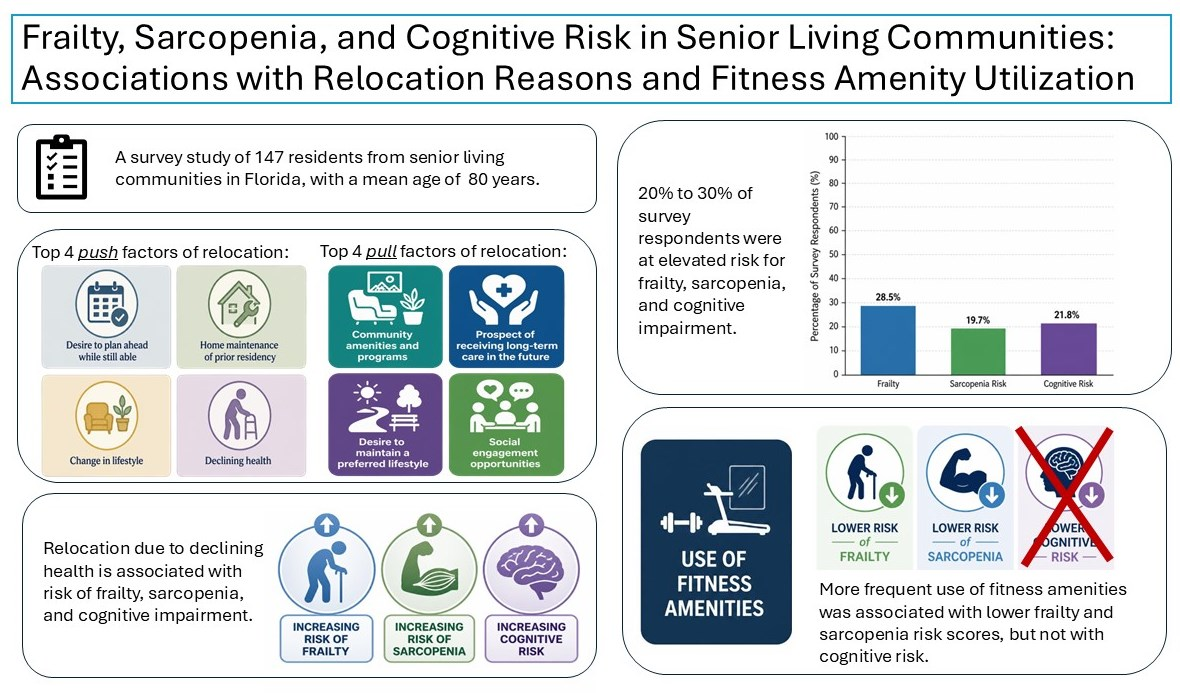
| Desire to plan ahead while still able | 69 | 46.9% |
| Home maintenance of prior residency | 63 | 42.9% |
| Change in lifestyle | 35 | 23.8% |
| Declining health | 25 | 17.0% |
| Fear of burdening others | 25 | 17.0% |
| Felt socially isolated | 24 | 16.3% |
| Heavy housework in prior residency | 17 | 11.6% |
| Declining health of others | 15 | 10.2% |
| Lack of services in prior residency | 13 | 8.8% |
| Needed assistance and no one was available to help | 7 | 4.8% |
| Reduction in income | 6 | 4.1% |
| Pull Factors | ||
| Community amenities and programs | 114 | 77.6% |
| Prospect of receiving long-term care in the future | 50 | 34.0% |
| Desire to maintain a preferred lifestyle | 46 | 31.3% |
| Social engagement opportunities | 46 | 31.3% |
| Being with people of similar ages | 32 | 21.8% |
| Offer household maintenance services | 30 | 20.4% |
| To be close to family, friends, or neighbors | 29 | 19.7% |
| Affordability | 27 | 18.4% |
| Variables | n | Percent |
|---|---|---|
| Community fitness amenities | ||
| Group exercise programs | 60 | 40.8% |
| Gym or fitness center | 59 | 40.1% |
| Outdoor physical activity programs (e.g., golf courses and tennis courts) | 44 | 29.9% |
| Personal training | 32 | 21.8% |
| Frequently used fitness amenities | ||
| Exercise machines or equipment | 73 | 49.7% |
| Group fitness classes | 70 | 47.6% |
| Swimming pool | 46 | 31.3% |
| Personal training | 17 | 11.6% |
| Golf course | 9 | 6.1% |
| Tennis court | 1 | 0.7% |
| Do not use any | 6 | 4.1% |
| Frequency of fitness amenity use over the past 7 days | ||
| 1–2 days | 27 | 18.4% |
| 3–5 days | 47 | 32.0% |
| Almost every day | 27 | 18.4% |
| Did not use | 38 | 25.9% |
| Missing | 8 | 5.4% |
| Minutes of fitness amenity use per day | ||
| Less than 30 min | 9 | 6.1% |
| 30 to <60 min | 42 | 28.6% |
| 60 to <120 min | 34 | 23.1% |
| 120 min or more | 5 | 3.4% |
| Missing | 50 | 34.0% |
| Measure | Respondents with a Health-Related Relocation Reason Mean (SD) | Respondents Without a Health-Related Relocation Reason Mean (SD) | Mann–Whitney U | p Value |
|---|---|---|---|---|
| Tilburg Frailty Indicator (TFI) | 6.2 (2.1) | 2.8 (2.3) | U = 410 | p < 0.001 |
| Strength, assistance in walking, rise from a chair, climb stairs, and falls (SARC-F) | 4.5 (2.3) | 1.4 (1.6) | U = 393 | p < 0.001 |
| Ascertain Dementia 8-item Informant Questionnaire (AD8) | 1.9 (2.2) | 0.9 (1.4) | U = 1062 | p = 0.01 |
Disclaimer/Publisher’s Note: The statements, opinions and data contained in all publications are solely those of the individual author(s) and contributor(s) and not of MDPI and/or the editor(s). MDPI and/or the editor(s) disclaim responsibility for any injury to people or property resulting from any ideas, methods, instructions or products referred to in the content. |
© 2026 by the authors. Licensee MDPI, Basel, Switzerland. This article is an open access article distributed under the terms and conditions of the Creative Commons Attribution (CC BY) license.
Share and Cite
Liu, C.-j.; Ulloa, G.; Leal, K.; Fan, C.-W.; Chang, P.-S.; Wang, I. Frailty, Sarcopenia, and Cognitive Risk in Senior Living Communities: Associations with Relocation Reasons and Fitness Amenity Utilization. Geriatrics 2026, 11, 81. https://doi.org/10.3390/geriatrics11040081
Liu C-j, Ulloa G, Leal K, Fan C-W, Chang P-S, Wang I. Frailty, Sarcopenia, and Cognitive Risk in Senior Living Communities: Associations with Relocation Reasons and Fitness Amenity Utilization. Geriatrics. 2026; 11(4):81. https://doi.org/10.3390/geriatrics11040081
Chicago/Turabian StyleLiu, Chiung-ju, Gabriella Ulloa, Kelly Leal, Chia-Wei Fan, Pei-Shiun Chang, and Inga Wang. 2026. "Frailty, Sarcopenia, and Cognitive Risk in Senior Living Communities: Associations with Relocation Reasons and Fitness Amenity Utilization" Geriatrics 11, no. 4: 81. https://doi.org/10.3390/geriatrics11040081
APA StyleLiu, C.-j., Ulloa, G., Leal, K., Fan, C.-W., Chang, P.-S., & Wang, I. (2026). Frailty, Sarcopenia, and Cognitive Risk in Senior Living Communities: Associations with Relocation Reasons and Fitness Amenity Utilization. Geriatrics, 11(4), 81. https://doi.org/10.3390/geriatrics11040081