


Association Between the Color Kanji Pick-Out Test App Performance and Cognitive Frailty as a Potential Early Screening Marker for Cognitive Decline
 , , , ,
Abstract
1. Introduction
2. Materials and Methods
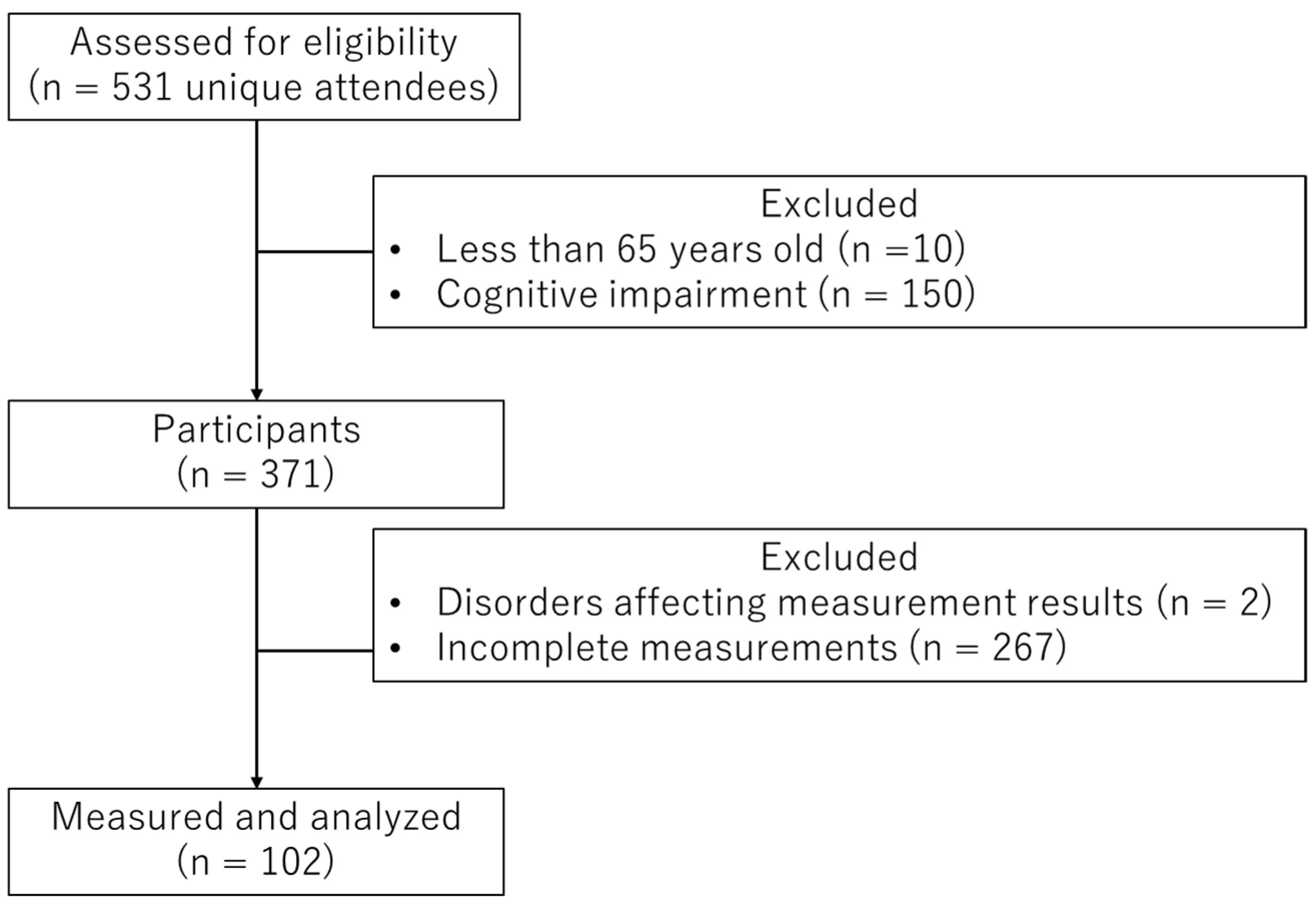
2.1. Participants
2.2. Ethical Considerations
2.3. Measurements
2.4. Color Kanji Pick-Out Test (CKPT) App
2.5. Mini-Mental State Examination (MMSE)
2.6. Cognitive Frailty
2.7. Other Variables
2.8. Potential Sources of Bias and Mitigation Strategies
2.9. Statistical Analysis
3. Results
3.1. Participant Characteristics
3.2. Association Between CKPT App Performance and Cognitive Frailty
4. Discussion
5. Conclusions
Author Contributions
Funding
Institutional Review Board Statement
Informed Consent Statement
Data Availability Statement
Conflicts of Interest
Abbreviations
| AIC | Akaike information criterion |
| CKPT | Color Kanji Pick-out Test |
| MCI | Mild cognitive impairment |
| MMSE | Mini-Mental State Examination |
| SCD | Subjective cognitive decline |
References
- Ishihara, M.; Matsunaga, S.; Islam, R.; Shibata, O.; Chung, U.I. A policy overview of Japan’s progress on dementia care in a super-aged society and future challenges. Glob. Health Med. 2024, 6, 13–18. [Google Scholar] [CrossRef] [Scilit]
- Tahami Monfared, A.A.; Khachatryan, A.; Hummel, N.; Kopiec, A.; Martinez, M.; Zhang, R.; Zhang, Q. Assessing Quality of Life, Economic Burden, and Independence Across the Alzheimer’s Disease Continuum Using Patient-Caregiver Dyad Surveys. J. Alzheimer’s Dis. 2024, 99, 191–206. [Google Scholar] [CrossRef] [Scilit] [PubMed]
- Rafii, M.S.; Aisen, P.S. Detection and treatment of Alzheimer’s disease in its preclinical stage. Nat. Aging 2023, 3, 520–531. [Google Scholar] [CrossRef] [Scilit]
- Yamasaki, T.; Tanaka, M.; Kumagai, S. Editorial: Recent advances in research on cognitive frailty and related conditions. Front. Aging Neurosci. 2025, 17, 1595526. [Google Scholar] [CrossRef] [Scilit]
- Kelaiditi, E.; Cesari, M.; Canevelli, M.; van Kan, G.A.; Ousset, P.J.; Gillette-Guyonnet, S.; Ritz, P.; Duveau, F.; Soto, M.E.; Provencher, V.; et al. Cognitive frailty: Rational and definition from an (I.A.N.A./I.A.G.G.) international consensus group. J. Nutr. Health Aging 2013, 17, 726–734. [Google Scholar] [CrossRef] [Scilit]
- Ruan, Q.; Yu, Z.; Chen, M.; Bao, Z.; Li, J.; He, W. Cognitive frailty, a novel target for the prevention of elderly dependency. Ageing Res. Rev. 2015, 20, 1–10. [Google Scholar] [CrossRef] [Scilit]
- Jessen, F.; Amariglio, R.E.; van Boxtel, M.; Breteler, M.; Ceccaldi, M.; Chételat, G.; Dubois, B.; Dufouil, C.; Ellis, K.A.; van der Flier, W.M.; et al. A conceptual framework for research on subjective cognitive decline in preclinical Alzheimer’s disease. Alzheimer’s Dement. 2014, 10, 844–852. [Google Scholar] [CrossRef] [Scilit] [PubMed]
- Jessen, F.; Amariglio, R.E.; Buckley, R.F.; van der Flier, W.M.; Han, Y.; Molinuevo, J.L.; Rabin, L.; Rentz, D.M.; Rodriguez-Gomez, O.; Saykin, A.J.; et al. The characterisation of subjective cognitive decline. Lancet Neurol. 2020, 19, 271–278. [Google Scholar] [CrossRef] [Scilit]
- Whitfield, T.; Chouliaras, L.; Morrell, R.; Rubio, D.; Radford, D.; Marchant, N.L.; Walker, Z. The criteria used to rule out mild cognitive impairment impact dementia incidence rates in subjective cognitive decline. Alzheimer’s Res. Ther. 2024, 16, 142. [Google Scholar] [CrossRef] [Scilit] [PubMed]
- Tomata, Y.; Sugiyama, K.; Kaiho, Y.; Sugawara, Y.; Hozawa, A.; Tsuji, I. Predictive ability of a simple subjective memory complaints scale for incident dementia: Evaluation of Japan’s national checklist, the “Kihon Checklist”. Geriatr. Gerontol. Int. 2017, 17, 1300–1305. [Google Scholar] [CrossRef] [Scilit]
- Folstein, J.R.; Van Petten, C. Influence of cognitive control and mismatch on the N2 component of the ERP: A review. Psychophysiology 2008, 45, 152–170. [Google Scholar] [CrossRef] [Scilit]
- Di Fazio, C.; Scaliti, E.; Stanziano, M.; Nigri, A.; Demichelis, G.; Tamietto, M.; Palermo, S. Exploring cortical excitability modulation to promote cognitive resilience in aging: An rTMS study protocol. Front. Hum. Neurosci. 2026, 20, 1743236. [Google Scholar] [CrossRef] [Scilit]
- Okura, M.; Ogita, M.; Arai, H. Self-Reported Cognitive Frailty Predicts Adverse Health Outcomes for Community-Dwelling Older Adults Based on an Analysis of Sex and Age. J. Nutr. Health Aging 2019, 23, 654–664. [Google Scholar] [CrossRef] [Scilit]
- Sampaio, P.; Sampaio, R.A.C.; Yamada, M.; Arai, H. Systematic review of the Kihon Checklist: Is it a reliable assessment of frailty?: Kihon Checklist: Systematic review. Geriatr. Gerontol. Int. 2016, 16, 893–902. [Google Scholar] [CrossRef] [Scilit] [PubMed]
- Satake, S.; Senda, K.; Hong, Y.J.; Miura, H.; Endo, H.; Sakurai, T.; Kondo, I.; Toba, K. Validity of the Kihon Checklist for assessing frailty status. Geriatr. Gerontol. Int. 2016, 16, 709–715. [Google Scholar] [CrossRef] [Scilit] [PubMed]
- Goldberg, S.M.; Lopez, O.L.; Cohen, A.D.; Klunk, W.E.; Aizenstein, H.A.; Mizuno, A.; Snitz, B.E. The roles of study setting, response bias, and personality in subjective memory complaints of cognitively normal older adults. Int. Psychogeriatr. 2021, 33, 665–676. [Google Scholar] [CrossRef] [Scilit] [PubMed]
- Folstein, M.F.; Folstein, S.E.; McHugh, P.R. ‘Mini-mental state’. A practical method for grading the cognitive state of pa-tients for the clinician. J. Psychiatr. Res. 1975, 12, 189–198. [Google Scholar] [CrossRef] [Scilit]
- Mitchell, A.J. A meta-analysis of the accuracy of the mini-mental state examination in the detection of dementia and mild cognitive impairment. J. Psychiatr. Res. 2009, 43, 411–431. [Google Scholar] [CrossRef] [Scilit]
- Goda, A.; Shimura, T.; Murata, S.; Abiko, T.; Miyachi, R.; Ohsugi, H.; Okuyama, E. Development of an Application for Assessment of Very Early Stage Cognitive Decline. J. New Med. Innov. Res. 2023, 4, 5. [Google Scholar] [CrossRef] [Scilit]
- Goda, A.; Nakano, H.; Kikuchi, Y.; Mori, K.; Mitsumaru, N.; Murata, S. Association between Subjective Cognitive Complaints and Sleep Disturbance among Community-Dwelling Elderly Individuals in Japan. Healthcare 2024, 12, 1245. [Google Scholar] [CrossRef] [Scilit]
- Gordon, E.H.; Peel, N.M.; Samanta, M.; Theou, O.; Howlett, S.E.; Hubbard, R.E. Sex differences in frailty: A systematic review and meta-analysis. Exp. Gerontol. 2017, 89, 30–40. [Google Scholar] [CrossRef] [Scilit] [PubMed]
- Hatanaka, S.; Sasai, H.; Shida, T.; Osuka, Y.; Kojima, N.; Ohta, T.; Abe, T.; Yamashita, M.; Obuchi, S.P.; Ishizaki, T.; et al. Association between dynapenia and cognitive decline in community-dwelling older Japanese adults: The IRIDE Cohort Study. Geriatr. Gerontol. Int. 2024, 24, 123–129. [Google Scholar] [CrossRef] [Scilit]
- Sugimoto, T.; Arai, H.; Sakurai, T. An update on cognitive frailty: Its definition, impact, associated factors and underlying mechanisms, and interventions. Geriatr. Gerontol. Int. 2022, 22, 99–109. [Google Scholar] [CrossRef] [Scilit] [PubMed]
- Satake, S.; Arai, H. The revised Japanese version of the Cardiovascular Health Study criteria (revised J-CHS criteria). Geriatr. Gerontol. Int. 2020, 20, 992–993. [Google Scholar] [CrossRef] [Scilit]
- Barros, A.J.; Hirakata, V.N. Alternatives for logistic regression in cross-sectional studies: An empirical comparison of models that directly estimate the prevalence ratio. BMC Med. Res. Methodol. 2003, 3, 21. [Google Scholar] [CrossRef] [Scilit] [PubMed]
- Firth, D. Bias Reduction of Maximum Likelihood Estimates. Biometrika 1993, 80, 27–38. [Google Scholar] [CrossRef] [Scilit]
- Heinze, G.; Schemper, M. A solution to the problem of separation in logistic regression. Stat. Med. 2002, 21, 2409–2419. [Google Scholar] [CrossRef] [Scilit]
- Harada, C.N.; Natelson Love, M.C.; Triebel, K.L. Normal cognitive aging. Clin. Geriatr. Med. 2013, 29, 737–752. [Google Scholar] [CrossRef] [Scilit]
- Hoogendijk, E.O.; van Hout, H.P.; Heymans, M.W.; van der Horst, H.E.; Frijters, D.H.; Broese van Groenou, M.I.; Deeg, D.J.; Huisman, M. Explaining the association between educational level and frailty in older adults: Results from a 13-year longitudinal study in The Netherlands. Ann. Epidemiol. 2014, 24, 538–544.e532. [Google Scholar] [CrossRef] [Scilit]
- García-Chanes, R.E.; Avila-Funes, J.A.; Borda, M.G.; Pérez-Zepeda, M.U.; Gutiérrez-Robledo, L.M. Higher frailty levels are associated with lower cognitive test scores in a multi-country study: Evidence from the study on global ageing and adult health. Front. Med. 2023, 10, 1166365. [Google Scholar] [CrossRef] [Scilit]
- Barceló, F.; Sanz, M.; Molina, V.; Rubia, F.J. The Wisconsin Card Sorting Test and the assessment of frontal function: A validation study with event-related potentials. Neuropsychologia 1997, 35, 399–408. [Google Scholar] [CrossRef] [Scilit]
- Bowie, C.R.; Harvey, P.D. Administration and interpretation of the Trail Making Test. Nat. Protoc. 2006, 1, 2277–2281. [Google Scholar] [CrossRef] [Scilit] [PubMed]
- Ceïde, M.E.; Ayers, E.I.; Lipton, R.; Verghese, J. Walking While Talking and Risk of Incident Dementia. Am. J. Geriatr. Psychiatry 2018, 26, 580–588. [Google Scholar] [CrossRef] [Scilit] [PubMed]
- Bartoli, M.; Palermo, S.; Cipriani, G.E.; Amanzio, M. A Possible Association Between Executive Dysfunction and Frailty in Patients with Neurocognitive Disorders. Front. Psychol. 2020, 11, 554307. [Google Scholar] [CrossRef] [Scilit]
- Gross, A.L.; Xue, Q.L.; Bandeen-Roche, K.; Fried, L.P.; Varadhan, R.; McAdams-DeMarco, M.A.; Walston, J.; Carlson, M.C. Declines and Impairment in Executive Function Predict Onset of Physical Frailty. J. Gerontol. A Biol. Sci. Med. Sci. 2016, 71, 1624–1630. [Google Scholar] [CrossRef] [Scilit] [PubMed]
- O’Halloran, A.M.; Fan, C.W.; Kenny, R.A.; Pénard, N.; Galli, A.; Robertson, I.H. Variability in sustained attention and risk of frailty. J. Am. Geriatr. Soc. 2011, 59, 2390–2392. [Google Scholar] [CrossRef] [Scilit]
- O’Halloran, A.M.; Finucane, C.; Savva, G.M.; Robertson, I.H.; Kenny, R.A. Sustained attention and frailty in the older adult population. J. Gerontol. B Psychol. Sci. Soc. Sci. 2014, 69, 147–156. [Google Scholar] [CrossRef] [Scilit]
- Rosado-Artalejo, C.; Carnicero, J.A.; Losa-Reyna, J.; Castillo, C.; Cobos-Antoranz, B.; Alfaro-Acha, A.; Rodríguez-Mañas, L.; García-García, F.J. Global Performance of Executive Function Is Predictor of Risk of Frailty and Disability in Older Adults. J. Nutr. Health Aging 2017, 21, 980–987. [Google Scholar] [CrossRef] [Scilit]
- Franco-Marina, F.; García-González, J.J.; Wagner-Echeagaray, F.; Gallo, J.; Ugalde, O.; Sánchez-García, S.; Espinel-Bermúdez, C.; Juárez-Cedillo, T.; Rodríguez, M.Á.V.; García-Peña, C. The Mini-mental State Examination revisited: Ceiling and floor effects after score adjustment for educational level in an aging Mexican population. Int. Psychogeriatr. 2010, 22, 72–81. [Google Scholar] [CrossRef] [Scilit]
- Tsoy, E.; Zygouris, S.; Possin, K.L. Current State of Self-Administered Brief Computerized Cognitive Assessments for Detection of Cognitive Disorders in Older Adults: A Systematic Review. J. Prev. Alzheimer’s Dis. 2021, 8, 267–276. [Google Scholar] [CrossRef] [Scilit]
- Pellicer-Espinosa, I.; Díaz-Orueta, U. Cognitive Screening Instruments for Older Adults with Low Educational and Literacy Levels: A Systematic Review. J. Appl. Gerontol. 2022, 41, 1222–1231. [Google Scholar] [CrossRef] [Scilit] [PubMed]
- Zou, C.; Yu, Q.; Wang, C.; Ding, M.; Chen, L. Association of depression with cognitive frailty: A systematic review and meta-analysis. J. Affect. Disord. 2023, 320, 133–139. [Google Scholar] [CrossRef] [Scilit]
- Kaur, S.; Banerjee, N.; Miranda, M.; Slugh, M.; Sun-Suslow, N.; McInerney, K.F.; Sun, X.; Ramos, A.R.; Rundek, T.; Sacco, R.L.; et al. Sleep quality mediates the relationship between frailty and cognitive dysfunction in non-demented middle aged to older adults. Int. Psychogeriatr. 2019, 31, 779–788. [Google Scholar] [CrossRef] [Scilit] [PubMed]
- Moon, J.H.; Huh, J.S.; Won, C.W.; Kim, H.J. Is Polypharmacy Associated with Cognitive Frailty in the Elderly? Results from the Korean Frailty and Aging Cohort Study. J. Nutr. Health Aging 2019, 23, 958–965. [Google Scholar] [CrossRef] [Scilit] [PubMed]

| Variable | Total (n = 102) | Cognitive Frailty (n = 14) | No Cognitive Frailty (n = 88) | p-Value |
|---|---|---|---|---|
| Age (years) † | 73.55 ± 5.98; 73 (60–89) | 76.29 ± 5.76; 78 (66–83) | 73.11 ± 5.93; 73 (60–89) | 0.065 |
| Years of education ‡ | 12.07 ± 1.64; 12 (8–18) | 11.71 ± 1.44; 12 (9–15) | 12.13 ± 1.67; 12 (8–18) | 0.390 |
| MMSE score ‡ | 29.42 ± 0.79; 30 (27–30) | 28.86 ± 1.17; 29 (27–30) | 29.51 ± 0.68; 30 (28–30) | 0.028 |
| CKPT app total score † | 9.10 ± 3.85; 8.82 (0–17) | 6.36 ± 3.12; 6.25 (1.6–12) | 9.54 ± 3.79; 10 (0–17) | 0.004 |
| Subjective cognitive decline, n (%) | <0.001 | |||
| Present | 24 (23.5%) | 14 (100%) | 10 (11.4%) | |
| Absent | 78 (76.5%) | 0 (0%) | 78 (88.6%) | |
| No. of KCL cognitive items endorsed ‡ | 0.31 ± 0.61; 0 (0–2) | 1.50 ± 0.52; 1.5 (1–2) | 0.13 ± 0.37; 0 (0–2) | <0.001 |
| “Family or friends say you ask the same things repeatedly”, n (%) (Present/Absent) | <0.001 | |||
| Present | 11 (10.8%) | 8 (57.1%) | 3 (3.4%) | |
| Absent | 91 (89.2%) | 6 (42.9%) | 85 (96.6%) | |
| “You are unable to make a call by looking up phone numbers.”, n (%) (Present/Absent) | <0.001 | |||
| Present | 6 (5.9%) | 5 (35.7%) | 1 (1.1%) | |
| Absent | 96 (94.1%) | 9 (64.3%) | 87 (98.9%) | |
| “You sometimes do not know today’s date”, n (%) (Present/Absent) | <0.001 | |||
| Present | 15 (14.7%) | 8 (57.1%) | 7 (8.0%) | |
| Absent | 87 (85.3%) | 6 (42.9%) | 81 (92.0%) | |
| J-CHS classification (frail/prefrail/robust), n (%) * | <0.001 | |||
| Frail | 5 (4.9%) | 3 (21.4%) | 2 (2.3%) | |
| Prefrail | 37 (36.3%) | 11 (78.6%) | 26 (29.5%) | |
| Robust | 60 (58.8%) | 0 (0.0%) | 60 (68.2%) | |
| No. of J-CHS criteria met ‡ | 0.60 ± 0.87; 0 (0–4) | 1.64 ± 1.01; 1 (1–4) | 0.43 ± 0.72; 0 (0–3) | <0.001 |
| Weight loss, n (%) (Present/Absent) | 0.227 | |||
| Present | 16 (15.7%) | 4 (28.6%) | 12 (13.6%) | |
| Absent | 86 (84.3%) | 10 (71.4%) | 76 (86.4%) | |
| Weak grip strength, n (%) (Present/Absent) | 0.001 | |||
| Present | 11 (10.8%) | 6 (42.9%) | 5 (5.7%) | |
| Absent | 91 (89.2%) | 8 (57.1%) | 83 (94.3%) | |
| Exhaustion, n (%) (Present/Absent) | 0.001 | |||
| Present | 21 (20.6%) | 8 (57.1%) | 13 (14.8%) | |
| Absent | 81 (79.4%) | 6 (42.9%) | 75 (85.2%) | |
| Slow gait speed, n (%) (Present/Absent) | 0.245 | |||
| Present | 7 (6.9%) | 2 (14.3%) | 5 (5.7%) | |
| Absent | 95 (93.1%) | 12 (85.7%) | 83 (94.3%) | |
| Low physical activity, n (%) (Present/Absent) | 0.033 | |||
| Present | 6 (5.9%) | 3 (21.4%) | 3 (3.4%) | |
| Absent | 96 (94.1%) | 11 (78.6%) | 85 (96.6%) |
| Model | Variable | β_Std (Standardized Coefficient) | Odds Ratio (per 1 SD) | 95% CI (Lower–Upper) | p-Value | AIC |
|---|---|---|---|---|---|---|
| Model 1 | CKPT app total score | −0.755 | 0.470 | 0.236–0.886 | 0.019 | 79.798 |
| Age (years) | 0.261 | 1.298 | 0.694–2.513 | 0.417 | ||
| Years of education | 0.100 | 1.105 | 0.572–2.056 | 0.759 | ||
| Model 2 | MMSE score | −0.601 | 0.548 | 0.322–0.909 | 0.020 | 79.670 |
| Age (years) | 0.282 | 1.326 | 0.739–2.475 | 0.347 | ||
| Years of education | −0.189 | 0.828 | 0.403–1.659 | 0.601 | ||
| Model 3 | CKPT app total score | −0.695 | 0.499 | 0.250–0.938 | 0.031 | 79.286 |
| MMSE score | −0.592 | 0.553 | 0.316–0.945 | 0.031 | ||
| Age (years) | 0.018 | 1.018 | 0.518–2.013 | 0.959 | ||
| Years of education | −0.047 | 0.954 | 0.450–1.882 | 0.898 |
Disclaimer/Publisher’s Note: The statements, opinions and data contained in all publications are solely those of the individual author(s) and contributor(s) and not of MDPI and/or the editor(s). MDPI and/or the editor(s) disclaim responsibility for any injury to people or property resulting from any ideas, methods, instructions or products referred to in the content. |
© 2026 by the authors. Licensee MDPI, Basel, Switzerland. This article is an open access article distributed under the terms and conditions of the Creative Commons Attribution (CC BY) license.
Share and Cite
Goda, A.; Nakano, H.; Kikuchi, Y.; Katsurasako, T.; Mori, K.; Kubo, A.; Nonaka, K.; Iwamoto, K.; Mitsumaru, N.; Shimura, T.; et al. Association Between the Color Kanji Pick-Out Test App Performance and Cognitive Frailty as a Potential Early Screening Marker for Cognitive Decline. Geriatrics 2026, 11, 41. https://doi.org/10.3390/geriatrics11020041
Goda A, Nakano H, Kikuchi Y, Katsurasako T, Mori K, Kubo A, Nonaka K, Iwamoto K, Mitsumaru N, Shimura T, et al. Association Between the Color Kanji Pick-Out Test App Performance and Cognitive Frailty as a Potential Early Screening Marker for Cognitive Decline. Geriatrics. 2026; 11(2):41. https://doi.org/10.3390/geriatrics11020041
Chicago/Turabian StyleGoda, Akio, Hideki Nakano, Yuki Kikuchi, Tsuyoshi Katsurasako, Kohei Mori, Atsuko Kubo, Kayoko Nonaka, Kohei Iwamoto, Nozomi Mitsumaru, Takaki Shimura, and et al. 2026. "Association Between the Color Kanji Pick-Out Test App Performance and Cognitive Frailty as a Potential Early Screening Marker for Cognitive Decline" Geriatrics 11, no. 2: 41. https://doi.org/10.3390/geriatrics11020041
APA StyleGoda, A., Nakano, H., Kikuchi, Y., Katsurasako, T., Mori, K., Kubo, A., Nonaka, K., Iwamoto, K., Mitsumaru, N., Shimura, T., & Murata, S. (2026). Association Between the Color Kanji Pick-Out Test App Performance and Cognitive Frailty as a Potential Early Screening Marker for Cognitive Decline. Geriatrics, 11(2), 41. https://doi.org/10.3390/geriatrics11020041

