


Personalized Hemodialysis Approaches in Frail Older Individuals


 , , , , and
Abstract
1. Introduction
1.1. The Aging Dialysis Population
1.2. The Mismatch Between Evidence and Practice
2. Frailty Assessment in Hemodialysis Patients
2.1. Defining Frailty
2.2. Assessment Tools
2.3. Prognostic Value
2.4. Implementation in Clinical Practice
3. Dialysis Prescription: Modality, Frequency and Session Duration
4. Ultrafiltration Strategies
4.1. The Problem with Rapid Fluid Removal
4.2. Weight-Specific UFR Thresholds
4.3. Strategies to Reduce UFR and Prevent Hypotension
4.4. Accepting Higher Dry Weights in Frail Patients
5. Vascular Access Decisions
5.1. The Fistula-First Paradigm
5.2. Reconsidering Access Choices in Frail Older Individuals
5.3. The Role of Frailty Assessment
5.4. Toward Shared Decision-Making
5.5. Practical Recommendations
6. Hemodialysis Membrane Selection in Older Adults
6.1. Biocompatibility and Membrane Materials
6.2. Permeability and High-Flux Membranes
6.3. Heterogeneity Within Polysulfone Membranes
6.4. Medium Cut-Off Membranes: Access, Albumin, and Outcomes
6.5. Tolerance, Inflammation, and Adjunctive Membrane Strategies
6.6. Asymmetric Cellulose Triacetate Membranes
7. Conservative Kidney Management
7.1. Defining Conservative Care
7.2. Survival Outcomes
7.3. Quality of Life and Symptom Burden
7.4. Patient and Clinician Perspectives
7.5. Clinical Implementation
7.6. Shared Decision-Making Framework
8. Quality of Life and Patient-Centered Outcomes
8.1. Beyond Survival
8.2. Recovery Time After Dialysis
8.3. Functional Decline
8.4. Integrating Patient-Centered Outcomes
9. Future Directions
9.1. Research Gaps
9.2. Implementation Science
9.3. Training and Education
9.4. Integrating Geriatric Principles
10. Conclusions
Author Contributions
Funding
Institutional Review Board Statement
Informed Consent Statement
Data Availability Statement
Conflicts of Interest
References
- Johansen, K.L.; Chertow, G.M.; Foley, R.N.; Gilbertson, D.T.; Herzog, C.A.; Ishani, A.; Israni, A.K.; Ku, E.; Kurella Tamura, M.; Li, S.; et al. US Renal Data System 2020 Annual Data Report: Epidemiology of Kidney Disease in the United States. Am. J. Kidney Dis. 2021, 77, A7–A8. [Google Scholar] [CrossRef] [Scilit]
- Yan, T.; Gameiro, J.; Grilo, J.; Filipe, R.; Rocha, E. Hemodialysis Vascular Access in Elderly Patients: A Comprehensive Review. J. Vasc. Access. 2024, 25, 27–39. [Google Scholar] [CrossRef] [Scilit]
- Kojima, G. Prevalence of Frailty in End-Stage Renal Disease: A Systematic Review and Meta-Analysis. Int. Urol. Nephrol. 2017, 49, 1989–1997. [Google Scholar] [CrossRef] [Scilit]
- Cao, M.; Tang, B.; Yang, L.; Zeng, J. A Machine Learning-Based Model for Predicting the Risk of Cognitive Frailty in Elderly Patients on Maintenance Hemodialysis. Sci. Rep. 2025, 15, 2525. [Google Scholar] [CrossRef] [Scilit]
- Chan, G.C.-K.; Kalantar-Zadeh, K.; Ng, J.K.-C.; Tian, N.; Burns, A.; Chow, K.-M.; Szeto, C.-C.; Li, P.K.-T. Frailty in Patients on Dialysis. Kidney Int. 2024, 106, 35–49. [Google Scholar] [CrossRef] [Scilit]
- Bossola, M.; Mariani, I.; Antocicco, M.; Pepe, G.; Di Stasio, E. Frailty, All-Cause Mortality, and Hospitalization in Patients on Maintenance Hemodialysis: A Systematic Review and Meta-Analysis. J. Clin. Med. 2025, 14, 4914. [Google Scholar] [CrossRef] [Scilit] [PubMed]
- Lee, H.-J.; Son, Y.-J. Prevalence and Associated Factors of Frailty and Mortality in Patients with End-Stage Renal Disease Undergoing Hemodialysis: A Systematic Review and Meta-Analysis. Int. J. Environ. Res. Public Health 2021, 18, 3471. [Google Scholar] [CrossRef] [Scilit] [PubMed]
- Eknoyan, G.; Beck, G.J.; Cheung, A.K.; Daugirdas, J.T.; Greene, T.; Kusek, J.W.; Allon, M.; Bailey, J.; Delmez, J.A.; Depner, T.A.; et al. Effect of Dialysis Dose and Membrane Flux in Maintenance Hemodialysis. N. Engl. J. Med. 2002, 347, 2010–2019. [Google Scholar] [CrossRef] [Scilit]
- Kanbay, M.; Basile, C.; Battaglia, Y.; Mantovani, A.; Yavuz, F.; Pizzarelli, F.; Luyckx, V.A.; Covic, A.; Liakopoulos, V.; Mitra, S. Shared Decision Making in Elderly Patients with Kidney Failure. Nephrol. Dial. Transplant. 2024, 39, 742–751. [Google Scholar] [CrossRef] [Scilit] [PubMed]
- Garcia-Canton, C.; Rodenas, A.; Lopez-Aperador, C.; Rivero, Y.; Anton, G.; Monzon, T.; Diaz, N.; Vega, N.; Loro, J.F.; Santana, A.; et al. Frailty in Hemodialysis and Prediction of Poor Short-Term Outcome: Mortality, Hospitalization and Visits to Hospital Emergency Services. Ren. Fail. 2019, 41, 567–575. [Google Scholar] [CrossRef] [Scilit]
- Coric, A.; Resic, H.; Celik, D.; Masnic, F.; Ajanovic, S.; Prohic, N.; Beciragic, A.; Grosa, E.; Smajlovic, A.; Mujakovic, A. Mortality in Hemodialysis Patients Over 65 Years of Age. Mater. Socio Medica 2015, 27, 91. [Google Scholar] [CrossRef] [Scilit]
- Fried, L.P.; Tangen, C.M.; Walston, J.; Newman, A.B.; Hirsch, C.; Gottdiener, J.; Seeman, T.; Tracy, R.; Kop, W.J.; Burke, G.; et al. Frailty in Older Adults: Evidence for a Phenotype. J. Gerontol. A Biol. Sci. Med. Sci. 2001, 56, M146–M156. [Google Scholar] [CrossRef] [Scilit]
- Rockwood, K. A Global Clinical Measure of Fitness and Frailty in Elderly People. Can. Med. Assoc. J. 2005, 173, 489–495. [Google Scholar] [CrossRef] [Scilit]
- Morley, J.E.; Malmstrom, T.K.; Miller, D.K. A Simple Frailty Questionnaire (FRAIL) Predicts Outcomes in Middle Aged African Americans. J. Nutr. Health Aging 2012, 16, 601–608. [Google Scholar] [CrossRef] [Scilit]
- Guralnik, J.M.; Simonsick, E.M.; Ferrucci, L.; Glynn, R.J.; Berkman, L.F.; Blazer, D.G.; Scherr, P.A.; Wallace, R.B. A Short Physical Performance Battery Assessing Lower Extremity Function: Association with Self-Reported Disability and Prediction of Mortality and Nursing Home Admission. J. Gerontol. 1994, 49, M85–M94. [Google Scholar] [CrossRef] [Scilit]
- Puri, A.; Lloyd, A.M.; Bello, A.K.; Tonelli, M.; Campbell, S.M.; Tennankore, K.; Davison, S.N.; Thompson, S. Frailty Assessment Tools in Chronic Kidney Disease: A Systematic Review and Meta-Analysis. Kidney Med. 2025, 7, 100960. [Google Scholar] [CrossRef] [Scilit]
- Li, Y.; Zhang, D.; Ma, Q.; Diao, Z.; Liu, S.; Shi, X. The Impact of Frailty on Prognosis in Elderly Hemodialysis Patients: A Prospective Cohort Study. Clin. Interv. Aging 2021, 16, 1659–1667. [Google Scholar] [CrossRef] [Scilit]
- Cheng, M.; He, M.; Ning, L.; Gan, H.; Liu, H.; Liu, Q.; Shi, F.; Luo, Y.; Zeng, Z. Association between Frailty and Adverse Outcomes in Patients Undergoing Maintenance Hemodialysis: A Systematic Review and Meta-Analysis. Ren. Fail. 2024, 46, 2367716. [Google Scholar] [CrossRef] [Scilit] [PubMed]
- Pereira, M.; Tocino, M.L.S.; Mas-Fontao, S.; Manso, P.; Burgos, M.; Carneiro, D.; Ortiz, A.; Arenas, M.D.; González-Parra, E. Dependency and Frailty in the Older Haemodialysis Patient. BMC Geriatr. 2024, 24, 416. [Google Scholar] [CrossRef] [Scilit] [PubMed]
- Bulbul, E.; Namoglu, S.S. The Frailty in Older Hemodialysis Patients and Associations with Depression, Functional Status, Dialysis Adequacy. Ther. Apher. Dial. 2024, 28, 727–734. [Google Scholar] [CrossRef] [Scilit] [PubMed]
- Yoshikoshi, S.; Yamamoto, S.; Suzuki, Y.; Imamura, K.; Harada, M.; Yamabe, S.; Matsunaga, Y.; Osada, S.; Tagaya, H.; Matsunaga, A. Association between Physical Frailty and Sleep Disturbances among Patients on Hemodialysis: A Cross-Sectional Study. Nephron 2024, 148, 152–159. [Google Scholar] [CrossRef] [Scilit] [PubMed]
- Kennard, A.L.; Rainsford, S.; Glasgow, N.J.; Talaulikar, G.S. Use of Frailty Assessment Instruments in Nephrology Populations: A Scoping Review. BMC Geriatr. 2023, 23, 449. [Google Scholar] [CrossRef] [Scilit]
- Battaglia, Y.; Shroff, R.; Meijers, B.; Nistor, I.; Alfano, G.; Franssen, C.; Luyckx, V.; Liakopoulos, V.; Mantovani, A.; Baciga, F.; et al. Haemodiafiltration versus High-Flux Haemodialysis—A Consensus Statement from the EuDial Working Group of the ERA. Nephrol. Dial. Transplant. 2025, 40, 1590–1614. [Google Scholar] [CrossRef] [Scilit]
- Daugirdas, J.T.; Depner, T.A.; Inrig, J.; Mehrotra, R.; Rocco, M.V.; Suri, R.S.; Weiner, D.E.; Greer, N.; Ishani, A.; MacDonald, R.; et al. KDOQI Clinical Practice Guideline for Hemodialysis Adequacy: 2015 Update. Am. J. Kidney Dis. 2015, 66, 884–930. [Google Scholar] [CrossRef] [Scilit]
- Morena, M.; Jaussent, A.; Chalabi, L.; Leray-Moragues, H.; Chenine, L.; Debure, A.; Thibaudin, D.; Azzouz, L.; Patrier, L.; Maurice, F.; et al. Treatment Tolerance and Patient-Reported Outcomes Favor Online Hemodiafiltration Compared to High-Flux Hemodialysis in the Elderly. Kidney Int. 2017, 91, 1495–1509. [Google Scholar] [CrossRef] [Scilit]
- Blankestijn, P.J.; Vernooij, R.W.M.; Hockham, C.; Strippoli, G.F.M.; Canaud, B.; Hegbrant, J.; Barth, C.; Covic, A.; Cromm, K.; Cucui, A.; et al. Effect of Hemodiafiltration or Hemodialysis on Mortality in Kidney Failure. N. Engl. J. Med. 2023, 389, 700–709. [Google Scholar] [CrossRef] [Scilit]
- Zhu, Y.; Li, J.; Lu, H.; Shi, Z.; Wang, X. Effect of Hemodiafiltration and Hemodialysis on Mortality of Patients with End-Stage Kidney Disease: A Meta-Analysis. BMC Nephrol. 2024, 25, 372. [Google Scholar] [CrossRef] [Scilit]
- Guedes, M.; Vernooij, R.W.M.; Davenport, A.; Kuhlmann, M.K.; Aregger, F.; Pecoits-Filho, R. Clinical Performance, Intermediate and Long-term Outcomes of High-volume Hemodiafiltration in Patients with Kidney Failure. Semin. Dial. 2022, 35, 420–426. [Google Scholar] [CrossRef] [Scilit]
- Ronco, C.; Marchionna, N.; Brendolan, A.; Neri, M.; Lorenzin, A.; Martínez Rueda, A.J. Expanded Haemodialysis: From Operational Mechanism to Clinical Results. Nephrol. Dial. Transplant. 2018, 33, iii41–iii47. [Google Scholar] [CrossRef] [Scilit] [PubMed]
- Kosmadakis, G.; Necoara, A.; Baudenon, J.; Deville, C.; Enache, I.; Chelaru, E. The Multidimensional Impact of Expanded Hemodialysis: A Comprehensive Review. Semin. Dial. 2025, 38, 176–186. [Google Scholar] [CrossRef] [Scilit] [PubMed]
- Castillo, J.C.; Doria, C.; Cely, J.; Camargo, D.; Orozco, V.; Ducuara, D.; Vesga, J.; Sanabria, M.; Rivera, A.; Lindholm, B.; et al. Efficacy in the Reduction Ratios of Middle Molecules with the Use of Medium Cut-off Dialyzers and Reduced Dialysate Flows: A Cohort Study. Front. Med. 2025, 12, 1663750. [Google Scholar] [CrossRef] [Scilit]
- Zakrzewska, A.; Biedunkiewicz, J.; Komorniczak, M.; Jankowska, M.; Jasiulewicz, K.; Płonka, N.; Biedunkiewicz, B.; Małgorzewicz, S.; Tarasewicz, A.; Puchalska-Reglińska, E.; et al. Intradialytic Tolerance and Recovery Time in Different High-Efficiency Hemodialysis Modalities. J. Clin. Med. 2024, 13, 326. [Google Scholar] [CrossRef] [Scilit]
- Mercadal, L.; Franck, J.-E.; Metzger, M.; Yuan, W.; Kolko, A.; Monnet, E.; Hannedouche, T.; Jacquelinet, C.; Stengel, B. Improved Survival Associated with Acetate-Free Haemodialysis in Elderly: A Registry-Based Study. Nephrol. Dial. Transplant. 2015, 30, 1560–1568. [Google Scholar] [CrossRef] [Scilit] [PubMed]
- Lukkanalikitkul, E.; Kidkaem, H.; Phonrat, M.; Prathompong, P.; Anutrakulchai, S. A Randomized Trial Comparing Medium Cut-off Membrane Dialyzers with Online Hemodiafiltration for Uremic Toxins Clearance in Hemodialysis Patients. Sci. Rep. 2025, 15, 5467. [Google Scholar] [CrossRef] [Scilit] [PubMed]
- Movilli, E.; Camerini, C.; Zein, H.; D’Avolio, G.; Sandrini, M.; Strada, A.; Maiorca, R. A Prospective Comparison of Bicarbonate Dialysis, Hemodiafiltration, and Acetate-Free Biofiltration in the Elderly. Am. J. Kidney Dis. 1996, 27, 541–547. [Google Scholar] [CrossRef] [Scilit]
- Rayner, H.C.; Zepel, L.; Fuller, D.S.; Morgenstern, H.; Karaboyas, A.; Culleton, B.F.; Mapes, D.L.; Lopes, A.A.; Gillespie, B.W.; Hasegawa, T.; et al. Recovery Time, Quality of Life, and Mortality in Hemodialysis Patients: The Dialysis Outcomes and Practice Patterns Study (DOPPS). Am. J. Kidney Dis. 2014, 64, 86–94. [Google Scholar] [CrossRef] [Scilit] [PubMed]
- Brown, E.A.; Finkelstein, F.O.; Iyasere, O.U.; Kliger, A.S. Peritoneal or Hemodialysis for the Frail Elderly Patient, the Choice of 2 Evils? Kidney Int. 2017, 91, 294–303. [Google Scholar] [CrossRef] [Scilit]
- Alvarez, L.; Brown, D.; Hu, D.; Chertow, G.M.; Vassalotti, J.A.; Prichard, S. Intradialytic Symptoms and Recovery Time in Patients on Thrice-Weekly In-Center Hemodialysis: A Cross-Sectional Online Survey. Kidney Med. 2020, 2, 125–130. [Google Scholar] [CrossRef] [Scilit]
- Basile, C.; Casino, F.G.; Aucella, F. Incremental Hemodialysis, a Valuable Option for the Frail Elderly Patient. J. Nephrol. 2019, 32, 741–750. [Google Scholar] [CrossRef] [Scilit]
- Kalantar-Zadeh, K.; Unruh, M.; Zager, P.G.; Kovesdy, C.P.; Bargman, J.M.; Chen, J.; Sankarasubbaiyan, S.; Shah, G.; Golper, T.; Sherman, R.A.; et al. Twice-Weekly and Incremental Hemodialysis Treatment for Initiation of Kidney Replacement Therapy. Am. J. Kidney Dis. 2014, 64, 181–186. [Google Scholar] [CrossRef] [Scilit]
- Obi, Y.; Streja, E.; Rhee, C.M.; Ravel, V.; Amin, A.N.; Cupisti, A.; Chen, J.; Mathew, A.T.; Kovesdy, C.P.; Mehrotra, R.; et al. Incremental Hemodialysis, Residual Kidney Function, and Mortality Risk in Incident Dialysis Patients: A Cohort Study. Am. J. Kidney Dis. 2016, 68, 256–265. [Google Scholar] [CrossRef] [Scilit]
- Bolasco, P. Incremental Hemodialysis: Review of Clinical Trials Focused on Patients Undergoing Once-Weekly Hemodialysis. Nutrients 2025, 17, 713. [Google Scholar] [CrossRef] [Scilit] [PubMed]
- Lockridge, R.S.; Spencer, M.; Craft, V.; Pipkin, M.; Campbell, D.; McPhatter, L.; Albert, J.; Anderson, H.; Jennings, F.; Barger, T. Nightly Home Hemodialysis: Five and One-half Years of Experience in Lynchburg, Virginia. Hemodial. Int. 2004, 8, 61–69. [Google Scholar] [CrossRef] [Scilit] [PubMed]
- Johansen, K.L.; Zhang, R.; Huang, Y.; Chen, S.-C.; Blagg, C.R.; Goldfarb-Rumyantzev, A.S.; Hoy, C.D.; Lockridge, R.S.; Miller, B.W.; Eggers, P.W.; et al. Survival and Hospitalization among Patients Using Nocturnal and Short Daily Compared to Conventional Hemodialysis: A USRDS Study. Kidney Int. 2009, 76, 984–990. [Google Scholar] [CrossRef] [Scilit]
- Flythe, J.E.; Kimmel, S.E.; Brunelli, S.M. Rapid Fluid Removal during Dialysis Is Associated with Cardiovascular Morbidity and Mortality. Kidney Int. 2011, 79, 250–257. [Google Scholar] [CrossRef] [Scilit] [PubMed]
- Movilli, E.; Gaggia, P.; Zubani, R.; Camerini, C.; Vizzardi, V.; Parrinello, G.; Savoldi, S.; Fischer, M.S.; Londrino, F.; Cancarini, G. Association between High Ultrafiltration Rates and Mortality in Uraemic Patients on Regular Haemodialysis. A 5-Year Prospective Observational Multicentre Study. Nephrol. Dial. Transplant. 2007, 22, 3547–3552. [Google Scholar] [CrossRef] [Scilit]
- Burton, J.O.; Jefferies, H.J.; Selby, N.M.; McIntyre, C.W. Hemodialysis-Induced Cardiac Injury: Determinants and Associated Outcomes. Clin. J. Am. Soc. Nephrol. 2009, 4, 914–920. [Google Scholar] [CrossRef] [Scilit]
- McIntyre, C.W.; Harrison, L.E.A.; Eldehni, M.T.; Jefferies, H.J.; Szeto, C.-C.; John, S.G.; Sigrist, M.K.; Burton, J.O.; Hothi, D.; Korsheed, S.; et al. Circulating Endotoxemia: A Novel Factor in Systemic Inflammation and Cardiovascular Disease in Chronic Kidney Disease. Clin. J. Am. Soc. Nephrol. 2011, 6, 133–141. [Google Scholar] [CrossRef] [Scilit]
- Yu, J.; Chen, X.; Li, Y.; Wang, Y.; Liu, Z.; Shen, B.; Teng, J.; Zou, J.; Ding, X. High Ultrafiltration Rate Induced Intradialytic Hypotension Is a Predictor for Cardiac Remodeling: A 5-Year Cohort Study. Ren. Fail. 2021, 43, 40–48. [Google Scholar] [CrossRef] [Scilit]
- Chou, J.A.; Kalantar-Zadeh, K.; Mathew, A.T. A Brief Review of Intradialytic Hypotension with a Focus on Survival. Semin. Dial. 2017, 30, 473–480. [Google Scholar] [CrossRef] [Scilit]
- Reilly, R.F. Attending Rounds: A Patient with Intradialytic Hypotension. Clin. J. Am. Soc. Nephrol. 2014, 9, 798–803. [Google Scholar] [CrossRef] [Scilit]
- Yu, J.; Liu, Z.; Shen, B.; Teng, J.; Zou, J.; Ding, X. Intradialytic Hypotension as an Independent Risk Factor for Long-Term Mortality in Maintaining Hemodialysis Patients: A 5-Year Follow-Up Cohort Study. Blood Purif. 2018, 45, 320–326. [Google Scholar] [CrossRef] [Scilit]
- Hamrahian, S.M.; Vilayet, S.; Herberth, J.; Fülöp, T. Prevention of Intradialytic Hypotension in Hemodialysis Patients: Current Challenges and Future Prospects. Int. J. Nephrol. Renov. Dis. 2023, 16, 173–181. [Google Scholar] [CrossRef] [Scilit]
- Shoji, T.; Kabata, D.; Kimura, S.; Nagata, Y.; Mori, K.; Nakatani, S.; Fujii, H.; Morioka, T.; Emoto, M. The Surprise Question in Hemodialysis, Frailty, Nutrition, Patient-Reported Quality of Life, and All-Cause Mortality: The Osaka Dialysis Complication Study (ODCS). Kidney Med. 2024, 6, 100914. [Google Scholar] [CrossRef] [Scilit]
- Mermelstein, A.; Raimann, J.G.; Wang, Y.; Kotanko, P.; Daugirdas, J.T. Ultrafiltration Rate Levels in Hemodialysis Patients Associated with Weight-Specific Mortality Risks. Clin. J. Am. Soc. Nephrol. 2023, 18, 767–776. [Google Scholar] [CrossRef] [Scilit] [PubMed]
- Canney, M.; Clark, E.G. Risk-Based Thresholds for Hemodialysis Ultrafiltration Rates: A Warning Signal or a Call to Action? Clin. J. Am. Soc. Nephrol. 2023, 18, 693–695. [Google Scholar] [CrossRef] [Scilit]
- Saran, R.; Bragg-Gresham, J.L.; Levin, N.W.; Twardowski, Z.J.; Wizemann, V.; Saito, A.; Kimata, N.; Gillespie, B.W.; Combe, C.; Bommer, J.; et al. Longer Treatment Time and Slower Ultrafiltration in Hemodialysis: Associations with Reduced Mortality in the DOPPS. Kidney Int. 2006, 69, 1222–1228. [Google Scholar] [CrossRef] [Scilit] [PubMed]
- Ng, J.K.-C.; Lau, S.L.-F.; Chan, G.C.-K.; Tian, N.; Li, P.K.-T. Nutritional Assessments by Bioimpedance Technique in Dialysis Patients. Nutrients 2023, 16, 15. [Google Scholar] [CrossRef] [Scilit] [PubMed]
- Mustafa, R.A.; Bdair, F.; Akl, E.A.; Garg, A.X.; Thiessen-Philbrook, H.; Salameh, H.; Kisra, S.; Nesrallah, G.; Al-Jaishi, A.; Patel, P.; et al. Effect of Lowering the Dialysate Temperature in Chronic Hemodialysis: A Systematic Review and Meta-Analysis. Clin. J. Am. Soc. Nephrol. 2016, 11, 442–457. [Google Scholar] [CrossRef] [Scilit]
- Arasnezhad, M.; Namazinia, M.; Mazlum, S.R.; Miri, K. The Effect of Ascending- Descending Ultrafiltration and Sodium Profiles on Blood Pressure in Hemodialysis Patients: A Randomized Cross-over Study. BMC Nephrol. 2024, 25, 128. [Google Scholar] [CrossRef] [Scilit]
- Mambelli, E.; Grandi, F.; Santoro, A. Comparison of Blood Volume Biofeedback Hemodialysis and Conventional Hemodialysis on Cardiovascular Stability and Blood Pressure Control in Hemodialysis Patients: A Systematic Review and Meta-Analysis of Randomized Controlled Trials. J. Nephrol. 2024, 37, 897–909. [Google Scholar] [CrossRef] [Scilit]
- Hecking, M.; Madero, M.; Port, F.K.; Schneditz, D.; Wabel, P.; Chazot, C. Fluid Volume Management in Hemodialysis: Never Give Up! Kidney Int. 2023, 103, 2–5. [Google Scholar] [CrossRef] [Scilit]
- van Loon, I.N.; Goto, N.A.; Boereboom, F.T.J.; Bots, M.L.; Hoogeveen, E.K.; Gamadia, L.; van Bommel, E.F.H.; van de Ven, P.J.G.; Douma, C.E.; Vincent, H.H.; et al. Geriatric Assessment and the Relation with Mortality and Hospitalizations in Older Patients Starting Dialysis. Nephron 2019, 143, 108–119. [Google Scholar] [CrossRef] [Scilit]
- Bossola, M.; Mariani, I.; Strizzi, C.T.; Piccinni, C.P.; Di Stasio, E. How to Limit Interdialytic Weight Gain in Patients on Maintenance Hemodialysis: State of the Art and Perspectives. J. Clin. Med. 2025, 14, 1846. [Google Scholar] [CrossRef] [Scilit]
- Leung, K.C.W.; Quinn, R.R.; Ravani, P.; Duff, H.; MacRae, J.M. Randomized Crossover Trial of Blood Volume Monitoring–Guided Ultrafiltration Biofeedback to Reduce Intradialytic Hypotensive Episodes with Hemodialysis. Clin. J. Am. Soc. Nephrol. 2017, 12, 1831–1840. [Google Scholar] [CrossRef] [Scilit]
- Vascular Access Work Group. Clinical Practice Guidelines for Vascular Access. Am. J. Kidney Dis. 2006, 48, S176–S247. [Google Scholar] [CrossRef] [Scilit]
- Al-Jaishi, A.A.; Oliver, M.J.; Thomas, S.M.; Lok, C.E.; Zhang, J.C.; Garg, A.X.; Kosa, S.D.; Quinn, R.R.; Moist, L.M. Patency Rates of the Arteriovenous Fistula for Hemodialysis: A Systematic Review and Meta-Analysis. Am. J. Kidney Dis. 2014, 63, 464–478. [Google Scholar] [CrossRef] [Scilit] [PubMed]
- Ravani, P.; Palmer, S.C.; Oliver, M.J.; Quinn, R.R.; MacRae, J.M.; Tai, D.J.; Pannu, N.I.; Thomas, C.; Hemmelgarn, B.R.; Craig, J.C.; et al. Associations between Hemodialysis Access Type and Clinical Outcomes: A Systematic Review. J. Am. Soc. Nephrol. 2013, 24, 465–473. [Google Scholar] [CrossRef] [Scilit] [PubMed]
- Dember, L.M.; Beck, G.J.; Allon, M.; Delmez, J.A.; Dixon, B.S.; Greenberg, A.; Himmelfarb, J.; Vazquez, M.A.; Gassman, J.J.; Greene, T.; et al. Effect of Clopidogrel on Early Failure of Arteriovenous Fistulas for Hemodialysis: A Randomized Controlled Trial. JAMA 2008, 299, 2164. [Google Scholar] [CrossRef] [Scilit]
- Liu, P.; Pang, S.C.; Li, H.; Tan, R.Y.; Tng, R.K.A.; Gan, S.W.S.; Choong, H.L.L.; Chong, T.T.; Tan, C.S. Outcomes of Arteriovenous Fistula in Elderly Patients on Maintenance Haemodialysis. Int. Urol. Nephrol. 2021, 53, 1923–1931. [Google Scholar] [CrossRef] [Scilit] [PubMed]
- Liu, R.; Lin, S.; Liu, L.; Xu, J.; Liu, L.; Pang, J.; An, H.; Yang, W.; Jian, J.; Wang, J.; et al. Vascular Access Type and Prognosis in Elderly Hemodialysis Patients: A Propensity-Score-Matched Study. Ren. Fail. 2024, 46, 2387205. [Google Scholar] [CrossRef] [Scilit] [PubMed]
- Lee, T.; Qian, J.; Thamer, M.; Allon, M. Tradeoffs in Vascular Access Selection in Elderly Patients Initiating Hemodialysis with a Catheter. Am. J. Kidney Dis. 2018, 72, 509–518. [Google Scholar] [CrossRef] [Scilit]
- Lyu, B.; Chan, M.R.; Yevzlin, A.S.; Astor, B.C. Catheter Dependence After Arteriovenous Fistula or Graft Placement Among Elderly Patients on Hemodialysis. Am. J. Kidney Dis. 2021, 78, 399–408.e1. [Google Scholar] [CrossRef] [Scilit] [PubMed]
- McDonnell, S.M.; Nikfar, S.; Blecha, M.; Halandras, P.M. Frailty Screening for Determination of Hemodialysis Access Placement. J. Vasc. Surg. 2024, 79, 911–917. [Google Scholar] [CrossRef] [Scilit] [PubMed]
- Lazarides, M.K.; Georgiadis, G.S.; Antoniou, G.A.; Staramos, D.N. A Meta-Analysis of Dialysis Access Outcome in Elderly Patients. J. Vasc. Surg. 2007, 45, 420–426.e2. [Google Scholar] [CrossRef] [Scilit]
- Lok, C.E.; Huber, T.S.; Lee, T.; Shenoy, S.; Yevzlin, A.S.; Abreo, K.; Allon, M.; Asif, A.; Astor, B.C.; Glickman, M.H.; et al. KDOQI Clinical Practice Guideline for Vascular Access: 2019 Update. Am. J. Kidney Dis. 2020, 75, S1–S164. [Google Scholar] [CrossRef] [Scilit]
- Arhuidese, I.J.; Cooper, M.A.; Rizwan, M.; Nejim, B.; Malas, M.B. Vascular Access for Hemodialysis in the Elderly. J. Vasc. Surg. 2019, 69, 517–525.e1. [Google Scholar] [CrossRef] [Scilit]
- Clark, W.R.; Hamburger, R.J.; Lysaght, M.J. Effect of Membrane Composition and Structure on Solute Removal and Biocompatibility in Hemodialysis. Kidney Int. 1999, 56, 2005–2015. [Google Scholar] [CrossRef] [Scilit]
- Ronco, C.; Clark, W.R. Haemodialysis Membranes. Nat. Rev. Nephrol. 2018, 14, 394–410. [Google Scholar] [CrossRef] [Scilit]
- Takemoto, Y.; Naganuma, T.; Yoshimura, R. Biocompatibility of the Dialysis Membrane. In Contributions to Nephrology; Kawanishi, H., Yamashita, A.C., Eds.; S. Karger AG: Basel, Switzerland, 2011; Volume 168, pp. 139–145. ISBN 978-3-8055-9560-5. [Google Scholar]
- Ávila, E.; Sepúlveda, R.A.; Retamal, J.; Hachim, D. Biocompatibility in Hemodialysis: Artificial Membrane and Human Blood Interactions. BMC Nephrol. 2025, 26, 482. [Google Scholar] [CrossRef] [Scilit]
- Huang, W.; Bai, J.; Zhang, Y.; Qiu, D.; Wei, L.; Zhao, C.; Ren, Z.; Wang, Q.; Ren, K.; Cao, N. Effects of Low-Flux and High-Flux Hemodialysis on the Survival of Elderly Maintenance Hemodialysis Patients. Ren. Fail. 2024, 46, 2338217. [Google Scholar] [CrossRef] [Scilit]
- Locatelli, F.; Martin-Malo, A.; Hannedouche, T.; Loureiro, A.; Papadimitriou, M.; Wizemann, V.; Jacobson, S.H.; Czekalski, S.; Ronco, C.; Vanholder, R. Effect of Membrane Permeability on Survival of Hemodialysis Patients. J. Am. Soc. Nephrol. 2009, 20, 645–654. [Google Scholar] [CrossRef] [Scilit]
- Koga, Y.; Fujieda, H.; Meguro, H.; Ueno, Y.; Aoki, T.; Miwa, K.; Kainoh, M. Biocompatibility of Polysulfone Hemodialysis Membranes and Its Mechanisms: Involvement of Fibrinogen and Its Integrin Receptors in Activation of Platelets and Neutrophils. Artif. Organs 2018, 42, E246–E258. [Google Scholar] [CrossRef] [Scilit]
- Zawada, A.M.; Melchior, P.; Erlenkötter, A.; Delinski, D.; Stauss-Grabo, M.; Kennedy, J.P. Polyvinylpyrrolidone in Hemodialysis Membranes: Impact on Platelet Loss during Hemodialysis. Hemodial. Int. 2021, 25, 498–506. [Google Scholar] [CrossRef] [Scilit]
- Koga, Y.; Meguro, H.; Fujieda, H.; Ueno, Y.; Miwa, K.; Kainoh, M. A New Hydrophilic Polysulfone Hemodialysis Membrane Can Prevent Platelet–Neutrophil Interactions and Successive Neutrophil Activation. Int. J. Artif. Organs 2019, 42, 175–181. [Google Scholar] [CrossRef] [Scilit] [PubMed]
- Qian, J.Z.; McAdams-DeMarco, M.; Ng, D.K.; Lau, B. Arteriovenous Fistula Placement, Maturation, and Patency Loss in Older Patients Initiating Hemodialysis. Am. J. Kidney Dis. 2020, 76, 480–489.e1. [Google Scholar] [CrossRef] [Scilit] [PubMed]
- Ronco, C.; La Manna, G. Expanded Hemodialysis: A New Therapy for a New Class of Membranes. In Contributions to Nephrology; La Manna, G., Ronco, C., Eds.; S. Karger AG: Basel, Switzerland, 2017; Volume 190, pp. 124–133. ISBN 978-3-318-06060-7. [Google Scholar]
- Kirsch, A.H.; Lyko, R.; Nilsson, L.-G.; Beck, W.; Amdahl, M.; Lechner, P.; Schneider, A.; Wanner, C.; Rosenkranz, A.R.; Krieter, D.H. Performance of Hemodialysis with Novel Medium Cut-off Dialyzers. Nephrol. Dial. Transplant. 2017, 32, 165–172. [Google Scholar] [CrossRef] [Scilit]
- Krishnasamy, R.; Hawley, C.M.; Jardine, M.J.; Roberts, M.A.; Cho, Y.; Wong, M.; Heath, A.; Nelson, C.L.; Sen, S.; Mount, P.F.; et al. A tRial Evaluating Mid Cut-Off Value Membrane Clearance of Albumin and Light Chains in HemoDialysis Patients: A Safety Device Study. Blood Purif. 2020, 49, 468–478. [Google Scholar] [CrossRef] [Scilit] [PubMed]
- Kandi, M.; Brignardello-Petersen, R.; Couban, R.; Wu, C.; Nesrallah, G. Clinical Outcomes with Medium Cut-Off Versus High-Flux Hemodialysis Membranes: A Systematic Review and Meta-Analysis. Can. J. Kidney Health Dis. 2022, 9, 20543581211067087. [Google Scholar] [CrossRef] [Scilit]
- Molano, A.P.; Hutchison, C.A.; Sanchez, R.; Rivera, A.S.; Buitrago, G.; Dazzarola, M.P.; Munevar, M.; Guerrero, M.; Vesga, J.I.; Sanabria, M. Medium Cutoff Versus High-Flux Hemodialysis Membranes and Clinical Outcomes: A Cohort Study Using Inverse Probability Treatment Weighting. Kidney Med. 2022, 4, 100431. [Google Scholar] [CrossRef]
- Kim, T.H.; Kim, S.; Kim, T.Y.; Park, H.Y.; Jung, K.S.; Lee, M.H.; Jhee, J.H.; Lee, J.E.; Choi, H.Y.; Park, H.C. Removal of Large Middle Molecules via Haemodialysis with Medium Cut-off Membranes at Lower Blood Flow Rates: An Observational Prospective Study. BMC Nephrol. 2020, 21, 2. [Google Scholar] [CrossRef] [Scilit] [PubMed]
- Lo Cicero, L.; Lentini, P.; Sessa, C.; Castellino, N.; D’Anca, A.; Torrisi, I.; Marcantoni, C.; Castellino, P.; Santoro, D.; Zanoli, L. Inflammation and Arterial Stiffness as Drivers of Cardiovascular Risk in Kidney Disease. Cardiorenal Med. 2025, 15, 29–40. [Google Scholar] [CrossRef] [Scilit] [PubMed]
- Zickler, D.; Schindler, R.; Willy, K.; Martus, P.; Pawlak, M.; Storr, M.; Hulko, M.; Boehler, T.; Glomb, M.A.; Liehr, K.; et al. Medium Cut-Off (MCO) Membranes Reduce Inflammation in Chronic Dialysis Patients—A Randomized Controlled Clinical Trial. PLoS ONE 2017, 12, e0169024. [Google Scholar] [CrossRef] [Scilit]
- Davenport, A. Intradialytic Complications during Hemodialysis. Hemodial. Int. 2006, 10, 162–167. [Google Scholar] [CrossRef] [Scilit]
- Flythe, J.E.; Xue, H.; Lynch, K.E.; Curhan, G.C.; Brunelli, S.M. Association of Mortality Risk with Various Definitions of Intradialytic Hypotension. J. Am. Soc. Nephrol. 2015, 26, 724–734. [Google Scholar] [CrossRef] [Scilit]
- Patel, N.; Dalal, P.; Panesar, M. Dialysis Disequilibrium Syndrome: A Narrative Review. Semin. Dial. 2008, 21, 493–498. [Google Scholar] [CrossRef] [Scilit]
- Vanholder, R.; De Smet, R.; Glorieux, G.; Argilés, A.; Baurmeister, U.; Brunet, P.; Clark, W.; Cohen, G.; De Deyn, P.P.; Deppisch, R.; et al. Review on Uremic Toxins: Classification, Concentration, and Interindividual Variability. Kidney Int. 2003, 63, 1934–1943. [Google Scholar] [CrossRef] [Scilit]
- Meyer, T.W. The Removal of Protein-Bound Solutes by Dialysis. J. Ren. Nutr. 2012, 22, 203–206. [Google Scholar] [CrossRef] [Scilit]
- Boschetti-de-Fierro, A.; Voigt, M.; Storr, M.; Krause, B. MCO Membranes: Enhanced Selectivity in High-Flux Class. Sci. Rep. 2015, 5, 18448. [Google Scholar] [CrossRef] [Scilit] [PubMed]
- Canaud, B.; Bragg-Gresham, J.L.; Marshall, M.R.; Desmeules, S.; Gillespie, B.W.; Depner, T.; Klassen, P.; Port, F.K. Mortality Risk for Patients Receiving Hemodiafiltration versus Hemodialysis: European Results from the DOPPS. Kidney Int. 2006, 69, 2087–2093. [Google Scholar] [CrossRef] [Scilit]
- Maduell, F.; Broseta, J.J.; Rodríguez-Espinosa, D.; Del Risco, J.; Rodas, L.M.; Arias-Guillén, M.; Vera, M.; Fontseré, N.; Salgado, M.D.C.; Rico, N. Comparison of Four Medium Cut-off Dialyzers. Clin. Kidney J. 2022, 15, 2292–2299. [Google Scholar] [CrossRef] [Scilit]
- Piroddi, M.; Pilolli, F.; Aritomi, M.; Galli, F. Vitamin E as a Functional and Biocompatibility Modifier of Synthetic Hemodialyzer Membranes: An Overview of the Literature on Vitamin E-Modified Hemodialyzer Membranes. Am. J. Nephrol. 2012, 35, 559–572. [Google Scholar] [CrossRef] [Scilit] [PubMed]
- Ni, C.; Zhou, W.; Yu, M.; Li, X.; Li, J.; Cui, Y.; Cui, W. Vitamin E Treatment Improves the Antioxidant Capacity of Patients Receiving Dialysis: A Systematic Review and Meta-Analysis. Mol. Nutr. Food Res. 2023, 67, 2300269. [Google Scholar] [CrossRef] [Scilit] [PubMed]
- D’Arrigo, G.; Baggetta, R.; Tripepi, G.; Galli, F.; Bolignano, D. Effects of Vitamin E-Coated versus Conventional Membranes in Chronic Hemodialysis Patients: A Systematic Review and Meta-Analysis. Blood Purif. 2017, 43, 101–122. [Google Scholar] [CrossRef] [Scilit]
- Bargnoux, A.-S.; Cristol, J.-P.; Jaussent, I.; Chalabi, L.; Bories, P.; Dion, J.-J.; Henri, P.; Delage, M.; Dupuy, A.-M.; Badiou, S.; et al. Vitamin E–Coated Polysulfone Membrane Improved Red Blood Cell Antioxidant Status in Hemodialysis Patients. JN 2013, 26, 556–563. [Google Scholar] [CrossRef] [Scilit]
- Aucella, F.; Gesuete, A.; Vigilante, M.; Prencipe, M. Adsorption Dialysis: From Physical Principles to Clinical Applications. Blood Purif. 2013, 35, 42–47. [Google Scholar] [CrossRef] [Scilit]
- Kishikawa, T.; Fujieda, H.; Sakaguchi, H. Comprehensive Analysis of Cytokine Adsorption Properties of Polymethyl Methacrylate (PMMA) Membrane Material. J. Artif. Organs 2022, 25, 343–349. [Google Scholar] [CrossRef] [Scilit] [PubMed]
- Franzin, R.; Stasi, A.; Caggiano, G.; Squiccimarro, E.; Losappio, V.; Fiorentino, M.; Alfieri, C.; Stallone, G.; Gesualdo, L.; Castellano, G. Enhancing Immune Protection in Hemodialysis Patients: Role of the Polymethyl Methacrylate Membrane. Blood Purif. 2023, 52, 49–61. [Google Scholar] [CrossRef] [Scilit]
- Fabbrini, P.; Sirtori, S.; Casiraghi, E.; Pieruzzi, F.; Genovesi, S.; Corti, D.; Brivio, R.; Gregorini, G.; Como, G.; Carati, M.L.; et al. Polymethylmethacrylate Membrane and Serum Free Light Chain Removal: Enhancing Adsorption Properties. Blood Purif. 2013, 35, 52–58. [Google Scholar] [CrossRef] [Scilit]
- Shutov, E.; Mishin, O. Evaluation of the Effect of the PMMA Dialysis Membrane on the Level of Inflammation in Patients on Hemodialysis. Blood Purif. 2023, 52, 43–48. [Google Scholar] [CrossRef] [Scilit]
- Aucella, F.; Vigilante, M.; Gesuete, A.; Maruccio, G.; Specchio, A.; Gesualdo, L. Uraemic Itching: Do Polymethylmethacrylate Dialysis Membranes Play a Role? Nephrol. Dial. Transplant. 2007, 22, v8–v12. [Google Scholar] [CrossRef] [Scilit]
- Abe, M.; Hamano, T.; Wada, A.; Nakai, S.; Masakane, I.; on behalf of the Renal Data Registry Committee, Japanese Society for Dialysis Therapy. Effect of Dialyzer Membrane Materials on Survival in Chronic Hemodialysis Patients: Results from the Annual Survey of the Japanese Nationwide Dialysis Registry. PLoS ONE 2017, 12, e0184424. [Google Scholar] [CrossRef] [Scilit] [PubMed]
- Puerta, M.; Jaldo, M.T.; Muñoz, P.; Martínez-Miguel, P.; Maduell, F.; Lancho, C.; García-Herrera, A.L.; Eloot, S.; De Sequera, P. SOLFA Study: A Multicenter, Open-Label, Prospective, Randomized Study to Investigate the Clotting Propensity of Asymmetric Cellulose Triacetate Membrane Compared to Synthetic Membranes in on Line HDF. J. Nephrol. 2025, 38, 697–705. [Google Scholar] [CrossRef] [Scilit] [PubMed]
- Santos, A.; Macías, N.; Cruzado, L.; Vega, A. The Removal Capacity of Asymmetric Cellulose Triacetate during Post-Dilution Online Hemodiafiltration. Kidney Res. Clin. Pract. 2021, 40, 325–327. [Google Scholar] [CrossRef] [Scilit]
- Tanaka, Y.; Michiwaki, H.; Asa, H.; Hirose, D.; Tao, T.; Minakuchi, J. Multipotentials of New Asymmetric Cellulose Triacetate Membrane for On-Line Hemodiafiltration Both in Postdilution and Predilution. Ren. Replace. Ther. 2019, 5, 21. [Google Scholar] [CrossRef] [Scilit]
- Ronci, M.; Leporini, L.; Felaco, P.; Sirolli, V.; Pieroni, L.; Greco, V.; Aceto, A.; Urbani, A.; Bonomini, M. Proteomic Characterization of a New Asymmetric Cellulose Triacetate Membrane for Hemodialysis. Proteom. Clin. Appl. 2018, 12, 1700140. [Google Scholar] [CrossRef] [Scilit]
- Wongrakpanich, S.; Susantitaphong, P.; Isaranuwatchai, S.; Chenbhanich, J.; Eiam-Ong, S.; Jaber, B.L. Dialysis Therapy and Conservative Management of Advanced Chronic Kidney Disease in the Elderly: A Systematic Review. Nephron 2017, 137, 178–189. [Google Scholar] [CrossRef] [Scilit] [PubMed]
- Da Silva-Gane, M.; Wellsted, D.; Greenshields, H.; Norton, S.; Chandna, S.M.; Farrington, K. Quality of Life and Survival in Patients with Advanced Kidney Failure Managed Conservatively or by Dialysis. Clin. J. Am. Soc. Nephrol. 2012, 7, 2002–2009. [Google Scholar] [CrossRef] [Scilit]
- O’Connor, N.R.; Kumar, P. Conservative Management of End-Stage Renal Disease without Dialysis: A Systematic Review. J. Palliat. Med. 2012, 15, 228–235. [Google Scholar] [CrossRef] [Scilit]
- Foote, C.; Kotwal, S.; Gallagher, M.; Cass, A.; Brown, M.; Jardine, M. Survival Outcomes of Supportive Care versus Dialysis Therapies for Elderly Patients with End-stage Kidney Disease: A Systematic Review and Meta-analysis. Nephrology 2016, 21, 241–253. [Google Scholar] [CrossRef] [Scilit]
- Carson, R.C.; Juszczak, M.; Davenport, A.; Burns, A. Is Maximum Conservative Management an Equivalent Treatment Option to Dialysis for Elderly Patients with Significant Comorbid Disease? Clin. J. Am. Soc. Nephrol. 2009, 4, 1611–1619. [Google Scholar] [CrossRef] [Scilit]
- Murtagh, F.E.M.; Marsh, J.E.; Donohoe, P.; Ekbal, N.J.; Sheerin, N.S.; Harris, F.E. Dialysis or Not? A Comparative Survival Study of Patients over 75 Years with Chronic Kidney Disease Stage 5. Nephrol. Dial. Transplant. 2007, 22, 1955–1962. [Google Scholar] [CrossRef] [Scilit]
- Buur, L.E.; Madsen, J.K.; Eidemak, I.; Krarup, E.; Lauridsen, T.G.; Taasti, L.H.; Finderup, J. Does Conservative Kidney Management Offer a Quantity or Quality of Life Benefit Compared to Dialysis? A Systematic Review. BMC Nephrol. 2021, 22, 307. [Google Scholar] [CrossRef] [Scilit]
- Davison, S.N.; Jhangri, G.S.; Johnson, J.A. Longitudinal Validation of a Modified Edmonton Symptom Assessment System (ESAS) in Haemodialysis Patients. Nephrol. Dial. Transplant. 2006, 21, 3189–3195. [Google Scholar] [CrossRef] [Scilit] [PubMed]
- Verberne, W.R.; Geers, A.B.M.T.; Jellema, W.T.; Vincent, H.H.; Van Delden, J.J.M.; Bos, W.J.W. Comparative Survival among Older Adults with Advanced Kidney Disease Managed Conservatively Versus with Dialysis. Clin. J. Am. Soc. Nephrol. 2016, 11, 633–640. [Google Scholar] [CrossRef] [Scilit] [PubMed]
- Seow, Y.-Y.; Cheung, Y.B.; Qu, L.M.; Yee, A.C.P. Trajectory of Quality of Life for Poor Prognosis Stage 5D Chronic Kidney Disease with and without Dialysis. Am. J. Nephrol. 2013, 37, 231–238. [Google Scholar] [CrossRef] [Scilit]
- Murtagh, F.E.; Addington-Hall, J.; Edmonds, P.; Donohoe, P.; Carey, I.; Jenkins, K.; Higginson, I.J. Symptoms in the Month Before Death for Stage 5 Chronic Kidney Disease Patients Managed Without Dialysis. J. Pain Symptom Manag. 2010, 40, 342–352. [Google Scholar] [CrossRef] [Scilit] [PubMed]
- Yong, D.; Kwok, A.; Wong, D.; Suen, M.; Chen, W.; Tse, D. Symptom Burden and Quality of Life in End-Stage Renal Disease: A Study of 179 Patients on Dialysis and Palliative Care. Palliat. Med. 2009, 23, 111–119. [Google Scholar] [CrossRef] [Scilit]
- Murtagh, F.E.M.; Addington-Hall, J.M.; Edmonds, P.M.; Donohoe, P.; Carey, I.; Jenkins, K.; Higginson, I.J. Symptoms in Advanced Renal Disease: A Cross-Sectional Survey of Symptom Prevalence in Stage 5 Chronic Kidney Disease Managed without Dialysis. J. Palliat. Med. 2007, 10, 1266–1276. [Google Scholar] [CrossRef] [Scilit]
- Brown, M.A.; Collett, G.K.; Josland, E.A.; Foote, C.; Li, Q.; Brennan, F.P. CKD in Elderly Patients Managed without Dialysis: Survival, Symptoms, and Quality of Life. Clin. J. Am. Soc. Nephrol. 2015, 10, 260–268. [Google Scholar] [CrossRef] [Scilit]
- Verberne, W.R.; Dijkers, J.; Kelder, J.C.; Geers, A.B.M.; Jellema, W.T.; Vincent, H.H.; Van Delden, J.J.M.; Bos, W.J.W. Value-Based Evaluation of Dialysis versus Conservative Care in Older Patients with Advanced Chronic Kidney Disease: A Cohort Study. BMC Nephrol. 2018, 19, 205. [Google Scholar] [CrossRef] [Scilit]
- Hussain, J.A.; Mooney, A.; Russon, L. Comparison of Survival Analysis and Palliative Care Involvement in Patients Aged over 70 Years Choosing Conservative Management or Renal Replacement Therapy in Advanced Chronic Kidney Disease. Palliat. Med. 2013, 27, 829–839. [Google Scholar] [CrossRef] [Scilit]
- Sakthivel, P.; Mostafa, A.; Aiyegbusi, O.L. Factors That Influence the Selection of Conservative Management for End-Stage Renal Disease—A Systematic Review. Clin. Kidney J. 2024, 17, sfad269. [Google Scholar] [CrossRef] [Scilit]
- Thorsteinsdottir, B.; Swetz, K.M.; Tilburt, J.C. Dialysis in the Frail Elderly—A Current Ethical Problem, an Impending Ethical Crisis. J. Gen. Intern. Med. 2013, 28, 1511–1516. [Google Scholar] [CrossRef] [Scilit] [PubMed]
- Morton, R.L.; Snelling, P.; Webster, A.C.; Rose, J.; Masterson, R.; Johnson, D.W.; Howard, K. Factors Influencing Patient Choice of Dialysis versus Conservative Care to Treat End-Stage Kidney Disease. Can. Med. Assoc. J. 2012, 184, E277–E283. [Google Scholar] [CrossRef] [Scilit] [PubMed]
- Mandel, E.I.; Bernacki, R.E.; Block, S.D. Serious Illness Conversations in ESRD. Clin. J. Am. Soc. Nephrol. 2017, 12, 854–863. [Google Scholar] [CrossRef] [Scilit] [PubMed]
- Rebollo Rubio, A.; Morales Asencio, J.M.; Eugenia Pons Raventos, M. Depression, Anxiety and Health-related Quality of Life amongst Patients Who Are Starting Dialysis Treatment. J. Ren. Care 2017, 43, 73–82. [Google Scholar] [CrossRef] [Scilit]
- Rosansky, S.; Glassock, R.J.; Clark, W.F. Early Start of Dialysis: A Critical Review. Clin. J. Am. Soc. Nephrol. 2011, 6, 1222–1228. [Google Scholar] [CrossRef] [Scilit]
- Davison, S.N.; Levin, A.; Moss, A.H.; Jha, V.; Brown, E.A.; Brennan, F.; Murtagh, F.E.M.; Naicker, S.; Germain, M.J.; O’Donoghue, D.J.; et al. Executive Summary of the KDIGO Controversies Conference on Supportive Care in Chronic Kidney Disease: Developing a Roadmap to Improving Quality Care. Kidney Int. 2015, 88, 447–459. [Google Scholar] [CrossRef] [Scilit]
- De Biase, V.; Tobaldini, O.; Boaretti, C.; Abaterusso, C.; Pertica, N.; Loschiavo, C.; Trabucco, G.; Lupo, A.; Gambaro, G. Prolonged Conservative Treatment for Frail Elderly Patients with End-Stage Renal Disease: The Verona Experience. Nephrol. Dial. Transplant. 2007, 23, 1313–1317. [Google Scholar] [CrossRef] [Scilit]
- Murtagh, F.; Cohen, L.M.; Germain, M.J. Dialysis Discontinuation: Quo Vadis? Adv. Chronic Kidney Dis. 2007, 14, 379–401. [Google Scholar] [CrossRef] [Scilit]
- Farrington, K.; Covic, A.; Nistor, I.; Aucella, F.; Clyne, N.; De Vos, L.; Findlay, A.; Fouque, D.; Grodzicki, T.; Iyasere, O.; et al. Clinical Practice Guideline on Management of Older Patients with Chronic Kidney Disease Stage 3b or Higher (eGFR<45 mL/Min/1.73 M2): A Summary Document from the European Renal Best Practice Group. Nephrol. Dial. Transplant. 2017, 32, 9–16. [Google Scholar] [CrossRef] [Scilit]
- Park, Y.; Hwang, W.M. Management of Elderly Patients with Chronic Kidney Disease. Yonsei Med. J. 2025, 66, 63. [Google Scholar] [CrossRef] [Scilit]
- Morton, R.L.; Tong, A.; Howard, K.; Snelling, P.; Webster, A.C. The Views of Patients and Carers in Treatment Decision Making for Chronic Kidney Disease: Systematic Review and Thematic Synthesis of Qualitative Studies. BMJ 2010, 340, c112. [Google Scholar] [CrossRef] [Scilit] [PubMed]
- Hussein, W.F.; Arramreddy, R.; Sun, S.J.; Reiterman, M.; Schiller, B. Higher Ultrafiltration Rate Is Associated with Longer Dialysis Recovery Time in Patients Undergoing Conventional Hemodialysis. Am. J. Nephrol. 2017, 46, 3–10. [Google Scholar] [CrossRef] [Scilit]
- Elsayed, M.M.; Zeid, M.M.; Hamza, O.M.R.; Elkholy, N.M. Dialysis Recovery Time: Associated Factors and Its Association with Quality of Life of Hemodialysis Patients. BMC Nephrol. 2022, 23, 298. [Google Scholar] [CrossRef] [Scilit] [PubMed]
- Kurella Tamura, M.; Covinsky, K.E.; Chertow, G.M.; Yaffe, K.; Landefeld, C.S.; McCulloch, C.E. Functional Status of Elderly Adults before and after Initiation of Dialysis. N. Engl. J. Med. 2009, 361, 1539–1547. [Google Scholar] [CrossRef] [Scilit]
- Goto, N.A.; Van Loon, I.N.; Boereboom, F.T.J.; Emmelot-Vonk, M.H.; Willems, H.C.; Bots, M.L.; Gamadia, L.E.; Van Bommel, E.F.H.; Van De Ven, P.J.G.; Douma, C.E.; et al. Association of Initiation of Maintenance Dialysis with Functional Status and Caregiver Burden. Clin. J. Am. Soc. Nephrol. 2019, 14, 1039–1047. [Google Scholar] [CrossRef] [Scilit] [PubMed]
- Flythe, J.E.; Dorough, A.; Narendra, J.H.; Wingard, R.L.; Dalrymple, L.S.; DeWalt, D.A. Development and Content Validity of a Hemodialysis Symptom Patient-Reported Outcome Measure. Qual. Life Res. 2019, 28, 253–265. [Google Scholar] [CrossRef] [Scilit]
- Hays, R.D.; Kallich, J.D.; Mapes, D.L.; Coons, S.J.; Carter, W.B. Development of the Kidney Disease Quality of Life (KDQOLTM) Instrument. Qual. Life Res. 1994, 3, 329–338. [Google Scholar] [CrossRef] [Scilit]

| Tool | Domains Assessed | Advantages/Limitations | References |
|---|---|---|---|
| Fried Frailty Phenotype | Five components: unintentional weight loss, self-reported exhaustion, low physical activity, weak grip strength, slow walking speed. ≥3 criteria = frail, 1–2 = pre-frail, 0 = robust. | Extensively validated in dialysis populations. Requires functional capacity for performance-based testing, limiting use in very debilitated patients. | [12] |
| Clinical Frailty Scale (CFS) | Nine-point scale from very fit (1) to terminally ill (9) based on clinical judgment. | Simple, requires no equipment or patient cooperation. Appropriate for routine clinical use. Correlates with adverse outcomes in dialysis patients. | [4,13] |
| FRAIL Scale | Self-reported questionnaire: Fatigue, Resistance, Ambulation, Illnesses, Loss of weight. | Brief and simple, facilitating implementation. May underestimate frailty severity compared to performance measures. | [14] |
| Short Physical Performance Battery (SPPB) | Objective assessment of balance, gait speed, and chair stand performance. | Strong prognostic value. Requires patients capable of performing physical tasks, limiting applicability in severely frail individuals. | [15] |
| Comparative Studies | Different scales yield varying prevalence estimates but most correlate with increased mortality, hospitalization, and cardiovascular events. | Choice should balance practical constraints, clinical context, and precision. All tools demonstrate independent prognostic value beyond age and comorbidity. | [16] |
| Modality | Schedule | Advantages in Frail Older Individuals | References |
|---|---|---|---|
| Standard Hemodialysis | 3×/week, 3.5–4 h/session | Established protocols, adequate for anuric patients. Imposes substantial burden: 12 h weekly in unit plus travel, recovery time affects 47–73% patients for >2 h. | [36,38] |
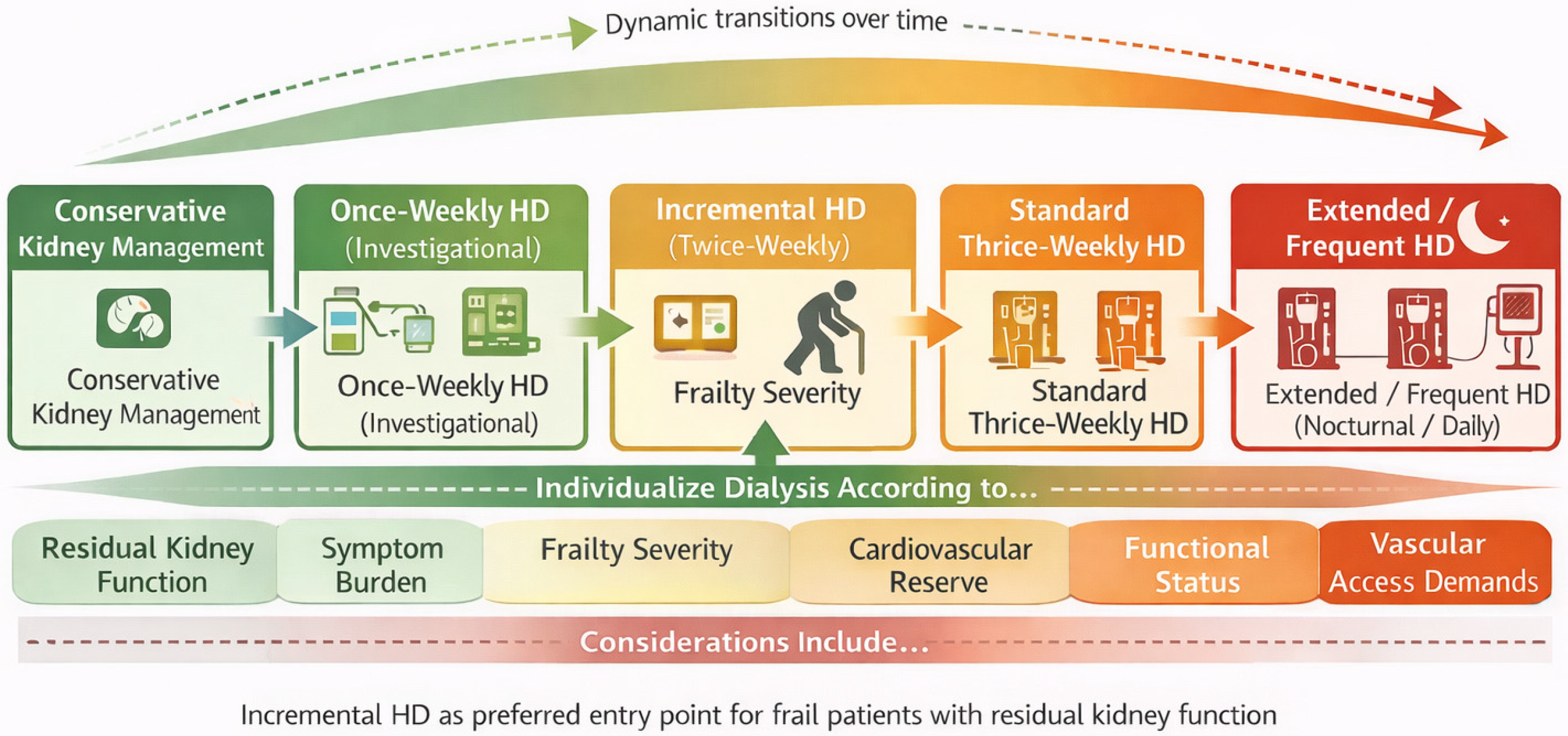
| Incremental Hemodialysis | Twice-weekly initially, transition to 3×/week as residual function declines | Lower treatment burden, preserves residual kidney function, reduced vascular access trauma, decreased intradialytic complications. Particularly relevant for patients with residual function and higher treatment burden. | [39,40,41] |
| Once-weekly Hemodialysis | 1×/week (investigational) | Feasible in patients with significant residual function when combined with aggressive dietary management and close monitoring. Still primarily research setting. | [42] |
| Extended Hours Options | Nocturnal (6–8 h, 3–6×/week) or short daily (2–3 h, 5–6×/week) | Gentler ultrafiltration, better hemodynamic stability for nocturnal. Limited applicability in frail populations due to prolonged immobility concerns, increased access demands, and time burden. | [43,44] |
| Strategy | Implementation Details | References |
|---|---|---|
| Extended Treatment Time | Increase session duration from 3.5 to 4.5–5 h. Proportionally reduces UFR, improves hemodynamic stability. DOPPS demonstrated associations between longer treatment time and reduced mortality. | [57] |
| Increased Frequency | Four times weekly schedule distributes fluid removal across additional sessions, reducing per-session UFR. Benefits patients with large interdialytic weight gains who cannot extend individual sessions. | [64] |
| Dry Weight Optimization | Rigorous assessment using clinical criteria (blood pressure patterns, edema, dyspnea, post-dialysis fatigue) combined with bioimpedance analysis. Regular reassessment prevents pursuing unrealistic targets. | [58] |
| Dietary Management | Sodium restriction and interdialytic fluid intake education reduce weight gain between sessions, permitting lower UFR. Loop diuretics may assist volume control in patients with residual function. | [64] |
| Cool Dialysate | Temperature reduction to 35.5 °C versus 37 °C reduces intradialytic hypotension incidence by minimizing vasodilation. | [59] |
| Dialysate Profiling | Adjusting sodium and bicarbonate composition during session may improve hemodynamic stability, though evidence remains mixed. | [60] |
| Blood Volume Monitoring | Hematocrit or relative blood volume measurement systems trigger UFR adjustments, reducing hypotension risk. | [65] |
| Access Type | Characteristics in Older Patients | Considerations for Frail Patients | References |
|---|---|---|---|
| Arteriovenous Fistula (AVF) | Maturation time: 2–6 months. Primary failure rates: 20–60% overall, up to 42.1% for radiocephalic in octogenarians vs. 5.6% for brachiocephalic. Superior long-term patency when successful. | Prolonged catheter dependence during maturation. High failure rates in older individuals vascular disease. May not benefit patients with life expectancy <12–18 months. Proximal AVF preferred over distal when pursued. | [69,70,71] |
| Arteriovenous Graft (AVG) | Shorter maturation (2–4 weeks). Lower primary failure than AVF in older individuals. Higher intervention rates than AVF but less catheter dependence time. | Appropriate for life expectancy 12–24 months requiring permanent access. Reduced maturation time versus AVF. Suitable option for patients with poor vessels or high AVF failure risk. | [72,73] |
| Central Venous Catheter (CVC) | Immediate usability. Higher infection risk. Lower patency than permanent access. Associated with increased mortality when compared to AVF/AVG long-term. | Consider as definitive access for life expectancy <12 months or poor surgical candidacy. Avoids procedures unlikely to yield benefit. Spares very frail patients from surgical risk. | [77] |
| Frailty-Guided Selection | Frail and very frail patients show higher AVF non-maturation rates, shorter survival, higher mortality within 3 years of access creation. | 2019 KDOQI update advocates life-plan approach with shared decision-making incorporating life expectancy, frailty status, vascular anatomy, and patient preferences rather than universal fistula-first. | [74,76] |
| Membrane Type | Materials | Advantages in Older Adults | Limitations | Indications | References |
|---|---|---|---|---|---|
| High-Flux Synthetic |
|
|
| Standard for older individuals with CV comorbidity, diabetes, low albumin | [23,78,79,80,81,83,84,85] |
| Medium Cut-Off (MCO) |
|
|
| Older individuals with CVC, difficult AVF maturation, limited achievableQb | [88,89,90,92,93,95] |
| Vitamin E-coated |
|
|
| Older individuals with high oxidative stress, EPO-resistant anemia | [104,105,106,107] |
| PMMA (Adsorptive) |
|
|
| Older individuals with high inflammation, severe uremic pruritus | [108,109,110,111,112,113,114] |
| Asymmetric Cellulose Triacetate (ATA) |
|
|
| Older individuals with bleeding risk requiring reduced anticoagulation, synthetic membrane allergy | [115,116,117,118] |
| Domain | Personalization Strategies | References |
|---|---|---|
| Initial Assessment | Integrate frailty screening into pre-dialysis evaluation using validated tools (CFS for rapid scoring, FRAIL scale < 5 min). Comprehensive geriatric evaluation including medication review, fall risk, cognitive screening when frailty identified. | [22] |
| Dialysis Prescription | Match intensity to individual circumstances: incremental HD (twice-weekly initially) for patients with residual function and minimal symptoms; standard thrice-weekly for anuric patients with modified session duration/UFR as needed. Consider residual renal function, interdialytic weight gain, functional status, symptom burden, patient preferences. | [39,40,42] |
| Ultrafiltration Management | Prioritize avoiding intradialytic hypotension over aggressive dry weight targets. Employ longer sessions, increased frequency, rigorous dry weight assessment with bioimpedance, sodium/fluid restriction education, cool dialysate (35.5 °C), blood volume monitoring. Accept modest volume excess when alternative is symptomatic hypotension and debilitating fatigue. | [57,58,59,65] |
| Vascular Access Selection | Life-plan approach: AVG for life expectancy 12–24 months requiring permanent access; tunneled catheter as definitive access for <12 months life expectancy or poor surgical candidacy; proximal AVF over distal when AVF pursued in older individuals. Incorporate frailty assessment, life expectancy estimation, patient preferences through shared decision-making. | [74,76,77] |
| Conservative Management Option | Appropriate candidates: ≥80 years with multiple comorbidities, very high frailty scores, severe functional impairment, dementia or terminal illness, patients prioritizing quality over quantity after informed discussion. Comprehensive non-dialytic management with symptom control, advance care planning, regular monitoring. | [119,139,140] |
| Shared Decision-Making | Structured process incorporating prognosis discussion with realistic survival estimates, treatment burden description, values clarification exploring patient priorities, decision support tools, family involvement, allowance for reassessment. Move from default dialysis initiation toward individualized assessment of goal alignment. | [9,144,145] |
Disclaimer/Publisher’s Note: The statements, opinions and data contained in all publications are solely those of the individual author(s) and contributor(s) and not of MDPI and/or the editor(s). MDPI and/or the editor(s) disclaim responsibility for any injury to people or property resulting from any ideas, methods, instructions or products referred to in the content. |
© 2026 by the authors. Licensee MDPI, Basel, Switzerland. This article is an open access article distributed under the terms and conditions of the Creative Commons Attribution (CC BY) license.
Share and Cite
Gembillo, G.; Soraci, L.; Floris, M.; Lo Cicero, L.; Lo Re, C.; Filicetti, E.; Calderone, M.; Benenati, C.G.; Corsonello, A.; Santoro, D. Personalized Hemodialysis Approaches in Frail Older Individuals. Geriatrics 2026, 11, 40. https://doi.org/10.3390/geriatrics11020040
Gembillo G, Soraci L, Floris M, Lo Cicero L, Lo Re C, Filicetti E, Calderone M, Benenati CG, Corsonello A, Santoro D. Personalized Hemodialysis Approaches in Frail Older Individuals. Geriatrics. 2026; 11(2):40. https://doi.org/10.3390/geriatrics11020040
Chicago/Turabian StyleGembillo, Guido, Luca Soraci, Matteo Floris, Lorenzo Lo Cicero, Claudia Lo Re, Elvira Filicetti, Michela Calderone, Carmelo Giorgio Benenati, Andrea Corsonello, and Domenico Santoro. 2026. "Personalized Hemodialysis Approaches in Frail Older Individuals" Geriatrics 11, no. 2: 40. https://doi.org/10.3390/geriatrics11020040
APA StyleGembillo, G., Soraci, L., Floris, M., Lo Cicero, L., Lo Re, C., Filicetti, E., Calderone, M., Benenati, C. G., Corsonello, A., & Santoro, D. (2026). Personalized Hemodialysis Approaches in Frail Older Individuals. Geriatrics, 11(2), 40. https://doi.org/10.3390/geriatrics11020040

