In traditional nutrition research, DF has long been regarded as an anti-nutritional factor because it cannot be degraded by endogenous digestive enzymes and may reduce nutrient digestibility. Therefore, diets formulated for monogastric animals, particularly growing pigs, have typically contained relatively low levels of DF, generally ranging from approximately 8% to 15% total dietary fiber depending on the production stage and feeding objective [
24,
25]. Although monogastric animals cannot directly utilize DF, gut microorganisms possess the capacity to ferment fiber substrates, producing beneficial microbial metabolites that may exert probiotic effects on the host [
25]. At present, the application of DF in swine nutrition remains challenging, as multiple factors must be considered, including the wide variety of fiber sources, the complexity of fiber composition, and differences among pig breeds [
26]. In this study, wheat bran was partially replaced with PWCF to assess the effects of dietary fiber supplementation on growth performance, immune status, nutrient digestibility, and gut microbiota in growing pigs.
4.1. Partial Replacement of Wheat Bran with PWCF Did Not Affect Growth Performance in Growing Pigs
DF levels in pig diets are often restricted because of their potential anti-nutritional properties, which may reduce the digestibility of protein and energy [
27]. In the present study, partial replacement of wheat bran with PWCF did not adversely affect average daily gain or feed conversion ratio in growing pigs. These findings suggest that PWCF can be incorporated at a low inclusion level without compromising growth performance. Consistent with our results, Wang et al. reported that pigs fed diets containing 5%, 10%, or 15% alfalfa meal exhibited improved feed utilization efficiency, whereas ADFI and ADG were not significantly affected [
28]. Together, these results indicate that moderate inclusion of predominantly insoluble lignocellulosic fiber sources, such as PWCF, can be well tolerated by growing pigs and does not necessarily impair productive performance under practical feeding conditions. Consistent with the present findings, previous studies have reported that moderate inclusion of insoluble dietary fiber sources, including wheat bran, sugar beet pulp, and soybean hulls, generally does not impair growth performance in growing pigs when total dietary fiber levels are maintained within practical feeding ranges. The increased utilization of threonine for mucin synthesis may be particularly relevant in the present study, as PWCF supplementation improved intestinal health indicators, suggesting enhanced mucus barrier activity and epithelial maintenance. However, other research has reported that high-fiber diets may reduce ADG and increase the F: G. For instance, when DF levels increased from 5% to 7%, ADG was significantly decreased in growing pigs [
29,
30]. These results indicate that excessive DF inclusion can exert negative effects on growth performance. Similarly, pigs fed high-fiber diets have been reported to exhibit poorer growth outcomes, including reduced carcass weight and dressing percentage, as well as a higher carcass fat iodine value [
31]. Such adverse effects may be attributed to the fact that DF can increase digesta viscosity and limit interactions between nutrients and digestive enzymes in the small intestine, thereby reducing nutrient digestion and absorption [
32].
4.2. Partial Replacement of Wheat Bran with PWCF Did Not Affect the Apparent Total Tract Digestibility of Nutrients in Growing Pigs
Apparent total tract digestibility is an important indicator for evaluating feed efficiency, improving swine production performance, and reducing environmental burden [
33]. Previous studies have shown that increasing DF levels to 6.86% significantly decreased the digestibility of CP, EE, CF, and ADF in growing pigs [
34]. Similarly, in corn-based diets, increasing DF content resulted in a linear reduction in the ATTD of CP, DM, ash, and organic matter [
35]. This decline may be attributed to the increased proportion of plant cell wall components associated with DF sources, which are generally resistant to digestion [
36]. Other studies have also reported that the digestibility of DM, GE, and NDF decreases as DF levels increase in growing pig diets [
37]. In addition, DF fractions have been negatively correlated with DE and metabolizable energy concentrations, indicating that high-fiber diets may reduce energy utilization in pigs [
38]. However, in the present study, supplementation with PWCF did not exert any negative effects on ATTD, suggesting that this fiber source can effectively substitute wheat bran at the tested inclusion level. It is noteworthy that PWCF contained a relatively high ash content (30.13%) compared with many conventional dietary fiber sources. This characteristic may reflect the naturally occurring mineral fraction associated with poplar wood and the compositional properties of the processed fiber product. Despite the elevated ash content, no adverse effects were observed on nutrient digestibility, growth performance, serum biochemical parameters, or intestinal health indicators in the present study. These findings suggest that the mineral fraction of PWCF was well tolerated at the dietary inclusion level evaluated. Nevertheless, further characterization of the mineral composition and bioavailability of PWCF is warranted to better understand its nutritional contribution and potential physiological implications.
4.3. Effects of Partial Replacement of Wheat Bran with PWCF on Immune Function and Serum Biochemical Parameters in Growing Pigs
The content of immunoglobulins in serum can directly reflect the immune capacity of the organism. In the present study, supplementation of PWCF in the diet to partially replace wheat bran exerted no adverse effects on the immune capacity of growing pigs. However, several studies have shown that high-fiber diets reduce the contents of IgM and IgG in the plasma of growing pigs, impair their immune capacity, and induce certain intestinal damage [
26]. Relevant studies have demonstrated that TP is closely associated with protein absorption and utilization [
39]. Meanwhile, GLU, TG, LDL, HDL, TC, and other lipid metabolism indices are closely associated with fat deposition and metabolism in pigs [
40]. Previous studies have shown that reductions in serum glucose and triglyceride concentrations are often observed in diets containing high levels of soluble dietary fiber, which can increase digesta viscosity and slow the diffusion and absorption of glucose and lipids across the intestinal epithelium [
41,
42]. In the present experiment, supplementation of PWCF in the diet did not reduce the contents of GLU and TG, which indicates that dietary supplementation of this fiber exerts no adverse effects on lipid absorption in growing pigs. Meanwhile, serum CAT concentration was significantly increased in growing pigs on day 30. Although CAT does not directly participate in nitrogen metabolism, its role in scavenging H
2O
2, protecting nitrogen-metabolizing enzymes, and maintaining redox homeostasis may indirectly contribute to the normal progression of nitrogen metabolism [
43].
4.4. Effects of Partial Replacement of Wheat Bran with PWCF on Nitrogen Metabolism in Growing Pigs
BUN is negatively correlated with dietary efficiency and lean tissue deposition [
44]. Therefore, plasma BUN concentration serves as an indicator of dietary protein supply and utilization [
45]. Supplementation of PWCF in the present study reduced serum BUN concentration, which is consistent with the findings of Malmlöf and Lenis et al., who reported that feeding high-fiber diets decreased the postprandial mean concentrations of urea in portal and arterial blood in pigs [
46,
47]. However, the results of the present study are also in contrast to those of Van Der Meulen (1997), who demonstrated that when corn starch was completely replaced with raw potato starch in growing pigs, the postprandial mean concentrations of urea in portal and arterial blood were increased compared with the low-fiber control group [
48]. Changes in blood urea concentration depend on the dietary protein level and the fermentability of DF [
49]. Therefore, based on the concept of ideal protein ratio, the use of DF combined with a reduced dietary protein level may lower the BUN concentration, thereby decreasing urea excretion via urine. In summary, compared with other DF, PWCF can effectively replace wheat bran and reduce the content of BUN in the serum of growing pigs.
The BUN/creatinine ratio is considered a sensitive indicator for evaluating protein catabolism, and its variation depends on the balance between BUN production and creatinine excretion [
50]. In the present study, no significant difference in the BUN/creatinine ratio was observed between the two groups on day 30, whereas the ratio was significantly lower in the FF group on day 60. This change was primarily driven by the declining trend in BUN, while creatinine concentration remained stable throughout the experimental period. This indicates that the decline in this ratio might be attributed to the reduction in protein metabolism [
51]. Mechanistically, long-term FF treatment may suppress muscle protein degradation or amino acid deamination, thereby reducing ammonia production and subsequently decreasing hepatic urea synthesis, which ultimately leads to a lower BUN concentration. However, further studies are needed to confirm this hypothesis, as nitrogen balance, urinary nitrogen excretion, and hepatic metabolism were not directly measured in the present study.
As a precursor for urea synthesis, blood ammonia can help explain the mechanism underlying the decrease in BUN [
52]. In the present study, blood ammonia concentration did not differ significantly between the two groups and did not decrease in parallel with BUN. This may suggest that reduced ammonia generation was not the sole direct cause of the decline in BUN. At the same time, the stable blood ammonia concentration indicates that FF treatment did not impair hepatic ammonia detoxification capacity, thereby maintaining a safe and stable nitrogen metabolic state.
The plasma amino acid profile directly reflects amino acid metabolic homeostasis [
53]. On day 30, FF treatment only tended to reduce total amino acid concentration, indicating that the animals may have maintained metabolic balance through compensatory regulation. However, on day 60, TFAA concentration was significantly reduced, with threonine showing a particularly marked decline. The decrease in total amino acids may suggest alterations in amino acid metabolism or utilization. Potential explanations could include changes in amino acid transport, intestinal absorption, or metabolic partitioning; however, these mechanisms were not directly assessed in the present study and therefore remain speculative. The concurrent reductions in total amino acids and BUN may indicate an influence of PWCF supplementation on nitrogen metabolism, although the underlying physiological mechanisms remain unclear. In addition, the decrease in essential amino acids may reflect altered amino acid availability, but its effects on protein metabolism require further investigation [
54]. As an essential amino acid, threonine plays a critical role in intestinal health because it is a major constituent of mucin glycoproteins secreted by goblet cells [
55]. Therefore, the reduced serum threonine concentration observed in the FF group may also reflect altered intestinal utilization associated with mucin synthesis and turnover. However, this possibility was not directly evaluated in the present study and requires further investigation.
In summary, FF treatment reduced BUN concentration and the BUN/creatinine ratio, indicating altered nitrogen metabolism. In addition, FF treatment was associated with lower serum TFAA and threonine concentrations, suggesting changes in amino acid utilization and metabolic homeostasis. Notably, blood ammonia concentration remained unchanged, indicating that FF supplementation did not adversely affect nitrogen metabolic status.
4.5. Effects of Partial Replacement of Wheat Bran with PWCF on Gut Microbiota in Growing Pigs
The gut microbial community is composed of various bacterial species in specific proportions, among which interspecific interactions constrain each other’s functions and enable mutual dependence to establish an ecological balance [
56]. The gut microbiota plays a pivotal role in the interactions between diet and host physiology and represents one of the most important determinants of intestinal health [
57]. DF acts as a substrate during fermentation and facilitates the proliferation of selective microbiota, thereby leading to alterations in the composition of the gut microbiota [
24]. It has been well established that DF exerts a positive effect on maintaining the diversity of the gut microbial community and intestinal health in pigs [
58]. PWCF is rich in hemicellulose dominated by xylan, which has a main chain composed of xylose residues, simple side chains, and a low degree of branching, making it an excellent carbon source for intestinal fiber-degrading bacteria [
59].
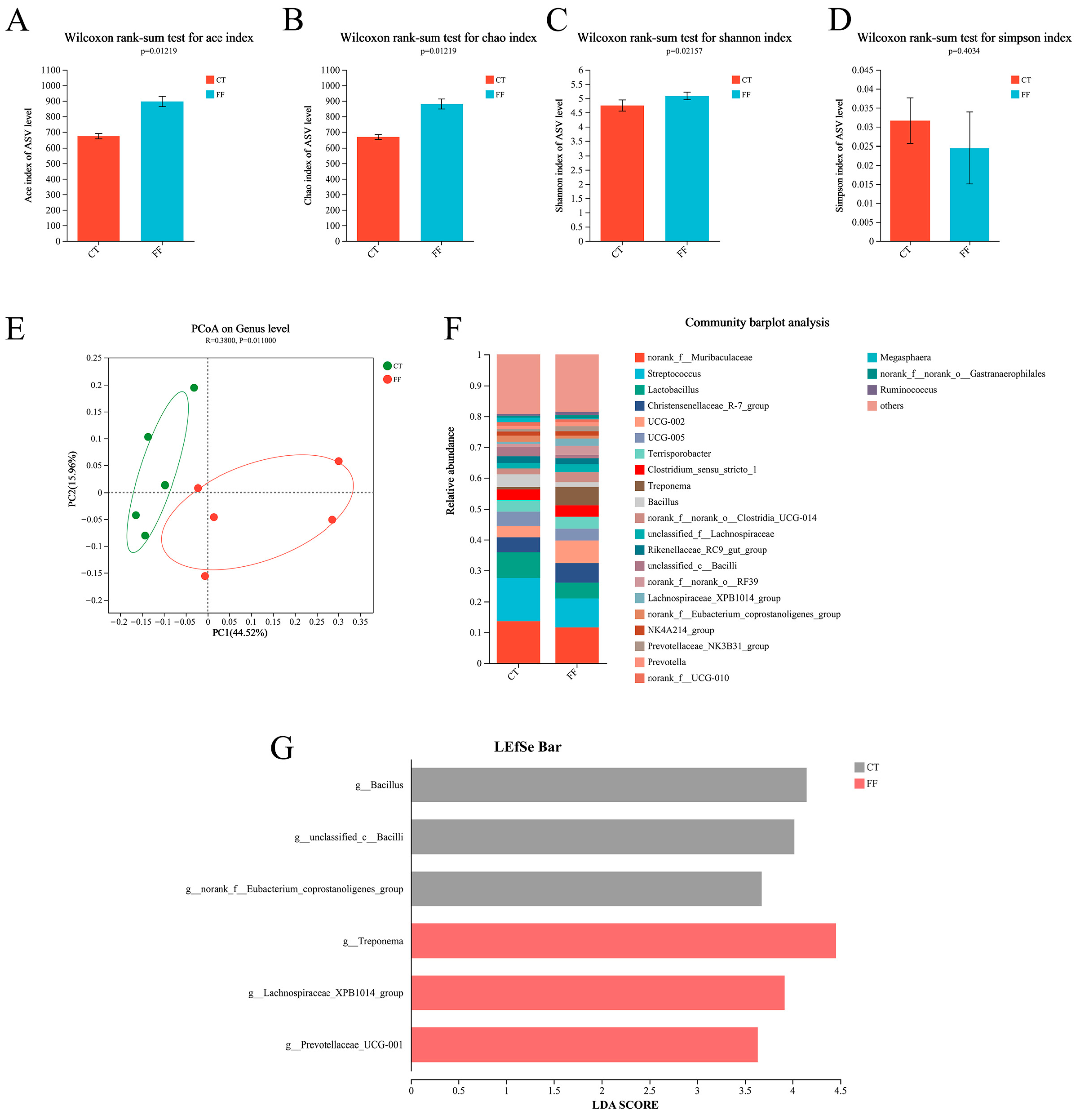
Compared with the CT group, the FF group exhibited a higher relative abundance of
Treponema, Lachnospiraceae, and Prevotellaceae.
Treponema is a typical fiber-degrading spirochete whose genome is enriched in coding genes for xylanase, endoglucanase, and other hydrolases, enabling it to efficiently hydrolyze the xylan backbone. The high xylan content in poplar wood provides a specific substrate for this genus, allowing it to dominate the fiber-degrading ecological niche [
60]. Although wheat bran also contains arabinoxylan, it has numerous and highly branched side chains, making it more readily utilized by rapidly fermenting bacteria (e.g.,
Lactobacillus, Ruminococcaceae), and thus it exhibits lower selectivity for such fiber-degrading bacteria than the high xylan in poplar wood [
61]. Meanwhile, PWCF contains a certain proportion of lignin yet does not reach a high degree of lignification; it is mainly distributed in the intercellular layers and cell corners, forming a “fiber–lignin” composite structure [
62]. Prevotellaceae is sensitive to fluctuations in ammonia concentration and pH [
63]. Moderate lignin retards protein degradation and reduces ammonia accumulation, thus favoring its growth more, whereas wheat bran, with a high protein content and rapid fermentation, easily leads to elevated ammonia concentrations and inhibits Prevotellaceae [
64].
Relevant studies have demonstrated that
Treponema, Lachnospiraceae, and Prevotellaceae are common xylan-degrading genera and families with abundant xylanases, indicating that supplementation with PWCF can effectively increase the relative abundance of DF-degrading genera [
60,
65,
66,
67]. Wang et al. also reported similar findings that the proportions of Prevotellaceae and Lachnospiraceae are positively correlated with DF intake. These bacterial families are associated with the fermentation of plant-derived non-starch polysaccharides into short-chain fatty acids (SCFAs).
Treponema has been reported to participate in the degradation of dietary fiber. However, fermentation metabolites, intestinal pH, pathogen abundance, nutrient absorption, and intestinal health indicators were not evaluated in the present study [
68]. Therefore, whether the increased abundance of
Treponema resulted in functional changes in the intestinal environment remains to be determined.
Likewise, several studies have demonstrated that DF supplementation in the diet promotes the growth of beneficial bacteria (e.g., Lachnospiraceae and Prevotellaceae) and inhibits the growth of pathogenic bacteria, thereby exerting a certain anti-inflammatory effect. This finding is consistent with the results of the present study: the proportion of Lachnospira in the FF group was significantly higher than that in the CT group, suggesting that DF supplementation may influence the composition of the gut microbial community. However, its effects on intestinal inflammation and microbial dysbiosis were not directly assessed in the present study [
69,
70].
The present study only analyzed the changes in the relative abundance of Treponema, Lachnospiraceae, and Prevotellaceae, but did not determine their core metabolites, especially SCFAs such as acetic acid, propionic acid, and butyric acid, making it impossible to directly verify whether the alterations in microbial abundance are actually translated into differences in metabolic functions. These results indicated that PWCF can alter the composition of the gut microbiota and increase the relative abundance of bacterial genera capable of degrading PWCF, whereas whether it exerts beneficial effects on intestinal barrier function requires further investigation.