1. Introduction
Skeletal muscle tissue is the most abundant tissue in the body, accounting for approximately 40% of an animal’s weight [
1,
2]. Satellite cells are important adult stem cells in mammalian skeletal muscle, responsible for muscle fiber growth, regeneration, and damage repair [
3]. In agriculturally important animals (e.g., pigs, cattle, sheep, chickens), the proliferation and differentiation capacity of satellite cells are directly related to muscle development efficiency and meat production performance [
4]. Isolated primary satellite cells are challenging to culture in vitro due to their tendency to undergo proliferation arrest and spontaneous differentiation, as well as their limited passage capacity. These limitations severely restrict their application in studies of muscle development mechanisms, nutritional regulation, and disease modeling [
5]. The Junmu No.1 White pig is a hybrid of Belgian Seghers hybrid boars and Chinese Sanjiang hybrid sows [
6], characterized by rapid growth, high lean meat percentage, outstanding feed efficiency, strong adaptability, and the ability to quickly produce high-quality commercial pigs that meet market demands when crossed with Large White pigs. A stable and functionally intact immortalized porcine satellite cell (PSC) line is therefore needed to provide a consistent genetic background and sufficient cell numbers for studying the genetic regulation of muscle development in pigs.
The construction of immortalized cell lines often relies on viral-derived oncogenes (such as SV40 large T antigen/SV40LT), telomerase activation (hTERT) or spontaneous mutations leading to immortalization [
7]. In bovine intestinal epithelial cells, hTERT-based immortalization successfully preserved barrier function and pathogen responsiveness [
2]. SV40LT-mediated immortalization technology has also been widely used in human, mouse myocytes, and porcine skeletal muscle satellite cell research [
8]. The successful establishment of immortalized satellite cell lines from Western commercial pigs [
8], together with the generation of a porcine enteric smooth muscle cell line via lentiviral transduction of SV40 large T antigen [
9], strongly supports the feasibility and validity of our technical strategy for immortalizing Junmu No.1 white pig satellite cells.
Despite the well-established utility of immortalized cell lines in biomedical research, relatively few immortalized satellite cell lines have been generated from livestock species, particularly pigs (
Table 1). The murine C2C12 line, spontaneously immortalized from dystrophic mouse satellite cells, has served as the predominant in vitro model for myogenesis studies for over four decades [
10]. In porcine species, Jiang et al. established an SV40LT-immortalized enteric smooth muscle cell line from Yorkshire pigs [
9], and Ni et al. recently generated an immortalized skeletal muscle satellite cell line from Large White pigs [
8]. In bovine species, Ji et al. created SV40LT-immortalized rumen epithelial cells [
2], while Stout et al. employed a dual bTERT/CDK4 strategy to immortalize bovine satellite cells for cultured meat applications [
11]. Notably, no immortalized satellite cell lines have been established from Chinese indigenous pig breeds, which possess distinct genetic backgrounds and muscle development characteristics compared to Western commercial breeds. The Junmu No.1 pig, a hybrid derived from Belgian Seghers hybrid boars and Chinese Sanjiang hybrid sows [
6], represents a valuable genetic resource for which, to our knowledge, no immortalized in vitro satellite cell model has yet been reported.
This study aims to establish an immortalized porcine satellite cell line from Junmu No.1 pigs (imPSC-JM) through lentivirus-mediated stable transfection of the SV40LT gene. We will then systematically evaluate its proliferative characteristics, stem cell marker expression, and myogenic differentiation potential through both qualitative and quantitative comparisons with primary PSCs. The ultimate goal is to create a genetically stable, long-term passaging PSC model that can provide a continuous and reliable in vitro research resource for studying the genetic mechanisms underlying muscle development in our specific pig breed.
2. Materials and Methods
2.1. Cell Isolation and Culture
All animal procedures in this study were reviewed and approved by the Institutional Animal Care and Use Committee (IACUC) of Jilin University (Approval No. SY202506050). All procedures were performed in strict accordance with the Guidelines for the Welfare and Ethical Review of Laboratory Animals (GB/T 35892-2018) of the People’s Republic of China and the Guide for the Care and Use of Laboratory Animals (8th edition) of the U.S. National Research Council. The study adhered to the 3R principle (Replacement, Reduction, Refinement) to minimize animal suffering and the number of animals used. A two-day-old male Junmu No.1 White pig was selected for satellite cell isolation based on the following considerations. Neonatal piglets (1–3 days old) possess a high proportion of Pax7-positive satellite cells relative to total myonuclei, as satellite cell abundance declines rapidly during postnatal muscle maturation [
12]. This developmental stage provides an optimal balance between cell yield and proliferative capacity, as satellite cells from neonatal animals exhibit higher proliferative potential compared to those isolated from older animals [
13]. Similar age selections have been employed in previous porcine satellite cell studies: Ni et al. used 3-day-old Large White piglets [
8], and Wang et al. isolated satellite cells from newborn piglets [
5]. Our choice of 2-day-old animals is consistent with these established protocols and ensures maximal satellite cell yield prior to the onset of significant postnatal quiescence.
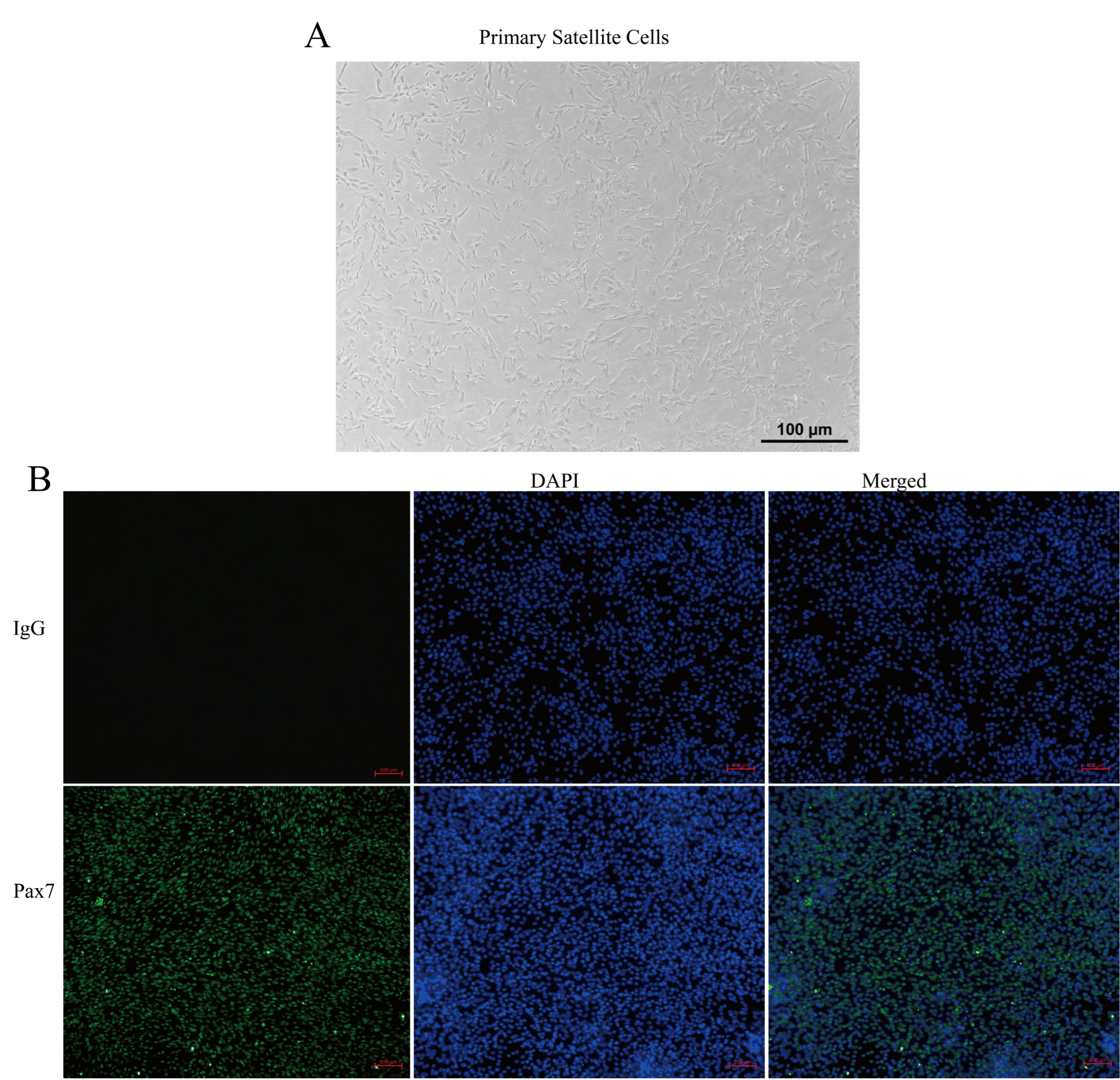
The selected piglet was euthanized at the Jilin University Agricultural Experiment Base following humane slaughter practices, and the musculus longissimus dorsi was collected. The back skin was incised along the ribs, and the longissimus dorsi muscles on both sides of the spine were removed. Fascia and fat were carefully trimmed away. The muscles were washed 3–5 times with pre-chilled PBS buffer supplemented with 5% antibiotic–antimycotic (Thermo Fisher Scientific, Waltham, MA, USA, 15240062) until no blood was visible. The longissimus dorsi muscle was cut into small pieces and digested in 0.2% type II collagenase (Thermo Fisher Scientific, USA, 17101015) in a shaking water bath at 37 °C for 2 h. The supernatant cell suspension was washed with Dulbecco’s modified eagle medium (DMEM) high glucose medium (Servicebio, Wuhan, China, G4511) supplemented with 1% antibiotic–antimycotic, and then sequentially filtered through 100 μm, 70 μm, and 40 μm filters (BD (Becton Dickinson), Franklin Lakes, NJ, USA, 352360, 352350, 352340) to remove tissue debris. The cells were resuspended in DMEM/F-12 medium (Servicebio, China, G4610) supplemented with 15% FBS (Pricella, Wuhan, China, 164210-50), 1% non-essential amino acids (Pricella, PB180424), 1% GlutaMax (Thermo Fisher Scientific, USA, 35050061), 1% antibiotic–antimycotic, and 2.5 ng/mL thermally stable recombinant human bFGF/FGF-2 protein (Yeasen, Shanghai, China, 91334ES60). The mixed cells were cultured in a culture dish for 2 h to remove fibroblasts by differential adhesion. All culture plates and flasks used in this study were pre-coated with Matrigel (BD, 356234) overnight at 4 °C prior to cell seeding. The purified satellite cells were transferred to new culture flasks for proliferation culture. At ~70% confluency, the proliferation medium was replaced with differentiation medium supplemented with 2% horse serum (Thermo Fisher Scientific, USA, 26050070) and 1% antibiotic–antimycotic to induce PSC to differentiate. The state of induced differentiation was observed from 24 h to 96 h.
2.2. Initial PSC Characterization
To assess proliferating PSC, the p2 PSC were seeded at a density of 5 × 10
4 cells/well in 24-well plates and cultured to 70% confluency, fixed in 4% paraformaldehyde (Beyotime, Shanghai, China, P0099) for 30 min, washed three times with DPBS, permeabilized with permeabilization buffer (Beyotime, China, P0096) for 30 min, washed three times with wash buffer (Beyotime, China, P0106), and blocked with blocking buffer (Beyotime, China, P0260) at 37 °C for 1 h. Primary antibodies against PAX7 (paired box 7) and MYOD1 (myogenic differentiation 1) were diluted 1:200 in blocking buffer and incubated with the cells overnight at 4 °C. The next day, the cells were washed three times with PBST and incubated for 1 h at room temperature with secondary antibodies (Proteintech #RGAR002 for PAX7, 1:1000; Proteintech #RGAM004 for MYOD1, 1:1000) and DAPI (4’,6-diamidino-2-phenylindole) nuclear stain (Abcam #ab104139, Cambridge, UK; 1:1000) diluted in blocking buffer. Finally, the cells were washed three times and imaged using a Zeiss fluorescence microscope (Axio Vert.A1, Carl Zeiss AG, Oberkochen, Germany). All antibody information is provided in
Supplementary File S2.
2.3. Plasmid Construction and Lentiviral Packaging
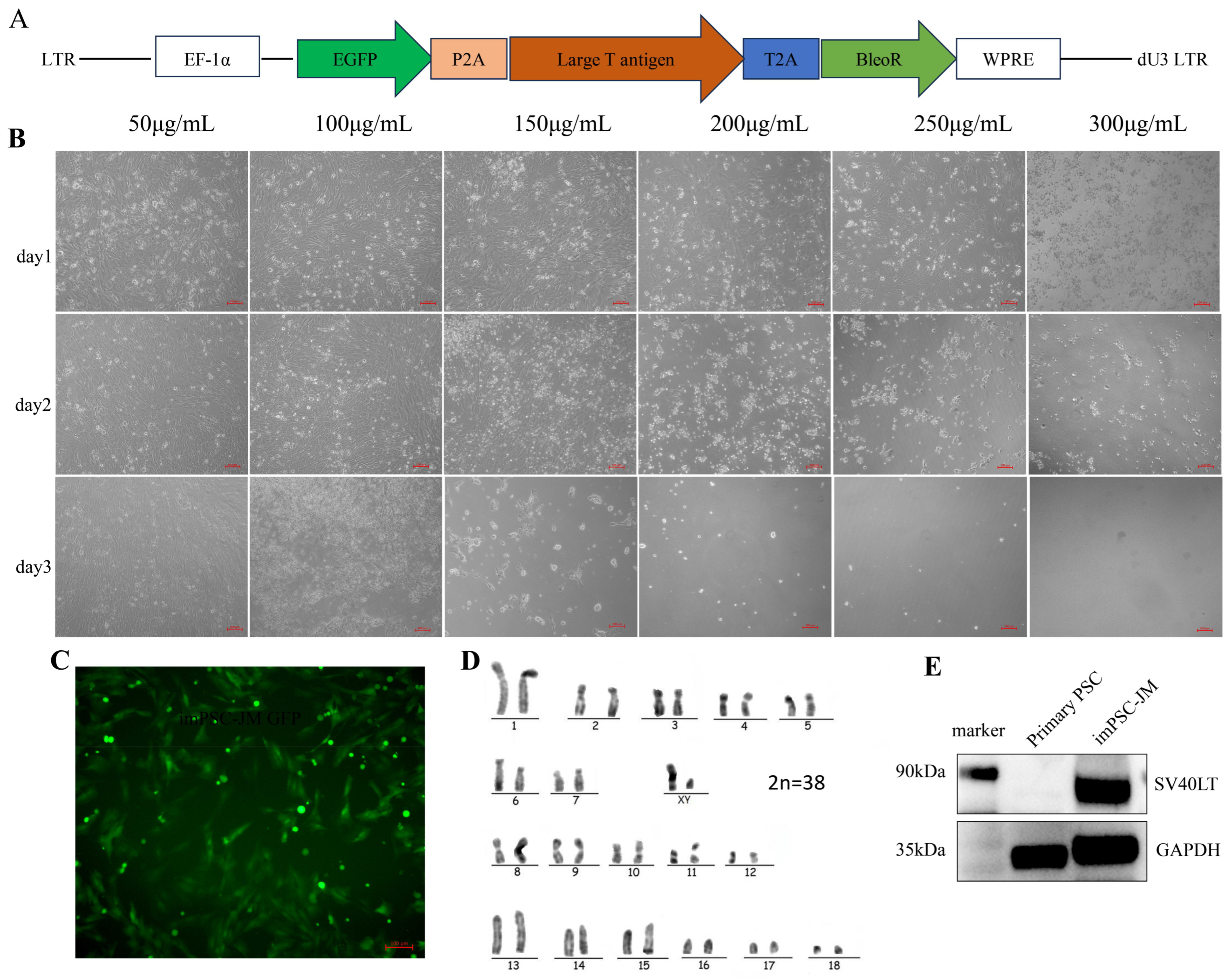
The Large T antigen gene (SV40LT, Gene ID: 29031019) was obtained from the pHAGE2-TetOminiCMV-SV40LT plasmid ( Addgene#136616, Watertown, MA, USA) by high-fidelity PCR. The SV40LT gene was inserted into a lentiviral vector derived in our laboratory by modifying pHAGE-EF1α-eGFP-W (Addgene #126686). The newly constructed plasmid contains SV40LT and the BleoR gene, encoding zeocin resistance for selection after viral transduction, separated by P2A (Porcine teschovirus 2A self-cleaving peptides) and T2A (Thosea asigna virus 2A self-cleaving peptides) peptide sequences, respectively. The plasmid was named pHAGE-EF1α-eGFP-SV40LT-BleoR and sequence is available in the
Supplementary File S1. All cloning steps were performed using homologous recombination, including fragment amplification with PrimeSTAR Max DNA Polymerase Ver.2 (Takara Bio, Kusatsu, Japan, #R047), PCR purification (Promega, Madison, WI, USA, A9282), In-Fusion assembly (Takara Bio, Japan, 639649), and transformation into chemically competent
E. coli (Takara Bio, Japan, 9057), all according to the manufacturers’ instructions. The assembly was verified by Sanger sequencing (Sangon Biotech, Shanghai, China), and the plasmid was purified at a large scale using a TIANGEN EndoFree Maxi Plasmid Kit (Tiangen, Beijing, China, DP117).
Lentiviral vectors were produced using the third-generation packaging system in 293T cells (ATCC, CRL-3216). Cells were seeded at a density of 6 × 10⁶ cells per 10 cm dish in DMEM supplemented with 10% fetal bovine serum (FBS) and 1% penicillin-streptomycin. When cells reached 70–80% confluence, they were transfected with the transfer plasmid encoding the gene of interest, along with the packaging plasmids pMDLg/pRRE, pRSV-Rev, and the envelope plasmid pMD2.G, at a ratio of 4:2:1:1 (w/w), using polyethyleneimine (PEI max, Polyscience, Warrington, PA, USA, 24765).
The transfection mix was prepared in Opti-MEM (Thermo Fisher Scientific, USA, 51985034) and incubated for 20 min at room temperature before adding to the cells. Culture supernatants containing lentiviral particles were harvested 48 h and 72 h post-transfection and filtered through a 0.45 µm filter to remove cell debris. Viral titers were determined by transducing HEK293T cells and analyzing GFP expression 72 h post-infection by flow cytometry (Sony, Tokyo, Japan, SA3800). The virus was then diluted to 106 IU/mL in culture medium and stored at −80 degrees Celsius for future use. All experiments were performed under biosafety level 2 (BSL-2) conditions in accordance with institutional guidelines.
2.4. Cell Transfection and Screening
PSCs were detached using 0.25% Trypsin–EDTA (Thermo Fisher Scientific, USA, 25200056) and seeded at a density of 5 × 10⁵ cells/well in 6-well plates. To determine the optimal Zeocin concentration for stable cell selection, cells at approximately 50% confluency were cultured in growth medium supplemented with Zeocin (Beyotime, China, ST1450) at final concentrations of 50, 100, 150, 200, 250 or 300 μg/mL. The medium was replaced daily for three consecutive days, and 200 μg/mL Zeocin, identified as the lowest concentration resulting in complete cell death, was selected and used for all subsequent experiments.
For lentiviral transduction, cells were seeded at a density of 5 × 10⁵ cells/well in 6-well plates and cultured to approximately 50% confluency. The medium was then replaced with fresh growth medium containing 10 μg/mL Polybrene (Beyotime, China, C0351) and Lenti-EGFP-SV40LT virus at a final titer of 1 × 10⁶ IU/mL. This lentiviral vector encodes the SV40 large T antigen and a Zeocin resistance gene. After overnight incubation, the viral supernatant was replaced with fresh growth medium.
At 72 h post-transduction, cells were subjected to selection using growth medium supplemented with 200 μg/mL Zeocin. Selection was maintained for 7 days, with medium changes every 2 days, until all non-transduced cells were eliminated.
2.5. Long-Term Growth Curve Determination
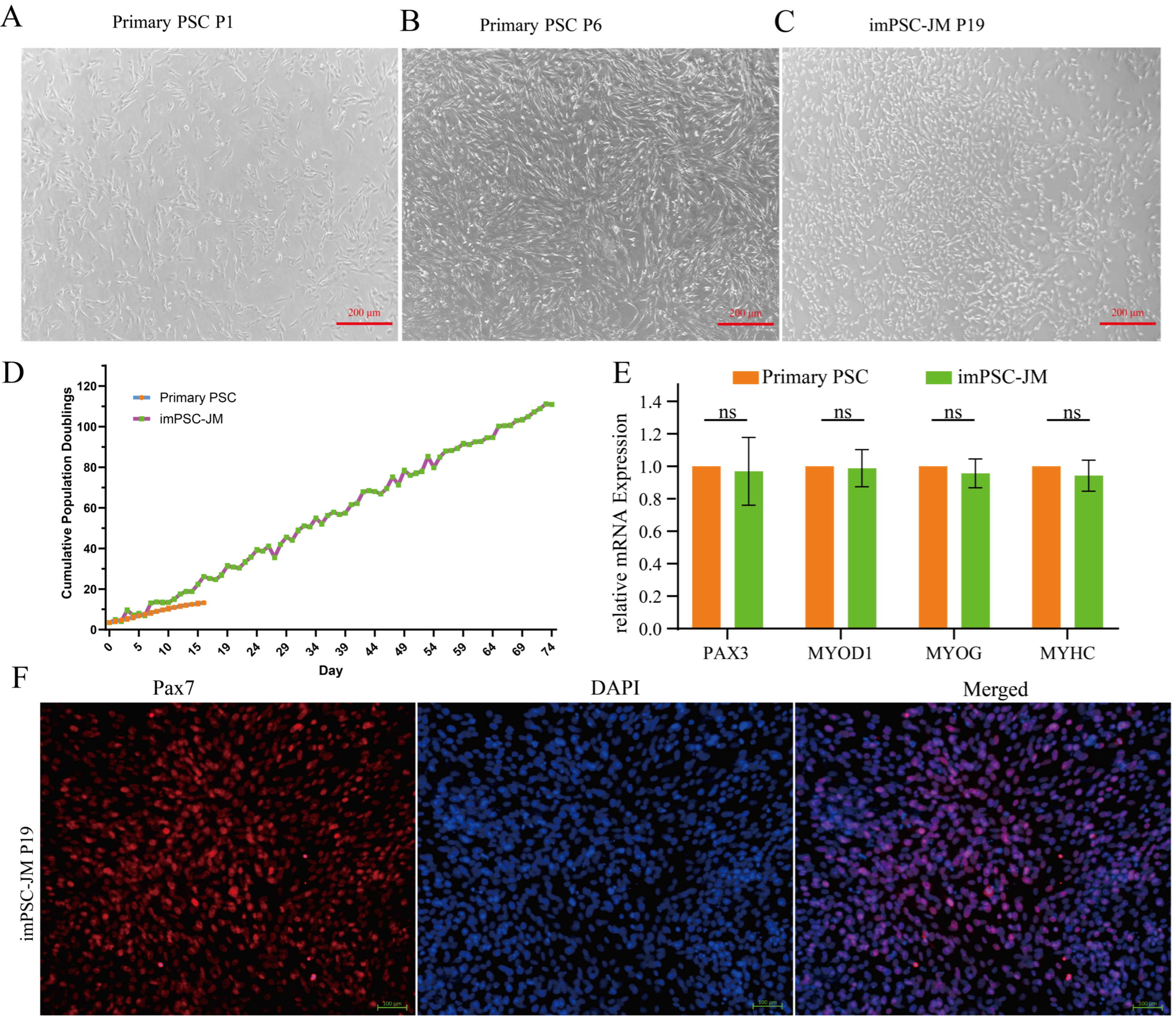
Once the engineered cells were stably growing under Zeocin selection for 10 passages, long-term growth was assessed through serial passaging analysis. Briefly, both imPSC-JM and primary PSC were seeded in triplicate at a density of 5 × 10⁵ cells/well in 6-well plates. The culture medium was replaced every other day until the cells reached approximately 80% confluency, at which point the cells were harvested, counted using an automated cell counter (Monwei, Shanghai, China), and re-plated into new 6-well plates as described above. Every 5 passages, a sub-population of cells was cryopreserved in FBS + 10% DMSO. Primary PSC cultures were terminated after a sharp decline in cell growth, indicating the onset of senescence. The engineered cells were designated as immortalized porcine satellite cells (imPSC-JM) after achieving 110 cumulative population doublings.
2.6. Immunofluorescence and Analysis of imPSC-JM
imPSC-JM at passage 30 (P30) were characterized and compared with primary PSCs at passage 2 (P2) to assess the myogenic differentiation capacity of imPSC-JM. Briefly, proliferating cells were seeded at a density of 5 × 10
4 cells/well in 24-well plates, cultured to approximately 70–80% confluence, and then fixed and stained for DAPI, PAX7, and MYOD1. For differentiation analysis, cells were seeded at a density of 5 × 10
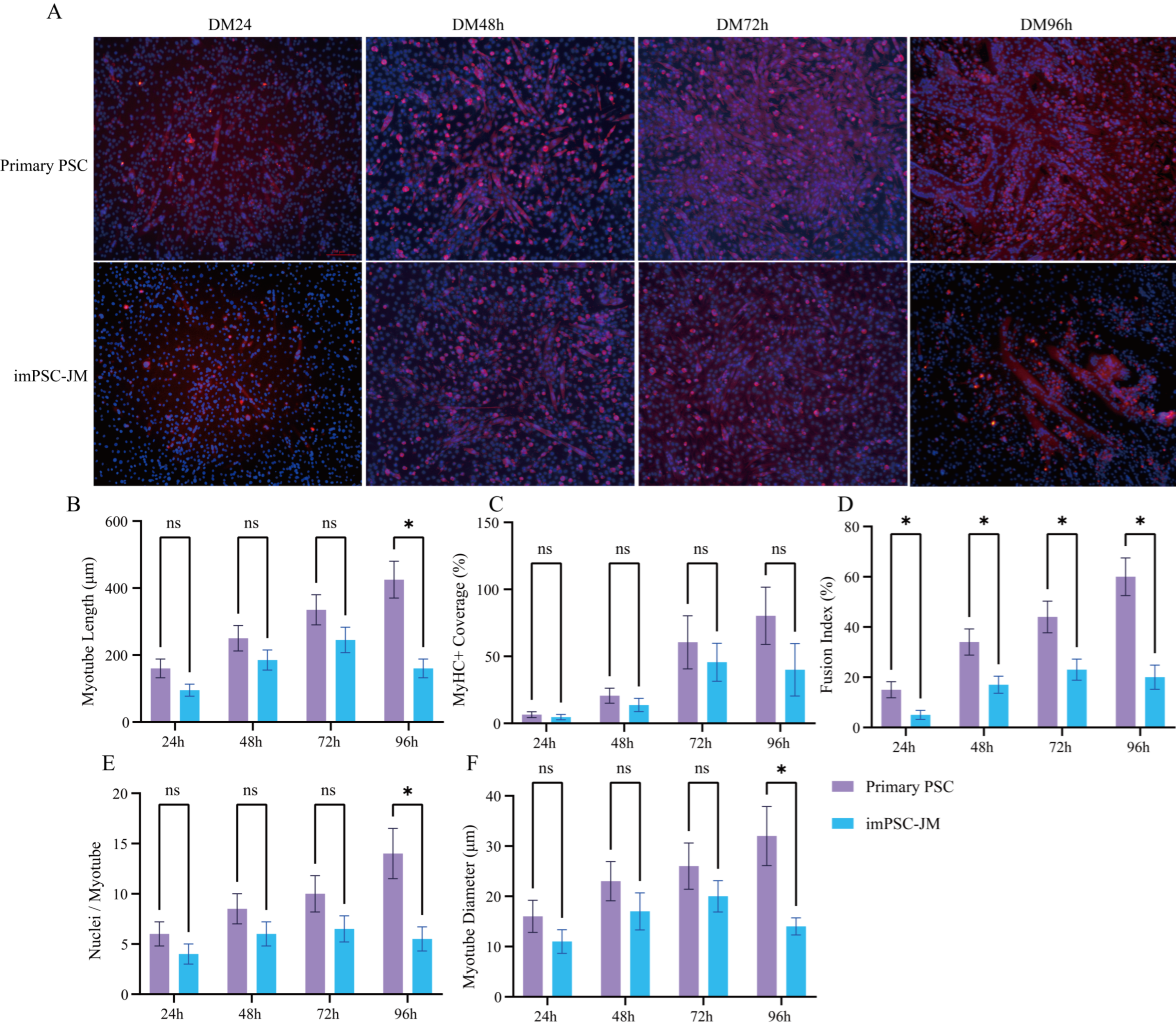
4 cells/well in 24-well plates, cultured to approximately 80% confluence, and switched to differentiation medium (DMEM supplemented with 2% horse serum). At 24, 48, 72, and 96 h post-induction, cells were fixed and immunostained for MYHC with DAPI counterstaining. Additional markers including PAX7, MYOD1, Desmin, and DMD were assessed at 96 h to confirm terminal differentiation. All antibody information is provided in
Supplementary File S2.
For morphometric quantification of myogenic differentiation, three independent replicates were performed per group at each time point, and images were captured using a Zeiss fluorescence microscope (Axio Vert A1). The following parameters were measured using ImageJ software (version 1.54p, NIH, Bethesda, MD, USA): fusion index (percentage of nuclei within MYHC-positive myotubes containing ≥3 nuclei relative to total nuclei), average number of nuclei per myotube (counted only in MYHC-positive structures containing ≥3 nuclei), myotube length (longest axis of MYHC-positive structures containing ≥3 nuclei), myotube diameter (perpendicular to the longest axis at the widest point of MYHC-positive structures containing ≥3 nuclei), and MYHC-positive coverage. For MYHC-positive coverage quantification, MYHC fluorescence images were first subjected to threshold segmentation to generate binary masks of all MYHC-positive regions; subsequently, only MYHC-positive regions overlapping with ≥3 DAPI-stained nuclei were retained, and the coverage was calculated as the percentage of these qualified MYHC-positive areas relative to the total image area. Statistical comparisons between primary PSC and imPSC-JM at each time point were performed using multiple unpaired t-tests in GraphPad Prism (version 9.0), with statistical significance set at p < 0.05.
2.7. Karyotype Analysis
Karyotype analysis of imPSC-JM was performed by Sangon Biotech (Shanghai, China) at passage 20. Twenty G-banded metaphase spreads were analyzed using the Giemsa-trypsin-Giemsa (GTG) Banding technique.
2.8. Western Blot Analysis
The imPSC-JM were collected and lysed with RIPA lysis buffer (Beyotime, China, P0013C) containing protease inhibitor cocktail (MedChemExpress, Monmouth Junction, NJ, USA, HY-K0010) and phosphatase inhibitor cocktail (Target Molecule Corp., Boston, MA, USA, C0057) for protein extraction. The cell lysates were centrifuged (13,000× g, 4 °C) for 10 min, and the supernatants were collected. The protein concentrations were determined by a BCA protein assay kit (Beyotime, China, P0009). A total of 10 μg of each prepared protein sample was diluted with SDS-containing sample buffer and separated by 10% SDS-PAGE. The proteins that had been electrophoretically separated on SDS gels were transferred to PVDF (0.45 μm) membranes. Nonspecific reactivity was blocked for 1.5 h at RT (25 °C) in standard 1 × TBST buffer containing 5% BSA. The membranes were incubated overnight at 4 °C with a 1:500 dilution of anti-SV40 T antigen–antibody (MedChemExpress, USA, HY-P83511) and with a 1:8000 dilution of the anti-GAPDH antibody (Proteintech, China, 60004-1-Ig). Then, the membranes were washed for 10 min (4 times) with TBST (Servicebio, China, G0004). Subsequently, they were incubated for 1 h at room temperature with HRP-conjugated Goat Anti-Rabbit IgG(H+L) (Proteintech, China, SA00001-2) diluted 1:20,000. Immunoreactive bands were detected using an ECL Advanced Western Blotting Detection Kit (Invitrogen, Carlsbad, CA, USA, 32106), and the signal intensities were determined with the Tanon 5200 (Tanon Science & Technology Co., Ltd., Shanghai, China) chemiluminescence/fluorescence image analysis system.
2.9. Library Preparation and Next-Generation Sequencing
RNA sequencing (RNA-seq) was performed by Novogene Corporation (Tianjin, China). Briefly, RNA-seq was conducted on the Illumina NovaSeq platform to profile mRNAs and lncRNAs in primary PSCs and imPSC-JM. Total RNA was extracted from primary PSCs and imPSC-JM (n = 3 each) using the RNAprep Pure Cell/Bacteria Kit (Tiangen, Beijing, China, DP430) according to the manufacturer’s instructions. RNA quality (including integrity, RIN value) and concentration were determined using an Agilent 2100 Bioanalyzer (Agilent Technologies, Santa Clara, CA, USA). The following steps were all performed according to the manufacturer’s recommendations: rRNA removal, fragmentation, first- and second-strand cDNA synthesis, cDNA purification, terminal repair, A-tailing, adapter ligation, size selection (370–450 bp), and PCR enrichment (10 cycles). The PCR products were purified using the AMPure XP system. After library construction, preliminary quantification was carried out using Qubit, and the library’s insert fragment size was verified using an Agilent Bioanalyzer.
RNA sequencing data quality control and analysis were performed as described before [
14]. Briefly, sequencing reads were filtered to remove sequences containing adapter contamination, low-quality reads, and those with a high proportion of N bases. Trimmed reads were then mapped to the pig reference genome assembly (
https://ftp.ensembl.org/pub/release-114/fasta/sus_scrofa/dna/Sus_scrofa.Sscrofa11.1.dna.toplevel.fa.gz, accessed on 15 May 2025) using HISAT2 and StringTie [
15]. Sequencing read alignments were further analyzed using Cufflinks/Cuffmerge to filter out reads mapped to unannotated genes and long noncoding RNAs [
16]. Gene expression level was calculated as Transcripts Per Million (TPM).
2.10. RNA-Seq Analysis
Raw gene count files were used for Pearson correlation coefficient analysis, principal component analysis (PCA), and DESeq2 analysis. Genes with
padj < 0.01 and |log
2FoldChange| > 2 were considered differentially expressed at the genome-wide level. For the targeted analysis of myogenic and pathway-specific genes (
Table 2 and
Table 3), a relaxed cutoff of
padj < 0.05 and |log
2FoldChange| > 1 was applied.
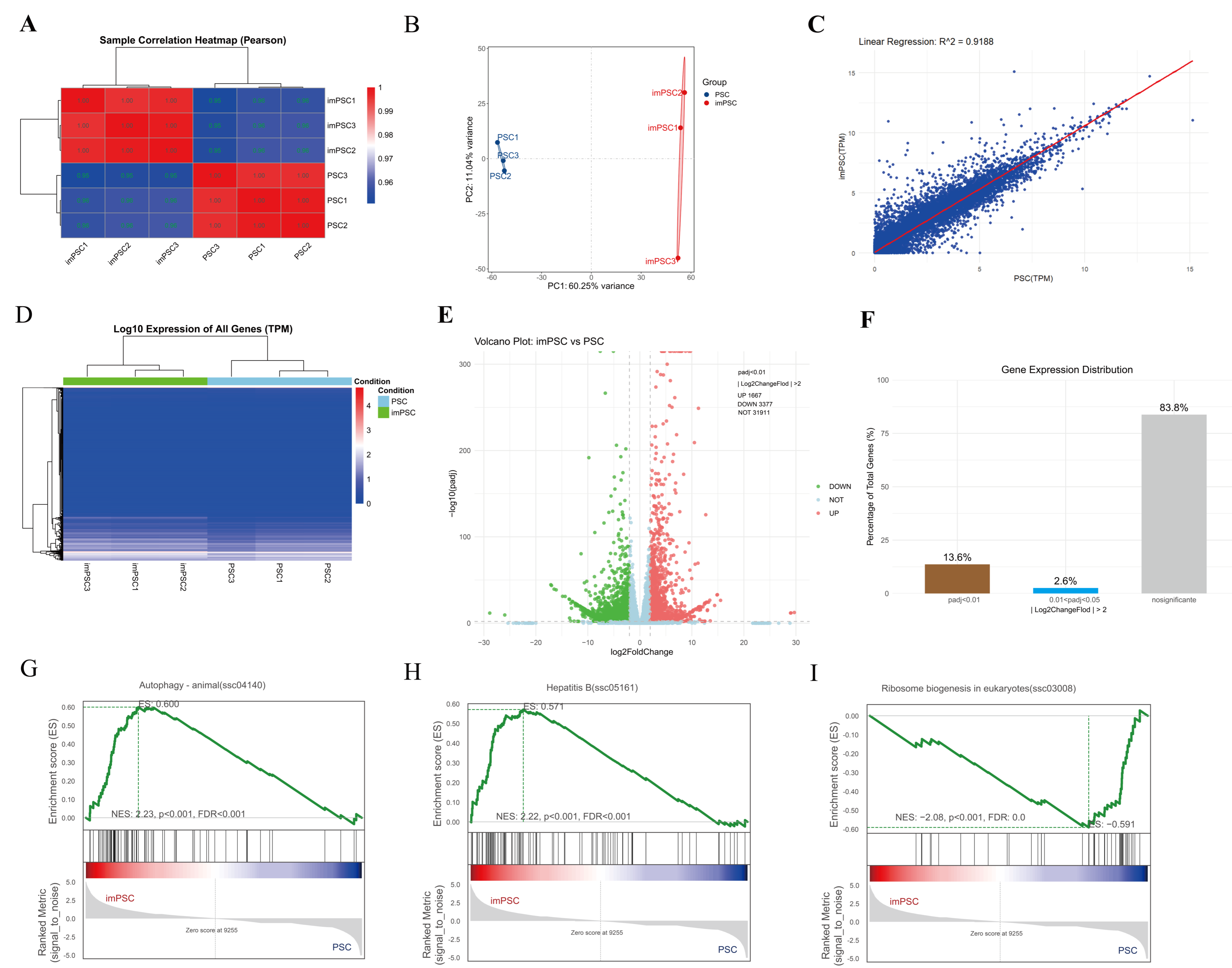
Normalized TPM values were used to compare gene expression patterns between imPSC-JM and primary PSC. Log10(TPM + 1) transformed data was used to construct a linear regression model to assess consistency: PSC_TPM = β0 + β1 × imPSC_TPM + ε. High consistency between the two datasets was inferred if the slope β1 ≈ 1 and the intercept β0 ≈ 0, where ε represents the random error. The model fit was evaluated using R2.
We generated clustering heatmaps of the two datasets to visualize gene expression patterns. In addition to a heatmap of all genes, we downloaded muscle development-related Gene Ontology (GO) terms from the GO database and created a new gene set (
Supplementary File S3) comprising all genes associated with these terms [
17]. We then generated a separate heatmap displaying the expression levels of this muscle development gene set.
For targeted analysis of myogenic gene expression, key genes involved in satellite cell identity (PAX7, PAX3), myogenic regulatory factors (MYOD1, MYF5, MYOG, MYF6), muscle structural components (MYH1, MYH4, MYH7, DES, DMD, ACTA1), satellite cell regulation (SPRY1, HES1), myoblast fusion (MYMK, MYMX), and muscle signaling (MSTN, FOXO1) were extracted from the TPM dataset. Mean TPM values were calculated for each group, and log2 fold changes were computed as log2[(mean_imPSC + 1)/(mean_PSC + 1)]. Statistical significance was assessed using Student’s t-test with Benjamini–Hochberg correction for multiple comparisons. Gene Set Enrichment Analysis (GSEA) was conducted using the clusterProfiler package (version 4.2.0) with a pig KEGG pathway gene set database as the background. Pathways with |normalized enrichment score (NES)| > 2, p < 0.01, and false discovery rate (FDR) < 0.05 were considered significantly enriched. To validate GSEA findings at the individual gene level, key genes within significantly enriched pathways (autophagy, inflammatory signaling, and ribosome biogenesis) were extracted and their differential expression was analyzed using the same statistical approach as described above.
All analyses were performed using R v4.5.0.
2.11. Quantitative Real-Time PCR (qPCR)
Total RNA was extracted from primary PSC and imPSC-JM using the RNAprep Pure Cell/Bacteria Kit (DP430, Tiangen, China) according to the manufacturer’s instructions. The quality and concentration of the RNA were detected with a spectrophotometer (Nanodrop 2000, Thermo Scientific, USA). Next, cDNA was synthesized by reverse transcription using the PrimeScript™ RT Reagent Kit with gDNA Eraser (R047A, TaKaRa, Japan) according to the manufacturer’s instructions. qPCR was performed on a PCRmax Eco48 instrument (PCRmax, Altrincham, UK) using SYBR Green Master Mix (Roche, Indianapolis, IN, USA, 04913914001). The primers used for qPCR were designed with NCBI Primer Blast. The qPCR primers for each gene are shown in
Supplement File S4. The relative mRNA expression levels were determined using the 2
−ΔΔCt method.
4. Discussion
In this study, we successfully established an immortalized porcine satellite cell line (imPSC-JM) from neonatal Junmu No.1 piglets via lentivirus-mediated stable transduction of the SV40 large T antigen (SV40LT). The resulting line exhibited four key features: (i) sustained proliferation exceeding 110 population doublings (PDs) without senescence; (ii) a stable diploid karyotype and characteristic spindle-shaped morphology; (iii) preservation of the canonical satellite cell marker PAX7 and full myogenic differentiation capacity, as evidenced by the formation of multinucleated myotubes expressing Desmin, MYHC, and DMD (
Figure S1); and (iv) high transcriptomic fidelity to primary porcine satellite cells (PSCs) (Pearson r ≥ 0.95; R
2 = 0.9188; 83.8% of expressed genes unaltered). To our knowledge, imPSC-JM is the first immortalized satellite cell line derived from a Chinese-developed pig breed, filling a critical gap in cellular tools for porcine myogenesis research and providing a stable, genetically defined platform for dissecting the molecular basis of the unique muscle traits of Junmu No.1 pigs.
The successful establishment of imPSC-JM extends the growing repertoire of immortalized myogenic cell lines from livestock species. C2C12, spontaneously immortalized from dystrophic mouse satellite cells nearly five decades ago, has long served as the predominant in vitro model for myogenesis [
10]. However, marked interspecies differences in muscle fiber-type composition, postnatal growth kinetics, and metabolic regulation between rodents and large livestock animals limit the translational value of murine models for agriculturally relevant questions [
18,
19]. To overcome this limitation, immortalized satellite cell lines have recently been generated from cattle [
11] and Western commercial pigs (Large White) [
8], alongside immortalized epithelial and smooth muscle lines from cattle and pigs [
2,
9]. Notably, all previously reported porcine satellite cell lines have been derived from Western commercial breeds (e.g., Large White, Yorkshire), none of which adequately represent the genetic background of Chinese-developed breeds. The Junmu No.1 pig, a hybrid integrating Belgian Seghers and Chinese Sanjiang genetic resources, exhibits a distinctive combination of rapid growth, high lean meat percentage, and environmental adaptability that cannot be recapitulated by purely European or purely Chinese genetic backgrounds [
6]. imPSC-JM thus provides a much-needed cellular platform tailored to this unique genetic resource and complements the existing portfolio of livestock myogenic lines.
imPSC-JM achieved a greater proliferative capacity (>110 CPDs) than the >P40 passaging capacity reported for the Large White-derived line by Ni et al. [
8], although direct comparison is limited by the different metrics used (cumulative population doublings vs. passage number) and would require head-to-head experiments under identical conditions for confirmation. The stable diploid karyotype maintained in imPSC-JM is consistent with reports in immortalized bovine and porcine cells [
2,
9], reinforcing the general observation that SV40LT-mediated immortalization, when performed under optimized conditions, does not necessarily induce gross chromosomal abnormalities. Importantly, our quantitative time-course analysis of myogenic differentiation provides a level of mechanistic detail that has been lacking in previous descriptive characterizations of immortalized livestock satellite cell lines.
A central observation of our study is that imPSC-JM, while retaining the core myogenic transcriptional program, exhibits significantly reduced fusion efficiency relative to primary PSCs. Quantitative time-course analysis revealed that this reduction is highly parameter-specific: the fusion index was significantly lower at all time points (24–96 h), whereas myotube length, diameter, nuclei per myotube, and MYHC-positive coverage remained largely comparable during the early differentiation phase (24–72 h), with significant divergence emerging only at 96 h. This pattern is mechanistically interpretable in light of SV40LT biology: by inactivating the p53 and Rb tumor-suppressor pathways, SV40LT disrupts the irreversible cell-cycle exit that is a prerequisite for terminal myogenic differentiation and efficient myoblast fusion [
20,
21,
22]. Our findings are consistent with previous observations in extensively passaged C2C12 cells [
23] and other SV40LT-immortalized myogenic lines [
8], collectively supporting the view that fusion efficiency is the differentiation parameter most sensitively affected by oncogene-mediated immortalization.
The dissociation we observed between fusion efficiency and MYHC-positive coverage is conceptually significant: it indicates that activation of the myogenic transcriptional program (driven by MYOD1 and MYOG and reflected in muscle structural gene expression) is largely uncoupled from the cell-fusion machinery in immortalized cells. Analogous dissociations have been documented in MYMK-deficient myoblasts [
24] and in aged satellite cells [
25], where myogenic gene expression is preserved but multinucleation is impaired. From a practical standpoint, this dissociation defines the appropriate use case for imPSC-JM: the line is well suited for studies of satellite cell quiescence, activation, proliferation, early myogenic commitment, and muscle-specific gene regulation, but should be supplemented with primary cells when the experimental endpoint specifically requires high-efficiency fusion or extensive myofiber maturation. Based on our time-course data, we recommend a 72 h differentiation protocol as the optimal window for most applications, since this time point captures peak myotube parameters before the onset of decline. With respect to passage-dependent phenotypic drift, continued culture of imPSC-JM beyond P50 has not revealed overt changes in PAX7 immunoreactivity, proliferation, or morphology; nevertheless, potential late-passage drift in fusion efficiency warrants formal evaluation in future work.
The remarkable transcriptomic concordance between imPSC-JM and primary PSCs (Pearson r ≥ 0.95; R
2 = 0.9188; 83.8% of expressed genes unaltered) provides robust support for the use of imPSC-JM as a faithful surrogate for primary satellite cells in molecular and genetic studies. Targeted analysis of myogenic regulatory factors (MYOD1, MYF5, MYOG, MYF6), satellite cell identity markers (PAX7, PAX3), muscle structural genes (MYH1, MYH4, MYH7, DES, DMD, ACTA1), and fusion regulators (MYMK, MYMX) revealed no significant differences, demonstrating that the foundational myogenic transcriptional architecture is fully preserved. The moderate upregulation of SPRY1—a negative regulator of receptor tyrosine kinase signaling implicated in maintaining satellite cell quiescence [
26]—may even reflect an enhanced capacity of imPSC-JM to sustain the undifferentiated state during long-term proliferation, a feature that could be advantageous for experimental applications requiring large quantities of homogeneous, uncommitted cells.
Beyond this overall fidelity, GSEA and gene-level analyses revealed reproducible pathway remodeling associated with immortalization. The coordinated upregulation of autophagy-related genes (ATG16L2, MAP1LC3A/B, CTSL) and inflammatory mediators (IL6, CXCL8, CXCL2), together with downregulation of ribosome-biogenesis components (NPM1), defines a coherent adaptive program that supports sustained proliferation. Mechanistically, the IL6–JAK–STAT3 axis has been shown to drive CTSL-mediated autophagy in cancer cells [
27], suggesting that an analogous regulatory loop may operate in imPSC-JM to maintain cellular homeostasis under continuous proliferative stress. The downregulation of ribosome biogenesis is particularly noteworthy: rather than indicating a generic loss of biosynthetic capacity, it likely reflects a resource-allocation strategy that favors DNA replication, autophagic recycling, and stress-resistance pathways over de novo ribosome assembly [
28,
29]. Similar metabolic reprogramming has been documented in immortalized murine tenocytes [
7], suggesting that this transcriptional signature may represent a general hallmark of SV40LT-mediated immortalization across cell types and species. These pathway-level insights not only validate imPSC-JM as a model system but also inform future strategies for engineering immortalized cell lines with improved fidelity.
Beyond providing a defined model for Junmu No.1 myogenesis, imPSC-JM carries broader implications for porcine biology, translational research, and cellular agriculture. As a stable platform with a fixed genetic background, the line is well positioned to dissect the molecular determinants of breed-specific traits such as fiber-type composition, lean meat deposition, and feed efficiency that underpin the agricultural value of Junmu No.1 pigs. Given the increasing recognition of pigs as a translational biomedical model [
19], imPSC-JM may also serve as a physiologically more relevant alternative to murine C2C12 cells for studying human muscular dystrophies, sarcopenia, and metabolic muscle disorders, while concurrently offering a defined, scalable resource for cultured meat applications, where porcine-derived myogenic cell lines remain in short supply [
30,
31]. These prospects, however, must be weighed against several limitations of the present work: characterization was performed on a single clonal population from one donor, neonatal isolation may not fully recapitulate the biology of adult quiescent satellite cells, the modest reduction in fusion efficiency represents an inherent trade-off of SV40LT-mediated immortalization, and our analysis was confined to the transcriptome, leaving proteomic, epigenomic, and metabolomic remodeling unexplored. Multi-donor validation and multi-omics profiling will therefore be important next steps for establishing the generalizability of this model.
Looking forward, imPSC-JM provides an ideal substrate for systematic functional genomics, including CRISPR/Cas9-mediated knockout, knock-in, and large-scale screens, to dissect the regulatory networks underlying muscle development and meat quality in this breed. Comparative analyses with immortalized lines from other pig breeds, such as Large White, Meishan, or Bama, may further illuminate the genetic basis of breed-specific muscle phenotypes, while controlled exposure of the line to nutritional, hormonal, and environmental cues offers direct relevance to feed formulation and management strategies. In parallel, the dissociation we observed between fusion efficiency and myogenic gene expression motivates the engineering of next-generation immortalized lines—for instance, by employing inducible or reversible SV40LT systems, combining hTERT/CDK4 strategies [
11], or applying small-molecule modulators of the p53/Rb pathways—to better preserve fusion competence while retaining proliferative capacity. Such refinements would expand the applicability of imPSC-JM to disease modeling of muscular dystrophy and metabolic myopathies, as well as to emerging tissue-engineering and cultured-meat platforms addressing pressing challenges in sustainable food production.




 ,
,