Article

Seroprevalence of Toxoplasma gondii in Livestock and Poultry in Yunnan Province, China: A Cross-Sectional Study

1
The Yunnan Key Laboratory of Veterinary Etiological Biology, College of Veterinary Medicine, Yunnan Agricultural University, Kunming 650201, China
2
College of Bioengineering, Sichuan Water Conservancy Vocational College, Chengdu 611130, China
3
Shanxi Key Laboratory of Animal Disease Research, Prevention and Control, College of Veterinary Medicine, Shanxi Agricultural University, Taigu 030801, China
*
Authors to whom correspondence should be addressed.
These authors contributed equally to this work.
Vet. Sci. 2026, 13(6), 517; https://doi.org/10.3390/vetsci13060517
Submission received: 6 May 2026 / Revised: 23 May 2026 / Accepted: 25 May 2026 / Published: 27 May 2026
(This article belongs to the Special Issue Detection of Parasitic Diseases in Livestock: 2nd Edition)

Simple Summary

Toxoplasma gondii is a zoonotic protozoan parasite that infects humans as well as a wide range of livestock and poultry, resulting in substantial economic losses and public-health risks. In this study, we investigated T. gondii seroprevalence and associated risk factors in livestock and poultry across 16 prefectures/cities in Yunnan Province, southwestern China. Seropositivity was detected in livestock and poultry from all 16 surveyed prefectures of Yunnan Province, indicating widespread exposure to T. gondii. T. gondii seroprevalence was highest in small ruminants (sheep and goats) and lowest in poultry. At the regional level, Diqing Prefecture had the highest seroprevalence among all prefectures surveyed. Season, region, and host species were identified as significant risk factors for T. gondii infection. Although the T. gondii prevalence observed in this study was much lower than those reported in previous studies, suggesting a downward trend over time, marked regional variation persists. Therefore, stringent and sustained control measures against T. gondii infection in livestock, poultry, and humans in Yunnan Province are recommended.

Abstract

Toxoplasma gondii is a food- and environment-borne protozoan that is associated with human infection, food safety and animal health. Despite Yunnan Province being a major food-producing animal region in China, comprehensive data on the seroprevalence and risk factors of T. gondii infection in its food animals remain limited. This study investigated the seroprevalence of T. gondii infection among pigs, sheep and goats, cattle and poultry across all 16 prefectures/cities in Yunnan Province. From April 2023 to December 2024, a total of 10,766 blood samples were collected from clinically healthy livestock and poultry, including 2954 pigs, 1950 cattle, 1961 sheep and goats, and 3901 poultry. Sera were examined for the presence of specific antibodies against T. gondii by the Modified Agglutination Test (MAT). Seroprevalence was calculated, and statistical analyses were conducted to assess risk factors (geographic location, season, and animal species). The overall seroprevalence was 13.7% (1474/10,766), with species-specific rates of 26.3% (516/1961) in sheep and goats, 15.1% (446/2954) in pigs, 12.9% (252/1950) in cattle, and the lowest (6.7%, 260/3901) in poultry. Seroprevalence varied considerably across regions, ranging from 9.4% to 27.5%, with the highest prevalence rate being observed in Diqing (27.5%, 141/515). Based on statistical analysis, season, region and animal species were identified as significant risk factors associated with T. gondii infection in Yunnan Province. Overall, this first province-wide investigation revealed widespread exposure of T. gondii across both regions and species. Stringent and sustained control measures against toxoplasmosis of livestock, poultry, and humans in Yunnan Province are recommended.

1. Introduction

Toxoplasma gondii, a food-borne, zoonotic protozoan parasite with worldwide distribution, is capable of infecting humans as well as a broad range of warm-blooded animals, particularly pigs, cattle, sheep, and goats [1]. Livestock and avian diseases constitute a public-health concern [2], as handling or eating contaminated raw or undercooked meat from infected animals is a principal route of pathogen transmission to humans [3,4,5]. Additionally, the consumption of infected raw milk may serve as a potential vehicle for T. gondii transmission [1]. It is generally assumed that approximately 30–50% of the human population is infected by this parasite [6]. Although toxoplasmosis is often subclinical in both humans and animals, vertical transmission or immunocompromised hosts can be fatal, causing abortion, stillbirth, congenital malformations and subsequent complications [7,8]. These adverse effects are common not only in humans but also in economically important livestock such as pigs and small ruminants. As farm animals represent a direct source of human infection [4,5], controlling T. gondii infections in livestock and poultry is of considerable importance.
Yunnan Province is located in Southwestern China, where its monsoon climate has endowed its high biodiversity. Additionally, Yunnan Province harbours numerous indigenous livestock breeds, including Diannan small-ear pigs, Yunling cattle, Ninglang black sheep, Yunnan semi-fine-wool sheep, Chahua chickens and Wuding chickens, that are crucial for local animal-production systems. Meanwhile, as a major livestock-producing region in China, Yunnan yields 5.058 million metric tons of meat from livestock and poultry in 2024 (https://stats.yn.gov.cn/Pages_23_6415.aspx, accessed on 1 May 2026). Hotpot, BBQ, and raw milk are favorite foods in Yunnan Province. In addition, some areas still retain the custom of eating raw meat. Unfortunately, T. gondii is not included in routine meat inspection protocols in China, leaving the food supply chain devoid of targeted preventive measures, an omission that may pose a public-health risk.
Serological survey is expected to provide information for assessing the possibility and potential frequency of the contact between the hosts and T. gondii, assisting the evaluation of the associated public-health risk posed by this zoonotic parasite. Preliminary seroprevalence surveys of T. gondii in humans and animals have been conducted in Yunnan Province by different methods and diagnostic kits. However, systematic, large-scale surveillance data delineating the prevalence landscape of T. gondii in livestock are still conspicuously absent, and the results can vary due to the applied methods and the scale of samples. Consequently, the present study is designed to determine the seroprevalence and risk factors of T. gondii infection in livestock and poultry across all 16 prefectures/cities of Yunnan with a single sensitive technique (Modified Agglutination Test, MAT).

2. Materials and Methods

2.1. Study Design and Samples Collection

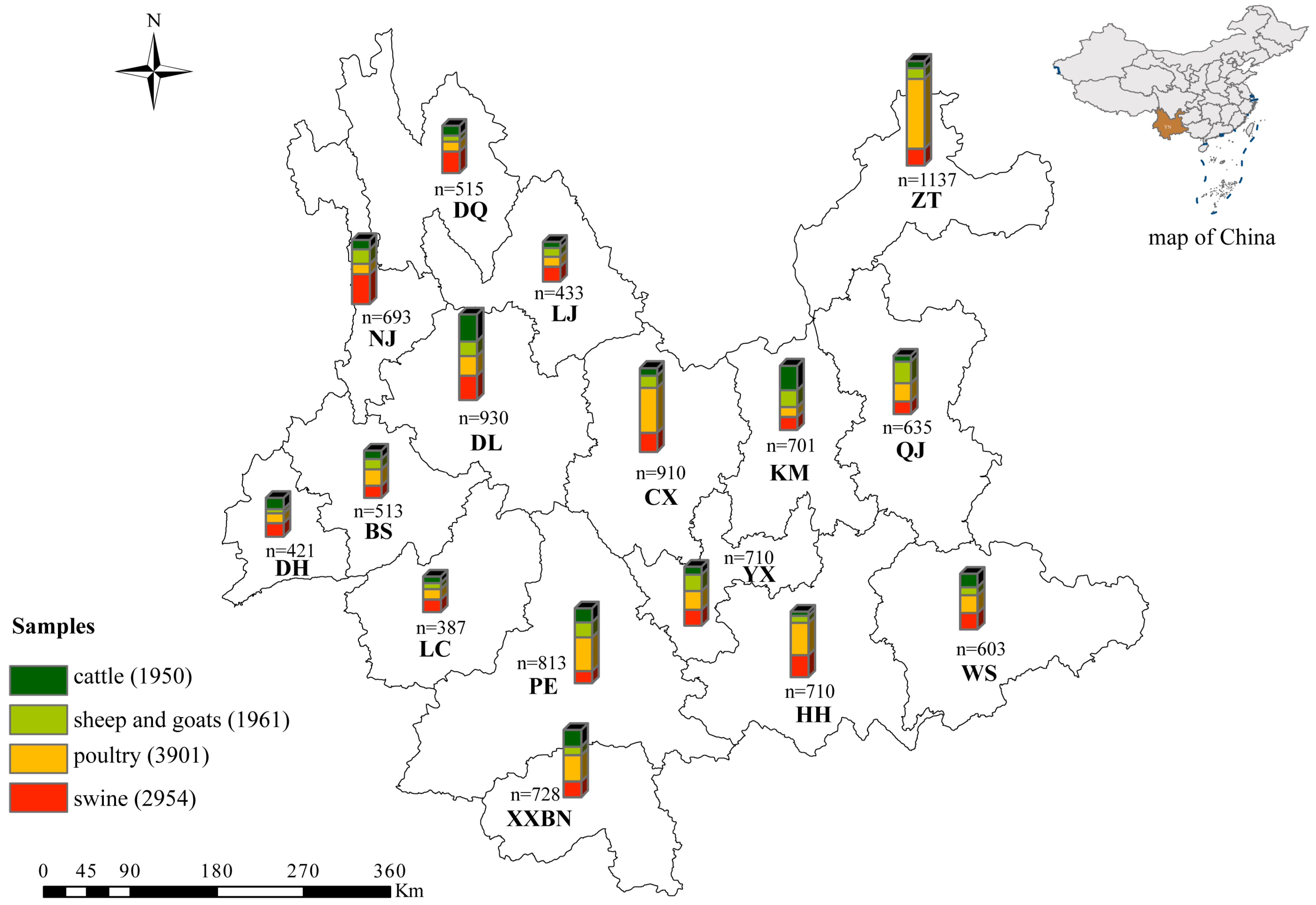
From April 2023 to December 2024, a total of 10,766 serum samples were collected from pigs (n = 2954), cattle (n = 1950), sheep and goats (n = 1961), and poultry (mixed chickens and ducks, n = 3901) across 16 prefectures/cities of Yunnan Province, including Kunming, Qujing, Yuxi, Baoshan, Zhaotong, Lijiang, Pu’er, Lincang, Chuxiong Yi Autonomous Prefecture, Honghe Hani and Yi Autonomous Prefecture, Wenshan Zhuang and Miao Autonomous Prefecture, Xishuangbanna Dai Autonomous Prefecture, Dali Bai Autonomous Prefecture, Dehong Dai and Jing-po Autonomous Prefecture, Nujiang Lisu Autonomous Prefecture, and Diqing Tibetan Autonomous Prefecture (Figure 1). Detailed sampling information for each site, including sampling location and the number of samples collected from each livestock and poultry species, is provided in Supplementary Table S1. Samples were immediately placed in portable ice boxes and transported to the laboratory for detection of T. gondii antibodies.

2.2. Detection of T. gondii Antibodies

All serum samples were tested for T. gondii IgG antibodies by MAT, as previously described [9]. Sera were screened at dilutions 1:25, 1:50 and 1:100, and titers ≥ 1:25 indicate T. gondii infection. Formalin-fixed T. gondii RH tachyzoites were provided by the University of Tennessee (Knoxville, TN, USA). Positive and negative control sera were used.

2.3. Statistical Analysis

We categorized the samples by region, season, species, gender and age (age < 12 months and ≥12 months) for analysis of potential infection risk factors. IBM SPSS 27.0 software was used for statistical analyses. T. gondii seroprevalence was estimated from the ratio of positive samples to the total number of samples tested, and 95% confidence intervals (CI) were also given. Associations between T. gondii seroprevalence and the explanatory variables were screened using the Chi-square test. All statistical variables with a p-value < 0.05 were considered statistically significant.

3. Results

3.1. Comprehensive Seroprevalence and Risk Factors of T. gondii Infection in Livestock and Poultry in Yunnan Province

T. gondii antibodies were detected in 13.7% (1474) of the 10,766 serum samples collected from all four livestock groups across Yunnan’s 16 regions. Among the four food animals, small ruminants exhibited the highest exposure, with 26.3% (516/1961) of sheep and goats testing positive, followed by pigs (15.1%, 446/2954) and cattle (12.9%, 252/1950), whereas poultry had the lowest prevalence at 6.7% (260/3901). Species was a significant predictor of infection (p < 0.001); compared with poultry, the seroprevalence of T. gondii was higher in sheep and goats, pigs, and cattle (p < 0.001), with an odds ratio of 5.00, 2.49 and 2.08, respectively (Table 1).
Seasonal subgroup analysis revealed a bimodal pattern; the seroprevalence peaked in summer (16.7%, 155/927) and winter (19.3%, 561/2903), declined in autumn (11.4%, 431/3795) and was lowest in spring (10.4%, 327/3141). Compared with spring, the odds of seropositivity were 1.73 and 2.06 times higher in summer and winter, respectively (p < 0.001).
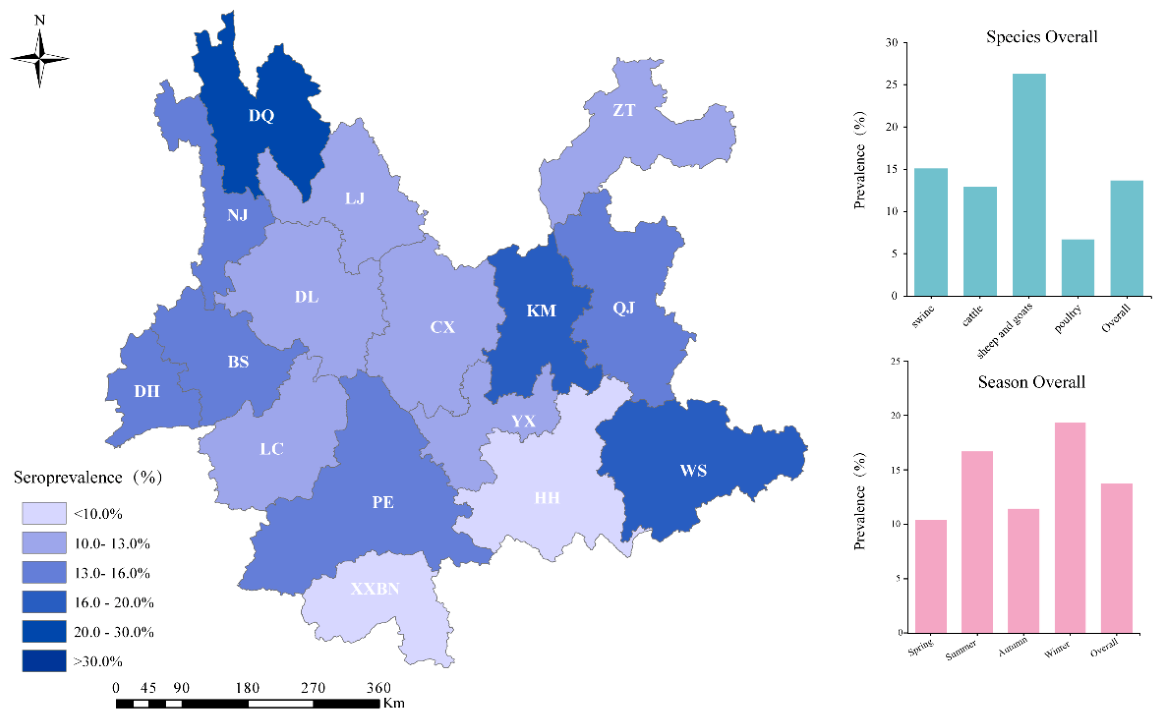
Geographically, infection rates differed across different prefectures/cities (Table 1), and the geographical distribution map is shown in Figure 2. The highest seroprevalence was recorded in Diqing (27.4%, 141/515), followed by Wenshan (17.3%, 104/603), Kunming (16.5%, 123/744), Baoshan (15.8%, 81/513) and Pu’er (15.7%, 128/813), while the lowest infection rate was observed in Honghe (9.4%, 67/710). Xishuangbanna, Chuxiong, Dali, Lijiang, Lincang, Yuxi, and Zhaotong showed a similar prevalence within 10% to 12.3%. Notably, Diqing, an alpine pastoral region, displayed twice the provincial average; the risk of animals in Diqing being infected was 3.6-fold higher than Honghe (OR = 3.6, p < 0.001), implying altitude-related ecological drivers. Overall, the association between the seroprevalence and the geographic location was statistically significant (p < 0.01).

3.2. Seroprevalence and Risk Factors of T. gondii Infection in Pigs

The results showed that 446 out of 2954 (15.1%) were T. gondii IgG seropositive (Table 2). Anti-T. gondii antibodies were detected in all surveyed regions (Supplementary Table S2); the highest rates occurred in Diqing (33.1%, 77/233), followed by Dehong (18.2%), Zhaotong (18.1%), Kunming (17.6%) and Wenshan (16.4%). Diqing’s prevalence was 2.19-fold the provincial mean, whereas the lowest rate was recorded in Yuxi (7.6%, 13/171). Inter-prefecture differences were highly significant (p < 0.001), identifying geography as a major risk factor.
Seasonal distribution showed a pronounced bimodal pattern (Table 2). Prevalence peaked in summer (28.7%, 55/192) and winter (24.1%, 134/556), declined in spring (13.0%, 110/845), and reached its nadir in autumn (10.8%, 147/1361). The season was an independent risk factor for porcine toxoplasmosis in Yunnan Province.
There was no statistical difference in T. gondii seroprevalence by sex or age category of the tested animals.

3.3. Seroprevalence and Risk Factors of T. gondii Infection in Cattle

Among the 1950 bovine sera, 252 tested positive (12.9%, Table 2). Animals that tested positive were detected in every collection site, but exposure clustered geographically (Supplementary Table S2). Similar to pigs, the highest prevalence in cattle was also recorded in Diqing (20.0%, 22/110). Inter-prefecture differences were significant (p < 0.01), indicating that location is an important risk factor for bovine toxoplasmosis.
Neither sex nor age influenced infection risk. Seroprevalence was 14.0% in cows, 10.3% in bulls and 13.4% in animals of unrecorded sex (p = 0.294, Table 2). Similarly, no significant effect from age difference was observed: 10.5% in adults, 16.0% in juveniles, and 13.4% in animals of unknown age (p = 0.252).
Seasonal analysis revealed winter as the low-risk period (9.4%; 65/693; 95% CI: 7.43–11.78%), with a sharp rise in autumn (16.3%; 90/551; 95% CI: 13.48–19.65%); spring and summer showed intermediate values of 14.5% and 12.0% (Table 2), respectively. Using winter as a reference, season was an independent risk variable (χ2 = 31.62, df = 3, p < 0.001), with autumn results showing a strong association (OR > 3, 95% CI: 2.40–4.88).

3.4. Seroprevalence and Risk Factors of T. gondii Infection in Sheep and Goats

A provincial serosurvey of 1961 sheep and goat sera revealed a global T. gondii prevalence of 26.3% (516/1961, Table 2). Infection exhibited a clear altitudinal–climatic gradient (Supplementary Table S2): the north-eastern highlands (Zhaotong 41%, Wenshan 40%, Diqing 39%) registered the highest seroprevalence (OR 6.99–10.24 vs. reference), the southern hot-humid belt (Baoshan, Dehong, Xishuangbanna and Pu’er) formed an intermediate 30–40% zone (OR 3–5), while the central temperate plateau (Dali, Chuxiong, Kunming, Lijiang and Lincang) remained at 15–20%, with Dali showing the lowest seroprevalence (9.9%). Prefecture-level risk paralleled elevation, mean annual temperature and grazing intensity, indicating strong spatial aggregation.
The analysis of possible risk factors of T. gondii infection in sheep and goats showed that the regions and season were considered as important risk factors, but not sex or age. Ewes, rams and animals of unrecorded sex showed seroprevalences of 20.2% (45/223), 23.9% (81/339) and 27.9% (390/1399) (Table 2), respectively. Rams carried a 1.24-fold higher odds of infection than ewes (OR = 1.24; 95% CI: 0.82–1.87), whereas the unknown-sex group had a 1.53-fold excess risk (OR = 1.53; 95% CI: 1.08–2.16); the overall effect of sex was significant (p = 0.029).
Age stratification revealed a similar pattern: 20.2% (24/119) in lambs (<12 months), 23.0% (102/443) in adults (≥12 months) and 27.9% (390/1399) in sheep of unrecorded age. Compared with lambs, adults showed an OR of 1.18 (95% CI: 0.72–1.95) and the unknown-age group an OR of 1.53 (95% CI: 0.96–2.43); the age-associated difference was also statistically significant (p = 0.038).
Seasonal analysis disclosed a pronounced bimodal profile. Spring baseline prevalence was 18.7% (59/315; 95% CI: 14.81–23.41%), rose sharply to 36.7% (54/147; 95% CI: 29.37–44.77%) in summer, declined to 21.3% (146/685; 95% CI: 18.41–24.54%) in autumn and rebounded to 31.6% (257/814; 95% CI: 28.47–34.85%) in winter. Relative to spring, summer and winter carried 2.52-fold and 2.00-fold higher odds of infection, respectively, whereas autumn did not differ significantly (OR = 1.18; 95% CI: 0.84–1.65; p > 0.05).

3.5. Seroprevalence and Risk Factors of T. gondii Infection in Poultry

A total of 3901 poultry sera (mixed chickens and ducks) were collected, corresponding to an overall seroprevalence of 6.7% (95% CI: 5.92–7.49%) (Table 1). Using Xishuangbanna (3.5%; 10/288) as reference (Supplementary Table S2), the poultry in high-altitude prefectures displayed significantly higher T. gondii positive rates: 13.6% in Diqing (15/110; OR = 4.39; 95% CI: 1.91–10.10), 10.5% in Chuxiong (51/488; OR = 3.24; 95% CI: 1.62–6.50) and 11.1% in Kunming (12/108; OR = 3.48; 95% CI: 1.46–8.30). Inter-prefecture heterogeneity was highly significant, indicating that altitude-linked temperature gradients and management practices modulate oocyst survival and poultry exposure risk across Yunnan.
Males and females showed similar seroprevalences (5.0% vs 5.5%) (Table 2), whereas results for the unknown-sex group rose to 7.6%. Age exerted a significant effect (p = 0.014): birds < 90 d carried 10.4% positivity, while both 90–180 d and > 180 d groups stabilized at 5.2%. The effect of their production system was predictable: free-range flocks had 4.4% seroprevalence compared with 8.6% in large-scale confined farms (OR = 2.08; 95% CI: 1.53–2.83; p < 0.001), indicating that intensive husbandry amplifies exposure.
Seasonally, autumn recorded the lowest rate (4.01%; 48/1198; 95% CI: 3.04–5.27%) (Table 2). Winter showed a sharp increase to 12.50% (105/840; 95% CI: 10.43–14.91%), yielding an OR of 3.42 (95% CI: 2.40–4.88) relative to autumn. Spring and summer displayed intermediate risks (OR = 1.49 and 1.36, respectively). A χ2 trend test confirmed winter as a distinct high-risk period (p < 0.001).

4. Discussion

T. gondii, one of the most widespread zoonoses, infects humans via oocysts- or tissue cysts-contaminated foods [10], making livestock and poultry central to its food-borne transmission. Consequently, accurate epidemiological monitoring of T. gondii infection in domestic animals is imperative to inform evidence-based policies and to quantify both environmental oocyst contamination and the risk to human health. Hence, a systematic elucidation of T. gondii epidemiology is urgently needed in regions such as Yunnan Province, where livestock numbers are large and host assemblages are complex.
Among the available diagnostic approaches, molecular methods are prone to false negatives because tissue cysts exhibit focal distribution within hosts. Serological assays are therefore preferred for large-scale surveillance and monitoring in meat safety owing to their simplicity, low cost and broad species applicability. The MAT has been extensively employed to detect IgG antibodies to T. gondii in sera, and is the most widely validated serological tool for animals, wildlife and humans [11,12,13,14,15]. In the present study, we employed MAT to detect T. gondii—specific IgG antibodies in sera from livestock and poultry sampled across all 16 prefectures/cities of Yunnan Province, aiming to generate a robust estimate of parasite seroprevalence in these populations. Previous research have reported that the diagnostic method may be a source of heterogeneity [16,17,18]; we used MAT exclusively to estimate the exposure rate, thereby eliminating method-based variation.
This study provides the first provincial serological insights into toxoplasmosis in livestock and poultry in Yunnan Province. An overall seroprevalence of 13.7% was found, which was markedly lower than the 28.3% in food-producing animals during 2000–2019 [16]. Our results suggested that the exposure rate was much less common in Yunnan Province than previously reported. Here, the global T. gondii seroprevalence was 13.7%, compared with 15.3% (China, 2010–2023) [17] and 23.7% (China, 2000–2017) [19], respectively. It is also below the 21.8% recently described for southwestern China and the 24.7% previously estimated for Yunnan itself [17], indicating a declining provincial trend. Compared with other Chinese regions, the Yunnan estimate was lower than those of eastern (20.5%), northern (17.7%), and central China (15.9%), but similar to northeastern (10.5%), northwestern (12.4%), and southern China (13.7%). This reduction is probably attributable to the development of the intensive management and health management of the animal husbandry in China, which minimize oocyst contact [20]. In addition, contingencies related to COVID-19, African swine fever, and avian influenza (e.g., movement restrictions, heightened biosecurity, wildlife-protection enforcement) may have further interrupted the eco-epidemiological circulation of T. gondii between wildlife, cats, and food animals.
Host species emerged as the principal determinant of T. gondii seroprevalence in Yunnan. Yunnan is famous for its diversity in species, and is a hotbed for zoonotic diseases. The difference in T. gondii prevalence among different hosts could be attributed to variability in susceptibility [21], and the observed hierarchy: sheep and goats 26.3% > pigs 15.1% > cattle 12.9% > poultry 6.7%, mirrors species-specific susceptibility shaped by host immunity and parasite evasion strategies. Here, sheep and goats displayed the highest seroprevalence (26.3%), while poultry displayed the lowest prevalence (6.7%), and pigs and cattle displayed intermediate levels. This order was inverse of the nationwide hierarchy [17,22,23], in which pigs were the highest and cattle were the lowest, with sheep and goats in the mid-level. This pattern likely reflects the combination of Yunnan’s vertical climate, which fostered succulent shrubs that sustain extended outdoor grazing, and the prevailing practice of year-round tether-free herding, thereby maximizing the contact possibility of definitive (felids) and intermediate (rodents, wild birds) hosts with sheep and goats.
Small ruminants act as sentinels of environmental oocyst contamination because of their ground-level grazing. The 26.3% prevalence in sheep and goats was double that of the 2010–2023 national average (11.2%), and aligned with the 27.0% reported earlier for Yunnan [17]. In contrast, this prevalence was lower than that in Zhejiang (37.8%), Beijing (35.2%) and Hubei (31.7%) [24], where lower altitude, eastward river flow and higher pet cat density favoured oocyst accumulation and sporulation [19]. Another possible explanation was that higher disposable incomes in these affluent regions promoted cat ownership, while hot and humid climates accelerated oocyst sporulation; contamination of drinking water and pastures with feline faeces consequently drove the elevated T. gondii prevalence recorded in sheep and goats [25]. BBQ is a common way to eat lamb meat, which often fails to kill all pathogens in the meat. Hence, high infection rate in sheep and goats made them a source for human and animal infections [26,27].
Pigs, implicated in 30–60% of human acute toxoplasmosis through pork consumption [25], showed 15.1% seroprevalence, below both of China’s average infection in 2010–2023 (23.2%) [17] and the previous data of Yunnan (26.1%) [24], but higher than those reported in Qinhai (11.8%), Guangdong (12.0%), Ningxia (13.0%) and Helongjiang (10.5%) [24]. Epidemiological studies have linked porcine T. gondii infection to environmental oocyst shedding by felids, exposure to infected rodents, on-farm management practices, and long-distance pig transport [19,28]. Intensification of the provincial pig industry has evidently reduced exposure.
Although cattle exhibit greater resistance to T. gondii, the prevalence was 12.9%, which corresponds with Tonouhewa et al. [29] and Pereira et al. [30] who reported the lowest prevalence rate of T. gondii infections in cattle than in pigs and sheep. In China, the seroprevalence of T. gondii infection ranged from 0.75 to 30.34%; our result was lower than in Guizhou (30.3%), Zhejiang (27.6%) and Chongqing (27.3%) [24], and higher than in Hunan (8.3%) [29], Liaoning (6.0%) and Guangdong (5.7%) regions in China previously [31]. Moreover, higher prevalence had been reported in Israel (29.4%) [32] and South Africa (32.6%) [33], and lower seroprevalence rates had been reported in Brazil (2%) and Switzerland (3.8%) [34]. Similar to small ruminants, the predominant route of T. gondii transmission in cattle was the ingestion of sporulated oocysts disseminated on forage, feed, and in water sources [35]. Beef is another major meat consumed in Yunnan, and a substantial proportion of consumers eat it raw with the belief that this practice preserves nutrients and improves palatability. Therefore, the risk of T. gondii infection in humans may be increased by raw contaminated beef.
Notably, the 6.7% T. gondii prevalence detected in poultry here was markedly lower than the national average of 19.9% reported for chickens and the aggregated 30.5% [17] recorded across southwestern China, but consistent with a recent local survey [36]. A meta-analysis reported 21.1% prevalence in Yunnan chickens [37], underscoring a genuine downward trend, possibly linked to expanded commercial cage systems that limited contact with oocyst-littered soil. In Guangxi and Jiangxi, where the climate was warm and humid, conditions that favoured oocyst survival and sporulation, prevalence in chicken exceeded 35% [24]. Conversely, the low rates in Xinjiang and Gansu coincide with prolonged drought that limited oocyst viability and sporulation. Yet, contemporaneous surveys of chicken T. gondii prevalence in southwestern provinces, including Sichuan and Chongqing, reported higher [37] results than that observed in this study, suggesting that factors other than climate were responsible for the low T. gondii positivity recorded in the present study.
The seroprevalence for livestock and poultry showed that T. gondii infection was widespread in meat-producing animals in different regions of Yunnan Province, consistent with T. gondii seroprevalence reported in similar studies worldwide, where T. gondii seroprevalence varied widely across different geographical areas [38]. Logistic regression revealed geography as the principal risk factor, with Diqing exhibiting the highest odds of infection (27.4%; OR = 3.62, 95% CI: 2.41–5.44, p < 0.001), probably reflecting divergent climates, culinary practices, economic development, hygiene habits, and regional control policies. Humid climates with large diurnal temperature swings, semi-nomadic herding and raw-meat consumption create optimal conditions for oocyst survival and parasite transmission. Wenshan (17.3%), with warm temperatures and abundant wildlife, and the southern humid prefectures of Pu’er, Baoshan and Dehong (15–17%) also registered elevated prevalences. High rainfall (~20 °C mean annual temperature) facilitated prolonged oocyst sporulation, while traditional raw-meat dishes established a bidirectional “human–cat–livestock” transmission loop that accelerated parasite circulation.
This study has several limitations. First, detailed metadata, including management practices, cat exposure, age, sex, and production system were largely unavailable, and the cross-sectional design precludes causal inference. Second, the reliance on serology (MAT) without molecular confirmation reflects exposure rather than active infection. Third, poultry species were grouped together, which may mask species-specific differences. Fourth, the interpretations regarding ecological and climatic drivers remain exploratory, as they lack support from direct environmental measurements. In light of these limitations, future studies in Yunnan Province should integrate molecular methods, collect comprehensive risk-factor data, and adopt longitudinal designs to better elucidate the transmission dynamics of T. gondii.
In summary, our study represents the first large-scale comprehensive analyses of T. gondii seroprevalence in Yunnan’s livestock and poultry and associated risk factors, which may provide baseline information for the development of control measures against infection in domesticated animals in Yunnan Province. However, there were some limitations in our study. For example, some samples lacked detailed information such as age, gender, management mode, and presence of cats, thus detailed analyses of the effect of these factors on T. gondii seroprevalence could not be performed.

5. Conclusions

This study provides the first provincial serological insights into T. gondii seroprevalence in livestock and poultry in Yunnan Province, China. A total of 10,766 serum samples were collected and screened; the overall seroprevalence was 13.7% (1474/10,766; 95% CI: 13.16–14.44%), with regions, season, and host species being identified as key risk factors. These findings confirm that Yunnan remains a meso-endemic region for T. gondii. Our results provide critical baseline data for elucidating transmission dynamics of T. gondii and designing targeted control strategies against T. gondii. They also offer an evidence-based reference for livestock development, food-safety assessment, and the inter-sectoral One-Health approach involving public-health authorities, wildlife agencies, and the broader research community.

Supplementary Materials

The following supporting information can be downloaded at: https://www.mdpi.com/article/10.3390/vetsci13060517/s1, Table S1: Sample collection information by site and species; Table S2: Regional risk factors associated with T. gondii seroprevalence in livestock and poultry in Yunnan Province, China.

Author Contributions

Conceptualization, F.-C.Z., X.-Q.Z. and M.-L.D.; methodology, J.-J.H. and M.-L.D.; validation, J.-J.H. and F.-C.Z.; formal analysis, M.-L.D.; investigation, M.-L.D., Z.-Y.S., Y.-C.Z., M.-L.J., L.-Y.W. and J.-F.Y.; resources, M.-L.D., Z.-Y.S., Y.-C.Z., J.-F.Y. and L.-Y.W.; data curation, M.-L.D.; writing—original draft preparation, M.-L.D.; writing—review and editing, J.-J.H., M.-L.D. and X.-Q.Z.; visualization, M.-L.D.; supervision, X.-Q.Z. and F.-C.Z.; project administration, F.-C.Z. and X.-Q.Z.; funding acquisition, X.-Q.Z. and F.-C.Z. All authors have read and agreed to the published version of the manuscript.

Funding

This research was funded by NSFC-Yunnan Joint Fund (Grant No. U2202201), the National Natural Science Foundation of China (Grant No. 32260889), and the Yunnan Key Laboratory of Veterinary Etiological Biology (Grant No. 202449CE340019).

Institutional Review Board Statement

Not applicable.

Informed Consent Statement

Not applicable.

Data Availability Statement

The data presented in this study are included in the article. Further inquiries can be directed to the corresponding author.

Conflicts of Interest

The authors declare no conflicts of interest.

References

  1. Koethe, M.; Schade, C.; Fehlhaber, K.; Ludewig, M. Survival of Toxoplasma gondii tachyzoites in simulated gastric fluid and cow’s milk. Vet. Parasitol. 2017, 233, 111–114. [Google Scholar] [CrossRef] [Scilit]
  2. Aguirre, A.A.; Longcore, T.; Barbieri, M.; Dabritz, H.; Hill, D.; Klein, P.N.; Lepczyk, C.; Lilly, E.L.; McLeod, R.; Milcarsky, J.; et al. The One Health Approach to Toxoplasmosis: Epidemiology, Control, and Prevention Strategies. Ecohealth 2019, 16, 378–390. [Google Scholar] [CrossRef] [Scilit]
  3. Dubey, J.P.; Hill, D.E.; Jones, J.L.; Hightower, A.W.; Kirkland, E.; Roberts, J.M.; Marcet, P.L.; Lehmann, T.; Vianna, M.C.; Miska, K.; et al. Prevalence of viable Toxoplasma gondii in beef, chicken, and pork from retail meat stores in the United States: Risk assessment to consumers. J. Parasitol. 2005, 91, 1082–1093. [Google Scholar] [CrossRef] [Scilit]
  4. Felin, E.; Hälli, O.; Heinonen, M.; Jukola, E.; Fredriksson-Ahomaa, M. Assessment of the feasibility of serological monitoring and on-farm information about health status for the future meat inspection of fattening pigs. Prev. Vet. Med. 2019, 162, 76–82. [Google Scholar] [CrossRef] [Scilit] [PubMed]
  5. Milne, G.; Webster, J.P.; Walker, M. Toward Improving Interventions Against Toxoplasmosis by Identifying Routes of Transmission Using Sporozoite-specific Serological Tools. Clin. Infect. Dis. 2020, 71, e686–e693. [Google Scholar] [CrossRef] [Scilit] [PubMed]
  6. Elsheikha, H.M.; Marra, C.M.; Zhu, X.Q. Epidemiology, Pathophysiology, Diagnosis, and Management of Cerebral Toxoplasmosis. Clin. Microbiol. Rev. 2021, 34, 10–1128. [Google Scholar] [CrossRef] [Scilit] [PubMed]
  7. Liu, Q.; Wang, Z.D.; Huang, S.Y.; Zhu, X.Q. Diagnosis of toxoplasmosis and typing of Toxoplasma gondii. Parasit. Vectors 2015, 8, 292. [Google Scholar] [CrossRef] [Scilit]
  8. Kochanowsky, J.A.; Koshy, A.A. Toxoplasma gondii. Curr. Biol. 2018, 28, R770–R771. [Google Scholar] [CrossRef] [Scilit]
  9. Su, C.; Dubey, J.P. Isolation and Genotyping of Toxoplasma gondii Strains. Methods Mol. Biol. 2020, 2071, 49–80. [Google Scholar] [CrossRef] [Scilit]
  10. Dubey, J.P. Toxoplasmosis of Animals and Humans; CRC Press: Boca Raton, FL, USA, 2016. [Google Scholar]
  11. Hill, D.E.; Chirukandoth, S.; Dubey, J.P.; Lunney, J.K.; Gamble, H.R. Comparison of detection methods for Toxoplasma gondii in naturally and experimentally infected swine. Vet. Parasitol. 2006, 141, 9–17. [Google Scholar] [CrossRef] [Scilit]
  12. Dubey, J.P.; Lehmann, T.; Lautner, F.; Kwok, O.C.; Gamble, H.R. Toxoplasmosis in sentinel chickens (Gallus domesticus) in New England farms: Seroconversion, distribution of tissue cysts in brain, heart, and skeletal muscle by bioassay in mice and cats. Vet. Parasitol. 2015, 214, 55–58. [Google Scholar] [CrossRef] [Scilit] [PubMed]
  13. Gardner, I.A.; Greiner, M.; Dubey, J.P. Statistical evaluation of test accuracy studies for Toxoplasma gondii in food animal intermediate hosts. Zoonoses Public Health 2010, 57, 82–94. [Google Scholar] [CrossRef] [Scilit]
  14. Xin, S.; Jiang, N.; Yang, L.; Zhu, N.; Huang, W.; Li, J.; Zhang, L.; Su, C.; Yang, Y. Isolation, genotyping and virulence determination of a Toxoplasma gondii strain from non-human primate from China. Transbound. Emerg. Dis. 2022, 69, 919–925. [Google Scholar] [CrossRef] [Scilit] [PubMed]
  15. Su, R.; Jiang, N.; Lu, Y.; Jian, F.; Wang, H.; Zhang, G.; Zhang, L.; Yang, Y. Low prevalence of viable Toxoplasma gondii in swine from slaughter houses in the central of China. Parasitol. Int. 2020, 76, 102090. [Google Scholar] [CrossRef] [Scilit] [PubMed]
  16. Hajimohammadi, B.; Ahmadian, S.; Firoozi, Z.; Askari, M.; Mohammadi, M.; Eslami, G.; Askari, V.; Loni, E.; Barzegar-Bafrouei, R.; Boozhmehrani, M.J. A Meta-Analysis of the Prevalence of Toxoplasmosis in Livestock and Poultry Worldwide. Ecohealth 2022, 19, 55–74. [Google Scholar] [CrossRef] [Scilit]
  17. Yang, Z.; Yuan, H.; Nie, L.; Wen, Q.; Li, H.; Yang, L.; Song, Y.; Luo, X.; Zhang, X.X.; Yuan, Z.G. Deciphering the epidemiological dynamics: Toxoplasma gondii seroprevalence in mainland China’s food animals, 2010–2023. Front. Cell. Infect. Microbiol. 2024, 14, 1381537. [Google Scholar] [CrossRef] [Scilit]
  18. Rouatbi, M.; Amairia, S.; Amdouni, Y.; Boussaadoun, M.A.; Ayadi, O.; Al-Hosary, A.A.T.; Rekik, M.; Ben Abdallah, R.; Aoun, K.; Darghouth, M.A.; et al. Toxoplasma gondii infection and toxoplasmosis in North Africa: A review. Parasite 2019, 26, 6. [Google Scholar] [CrossRef] [Scilit]
  19. Dong, H.; Su, R.; Lu, Y.; Wang, M.; Liu, J.; Jian, F.; Yang, Y. Prevalence, Risk Factors, and Genotypes of Toxoplasma gondii in Food Animals and Humans (2000–2017) From China. Front. Microbiol. 2018, 9, 2108. [Google Scholar] [CrossRef] [Scilit]
  20. Wang, X.; Shen, W.; Wu, P.; Wang, C.; Li, J.; Wang, D.; Yue, W. How Food Consumption Trends Change the Direction of Sheep Breeding in China. Animals 2024, 14, 3047. [Google Scholar] [CrossRef] [Scilit]
  21. Mukhopadhyay, D.; Arranz-Solís, D.; Saeij, J.P.J. Influence of the Host and Parasite Strain on the Immune Response During Toxoplasma Infection. Front. Cell. Infect. Microbiol. 2020, 10, 580425. [Google Scholar] [CrossRef] [Scilit]
  22. Pan, M.; Lyu, C.; Zhao, J.; Shen, B. Sixty Years (1957–2017) of Research on Toxoplasmosis in China-An Overview. Front. Microbiol. 2017, 8, 1825. [Google Scholar] [CrossRef] [Scilit] [PubMed]
  23. Deng, H.; Devleesschauwer, B.; Liu, M.; Li, J.; Wu, Y.; van der Giessen, J.W.B.; Opsteegh, M. Seroprevalence of Toxoplasma gondii in pregnant women and livestock in the mainland of China: A systematic review and hierarchical meta-analysis. Sci. Rep. 2018, 8, 6218. [Google Scholar] [CrossRef] [Scilit] [PubMed]
  24. Su, Y.J.; Ma, Z.D.; Qiao, X.; Wang, P.T.; Kang, Y.T.; Yang, N.A.; Jia, W.; Zhao, Z.J. Geospatial epidemiology of Toxoplasma gondii infection in livestock, pets, and humans in China, 1984–2020. Parasitol. Res. 2022, 121, 743–750. [Google Scholar] [CrossRef] [Scilit]
  25. Sharif, M.; Sarvi, S.; Shokri, A.; Hosseini Teshnizi, S.; Rahimi, M.T.; Mizani, A.; Ahmadpour, E.; Daryani, A. Toxoplasma gondii infection among sheep and goats in Iran: A systematic review and meta-analysis. Parasitol. Res. 2015, 114, 1–16. [Google Scholar] [CrossRef] [Scilit]
  26. Belluco, S.; Mancin, M.; Conficoni, D.; Simonato, G.; Pietrobelli, M.; Ricci, A. Investigating the Determinants of Toxoplasma gondii Prevalence in Meat: A Systematic Review and Meta-Regression. PLoS ONE 2016, 11, e0153856. [Google Scholar] [CrossRef] [Scilit]
  27. Opsteegh, M.; Maas, M.; Schares, G.; Giessen, J.V.D. Relationship between seroprevalence in the main livestock species and presence of Toxoplasma gondii in meat (GP/EFSA/BIOHAZ/2013/01) An extensive literature review. Final report. EFSA Support. Publ. 2016, 13, 996E. [Google Scholar]
  28. Zhou, P.; Chen, Z.; Li, H.L.; Zheng, H.; He, S.; Lin, R.Q.; Zhu, X.Q. Toxoplasma gondii infection in humans in China. Parasit. Vectors 2011, 4, 165. [Google Scholar] [CrossRef] [Scilit]
  29. Shen, P.; Xu, P.Y. Seroprevalence and Risk Factors of Toxoplasma gondii Infection of Cattle and Goats in Farms of Hunan Province, China. Vector Borne Zoonotic Dis. 2024, 24, 710–713. [Google Scholar] [CrossRef] [Scilit]
  30. Pereira, D.C.; Dubey, J.P.; Da Mata, A.; Neto, H.; Cardoso, L.; Lopes, A.P. Seroepidemiology of Toxoplasma gondii in domestic cattle, sheep, goats and pigs from São Tomé and Príncipe. Rev. Bras. Parasitol. Vet. 2020, 29, e014819. [Google Scholar] [CrossRef] [Scilit] [PubMed]
  31. Dubey, J.P.; Murata, F.H.A.; Cerqueira-Cézar, C.K.; Kwok, O.C.H.; Yang, Y.R. Public Health Significance of Toxoplasma gondii Infections in Cattle: 2009–2020. J. Parasitol. 2020, 106, 772–788. [Google Scholar] [CrossRef] [Scilit]
  32. Mazuz, M.L.; Weiss, A.; Beer, O.; Tirosh-Levy, S.; Riklis, I.; Dveyrin, Z.; Rorman, E.; Cohen, N.Z.; Markovich, M.P.; Baneth, G. High infection rates of Toxoplasma gondii in cattle, sheep and pigs from Israel. Comp. Immunol. Microbiol. Infect. Dis. 2023, 92, 101928. [Google Scholar] [CrossRef] [Scilit]
  33. Adesiyun, A.A.; Knobel, D.L.; Thompson, P.N.; Wentzel, J.; Kolo, F.B.; Kolo, A.O.; Conan, A.; Simpson, G.J.G. Sero-Epidemiological Study of Selected Zoonotic and Abortifacient Pathogens in Cattle at a Wildlife-Livestock Interface in South Africa. Vector Borne Zoonotic Dis. 2020, 20, 258–267. [Google Scholar] [CrossRef] [Scilit]
  34. Amdouni, Y.; Rjeibi, M.R.; Rouatbi, M.; Amairia, S.; Awadi, S.; Gharbi, M. Molecular detection of Toxoplasma gondii infection in slaughtered ruminants (sheep, goats and cattle) in Northwest Tunisia. Meat Sci. 2017, 133, 180–184. [Google Scholar] [CrossRef] [Scilit]
  35. Gomes, D.F.C.; Krawczak, F.D.S.; Oliveira, C.H.S.; Ferreira Júnior, Á.; Fernandes É, K.K.; Lopes, W.D.Z.; Sevá, A.D.P.; Gennari, S.M. Toxoplasma gondii in cattle in Brazil: A review. Rev. Bras. Parasitol. Vet. 2020, 29, e015719. [Google Scholar] [CrossRef] [Scilit] [PubMed]
  36. Li, K.; Liu, X.; Zhao, J.; Yan, H.; Zhao, R.; Chang, Z.; Wang, C.; Xin, A.; Li, X. Investigation and genotyping of Toxoplasma gondii infection in Yunnan Province. Anim. Husb. Vet. Med. 2021, 53, 105–111. (In Chinese) [Google Scholar]
  37. Nie, L.B.; Gong, Q.L.; Wang, Q.; Zhang, R.; Shi, J.F.; Yang, Y.; Li, J.M.; Zhu, X.Q.; Shi, K.; Du, R. Prevalence of Toxoplasma gondii infection in chickens in China during 1993–2021: A systematic review and meta-analysis. Parasitol. Res. 2022, 121, 287–301. [Google Scholar] [CrossRef] [Scilit] [PubMed]
  38. Rahman, A.M.; Qaddoumi, M.; Adawi, H.; Salih, M.A.; Alhussain, H.; Gawish, A.; Boughattas, S.; Eltai, N.O. Seroprevalence of Toxoplasma gondii in goats and sheep in Qatar. One Health 2025, 21, 101119. [Google Scholar] [CrossRef] [Scilit] [PubMed]
Figure 1. Sample collection sites for livestock and poultry serum samples across all 16 prefectures/cities in Yunnan Province. DQ, Diqing; NJ, Nujiang; LJ, Lijiang; DL, Dali; BS, Baoshan; DH, Dehong; LC, Lincang; PE, Pu’er; XXBN, Xishuangbanna; ZT, Zhaotong; CX, Chuxiong; KM, Kunming; QJ, Qujing; YX, Yuxi; HH, Honghe; WS, Wenshan. The n represents the number of samples of all species in one site.
Vetsci 13 00517 g001
Figure 2. Overall prevalence of T. gondii in livestock and poultry by region, host species, and season. Abbreviations are identical to those defined in Figure 1.
Vetsci 13 00517 g002
Table 1. Analysis of T. gondii seroprevalence and risk factors in livestock and poultry across 16 prefectures/cities in Yunnan Province, China.
FactorsCategorySamplesNo. PositivePositive Rate
(95% CI)
p ValueOdds Ratio
(OR, 95% CI)
Classificationpigs295444615.1 (13.81–16.39%)<0.0012.49 (2.12–2.93)
cattle195025212.9 (11.43–14.41%)<0.0012.08 (1.73–2.50)
sheep and goats196151626.3 (24.36–28.26%)<0.0015.00 (4.26–5.87)
poultry39012606.7 (5.88–7.45%) Reference
SeasonSpring314132710.4 (9.39–11.53%) Reference
Summer92715516.7 (14.46–19.26%)<0.0011.73 (1.41–2.13)
Autumn379543111.4 (10.39–12.41%)0.2091.10 (0.95–1.28)
Winter290356119.3 (17.93–20.80%)<0.0012.06 (1.78–2.39)
RegionXishuangbanna7287310.0 (8.05–12.42%)0.7061.07 (0.75–1.52)
Baoshan5138115.8 (12.89–19.20%)<0.0011.80 (1.27–2.54)
Chuxiong91011212.3 (10.33–14.60%)0.0681.35 (0.98–1.86)
Dali93010611.4 (9.51–13.60%)0.2011.37 (1.01–1.87)
Dehong4216415.2 (12.09–18.95%)<0.011.72 (1.19–2.48)
Diqing51514127.4 (23.71–31.39%)<0.0013.62 (2.63–4.97)
Honghe710679.4 (7.50–11.81%) Reference
Kunming70111516.4 (13.85–19.33%)<0.0011.90 (1.38–2.61)
Lijiang4334510.4 (7.86–13.62%)0.5981.14 (0.78–1.68)
Lincang3874210.9 (8.13–14.35%)0.4541.17 (0.78–1.76)
Nujiang6939613.9 (11.48–16.62%)0.011.54 (1.11–2.15)
Puer81312815.7 (13.40–18.41%)<0.0011.79 (1.31–2.46)
Qujing6358914.0 (11.53–16.93%)<0.011.56 (1.12–2.19)
Wenshan60310417.3 (14.44–20.47%)<0.0012.00 (1.44–2.78)
Yuxi6377712.1 (9.78–14.85%)0.1171.28 (0.91–1.81)
Zhaotong113713411.8 (10.04–13.79%)0.1161.32 (0.98–1.80)
Total10,766147413.7 (13.05–14.35%)  
Note: Seasons are defined as spring (March–May), summer (June–September), autumn (October–November), and winter (December–February). Bold values indicate statistical significance at the p < 0.05 level.
Table 2. Analyses of risk factors for T. gondii infection in different species in Yunnan Province, China.
FactorsCategorySamplesNo. PositivePositive Rate (95% CI)p ValueOdds Ratio
(95% CI)
Swine
Overall 295444615.1 (13.85–16.43)  
Genderfemale2463514.2 (10.41–19.14) Reference
male3215818.1 (14.25–22.65)0.2221.33 (0.84–2.10)
unrecorded237735314.9 (13.48–16.34)0.7931.05 (0.72–1.53)
Age≥12 months2474719.0 (14.62–24.38)0.1011.45 (0.93–2.26)
<12 months3304613.9 (10.62–18.09) Reference
unrecorded237735314.9 (13.48–16.34)0.6621.08 (0.77–1.50)
SeasonSpring84511013.0 (10.92–15.46)0.1401.24 (0.95–1.61)
Summer1925528.7 (22.72–35.41)<0.013.32 (2.32–4.74)
Autumn136114710.8 (9.26–12.56) Reference
Winter55613424.1 (20.73–27.83)<0.012.62 (2.02–3.40)
Cattle
Overall 195025212.9 (11.51–14.49)  
Genderfemale1642314.0 (9.53–20.17)0.2421.43 (0.79–2.58)
male2632710.3 (7.15–14.52) Reference
unrecorded151320213.4 (11.73–15.16)0.1701.35 (0.88–2.06)
Age≥12 months3623810.5 (7.74–14.08) Reference
<12 months751216.0 (9.40–25.92)0.1761.62 (0.80–3.28)
unrecorded151320213.4 (11.73–15.16)0.1451.31 (0.91–1.90)
SeasonSpring4907114.5 (11.65–17.88)<0.011.64 (1.14–2.34)
Summer2162612.0 (8.35–17.05)0.2571.32 (0.82–2.14)
Autumn5519016.3 (13.48–19.65)<0.011.89 (1.34–2.65)
Winter693659.4 (7.43–11.78) Reference
Sheep and goats
Overall 196151626.3 (24.41–28.31)  
Genderfemale2234520.2 (15.44–25.93) Reference
male3398123.9 (19.66–28.71)0.3021.24 (0.82–1.87)
unrecorded139939027.9 (25.59–30.28)<0.051.53 (1.08–2.16)
Age≥12 months44310223.0 (19.35–27.17)0.5071.18 (0.72–1.95)
<12 months1192420.2 (13.94–28.26) Reference
unrecorded139939027.9 (25.59–30.28)0.0721.53 (0.96–2.43)
SeasonSpring3155918.7 (14.81–23.41) Reference
Summer1475436.7 (29.37–44.77)<0.012.52 (1.63–3.91)
Autumn68514621.3 (18.41–24.54)0.3471.18 (0.84–1.65)
Winter81425731.6 (28.47–34.85)<0.012.00 (1.46–2.76)
Poultry
Overall 39012606.7 (5.92–7.49)  
 female26571937.26 (6.34–8.31)<0.011.50 (1.10–2.05)
 male1089545.0 (3.82–6.41) Reference
 <90 d77810.4 (5.36–19.18) 2.11 (0.94–4.69)
 90–180 d728385.2 (3.83–7.08) Reference
 >180 d30962146.91 (6.07–7.86)0.0991.35 (0.95–1.92)
Feeding modelFree-range1287564.4 (3.37–5.61) Reference
Intensive26142047.8 (6.84–8.90)<0.011.86 (1.37–2.52)
SeasonSpring1491875.8 (4.75–7.14)<0.051.49 (1.04–2.13)
Summer372205.4 (3.51–8.16)0.2591.36 (0.80–2.33)
Autumn1198484.0 (3.04–5.27) Reference
Winter84010512.5 (10.43–14.91)<0.013.42 (2.40–4.88)
Bold values indicate statistical significance at the p < 0.05 level.
Disclaimer/Publisher’s Note: The statements, opinions and data contained in all publications are solely those of the individual author(s) and contributor(s) and not of MDPI and/or the editor(s). MDPI and/or the editor(s) disclaim responsibility for any injury to people or property resulting from any ideas, methods, instructions or products referred to in the content.