

Rabbit Does as a Model for Studying Plasma Metabolomic Adaptations Across Reproductive Stages: Insights from Parturition to Weaning

 ,
,  ,
,  and
and 
Simple Summary
Abstract
1. Introduction
2. Materials and Methods
2.1. Animal Ethics Statement
2.2. Animals and Experimental Design
2.3. Plasma Metabolomic Analysis by LC-MS
2.3.1. Solvents and Chemical Standards for Metabolomic Analysis
2.3.2. Sample Quality Control and Metabolomics Data Pre-Processing
2.3.3. Metabolite Identification
2.3.4. Statistical Analysis of Metabolites
3. Results
4. Discussion
5. Conclusions
Author Contributions
Funding
Institutional Review Board Statement
Informed Consent Statement
Data Availability Statement
Acknowledgments
Conflicts of Interest
Abbreviations
| LC-MS | Liquid chromatography–mass spectrometry |
| PCA | Principal component analysis |
| PLS-DA | Partial least squares discriminant analysis |
| ACN | Acetonitrile |
| IS | Internal standards |
| HPLC | High-performance liquid chromatography |
| m/z | Mass-to-charge ratio |
| QC | Quality control |
| NMR | Nuclear magnetic resonance |
| GC-MS | Gas chromatography–mass spectrometry |
| TOF-MS | Time-of-flight mass spectrometry |
| FT-ICR-MS | Fourier-transform ion cyclotron resonance mass spectrometry |
| ROC | Receiver operating characteristic |
| AUC | Area under the curve |
| VIP | Variable importance in projection |
| ESI | Electrospray ionization |
| HMDB | Human Metabolome Database |
References
- Cartuche, L.; Pascual, M.; Gómez, E.A.; Blasco, A. Economic Weights in Rabbit Meat Production. World Rabbit sci. 2014, 22, 165. [Google Scholar] [CrossRef]
- González-Mariscal, G. Neuroendocrinology of Maternal Behavior in the Rabbit. Horm. Behav. 2001, 40, 125–132. [Google Scholar] [CrossRef] [PubMed]
- Nathanielsz, P.W.; Abel, M. Cortisol-Induced Parturition in the Rabbit. J. Endocrinol. 1972, 54, 345–346. [Google Scholar] [CrossRef]
- Thorburn, G.D.; Challis, J.R. Endocrine Control of Parturition. Physiol. Rev. 1979, 59, 863–918. [Google Scholar] [CrossRef]
- Franklin, K.J.; Winstone, N.E. Further Notes on Parturition in the Rabbit. J. Physiol. 1954, 125, 43–50. [Google Scholar] [CrossRef]
- Sibolboro Mezzacappa, E. Lactation and Weaning Effects on Physiological and Behavioral Response to Stressors. Physiol. Behav. 2003, 78, 1–9. [Google Scholar] [CrossRef] [PubMed]
- Xiccato, G.; Trocino, A.; Boiti, C.; Brecchia, G. Reproductive Rhythm and Litter Weaning Age as They Affect Rabbit Doe Performance and Body Energy Balance. Anim. Sci. 2005, 81, 289–296. [Google Scholar] [CrossRef]
- Marín-García, P.J.; Llobat, L.; Cambra-López, M.; Blas, E.; Larsen, T.; Pascual, J.J.; Hedemann, M.S. Biomarkers for Ideal Protein: Rabbit Diet Metabolomics Varying Key Amino Acids. Commun. Biol. 2024, 7, 712. [Google Scholar] [CrossRef] [PubMed]
- Marín-García, P.J.; Mateo-López, J.; Cortés-García, C.; Llobat, L.; Huertas-Herrera, A.; Toro-Manríquez, M.; Cambra-López, M.; Pascual, J.J.; Hedemann, M.S. Untargeted Metabolomics to Harness Ideal Protein Concept and Mitigate Environmental Impact in Rabbit Models. Int. J. Mol. Sci. 2025, 26, 6047. [Google Scholar] [CrossRef]
- Marín-García, P.J.; Rouco, C.; Llobat, L.; Larsen, T.; Hedemann, M.S. Targeted and Untargeted Metabolomic Profiles in Wild Rabbit Does (Oryctolagus cuniculus) of Different Breeding States (Pregnant and Lactating). J. Exp. Zool. Part A Ecol. Integr. Physiol. 2024, 341, 743–752. [Google Scholar] [CrossRef]
- Marín-García, P.J.; Llobat, L.; Rouco, C.; Aguayo-Adán, J.A.; Larsen, T.; Cambra-López, M.; Blas, E.; Pascual, J.J. Nutritional Metabolites as Biomarkers of Previous Feed Intake in European Rabbit (Oryctolagus cuniculus): Applications on Conservation. Animals 2022, 12, 2608. [Google Scholar] [CrossRef]
- Marín-García, P.J.; López-Luján, M.C.; Ródenas, L.; Martínez-Paredes, E.M.; Blas, E.; Pascual, J.J. Plasmatic Urea Nitrogen in Growing Rabbits with Different Combinations of Dietary Levels of Lysine, Sulphur Amino Acids and Threonine. Animals 2020, 10, 946. [Google Scholar] [CrossRef] [PubMed]
- Marín-García, P.J.; Llobat, L.; Rouco, C.; Aguayo-Adán, J.A.; Larsen, T.; Cambra-López, M.; Blas, E.; Pascual Amorós, J.J. Unravelling the Role of Metabolites for Detecting Physiological State of Wild Animals: European Rabbit’s (Oryctolagus cuniculus) Case. Animals 2022, 12, 3225. [Google Scholar] [CrossRef]
- Mateo-López, J.; Huertas-Herrera, A.; Toro-Manríquez, M.; Hedemann, M.S.; Cortés-García, C.; Llobat, L.; Páez-Rosas, D.; Cambra-López, M.; Pascual, J.J.; Marín-García, P.J. Genetic Selection for Growth Rate Reshapes the Plasma Metabolome of Rabbit Does Derived from Vitrified Embryos: Insights into Nutrient Metabolism and Productive Efficiency. Vet. Sci. 2026, 13, 391. [Google Scholar] [CrossRef]
- Marín-García, P.J.; López-Luján, M.D.C.; Ródenas, L.; Martínez-Paredes, E.M.; Blas, E.; Pascual, J.J. Plasma Urea Nitrogen as an Indicator of Amino Acid Imbalance in Rabbit Diets. World Rabbit Sci. 2020, 28, 63. [Google Scholar] [CrossRef]
- Brecchia, G.; Bonanno, A.; Galeati, G.; Federici, C.; Maranesi, M.; Gobbetti, A.; Zerani, M.; Boiti, C. Hormonal and Metabolic Adaptation to Fasting: Effects on the Hypothalamic–Pituitary–Ovarian Axis and Reproductive Performance of Rabbit Does. Domest. Anim. Endocrinol. 2006, 31, 105–122. [Google Scholar] [CrossRef]
- Marín-García, P.J.; Martínez-Paredes, E.; Ródenas, L.; Larsen, T.; Cambra-López, M.; Blas, E.; Pascual, J.J. Genetic Selection for Postweaning Growth Rate Shows No Relevant Negative Impact on Reproductive Performance in Breeding Rabbit Does. animal 2025, 19, 101394. [Google Scholar] [CrossRef]
- Fernández-Carmona, J.; Blas, E.; Pascual, J.J.; Maertens, L.; Gidenne, T.; Xiccato, G.; García, J. García Recommendations and Guidelines for Applied Nutrition Experiments in Rabbits. World Rabbit Sci. 2010, 13, 209–228. [Google Scholar] [CrossRef]
- Sumner, L.W.; Amberg, A.; Barrett, D.; Beale, M.H.; Beger, R.; Daykin, C.A.; Fan, T.W.-M.; Fiehn, O.; Goodacre, R.; Griffin, J.L.; et al. Proposed Minimum Reporting Standards for Chemical Analysis: Chemical Analysis Working Group (CAWG) Metabolomics Standards Initiative (MSI). Metabolomics 2007, 3, 211–221. [Google Scholar] [CrossRef]
- Zhao, H.Y.; Tan, J.; Li, L.X.; Wang, Y.; Liu, M.; Jiang, L.S.; Zhao, Y.C. Longitudinal Characterization of Serum Metabolome and Lipidome Reveals That the Ceramide Profile Is Associated with Metabolic Health in Early Postpartum Cows Experiencing Different Lipolysis. J. Dairy Sci. 2024, 107, 7446–7468. [Google Scholar] [CrossRef]
- Huang, Y.; Kong, Y.; Li, B.; Zhao, C.; Loor, J.J.; Tan, P.; Yuan, Y.; Zeng, F.; Zhu, X.; Qi, S.; et al. Effects of Perinatal Stress on the Metabolites and Lipids in Plasma of Dairy Goats. Stress Biol. 2023, 3, 11. [Google Scholar] [CrossRef] [PubMed]
- Shu, S.; Fu, C.; Wang, G.; Peng, W. The Effects of Postpartum Yak Metabolism on Reproductive System Recovery. Metabolites 2022, 12, 1113. [Google Scholar] [CrossRef]
- Sparks, J.W.; Pegorier, J.-P.; Girard, J.; Battaglia, F.C. Substrate Concentration Changes during Pregnancy in the Guinea Pig Studied under Unstressed Steady State Conditions. Pediatr. Res. 1981, 15, 1340–1344. [Google Scholar] [CrossRef] [PubMed]
- Castro Pérez, J. Metabolismo Lipídico en Conejos: Aportaciones Sobre la Composición Lipídica y Regulación Enzimática en Tejidos Adultos y Fetales; Universidad Complutense de Madrid: Madrid, Spain, 1975. [Google Scholar]
- Ma, W.; Yin, L.; Hu, Y.; Liu, X.; Guo, Z.; Zhong, B.; Qiu, H.; Li, J. Multi-Omics Analysis Reveals Interactions between Host and Microbes in Bama Miniature Pigs during Weaning. Front. Microbiol. 2024, 15, 1482925. [Google Scholar] [CrossRef] [PubMed]
- Minuti, A.; Bani, P.; Piccioli-Cappelli, F.; Uboldi, O.; Bacciu, N.; Trevisi, E. Metabolic and Biochemical Changes in Plasma of the Periparturient Rabbit Does with Different Litter Size. Animal 2015, 9, 614–621. [Google Scholar] [CrossRef]
- Bivolarski, B.L.; Vachkova, E.G. Morphological and Functional Events Associated to Weaning in Rabbits. Anim. Physiol. Nutr. 2014, 98, 9–18. [Google Scholar] [CrossRef] [PubMed]
 : (blue) parturition time,
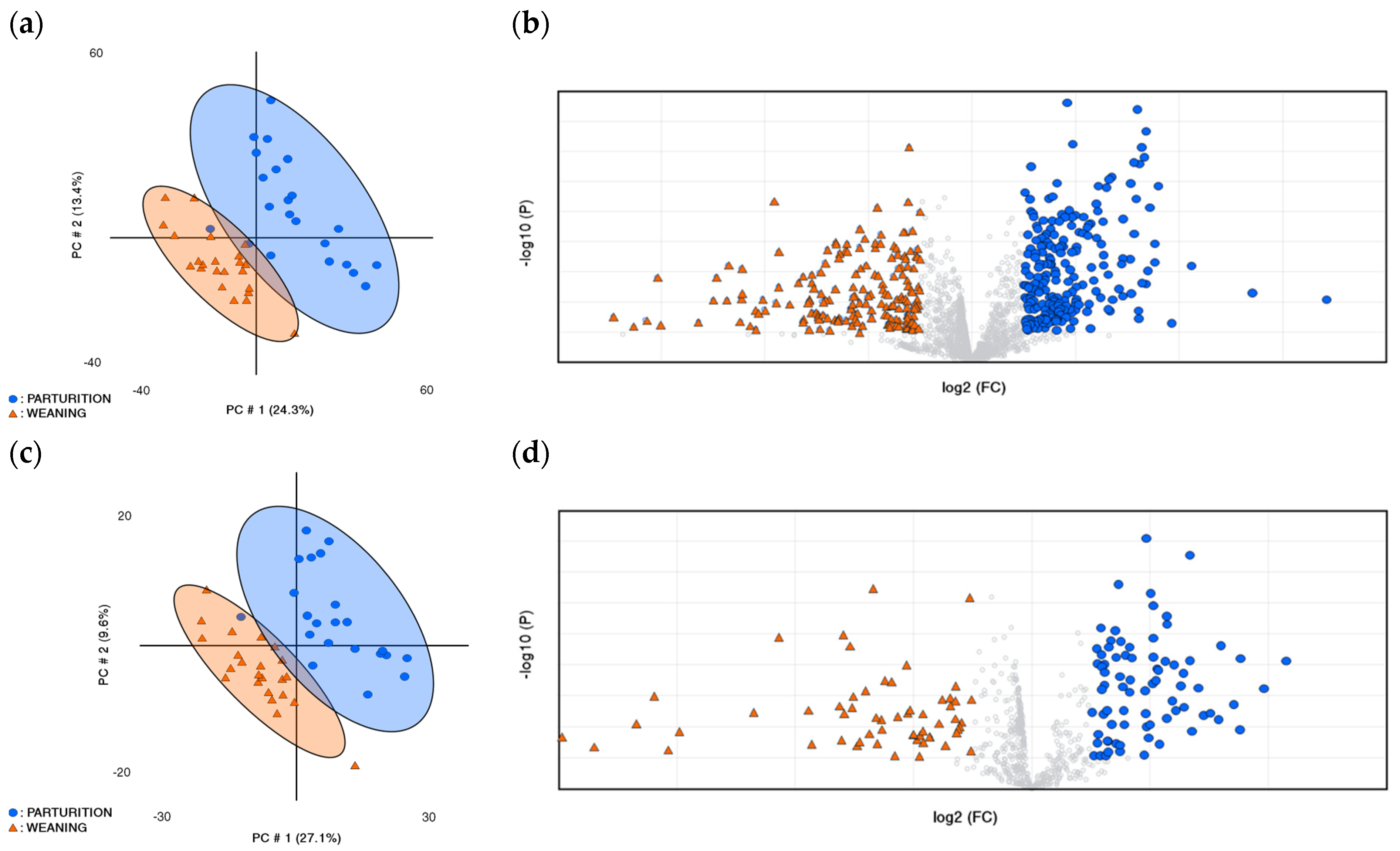
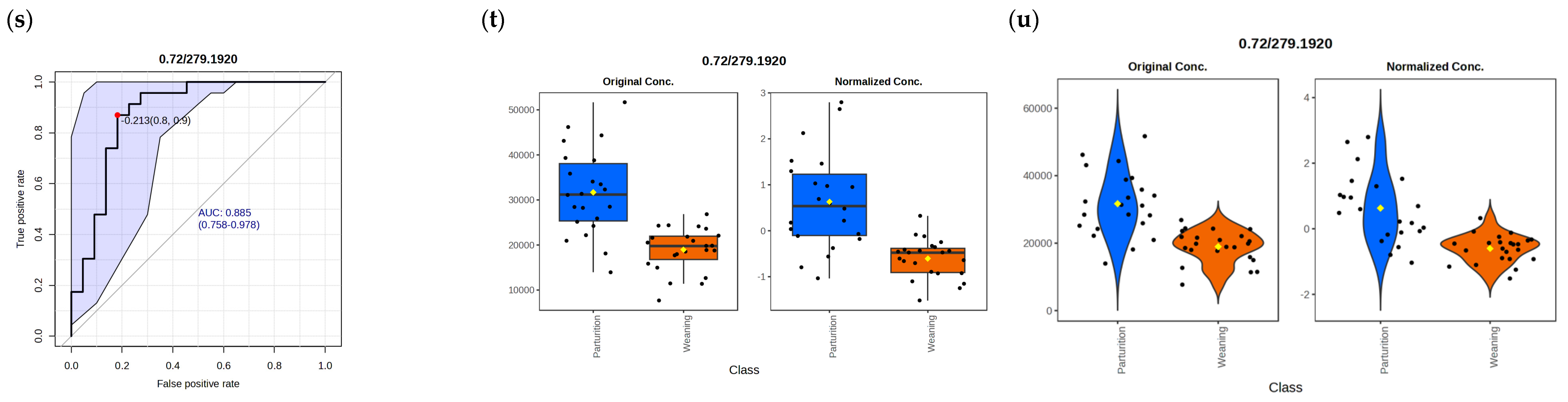
  : (orange) weaning time. (R2 = 0.80, Q2 = 0.65; R2 = 0.81, Q2 = 0.65, for a and c, respectively. R2: explained variance; Q2: predictive ability.) (b,d) Volcano plots show significantly different abundant metabolites between both plasma extraction times (two-sided Wilcoxon rank tests with the value adjusted by false discovery rate, FDR < 0.05 Benjamini–Hochberg) are shown; fold change threshold > 2.0 in the volcano plots. Volcano plots are in positive (ESI+, (b)) and in negative mode (ESI-, (d)).
: (blue) parturition time, : (orange) weaning time. (R2 = 0.80, Q2 = 0.65; R2 = 0.81, Q2 = 0.65, for a and c, respectively. R2: explained variance; Q2: predictive ability.) (b,d) Volcano plots show significantly different abundant metabolites between both plasma extraction times (two-sided Wilcoxon rank tests with the value adjusted by false discovery rate, FDR < 0.05 Benjamini–Hochberg) are shown; fold change threshold > 2.0 in the volcano plots. Volcano plots are in positive (ESI+, (b)) and in negative mode (ESI-, (d)).
: (orange) weaning time. (R2 = 0.80, Q2 = 0.65; R2 = 0.81, Q2 = 0.65, for a and c, respectively. R2: explained variance; Q2: predictive ability.) (b,d) Volcano plots show significantly different abundant metabolites between both plasma extraction times (two-sided Wilcoxon rank tests with the value adjusted by false discovery rate, FDR < 0.05 Benjamini–Hochberg) are shown; fold change threshold > 2.0 in the volcano plots. Volcano plots are in positive (ESI+, (b)) and in negative mode (ESI-, (d)).
: (blue) parturition time, : (orange) weaning time. (R2 = 0.80, Q2 = 0.65; R2 = 0.81, Q2 = 0.65, for a and c, respectively. R2: explained variance; Q2: predictive ability.) (b,d) Volcano plots show significantly different abundant metabolites between both plasma extraction times (two-sided Wilcoxon rank tests with the value adjusted by false discovery rate, FDR < 0.05 Benjamini–Hochberg) are shown; fold change threshold > 2.0 in the volcano plots. Volcano plots are in positive (ESI+, (b)) and in negative mode (ESI-, (d)). : (blue) parturition time, : (orange) weaning time.
: (blue) parturition time, : (orange) weaning time.
: (blue) parturition time, : (orange) weaning time.



| Parturition * | Weaning * | |||||||
|---|---|---|---|---|---|---|---|---|
| RT-m/z | ION | Metabolite | X | ±SE ** | X | ±SE | Fold *** | p_Value |
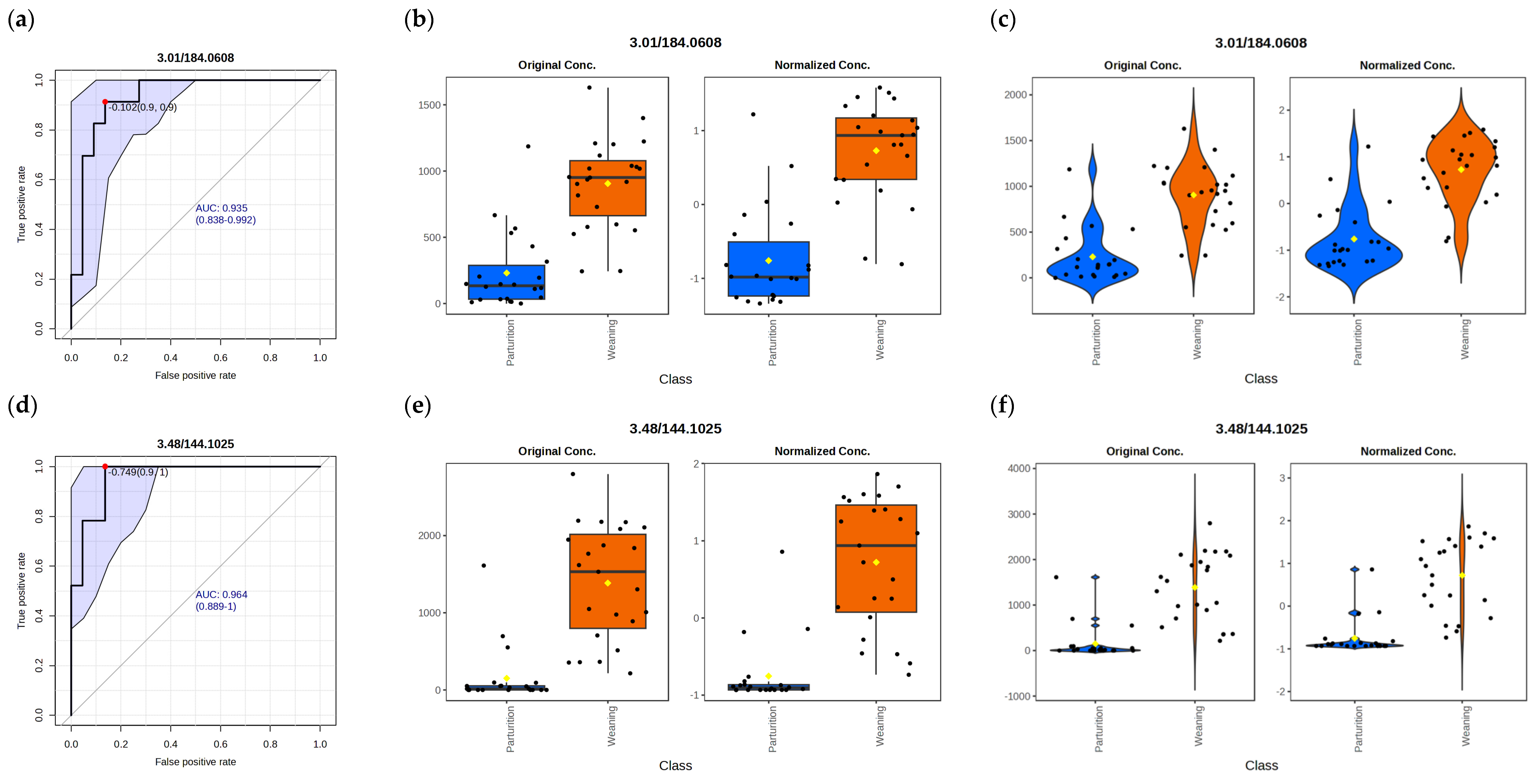
| 3.01/184.0608 | [M+H]+ | 4-Pyridoxic acid | 230 | ±68 | 906 | ±66 | 0.254 | <0.0001 |
| 3.48/144.1025 | [M+H]+ | Proline betaine | 151 | ±127 | 1385 | ±124 | 0.109 | <0.0001 |
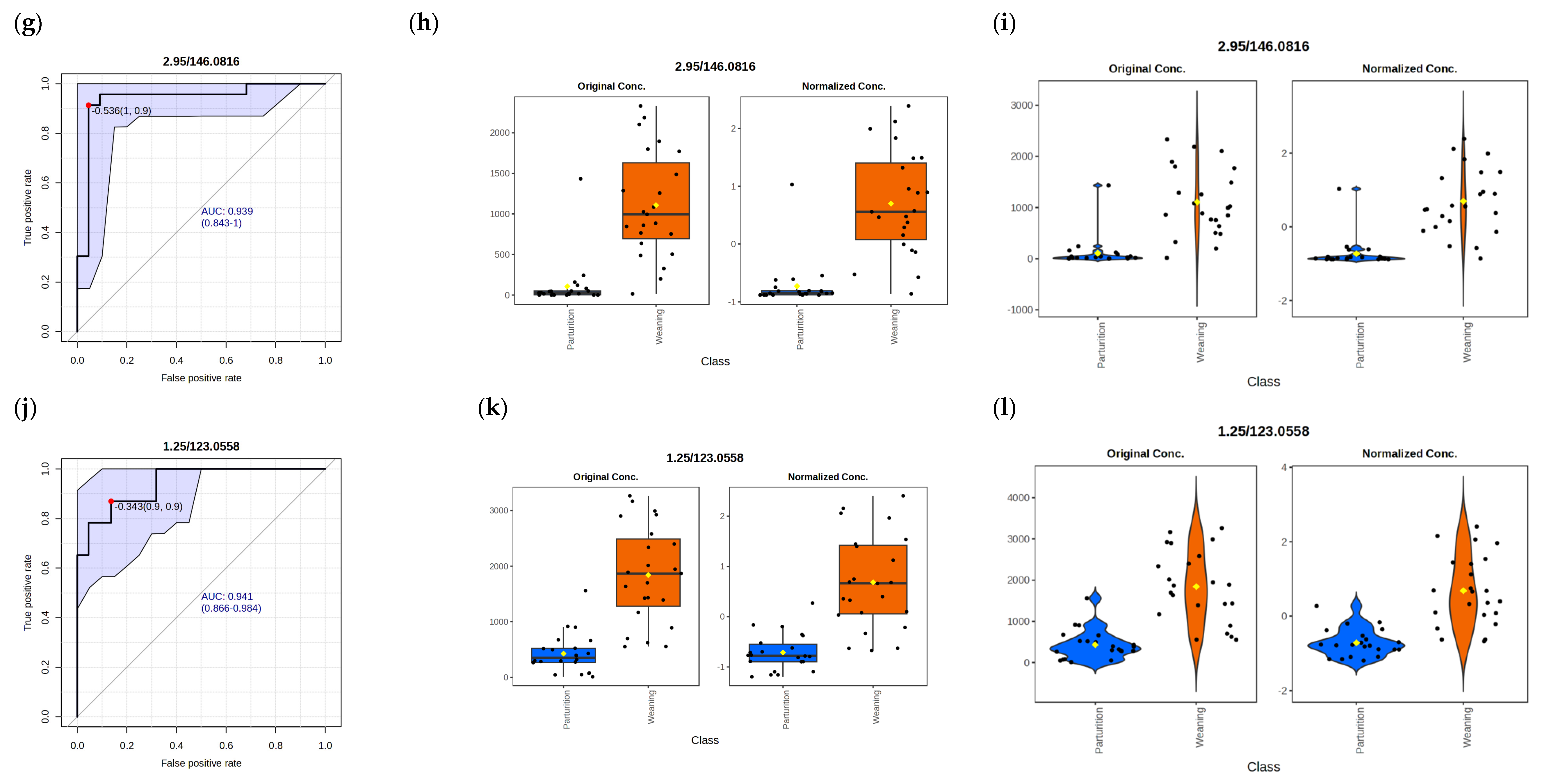
| 2.95/146.0816 | [M+H]+ | Allysine | 107 | ±110 | 1109 | ±107 | 0.096 | <0.0001 |
| 1.25/123.0558 | [M+H]+ | 2-acetylpyrazine | 429 | ±143 | 1841 | ±140 | 0.233 | <0.0001 |
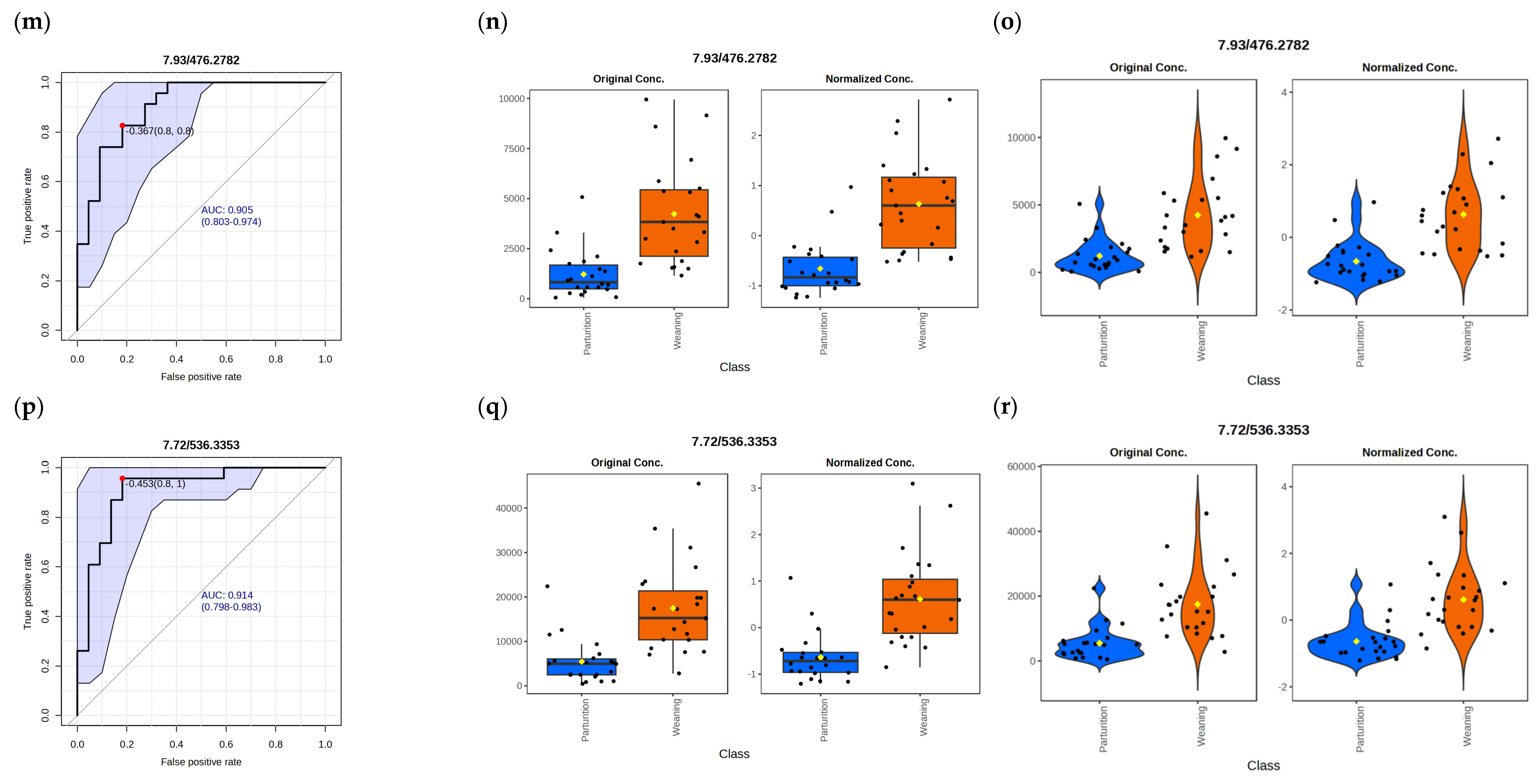
| 7.93/476.2782 | [M+H]+ | LysoPE(18:3/0:0 | 1225 | ±426 | 4237 | ±416 | 0.289 | <0.0001 |
| 7.72/536.3353 | [M+NH4]+ | LysoPC | 5431 | ±1708 | 17,444 | ±1671 | 0.311 | <0.0001 |
| 0.72/279.1920 | [M+H]+ | alpha-CEHC | 31,693 | ±1598 | 18,947 | ±1563 | 1.673 | <0.0001 |
Disclaimer/Publisher’s Note: The statements, opinions and data contained in all publications are solely those of the individual author(s) and contributor(s) and not of MDPI and/or the editor(s). MDPI and/or the editor(s) disclaim responsibility for any injury to people or property resulting from any ideas, methods, instructions or products referred to in the content. |
© 2026 by the authors. Licensee MDPI, Basel, Switzerland. This article is an open access article distributed under the terms and conditions of the Creative Commons Attribution (CC BY) license.
Share and Cite
Mateo-López, J.; Huertas-Herrera, A.; Toro-Manríquez, M.; Páez-Rosas, D.; Hedemann, M.S.; Llobat, L.; Marín-García, P.J. Rabbit Does as a Model for Studying Plasma Metabolomic Adaptations Across Reproductive Stages: Insights from Parturition to Weaning. Vet. Sci. 2026, 13, 497. https://doi.org/10.3390/vetsci13050497
Mateo-López J, Huertas-Herrera A, Toro-Manríquez M, Páez-Rosas D, Hedemann MS, Llobat L, Marín-García PJ. Rabbit Does as a Model for Studying Plasma Metabolomic Adaptations Across Reproductive Stages: Insights from Parturition to Weaning. Veterinary Sciences. 2026; 13(5):497. https://doi.org/10.3390/vetsci13050497
Chicago/Turabian StyleMateo-López, Jorge, Alejandro Huertas-Herrera, Mónica Toro-Manríquez, Diego Páez-Rosas, Mette Skou Hedemann, Lola Llobat, and Pablo Jesús Marín-García. 2026. "Rabbit Does as a Model for Studying Plasma Metabolomic Adaptations Across Reproductive Stages: Insights from Parturition to Weaning" Veterinary Sciences 13, no. 5: 497. https://doi.org/10.3390/vetsci13050497
APA StyleMateo-López, J., Huertas-Herrera, A., Toro-Manríquez, M., Páez-Rosas, D., Hedemann, M. S., Llobat, L., & Marín-García, P. J. (2026). Rabbit Does as a Model for Studying Plasma Metabolomic Adaptations Across Reproductive Stages: Insights from Parturition to Weaning. Veterinary Sciences, 13(5), 497. https://doi.org/10.3390/vetsci13050497