

Portable Electronic Olfactometer for Non-Invasive Screening of Canine Ehrlichiosis: A Proof-of-Concept Study Using Machine Learning
 ,
,  and
and 
Simple Summary
Abstract
1. Introduction
2. Materials and Methods
2.1. Controlled Environmental and Pre-Analytical Conditions
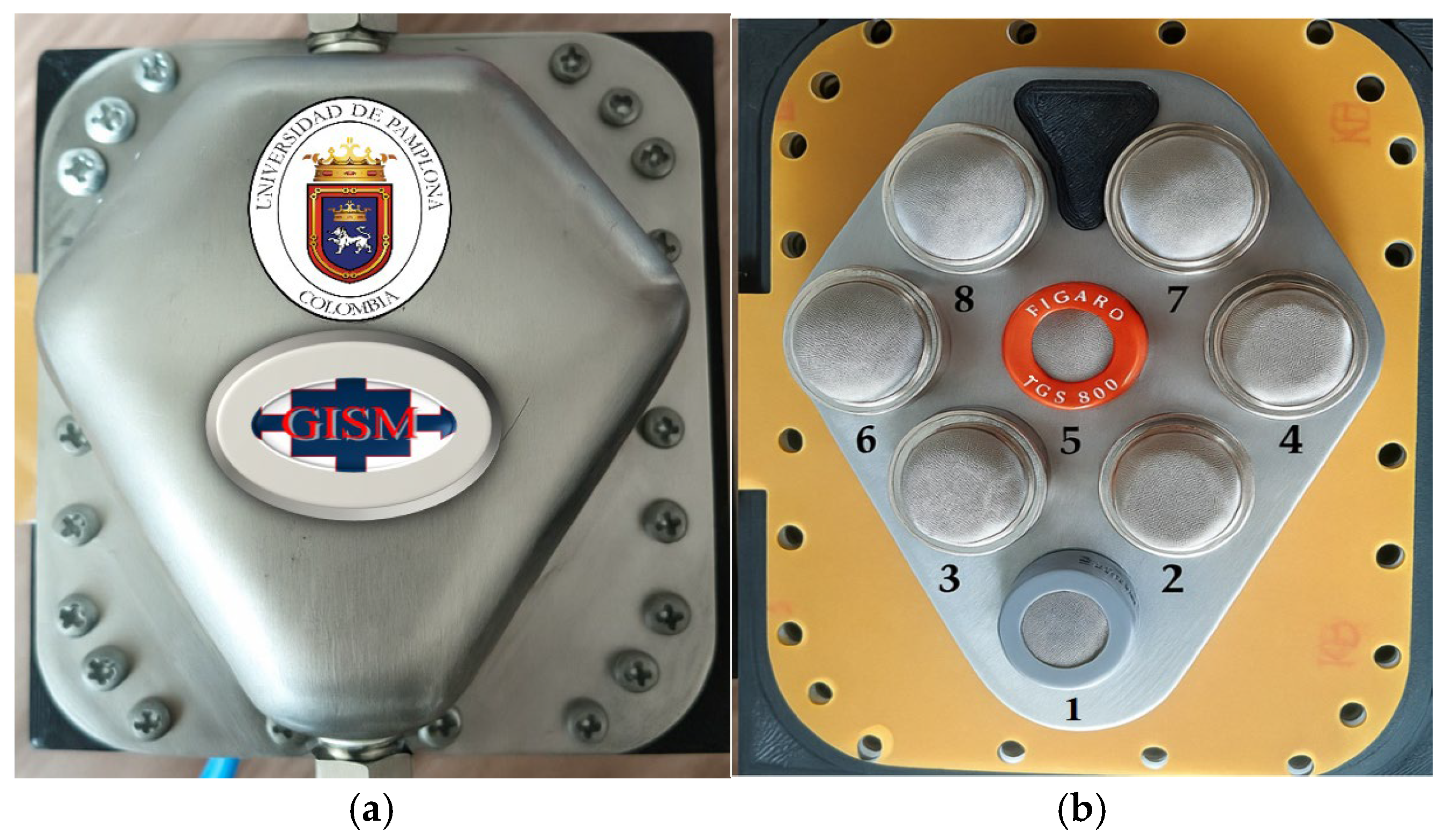
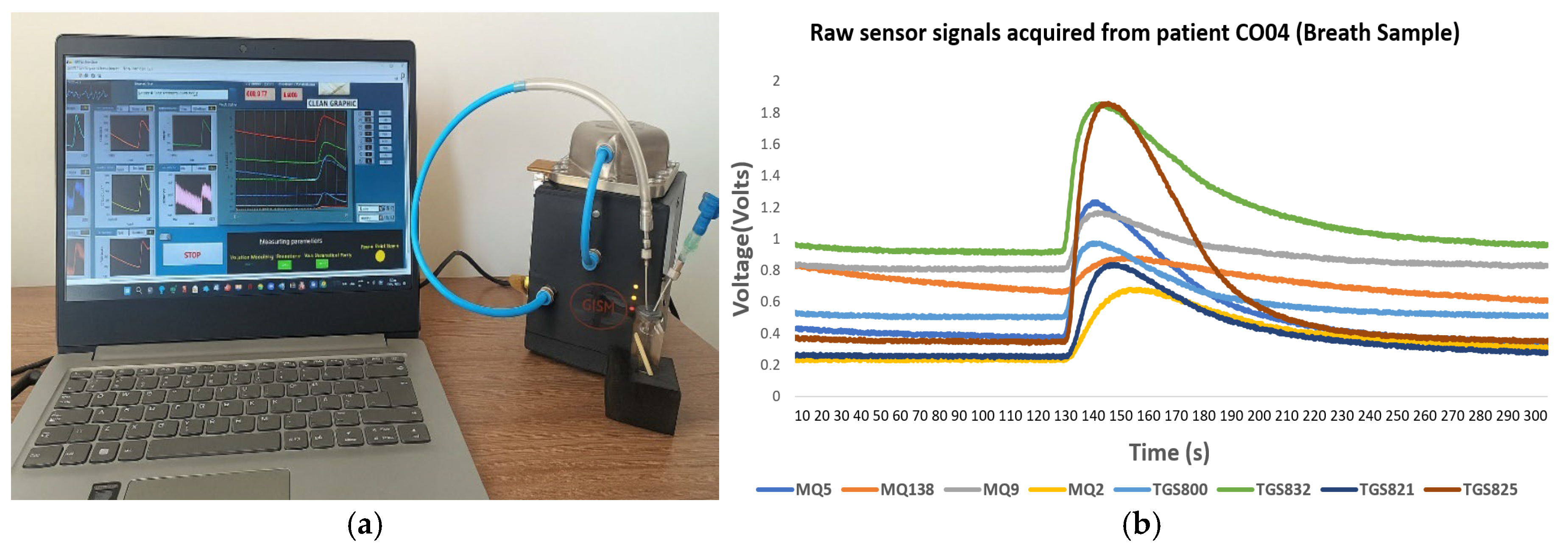
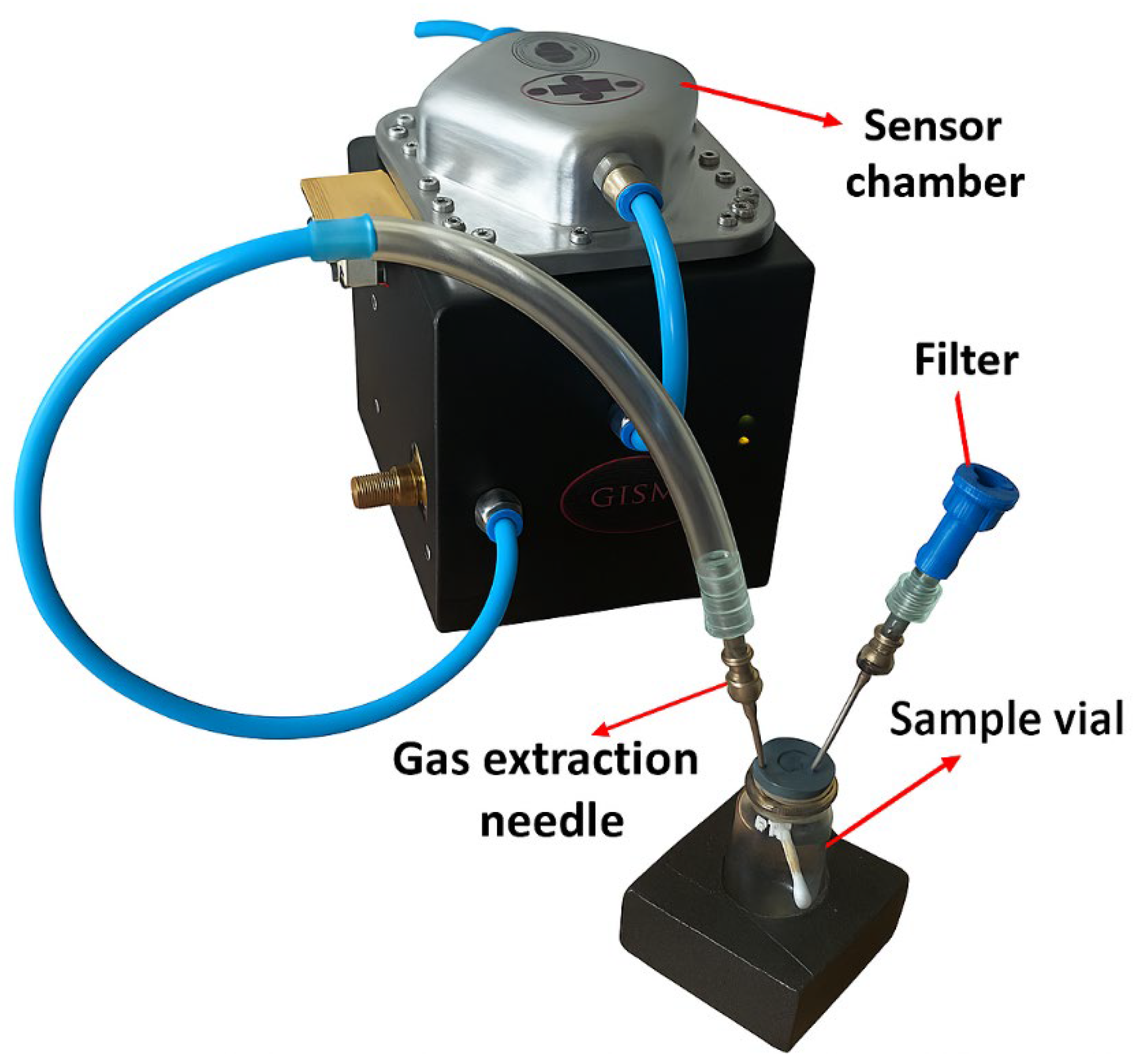
2.2. Design of the Electronic Olfactometer
2.3. Sample Collection
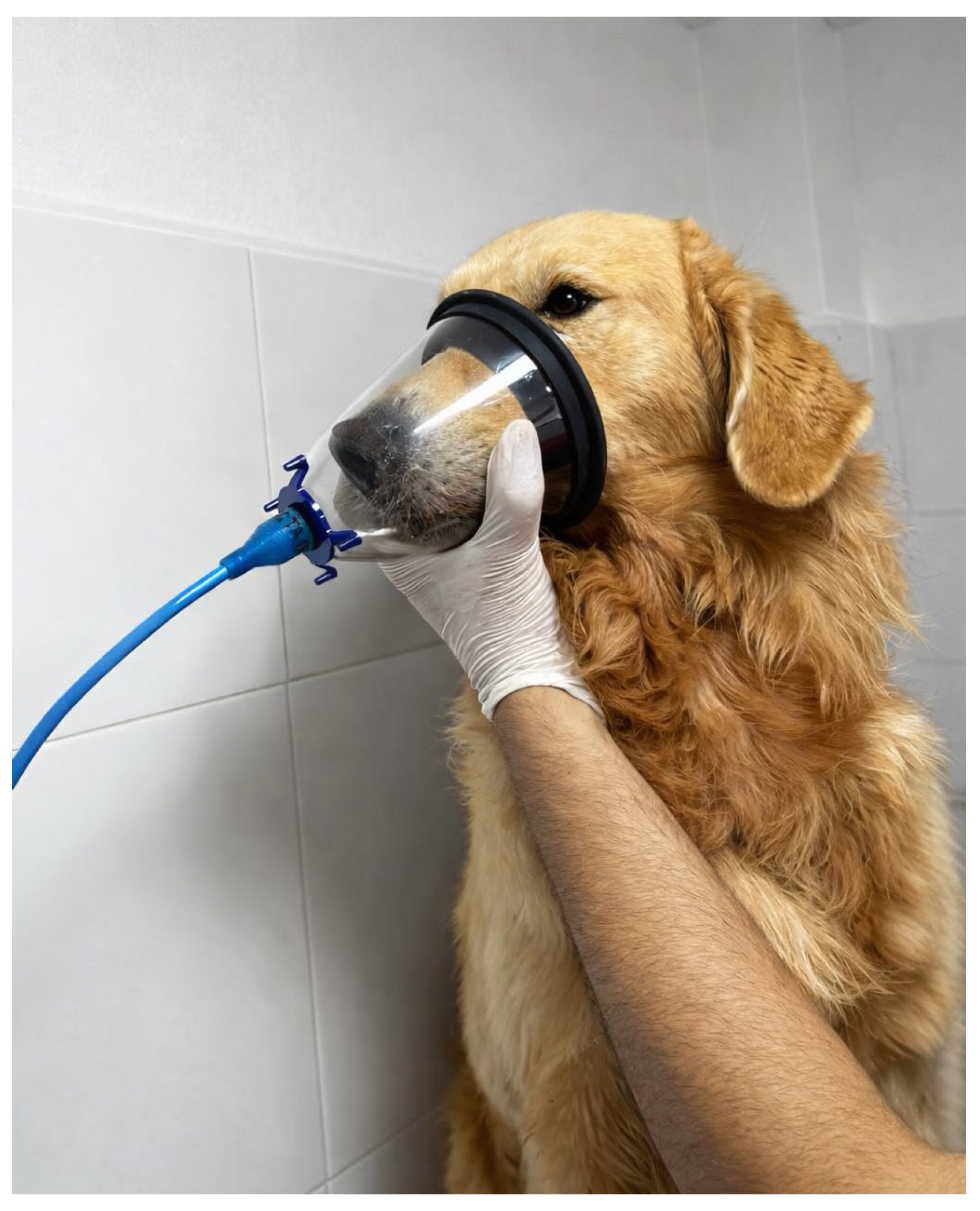
- Breath sample:
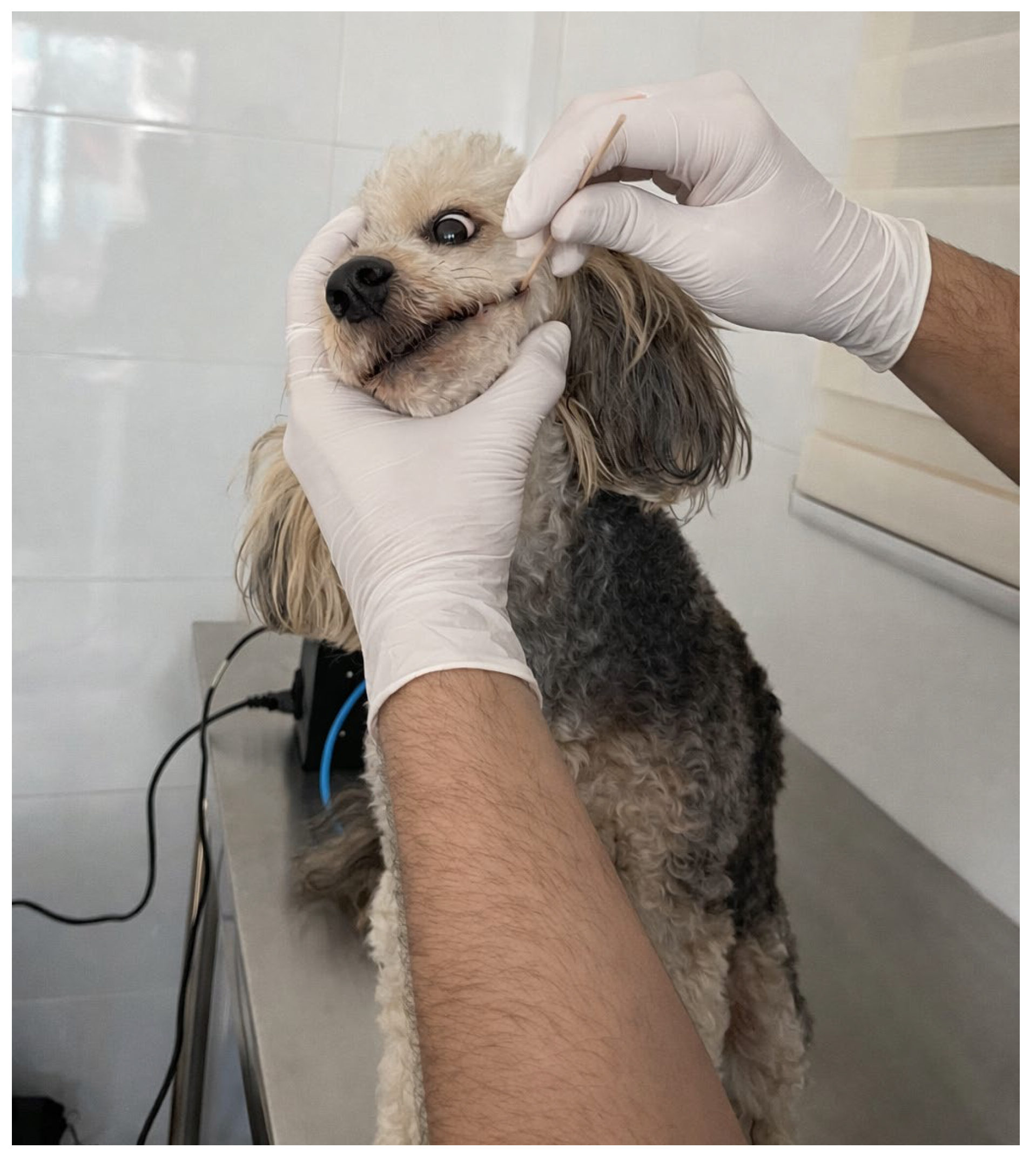
- Saliva sample
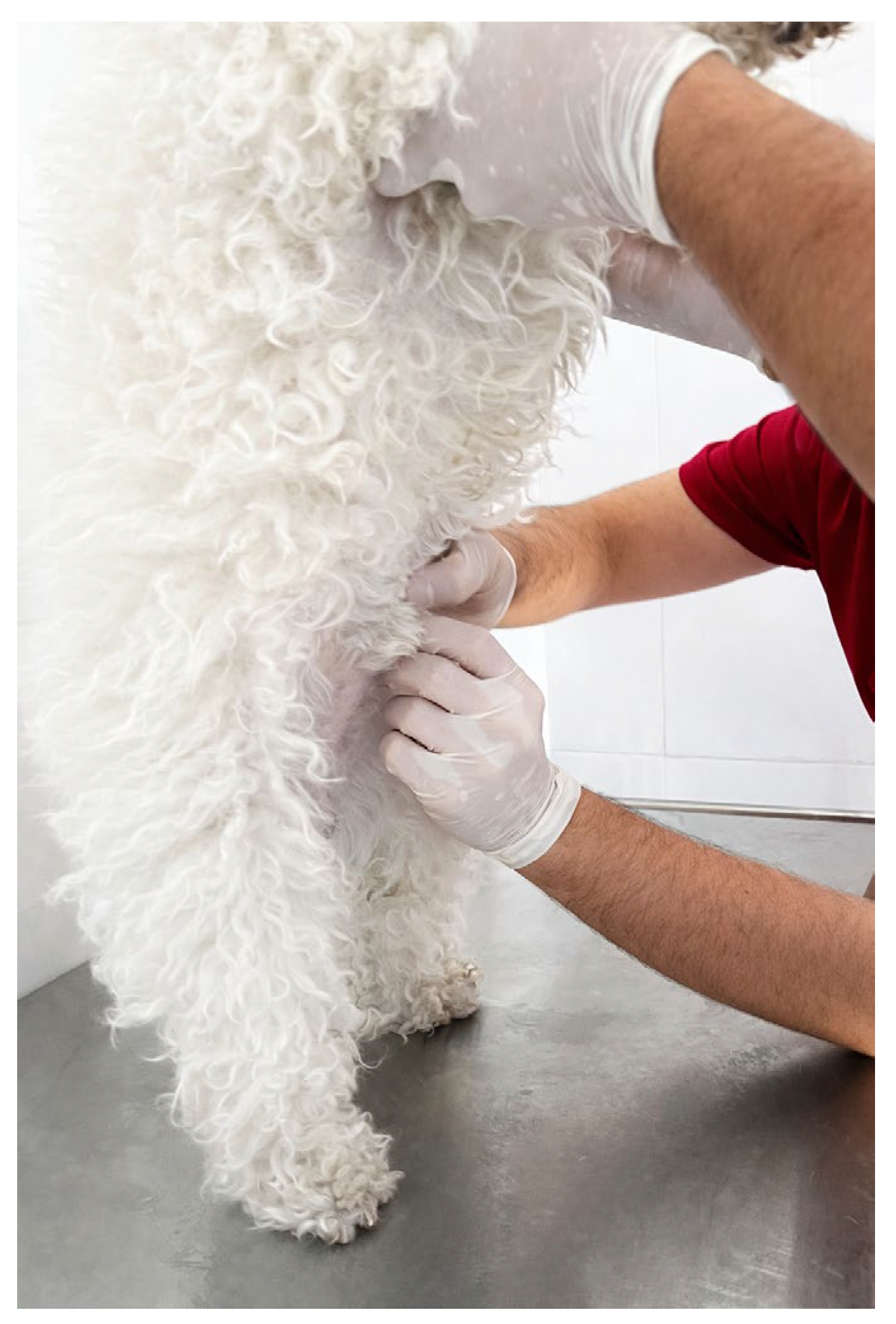
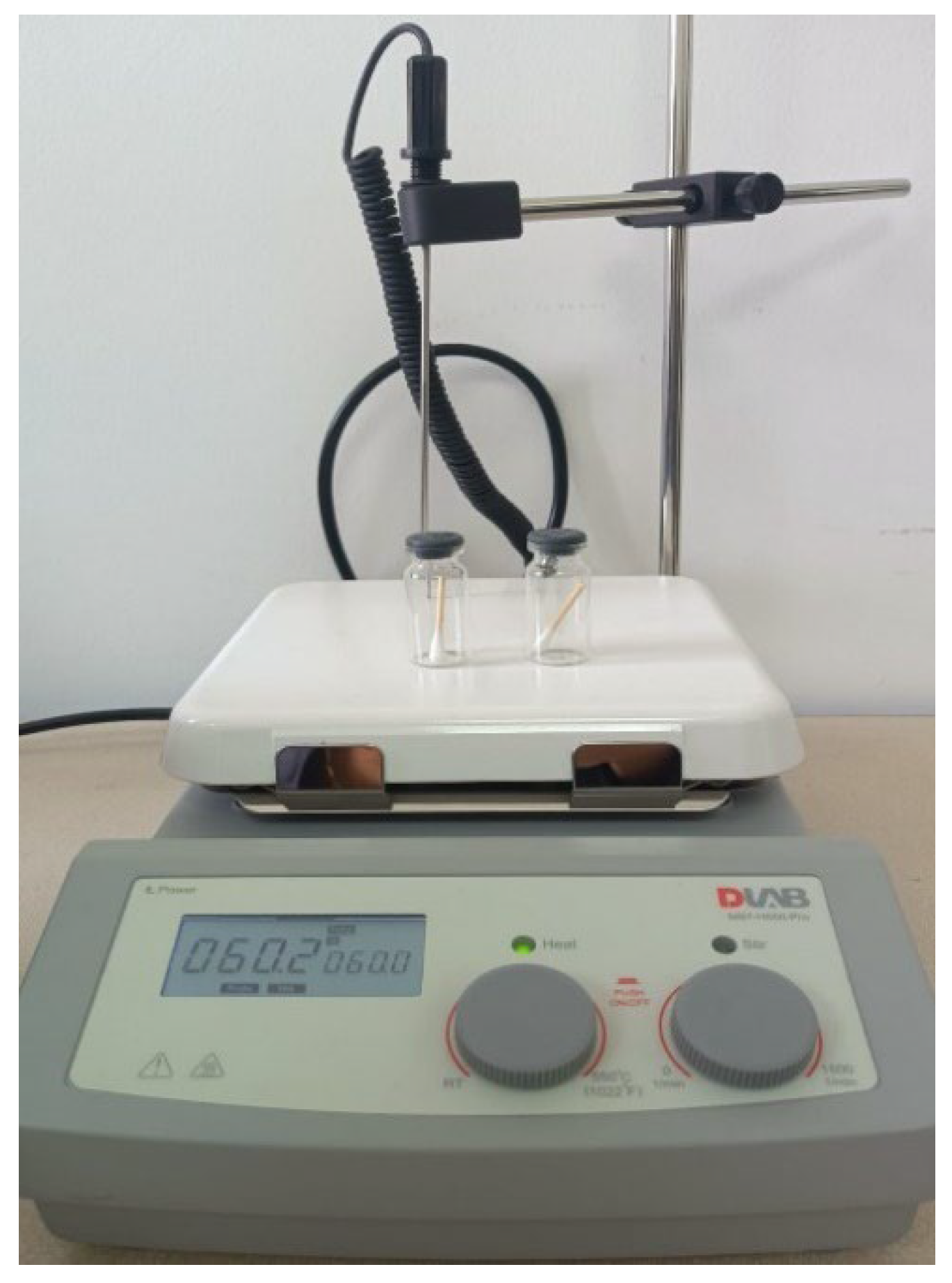
- Hair sample
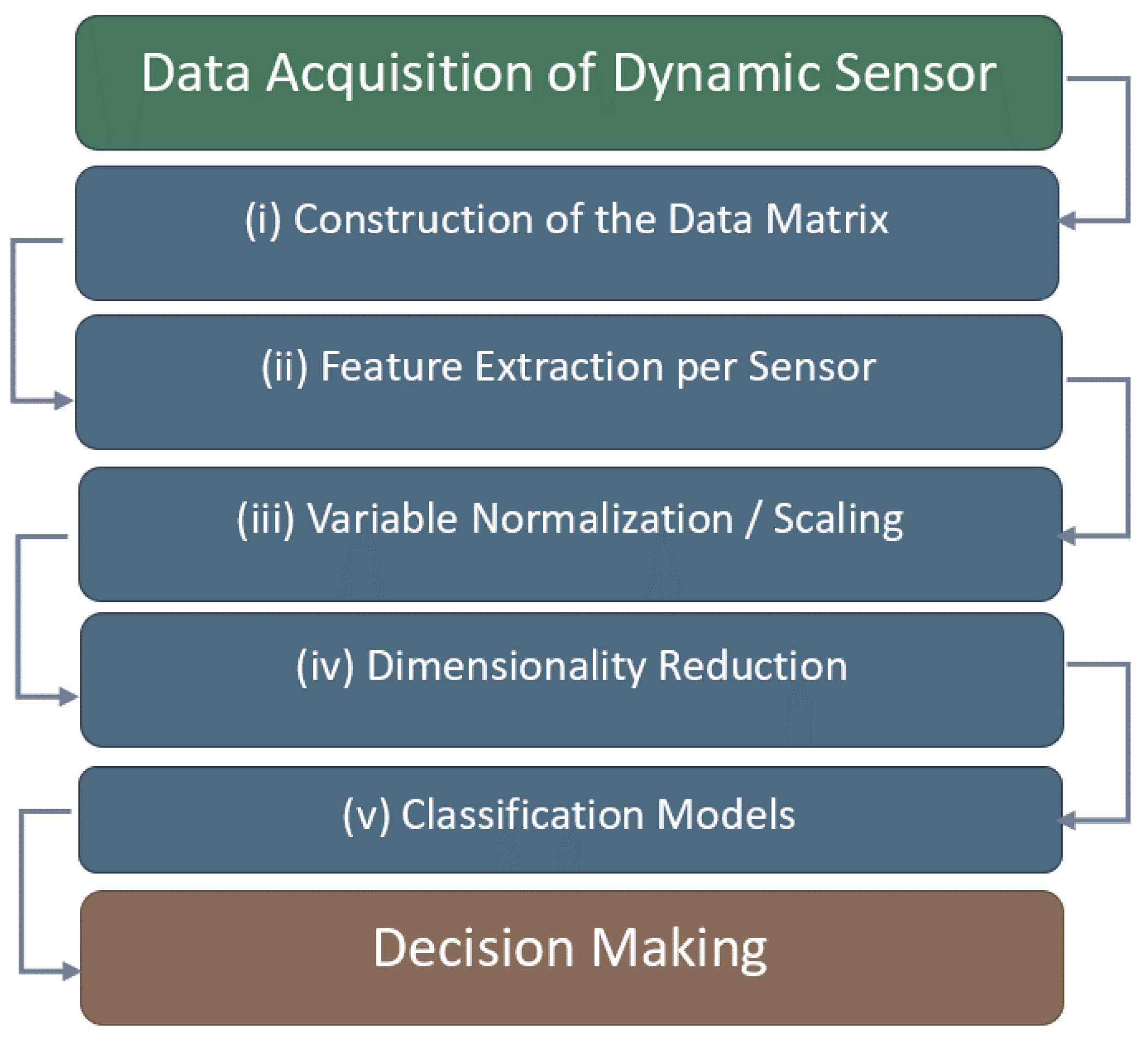
2.4. Data Processing Methods
2.4.1. Principal Component Analysis (PCA)
- Signal amplitude, calculated as the difference between the maximum value (Gmax) and the minimum value (Gmin) recorded during the measurement process:
- 2.
- Variation obtained as the difference between the final value (Gfinal) and the initial value (Ginitial) of the signal:
2.4.2. Classification Models
- k-Nearest Neighbors (k-NN)
- Random Forest (RF)
- AdaBoost (Adaptive Boosting)
- Support Vector Machine (SVM)
- Classifier parameter settings
2.5. Confusion Matrix
- Accuracy: Proportion of correct predictions relative to the total number of samples.
- Precision: Percentage of samples predicted as positive that are actually positive (controls for FP).
- Sensitivity (Recall): Percentage of actual positive cases correctly identified (controls for FN).
- Specificity: Percentage of actual negative cases correctly identified.
- F1-score: Harmonic mean of precision and sensitivity (balances false positives and false negatives).
- ROC Curve: The ROC curve plots the true positive rate (TPR) against the false positive rate (FPR) as the decision threshold varies.
3. Results
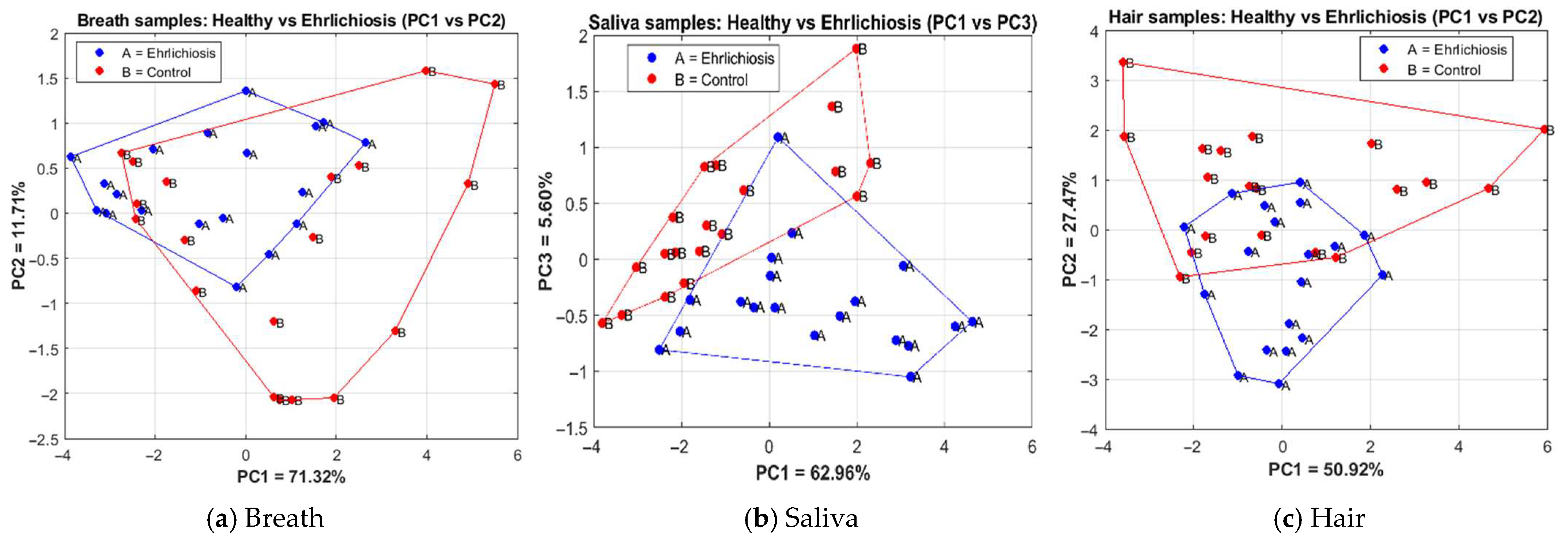
3.1. Results of Multivariate Analysis: PCA
- For breath samples, the explained variance was PC1 = 71.32% and PC2 = 11.71%, with a cumulative variance of PC1–PC2 = 83.03%.
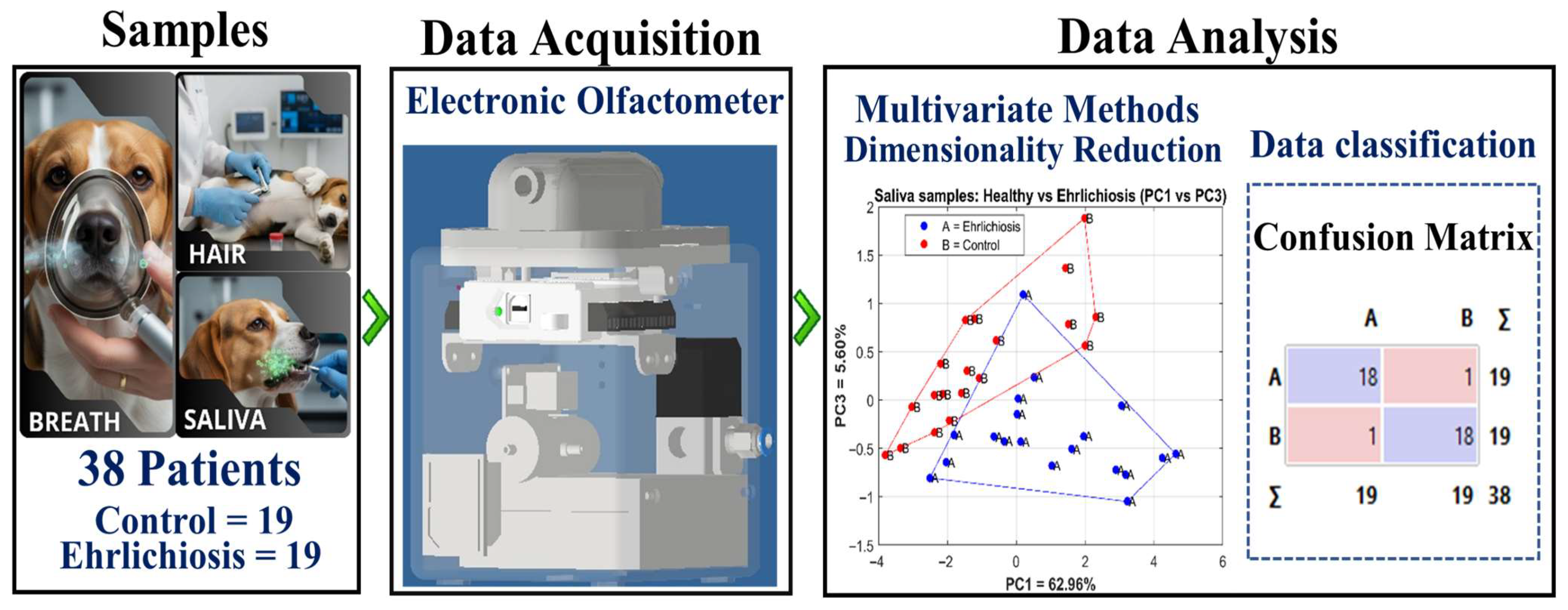
- For saliva samples, PC1–PC3 was represented because it provided a clearer visual separation than PC1–PC2; the variances were PC1 = 62.96%, PC2 = 22.63%, and PC3 = 5.60%, with a cumulative variance of PC1–PC3 = 91.19%.
- For hair samples, the explained variance was PC1 = 50.92% and PC2 = 27.47%, with a cumulative variance of PC1–PC2 = 78.39%.
3.2. Results of the Classification Models
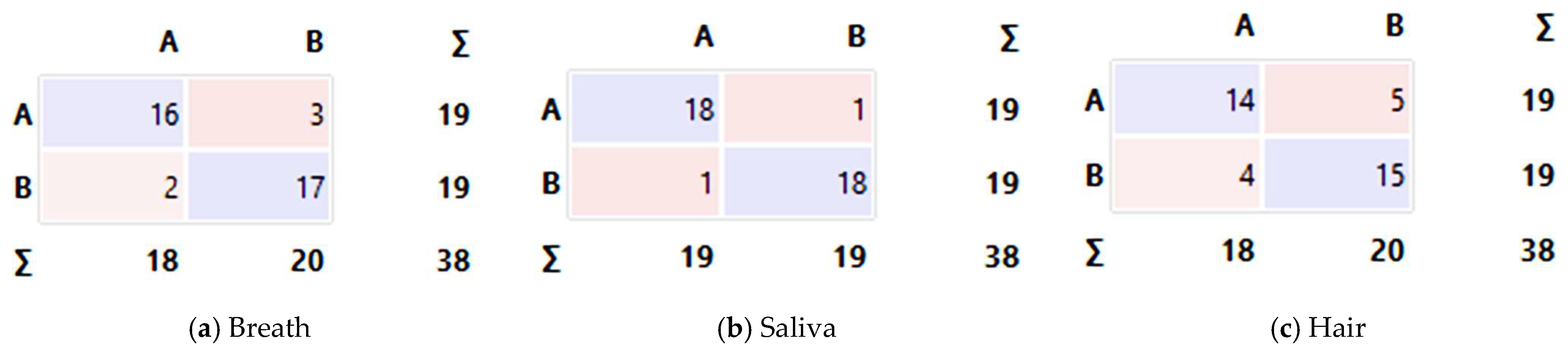
- Breath (Figure 11a). The model correctly classified 16 infected dogs (TP) and 17 healthy dogs (TN). There were three false negatives (FN), in which infected dogs were predicted as healthy, and two false positives (FP), in which healthy dogs were predicted as infected.
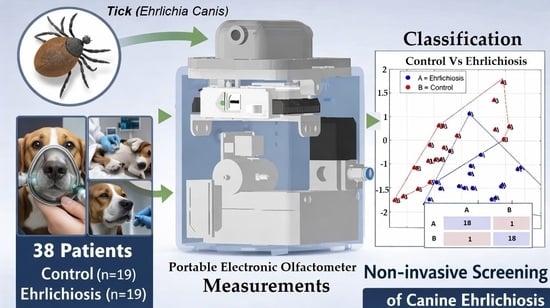
- Saliva (Figure 11b). This modality yielded the best performance, with 18 TP and 18 TN, and only 1 FN and 1 FP. These results demonstrate a strong discriminative capability for this sample type.
- Hair (Figure 11c). The model correctly identified 14 TP and 15 TN but produced 5 FN and 4 FP, indicating lower accuracy and greater inter-class confusion.
4. Discussion
5. Conclusions
Author Contributions
Funding
Institutional Review Board Statement
Informed Consent Statement
Data Availability Statement
Acknowledgments
Conflicts of Interest
Abbreviations
| VOCs | Volatile Organic Compounds |
| MOX | Metal Oxide Gas Sensor |
| PCA | Principal Component Analysis |
| SVM | Support Vector Machine |
| k-NN | k-Nearest Neighbors |
| RF | Random Forest |
| GC–MS | Gas Chromatography–Mass Spectrometry |
| IFA | Indirect Immunofluorescence Assay |
| ELISA | Enzyme-Linked Immunosorbent Assay |
| PCR | Polymerase Chain Reaction |
| CNF | Carbon Nanofiber |
| CP | Conducting Polymer |
| SAW | Surface Acoustic Wave |
| DAQ | Data Acquisition |
| ROC | Receiver Operating Characteristic |
| AUC | Area Under the ROC Curve |
| CA | Classification Accuracy |
| TP | True Positive |
| TN | True Negative |
| FP | False Positive |
| FN | False Negative |
References
- Ferrolho, J.; Antunes, S.; Vilhena, H.; Anastácio, S.; Sousa, S.; Frouco, G.; Ferreira, B.; Domingos, A. The complexities of canine monocytic ehrlichiosis: Insights into Ehrlichia canis and its vector Rhipicephalus sanguineus. Microbiol. Res. 2025, 16, 85. [Google Scholar] [CrossRef]
- Mylonakis, M.E.; Harrus, S.; Breitschwerdt, E.B. An update on the treatment of canine monocytic ehrlichiosis (Ehrlichia canis). Vet. J. 2019, 246, 45–53. [Google Scholar] [CrossRef] [PubMed]
- Aziz, M.U.; Hussain, S.; Song, B.; Ghauri, H.N.; Zeb, J.; Sparagano, O.A. Ehrlichiosis in dogs: A comprehensive review about the pathogen and its vectors with emphasis on South and East Asian countries. Vet. Sci. 2022, 10, 21. [Google Scholar] [CrossRef]
- Waner, T. Combined simultaneous in-clinic, serology and molecular analysis for the diagnosis of canine monocytic ehrlichiosis (Ehrlichia canis). Isr. J. Vet. Med. 2022, 77, 67–71. [Google Scholar]
- Kabir, A.; Chouhan, C.S.; Habib, T.; Hossain, M.Z.; Raihan, A.; Yeasmin, F.; Siddique, M.P.; Rahman, A.K.M.A.; Nahar, A.; Rahman, M.S.; et al. Epidemiology of canine ehrlichiosis and molecular characterization of Ehrlichia canis in Bangladeshi pet dogs. PLoS ONE 2024, 19, e0314729. [Google Scholar] [CrossRef]
- McCown, M.E.; Monterroso, V.H.; Cardona, W. Surveillance for Ehrlichia canis, Anaplasma phagocytophilum, Borrelia burgdorferi, and Dirofilaria immitis in dogs from three cities in Colombia. J. Spec. Oper. Med. 2014, 14, 86–90. [Google Scholar] [CrossRef]
- Cartagena-Yarce, L.M.; Ríos-Osorio, L.A.; Cardona-Arias, J.A. Seroprevalencia de Ehrlichia canis en perros con sospecha de infección por patógenos transmitidos por garrapatas en Medellín, 2012–2014. Rev. Med. Vet. 2015, 29, 51–62. (In Spanish) [Google Scholar] [CrossRef]
- Cabrera-Jaramillo, A.; Monsalve, S.; Arroyave, E.; Rodas, J.-D. Prevalencia de Ehrlichia canis y Hepatozoon canis en perros albergados en el sur del Valle de Aburrá, Colombia. Rev. Colomb. Cienc. Pecu. 2023, 35, 82–92. (In Spanish) [Google Scholar] [CrossRef]
- Chakraborty, A.; Rath, P.K.; Panda, S.K.; Mishra, B.P.; Dehuri, M.; Biswal, S.; Jena, M.K.; Sahu, B.P.; Paital, B.; Sahoo, D.K. Molecular confirmation, epidemiology, and pathophysiology of Ehrlichia canis prevalence in eastern India. Pathogens 2024, 13, 803. [Google Scholar] [CrossRef] [PubMed]
- Fourie, J.J.; Stanneck, D.; Luus, H.G.; Beugnet, F.; Wijnveld, M.; Jongejan, F. Transmission of Ehrlichia canis by Rhipicephalus sanguineus ticks feeding on dogs and on artificial membranes. Vet. Parasitol. 2013, 197, 595–603. [Google Scholar] [CrossRef]
- Groves, M.G.; Dennis, G.L.; Amyx, H.L.; Huxsoll, D.L. Transmission of Ehrlichia canis to dogs by ticks (Rhipicephalus sanguineus). Am. J. Vet. Res. 1975, 36, 937–940. [Google Scholar] [CrossRef]
- Wilson, A.D. Application of electronic-nose technologies and VOC-biomarkers for the noninvasive early diagnosis of gastrointestinal diseases. Sensors 2018, 18, 2613. [Google Scholar] [CrossRef] [PubMed]
- Staniek, M.E.; Sedda, L.; Gibson, T.D.; de Souza, C.F.; Costa, E.M.; Dillon, R.J.; Hamilton, J.G. eNose analysis of volatile chemicals from dogs naturally infected with Leishmania infantum in Brazil. PLoS Negl. Trop. Dis. 2019, 13, e0007599. [Google Scholar] [CrossRef]
- Zhang, E.; Wang, F.; Yin, C.; Wang, H.; Zhu, Y.; Duan, H.; Yang, S.; Zhang, Y.; Hu, J. Application of an electronic nose for the diagnosis of ketosis in dairy cows. Food Biosci. 2024, 60, 104355. [Google Scholar] [CrossRef]
- Kuchmenko, T.; Shuba, A.; Umarkhanov, R.; Chernitskiy, A. Portable electronic nose for analyzing the smell of nasal secretions in calves: Toward noninvasive diagnosis of infectious bronchopneumonia. Vet. Sci. 2021, 8, 74. [Google Scholar] [CrossRef]
- Fend, R.; Geddes, R.; Lesellier, S.; Vordermeier, H.M.; Corner, L.A.L.; Gormley, E.; Costello, E.; Hewinson, R.G.; Marlin, D.J.; Woodman, A.C.; et al. Use of an electronic nose to diagnose Mycobacterium bovis infection in badgers and cattle. J. Clin. Microbiol. 2005, 43, 1745–1751. [Google Scholar] [CrossRef] [PubMed]
- Dugheri, S.; Rapi, I.; Cappelli, G.; Fanfani, N.; Squillaci, D.; De Sio, S.; Mallardi, B.; Mantellini, P.; Staderini, F.; Traversini, V.; et al. Breath fingerprint of colorectal cancer patients by gas chromatography–mass spectrometry analysis preparatory to e-nose analyses. Pract. Lab. Med. 2025, 45, e00475. [Google Scholar] [CrossRef]
- Lee, T.; Yu, J.; Lee, S.W.; Oh, S.H.; Kang, D.; Son, H.; Hwang, H.J.; You, J.H.; Lee, G. Machine learning-integrated biomimetic electronic noses: Future perspectives. Microchem. J. 2025, 213, 113638. [Google Scholar] [CrossRef]
- Saini, A.S.; Yadav, N. A new paradigm of e-nose technology for the non-invasive and early lung cancer diagnostics. Chem. Eng. J. 2025, 512, 162155. [Google Scholar] [CrossRef]
- República de Colombia. Ley 1581 de 2012. Por la Cual se Dictan Disposiciones Generales para la Protección De Datos Personales. Diario Oficial 2012, No. 48.587. 18 October 2012. Available online: https://www.funcionpublica.gov.co/eva/gestornormativo/norma.php?i=49981 (accessed on 2 November 2025). (In Spanish)
- Khorramifar, A.; Karami, H.; Lvova, L.; Kolouri, A.; Łazuka, E.; Piłat-Rożek, M.; Łagód, G.; Ramos, J.; Lozano, J.; Kaveh, M.; et al. Environmental engineering applications of electronic nose systems based on MOX gas sensors. Sensors 2023, 23, 5716. [Google Scholar] [CrossRef]
- National Instruments. NI USB-6009 Multifunction I/O Device: Specifications and Support. Available online: https://www.ni.com/docs/zh-CN/bundle/usb-6009-specs/page/specs.html (accessed on 2 November 2025).
- National Association of State Public Health Veterinarians (NASPHV). Veterinary Standard Precautions: Compendium of Measures to Prevent Disease Associated with Animals in Public Settings; NASPHV, 2015. Available online: https://www.nasphv.org/Documents/VeterinaryStandardPrecautions.pdf (accessed on 10 November 2025).
- World Health Organization (WHO). Laboratory Biosafety Manual, 4th ed.; WHO: Geneva, Switzerland, 2020; Available online: https://www.who.int/publications/i/item/9789240011311 (accessed on 7 November 2025).
- World Organisation for Animal Health (WOAH). Terrestrial Manual: Chapter 1.1.4. Biosafety and Biosecurity in Veterinary Laboratories and Animal Facilities. WOAH: Paris, France, 2024; Available online: https://www.woah.org/fileadmin/Home/fr/Health_standards/tahm/1.01.04_BIOSAFETY_BIOSECURITY.pdf (accessed on 7 November 2025).
- De Oliveira, L.S.; Rodrigues, F.M.; De Oliveira, F.S.; Mesquita, P.R.R.; Leal, D.C.; Alcântara, A.C.; Souza, B.M.; Franke, C.R.; Pereira, P.A.D.P.; De Andrade, J.B. Headspace solid-phase microextraction/gas chromatography–mass spectrometry combined with chemometric analysis for volatile organic compounds determination in canine hair: A new tool to detect dog contamination by visceral leishmaniasis. J. Chromatogr. B 2008, 875, 392–398. [Google Scholar] [CrossRef]
- Demšar, J.; Curk, T.; Erjavec, A.; Gorup, Č.; Hočevar, T.; Milutinovič, M.; Možina, M.; Polajnar, M.; Toplak, M.; Starič, A.; et al. Orange: Data mining toolbox in Python. J. Mach. Learn. Res. 2013, 14, 2349–2353. Available online: https://jmlr.org/papers/volume14/demsar13a/demsar13a.pdf (accessed on 7 November 2025).
- Singh, D.; Singh, B. Investigating the impact of data normalization on classification performance. Appl. Soft Comput. 2020, 97, 105524. [Google Scholar] [CrossRef]
- Bedoui, S.; Samet, H.; Kachouri, A. Electronic nose system and principal component analysis technique for gases identification. In Advanced Biosignal Processing; De Gruyter: Berlin, Germany, 2018. [Google Scholar] [CrossRef]
- Jolliffe, I.T.; Cadima, J. Principal component analysis: A review and recent developments. Philos. Trans. R. Soc. A 2016, 374, 20150202. [Google Scholar] [CrossRef] [PubMed]
- Abu Alfeilat, H.A.; Hassanat, A.B.A.; Lasassmeh, O.; Tarawneh, A.S.; Alhasanat, M.B.; Salman, H.S.E.; Prasath, V.B.S. Effects of distance measure choice on k-nearest neighbor classifier performance: A review. Big Data 2019, 7, 221–248. [Google Scholar] [CrossRef]
- Wongoutong, C. The impact of neglecting feature scaling in k-means clustering. PLoS ONE 2024, 19, e0310839. [Google Scholar] [CrossRef]
- Breiman, L. Random forests. Mach. Learn. 2001, 45, 5–32. [Google Scholar] [CrossRef]
- Biau, G.; Scornet, E. A random forest guided tour. TEST 2016, 25, 197–227. [Google Scholar] [CrossRef]
- Freund, Y.; Schapire, R.E. A decision-theoretic generalization of on-line learning and an application to boosting. J. Comput. Syst. Sci. 1997, 55, 119–139. [Google Scholar] [CrossRef]
- Friedman, J.; Hastie, T.; Tibshirani, R. Additive logistic regression: A statistical view of boosting. Ann. Stat. 2000, 28, 337–407. [Google Scholar] [CrossRef]
- Qi, K.; Yang, H.; Hu, Q.; Yang, D. A new adaptive weighted imbalanced data classifier via improved support vector machines with high-dimension nature. Knowl.-Based Syst. 2019, 185, 104933. [Google Scholar] [CrossRef]
- Khan, S.N.; Khan, S.U.; Aznaoui, H.; Şahin, C.B.; Dinler, Ö.B. Generalization of linear and non-linear support vector machine in multiple fields: A review. Comput. Sci. Inf. Technol. 2023, 4, 226–239. [Google Scholar] [CrossRef]
- Hussain, M.; Chen, Z.; Lv, M.; Xu, J.; Dong, X.; Zhao, J.; Li, S.; Deng, Y.; He, N.; Li, Z.; et al. Rapid and label-free classification of pathogens based on light scattering, reduced power spectral features and support vector machine. Chin. Chem. Lett. 2020, 31, 3163–3167. [Google Scholar] [CrossRef]
- Fawcett, T. An introduction to ROC analysis. Pattern Recognit. Lett. 2006, 27, 861–874. [Google Scholar] [CrossRef]
- Sokolova, M.; Lapalme, G. A systematic analysis of performance measures for classification tasks. Inf. Process. Manag. 2009, 45, 427–437. [Google Scholar] [CrossRef]



| Code | Breed | Sex | Saliva | Breath | Hair | Observations | Ehrlichiosis | Control |
|---|---|---|---|---|---|---|---|---|
| EC00 | Golden Retriever | M | x | x | x | - | x | |
| EC01 | Poodle | M | x | x | x | x | ||
| CO02 | Poodle | F | x | x | x | x | ||
| CO03 | Yorkshire Terrier | M | x | x | x | x | ||
| CO04 | Border Collie | M | x | x | x | x | ||
| EC05 | Schnauzer | F | x | x | x | x | ||
| EC06 | French Bulldog | F | x | x | x | x | ||
| CO07 | Mixed-breed | M | x | x | x | x | ||
| EC08 | Mixed-breed | F | x | x | x | During hysterectomy treatment, she was very restless. | x | |
| EC09 | Pinscher | F | x | x | x | x | ||
| EC10 | Schnauzer | F | x | x | x | x | ||
| CO11 | Siberian Husky | M | x | x | x | x | ||
| CO12 | Mixed-breed | M | x | x | x | x | ||
| EC13 | Schnauzer | F | x | x | x | x | ||
| CO14 | Mixed-breed | F | x | x | x | x | ||
| EC15 | Poodle | M | x | x | x | x | ||
| CO16 | Pitbull | F | x | x | x | x | ||
| EC17 | Mixed-breed | M | x | x | x | x | ||
| CO18 | Mixed-breed | F | x | x | x | Gastroenteritis | x | |
| EC19 | Poodle | F | x | x | x | x | ||
| EC20 | Mixed-breed | M | x | x | x | x | ||
| CO21 | Mixed-breed | F | x | x | x | Undergoing blood transfusion and splenomegaly | x | |
| CO22 | Schnauzer | M | x | x | x | Treatment—lipoma removal | x | |
| EC23 | Poodle | M | x | x | x | x | ||
| CO24 | Mixed-breed | F | x | x | x | Chronic otitis | x | |
| EC25 | Mixed-breed | M | x | x | x | x | ||
| EC26 | Jack Russell | M | x | x | x | x | ||
| CO27 | Siberian Husky | F | x | x | x | x | ||
| EC28 | Pug | M | x | x | x | x | ||
| EC29 | Cocker Spaniel | F | x | x | x | x | ||
| CO30 | Mixed-breed | F | x | x | x | Treatment for tick infestation—hepatitis | x | |
| EC31 | Poodle | M | x | x | x | x | ||
| CO32 | Chihuahua | F | x | x | x | x | ||
| EC33 | Poodle | F | x | x | x | x | ||
| EC34 | French Bulldog | M | x | x | x | x | ||
| CO35 | Shih Tzu | F | x | x | x | x | ||
| CO36 | Schnauzer | M | x | x | x | x | ||
| CO37 | Golden Retriever | M | x | x | x | x |
| No. | Sensor/Model | Target Gases/Primary Application |
|---|---|---|
| 1 | MQ5 | Natural gas, LPG |
| 2 | MQ138 | Toluene, Acetone, Ethanol, Formaldehyde |
| 3 | MQ9 | Carbon monoxide (CO), Flammable gases |
| 4 | MQ2 | Propane, Methane, Alcohol, Hydrogen |
| 5 | TGS800 | Air contaminants such as Hydrogen, Ethanol, CO, Methane, Isobutane |
| 6 | TGS832 | Chlorofluorocarbons |
| 7 | TGS821 | Alcohol vapors, Ammonia, Hydrogen |
| 8 | TGS825 | Hydrogen sulfide |
| Classifier | Parameter | Value |
|---|---|---|
| SVM | Type | C-SVM |
| Kernel | RBF | |
| C (Cost) | 10 | |
| γ (gamma) | Auto | |
| k-NN | Number of neighbors (k) | 5 |
| Distance metric | Euclidean | |
| Weighting scheme | Distance-weighted | |
| Random Forest | Number of trees | 22 |
| Attributes per split | 1 | |
| Minimum samples per node | 5 | |
| Replicable training | Enabled | |
| AdaBoost | Base estimator | Decision Tree |
| Number of estimators | 50 | |
| Learning rate | 1.0 | |
| Random seed | 2 |
| Sample | Model | AUC (Mean ± SD) | Accuracy (% ± SD) | F1 (% ± SD) | Precision (% ± SD) | Recall (% ± SD) | Specificity (% ± SD) |
|---|---|---|---|---|---|---|---|
| Breath | AdaBoost | 0.658 ± 0.381 | 65.8 ± 32.5 | 64.6 ± 34.2 | 68.3 ± 25.2 | 65.8 ± 26.4 | 65.8 ± 22.9 |
| SVM | 0.884 ± 0.155 | 86.8 ± 13.7 | 86.8 ± 20.6 | 86.9 ± 15.2 | 86.8 ± 14.4 | 86.8 ± 14.1 | |
| k-NN | 0.751 ± 0.222 | 68.4 ± 31.9 | 68.4 ± 27.8 | 68.4 ± 25.5 | 68.4 ± 27.3 | 68.4 ± 30.8 | |
| Random Forest | 0.878 ± 0.112 | 76.3 ± 23.5 | 75.9 ± 23.7 | 78.3 ± 21.7 | 76.3 ± 25.4 | 76.3 ± 21.2 | |
| Saliva | AdaBoost | 0.658 ± 0.394 | 65.8 ± 27.7 | 65.8 ± 23.0 | 65.8 ± 28.4 | 65.8 ± 32.5 | 65.8 ± 30.6 |
| SVM | 0.964 ± 0.052 | 94.7 ± 11.4 | 94.7 ± 14.7 | 94.7 ± 12.3 | 94.7 ± 11.6 | 94.7 ± 10.1 | |
| k-NN | 0.803 ± 0.137 | 84.2 ± 15.4 | 83.8 ± 15.7 | 84.2 ± 18.5 | 83.8 ± 16.7 | 84.2 ± 20.7 | |
| Random Forest | 0.776 ± 0.260 | 76.3 ± 21.3 | 75.9 ± 22.5 | 78.3 ± 22.8 | 76.3 ± 24.7 | 76.3 ± 25.0 | |
| Hair | AdaBoost | 0.553 ± 0.489 | 55.3 ± 41.3 | 54.5 ± 40.3 | 55.7 ± 38.5 | 55.3 ± 40.5 | 55.3 ± 35.0 |
| SVM | 0.798 ± 0.226 | 76.3 ± 16.3 | 76.3 ± 20.3 | 76.4 ± 19.2 | 76.3 ± 24.2 | 76.3 ± 22.0 | |
| k-NN | 0.723 ± 0.288 | 68.4 ± 29.5 | 68.3 ± 29.7 | 68.6 ± 28.5 | 68.4 ± 27.3 | 68.4 ± 29.3 | |
| Random Forest | 0.737 ± 0.261 | 68.4 ± 30.5 | 68.3 ± 28.8 | 68.6 ± 29.4 | 68.4 ± 28.3 | 68.4 ± 27.3 |
Disclaimer/Publisher’s Note: The statements, opinions and data contained in all publications are solely those of the individual author(s) and contributor(s) and not of MDPI and/or the editor(s). MDPI and/or the editor(s) disclaim responsibility for any injury to people or property resulting from any ideas, methods, instructions or products referred to in the content. |
© 2026 by the authors. Licensee MDPI, Basel, Switzerland. This article is an open access article distributed under the terms and conditions of the Creative Commons Attribution (CC BY) license.
Share and Cite
Durán Cotrina, S.V.; Acevedo, C.M.D.; Carrillo Gómez, J.K. Portable Electronic Olfactometer for Non-Invasive Screening of Canine Ehrlichiosis: A Proof-of-Concept Study Using Machine Learning. Vet. Sci. 2026, 13, 88. https://doi.org/10.3390/vetsci13010088
Durán Cotrina SV, Acevedo CMD, Carrillo Gómez JK. Portable Electronic Olfactometer for Non-Invasive Screening of Canine Ehrlichiosis: A Proof-of-Concept Study Using Machine Learning. Veterinary Sciences. 2026; 13(1):88. https://doi.org/10.3390/vetsci13010088
Chicago/Turabian StyleDurán Cotrina, Silvana Valentina, Cristhian Manuel Durán Acevedo, and Jeniffer Katerine Carrillo Gómez. 2026. "Portable Electronic Olfactometer for Non-Invasive Screening of Canine Ehrlichiosis: A Proof-of-Concept Study Using Machine Learning" Veterinary Sciences 13, no. 1: 88. https://doi.org/10.3390/vetsci13010088
APA StyleDurán Cotrina, S. V., Acevedo, C. M. D., & Carrillo Gómez, J. K. (2026). Portable Electronic Olfactometer for Non-Invasive Screening of Canine Ehrlichiosis: A Proof-of-Concept Study Using Machine Learning. Veterinary Sciences, 13(1), 88. https://doi.org/10.3390/vetsci13010088