The Dual Character of Animal-Centred Care: Relational Approaches in Veterinary and Animal Sanctuary Work

1
FAU Kompetenzzentrum für interdisziplinäre Wissenschaftsreflexion, Friedrich-Alexander University Erlangen-Nürnberg, 91054 Erlangen, Germany
2
Faculty for Health Sciences Brandenburg, University of Potsdam, 14469 Potsdam, Germany
*
Author to whom correspondence should be addressed.
Vet. Sci. 2025, 12(8), 696; https://doi.org/10.3390/vetsci12080696
Submission received: 12 May 2025
/
Revised: 7 July 2025
/
Accepted: 18 July 2025
/
Published: 25 July 2025
(This article belongs to the Special Issue Advanced Therapy in Companion Animals—2nd Edition)
Simple Summary
Caring for animals is central to veterinary and animal sanctuary work. However, the meaning of animal-centred care is often the subject of debate. This article explores the challenges faced by professionals when balancing two approaches: treating animals as individuals and considering their species-specific needs. These tensions are further shaped by the differing expectations of various groups—including animal owners, caretakers, veterinarians, institutions, and the public—who may hold conflicting views on what constitutes appropriate care. This article focuses on human–animal interactions in sanctuaries and the difficult decisions regarding killing an animal in veterinary medicine, such as euthanasia. The two care approaches and the expectations of actor groups can conflict—particularly when professionals must make decisions in real-life situations that are constrained by limited resources and time. By highlighting these tensions, this study provides insight into the nuances of animal-centered care and the skills needed by professionals to navigate the ever-increasing complexities of the field.
Abstract
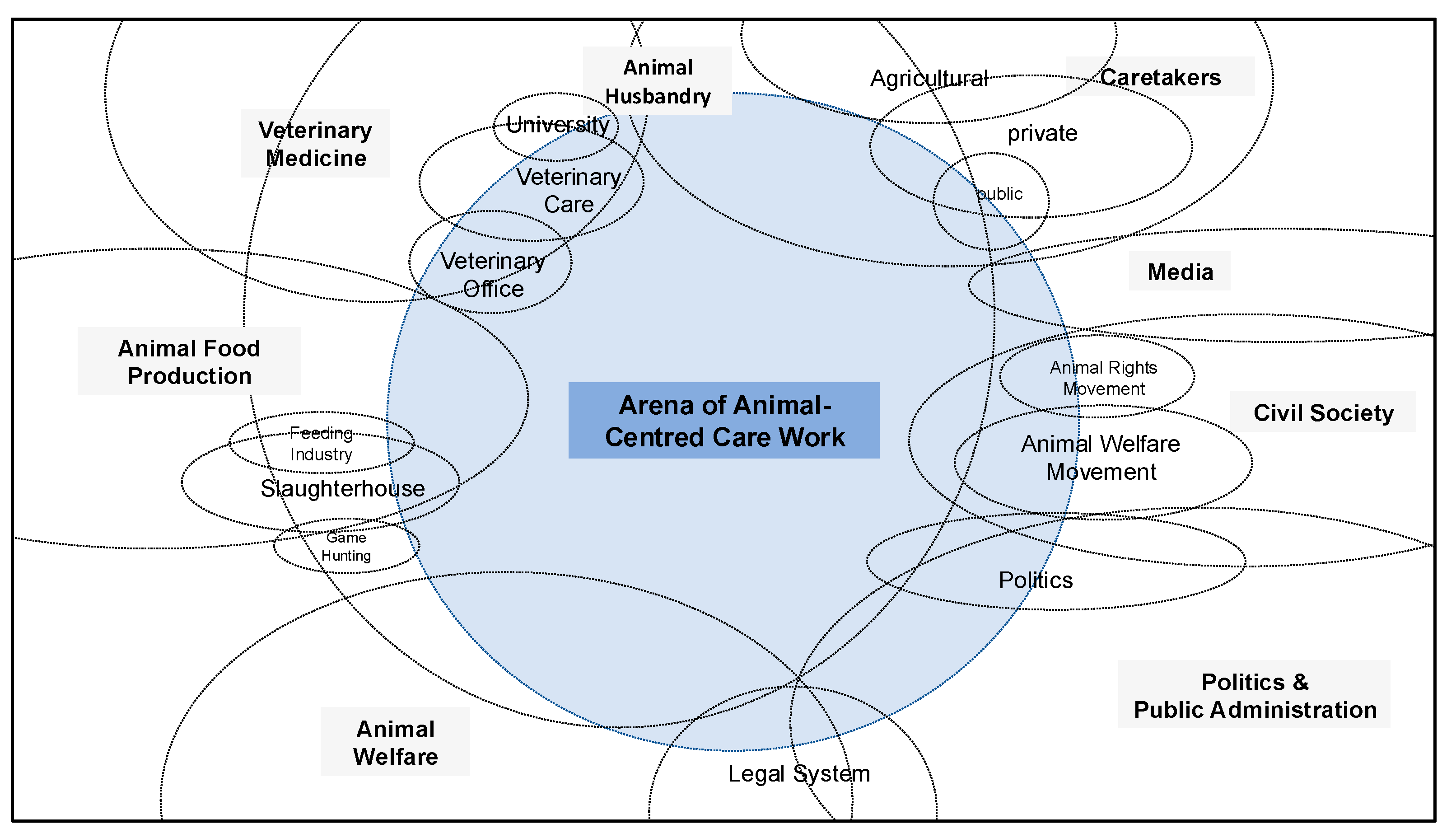
Caring for the lives and welfare of animals is central to veterinary and animal sanctuary work, yet the meaning remains a subject of complex debates. Different stakeholders negotiate what constitutes appropriate care, leading to conflicting demands and expectations from internal and external sources. This article is based on two qualitative studies: Study I explores the multifaceted aspects of death work in farm animal medicine, emphasising the practical, emotional and ethical challenges involved. Study II examines human–animal interaction in sanctuaries, which reveal tensions between instrumental and relational care in animal-centred work. Relational care represents a subjectifying approach with individual attention to animals, while instrumental care is a more objectifying perspective based on species representation. These demands can often be contradictory, complicating day-to-day decision making under pressure. To analyse these complexities, this study employs Clarke’s situational analysis (social worlds/arenas mapping), providing a means of comparing care work across different fields. This approach highlights how actor constellations, institutional settings, and structural constraints influence the negotiation of care. Addressing these issues provides a more nuanced understanding of the professional challenges of animal-centred care and the necessary skills to navigate its inherent contradictions.