Data Descriptor

Urinary Metabolite Panel Dataset for Bulgarian Children with Autism Spectrum Disorder (ASD)

by
Victor Slavov
1,*,
Lubomir Traikov
1,
Stanislava Ciurinskiene
2,
Maria Savcheva
3,
Till Heine
4,
Radka Tafradjiiska-Hadjiolova
5,
Alexandra Zlatarova
5,
Ivan Tourtourikov
6,
Dilyana Madzharova
6,
Anita Kavrakova
6 and
Tanya Kadiyska
5,6
1
Department of Medical Physics and Biophysics, Medical University of Sofia, 1431 Sofia, Bulgaria
2
Vsiaka Duma Society, 1000 Sofia, Bulgaria
3
Laboratory of Transfusion Hematology, Saint Sophia Hospital, 1618 Sofia, Bulgaria
4
Biovis Diagnostik MVZ GmbH, 65552 Limburg, Germany
5
Department of Physiology and Pathophysiology, Medical University of Sofia, 1431 Sofia, Bulgaria
6
Genetic Medico-Diagnostic Laboratory Genica, Genome Center Bulgaria, 1612 Sofia, Bulgaria
*
Author to whom correspondence should be addressed.
Data 2026, 11(4), 82; https://doi.org/10.3390/data11040082
Submission received: 7 March 2026 / Revised: 6 April 2026 / Accepted: 8 April 2026 / Published: 10 April 2026

Abstract

This Data Descriptor presents an anonymized, shuffled dataset of creatinine-normalized urinary metabolite measurements from 73 Bulgarian children with autism spectrum disorder (ASD), released to support reuse in secondary analyses and cross-cohort comparisons. The public release represents a pathway-oriented 24-marker subset from a broader urinary diagnostic panel, assembled as a self-contained resource for investigators working in these metabolic domains. Spot urine results are provided as individual-level values after creatinine normalization; for trimethylamine, values below the limit of quantification (LOQ) were replaced with LOQ/2. The deposit contains measurements for 24 urinary markers grouped into three functional classes (neurotransmitters and aromatic amino acid precursors; one-carbon/methylation and vitamin-related metabolites; and energy metabolism/organic acids with microbiome-related amines). The underlying cohort comprised children aged 3–13 years, and no contemporaneous neurotypical control group was enrolled. Second-morning, midstream, acid-stabilized spot urine samples were collected within the provider’s workflow; metabolites were measured by LC–MS/MS, and spot urinary creatinine was measured enzymatically for normalization. The release includes the results table in both XLSX and CSV formats, a reference limits and units file for contextual interpretation, a data dictionary, a README, a changelog, and SHA-256 checksums for integrity verification. The public files contain de-identified analytical variables only and omit individual-level demographics, dates, standalone urinary creatinine, and richer clinical metadata to preserve anonymity.
Dataset License: Creative Commons Attribution 4.0 International

1. Summary

This release provides anonymized, shuffled participant-level urinary measurements for 24 creatinine-normalized markers in a pediatric autism spectrum disorder (ASD) case–cohort from Bulgaria (n = 73). The public release represents a pathway-oriented subset from a broader urinary diagnostic panel and is structured as a self-contained thematic resource spanning three functional domains: neurotransmitters and aromatic amino acid precursors, one-carbon/methylation and vitamin-related metabolites, and energy metabolism/organic acids with microbiome-related amines. The cohort comprised children aged 3–13 years; median age (interquartile range, IQR) was 5 (4–7) years, including 57 males and 16 females, and no contemporaneous neurotypical control group was enrolled (Table 1). Spot urine collection followed a second-morning, midstream, acid-stabilized protocol using a commercial kit (T928; biovis Diagnostik MVZ GmbH, Limburg, Germany), with collection 2–4 h after the first morning void and acidification verified using the provided pH strip. Urinary metabolites were measured by LC–MS/MS, whereas spot urinary creatinine was measured enzymatically for normalization. The dataset was deposited to enable reuse of a case-only urinary marker panel in descriptive distribution analyses, exploratory feature screening, and cross-cohort comparisons that incorporate external control data or published reference limits. The public release contains de-identified analytical variables only; individual-level demographics, dates, standalone urinary creatinine, and richer clinical metadata are not included in the deposited files.

2. Data Description

2.1. Files in This Release

The Zenodo record [1] includes the following files:
  • ASD_urine_metabolites_panel_v1_results_anonymized_shuffled.xlsx (primary results table in Excel format);
  • ASD_urine_metabolites_panel_v1_results_anonymized_shuffled.csv (primary results table in CSV format);
  • ASD_v1_reference_ranges_units.csv (reporting units and laboratory reference limits);
  • ASD_v1_data_dictionary.csv (variable definitions, units, and reference metadata);
  • ASD_v1_README.md (dataset overview and usage notes);
  • ASD_v1_CHANGELOG.md (release version history);
  • ASD_v1_SHA256SUMS.txt (SHA-256 checksums for integrity verification).

2.2. Results Table

The primary results table is provided in both .xlsx and .csv formats. It contains one row per participant and one column for each of the 24 creatinine-normalized urinary metabolite variables included in the panel. The released variables comprise 23 creatinine-normalized metabolite concentration variables and one derived ratio variable (SAM/SAH), spanning the three functional classes used throughout this descriptor: neurotransmitters and aromatic amino acid precursors; one-carbon/methylation and vitamin-related metabolites; and energy metabolism/organic acids with microbiome-related amines. Reporting units are provided consistently as issued by the laboratory and comprise μg/g creatinine, μmol/g creatinine, mg/g creatinine, and ratio, depending on the marker. The public results table contains de-identified analytical variables only and is intended to support descriptive analyses, feature screening, and external cross-cohort comparisons using participant-by-marker data matrices. Variable-level metadata, including variable meaning, units, functional grouping, and reference-limit metadata, are provided in ASD_v1_data_dictionary.csv.

2.3. Reference Limits File

ASD_v1_reference_ranges_units.csv provides the reporting units and laboratory reference limits for the panel variables. The file contains, for each variable, the analyte name, reporting units, reference type, and lower and upper bounds where applicable. One-sided decision limits are encoded as single-threshold entries (< or >), whereas two-sided limits are encoded as ranges. Together with the results table and data dictionary, this file allows users to identify the reporting units, reference type, and whether each benchmark is given as a one-sided threshold or a two-sided interval. The reporting units in this file are the same as those used in the deposited results tables and comprise μg/g creatinine, μmol/g creatinine, mg/g creatinine, and ratio, depending on the marker. These limits are provided for contextual interpretation only and are not a substitute for a contemporaneous control group.

2.4. De-Identification, Release Scope, and Subset Rationale

Participant rows are anonymized and shuffled. The public dataset contains no direct identifiers, dates, locations, or individual-level demographic variables. This v1 public release represents a pathway-oriented subset from a broader urinary diagnostic panel rather than the full set of analytes measured in the wider workflow. The 24 included markers were grouped into three functionally coherent classes—neurotransmitters and aromatic amino acid precursors, one-carbon/methylation and vitamin-related metabolites, and energy metabolism/organic acids with microbiome-related amines—to provide a self-contained, reuse-oriented dataset for investigators working in these metabolic domains. Accordingly, this record should be interpreted as a standalone thematic dataset with defined scope boundaries, rather than as the complete analytical panel. Cohort-level demographic summaries are provided in Table 1, whereas broader clinical context is available in the companion publication [2]. Individual-level age, sex, standalone urinary creatinine, sampling dates, and richer clinical metadata were intentionally excluded from the public files as part of the de-identification boundary for this small pediatric case-only cohort. Although coarser participant-level metadata such as age bins, sex, or grouped creatinine values could improve analytical flexibility, they were not released in v1 because, in combination with the small cohort size and case-only pediatric design, they would introduce additional quasi-identifiers and increase linkage and re-identification risk. Accordingly, no additional participant-level metadata beyond the deposited analytical variables are included in the public record for this version.

2.5. Summary Tables and Visualization

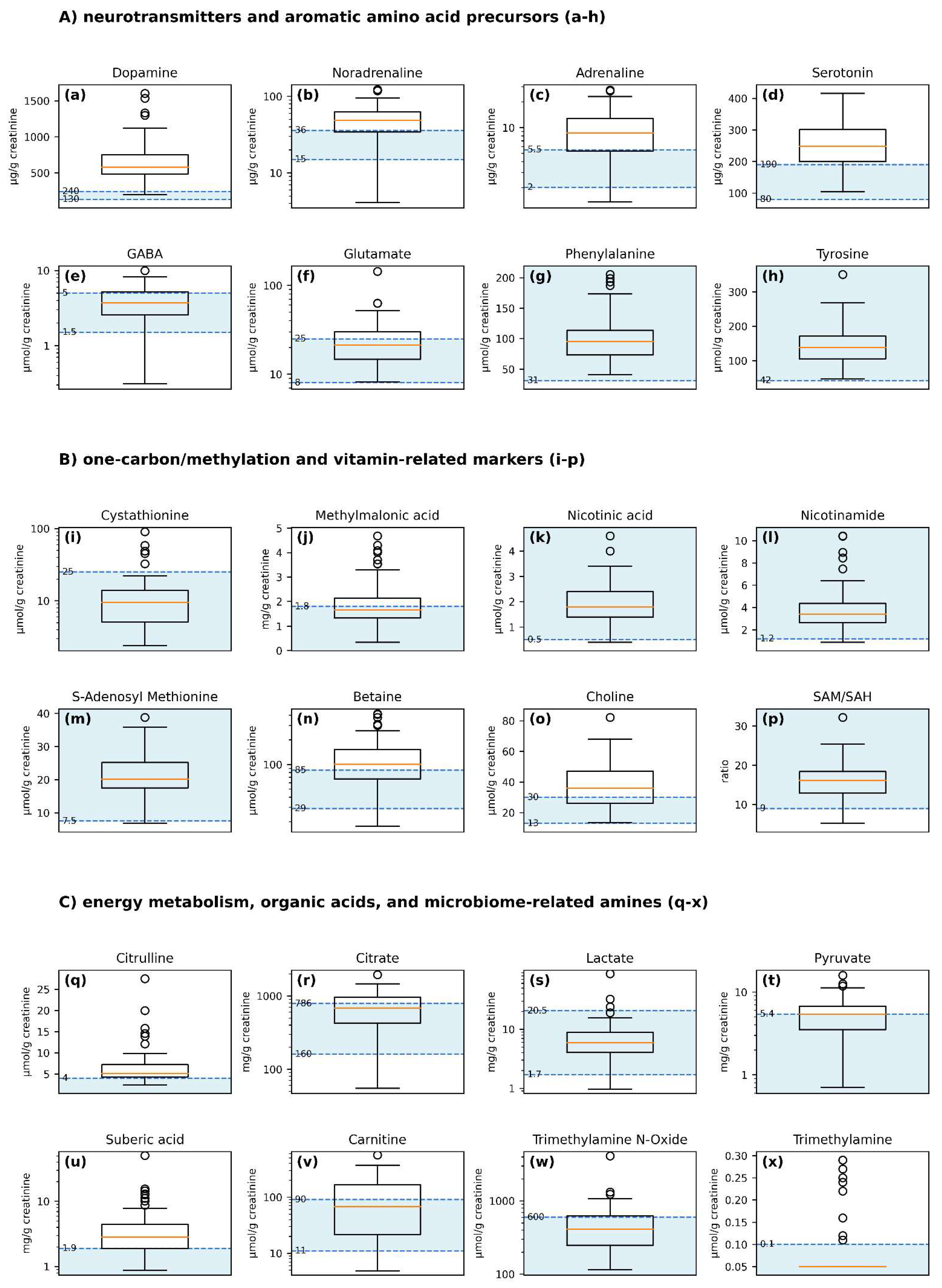
Table 1 provides an overview of the dataset and analytical characteristics. Table 2 provides descriptive summaries of each marker together with the corresponding laboratory reference limits and contextual counts relative to those limits. Figure 1 visualizes marker distributions grouped into three functional classes, with laboratory reference limits shown only for contextual reference and not as evidence of ASD-specific abnormalities or as a case-versus-normal comparison.

3. Methods

3.1. Urine Collection

Second-morning, midstream, acid-stabilized spot urine was collected at home using an acid-stabilized urine collection kit (T928; biovis Diagnostik MVZ GmbH, Limburg, Germany) within the provider’s second-morning workflow. Caregivers were instructed to collect the second-morning void approximately 2–4 h after the first-morning urine (minimum 2 h), avoid excessive fluid intake before sampling, refrain from strenuous physical activity on the morning of collection, and avoid caffeine-containing beverages and energy drinks for at least 16 h prior to collection. Pre-sampling standardization in this cohort therefore comprised standardized collection timing together with these specific behavioral/dietary restrictions before sampling. Recruitment and pre-analytical procedures (collection, stabilization, storage, and shipment logistics) were coordinated via Genome Center Bulgaria (Sofia, Bulgaria), and samples were shipped to the German provider laboratory for analytical measurement and report release. The present 24-marker Zenodo release derives from the same cohort and pre-analytical workflow.

3.2. Laboratory Measurement, Units, and Normalization

Urinary metabolite measurements were performed by LC–MS/MS, whereas spot urinary creatinine was measured by a routine enzymatic method (UV/VIS photometric assay). Metabolite results were reported by the provider as creatinine-normalized values in laboratory-issued reporting units. Across the present 24-marker release, these units are reported consistently as μg/g creatinine, μmol/g creatinine, mg/g creatinine, and ratio, depending on the marker. Laboratory reference limits were taken from the commercial documentation accompanying the analytical service and are defined for the same second-morning, acid-stabilized urine collection and reporting units used by the provider. The present Zenodo record reports creatinine-normalized values for a pathway-oriented 24-marker subset from the broader urinary diagnostic workflow; the same analytical procedures and creatinine-normalization approach were used for the variables included in this release.

3.3. Handling of Qualified Results

For trimethylamine, 64 of 73 results (87.7%) were reported by the laboratory as below the quantification limit (LOQ; <0.1 μmol/g creatinine). For descriptive tabulation and figure generation, these qualified results were represented as LOQ/2 = 0.05 μmol/g creatinine in the public release. LOQ/2 was selected as a simple and transparent substitution for descriptive tabulation and visualization, allowing qualified results to remain represented in the public release rather than being omitted or treated as missing. Because the purpose here is descriptive presentation rather than recovery of precise underlying concentrations, and because the variable includes a high proportion of below-LOQ observations, alternative simple substitution choices would not remove the need for cautious interpretation. Accordingly, trimethylamine should be interpreted as a heavily left-censored variable; its apparent distribution is strongly influenced by the substitution rule and should not be treated as a fully quantitative distribution without appropriate caution or censoring-aware handling.

3.4. Software for Figures

As reported in [2], statistical analyses were performed in Python (v3.11) using SciPy and statsmodels. Figure 1 for the present 24-marker release was generated from the curated subset in the same analysis environment.

3.5. Ethics Approval and Informed Consent

The study was conducted in accordance with the Declaration of Helsinki and approved by the Research Ethics Committee of University Hospital “St. Ivan Rilski”, Sofia, Bulgaria (protocol number 3/26.04.2023, date of approval: 26 April 2023). Informed consent was obtained from the parents/guardians of all subjects involved in the study.

4. Usage Notes

This case-only, cross-sectional dataset is intended primarily for descriptive analyses, exploratory feature screening, and comparisons with external cohorts or laboratory-provided reference benchmarks. Because no contemporaneous neurotypical control group was enrolled, the deposited values and the proportions outside laboratory-provided reference limits should be interpreted as contextual descriptors rather than evidence of ASD-specific abnormalities. Accordingly, Table 2 and Figure 1 should be read as descriptive aids for dataset interpretation, not as case-versus-normal comparisons.
The public release contains de-identified analytical variables only. Individual-level demographic variables, dates, standalone urinary creatinine, and richer clinical covariates are not included in the deposited files; therefore, age- or sex-stratified analyses, direct assessment of urine dilution effects, and covariate-adjusted analyses are not possible from the public dataset alone. This reflects a deliberate balance between participant privacy and downstream reuse: in this small pediatric case-only cohort, adding even coarsened participant-level metadata such as age bins, sex, or grouped creatinine information could introduce additional quasi-identifiers and increase linkage and re-identification risk. Pre-sampling guidance documented in the study protocol comprised standardized collection timing together with restrictions on excessive fluid intake, strenuous activity, and caffeine-containing beverages/energy drinks before sampling; broader dietary intake and participant-level medication variables are not available in the public dataset. Accordingly, no additional participant-level metadata are released in this v1 record. Additional participant-level information is not part of the open public release but may be considered for sharing upon scientifically justified request, subject to applicable ethical and privacy constraints. Users should consult the data dictionary for variable definitions and units and the reference-limits file for reference type (two-sided ranges or one-sided thresholds). As with other creatinine-normalized spot-urine datasets, some residual variability related to urine concentration and pre-analytical conditions may remain. Trimethylamine requires particular caution: 64 of 73 values (87.7%) were reported as below the LOQ and were represented as LOQ/2 in the public release for descriptive continuity. Accordingly, this variable should be regarded as heavily left-censored, its apparent distribution should not be overinterpreted, and downstream modeling or comparative analyses should use methods appropriate for censored data or otherwise treat the variable conservatively.

Author Contributions

Conceptualization, V.S.; methodology, V.S. and T.H.; formal analysis, V.S., D.M., and A.K.; investigation/resources, S.C., M.S. and I.T.; visualization, V.S. and R.T.-H.; writing—original draft preparation, V.S. and A.Z.; writing—review and editing, L.T. and T.K.; supervision, L.T. and T.K.; project administration, R.T.-H. and T.K.; funding acquisition, R.T.-H. and T.K. All authors have read and agreed to the published version of the manuscript.

Funding

This research received no external funding.

Institutional Review Board Statement

The study was conducted in accordance with the Declaration of Helsinki and approved by the Research Ethics Committee of University Hospital “St. Ivan Rilski”, Sofia, Bulgaria (protocol number 3/26.04.2023, date of approval: 26 April 2023).

Informed Consent Statement

Informed consent was obtained from the parents/guardians of all subjects involved in the study.

Data Availability Statement

The dataset presented in this study is publicly available in Zenodo at https://doi.org/10.5281/zenodo.18614881. The deposited record includes the primary results tables (.csv and .xlsx), the data dictionary, the reference-limits file, and accompanying documentation. The public record contains de-identified analytical variables only; individual-level demographic variables, dates, standalone urinary creatinine, and richer clinical metadata are not included. No additional participant-level metadata are released in v1 as part of the open public record, because the de-identification boundary for this small pediatric case-only cohort was defined to minimize linkage and re-identification risk. Additional participant-level information is not part of the open public release but may be considered for sharing upon scientifically justified request, subject to applicable ethical and privacy constraints.

Conflicts of Interest

Till Heine was employed by the Biovis Diagnostik MVZ GmbH. The remaining authors declare that the research was conducted in the absence of any commercial or financial relationships that could be construed as a potential conflict of interest.

Abbreviations

The following abbreviations are used in this manuscript:
ASDAutism spectrum disorder
GABAγ-Aminobutyric acid
IQRInterquartile range
LC–MS/MSLiquid chromatography–tandem mass spectrometry
LOQLimit of quantification
SAMS-adenosylmethionine
SAHS-adenosylhomocysteine
UV/VISUltraviolet–visible spectrophotometry

References

  1. Slavov, V. Urinary Metabolite Panel Dataset for Bulgarian Children with ASD (N = 73; Ages 3–13), v1; Zenodo. [CrossRef]
  2. Slavov, V.; Traikov, L.; Ciurinskiene, S.; Tafradjiiska-Hadjiolova, R.; Kadiyska, T. Urinary Tryptophan–Kynurenine Pathway Profiling in Bulgarian Children with Autism Spectrum Disorder (ASD): Neopterin Co-Varies with Kynurenine and Quinolinic Acid. Metabolites 2026, 16, 169. [Google Scholar] [CrossRef] [PubMed]
Figure 1. Creatinine-normalized distributions of urinary metabolite panel markers in the ASD cohort (n = 73), grouped by functional class: (A) neurotransmitters and aromatic amino acid precursors (ah); (B) one-carbon/methylation and vitamin-related markers (ip); (C) energy metabolism, organic acids, and microbiome-related amines (qx). Dashed lines indicate laboratory-provided reference limits, and shaded regions represent the corresponding reference ranges where applicable (two-sided ranges or one-sided thresholds). These visual guides are shown only for contextual reference and should not be interpreted as contemporaneous control values or as evidence of ASD-specific abnormalities. Boxplots show the median (center line), IQR (box), whiskers extend to the most extreme values within 1.5 × IQR, and circles denote outliers. Panels (b,c,e,f,i,rw) are displayed on a logarithmic y–axis. Abbreviations: ASD, autism spectrum disorder; IQR, interquartile range.
Data 11 00082 g001
Table 1. Dataset characteristics and analytical notes for the urinary metabolite panel dataset.
CharacteristicValue
Participants, n73
Age range, years3–13
Analytes, n24
Data matrix dimensions (rows × columns)73 × 24
Reporting basisCreatinine-normalized spot urine concentrations
Units (as provided by laboratory)μg/g creatinine; μmol/g creatinine; mg/g creatinine; ratio
Reference limitsLaboratory-provided reference intervals/decision limits (two-sided ranges or one-sided thresholds)
Qualified results handlingTrimethylamine: 64/73 values (87.7%) were reported as <0.1 μmol/g creatinine and were represented as LOQ/2 = 0.05 μmol/g creatinine for descriptive tabulation and visualization
Missing valuesNone (0/73 × 24)
De-identificationAnonymized and shuffled; no demographics or dates included in the data file
Note: Values are creatinine-normalized spot urine results. The deposited tabular dataset contains anonymized, shuffled participant rows and results for 24 urinary metabolite markers/ratios. Individual-level demographic variables (age, sex) and urinary creatinine distribution are not included in the public dataset; only de-identified metabolite results are provided. Reference limits are laboratory-provided and shown for contextual interpretation. Because most trimethylamine results were below the LOQ, this variable is heavily left-censored and should be interpreted with particular caution in distributional or modeling analyses. Abbreviations: LOQ, limit of quantification.
Table 2. Descriptive summary of urinary metabolite panel markers, with accompanying laboratory reference limits and contextual counts relative to those limits, in the ASD cohort (n = 73).
AnalyteUnitReference LimitMedian (IQR)Below Ref n (%)Above Ref n (%)
Dopamineμg/g creatinine130–240578.35 (483.42–750.03)0 (0.0)72 (98.6)
Noradrenalineμg/g creatinine15–3648.78 (34.20–62.63)3 (4.1)51 (69.9)
Adrenalineμg/g creatinine2–5.58.69 (5.34–12.80)1 (1.4)53 (72.6)
Serotoninμg/g creatinine80–190248.20 (199.45–300.90)0 (0.0)58 (79.5)
GABAμmol/g creatinine1.5–53.69 (2.55–5.20)2 (2.7)19 (26.0)
Glutamateμmol/g creatinine8–2521.27 (14.72–30.10)0 (0.0)22 (30.1)
Phenylalanineμmol/g creatinine>3194.90 (73.10–113.70)0 (0.0)0 (0.0)
Tyrosineμmol/g creatinine>42138.00 (105.30–171.40)0 (0.0)0 (0.0)
Cystathionineμmol/g creatinine<259.50 (5.10–13.90)0 (0.0)5 (6.8)
Methylmalonic acidmg/g creatinine<1.81.66 (1.33–2.14)0 (0.0)32 (43.8)
Nicotinic acidμmol/g creatinine>0.51.80 (1.40–2.40)1 (1.4)0 (0.0)
Nicotinamideμmol/g creatinine>1.23.40 (2.64–4.36)7 (9.6)0 (0.0)
S-Adenosyl Methionineμmol/g creatinine>7.520.10 (17.50–25.20)1 (1.4)0 (0.0)
Betaineμmol/g creatinine29–85100.50 (66.70–151.70)2 (2.7)42 (57.5)
Cholineμmol/g creatinine13–3036.00 (26.10–47.10)0 (0.0)47 (64.4)
SAM/SAHratio>916.10 (12.90–18.40)5 (6.8)0 (0.0)
Citrullineμmol/g creatinine<45.08 (4.30–7.19)0 (0.0)57 (78.1)
Citratemg/g creatinine160–786683.42 (425.74–964.60)4 (5.5)29 (39.7)
Lactatemg/g creatinine1.7–20.55.89 (4.03–8.88)3 (4.1)3 (4.1)
Pyruvatemg/g creatinine<5.45.39 (3.51–6.73)0 (0.0)35 (47.9)
Suberic acidmg/g creatinine<1.92.81 (1.89–4.44)0 (0.0)54 (74.0)
Carnitineμmol/g creatinine11–9067.10 (21.60–166.00)7 (9.6)31 (42.5)
Trimethylamine N-Oxideμmol/g creatinine<600413.10 (248.40–627.40)0 (0.0)20 (27.4)
Trimethylamineμmol/g creatinine<0.10.05 (0.05–0.05)0 (0.0)9 (12.3)
Note: Reference limits are laboratory-provided and are shown for contextual interpretation only, as no neurotypical control group was enrolled. The counts below or above laboratory reference limits are included only to document the reporting framework accompanying the dataset and should not be interpreted as a case-versus-normal comparison or as evidence of ASD-specific abnormalities. For one-sided limits (< or >), only the indicated direction is considered outside reference. For trimethylamine, 64/73 results (87.7%) were reported by the laboratory as below the quantification limit (<0.1 μmol/g creatinine) and were represented as LOQ/2 = 0.05 μmol/g creatinine for descriptive summary and visualization. Accordingly, the trimethylamine distribution shown here is heavily influenced by left-censoring and the substitution rule and should not be interpreted as a fully quantitative distribution without appropriate caution. Abbreviations: ASD, autism spectrum disorder; IQR, interquartile range; GABA, γ-aminobutyric acid; SAM/SAH, S-adenosylmethionine/S-adenosylhomocysteine; LOQ, limit of quantification.
Disclaimer/Publisher’s Note: The statements, opinions and data contained in all publications are solely those of the individual author(s) and contributor(s) and not of MDPI and/or the editor(s). MDPI and/or the editor(s) disclaim responsibility for any injury to people or property resulting from any ideas, methods, instructions or products referred to in the content.