
Next Article in Journal
Long-Term Temporal Variability of Flowering Day of Red Spider Lily (Lycoris radiata)
Previous Article in Journal
Clustering of Temporal and Visual Data: Recent Advancements
error_outline You can access the new MDPI.com website here. Explore and share your feedback with us.
 
 
Data Descriptor

A Database of Fruit and Seed Morphological Traits and Images from Subtropical Flora of Hong Kong


School of Biological Sciences, The University of Hong Kong, Pokfulam Road, Hong Kong, China
*
Author to whom correspondence should be addressed.
Submission received: 28 September 2025 / Revised: 25 December 2025 / Accepted: 3 January 2026 / Published: 5 January 2026
(This article belongs to the Section Information Systems and Data Management)

Abstract

Plant functional traits are key to understanding species performance, community assembly and ecosystem processes. Fruit and seed traits play an important role in early life-cycle processes by influencing seed dispersal, germination, and establishment, ultimately shaping plant regeneration and ecosystem dynamics. While global initiatives such as TRY and Seed Information Database (SID) have assembled extensive trait data, coverage of reproductive traits remains limited, and high-quality images of diaspores are particularly scarce, particularly in subtropical Asia. To address this need, we created an open-source, comprehensive database of fruit and seed traits, accompanied by diaspore images against a high-contrast background. This dataset documents 684 species in 128 families recorded in Hong Kong and provides standardised measurements of morphological attributes (e.g., length, mass, number of seeds per fruit) and dispersal characteristics (e.g., presence of appendages). Our measurements were validated against previously published records of common species in Hong Kong, showing strong consistency with R2 = 0.80 (p < 0.001) for fruit dry mass and R2 = 0.91 (p < 0.001) for seed dry mass, respectively. This database provides a valuable resource for trait-based ecology, forest dynamics and conservation biology. Additionally, it supports applications in ecological restoration, habitat management, and predicting plant responses to environmental change. This initiative enhances our understanding of trait-based ecology by complementing global initiatives such as TRY and SID and improving the representation of reproductive traits from subtropical Asia, a region that is underrepresented in existing global databases.
Dataset License: CC-BY-NC

1. Introduction

Plant functional traits are widely recognized as key determinants of species performance, demographic strategies, and ecosystem functioning. Fruit and seed traits are particularly influential because they shape critical early life-history stages of plants, govern resource allocation, and mediate interactions with both abiotic dispersal vectors (e.g., wind, water) as well as biotic agents (e.g., birds, mammals, insects) [1,2,3]. Variation in these traits affects species coexistence by influencing dispersal limitation, colonization ability, and niche differentiation across heterogeneous landscapes [4,5]. Moreover, seed morphology mediates the dependence of many species on specific animal dispersers—for example, large-seeded species often require large-bodied frugivores. When these dispersers decline, such species experience reduced dispersal and recruitment, increasing their extinction risk [5,6,7]. Although prior work has clarified the ecological roles of reproductive traits, quantitative and standardized datasets remain geographically and taxonomically limited. Addressing this gap is essential for advancing trait-based ecology but also for informing biodiversity conservation, ecological restoration, and predictions of ecosystem responses to global environmental change.
Large-scale trait databases have greatly advanced comparative ecology by aggregating standardised measurements across taxa and regions. Major resources such as the TRY Plant Trait Database [8] have compiled more than 50 distinct seed traits, and the Seed Information Database (SID) at the Royal Botanic Gardens, Kew documents over 52,000 seed plant taxa worldwide [9]. Regional trait efforts have focused on the Mediterranean Basin [10], Central Europe [11,12] and Australia [13]. Despite these advances, fruit and seed traits remain comparatively underrepresented in both coverage and diversity relative to vegetative traits such as leaves or stems [14,15]. Additionally, certain attributes, such as seed number per fruit, appendages and seed colour, are significantly sparse, constituting only 3% of recorded observations compared with seed dimensions and dry mass [8]. Likewise, image datasets of diaspores are underrepresented across families, for example, in SID 3.26% of seed morphology images are publicly accessible among all plant taxa recorded worldwide.
The knowledge gap is particularly pronounced in subtropical Asia, a biodiversity hotspot with high species richness but limited trait coverage. China hosts more than 36,000 vascular plant species, yet detailed seed-trait records and high-quality digital images are available for only a small fraction of this flora, representing approximately 11% and 1.39% of species, respectively [16]. This imbalance limits the integration of subtropical flora into global comparative studies, undermining efforts to predict regeneration strategies, restoration potential, and species’ responses to global change. Hong Kong’s subtropical coastal environment supports a wide range of habitats and includes both tropical and temperate range-edge species. This diversity provides an opportunity to expand reproductive-trait data for a biogeographic zone that remains underrepresented in global databases.
To address these gaps, we present an open-access, standardised dataset for fruit and seed morphological traits and high-resolution diaspore images for 684 species across 128 plant families (both gymnosperms and angiosperms) from Hong Kong. This database includes species-level means for morphological metrics, linked to high-resolution photographs and metadata including sampling date, measurement protocols, and image calibration. All measurements follow standardised procedures stated in [9], using consistent units (millimetre, gram) and a fixed protocol for image calibration. These harmonized metadata fields enhance reproducibility and support integration with global trait databases. By improving representation of subtropical reproductive traits, this resource supports trait-based research on community assembly, seed dispersal and regeneration, restoration planning, and conservation management.

2. Data Description

2.1. Study Site

Fruits and seeds were collected in Hong Kong, southern China (22.3193° N and 114.1694° E) which covers 1104 km2, and lies in the subtropical monsoonal zone. The region receives 2200 mm of mean annual precipitation and has an average temperature of 23.4 °C based on 1991 to 2020 records [17]. Its terrain is highly heterogeneous, with 63% of the land steeper than 15° [18], creating varied microhabitats and dispersal environments such as ridge-top sites, and sheltered lowland. Hong Kong supports a mosaic of vegetation types, including mangroves, grasslands, shrubland and secondary forests [19,20]. Collectively, Hong Kong hosts more than 3300 plant species including predominantly native species, with some introduced taxa [21]. The flora comprises both tropical and temperate lineages, many of which are widely distributed across subtropical Asia, ranging from the Southern part of Japan, South Korea, China, and the entire Vietnam. The combination of topographic heterogeneity, climatic seasonality, and diverse vegetation types makes Hong Kong a representative site for characterizing broad variation in fruit and seed traits [22].

2.2. Diaspore Images

An online webpage of seed images has been set up. Users can search by genus or species name or sort them by key attributes such as manually categorized seed colour (Beige, Black, Blue, Brown, Green, Orange, Pink, Purple, Red, White and Yellow), approximate seed size, and plant family. Each entry includes a high-resolution photograph captured under standardised lighting (5500K LED illumination) and background conditions with a physical scale bar included to ensure accurate visual comparisons. For seeds smaller than 5 mm diameter, images were captured using a calibrated digital microscope (Leica Microsystem, Wetzlar, Germany). A focus-stacked image was produced for each seed to ensure full clarity of surface features, and all traits were measured directly within the Leica Microsystem software (LAS 4.2), with scale bars generated directly from the calibrated optical settings.
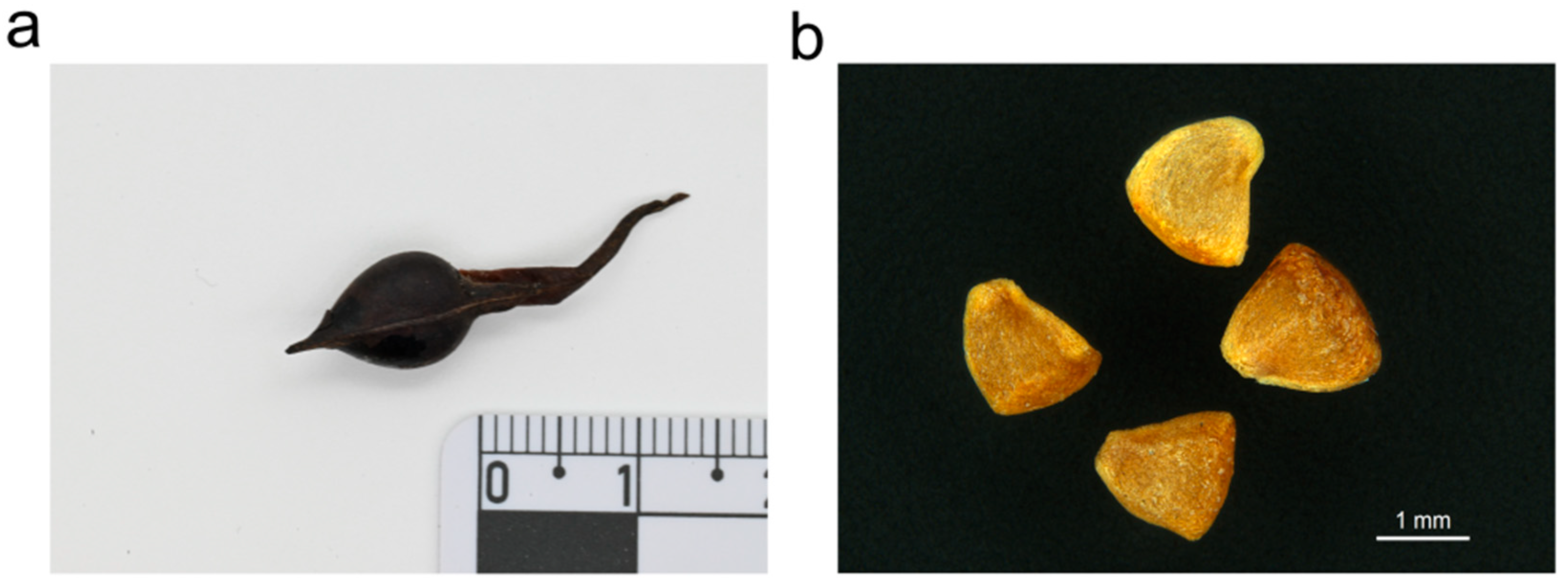
Image pixel dimensions vary among specimens because magnification levels were adjusted to match seed size, allowing small diaspores to occupy an optimal proportion of the frame. This variability reflects diaspore-size–dependent zoom rather than differences in optical configuration; illumination (5500 K), white balance, and calibration files were held constant across all samples. No image resizing, external compression, or manual scaling was performed. Seeds were oriented to reveal diagnostic features such as surface texture, appendages, and symmetry (Figure 1). Trait measurements were extracted digitally from these calibrated images, ensuring measurement accuracy regardless of variation in pixel dimensions.
The image collection encompasses different plant growth forms from herbaceous plants to standing trees, representing a broad range of dispersal syndromes and morphological diversity. Images provide not only taxonomic identification reference, but also enable further morphometric analyses (e.g., aspect ratio, roundness, surface area) using image processing software like ImageJ (version 1.52k). All images are uploaded in JPEG format without compression, with associated metadata including scientific name (standardised following Plants of the World Online) and their family.

2.3. Morphological Traits of Fruits and Seeds

The dataset contains three data tables.
The first file (Species_list.csv) contains information about the 684 species recorded from 128 families across Hong Kong. It includes 15 variables. Variables include species code, scientific name (adapted in Plants of the World Online), synonyms from World Checklist of Vascular Plants, family assignments under multiple classification systems (Cronquist, Kubitzki, APG IV), growth form, nativeness, collection metadata, and collector information.
The second file (Fruit_trait.csv) contains fruit characteristics of 629 species. It includes 7 variables, namely species code, thickness, width and length of the outer part of fruits, dry mass, colour of appearance and corresponding fruit type. The third table (Seed_trait.csv) provides seed characteristics of 670 species. It contains 8 variables, including species code, number of seeds per fruit, dry mass, thickness, width, length, colour and the presence of elaiosomes attached to the seed.
The inconsistency of the total number of species recorded between fruit and seed characteristics was due to practical limitations such as damage to fruits during transportation or processing (Discussed in limitations). Accordingly, fruit traits were unavailable for 61 species despite the successful measurement of their seed traits. Nevertheless, missing values in the above files are indicated as “NA”.

3. Methods

3.1. Morphological Traits Measurement

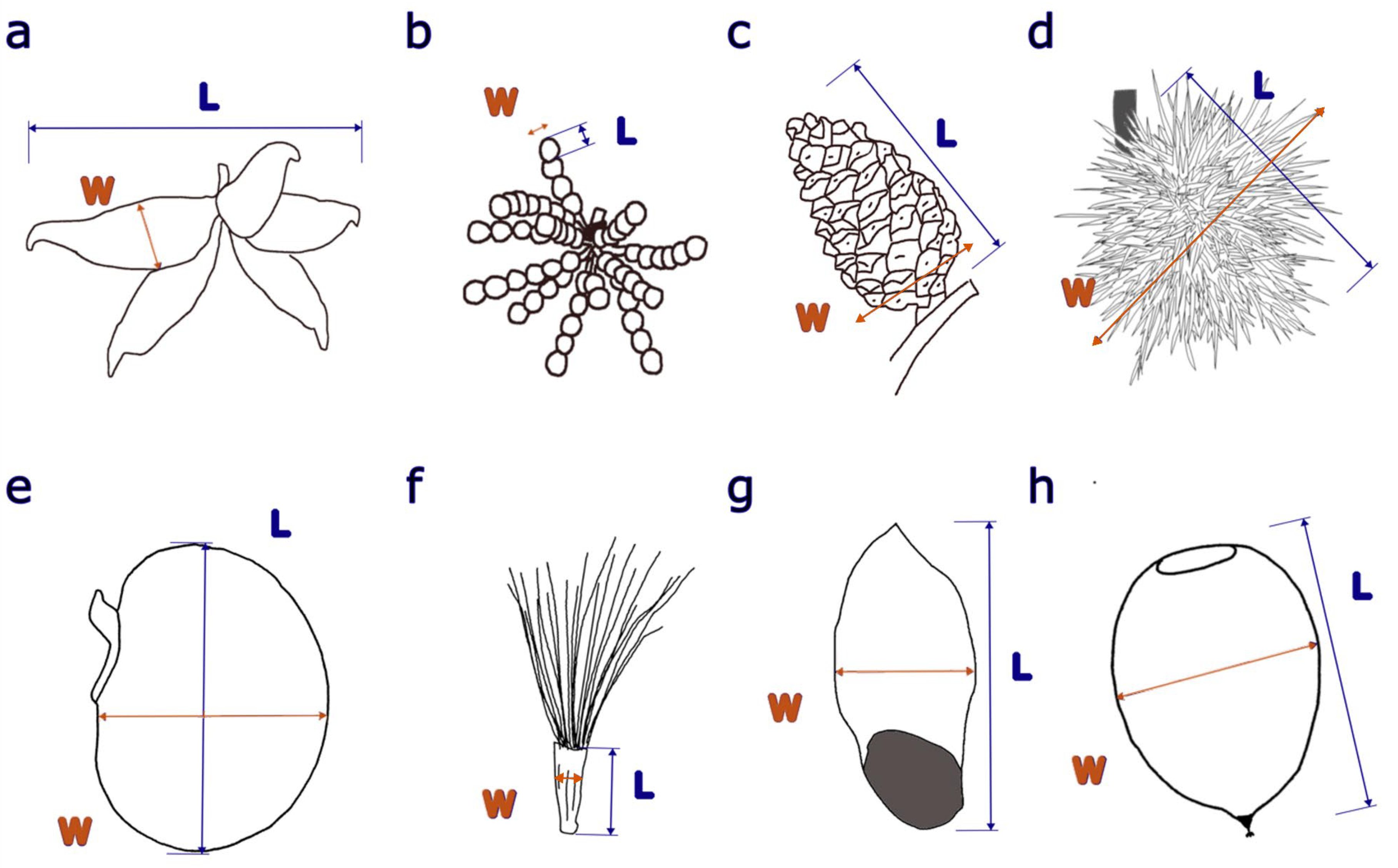
Fruit and seed collection took place between October 2018 and January 2025 at a minimum of three geographically distinct sites for each species, with sites separated by approximately 3 km path distance where possible. For rare species that have less than three known locations in the study region, samples were taken from a minimum of three individuals per site [23]. Ten mature, undamaged fruits were randomly chosen for fruit length (L), width (W), thickness (T), and mass (M) measurement. Ten seeds were extracted from the remaining unsampled fruits for seed measurement. For large seed species with seed length ≥ 5 mm, seed dimensions were measured using digital callipers (±0.01 mm) and precision balances (±0.00001 g), while for tiny seed species (<5 mm in diameter), seed dimensions were measured using Leica microsystem software. Means of each trait were then averaged from individual readings. The remaining fruits were processed to separate seeds and pulp, and seed traits measurement was repeated following the same procedures as the fruits. Fruits and seeds were oven-dried at 70 degrees Celsius for at least 72 to 96 h, with fleshy fruits generally requiring the longer drying duration to reach constant mass [24]. All trait measurements were obtained following standardised protocols from the Seed Information Database (SID) [9]. Fruit length was measured from the point of attachment to the distal tip (Figure 2). Lateral dimensions were recorded as width and thickness; in laterally compressed fruits, the larger diameter was width and the smaller as thickness. Seed length refers to the distance between the chalazal and micropylar ends. Seed width is the maximum lateral diameter between the flanks, and seed height (thickness) is the distance between the ventral (raphal) side and the dorsal side.
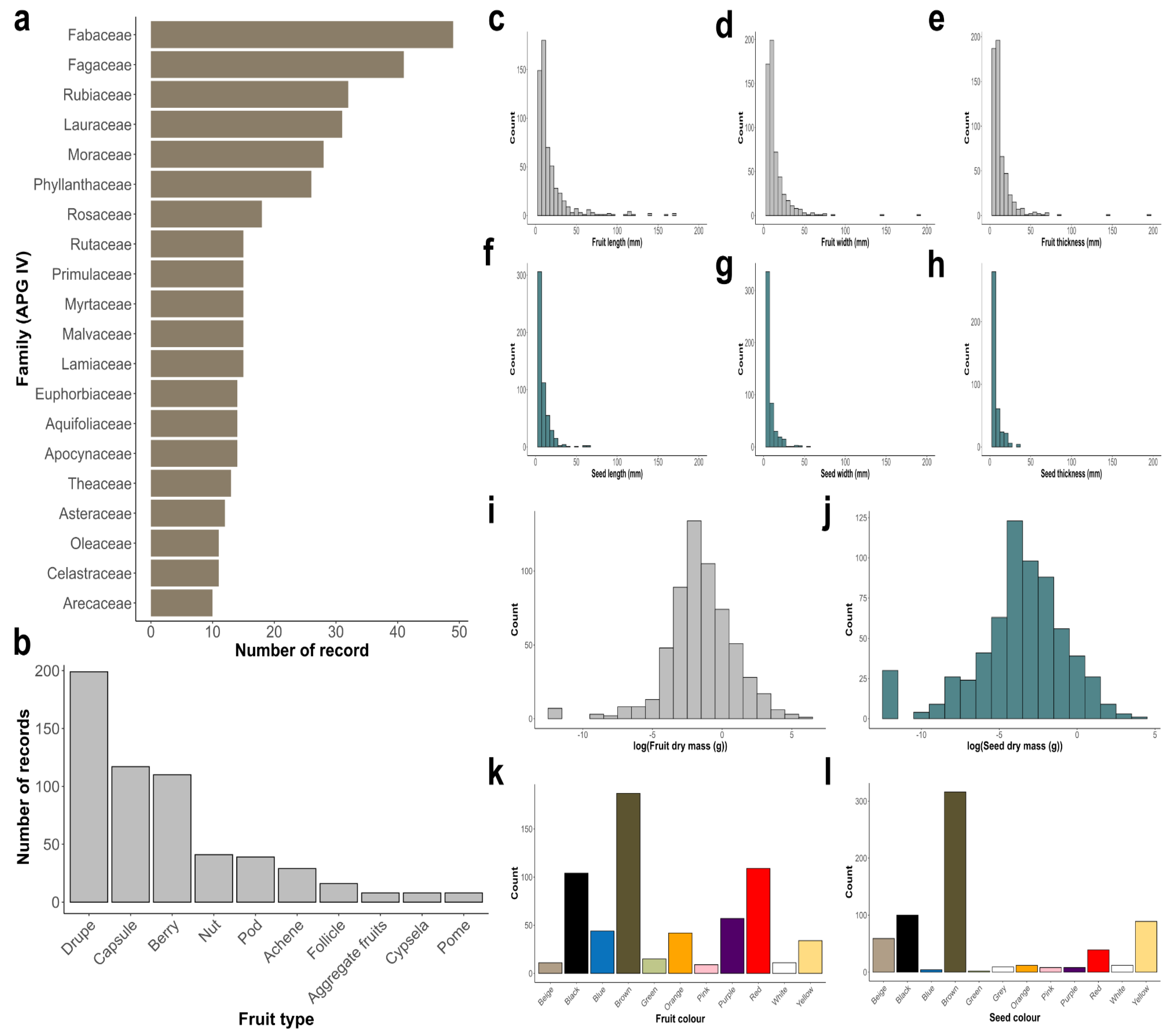
Moreover, categorical traits (fruit type, colour, presence of elaiosomes) were assigned based on field observation, taxonomic references (Flora of China, Flora of Hong Kong), and Plants of the World Online (Figure 3). Taxonomic names were standardised primarily following the Cronquist (1988) system, which remains the official and stable framework used by the Hong Kong Herbarium. To facilitate broader interoperability, we also provide corresponding names under the Angiosperm Phylogeny Group IV (APG IV) classification, allowing users working in phylogenetically informed contexts to cross-reference traits across both systems.
All species names were harmonized through a multi-step matching workflow using “WorldFlora” (R package version 1.14). First, exact matches were searched against the Hong Kong Herbarium’s accepted nomenclature. Names that did not match directly were queried in Plants of the World Online (POWO) to retrieve accepted names or recognized synonyms. Fuzzy matching was applied only to resolve minor orthographic variants (e.g., hyphenation, diacritics), and no automatic synonym expansion was allowed. This workflow ensured a reproducible, transparent, and regionally consistent taxonomy across the datasets.

3.2. Data Validation

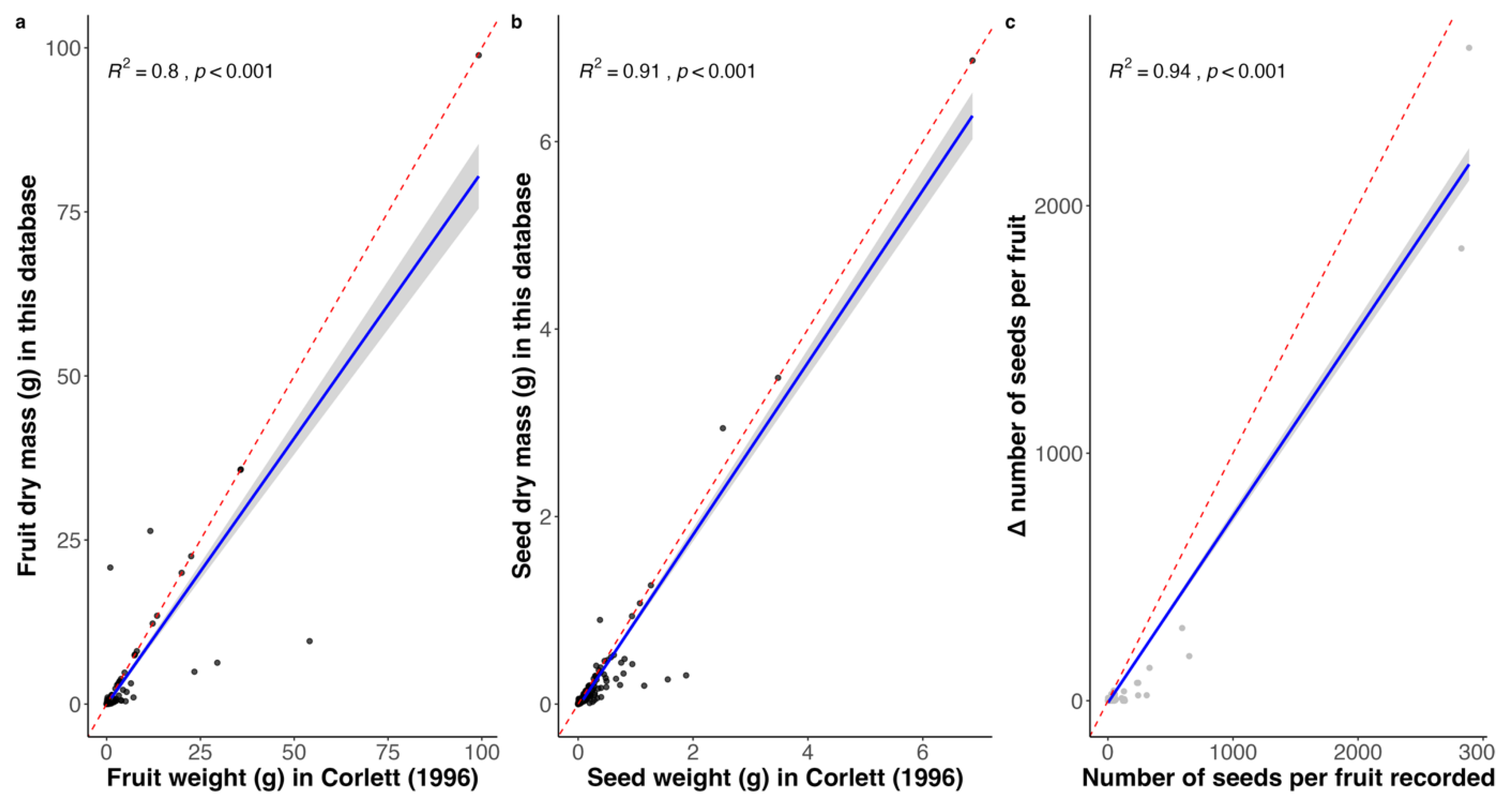
For species present in both datasets (n = 240), all data entries were cross-checked against [25]. Traits that are recorded in both datasets such as dry fruit mass, dry seed mass, and number of seeds per fruit, were used for comparison. Dimensional traits were excluded due to inconsistent definitions. Our dataset demonstrated high agreement with the independent validation, with R2 = 0.80 for fruit dry mass and R2 = 0.91 for seed dry mass (p < 0.001) (Figure 4a,b). Additionally, when correlating the number of seeds recorded in a fruit, discrepancies between the two datasets became larger as the number of seeds per fruit increased (Figure 4c), suggesting that multi-seeded fruits tend to show greater variation in seed number. Multi-seeded fruits often show broad categorical ranges in external datasets, and alignment between coarse bins (e.g., 50 seeds a unit) and precise counts can introduce apparent divergence.

3.3. Image Acquisition

All seeds were photographed after being air-dried at room temperature for 24 h to minimize artefacts caused by moisture variation. Additionally, the photographed seeds correspond to the same individuals used for morphological measurements. Images were captured using a Nikon Z50 digital camera (Tokyo, Japan) equipped with a macro lens (Nikon NIKKOR Z MC 105 mm, Tokyo, Japan), under standardised lighting conditions (5500K LED illumination) to ensure uniform contrast and colour representation. Each seed was placed on a non-reflective background with an adjacent millimetre scale bar to facilitate accurate size calibration (Figure 1). Seeds were oriented to display diagnostic features such as overall shape, surface texture, and appendages (e.g., wings, hairs, elaiosomes).
The number of diaspores photographed per taxon varied depending on availability in the seed collection and the natural seed size. At least three visually modal individual seeds that were selected through consensus among collectors based on diagnostic morphological features were displayed in each image. For species with exceptionally large diaspores, a single individual occupied the entire frame, and thus only one was photographed. All images were stored in high-resolution (minimum 300 dpi) JPEG format, accompanied by metadata including species name and family.

4. User Notes

4.1. Measurement Exceptions

In several fruit types, specific morphological structures beyond the pericarp influences dispersal and protection, and therefore their inclusion in size measurements depends on their functional role (Table 1). For example, in the Fagaceae, the cupule forms a persistent woody or spiny covering that either partially or completely encloses the nut. In genera such as Castanea, Castanopsis, and Lithocarpus, the cupule may fuse with the pericarp to form a single dispersal unit [26]. Because the cupule contributes substantially to the protective investment and affects the overall size and dispersal behaviour of the fruit, its dimensions in Fagaceae were included in fruit size measurements. Because the fruit functions as a single dispersal unit, we measured the width of follicles, such as Sterculia lanceolata, for a single follicle wall segment instead of the distance of the whole fruit.
Moreover, the length of the wings was included in winged seeds in which their wings do not fall off naturally, while the size of cypslea was measured excluding pappus (Table 1).

4.2. Potential Use and Limitations

The dataset is most suitable for ecological and functional trait analyses focusing on dispersal, morphology, and community assembly. Diaspores image collection would be an important training dataset for extracting traits or texture information using machine learning or deep learning. This dataset is not intended for physiological, biochemical, or genetic trait inference, as these require different measurement protocols and scales.
However, this dataset has several limitations. First, to balance the representativeness and feasibility of species coverage in flora-rich regions like Hong Kong, we measured morphological traits from ten fresh and undamaged fruits per species, which represents a practical median sample size. Although previous studies have shown that small sample size (less than ten) could effectively capture morphological traits variations in different species [27,28], ten fruits per species may not fully capture intraspecific variation. Future studies could expand sampling to quantify within-species variance more comprehensively.
Second, a small portion of species lacked complete fruit or seed trait data due to unavoidable practical issues during specimen handling. Some fruits were lost after measurement or during transport, while seeds from a few species were damaged during the oven-drying process and could not be measured accurately. To avoid violating overall data quality or representativeness of the dataset, we excluded those data, leading to an imbalance in species representation between fruit and seed records.

5. Conclusions

We present the Hong Kong Fruit and Seed Trait and Image Database, an open-access dataset documenting fruit and seed morphology for 684 subtropical Asian plant species. By combining standardised quantitative trait measurements with curated high-resolution diaspore images, this dataset addresses critical geographical gaps in subtropical Asia in existing global trait databases, which remain biased toward temperate regions and vegetative traits. A notable contribution of this dataset is the addition of 435 seed-weight records that are currently absent from SID. These newly reported measurements expand trait coverage for subtropical and tropical species and enhance global trait datasets used in comparative and ecological analyses.
Beyond serving as a reference for taxonomic and ecological studies, the image dataset provides a foundation for several predictive modelling applications. For example, high-resolution diaspore images can be used to train machine-learning models to extract morphometric vectors, enabling automated prediction of dispersal syndromes, functional trait groupings, or likely restoration performance based on trait profiles. Such applications demonstrate the potential of the dataset to support both ecological inference and conservation decision-making.
This initiative provides a standardised protocol and replicable framework for expanding traits and image documentation in other biodiversity hotspots. Future updates will incorporate additional taxa, traits, and geographic regions, further strengthening the integration of subtropical flora into global trait-based ecology.

Author Contributions

Y.K.L., C.C.P., T.W.S. and B.C.H.H. initiated the study; Y.K.L. led the data collection, measurement, processing of specimens, data compilation and led the writing of the manuscript. T.C.-T.C. and C.Y.L. measured and processed the specimens. All authors have read and agreed to the published version of the manuscript.

Funding

The project was supported by the Centre for Slope Safety (AoE/E-603/18) of the Research Grants Council of the Hong Kong SAR Government.

Data Availability Statement

Fruit and seed traits dataset is available at Figshare https://figshare.com/s/5ca87462531b88267b4b (accessed on 2 January 2026). The online seed image database can be reached at https://hk-seedimagedb-cfddwp.vercel.app (accessed on 2 January 2026).

Acknowledgments

We would like to acknowledge Richard T. Corlett for providing part of the seed measurement data and valuable comments on this manuscript. We also want to thank Laura Wong for the assistance of managing seed collection in Herbarium, School of Biological Science, the University of Hong Kong. We would like to thank Mathew Wan, Peter Chuen Yan Cheng, Aland H. Y. Chan, Leo Ho Yin Chu, Ching Hei Lo for the assistance in collecting wild fruits and lab measurement.

Conflicts of Interest

The authors declare no conflict of interest.

References

  1. Aslan, C.; Beckman, N.G.; Rogers, H.S.; Bronstein, J.; Zurell, D.; Hartig, F.; Shea, K.; Pejchar, L.; Neubert, M.; Poulsen, J.; et al. Employing Plant Functional Groups to Advance Seed Dispersal Ecology and Conservation. AoB PLANTS 2019, 11, plz006. [Google Scholar] [CrossRef] [PubMed]
  2. Jiang, F.; Xun, Y.; Cai, H.; Jin, G. Functional Traits Can Improve Our Understanding of Niche- and Dispersal-Based Processes. Oecologia 2018, 186, 783–792. [Google Scholar] [CrossRef] [PubMed]
  3. Zhang, B.; Hastings, A.; Grosholz, E.D.; Zhai, L. The Comparison of Dispersal Rate between Invasive and Native Species Varied by Plant Life Form and Functional Traits. Mov. Ecol. 2023, 11, 73. [Google Scholar] [CrossRef] [PubMed]
  4. Kraft, N.J.B.; Godoy, O.; Levine, J.M. Plant Functional Traits and the Multidimensional Nature of Species Coexistence. Proc. Natl. Acad. Sci. USA 2015, 112, 797–802. [Google Scholar] [CrossRef]
  5. Maron, J.L.; Hahn, P.G.; Hajek, K.L.; Pearson, D.E. Trade-offs between Seed Size and Biotic Interactions Contribute to Coexistence of Co-occurring Species That Vary in Fecundity. J. Ecol. 2021, 109, 626–638. [Google Scholar] [CrossRef]
  6. Handel, S.N. The Role of Plant-Animal Mutualisms in the Design and Restoration of Natural. In Restoration Ecology and Sustainable Development; Cambridge University Press: Cambridge, UK, 1997; pp. 111–132. [Google Scholar]
  7. Herrera, C.M. Determinants of Plant-Animal Coevolution: The Case of Mutualistic Dispersal of Seeds by Vertebrates. Oikos 1985, 44, 132–141. [Google Scholar] [CrossRef]
  8. Kattge, J.; Díaz, S.; Lavorel, S.; Prentice, I.C.; Leadley, P.; Bönisch, G.; Garnier, E.; Westoby, M.; Reich, P.B.; Wright, I.J.; et al. TRY—A Global Database of Plant Traits. Glob. Change Biol. 2011, 17, 2905–2935. [Google Scholar] [CrossRef]
  9. Liu, U.; Cossu, T.A.; Dickie, J. Royal Botanic Gardens, Kew’s Seed Information Database (SID): A Compilation of Taxon-Based Biological Seed Characteristics or Traits. Biodivers. Inf. Sci. Stand. 2019, 3, e37030. [Google Scholar] [CrossRef]
  10. Tavşanoğlu, Ç.; Pausas, J.G. A Functional Trait Database for Mediterranean Basin Plants. Sci. Data 2018, 5, 180135. [Google Scholar] [CrossRef]
  11. Dayrell, R.L.C.; Begemann, L.; Ott, T.; Poschlod, P. DiasMorph: A Dataset of Morphological Traits and Images of Central European Diaspores. Sci. Data 2024, 11, 781. [Google Scholar] [CrossRef]
  12. Hintze, C.; Heydel, F.; Hoppe, C.; Cunze, S.; König, A.; Tackenberg, O. D3: The Dispersal and Diaspore Database—Baseline Data and Statistics on Seed Dispersal. Perspect. Plant Ecol. Evol. Syst. 2013, 15, 180–192. [Google Scholar] [CrossRef]
  13. Falster, D.; Gallagher, R.; Wenk, E.H.; Wright, I.J.; Indiarto, D.; Andrew, S.C.; Baxter, C.; Lawson, J.; Allen, S.; Fuchs, A.; et al. AusTraits, a Curated Plant Trait Database for the Australian Flora. Sci. Data 2021, 8, 254. [Google Scholar] [CrossRef] [PubMed]
  14. Larson, J.E.; Funk, J.L. Regeneration: An Overlooked Aspect of Trait-based Plant Community Assembly Models. J. Ecol. 2016, 104, 1284–1298. [Google Scholar] [CrossRef]
  15. Saatkamp, A.; Cochrane, A.; Commander, L.; Guja, L.K.; Jimenez-Alfaro, B.; Larson, J.; Nicotra, A.; Poschlod, P.; Silveira, F.A.O.; Cross, A.T.; et al. A Research Agenda for Seed-trait Functional Ecology. New Phytol. 2019, 221, 1764–1775. [Google Scholar] [CrossRef]
  16. Lin, C.; Ji, L.; Ma, K.; Liu, B.; Zhao, M. Catalogue of Life China 2024 Annual Checklist; 744371929 bytes, 7 files; Chinese Academy of Sciences: Beijing, China, 2024. [Google Scholar]
  17. Hong Kong Observatory Climate of Hong Kong. 2024. Available online: https://www.hko.gov.hk/en/cis/climahk.htm (accessed on 25 December 2025).
  18. Cheung, R.W.M. Landslide Risk Management in Hong Kong. Landslides 2021, 18, 3457–3473. [Google Scholar] [CrossRef]
  19. Corlett, R.T. Human Impact on the Flora of Hong Kong Island. In The Changing Face of East Asia During the Tertiary and Quaternary; Centre of Asian Studies, The University of Hong Kong: Hong Kong, China, 1997; pp. 400–412. [Google Scholar]
  20. Corlett, R.T. Environmental Forestry in Hong Kong: 1871–1997. For. Ecol. Manag. 1999, 116, 93–105. [Google Scholar] [CrossRef]
  21. HKSAR Hong Kong Herbarium Hong Kong Plant Database. 2024. Available online: https://www.herbarium.gov.hk/en/hk-plant-database/index.html (accessed on 25 December 2025).
  22. Dudgeon, D.; Corlett, R.T. The Ecology and Biodiversity of Hong Kong; Joint Publishing (Hong Kong) Ltd.: Hong Kong, China, 2004. [Google Scholar]
  23. HKSAR Hong Kong Herbarium. Rare and Precious Plants of Hong Kong; Introduction; Hong Kong Herbarium: Hong Kong, China, 2021. [Google Scholar]
  24. Cornelissen, J.H.C.; Lavorel, S.; Garnier, E.; Díaz, S.; Buchmann, N.; Gurvich, D.E.; Reich, P.B.; Steege, H.T.; Morgan, H.D.; Heijden, M.G.A.V.D.; et al. A Handbook of Protocols for Standardised and Easy Measurement of Plant Functional Traits Worldwide. Aust. J. Bot. 2003, 51, 335–380. [Google Scholar] [CrossRef]
  25. Corlett, R.T. Characteristics of vertebrate-dispersed fruits in Hong Kong. J. Trop. Ecol. 1996, 12, 819–833. [Google Scholar] [CrossRef]
  26. Forman, L.L. On the Evolution of Cupules in the Fagaceae. Kew Bull. 1966, 18, 385–419. [Google Scholar] [CrossRef]
  27. Arias, S.; Terrazas, T. Seed Morphology and Variation in the Genus Pachycereus (Cactaceae). J. Plant Res. 2004, 117, 277–289. [Google Scholar] [CrossRef]
  28. Rashid, N.; Zafar, M.; Ahmad, M.; Malik, K.; Haq, I.; Shah, S.N.; Mateen, A.; Ahmed, T. Intraspecific Variation in Seed Morphology of Tribe Vicieae (Papilionoidae) Using Scanning Electron Microscopy Techniques. Microsc. Res. Tech. 2018, 81, 298–307. [Google Scholar] [CrossRef]
Figure 1. Examples of seed images in the database. (a) Aquilaria sinensis, an example of a seed > 10 mm captured using standard photographic equipment. (b) Lycianthes biflora, an example of a seed < 10 mm imaged using a digital microscope.
Data 11 00008 g001
Figure 2. Illustration of fruit and seed trait measurements. Panels (ad) show representative fruit types, including (a) follicle, (b) compound fruit, (c) cone, and (d) chestnut. Panels (eh) show representative seed types, including (e) plain seed, (f) cypsela, (g) winged seed, and (h) nut (acorn). The abbreviations W and L indicate width (in orange) and length (in blue), respectively.
Data 11 00008 g002
Figure 3. Summary of traits measurement. (a) Top 20 plant families recorded in the database. (b) Top ten of fruit types documented. (c) Distribution of fruit length in mm. (d) Distribution of fruit width in mm. (e) Distribution of fruit thickness in mm. (f) Distribution of seed length in mm. (g) Distribution of seed width in mm. (h) Distribution of fruit thickness in mm. (i) Distribution of fruit dry mass in g. (j) Distribution of seed dry mass in g. (k) Colour of fruit appearance. (l) Colour of seed appearance.
Data 11 00008 g003
Figure 4. Correlation of (a) fruit weight; (b) seed weight; (c) difference of number of seeds per fruit recorded in [25] against this database. Blue line represents fitted regression lines; red line is the 1:1 line. The shaded areas indicate 95% confidence intervals around each regression line.
Data 11 00008 g004
Table 1. Examples of fruit types measured with species arrangement.
Fruit TypeRepresentative GenusMeasurement Exceptions
FolliclesSterculia (Malvaceae), Strophanthus (Apocynaceae)Fruit Width of follicles was measured for a single section.
AcornsCastanea (Fagaceae), Castanopsis (Fagaceae), Lithocarpus (Fagaceae)Cupules were included when measuring fruit length.
CypsleaAinsliaea (Asteraceae), Blumea (Asteraceae)Fruit and seed length were measured excluding pappus.
Winged seedsPolyspora (Theaceae), Loeseneriella
(Celastraceae)
Seed length was measured including wings.
Disclaimer/Publisher’s Note: The statements, opinions and data contained in all publications are solely those of the individual author(s) and contributor(s) and not of MDPI and/or the editor(s). MDPI and/or the editor(s) disclaim responsibility for any injury to people or property resulting from any ideas, methods, instructions or products referred to in the content.