
A Curated Dataset on the Acute In Vivo Ecotoxicity of Metallic Nanomaterials from Published Literature


Abstract
1. Summary
2. Data Description
2.1. Data Structure
2.2. Dataset Overview
- -
- NanoE-Tox contains data on metallic ENMs, fullerenes, and carbon nanotubes. Our dataset focuses solely on metallic nanomaterials and EC50 values. Additionally, yeast and bacteria are absent from our dataset as they were not species groups focused on during our literature search.
- -
- ENM shape data was harmonized using a categorical scheme (more detail in Section 3), compared to the unharmonized shape information presented within NanoE-Tox.
- -
- Impurity was not collected due to a lack of information within the studies and unstandardized reporting within the studies.
- -
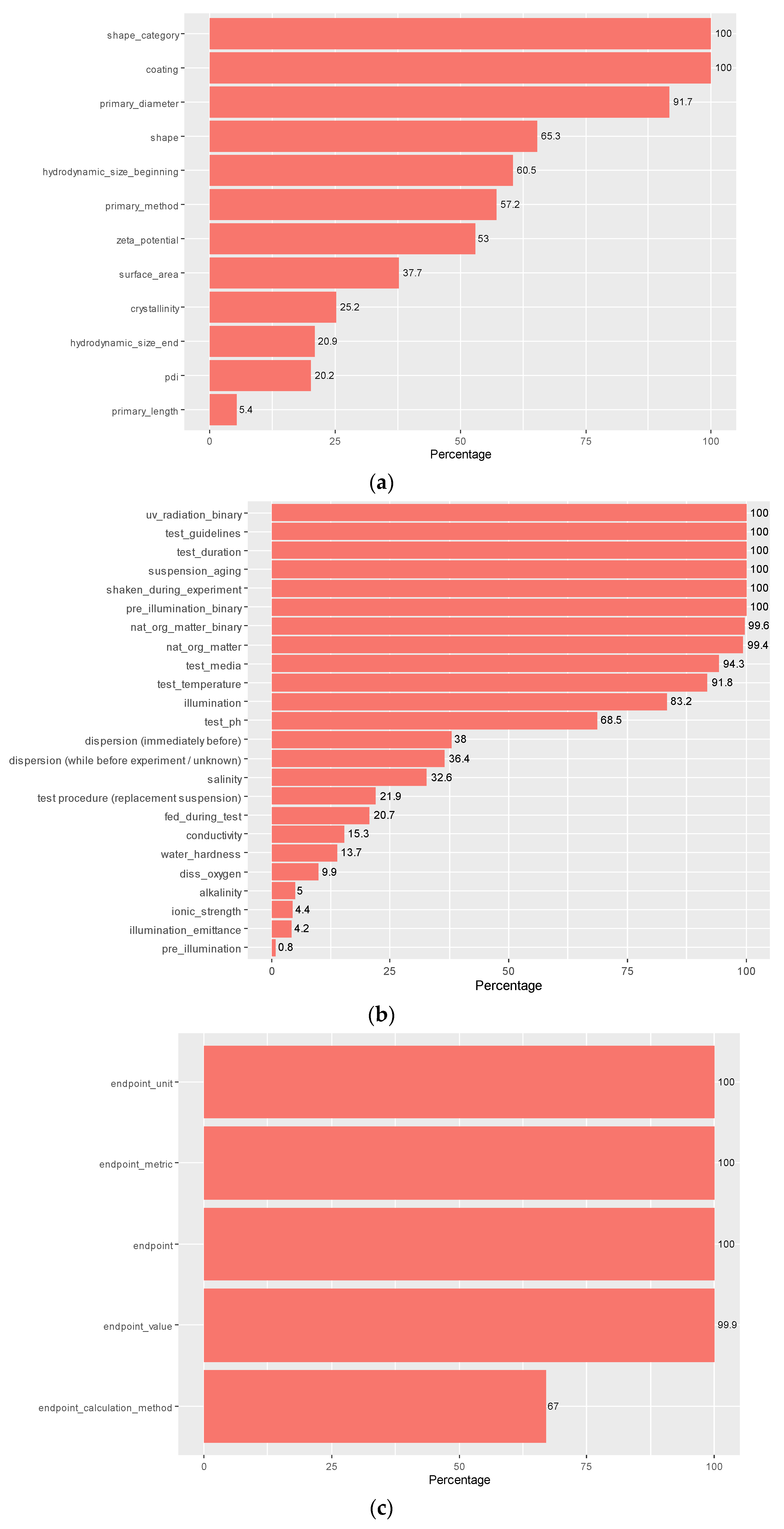
- “Characterization in test environment” from NanoE-Tox does not consider the timepoints at which measurements were performed. Our dataset considers the timepoints and media used to conduct measurements as they strongly affect measurements [22].
- -
- Our dataset does not include the mechanism of toxicity but contains additional experimental detail such as dispersion methods, aging/weathering, UV radiation, and water quality information.
3. Methods
3.1. Data Collection
- -
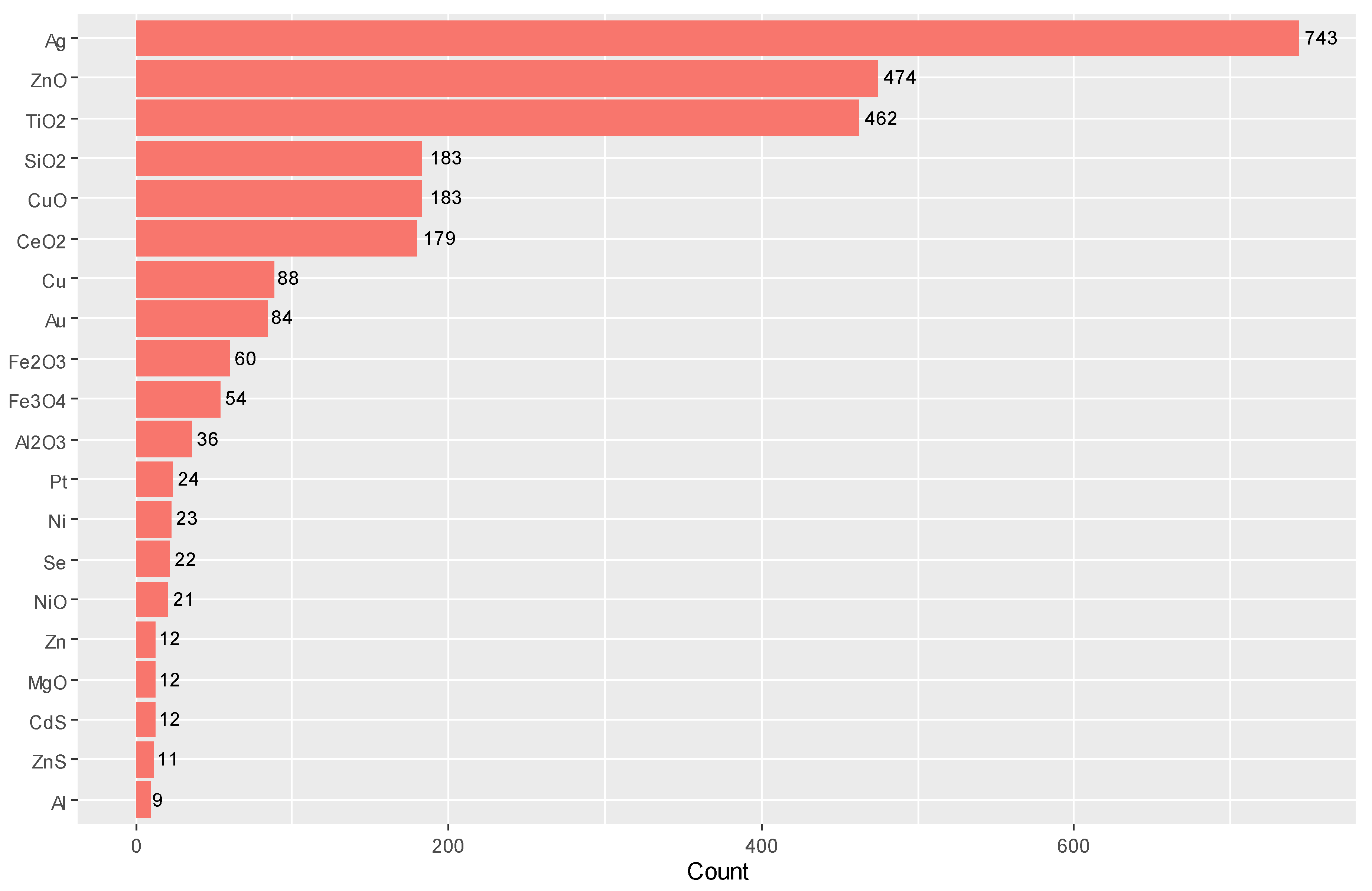
- ENMs: Zn, Ag, Au, ZnO, TiO2, CuO, CdO, Bi2O3, CeO2, Cu, Fe3O4, Co3O4, WO3, MgO, Sb2O3, Pd, Mn3O4, Al2O3, SiO2, NiO, La2O3, Gd0.97CoO3, La2NiO4, (La0.6Sr0.4)0.95CoO3, Ce0.9Gd0.1O2, LaCoO3, LaFeO3, (La0.5Sr0.5)0.99MnO3, Ce0.8Pr0.2O2, Co, Se, Fe2O3, SnO2, CuFe2O4, CoFe2O4, NiFe2O4, Al, Ni, Mn2O3, Pt, ZrO2, PbS, Al2O3.TiO2, BaFe12O19, Cr2O3, CuZnFe4O4, Mg(OH)2, Sn, W, CdS, Ag-Au, Cr, In2O3, ZnS, BaTiO3, B, Ag2S, Ag2O, Y2O3.
- -
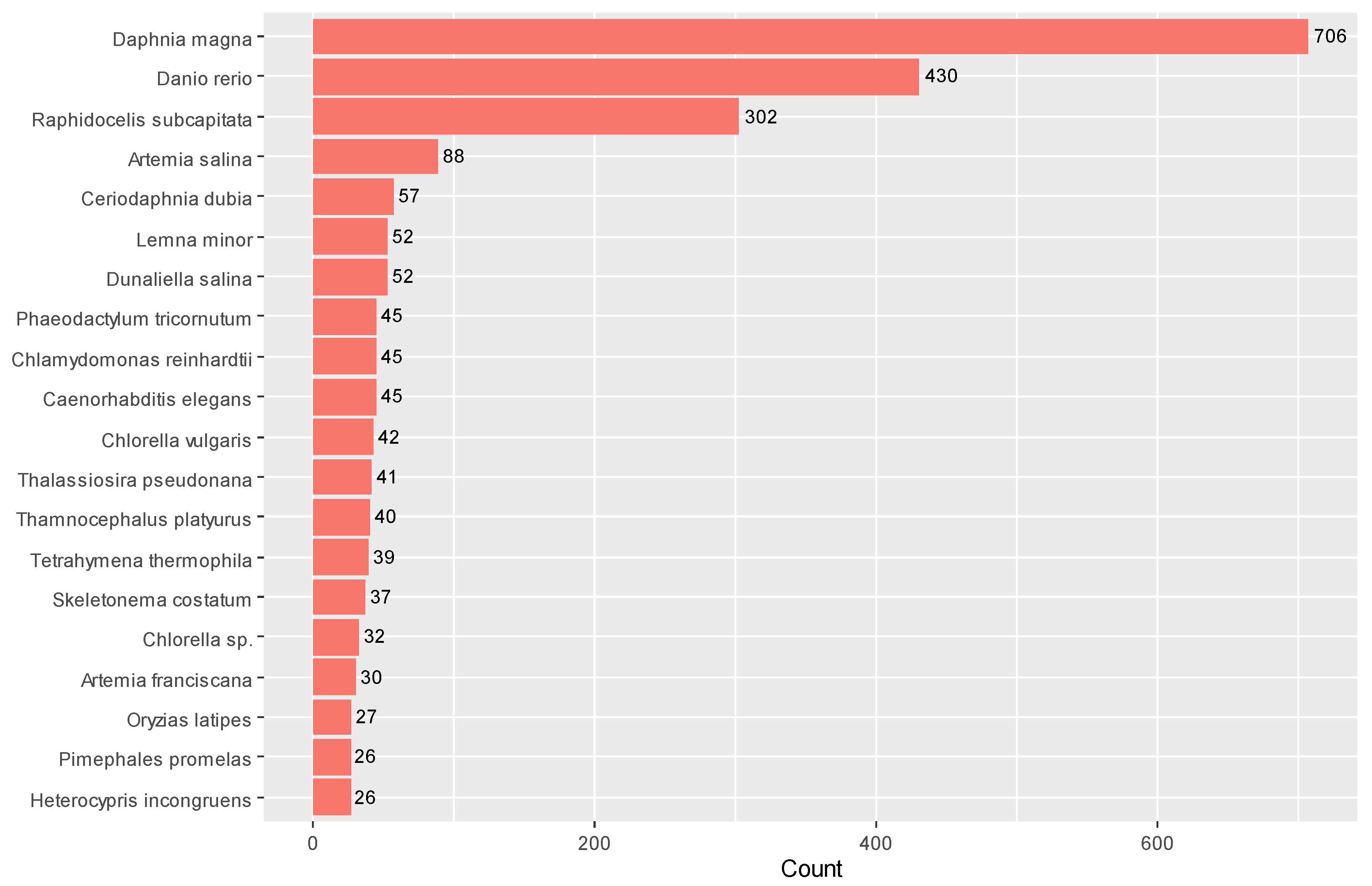
- Species groups: algae, diatom, cyanobacteria, protozoa, aquatic plants, cnidaria, crustacea (amphipoda, anostraca, cladocera, copepoda, ostracoda), fish, mollusca, rotifera, annelida, nematoda, insecta.
3.2. Data Harmonization
- -
- ENM shape data was harmonized by utilizing the TEM/SEM images in studies (if available). This was performed using the shape classes as described in the Supplementary Materials (Table S3.1.1) of Balraadjsing et al. 2022 [13], with some modifications. Changes made to this classification include the merging of “spherical” and “nearly spherical” classes into “spheroid” due to the large variety of images where no clear distinction could be made between both classes. Furthermore, the new category “triangular” was added for ENMs that resemble triangular shapes. When no images were present, then the shape as described by the authors was used.
- -
- When the coating was not disclosed within a study then the ENM was assumed to be uncoated.
- -
- Exposure conditions (e.g., temperature, illumination, pH) that were not clearly disclosed in the underlying publications were assumed to be the same as the culturing conditions (if this was reported).
- -
- Due to species names changing over time (e.g., Raphidocelis subcapitata), their (current) taxonomic information was assessed and harmonized using WoRMS (https://www.marinespecies.org/ (accessed on 1 September 2022)), algaebase (https://www.algaebase.org/ (accessed on 1 September 2022)), and fishbase (www.fishbase.org (accessed on 1 September 2022)).
3.3. Filling in Data Gaps
- -
- -
- When the culturing conditions were not reported, then the standardized guidelines were used to fill in the exposure conditions.
- -
- Literature was consulted to fill in water-quality gaps or to identify the composition of the media:
- ○
- SAN PIN tap water: SanPin 2.1.4.1074-01 protocol.
- ○
- ○
- Deionized/ultrapure/distilled/double distilled water/MilliQ: ASTM D1193-06(2018) protocol [34], ISO 3696:1987 protocol [35], Millipore (http://www.merckmillipore.com (accessed on 1 October 2022)).
- ○
- Class I and Class V natural waters: [36].
- ○
- Dechlorinated tap water: salinity filled in as 0‰ because in theory no chlorine should be present.
- ○
- Composition for remaining standardized and frequently used media: [37].
4. User Notes
Author Contributions
Funding
Data Availability Statement
Conflicts of Interest
References
- Choi, J.-S.; Ha, M.K.; Trinh, T.X.; Yoon, T.H.; Byun, H.-G. Towards a generalized toxicity prediction model for oxide nanomaterials using integrated data from different sources. Sci. Rep. 2018, 8, 6110. [Google Scholar] [CrossRef]
- Huang, H.-J.; Lee, Y.-H.; Hsu, Y.-H.; Liao, C.-T.; Lin, Y.-F.; Chiu, H.-W. Current Strategies in Assessment of Nanotoxicity: Alternatives to In Vivo Animal Testing. Int. J. Mol. Sci. 2021, 22, 4216. [Google Scholar] [CrossRef] [PubMed]
- Bahl, A.; Hellack, B.; Balas, M.; Dinischiotu, A.; Wiemann, M.; Brinkmann, J.; Luch, A.; Renard, B.Y.; Haase, A. Recursive feature elimination in random forest classification supports nanomaterial grouping. NanoImpact 2019, 15, 100179. [Google Scholar] [CrossRef]
- Ingre-Khans, E.; Ågerstrand, M.; Beronius, A.; Rudén, C. Toxicity studies used in registration, evaluation, authorisation and restriction of chemicals (REACH): How accurately are they reported? Integr. Environ. Assess. Manag. 2019, 15, 458–469. [Google Scholar] [CrossRef] [PubMed]
- Stoykova, K. Towards Non-Animal Testing in European Regulatory Toxicology: An Introduction to the REACH Framework and Challenges in Implementing the 3Rs. Eur. J. Risk Regul. 2025, 16, 985–1016. [Google Scholar] [CrossRef]
- Forest, V. Experimental and Computational Nanotoxicology—Complementary Approaches for Nanomaterial Hazard Assessment. Nanomaterials 2022, 12, 1346. [Google Scholar] [CrossRef]
- Basei, G.; Hristozov, D.; Lamon, L.; Zabeo, A.; Jeliazkova, N.; Tsiliki, G.; Marcomini, A.; Torsello, A. Making use of available and emerging data to predict the hazards of engineered nanomaterials by means of in silico tools: A critical review. NanoImpact 2019, 13, 76–99. [Google Scholar] [CrossRef]
- Pikula, K.; Zakharenko, A.; Chaika, V.; Kirichenko, K.; Tsatsakis, A.; Golokhvast, K. Risk assessments in nanotoxicology: Bioinformatics and computational approaches. Curr. Opin. Toxicol. 2020, 19, 1–6. [Google Scholar] [CrossRef]
- Vijver, M.G.; Zhai, Y.; Wang, Z.; Peijnenburg, W.J.G.M. Emerging investigator series: The dynamics of particle size distributions need to be accounted for in bioavailability modelling of nanoparticles. Environ. Sci. Nano 2018, 5, 2473–2481. [Google Scholar] [CrossRef]
- Chen, G.; Vijver, M.G.; Peijnenburg, W.J.G.M. Summary and Analysis of the Currently Existing Literature Data on Metal-based Nanoparticles Published for Selected Aquatic Organisms: Applicability for Toxicity Prediction by (Q)SARs. Altern. Lab. Anim. 2015, 43, 221–240. [Google Scholar] [CrossRef] [PubMed]
- Lead, J.R.; Batley, G.E.; Alvarez, P.J.J.; Croteau, M.-N.; Handy, R.D.; McLaughlin, M.J.; Judy, J.D.; Schirmer, K. Nanomaterials in the environment: Behavior, fate, bioavailability, and effects-An updated review: Nanomaterials in the environment. Environ. Toxicol. Chem. 2018, 37, 2029–2063. [Google Scholar] [CrossRef]
- Furxhi, I.; Willighagen, E.; Evelo, C.; Costa, A.; Gardini, D.; Ammar, A. A data reusability assessment in the nanosafety domain based on the NSDRA framework followed by an exploratory quantitative structure activity relationships (QSAR) modeling targeting cellular viability. NanoImpact 2023, 31, 100475. [Google Scholar] [CrossRef]
- Balraadjsing, S.; Peijnenburg, W.J.G.M.; Vijver, M.G. Exploring the potential of in silico machine learning tools for the prediction of acute Daphnia magna nanotoxicity. Chemosphere 2022, 307, 135930. [Google Scholar] [CrossRef]
- Bossa, C.; Andreoli, C.; Bakker, M.; Barone, F.; De Angelis, I.; Jeliazkova, N.; Nymark, P.; Battistelli, C.L. FAIRification of nanosafety data to improve applicability of (Q)SAR approaches: A case study on in vitro Comet assay genotoxicity data. Comput. Toxicol. 2021, 20, 100190. [Google Scholar] [CrossRef]
- Chen, G.; Vijver, M.; Xiao, Y.; Peijnenburg, W. A Review of Recent Advances towards the Development of (Quantitative) Structure-Activity Relationships for Metallic Nanomaterials. Materials 2017, 10, 1013. [Google Scholar] [CrossRef]
- Furxhi, I. Health and environmental safety of nanomaterials: O Data, Where Art Thou? NanoImpact 2022, 25, 100378. [Google Scholar] [CrossRef]
- Xiao, Y.; Peijnenburg, W.J.G.M.; Chen, G.; Vijver, M.G. Toxicity of copper nanoparticles to Daphnia magna under different exposure conditions. Sci. Total Environ. 2016, 563–564, 81–88. [Google Scholar] [CrossRef] [PubMed]
- Jeliazkova, N.; Apostolova, M.D.; Andreoli, C.; Barone, F.; Barrick, A.; Battistelli, C.; Bossa, C.; Botea-Petcu, A.; Châtel, A.; De Angelis, I.; et al. Towards FAIR nanosafety data. Nat. Nanotechnol. 2021, 16, 644–654. [Google Scholar] [CrossRef] [PubMed]
- Elberskirch, L.; Binder, K.; Riefler, N.; Sofranko, A.; Liebing, J.; Minella, C.B.; Mädler, L.; Razum, M.; van Thriel, C.; Unfried, K.; et al. Digital research data: From analysis of existing standards to a scientific foundation for a modular metadata schema in nanosafety. Part. Fibre Toxicol. 2022, 19, 1. [Google Scholar] [CrossRef] [PubMed]
- Juganson, K.; Ivask, A.; Blinova, I.; Mortimer, M.; Kahru, A. NanoE-Tox: New and in-depth database concerning ecotoxicity of nanomaterials. Beilstein J. Nanotechnol. 2015, 6, 1788–1804. [Google Scholar] [CrossRef]
- Gakis, G.P.; Aviziotis, I.G.; Charitidis, C.A. Metal and metal oxide nanoparticle toxicity: Moving towards a more holistic structure–activity approach. Environ. Sci. Nano 2023, 10, 761–780. [Google Scholar] [CrossRef]
- Comandella, D.; Gottardo, S.; Rio-Echevarria, I.M.; Rauscher, H. Quality of physicochemical data on nanomaterials: An assessment of data completeness and variability. Nanoscale 2020, 12, 4695–4708. [Google Scholar] [CrossRef]
- European Chemicals Agency. Appendix for Nanoforms to the Guidance on Registration and the Guidance on Substance Identification: Version 2.0 January 2022; Publications Office: Luxembourg, 2022; Available online: https://op.europa.eu/en/publication-detail/-/publication/ba400f97-66fe-11ed-b14f-01aa75ed71a1/language-en (accessed on 17 December 2025).
- Faria, M.; Björnmalm, M.; Thurecht, K.J.; Kent, S.J.; Parton, R.G.; Kavallaris, M.; Johnston, A.P.R.; Gooding, J.J.; Corrie, S.R.; Boyd, B.J.; et al. Minimum information reporting in bio–nano experimental literature. Nat. Nanotechnol. 2018, 13, 777–785. [Google Scholar] [CrossRef]
- Hartmann, N.B.; Ågerstrand, M.; Lützhøft, H.-C.H.; Baun, A. NanoCRED: A transparent framework to assess the regulatory adequacy of ecotoxicity data for nanomaterials—Relevance and reliability revisited. NanoImpact 2017, 6, 81–89. [Google Scholar] [CrossRef]
- Shao, G.; Beronius, A.; Nymark, P. SciRAPnano: A pragmatic and harmonized approach for quality evaluation of in vitro toxicity data to support risk assessment of nanomaterials. Front. Toxicol. 2023, 5, 1319985. [Google Scholar] [CrossRef] [PubMed]
- Exner, T.E.; Papadiamantis, A.G.; Melagraki, G.; Amos, J.D.; Bossa, N.; Gakis, G.P.; Charitidis, C.A.; Cornelis, G.; Costa, A.L.; Doganis, P.; et al. Metadata stewardship in nanosafety research: Learning from the past, preparing for an “on-the-fly” FAIR future. Front. Phys. 2023, 11, 1233879. [Google Scholar] [CrossRef]
- European Commission, Joint Research Centre: Institute for Health and Consumer Protection. Titanium Dioxide, NM-100, NM-101, NM-102, NM-103, NM-104, NM-105: Characterisation and Physico Chemical Properties; Publications Office: Luxembourg, 2014; Available online: https://data.europa.eu/doi/10.2788/79554 (accessed on 5 September 2025).
- European Commission, Joint Research Centre: Institute for Health and Consumer Protection. Cerium Dioxide NM-211, NM-212, NM-213, Characterisation and Test Item Preparation: JRC Repository: NM Series of Representative Manufactured Nanomaterials; Publications Office: Luxembourg, 2014; Available online: https://data.europa.eu/doi/10.2788/80203 (accessed on 5 September 2025).
- European Commission, Joint Research Centre: Institute for Health and Consumer Protection. NM-Series of Representative Manufactured Nanomaterials: NM 300 Silver Characterisation, Stability, Homogeneity; Publications Office: Luxembourg, 2011; Available online: https://data.europa.eu/doi/10.2788/23079 (accessed on 5 September 2025).
- European Commission, Joint Research Centre: Institute for Health and Consumer Protection. NM-Series of Representative Manufactured Nanomaterials: Zinc Oxide NM 110, NM 111, NM 112, NM 113 Characterisation and Test Item Preparation; Publications Office: Luxembourg, 2011; Available online: https://data.europa.eu/doi/10.2787/55008 (accessed on 5 September 2025).
- Dickman, C.; Christy, M. Effects of salinity on tadpoles of the green and golden bell frog (Litoria aurea). Amphib Reptil. 2002, 23, 1–11. [Google Scholar] [CrossRef]
- Millero, F.J.; Feistel, R.; Wright, D.G.; McDougall, T.J. The composition of Standard Seawater and the definition of the Reference-Composition Salinity Scale. Deep. Sea Res. Part I Oceanogr. Res. Pap. 2008, 55, 50–72. [Google Scholar] [CrossRef]
- ASTM D1193-06(2018); Standard Specification for Reagent Water. ASTM: West Conshohocken, PA, USA, 2018. [CrossRef]
- ISO 3696:1987; Water for Analytical Laboratory Use—Specification and Test Methods. International Organization for Standardization: London, UK, 1987.
- Hammes, J.; Gallego-Urrea, J.A.; Hassellöv, M. Geographically distributed classification of surface water chemical parameters influencing fate and behavior of nanoparticles and colloid facilitated contaminant transport. Water Res. 2013, 47, 5350–5361. [Google Scholar] [CrossRef]
- Andersen, R.A. (Ed.) Algal Culturing Techniques; Elsevier/Academic Press: Burlington, VT, USA, 2005. [Google Scholar]


Disclaimer/Publisher’s Note: The statements, opinions and data contained in all publications are solely those of the individual author(s) and contributor(s) and not of MDPI and/or the editor(s). MDPI and/or the editor(s) disclaim responsibility for any injury to people or property resulting from any ideas, methods, instructions or products referred to in the content. |
© 2026 by the authors. Licensee MDPI, Basel, Switzerland. This article is an open access article distributed under the terms and conditions of the Creative Commons Attribution (CC BY) license.
Share and Cite
Balraadjsing, S.; Peijnenburg, W.J.G.M.; Vijver, M.G. A Curated Dataset on the Acute In Vivo Ecotoxicity of Metallic Nanomaterials from Published Literature. Data 2026, 11, 22. https://doi.org/10.3390/data11010022
Balraadjsing S, Peijnenburg WJGM, Vijver MG. A Curated Dataset on the Acute In Vivo Ecotoxicity of Metallic Nanomaterials from Published Literature. Data. 2026; 11(1):22. https://doi.org/10.3390/data11010022
Chicago/Turabian StyleBalraadjsing, Surendra, Willie J. G. M. Peijnenburg, and Martina G. Vijver. 2026. "A Curated Dataset on the Acute In Vivo Ecotoxicity of Metallic Nanomaterials from Published Literature" Data 11, no. 1: 22. https://doi.org/10.3390/data11010022
APA StyleBalraadjsing, S., Peijnenburg, W. J. G. M., & Vijver, M. G. (2026). A Curated Dataset on the Acute In Vivo Ecotoxicity of Metallic Nanomaterials from Published Literature. Data, 11(1), 22. https://doi.org/10.3390/data11010022