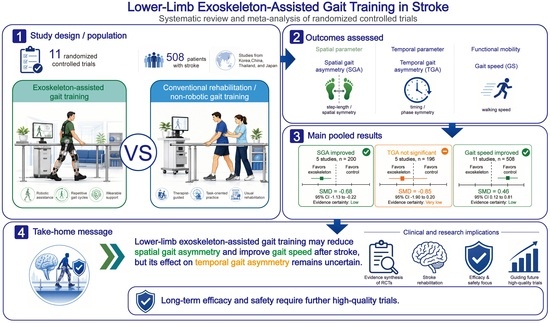
Effects of Gait Training with Lower-Limb Robotic Exoskeletons and Exoskeleton-Type Devices on Gait Symmetry and Gait Speed in Patients with Stroke: A Systematic Review and Meta-Analysis


Abstract
1. Introduction
2. Materials and Methods
2.1. Protocol and Registration
2.2. Information Sources and Search
2.3. Eligibility Criteria
2.4. Data Collection and Extraction
2.5. Risk-of-Bias Assessment
2.6. Data Synthesis and Analysis
2.7. Certainty of Evidence
3. Results
3.1. Study Selection and Characteristics
3.2. Risk-of-Bias Results
3.3. Results for SGA
3.4. Results for TGA
3.5. Results for GS
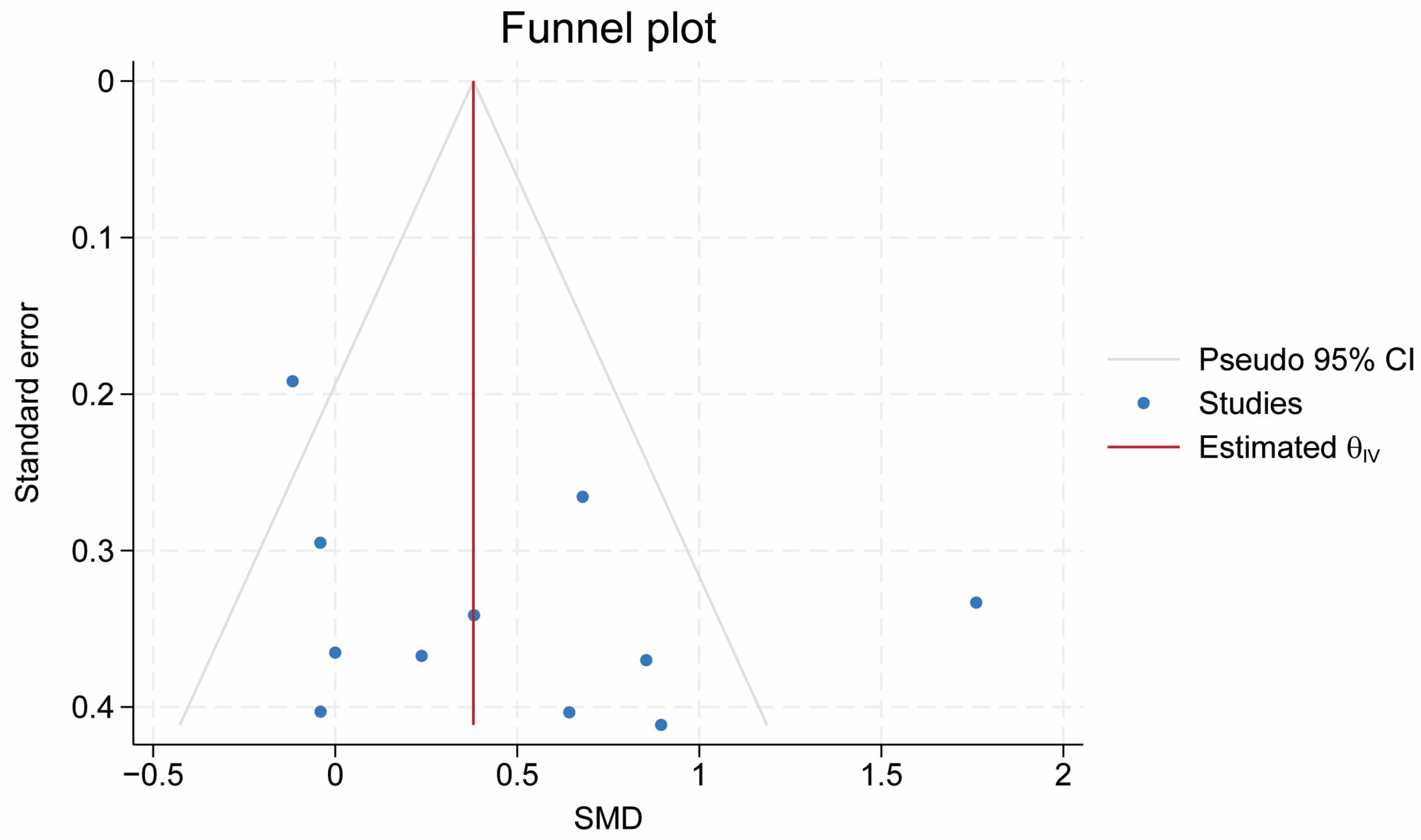
3.6. Sensitivity Analysis
3.7. GRADE Certainty of Evidence Assessment
4. Discussion
5. Conclusions
Supplementary Materials
Author Contributions
Funding
Institutional Review Board Statement
Informed Consent Statement
Data Availability Statement
Conflicts of Interest
Abbreviations
| RCT | randomized controlled trial |
| PRISMA | Preferred Reporting Items for Systematic Reviews and Meta-Analyses |
| PICOS | population, intervention, comparator, outcomes, and study design |
| SGA | spatial gait asymmetry |
| TGA | temporal gait asymmetry |
| GS | gait speed |
| CRT | conventional rehabilitation therapy |
| SMD | standardized mean difference |
| CI | confidence interval |
| REML | restricted maximum likelihood |
| RoB 2 | Cochrane risk-of-bias tool for randomized trials, version 2 |
| GRADE | Grading of Recommendations Assessment, Development and Evaluation |
| I2 | heterogeneity statistic |
| τ2 | between-study variance |
References
- Louie, D.R.; Simpson, L.A.; Mortenson, W.B.; Field, T.S.; Yao, J.; Eng, J.J. Prevalence of Walking Limitation After Acute Stroke and Its Impact on Discharge to Home. Phys. Ther. 2022, 102, pzab246. [Google Scholar] [CrossRef] [PubMed] [PubMed Central]
- Patterson, K.K.; Parafianowicz, I.; Danells, C.J.; Closson, V.; Verrier, M.C.; Staines, W.R.; Black, S.E.; McIlroy, W.E. Gait asymmetry in community-ambulating stroke survivors. Arch. Phys. Med. Rehabil. 2008, 89, 304–310. [Google Scholar] [CrossRef] [PubMed]
- Awad, L.N.; Palmer, J.A.; Pohlig, R.T.; Binder-Macleod, S.A.; Reisman, D.S. Walking speed and step length asymmetry modify the energy cost of walking after stroke. Neurorehabil. Neural Repair 2015, 29, 416–423. [Google Scholar] [CrossRef] [PubMed] [PubMed Central]
- Winstein, C.J.; Stein, J.; Arena, R.; Bates, B.; Cherney, L.R.; Cramer, S.C.; Deruyter, F.; Eng, J.J.; Fisher, B.; Harvey, R.L.; et al. Guidelines for adult stroke rehabilitation and recovery: A guideline for healthcare professionals from the American Heart Association/American Stroke Association. Stroke 2016, 47, e98–e169. [Google Scholar] [CrossRef] [PubMed]
- Louie, D.R.; Eng, J.J. Powered robotic exoskeletons in post-stroke rehabilitation of gait: A scoping review. J. Neuroeng. Rehabil. 2016, 13, 53. [Google Scholar] [CrossRef] [PubMed] [PubMed Central]
- Koldaş Doğan, Ş. Robot-assisted gait training in stroke. Turk. J. Phys. Med. Rehabil. 2024, 70, 293–299. [Google Scholar] [CrossRef] [PubMed] [PubMed Central]
- Hsu, T.H.; Tsai, C.L.; Chi, J.Y.; Hsu, C.Y.; Lin, Y.N. Effect of wearable exoskeleton on post-stroke gait: A systematic review and meta-analysis. Ann. Phys. Rehabil. Med. 2023, 66, 101674. [Google Scholar] [CrossRef] [PubMed]
- Leow, X.R.G.; Ng, S.L.A.; Lau, Y. Overground Robotic Exoskeleton Training for Patients with Stroke on Walking-Related Outcomes: A Systematic Review and Meta-analysis of Randomized Controlled Trials. Arch. Phys. Med. Rehabil. 2023, 104, 1698–1710. [Google Scholar] [CrossRef] [PubMed]
- Nam, Y.G.; Ko, M.J.; Bok, S.K.; Paik, N.J.; Lim, C.Y.; Lee, J.W.; Kwon, B.S. Efficacy of electromechanical-assisted gait training on clinical walking function and gait symmetry after brain injury of stroke: A randomized controlled trial. Sci. Rep. 2022, 12, 6880. [Google Scholar] [CrossRef] [PubMed] [PubMed Central]
- Huo, C.; Shao, G.; Chen, T.; Li, W.; Wang, J.; Xie, H.; Wang, Y.; Li, Z.; Zheng, P.; Li, L.; et al. Effectiveness of unilateral lower-limb exoskeleton robot on balance and gait recovery and neuroplasticity in patients with subacute stroke: A randomized controlled trial. J. Neuroeng. Rehabil. 2024, 21, 213. [Google Scholar] [CrossRef] [PubMed] [PubMed Central]
- Miyagawa, D.; Matsushima, A.; Maruyama, Y.; Mizukami, N.; Tetsuya, M.; Hashimoto, M.; Yoshida, K. Gait training with a wearable powered robot during stroke rehabilitation: A randomized parallel-group trial. J. Neuroeng. Rehabil. 2023, 20, 54. [Google Scholar] [CrossRef] [PubMed] [PubMed Central]
- Mehrholz, J.; Thomas, S.; Kugler, J.; Pohl, M.; Elsner, B. Electromechanical-assisted training for walking after stroke. Cochrane Database Syst. Rev. 2020, 10, CD006185. [Google Scholar] [CrossRef] [PubMed]
- Moucheboeuf, G.; Griffier, R.; Gasq, D.; Glize, B.; Bouyer, L.; Dehail, P.; Cassoudesalle, H. Effects of robotic gait training after stroke: A meta-analysis. Ann. Phys. Rehabil. Med. 2020, 63, 518–534. [Google Scholar] [CrossRef] [PubMed]
- Page, M.J.; McKenzie, J.E.; Bossuyt, P.M.; Boutron, I.; Hoffmann, T.C.; Mulrow, C.D.; Shamseer, L.; Tetzlaff, J.M.; Akl, E.A.; Brennan, S.E.; et al. The PRISMA 2020 statement: An updated guideline for reporting systematic reviews. BMJ 2021, 372, n71. [Google Scholar] [CrossRef] [PubMed] [PubMed Central]
- Sterne, J.A.C.; Savović, J.; Page, M.J.; Elbers, R.G.; Blencowe, N.S.; Boutron, I.; Cates, C.J.; Cheng, H.Y.; Corbett, M.S.; Eldridge, S.M.; et al. RoB 2: A revised tool for assessing risk of bias in randomised trials. BMJ 2019, 366, l4898. [Google Scholar] [CrossRef] [PubMed]
- Higgins, J.P.; Thompson, S.G.; Deeks, J.J.; Altman, D.G. Measuring inconsistency in meta-analyses. BMJ 2003, 327, 557–560. [Google Scholar] [CrossRef] [PubMed] [PubMed Central]
- Veroniki, A.A.; Jackson, D.; Viechtbauer, W.; Bender, R.; Bowden, J.; Knapp, G.; Kuss, O.; Higgins, J.P.; Langan, D.; Salanti, G. Methods to estimate the between-study variance and its uncertainty in meta-analysis. Res. Synth. Methods 2016, 7, 55–79. [Google Scholar] [CrossRef] [PubMed] [PubMed Central]
- Sterne, J.A.; Sutton, A.J.; Ioannidis, J.P.; Terrin, N.; Jones, D.R.; Lau, J.; Carpenter, J.; Rücker, G.; Harbord, R.M.; Schmid, C.H.; et al. Recommendations for examining and interpreting funnel plot asymmetry in meta-analyses of randomised controlled trials. BMJ 2011, 343, d4002. [Google Scholar] [CrossRef] [PubMed]
- Pustejovsky, J.E.; Rodgers, M.A. Testing for funnel plot asymmetry of standardized mean differences. Res. Synth. Methods 2019, 10, 57–71. [Google Scholar] [CrossRef] [PubMed]
- Guyatt, G.; Oxman, A.D.; Akl, E.A.; Kunz, R.; Vist, G.; Brozek, J.; Norris, S.; Falck-Ytter, Y.; Glasziou, P.; DeBeer, H.; et al. GRADE guidelines: 1. Introduction-GRADE evidence profiles and summary of findings tables. J. Clin. Epidemiol. 2011, 64, 383–394. [Google Scholar] [CrossRef] [PubMed]
- Kang, C.J.; Chun, M.H.; Lee, J.; Lee, J.Y. Effects of robot (SUBAR)-assisted gait training in patients with chronic stroke: Randomized controlled trial. Medicine 2021, 100, e27974. [Google Scholar] [CrossRef] [PubMed] [PubMed Central]
- Lee, H.J.; Lee, S.H.; Seo, K.; Lee, M.; Chang, W.H.; Choi, B.O.; Ryu, G.H.; Kim, Y.H. Training for Walking Efficiency With a Wearable Hip-Assist Robot in Patients With Stroke: A Pilot Randomized Controlled Trial. Stroke 2019, 50, 3545–3552. [Google Scholar] [CrossRef] [PubMed]
- Yoo, M.; Chun, M.H.; Hong, G.R.; Lee, C.; Lee, J.K.; Lee, A. Effects of Training with a Powered Exoskeleton on Cortical Activity Modulation in Hemiparetic Chronic Stroke Patients: A Randomized Controlled Pilot Trial. Arch. Phys. Med. Rehabil. 2023, 104, 1620–1629. [Google Scholar] [CrossRef] [PubMed]
- Liang, C.; Wan, C.; Yang, J.; Shen, X.; Yu, C.; Shao, Y.; Che, P.; Zhang, Y.; Li, Y. Effect of the Kickstart exoskeleton lower extremity walking system on improving lower extremity walking ability in subacute stroke patients: A randomized controlled trial. J. Neuroeng. Rehabil. 2025, 22, 155. [Google Scholar] [CrossRef] [PubMed] [PubMed Central]
- Xie, R.; Sun, J.; Yu, J.; Zhang, Y.; Jin, H.; Zhu, X.; Feng, Y.; Sun, Y.; Ji, L.; Li, C.; et al. Efficacy of bilateral soft exoskeleton training for people with subacute stroke: A randomized controlled trial. J. Neuroeng. Rehabil. 2026, 23, 48. [Google Scholar] [CrossRef] [PubMed]
- Cao, H.J.; Song, H.J.; Sun, Y.L.; Zhang, G.Y.; Li, X. A wearable exoskeleton with posture feedback improves abnormal gait in patients with stroke. Chin. J. Tissue Eng. Res. 2025, 29, 5127–5133. [Google Scholar] [CrossRef]
- Li, D.X.; Zha, F.B.; Long, J.J.; Liu, F.; Cao, J.; Wang, Y.L. Effect of Robot Assisted Gait Training on Motor and Walking Function in Patients with Subacute Stroke: A Random Controlled Study. J. Stroke Cerebrovasc. Dis. 2021, 30, 105807. [Google Scholar] [CrossRef] [PubMed]
- Thimabut, N.; Yotnuengnit, P.; Charoenlimprasert, J.; Sillapachai, T.; Hirano, S.; Saitoh, E.; Piravej, K. Effects of the Robot-Assisted Gait Training Device Plus Physiotherapy in Improving Ambulatory Functions in Patients with Subacute Stroke with Hemiplegia: An Assessor-Blinded, Randomized Controlled Trial. Arch. Phys. Med. Rehabil. 2022, 103, 843–850. [Google Scholar] [CrossRef] [PubMed]
- Yang, J.; Zhu, Y.; Li, H.; Wang, K.; Li, D.; Qi, Q. Effect of robotic exoskeleton training on lower limb function, activity and participation in stroke patients: A systematic review and meta-analysis of randomized controlled trials. Front. Neurol. 2024, 15, 1453781. [Google Scholar] [CrossRef] [PubMed] [PubMed Central]
- Lang, C.E.; Lohse, K.R.; Birkenmeier, R.L. Dose and timing in neurorehabilitation: Prescribing motor therapy after stroke. Curr. Opin. Neurol. 2015, 28, 549–555. [Google Scholar] [CrossRef] [PubMed] [PubMed Central]
- Balasubramanian, C.K.; Bowden, M.G.; Neptune, R.R.; Kautz, S.A. Relationship between step length asymmetry and walking performance in subjects with chronic hemiparesis. Arch. Phys. Med. Rehabil. 2007, 88, 43–49. [Google Scholar] [CrossRef] [PubMed]
- Reisman, D.S.; Wityk, R.; Silver, K.; Bastian, A.J. Locomotor adaptation on a split-belt treadmill can improve walking symmetry post-stroke. Brain 2007, 130, 1861–1872. [Google Scholar] [CrossRef] [PubMed] [PubMed Central]
- Patterson, K.K.; Gage, W.H.; Brooks, D.; Black, S.E.; McIlroy, W.E. Evaluation of gait symmetry after stroke: A comparison of current methods and recommendations for standardization. Gait Posture 2010, 31, 241–246. [Google Scholar] [CrossRef] [PubMed]
- Schmid, A.; Duncan, P.W.; Studenski, S.; Lai, S.M.; Richards, L.; Perera, S.; Wu, S.S. Improvements in speed-based gait classifications are meaningful. Stroke 2007, 38, 2096–2100. [Google Scholar] [CrossRef] [PubMed]
- Wonsetler, E.C.; Bowden, M.G. A systematic review of mechanisms of gait speed change post-stroke. Part 1: Spatiotemporal parameters and asymmetry ratios. Top. Stroke Rehabil. 2017, 24, 435–446. [Google Scholar] [CrossRef] [PubMed] [PubMed Central]
- Tilson, J.K.; Sullivan, K.J.; Cen, S.Y.; Rose, D.K.; Koradia, C.H.; Azen, S.P.; Duncan, P.W.; Locomotor Experience Applied Post Stroke (LEAPS) Investigative Team. Meaningful gait speed improvement during the first 60 days poststroke: Minimal clinically important difference. Phys. Ther. 2010, 90, 196–208. [Google Scholar] [CrossRef] [PubMed] [PubMed Central]
- Li, S.; Francisco, G.E.; Zhou, P. Post-stroke Hemiplegic Gait: New Perspective and Insights. Front. Physiol. 2018, 9, 1021. [Google Scholar] [CrossRef] [PubMed] [PubMed Central]
- Hendrickson, J.; Patterson, K.K.; Inness, E.L.; McIlroy, W.E.; Mansfield, A. Relationship between asymmetry of quiet standing balance control and walking post-stroke. Gait Posture 2014, 39, 177–181. [Google Scholar] [CrossRef] [PubMed]
- Patterson, K.K.; Mansfield, A.; Biasin, L.; Brunton, K.; Inness, E.L.; McIlroy, W.E. Longitudinal changes in poststroke spatiotemporal gait asymmetry over inpatient rehabilitation. Neurorehabil. Neural Repair. 2015, 29, 153–162. [Google Scholar] [CrossRef] [PubMed]
- Ioannidis, J.P.; Evans, S.J.; Gøtzsche, P.C.; O’Neill, R.T.; Altman, D.G.; Schulz, K.; Moher, D.; Consort Group. Better reporting of harms in randomized trials: An extension of the CONSORT statement. Ann. Intern. Med. 2004, 141, 781–788. [Google Scholar] [CrossRef] [PubMed]
- Lord, S.E.; McPherson, K.; McNaughton, H.K.; Rochester, L.; Weatherall, M. Community ambulation after stroke: How important and obtainable is it and what measures appear predictive? Arch. Phys. Med. Rehabil. 2004, 85, 234–239. [Google Scholar] [CrossRef] [PubMed]
- Bernaldo de Quirós, M.; Douma, E.H.; van den Akker-Scheek, I.; Lamoth, C.J.C.; Maurits, N.M. Quantification of Movement in Stroke Patients under Free Living Conditions Using Wearable Sensors: A Systematic Review. Sensors 2022, 22, 1050. [Google Scholar] [CrossRef] [PubMed] [PubMed Central]
- Thakur, N.; Han, C.Y. An Ambient Intelligence-Based Human Behavior Monitoring Framework for Ubiquitous Environments. Information 2021, 12, 81. [Google Scholar] [CrossRef]



| Included Study | Country | Sample Size (C/T) | Age (C/T) Years | Time Since Stroke (C/T) | Intervention Group | Control Group | Intervention Duration | Outcomes |
|---|---|---|---|---|---|---|---|---|
| Lee et al. 2019 [22] | South Korea | 14/14 | 62.2 ± 6.36/ 61.85 ± 7.87 | 50.46 ± 10.23 months/48.82 ± 8.68 months | CRT + conventional walking training + robot for overground walking training | CRT + conventional walking training | 4 weeks | SGA, TGA, GS |
| Thimabut et al. 2022 [28] | Thailand | 13/13 | 62.80 ± 8.50/ 52.80 ± 12.60 | 2.4 ± 0.7 months/ 1.8 ± 0.8 months | CRT + platform-based robotic training device | CRT + conventional walking training | 6 weeks | GS |
| Nam et al. 2022 [9] | South Korea | 72/72 | 62.42 ± 15.04/ 60.63 ± 15.61 | 17.2 ± 40.1 months/25.2 ± 47.2 months | CRT + EXOWALK exoskeleton-assisted gait training | CRT + therapist-assisted gait training | 4 weeks | SGA, TGA, GS |
| Liang et al. 2025 [24] | China | 23/23 | 61.83 ± 12.30 /60.43 ± 11.55 | 1.46 ± 0.95 months/1.31 ± 0.19 months | CRT + Kickstart® lower-limb exoskeleton-assisted walking training | CRT + conventional walking training | 4 weeks | GS |
| Yoo et al. 2023 [23] | South Korea | 15/15 | 66.00 ± 5.31 /61.86 ± 7.10 | 189.6 ± 85.7 months/138.8 ± 89.9 months | Healbot G powered exoskeleton-assisted treadmill gait training | Conventional treadmill gait training | 4 weeks | SGA, TGA, GS |
| Xie et al. 2026 [25] | China | 30/30 | 61.80 ± 5.55/ 61.63 ± 5.90 | 1.92 ± 1.36 months/2.23 ± 1.88 months | CRT + bilateral soft exoskeleton-assisted treadmill gait training | CRT + conventional treadmill gait training | 20 consecutive days | SGA, TGA, GS |
| Cao et al. 2025 [26] | China | 26/26 | 51.75 ± 12.81 /52.08 ± 12.9 | 0.58 ± 0.14 months/0.55 ± 0.16 months | CRT + Kickstart wearable exoskeleton combined with posture-feedback walking training | CRT + conventional assisted walking training | 4 weeks | SGA, TGA, GS |
| Kang et al. 2021 [21] | South Korea | 15/15 | 62.9 ± 6.0 /64.3 ± 4.6 | 42.6 ± 59.2 months/168.3 ± 67.3 months | SUBAR overground lower-limb robotic exoskeleton-assisted gait training | Conventional physical therapy, including functional gait training | 3 weeks | GS |
| Li et al. 2021 [27] | China | 18/18 | 50.13 ± 9.49/50.53 ± 12.26 | 3.38 ± 1.19 months/2.53 ± 1.33 months | CRT + BEAR-H1 lower-limb robotic exoskeleton-assisted gait training | CRT + conventional walking training | 4 weeks | GS |
| Huo et al. 2024 [10] | China | 20/20 | 55.25 ± 11.16 /57.93 ± 11.47 | 2.43 ± 1.09 months/2.24 ± 1.17 months | CRT + LiteStepper® unilateral lower-limb robotic exoskeleton-assisted overground gait training | CRT + conventional walking training | 4 weeks | GS |
| Miyagawa et al. 2023 [11] | Japan | 20/20 | 63.0 ± 12.9 /65.1 ± 12.9 | Not reported | CRT + curara® wearable powered robot-assisted gait training | CRT + therapist-assisted conventional gait training | 15-day trial period | GS |
| Outcome | Included Studies/Sample Size | Risk of Bias | Inconsistency | Indirectness | Imprecision | Publication Bias | Certainty of Evidence |
|---|---|---|---|---|---|---|---|
| SGA | 5 studies/196 | Serious | Serious | Not serious | Serious | Not assessed (number of studies < 10) | Very low |
| TGA | 5 studies/196 | Serious | Very serious | Not serious | Serious | Not assessed (number of studies < 10) | Very low |
| GS | 11 studies/469 | Serious | Serious | Not serious | Serious | Not serious | Very low |
Disclaimer/Publisher’s Note: The statements, opinions and data contained in all publications are solely those of the individual author(s) and contributor(s) and not of MDPI and/or the editor(s). MDPI and/or the editor(s) disclaim responsibility for any injury to people or property resulting from any ideas, methods, instructions or products referred to in the content. |
© 2026 by the authors. Licensee MDPI, Basel, Switzerland. This article is an open access article distributed under the terms and conditions of the Creative Commons Attribution (CC BY) license.
Share and Cite
Zhang, C.; Wu, J.; Zang, W.; Zhang, Q. Effects of Gait Training with Lower-Limb Robotic Exoskeletons and Exoskeleton-Type Devices on Gait Symmetry and Gait Speed in Patients with Stroke: A Systematic Review and Meta-Analysis. Bioengineering 2026, 13, 892. https://doi.org/10.3390/bioengineering13080892
Zhang C, Wu J, Zang W, Zhang Q. Effects of Gait Training with Lower-Limb Robotic Exoskeletons and Exoskeleton-Type Devices on Gait Symmetry and Gait Speed in Patients with Stroke: A Systematic Review and Meta-Analysis. Bioengineering. 2026; 13(8):892. https://doi.org/10.3390/bioengineering13080892
Chicago/Turabian StyleZhang, Chengshuo, Jiarong Wu, Wanli Zang, and Qiuxia Zhang. 2026. "Effects of Gait Training with Lower-Limb Robotic Exoskeletons and Exoskeleton-Type Devices on Gait Symmetry and Gait Speed in Patients with Stroke: A Systematic Review and Meta-Analysis" Bioengineering 13, no. 8: 892. https://doi.org/10.3390/bioengineering13080892
APA StyleZhang, C., Wu, J., Zang, W., & Zhang, Q. (2026). Effects of Gait Training with Lower-Limb Robotic Exoskeletons and Exoskeleton-Type Devices on Gait Symmetry and Gait Speed in Patients with Stroke: A Systematic Review and Meta-Analysis. Bioengineering, 13(8), 892. https://doi.org/10.3390/bioengineering13080892