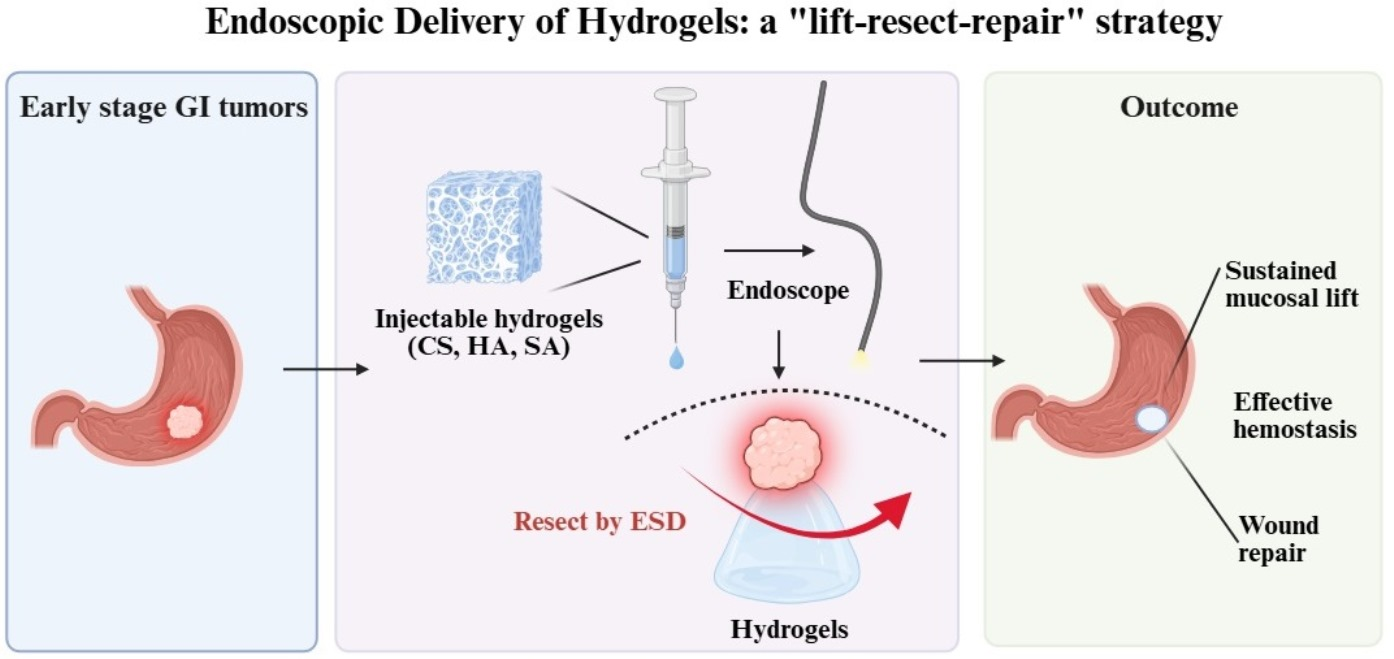


Endoscopic Delivery of Hydrogels: A Novel Strategy for Treating Early-Stage Gastrointestinal Tumors

Abstract
1. Introduction
2. Hydrogels for Endoscopic Resection: Classification and Fundamental Properties
- (1)
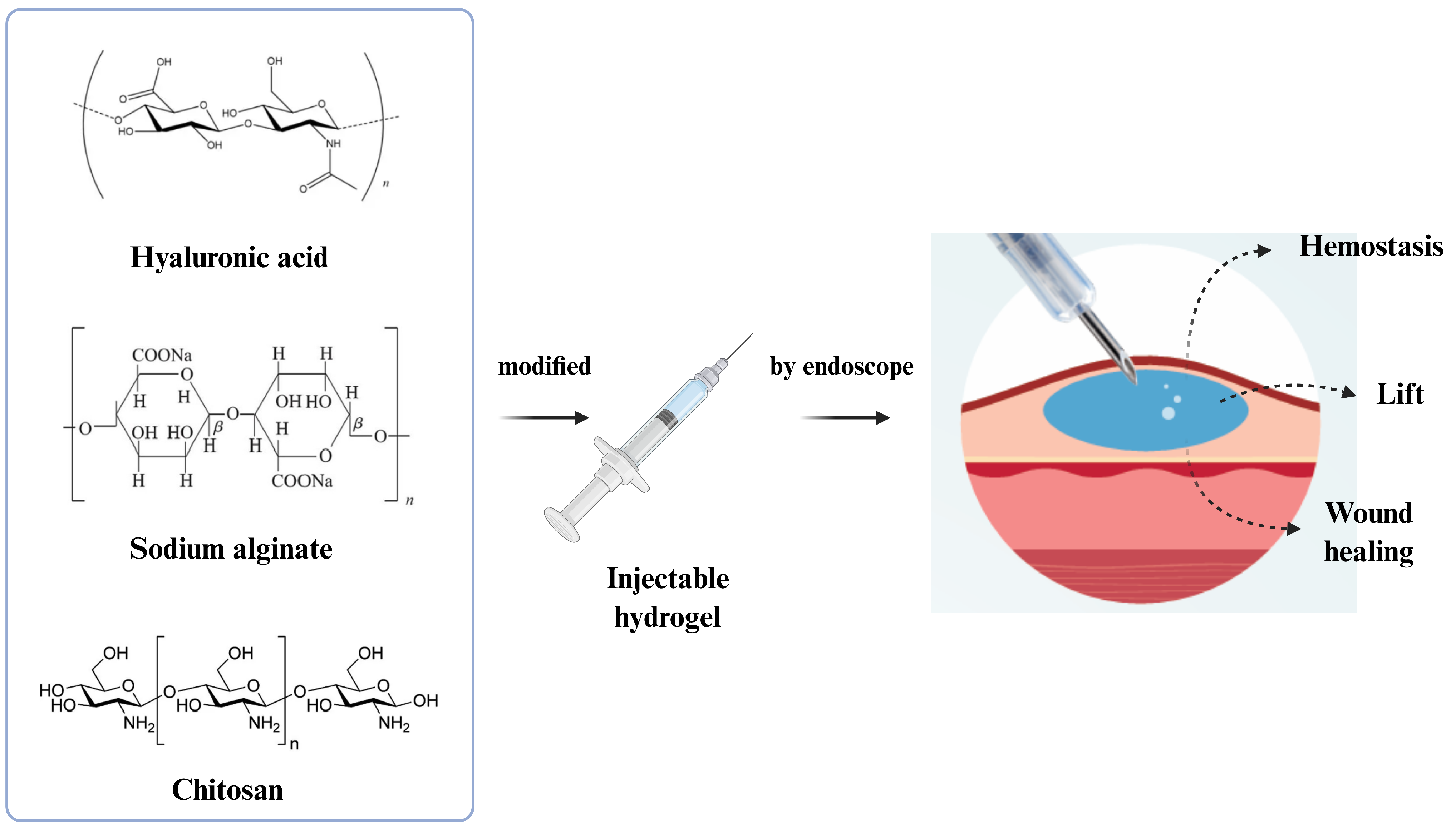
- CS: CS is derived from the deacetylation of chitin found in the exoskeletons of crustaceans and arthropods [44]. It exhibits high adhesiveness, hemostatic and antibacterial properties, and low cytotoxicity [43,45]. However, its inherent insolubility in neutral pH aqueous solutions limits its direct biomedical applications. Modified CS derivatives can serve as submucosal injectates. For example, modification of free amino groups with lactose and photoreactive azide groups produces fully water-soluble CS derivatives at neutral pH, which form insoluble hydrogels upon UV irradiation, making them suitable for submucosal injection. The high viscosity of CS makes it difficult to inject through endoscopic needles. To address this, a team studied photocrosslinked CS, a material that can be injected into the submucosal layer of the digestive tract in solution form. Upon exposure to ultraviolet light, photocrosslinked CS transforms into a hydrogel, providing a significant and long-lasting lifting effect [54]. However, reliance on ultraviolet light raises concerns about potential adverse effects on surrounding normal tissues with long-term use. Therefore, temperature-sensitive hydrogels based on CS and β-glycerophosphate (CS/GP), known as thermo-sensitive CS, were developed [55]. These hydrogels remain in solution at low temperatures and transform into a gel at body temperature. Nevertheless, the gelation process of CS/GP is slow. To optimize this, a temperature-sensitive gel system containing CS, β-glycerophosphate, and collagen (CS/GP/Col) was developed, which accelerates gelation, stimulates growth factor secretion, and modulates local inflammatory responses [56]. However, this system exhibits poor bioadhesion and is prone to detachment. To overcome these limitations, hydroxypropyl cellulose (HPC) was added to the CS/GP/Col system, resulting in a novel four-component gel system (CS/GP/HPC/Col) characterized by rapid gelation, enhanced adhesion, and reduced inflammatory response [56].
- (2)
- SA: SA is a natural polysaccharide extracted from brown algae, composed of linear chains of β-D-mannuronic acid (M) and α-L-guluronic acid (G) residues linked by 1,4-glycosidic bonds [46]. Variations in the M/G ratio and block structures result in differences in conformation and biological properties [57,58], allowing modulation of hydrogel mechanical strength and bioactivity through control of molecular weight and distribution. SA promotes platelet aggregation and accelerates fibrin formation. Engineering modifications, such as adjusting SA concentration [59] or calcium ion concentration [60], can enhance its functional properties to regulate mechanical strength and stability. Alginate exhibits favorable mechanical properties by providing spatial support and filling, excellent biocompatibility, low immunogenicity, absence of specific cell recognition sites, and resistance to degradation by mammalian enzymes, demonstrating relative bio-inertness [9,50]. Alginate gel preparation is simple, mild, and non-toxic [49]. Grafting and modifying alginate chains to introduce specific functional groups can expand its applications in drug delivery, bio-coatings, wound healing, and tissue engineering scaffolds [47,48]. SA composites with CS [61] or polyacrylamide [62] can serve as wound dressings with effective hemostatic and pro-healing properties [63]. In a comparative experimental study, ESD was successfully accomplished with 2%, 3% and 4% SA in 10 patients [63]. Studies show that SA solutions at concentrations between 0.6% and 4% are more effective submucosal injectates than NS, with 0.6% considered optimal, providing effective tissue lifting without causing damage [63,64]. Uemura et al. applied 0.6% SA during ESD for gastric and esophageal tumors and found its efficacy [65,66]. In 2024, a single-center, retrospective pilot study shows that the rate of en bloc resection of 0.6% SA group was 97% [67]. Both in vitro and ex vivo studies have confirmed the effectiveness of SA. As a material with great potential, its future clinical utility can be further enhanced by optimizing concentration, formulation, and performance.
- (3)
- HA: HA is an acidic glycosaminoglycan composed of D-glucuronic acid and N-acetylglucosamine, widely found in mammalian connective tissues [51]. Valued for its excellent water retention, ability to promote cell repair, and high biocompatibility, HA is extensively used in fields such as ophthalmology and orthopedic treatments [52]. The safety and efficacy of HA have been demonstrated in both large animal models and human studies. Due to its high viscosity, HA requires dilution prior to injection.

| Year | Type of Study | Components | Results |
|---|---|---|---|
| 2012 | Animal experimental study | Photocrosslinkable CS hydrogel | A long-lasting lifting effect [54]. |
| 2021 | Animal experimental study | CS/GP | It remains in solution at low temperatures and transforms into a gel at body temperature [55]. |
| 2024 | Animal experimental study | HpHCS-PVP-β-glycerophosphate | It enhances the stability and injectability, and enables rapid gelation even at low concentrations [71]. |
| 2011 | A comparative experimental study | 2%, 3%, 4% SA | ESD was successfully accomplished with SA in 10 patients [63]. |
| 2019 | A multicenter randomized controlled trial | 0.6% SA | During ESD, the efficacy of submucosal injections was 91.7% [66]. |
| 2024 | A single-center, retrospective pilot study | 0.6% SA | The rate of en bloc resection was 97% [67]. |
| 2006 | Clinical study | A mixture of 0.125% HA derived from 1% 1900 kDa HA with 10% glycerol, 5% fructose, and 0.9% NS. | Endoscopic en bloc resection rate was 94% but histologic en bloc resection rate was 78% [69]. |
| 2012 | Prospective randomized controlled trial | 0.13% HA | The complete resection rate was significantly higher than the NS group [68]. |
| 2017 | Animal experimental study | HA combined with chondroitin sulfate and poloxamer 407 | Reducing cost and long-lasting [70]. |
| 2023 | A comparative experimental study | A temperature-sensitive hydrogel based on HA and poloxamer 407 | A longer duration of elevation compared to NS [72]. |
3. Application Strategies Based on Therapeutic Objectives
3.1. For Safe Resection: Submucosal Lifting Hydrogels
3.2. For Intra- and Post-Operative Safety: Hemostatic and Sealing Hydrogels
3.3. Enhanced Function: Hydrogels in Surgical Training
4. Challenges and Future Perspectives
5. Conclusions
Author Contributions
Funding
Data Availability Statement
Conflicts of Interest
Abbreviations
| CS | Chitosan |
| CS/GP | Chitosan and β-glycerophosphate |
| CS/GP/Col | Chitosan, β-glycerophosphate, and collagen |
| EMR | Endoscopic mucosal resection |
| ER | Endoscopic resection |
| ESD | Endoscopic submucosal dissection |
| HA | Hyaluronic Acid |
| HpHCS | High-pH chitosan |
| NS | Normal saline |
| SA | Sodium Alginate |
| SMTs | Submucosal tumors |
References
- Quante, M.; Varga, J.; Wang, T.C.; Greten, F.R. The gastrointestinal tumor microenvironment. Gastroenterology 2013, 145, 63–78. [Google Scholar] [CrossRef]
- Bray, F.; Laversanne, M.; Sung, H.; Ferlay, J.; Siegel, R.L.; Soerjomataram, I.; Jemal, A. Global cancer statistics 2022: GLOBOCAN estimates of incidence and mortality worldwide for 36 cancers in 185 countries. CA Cancer J. Clin. 2024, 74, 229–263. [Google Scholar] [CrossRef]
- Xia, C.; Li, H.; Xu, Y.; Guo, G.; Yu, X.; Wang, W.; Dai, S.; Dai, C.; Zhu, Y.; Jiang, K.; et al. Effect of an Endoscopy Screening on Upper Gastrointestinal Cancer Mortality: A Community-Based Multicenter Cluster Randomized Clinical Trial. Gastroenterology 2025, 168, 725–740. [Google Scholar] [CrossRef] [PubMed]
- Qu, H.; Yang, F.; Chen, T.; Cui, X.; Sun, S. Enhancing gastrointestinal stromal tumor risk stratification: A novel deep learning approach applied to EUS imaging. Endosc. Ultrasound 2025, 14, 120–128. [Google Scholar] [CrossRef]
- Yasuda, K.; Cho, E.; Nakajima, M.; Kawai, K. Diagnosis of submucosal lesions of the upper gastrointestinal tract by endoscopic ultrasonography. Gastrointest. Endosc. 1990, 36, S17–S20. [Google Scholar] [CrossRef] [PubMed]
- Kannengiesser, K.; Mahlke, R.; Petersen, F.; Peters, A.; Ross, M.; Kucharzik, T.; Maaser, C. Contrast-enhanced harmonic endoscopic ultrasound is able to discriminate benign submucosal lesions from gastrointestinal stromal tumors. Scand. J. Gastroenterol. 2012, 47, 1515–1520. [Google Scholar] [CrossRef]
- Ma, G.L.; Murphy, J.D.; Martinez, M.E.; Sicklick, J.K. Epidemiology of gastrointestinal stromal tumors in the era of histology codes: Results of a population-based study. Cancer Epidemiol. Biomark. Prev. 2015, 24, 298–302. [Google Scholar] [CrossRef]
- Lefort, C.; Gupta, V.; Lisotti, A.; Palazzo, L.; Fusaroli, P.; Pujol, B.; Gincul, R.; Fumex, F.; Palazzo, M.; Napoleon, B. Diagnosis of gastric submucosal tumors and estimation of malignant risk of GIST by endoscopic ultrasound. Comparison between B mode and contrast-harmonic mode. Dig. Liver Dis. 2021, 53, 1486–1491. [Google Scholar] [CrossRef] [PubMed]
- Lee, J.H.; Choi, K.D.; Kim, M.Y.; Choi, K.S.; Kim, D.H.; Park, Y.S.; Kim, K.C.; Song, H.J.; Lee, G.H.; Jung, H.Y.; et al. Clinical impact of EUS-guided Trucut biopsy results on decision making for patients with gastric subepithelial tumors ≥2 cm in diameter. Gastrointest. Endosc. 2011, 74, 1010–1018. [Google Scholar] [CrossRef]
- Zhou, Y.; Sun, L.; Wang, X.; Wan, D.; Xu, J.; Jiang, M.; Liu, Y.; Liu, C.; Tu, Y.; Huang, H.; et al. EUS-guided fine-needle biopsy versus fine-needle aspiration for histopathological evidence for type 1 autoimmune pancreatitis: A single-center retrospective study in China. Endosc. Ultrasound 2024, 13, 351–360. [Google Scholar] [CrossRef]
- Li, H.; Feng, Y.; Feng, X.; Gao, F.; Linghu, E. A new classification of gastric submucosal tumors under EUS based on blood flow signals. Endosc. Ultrasound 2025, 14, 212–219. [Google Scholar] [CrossRef] [PubMed]
- Zhang, C.; Tan, W.; Li, X.; Tao, X.; Xiao, B.; Zhou, W.; Yu, H. Risk stratification system of gastrointestinal stromal tumors under EUS elastography based on artificial intelligence. Endosc. Ultrasound 2025, 14, 220–227. [Google Scholar] [CrossRef]
- Zhang, K.; Ge, N.; Shen, L.; Yang, F.; Qiu, J.; Guo, J.; Wang, K.; Wang, S.; Yang, F.; Sheng, S.; et al. Recent research progress of photoacoustic endoscopy in the digestive system. Endosc. Ultrasound 2025, 14, 99–105. [Google Scholar] [CrossRef] [PubMed]
- ASGE Standards of Practice Committee; Forbes, N.; Elhanafi, S.E.; Al-Haddad, M.A.; Thosani, N.C.; Draganov, P.V.; Othman, M.O.; Ceppa, E.P.; Kaul, V.; Feely, M.M.; et al. American Society for Gastrointestinal Endoscopy guideline on endoscopic submucosal dissection for the management of early esophageal and gastric cancers: Summary and recommendations. Gastrointest. Endosc. 2023, 98, 271–284. [Google Scholar] [CrossRef]
- Tamegai, Y.; Saito, Y.; Masaki, N.; Hinohara, C.; Oshima, T.; Kogure, E.; Liu, Y.; Uemura, N.; Saito, K. Endoscopic submucosal dissection: A safe technique for colorectal tumors. Endoscopy 2007, 39, 418–422. [Google Scholar] [CrossRef]
- Pimentel-Nunes, P.; Libanio, D.; Bastiaansen, B.A.J.; Bhandari, P.; Bisschops, R.; Bourke, M.J.; Esposito, G.; Lemmers, A.; Maselli, R.; Messmann, H.; et al. Endoscopic submucosal dissection for superficial gastrointestinal lesions: European Society of Gastrointestinal Endoscopy (ESGE) Guideline—Update 2022. Endoscopy 2022, 54, 591–622. [Google Scholar] [CrossRef]
- Libanio, D.; Pimentel-Nunes, P.; Bastiaansen, B.; Bisschops, R.; Bourke, M.J.; Deprez, P.H.; Esposito, G.; Lemmers, A.; Leclercq, P.; Maselli, R.; et al. Endoscopic submucosal dissection techniques and technology: European Society of Gastrointestinal Endoscopy (ESGE) Technical Review. Endoscopy 2023, 55, 361–389. [Google Scholar] [CrossRef] [PubMed]
- Fuccio, L.; Ponchon, T. Colorectal endoscopic submucosal dissection (ESD). Best Pract. Res. Clin. Gastroenterol. 2017, 31, 473–480. [Google Scholar] [CrossRef]
- Draganov, P.V.; Wang, A.Y.; Othman, M.O.; Fukami, N. AGA Institute Clinical Practice Update: Endoscopic Submucosal Dissection in the United States. Clin. Gastroenterol. Hepatol. Off. Clin. Pract. J. Am. Gastroenterol. Assoc. 2019, 17, 16–25.e11. [Google Scholar] [CrossRef]
- Tang, B.; Shan, J.; Yuan, T.; Xiao, Y.; Liang, J.; Fan, Y.; Zhang, X. Hydroxypropylcellulose enhanced high viscosity endoscopic mucosal dissection intraoperative chitosan thermosensitive hydrogel. Carbohydr. Polym. 2019, 209, 198–206. [Google Scholar] [CrossRef]
- Ahmed, Y.; Othman, M. EMR/ESD: Techniques, Complications, and Evidence. Curr. Gastroenterol. Rep. 2020, 22, 39. [Google Scholar] [CrossRef] [PubMed]
- Ono, H.; Yao, K.; Fujishiro, M.; Oda, I.; Uedo, N.; Nimura, S.; Yahagi, N.; Iishi, H.; Oka, M.; Ajioka, Y.; et al. Guidelines for endoscopic submucosal dissection and endoscopic mucosal resection for early gastric cancer (second edition). Dig. Endosc. Off. J. Jpn. Gastroenterol. Endosc. Soc. 2021, 33, 4–20. [Google Scholar] [CrossRef]
- Yanai, Y.; Yokoi, C.; Watanabe, K.; Akazawa, N.; Akiyama, J. Endoscopic resection for gastrointestinal tumors (esophageal, gastric, colorectal tumors): Japanese standard and future prospects. Glob. Health Med. 2021, 3, 365–370. [Google Scholar] [CrossRef]
- Monkemuller, K.; Vargo, J.J. Are We Ready to Embrace Endoscopic Submucosal Dissection as the Organ-Sparing, Minimally Invasive Endoscopic Surgical Procedure of Choice for Large Colorectal Adenomas and Early Cancers? Gastroenterology 2022, 163, 1168–1170. [Google Scholar] [CrossRef] [PubMed]
- Yuan, N.; Xu, L.; Xu, B.; Zhao, J.; Rong, J. Chitosan derivative-based self-healable hydrogels with enhanced mechanical properties by high-density dynamic ionic interactions. Carbohydr. Polym. 2018, 193, 259–267. [Google Scholar] [CrossRef]
- Ahmed, S.; Ikram, S. Chitosan Based Scaffolds and Their Applications in Wound Healing. Achiev. Life Sci. 2016, 10, 27–37. [Google Scholar] [CrossRef]
- Alavi, M.; Moetasam Zorab, M.; Ashengroph, M.; Aljelehawy, Q.H.A.; Kahrizi, D. Antibacterial and wound healing applications of curcumin in micro and nano-scaffolds based on chitosan, cellulose, and collagen. Cell. Mol. Biol. 2022, 68, 9–14. [Google Scholar] [CrossRef]
- Agarwal, T.; Chiesa, I.; Costantini, M.; Lopamarda, A.; Tirelli, M.C.; Borra, O.P.; Varshapally, S.V.S.; Kumar, Y.A.V.; Koteswara Reddy, G.; De Maria, C.; et al. Chitosan and its derivatives in 3D/4D (bio) printing for tissue engineering and drug delivery applications. Int. J. Biol. Macromol. 2023, 246, 125669. [Google Scholar] [CrossRef]
- Lee, K.Y.; Mooney, D.J. Alginate: Properties and biomedical applications. Prog. Polym. Sci. 2012, 37, 106–126. [Google Scholar] [CrossRef]
- Farshidfar, N.; Iravani, S.; Varma, R.S. Alginate-Based Biomaterials in Tissue Engineering and Regenerative Medicine. Mar. Drugs 2023, 21, 189. [Google Scholar] [CrossRef] [PubMed]
- Matsui, Y.; Inomata, M.; Izumi, K.; Sonoda, K.; Shiraishi, N.; Kitano, S. Hyaluronic acid stimulates tumor-cell proliferation at wound sites. Gastrointest. Endosc. 2004, 60, 539–543. [Google Scholar] [CrossRef] [PubMed]
- Abatangelo, G.; Vindigni, V.; Avruscio, G.; Pandis, L.; Brun, P. Hyaluronic Acid: Redefining Its Role. Cells 2020, 9, 1743. [Google Scholar] [CrossRef]
- Caliari, S.R.; Burdick, J.A. A practical guide to hydrogels for cell culture. Nat. Methods 2016, 13, 405–414. [Google Scholar] [CrossRef] [PubMed]
- Cao, H.; Duan, L.; Zhang, Y.; Cao, J.; Zhang, K. Current hydrogel advances in physicochemical and biological response-driven biomedical application diversity. Signal Transduct. Target. Ther. 2021, 6, 426. [Google Scholar] [CrossRef]
- Niziołek, K.; Słota, D.; Sobczak-Kupiec, A. Polysaccharide-Based Composite Systems in Bone Tissue Engineering: A Review. Materials 2024, 17, 4220. [Google Scholar] [CrossRef]
- Shim, C.S. Endoscopic mucosal resection: An overview of the value of different techniques. Endoscopy 2001, 33, 271–275. [Google Scholar] [CrossRef]
- Cai, M.Y.; Martin Carreras-Presas, F.; Zhou, P.H. Endoscopic full-thickness resection for gastrointestinal submucosal tumors. Dig. Endosc. Off. J. Jpn. Gastroenterol. Endosc. Soc. 2018, 30, 17–24. [Google Scholar] [CrossRef]
- Asge Technology, C.; Kantsevoy, S.V.; Adler, D.G.; Conway, J.D.; Diehl, D.L.; Farraye, F.A.; Kwon, R.; Mamula, P.; Rodriguez, S.; Shah, R.J.; et al. Endoscopic mucosal resection and endoscopic submucosal dissection. Gastrointest. Endosc. 2008, 68, 11–18. [Google Scholar] [CrossRef]
- Rashid, M.U.; Alomari, M.; Afraz, S.; Erim, T. EMR and ESD: Indications, techniques and results. Surg. Oncol. 2022, 43, 101742. [Google Scholar] [CrossRef]
- Castro, R.; Libanio, D.; Pita, I.; Dinis-Ribeiro, M. Solutions for submucosal injection: What to choose and how to do it. World J. Gastroenterol. 2019, 25, 777–788. [Google Scholar] [CrossRef]
- Wang, C.J.; Park, C.G.; Kim, S.N. Functional hydrogels as submucosal injectable materials in therapeutic endoscopy. Biomed. Eng. Lett. 2026, 16, 329–352. [Google Scholar] [CrossRef] [PubMed]
- Yuan, N.; Shao, K.; Huang, S.; Chen, C. Chitosan, alginate, hyaluronic acid and other novel multifunctional hydrogel dressings for wound healing: A review. Int. J. Biol. Macromol. 2023, 240, 124321. [Google Scholar] [CrossRef]
- Muzzarelli, R.A.; Mattioli-Belmonte, M.; Pugnaloni, A.; Biagini, G. Biochemistry, histology and clinical uses of chitins and chitosans in wound healing. EXS 1999, 87, 251–264. [Google Scholar]
- Senel, S.; McClure, S.J. Potential applications of chitosan in veterinary medicine. Adv. Drug Deliv. Rev. 2004, 56, 1467–1480. [Google Scholar] [CrossRef]
- Zhao, J.; Qiu, P.; Wang, Y.; Wang, Y.; Zhou, J.; Zhang, B.; Zhang, L.; Gou, D. Chitosan-based hydrogel wound dressing: From mechanism to applications, a review. Int. J. Biol. Macromol. 2023, 244, 125250. [Google Scholar] [CrossRef] [PubMed]
- Wang, H.; Yang, L.; Yang, Y. A review of sodium alginate-based hydrogels: Structure, mechanisms, applications, and perspectives. Int. J. Biol. Macromol. 2025, 292, 139151. [Google Scholar] [CrossRef]
- Draget, K.I.; Skjak-Braek, G.; Smidsrod, O. Alginate based new materials. Int. J. Biol. Macromol. 1997, 21, 47–55. [Google Scholar] [CrossRef]
- Lee, T.K.; Castilho, A.; Cheung, V.C.; Tang, K.H.; Ma, S.; Ng, I.O. CD24(+) liver tumor-initiating cells drive self-renewal and tumor initiation through STAT3-mediated NANOG regulation. Cell Stem Cell 2011, 9, 50–63. [Google Scholar]
- Li, N.; Xu, X.X.; Sun, G.W.; Guo, X.; Liu, Y.; Wang, S.J.; Zhang, Y.; Yu, W.T.; Wang, W.; Ma, X.J. The effect of electrostatic microencapsulation process on biological properties of tumour cells. J. Microencapsul. 2013, 30, 530–537. [Google Scholar] [CrossRef]
- Huang, L.; Jiang, Y.; Zhang, P.; Li, M.; Liu, B.; Tang, K. Injectable Modified Sodium Alginate Microspheres for Enhanced Operative Efficiency and Safety in Endoscopic Submucosal Dissection. Biomacromolecules 2024, 25, 2953–2964. [Google Scholar] [CrossRef]
- Neuman, M.G.; Nanau, R.M.; Oruna-Sanchez, L.; Coto, G. Hyaluronic acid and wound healing. J. Pharm. Pharm. Sci. 2015, 18, 53–60. [Google Scholar] [CrossRef]
- Litwiniuk, M.; Krejner, A.; Speyrer, M.S.; Gauto, A.R.; Grzela, T. Hyaluronic Acid in Inflammation and Tissue Regeneration. Wounds 2016, 28, 78–88. [Google Scholar]
- Yamamoto, H.; Yube, T.; Isoda, N.; Sato, Y.; Sekine, Y.; Higashizawa, T.; Ido, K.; Kimura, K.; Kanai, N. A novel method of endoscopic mucosal resection using sodium hyaluronate. Gastrointest. Endosc. 1999, 50, 251–256. [Google Scholar] [CrossRef]
- Kumano, I.; Ishihara, M.; Nakamura, S.; Kishimoto, S.; Fujita, M.; Hattori, H.; Horio, T.; Tanaka, Y.; Hase, K.; Maehara, T. Endoscopic submucosal dissection for pig esophagus by using photocrosslinkable chitosan hydrogel as submucosal fluid cushion. Gastrointest. Endosc. 2012, 75, 841–848. [Google Scholar] [CrossRef]
- Jeon, H.J.; Choi, H.S.; Bang, E.J.; Lee, K.W.; Kim, S.H.; Lee, J.M.; Kim, E.S.; Keum, B.; Tae Jeen, Y.; Lee, H.S.; et al. Efficacy and safety of a thermosensitive hydrogel for endoscopic submucosal dissection: An in vivo swine study. PLoS ONE 2021, 16, e0260458. [Google Scholar]
- Shan, J.; Tang, B.; Liu, L.; Sun, X.; Shi, W.; Yuan, T.; Liang, J.; Fan, Y.; Zhang, X. Development of chitosan/glycerophosphate/collagen thermo-sensitive hydrogel for endoscopic treatment of mucosectomy-induced ulcer. Mater. Sci. Eng. C Mater. Biol. Appl. 2019, 103, 109870. [Google Scholar]
- Smidsrod, O.; Skjak-Braek, G. Alginate as immobilization matrix for cells. Trends Biotechnol. 1990, 8, 71–78. [Google Scholar] [CrossRef]
- Rokstad, A.M.; Gustafsson, B.I.; Espevik, T.; Bakke, I.; Pfragner, R.; Svejda, B.; Modlin, I.M.; Kidd, M. Microencapsulation of small intestinal neuroendocrine neoplasm cells for tumor model studies. Cancer Sci. 2012, 103, 1230–1237. [Google Scholar] [CrossRef]
- Liu, C.; Liu, Y.; Xu, X.X.; Wu, H.; Xie, H.G.; Chen, L.; Lu, T.; Yang, L.; Guo, X.; Sun, G.W.; et al. Potential effect of matrix stiffness on the enrichment of tumor initiating cells under three-dimensional culture conditions. Exp. Cell Res. 2015, 330, 123–134. [Google Scholar] [CrossRef]
- Jia, Y.; Xu, X.; Liu, Y.; Shen, H.; Sun, S.; Sun, G. Effect of calcium concentration on metastasis of hepatocellular carcinoma cells cultured in alginate gel beads. Colloids Surf. B Biointerfaces 2025, 245, 114201. [Google Scholar] [CrossRef]
- Chen, Y.; Qiu, H.; Dong, M.; Cheng, B.; Jin, Y.; Tong, Z.; Li, P.; Li, S.; Yang, Z. Preparation of hydroxylated lecithin complexed iodine/carboxymethyl chitosan/sodium alginate composite membrane by microwave drying and its applications in infected burn wound treatment. Carbohydr. Polym. 2019, 206, 435–445. [Google Scholar] [CrossRef]
- Zhou, Q.; Kang, H.; Bielec, M.; Wu, X.; Cheng, Q.; Wei, W.; Dai, H. Influence of different divalent ions cross-linking sodium alginate-polyacrylamide hydrogels on antibacterial properties and wound healing. Carbohydr. Polym. 2018, 197, 292–304. [Google Scholar]
- Akagi, T.; Yasuda, K.; Tajima, M.; Suzuki, K.; Inomata, M.; Shiraishi, N.; Sato, Y.; Kitano, S. Sodium alginate as an ideal submucosal injection material for endoscopic submucosal resection: Preliminary experimental and clinical study. Gastrointest. Endosc. 2011, 74, 1026–1032. [Google Scholar] [CrossRef]
- Kusano, T.; Etoh, T.; Akagi, T.; Ueda, Y.; Shiroshita, H.; Yasuda, K.; Satoh, M.; Inomata, M.; Shiraishi, N.; Kitano, S. Evaluation of 0.6% sodium alginate as a submucosal injection material in endoscopic submucosal dissection for early gastric cancer. Dig. Endosc. Off. J. Jpn. Gastroenterol. Endosc. Soc. 2014, 26, 638–645. [Google Scholar] [CrossRef]
- Kawaguchi, K.; Isomoto, H. Novel submucosal injection solution 0.6% sodium alginate: Bench to market for endoscopic submucosal dissection optimization. Dig. Endosc. Off. J. Jpn. Gastroenterol. Endosc. Soc. 2019, 31, 393–395. [Google Scholar]
- Uemura, N.; Oda, I.; Saito, Y.; Ono, H.; Fujisaki, J.; Matsuhashi, N.; Ohata, K.; Yahagi, N.; Yada, T.; Satoh, M.; et al. Efficacy and safety of 0.6% sodium alginate solution in endoscopic submucosal dissection for esophageal and gastric neoplastic lesion: A randomized controlled study. Dig. Endosc. Off. J. Jpn. Gastroenterol. Endosc. Soc. 2019, 31, 396–404. [Google Scholar] [CrossRef]
- Nakamura, H.; Morita, R.; Ito, R.; Sakurada, A.; Tomita, N.; Hirata, Y.; Kanari, Y.; Komatsu, Y.; Takanashi, K.; Anbo, T.; et al. Feasibility and safety of 0.6% sodium alginate in endoscopic submucosal dissection for colorectal neoplastic lesion: A pilot study. DEN Open 2024, 4, e313. [Google Scholar] [CrossRef]
- Yoshida, N.; Naito, Y.; Inada, Y.; Kugai, M.; Kamada, K.; Katada, K.; Uchiyama, K.; Ishikawa, T.; Takagi, T.; Handa, O.; et al. Endoscopic mucosal resection with 0.13% hyaluronic acid solution for colorectal polyps less than 20 mm: A randomized controlled trial. J. Gastroenterol. Hepatol. 2012, 27, 1377–1383. [Google Scholar] [CrossRef]
- Fujishiro, M.; Yahagi, N.; Nakamura, M.; Kakushima, N.; Kodashima, S.; Ono, S.; Kobayashi, K.; Hashimoto, T.; Yamamichi, N.; Tateishi, A.; et al. Successful outcomes of a novel endoscopic treatment for GI tumors: Endoscopic submucosal dissection with a mixture of high-molecular-weight hyaluronic acid, glycerin, and sugar. Gastrointest. Endosc. 2006, 63, 243–249. [Google Scholar] [CrossRef]
- Fernandez-Esparrach, G.; Cuatrecasas, M.; Rodriguez de Miguel, C.; Sanchez-Montes, C.; Cordova, H. Efficacy and safety of a combination of hyaluronic acid, chondroitin sulfate, and poloxamer 407 as a submucosal injection solution for endoscopic resection: Pilot study on a swine model. Endosc. Int. Open 2017, 5, E450–E454. [Google Scholar] [CrossRef][Green Version]
- Liu, Y.; Lang, C.; Zhang, K.; Feng, L.; Li, J.; Wang, T.; Sun, S.; Sun, G. Injectable chitosan-polyvinylpyrrolidone composite thermosensitive hydrogels with sustained submucosal lifting for endoscopic submucosal dissection. Int. J. Biol. Macromol. 2024, 276, 133165. [Google Scholar] [CrossRef]
- Varela-Rey, I.; de la Iglesia, D.; San Bruno-Ruz, A.; Mejuto-Fernandez, R.; Monteserin-Ron, L.; Lopez-Diaz, J.; Garcia-Salom, P.; Gonzalez-Cantalapiedra, A.; Manuel Brea, J.; Pina-Marquez, R.; et al. Design and biopharmaceutical preclinical characterisation of a new thermosensitive hydrogel for the removal of gastric polyps. Int. J. Pharm. 2023, 635, 122706. [Google Scholar] [CrossRef]
- Qin, G.; Wu, R.; Wang, Q.; Sun, M.; Li, Y.; Duan, S.; Xu, F.J. Injectable Hyaluronic Acid-Based Hydrogels for Rapid Endoscopic Submucosal Dissection. ACS Biomater. Sci. Eng. 2024, 10, 7657–7666. [Google Scholar] [CrossRef]
- Moles-Aranda, C.; Perez-Gonzalez, N.; Calpena-Campmany, A.C.; Martin-Villena, M.J.; Otero-Espinar, F.J.; Severino, P.; Souto, E.B.; Morales-Molina, J.A.; Clares-Naveros, B. Preparation and ex vivo investigation of an injectable microparticulate formulation for gastrointestinal mucosa polyp resection. Eur. J. Pharm. Biopharm. 2022, 178, 25–34. [Google Scholar] [CrossRef]
- Suzuki, Y.; Esaki, M.; Ihara, E. Development of postoperative bleeding management in gastric endoscopic submucosal dissection. Dig. Endosc. Off. J. Jpn. Gastroenterol. Endosc. Soc. 2024, 36, 708–709. [Google Scholar] [CrossRef]
- Li, Y.; Wang, Y.; Ding, Y.; Fan, X.; Ye, L.; Pan, Q.; Zhang, B.; Li, P.; Luo, K.; Hu, B.; et al. A Double Network Composite Hydrogel with Self-Regulating Cu(2+)/Luteolin Release and Mechanical Modulation for Enhanced Wound Healing. ACS Nano 2024, 18, 17251–17266. [Google Scholar]
- Zanchetta, F.C.; De Wever, P.; Morari, J.; Gaspar, R.C.; Prado, T.P.D.; De Maeseneer, T.; Cardinaels, R.; Araujo, E.P.; Lima, M.H.M.; Fardim, P. In Vitro and In Vivo Evaluation of Chitosan/HPMC/Insulin Hydrogel for Wound Healing Applications. Bioengineering 2024, 11, 168. [Google Scholar]
- Zhang, X.; Liang, Y.; Huang, S.; Guo, B. Chitosan-based self-healing hydrogel dressing for wound healing. Adv. Colloid Interface Sci. 2024, 332, 103267. [Google Scholar]
- He, J.; Zhang, Z.; Yang, Y.; Ren, F.; Li, J.; Zhu, S.; Ma, F.; Wu, R.; Lv, Y.; He, G.; et al. Injectable Self-Healing Adhesive pH-Responsive Hydrogels Accelerate Gastric Hemostasis and Wound Healing. Nanomicro Lett. 2021, 13, 80. [Google Scholar]
- Lei, X.X.; Hu, J.J.; Zou, C.Y.; Jiang, Y.L.; Zhao, L.M.; Zhang, X.Z.; Li, Y.X.; Peng, A.N.; Song, Y.T.; Huang, L.P.; et al. Multifunctional two-component in-situ hydrogel for esophageal submucosal dissection for mucosa uplift, postoperative wound closure and rapid healing. Bioact. Mater. 2023, 27, 461–473. [Google Scholar] [CrossRef]
- Nur, M.G.; Rahman, M.; Dip, T.M.; Hossain, M.H.; Hossain, N.B.; Baratchi, S.; Padhye, R.; Houshyar, S. Recent advances in bioactive wound dressings. Wound Repair Regen. 2025, 33, e13233. [Google Scholar] [CrossRef] [PubMed]
- Guo, J.; Ye, L.; Gao, Y.; Li, S.; Zhang, L.; Liu, W.; Peng, T.; Mou, Y.; Wu, C.; Xie, C.; et al. Hybrid Dry Powders for Rapid Sealing of Gastric Perforations under an Endoscope. ACS Nano 2023, 17, 9521–9528. [Google Scholar] [CrossRef] [PubMed]
- Xu, M.; Peng, W.; Yu, G.; Xiao, Z.; Zhao, Z.; Xu, Z.; Shao, Q.; Hu, X.; Cao, Z.; Wu, M.; et al. Clinically Translatable Injectable Hydrogel Platform for Dual Intraoperative Elevation and Postoperative Healing in Endoscopic Submucosal Dissection. ACS Nano 2025, 19, 42331–42348. [Google Scholar] [CrossRef] [PubMed]
- Zhao, F.; Bai, Y.; Wu, J.; Zhu, Z.; Mao, J.; Aili, A.; Gu, H.; Yu, S.; Wang, Z. A novel model of dual-network composite hydrogels for application in endoscopic submucosal dissection. BMC Gastroenterol. 2025, 25, 781. [Google Scholar] [CrossRef]
- Chantarojanasiri, T.; Siripun, A.; Pinyotheppratarn, R.; Kongkam, P.; Pausawasdi, N.; Ratanachu-Ek, T. Revolution of hands-on model for interventional EUS: How to make a training model. Endosc. Ultrasound 2024, 13, 76–82. [Google Scholar] [CrossRef]
- Ishihara, M.; Kumano, I.; Hattori, H.; Nakamura, S. Application of hydrogels as submucosal fluid cushions for endoscopic mucosal resection and submucosal dissection. J. Artif. Organs 2015, 18, 191–198. [Google Scholar] [CrossRef]
- Xu, M.; Xu, K.; Peng, W.; Ge, J.; Wang, N.; Yu, G.; Wu, Y.; Zeng, J. Hydrogels in endoscopic submucosal dissection for gastrointestinal cancers. Acta Biomater. 2025, 200, 47–66. [Google Scholar] [CrossRef]
- Sharma, M.B.; Abdelmohsen, H.A.M.; Kap, Ö.; Kilic, V.; Horzum, N.; Cheneler, D.; Hardy, J.G. Poly(2-Hydroxyethyl Methacrylate) Hydrogel-Based Microneedles for Bioactive Release. Bioengineering 2024, 11, 649. [Google Scholar] [CrossRef]
- Halvorsen, N.; Mori, Y. Artificial intelligence and upper gastrointestinal endoscopy: What is the optimal study design? Minerva Surg. 2023, 78, 81–85. [Google Scholar] [CrossRef]
- Zhang, D.; Wu, C.; Yang, Z.; Yin, H.; Liu, Y.; Li, W.; Huang, H.; Jin, Z. The application of artificial intelligence in EUS. Endosc. Ultrasound 2024, 13, 65–75. [Google Scholar] [CrossRef]
- McDowell, H.B.; McElhinney, K.L.; Tsui, E.L.; Laronda, M.M. Generation of Tailored Extracellular Matrix Hydrogels for the Study of In Vitro Folliculogenesis in Response to Matrisome-Dependent Biochemical Cues. Bioengineering 2024, 11, 543. [Google Scholar] [CrossRef] [PubMed]

| Hydrogels | Structure | Benefits | Limitations |
|---|---|---|---|
| Chitosan | a copolymer of N-acetylglucosamine and D-glucosamine [43,44] | High adhesiveness; hemostasis; antibacterial properties; low cytotoxicity [43,45]. | Limited solubility; high viscosity [43,45]. |
| Sodium alginate | linear chains of β-D-mannuronic acid (M) and α-L-guluronic acid (G) residues linked via 1,4-glycosidic bonds [46] | Inexpensive; easy to get and store; excellent biocompatibility; low immunogenicity; hemostasis [47,48,49,50]. | High concentration injection difficulty; optimal concentration yet to be determined [47,49,50]. |
| Hyaluronic acid | an acidic glycosaminoglycan composed of D-glucuronic acid and N-acetylglucosamine [51] | Good biocompatibility; excellent water retention; promoting cell repair [52]. | Costly; high viscosity; limited availability [53]. |
Disclaimer/Publisher’s Note: The statements, opinions and data contained in all publications are solely those of the individual author(s) and contributor(s) and not of MDPI and/or the editor(s). MDPI and/or the editor(s) disclaim responsibility for any injury to people or property resulting from any ideas, methods, instructions or products referred to in the content. |
© 2026 by the authors. Licensee MDPI, Basel, Switzerland. This article is an open access article distributed under the terms and conditions of the Creative Commons Attribution (CC BY) license.
Share and Cite
Jia, Y.; Ge, N. Endoscopic Delivery of Hydrogels: A Novel Strategy for Treating Early-Stage Gastrointestinal Tumors. Bioengineering 2026, 13, 681. https://doi.org/10.3390/bioengineering13060681
Jia Y, Ge N. Endoscopic Delivery of Hydrogels: A Novel Strategy for Treating Early-Stage Gastrointestinal Tumors. Bioengineering. 2026; 13(6):681. https://doi.org/10.3390/bioengineering13060681
Chicago/Turabian StyleJia, Yunbo, and Nan Ge. 2026. "Endoscopic Delivery of Hydrogels: A Novel Strategy for Treating Early-Stage Gastrointestinal Tumors" Bioengineering 13, no. 6: 681. https://doi.org/10.3390/bioengineering13060681
APA StyleJia, Y., & Ge, N. (2026). Endoscopic Delivery of Hydrogels: A Novel Strategy for Treating Early-Stage Gastrointestinal Tumors. Bioengineering, 13(6), 681. https://doi.org/10.3390/bioengineering13060681