Article

Development and Evaluation of a Urinary Na/K Ratio Prediction Model: A Systematic Comparison from Attention-Based Deep Learning to Classical Ensemble Approaches


1
Center for Semiconductor and Digital Future, Mie University, Tsu 514-0102, Mie, Japan
2
Department of Management Science and Technology, Tohoku University, Sendai 980-8579, Miyagi, Japan
3
Department of Medical Radiological Technology, Kagoshima College of Medical Technology, Kagoshima 891-0133, Kagoshima, Japan
*
Author to whom correspondence should be addressed.
Bioengineering 2026, 13(2), 252; https://doi.org/10.3390/bioengineering13020252

Submission received: 18 January 2026 / Revised: 14 February 2026 / Accepted: 19 February 2026 / Published: 21 February 2026
(This article belongs to the Section Biosignal Processing)

Abstract

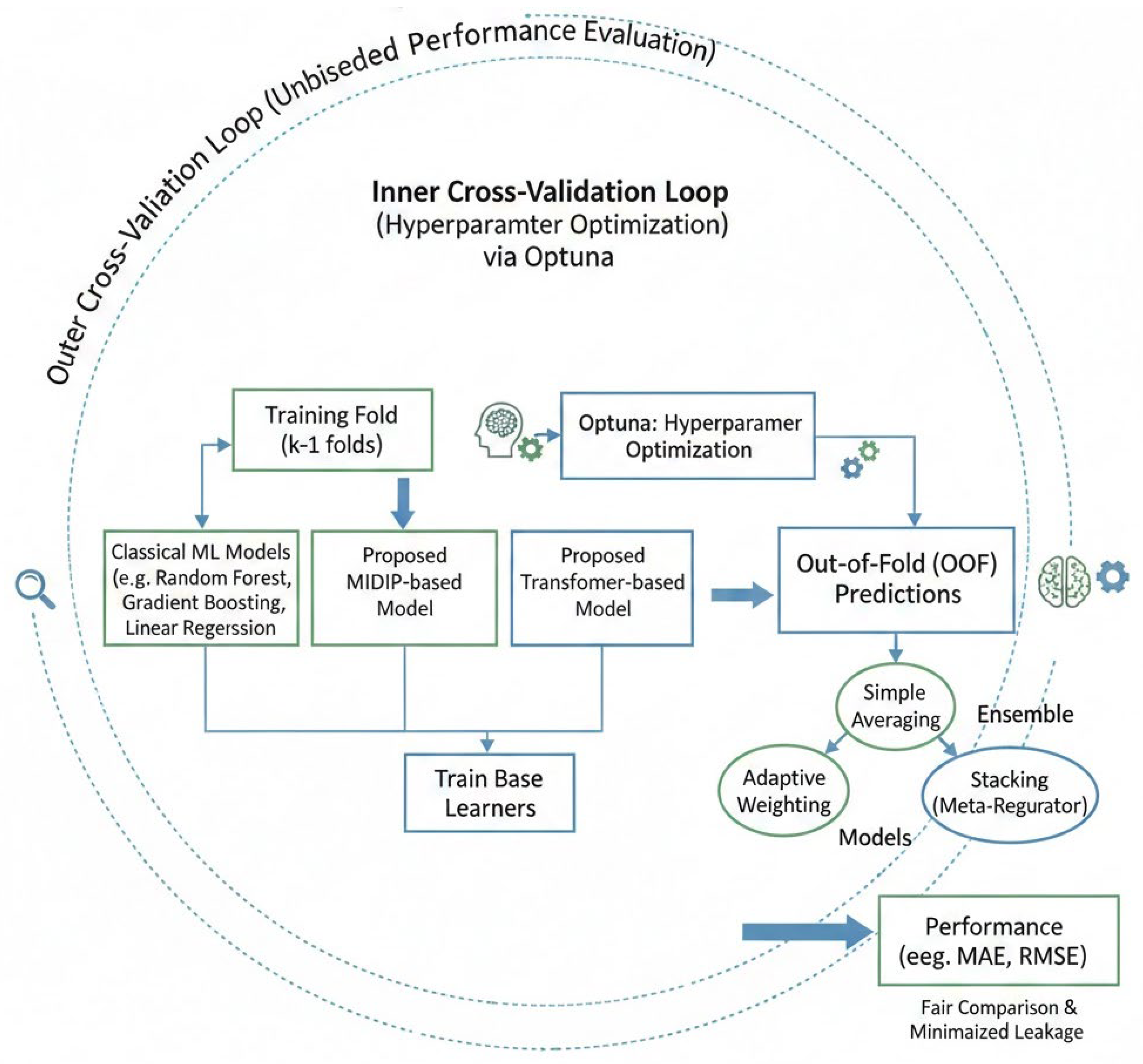
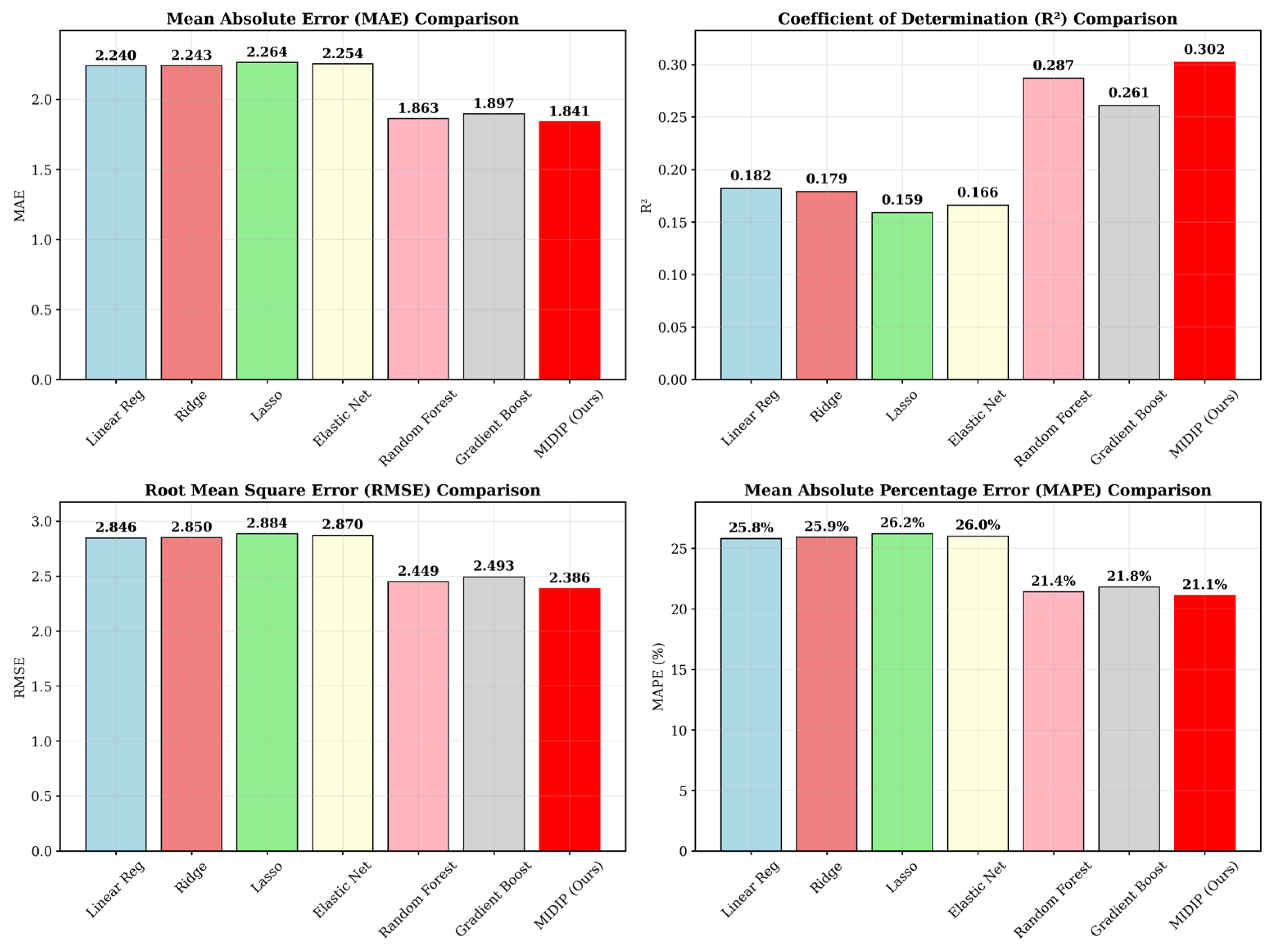
The urinary sodium-to-potassium (Na/K) ratio is a clinically established predictor of blood pressure and cardiovascular risk. This study aimed to develop and rigorously evaluate machine learning models for estimating the urinary Na/K ratio using four easily obtainable physiological variables: body weight, systolic blood pressure, diastolic blood pressure, and pulse rate. A dataset of 82 participants was analyzed under a nested cross-validation framework to ensure strict generalization assessment. We first designed an attention-based deep learning model (MIDIP: Multi-Integrated Deep Ion Prediction). Although MIDIP showed reduced training error, nested validation revealed performance instability, indicating overfitting in this small-sample setting. We then compared classical machine learning models and ensemble strategies. Among all configurations, simple averaging of Random Forest, Gradient Boosting, and Linear Regression (Group A) achieved the best performance (MAE = 1.756, RMSE = 2.349, R2 = 0.390). In contrast, incorporating a Transformer model (Group B) degraded performance (MAE = 1.855, R2 = 0.294). Similarly, adaptive weighting (AWE) did not improve accuracy (Group A: MAE = 1.836, R2 = 0.266; Group B: MAE = 2.133, R2 = 0.035). These results demonstrate that, under limited sample conditions (N = 82), model simplicity and equal-weight ensemble integration provide superior generalization compared to attention-based or adaptively weighted deep architectures. The findings underscore the importance of strict validation and controlled model complexity when developing clinically applicable prediction models from small datasets.
Keywords: urinary Na/K ratio; machine learning; attention-based deep learning; ensemble modeling; small-sample validation urinary Na/K ratio; machine learning; attention-based deep learning; ensemble modeling; small-sample validation