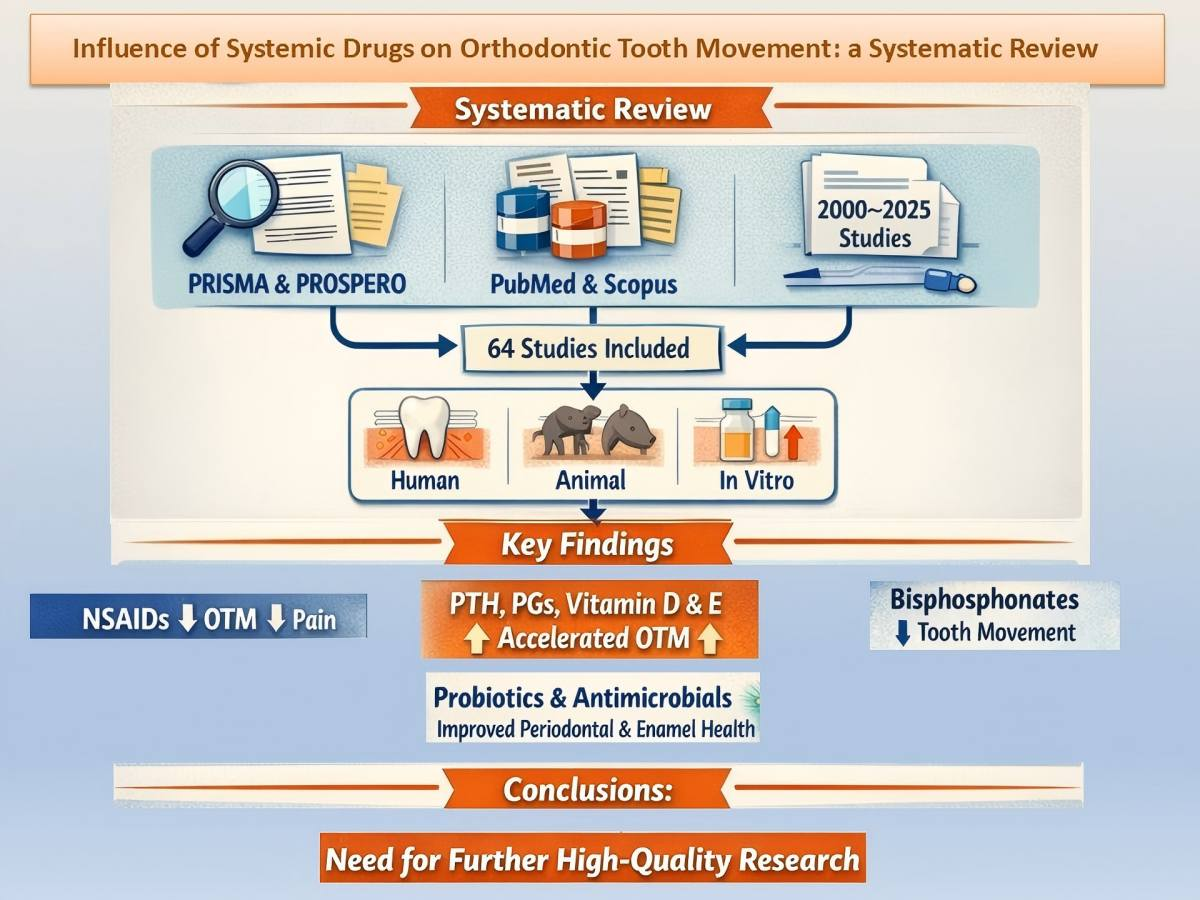

Influence of Pharmacological Agents on Orthodontic Tooth Movement: A Systematic Review

 ,
, 

 ,
,  and
and 
Abstract
1. Introduction
2. Materials and Methods
2.1. Protocol
2.2. Review Objectives and Hypotheses
- -
- Orthodontic tooth movement;
- -
- Bone remodeling and inflammatory markers;
- -
- Periodontal and pulpal responses;
- -
- Pain modulation during orthodontic treatment;
- -
- Enamel demineralization;
- -
- Clinical implications for orthodontic mechanics and treatment planning in growing patients and adults.
- -
- NSAIDs and other anti-inflammatory drugs reduce OTM by suppressing prostaglandin-mediated bone resorption.
- -
- Bone metabolism-modifying agents can impact the rate and pattern of tooth movement.
- -
- Hormonal agents and immunomodulatory drugs alter periodontal tissue responses.
- -
- Topical agents influence enamel stability during fixed appliance therapy.
2.3. PICO
- Population (P): Patients undergoing orthodontic treatment; animal and in vitro models were included to support biological interpretation.
- Intervention (I): Systemic or local pharmacological agents administered during orthodontic treatment.
- Comparison (C): No pharmacological exposure, placebo, or alternative drug when applicable.
- Outcomes (O):
- Primary outcome: Rate or extent of orthodontic tooth movement.
- Secondary outcomes: Pain perception during orthodontic treatment and periodontal or enamel responses directly related to appliance therapy.
2.4. Search Strategy and Study Selection
2.5. Study Selection
2.6. Inclusion and Exclusion Criteria
- -
- Randomized controlled trials [RCTs], controlled clinical trials, observational studies, in vitro studies, and preclinical animal studies;
- -
- Studies evaluating the effects of drugs on tooth movement, bone remodelling, periodontal response, or pain modulation during orthodontic treatment;
- -
- Published between 2000 and 2025;
- -
- Full text available in English.
- -
- Studies not relevant to the review objective;
- -
- Studies on dental topics unrelated to orthodontics;
- -
- Case reports, letters, or abstracts;
- -
- Non-English articles without full text
2.7. Data Extraction and Organization
- -
- Authors and year of publication;
- -
- Study design;
- -
- Population or experimental model;
- -
- Drug studied;
- -
- Orthodontic intervention or biological outcome;
- -
- Main results;
- -
- Clinical relevance of drug effects.
- 1
- NSAIDs and analgesics;
- 2
- Drugs affecting bone metabolism [bisphosphonates, RANK/RANKL modulators, vitamin D, etc.];
- 3
- Hormones and endocrine agents;
- 4
- Antiseptics and antimicrobials;
- 5
- Special systemic or immunomodulatory drugs;
- 6
- Other drugs with potential orthodontic impact.
2.8. Risk of Bias Assessment and GRADE
2.9. Data Analysis
3. Results
3.1. Characteristics of Included Studies

3.2. Human Clinical Evidence on Orthodontic Tooth Movement and Pain
3.2.1. NSAIDs and Analgesics
3.2.2. Drugs Affecting Bone Metabolism
3.2.3. Hormonal and Endocrine Agents
3.2.4. Periodontal and Enamel Outcomes in Orthodontic Patients
3.2.5. Special Systemic Drugs and Immunomodulators
3.3. Risk of Bias and Certainty of Evidence
4. Discussion
5. Conclusions
Supplementary Materials
Author Contributions
Funding
Institutional Review Board Statement
Informed Consent Statement
Data Availability Statement
Conflicts of Interest
Abbreviations
| OTM | Orthodontic Tooth Movement |
| NSAIDs | Non-Steroidal Anti-Inflammatory Drugs |
| PGE2 | Prostaglandin E2 |
| PGE1 | Prostaglandin E1 |
| PTH | Parathyroid Hormone |
| iPTH | Intermittent Parathyroid Hormone |
| RANKL | Receptor Activator of Nuclear Factor Kappa-B Ligand |
| OPG | Osteoprotegerin |
| PDL | Periodontal Ligament |
| GCF | Gingival Crevicular Fluid |
| STAT3 | Signal Transducer and Activator of Transcription 3 |
| AMPK | AMP-Activated Protein Kinase |
| NF-κB | Nuclear Factor Kappa-Light-Chain-Enhancer of Activated B Cells |
| GLP-1 | Glucagon-Like Peptide 1 |
| IL-1β | Interleukin 1 beta |
| IL-6 | Interleukin 6 |
| IL-17 | Interleukin 17 |
| TNF-α | Tumor Necrosis Factor alpha |
| IFN-γ | Interferon gamma |
| VAS | Visual Analog Scale |
| CPP-ACP | Casein Phosphopeptide–Amorphous Calcium Phosphate |
| CPP-ACFP | Casein Phosphopeptide–Amorphous Calcium Fluoride Phosphate |
| RCT | Randomized Controlled Trial |
| PRISMA | Preferred Reporting Items for Systematic Reviews and Meta-Analyses |
| PRISMA-P | Preferred Reporting Items for Systematic Review and Meta-Analysis Protocols |
| ROB | Risk of Bias |
| GRADE | Grading of Recommendations Assessment, Development and Evaluation |
| ADHD | Attention Deficit Hyperactivity Disorder |
References
- Gupta, M.; Kandula, S.; Laxmikanth, S.M.; Vyavahare, S.S.; Reddy, S.B.H.; Ramachandra, C.S. Controlling pain during orthodontic fixed appliance therapy with non-steroidal anti-inflammatory drugs (NSAID): A randomized, double-blinded, placebo-controlled study. J. Orofac. Orthop. 2014, 75, 471–476. [Google Scholar] [CrossRef]
- Shetty, N.; Patil, A.K.; Ganeshkar, S.V.; Hegde, S. Comparison of the effects of ibuprofen and acetaminophen on PGE2 levels in the GCF during orthodontic tooth movement: A human study. Prog. Orthod. 2013, 14, 6. [Google Scholar] [CrossRef]
- Maspero, C.; Galbiati, G.; Giannini, L.; Guenza, G.; Farronato, M. Class II division 1 malocclusions: Comparisons between one- and two-step treatment. Eur. J. Paediatr. Dent. 2018, 4, 295–299. [Google Scholar] [CrossRef]
- Farronato, G.; Rosso, G.; Giannini, L.; Galbiati, G.; Maspero, C. Correlation between skeletal Class II and temporomandibular joint disorders: A literature review. Minerva Stomatol. 2016, 65, 239–247. [Google Scholar]
- Kirschneck, C.; Meier, M.; Bauer, K.; Proff, P.; Fanghänel, J. Meloxicam medication reduces orthodontically induced dental root resorption and tooth movement velocity: A combined in vivo and in vitro study of dental-periodontal cells and tissue. Cell Tissue Res. 2017, 368, 61–78. [Google Scholar] [CrossRef] [PubMed]
- Maspero, C.; Galbiati, G.; Giannini, L.; Farronato, G. Sagittal and vertical effects of transverse sagittal maxillary expander (TSME) in three different malocclusion groups. Prog. Orthod. 2015, 16, 6. [Google Scholar] [CrossRef]
- Farronato, G.; Giannini, L.; Galbiati, G.; Stabilini, S.A.; Maspero, C. Orthodontic-surgical treatment: Neuromuscular evaluation in open and deep skeletal bite patients. Prog. Orthod. 2013, 14, 41. [Google Scholar] [CrossRef]
- Cenzato, N.; Crispino, R.; Galbiati, G.; Giannini, L.; Bolognesi, L.; Lanteri, V.; Maspero, C. Premature loss of primary molars in children: Space recovery through molar distalisation. A literature review. Eur. J. Paediatr. Dent. 2024, 25, 72–76. [Google Scholar] [CrossRef] [PubMed]
- Zhang, C.; Li, T.; Zhou, C.; Huang, L.; Li, Y.; Wang, H.; Duan, P.; Zou, S.; Mei, L. Parathyroid hormone increases alveolar bone homoeostasis during orthodontic tooth movement in rats with periodontitis via crosstalk between STAT3 and β-catenin. Int. J. Oral. Sci. 2020, 12, 38. [Google Scholar] [CrossRef]
- Xu, L.; Sun, X.; Zhu, G.; Mao, J.; Baban, B.; Qin, X. Local delivery of simvastatin maintains tooth anchorage during mechanical tooth moving via anti-inflammation property and AMPK/MAPK/NF-kB inhibition. J. Cell. Mol. Med. 2021, 25, 333–344. [Google Scholar] [CrossRef] [PubMed]
- Peruga, M.; Lis, J. Correlation of sex hormone levels with orthodontic tooth movement in the maxilla: A prospective cohort study. Eur. J. Orthod. 2024, 46, cjae025. [Google Scholar] [CrossRef]
- Daley, T.D.; Wysocki, G.P.; Mamandras, A.H. Orthodontic therapy in the patient treated with cyclosporine. Am. J. Orthod. Dentofac. Orthop. 1991, 100, 537–541. [Google Scholar] [CrossRef]
- Beerens, M.W.; Ten Cate, J.M.; Buijs, M.J.; Van Der Veen, M.H. Long-term remineralizing effect of MI Paste Plus on regression of early caries after orthodontic fixed appliance treatment: A 12-month follow-up randomized controlled trial. Eur. J. Orthod. 2018, 40, 457–464. [Google Scholar]
- Maspero, C.; Gaffuri, F.; Castro, I.O.; Lanteri, V.; Ugolini, A.; Farronato, M. Correlation between Dental Vestibular-Palatal Inclination and Alveolar Bone Remodeling after Orthodontic Treatment: A CBCT Analysis. Materials 2019, 12, 4225. [Google Scholar] [CrossRef]
- Maspero, C.; Fama, A.; Cavagnetto, D.; Abate, A.; Farronato, M. Treatment of dental dilacerations. J. Biol. Regul. Homeost. Agents 2019, 33, 1623–1627. [Google Scholar] [PubMed]
- Maspero, C.; Giannini, L.; Galbiati, G.; Kairyte, L.; Farronato, G. Upper airway obstruction in class II patients. Effects of Andresen activator on the anatomy of pharingeal airway passage. Cone beam evaluation. Stomatologija 2015, 17, 124–130. [Google Scholar] [PubMed]
- Salmassian, R.; Oesterle, L.J.; Shellhart, W.C.; Newman, S.M. Comparison of the efficacy of ibuprofen and acetaminophen in controlling pain after orthodontic tooth movement. Am. J. Orthod. Dentofac. Orthop. 2009, 135, 516–521. [Google Scholar] [CrossRef]
- Minor, V.; Marris, C.K.; McGorray, S.P.; Yezierski, R.; Fillingim, R.; Logan, H.; Wheeler, T.T. Effects of preoperative ibuprofen on pain after separator placement. Am. J. Orthod. Dentofac. Orthop. 2009, 136, 510–517. [Google Scholar] [CrossRef] [PubMed]
- Murdock, S.; Phillips, C.; Khondker, Z.; Hershey, H.G. Treatment of pain after initial archwire placement: A noninferiority randomized clinical trial comparing over-the-counter analgesics and bite-wafer use. Am. J. Orthod. Dentofac. Orthop. 2010, 137, 316–323. [Google Scholar] [CrossRef]
- Hosseinzadeh Nik, T.; Shahsavari, N.; Ghadirian, H.; Ostad, S.N. Acetaminophen versus liquefied ibuprofen for control of pain during separation in orthodontic patients: A randomized triple blinded clinical trial. Acta Med. Iran. 2016, 54, 418–421. [Google Scholar]
- Hu, Y.; Liu, W.; Liu, Z.; Kuang, W.; He, H. Receptor activator of nuclear factor-kappa ligand, OPG, and IGF-I expression during orthodontically induced inflammatory root resorption in the recombinant human growth hormone–treated rats. Angle Orthod. 2015, 85, 562–569. [Google Scholar] [CrossRef]
- Tuncer, Z.; Polat-Ozsoy, O.; Demirbilek, M.; Bostanoglu, E. Effects of various analgesics on the level of prostaglandin E2 during orthodontic tooth movement. Eur. J. Orthod. 2014, 36, 268–274. [Google Scholar] [CrossRef]
- Kluemper, G.T.; Hiser, D.G.; Rayens, M.K.; Jay, M.J. Efficacy of a wax containing benzocaine in the relief of oral mucosal pain caused by orthodontic appliances. Am. J. Orthod. Dentofac. Orthop. 2002, 122, 359–365. [Google Scholar] [CrossRef]
- Ngan, P.; Wilson, S.; Shanfeld, J.; Amini, H. The effect of ibuprofen on the level of discomfort in patients undergoing orthodontic treatment. Am. J. Orthod. Dentofac. Orthop. 1994, 106, 88–95. [Google Scholar] [CrossRef]
- Li, Y.; Chen, X.Y.; Tang, Z.L.; Tan, J.Q.; Wang, D.X.; Dong, Q. Differences in accelerated tooth movement promoted by recombinant human parathyroid hormone after mandibular ramus osteotomy. Am. J. Orthod. Dentofac. Orthop. 2019, 155, 670–680. [Google Scholar] [CrossRef] [PubMed]
- Charavet, C.; Lecloux, G.; Bruwier, A.; Rompen, E.; Maes, N.; Limme, M.; Lambert, F. Localized piezoelectric alveolar decortication for orthodontic treatment in adults: A randomized controlled trial. J. Dent. Res. 2016, 95, 1003–1009. [Google Scholar] [CrossRef] [PubMed]
- Lotwala, R.B.; Greenlee, G.M.; Ott, S.M.; Hall, S.H.; Huang, G.J. Bisphosphonates as a risk factor for adverse orthodontic outcomes: A retrospective cohort study. Am. J. Orthod. Dentofac. Orthop. 2012, 142, 625–634.e3. [Google Scholar] [CrossRef]
- Lee, K.J.; Park, Y.C.; Yu, H.S.; Choi, S.H.; Yoo, Y.J. Effects of continuous and interrupted orthodontic force on interleukin-1β and prostaglandin E2 production in gingival crevicular fluid. Am. J. Orthod. Dentofac. Orthop. 2004, 125, 168–177. [Google Scholar] [CrossRef] [PubMed]
- Shen, W.R.; Kitaura, H.; Qi, J.; Ogawa, S.; Ohori, F.; Noguchi, T.; Marahleh, A.; Nara, Y.; Adya, P.; Mizoguchi, I. Local administration of high-dose diabetes medicine exendin-4 inhibits orthodontic tooth movement in mice. Angle Orthod. 2021, 91, 111–118. [Google Scholar] [CrossRef]
- Li, Y.; Tang, L. Local delivery of osteoprotegerin may be a way of reinforcing orthodontic anchorage. Med. Hypotheses 2009, 72, 178–179. [Google Scholar] [CrossRef]
- Yamasaki, K.; Shibata, Y.; Imai, S.; Tani, Y.; Shibasaki, Y.; Fukuhara, T. Clinical application of prostaglandin E1 (PGE1) upon orthodontic tooth movement. Am. J. Orthod. 1984, 85, 508–518. [Google Scholar] [CrossRef]
- Rajasekaran, U.; Nayak, U.K. Effect of prostaglandin E1 versus corticotomy on orthodontic tooth movement: An in vivo study. Indian. J. Dent. Res. 2014, 25, 717–722. [Google Scholar] [CrossRef]
- Tsvetkova, M.; Kovalenko, A. Orthodontic treatment algorithm of patients with a burdened drug anamnesis: Drugs that reduce bone mineral density. Georgian Med. News 2023, 340–341, 148–152. [Google Scholar]
- Seong, C.; Chen, P.J.; Kalajzic, Z.; Mehta, S.; Sharma, A.; Nanda, R.; Yadav, S.; Dutra, E.H. Vitamin E enriched diet increases the rate of orthodontic tooth movement. Am. J. Orthod. Dentofac. Orthop. 2022, 161, 687–697.e3. [Google Scholar] [CrossRef]
- Esenlik, E.; Nazıroğlu, M.; Açıkalın, C.; Övey, I.S. Vitamin E supplementation modulates gingival crevicular fluid lipid peroxidation and antioxidant levels in patients with orthodontic tooth movement. Cell Biochem. Funct. 2012, 30, 376–381. [Google Scholar] [CrossRef] [PubMed]
- Tashkandi, N.; Zhao, Y.; Mitchell-Lee, G.; Stephens, D.; Patel, M.; Motro, M.; Will, L.A.; Kantarci, A. Longitudinal assessment of salivary vitamin D binding protein during orthodontic tooth movement. BMC Oral. Health 2021, 21, 332. [Google Scholar] [CrossRef]
- Iosub Ciur, M.D.; Zetu, I.N.; Haba, D.; Viennot, S.; Bourgeois, D.; Andrian, S. Evaluation of the influence of local administration of vitamin D on the rate of orthodontic tooth movement. Rev. Med. Chir. Soc. Med. Nat. Iasi 2016, 120, 694–699. [Google Scholar] [PubMed]
- Tsvetkova, M.; Kovalenko, A. Algorithm of orthodontic treatment patients with a burdened drug anamnesis. drugs that can inhibit tooth movement. Georgian Med. News 2022, 330, 43–48. [Google Scholar] [PubMed]
- Yu, W.; Hu, B.; Shi, X.; Cao, Z.; Ren, M.; He, Z.; Lin, J.; Deng, H.; Hu, R. Nicotine inhibits osteogenic differentiation of human periodontal ligament cells under cyclic tensile stress through canonical Wnt pathway and α7 nicotinic acetylcholine receptor. J. Periodontal Res. 2018, 53, 555–564. [Google Scholar] [CrossRef]
- Quast, A.; Martian, V.; Bohnsack, A.; Batschkus, S.; Meyer-Marcotty, P.; Miosge, N. Donor variation and sex hormone receptors in periodontal ligament cells. Arch. Oral. Biol. 2021, 122, 105026. [Google Scholar] [CrossRef]
- Buchhardt, J.; Kiess, W.; Körner, A.; Biemann, R.; Hirsch, C. Child Study Team LCST. The influence of steroid hormones on tooth wear in children and adolescents. J. Clin. Med. 2022, 11, 3603. [Google Scholar] [CrossRef]
- Akhtar, F.; Khan, S.; Tariq, M.; Siddique, Y.H. Comparative assessment of periodontal status and genotoxicity in orthodontic patients on fixed mechanotherapy with and without adjunct chlorhexidine mouthrinse: A randomized control clinical trial. J. Indian. Soc. Periodontol. 2022, 26, 485–491. [Google Scholar] [CrossRef]
- Jenatschke, F.; Elsenberger, E.; Welte, H.D.; Schlagenhauf, U. Influence of repeated chlorhexidine varnish applications on Mutans streptococci counts and caries increment in patients treated with fixed orthodontic appliances. J. Orofac. Orthop. 2001, 62, 36–45. [Google Scholar] [CrossRef]
- Madléna, M.; Vitalyos, G.; Márton, S.; Nagy, G. Effect of chlorhexidine varnish on bacterial levels in plaque and saliva during orthodontic treatment. J. Clin. Dent. 2000, 11, 42–46. [Google Scholar] [PubMed]
- Pretti, H.; Barbosa, G.L.D.R.; Lages, E.M.B.; Gala-García, A.; Magalhães, C.S.D.; Moreira, A.N. Effect of chlorhexidine varnish on gingival growth in orthodontic patients: A randomized prospective split-mouth study. Dent. Press. J. Orthod. 2015, 20, 66–71. [Google Scholar] [CrossRef] [PubMed]
- Paschos, E.; Limbach, M.; Teichmann, M.; Huth, K.C.; Folwaczny, M.; Hickel, R.; Rudzki-Janson, I. Orthodontic attachments and chlorhexidine-containing varnish effects on gingival health. Angle Orthod. 2008, 78, 908–916. [Google Scholar] [CrossRef]
- Anderson, G.B.; Bowden, J.; Morrison, E.C.; Caffesse, R.G. Clinical effects of chlorhexidine mouthwashes on patients undergoing orthodontic treatment. Am. J. Orthod. Dentofac. Orthop. 1997, 111, 606–612. [Google Scholar] [CrossRef]
- Lundström, F.; Krasse, B. Streptococcus mutans and lactobacilli frequency in orthodontic patients: The effect of chlorhexidine treatments. Eur. J. Orthod. 1987, 9, 109–116. [Google Scholar] [CrossRef]
- Momeni, D. Comparison of the antibacterial effects of persica mouthwash with chlorexidine on streptococcus mutans in orthodontic patients. DARU 2006, 14, 178–182. [Google Scholar]
- Jamilian, A.; Ghasemi, M.; Gholami, D.; Kaveh, B. Clinical effects of 2% chlorhexidine gel on patients undergoing orthodontic treatment. Orthod. Waves 2008, 67, 162–166. [Google Scholar] [CrossRef]
- Sehgal, A.; Shetty, S.; Ashith, M.V.; Jose, N.P.; Mangal, U. Efficacy of chlorhexidine varnish in patients undergoing multibracket fixed orthodontic treatment: A controlled clinical study. Biomed. Pharmacol. J. 2018, 11, 945–950. [Google Scholar] [CrossRef]
- Alforaidi, S.; Bresin, A.; Almosa, N.; Lehrkinder, A.; Lingström, P. Effect of drops containing Lactobacillus reuteri (DSM 17938 and ATCC PTA 5289) on plaque acidogenicity and other caries-related variables in orthodontic patients. BMC Microbiol. 2021, 21, 271. [Google Scholar] [CrossRef]
- Alp, S.; Baka, Z.M. Effects of probiotics on salivary Streptococcus mutans and Lactobacillus levels in orthodontic patients. Am. J. Orthod. Dentofac. Orthop. 2018, 154, 517–523. [Google Scholar] [CrossRef]
- Øgaard, B.; Alm, A.A.; Larsson, E.; Adolfsson, U. A prospective, randomized clinical study on the effects of an amine fluoride/stannous fluoride toothpaste/mouthrinse on plaque, gingivitis and initial caries lesion development in orthodontic patients. Eur. J. Orthod. 2006, 28, 8–12. [Google Scholar] [CrossRef]
- Karadeniz, E.I.; Gonzales, C.; Elekdag-Turk, S.; Isci, D.; Sahin-Saglam, A.M.; Alkis, H.; Turk, T.; Darendeliler, M.A. The effect of fluoride on orthodontic tooth movement in humans: A two- and three-dimensional evaluation. Aust. Orthod. J. 2011, 27, 94–101. [Google Scholar] [CrossRef]
- Farhadian, N.; Miresmaeili, A.; Eslami, B.; Mehrabi, S. Effect of fluoride varnish on enamel demineralization around brackets: An in vivo study. Am. J. Orthod. Dentofac. Orthop. 2008, 133, S95–S98. [Google Scholar] [CrossRef] [PubMed]
- Gontijo, L.; Cruz, R.D.A.; Brandão, P.R.G. Dental enamel around fixed orthodontic appliances after fluoride varnish application. Braz. Dent. J. 2007, 18, 49–53. [Google Scholar] [CrossRef]
- Øgaard, B.; Larsson, E.; Henriksson, T.; Birkhed, D.; Bishara, S.E. Effects of combined application of antimicrobial and fluoride varnishes in orthodontic patients. Am. J. Orthod. Dentofac. Orthop. 2001, 120, 28–35. [Google Scholar] [CrossRef] [PubMed]
- Vivaldi-Rodrigues, G.; Demito, C.F.; Bowman, S.J.; Ramos, A.L. The effectiveness of a fluoride varnish in preventing the development of white spot lesions. World J. Orthod. 2006, 7, 138–144. [Google Scholar]
- Alexander, S.A.; Ripa, L.W. Effects of self-applied topical fluoride preparations in orthodontic patients. Angle Orthod. 2000, 70, 424–430. [Google Scholar] [CrossRef]
- Willmot, D.R. White lesions after orthodontic treatment: Does low fluoride make a difference? J. Orthod. 2004, 31, 235–242. [Google Scholar] [CrossRef]
- Beerens, M.W.; Van Der Veen, M.H.; Van Beek, H.; Ten Cate, J.M. Effects of casein phosphopeptide amorphous calcium fluoride phosphate paste on white spot lesions and dental plaque after orthodontic treatment: A 3-month follow-up. Eur. J. Oral. Sci. 2010, 118, 610–617. [Google Scholar] [CrossRef]
- Sköld-Larsson, K.; Fornell, A.; Lussi, A.; Twetman, S. Effect of topical applications of a chlorhexidine/thymol-containing varnish on fissure caries assessed by laser fluorescence. Acta Odontol. Scand. 2004, 62, 339–342. [Google Scholar] [CrossRef]
- Furtado Júnior, J.H.D.C.; Valadas, L.A.R.; Fonseca, S.G.D.C.; Lobo, P.L.D.; Calixto, L.H.M.; Lima, A.G.F.; de Aguiar, M.H.R.; Arruda, I.S.; Lotif, M.A.L.; Neto, E.M.R.; et al. Clinical and microbiological evaluation of Brazilian red propolis containing-dentifrice in orthodontic patients: A randomized clinical trial. Evid.-Based Complement. Altern. Med. 2020, 1, 8532701. [Google Scholar] [CrossRef]
- Boyd, R.L. Effects on gingivitis of daily rinsing with 1.5% H2O2. J. Clin. Periodontol. 1989, 16, 557–562. [Google Scholar] [CrossRef]
- Loo, W.T.Y.; Dou, Y.D.; Chou, W.K.J.; Wang, M. Thymosin alpha 1 provides short-term and long-term benefits in the reimplantation of avulsed teeth: A double-blind randomized control pilot study. Am. J. Emerg. Med. 2008, 26, 574–577. [Google Scholar] [CrossRef] [PubMed]
- Senirkentli, G.B.; Polat, S.; Onder, N.S. Oral health status of children with a history of liver transplantation. Pediatr. Transplant. 2025, 29, e70125. [Google Scholar] [CrossRef]
- Van Venrooy, J.R.; Proffit, W.R. Orthodontic care for medically compromised patients: Possibilities and limitations. J. Am. Dent. Assoc. 1985, 111, 262–266. [Google Scholar] [CrossRef] [PubMed]
- Aghili, H. Effect of methylphenidate on orthodontic tooth movement and histological features of bone tissue in rats: An experimental study. J. Clin. Diagn. Res. 2017, 11, ZF01. [Google Scholar] [CrossRef] [PubMed]
- Kjellberg, H. Craniofacial growth in juvenile chronic arthritis. Acta Odontol. Scand. 1998, 56, 360–365. [Google Scholar] [CrossRef]
- Livingston, S.; Pauli, L.L.; Pruce, I.; Kramer, I.I. Phenobarbital vs. phenytoin for grand mal epilepsy. Am. Fam. Physician 1980, 22, 123–127. [Google Scholar] [PubMed]
- Turpin, D.L. Medications weigh-in on tooth movement. Am. J. Orthod. Dentofac. Orthop. 2009, 135, 139–140. [Google Scholar] [CrossRef] [PubMed]
- Saito, M.; Saito, S.; Ngan, P.W.; Shanfeld, J.; Davidovitch, Z. Interleukin 1 beta and prostaglandin E are involved in the response of periodontal cells to mechanical stress in vivo and in vitro. Am. J. Orthod. Dentofac. Orthop. 1991, 99, 226–240. [Google Scholar] [CrossRef]
- Nakano, Y.; Yamaguchi, M.; Shimizu, M.; Kikuta, J.; Yoshino, T.; Tanimoto, Y.; Kasai, K. Interleukin-17 is involved in orthodontically induced inflammatory root resorption in dental pulp cells. Am. J. Orthod. Dentofac. Orthop. 2015, 148, 302–309. [Google Scholar] [CrossRef] [PubMed]
- Esposito, L.; Poletti, L.; Maspero, C.; Porro, A.; Pietrogrande, M.C.; Pavesi, P.; Dellepiane, R.M.; Farronato, G. Hyper-IgE syndrome: Dental implications. Oral. Surg. Oral. Med. Oral. Pathol. Oral. Radiol. 2012, 114, 147–153. [Google Scholar] [CrossRef]
- Maspero, C.; Galbiati, G.; Perillo, L.; Favero, L.; Giannini, L. Orthopaedic treatment efficiency in skeletal Class III malocclusions in young patients: RME-face mask versus TSME. Eur. J. Paediatr. Dent. 2012, 13, 225–230. [Google Scholar]
- Farronato, G.; Giannini, L.; Galbiati, G.; Maspero, C. A 5-year longitudinal study of survival rate and periodontal parameter changes at sites of dilacerated maxillary central incisors. Prog. Orthod. 2014, 15, 3. [Google Scholar] [CrossRef][Green Version]
- Gaffuri, F.; Cossellu, G.; Maspero, C.; Lanteri, V.; Ugolini, A.; Rasperini, G.; Castro, I.O.; Farronato, M. Correlation between facial growth patterns and cortical bone thickness assessed with cone-beam computed tomography in young adult untreated patients. Saudi Dent. J. 2021, 33, 161–167. [Google Scholar] [CrossRef]
- Farronato, G.; Salvadori, S.; Giannini, L.; Maspero, C. Congenital macroglossia: Surgical and orthodontic management. Prog. Orthod. 2012, 13, 92–98. [Google Scholar] [CrossRef]
- Maspero, C.; Giannini, L.; Galbiati, G.; Prevedello, C.; Farronato, G. Periodontal conditions in juvenile idiopatic arthritis. Minerva Stomatol. 2017, 66, 43–50. [Google Scholar] [CrossRef]
- Maspero, C.; Galbiati, G.; Del Rosso, E.; Farronato, M.; Giannini, L. RME: Effects on the nasal septum. A CBCT evaluation. Eur. J. Paediatr. Dent. 2019, 20, 123–126. [Google Scholar] [CrossRef]
- Nath, S.K.; Goswami, P.; Mahalakshmi, S.; Kaur, I.; Mengi, A.; Bandyopadhyay, B. Comparative evaluation of effect of TENS on controlling pain associated with orthodontic separator placement-a clinical study. J. Pharm. Bioallied Sci. 2024, 16, S577–S579. [Google Scholar] [CrossRef]
- Harazaki, M.; Takahashi, H.; Ito, A.; Isshiki, Y. Soft laser irradiation induced pain reduction in orthodontic treatment. Bull. Tokyo Dent. Coll. 1998, 39, 95–101. [Google Scholar]
- Ackerman, J.L.; Proffit, W.R. Soft tissue limitations in orthodontics: Treatment planning guidelines. Angle Orthod. 1997, 67, 327–336. [Google Scholar] [CrossRef]
- Scheurer, P.A.; Firestone, A.R.; Bürgin, W.B. Perception of pain as a result of orthodontic treatment with fixed appliances. Eur. J. Orthod. 1996, 18, 349–357. [Google Scholar] [CrossRef]
- Negruțiu, B.M.; Costea, C.P.; Pîrvan, A.N.; Gavra, D.I.; Pusta, C.J.; Vaida, L.L.; Moca, A.E.; Iurcov, R.; Staniș, C.E. Pain perception and dietary impact in fixed orthodontic appliances vs. clear aligners: An observational study. J. Clin. Med. 2025, 14, 5060. [Google Scholar] [CrossRef] [PubMed]
- Monk, A.B.; Harrison, J.E.; Worthington, H.V.; Teague, A. Pharmacological interventions for pain relief during orthodontic treatment. Cochrane Database Syst. Rev. 2017, 11, CD003976. [Google Scholar] [CrossRef] [PubMed]
- Sjoukes, A.; Venekamp, R.P.; van de Pol, A.C.; Hay, A.D.; Little, P.; Schilder, A.G.; Damoiseaux, R.A. Paracetamol (acetaminophen) or non-steroidal anti-inflammatory drugs, alone or combined, for pain relief in acute otitis media in children. Cochrane Database Syst. Rev. 2016, 12, CD011534. [Google Scholar] [CrossRef] [PubMed]
- Kaku, M.; Shimoe, S.; Mine, Y.; Taji, T.; Murayama, T.; Nikawa, H. Transient apical breakdown during orthodontic incisor intrusion treated with non-steroidal anti-inflammatory drugs: A case report. Br. Dent. J. 2025, 239, 774–777. [Google Scholar] [CrossRef]
- Wang, S.; Ko, C.C.; Chung, M.K. Nociceptor mechanisms underlying pain and bone remodeling via orthodontic forces: Toward no pain, big gain. Front. Pain Res. 2024, 5, 1365194. [Google Scholar] [CrossRef]
- Ashley, P.F.; Parekh, S.; Moles, D.R.; Anand, P.; MacDonald, L.C. Preoperative analgesics for additional pain relief in children and adolescents having dental treatment. Cochrane Database Syst. Rev. 2016, 8, CD008392. [Google Scholar] [CrossRef]
- Alzubaidi, M.A.; Drummond, B.K.; Wu, J.; Jones, A.; Aggarwal, V.R. Interventions to reduce intra-operative and post-operative pain associated with routine dental procedures in children: A systematic review and meta-analysis. Dent. J. 2024, 12, 163. [Google Scholar] [CrossRef]
- Jagdish, N.; Padmanabhan, S.; Chitharanjan, A.B. Effect of oil pulling on the Streptococcus mutans concentation in plaque around orthodontic brackets—A prospective clinical study. J. Indian. Soc. Pedod. Prev. Dent. 2024, 42, 235–239. [Google Scholar] [CrossRef]
- Giannini, L.; Stella, G.; Cattaneo, G.; Dipalma, G.; Maspero, C. Clinical Applications of Probiotics in Pediatric Dentistry and Orthodontics-A Systematic Review. Nutrients 2025, 17, 3153. [Google Scholar] [CrossRef] [PubMed] [PubMed Central]
- Lanteri, V.; Cavagnetto, D.; Abate, A.; Mainardi, E.; Gaffuri, F.; Ugolini, A.; Maspero, C. Buccal bone changes around first permanent molars and second primary molars after maxillary expansion with a low compliance Ni-Ti leaf spring expander. Int. J. Environ. Res. Public Health 2020, 17, 9104. [Google Scholar] [CrossRef]
- Butera, A.; Pascadopoli, M.; Pellegrini, M.; Trapani, B.; Gallo, S.; Radu, M.; Scribante, A. Biomimetic hydroxyapatite paste for molar-incisor hypomineralization: A randomized clinical trial. Oral. Dis. 2023, 29, 2789–2798. [Google Scholar] [CrossRef] [PubMed]
- Lu, X.; Qu, Y.; Zhu, T.; Qu, X.; Zhang, Z.; Yu, Y.; Hao, Y. Applications of photothermally mediated nanohybrids for white spot lesions in orthodontics. Colloids Surf. B Biointerfaces 2023, 225, 113274. [Google Scholar] [CrossRef]
- Khachatryan, G.; Markaryan, M.; Vardanyan, I.; Manrikyan, M.; Manrikyan, G. Morphological characteristics and prevention of tooth enamel demineralization during orthodontic treatment with non-removable appliances. Int. J. Environ. Res. Public. Health 2022, 20, 540. [Google Scholar] [CrossRef] [PubMed]
- El-Angbawi, A.; McIntyre, G.T.; Fleming, P.S.; Bearn, D.R. Non-surgical adjunctive interventions for accelerating tooth movement in patients undergoing fixed orthodontic treatment. Cochrane Database Syst. Rev. 2015, 11, CD010887. [Google Scholar] [CrossRef]
- El-Angbawi, A.; McIntyre, G.; Fleming, P.S.; Bearn, D. Non-surgical adjunctive interventions for accelerating tooth movement in patients undergoing orthodontic treatment. Cochrane Database Syst. Rev. 2023, 6, CD010887. [Google Scholar] [CrossRef] [PubMed]
- Farronato, G.; Maspero, C.; Farronato, D.; Gioventù, S. Orthodontic treatment in a patient with cleidocranial dysostosis. Angle Orthod. 2009, 79, 178–185. [Google Scholar] [CrossRef] [PubMed]
- Chakravorty, A.; Govindaraju, L. Assessing the impact of green tea extract on postoperative pain control in children undergoing orthodontic extractions: A split-mouth, randomized, controlled, double-blinded trial. Int. J. Clin. Pediatr. Dent. 2025, 18, 825–830. [Google Scholar] [CrossRef] [PubMed]

| Drug Category | Main Agents | Effect on OTM | Evidence Source | Overall Risk of Bias | Interpretation |
|---|---|---|---|---|---|
| NSAIDs/analgesics | Ibuprofen, meloxicam, aspirin | ↓ or ↔ | Human, animal | Moderate–High | May slow OTM by inhibiting prostaglandin-mediated bone resorption |
| Antiresorptive drugs | Bisphosphonates, OPG | ↓ | Human, animal | High | Consistent inhibition of OTM due to reduced osteoclast activity |
| Bone turnover enhancers | PTH analogues, prostaglandins | ↑ | Animal, limited human | High | Acceleration observed mainly in preclinical models |
| Hormonal/endocrine agents | Vitamin D, vitamin E, sex hormones | ↑/variable | Animal, observational | High | Potential modulation of bone remodeling; high interstudy variability |
| Immunomodulatory/special drugs | Methylphenidate, cyclosporine | ↓/variable | Animal, observational | High | Limited and heterogeneous evidence |
| Topical/preventive agents | Chlorhexidine, fluoride, probiotics | ↔ | Human | Moderate | No direct effect on OTM |
| Drug Category | Main Agents | Effect on Pain | Effect on Inflammation | Evidence Source | Overall Risk of Bias | Clinical Relevance |
|---|---|---|---|---|---|---|
| NSAIDs | Ibuprofen, meloxicam | ↓↓ | ↓ | Human, animal | Moderate | Effective pain control; possible impact on OTM |
| Analgesics (non-NSAID) | Acetaminophen | ↓ | ↔ | Human | Moderate | Pain relief without clear effect on OTM |
| Hormonal/antioxidant agents | Vitamin E | ↓ | ↓ oxidative stress | Human, animal | High | Supportive role; limited clinical data |
| Topical agents | Benzocaine wax, ketoprofen gel | ↓ (local) | ↔ | Human | Moderate | Adjunctive mucosal pain relief |
| Immunomodulators | Thymosin α1 | ↓ | ↓ cytokine expression | Human (limited) | Moderate–High | Exploratory evidence only |
| Agent Category | Main Agents | Periodontal Effects | Enamel Effects | Evidence Source | Overall Risk of Bias | Clinical Implication |
|---|---|---|---|---|---|---|
| Antiseptics | Chlorhexidine | ↓ plaque, ↓ gingival inflammation | ↔ | Human | Moderate–High | Effective adjunct; monitor side effects |
| Fluoride-based agents | Fluoride varnish, AmF/SnF2 | ↓ gingivitis | ↓ demineralization | Human | Moderate | Preventive benefit during fixed appliances |
| Probiotics | Lactobacillus spp. | ↓ plaque acidogenicity | ↔ | Human | Moderate | Supportive role in oral hygiene |
| Remineralizing agents | MI Paste Plus, CPP-ACP | ↔ | ↑ remineralization | Human | Low–Moderate | Enamel protection post-treatment |
| Oxidizing agents | H2O2 rinses | ↓ gingival inflammation | ↔ | Human | High | Adjunctive, short-term use |
| GRADE Domain | Judgment | Explanation |
|---|---|---|
| Risk of bias | Very serious ↓↓ | Most studies showed a high risk of bias due to inadequate randomization, lack of allocation concealment, no blinding, and incomplete reporting. |
| Inconsistency | Serious ↓ | Substantial heterogeneity across drug categories, study designs, models, and outcome measures. |
| Indirectness | Very serious ↓↓ | Many studies used animal models limiting applicability to clinical orthodontic movement. |
| Imprecision | Serious ↓ | Small sample sizes, short follow-up periods and high variability reduced precision of effect estimates. |
| Publication bias | Possible ↓ | Inconsistent reporting, lack of preregistered protocols and potential selective publication. |
| Overall certainty | Very low | The true effect of pharmacological agents on orthodontic tooth movement is likely to differ substantially from current estimates. |
| Category | Findings | Examples/Notes |
|---|---|---|
| 1. Effects on Orthodontic Tooth Movement [OTM] | Accelerators | PTH, PGE1, Vitamin D |
| Inhibitors | Bisphosphonates, GLP-1 agonists, Estrogen, NSAIDs [dose-dependent] | |
| Neutral/Modulators | Simvastatin, Probiotics, Antimicrobial agents | |
| 2. Effects on Periodontal and Pulpal Health | Protective | Chlorhexidine varnish, Probiotics, Red propolis, Vitamin E [antioxidant] |
| Risk-enhancing | IL-17 [root resorption], Nicotine [reduced osteogenesis], Glucocorticoids [immunosuppression] | |
| 3. Methodological Heterogeneity | Limitations of available evidence | Variability in dosage, administration route, follow-up, and experimental model [human vs. animal] reduces comparability across studies |
| Clinical Domain | Key Implications | Examples/Notes |
|---|---|---|
| Medication history | Must be routinely assessed as part of orthodontic diagnosis | Essential as noted by van Venrooy & Proffit (1985) [68] |
| Bone-active drugs | Produce the most significant effects on treatment duration and biomechanics | Bisphosphonates, PTH analogs, GLP-1 agonists |
| Inflammation-modulating drugs | Influence risk of root resorption and alter pain patterns | NSAIDs, corticosteroids, cytokine-modulating agents |
| Topical antimicrobials and probiotics | Improve oral/periodontal health but do not affect tooth movement | Chlorhexidine, red propolis, probiotics, MI Paste |
| Systemic immunomodulators | Introduce treatment complications and require individualized protocols | Cyclosporine, glucocorticoids, post-transplant drugs |
| Orthodontic management considerations | Force systems should be adapted; closer follow-ups recommended; adjunctive imaging and physician collaboration may be needed | Especially in long-term pharmacotherapy |
Disclaimer/Publisher’s Note: The statements, opinions and data contained in all publications are solely those of the individual author(s) and contributor(s) and not of MDPI and/or the editor(s). MDPI and/or the editor(s) disclaim responsibility for any injury to people or property resulting from any ideas, methods, instructions or products referred to in the content. |
© 2026 by the authors. Licensee MDPI, Basel, Switzerland. This article is an open access article distributed under the terms and conditions of the Creative Commons Attribution (CC BY) license.
Share and Cite
Giannini, L.; Macrì, F.; Inchingolo, A.M.; Inchingolo, F.; Dipalma, G.; Maspero, C. Influence of Pharmacological Agents on Orthodontic Tooth Movement: A Systematic Review. Bioengineering 2026, 13, 224. https://doi.org/10.3390/bioengineering13020224
Giannini L, Macrì F, Inchingolo AM, Inchingolo F, Dipalma G, Maspero C. Influence of Pharmacological Agents on Orthodontic Tooth Movement: A Systematic Review. Bioengineering. 2026; 13(2):224. https://doi.org/10.3390/bioengineering13020224
Chicago/Turabian StyleGiannini, Lucia, Federica Macrì, Angelo Michele Inchingolo, Francesco Inchingolo, Gianna Dipalma, and Cinzia Maspero. 2026. "Influence of Pharmacological Agents on Orthodontic Tooth Movement: A Systematic Review" Bioengineering 13, no. 2: 224. https://doi.org/10.3390/bioengineering13020224
APA StyleGiannini, L., Macrì, F., Inchingolo, A. M., Inchingolo, F., Dipalma, G., & Maspero, C. (2026). Influence of Pharmacological Agents on Orthodontic Tooth Movement: A Systematic Review. Bioengineering, 13(2), 224. https://doi.org/10.3390/bioengineering13020224