Applications of 3D Printing and Artificial Intelligence in Healthcare Management: A Narrative Review
 and
and
Abstract
1. Introduction
- Summarize recent developments (2018–2025) in AI-enhanced 3D printing relevant to healthcare systems;
- Analyze their implications for management domains such as cost, workflow, and regulation;
- Identify implementation models and challenges in different healthcare settings.
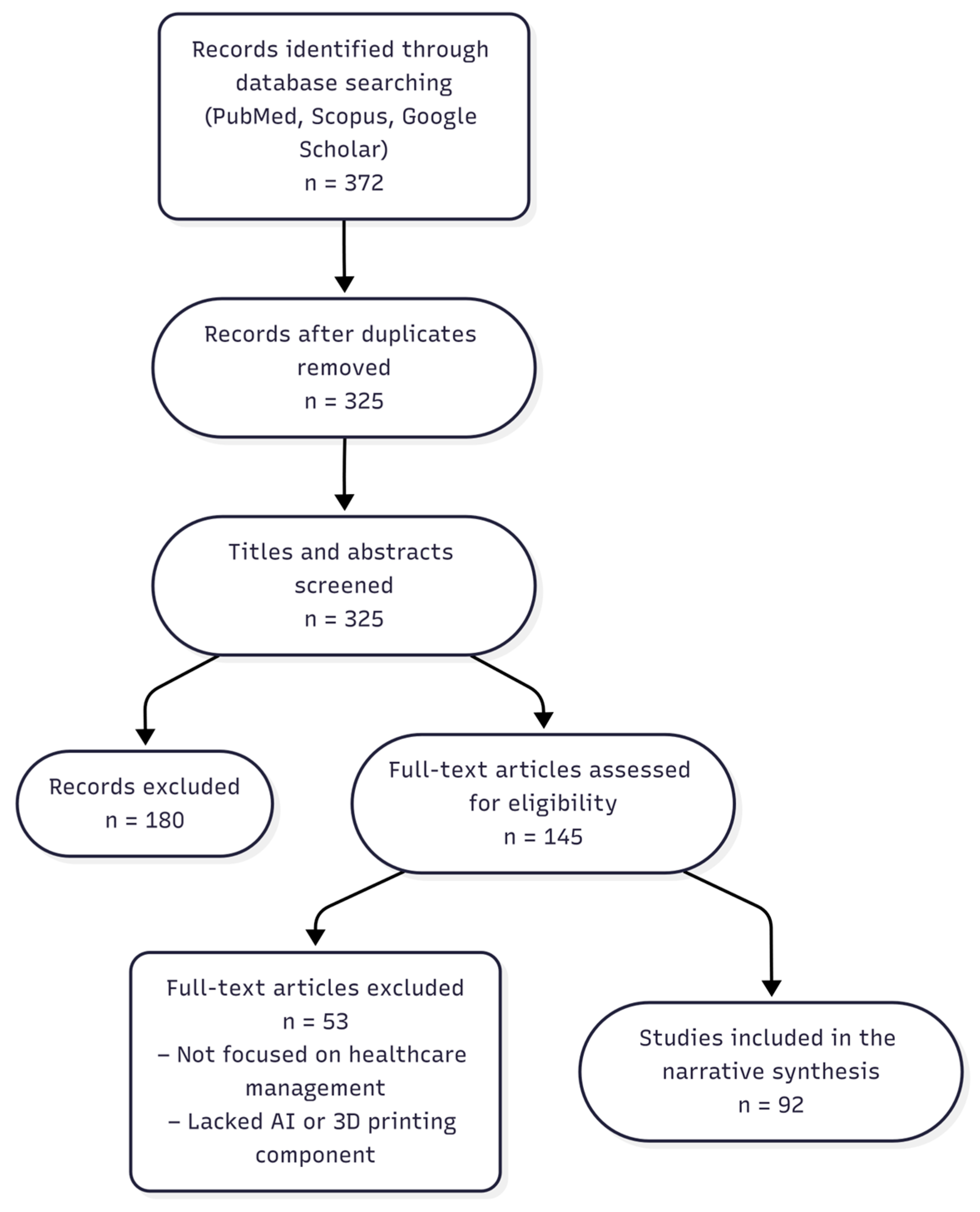
Literature Search Strategy
2. Technological Foundations and Current State
2.1. Fundamental Principles of 3D Printing in Healthcare
2.2. Artificial Intelligence Integration in Healthcare Manufacturing
2.3. Current Applications in Clinical Practice
2.4. AI-Enhanced 3D Printing Applications in Healthcare
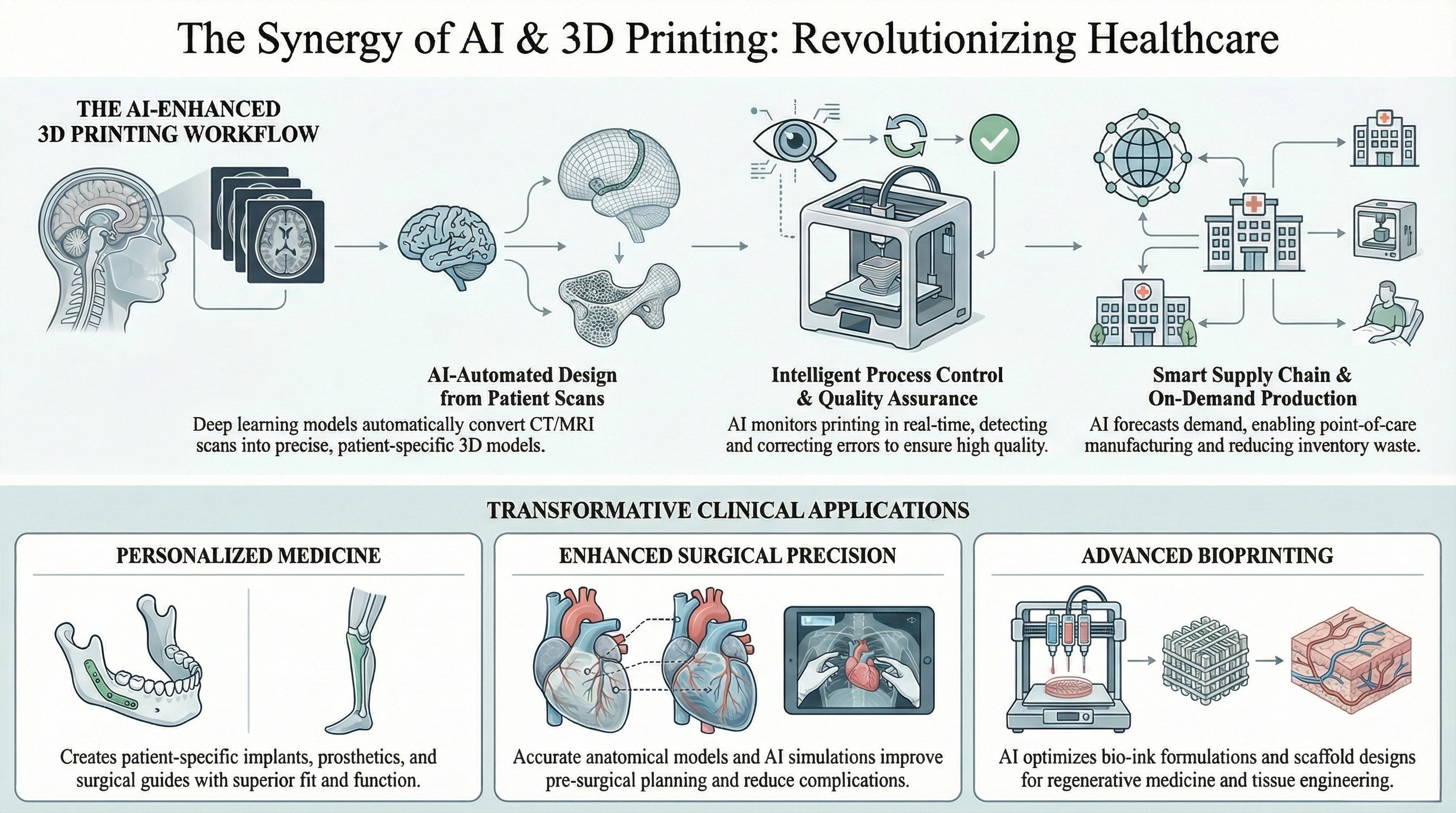
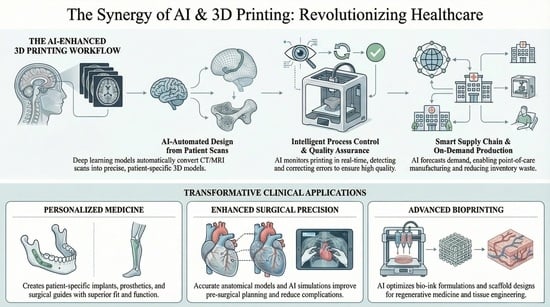
- Design Optimization and Personalization: AI algorithms (including generative design and deep learning models) assist in creating complex, patient-specific designs for implants, prosthetics, and anatomical models. By learning from imaging data or prior designs, AI can suggest optimal geometries or material distributions that improve fit and function. This is critical for personalized medicine, where each product must be tailored to an individual patient’s anatomy or condition resulting in enhanced comfort and better treatment outcomes [27,34].
- Process Control and Quality Assurance: Machine learning and reinforcement learning techniques are used to monitor 3D printing processes in real time and adjust parameters to ensure quality. For example, AI computer vision systems can detect printing defects (like warping or misalignment) and correct them on the fly, reducing errors and waste. Such intelligent control is especially important when producing medical devices, which require high precision and reliability [8].
- Healthcare Supply Chain Management: AI-driven analytics and predictive models help determine when and where to 3D-print medical supplies or devices, improving responsiveness. On-demand printing at or near the point of care, guided by AI demand forecasting, can reduce the need to stockpile inventory and shorten delivery times. This has been useful for quickly producing items like surgical instruments, custom surgical guides, or even personal protective equipment during crises [35].
- Clinical Decision Support and Simulation: In combination with 3D printing, AI can support clinical decisions by simulating outcomes. For instance, patient imaging data can be analyzed by deep learning models to identify the optimal surgical approach, and a 3D-printed model of the patient’s anatomy can then be created for rehearsal. AI can also predict how a 3D-printed implant might behave under physiological conditions, aiding clinicians in selecting or modifying designs for better safety and efficacy [36].
- Automation and Workflow Integration: Natural language processing and other AI tools can help integrate 3D printing into hospital information systems. For example, NLP could scan surgical schedules and physician notes to identify cases that might benefit from a 3D-printed model or device, automatically flagging them for the hospital’s 3D printing lab. Reinforcement learning-based scheduling algorithms might optimize printer utilization when multiple print jobs (for different patients or departments) are queued, prioritizing urgent needs and minimizing idle time [37,38].
3. Healthcare Management Implications
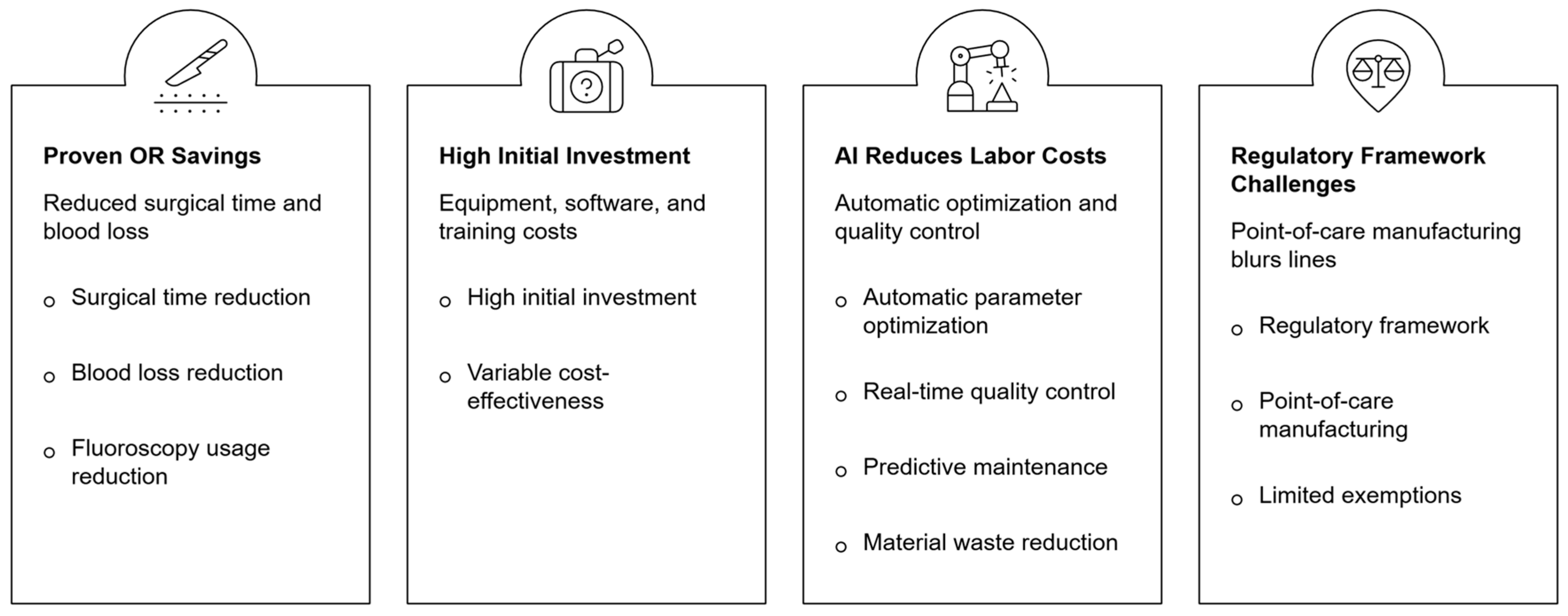
3.1. Economic Considerations and Value Assessment
3.2. Operational Implementation and Workflow Integration
3.3. Governance, Quality Management and Regulatory Considerations
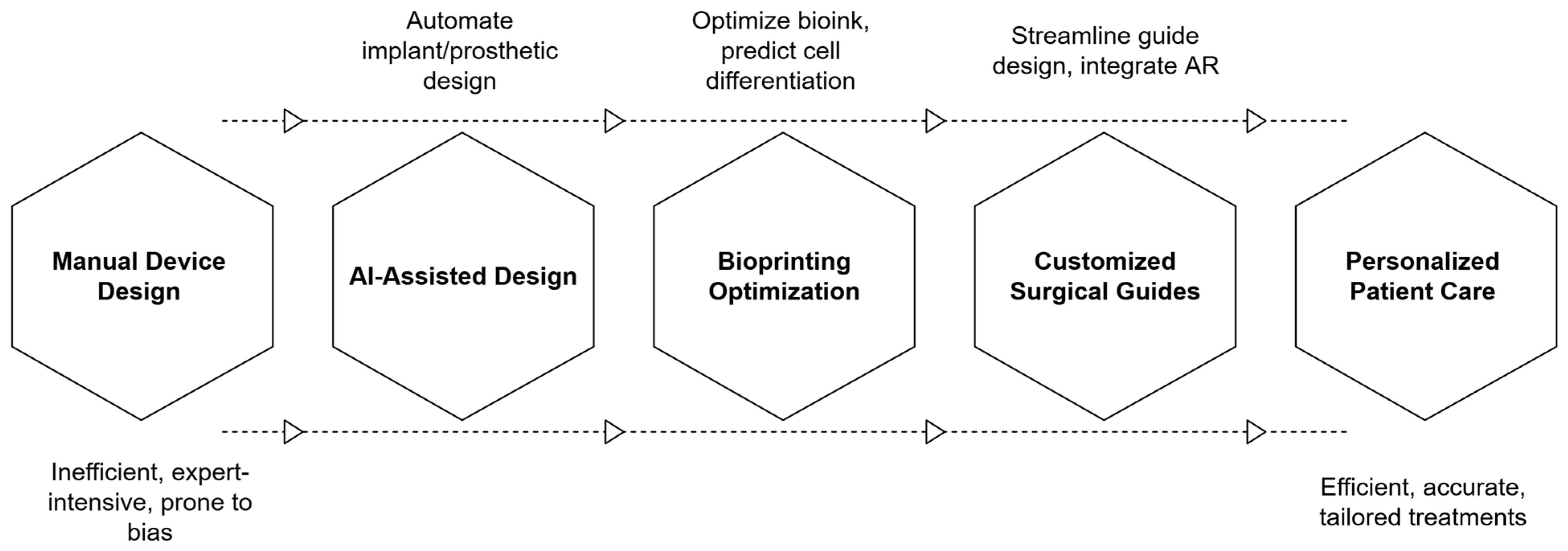
4. Personalized Medicine and Patient-Specific Devices
4.1. AI-Assisted Design of Implants and Prosthetics
4.2. Bioprinting and Regenerative Medicine
4.3. Customized Surgical Guides and Tools
5. Customized Surgical Guides and Tools
5.1. AI-Driven Optimization of 3D Printing Resources
5.2. On-Demand Production and Point-of-Care Manufacturing
5.3. AI-Enabled Inventory Management and Waste Reduction
6. Global Perspectives and Regional Variations
6.1. Adoption Patterns Across Healthcare Systems
6.2. Sustainable Healthcare Management Approaches
6.3. Cross-Cultural Considerations in Technology Implementation
7. Ethical and Legal Frameworks
7.1. Patient Privacy and Data Security
7.2. Informed Consent and Patient Autonomy
7.3. Intellectual Property and Liability Considerations
8. Challenges and Future Directions
8.1. Implementation Barriers and Adoption Strategies
8.2. Emerging Trends and Future Applications
8.3. Research Gaps and Future Directions
8.4. Limitations
9. Conclusions
Author Contributions
Funding
Institutional Review Board Statement
Informed Consent Statement
Data Availability Statement
Conflicts of Interest
Abbreviations
| 3D | Three-Dimensional |
| 4D | Four-Dimensional |
| AI | Artificial Intelligence |
| AM | Additive Manufacturing |
| API | Application Programming Interface |
| AR | Augmented Reality |
| CNN | Convolutional Neural Network |
| CT | Computed Tomography |
| DFU | Diabetic Foot Ulcer |
| DLP | Digital Light Processing |
| EHR | Electronic Health Record |
| FDA | Food and Drug Administration |
| FDM | Fused Deposition Modeling |
| FMEA | Failure Mode and Effects Analysis |
| GDPR | General Data Protection Regulation |
| HIPAA | Health Insurance Portability and Accountability Act |
| IoT | Internet of Things |
| KPI | Key Performance Indicator |
| ML | Machine Learning |
| MRI | Magnetic Resonance Imaging |
| mHealth | Mobile Health |
| NLP | Natural Language Processing |
| PPE | Personal Protective Equipment |
| QbD | Quality by Design |
| QMS | Quality Management System |
| RFID | Radio-Frequency Identification |
| RL | Reinforcement Learning |
| RWE | Real-World Evidence |
| SLA | Stereolithography |
| SLS | Selective Laser Sintering |
| SPC | Statistical Process Control |
| TCO | Total Cost of Ownership |
| U-Net | U-Net Neural Network Architecture |
| VR | Virtual Reality |
References
- Urbaite, G. 3D Printing and Additive Manufacturing: Revolutionizing the Production Process. Luminis Appl. Sci. Eng. 2024, 1, 73–83. [Google Scholar] [CrossRef]
- Schwam, Z.G.; Chang, M.T.; Barnes, M.A.; Paskhover, B. Applications of 3-Dimensional Printing in Facial Plastic Surgery. J. Oral Maxillofac. Surg. 2016, 74, 427–428. [Google Scholar] [CrossRef] [PubMed][Green Version]
- Wixted, C.M.; Peterson, J.R.; Kadakia, R.J.; Adams, S.B. Three-Dimensional Printing in Orthopaedic Surgery: Current Applications and Future Developments. J. Am. Acad. Orthop. Surg. Glob. Res. Rev. 2021, 5, e20.00230-11. [Google Scholar] [CrossRef] [PubMed]
- Martelli, N.; Serrano, C.; van den Brink, H.; Pineau, J.; Prognon, P.; Borget, I.; El Batti, S. Advantages and Disadvantages of 3-Dimensional Printing in Surgery: A Systematic Review. Surgery 2016, 159, 1485–1500. [Google Scholar] [CrossRef] [PubMed]
- Satapathy, S.R.; Sahoo, R.N.; Nandi, S.; Satapathy, B.; Panigrahi, L.; Mallick, S. 3D Printing in Managing Supply Disruptions Related to COVID-19 Pandemic: Food and Drug Administration’s Current Thinking on Regulation. Minerva Biotechnol. Biomol. Res. 2021, 33, 43–50. [Google Scholar] [CrossRef]
- Rojek, I.; Mikołajewski, D.; Dostatni, E.; Kopowski, J. Specificity of 3D Printing and AI-Based Optimization of Medical Devices Using the Example of a Group of Exoskeletons. Appl. Sci. 2023, 13, 1060. [Google Scholar] [CrossRef]
- Rebahi, Y.; Gharra, M.; Rizzi, L.; Zournatzis, I. Combining Computer Vision, Artificial Intelligence and 3D Printing in Wheelchair Design Customization: The Kyklos 4.0 Approach. Artif. Intell. Appl. 2023, XX, 1–5. [Google Scholar]
- Rahman, Z.; Barakh Ali, S.F.; Ozkan, T.; Charoo, N.A.; Reddy, I.K.; Khan, M.A. Additive Manufacturing with 3D Printing: Progress from Bench to Bedside. AAPS J. 2018, 20, 101. [Google Scholar] [CrossRef]
- Banerjee, A.; Haridas, H.; Sengupta, A.; Jabalia, N. Artificial Intelligence in 3D Printing: A Revolution in Health Care; Lecture Notes in Bioengineering; Springer: Berlin/Heidelberg, Germany, 2021. [Google Scholar]
- Sokmen, S.; Cakmak, S.; Oksuz, I. 3D Printing of an Artificial Intelligence-Generated Patient-Specific Coronary Artery Segmentation in a Support Bath. Biomed. Mater. 2024, 19, 035038. [Google Scholar] [CrossRef]
- Ballard, D.H.; Mills, P.; Duszak, R.; Weisman, J.A.; Rybicki, F.J.; Woodard, P.K. Medical 3D Printing Cost-Savings in Orthopedic and Maxillofacial Surgery: Cost Analysis of Operating Room Time Saved with 3D Printed Anatomic Models and Surgical Guides. Acad. Radiol. 2020, 27, 1103–1113. [Google Scholar] [CrossRef]
- Thacharodi, A.; Singh, P.; Meenatchi, R.; Tawfeeq Ahmed, Z.H.; Kumar, R.R.S.; V, N.; Kavish, S.; Maqbool, M.; Hassan, S. Revolutionizing Healthcare and Medicine: The Impact of Modern Technologies for a Healthier Future—A Comprehensive Review. Health Care Sci. 2024, 3, 329–349. [Google Scholar] [CrossRef] [PubMed]
- Carvalho, V.; Gonçalves, I.; Lage, T.; Rodrigues, R.O.; Minas, G.; Teixeira, S.F.C.F.; Moita, A.S.; Hori, T.; Kaji, H.; Lima, R.A. 3D Printing Techniques and Their Applications to Organ-on-a-Chip Platforms: A Systematic Review. Sensors 2021, 21, 3304. [Google Scholar] [CrossRef] [PubMed]
- Anagnostopoulos, S.; Gallos, P.; Zoulias, E.; Fotos, N.; Mantas, J. 3D Digital Printing in Healthcare: Technologies, Applications and Health Issues. In Studies in Health Technology and Informatics; Mantas, J., Gallos, P., Zoulias, E., Hasman, A., Househ, M.S., Diomidous, M., Liaskos, J., Charalampidou, M., Eds.; IOS Press: Amsterdam, The Netherlands, 2022. [Google Scholar]
- Ravi, P.; Chepelev, L.L.; Stichweh, G.V.; Jones, B.S.; Rybicki, F.J. Medical 3D Printing Dimensional Accuracy for Multi-Pathological Anatomical Models 3D Printed Using Material Extrusion. J. Digit. Imaging 2022, 35, 613–622. [Google Scholar] [CrossRef] [PubMed]
- Jeong, Y.G.; Yoo, J.J.; Lee, S.J.; Kim, M.S. 3D Digital Light Process Bioprinting: Cutting-Edge Platforms for Resolution of Organ Fabrication. Mater. Today Bio 2024, 29, 101284. [Google Scholar] [CrossRef]
- Abolhassani, A.; Jones, T.; Bhatt, A.N.; McClain, J.; Ahmed, A.; Davis, J.; Bethel, M. A Decade in Print: The Evolving Academic Benchmark of Cardiology Fellowship Applications. Cureus 2025, 17, e92810. [Google Scholar] [CrossRef]
- Ikhsan, R.Z.; Rahayu, S.; Arribathi, A.H.; Azizah, N. Integrating Artificial Intelligence with 3D Printing Technology in Healthcare: Sustainable Solutions for Clinical Training Optimization. ADI J. Recent Innov. (AJRI) 2024, 6, 99–107. [Google Scholar] [CrossRef]
- Khandare, M.S.N.; Kadu, M.A.; Kaware, M.P.; Kaldate, M.R.; Solav, M.A. Integration into 3D Printing for Image Processing Using AI ML. Int. J. Adv. Res. Sci. Commun. Technol. 2024, 4. [Google Scholar] [CrossRef]
- Agarwal, A.; Kumar, R.; Gupta, M. Review on Deep Learning Based Medical Image Processing. In Proceedings of the 2022 IEEE International Conference on Current Development in Engineering and Technology (CCET), Bhopal, India, 23–24 December 2022; IEEE: New York, NY, USA, 2022; pp. 1–5. [Google Scholar]
- Teng, Z.; Li, L.; Xin, Z.; Xiang, D.; Huang, J.; Zhou, H.; Shi, F.; Zhu, W.; Cai, J.; Peng, T.; et al. A Literature Review of Artificial Intelligence (AI) for Medical Image Segmentation: From AI and Explainable AI to Trustworthy AI. Quant. Imaging Med. Surg. 2024, 14, 9620–9652. [Google Scholar] [CrossRef]
- Sha, A.; R, A.K.E.; Menon, D.S.; T, A. Enhancing Segmentation Efficiency: A 2D U-Net Approach with 3D-to-2D Conversion for Medical Image Analysis. In Proceedings of the 2023 7th International Conference on Electronics, Communication and Aerospace Technology (ICECA), Coimbatore, India, 22–24 November 2023; IEEE: New York, NY, USA, 2023; pp. 206–211. [Google Scholar]
- Paraskevoudis, K.; Karayannis, P.; Koumoulos, E.P. Real-Time 3D Printing Remote Defect Detection (Stringing) with Computer Vision and Artificial Intelligence. Processes 2020, 8, 1464. [Google Scholar] [CrossRef]
- Batra, R.; Mittal, G.; Saha, A. An Organized Review of Machine Learning (ML) Perspectives in Manufacturing and Quality Control Processes. In Proceedings of the 2023 International Conference on Power Energy, Environment & Intelligent Control (PEEIC), Greater Noida, India, 19–23 December 2023; IEEE: New York, NY, USA, 2023; pp. 522–527. [Google Scholar]
- Akmal, J.S.; Salmi, M.; Hemming, B.; Teir, L.; Suomalainen, A.; Kortesniemi, M.; Partanen, J.; Lassila, A. Cumulative Inaccuracies in Implementation of Additive Manufacturing Through Medical Imaging, 3D Thresholding, and 3D Modeling: A Case Study for an End-Use Implant. Appl. Sci. 2020, 10, 2968. [Google Scholar] [CrossRef]
- Moroni, S.; Casettari, L.; Lamprou, D.A. 3D and 4D Printing in the Fight against Breast Cancer. Biosensors 2022, 12, 568. [Google Scholar] [CrossRef]
- Wang, J.; Zhao, Z.; Liang, H.; Zhang, R.; Liu, X.; Zhang, J.; Singh, S.; Guo, W.; Yan, T.; Hoang, B.H.; et al. Artificial Intelligence Assisted Preoperative Planning and 3D-Printing Guiding Frame for Percutaneous Screw Reconstruction in Periacetabular Metastatic Cancer Patients. Front. Bioeng. Biotechnol. 2024, 12, 1404937. [Google Scholar] [CrossRef] [PubMed]
- Gómez, V.J.; Martín-González, A.; Zafra-Vallejo, V.; Zubillaga-Rodríguez, I.; Fernández-García, A.; Sánchez-Aniceto, G. In-House Virtual Surgery Planning and 3D Printing for Head and Neck Surgery with Free Software: Our Workflow. Craniomaxillofacial Trauma Reconstr. 2023, 17, 331–339. [Google Scholar] [CrossRef] [PubMed]
- Suleman, A.; Kondiah, P.P.D.; Mabrouk, M.; Choonara, Y.E. The Application of 3D-Printing and Nanotechnology for the Targeted Treatment of Osteosarcoma. Front. Mater. 2021, 8, 668834. [Google Scholar] [CrossRef]
- Zhang, Q.; Li, Z.; Chen, Z.; Peng, Y.; Jin, Z.; Qin, L. Prediction of Knee Biomechanics with Different Tibial Component Malrotations after Total Knee Arthroplasty: Conventional Machine Learning vs. Deep Learning. Front. Bioeng. Biotechnol. 2023, 11, 1255625. [Google Scholar] [CrossRef]
- Li, X.; Ai, X.; Wang, B.; Luo, M.; Miyamoto, A.; Kuchay, M.S.; Feng, D.; Zhang, C. Application of 3D Printing in the Treatment of Diabetic Foot Ulcers: Current Status and New Insights. Front. Bioeng. Biotechnol. 2024, 12, 1475885. [Google Scholar] [CrossRef]
- Guptha, P.M.; Kanoujia, J.; Kishore, A.; Raina, N.; Wahi, A.; Gupta, P.K.; Gupta, M. A Comprehensive Review of the Application of 3D-Bioprinting in Chronic Wound Management. Expert Opin. Drug Deliv. 2024, 21, 1573–1594. [Google Scholar] [CrossRef]
- Abuhamad, A.Y.; Masri, S.; Fadilah, N.I.M.; Alamassi, M.N.; Maarof, M.; Fauzi, M.B. Application of 3D-Printed Bioinks in Chronic Wound Healing: A Scoping Review. Polymers 2024, 16, 2456. [Google Scholar] [CrossRef]
- Carey, H. How Artificial Intelligence Is Shaping the Development and Design of Medical Implants. J. Med. Implant. 2024, 9, 1000253. Available online: https://www.omicsonline.org/open-access-pdfs/the-impact-of-artificial-intelligence-on-the-development-and-design-of-medical-implants.pdf (accessed on 30 September 2025).
- Dong, C.; Petrovic, M.; Davies, I.J. Applications of 3D printing in medicine: A review. Ann. 3D Print. Med. 2024, 14, 100149. [Google Scholar] [CrossRef]
- Meyer-Szary, J.; Luis, M.S.; Mikulski, S.; Patel, A.; Schulz, F.; Tretiakow, D.; Fercho, J.; Jaguszewska, K.; Frankiewicz, M.; Pawłowska, E.; et al. The Role of 3D Printing in Planning Complex Medical Procedures and Training of Medical Professionals-Cross-Sectional Multispecialty Review. Int. J. Environ. Res. Public Health 2022, 19, 3331. [Google Scholar] [CrossRef] [PubMed]
- Baig, M.A.; Norah, A.; Haifa, A.; Nouf, A.; Baig, S.M. Implementation of 3D Printing in Various Healthcare Settings: A Scoping Review. Stud. Health Technol. Inform. 2023, 305, 410–413. [Google Scholar] [CrossRef] [PubMed]
- Paul, G.M.; Rezaienia, A.; Wen, P.; Condoor, S.; Parkar, N.; King, W.; Korakianitis, T. Medical Applications for 3D Printing: Recent Developments. Mo. Med. 2018, 115, 75–81. [Google Scholar] [PubMed]
- Alzoubi, L.; Aljabali, A.A.A.; Tambuwala, M.M. Empowering Precision Medicine: The Impact of 3D Printing on Personalized Therapeutic. AAPS PharmSciTech 2023, 24, 228. [Google Scholar] [CrossRef]
- Urlings, J.; de Jong, G.; Maal, T.; Henssen, D. Views on Augmented Reality, Virtual Reality, and 3D Printing in Modern Medicine and Education: A Qualitative Exploration of Expert Opinion. J. Digit. Imaging 2023, 36, 1930–1939. [Google Scholar] [CrossRef]
- Choonara, Y.E.; du Toit, L.C.; Kumar, P.; Kondiah, P.P.D.; Pillay, V. 3D-Printing and the Effect on Medical Costs: A New Era? Expert Rev. Pharmacoeconomics Outcomes Res. 2016, 16, 23–32. [Google Scholar] [CrossRef]
- Khanna, N.N.; Maindarkar, M.A.; Viswanathan, V.; Fernandes, J.F.E.; Paul, S.; Bhagawati, M.; Ahluwalia, P.; Ruzsa, Z.; Sharma, A.; Kolluri, R.; et al. Economics of Artificial Intelligence in Healthcare: Diagnosis vs. Treatment. Healthcare 2022, 10, 2493. [Google Scholar] [CrossRef]
- Ventola, C.L. Medical Applications for 3D Printing: Current and Projected Uses. Pharm. Ther. 2014, 39, 704–711. [Google Scholar]
- Ramola, M.; Yadav, V.; Jain, R. On the Adoption of Additive Manufacturing in Healthcare: A Literature Review. J. Manuf. Technol. Manag. 2019, 30, 48–69. [Google Scholar] [CrossRef]
- Shim, K.W. Medical Applications of 3D Printing and Standardization Issues. Brain Tumor Res. Treat. 2023, 11, 159–165. [Google Scholar] [CrossRef]
- Pugliese, R.; Regondi, S. Artificial Intelligence-Empowered 3D and 4D Printing Technologies toward Smarter Biomedical Materials and Approaches. Polymers 2022, 14, 2794. [Google Scholar] [CrossRef] [PubMed]
- Beitler, B.G.; Abraham, P.F.; Glennon, A.R.; Tommasini, S.M.; Lattanza, L.L.; Morris, J.M.; Wiznia, D.H. Interpretation of Regulatory Factors for 3D Printing at Hospitals and Medical Centers, or at the Point of Care. 3D Print Med. 2022, 8, 7. [Google Scholar] [CrossRef] [PubMed]
- Morrison, R.J.; Kashlan, K.N.; Flanangan, C.L.; Wright, J.K.; Green, G.E.; Hollister, S.J.; Weatherwax, K.J. Regulatory Considerations in the Design and Manufacturing of Implantable 3D-Printed Medical Devices. Clin. Transl. Sci. 2015, 8, 594–600. [Google Scholar] [CrossRef] [PubMed]
- Rojek, I.; Dostatni, E.; Kopowski, J.; Macko, M.; Mikołajewski, D. AI-Based Support System for Monitoring the Quality of a Product within Industry 4.0 Paradigm. Sensors 2022, 22, 8107. [Google Scholar] [CrossRef]
- Carl, A.-K.; Hochmann, D. Comparison of the Regulatory Requirements for Custom-Made Medical Devices Using 3D Printing in Europe, the United States, and Australia. Biomed. Technik. Biomed. Eng. 2022, 67, 61–69. [Google Scholar] [CrossRef]
- Di Prima, M.; Coburn, J.; Hwang, D.; Kelly, J.; Khairuzzaman, A.; Ricles, L. Additively Manufactured Medical Products—The FDA Perspective. 3D Print. Med. 2016, 2, 1. [Google Scholar] [CrossRef]
- Wu, S.; Zeng, J.; Li, H.; Han, C.; Wu, W.; Zeng, W.; Tang, L. A Review on the Full Chain Application of 3D Printing Technology in Precision Medicine. Processes 2023, 11, 1736. [Google Scholar] [CrossRef]
- Pettersson, A.B.; Ballardini, R.M.; Mimler, M.; Li, P.; Salmi, M.; Minssen, T.; Gibson, I.; Mäkitie, A. Legal Issues and Underexplored Data Protection in Medical 3D Printing: A Scoping Review. Front. Bioeng. Biotechnol. 2023, 11, 1102780. [Google Scholar] [CrossRef]
- Ripley, B.; Levin, D.; Kelil, T.; Hermsen, J.L.; Kim, S.; Maki, J.H.; Wilson, G.J. 3D Printing from MRI Data: Harnessing Strengths and Minimizing Weaknesses. J. Magn. Reson. Imaging JMRI 2017, 45, 635–645. [Google Scholar] [CrossRef]
- Parthasarathy, J.; Krishnamurthy, R.; Ostendorf, A.; Shinoka, T.; Krishnamurthy, R. 3D Printing with MRI in Pediatric Applications. J. Magn. Reson. Imaging JMRI 2020, 51, 1641–1658. [Google Scholar] [CrossRef]
- Okkalidis, N.; Bliznakova, K.; Kolev, N. A Filament 3D Printing Approach for CT-Compatible Bone Tissues Replication. Phys. Medica 2022, 102, 96–102. [Google Scholar] [CrossRef] [PubMed]
- Chopra, S.; Emran, T.B. Advances in AI-Based Prosthetics Development: Editorial. Int. J. Surg. 2024, 110, 4538–4542. [Google Scholar] [CrossRef] [PubMed]
- David, S.; Bačić, B.; Richter, C.; Mundt, M. Editorial: Artificial Intelligence to Enhance Biomechanical Modelling. Front. Sports Act. Living 2023, 5, 1188035. [Google Scholar] [CrossRef]
- Siddiqui, I.A.; Littlefield, N.; Carlson, L.A.; Gong, M.; Chhabra, A.; Menezes, Z.; Mastorakos, G.M.; Thakar, S.M.; Abedian, M.; Lohse, I.; et al. Fair AI-Powered Orthopedic Image Segmentation: Addressing Bias and Promoting Equitable Healthcare. Sci. Rep. 2024, 14, 16105. [Google Scholar] [CrossRef] [PubMed]
- Chia, H.N.; Wu, B.M. Recent Advances in 3D Printing of Biomaterials. J. Biol. Eng. 2015, 9, 4. [Google Scholar] [CrossRef]
- Abolhassani, S.; Fattahi, R.; Safshekan, F.; Saremi, J.; Hasanzadeh, E. Advances in 4D Bioprinting: The Next Frontier in Regenerative Medicine and Tissue Engineering Applications. Adv. Healthc. Mater. 2025, 14, e2403065. [Google Scholar] [CrossRef]
- Alexiou, M.V.; Tooulias, A.I. Chapter 3-Three-Dimensional Bioprinting in Medical Surgery. In 3D Printing: Applications in Medicine and Surgery Volume; Papadopoulos, V.N., Tsioukas, V., Suri, J.S.B.T., Eds.; Elsevier: Amsterdam, The Netherlands, 2022; pp. 27–75. ISBN 978-0-323-66193-5. [Google Scholar]
- Shi, L.; Wei, W.; Smith, A.; Abbasi, G. Implementation and Evaluation of an EHR-Integrated Perpetual Inventory System in a Large Tertiary Hospital Oncology Pharmacy. Am. J. Health-Syst. Pharm. 2024, 81, 546–554. [Google Scholar] [CrossRef]
- Osouli-Bostanabad, K.; Adibkia, K. Made-on-Demand, Complex and Personalized 3D-Printed Drug Products. BioImpacts BI 2018, 8, 77–79. [Google Scholar] [CrossRef]
- Rezapour Sarabi, M.; Alseed, M.M.; Karagoz, A.A.; Tasoglu, S. Machine Learning-Enabled Prediction of 3D-Printed Microneedle Features. Biosensors 2022, 12, 491. [Google Scholar] [CrossRef]
- Oladapo, B.I.; Bowoto, O.K.; Adebiyi, V.A.; Ikumapayi, O.M. Net Zero on 3D Printing Filament Recycling: A Sustainable Analysis. Sci. Total Environ. 2023, 894, 165046. [Google Scholar] [CrossRef]
- Faruki, A.A.; Zane, R.D.; Wiler, J.L. The Role of Academic Health Systems in Leading the “Third Wave” of Digital Health Innovation. JMIR Med. Educ. 2022, 8, e32679. [Google Scholar] [CrossRef]
- Mohd Noor, M.N.; Leow, M.L.; Lai, W.H.; Hon, Y.K.; Tiong, L.L.; Chern, P.M. Research Landscape on 3D Printing Applications in Healthcare within Southeast Asian Countries: A Systematic Scoping Review Protocol. BMJ Open 2022, 12, e065546. [Google Scholar] [CrossRef] [PubMed]
- Olatunji, G.; Osaghae, O.W.; Aderinto, N. Exploring the Transformative Role of 3D Printing in Advancing Medical Education in Africa: A Review. Ann. Med. Surg. (2012) 2023, 85, 4913–4919. [Google Scholar] [CrossRef]
- Rojek, I.; Mikołajewski, D.; Kempiński, M.; Galas, K.; Piszcz, A. Emerging Applications of Machine Learning in 3D Printing. Appl. Sci. 2025, 15, 1781. [Google Scholar] [CrossRef]
- Jindal, J.A.; Lungren, M.P.; Shah, N.H. Ensuring Useful Adoption of Generative Artificial Intelligence in Healthcare. J. Am. Med. Inform. Assoc. 2024, 31, 1441–1444. [Google Scholar] [CrossRef] [PubMed]
- Zhang, Z.; Zhou, X.; Fang, Y.; Xiong, Z.; Zhang, T. AI-Driven 3D Bioprinting for Regenerative Medicine: From Bench to Bedside. Bioact. Mater. 2025, 45, 201–230. [Google Scholar] [CrossRef]
- Arbelaez Ossa, L.; Milford, S.R.; Rost, M.; Leist, A.K.; Shaw, D.M.; Elger, B.S. AI Through Ethical Lenses: A Discourse Analysis of Guidelines for AI in Healthcare. Sci. Eng. Ethics 2024, 30, 24. [Google Scholar] [CrossRef]
- Kermavnar, T.; Shannon, A.; O’Sullivan, K.J.; McCarthy, C.; Dunne, C.P.; O’Sullivan, L.W. Three-Dimensional Printing of Medical Devices Used Directly to Treat Patients: A Systematic Review. 3D Print. Addit. Manuf. 2021, 8, 366–408. [Google Scholar] [CrossRef]
- Willemsen, K.; Nizak, R.; Noordmans, H.J.; Castelein, R.M.; Weinans, H.; Kruyt, M.C. Challenges in the Design and Regulatory Approval of 3D-Printed Surgical Implants: A Two-Case Series. Lancet. Digit. Health 2019, 1, e163–e171. [Google Scholar] [CrossRef]
- Martínez-Villaseñor, L.; Ponce, H. Ethical Design Framework for Artificial Intelligence Healthcare Technologies BT. In Data-Driven Innovation for Intelligent Technology: Perspectives and Applications in ICT; Ponce, H., Brieva, J., Lozada-Flores, O., Martínez-Villaseñor, L., Moya-Albor, E., Eds.; Springer Nature: Cham, Switzerland, 2024; pp. 223–246. ISBN 978-3-031-54277-0. [Google Scholar]
- Cronin, U.M.; Cummins, N.M.; O’Sullivan, A.; O’Sullivan, L. Perceived Barriers and Opportunities to the Use of 3D Printing in a Healthcare System with Low Adoption: A Semi-Structured Interview Study. HRB Open Res. 2025, 8, 35. [Google Scholar] [CrossRef]
- Shoja, M.M.; Van de Ridder, J.M.M.; Rajput, V. The Emerging Role of Generative Artificial Intelligence in Medical Education, Research, and Practice. Cureus 2023, 15, e40883. [Google Scholar] [CrossRef]
- Yap, Y.L.; Tan, Y.S.E.; Tan, H.K.J.; Peh, Z.K.; Low, X.Y.; Yeong, W.Y.; Tan, C.S.H.; Laude, A. 3D Printed Bio-Models for Medical Applications. Rapid Prototyp. J. 2017, 23, 227–235. [Google Scholar] [CrossRef]
- Shiroorkar, S.; Shiroorkar, P.N.; Aman, M.; Gurlhosur, S.S.; Gangadhar, S. Applications for 3D Printing in Healthcare System: Current Trends, Recent Developments and Future Prospects. Karnataka Med. J. 2025, 47, 59–66. [Google Scholar] [CrossRef]
- Niha, K.; Surendiran, B.; Amutha, S. Biomedical Data Management and Analytics in IOMT BT. In Data Management, Analytics and Innovation; Sharma, N., Goje, A.C., Chakrabarti, A., Bruckstein, A.M., Eds.; Springer Nature: Singapore, 2024; pp. 427–441. [Google Scholar]
- Kanthimathi, T.; Rathika, N.; Fathima, A.J.; S, R.K.; Srinivasan, S.; R, T. Robotic 3D Printing for Customized Industrial Components: IoT and AI-Enabled Innovation. In Proceedings of the 2024 14th International Conference on Cloud Computing, Data Science & Engineering (Confluence), Noida, India, 18–19 January 2024; IEEE: New York, NY, USA, 2024; pp. 509–513. [Google Scholar]
- Kang, H.-W.; Lee, S.J.; Ko, I.K.; Kengla, C.; Yoo, J.J.; Atala, A. A 3D Bioprinting System to Produce Human-Scale Tissue Constructs with Structural Integrity. Nat. Biotechnol. 2016, 34, 312–319. [Google Scholar] [CrossRef]



| AI Technique | 3D Printing Application | Healthcare Management Impact |
|---|---|---|
| Machine learning (supervised/unsupervised) | Patient-specific implants and prosthetics | Improved decision support for device selection; reduced revision rates; better resource utilization |
| Deep learning (CNNs) | Medical image segmentation for surgical models | Faster workflow integration; reduced preoperative planning time; increased operational efficiency |
| Generative design algorithms | Implant and prosthetic design optimization | Cost reduction through material optimization; shorter design cycles; enhanced value-based care |
| Reinforcement learning | Process control and printer parameter optimization | Improved quality assurance; reduced waste and rework; increased operational resilience |
| Computer vision | Real-time print monitoring and defect detection | Enhanced governance and accountability; standardized quality control processes |
| Predictive analytics | Demand forecasting for point-of-care manufacturing | Improved inventory management; reduced stockpiling; supply chain resilience |
| Natural language processing (NLP) | Identification of cases suitable for 3D printing from clinical records | Decision support for managers; improved workflow prioritization; automation of service requests |
| AI-assisted simulation and modeling | Surgical planning and outcome prediction | Risk reduction; improved clinical and managerial decision-making; reduced operating time |
| Machine learning–driven bioink optimization | Bioprinting and regenerative medicine | Long-term capacity planning; R&D efficiency; strategic investment support |
Disclaimer/Publisher’s Note: The statements, opinions and data contained in all publications are solely those of the individual author(s) and contributor(s) and not of MDPI and/or the editor(s). MDPI and/or the editor(s) disclaim responsibility for any injury to people or property resulting from any ideas, methods, instructions or products referred to in the content. |
© 2026 by the authors. Licensee MDPI, Basel, Switzerland. This article is an open access article distributed under the terms and conditions of the Creative Commons Attribution (CC BY) license.
Share and Cite
Domínguez Trujillo, C.; Monopoli Forleo, D.; Dávila Quintana, C.D.; Mora Delgado, J. Applications of 3D Printing and Artificial Intelligence in Healthcare Management: A Narrative Review. Bioengineering 2026, 13, 196. https://doi.org/10.3390/bioengineering13020196
Domínguez Trujillo C, Monopoli Forleo D, Dávila Quintana CD, Mora Delgado J. Applications of 3D Printing and Artificial Intelligence in Healthcare Management: A Narrative Review. Bioengineering. 2026; 13(2):196. https://doi.org/10.3390/bioengineering13020196
Chicago/Turabian StyleDomínguez Trujillo, Conrado, Donato Monopoli Forleo, Carmen Delia Dávila Quintana, and Juan Mora Delgado. 2026. "Applications of 3D Printing and Artificial Intelligence in Healthcare Management: A Narrative Review" Bioengineering 13, no. 2: 196. https://doi.org/10.3390/bioengineering13020196
APA StyleDomínguez Trujillo, C., Monopoli Forleo, D., Dávila Quintana, C. D., & Mora Delgado, J. (2026). Applications of 3D Printing and Artificial Intelligence in Healthcare Management: A Narrative Review. Bioengineering, 13(2), 196. https://doi.org/10.3390/bioengineering13020196