Review

Advances in Achilles Tendon Tissue Engineering: Integrating Cells, Scaffolds, and Mechanical Loading for Functional Regeneration
United Lincolnshire Hospitals NHS Trust, Lincoln LN2 5QY, UK
*
Author to whom correspondence should be addressed.
Bioengineering 2025, 12(12), 1346; https://doi.org/10.3390/bioengineering12121346
Submission received: 19 October 2025 / Revised: 24 November 2025 / Accepted: 3 December 2025 / Published: 10 December 2025

Abstract

Achilles tendon injuries are among the most frequent and debilitating musculoskeletal conditions, often resulting in incomplete healing and functional deficits. Conventional repair techniques primarily restore structural continuity but rarely achieve full biomechanical or histological regeneration. Recent advances in tissue engineering have introduced innovative strategies combining biomimetic scaffolds, cellular therapy, growth factors, and mechanical loading to promote regenerative rather than fibrotic repair. This review summarises the current understanding of Achilles tendon biology and healing mechanisms, with a focus on the integration of stem cell technologies, scaffold design, and mechanobiological conditioning. Various scaffold systems, including natural, synthetic, hybrid, and hydrogel-based constructs, are evaluated for their biocompatibility, mechanical performance, and tenoinductive potential. Preclinical studies demonstrate that mesenchymal stem cell (MSC)-loaded scaffolds exhibit significantly enhanced biomechanical outcomes in tendon defect models, including improved tensile strength, organized collagen I deposition and aligned fibre architecture in repaired constructs. While preclinical results are promising, clinical translation remains limited by regulatory, economic, and methodological challenges. Future research should prioritise standardised protocols, long-term functional outcomes, and interdisciplinary collaboration.

1. Introduction

Tendons are fibrous connective tissues that attach muscles to bones and transmit forces. They store energy, maintain posture, and produce joint movement. These functions require tendons to have high tensile strength and withstand large compressive forces [1,2,3].
The Achilles tendon (AT), also known as the calcaneal tendon, is the largest and strongest tendon in the body. It is formed by the merging of the gastrocnemius and soleus muscle tendons. During running, the AT is subjected to large forces and experiences a strain reaching 12.5 times the body weight. The AT is the most injured tendon, accounting for approximately 40% of all ruptures [4,5].
Tissue engineering is defined as “the application of the principles of biology and engineering and appropriate use of chemicals, cells, and factors to develop substitutes that restore, maintain, or improve tissue function” [6]. The regeneration of a tendon with the same composition as the original uninjured tendon may be critical for proper management of tendon injuries [7].
Tissue engineering approaches have revolutionised AT injury management by promoting the regenerative healing of the native tendon structure and function using biomimetic scaffolds, stem cells, growth factors, and mechanical stimulation [8,9].
Conventional repair methods usually lead to the formation of fibrotic scar tissue with poorer mechanical properties than normal tendon tissue. Conversely, tissue engineering approaches aim to guide a regenerative healing process that restores the aligned collagen structure and biomechanical properties of healthy tendon tissue. This is especially critical for the AT, which has a poor blood supply and an inherently low healing potential [8,9].

2. Macroscopic Structure

Establishing baseline compositional characteristics for normal tendons is essential to set suitable standards for healing and identify effective strategies for successful functional tissue engineering [10].
The AT is the most robust tendon in the human body, with a vital role in human upright walking. It links the triceps surae muscle, which includes the medial and lateral heads of the gastrocnemius muscle and the soleus muscle, to the calcaneus bone tuberosity, forming the back shape of the calf [11].
In 65% of individuals, the plantaris muscle tendon is laterally associated with the AT. The AT facilitates the transfer of forces generated by the triceps surae muscle, which are sufficiently substantial to manage various body weight loads, acting as the primary agent at the ankle joint to mediate plantar flexion. Consequently, the tendon is heavily stressed in sports involving jumping and rapid accelerations and stops, such as football, basketball, and running [11].
The AT is approximately 15 cm long. It has a characteristic spiral internal configuration in which fibres from the medial head of the gastrocnemius rotate laterally across the AT, and fibres from the lateral head rotate medially. Fibres from the soleus muscle remain centrally placed. The AT’s spiral configuration enables it to store energy and elastic recoil during running and jumping. Like most tendons, the AT is relatively hypovascular [12,13].
The blood supply to the AT is primarily from the posterior tibial artery, with a contribution from the fibular (peroneal) artery. These vessels provide perforating branches that course through the paratenon. Three vascular regions have been defined based on these supply branches, with the proximal third and distal insertion areas being primarily supplied by branches of the posterior tibial artery and the mid-portion, 2–6 cm above the calcaneal insertion, being supplied by the fibular artery [14,15]. The mid-portion has been demonstrated to be relatively hypovascular and is more susceptible to degeneration and rupture. Additionally, the torsional arrangement of the subtendons in the mid-portion has been linked to greater compressive loading in the central hypovascular core. It is proposed that these morphological factors are involved in the high prevalence of tendinopathy and the lack of a healing response at this site [11,14,16].

3. Microscopic Structure

The AT is a hypocellular tissue and mainly comprises the extracellular matrix (ECM). Collagen type I accounts for approximately 70% of the dry weight of the AT and is the main contributor to the tensile properties of the tendon [11,17]. The ECM also contains elastic fibres, a small amount of proteoglycans (1% of dry weight), and glycoproteins, including tenomodulin and tenascin-C, which are implicated in the regulation of cellular behaviour and tendon healing [11]. The composition of the ECM differs between the mid-portion of the tendon and the enthesis; the former is fibrous, while the latter is fibrocartilaginous with distinct biomechanical properties. Collagen types I, III, V, and VI, as well as small leucine-rich proteoglycans such as decorin, biglycan, fibromodulin, and lumican, are found in the mid-portion of the tendon and the enthesis but not in equal proportions. Type II collagen and aggrecan are present only in the enthesis, and versican is present only in the mid-portion of the tendon, a distribution thought to be related to their functions in resisting tension and compression, respectively. Consequently, the highly aligned type I collagen fibres are the primary contributors to the tendon’s mechanical properties. Conversely, type III collagen forms a finer fibrillar network to support the former. The proportion of type III collagen is inversely correlated with tensile strength, with an increase in type III collagen leading to a decrease in tensile strength [11,18].
Tenocytes are spindle-shaped fibroblast-like cells scattered through the collagenous matrix of the AT and located in fascicular and interfascicular compartments. They are oriented parallel to collagen fibres and are the principal cell type maintaining the ECM homeostasis. Tenocytes are also mechanosensitive, responding to mechanical stimulation via integrin-mediated signalling, gap junctions, and stretch-activated ion channels, which activate MAPK/ERK, TGF-β, and Wnt/β-catenin pathways that control matrix turnover/remodelling and proliferation [11,19,20].
The ECM contains several essential non-collagenous components, including elastin, decorin, biglycan, lubricin, and water. These components are responsible for the tendon’s viscoelastic properties, including stress relaxation, creep resistance, fibril sliding, and tissue recoil. Elastin, a key ECM component less abundant than collagen, is highly important in energy-storing tendons. Elastin returns rapidly to its original length after deformation and is essential to repetitive activities such as running and jumping. Decorin and aggrecan are proteoglycans that maintain collagen fibril spacing, influence tissue hydration, and control interfibrillar shear stress. These functions provide resistance against mechanical fatigue [11,21,22].
The crimp pattern of collagen fibrils is an ultrastructural feature of tendons, enabling them to function as mechanical shock absorbers. The ability of tendons to straighten when a load is applied enables energy dissipation. The straightening of crimps as a load is applied enables the tendon to transmit force efficiently with limited structural compromise. The wavy morphology of tendon crimps is important for efficient force transmission and a vital part of the tendon’s mechanical response. Changes in crimp morphology (such as reduction in crimp amplitude or wavelength) can result from ageing or pathology. This can result in compromised mechanical performance and increased susceptibility to injury [11,23,24].
From a translational bioengineering perspective, the precise characterisation of the cell–matrix organisation, mechanotransduction pathways, and hierarchical viscoelastic network of the AT is critical for developing targeted regenerative therapies. Engineering approaches should focus on recapitulating these features using biomimetic scaffolds, cell-seeded constructs, and mechanically preconditioned environments. Strategies such as 3D bioprinting, mechanostimulation in bioreactors, and the use of gene-edited tenocytes are potential avenues to improve repair and restore functional performance [25,26,27].

3.1. Tendon Healing: General Mechanisms and Achilles-Specific Considerations

The healing of tendons, such as the AT, is a slow and gradual process. The resulting scar tissue often has inferior mechanical properties to native tendon. In contrast to bone (which heals by regeneration), the tendon cannot completely re-establish its original hierarchical microstructure, including the highly aligned collagen fibrils and highly specialised interfascicular matrix [28,29].
The tendon repair process is typically described in three overlapping, yet distinct, stages: inflammatory, proliferative, and remodelling. The inflammatory phase lasts for a few days after the injury. It is characterised by haematoma formation, the infiltration of neutrophils and macrophages, the release of pro-inflammatory cytokines (IL-1β and TNF-α) and the start of angiogenesis [30,31]. The proliferative phase, lasting the first few weeks, is characterised by the proliferation of fibroblasts and tenocytes, increased cellularity, and the production of a collagenous ECM rich in disorganised type III collagen [31,32]. The remodelling phase can last several months, while cellularity reduces, collagen fibrils realign along the load-bearing axis, type I collagen gradually replaces type III collagen, and crimp patterns reappear [10,33].
Nevertheless, the tendon rarely completely regains its previous hierarchical structure and mechanical properties. In the AT, healing is also affected by poor intrinsic vascularisation and high mechanical demands, resulting in a higher risk of rerupture and chronic tendinopathy [16,34].

3.2. Tissue Regeneration Strategies for the AT

The strategies involve three core principles of tissue engineering: using cells, employing scaffolds to transport these cells, and incorporating bioactive molecules to promote cell differentiation and growth. These approaches can be applied individually or in combination to address AT injuries [35].

3.3. Tendon Stem/Progenitor Cells (TSPCs/TDSCs)

The discovery of tendon stem/progenitor cells (TSPCs) was a pivotal breakthrough in tendon biology. TSPCs, also known as TDSCs, are a small population of cells identified in various tendons (approximately 5% of tendon cells) and characterised by their capacity for self-renewal, clonogenicity, and multipotent differentiation. TSPCs are usually located in specific ECM niches within the tendon microenvironment, where a combination of biochemical and mechanical cues regulates their behaviour and fate [36,37]. TSPCs isolated in vitro can produce tenocytes, chondrocytes, osteoblasts, and adipocytes, supporting their stem-like nature [36,38]. The inherent commitment of TSPCs to the tendon lineage is a desirable trait, as this may enable them to restore tendon tissue more faithfully than stem cells from other sources [37].
Preclinical studies have shown that TSPCs seeded on aligned nanofibre scaffolds enhance the deposition of organised collagen bundles, upregulation of tenogenic markers (such as scleraxis and tenomodulin), and biomechanical properties of repaired tendons [38,39].
However, the scarcity of TSPCs in native tendon tissue precludes large-scale harvest, and age-related decreases in the TSPC number and function may limit the therapeutic potential of TSPCs in older individuals. Therefore, methods to expand TSPCs in vitro or recruit them in situ are an active research area [37,38,40].

3.4. Cells in Tissue Engineering

Cells are crucial in tendon tissue engineering, providing the necessary biological activity for regeneration. Tendon-derived stem cells (TDSCs) have shown potential due to their clonogenicity, multipotency, and ability to produce type I collagen while maintaining tissue-specific differentiation, making them promising for AT repair. Research has shown that tendon tissue engineered from TDSCs can mimic the structure and mechanical characteristics of embryonic tendons. However, clinical application remains limited by the low cell density of tendon tissue and the difficulties in obtaining sufficient donor cells [41,42].

3.5. Tenocytes and Tenoblasts

Tenocytes are fibroblast-like cells that have undergone terminal differentiation and are the predominant cell type in adult tendon tissue. They are responsible for the continual synthesis and remodelling of type I collagen, proteoglycans, and other constituents of the ECM required for normal tendon function. The precursors to tenocytes are called tenoblasts, characterised by high proliferative potential; however, they are sparse in adult tissues [43,44].
The direct application of autologous tenocytes and tenoblasts to repair or regenerate damaged tendons appears to be a logical approach, given their native tenogenic phenotype and ability to synthesise matrix components. However, several problems have limited their use. Tenocytes can only be harvested via biopsy from a healthy tendon, resulting in donor site morbidity and a low yield of cells for research purposes. Additionally, the in vitro expansion of tenocytes has been associated with phenotypic drift, characterised by the loss of tenogenic markers and the ability to differentiate into chondrocytic and osteogenic lineages, with an increased propensity for ectopic ossification [39,45].
Therefore, while tenocytes have been helpful in experimental models, they are not an ideal or scalable source of cells for widespread clinical use [46].

3.6. Mesenchymal Stem/Stromal Cells (MSCs)

MSCs are multipotent, non-haematopoietic cells of mesodermal origin capable of differentiating into bone, cartilage, and adipose lineages. They have been isolated from multiple clinically relevant tissues, including bone marrow, adipose tissue, synovium, periosteum, muscle, umbilical cord, skin/peripheral blood, periodontal ligament, and tendon itself [47,48]. Owing to their accessibility and capacity for expansion, bone marrow-derived MSCs (BMSCs) and adipose-derived MSCs (ADSCs) are the most widely investigated sources for regenerative approaches. Their therapeutic potential is closely linked to their ability to undergo tenogenic differentiation when stimulated by GDF-5 (BMP-14), GDF-7 (BMP-12), TGF-β, or through biomechanical and genetic cues, which up-regulate tendon transcription factors such as scleraxis and tenomodulin and increase extracellular matrix synthesis in vitro and in vivo [48,49]. However, osteo-chondrogenic drift can occur with prolonged in vitro expansion or suboptimal induction, making careful control of culture conditions important [48].
In vivo studies support the regenerative capacity of MSC-based therapies. In a rabbit AT defect model, BMSC-seeded scaffolds generated spindle-shaped tenocytes, parallel collagen alignment, neovascularisation, and mechanical strength approaching 98% of intact tendon at 6 months, significantly outperforming acellular scaffolds [50]. Comparable improvements have been reported using ADSCs, especially when combined with GDF-5, resulting in greater cell density, more organised collagen fibres, and enhanced biomechanical and histological outcomes in rat and rabbit models [51,52].
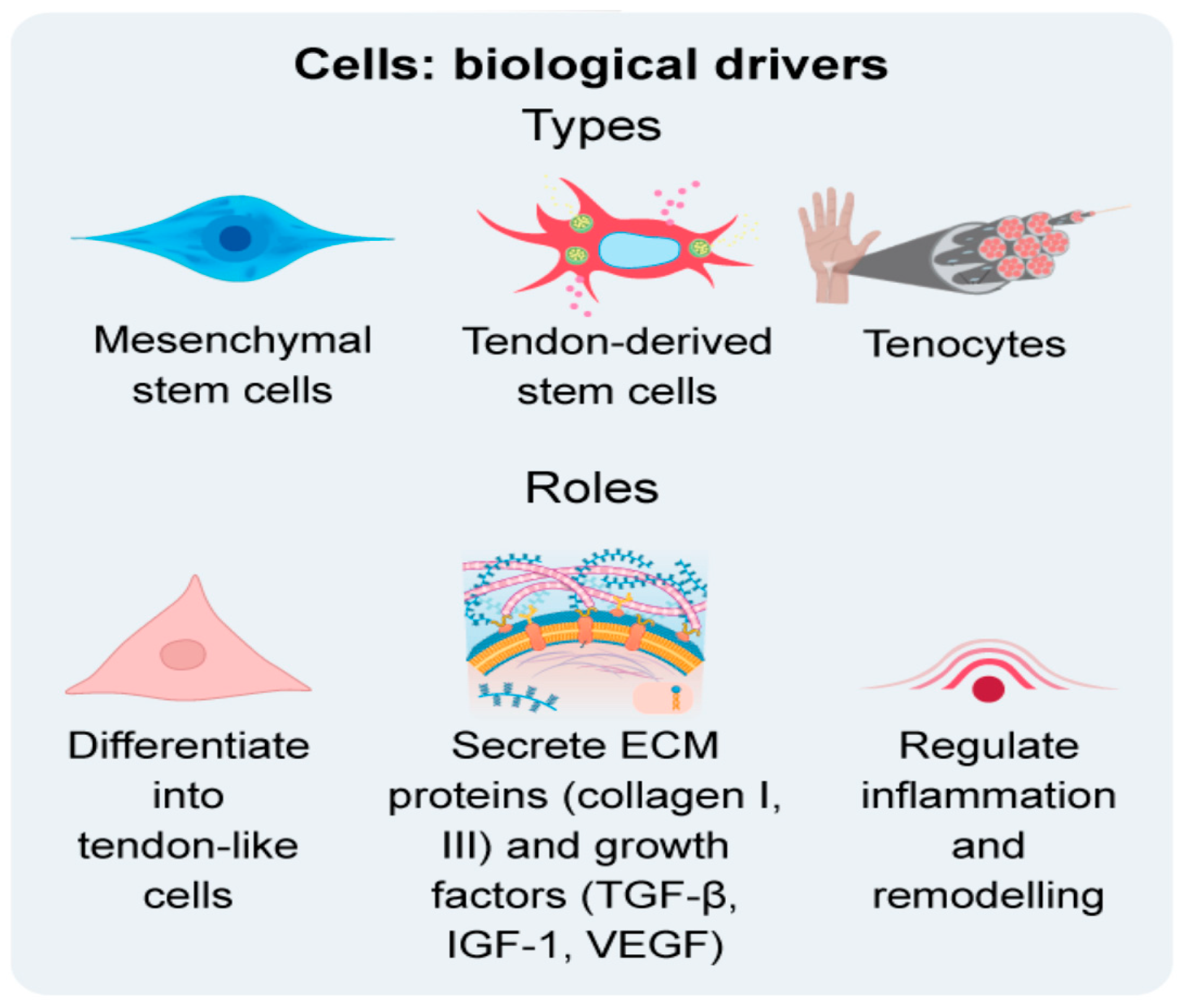
Beyond differentiation, a substantial proportion of MSC activity is mediated through paracrine mechanisms, including cytokines, growth factors, and extracellular vesicles (EVs), which modulate inflammation, promote cell proliferation and migration, and coordinate matrix remodelling [53]. EV-based strategies are emerging as a promising alternative, with BMSC-EVs improving tendon healing and collagen organisation in rat AT injuries in a dose-dependent manner [54], while ADSC-EVs enhance tenocyte proliferation, migration and extracellular matrix deposition [55]. The contribution of MSCs, tenocytes and tendon-derived stem cells to tendon regeneration is illustrated in Figure 1.
Collectively, MSCs remain central to tendon tissue engineering because they can be harvested in clinically relevant quantities, directed toward tendon lineage through biochemical and mechanical stimuli, and supplemented via EV-based approaches offering additional translational potential [48,52,53,54].

3.7. Scaffolds for AT Regeneration

Scaffolds are crucial in tissue engineering for ATs. They provide biomechanical support, a biomimetic ECM for cellular attachment and proliferation, and stimulation and organisation of collagen deposition and host tissue integration [34,48].
Scaffold design must be carefully considered to provide biocompatibility, biodegradability, and sufficient mechanical strength to withstand physiological loading, while promoting cellular infiltration and vascularisation and facilitating scaffold replacement by native tissue. Additional factors are also desirable, such as the incorporation of chemotactic or growth factors to attract endogenous progenitor cells, promote low immunogenicity, and complete integration into the healing tendon [33,46,55].
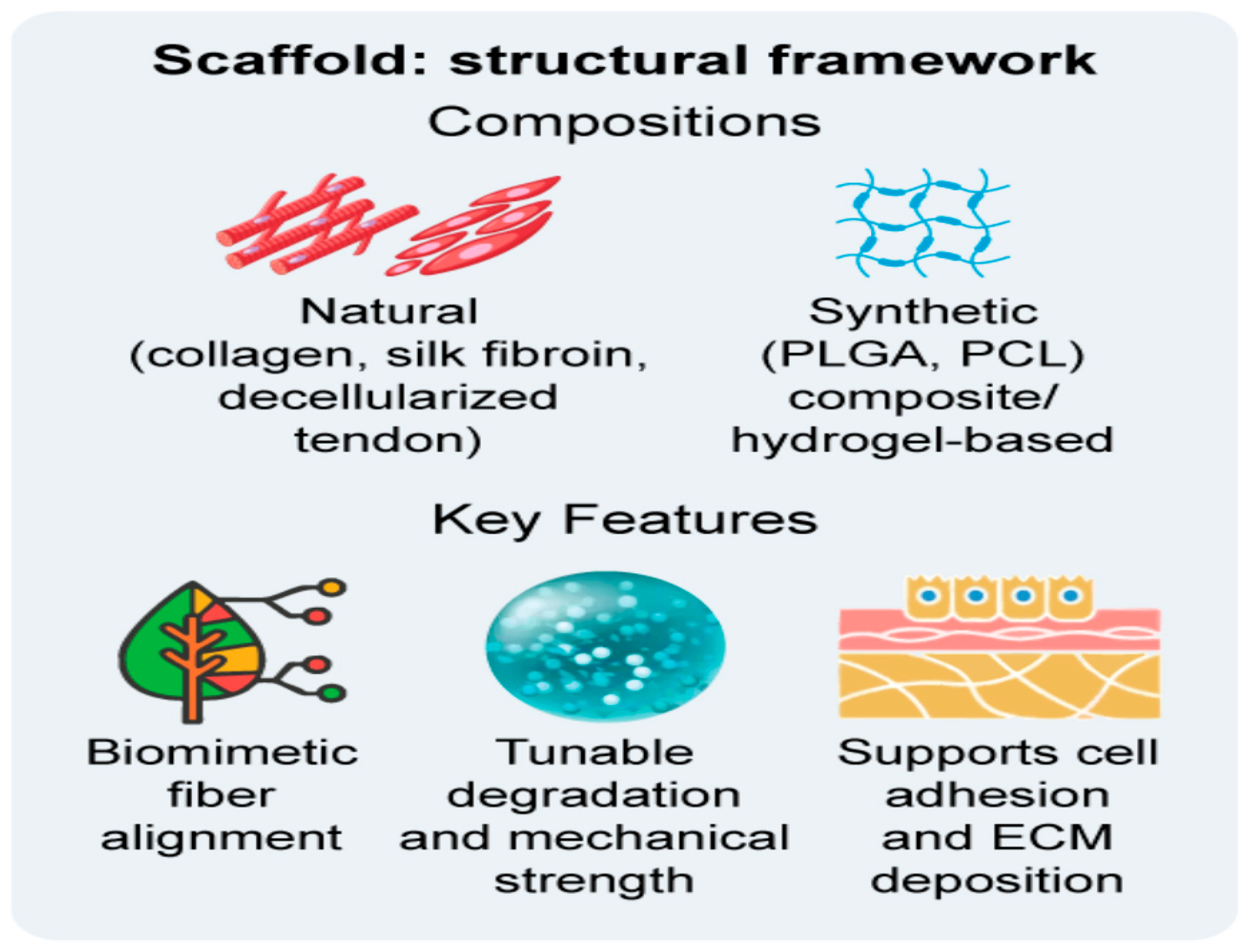
Performance depends on not only the base material but also architecture, including fibre alignment, porosity, anisotropy, and surface chemistry. It can be further improved by mechanical preconditioning in bioreactors to promote collagen maturation and tendon-like function [33,46,56]. The main scaffold compositions and design characteristics are summarised in Figure 2.

3.7.1. Natural Scaffolds

Natural scaffolds such as collagen, silk, small intestinal submucosa (SIS), gelatin, and decellularised tendons maintain the original bioactivity and cell-binding sites of the ECM. This facilitates cell adhesion and tenogenic differentiation [57,58].
Anionic collagen represents a chemically modified natural scaffold with enhanced regenerative properties. Produced through alkaline hydrolysis of native collagen, this modification converts carboxyamide groups of asparagine and glutamine residues into carboxylic groups, resulting in increased negative charge and enhanced piezoelectric properties [59,60].
Comparative studies have demonstrated that anionic collagen matrices exhibit significantly superior regeneration compared to native collagen scaffolds, with bone volume measurements showing an increase for anionic matrices versus native collagen in bone defect models [61]. The enhanced piezoelectric properties are particularly relevant for tendon tissue engineering, as piezoelectricity plays a crucial role in tendon mechanotransduction and repair signalling pathways [62]. Anionic collagen scaffolds have shown excellent biocompatibility, a low inflammatory response, and controlled biodegradation rates [59,63].
While most research has focused on bone regeneration applications, the combination of biocompatibility, enhanced piezoelectric properties, and proven superior regenerative capacity suggests a stronger potential for Achilles tendon tissue engineering.
Decellularised tendon scaffolds maintain the ECM ultrastructure and growth factors present in tendons while enabling fibroblast repopulation, with reduced immunogenicity compared to untreated grafts [64].
SIS-based matrices maintain similar bioactive molecules, including VEGF and TGF-β, recruit marrow-derived progenitors, and develop into collagen-rich, tendon-like tissue in vivo within 3 months [58].
In cadaveric studies, acellular human dermal allografts have also been found to augment stiffness and strength when used in AT repair and have shown promise in a preliminary clinical trial [65].
The use of natural scaffolds is associated with several advantages, such as including strong biological signalling and the presence of native ECM components that can be augmented to improve cell adhesion, proliferation, and tenogenic differentiation. However, natural scaffolds are often associated with batch-to-batch variability, may degrade too rapidly to provide long-term mechanical support, and can be associated with residual immunogenic material if the decellularisation process was inadequate, which can lead to an inflammatory response that impairs healing [57,64].

3.7.2. Synthetic Scaffolds

Synthetic scaffolds have been extensively investigated for applications in AT tissue engineering. These biomaterials can be tailored to possess appropriate mechanical properties, defined compositions, reproducibility, and mass-production potential [66].
Electrospun polymeric scaffolds, and particularly biodegradable polyesters, poly(l-lactic acid) [PLLA], poly(lactic-co-glycolic acid) [PLGA], and polycaprolactone [PCL], can mimic the fibrous architecture of tendon ECM, which is beneficial to cell alignment and tenogenic differentiation [66,67].
Synthetic scaffolds enable precise control over material characteristics such as fibre diameter, pore size, and degradation rate and thus the fine-tuning of scaffold performance to match tendon mechanical requirements. For example, PLLA/PLGA electrospun fibres were shown to provide appropriate tensile properties while supporting MSC adhesion and proliferation [67,68].
Although synthetic scaffolds have many desirable properties for tendon tissue engineering, their use presents limitations. For example, the degradation by-products, particularly the acidic products of polyesters, can elicit an inflammatory response and impair healing [69,70]. Additionally, the lack of biological recognition sites reduces their capacity to promote cell adhesion and integration relative to ECM-derived natural scaffolds [70,71].

3.7.3. Composite and Hybrid Scaffolds

Composite and hybrid scaffolds have been developed to overcome the limitations associated with the use of purely natural or synthetic biomaterials. Composite scaffolds combine the mechanical and structural properties of synthetic polymers with the biological recognition and cellular interaction of natural molecules [67]. Hybrid scaffolds, such as PCL with collagen or silk fibroin, have been shown to improve cell adhesion, proliferation, and ECM production in comparison to PCL-only constructs while retaining the required mechanical integrity for tendon regeneration [72]. Chitosan–PCL composites have also demonstrated improved biocompatibility and tenogenic differentiation capacity, attributed to the bioactive chitosan component. These systems are advantageous in that they enable fine-tuning of the degradation rates and fibre architecture to align with cues present in the native tendon ultrastructure [73].
Recent studies have emphasised the design of more complex scaffold architectures, such as multilayered or gradient scaffolds, which are better suited to replicate the tendon-bone interface in AT repair. This concept enables more accurate representation of the anisotropic mechanical environment in the native tendon, improving insertion site integration [74].
However, challenges associated with composite scaffolds include increased manufacturing complexity, potential batch-to-batch variability when natural polymers are incorporated, and issues with scaling up production processes. Nevertheless, the capacity of hybrid scaffolds to harness the benefits of natural and synthetic materials renders this approach among the most promising strategies for scaffold-based tendon regeneration [48,75].

3.7.4. Hydrogel Scaffolds

Hydrogels can provide hydrated ECM-mimicking environments conducive to the encapsulation and delivery of cells and biofactors and have also emerged as an attractive approach to AT repair [33,48]. Injectable materials, such as gelatin methacrylate (GelMA), PEG, fibrin, and hyaluronic acid derivatives, can be used to fill irregular defects in a minimally invasive manner [34,46]. They have also been used to deliver growth factors (TGF-β, GDF-5/7, PDGF, and IGF-1) and transplanted cells to improve tenogenic differentiation and angiogenesis, as well as matrix deposition [33,48]. Alone, hydrogels have limited tensile strength for AT loading and can result in swelling-induced stress [33,48]. This has resulted in a trend towards the use of hydrogels in combination with fibrous scaffolds, nanofibres, or composite designs to improve mechanical integrity while maintaining biological activity [34,46]. A comparative overview of scaffold categories is presented in Table 1. Additional comparative data on scaffold categories can be found in the Supplementary Materials (Table S2).

3.8. Bioactive Molecules and Biologics in Tendon Repair

Bioactive molecules, including growth factors, cytokines, chemokines, nucleic acids, and hormones, modulate cell growth, differentiation, and ECM synthesis during tendon healing and regeneration [34,46,77]. Recombinant growth factors are desirable because they can be produced with high purity, delivered in defined doses, and incorporated into engineered systems [46,48]. In tendon tissue engineering, growth factors are delivered directly (in solution or by injection), in combination with platelet concentrates, or immobilised/encapsulated within scaffolds to control release kinetics and local bioavailability [46,48,71].
Key molecules implicated in tenogenesis and tendon repair include TGF-β isoforms, PDGF-BB, IGF-1, FGF-2, VEGF, and BMP-12/13/14 (also known as GDF-7, 6, and 5) [46,48,78]. TGF-β signalling promotes tenogenic gene expression and collagen synthesis; however, prolonged activity can lead to fibrosis and adhesions, highlighting the importance of controlled delivery [79,80]. PDGF-BB drives the chemotaxis and proliferation of tendon fibroblasts and MSCs and provides angiogenic support during early healing [78,81]. IGF-1 stimulates tenocyte proliferation and collagen production and has been studied extensively as a tendon-healing adjunct [82,83]. FGF-2 supports cell proliferation, neovascularisation, and ECM remodelling, although its strong angiogenic effects must be tightly regulated to prevent disorganised scar tissue [84]. VEGF is critical to the revascularisation of the hypovascular AT; however, unregulated exposure may impair matrix quality. Thus, gradient or staged-delivery strategies have been developed to limit its action to early healing stages [76,85].
Autologous platelet-rich plasma (PRP) provides a combination of endogenous growth factors (PDGF, TGF-β, VEGF). However, high-quality randomised trials in Achilles tendinopathy and acute rupture have shown limited or no functional benefit, probably due to variability in formulations and protocols [86,87]. Recent consensus highlights the need for standardised PRP characterisation to achieve more reproducible and clinically comparable results [88].
In addition to proteins, small molecules and bioactive peptides are increasingly being used as signalling stimulators because of their stability, lower cost, and scalability. Because tendon repair is inherently mechanobiological, combining scaffold-based bioactive factor delivery with controlled mechanical loading is essential to direct collagen alignment and restore functional biomechanics [34,46,48].

3.9. Load in AT Tissue Engineering

Mechanical loading is a well-documented aspect of tendon biology with important implications for AT tissue engineering strategies. Tendons are known to be mechanosensitive, with tenocytes and TSPCs modulating gene expression, ECM production, and collagen fibrillogenesis and alignment in response to mechanical loading [2,89,90].
The AT experiences large mechanical loads, with peak forces reaching 12.5 times the body weight during running; thus, recapitulating physiological loading is a critical component of tissue-engineered tendon constructs [91]. The primary physiological loading stimulus for the AT is tensile loading, a key regulator of cellular differentiation and matrix organisation. The magnitude of tensile strain can direct transcription factor activation, including the activation of scleraxis, a transcription factor involved in early collagen fibrillogenesis, and mohawk, a transcription factor known to regulate fibril diameter during fibril growth and maturation [92].
In vitro studies have demonstrated that cyclic tensile stimulation enhances type I collagen deposition and fibril alignment along the loading axis compared to static culture, promoting superior mechanical strength [93].
However, a lack of tensile load produces scar-like tissue characterised by randomly oriented collagen fibrils. Thus, the control of mechanostimulation is a key component of regenerative strategies [94].
In an experimental model, the ablation of physiological compression in tendons resulted in reduced proteoglycan content and decreased compressive stiffness, indicating an important role for compressive cues in maintaining the tendon-bone interface [95,96].
Shear forces represent another class of mechanical stimuli relevant to tendon biology. Fascicular sliding in the AT is well-documented, and interfascicular shear enables the redistribution of stress during loading, contributing to the tendon’s resistance to rupture [97].
Ageing tendons, which exhibit decreased fascicular sliding, are associated with increased stiffness and susceptibility to rupture, suggesting a role for shear adaptation in these processes [98].
Lubricin, a proteoglycan known to be upregulated at interfaces experiencing shear, has been shown to promote fascicular gliding and is a demonstrated modulator of tendon mechanobiology [99].
Constructs enabling directed shear adaptation, by scaffold architecture or bioreactor conditioning, may improve the long-term durability of engineered AT [90,100].
The mechanotransduction pathways in response to loading identified at the molecular level include integrin signalling, stretch-activated ion channels, and their downstream pathways (MAPK/ERK and Wnt/β-catenin), which control proliferation, differentiation, and ECM remodelling [89,101].
The effects of mechanical loading can be positive and negative. Specifically, underloading or overloading is not beneficial and results in degenerative changes. An insufficient amount of mechanical stimulation leads to underdeveloped tissue. However, overloading increases catabolic activity, for instance, the increased production of MMPs and the pathological accumulation of collagen III. Therefore, a specific loading regimen is required for AT tissue engineering to encourage regenerative effects [102].
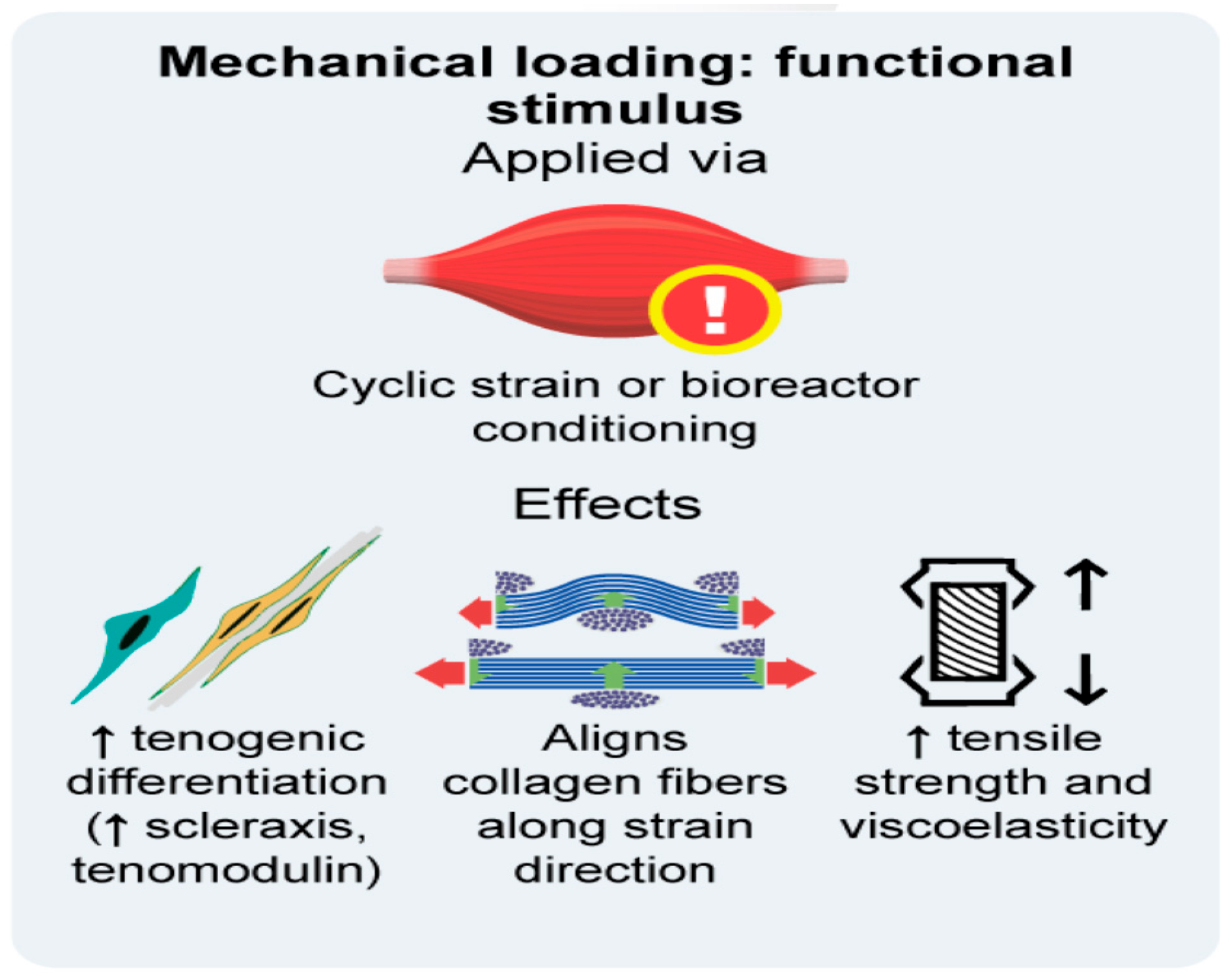
Consequently, mechanical loading through tension, compression, and shear stress is not only crucial for biomechanical reasons; it also contributes to the phenotype of the tendon construct. Applying physiological and stage-specific loading conditions in the bioreactor or scaffold is therefore essential to engineer a tendon with a hierarchical organisation, zonal distribution, and the native mechanical properties of the AT [17,90,103]. The effects of bioreactor conditioning and mechanical stimulation are shown in Figure 3.

3.10. Advanced Fabrication Techniques

Although the choice of scaffold materials is important, the method used to fabricate these biomaterials into functional constructs is equally critical to the final scaffold’s architecture, mechanical properties, and biological performance [48].
One of the most significant innovations in tendon tissue engineering is the ability to customise the architecture and distribution of cell layers with controlled fibre alignment using 3D bioprinting technology. Bioprinting of tendon tissues is normally performed using extrusion-based techniques [27,104].
Extrusion-based bioprinting, the most widely adopted technique for tendon applications, uses shear-thinning bioinks comprising cell-embedded collagen, GelMA, and decellularised tendon ECM to construct and place design fibres that mimic the anisotropic structural alignment of the native tendon [105].
Studies have shown that bioprinted scaffolds seeded with MSCs or TSPCs exhibit better collagen deposition, mechanical properties, and tenogenic marker (scleraxis and tenomodulin) activation than scaffolds produced using traditional fabrication methods [106].
Three-dimensional bioprinting can design constructs based solely on medical imaging data, enabling easy personalisation of the AT and making this technology extremely useful and versatile [48,104].

3.11. Clinical Applications and Outcomes

Although promising results have been achieved in animal models and considerable advances have been made in preclinical research, the clinical translation of tissue engineering approaches for AT repair remains at an early developmental stage [107].
The translation of cell-based and scaffold-based therapies is further complicated by stringent regulatory requirements, as these products are classified as advanced therapy medicinal products (ATMPs) by agencies such as the FDA, EMA, and MHRA, requiring rigorous safety and efficacy data [108,109].
Among other approaches, mesenchymal (stem) cell therapy has garnered the most attention in the treatment of Achilles tendinopathy, as MSCs can modulate inflammation and matrix remodelling and differentiate into tenogenic progeny [110].
A Phase IIa clinical trial by Goldberg et al. (2024) demonstrated that, after autologous bone marrow-derived MSCs were injected into the ATs of 10 patients with chronic mid-portion tendinopathy, no serious side effects were reported. Considerable improvements in VISA-A scores at 6 and 12 months were observed in pain and other aspects of function, indicating that the treatment is safe [111].
However, a systematic review by van den Boom et al. (2020) concluded that, while Level 3 evidence supports the efficacy of stem cell therapy for tendon disorders, the findings are at considerable risk of bias due to small sample sizes, a lack of control groups, and heterogeneity in cell preparation and delivery methods [112]. Significant challenges include a lack of standardised MSC isolation and culture protocols, variable cell doses, inconsistent injection techniques, and the absence of large-scale randomised controlled trials [113].
Several acellular scaffold products have received regulatory clearance for soft tissue augmentation in tendon repair, including GraftJacket (acellular human dermal matrix), TissueMend (fetal bovine dermis), and REGENETEN (bioinductive bovine collagen scaffold) [114].
Cadaveric biomechanical studies, such as that by Barber et al. (2008), have demonstrated that the augmentation of AT repairs with GraftJacket significantly increases repair strength and stiffness compared to repair alone [65].
Recent case series by Ling et al. (2024) and Genuth et al. (2025) reported that bioinductive collagen scaffold augmentation for AT ruptures and insertional tendinitis appears safe and feasible, with good functional outcomes and no increase in complication rates [115,116].
However, the absence of randomised controlled trials focusing on scaffold-augmented repair in comparison to traditional repair methods precludes truly conclusive, clinically impactful findings, warranting more targeted research [48].
The direct application of certain recombinant growth factors, such as PDGF-BB, IGF-1, and the BMPs, has been considered to enhance tendon healing by stimulating the proliferation of tendon cells, as well as the matrix and collagen structures associated with tendons [76].
Although growth factor injections have shown promising results in preclinical studies, clinical translation has been limited by challenges such as the short half-life of recombinant proteins, difficulty in achieving sustained local delivery, and a lack of large-scale clinical trials specifically in the context of AT repair [76].
Future strategies may include controlled-release delivery systems, such as growth factor-loaded scaffolds, which could maintain therapeutic concentrations over extended periods and potentially enhance clinical efficacy [76,117]. Key preclinical and clinical studies are summarized in Table 2. Further detailed study characteristics are available in the Supplementary Materials (Table S1).

3.12. Current Limitations and Challenges

A major obstacle to broader clinical adoption remains the striking lack of consistency across published studies. Patient selection criteria, treatment protocols, and follow-up periods vary considerably between studies, making cross-study comparisons and robust meta-analyses exceptionally challenging [118,119]. This problem is compounded by the absence of standardised outcome measures; some studies rely on patient-reported measures, such as VISA-A or AOFAS scores, while others emphasise imaging modalities such as ultrasound or MRI, and still others focus on biomechanical testing. Such heterogeneity hinders efforts to synthesise evidence and develop clear clinical guidelines [120].
Another limitation concerns the temporal scope of available data. Most clinical trials report outcomes over relatively short to medium time frames, typically between 6 and 24 months, with surprisingly minimal information on long-term durability or rerupture rates. Without extended follow-up data, it is challenging to assess whether early improvements are sustained or whether complications emerge over time [112,113].
Finally, economic and regulatory factors cannot be overlooked. Cell-based and scaffold-augmented therapies tend to be expensive, and insurance coverage remains limited. Navigating the regulatory landscape for ATMPs adds further complexity. These barriers restrict widespread clinical adoption and limit patient access to potentially beneficial treatments [121,122].
Standardization of cell isolation, expansion, and delivery protocols is crucial to reduce variability across studies and achieve reproducible clinical outcomes. The establishment of multicenter registries and adherence to international reporting standards, such as the ICON Tendinopathy Consensus, may facilitate harmonization and meta-analytic comparisons [120].
Therefore, although tissue engineering strategies for AT repair have demonstrated safety and feasibility in early-phase clinical studies, definitive evidence of clinical superiority over conventional surgical or conservative treatments remains elusive [48,71].
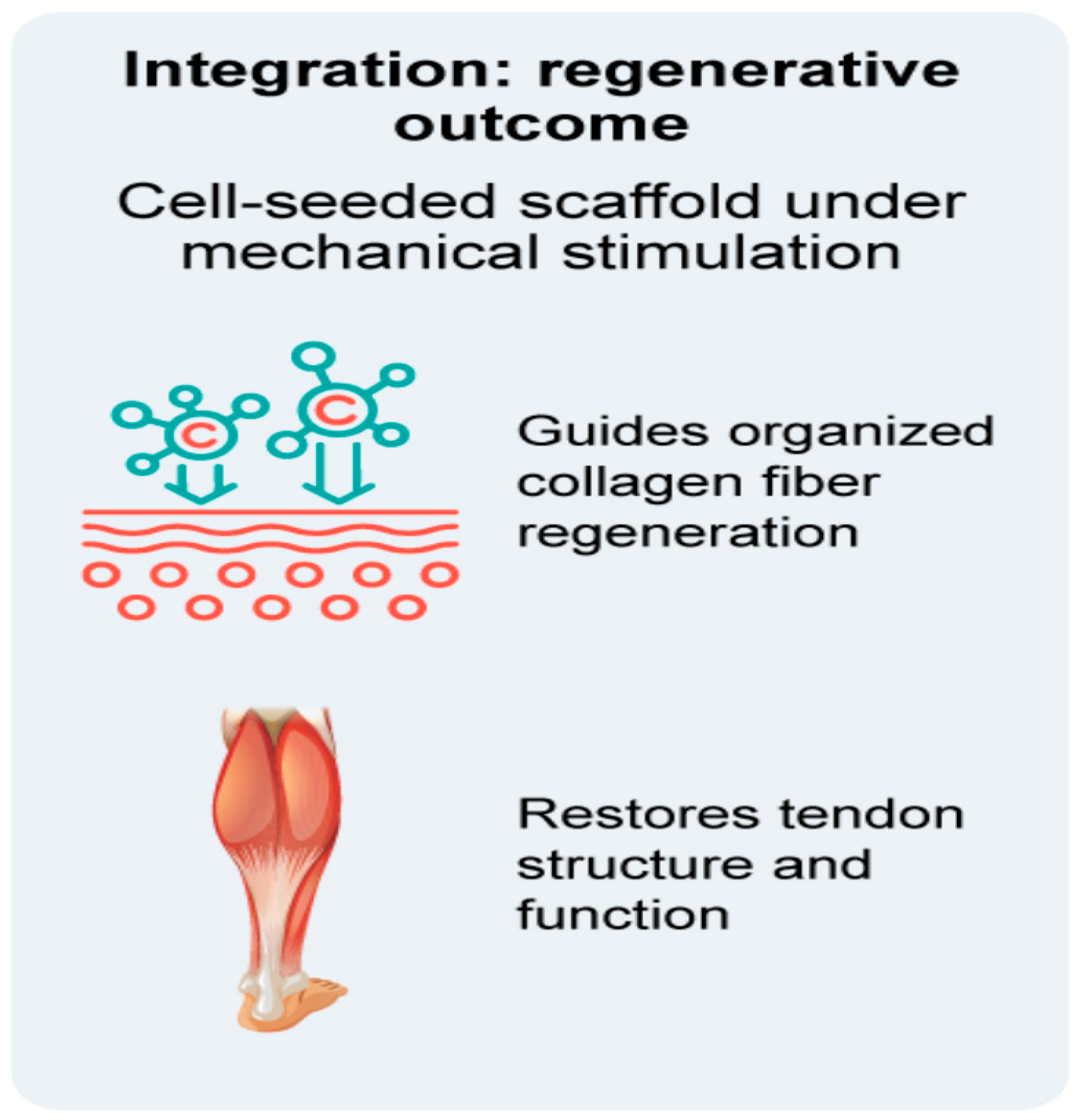
A schematic representation of the integrated regenerative approach is provided in Figure 4.

3.13. Future Directions in Tissue Engineering

Despite the challenges outlined previously, tendon tissue engineering is at an inspiring time, with several novel technologies and strategies emerging with the potential to overcome many of these limitations [71,123].
In the future, AT tissue engineering is likely to be shaped by several key transformative technologies and approaches, including biofabrication, molecular therapeutics, and precision medicine [104,119].
Overcoming the translational problems outlined previously and approaching clinically relevant outcomes will require the next wave of tissue engineering strategies to incorporate advances from various disciplines, including materials science, biofabrication, genomics, and precision medicine [48,119].
One of the most promising areas of development is the design of patient-specific 3D bioprinted tendon grafts, which can be customised based on patient anatomy and injury parameters using medical imaging data (CT, MRI) [104,124].
Additionally, the next generation of biomaterials is likely to include “smart” or stimuli-responsive materials that can dynamically respond to the healing environment, providing control over growth factor delivery. An example is scaffolds with mechanically responsive nanoparticles that release therapeutic molecules in response to tensile loading, synchronising drug delivery with the timing of rehabilitation protocols [110,125,126].
Such controlled-release systems can overcome a significant limitation of direct growth factor injection, with the short half-life of recombinant proteins, by providing sustained release of therapeutics over extended periods [125].

4. Conclusions

This review consolidates the current advancements in AT tissue engineering, highlighting progress in cellular therapy, scaffold biomaterials, and mechanobiology, all aimed at achieving functional regeneration. Our primary findings reveal that the field has evolved significantly from basic biological constructs to intricate multicomponent systems. Preclinical research consistently shows the promise of this approach, with notable results indicating that MSC-seeded scaffolds can restore biomechanical strength close to native levels and that chemically modified scaffolds can significantly surpass native collagen in facilitating tissue formation. Initial clinical trials have confirmed the safety of cell-based therapies and the practicality of scaffold enhancement, with reports of notable functional improvements in patients suffering from chronic tendinopathy. Despite these advancements, a considerable gap in translation remains. The clinical outlook is cautiously optimistic, hindered by the absence of large-scale randomized controlled trials, variability in treatment protocols, and a lack of standardized outcome measures. Therefore, overcoming these obstacles is crucial for future clinical success. The future clinical perspective involves a comprehensive strategy: establishing a global consensus on manufacturing protocols and clinical endpoints, designing more intelligent and efficient clinical trials, and creating patient-specific solutions through technologies like 3D bioprinting. Ultimately, converting the remarkable laboratory successes into sustainable, accessible clinical therapies will require ongoing interdisciplinary collaboration among clinicians, engineers, and biologists to navigate the complex path from scientific discovery to a new standard of care for Achilles tendon injuries.

Supplementary Materials

The following supporting information can be downloaded at: https://www.mdpi.com/article/10.3390/bioengineering12121346/s1, Table S1: Summary of Key Studies on Achilles Tendon Tissue Engineering (PICOS Framework); Table S2: Comparison of Biomaterial Scaffold Types for Achilles Tendon Tissue Engineering.

Author Contributions

Conceptualisation: S.M., Y.J. and P.L. Methodology: S.M., Y.J. and P.L. Software: S.M. and Y.J. Validation: S.M., Y.J. and P.L. Formal analysis: S.M., Y.J. and P.L. Investigation: S.M. Resources: S.M. and Y.J. Data Curation: S.M. and Y.J. Writing—original draft preparation: S.M. Writing—review and editing: S.M., Y.J. and P.L. Visualisation: S.M. and Y.J. Supervision: S.M. and P.L. Project administration: S.M., Y.J. and P.L. All authors have read and agreed to the published version of the manuscript.

Funding

This research received no external funding.

Institutional Review Board Statement

Not applicable.

Informed Consent Statement

Not applicable.

Data Availability Statement

No new data were created or analyzed in this study.

Acknowledgments

We would like to thank our colleagues at United Lincolnshire Hospitals NHS Trust for their valuable support and assistance during the preparation of this manuscript, as well as the anonymous reviewers for their constructive feedback which helped to improve the quality of the work.

Conflicts of Interest

The authors declare no conflict of interest.

References

  1. Duscher, D.; Shiffman, M.A. Regenerative Medicine and Plastic Surgery: Skin and Soft Tissue, Bone, Cartilage, Muscle, Tendon and Nerves; Springer International Publishing: Cham, Switzerland, 2019. [Google Scholar]
  2. Qi, F.; Deng, Z.; Ma, Y.; Wang, S.; Liu, C.; Lyu, F.; Wang, T.; Zheng, Q. From the perspective of embryonic tendon development: Various cells applied to tendon tissue engineering. Ann. Transl. Med. 2020, 8, 131. [Google Scholar] [CrossRef]
  3. Canata, G.L.; d’Hooghe, P.; Hunt, K.J. (Eds.) Muscle and Tendon Injuries: Evaluation and Management; Springer: Berlin/Heidelberg, Germany, 2017. [Google Scholar]
  4. Järvinen, T.A.H.; Kannus, P.; Maffulli, N.; Khan, K.M. Achilles tendon disorders: Etiology and epidemiology. Foot Ankle Clin. 2005, 10, 255–266. [Google Scholar] [CrossRef]
  5. Veronesi, F.; Borsari, V.; Contartese, D.; Xian, J.; Baldini, N.; Fini, M. The clinical strategies for tendon repair with biomaterials: A review on rotator cuff and Achilles tendons. J. Biomed. Mater. Res. B Appl. Biomater. 2020, 108, 1826–1843. [Google Scholar] [CrossRef]
  6. Laurencin, C.T.; Ambrosio, A.M.; Borden, M.D.; Cooper, J.A. Tissue engineering: Orthopedic applications. Annu. Rev. Biomed. Eng. 1999, 1, 19–46. [Google Scholar] [CrossRef]
  7. Hogan, M.V.; Bagayoko, N.; James, R.; Starnes, T.; Katz, A.; Chhabra, A.B. Tissue engineering solutions for tendon repair. J. Am. Acad. Orthop. Surg. 2011, 19, 134–142. [Google Scholar] [CrossRef]
  8. Hart, D.A.; Chen, J.; Ahmed, A.S.; Ackermann, P.W. Optimizing tendon repair and regeneration: How does the in vivo environment shape outcomes following rupture of a tendon such as the Achilles tendon? Front. Bioeng. Biotechnol. 2024, 12, 1357871. [Google Scholar] [CrossRef]
  9. Li, J. Research progress on the preparation and application of decellularized tendons. Curr. Issues Mol. Biol. 2025, 47, 251. [Google Scholar] [CrossRef]
  10. Freedman, B.R.; Gordon, J.A.; Soslowsky, L.J. The Achilles tendon: Fundamental properties and mechanisms governing healing. Muscles Ligaments Tendons J. 2014, 4, 245–255. [Google Scholar] [CrossRef] [PubMed]
  11. Schulze-Tanzil, G.G.; Delgado-Cáceres, M.; Stange, R.; Wildemann, B.; Docheva, D. Tendon healing: A concise review on cellular and molecular mechanisms with a particular focus on the Achilles tendon. Bone Joint Res. 2022, 11, 561–574. [Google Scholar] [CrossRef] [PubMed]
  12. Szaro, P.; Witkowski, G.; Smigielski, R.; Krajewski, P.; Ciszek, B. Fascicles of the adult human Achilles tendon–An anatomical study. Ann. Anat. 2009, 191, 586–593. [Google Scholar] [CrossRef] [PubMed]
  13. Handsfield, G.G.; Greiner, J.; Madl, J.; Rog-Zielinska, E.A.; Hollville, E.; Vanwanseele, B.; Shim, V. Achilles subtendon structure and behavior as evidenced from tendon imaging and computational modeling. Front. Sports Act. Living 2020, 2, 70. [Google Scholar] [CrossRef] [PubMed]
  14. Chen, T.M.; Rozen, W.M.; Pan, W.-R.; Ashton, M.W.; Richardson, M.D.; Taylor, G.I. The arterial anatomy of the Achilles tendon: Anatomical study and clinical implications. Clin. Anat. 2009, 22, 377–385. [Google Scholar] [CrossRef]
  15. Zantop, T.; Tillmann, B.; Petersen, W. Quantitative assessment of blood vessels of the human Achilles tendon: An immunohistochemical cadaver study. Arch. Orthop. Trauma Surg. 2003, 123, 501–504. [Google Scholar] [CrossRef]
  16. Ahmed, I.M.; Lagopoulos, M.; McConnell, P.; Soames, R.W.; Sefton, G.K. Blood supply of the Achilles tendon. J. Orthop. Res. 1998, 16, 591–596. [Google Scholar] [CrossRef]
  17. Screen, H.R.C. Tendon functional extracellular matrix. J. Orthop. Res. 2015, 33, 780–785. [Google Scholar] [CrossRef]
  18. Waggett, A.D.; Ralphs, J.R.; Kwan, A.P.L.; Woodnutt, D.; Benjamin, M. Characterization of collagens and proteoglycans at the insertion of the human Achilles tendon. Matrix Biol. 1998, 16, 457–470. [Google Scholar] [CrossRef] [PubMed]
  19. Wall, M.E.; Otey, C.A.; Loboa, E.G. Cell signaling in tenocytes: Response to load and ligands in health and disease. In Metabolic Influences on Risk for Tendon Disorders; Ackermann, P., Hart, D., Eds.; Advances in Experimental Medicine and Biology; Springer: Cham, Switzerland, 2016; Volume 920, pp. 79–95. [Google Scholar]
  20. Gögele, C.; Pattappa, G.; Tempfer, H.; Docheva, D.; Schulze-Tanzil, G. Tendon mechanobiology in the context of tendon biofabrication. Front. Bioeng. Biotechnol. 2025, 13, 1560025. [Google Scholar] [CrossRef] [PubMed]
  21. Eisner, L.E.; Rosario, R.; Andarawis-Puri, N.; Arruda, E.M. The role of the non-collagenous extracellular matrix in tendon and ligament mechanical behavior: A review. J. Biomech. Eng. 2022, 144, 050801. [Google Scholar] [CrossRef]
  22. Zhang, S.; Ju, W.; Chen, X.; Zhao, Y.; Feng, L.; Yin, Z.; Chen, X. Hierarchical ultrastructure: An overview of what is known about tendons and future perspective for tendon engineering. Bioact. Mater. 2021, 8, 124–139. [Google Scholar] [CrossRef]
  23. Franchi, M.; Ottani, V.; Stagni, R.; Ruggeri, A. Tendon and ligament fibrillar crimps give rise to left-handed helices of collagen fibrils in both planar and helical crimps. J. Anat. 2010, 216, 301–309. [Google Scholar] [CrossRef]
  24. Franchi, M.; Quaranta, M.; De Pasquale, V.; Macciocca, M.; Orsini, E.; Trirè, A.; Ottani, V.; Ruggeri, A. Tendon crimps and peritendinous tissues responding to tensional forces. Eur. J. Histochem. 2007, 51 (Suppl. 1), 9–14. [Google Scholar]
  25. Gomez-Florit, M.; Labrador-Rached, C.J.; Domingues, R.M.A.; Gomes, M.E. The tendon microenvironment: Engineered in vitro models to study cellular crosstalk. Adv. Drug Deliv. Rev. 2022, 185, 114299. [Google Scholar] [CrossRef]
  26. Govindaraju, D.T.; Chen, C.-H.; Shalumon, K.T.; Kao, H.-H.; Chen, J.-P. Bioactive nanostructured scaffold-based approach for tendon and ligament tissue engineering. Nanomaterials 2023, 13, 1847. [Google Scholar] [CrossRef]
  27. Aykora, D.; Taşçı, B.; Şahin, M.Z.; Tekeoğlu, I.; Uzun, M.; Sarafian, V.; Docheva, D. Tendon regeneration deserves better: Focused review on in vivo models, artificial intelligence and 3D bioprinting approaches. Front. Bioeng. Biotechnol. 2025, 13, 1580490. [Google Scholar] [CrossRef]
  28. Sharma, P.; Maffulli, N. Tendon injury and tendinopathy: Healing and repair. J. Bone Joint Surg. Am. 2005, 87, 187–202. [Google Scholar] [CrossRef] [PubMed]
  29. Nourissat, G.; Berenbaum, F.; Duprez, D. Tendon injury: From biology to tendon repair. Nat. Rev. Rheumatol. 2015, 11, 223–233. [Google Scholar] [CrossRef] [PubMed]
  30. Marsolais, D.; Côté, C.H.; Frenette, J. Neutrophils and macrophages accumulate sequentially following Achilles tendon injury. J. Orthop. Res. 2001, 19, 1203–1209. [Google Scholar] [CrossRef]
  31. Manning, C.N.; Havlioglu, N.; Knutsen, E.; Sakiyama-Elbert, S.E.; Silva, M.J.; Thomopoulos, S.; Gelberman, R.H. The early inflammatory response after flexor tendon healing: A gene expression and histological analysis. J. Orthop. Res. 2014, 32, 645–652. [Google Scholar] [CrossRef] [PubMed]
  32. Wang, J.H.-C.; Guo, Q.; Li, B. Tendon biomechanics and mechanobiology—A minireview of basic concepts and recent advancements. J. Hand Ther. 2012, 25, 133–140. [Google Scholar] [CrossRef]
  33. Vasiliadis, A.V.; Katakalos, K. The role of scaffolds in tendon tissue engineering. J. Funct. Biomater. 2020, 11, 78. [Google Scholar] [CrossRef]
  34. Zhu, S.; He, Z.; Ji, L.; Zhang, W.; Tong, Y.; Luo, J.; Zhang, Y.; Li, Y.; Meng, X.; Bi, Q. Advanced nanofiber-based scaffolds for Achilles tendon regenerative engineering. Front. Bioeng. Biotechnol. 2022, 10, 8970. [Google Scholar] [CrossRef]
  35. Lei, T.; Zhang, T.; Ju, W.; Chen, X.; Heng, B.C.; Shen, W.; Chen, X. Biomimetic strategies for tendon/ligament-to-bone interface regeneration. Bioact. Mater. 2021, 6, 2491–2510. [Google Scholar] [CrossRef] [PubMed]
  36. Bi, Y.; Ehirchiou, D.; Kilts, T.M.; Inkson, C.A.; Embree, M.C.; Sonoyama, W.; Li, L.; Seo, B.-M.; Zhang, L.; Shi, S.; et al. Identification of tendon stem/progenitor cells and the role of the extracellular matrix in their niche. Nat. Med. 2007, 13, 1219–1227. [Google Scholar] [CrossRef] [PubMed]
  37. Orfei, C.P.; Perucca, E.; Kouroupis, D.; Willman, M.A.; Ragni, E.; Kaplan, L.D.; Best, T.M.; Correa, D.; de Girolamo, L. Human tendon stem/progenitor cell features and functionality are highly influenced by in vitro culture conditions. Front. Bioeng. Biotechnol. 2021, 9, 711964. [Google Scholar] [CrossRef]
  38. Yang, J.; Wang, W.; Yang, H.; Zhao, D.; Liu, S.; Ma, H. Isolation and biological characterization of tendon-derived stem cells (TDSCs) from fetal bovine Achilles tendon: Multilineage potential and stemness properties. Vitr. Cell. Dev. Biol.-Anim. 2016, 52, 190–203. [Google Scholar]
  39. Citeroni, M.R.; Ciardulli, M.C.; Russo, V.; Della Porta, G.; Mauro, A.; El Khatib, M.; Di Mattia, M.; Galesso, D.; Barbera, C.; Forsyth, N.R.; et al. In vitro innovation of tendon tissue engineering strategies. Int. J. Mol. Sci. 2020, 21, 6726. [Google Scholar] [CrossRef]
  40. Huang, Z.; Yin, Z.; Xu, J.; Fei, Y.; Heng, B.C.; Jiang, X.; Chen, W.; Shen, W. Tendon stem/progenitor cell subpopulations and their implications in tendon biology. Front. Cell Dev. Biol. 2021, 9, 631272. [Google Scholar] [CrossRef]
  41. Sahni, V.; Tibrewal, S.; Bissell, L.; Khan, W.S. The role of tissue engineering in Achilles tendon repair: A review. Curr. Stem Cell Res. Ther. 2015, 10, 31–36. [Google Scholar] [CrossRef] [PubMed]
  42. Walia, B.; Huang, A.H. Tendon stem/progenitor cells: Understanding the biology to inform therapeutic strategies. Stem Cells Transl. Med. 2019, 8, 470–484. [Google Scholar] [CrossRef]
  43. Li, Y.; Xu, Z.; Zhang, P.; Leong, Q.; Zhao, Y.; Guo, L.; Sun, W. Identification and distinction of tenocytes and tendon-derived stem cells. Front. Cell Develop. Biol. 2021, 9, 629515. [Google Scholar] [CrossRef]
  44. Dec, P.; Żyłka, M.; Burszewski, P.; Modrzejewski, A.; Pawlik, A. Recent advances in the use of stem cells in tissue engineering and adjunct therapies for tendon reconstruction and future perspectives. Int. J. Mol. Sci. 2024, 25, 4498. [Google Scholar] [CrossRef]
  45. Yao, L.; Bestwick, C.S.; Bestwick, L.B.; Maffulli, N.; Aspden, R.M. Phenotypic drift in human tenocyte culture. J. Orthop. Res. 2006, 24, 1315–1323. [Google Scholar]
  46. Docheva, D.; Müller, S.A.; Majewski, M.; Evans, C.H. Biologics for tendon repair. Adv. Drug Deliv. Rev. 2015, 84, 222–239. [Google Scholar] [CrossRef]
  47. Ullah, I.; Subbarao, R.B.; Rho, G.J. Human mesenchymal stem cells—Current trends and future prospective. Cells Tissues Organs 2015, 199, 3–12. [Google Scholar] [CrossRef] [PubMed]
  48. Ruiz-Alonso, S.; Lafuente-Merchan, M.; Ciriza, J.; Saenz-del-Burgo, L.; Pedraz, J.L. Tendon tissue engineering: Cells, growth factors, scaffolds and production techniques. J. Control. Release 2021, 333, 448–486. [Google Scholar] [CrossRef] [PubMed]
  49. Chen, J.L.; Zhang, W.; Liu, Z.Y.; Heng, B.C.; Ouyang, H.W. Physical regulation of stem cells differentiation into teno-lineage: Current strategies and future directions. Cell Tissue Res. 2015, 360, 195–207. [Google Scholar] [CrossRef]
  50. Chailakhyan, R.K.; Kon, E.; Shekhter, A.B.; Ivannikov, S.V.; Telpukhov, V.I.; Grosheva, A.G.; Suslin, D.S.; Vorobieva, N.N.; Gerasimov, Y.V.; Churbanov, S.N.; et al. Autologous bone marrow-derived mesenchymal stem cells provide complete regeneration in a rabbit model of the Achilles tendon bundle rupture. Int. Orthop. 2021, 45, 3263–3276. [Google Scholar] [CrossRef]
  51. de Aro, A.A.; Carneiro, G.D.; Teodoro, L.F.R.; da Veiga, F.C.; Ferrucci, D.L.; Simões, G.F.; Simões, P.W.; Alvares, L.E.; de Oliveira, A.L.R.; Vicente, C.P.; et al. Injured Achilles tendons treated with adipose-derived stromal cells and/or GDF-5 show improved morphology and biomechanics in rats. PLoS ONE 2018, 13, e0202514. [Google Scholar]
  52. Xie, S.; Zhou, Y.; Tang, Y.; Chen, C.; Li, S.; Zhao, C.; Hu, J.; Lu, H. Decellularized tendon matrix scaffold combined with BMSC sheets for repair of Achilles tendon defect in rabbits. J. Orthop. Res. 2019, 37, 887–897. [Google Scholar] [CrossRef]
  53. Jiang, L.; Lu, J.; Chen, Y.; Lyu, K.; Long, L.; Wang, X.; Liu, T.; Li, S. Mesenchymal stem cells: An efficient cell therapy for tendon repair (review). Int. J. Mol. Med. 2023, 52, 70. [Google Scholar] [CrossRef]
  54. Gissi, C.; Radeghieri, A.; Antonetti, C.; Gallorini, M.; Calciano, L.; Oliva, F.; Veronesi, F.; Zendrini, A.; Cataldi, A.; Bergese, P.; et al. Extracellular vesicles from rat bone-marrow MSCs improve tendon repair in an Achilles tendon injury model in a dose-dependent manner: A pilot study. PLoS ONE 2020, 15, e0229914. [Google Scholar] [CrossRef]
  55. Chen, S.H.; Chen, Z.Y.; Lin, Y.H.; Chen, S.H.; Chou, P.Y.; Kao, H.K.; Lin, F.H. Extracellular vesicles of adipose-derived stem cells promote the healing of traumatized Achilles tendons. Int. J. Mol. Sci. 2021, 22, 12373. [Google Scholar] [CrossRef] [PubMed]
  56. Webb, K. Polyhydroxyalkanoate (PHBHHx) scaffolds for Achilles tendon repair in rats. Biomaterials 2004, 25, 1695–1703. [Google Scholar]
  57. Rieu, C.; Picaut, L.; Mosser, G.; Trichet, L. From tendon injury to collagen-based tendon regeneration: Overview and recent advances. Curr. Org. Chem. 2015, 19, 1552–1574. [Google Scholar] [CrossRef]
  58. Badylak, S.F.; Arnoczky, S.; Plouhar, P.; Haut, R.; Mendenhall, V.; Clarke, R.; Horvath, C. Naturally occurring extracellular matrix as a scaffold for musculoskeletal repair. Tissue Eng. 1998, 4, 361–373. [Google Scholar] [CrossRef]
  59. Rocha, L.B.; Goissis, G.; Rossi, M.A. Biocompatibility of anionic collagen matrix as scaffold for bone healing. Biomaterials 2002, 23, 449–456. [Google Scholar] [CrossRef] [PubMed]
  60. Plepis, A.M.D.G.; Goissis, G.; Das-Gupta, D.K. Dielectric and pyroelectric characterization of anionic and native collagen. Polym. Eng. Sci. 1996, 36, 2932–2938. [Google Scholar] [CrossRef]
  61. Pettian, M.S.; Plepis, A.M.D.G.; Martins, V.D.C.A.; Santos, G.R.D.; Pinto, C.A.L.; Galdeano, E.A.; Calegari, A.R.A.; de Moraes, C.A.; Cunha, M.R.D. Use of an anionic collagen matrix made from bovine intestinal serosa for in vivo repair of cranial defects. PLoS ONE 2018, 13, e0197806. [Google Scholar] [CrossRef]
  62. Fernandez-Yague, M.A.; Trotier, A.; Demir, S.; Akogwu, S.A.; Larrañaga, A.; Thirumaran, A.; Moreno-Gomez, N.; Ng, J.; Patil, S.; Zeugolis, D.I.; et al. A self-powered piezo-bioelectric device regulates tendon repair-associated signaling pathways through modulation of mechanosensitive ion channels. Adv. Mater. 2021, 34, 2008788. [Google Scholar] [CrossRef]
  63. Goissis, G.; Marcantonio, E., Jr.; Marcantônio, R.A.; Lia, R.C.; Cancian, D.C.; de Carvalho, W.M. Biocompatibility studies of anionic collagen membranes with different degree of glutaraldehyde cross-linking. Biomaterials 1999, 20, 27–34. [Google Scholar] [CrossRef]
  64. Farnebo, S.; Woon, C.Y.L.; Bronstein, J.A.; Schmitt, T.; Lindsey, D.P.; Pham, H.; Castillo, A.B.; Chang, J. Decellularized tendon-bone composite grafts for extremity reconstruction: An experimental study. Plast. Reconstr. Surg. 2014, 133, 79–89. [Google Scholar] [CrossRef]
  65. Barber, F.A.; McGarry, J.E.; Herbert, M.A.; Anderson, R.B. A biomechanical study of Achilles tendon repair augmentation using GraftJacket matrix. Foot Ankle Int. 2008, 29, 329–333. [Google Scholar] [CrossRef]
  66. Zhang, Y.; Xue, Y.; Ren, Y.; Li, X.; Liu, Y. Biodegradable polymer electrospinning for tendon repairment. Polymers 2023, 15, 1566. [Google Scholar] [CrossRef]
  67. Heidari, B.S.; Ruan, R.; Vahabli, E.; Chen, P.; De-Juan-Pardo, E.M.; Zheng, M.; Doyle, B. Natural, synthetic and commercially-available biopolymers used to regenerate tendons and ligaments. Bioact. Mater. 2023, 19, 179–197. [Google Scholar]
  68. Rothrauff, B.B.; Lauro, B.B.; Yang, G.; Debski, R.E.; Musahl, V.; Tuan, R.S. Braided and stacked electrospun nanofibrous scaffolds for tendon and ligament tissue engineering. Tissue Eng. Part A 2017, 23, 378–389. [Google Scholar] [CrossRef]
  69. Reverchon, E.; Baldino, L.; Cardea, S.; De Marco, I. Biodegradable synthetic scaffolds for tendon regeneration. Muscles Ligaments Tendons J. 2012, 2, 181–186. [Google Scholar] [PubMed]
  70. Huang, L.; Liu, Y.; Chen, Y.; Xu, J.; Pan, Y.; Lin, J.; Lin, Y. Biomimetic scaffolds for tendon tissue regeneration. Nanomaterials 2023, 13, 246. [Google Scholar] [CrossRef] [PubMed]
  71. Ning, C.; Pan, T.; Zhou, Z.; Tan, G. Recent advances in tendon tissue engineering strategy. Front. Bioeng. Biotechnol. 2023, 11, 1115312. [Google Scholar] [CrossRef] [PubMed]
  72. Emonts, C.; Bauer, B.; Pitts, J.; Roger, Y.; Hoffmann, A.; Menzel, H.; Gries, T. Mechanical, biological and in vitro degradation investigation of braided scaffolds for tendon and ligament tissue engineering based on different polycaprolactone materials with chitosan-graft-PCL surface modification. Polymers 2024, 16, 2349. [Google Scholar] [CrossRef]
  73. Leung, M.; Jana, S.; Tsao, C.-T.; Zhang, M. Tenogenic differentiation of human bone marrow stem cells via a combinatory effect of aligned chitosan-poly-caprolactone nanofibers and TGF-β3. J. Mater. Chem. B 2013, 1, 6516–6524. [Google Scholar] [CrossRef]
  74. Song, T.; Fang, L.; Zhang, J.; Liu, Y.; Zhu, W.; Li, C.; Lei, J. Artificial single-layer, multi-layer, and gradient scaffolds made of nano-micromaterials for musculoskeletal tissue regeneration: A mini-review. Nano-Micro Lett. 2025, 17, 105–113. [Google Scholar]
  75. Kent, R.N., III; Huang, A.H.; Baker, B.M. Augmentation of tendon and ligament repair with fiber-reinforced hydrogel composites. Adv. Healthc. Mater. 2024, 13, 400668. [Google Scholar] [CrossRef] [PubMed]
  76. Lin, M.; Li, W.; Ni, X.; Sui, Y.; Li, H.; Chen, X.; Lu, Y.; Jiang, M.; Wang, C. Growth factors in the treatment of Achilles tendon injury. Front. Bioeng. Biotechnol. 2023, 11, 1250533. [Google Scholar] [CrossRef]
  77. Molloy, T.; Wang, Y.; Murrell, G.A.C. The roles of growth factors in tendon and ligament healing. Sports Med. 2003, 33, 381–394. [Google Scholar] [CrossRef]
  78. Evrova, O.; Buschmann, J. In vitro and in vivo effects of PDGF-BB delivery on tendon healing: A review. Eur. Cell Mater. 2017, 34, 15–39. [Google Scholar] [CrossRef]
  79. Li, Y.; Liu, X.; Liu, X.; Peng, Y.; Zhu, B.; Guo, S.; Wang, C.; Wang, D.; Li, S. Transforming growth factor-β signalling pathway in tendon healing. Growth Factors 2022, 40, 98–107. [Google Scholar] [CrossRef] [PubMed]
  80. Sakai, T.; Kumagai, K. Molecular dissection of tendon development and healing: Insights into tenogenic phenotypes and functions. J. Biol. Chem. 2025, 301, 108353. [Google Scholar] [CrossRef]
  81. Thomopoulos, S.; Zaegel, M.; Das, R.; Harwood, F.L.; Silva, M.J.; Amiel, D.; Gelberman, R.H. PDGF-BB released in tendon repairs improves functional results in a canine model. J. Orthop. Res. 2007, 25, 1357–1363. [Google Scholar]
  82. Kurtz, C.A.; Loebig, T.G.; Anderson, D.D.; DeMeo, P.J.; Campbell, P.G. Insulin-like growth factor I accelerates functional recovery from Achilles tendon injury in a rat model. Am. J. Sports Med. 1999, 27, 363–369. [Google Scholar] [CrossRef]
  83. Miescher, I.; Rieber, J.; Calcagni, M.; Buschmann, J. In vitro and in vivo effects of IGF-1 delivery strategies on tendon healing: A review. Int. J. Mol. Sci. 2023, 24, 2370. [Google Scholar] [CrossRef]
  84. Lu, J.; Jiang, L.; Chen, Y.; Lyu, K.; Zhu, B.; Li, Y.; Liu, X.; Liu, X.; Long, L.; Wang, X.; et al. The functions and mechanisms of basic fibroblast growth factor in tendon healing. Front. Physiol. 2022, 13, 852795. [Google Scholar] [CrossRef]
  85. Liu, X.; Lu, D.; Liu, R.; Wang, H.; Guo, Z.; Zhou, C.; Wang, H.; Li, J. The role of vascular endothelial growth factor in tendon repair. J. Orthop. Transl. 2021, 27, 94–104. [Google Scholar]
  86. de Vos, R.J.; Weir, A.; van Schie, H.T.; Bierma-Zeinstra, S.M.; Verhaar, J.A.; Weinans, H.; Tol, J.L. Platelet-rich plasma injection for chronic Achilles tendinopathy: A randomized controlled trial. JAMA 2010, 303, 144–149. [Google Scholar] [CrossRef] [PubMed]
  87. Keene, D.J.; Alsousou, J.; Harrison, P.; Hulley, P.; Wagland, S.; Parsons, S.R.; Thompson, J.Y.; O’Connor, H.M.; Schlüssel, M.M.; Dutton, S.J.; et al. Platelet-rich plasma for acute Achilles tendon rupture (PATH-2): A multicentre, randomised, placebo-controlled, superiority trial. BMJ 2019, 367, l6132. [Google Scholar] [CrossRef] [PubMed]
  88. Everts, P.; Onishi, K.; Jayaram, P.; Lana, J.F.; Mautner, K. Platelet-rich plasma: New performance understandings and therapeutic considerations in 2020. Int. J. Mol. Sci. 2020, 21, 7794. [Google Scholar] [CrossRef]
  89. Killian, M.L.; Thomopoulos, S. Tendon mechanobiology: Development, healing, and homeostasis. J. Orthop. Res. 2016, 34, 110–120. [Google Scholar]
  90. Tam, K.T.; Baar, K. Using load to improve tendon/ligament tissue engineering and develop novel treatments for tendinopathy. Matrix Biol. 2025, 135, 39–54. [Google Scholar] [CrossRef]
  91. Komi, P.V. Relevance of in vivo force measurements to human biomechanics. J. Biomech. 1990, 23, 23–34. [Google Scholar] [CrossRef]
  92. Gracey, E.; Burssens, A.; Cambré, I.; Schett, G.; Lories, R.; McInnes, I.B.; Asahara, H.; Elewaut, D. Tendon and ligament mechanical loading in the pathogenesis of inflammatory arthritis. Nat. Rev. Rheumatol. 2020, 16, 193–207. [Google Scholar] [CrossRef]
  93. Wang, T.; Gardiner, B.S.; Lin, Z.; Rubenson, J.; Kirk, T.B.; Wang, A.; Zheng, M.H. Cyclic mechanical stimulation rescues Achilles tendon from degeneration in a bioreactor system. J. Orthop. Res. 2015, 33, 1888–1896. [Google Scholar] [CrossRef]
  94. Sharma, P.; Maffulli, N. Tendinopathy and tendon injury: The future. Disabil. Rehabil. 2008, 30, 1733–1745. [Google Scholar] [CrossRef]
  95. Vogel, K.G.; Ördög, A.; Pogány, G.; Oláh, J. Proteoglycans in the compressed region of human tibialis posterior tendon and in ligaments. J. Orthop. Res. 1993, 11, 68–77. [Google Scholar] [CrossRef]
  96. Benjamin, M.; Ralphs, J.R. Fibrocartilage in tendons and ligaments—An adaptation to compressive load. J. Anat. 1998, 193, 481–494. [Google Scholar] [CrossRef] [PubMed]
  97. Thorpe, C.T.; Udeze, C.P.; Birch, H.L.; Clegg, P.D.; Screen, H.R.C. Specialization of tendon mechanical properties results from interfascicular differences. J. R. Soc. Interface 2012, 9, 3108–3117. [Google Scholar] [CrossRef]
  98. Arya, S.; Kulig, K. Tendinopathy alters mechanical and material properties of the Achilles tendon. J. Appl. Physiol. 2010, 108, 670–675. [Google Scholar] [CrossRef]
  99. Sun, Y.L.; Wei, Z.; Zhao, C.; Jay, G.D.; Schmid, T.M.; Amadio, P.C.; An, K.N. Lubricin in human achilles tendon: The evidence of intratendinous sliding motion and shear force in achilles tendon. J. Orthop. Res. 2015, 33, 932–937. [Google Scholar] [CrossRef]
  100. Wang, T.; Gardiner, B.S.; Lin, Z.; Rubenson, J.; Kirk, T.B.; Wang, A.; Xu, J.; Smith, D.W.; Lloyd, D.G.; Zheng, M.H. Bioreactor design for tendon/ligament engineering. Tissue Eng. Part B Rev. 2013, 19, 133–146. [Google Scholar] [CrossRef]
  101. Wang, J.H.C.; Thampatty, B.P. Mechanobiology of adult and stem cells. Int. Rev. Cell Mol. Biol. 2008, 271, 301–346. [Google Scholar] [CrossRef] [PubMed]
  102. Riley, G. The pathogenesis of tendinopathy. A molecular perspective. Rheumatology 2004, 43, 131–142. [Google Scholar] [CrossRef] [PubMed]
  103. Wang, T.; Lin, Z.; Day, R.E.; Gardiner, B.; Landao-Bassonga, E.; Rubenson, J.; Kirk, T.B.; Smith, D.W.; Lloyd, D.G.; Zheng, M.H. Programmable mechanical loading regulates healing in tendon tissue engineering. Tissue Eng. Part A 2015, 21, 2290–2300. [Google Scholar]
  104. Bai, X.; Yang, Y.; Chu, J.; Deng, Y.; Li, M.; Yang, H. 3D bioprinting patient-specific grafts for tendon/ligament repair in motion: Emerging trends and challenges. Front. Bioeng. Biotechnol. 2025, 13, 1643430. [Google Scholar] [CrossRef]
  105. Kim, W.J.; Yun, H.S.; Kim, G.H. 3D bioprinted multi-layered cell constructs with gradient properties for tendon-to-bone interface regeneration. Bioact. Mater. 2025, 33, 497–512. [Google Scholar]
  106. Kaneda, G.; Chan, J.L.; Castaneda, C.M.; Chung, T.T.; Hooper, R.C.; Taniguchi, I.; Zhu, Y.; Moeinzadeh, S.; Kim, H.T.; Yang, Y.P. iPSC-derived tenocytes seeded on microgrooved 3D printed scaffolds for Achilles tendon regeneration. J. Orthop. Res. 2023, 41, 1722–1733. [Google Scholar] [CrossRef] [PubMed]
  107. González-Quevedo, D.; Martínez-Medina, I.; Campos, A.; Campos, F.; Carriel, V. Tissue engineering strategies for the treatment of tendon injuries: A systematic review and meta-analysis of animal models. Bone Joint Res. 2018, 7, 318–324. [Google Scholar] [CrossRef] [PubMed]
  108. Yoon, J.; Lee, S.; Kim, M.J.; Kim, J.H. Brief summary of the regulatory frameworks of regenerative medicine therapies. Front. Pharmacol. 2025, 15, 1486812. [Google Scholar] [CrossRef] [PubMed]
  109. Ancans, J. Cell therapy medicinal product regulatory framework in Europe and its application for MSC-based therapy development. Front. Immunol. 2012, 3, 253. [Google Scholar] [CrossRef]
  110. Liang, W.; Zhou, C.; Zhang, J.; Huang, J.; Chen, J.; Luo, Y.; Huang, H.; Zhong, Z.; Xu, J. The current status of various preclinical therapeutic strategies for tendon-bone healing: A review. Front. Bioeng. Biotechnol. 2024, 12, 1379025. [Google Scholar]
  111. Goldberg, A.J.; Masci, L.; O’Donnell, P.; Green, R.; Brooking, D.; Bassett, P.; Lowdell, M.W.; Smith, R.K.W. Autologous bone marrow derived mesenchymal stem cells are safe for the treatment of Achilles tendinopathy. Sci. Rep. 2024, 14, 11421. [Google Scholar] [CrossRef]
  112. van den Boom, N.A.C.; Winters, M.; Haisma, H.J.; Moen, M.H. Efficacy of stem cell therapy for tendon disorders: A systematic review. Orthop. J. Sports Med. 2020, 8, 2325967120915857. [Google Scholar] [CrossRef]
  113. Mirghaderi, S.P.; Valizadeh, Z.; Shadman, K.; Lafosse, T.; Oryadi-Zanjani, L.; Yekaninejad, M.S.; Nabian, M.H. Cell therapy efficacy and safety in treating tendon disorders: A systemic review of clinical studies. J. Exp. Orthop. 2022, 9, 85. [Google Scholar] [CrossRef]
  114. Longo, U.G.; Lamberti, A.; Maffulli, N.; Denaro, V. Scaffolds in tendon tissue engineering. Stem Cells Int. 2012, 2012, 517165. [Google Scholar] [CrossRef]
  115. Ling, S.K.K.; Ko, V.M.C.; Zuo, Y.; Chow, E.M.W.; Mak, M.K.L.; Yung, P.S.H. Case series on bioinductive collagen scaffold augmented tendon repair for acute Achilles tendon ruptures with background tendinopathy. J. Orthop. Surg. 2025, 33, 22104917251343231. [Google Scholar] [CrossRef]
  116. Genuth, G.; Iselin, L.D.; Maffulli, N.; Oliva, F. Treating insertional Achilles tendinitis with bio inductive collagen scaffold—Does it improve outcomes? A case series. J. Clin. Orthop. Trauma 2025, 63, 102931. [Google Scholar] [CrossRef]
  117. Wang, M.; Xu, L.; Luo, Y.; Qin, J.; Xiao, Z.; Li, Y.; Zhu, C.; Zhao, Y.; Dai, J. Insulin-like growth factor-1 (IGF-1) empowering tendon regenerative healing: Mechanisms, applications, and future directions. Front. Bioeng. Biotechnol. 2025, 13, 1492811. [Google Scholar] [CrossRef]
  118. Shearn, J.T.; Kinneberg, K.R.C.; Dyment, N.A.; Gallick, M.R.; Kenter, K.; Wylie, C.; Butler, D.L. Tendon tissue engineering: Progress, challenges, and translation to the clinic. J. Musculoskelet. Neuronal Interact. 2011, 11, 163–173. [Google Scholar] [PubMed]
  119. Capella-Monsonís, H.; Zeugolis, D.I. Advances, challenges, and future directions in the clinical translation of extracellular matrix biomaterials. Adv. Drug Deliv. Rev. 2024, 211, 115360. [Google Scholar] [CrossRef]
  120. Silbernagel, K.G.; Malliaras, P.; de Vos, R.J.; Hanlon, S.; Molenaar, M.; Alfredson, H.; van den Akker-Scheek, I.; Antflick, J.; van Ark, M.; Färnqvist, K.; et al. ICON 2020-International Scientific Tendinopathy Symposium Consensus: A systematic review of outcome measures reported in clinical trials of Achilles tendinopathy. Sports Med. 2022, 52, 613–641. [Google Scholar] [CrossRef] [PubMed]
  121. De Luca, M.; Aiuti, A.; Cossu, G.; Parmar, M.; Pellegrini, G.; Robey, P.G. Cost and availability of novel cell and gene therapies. Nat. Rev. Mater. 2023, 8, 83–85. [Google Scholar] [CrossRef] [PubMed]
  122. ten Ham, R.M.T.; Hoekman, J.; Hövels, A.M.; Broekmans, A.W.; Leufkens, H.G.M.; Klungel, O.H. Estimation of manufacturing development costs of cell-based therapies: A feasibility study. Cytotherapy 2021, 23, 245–252. [Google Scholar] [CrossRef]
  123. Zhou, H.; Chen, Y.; Yan, W.; Chen, X.; Zi, Y. Advances and challenges in biomaterials for tendon and enthesis repair. Bioact. Mater. 2025, 47, 531–545. [Google Scholar] [CrossRef] [PubMed]
  124. Rosset, J.; Olaniyanu, E.; Stein, K.; Almeida, N.D.; França, R. Exploring the frontier of 3D bioprinting for tendon regeneration: A review. Eng 2024, 5, 1838–1849. [Google Scholar] [CrossRef]
  125. Yang, M.; Guo, J.; Wu, C.; Zeng, Y.; Guo, S.; Xu, H.; Yin, Z.; Yan, S.; Ouyang, H. Injectable composite microspheres/hydrogel membranes for Achilles tendon repair: A controlled-release system for tenogenic differentiation and anti-adhesion. Bioact. Mater. 2025, 45, 417–434. [Google Scholar]
  126. Freedman, B.R.; Mooney, D.J. Biomaterials to mimic and heal connective tissues. Adv. Mater. 2019, 31, 1806695. [Google Scholar] [CrossRef] [PubMed]
Figure 1. Overview of cell types and biological functions in Achilles tendon tissue engineering.
Bioengineering 12 01346 g001
Figure 2. Structural features of natural, synthetic, hybrid, and decellularised scaffolds used in tendon tissue engineering.
Bioengineering 12 01346 g002
Figure 3. Mechanical loading as a functional stimulus and its cellular and extracellular effects.
Bioengineering 12 01346 g003
Figure 4. Integrated tissue engineering approach for restoring Achilles tendon structure and function.
Bioengineering 12 01346 g004
Table 1. Comparative overview of natural, synthetic, hybrid, hydrogel, and decellularised anionic collagen scaffolds employed in Achilles tendon tissue engineering. The table summarises principal materials, key advantages, limitations, and representative literature supporting each category.
Scaffold TypeCommon MaterialsAdvantagesLimitationsRepresentative Studies
Natural scaffoldsCollagen, silk
fibroin, gelatin,
SIS,
decellularised
tendon
Excellent
biocompatibility
and cell
adhesion; retain
ECM bioactivity;
support
tenogenic
differentiation
Variable
degradation
rates; potential
immunogenicity;
limited
mechanical
strength
Rieu et al.,
2015; Badylak
et al., 1998;
Farnebo et al.,
2014 [57,58,59]
Synthetic scaffoldsPLLA, PLGA,
PCL, PHBHHx
Tunable
mechanical
properties;
reproducible;
scalable
manufacturing
Lack
of bioactive
motifs; acidic
degradation by-
products may
trigger
inflammation
Reverchon et
al., 2012; Zhang
et al., 2023;
Heidari et al.,
2023 [61,62,64]
Hybrid/composite scaffoldsPCL–collagen,
PCL–silk,
chitosan–PCL,
multilayered
gradient
designs
Combine
biological
recognition
with mechanical
strength;
adjustable
degradation and
architecture
Complex
fabrication;
potential batch
variation
Leung et al.,
2013; Emonts
et al., 2024;
Song et al.,
2025 [67,68,69]
Hydrogel scaffoldsGelMA, PEG,
fibrin,
hyaluronic acid
derivatives
Injectable;
mimic hydrated
ECM; allow
growth-factor
or cell
encapsulation
Low tensile
strength;
swelling stress;
often require
fibre
reinforcement
Zhu et al., 2022;
Lin et al., 2023 [34,76]
Decellularised Anionic Collagen (from AT)Modified
Achilles tendon
collagen with
increased
surface charge
Enhanced cell
adhesion and
proliferation;
preserved
ultrastructure;
reduced
immunogenicity
Limited clinical
data; scalability
challenges
Rieu et al.,
2015; Farnebo
et al., 2014 [57,59]
Table 2. Summary of key preclinical and clinical studies on Achilles tendon (calcaneal tendon) tissue engineering using the PICOS framework. The table highlights model populations, interventions, comparators, primary outcomes, and concise summaries of findings relevant to regenerative performance.
StudyPopulationInterventionComparisonOutcomesSummary
Chailakhya
n et al.,
2021 [50]
Rabbit Achilles tendon defectBone
marrow–
derived MSC-
seeded
scaffold
Cell-free
scaffold
Tensile
strength,
collagen
alignment
Achieved
~98% of
intact tendon
strength after
6 months;
superior
biomechanica
l recovery.
de Aro et
al., 2018 [51]
Rat Achilles
Tendon defect
Adipose-
derived stem
cells (ADSCs)
+ GDF-5
ADSCs aloneHistological
organisation,
biomechanica
l recovery
Increased
collagen
alignment,
cellularity,
and
mechanical
strength in
ADSC + GDF-
5 group.
Goldberg et
al., 2024 [111]
Human
chronic mid-
portion
tendinopathy
Autologous
bone
marrow–
derived MSC
injection
None (open-
label trial)
VISA-A score
improvement,
safety
Significant
pain and
function
improvement
at 6–12 months; no
major adverse events
Ling et al.,
2024 [115]
Patients
with acute
AT rupture
Bioinductive
collagen
scaffold
augmentation
Conventional
repair
Functional
outcome,
complication
rate
Good
postoperative
recovery and
comparable
complication
rate to
control;
promising feasibility
Xie et al., 2019 [52]Rabbit AT defectDecellularised tendon matrix scaffold + BMSC sheetDecellularised scaffold only Collagen organisation, mechanical properties Improved fibre alignment, renovated morphology, and mechanical stiffness
Disclaimer/Publisher’s Note: The statements, opinions and data contained in all publications are solely those of the individual author(s) and contributor(s) and not of MDPI and/or the editor(s). MDPI and/or the editor(s) disclaim responsibility for any injury to people or property resulting from any ideas, methods, instructions or products referred to in the content.