
The Stress–Strain State in the Pelvis During Sit-to-Stand Transfer



Abstract
1. Introduction
2. Materials and Methods
2.1. Motion Analysis
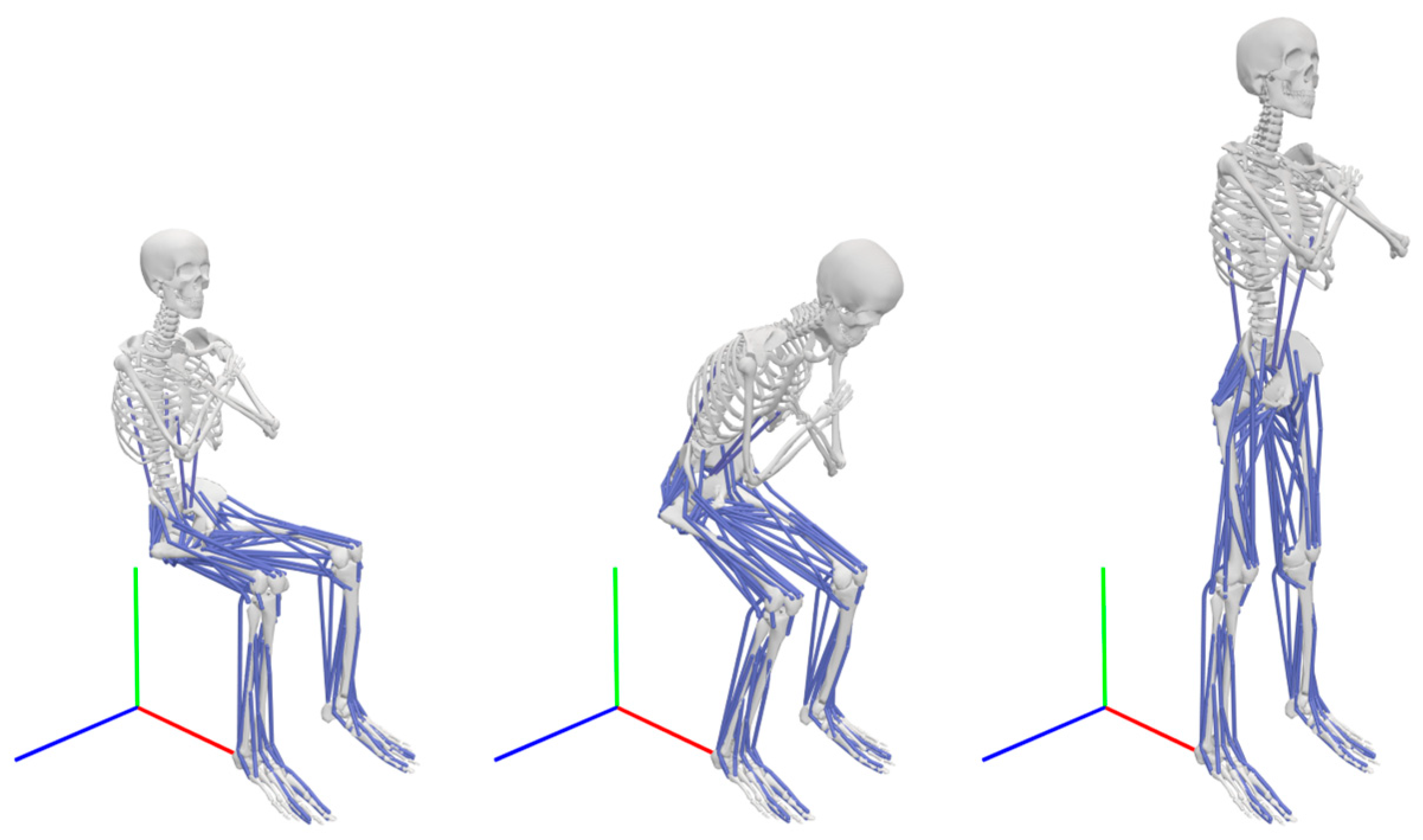
2.1.1. Sit-to-Stand Transfer Data and Musculoskeletal Model
2.1.2. Static Optimization Analysis
2.1.3. Residual and Reserve Actuators
2.1.4. Muscle and Joint Reaction Forces
2.2. FEM Analysis
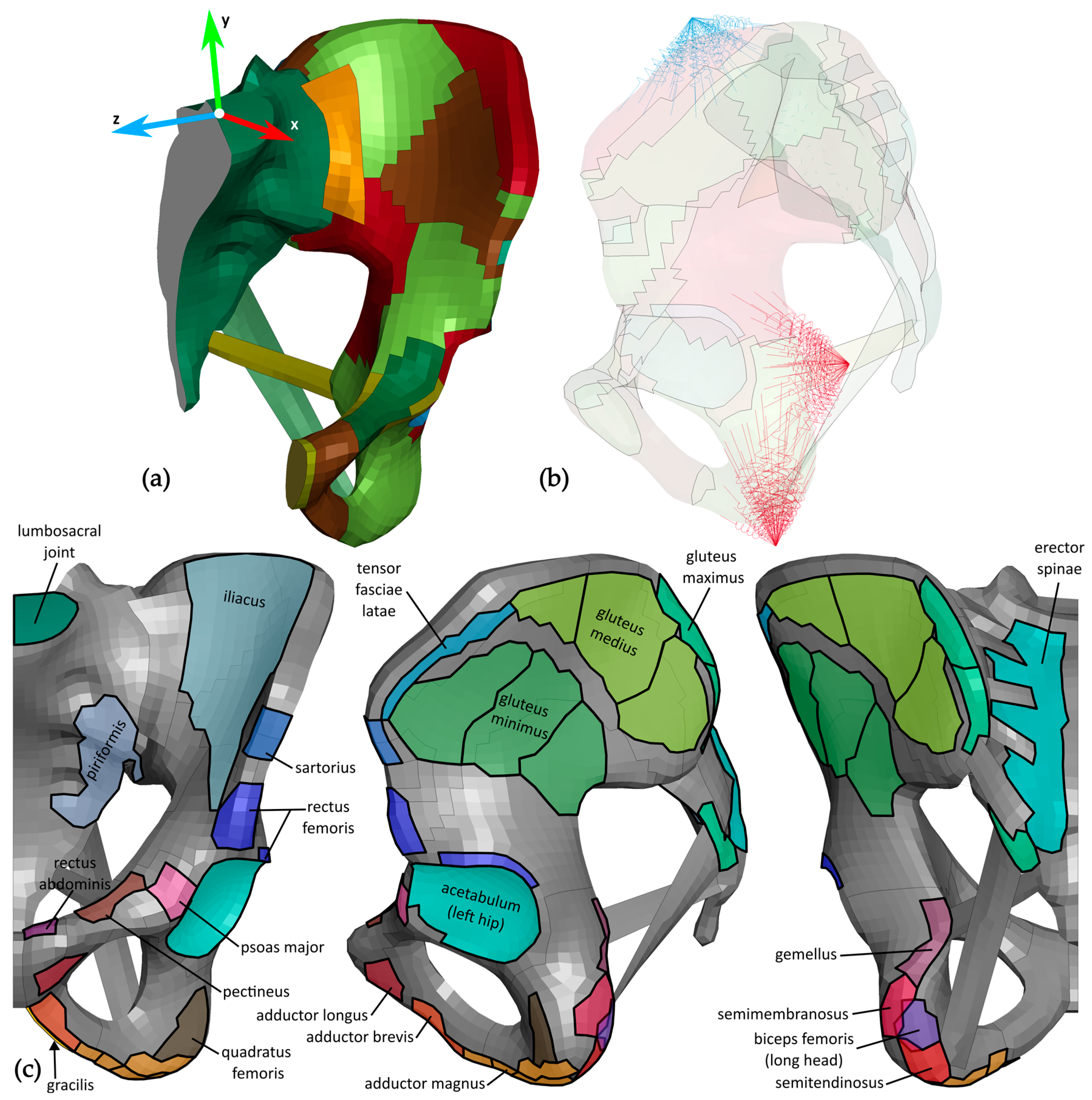
2.2.1. FE Pelvis Model
2.2.2. Coordinate Systems
2.2.3. Boundary Conditions
3. Results
3.1. Motion Analysis Results
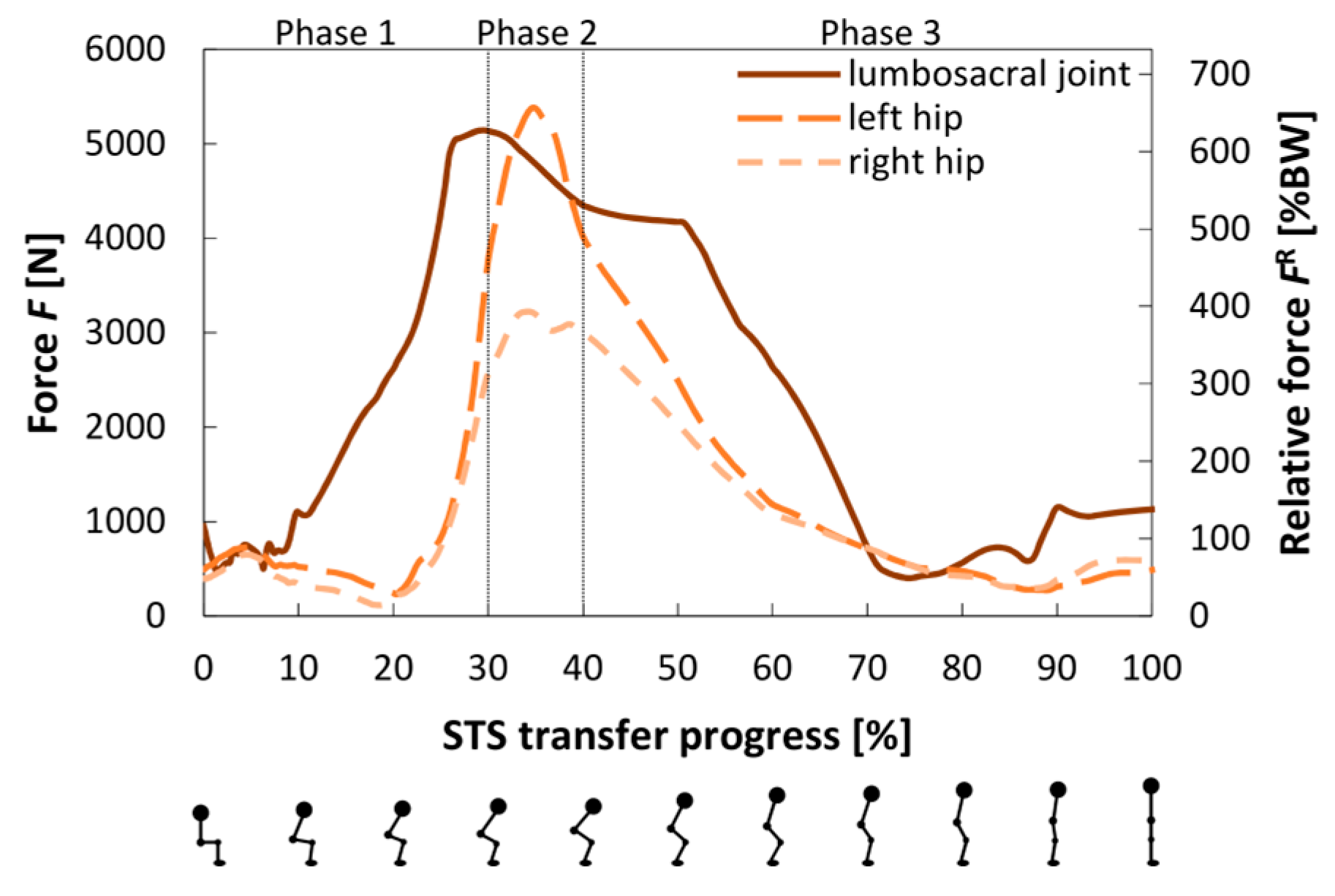
3.1.1. Joint Reaction Forces
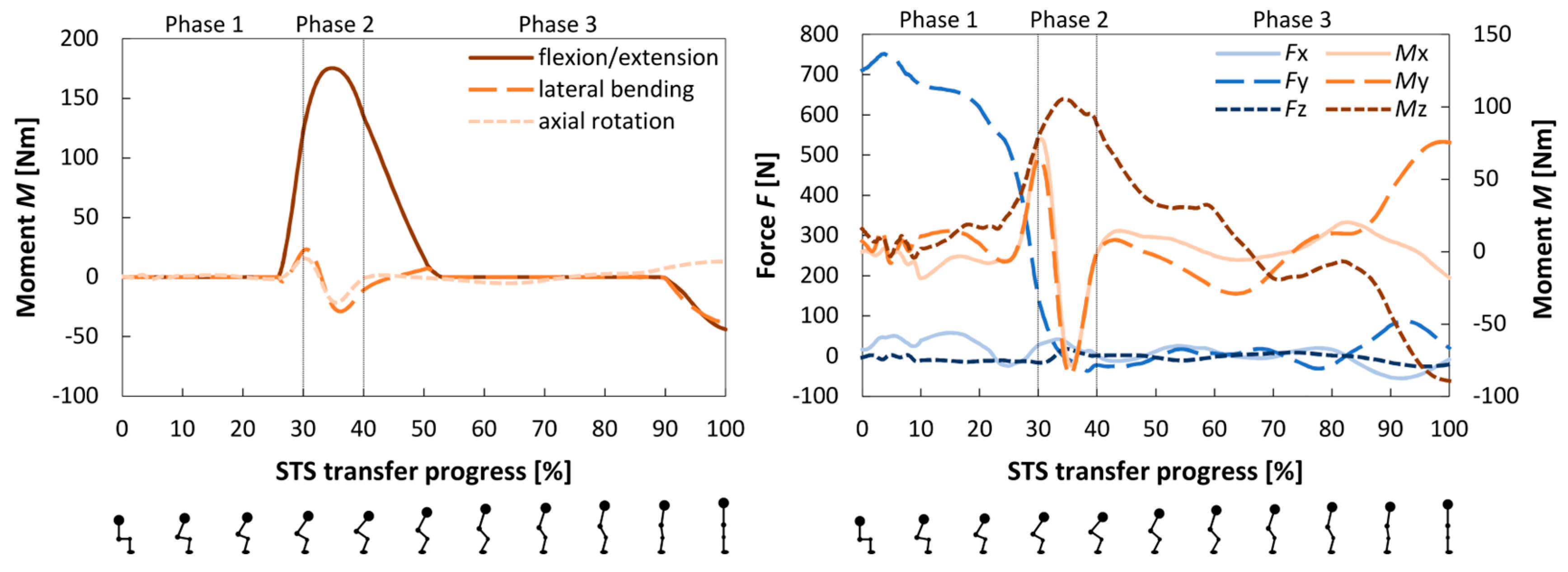
3.1.2. Loads in Reserve and Residual Actuators
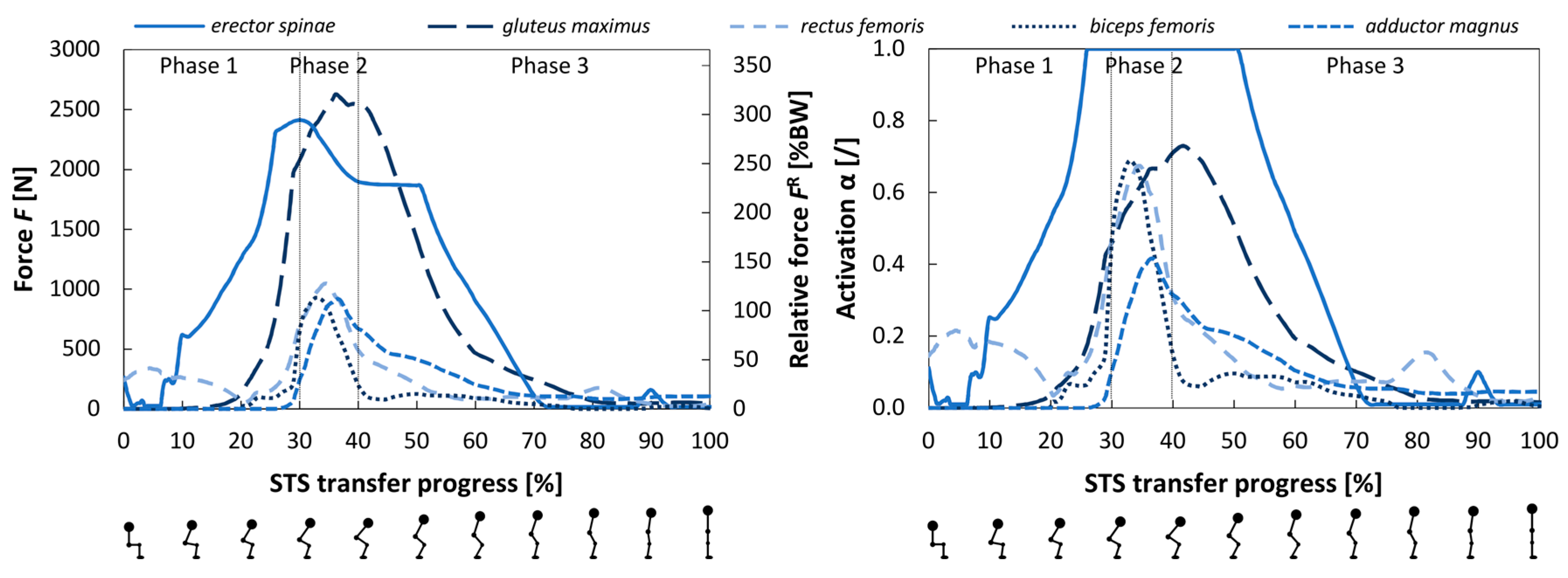
3.1.3. Muscle Forces
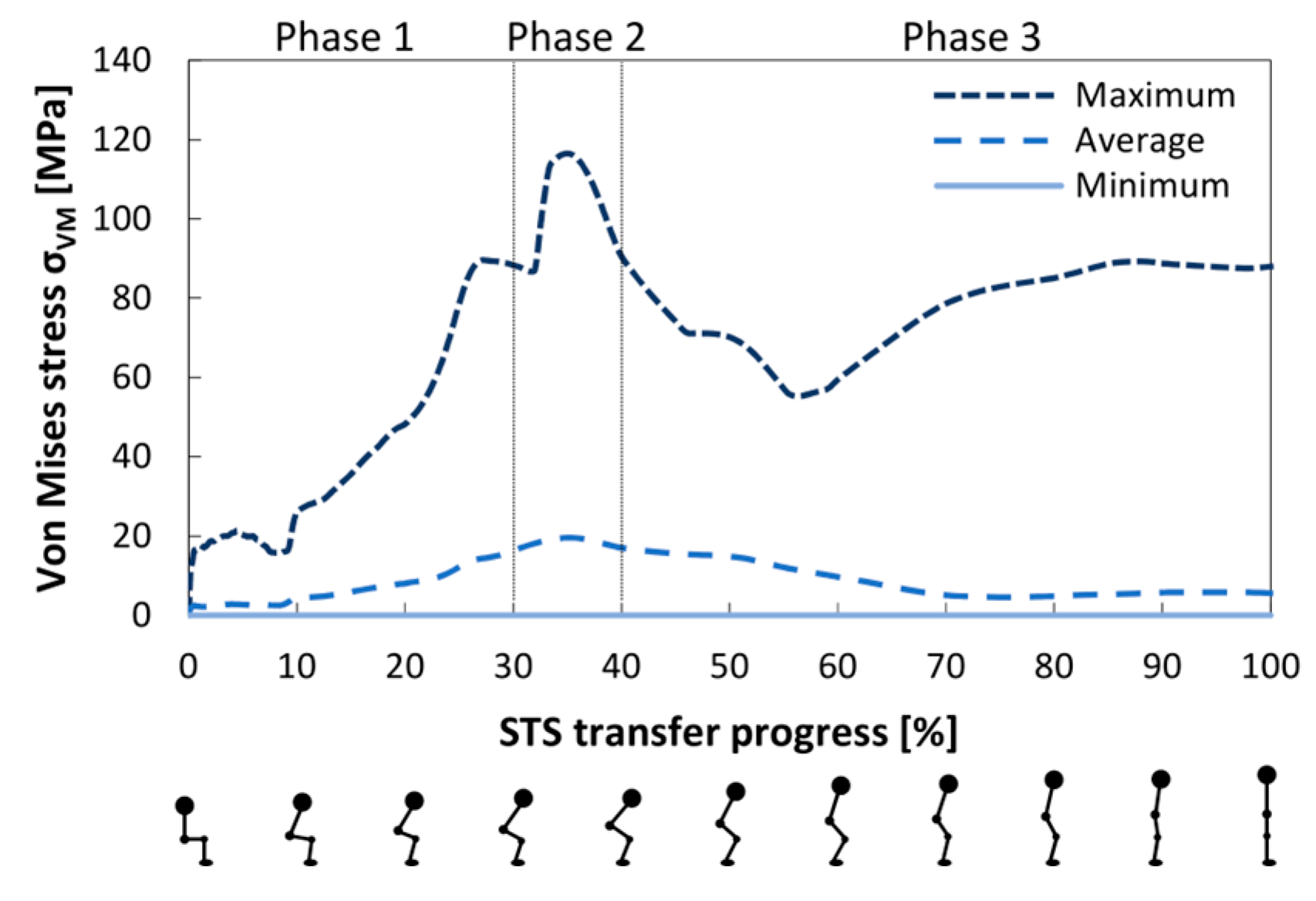
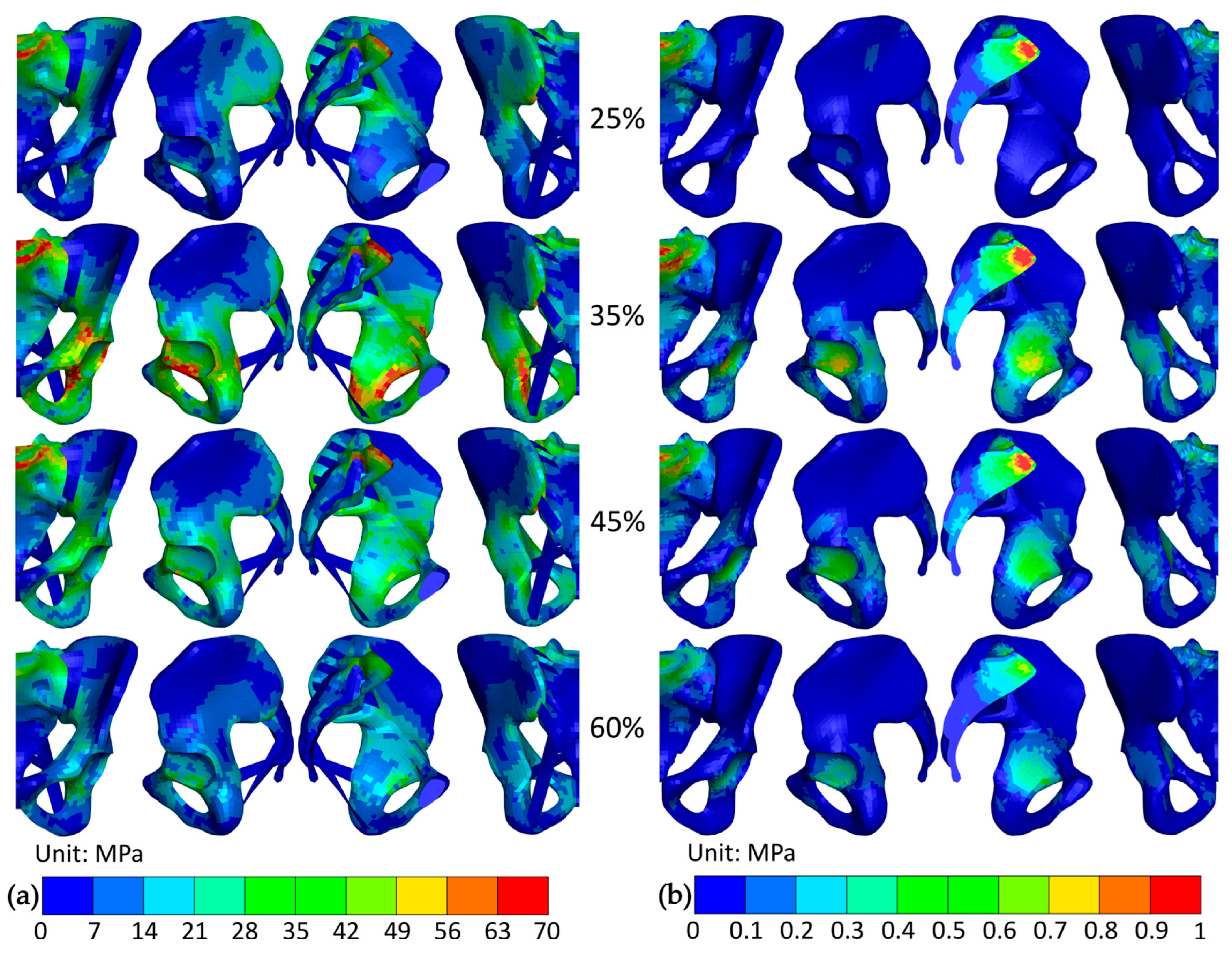
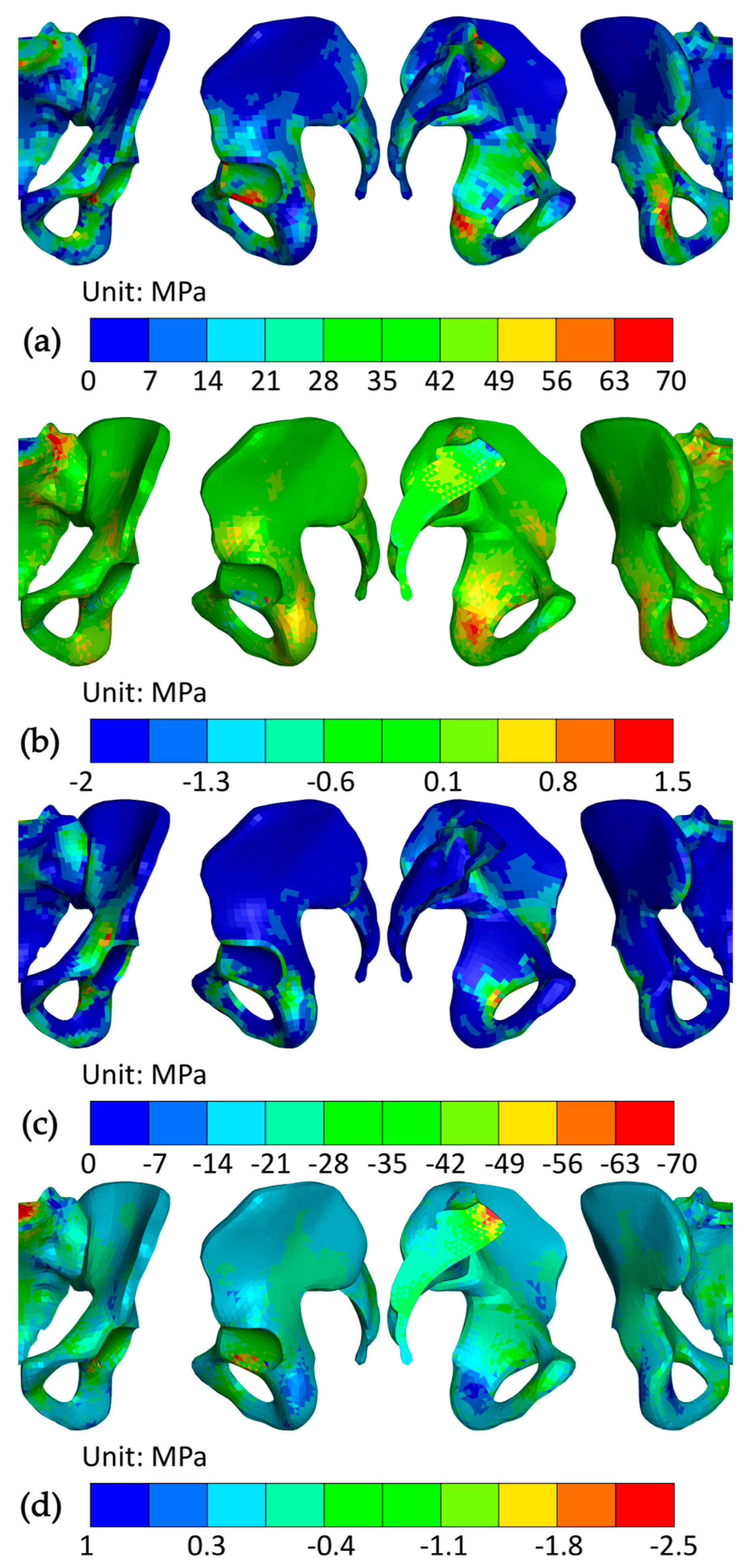
3.2. FE Analysis Results
4. Discussion
5. Conclusions
Supplementary Materials
Author Contributions
Funding
Institutional Review Board Statement
Informed Consent Statement
Data Availability Statement
Conflicts of Interest
Abbreviations
| EMG | Electromyography |
| MC | Muscle Contraction |
| FEM | Finite Element Method |
| FE | Finite Element |
| STS | Sit-to-Stand |
| THUMS | Total HUman Model for Safety |
| DOF | Degrees of Freedom |
| SO | Static Optimization |
| COM | Center of Mass |
| BW | Body Weight |
References
- Gänsslen, A.; Lindahl, J.; Grechenig, S.; Füchtmeier, B. (Eds.) Pelvic Ring Fractures; Springer International Publishing: Cham, Switzerland, 2021; ISBN 978-3-030-54729-5. [Google Scholar]
- Tornetta, P.; Matta, J.M. Outcome of Operatively Treated Unstable Posterior Pelvic Ring Disruptions. Clin. Orthop. 1996, 329, 186–193. [Google Scholar] [CrossRef]
- Lindahl, J.; Hirvensalo, E. Outcome of Operatively Treated Type-C Injuries of the Pelvic Ring. Acta Orthop. 2005, 76, 667–678. [Google Scholar] [CrossRef]
- Papakostidis, C.; Kanakaris, N.K.; Kontakis, G.; Giannoudis, P.V. Pelvic Ring Disruptions: Treatment Modalities and Analysis of Outcomes. Int. Orthop. 2009, 33, 329–338. [Google Scholar] [CrossRef] [PubMed]
- Simonian, P.T.; Schwappach, J.R.; Routt, M.L.C.; Agnew, S.G.; Harrington, R.M.; Tencer, A.F. Evaluation of New Plate Designs for Symphysis Pubis Internal Fixation. J. Trauma Inj. Infect. Crit. Care 1996, 41, 498–502. [Google Scholar] [CrossRef]
- Van Zwienen, C.M.A.; Van Den Bosch, E.W.; Hoek Van Dijke, G.A.; Snijders, C.J.; Van Vugt, A.B. Cyclic Loading of Sacroiliac Screws in Tile C Pelvic Fractures. J. Trauma Inj. Infect. Crit. Care 2005, 58, 1029–1034. [Google Scholar] [CrossRef]
- Suzuki, T.; Hak, D.J.; Ziran, B.H.; Adams, S.A.; Stahel, P.F.; Morgan, S.J.; Smith, W.R. Outcome and Complications of Posterior Transiliac Plating for Vertically Unstable Sacral Fractures. Injury 2009, 40, 405–409. [Google Scholar] [CrossRef]
- Bergmann, G.; Deuretzbacher, G.; Heller, M.; Graichen, F.; Rohlmann, A.; Strauss, J.; Duda, G.N. Hip Contact Forces and Gait Patterns from Routine Activities. J. Biomech. 2001, 34, 859–871. [Google Scholar] [CrossRef]
- Bergmann, G.; Bender, A.; Dymke, J.; Duda, G.; Damm, P. Standardized Loads Acting in Hip Implants. PLoS ONE 2016, 11, e0155612. [Google Scholar] [CrossRef] [PubMed]
- Rohlmann, A.; Pohl, D.; Bender, A.; Graichen, F.; Dymke, J.; Schmidt, H.; Bergmann, G. Activities of Everyday Life with High Spinal Loads. PLoS ONE 2014, 9, e98510. [Google Scholar] [CrossRef]
- Damm, P.; Reitmaier, S.; Hahn, S.; Waldheim, V.; Firouzabadi, A.; Schmidt, H. In Vivo Hip and Lumbar Spine Implant Loads during Activities in Forward Bent Postures. J. Biomech. 2020, 102, 109517. [Google Scholar] [CrossRef] [PubMed]
- Đorđević, S.; Stančin, S.; Meglič, A.; Milutinović, V.; Tomažič, S. MC Sensor—A Novel Method for Measurement of Muscle Tension. Sensors 2011, 11, 9411–9425. [Google Scholar] [CrossRef]
- Hof, A.L.; Pronk, C.N.A.; Van Best, J.A. Comparison between EMG to Force Processing and Kinetic Analysis for the Calf Muscle Moment in Walking and Stepping. J. Biomech. 1987, 20, 167–178. [Google Scholar] [CrossRef]
- Zajac, F.E. Muscle and Tendon: Properties, Models, Scaling, and Application to Biomechanics and Motor Control. Crit. Rev. Biomed. Eng. 1989, 17, 359–411. [Google Scholar] [PubMed]
- Bogey, R. An EMG-to-Force Processing Approach to Estimating Knee Muscle Forces during Adult, Self-Selected Speed Gait. Bioengineering 2023, 10, 980. [Google Scholar] [CrossRef] [PubMed]
- Su, H.; Qi, W.; Li, Z.; Chen, Z.; Ferrigno, G.; De Momi, E. Deep Neural Network Approach in EMG-Based Force Estimation for Human–Robot Interaction. IEEE Trans. Artif. Intell. 2021, 2, 404–412. [Google Scholar] [CrossRef]
- Liu, K.; Liu, Y.; Ji, S.; Gao, C.; Fu, J. Estimation of Muscle Forces of Lower Limbs Based on CNN–LSTM Neural Network and Wearable Sensor System. Sensors 2024, 24, 1032. [Google Scholar] [CrossRef]
- Delp, S.L.; Anderson, F.C.; Arnold, A.S.; Loan, P.; Habib, A.; John, C.T.; Guendelman, E.; Thelen, D.G. OpenSim: Open-Source Software to Create and Analyze Dynamic Simulations of Movement. IEEE Trans. Biomed. Eng. 2007, 54, 1940–1950. [Google Scholar] [CrossRef]
- Seth, A.; Hicks, J.L.; Uchida, T.K.; Habib, A.; Dembia, C.L.; Dunne, J.J.; Ong, C.F.; DeMers, M.S.; Rajagopal, A.; Millard, M.; et al. OpenSim: Simulating Musculoskeletal Dynamics and Neuromuscular Control to Study Human and Animal Movement. PLOS Comput. Biol. 2018, 14, e1006223. [Google Scholar] [CrossRef]
- Yoganandan, N.; Humm, J.R.; DeVogel, N.; Banerjee, A.; Pintar, F.A.; Somers, J.T. Pelvis Injury Risk Curves in Side Impacts from Human Cadaver Experiments Using Survival Analysis and Brier Score Metrics. Traffic Inj. Prev. 2019, 20, S137–S142. [Google Scholar] [CrossRef]
- Cardwell, M.C.; Martin, J.M.; Meinerz, C.; Beck, C.J.; Wang, M.; Schmeling, G.J. A Cadaveric Biomechanical Evaluation of Anterior Posterior Compression II Injuries. Injury 2023, 54, 834–840. [Google Scholar] [CrossRef]
- Girardi, B.L.; Attia, T.; Backstein, D.; Safir, O.; Willett, T.L.; Kuzyk, P.R.T. Biomechanical Comparison of the Human Cadaveric Pelvis with a Fourth Generation Composite Model. J. Biomech. 2016, 49, 537–542. [Google Scholar] [CrossRef]
- Böhme, J.; Shim, V.; Höch, A.; Mütze, M.; Müller, C.; Josten, C. Clinical Implementation of Finite Element Models in Pelvic Ring Surgery for Prediction of Implant Behavior: A Case Report. Clin. Biomech. 2012, 27, 872–878. [Google Scholar] [CrossRef]
- John, J.; Klug, C.; Kranjec, M.; Svenning, E.; Iraeus, J. Hello, World! VIVA+: A Human Body Model Lineup to Evaluate Sex-Differences in Crash Protection. Front. Bioeng. Biotechnol. 2022, 10, 918904. [Google Scholar] [CrossRef]
- Watson, P.J.; Dostanpor, A.; Fagan, M.J.; Dobson, C.A. The Effect of Boundary Constraints on Finite Element Modelling of the Human Pelvis. Med. Eng. Phys. 2017, 43, 48–57. [Google Scholar] [CrossRef] [PubMed]
- Ravera, E.P.; Crespo, M.J.; Catalfamo Formento, P.A. A Subject-Specific Integrative Biomechanical Framework of the Pelvis for Gait Analysis. Proc. Inst. Mech. Eng. Part H J. Eng. Med. 2018, 232, 1083–1097. [Google Scholar] [CrossRef]
- Ricci, P.-L.; Maas, S.; Kelm, J.; Gerich, T. Finite Element Analysis of the Pelvis Including Gait Muscle Forces: An Investigation into the Effect of Rami Fractures on Load Transmission. J. Exp. Orthop. 2018, 5, 33. [Google Scholar] [CrossRef] [PubMed]
- Caruthers, E.J.; Thompson, J.A.; Chaudhari, A.M.W.; Schmitt, L.C.; Best, T.M.; Saul, K.R.; Siston, R.A. Muscle Forces and Their Contributions to Vertical and Horizontal Acceleration of the Center of Mass During Sit-to-Stand Transfer in Young, Healthy Adults. J. Appl. Biomech. 2016, 32, 487–503. [Google Scholar] [CrossRef]
- Van Arkel, R.J.; Modenese, L.; Phillips, A.T.M.; Jeffers, J.R.T. Hip Abduction Can Prevent Posterior Edge Loading of Hip Replacements. J. Orthop. Res. 2013, 31, 1172–1179. [Google Scholar] [CrossRef]
- Phillips, A.T.M.; Pankaj, P.; Howie, C.R.; Usmani, A.S.; Simpson, A.H.R.W. Finite Element Modelling of the Pelvis: Inclusion of Muscular and Ligamentous Boundary Conditions. Med. Eng. Phys. 2007, 29, 739–748. [Google Scholar] [CrossRef]
- Neumann, D.A.; Kelly, E.R.; Kiefer, C.L.; Martens, K.; Grosz, C.M. Kinesiology of the Musculoskeletal System: Foundations for Rehabilitation, 3rd ed.; Elsevier: St. Louis, MO, USA, 2017; ISBN 978-0-323-28753-1. [Google Scholar]
- Schenkman, M.; Berger, R.A.; Riley, P.O.; Mann, R.W.; Hodge, W.A. Whole-Body Movements During Rising to Standing from Sitting. Phys. Ther. 1990, 70, 638–648. [Google Scholar] [CrossRef] [PubMed]
- Dalstra, M.; Huiskes, R. Load Transfer across the Pelvic Bone. J. Biomech. 1995, 28, 715–724. [Google Scholar] [CrossRef]
- Volinski, B.; Kalra, A.; Yang, K. Evaluation of Full Pelvic Ring Stresses Using a Bilateral Static Gait-Phase Finite Element Modeling Method. J. Mech. Behav. Biomed. Mater. 2018, 78, 175–187. [Google Scholar] [CrossRef]
- Fallahnezhad, K.; O’Rourke, D.; Bahl, J.S.; Thewlis, D.; Taylor, M. The Role of Muscle Forces and Gait Cycle Discretization When Assessing Acetabular Cup Primary Stability: A Finite Element Study. Comput. Methods Programs Biomed. 2023, 230, 107351. [Google Scholar] [CrossRef]
- Crowninshield, R.D.; Brand, R.A. A Physiologically Based Criterion of Muscle Force Prediction in Locomotion. J. Biomech. 1981, 14, 793–801. [Google Scholar] [CrossRef]
- Anderson, A.E.; Peters, C.L.; Tuttle, B.D.; Weiss, J.A. Subject-Specific Finite Element Model of the Pelvis: Development, Validation and Sensitivity Studies. J. Biomech. Eng. 2005, 127, 364–373. [Google Scholar] [CrossRef]
- Kou, W.; Liang, Y.; Wang, Z.; Liang, Q.; Sun, L.; Kuang, S. An Integrated Method of Biomechanics Modeling for Pelvic Bone and Surrounding Soft Tissues. Bioengineering 2023, 10, 736. [Google Scholar] [CrossRef]
- Oonishi, H.; Isha, H.; Hasegawa, T. Mechanical Analysis of the Human Pelvis and Its Application to the Artificial Hip Joint—By Means of the Three Dimensional Finite Element Method. J. Biomech. 1983, 16, 427–444. [Google Scholar] [CrossRef] [PubMed]
- Iglič, A.; Kralj-Iglič, V.; Daniel, M.; Maček-Lebar, A. Computer Determination of Contact Stress Distribution and Size of Weight Bearing Area in the Human Hip Joint. Comput. Methods Biomech. Biomed. Eng. 2002, 5, 185–192. [Google Scholar] [CrossRef] [PubMed]
- Daniel, M.; Iglič, A.; Kralj-Iglič, V. Hip Contact Stress during Normal and Staircase Walking: The Influence of Acetabular Anteversion Angle and Lateral Coverage of the Acetabulum. J. Appl. Biomech. 2008, 24, 88–93. [Google Scholar] [CrossRef] [PubMed]
- Ghosh, R.; Pal, B.; Ghosh, D.; Gupta, S. Finite Element Analysis of a Hemi-Pelvis: The Effect of Inclusion of Cartilage Layer on Acetabular Stresses and Strain. Comput. Methods Biomech. Biomed. Eng. 2015, 18, 697–710. [Google Scholar] [CrossRef]
- Enns-Bray, W.S.; Bahaloo, H.; Fleps, I.; Ariza, O.; Gilchrist, S.; Widmer, R.; Guy, P.; Pálsson, H.; Ferguson, S.J.; Cripton, P.A.; et al. Material Mapping Strategy to Improve the Predicted Response of the Proximal Femur to a Sideways Fall Impact. J. Mech. Behav. Biomed. Mater. 2018, 78, 196–205. [Google Scholar] [CrossRef] [PubMed]
- Khakpour, S.; Esrafilian, A.; Tanska, P.; Mononen, M.E.; Korhonen, R.K.; Jämsä, T. Effect of Osteoporosis-Related Reduction in the Mechanical Properties of Bone on the Acetabular Fracture during a Sideways Fall: A Parametric Finite Element Approach. PLoS ONE 2022, 17, e0263458. [Google Scholar] [CrossRef] [PubMed]
- Morgan, E.F.; Unnikrisnan, G.U.; Hussein, A.I. Bone Mechanical Properties in Healthy and Diseased States. Annu. Rev. Biomed. Eng. 2018, 20, 119–143. [Google Scholar] [CrossRef]
- Dalstra, M.; Huiskes, R.; Odgaard, A.; Van Erning, L. Mechanical and Textural Properties of Pelvic Trabecular Bone. J. Biomech. 1993, 26, 523–535. [Google Scholar] [CrossRef]
- Gerhardt, L.-C.; Boccaccini, A.R. Bioactive Glass and Glass-Ceramic Scaffolds for Bone Tissue Engineering. Materials 2010, 3, 3867–3910. [Google Scholar] [CrossRef] [PubMed]



| Muscle | Nr. of Actuators | Muscle | Nr. of Actuators |
|---|---|---|---|
| Adductor brevis | 1 | Pectineus | 1 |
| Adductor longus | 1 | Piriformis | 1 |
| Adductor magnus | 4 | Psoas major * | 1 |
| Biceps femoris (long head) | 1 | Quadratus femoris | 1 |
| Erector spinae | 1 | Rectus abdominis | 1 |
| Gemellus | 1 | Rectus femoris | 1 |
| Gluteus maximus | 3 | Sartorius | 1 |
| Gluteus medius | 3 | Semimembranosus | 1 |
| Gluteus minimus | 3 | Semitendinosus | 1 |
| Gracilis | 1 | Tensor fasciae latae | 1 |
| Iliacus | 1 |
| Material | E [MPa] | [/] | Material Model | LS-DYNA Material Code | LS-DYNA Element Formulation | |
|---|---|---|---|---|---|---|
| Trabecular bone | Sacrum | 40 | 0.45 | elasto-plastic | MAT_105 | Solid 13 (tet *) |
| Hemipelvis | 15 | 0.45 | elasto-plastic | MAT_105 | Solid 13 (tet *) | |
| Cortical bone | Sacrum | 13,020 | 0.3 | elasto-plastic | MAT_081 | Shell 16 |
| Hemipelvis | 17,300 | 0.3 | elasto-plastic | MAT_024 | Shell 16 | |
| Pubic symphysis | 0.05 | / | nonlinear elastic | MAT_057 | Solid 1 (hex **) | |
| Pubic ligaments | 20 | 0.4 | hyperelastic | MAT_024 | Shell 16 | |
| Sacrotuberous ligament | 20 | 0.4 | hyperelastic | MAT_024 | Shell 16 | |
| Sacrospinous ligament | 20 | 0.4 | hyperelastic | MAT_024 | Shell 16 | |
| Anterior and posterior SI ligaments | 20 | 0.4 | hyperelastic | MAT_024 | Shell 16 | |
| Interosseous SI ligaments | 5000 | 0.3 | rigid | MAT_020 | Beam 3 | |
Disclaimer/Publisher’s Note: The statements, opinions and data contained in all publications are solely those of the individual author(s) and contributor(s) and not of MDPI and/or the editor(s). MDPI and/or the editor(s) disclaim responsibility for any injury to people or property resulting from any ideas, methods, instructions or products referred to in the content. |
© 2025 by the authors. Licensee MDPI, Basel, Switzerland. This article is an open access article distributed under the terms and conditions of the Creative Commons Attribution (CC BY) license (https://creativecommons.org/licenses/by/4.0/).
Share and Cite
Žnidaršič, U.; Žerovnik, A.; Tomaževič, M.; Kunc, R. The Stress–Strain State in the Pelvis During Sit-to-Stand Transfer. Bioengineering 2025, 12, 1328. https://doi.org/10.3390/bioengineering12121328
Žnidaršič U, Žerovnik A, Tomaževič M, Kunc R. The Stress–Strain State in the Pelvis During Sit-to-Stand Transfer. Bioengineering. 2025; 12(12):1328. https://doi.org/10.3390/bioengineering12121328
Chicago/Turabian StyleŽnidaršič, Urban, Andrej Žerovnik, Matevž Tomaževič, and Robert Kunc. 2025. "The Stress–Strain State in the Pelvis During Sit-to-Stand Transfer" Bioengineering 12, no. 12: 1328. https://doi.org/10.3390/bioengineering12121328
APA StyleŽnidaršič, U., Žerovnik, A., Tomaževič, M., & Kunc, R. (2025). The Stress–Strain State in the Pelvis During Sit-to-Stand Transfer. Bioengineering, 12(12), 1328. https://doi.org/10.3390/bioengineering12121328