1. Introduction
Determination of the share of groundwater runoff in streamflow in terms of the relationship between precipitation and runoff from catchments has been one of the main subjects of research in the field of hydrology and hydrogeology for many decades. Statistical separation methods, baseflow separation methods based on mathematical models and digital filters, and methods based on recession curves analysis are some of the many known tools used in this research topic.
Statistical procedures were developed to estimate the proportion of groundwater from a long-term series of minimum discharges. Pioneering work in this area included studies by Wundt [
1,
2], who used low discharges as a measure of usable groundwater quantities. Castany et al. [
3] proposed determining the proportion of baseflow as the arithmetic mean of the 30 consecutive days with the lowest flows in the year. A significant milestone was Kille’s method [
4], known as MoMNQ, which eliminates the influence of direct runoff using monthly minima arranged in ascending order. Fendeková and Fendek pointed out the specifics and risks of incorrect application of this method [
5]. The problem of accurately interpreting the termination point of direct runoff in relation to the onset of the flow wave was also discussed in detail by Ineson and Downing [
6], Ward [
7], Appleby [
8], and Balek [
9]. The overall theoretical framework for low-flow hydrology was summarized by Smakhtin [
10].
The rise in computer technology enabled the automation of processes and the development of recursive digital filters. The basic algorithm was proposed by Lyne and Hollick [
11], and its effectiveness was later evaluated by Nathan and McMahon and Chapman [
12,
13]. The widely used HYSEP software, developed under the USGS by Sloto and Crouse [
14], implemented fixed interval, sliding interval, and Local minimum methods based on the principles of Pettyjohn and Henning [
15]. Further improvements in filter parameterization were introduced by Eckhardt [
16,
17], Arnold et al. [
18], Collischonn and Fan [
19], and most recently by Pelletier and Andréassian [
20], who sought to achieve an unbiased choice of separation constants. Tallaksen and Van Lanen gave an overview of the hydrograph separation methods used using recession curves [
21].
The central tool of integrated reservoir analysis is the master recession curve (MRC), which forms a theoretical envelope for individual recession segments. The methodological foundation for its practical application was laid by Rambert through the manual separation of outflow components using exponential templates [
22]. Tallaksen analyzed the weaknesses of visual segment matching (“matching strip method”) in relation to the loss of information about the variability of discharge processes [
23], while Fiorillo summarized the physical foundations of analytical recession models [
24]. A fundamental innovation was brought about by the digital transformation of Rambert’s principles by Malík [
25], based on the assumption that an identical flow rate (Q) reflects the same state of water saturation in the system. The method utilizes the superposition of laminar and turbulent sub-regimes and an iterative search for the representative time (t
r). The MRC construction process was gradually automated by the interactive tools of Lamb and Keith [
26], the spreadsheet macros of Posavec et al. [
27], and the specialized RC 4.0 software by Gregor [
28]. The application of hybrid genetic algorithms by Gregor and Malík subsequently enabled the objective construction of MRCs even in cases of fragmented data or complex flow regimes [
29]. Current research is shifting toward a stochastic understanding of discharge processes, with Fiorotto and Caroni introducing a statistical framework to account for measurement uncertainty [
30]. The importance of including natural variability in MRC models is emphasized by McMahon and Nathan [
31].
Most research in the area of the Western Carpathians devoted to the assessment of groundwater runoff is of a partial nature. Among the oldest is the work of Dovina [
32], which evaluates the minimum specific groundwater runoff from the crystalline rock catchments of the Western Carpathians using the graphical method of Foster [
33], Kille and Castany. Foster’s method was also used by Zakovic [
34], where the specific groundwater outflow as part of the evaluation of the hydrogeological conditions of sandstone formations was determined. One of the first more extensive works from this area is the work of Krasny et al., who used Kille’s method as a standard for the assessment of groundwater runoff in the territory of the former Czechoslovakia to form a baseflow map for the whole country [
35]. Kessl and Knezek documented a good correlation of baseflow runoff values obtained by Kille’s and Kliner–Knezek methods used on the example of several watersheds in the Czech Republic [
36]. Machlica and Fendekova compared the determination of groundwater runoff using Kille’s method and a watershed balance model in a small flysch catchment [
37]. The work of Stojkovova can be considered the first comparative analysis [
38], determining the groundwater runoff in various lithological environments of the Western Carpathians by several methods-Kille and Local minimum method. Other comparative works were smaller-local character and were dedicated to description of runoff conditions of specific watersheds with different lithologies. They compared the results of baseflow separation using Kille’s method, the Local minimum method, but also Castany’s method. Among the more recent works from the region of the Western Carpathians are the works of Dugovic and Malik [
39,
40], who compared the determination of groundwater runoff using Kille’s method and the Local minimum method for catchments characterized by different rock types.
Comparative analysis approach was also applied on baseflow separation techniques in other regions of the world. Chapman and Maxwell compared numerical recursive digital filters for baseflow separation against measured tracer experiment data in a foundational hydrology paper [
41]. Later Chapman evaluated and compared one-, two-, and three-parameter digital filtering and recession algorithms for estimating baseflow and surface runoff [
13]. Gonzales et al. evaluated and compared various baseflow separation techniques in a highly controlled temperate lowland catchment by focusing on the tracer versus non-tracer methods approach [
42]. By using different types of methods (hydrochemical), Igawami et al. evaluated the role of bedrock on rainfall–runoff processes of a small headwater catchment characterized by fissure-type permeability [
43]. In a case-study, Nejadhashemi presented the results of a verification of the accuracy of five mathematical methods of baseflow separation [
44]. In a broad comprehensive study by Stoelze et al., the authors compared nine different two-parameter conceptual groundwater models for baseflow separation from streamflow data in catchments with different types of aquifer [
45], concluding that there is no universally superior conceptual groundwater model structure and that the simulation of baseflow runoff depends directly on the specific hydrogeological type of the aquifer. Vogel and Kroll introduced a model to estimate stream low-flow statistics at an ungauged site by relating a simple linear conceptual storage model to the geomorphologic properties of a catchment [
46], showing that traditional regression techniques usually relate low flows directly to catchment attributes. And more recently, Latuamury et al. compared seven different recession models in paired watersheds [
47], using the RC 4.0 module [
48] of the HydroOffice 2015 software pack [
49].
This study presents the results of a multi-method determination of the parameters of baseflow focused on comparing and highlighting the differences obtained by individual methods. The methods used for this study were the classical statistical method of Kille, baseflow separation method of Local minimum (BFI) and a master recession curve analysis method modified with Rambert’s iterative solution. At the same time, it aims to compare the obtained results of runoff parameters for geological environments with different lithological and morphologic settings, but with similar groundwater circulation in the uppermost few tens of metres of the disconnected and weathered regolith zone on examples from 42 catchments in the Western Carpathians region in the territory of the Slovak Republic. The selected catchments represent three types of bedrock: crystalline base rock, folded flysch Paleogene sediments and unfolded flysch Paleogene sediments.
Differences in resulting baseflow determination can be seen between methods used in this study and it is obvious that the geological structure of the studied catchments, as a factor affecting the formation of groundwater or base runoff, weighs mainly on a regional scale within the differences in the investigated hydrogeological units. Meanwhile, in the smaller, more individual extent, it is the local morphologic characteristics, such as mean elevation, area, ruggedness of terrain and their specific combinations, that seem to be the primary factors affecting the runoff components ratio of catchments, along other natural conditions such as land cover, precipitation and evaporation, which were not directly considered in this study.
2. Materials and Methods
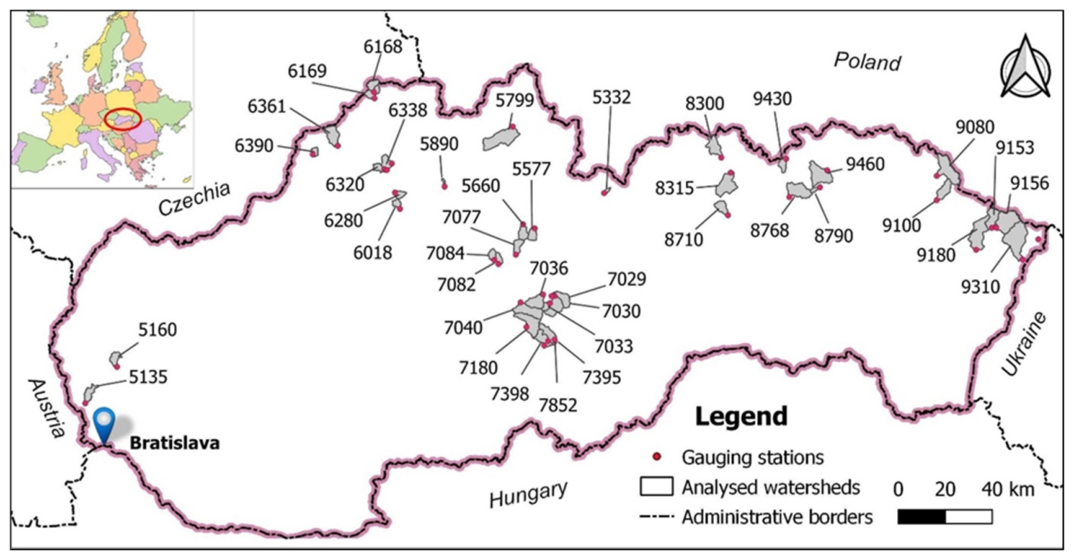
For the purpose of this study, 42 catchments from the region of the Western Carpathians Mts. were selected to be analyzed (
Figure 1). When selecting catchments, several factors affecting the quality of the achieved results were taken into account; in particular, the lithological homogeneity of the rock environment in terms of the basic division of the hydrogeological units of Western Carpathians, and similarities in lithology and/or contrasting lithological properties of rocks/sediments forming the area of catchment were considered. According to this, another selection condition was the area of the catchment. Given the fact that the larger the catchment is the more pronounced the differences in lithology may be, the area of individual catchments did not exceed 100 square kilometres at the time of the selection. The concept for selecting small headwater catchments which enclose homogenous lithologies is that the morphologic catchment divide line (boundary) corresponds with the hydrogeological boundaries and to a large extent eliminate any lateral cross-boundary flow. Considering this, it can be assumed that the values of the obtained runoff parameters represent the infiltration capacity of the individual studied hydrogeological units.
Availability of surface flow observation in a sufficient time span was the final condition. In a previous study [
40], 42 catchments in three hydrogeological units were selected according to these conditions, specifically, 19 catchments representing the crystalline rock hydrogeological unit, 16 catchments representing the folded flysch Paleogene hydrogeological unit and 7 catchments representing the unfolded Inner Carpathian Paleogene hydrogeological unit. Still, similar hydrogeological environments were analyzed: in all three types, regolith-dominated groundwater circulation is present. In all three units, the majority of groundwater circulation is bound to the cracked and weathered near-surface zone (regolith) although lithology and tectonic history might be different [
50]. The basic information about the surface water gauging stations on rivers/creeks as seen in
Table 1,
Table 2 and
Table 3 is based on the available yearbooks of the Slovak Hydro-Meteorological Institute (SHMI) [
51].
The groundwater divide lines for the catchments were determined by the position of surface water gauging stations. In this case, SHMI’s data on areas of the evaluated catchments, presented in yearbooks, were not used. In the past, the original values were determined by planimetry on paper maps which were often intentionally deformed (for military-tactical reasons in the cold-war period in the second half of the 20th century); the current digital form of the relief data enables more accurate delineation of areas. Having in mind the geological background of the data, in this study the manual procedure of catchment delineation was preferred. For the needs of our study, the priority was to determine the catchment area as accurately as possible; however, we do not claim to definitively determine it accurately [
40].
Table 1.
Selected characteristics of the evaluated catchments representing the crystalline rock hydrogeological unit.
Table 1.
Selected characteristics of the evaluated catchments representing the crystalline rock hydrogeological unit.
| ID | Catalogue Number 1 | River/
Creek | Gauging Station | Evaluated Period | Area (km2) | Stationing [km] | Mean
Elevation [m a.s.l.] | Mean TRI 2 |
|---|
| 2 | 5135 | Vydrica | Červený most | 1965–2012 | 21.38 | 3.30 | 350 | 13.52 |
| 3 | 5160 | Blatina | Pezinok | 1962–2009 | 18.96 | 8.75 | 482 | 18.84 |
| 4 | 5332 | Beliansky p. | Tri Studničky | 1975–1991 | 3.40 | 15.20 | 1632 | 39.07 |
| 13 | 5577 | Zadná voda | Kožiarka | 1972–2003 | 15.79 | 1.20 | 1422 | 32.27 |
| 14 | 5660 | Palúdžanka | Horáreň Hluché | 1970–2011 | 19.72 | 10.20 | 1376 | 36.20 |
| 22 | 6018 | Valčiansky p. | Valča | 1987–2000 | 10.04 | 7.90 | 852 | 32.94 |
| 38 | 6280 | Bystrička | Kunerad | 1968–2012 | 11.44 | 8.00 | 1009 | 15.76 |
| 51 | 7029 | Šaling | Čierny Balog | 1987–2012 | 25.21 | 0.90 | 849 | 22.64 |
| 52 | 7030 | Čierny Hron | Čierny Balog | 1969–2012 | 66.17 | 15.50 | 853 | 21.22 |
| 53 | 7033 | Brôtovo | Čierny Balog | 1981–2012 | 9.47 | 3.30 | 846 | 19.31 |
| 54 | 7036 | Vydrovo | Čierny Balog | 1981–2012 | 34.08 | 1.10 | 782 | 14.91 |
| 55 | 7040 | Kamenistý p. | Hrončok | 1970–2012 | 47.60 | 11.40 | 915 | 38.87 |
| 57 | 7077 | Lomnistá | Jasenie | 1984–2002 | 18.79 | 4.90 | 1368 | 34.79 |
| 58 | 7082 | Bukovec | Pohronský Bukovec | 1984–1992 | 10.19 | 4.60 | 1038 | 34.54 |
| 59 | 7084 | Sopotnica | Brusno | 1984–1997 | 11.73 | 7.60 | 1308 | 16.71 |
| 60 | 7180 | Slatina | Hriňová nad VN | 1971–2012 | 52.92 | 50.80 | 848 | 19.13 |
| 61 | 7395 | Ipeľ | Ipeľský potok | 1990–2012 | 26.63 | 200.10 | 836 | 19.66 |
| 62 | 7398 | Ipeľ | Málinec-nad VN | 1995–2012 | 53.14 | 197.60 | 803 | 10.82 |
| 78 | 7852 | Kokavka | Ďubákovo | 1990–2003 | 2.84 | 11.50 | 882 | 44.79 |
Table 2.
Selected characteristics of the evaluated catchments representing the folded flysch Paleogene hydrogeological unit.
Table 2.
Selected characteristics of the evaluated catchments representing the folded flysch Paleogene hydrogeological unit.
| ID | Catalogue Number 1 | River/Creek | Gauging
Station | Evaluated Period | Area (km2) | Stationing [km] | Mean
Elevation [m a.s.l.] | Mean TRI 2 |
|---|
| 16 | 5799 | Hruštínka | Lokca | 1979–1999 | 78.67 | 0.90 | 858 | 14.25 |
| 26 | 6168 | Predmieranka | Klokočov-Klin | 1982–2012 | 15.99 | 8.00 | 783 | 17.80 |
| 27 | 6169 | Predmieranka | Klokočov | 1985–1997 | 35.18 | 5.00 | 722 | 17.31 |
| 46 | 6361 | Papradianka | Papradno | 1983–1993 | 36.53 | 13.80 | 735 | 24.30 |
| 47 | 6390 | Petrinovec | Vydrná | 1961–2012 | 8.49 | 2.20 | 596 | 21.94 |
| 102 | 8768 | Ľutinka | Ľutina | 1992–2011 | 50.02 | 5.10 | 775 | 28.31 |
| 103 | 8790 | Pastovník | Hertník | 1969–1983 | 5.48 | 4.80 | 784 | 12.94 |
| 110 | 9080 | Vydranka | Medzilaborce | 2001–2010 | 64.73 | 0.54 | 556 | 16.42 |
| 111 | 9100 | Olšava | Čabiny | 1973–1992 | 30.93 | 0.65 | 446 | 19.27 |
| 112 | 9153 | Stružnica | Starina | 2001–2011 | 33.30 | 0.10 | 577 | 20.43 |
| 113 | 9156 | Cirocha | Starina-nad VN | 2001–2011 | 66.57 | 43.40 | 618 | 14.57 |
| 114 | 9180 | Pčolinka | Snina | 2001–2010 | 71.11 | 1.00 | 384 | 21.92 |
| 118 | 9300 | Zbojský p. | Nová Sedlica | 1972–1988 | 35.20 | 12.40 | 675 | 21.97 |
| 119 | 9310 | Ulička | Ulič | 2001–2011 | 96.57 | 2.50 | 573 | 22.42 |
| 122 | 9430 | Večný p. | Lenartov | 1982–1992 | 14.88 | 4.50 | 742 | 22.24 |
| 124 | 9460 | Šibská voda | Kľušov | 1992–2010 | 59.91 | 4.30 | 472 | 12.01 |
Table 3.
Selected characteristics of the evaluated catchments representing the unfolded Inner Carpathian Paleogene hydrogeological unit.
Table 3.
Selected characteristics of the evaluated catchments representing the unfolded Inner Carpathian Paleogene hydrogeological unit.
| ID | Catalogue Number 1 | River/Creek | Gauging Station | Evaluated Period | Area (km2) | Stationing [km] | Mean
Elevation [m a.s.l.] | Mean TRI 2 |
|---|
| 19 | 5890 | Čiernik | Turany | 1969–2003 | 2.69 | 0.50 | 564 | 10.57 |
| 42 | 6320 | Lietava | Lietava-obec | 1969–1979 | 11.47 | 3.75 | 529 | 16.06 |
| 43 | 6330 | Lietava | Lietava-Majer | 1969–2010 | 13.57 | 2.70 | 521 | 9.33 |
| 44 | 6338 | Bitarovský p. | Bánová | 1991–2009 | 18.59 | 1.03 | 416 | 26.23 |
| 85 | 8300 | Kamienka | Hniezdne | 1980–2008 | 34.46 | 0.70 | 716 | 23.55 |
| 86 | 8315 | Jakubianka | Jakubany | 1987–1997 | 54.16 | 8.00 | 941 | 16.94 |
| 100 | 8710 | Torysa | Nižné Repaše | 2001–2011 | 21.07 | 123.90 | 1003 | 20.51 |
The geological characteristics of the three studied hydrogeological units included in this paper (crystalline rock, folded flysch zone of the Outer Carpathians Paleogene and unfolded Inner Carpathian Paleogene hydrogeological units) are based on the description of the basic Alpine tectonic units in the territory of the Western Carpathians, which are divided into External and Internal Western Carpathians and their present form is a result of the Alpine orogenic stage, with remnants of earlier Hercynian (Variscan) evolution. A tectonic unit is characterized as three-dimensional rock body with its own defined borders, lithostratigraphic and structural content as well as defined tectonic evolution. The boundary between the External and Internal Western Carpathians is represented by the “Pieniny Klippen Belt” which is a narrow and intensively deformed belt consisting of steep cliffs, or klippen, composed of Jurassic and Early Cretaceous limestones which are more resistant to erosion than the surrounding Upper Cretaceous and Paleogene marlstones and clayey sediments [
53].
The catchments within the crystalline rock hydrogeological unit are represented by the “core mountains belt” and “Vepor belt” tectonic units, which are characterized by the central part of the mountain range (core) formed by early Paleozoic crystalline basement rock (mostly granites, and granodiorites), which is partly or completely covered by Mesozoic sediments [
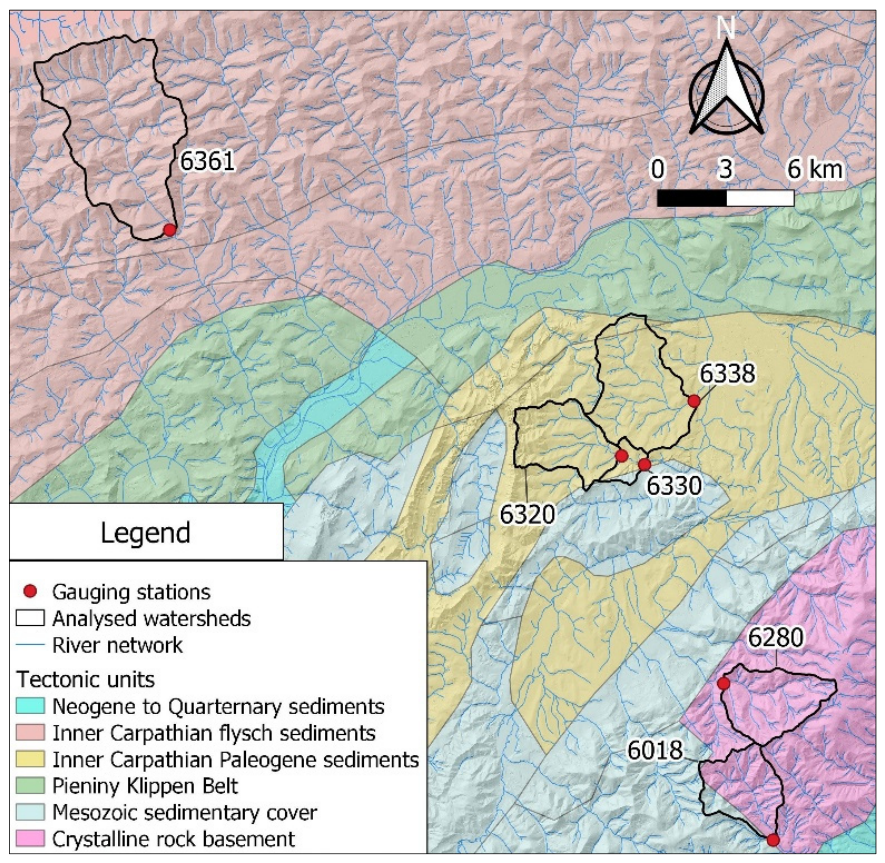
53]. The studied catchments were selected within the crystalline basement rock parts of these units, trying to avoid any presence of Mesozoic sediments that might be karstified and potentially cause some parts of runoff to be diverted to other catchments as seen on
Figure 2.
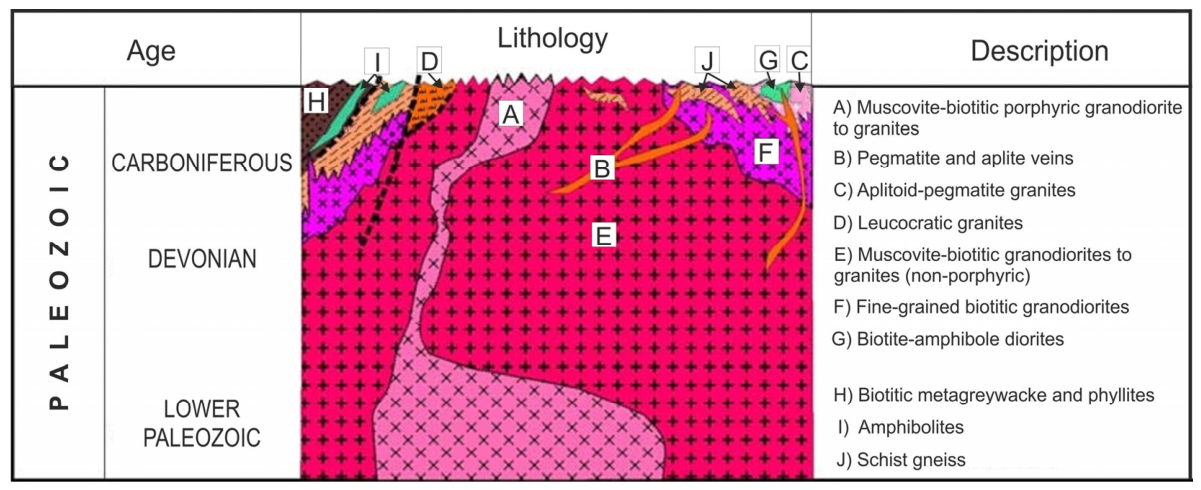
The basic lithostratigraphic profile representing the “core mountains belt” tectonic unit is shown in
Figure 3. This unit’s bedrock is composed by a complex of late Paleozoic metabasites and metasediments, as well as Devonian and Carboniferous granitoid magmatites, with complexes of metamorphic rocks consisting of mainly amphibolites, schists, phyllites and metagreywackes [
54].
Research including pumping tests on 187 boreholes in granitic and metamorphic rocks of this hydrogeological unit was summarized by Malík et al. [
55]. In it, they addressed its hydrodynamic properties in terms of determining the transmissivity coefficient (
T) with the mean value of 6.51 × 10
−5–3.97 × 10
−5 m
2∙s
−1 and hydraulic conductivity coefficient (
k) with the mean value of 2.15 × 10
−6–1.96 × 10
−6 m∙s
−1 [
55].
The flysch zone hydrogeological unit is represented, from a lithological point of view, by the Flysch zone, which is a massive accretionary wedge (a nappe stack) composed by Cretaceous and Paleogene formations in typical “flysch” development with alternating clayey shales and sandstones, deposited in deep-water environment by gravity flows and turbidity currents [
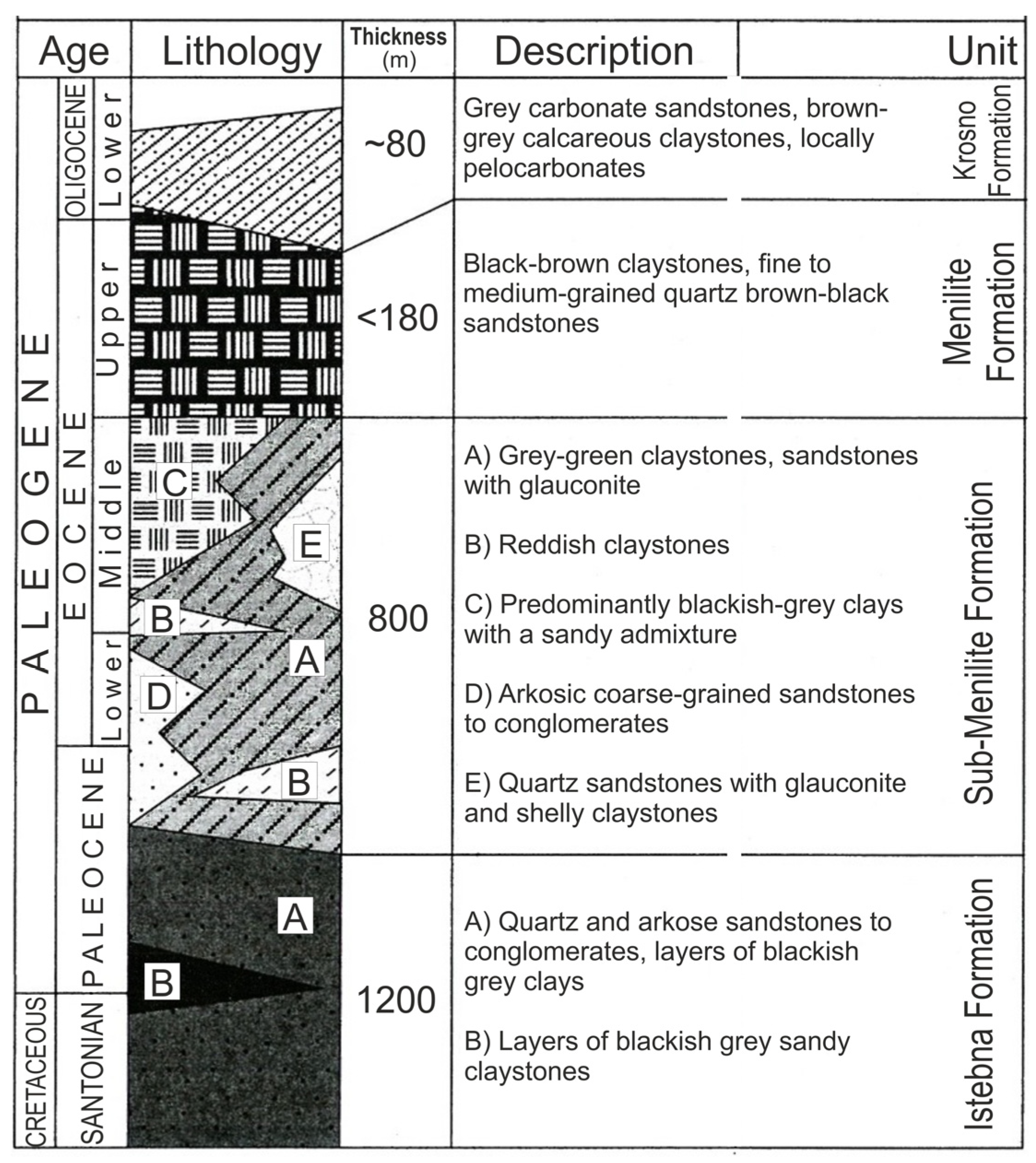
53]. The Flysch zone consists of several nappe systems: the outer underlying “Krosno” nappe system, which is generally characterized by variegated claystones, and the internal overlaying “Magura” nappe system, formed by prevailing sandstones (majority of studied catchments). Catchments located in the outer Krosno nappe system (6168, 6169, 9080, 9100, 9153, 9156, 9180, 9300 and 9310) can be characterized by lithological units of the Silesian nappe [
Figure 4], which ranges from the late Cretaceous to late Oligocene Paleogene period. The oldest formation of this group—the Istebna Formation—belongs in the Santonian to Paleocene stage and are characterized by quartz sandstones to conglomerates with positions of dark clays and claystones. Overlaying is a lithologically diverse sequence of the Sub-Menilite Formation, characterized by the predominance of pelitic or sandstone facies with distinctive green claystone positions. Next there is the Menilite Formation, which is represented by dark black-brown claystones with fine to medium grained quartz sandstone positions. The upper most Krosno Formation (approx. 80 m thick) is characterized by grey fine-grained sandstones and grey calcareous clays [
56].
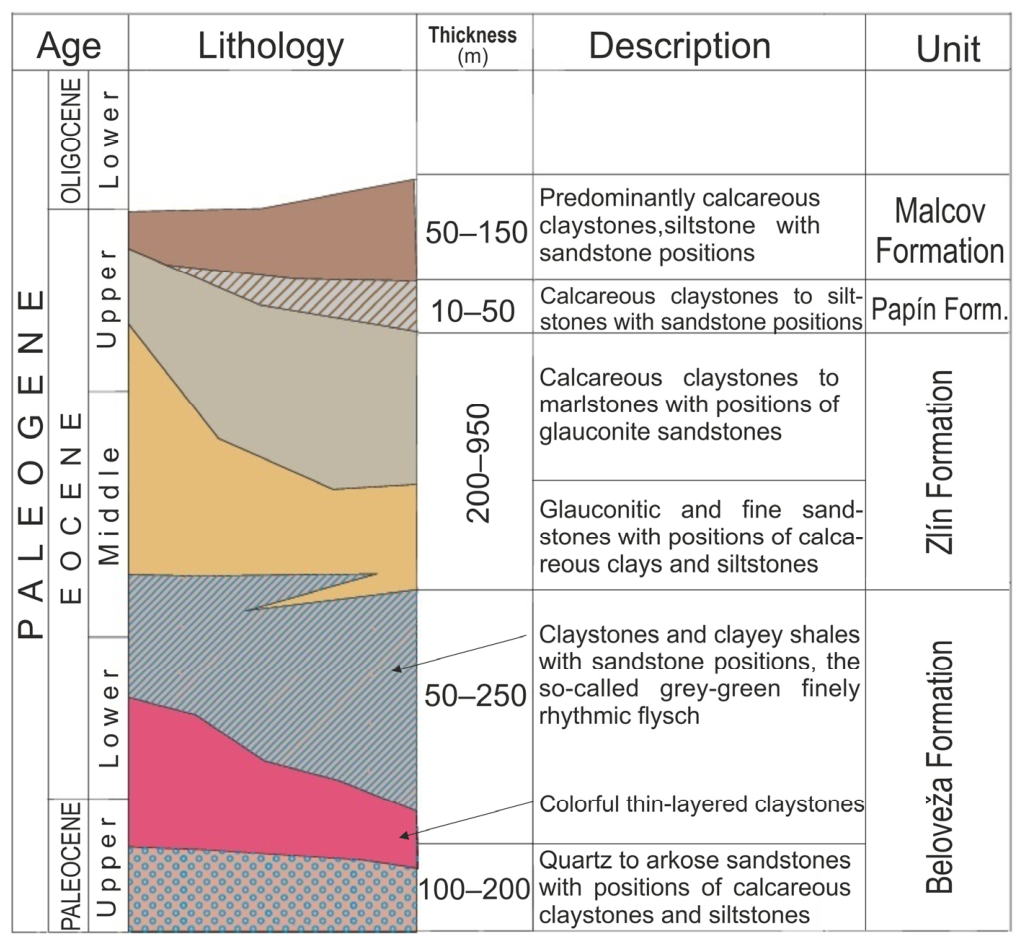
The rest of the flysch zone catchments (5799, 6361, 6390, 8768, 8790, 9430 and 9460) belong to the inner Magura Nappe system which can be described by the Paleogene Rača unit, whose litostratigraphical profile is shown on
Figure 5. Stratigraphically, this unit ranges from the upper Paleocene to late Oligocene period and covers four formations. Beloveža Formation is the oldest and is characterized by thin-layered monotonous clays and fine-grained sandstones (fine-rhythmic flysch). The overlaying Zlín Formation has two distinctive lithologic evolutions—claystone and sandstone evolution. The sequence ends with Malcov Formation, which is characterized by calcareous claystones and siltstones with positions of sandstones [
57].
After studying pumping tests results from several hundred wells in the flysch zone, Jetel published the opinion that the lithological representation of sandstones and claystones does not play an important role in the circulation of groundwater, because it takes place in the weathered near-surface zone [
58]. At that time, he published the results of the transmissivity coefficient (
T) for the near-surface Krosnian formation with a value of 4 × 10
−5–6 × 10
−4 m
2∙s
−1 and the hydraulic conductivity coefficient (
k) with a value of 4 × 10
−6–4 × 10
−5 m∙s
−1, while for the near-surface zone of the Rača unit he determined the coefficients with values of
T = 5 × 10
−6–6 × 10
−4 m
2∙s
−1 and
k = 4 × 10
−7–2 × 10
−5 m∙s
−1 [
58]. Later, Malík and Švasta processed the results of pumping tests from all available boreholes of the flysch zone of the Western Carpathians (database of 335 boreholes), while determining the transmissivity coefficient (
T) with an average value of 4.31 × 10
−5–2.22 × 10
−4 m
2∙s
−1 [
59].
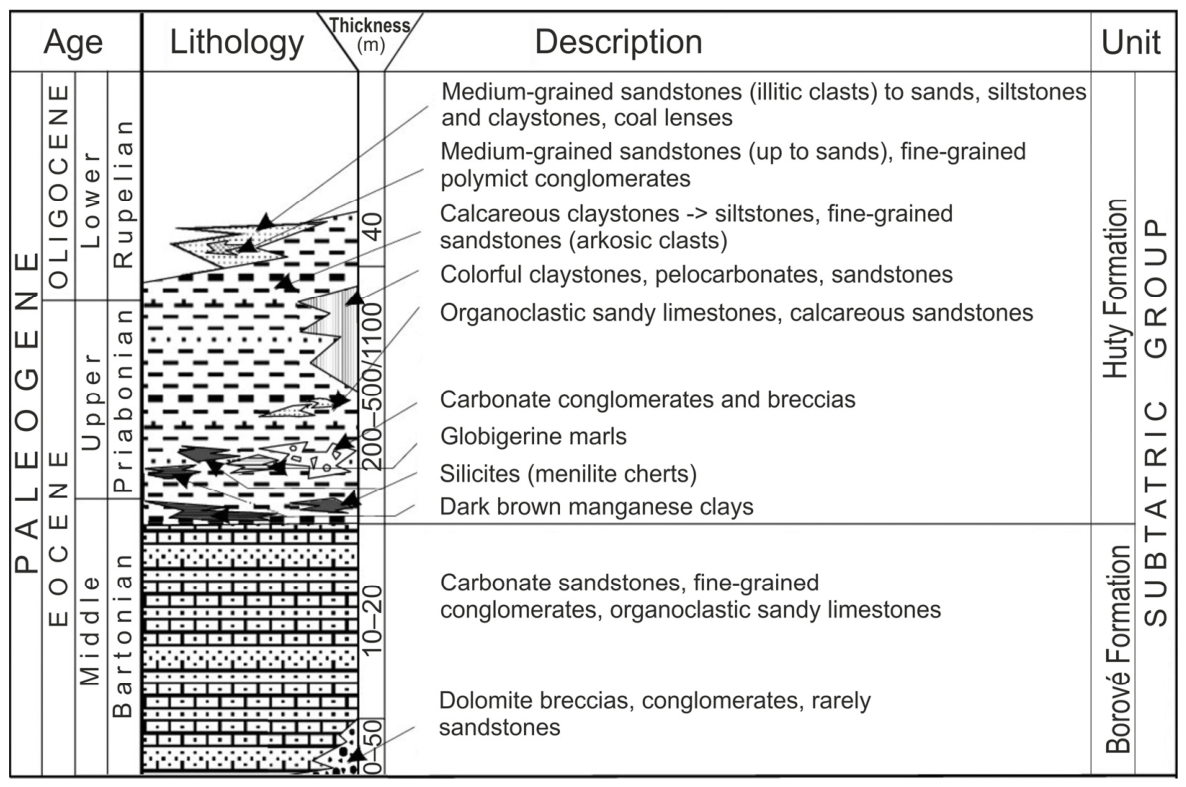
Paleogene sediments, which form the Inner Carpathian Palegoene hydrogeological unit are divided into several lithostratigraphic (litofacial) groups while the studied catchments are represented by the so-called Central Carpathian Paleogene Basin (or Subtatric Group). The stratigraphic range of this group is from Eocene to Oligocene, with the sequence starting with Eocene Borové formation—Bartonian transgressive basal carbonate breccias and conglomerates—overlain by Eocene to Oligocene Huty formation—Priabonian to Rupelian claystones with limestone and sandstone positions—as well as by typical mass transport deposits (“flysch” sandstones and claystones), and terminated by Rupelian deposition of predominantly sandy gravity flow deposits [
53]. A more detailed lithostratigraphic description is showed in
Figure 6.
In the above-mentioned study [
59], Malík and Švasta also studied sediments of the Inner Carpathian Paleogene. From the results of pumping tests on 330 boreholes in the monitored formations, they determined the hydraulic parameter of transmissivity coefficient with an average value of 2.02 × 10
−4–1.49 × 10
−4 m
2∙s
−1.
The main difference between the two Paleogene sedimentary hydrogeological units is that the Inner Paleogene unit was not affected by the final stages of Alpine orogeny and remained in a subhorizontal position with vertical movement of individual blocks; meanwhile, Flysch zone nappes of the Outer Carpathians, as a result of subduction of the basement, were set in motion during the Oligocene to Miocene periods, forming an extensive fold-and-thrust complex composed mainly of claystones and sandstones, while crystalline rocks formed the catchments’ bedrock in the core Mt. units of the Inner Carpathians, being predominantly granitoids/granodiorites and gneisses in their lithology. All the listed hydraulic characteristics of the investigated environments represent the parameters of the near-surface weathered regolith zone for each studied hydrogeological unit, presuming that the morphologic boundaries of catchments represent the hydrogeologic boundaries as well.
The studied data consists of average daily surface water flow or discharge in m
3∙s
−1 from 42 gauging stations. The values were provided from SHMI as a part of the “Integrated System for the Simulation of Runoff Processes” (ISSOP) [
61], in which they were used by the State Geological Institute of Dionýz Štúr (SGIDS) in the past period. The time series include stream flow monitoring data for the period from 1961 to 2012. Although the data for many catchments in this range concern different time periods—which could possibly influence the resulting estimated groundwater runoff values—the evaluated time series are as long as possible for the use of statistical methods of determining groundwater runoff (minimum of 10 years). If only overlapping time series were used, it would not be possible to cover as many catchments and the scope of this study would be considerably smaller.
From the data, the average annual values of the total runoff (
Qc) in m
3∙s
−1 for the monitored period available for individual catchments were determined, which were later, using catchments’ areas, converted to millimetres (mm) to show also specific runoff values. Furthermore, the groundwater runoff parameters, namely the average annual groundwater runoff (
Qgw in mm) and subsequently the ratio of groundwater runoff to total runoff (
Qgw/Qtot in %) from catchments were determined using three different methods (
Table 4,
Table 5 and
Table 6). These three methods are incorporated (or partly) in the software modules of the HydroOffice 2015 software pack [
48], which were used to help process the statistical determination (HydroOffice, Milos Gregor, Mojtin, Slovakia).
The methods described below were selected mainly for their successful previous use in similar conditions and environments of the Western Carpathian Mts, as well as their accessibility. The statistical method of Kille and the Local minimum baseflow separation method were used in Western Carpathians in the past, but mostly in partial small-scale studies. Motivation for use of these specific methods was to expand on this research to a larger overall extent for the territory of the Western Carpathians. Furthermore, it is well known, that baseflow indices are generally highly correlatable to hydrological properties of soils, geological properties and other storage-related parameters [
21]. Therefore, it is of great interest to examine the results of using a comparative analysis of these methods in real conditions, where, for example, such characteristics are not available from geological surveys, etc.
Regarding Rambert’s method, it was firstly developed locally in France [
22] and given the existence of other baseflow separation methods at that time, which were already more well known in the field, like Foster’s or Kille’s methods [
4,
33], Rambert’s method never really made such an impact. It was only later that this method was proposed in Czechoslovakia (at that time) by Kullmann to be used alongside Kille’s method [
62], but again, it never really gained any momentum as a baseflow separation method (to our knowledge), mainly because of its technical difficulties and limitations at that time. Only after the advances in information technologies after the end of 20th century was it revived again [
25], and therefore it was decided to also use this method for comparison and evaluation. The used methods themselves are described further.
Firstly, this study used the classic statistical method of Kille [
4], which was previously described and evaluated specifically for the region of the Western Carpathians Mts. [
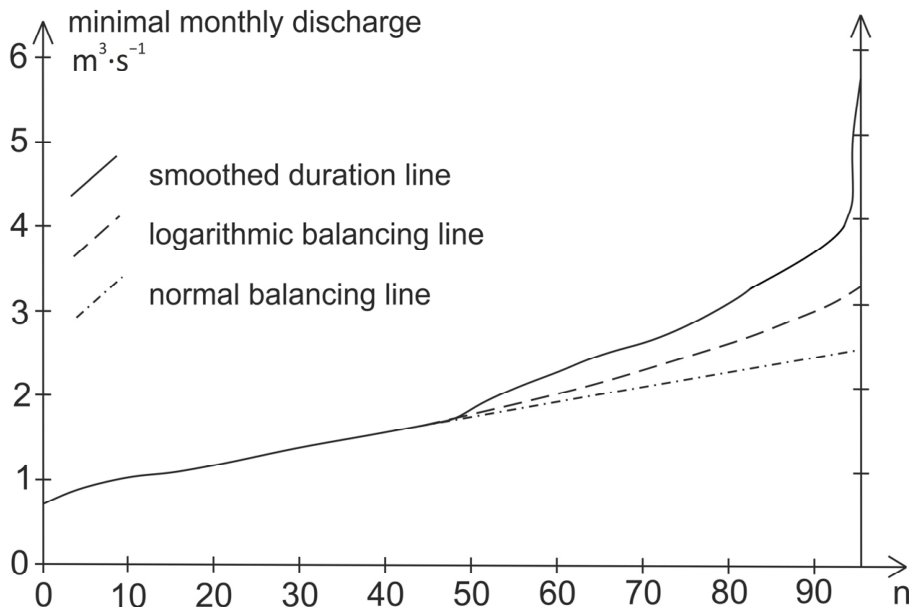
5]. For determining the value of long-term average groundwater runoff from a catchment with this method, at least a 10-year-long period of daily flow observations is required. The method is based on an analysis of minimum monthly surface stream flows. By plotting the values of minimum monthly flows in ascending order on the graph with linear distribution of coordinates, an image similar to the duration line of non-attained flows is obtained. The lower part of the set of ordered points can be translated by a straight line, representing, in terms of Schroeder [
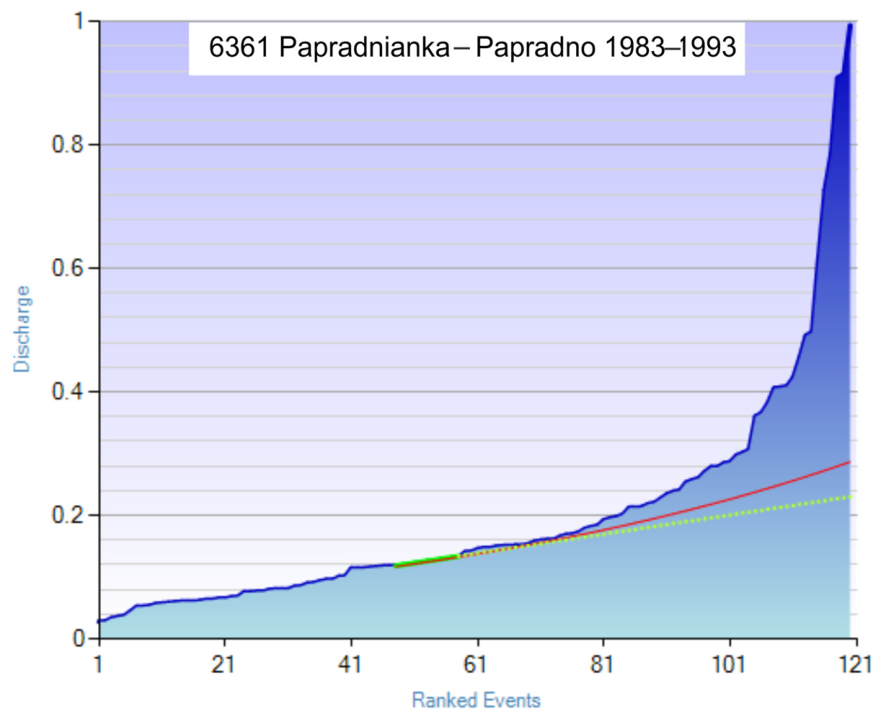
63], the dividing line of “pure groundwater drainage”. From the area under this straight line, the average groundwater runoff can then be calculated, the value of which corresponds to the central guideline of the balancing straight line. However, in reality, most sets of minimum monthly flows have an asymmetric distribution of abundance. Therefore, Kille further proposed transforming the distribution by plotting the same ascending ordered values in a semi-logarithmic plot, with the
x-axis having a linear scale and the
y-axis having a logarithmic scale. In such coordinates, it was possible to translate again, with a set of points, an equalizing straight line approximately in the range of values 5 ≤
n ≤ 50. This straight line, just like in the previous case, can be considered the line separating the groundwater runoff. If the logarithms of the y-coordinate of the equalizing line are converted to their natural values and plotted in the original linear graph, an exponential curve is obtained, which in the upper part of the set of points lies between the original measured values and an exaggerated equalization line led by the lower part of the set of ordered values of minimum monthly flows (
Figure 7).
From the sum of the minimum monthly flows in the lower part of the dataset and the reduced values of the minimum monthly flows in the area of the exponential curve (in the upper part of the dataset), it is then possible, according to Kille, to calculate the most probable value of the average long-term groundwater runoff [
4]. To calculate the values of groundwater runoff by this method, the Kille 3.1 module [
64] from the HydroOffice 2015 software pack [
48] was used (
Figure 8).
As the second alternative method, Local minimum method (BFI) was applied at the same set of discharge time series. This method represents one of the three basic continuous baseflow separation methods as standardized by Sloto & Crouse [
14]: fixed interval, sliding interval and Local minimum methods. Methods for continuous separation generally divide streamflow into a quick and a delayed component using an automated time-based separation. The delayed component is thought to represent the portion of total streamflow, that originates in groundwater drainage, defined by Hall as baseflow (
Qb) [
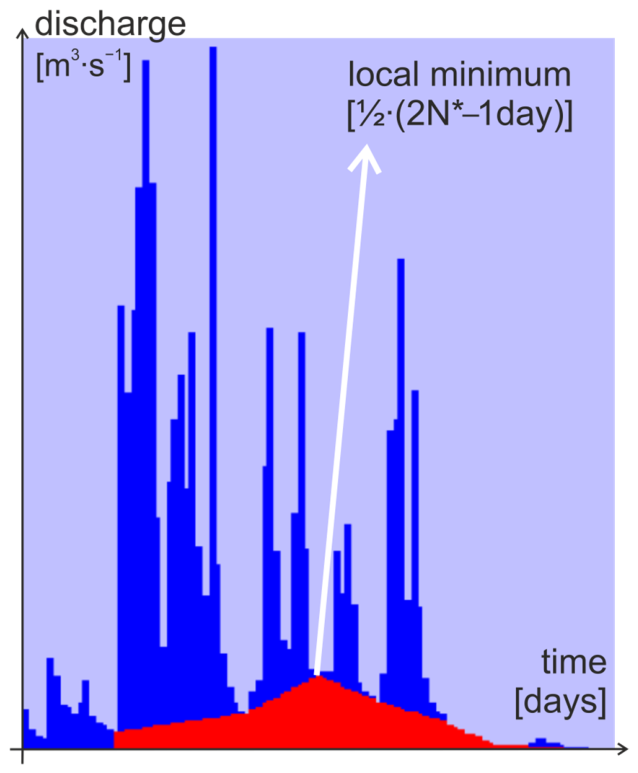
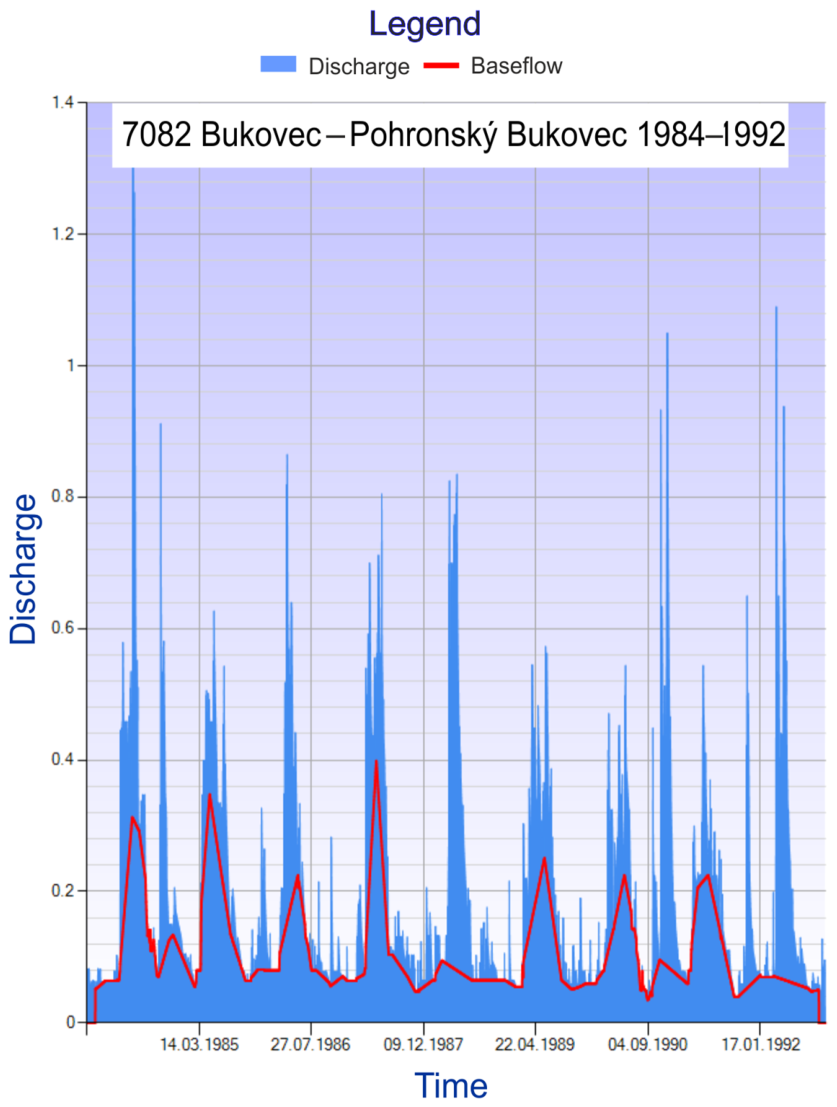
65]. The Local minimum method (BFI), as stated before, is based on an automated time-based algorithm which checks each day for discharge observations to determine if it has the lowest value of discharge in ½ of the selected interval minus 1 day before and after the day which is being checked. If the check is positive, then the checked value is a Local minimum and is subsequently connected by a straight line to adjacent Local minimums in the dataset (
Figure 9). The baseflow values in between each Local minimum are estimated by linear interpolations. For baseflow separation using this method, a specific value of the time interval or times step length of
N = 20 days was used, which was established as best for local hydrological and meteorological conditions of the studied region of Western Carpathian Mts by the work by Stojkovova and Fendekova [
66], who used this method to determine runoff characteristics in similar catchments of the studied region. The average values of baseflow (groundwater) runoff were determined by the BFI+ 3.0 [
67] module of the HydroOffice 2015 software pack [
48] (
Figure 10).
Rambert applied exponential recession curve to delineate baseflow in stream hydrograph in his method [
22]. In this pre-digital era, the baseflow master recession curve had to be manually created (in corresponding scale) in the form of a paper or plastic template. In later work, a digital conversion of this method described the supposed delineation of the baseflow recession curve as an exponential formula defining one of the flow components, the “slowest one” with the lowest recession coefficient value [
25]. This flow component is then inherently included in the whole master recession curve of the watershed, which can be composed as a set of several linear and exponential equations [
25]. Such a solution was then incorporated into the RC 4.0 module [
48] of the HydroOffice 2015 software pack (
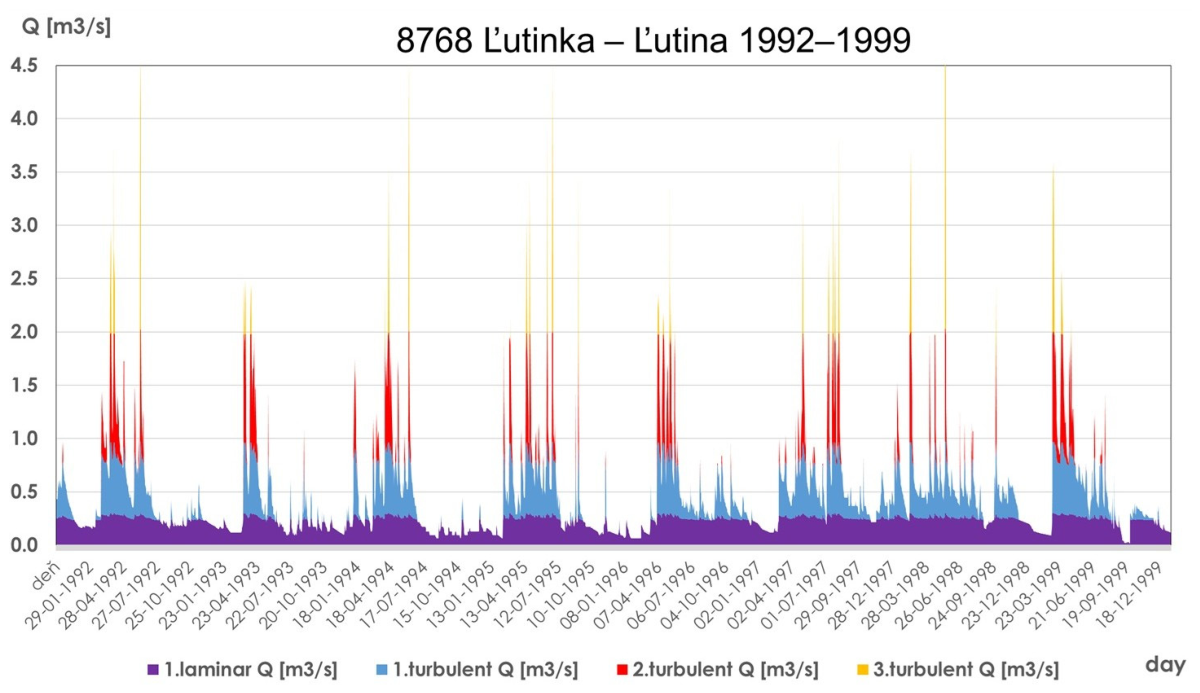
Figure 11) [
48], which uses artificial intelligence, and acts as a combination of a highly hybridized genetic algorithm and an artificial immune system method, together with another 14 conceptual models of recession functions. In the process of hydrograph separation into individual flow components, every measured discharge value
Qt and also relevant portions of
Qt01 …
Qt0n discharge values of individual flow components (
Qt01 +
Qt01 +
Qt0n =
Qt) are considered to be represented just by a time t value—theoretical elapsed time from the overall maximum discharge value
Qmax. Using iteration procedures, proportional amounts of different flow components (including baseflow) can be calculated, both for every moment of evaluated period or for the whole evaluated period [
25].
4. Discussion
When discussing the hydrogeological properties of individual hydrogeological units, it should be considered that the study compares regolith zones—loosened and weathered near-surface zones of units several tens of metres (10–50 m) thick. However, it seems that the granitoids have apparently more massive (thicker) loosened zones, with fissure type of permeability, originally. Although, we assume that this is an intergranular type of aquifer type, as the fissures and cracks in the exposed part are filled with secondary filling formed by loose rock, or sediment, which is then associated with a higher rate of storativity. In this case, fissures and tectonics affect the circulation of groundwater in the deeper bedrock; however, much less groundwater circulates there.
Jetel already reported in the past [
58] the exponential decrease in hydraulic conductivity with increasing depth. Geological history—the length of exposure to exogenous processes—could have played a more significant role in the development of the loosened zone in comparison to tectonic development of mostly closed fissure systems.
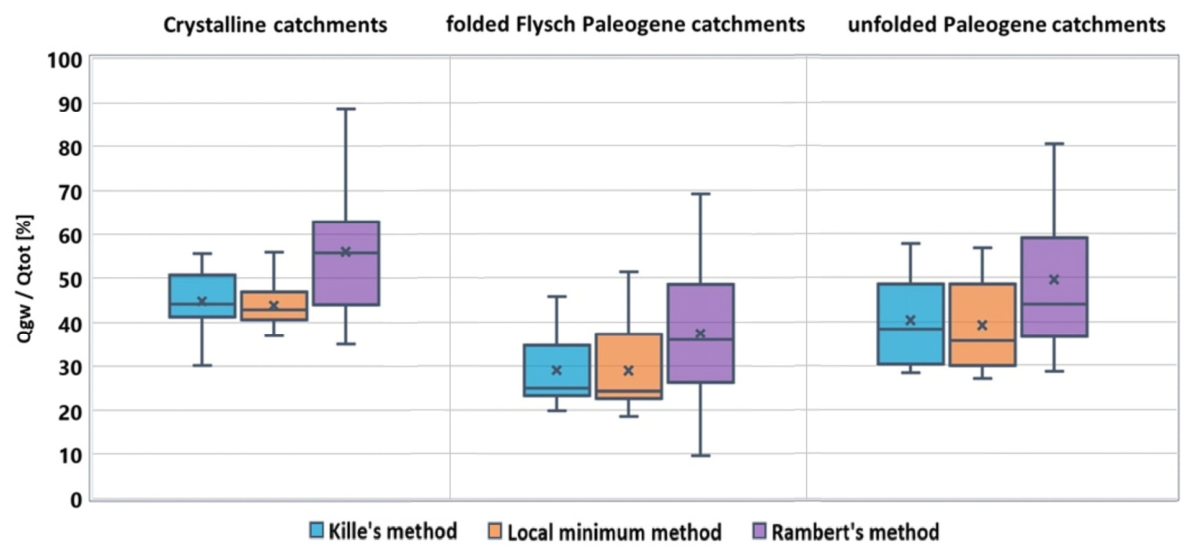
The main result of this study, from a hydrogeological point of view, is the share of groundwater runoff in total runoff from catchments. From these values, we observed that on average, the highest ratio of groundwater runoff to total runoff was determined in catchments of the crystalline rock hydrogeological unit by all three methods. The second highest share was determined in the unfolded Inner Carpathian Paleogene catchments and the lowest average value of this ratio was determined in the folded flysch Paleogene hydrogeological unit (
Figure 12). In comparison to the Kille and the Local minimum methods, Rambert’s method provided 10% higher values for all units, on average. The difference between Kille’s method and the Local minimum method was relatively negligible—1% higher results on average, determined by the method of Kille (
Table 7).
The spread of the data for the Kille and the Local minimum methods was generally smaller, compared to Rambert’s method. The smallest overall spread was observed for catchments in crystalline rock hydrogeological unit, and specifically for Local minimum method baseflow determination, meaning that the most precise results for baseflow determination in crystalline rock catchments were achieved by this method. For folded flysch Paleogene catchments, we observed the smallest spread (highest precision) of results with the use of Kille’s method. In the unfolded Paleogene hydrogeological unit, the spread was quite wide and quite similar for all three methods (
Figure 12).
For every method and every hydrogeological unit, the data had a positive skewness, meaning that the average value was always higher than median value. The only exception was Rambert’s method determination in the crystalline rock unit, where it was negative (
Figure 12).
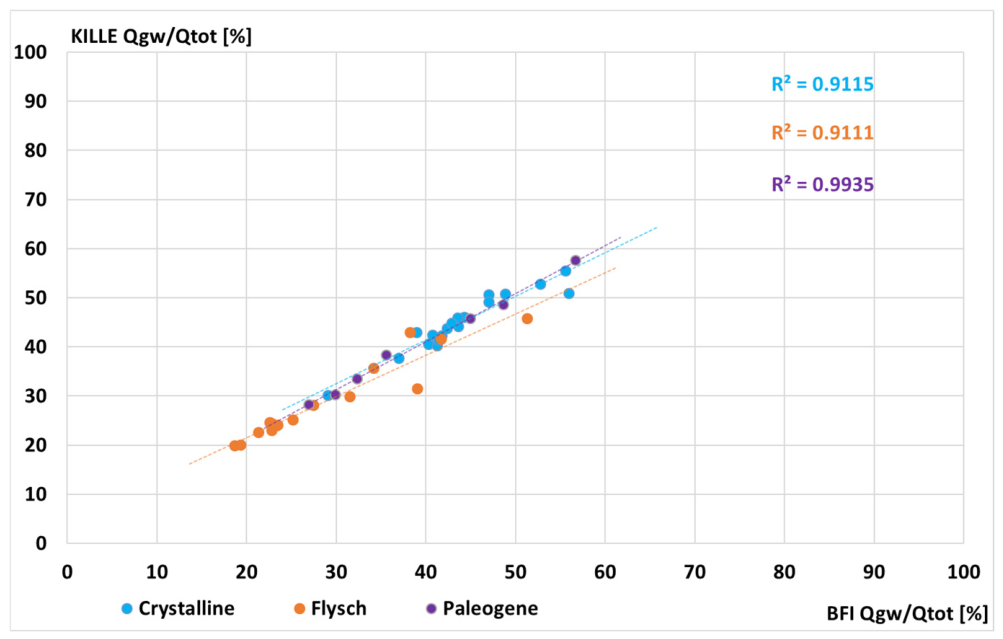
Overall, Kille’s method and the Local minimum method showed very strong linear dependency, when the values of groundwater to total runoff ratio for individual catchments were correlated (
Figure 13). The coefficient of determination R
2 showed a strong fit of 0.91 for crystalline and folded flysch Paleogene catchments and even stronger at 0.99 for unfolded Paleogene catchments, having in mind the different count of catchments in the studied hydrogeological units.
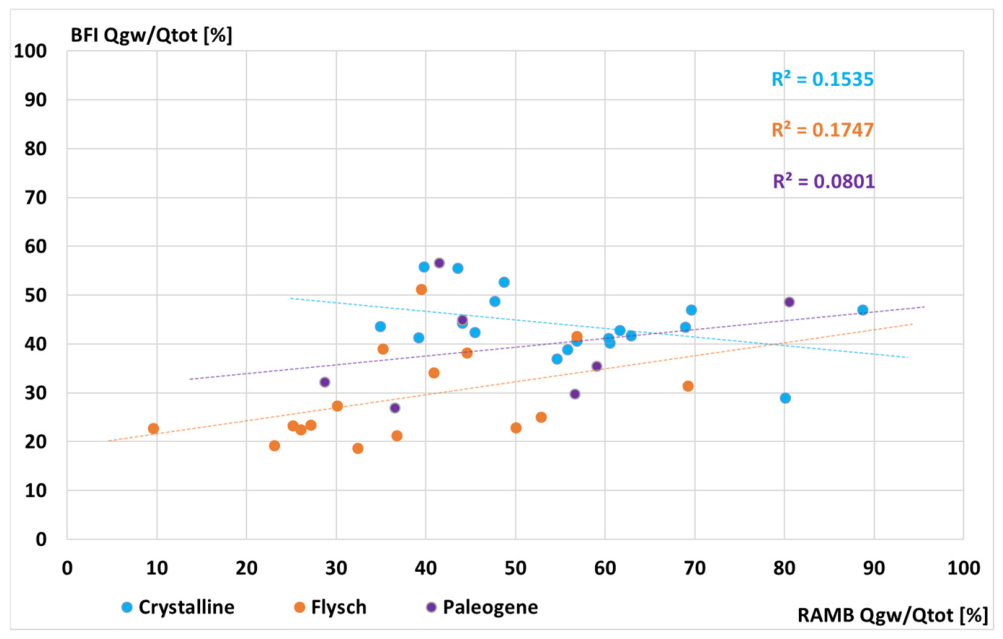
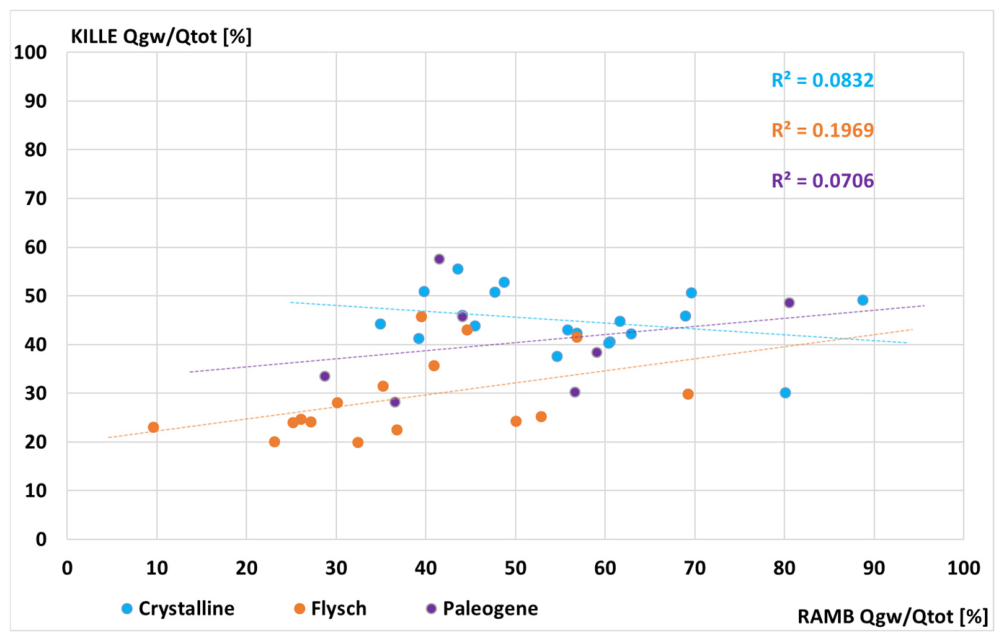
This was not the case when any of the two methods were correlated this way with Rambert’s method (
Figure 14 and
Figure 15). When compared to the individual values of baseflow to total runoff ratio determined by Kille’s method for catchments of the crystalline hydrogeological unit, the coefficient of determination
R2 was only 0.08; for the folded flysch unit 0.20 and for the unfolded Paleogene it was only 0.07. The
R2 of the correlation between results determined by Rambert’s method and Local minimum method was also quite low, at
R2 = 0.15, 0.17 and 0.08 for crystalline, folded flysch and unfolded Paleogene units, respectively. The comparison between Rambert’s method and any of the other two methods was doubtlessly very similar, due to the good correlation between Kille’s method and the Local minimum method.
While determining the baseflow with Rambert’s method, the highly hybridized genetic algorithm was implemented for creation of the MRCs or master recession curves for individual catchments of each hydrogeological unit. The algorithm works with the cloud of data and tries to select one recession line, representing the data cluster of the most representative recession curve. Apparently, there could be an opportunity for the subjectivity of the algorithm during interpretation, in which the baseflow can be increased by inclusions of non-baseflow components (e.g., interflow), or on the other hand, decreased when low values arise from excessively rapid recession leading to underestimation of the baseflow component.
5. Conclusions
On the territory of Slovak part of the West Carpathian Mts., hydrographs of 42 catchments of uniform geological settings were analyzed for baseflow. Three different methods were applied—Local minimum (BFI), Kille’s and Rambert’s. Although the bedrock of the individual catchments was homogeneous, three bedrock groups of catchments could be distinguished: crystalline, folded flysch and unfolded flysch Paleogene sediments. Due to differences in mean catchments’ altitudes ranging from 350 to 1632 m a.s.l., with an average of 796 m a.s.l., mean total annual runoff also varied from 179 to 1132 mm (average of 498 mm). The highest mean elevations were found in crystalline catchments (350–1632 m a.s.l.; 971 m a.s.l. in average); in the case of the two Paleogene catchments types, the altitudes were similar: 384–858 m a.s.l./644 m a.s.l. in average for folded Flysch and 416–1003 m a.s.l./670 m a.s.l. in average for unfolded Paleogene basement. Precipitation total in the area strongly depended on altitudes, which therefore means that the values of total annual runoff were in the range 193–1132 mm (average of 528 mm) in catchments with crystalline basement, 179–787 mm/488 mm in folded and 203–1043 mm/439 mm in unfolded Paleogene basement catchments.
In absolute values, highest baseflow in average was found also in 19 crystalline catchments (Local minimum method: 245 mm/Kille’s method: 241 mm/Rambert’s method: 296 mm) and the two Paleogene basement catchments were quite comparable, as there was slightly higher baseflow in 16 unfolded Paleogene claystone/sandstone catchments (182/177/207 mm) than in 7 catchments of folded Flysch basement (136/136/192 mm). In general, baseflow values showed even higher correlation with the altitude than the total runoff values. Just like total runoff values, baseflow was ranging a lot within individual catchments both in the groups of detection methods as well as in the groups by basement rock types. For Kille’s method it was 83–527 mm in crystalline, 64–206 mm in folded Flysch and 79–478 mm in unfolded Paleogene. For Local minimum method, baseflow results were in range of 75–527 mm in crystalline, 63–230 mm in folded Flysch and 78–469 mm in unfolded Paleogene. Rambert’s method resulted generally in higher values, but in similar ranges: 108–683 mm in crystalline, 54–446 mm in folded Flysch and 89–460 mm in unfolded Paleogene. The whole catchments’ dataset yielded ranges of 64–527 mm for Kille’s method baseflow, 63–527 mm for Local minimum (BFI) method baseflow and 54–683 mm for Rambert’s method baseflow.
For hydrogeological studies the most important parameter should be the ratio of baseflow in total runoff from the catchment, in other words, baseflow share shown in (%) values. Local minimum and Kille’s method results were quite similar: in average baseflow was participating on 39%/40% of total runoff in unfolded flysch Paleogene catchments, on 29% according to both methods in folded flysch, and in the case of catchments with crystalline basement, baseflow represented 44%/45% of total runoff. Rambert’s method results were different both in variability of individual baseflow ratio values (standard deviation of 19% in comparison to 11% in previous two methods) as well as in their difference from Local minimum and Kille’s method results which were from 16% to 51% for the whole dataset. In general, baseflow ratio was 10% to 12% higher, reaching 50% in unfolded flysch Paleogene catchments, 41% in folded flysch and 56% in crystalline catchments.
In general, usually less than one half of unevaporated precipitation is able to infiltrate and recharge groundwater resources in crystalline rocks and flysch sediments, while especially folded flysch rocks are sometimes able to absorb only 10–20% of unevaporated precipitation.
We assume the differences between the used methods to be caused by nature of Rambert’s method based on hydrograph recession curves analyses, while the previous two resulted from discharge statistics. Contrary to statistical methods or digital filters, the Rambert’s baseflow separation method requires discharge curves analysis to be performed prior to baseflow separation to determine initial discharge rate and the recessional exponent at least for the baseflow component. In this way, its use might be affected by subjectivity of interpretation, even when automatic recession curve assemblages are applied.
Considering this, we concluded after the extensive assessment of the three methods used that the Kille’s statistical method and the Local minimum baseflow separation method seem to be the most suitable, overall. Due to the negligible differences in the determination of groundwater runoff by these two methods, both methods are essentially interchangeable with very similar results achieved while using them. However, the difference between the applicability of both methods is the condition of a sufficient time series of streamflow observations. At least 10 hydrological years of observations are required to determine the baseflow by Kille’s method, which is not always possible for time/funding-limited short-term research and the like. Unlike Kille’s method, baseflow separation using the Local minimum method is possible on a much smaller dataset with comparable results. Therefore, we recommend the use of this method in the case of a lack of observations; otherwise, both methods can be used simultaneously, or independently. Also, regarding the differences between methods used in terms of distinct regolith zone assessment, the use of the Local minimum method seems to be more suitable for runoff analysis in crystalline rock environments characterized by fissure permeability and a more pronounced quick-flow part of the total runoff, on which this method showed the smallest spread in determination of baseflow. On the other hand, Kille’s method showed the smallest spread of values in the porous sedimentary environments of the Paleogene sedimentary catchments. Rambert’s method showed a relatively high spread of determination of groundwater runoff in all three studied regolith environments. Although the overall mean difference in results compared to the other two methods was not that high (around 10%), the variability and standard deviation for individual catchments was significant.; therefore, we conclude that this method is not optimal for large-scale studies such as this one, if there are other, more precise methods available.