An analysis of the results from different models, such as the CMIP5 model, as discussed and presented in the Intergovernmental Panel on Climate Change’s Fifth Assessment Report (IPCC), is vital for understanding the variations that occur in temperature and precipitation within the region of interest.
3.3.1. Precipitation
Projected mean annual precipitation from 2025 to 2099 relative to the baseline period is shown in
Table 4. The results show a general decrease in precipitation at all stations under the two scenarios. However, the magnitude of this reduction varies considerably by station and scenario.
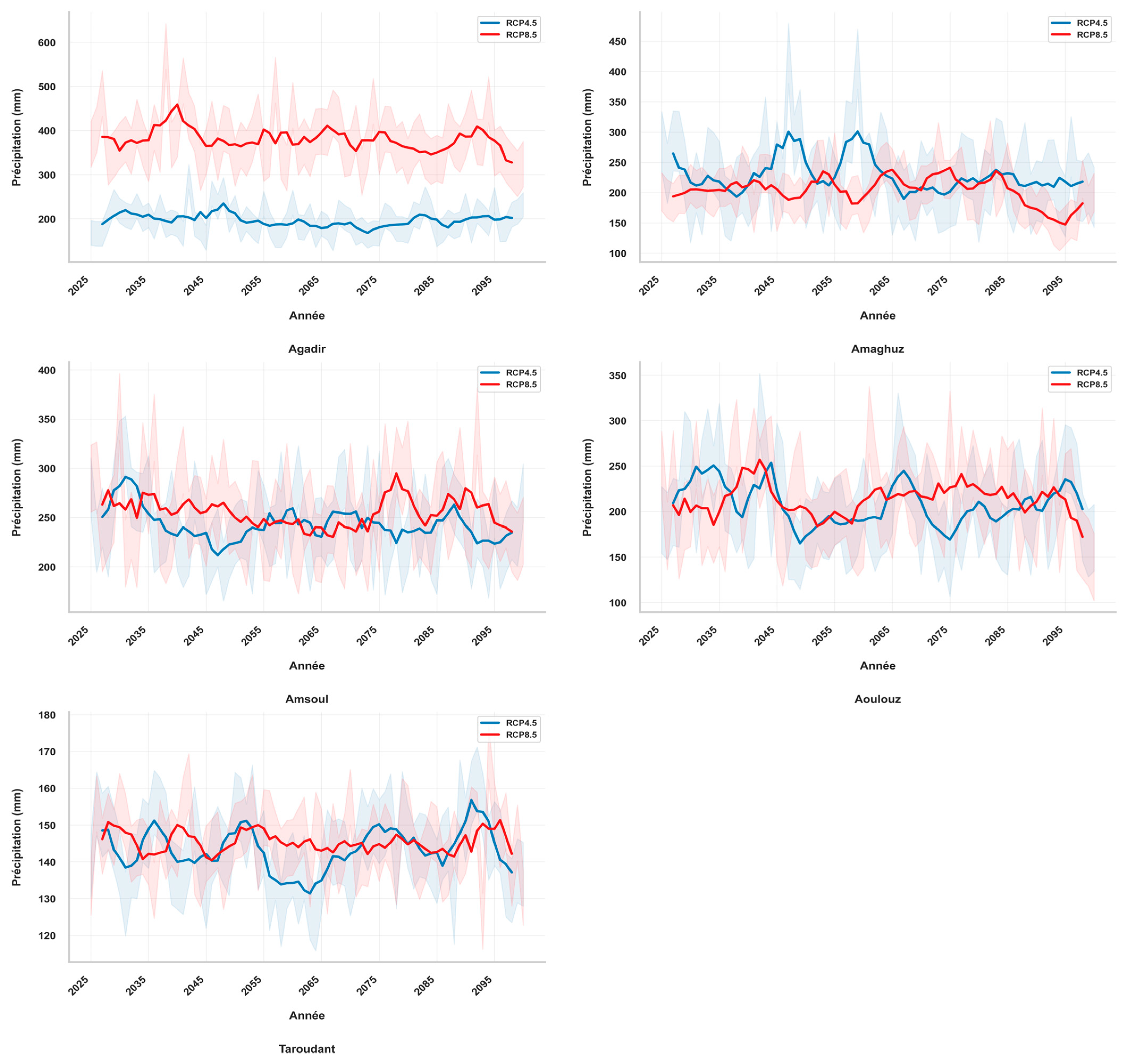
Analysis of the expected precipitation for the Souss-Massa region for the year 2099 (
Figure 5) shows large differences between the two scenarios. For the RCP 4.5 scenario, which is relatively optimistic, there is a trend of decreasing precipitation. The average precipitation per year will be 379.44 mm in Agadir 203.68 mm in Amaghouz, 254.9 mm in Amsoul 211.7 mm in Aoulouz and 145.19 mm in Taroudant. This represents a decrease of between −10.8% and −17.1% from the reference period.
Conversely, the RCP8.5 scenario emphasizes the extent of the increase in the precipitation deficit. The annual average values projected are 196.36 mm in Agadir, 198.12 mm in Amaghouz, 243.23 mm in Amsoul, 206.48 mm in Aoulouz, and 143.24 mm in Taroudant. The reduction varies from −15.0% in Taroudant to −53.8% in Agadir, which shows high sensitivity and a 43% point difference between the two scenarios. On the other hand, the differences between the RCP 4.5 and 8.5 scenarios for the other stations are relatively small, with all being below 4% and showing low sensitivity to the increase in radiative forcing. Based on climate projections over the period 2024–2099, the precipitation is thus expected to decrease over the watershed, with strong differences between scenarios and stations. These projections represent the possible effects of different scenarios of greenhouse gas concentration on precipitation regimes over the Souss-Massa watershed.
These spatial differences are likely controlled by elevation gradients, orographic effects, and regional atmospheric circulation patterns.
3.3.2. Temperature
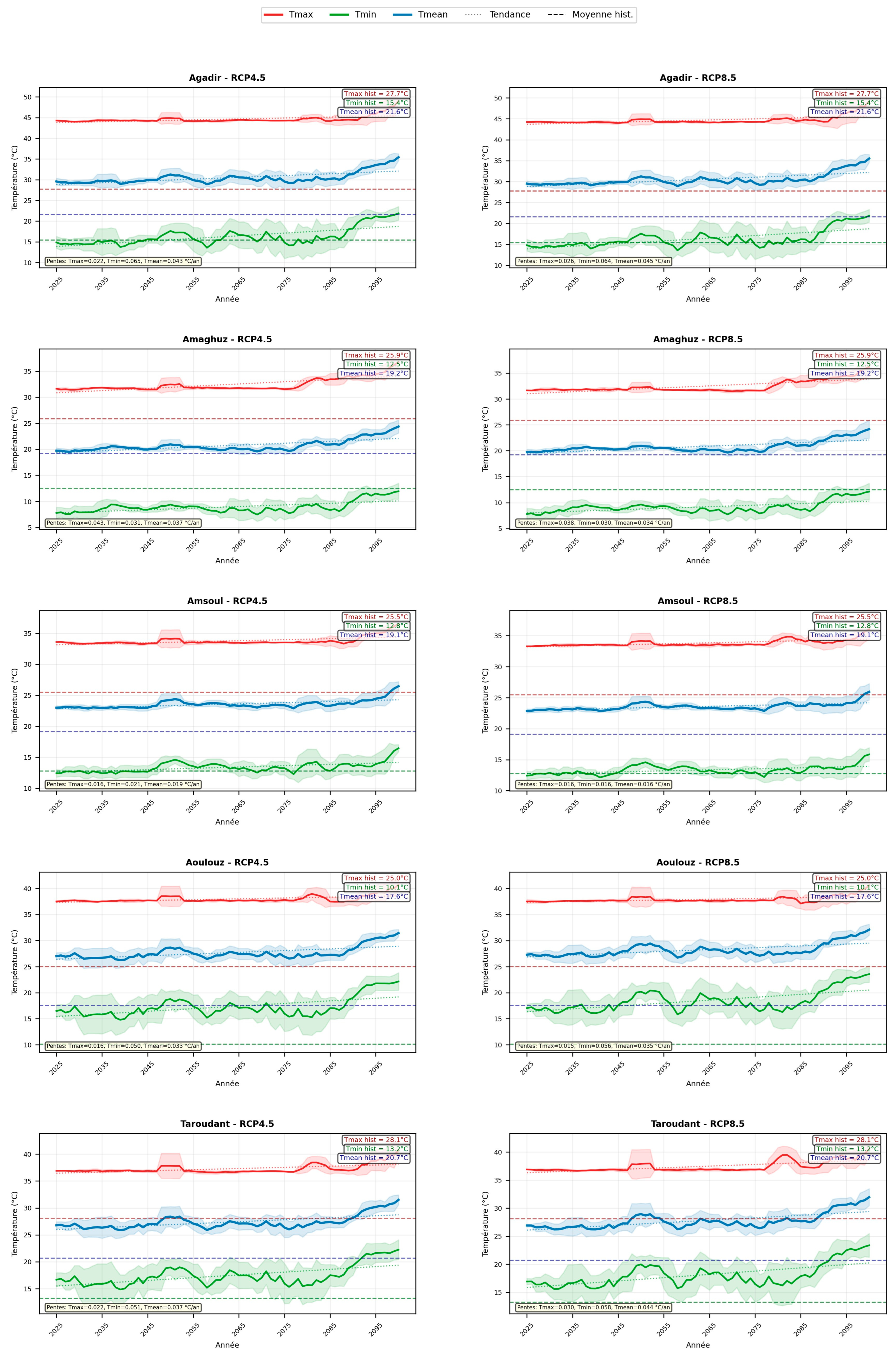
For the Souss-Massa region, extending to 2099, a thermal projection analysis indicates a significant and widespread warming trend for the RCP 4.5 and RCP8.5 scenarios. In all cases, it is observed that the temperature will continue to rise above the historical reference periods (T_hist). This is an indication of asymmetric warming, where the T-min are rising faster than the T-max in the Souss-Massa region, as evidenced by the projected data in all the monitoring stations in the region (
Figure 5). This pattern is confirmed by the projected slopes, which are systematically higher for T-min than for T-max, particularly under the high-emission RCP8.5 scenario; for instance, at the Agadir station, the T-min slope reaches 0.064 °C/year compared to 0.026 °C/year for T-max.
In the Agadir station, the projected maximum temperature is expected to attain or slightly exceed the 44 °C level after 2090, showing a significant increase compared to the historical T-max average of 27.7 °C. At the same time, the continuous increase in minimum temperatures reflects a significant enhancement of nocturnal warming, considerably contributing to the increase in the annual mean temperature.
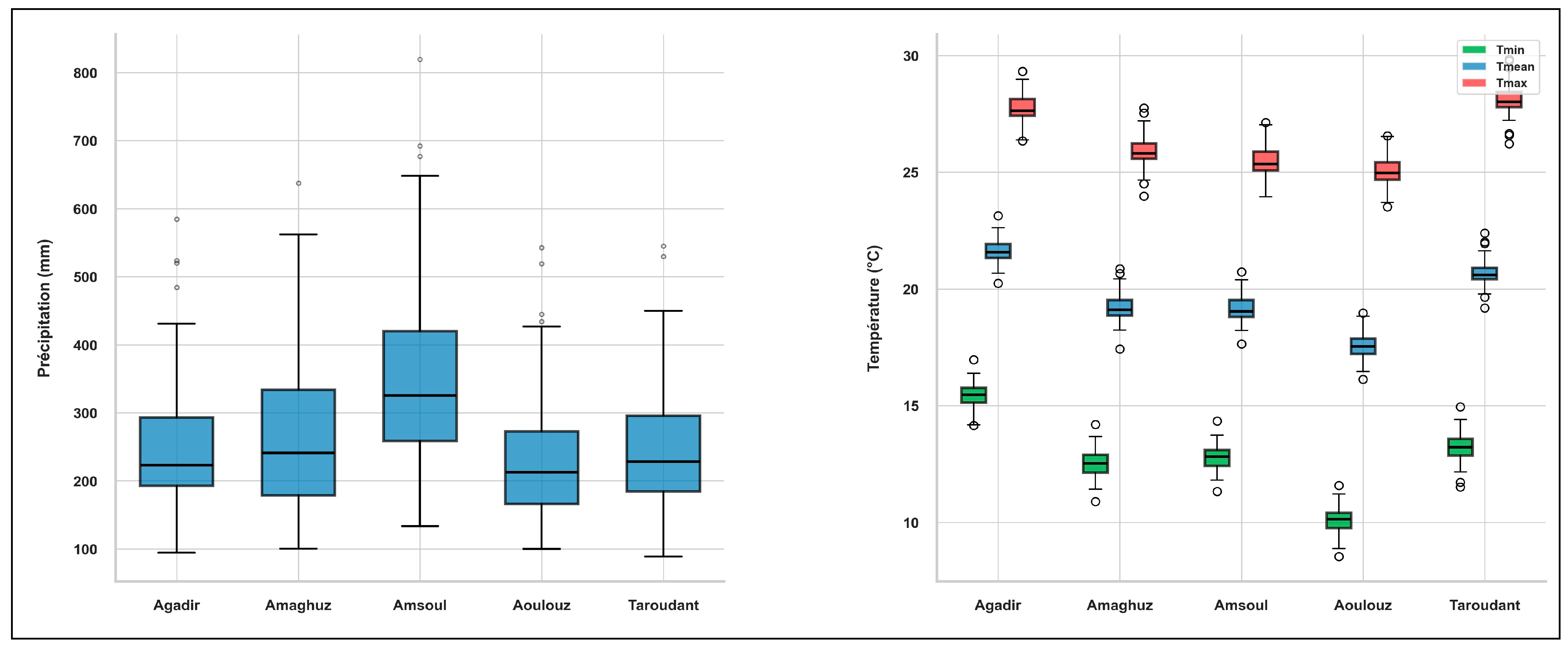
An acceleration of warming becomes more pronounced after 2050 at the Amaghouz and Amsoul stations, where projected trends show a continued increase in T-mean throughout the remainder of the century. Inland stations such as Aoulouz and Taroudant show concurrent increases in T-min, T-mean, and T-max compared to their historical averages, where T_mean increases by 17.6 °C and 20.7 °C, respectively, highlighting the increased sensitivity to long durations of hot temperatures in inland regions.
The RCP8.5 scenario shows a continued trend for increasing temperatures up to the end of the century, while the RCP 4.5 shows a relative stability for temperature increases from around 2085 onwards. Based on these projections, it is evident that there is a gradual increase in temperatures, as well as a decline in precipitation levels, which is likely to lead to a gradual increase in aridity within the Souss-Massa region (
Table 5).
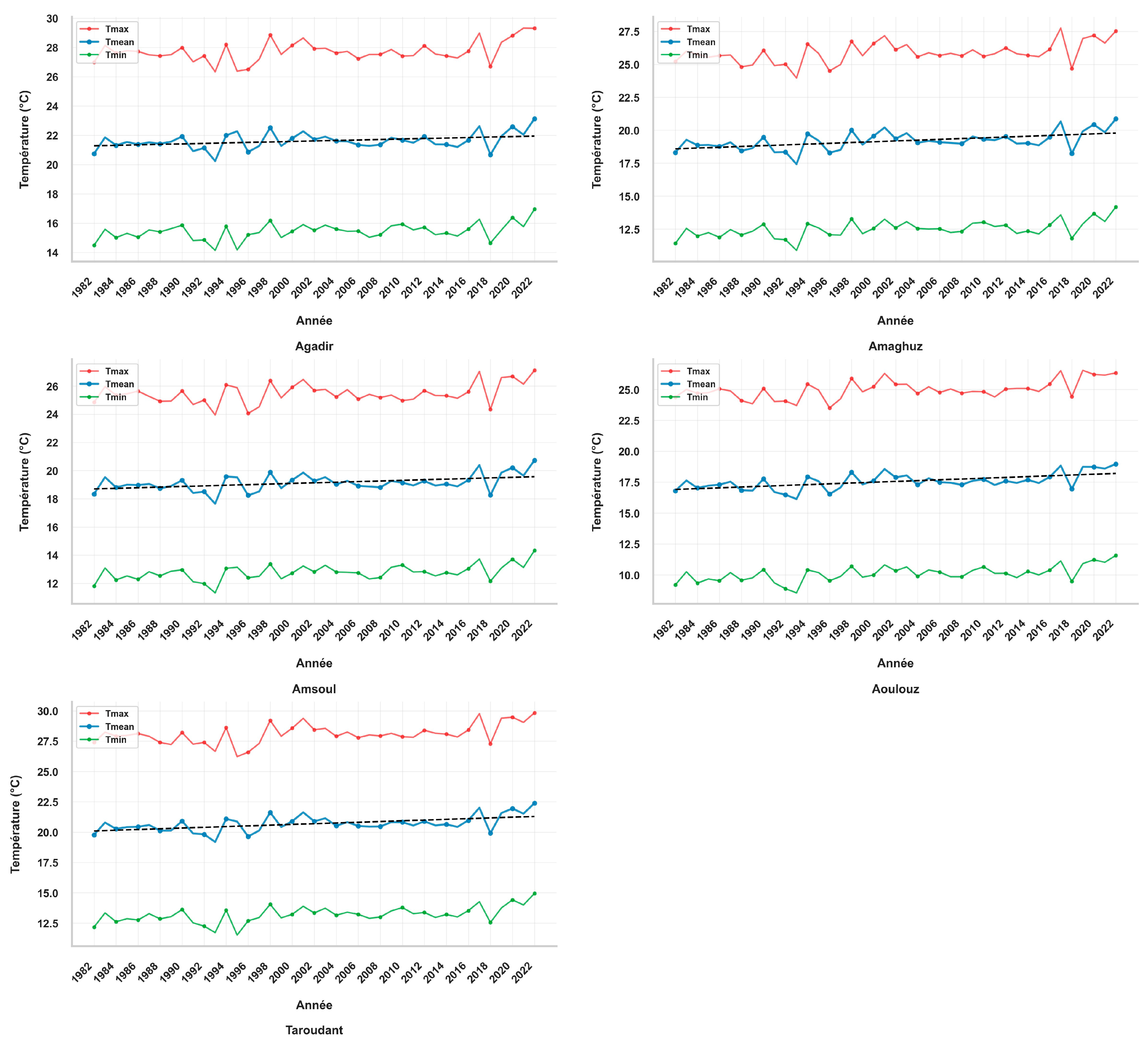
According to climate forecasts for the Souss-Massa watershed, temperatures are projected to consistently increase between 1982 and 2022, as well as between 2025 and 2099 (
Figure 3 and
Figure 6). Future forecasts for the years 2025–2099 under the RCP 4.5 scenario indicate significant temperature increases compared to the historical period. T-max could increase by +6.10 °C in Agadir, +6.58 °C in Amaghouz, +4.82 °C in Amsoul, +5.36 °C in Aoulouz, and +5.68 °C in Taroudant. For T-min, the increases would be +8.14 °C in Agadir, +6.94 °C in Amaghouz, +5.46 °C in Amsoul, +8.49 °C in Aoulouz, and +8.69 °C in Taroudant. The annual average T-mean could increase by +5.63 °C in Agadir, +6.41 °C in Amaghouz, +4.98 °C in Amsoul, +7.37 °C in Aoulouz, and +7.18 °C in Taroudant.
The high-emission RCP8.5 scenario makes temperature increases even more critical: +4.84 °C for T-max, +5.74 °C for T-min, and +4.99 °C for T-mean in Amsoul; +5.42 °C for T-max, +8.74 °C for T-min, and +7.46 °C for T-mean in Aoulouz; +5.82 °C for T-max, +8.74 °C for T-min, and +7.36 °C for T-mean in Taroudant; +6.42 °C for T-max, +8.74 °C for T-min, and +5.84 °C for T-mean in Agadir; and finally +6.65 °C for T-max, +7.04 °C for T-min, and +6.61 °C for T-mean in Amaghouz (
Table 6,
Table 7,
Table 8,
Table 9 and
Table 10).
These projections highlight the expected magnitude of temperature increases at the various stations studied, depending on greenhouse gas emission scenarios, and highlight the spatial heterogeneity of regional climate responses to global warming to global change.
Overall, the combined effects of increasing temperature and decreasing precipitation indicate a progressive intensification of aridity across the Souss-Massa watershed, particularly in inland areas, which may significantly increase pressure on regional water resources and agricultural sustainability.
The analysis of historical observations (1982–2022) and future projections (2025–2099) highlights consistent but contrasting climate responses in the Souss-Massa basin. While the temperature data show high statistical robustness, the precipitation data are more variable and uncertain for both past observations and future projections.
The results reveal two major characteristics of regional climate change. First, the temperature increase is statistically significant and spatially consistent across all stations considered. All climate projections indicate a warming trend until the end of the twenty-first century. Based on the RCP 4.5 and RCP8.5 scenarios, projected warming ranges between 1.3 and 8.7 °C by the year 2099, depending on the station and variable. Specifically, the projected increase in T-min reaches +8.74 °C in Aoulouz and +8.69 °C in Taroudant under the RCP8.5 scenario (
Table 9 and
Table 10), reflecting a severe intensification of nocturnal heat.
The historical climate trends identified in this study provide a vital context for understanding the implications of the forthcoming projections. The significant increase in temperature, as identified in the historical period, reveals that the projected increase in temperature is not just a result of model-based projections but, rather, is a continuation of the existing climatic shifts that are currently affecting the Souss-Massa basin.
These results are in agreement previous studies conducted at the Mediterranean and national levels. For example, Kusi et al. [
42] showed increases in temperature and evapotranspiration by 2050 and 2090. Similar results have been reported by Attar et al. [
43] and Díaz et al. [
44], who estimated an average temperature increase of 1.5 to 6 °C by the end of the century in the Souss-Massa catchment. The magnitude of the historical warming detected in this study reinforces previously identified national trends, confirming the persistence of a long-term temperature increase in Morocco [
26,
45].
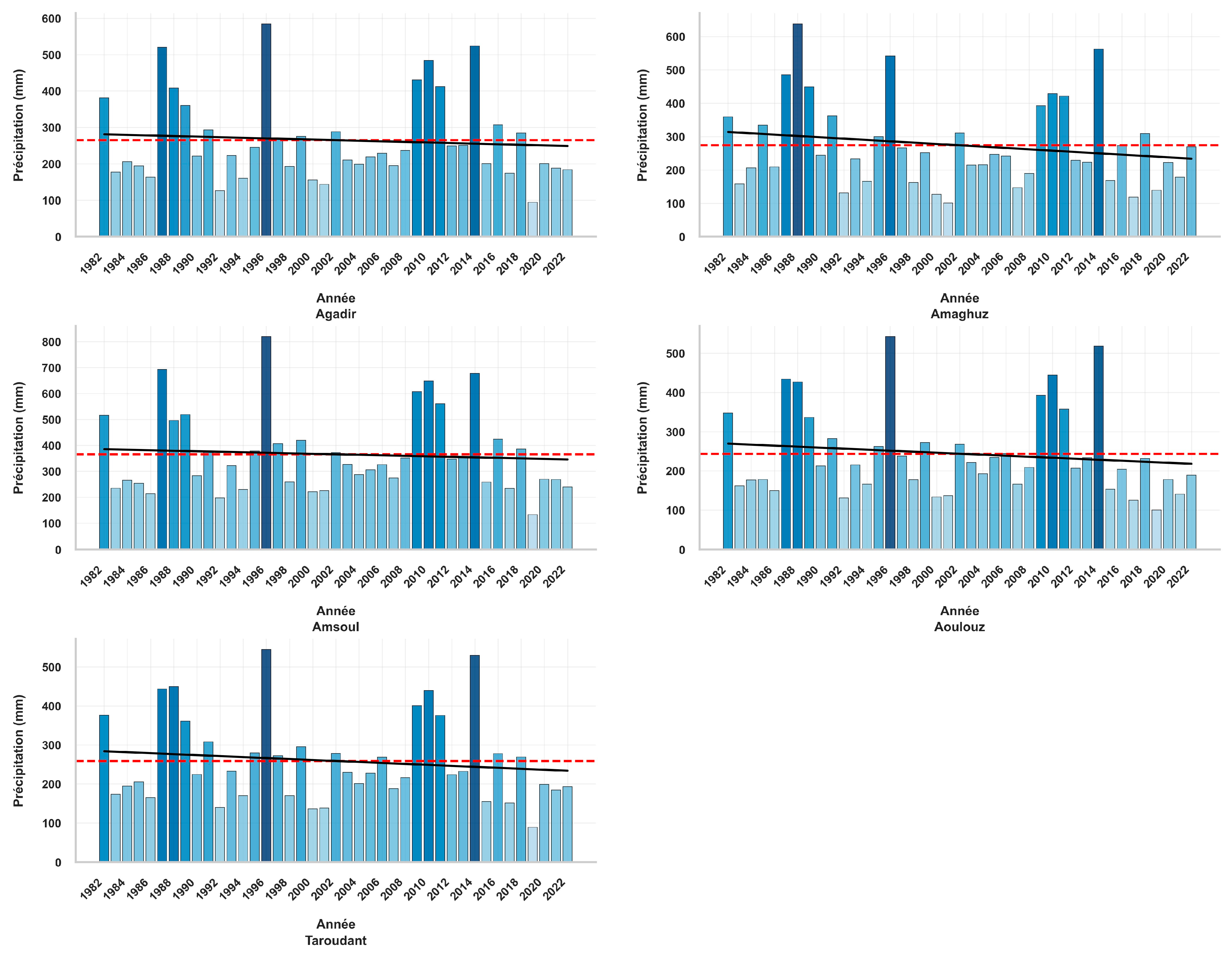
In contrast, precipitation projections remain more uncertain. Although a decreasing tendency appears in historical observations, the trends are not statistically significant due to the strong interannual variability typical of semi-arid climates. Nevertheless, climate projections consistently indicate a reduction in annual precipitation under both scenarios. Decreases range between 11% and 17% under RCP 4.5 and may reach up to −53.8% under RCP8.5 in coastal areas such as Agadir. These results align with previous studies projecting precipitation reductions between 10% and 20% by the end of the century [
26,
45], as well as MASEN (2014), which estimated decreases of 14–40% depending on model configurations.
The divergence between RCP 4.5 and RCP8.5 becomes increasingly pronounced after the mid-twenty-first century. Under RCP8.5, an additional warming of approximately 0.3–1.1 °C is projected by 2099 compared with RCP 4.5, confirming global assessments indicating that emission pathways strongly control late-century warming intensity [
46]. Differences in precipitation response also display spatial variability, with coastal stations showing stronger sensitivity to high-emission scenarios, possibly linked to large-scale atmospheric circulation changes affecting Mediterranean storm tracks, as suggested by Driouech et al. [
47]. For inland stations, the differences are relatively small (2–4 percentage points), which may indicate lower sensitivity to emission scenarios or larger uncertainties in precipitation simulation over continental regions. Recent research carried out within the Souss-Massa basin also confirms the reduction in precipitation and an increase in temperatures for both RCP 4.5 and RCP8.5 scenarios [
34], thus supporting the consistency of the current results with the national climate projections.
The projected changes observed in the Souss-Massa basin are consistent with broader Mediterranean climate tendencies, suggesting that local climate evolution follows regional-scale warming and drying patterns [
11]. The Fourth IPCC Assessment Report also shows warming of 2.5–5.5 °C by the end of the century depending on emission pathways [
48]. Future projections also suggest the likelihood of drought events [
49,
50,
51], in line with the trend of enhanced aridity in Morocco, especially in the north [
52]. At the global scale, there are several semi-arid basins that display similar trends of increasing temperatures and decreasing rainfall [
53,
54,
55]. On the other hand, there are areas that display a concurrent increase in both temperatures and rainfall [
56,
57,
58], highlighting that the impacts of climate change are not uniform in nature.
The combination of strong warming and reduced precipitation has important implications for water resource management. Rising temperatures are expected to increase evapotranspiration rates, reduce soil moisture availability, and intensify irrigation demand. Increased minimum temperatures may additionally affect crop development and agricultural productivity through warmer nighttime conditions.
In the coastal region of Agadir, the large precipitation reduction expected in the RCP8.5 scenario could have severe impacts on water resources and agricultural production. Nevertheless, due to the level of uncertainty involved in precipitation projections, water and agricultural resources in the basin should be strengthened through adaptive management strategies based on multi-scenario climate projections.




 ,
,