1. Introduction
As crucial carriers of urban history and culture, historic cities embody rich historical memories and unique cultural value. However, their drainage systems often fail to meet the demands of modern urbanization, leading to frequent waterlogging risks. Key factors exacerbating waterlogging risks in this historic area include not only common issues such as suboptimal drainage network layout, undersized and ageing pipelines, high proportion of impervious surfaces, and a lack of effective stormwater storage facilities but also heritage-specific constraints—strict heritage protection policies that restrict alterations to historic street profiles, difficulties in subsurface interventions near numerous historical building foundations, and significant challenges in pipeline relocation and traffic diversion due to dense historical structures and narrow streets. The study area contains over 20 historical streets and alleys (e.g., Beijie and Jingzhou Street), three national-level cultural heritage preservation units, and historic buildings accounting for 38% of its structures, which severely constrains the spatial implementation of engineering measures. With growing urban populations and economic activities, development pressures on historic cities continue to increase. How to achieve sustainable development while preserving historical features and cultural heritage has become a pressing challenge.
Urban waterlogging refers to the phenomenon where intense or prolonged rainfall exceeds the urban drainage capacity, resulting in water accumulation and disasters on city surfaces. During rapid urbanization, the drastic increase in impervious surface areas [
1] as led to numerous waterlogging events, such as the 25 March 2020 flood in Nanning [
2] and the 20 July 2021 flood in Zhengzhou [
3], causing significant economic losses [
4,
5,
6,
7,
8].
Traditional grey infrastructure is a common approach for controlling flood hazards [
9]. Grey infrastructure [
9,
10] effectively intercepts, converges, and directs runoff to achieve efficient drainage [
11]. However, its effectiveness in enhancing urban waterlogging resilience remains limited [
12,
13,
14]. In contrast, green infrastructure, characterized by Low Impact Development (LID), promotes sustainable urban development [
15,
16,
17]. Green infrastructure encompasses green roofs [
18], permeable pavements [
19], rain gardens [
20], and other similar measures.
Grey-green coupled systems—often termed Hybrid Green-Grey Infrastructure (HGGI)—have been implemented in various cities (e.g., Milwaukee) [
21] and have demonstrated hydrological benefits in those contexts. However, their application in strictly protected historic districts remains critically underexplored. Existing studies [
22,
23] confirm the hydraulic benefits of grey-green coupled systems, but their applicability to historic districts is limited by their failure to account for heritage-specific spatial constraints—for instance, Li et al. (2022) [
23] focused on an urban development zone without historical preservation requirements, assuming unrestricted retrofitting space and relying on large continuous green spaces and pipeline expansion that are infeasible in our study area (a historic district with 38% of structures being historic buildings, narrow alleyways typically 3–5 m wide, and strict heritage protection buffers); Hou et al. (2022) [
22] proposed large-scale storage tanks without addressing the excavation prohibitions in heritage-sensitive areas like ours, where underground construction within 20 m of historic building foundations is strictly restricted per local preservation regulations. Furthermore, accurate assessment requires rigorous model calibration based on local monitoring data, which is often lacking in theoretical studies.
To address these gaps, this study focuses on the historic urban district of City B, a typical area constrained by dense historical alleys and water bodies. Using a calibrated 1D-2D coupled model based on field monitoring data, we aim to (1) diagnose the drainage system bottleneck through a dual-dimensional approach integrating hydraulic performance evaluation (e.g., pipeline capacity, upstream–downstream connectivity) and construction feasibility analysis in historic contexts—distinct from standard InfoWorks ICM applications that prioritize only hydraulic parameters; (2) quantitatively assess the performance of single measures versus hybrid grey-green measures with explicit heritage-related constraints (e.g., non-excavation construction, adaptation to narrow alley spaces); (3) propose a practical strategy that maximizes flood control while minimizing environmental disturbance to historical fabric. This study provides a technical framework for environmental monitoring and infrastructure assessment in culturally sensitive urban areas.
2. Data and Methods
2.1. Overview of the Study Area
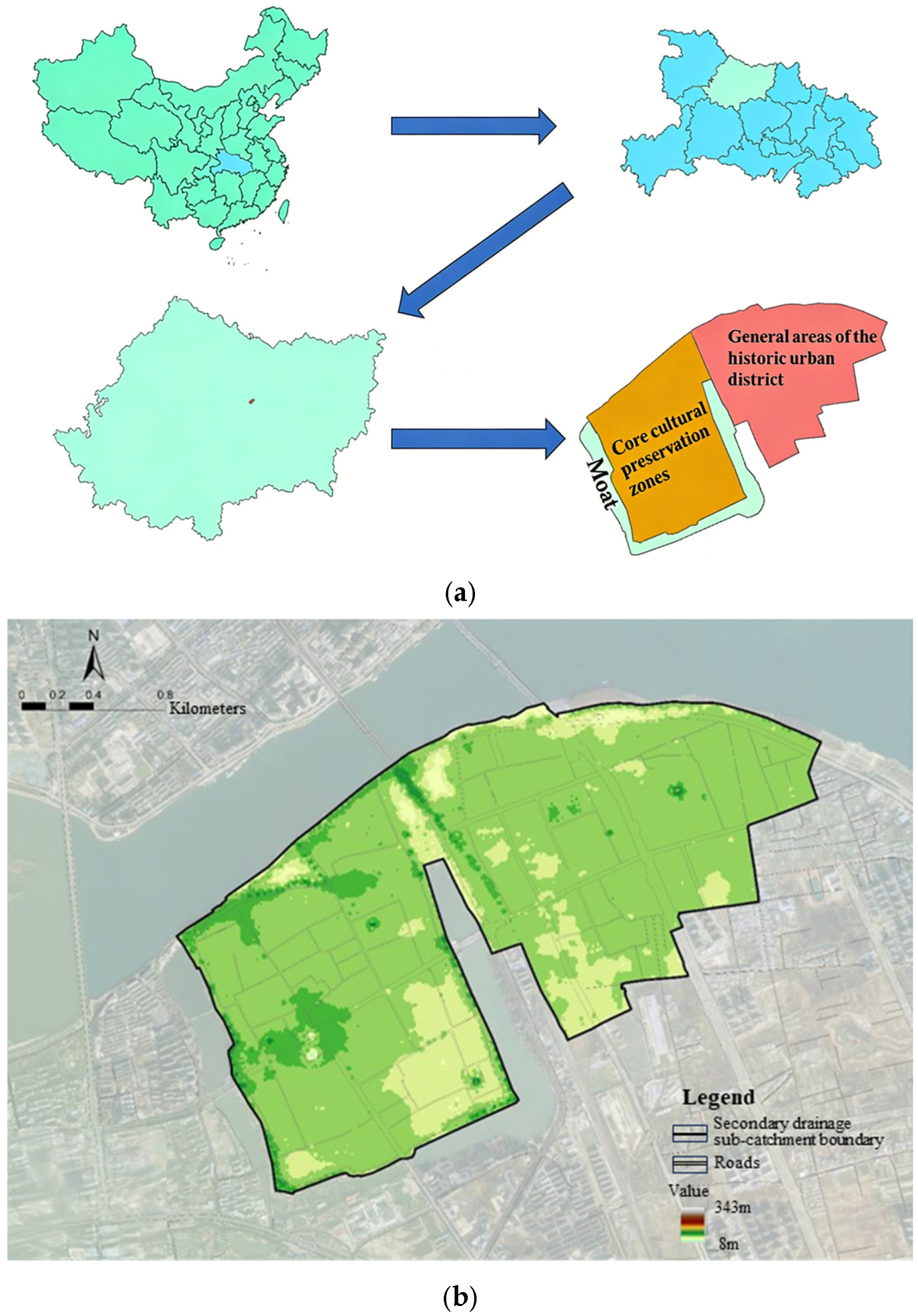
This study selects the historic urban district of City B (an anonymized name for a major historic city located in central China, along the middle reaches of the Han River) as the research area. Located on the south bank of the Han River, the district is surrounded by water on three sides and bordered by mountains on the fourth. The ancient city wall has a circumference of 7.6 km, with 3.5 km of well-preserved Ming and Qing dynasty sections remaining. A river with an average width of 250 m flows along the perimeter of the city wall. The terrain generally slopes from higher elevations in the west (approximately 65–71 m) to lower elevations in the east (approximately 59–68 m). The location of the study area within City B and its broader regional context is shown in
Figure 1a. A detailed topographic map of the historic urban district itself is presented in
Figure 1b.
2.2. Development of a 1D Drainage Network Model for Waterlogging Simulation
InfoWorks ICM is a powerful integrated catchment modelling software capable of simulating urban water cycles and assessing flood risks, making it suitable for urban drainage systems of varying scales and complexities. It can simulate runoff generation and convergence processes under different underlying surfaces, model hydrodynamic processes in drainage networks (including rivers, pipelines, drainage structures, and related parameters), and two-dimensional surface overflow processes. The software supports calculations and analyses of flow regimes such as gravity flow and pressure flow, enabling 1D-2D coupled simulations. Additionally, InfoWorks ICM can perform water quality simulations, including the accumulation of surface sediments and the transport of sediments and pollutants within drainage networks during rainfall events. Therefore, this study selected InfoWorks ICM to investigate waterlogging risks in the historic urban district.
2.2.1. Simplification of the Drainage Network
Prior to constructing the 1D drainage pipeline network model for the study area, the drainage system required preparation and simplification. The drainage network data for the historic urban district were obtained from the drainage pipeline investigation results of the Urban Drainage Network Investigation and Comprehensive Remediation (Phase I) Project of City B. The investigation data include information such as pipeline coordinates, type, diameter, material, and invert elevation.
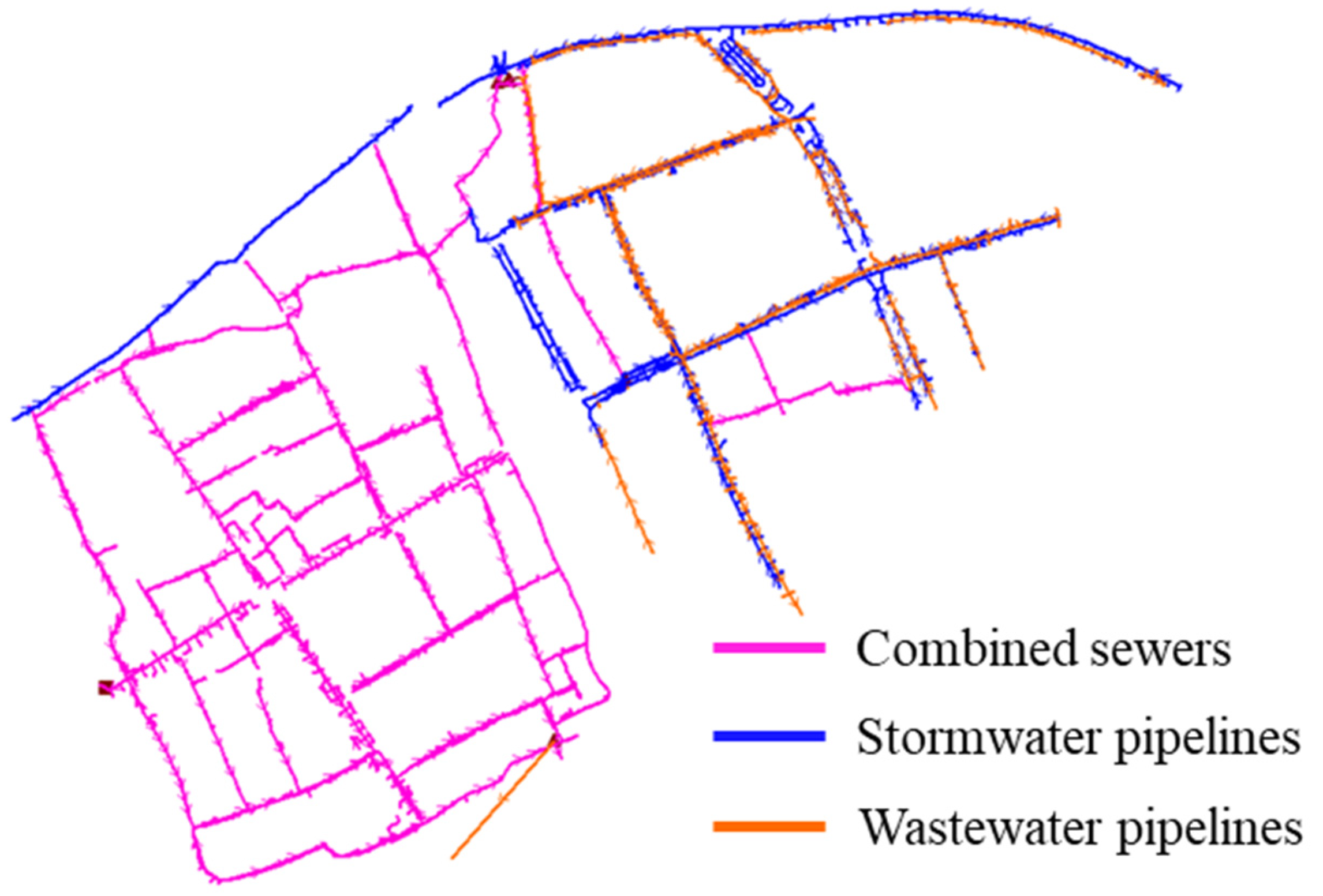
The drainage pipeline network in the historic urban district has a total length of 77.4 km, comprising a rainwater drainage network of 23.58 km, a combined sewer system of 41.14 km, and a wastewater drainage network of 12.68 km, resulting in a drainage pipeline density of 12.49 km/km
2. Based on drainage network census data, concrete pipes are estimated to constitute the majority (approximately 72%) of the total pipeline length, reflecting the aged infrastructure characteristic of historic districts. After data processing and simplification, the finalized model is shown in
Figure 2. The simplified pipeline network model of the study area comprises 2013 nodes, 2019 pipeline segments, and 4968 sub-catchments. It should be noted that the simplified model retains the full inventory of the drainage network, with a total pipe length of 77.4 km (comprising 23.58 km of stormwater sewers, 41.14 km of combined sewers, and 12.68 km of wastewater sewers). All subsequent hydraulic capacity assessments (
Section 3.1) are based on this simplified yet hydraulically equivalent network. The slight difference between the total length reported here (77.4 km) and the sum of pipe lengths (77.42 km) obtained from the simplified model is due to rounding and statistical aggregation during model simplification.
2.2.2. Subcatchment Division
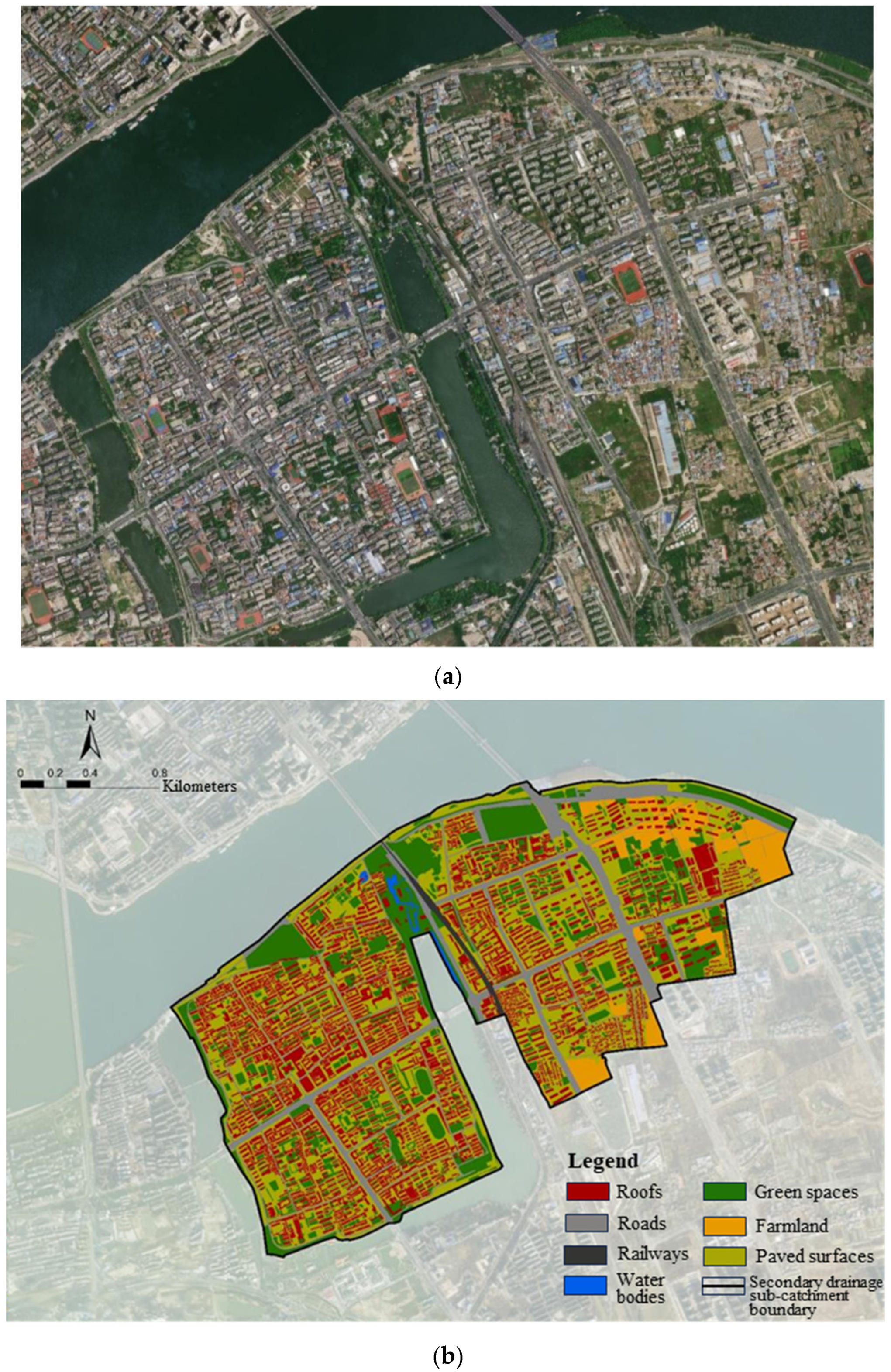
The underlying surface data of the historic urban district were derived from the Third National Land Survey data, topographic map features, and high-resolution satellite imagery which are presented as
Figure 3a and were processed using deep learning algorithms for identification. The underlying surfaces in the study area were classified into seven categories: roofs, roads, railways, water bodies, green spaces, farmland, and paved surfaces. The resulting classification map is shown as
Figure 3b. Comparative analysis between the satellite imagery and the classification map in
Figure 3 demonstrates high consistency between the classified underlying surface types and their corresponding spatial locations in the satellite imagery, indicating robust parsing accuracy.
The statistical results of the underlying surface characteristics are summarized in
Table 1. Impervious underlying surfaces—including roofs, roads, railways, and paved areas—account for 75.55% of the total underlying surface area. Permeable underlying surfaces, consisting of green spaces and farmland, occupy 23.64% of the total area.
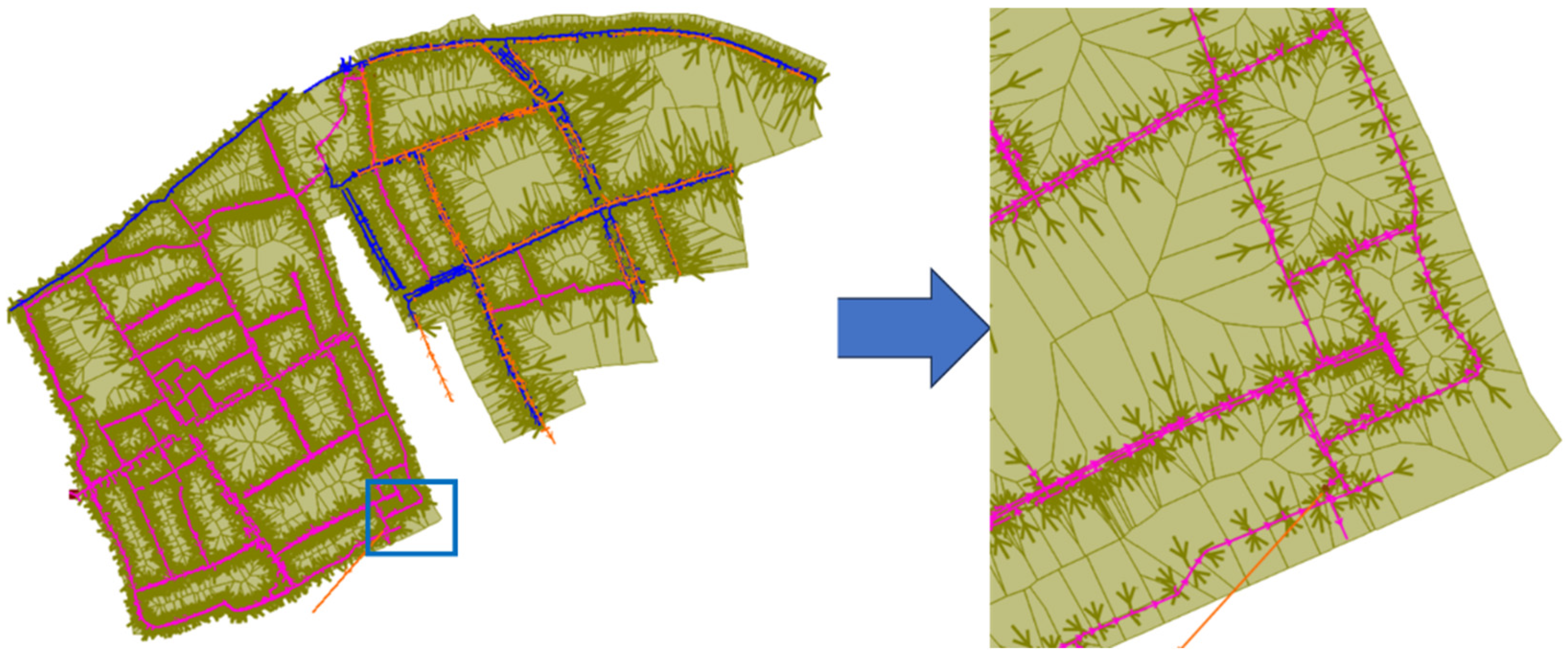
This study employed a combined approach of manual delineation and Thiessen polygon partitioning to divide the study area into subcatchments. Initially, major catchment zones were preliminarily delineated manually based on actual geographical features such as the distribution of main roads. This step leveraged prior knowledge of the study area to define approximate catchment boundaries. Subsequently, the pre-divided catchment zones were further subdivided using the Thiessen polygon method to generate subcatchments. This approach enables relatively uniform allocation of catchment areas based on node distribution. Finally, the subcatchments derived from the Thiessen polygon method were manually inspected and adjusted to correct any discrepancies with actual flow patterns or geographical characteristics, ensuring the division results align closely with real-world conditions. The manual adjustments were guided by the following criteria: (i) Boundary alignment: Subcatchment boundaries were adjusted to follow major roads, ridges, and natural drainage divides, ensuring consistency with actual overland flow directions. (ii) Outlet assignment:The Thiessen method allocated a subcatchment to an implausible drainage node (e.g., a parcel draining against the topographic gradient), and the outlet was reassigned to the most hydraulically appropriate node based on local slope and street layout. (iii) Geometric integrity: Excessively elongated or fragmented subcatchments were merged or reshaped to form hydrologically meaningful units. (iv) Feature preservation: Boundaries were aligned with prominent geographical features (e.g., rivers, green spaces) to maintain the natural integrity of the drainage system. These criteria ensure that the subcatchment division reflects both the mathematical uniformity of the Thiessen method and the physical reality of the study area.
This combined approach not only leverages the efficiency and uniformity of the Thiessen polygon method but also compensates for its limitations in accounting for actual geographical features through manual delineation and adjustments. This ensures that the subcatchment division aligns more closely with real-world flow patterns, resulting in enhanced division accuracy and improved reliability of subsequent simulations and analyses. The subcatchment division map of the simplified 1D drainage network model for the historic urban district is shown in
Figure 4.
2.2.3. Determination of Design Rainfall
The short-duration design rainfall for the historic urban district was determined using the local storm intensity formula (Equation (1)). The development of this formula adhered to the national methodological guidelines specified in the Standard for Design of Outdoor Drainage (GB50014-2021) [
24], as shown below:
where
q is the design storm intensity,
P is the return period of the design storm, and
t is the rainfall duration.
Based on the city’s historical practices, the Chicago hyetograph method was adopted to derive the temporal distribution of short-duration rainfall events. The specific parameters—a peak rainfall coefficient of r = 0.34 and a 2 h storm duration—were determined in accordance with the local authoritative technical report, City B’s Storm Intensity Formula Compilation Technical Report. This report synthesizes long-term local rainfall data, and the adopted values reflect the region’s specific climatic patterns: the 2 h duration captures the typical timescale of intense convective storms responsible for urban waterlogging in this area, while the r = 0.34 value represents a rainfall peak pattern that aligns with the observed characteristics of such events. The following key assumptions were applied in the hydrological modelling: (1) rainfall temporal pattern follows the Chicago hyetograph with a peak coefficient of r = 0.34 and a 2 h duration, which are based on the local “Storm Intensity Formula Compilation Technical Report” to represent typical convective storm patterns; (2) runoff generation was simulated using the fixed runoff coefficient model, with specific values assigned to each land use type (e.g., roofs: 0.80, green spaces: 0.15) according to GB50014-2021 and the InfoWorks ICM User Manual; (3) initial losses were set as constant values (3 mm for impervious surfaces, 6 mm for pervious surfaces) based on local monitoring data and model calibration; (4) dry weather flow (DWF) was estimated using a per capita wastewater generation rate of 250 L/(person·d) and a population density of 0.025 person/m
2 within the combined sewer area, resulting in an average
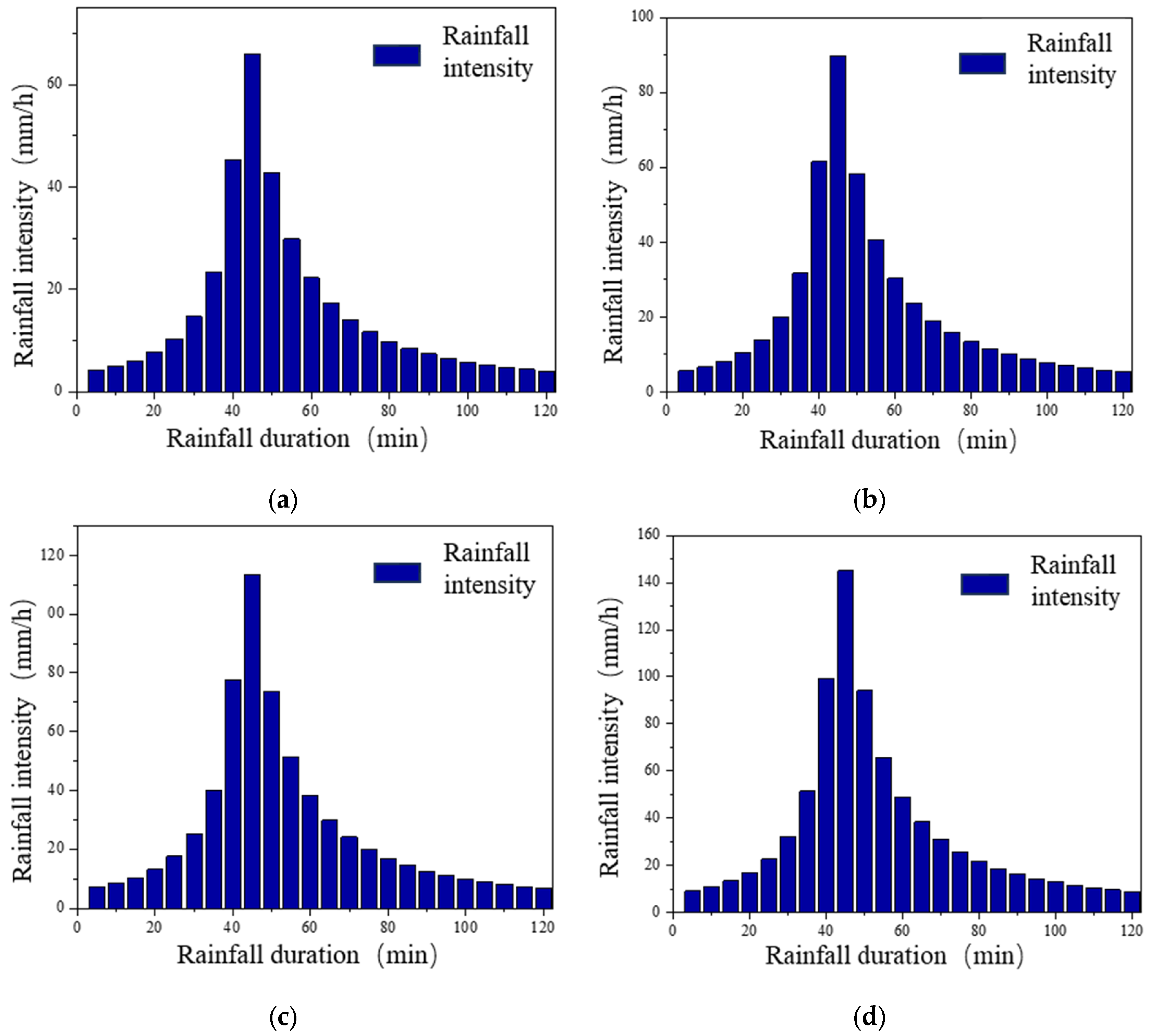
Qd of 280 L/s; (5) storage tank sizing was based on the volumetric method with a design rainfall depth of 20.9 mm, a composite runoff coefficient of 0.655, and a catchment area of 516 ha. A peak rainfall coefficient of r = 0.34 was applied to establish 2 h design hyetographs with a 5 min time step. Rainfall–time distribution curves were generated for return periods of 0.5, 1, 2, and 5 years, as illustrated in
Figure 5.
2.2.4. Determination of Runoff Generation and Convergence Parameters
For the historic urban district examined in this study, a fixed-proportion runoff model was employed for parameter configuration. The runoff coefficients in the model were determined based on the requirements specified in the Standard for Design of Outdoor Drainage (GB50014-2021) and recommended values from the InfoWorks ICM (version 2023.0) user manual [
25]. The runoff coefficient ranges provided in
Table 2 serve as key references. For the hydrological simulation in this study, specific fixed runoff coefficient values were adopted for each land use type (
Table 3). These values were determined by synthesizing the mid-to-upper range of the recommended values in
Table 2, considering the local urban surface characteristics, and were further validated during the model calibration process (
Section 2.4). This approach ensures the model’s parameters are both theoretically grounded and practically applicable to the study area. The specific parameters are presented in
Table 2.
The convergence model determines the flow concentration velocity of surface runoff, reflecting the time required for rainfall to travel from subcatchments to stormwater sewer systems and directly influence the pipeline flow concentration process. The SWMM runoff model was selected as the convergence calculation module in InfoWorks ICM, as it provides higher accuracy in simulating surface flow convergence in urban watersheds and more realistically represents the convergence characteristics of different underlying surface types. The specific parameter configurations are summarized in
Table 3.
After configuring the parameters, the pre-processed land use data were imported and extracted using the Automatic Terrain Optimization (ATO) feature in InfoWorks ICM. This completed the development of the 1D drainage network model for waterlogging simulation.
2.3. Development of the 1D-2D Coupled Drainage Model
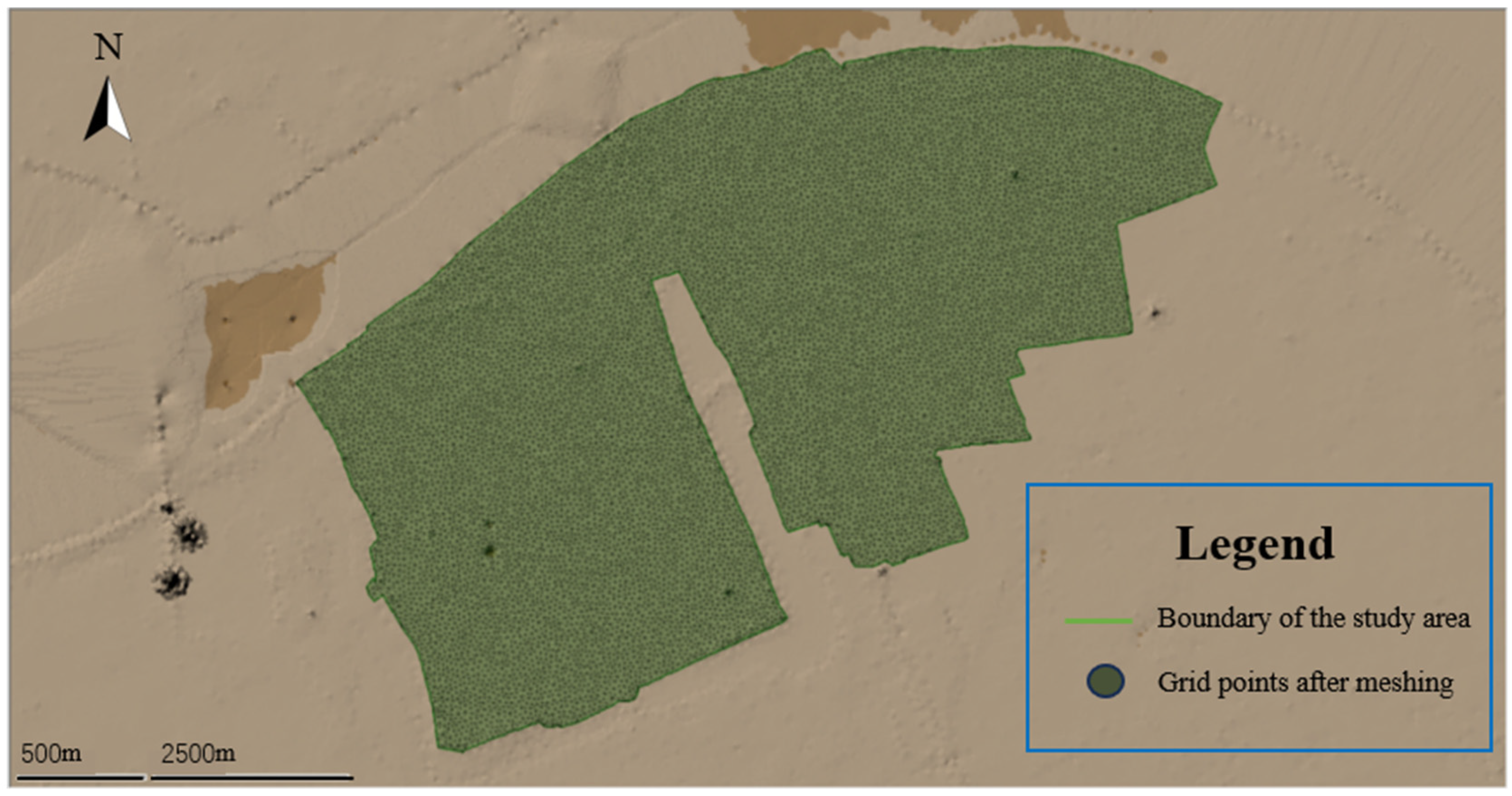
The topographic data of the historic urban district in this study were derived from interpolated elevation points based on 1:10,000 topographic maps. To precisely capture the local elevation changes critical for surface flow routing within the historic district, the topographic dataset was strictly clipped to the exact administrative boundary of the study area (5.16 km
2). For areas with missing elevation data, ALOS satellite-acquired terrain data at 12 m resolution were used for supplementation and correction. A ground TIN model was constructed by extracting elevation point information, on which the 2D domain meshing was completed using InfoWorks ICM (version 2023.0) software [
26]. The final model divided the historic urban district into 27,837 grids, each with an area ranging between 100 m
2 and 300 m
2. The potential influence of terrain data resolution on the 2D simulation results was assessed through model validation: the calibrated model achieved a Nash–Sutcliffe Efficiency (
NSE) of 0.91, and the simulated inundation areas showed strong spatial consistency with historical waterlogging records. This confirms that the combined use of 1:10,000 topographic maps and ALOS 12 m data provides sufficient vertical and horizontal accuracy for capturing the dominant flow paths and inundation patterns in this historic district. Nonetheless, it is acknowledged that the 12 m resolution may not fully resolve micro-topographic features (e.g., traditional courtyard drainage systems), which could introduce minor local uncertainties; however, the overall model performance indicates that these limitations do not compromise the reliability of the conclusions drawn in this study. The grid division results are shown in
Figure 6.
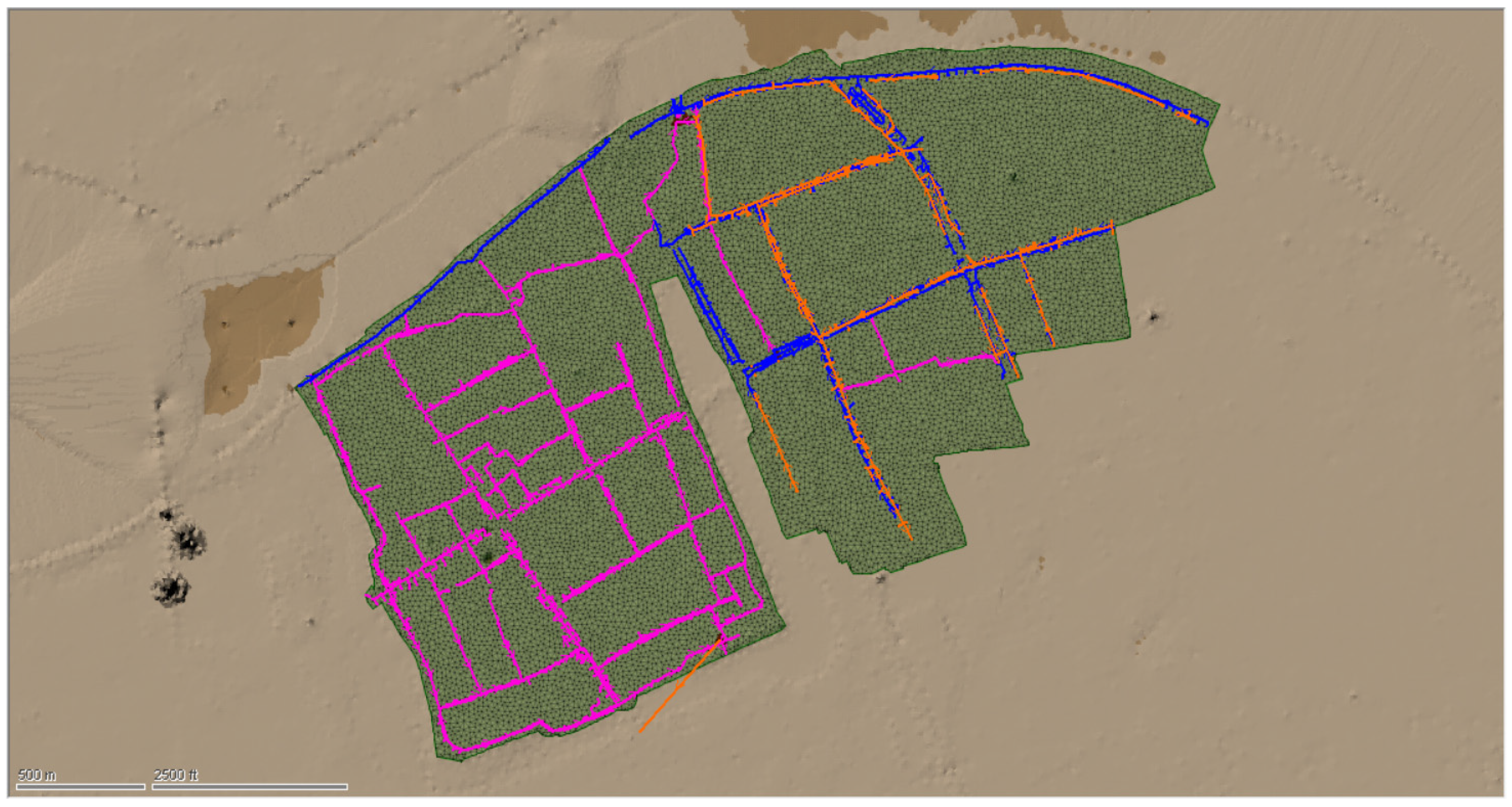
This study employed a 1D-2D coupled modelling approach, integrating the 1D drainage network model with a 2D surface overland flow model. The coupling was achieved by linking the top elevations of inspection wells at network nodes to corresponding 2D surface grids, establishing hydraulic connectivity between the subsystems. The coupled model simulates pressurized and free-surface shallow water flows within pipe channels, as well as the physical movement processes of waterlogging floods across the 2D surface domain. Furthermore, it effectively captures the exchange of flow and momentum between surface runoff and subsurface pipe flow, enabling dynamic simulation of water accumulation processes [
28,
29]. This provides robust support for in-depth analysis of urban waterlogging issues. The simplified network diagram of the 1D-2D coupled drainage model for the historic urban district is shown in
Figure 7.
2.4. Model Parameter Calibration and Validation
Reliable field monitoring data is the foundation of accurate environmental assessment. In this study, continuous rainfall and flow monitoring data were collected from the local urban drainage monitoring network. Rainfall data were obtained from 2 tipping-bucket rain gauges located within the catchment. Flow data were acquired from 4 ultrasonic Doppler flowmeters installed at key outlets of the main drainage pipelines. The monitoring period covered the rainy seasons from 2019 to 2023. During calibration, measured data from highly reliable pipeline segments and monitored periods were selected for model calibration. By comparing simulated process values with validated measured process values, the consistency of overall trends was analyzed, and model parameters were appropriately adjusted to meet calibration requirements. The Nash–Sutcliffe efficiency coefficient (
NSE) was employed as an evaluation metric for calibration effectiveness, calculated by Equation (2):
where
NSE is the Nash–Sutcliffe efficiency coefficient,
Qs is the simulated value,
Qm is the observed value,
is the mean of observed values, and
n is the number of observed data points.
Model calibration was performed using measured flow data from key pipeline sections, as documented in the city’s Water Quality and Quantity Monitoring Analysis Report. A Nash–Sutcliffe Efficiency (
NSE) value ≥ 0.5 is typically considered the minimum requirement for a satisfactory hydrological model calibration [
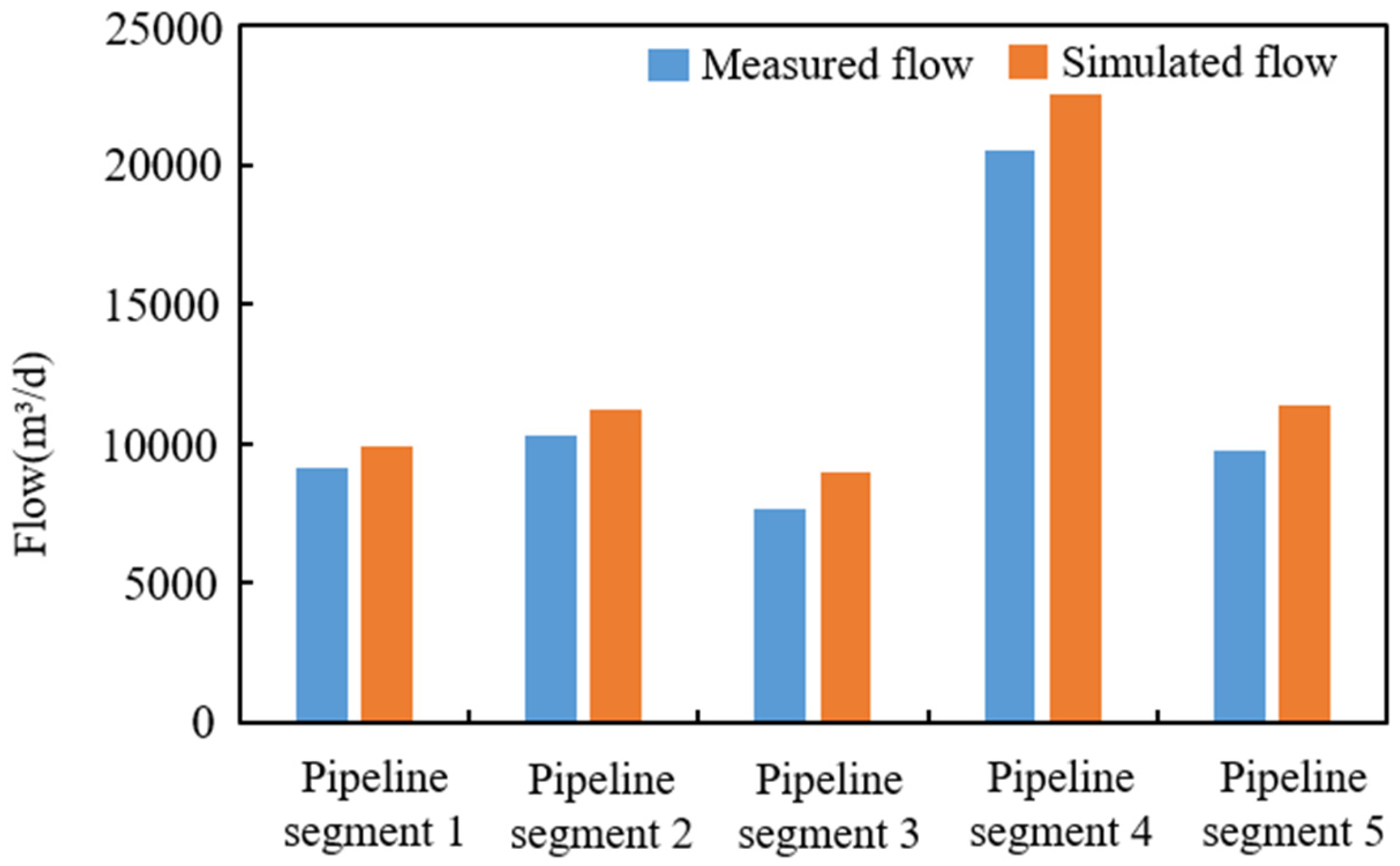
30]. The calibrated 1D-2D coupled model achieved an
NSE of 0.91, with complementary metrics (Root Mean Square Error, RMSE, and Percent Bias, PBIAS) also indicating a good fit (e.g., RMSE ≈ 0.45 m
3/s, |PBIAS| < 5%). This demonstrates minor discrepancies between simulated and measured flows and confirms its reliability for subsequent simulations. This strong agreement between the simulated and observed hydrographs at a calibration point is visually presented in
Figure 8.
Following calibration, an independent validation was conducted using monitoring data from a subsequent period (2022–2023), which included rainfall events not used in the calibration phase. The validation results (e.g., NSE > 0.85) confirmed the model’s robustness and predictive reliability under different hydrological conditions.
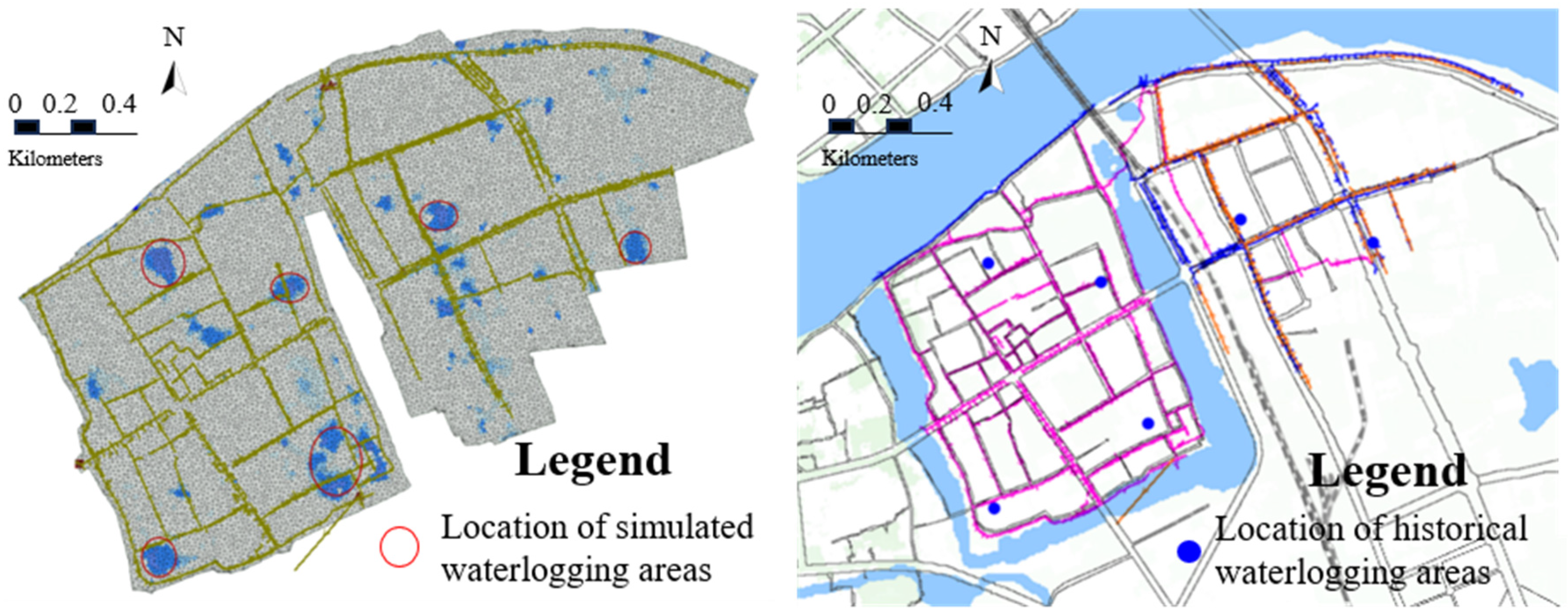
Validation: Following parameter calibration, the model’s spatial predictive capability was validated against historical records to ensure its reliability. The model was used to simulate waterlogging distribution under a 5-year return period, 2 h duration rainfall scenario. The simulated inundation areas were then compared with six well-documented historical waterlogging areas (monitored from 2019 to 2023). The comparison was based on the spatial correspondence between simulated inundation (depth > 0.15 m) and the documented extent of historical waterlogging. As illustrated in
Figure 9 the simulated flood risk areas align well with the distribution of the historical waterlogging areas. This qualitative spatial validation demonstrates a good consistency between the simulation results and actual conditions, thereby verifying the accuracy and reliability of the model for subsequent analyses.
2.5. Development of the Water Quality Model
2.5.1. Water Quality Simulation Module and Parameters
To assess the combined sewer overflow (CSO) pollution and evaluate the “integrated pollution-waterlogging management” effectiveness of the proposed intercepting sewer, a water quality module was incorporated into the calibrated 1D-2D hydrodynamic model. The pollutant loads were simulated using the buildup and washoff functions within InfoWorks ICM. The average pollutant concentrations for the dry weather flow (domestic sewage) were set as fixed input parameters for the model: BOD = 200 mg/L, COD = 420 mg/L, and NH
3-N = 35 mg/L. These values were derived from local pollution source census data and the city’s official technical reports. This setup enabled the simulation of temporal variations in pollutant concentrations at overflow outlets during storm events, as analyzed in
Section 3.3.3.
2.5.2. Environmental Constraints and Design Load Calculations
In addition to the dynamic simulation outputs from the water quality module, the evaluation of pollution control efficacy also involved external environmental standards and engineering design calculations, which are explicitly distinguished from the modelling results in this subsection.
- (a)
Input Data and Assumptions:
Receiving water body capacity: The Chemical Oxygen Demand (COD) assimilation capacity of the Han River is 120 t/d for the relevant reach. This value was adopted from the local environmental protection master plan and served as a regulatory constraint for assessing the environmental acceptability of the proposed interception system.
Design standard for interception: The interception ratio (n0) was determined according to the Standard for Design of Outdoor Drainage (GB50014-2021). Based on local practice and the characteristics of the combined sewer area, n0 = 3.0 was selected.
- (b)
Calculation Method for Post-Interception Load:
The estimated COD emission load after implementing the intercepting sewer was calculated, not directly simulated by the dynamic model. The calculation followed Equation (4) and used the simulated dry-weather flow (
Qd ≈ 280 L/s, see
Section 3.3.3) together with the assumed dry-weather COD concentration (420 mg/L, specified in
Section 2.5.1) and the design interception ratio (
n0 = 3.0). The resulting value (≤80 t/d) represents a design compliance check against the regulatory environmental capacity (120 t/d). This calculation is explicitly distinguished from the dynamic modelling results presented in
Section 3.1 and
Section 3.2 (hydraulic performance) and
Section 3.3.3 (pollutant concentration dynamics).
2.6. Calculation Workflow for Hybrid Grey-Green Infrastructure Design
To ensure transparency and reproducibility, the design and evaluation of the proposed HGGI system followed a structured four-step workflow:
Step 1—Baseline Assessment: A 1D-2D coupled hydrodynamic model was developed in InfoWorks ICM using drainage network data, underlying surface classification, and topographic information. The model was calibrated and validated against monitored flow and historical waterlogging records (NSE = 0.91).
Step 2—Problem Diagnosis: Hydraulic performance of the existing drainage system was evaluated under design rainfall events (0.5-, 1-, 2-, and 5-year return periods). Pipeline capacity deficiency and waterlogging hotspots were identified based on surcharge ratios and surface inundation depth (>0.15 m).
Step 3—Measure Configuration: Single mitigation measures were designed: (a) LID facilities (22.5 ha sunken green space, 70.5 ha permeable pavement) based on the Sponge City Master Plan; (b) three underground storage tanks (total volume 70,638 m3) using the volumetric method; (c) an intercepting sewer system (3.2 km, DN1200–DN2000) designed with an interception ratio of n0 = 3.0 and Qd = 280 L/s. These measures were then integrated into a hybrid grey-green infrastructure (HGGI) scenario.
Step 4—Effectiveness Evaluation: The calibrated model was re-run under the same design rainfall scenarios for each single measure and the HGGI scenario. Waterlogging area reduction and CSO volume/pollutant load reduction were quantified and compared. Synergistic effects were analyzed through comparative simulations (e.g., storage tank utilization rate with and without upstream LID).
This workflow ensures that the proposed strategy is hydraulically justified, heritage-compatible, and methodologically replicable.
3. Results and Discussion
3.1. Analysis of Pipeline Drainage Capacity
The hydrodynamic model demonstrated high reliability following calibration and validation. As shown in
Figure 8 (
Section 2.4), the flow calibration results exhibit excellent agreement between simulated and observed values, with an
NSE of 0.91. Furthermore, the spatial validation against historical waterlogging records showed strong consistency between simulated flood-prone areas and observed flood locations, as presented in
Figure 9. This confirms the model‘s robustness and suitability for subsequent waterlogging simulation and analysis within the historic district.
To systematically evaluate the actual drainage capacity of the pipeline network in the study area, this study conducted simulations under short-duration rainfall scenarios with different design return periods (
P = 0.5, 2 h;
P = 1, 2 h;
P = 2, 2 h; and
P = 5, 2 h). By importing rainfall sequences of each return period into the model, the hydraulic load conditions of the pipeline system under design rainfall scenarios were analyzed segment by segment (Tang 2023) [
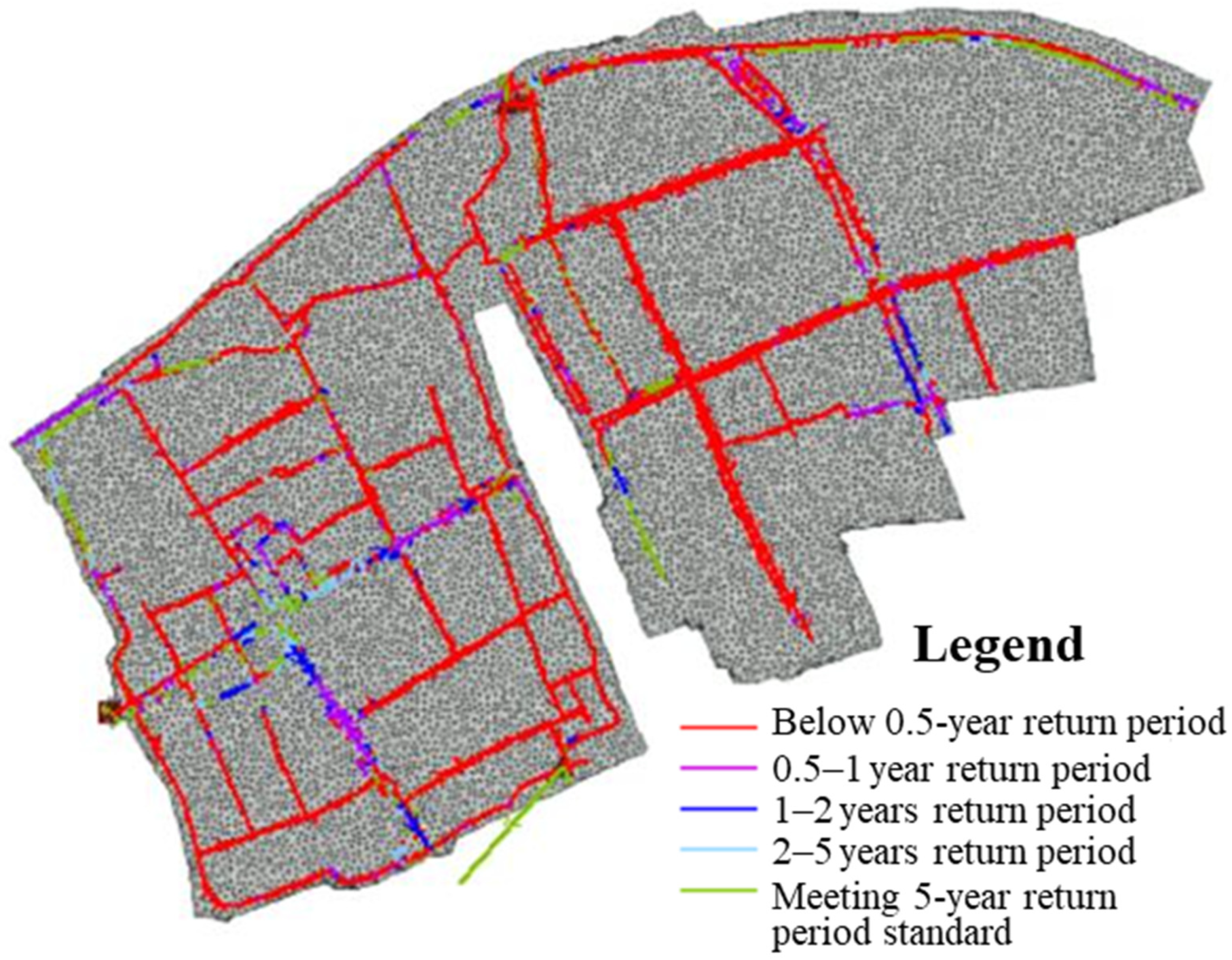
31], determining the rainfall return period standard met by each pipeline segment. Through this process, the drainage capacity of the pipeline network in the historic urban district was obtained as shown in
Figure 10 and
Table 4.
As shown in
Table 4, 75.3% of the pipeline length (or equivalently, 68.4% of all pipe segments) operates below the 0.5-year design standard, indicating widespread hydraulic overload and pressurized flow conditions during frequent storm events. Notably, several segments of these undersized pipelines are directly connected to pipelines meeting ≥2-year return period standards, forming key bottlenecks that correspond to the six historical waterlogging areas. These bottlenecks affect an upstream contributing area of 33.36 ha, which is consistent with the waterlogged area under 5-year return period rainfall. The mismatch in upstream–downstream capacity is the primary cause of localized waterlogging, as these bottlenecks restrict the entire drainage network’s performance despite the aggregate length of inadequate pipelines. Similar capacity deficiencies have been reported in European combined systems [
14]; however, while those studies prioritized pipe reinforcement, our heritage-constrained context necessitated a hybrid approach—highlighting that optimal upgrading paths are context-dependent rather than universal.
3.2. Waterlogging Analysis Under Design Rainfall Condition
Using the established 1D-2D coupled drainage model, simulations were conducted for four short-duration rainfall events with different return periods (
P = 0.5, 2 h;
P = 1, 2 h;
P = 2, 2 h; and
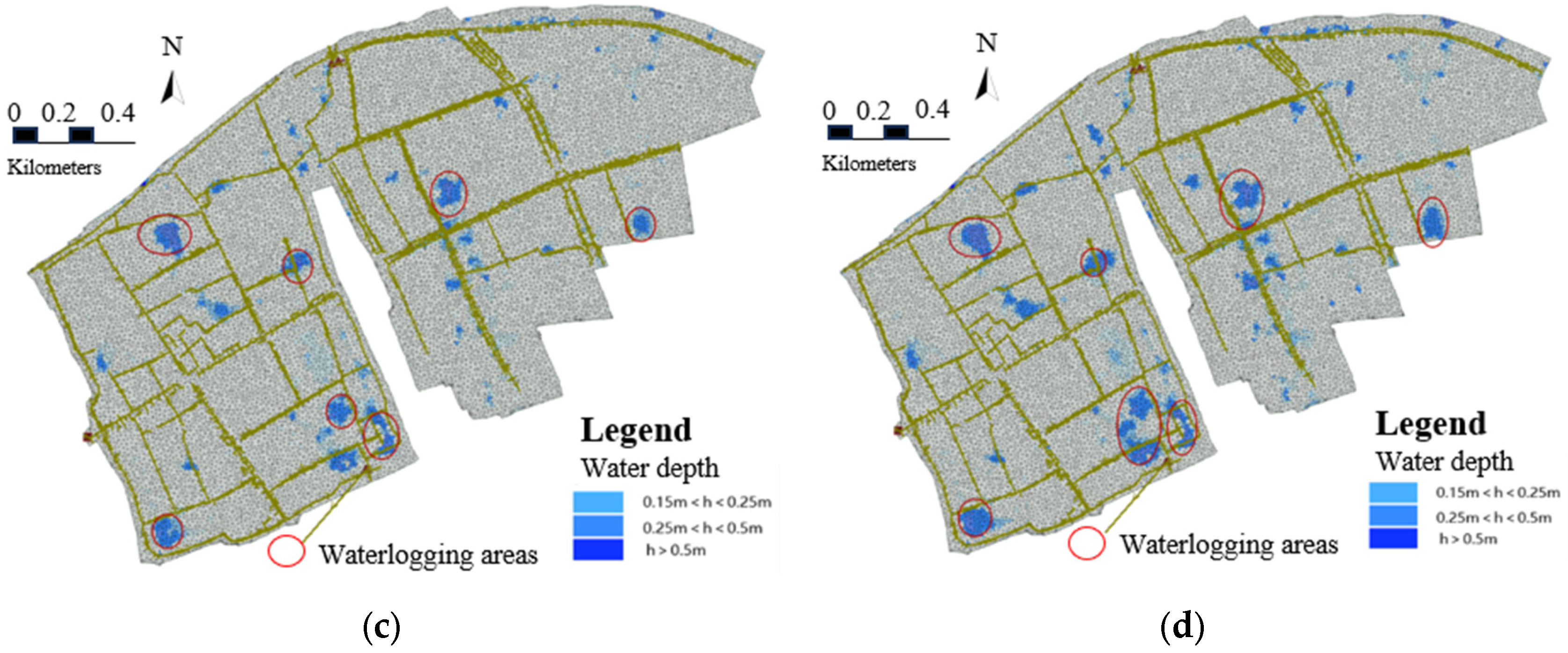
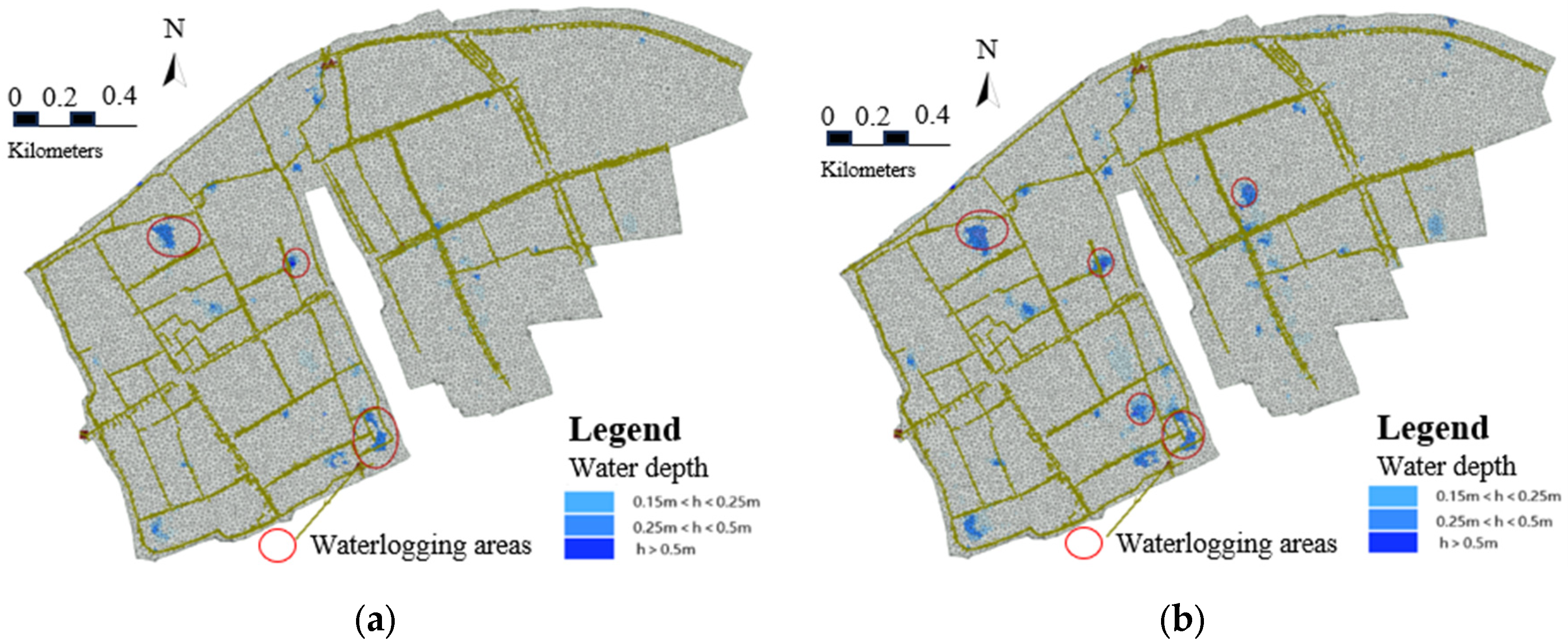
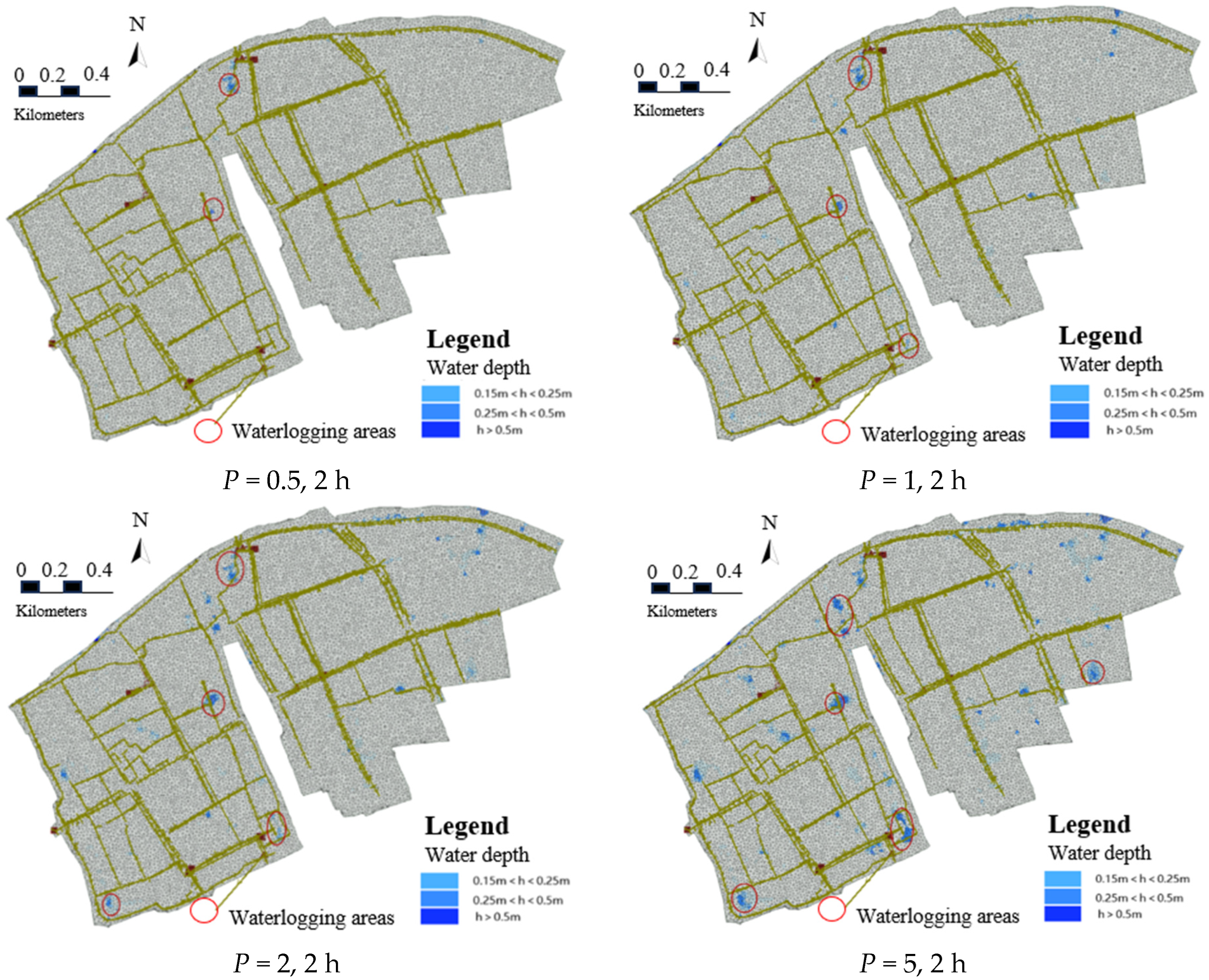
P = 5, 2 h). Based on the simulation results, waterlogging conditions in the historic urban district were analyzed. According to the Standard for Design of Outdoor Drainage (GB50014-2021), under the design return period for waterlogging prevention, road water accumulation exceeding 15 m depth is considered as waterlogging. Therefore, this study focused solely on areas with water depths greater than 15 m, and classified the water depth h into three severity levels: mild (0.15 m ≤ h < 0.25 m), moderate (0.25 m ≤ h < 0.5 m), and severe (h ≥ 0.5 m). The resulting spatial distribution and extent of waterlogging under different rainfall scenarios are presented in
Figure 11 and
Table 5, respectively.
As shown in
Figure 11, the waterlogging situation in the historic urban district progressively worsened with increasing return periods. Under the 0.5-year return period, 2 h duration rainfall scenario, water depths at all three major waterlogging areas ranged between 0.15 and 0.5 m, with no simulated grid cells exceeding the 0.5 m threshold. When the return period increased to
P = 1, 2 h, two additional major waterlogging areas emerged, with all five areas maintaining water depths within the 0.15–0.5 m range. At
P = 2, 2 h conditions, two more waterlogging areas developed, with most points exhibiting depths between 0.15 and 0.5 m, while some areas exceeded 0.5 m. Under the most severe
P = 5, 2 h scenario, seven major waterlogging areas were observed, with significantly expanded affected areas and multiple areas exceeding 0.5 m depth, indicating severe waterlogging conditions. The simulation results confirm the occurrence of severe flooding, with 0.77 ha of the area experiencing water depths ≥ 0.5 m (
Table 5).
Table 5 demonstrates that under the P = 5 scenario, the proportion of waterlogged area reached critically high levels, revealing an urgent drainage capacity crisis. These findings clearly indicate serious deficiencies in the drainage system of the historic district, necessitating immediate implementation of mitigation measures.
3.3. Determination of Waterlogging Control Measures
3.3.1. Newly Constructed LID Facilities for Mitigating Waterlogging in the Historic Urban District
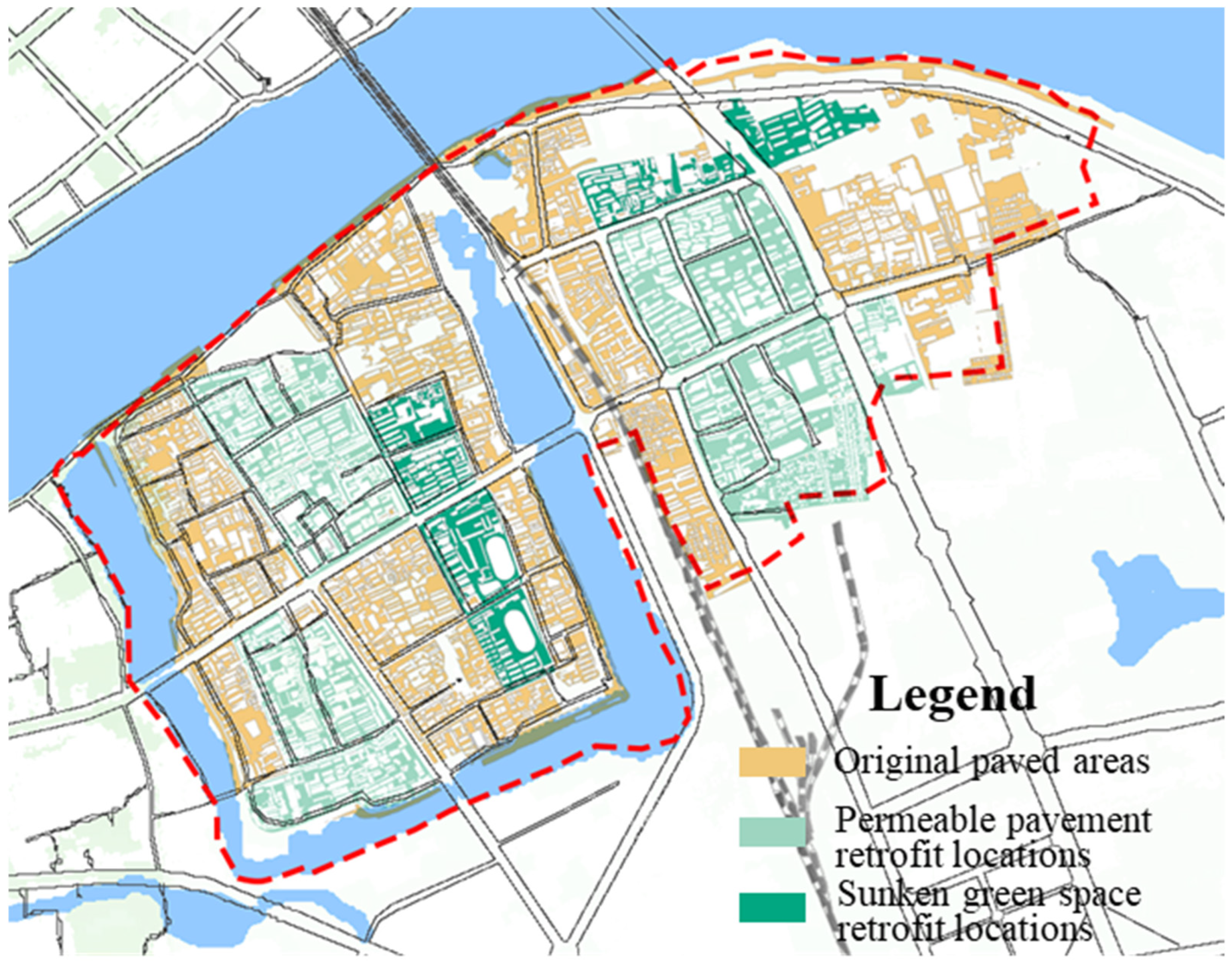
At the source of the drainage system, LID facilities can be implemented to control and reduce surface runoff, thereby mitigating urban waterlogging risks. According to the aforementioned analysis of underlying surface characteristics in the historic urban district, impervious surfaces dominate (75.76% total coverage), comprising roofs (23.69%), roads (11.47%), railways (0.59%), and paved areas (39.80%). These surfaces exhibit weak rainwater infiltration capacity and high surface runoff coefficients, necessitating source control through LID facilities to reduce total runoff volume. Following the Sponge City Master Plan of City B, which mandates a 75% annual runoff volume control rate for the historic district, an LID retrofit area of 93 ha (18.02% of the total area) was determined. This includes 22.5 ha of sunken green spaces (24% of retrofitted area) and 70.5 ha of permeable pavements (76% of retrofitted area). The specific layout is shown in
Figure 12.
To preserve the historic district’s characteristic “bluish-grey brick and tile” esthetic, permeable paving primarily consisted of imitation bluestone permeable bricks that meet the required permeability and esthetic compatibility standards. Sunken green spaces were strategically located outside core cultural preservation zones, and a number of residential courtyards were retrofitted to incorporate traditional drainage systems, thereby enhancing source reduction through retention and infiltration. Detailed material specifications and retrofit design parameters are provided in the
Supplementary Materials (Text S1). This approach preserves the architectural function of “four waters converging in the courtyard” while enhancing source reduction through retention and infiltration. SWMM simulations indicate a 30–45 min extension in rainwater retention time post-retrofit.
The effectiveness of newly constructed LID measures in reducing waterlogged areas is summarized in
Table 6. Under the 0.5-year return period scenario, the waterlogged area decreased from 5.97 ha to 4.12 ha, achieving a 30.99% reduction rate. However, the reduction efficacy gradually decreased with increasing return periods, reaching only 15.53% under the 5-year return period conditions, demonstrating that LID facilities are more suitable for source control in small to moderate rainfall events.
3.3.2. Newly Constructed Storage Tank Measures
The volume of newly constructed storage tanks in the historic urban district can be determined with reference to the volumetric method specified in the Sponge City Construction Technical Guide, calculated by Equation (3):
where
V is the designed storage tank volume for the historic urban district (m
3),
H is the design rainfall depth (20.9 mm) determined with reference to the annual runoff volume control target table for cities in Province B,
is the composite rainfall–runoff coefficient (0.655) calculated by weighted averaging method, and
F is the catchment area (516 ha) of the historic urban district. The constant 10 is a unit conversion factor that accounts for converting rainfall depth in mm over an area in ha to a volume in m
3 (since 1 mm × 1 ha = 10 m
3).
The calculation indicates that the required total storage volume for newly constructed storage tanks in the historic urban district is 70,637.82 m
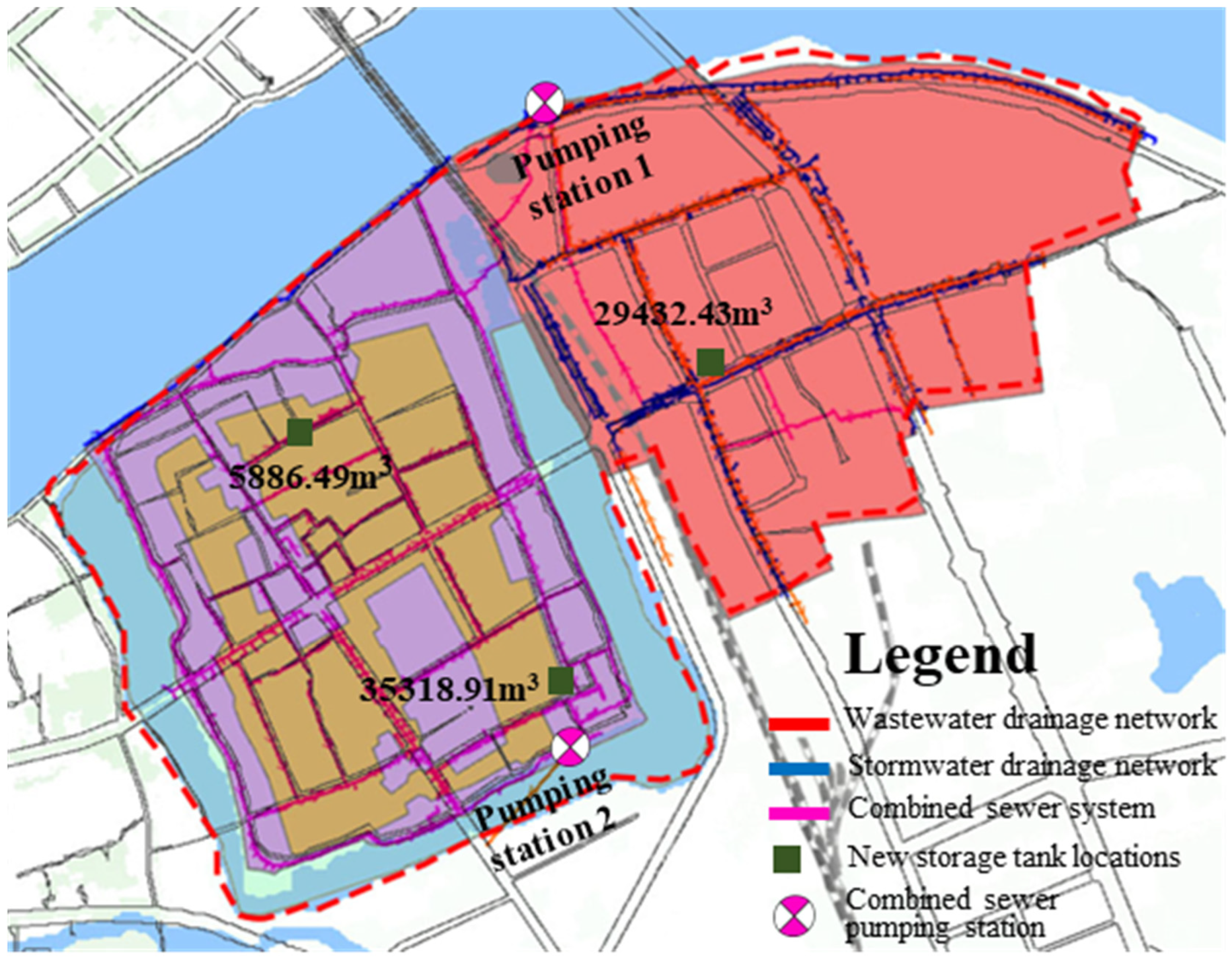
3. Considering the topographical characteristics of being “surrounded by water on three sides and bordered by mountains on the fourth” and the distribution of historical waterlogging areas, three underground storage tanks were constructed near three major waterlogging areas while maintaining a sufficient distance from core cultural preservation zones. The individual storage volumes are 5886.49 m
3, 29,432.42 m
3, and 35,318.91 m
3, respectively. Detailed parameters are presented in
Table 7. In accordance with the Historic District Conservation Plan, the locations of the storage tanks are shown in
Figure 13.
All three storage tanks are located on the periphery of the historic district. Constructed as underground reinforced concrete structures, the surface areas were restored with local vegetation to maintain consistency with the historic landscape esthetic. A full description of the landscape restoration design is available in the
Supplementary Materials (Text S1). Trenchless pipe jacking technology was employed during construction to avoid damaging surface-level historical streets. Among these, Tank No. 1 (volume: 29,432.42 m
3) connects to the moat through a DN1200 concealed conduit. During storm events, two submersible pumps (design flow rate: 500 m
3/h, head: 12 m) discharge stored stormwater into the moat. The water level of the moat is controlled at ≤59.5 m during pumping operations—1.2 m below the foundation elevation of the city wall—to prevent seepage risks to the wall’s foundation. This strategy utilizes the moat’s natural storage capacity of 1.5 million m
3 to enhance overall stormwater retention capability.
The effectiveness of the newly constructed storage tanks in reducing waterlogging is summarized in
Table 8. Under the 0.5-year return period rainfall scenario, the waterlogged area decreased from 5.97 ha to 2.30 ha, achieving a 61.47% reduction rate. The reduction rate was 52.75% for the 1-year return period scenario. However, under the 5-year return period scenario, the reduction rate declined to 39.09% due to storage capacity saturation, indicating that while storage tanks are highly effective for managing short-term peak flows, their efficacy diminishes under high-return-period rainfall events due to volume limitations.
3.3.3. Newly Constructed Intercepting Sewer Pipeline Measures
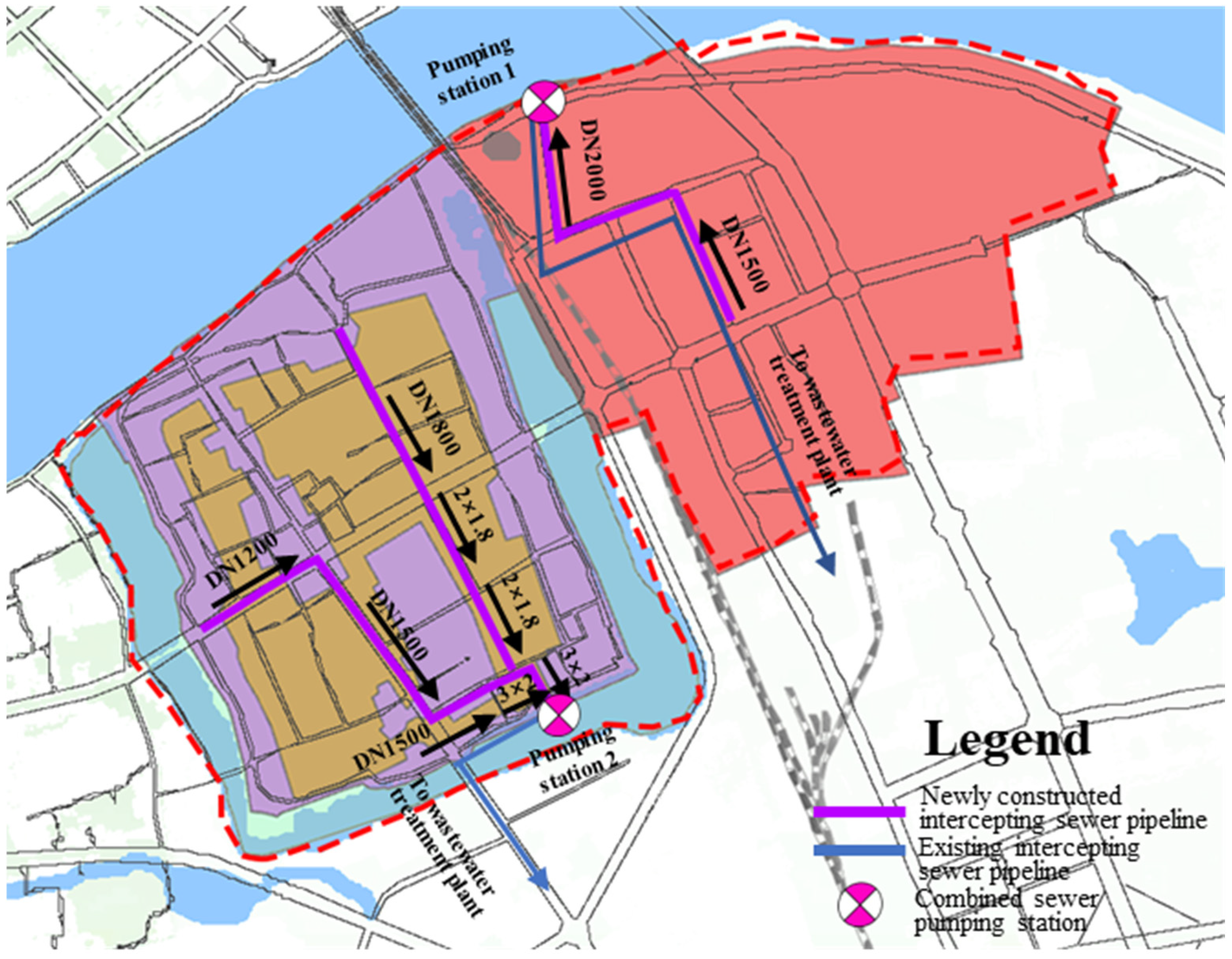
The combined sewer system accounts for 53.15% of the pipeline network in the historic urban district, with a total length of 41.14 km. The current interception capacity is insufficient, leading to combined sewer overflows during storm events that exacerbate both waterlogging and pollution. This study implemented newly constructed intercepting sewer pipelines in the combined sewer areas to enhance interception capacity (
Figure 14), conveying captured wastewater to treatment plants. According to the Standard for Design of Outdoor Drainage (GB 50014-2021), the interception ratio should be determined based on dry weather flow quality/quantity, environmental capacity of receiving water bodies, and drainage area characteristics [
32], typically ranging from 2 to 5. Based on the actual wastewater discharge conditions in City B’s central urban area, an interception ratio of 3.0 was adopted. The average dry weather wastewater flow
Qd was estimated based on the served population within the combined sewer area and a per capita wastewater generation rate. According to the city’s relevant planning documents and pollution source census data, the per capita wastewater generation rate was taken as 250 L/(person·d). The total population in the combined sewer area of the historic district is approximately 62,000. This yields an average dry weather flow
Qd of approximately 280 L/s, which serves as the basis for the interception sewer design. This ratio meets the environmental capacity requirements of the Han River, where the Chemical Oxygen Demand (COD) capacity is 120 t/d for the relevant section. The intercepted overflow wastewater maintains COD emissions ≤ 80 t/d. The designed flow rate for the intercepted sewer pipeline was calculated by Equation (4), yielding
Q = 1120 L/s.
where
Qint is the designed flow rate of the intercepted sewer pipeline (L/s),
Qd is the average dry weather wastewater flow (L/s), and
n0 is the interception ratio.
The environmental impact of this design was validated against the receiving water body’s capacity. According to the local environmental protection planning documents, the COD assimilation capacity for the relevant section of the Han River is 120 t/d. Based on the simulated pollutant load from the water quality model (
Section 2.5) under the designed interception scenario, the estimated COD discharge from the intercepted overflow is controlled below 80 t/d. This demonstrates that the proposed intercepting sewer not only alleviates waterlogging but also ensures that the post-interception pollution load complies with the environmental carrying capacity, achieving the “integrated pollution-waterlogging co-governance” objective.
The newly constructed intercepting sewer pipeline has a total length of 3.2 km, installed along the inner side of the Han River embankment. The pipeline, with diameters ranging from DN1200 to DN2000, utilizes reinforced concrete pipes with an anti-seepage grade of P8. For the section crossing beneath the historic city wall, trenchless technologies (directional drilling and micro pipe jacking) were employed to avoid disturbance to heritage structures and pavement. Strict settlement control was implemented, and real-time monitoring confirmed that ground movements remained within the stringent design limit throughout the construction period, thereby preserving the integrity of historic bluestone pavements and building foundations. Comprehensive construction parameters and settlement monitoring data are provided in the
Supplementary Materials (Text S1).
The improvement effect of the newly constructed intercepting sewer pipeline on waterlogging in the historic urban district is summarized in
Table 9. Under the 0.5-year return period rainfall scenario, the waterlogged area reduction rate reached 37.35%. However, the reduction rate decreased rapidly with increasing return periods, dropping to only 11.33% during the 5-year return period conditions. This indicates that the intercepting sewer pipeline primarily mitigates waterlogging by enhancing the conveyance capacity of the drainage network, while its ability to control excess runoff during heavy rainfall events remains limited.
3.3.4. Analysis of Waterlogging Control Effectiveness Through Grey-Green Coupling Measures
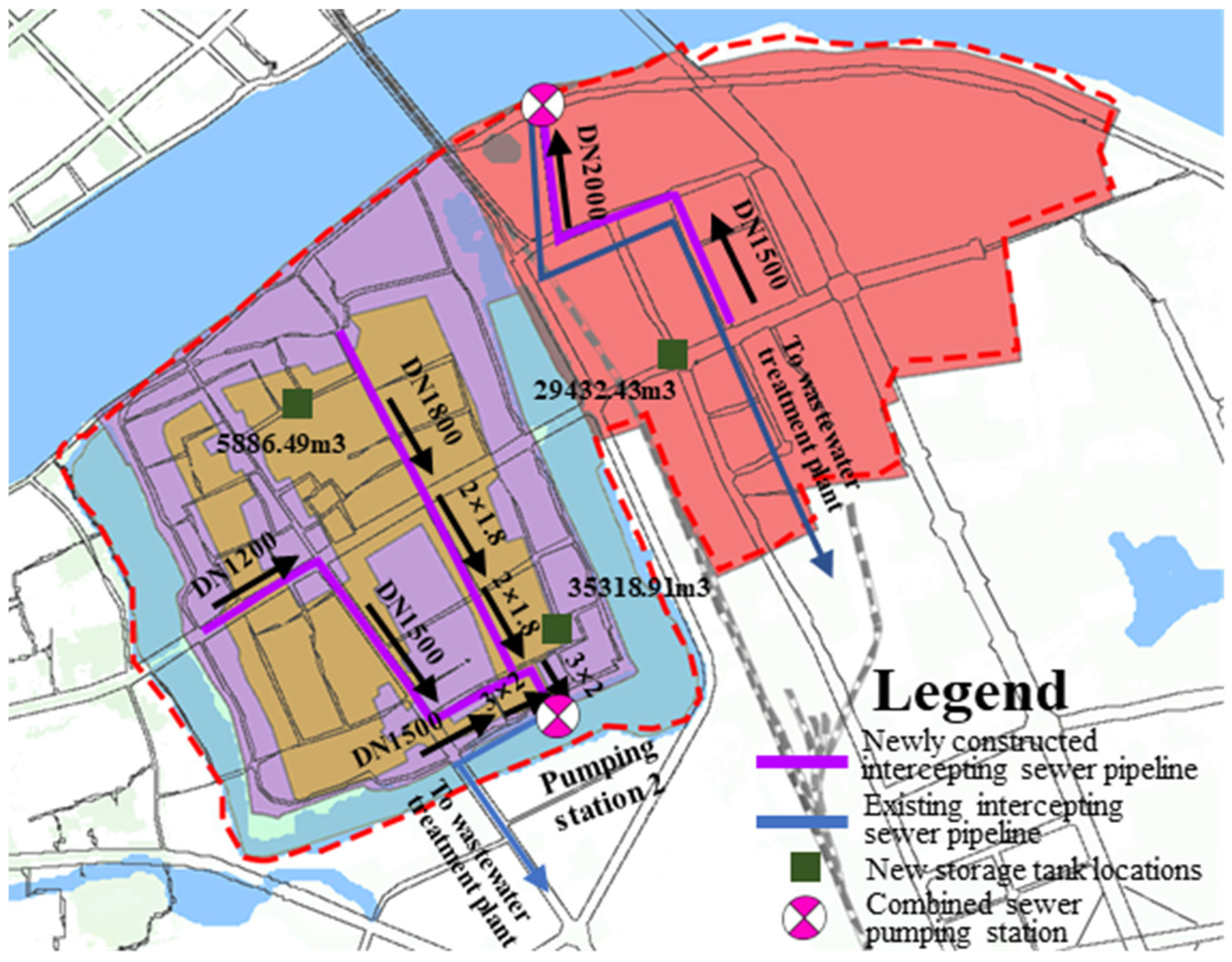
Based on the efficacy analysis of individual measures presented above, LID facilities excel in source runoff reduction, storage tanks are effective for peak flow regulation, and intercepting sewer pipelines enhance network conveyance capacity, demonstrating functional complementarity. Consequently, an integrated grey-green coupling strategy was developed following the framework of “LID-based source reduction—storage tank-based peak regulation—intercepting sewer pipeline-based terminal conveyance”. The specific layout is illustrated in
Figure 15, with the synergistic mechanisms operating as follows:
Source Control: LID facilities (22.5 ha sunken green spaces and 70.5 ha permeable pavements) mitigate surface runoff, reducing the waterlogged area by 21.23% to 30.99% under rainfall events with return periods of 0.5–2 years (
Table 6), thereby decreasing stormwater inflow into the pipeline network and reducing the inflow load on storage tanks. Comparative simulations under identical rainfall scenarios (0.5–5 year return periods) were conducted to verify synergy: with upstream LID, the volumetric utilization rate of storage tanks reaches 78–85% (average 81%), while the rate is 58–65% (average 62%) without LID. This confirms a 25–30% increase in volumetric utilization rate, attributed to reduced peak inflow and extended retention time from LID-induced runoff reduction.
Process Regulation: Storage tanks temporarily retain excess runoff not mitigated by LID facilities. During heavy rainfall events, stormwater is pumped to the intercepting sewer pipeline at a rate aligned with the pipeline’s design capacity. For example, Storage Tank No. 1 has a pumping capacity of 500 m3/h, matching the design flow (1800 m3/h) of the DN1200 intercepting sewer pipeline segment, thereby avoiding overflow from the storage tanks.
Terminal Conveyance: The intercepting sewer pipeline conveys both pumped stormwater from storage tanks and combined sewage to the wastewater treatment plant (capacity: 50,000 m3/day), preventing combined sewer overflows and achieving “integrated management of pollution and waterlogging”.
Figure 15.
Layout of the integrated control scheme.
Figure 15.
Layout of the integrated control scheme.
Under short-duration design rainfall scenarios (
P = 0.5, 2 h;
P = 1, 2 h;
P = 2, 2 h; and
P = 5, 2 h), the waterlogging conditions in the historic urban district after implementing grey-green coupling measures were analyzed. The resulting waterlogging points under the integrated control scheme for short-duration rainfall are presented in
Figure 16.
Under short-duration rainfall scenarios with return periods of 0.5–5 years, the waterlogging control effectiveness of the grey-green coupling measures is summarized in
Table 10. As shown in
Table 10, the integrated scheme achieved significantly higher reduction rates in waterlogged area compared to single-measure approaches: under the 0.5-year return period rainfall, an 83.58% reduction was achieved, with only 0.98 ha of residual waterlogged area consisting entirely of mild waterlogging; under the 1-year return period rainfall, an 81.90% reduction was attained with no severe waterlogging; even under the 5-year return period rainfall, a 64.87% reduction rate was maintained, reducing the total waterlogged area from 33.36 ha to 11.72 ha (
Table 5 and
Table 10). The residual waterlogging under this extreme scenario consisted of 9.85 ha of mild and 1.22 ha of moderate waterlogging, with only 0.65 ha of severe waterlogging remaining. Additionally, the implementation resulted in 90% of historical streets and alleys (e.g., Beijie and Jingzhou Street) exhibiting water depths ≤0.15 m, meeting cultural preservation requirements by preventing water damage to historical building foundations; trenchless technologies for intercepting sewers, decentralized LID facilities and underground storage tanks avoid large-scale road excavation; and the green space ratio increased from 18.75% to 23.6%, thereby enhancing the ecological environment of the historic district.
Beyond water quantity control, the grey-green coupling measure offers significant environmental benefits. By intercepting the initial rainwater and combined sewage through the newly constructed intercepting sewer (
Section 3.3.3), the system effectively reduces the Combined Sewer Overflow (CSO) pollution load entering the surrounding water bodies (the moat and Han River). Additionally, by prioritizing LID and storage tanks over extensive pipe replacement, the proposed scheme achieves a “minimal intervention” approach that avoids large-scale road excavation. This “minimal intervention” approach is critical for monitoring and maintaining the structural integrity of historical buildings and preventing construction-induced pollution.
The comparative performance of single and hybrid grey-green infrastructure measures under design rainfall events (0.5–5 year return periods) is summarized in
Table 11.
The proposed grey-green coupling scheme features distinct adaptability to historic preservation constraints, integrating antique-style materials, non-excavation techniques, and an innovative “integrated pollution-waterlogging co-governance mechanism”. This approach provides a technical paradigm for waterlogging management in culturally sensitive urban areas worldwide.
3.4. Limitations and Future Monitoring Strategy
While the simulation results demonstrate the effectiveness of the grey-green measures, this study relies primarily on hydraulic modelling. The model is subject to parameter uncertainty (e.g., fixed runoff coefficients, Chicago hyetograph parameters) and was evaluated under design storms rather than continuous long-term simulation, which may not fully capture multi-event dynamics or system fatigue. Regarding topographic data, the combined use of 1:10,000 topographic maps and ALOS 12 m DEM provides adequate accuracy for catchment-scale flow routing, as evidenced by the high
NSE value (0.91) and spatial validation (
Figure 9). However, the 12 m resolution may not fully resolve fine-scale micro-topographic features (e.g., courtyard drainage systems, narrow alley gradients), which could influence localized ponding depths. Future work incorporating higher-resolution LiDAR data would further refine the representation of these micro-scale features and reduce residual uncertainty in local inundation predictions. Future work should focus on establishing a long-term environmental monitoring system. Specifically, we suggest the following: (1) deploying low-cost Internet of Things (IoT) water-level sensors in the identified waterlogging-prone historical alleys to validate the model’s predictions in real-time; and (2) monitoring water quality indicators (e.g., COD, TSS) at the storage tank outlets to assess the pollution reduction efficiency of the system. Integrating real-time monitoring data with the current model will allow for dynamic risk assessment and adaptive management of the historic district. The methodology—not the specific numerical outcomes—is transferable to other historic cities, provided that local rainfall characteristics, drainage data, and heritage regulations are appropriately re-calibrated.
In alignment with the dual goals stated in the title, the HGGI scheme demonstrates tangible environmental preservation outcomes: (1) Minimized intervention through trenchless construction protects historic street integrity and foundations. (2) Cultural compatibility is achieved using heritage-inspired materials (e.g., imitation bluestone bricks) and landscape integration. (3) Ecological co-benefits arise from increased green space ratio and reduced pollutant discharges to surrounding waters. Thus, the scheme quantifiably balances flood resilience with the preservation of historic and environmental values. Nevertheless, full-scale implementation entails risks including unforeseen geotechnical conditions, potential cost overruns for trenchless construction, and the need for stakeholder acceptance when retrofitting traditional courtyards.
4. Conclusions
This study focused on the historic urban district of City B (516 ha) as the research object, addressing its unique context of “dense historical streets, strict cultural preservation regulations, and limited pipeline network space.” With the core objective of “balancing historic conservation with enhanced stormwater resilience,” a 1D-2D coupled drainage model was developed using InfoWorks ICM to systematically evaluate waterlogging characteristics under short-duration rainfall (0.5–5 year return periods) and the effectiveness of various control measures. The main conclusions are as follows:
The existing drainage system exhibits significant deficiencies. Model analysis reveals that 75.3% of the pipeline network segments (by length) in the historic district fail to meet the drainage standard for a 0.5-year return period, far below the 3–5 year requirement for megacities specified in the Standard for Design of Outdoor Drainage (GB50014-2021), indicating overall weak drainage capacity.
Newly constructed LID facilities demonstrated moderate waterlogging control under low-intensity rainfall scenarios, though their effectiveness diminished under higher return periods due to saturation. Storage tanks performed better, particularly for frequent events, but showed declining efficacy under extreme rainfall due to volume limitations. Intercepting sewers provided relatively limited improvement, partially alleviating conveyance pressure but proving inadequate for addressing waterlogging risks during extreme events.
The integrated grey-green coupling scheme achieves synergistic optimization of waterlogging control and historic preservation. The combination of LID facilities, storage tanks, and intercepting sewer pipelines demonstrated significant advantages across all return periods: under 0.5-year rainfall conditions, the waterlogged area was reduced to merely 0.98 ha (0.19% of the district), with a remarkable reduction rate of 83.58%; under 5-year rainfall conditions, the waterlogged area measured 11.72 ha (2.27% of the district), maintaining a substantial reduction rate of 64.87%. Notably, the nonlinear synergy stems from complementary functional interactions: (1) LID facilities reduce runoff peaks by 30–40% and extend inflow duration, avoiding premature overflow of storage tanks (which otherwise operate at 58–65% utilization alone) and increasing their effective utilization to 78–85%; (2) LID-induced runoff reduction alleviates congestion in intercepting sewers, enhancing their pollutant interception efficiency by reducing hydraulic overload. A marginal analysis further reveals diminishing returns for LID scaling: when LID coverage increases from the current 18.02% (93 ha) to 25% (129 ha), the marginal reduction rate of waterlogged area decreases from 30.99% (0.5-year event) to 8.7%, as storage tanks and intercepting sewers are already operating at near-optimal capacity. Beyond 25% LID coverage, additional investments yield negligible benefits due to saturated system capacity, while the number of severe waterlogging points decreased by 72% compared to the current situation. Through trenchless technologies, heritage avoidance designs, and traditional material applications, large-scale road excavation is avoided, and the green space ratio increased from 18.75% to 23.6%, realizing the synergy of flood control and historic preservation. The proposed scheme achieves a 64.87% reduction in waterlogged area under the 5-year return period rainfall condition, with 90% of historical streets maintaining water depth ≤ 0.15 m. This performance stems from the synergistic integration of LID facilities (sunken green spaces and permeable pavements) with grey infrastructure, which effectively meets cultural preservation requirements by preventing water damage to historical building foundations. The synergy arises from three complementary functions: LID attenuates runoff and delays peaks, storage tanks buffer excess volume, and the intercepting sewer ensures rapid conveyance—together achieving flood reduction beyond the sum of individual measures. While enhancing drainage capacity, the scheme achieves measurable preservation of the historic urban fabric: the original layout of the historical street network is largely preserved; the green space ratio is increased from 18.75% to 23.6%, maintaining the ecological continuity of the historic district; and 90% of historical streets and alleys retain their original width and pavement materials (e.g., Ming-Qing bluestone slabs). These outcomes are achieved through trenchless construction techniques (e.g., micro pipe jacking, directional drilling) and targeted facility layout outside core cultural preservation zones, avoiding damage to the historic spatial structure.
In conclusion, this study confirms that grey-green coupling measures represent an effective approach to addressing waterlogging issues in historic cities. The quantitative assessment methodology and optimized scheme provide technical references for designing sustainable drainage systems in similar historic urban areas, contributing to balancing the dual requirements of cultural heritage preservation and urban safety development.
The hydrological and hydraulic modelling in this study relied on several key assumptions, including runoff coefficients, initial loss values, Chicago hyetograph parameters (e.g., peak factor r = 0.34), and the designed volumes of storage tanks. These parameter values were primarily determined based on local design standards (Standard for Design of Outdoor Drainage GB50014-2021), the city’s technical reports, and site-specific monitoring data, ensuring their relevance and applicability to the study area. However, it is acknowledged that a comprehensive sensitivity analysis of these parameters was not within the primary scope of this study. The inherent uncertainty in parameter selection could influence the absolute magnitude of simulated waterlogging volumes and overflow loads. It is noted that the current scenario-based simulation focusing on design storms primarily evaluates peak flooding conditions (extent, depth). Temporal metrics such as ponding duration and the dynamic process of node surcharge were not the core output but are recognized as valuable for operational assessment. Future work involving long-term continuous simulation with monitored data would be essential to extract these dynamic performance indicators. Future work should incorporate systematic sensitivity or uncertainty analysis (e.g., using Monte Carlo simulation or parameter perturbation methods) to quantify the robustness of the model outcomes under varying assumptions. This would further enhance the reliability of the proposed hybrid grey-green infrastructure strategy for decision-making under uncertainty.
Supplementary Materials
The following supporting information can be downloaded at
https://www.mdpi.com/article/10.3390/hydrology13030088/s1; Text S1: Detailed engineering specifications of the proposed hybrid grey-green infrastructure measures, including material properties, construction parameters, monitoring data, and operational design. Researchers and practitioners interested in replicating the engineering design are encouraged to consult the Supplementary Materials.
Author Contributions
Conceptualization, H.Y. and Z.W.; methodology, H.W. and Z.W.; software, Z.W.; data curation, H.W. and Z.W.; writing—original draft preparation, H.W.; writing—review and editing, H.Y., H.W. and Z.W.; visualization, H.W.; funding acquisition, H.Y. All authors have read and agreed to the published version of the manuscript.
Funding
This work was supported by National Key R&D Plan of China (Grant No. 2021YFC3001400) and BUCEA Post Graduate Innovation Project (PG2024084).
Informed Consent Statement
This study does not involve human participants, animals, or their biological materials, so ethical approval and informed consent are not required. Clinical trial number: not applicable.
Data Availability Statement
The data that support the findings of this study are available from the corresponding author upon reasonable request.
Conflicts of Interest
Author Zhe Wang was employed by the CAS Architectural Design & Research Co., Ltd. The remaining authors declare that the research was conducted in the absence of any commercial or financial relationships that could be construed as a potential conflict of interest.
References
- Li, Z.; Wei, Z.Q.; Liu, Y.J.; Chen, Z. Monitoring urban impervious surface growth and its growth pattern in central China since 1995, A case study of Nanchang City. Sci. Geogr. Sin. 2015, 35, 1444–1451. [Google Scholar]
- Yuan, X.; Wang, S.; Hu, Z.Z. Do climate change and El Niño increase likelihood of Yangtze River extreme rainfall? Bull. Am. Meteorol. Soc. 2018, 99, S113–S117. [Google Scholar] [CrossRef]
- Li, W.; Ma, H.; Fu, R.; Han, H.; Wang, X. Development and maintenance mechanisms of a long-lived mesoscale vortex which governed the earlier stage of the “21.7” Henan torrential rainfall event. Front. Earth Sci. 2022, 10, 839250. [Google Scholar] [CrossRef]
- Aerts, J.; Botzen, W.J.W.; Emanuel, K.; Lin, N.; de Moel, H.; Michel-Kerjan, E.O. Evaluating flood resilience strategies for coastal megacities. Science 2014, 344, 472–474. [Google Scholar] [CrossRef]
- Ardiclioglu, M.; Hadi, A.M.W.M.; Periku, E.; Kuriqi, A. Experimental and numerical investigation of bridge configuration effect on hydraulic regime. Int. J. Civ. Eng. 2022, 20, 981–991. [Google Scholar] [CrossRef]
- Larsen, T.A.; Hoffmann, S.; Lüthi, C.; Truffer, B.; Maurer, M. Emerging solutions to the water challenges of an urbanizing world. Science 2016, 352, 928–933. [Google Scholar] [CrossRef]
- Nazari-Sharabian, M.; Taheriyoun, M.; Karakouzian, M. Surface runoff and pollutant load response to urbanization, climate variability, and low impact developments—A case study. Water Supply 2019, 19, 2410–2421. [Google Scholar] [CrossRef]
- Razavi Termeh, S.V.; Kornejady, A.; Pourghasemi, H.R.; Keesstra, S. Flood susceptibility mapping using novel ensembles of adaptive neuro fuzzy inference system and metaheuristic algorithms. Sci. Total Environ. 2018, 615, 438–451. [Google Scholar] [CrossRef]
- Johns, C.M. Understanding barriers to green infrastructure policy stormwater management in the City of Toronto: A shift from grey to green or policy layering conversion? J. Environ. Plan. Manag. 2019, 62, 1377–1401. [Google Scholar] [CrossRef]
- Morris, R.L.; Konlechner, T.M.; Ghisalberti, M.; Swearer, S.E. From grey to green: Efficacy of eco-engineering solutions for nature-based coastal defence. Glob. Change Biol. 2018, 24, 1827–1842. [Google Scholar] [CrossRef]
- Kleidorfer, M.; Tscheikner-Gratl, F.; Vonach, T.; Rauch, W. What can we learn from a 500-year event? Experiences from urban drainage in Austria. Water Sci. Technol. 2018, 77, 2146–2154. [Google Scholar] [CrossRef] [PubMed]
- Leng, L.; Mao, X.; Jia, H.; Xu, T.; Chen, A.S.; Yin, D.; Fu, G. Performance assessment of coupled green-grey-blue systems for Sponge City construction. Sci. Total Environ. 2020, 728, 138608. [Google Scholar] [CrossRef] [PubMed]
- Qi, J.D.; He, B.J.; Wang, M.; Zhu, J.; Fu, W.-C. Do grey infrastructures always elevate urban temperature? No, utilizing grey infrastructures to mitigate urban heat island effects. Sustain. Cities Soc. 2019, 46, 101392. [Google Scholar] [CrossRef]
- Venkataramanan, V.; Packman, A.I.; Peters, D.R.; Lopez, D.; McCuskey, D.J.; McDonald, R.I.; Miller, W.M.; Young, S.L. A systematic review of the human health and social well-being outcomes of green infrastructure for stormwater and flood management. J. Environ. Manag. 2019, 246, 868–880. [Google Scholar] [CrossRef]
- Fletcher, T.D.; Shuster, W.; Hunt, W.F.; Ashley, R.; Butler, D.; Arthur, S.; Trowsdale, S.; Barraud, S.; Semadeni-Davies, A.; Bertrand-Krajewski, J.-L.; et al. SUDS, LID, BMPs, WSUD and more—The evolution and application of terminology surrounding urban drainage. Urban Water J. 2015, 12, 525–542. [Google Scholar] [CrossRef]
- McFarland, A.R.; Larsen, L.; Yeshitela, K.; Engida, A.N.; Love, N.G. Guide for using green infrastructure in urban environments for stormwater management. Environ. Sci.-Water Res. Technol. 2019, 5, 643–659. [Google Scholar] [CrossRef]
- Versini, P.A.; Kotelnikova, N.; Poulhes, A.; Tchiguirinskaia, I.; Schertzer, D.; Leurent, F. A distributed modelling approach to assess the use of Blue and Green Infrastructures to fulfil stormwater management requirements. Landsc. Urban Plan. 2018, 173, 60–63. [Google Scholar] [CrossRef]
- Tang, M.F.; Zheng, X. Experimental study of the thermal performance of an extensive green roof on sunny summer days. Appl. Energy 2019, 242, 1010–1021. [Google Scholar] [CrossRef]
- Li, Q.; Wang, F.; Yu, Y.; Huang, Z.; Li, M.; Guan, Y. Comprehensive performance evaluation of LID practices for the sponge city construction: A case study in Guangxi, China. J. Environ. Manag. 2019, 231, 10–20. [Google Scholar] [CrossRef]
- Li, J.; Li, Y.; Li, Y. SWMM-based evaluation of the effect of rain gardens on urbanized areas. Environ. Earth Sci. 2015, 75, 17. [Google Scholar] [CrossRef]
- Mittag, M.; Sands, K.; Potts, A.; Gaebler, P.; McDonald, B.; Bounds, D.; Siemens, K. Green solutions on Milwaukee’s Fresh Coast: The MMSD Regional Green Infrastructure Plan. In WEFTEC 2013; Water Environment Federation: Alexandria, VA, USA, 2013. [Google Scholar]
- Hou, J.M.; Luan, G.X.; Wang, T.; Yang, L.; Yin, Y.L.; Li, X.Y.; Qiao, M.X. Impact of grey-green collaborative measures on combined sewer overflow pollution in Yinchuan City. Water Resour. Prot. 2022, 38, 43–49+86. [Google Scholar]
- Li, J.Y.; Li, Y.; Hu, Z.X. Multi-objective optimization modeling and application of grey-green coupled stormwater systems. Water Resour. Prot. 2022, 38, 49–55+80. [Google Scholar]
- GB50014-2021; Standard for Design of Outdoor Drainage. Ministry of Housing and Urban-Rural Development of the People‘s Republic of China. China Architecture & Building Press: Beijing, China, 2021.
- Innovyze. InfoWorks ICMUser Manual Version 100; Innovyze Inc.: Broomfield, CO, USA, 2023; Available online: https://www.autodesk.com/products/infoworks-icm/overview (accessed on 14 February 2026).
- Ma, X. Research on Typical Urban Waterlogging Simulation and Sponge City Reduction Effect Based on InfoWorks ICM Model. Master’s Thesis, Beijing University of Civil Engineering and Architecture, Beijing, China, 2019. [Google Scholar]
- Wang, Z. Research on Construction of Urban Waterlogging Monitoring and Early Warning System from the Perspective of Smart Cities. Master’s Thesis, Beijing University of Civil Engineering and Architecture, Beijing, China, 2024. [Google Scholar]
- Ye, B.H. Research on Effectiveness Evaluation of Sponge City Construction Based on Monitoring and Simulation. Master’s Dissertation, Beijing University of Civil Engineering and Architecture, Beijing, China, 2021. [Google Scholar]
- Zhang, X.W.; Liu, G.Q.; Fan, Z.W. Application research of dynamic flood risk maps in urban flood control of Wuxi City. Water Resour. Dev. Manag. 2019, 5, 10–17. [Google Scholar]
- Moriasi, D.N.; Arnold, J.G.; Van Liew, M.W.; Bingner, R.L.; Harmel, R.D.; Veith, T.L. Model evaluation guidelines for systematic quantification of accuracy in watershed simulations. Trans. ASABE 2007, 50, 885–900. [Google Scholar] [CrossRef]
- Tang, C. Analysis of Combined Sewer Overflow Characteristics and Optimal Control in Main Urban Area of a City. Master’s Thesis, Beijing University of Civil Engineering and Architecture, Beijing, China, 2023. [Google Scholar]
- Liu, M.Q. Research on Overflow Characteristics and Pollution Control of Municipal Sewage Pipe Network in Lecong Town. Master’s Thesis, Beijing University of Civil Engineering and Architecture, Beijing, China, 2016. [Google Scholar]
Figure 1.
(a) Macro location map of the study area within City B, China. (b) Topographic map of the historic urban district.
Figure 1.
(a) Macro location map of the study area within City B, China. (b) Topographic map of the historic urban district.
Figure 2.
Simplified schematic of the 1D drainage network model in the historic urban district.
Figure 2.
Simplified schematic of the 1D drainage network model in the historic urban district.
Figure 3.
(a) Satellite image of the historic urban district. (b) Underlying surface distribution map of the historic urban district.
Figure 3.
(a) Satellite image of the historic urban district. (b) Underlying surface distribution map of the historic urban district.
Figure 4.
Subcatchment division map of the 1D drainage network model in the historic urban district.
Figure 4.
Subcatchment division map of the 1D drainage network model in the historic urban district.
Figure 5.
Short-duration design hyetographs for different return periods. (a) 0.5-year return period, (b) 1-year return period; (c) 2-year return period; (d) 5-year return period.
Figure 5.
Short-duration design hyetographs for different return periods. (a) 0.5-year return period, (b) 1-year return period; (c) 2-year return period; (d) 5-year return period.
Figure 6.
Two-dimensional domain mesh distribution of the historic urban district.
Figure 6.
Two-dimensional domain mesh distribution of the historic urban district.
Figure 7.
Simplified network schematic of the 1D-2D coupled model for the historic urban district.
Figure 7.
Simplified network schematic of the 1D-2D coupled model for the historic urban district.
Figure 8.
Comparison of simulated and measured values for the 1D-2D coupled drainage model in the historic urban district.
Figure 8.
Comparison of simulated and measured values for the 1D-2D coupled drainage model in the historic urban district.
Figure 9.
Comparison between historical waterlogging areas and simulated waterlogging areas.
Figure 9.
Comparison between historical waterlogging areas and simulated waterlogging areas.
Figure 10.
Pipeline drainage capacity statistics.
Figure 10.
Pipeline drainage capacity statistics.
Figure 11.
Spatial distribution of waterlogged areas under short-duration rainfall in the historic urban district. (a) 0.5-year return period; (b) 1-year return period; (c) 2-year return period; (d) 5-year return period.
Figure 11.
Spatial distribution of waterlogged areas under short-duration rainfall in the historic urban district. (a) 0.5-year return period; (b) 1-year return period; (c) 2-year return period; (d) 5-year return period.
Figure 12.
Layout of newly constructed LID facilities.
Figure 12.
Layout of newly constructed LID facilities.
Figure 13.
Location map of newly constructed storage tanks.
Figure 13.
Location map of newly constructed storage tanks.
Figure 14.
Location map of newly constructed intercepting sewer pipeline.
Figure 14.
Location map of newly constructed intercepting sewer pipeline.
Figure 16.
Waterlogging points in areas under short-duration rainfall with grey-green coupling measures in the historic urban district.
Figure 16.
Waterlogging points in areas under short-duration rainfall with grey-green coupling measures in the historic urban district.
Table 1.
Summary of underlying surface characteristics in the historic urban district.
Table 1.
Summary of underlying surface characteristics in the historic urban district.
| No. | Underlying Surface Type | Area (ha) | Proportion (%) |
|---|
| 1 | Roofs | 122.22 | 23.69 |
| 2 | Roads | 59.44 | 11.47 |
| 3 | Railways | 3.04 | 0.59 |
| 4 | Water Bodies | 2.67 | 0.52 |
| 5 | Green Spaces | 97.12 | 18.75 |
| 6 | Farmland | 25.31 | 4.89 |
| 7 | Paved Surfaces | 206.20 | 39.80 |
| 8 | Total | 516 | 100.00 |
Table 2.
Summary of runoff coefficients for various underlying surface types [
26,
27].
Table 2.
Summary of runoff coefficients for various underlying surface types [
26,
27].
| Surface Type | Runoff Coefficient | Source |
|---|
| Various roof types, asphalt or concrete pavements | 0.85~0.95 | Standard for Design of Outdoor Drainage (GB50014-2021) |
| Cobblestone pavements or asphalt-surfaced gravel roads | 0.55~0.65 |
| Graded gravel roads | 0.4~0.5 |
| Gravel or dry-laid rubble pavement | 0.35~0.4 |
| Earth roads | 0.25~0.35 |
| Green spaces or parks | 0.1~0.2 |
| Various roof types, Asphalt or concrete pavements | 0.85~0.95 | InfoWorks ICM User’s Guide |
Table 3.
Summary of runoff generation and convergence parameters for different underlying surface types.
Table 3.
Summary of runoff generation and convergence parameters for different underlying surface types.
| No. | Underlying Surface Type | Convergence Parameters | Initial Loss (mm) | Fixed Runoff Coefficient |
|---|
| 1 | Roofs | 0.02 | 3 | 0.80 |
| 2 | Roads | 0.02 | 3 | 0.80 |
| 3 | Railways | 0.02 | 3 | 0.70 |
| 4 | Water Bodies | 0.10 | 10 | 1.0 |
| 5 | Green Spaces | 0.20 | 6 | 0.15 |
| 6 | Farmland | 0.20 | 6 | 0.30 |
| 7 | Paved Surfaces | 0.02 | 3 | 0.50 |
Table 4.
Summary of pipeline drainage capacity.
Table 4.
Summary of pipeline drainage capacity.
| Return Period | Number of Segments | Proportion by Count (%) | Length (m) | Proportion by Length (%) |
|---|
| Below 0.5-year return period | 3790 | 68.4% | 58,323.1 | 75.3% |
| 0.5–1 year return period | 541 | 9.8% | 6056.0 | 7.8% |
| 1–2 years return period | 271 | 4.9% | 3267.5 | 4.2% |
| 2–5 years return period | 258 | 4.7% | 2450.7 | 3.2% |
| Meeting 5-year return period standard | 680 | 12.3% | 7324.1 | 9.5% |
Table 5.
Statistics of waterlogged areas under short-duration rainfall in the historic urban district.
Table 5.
Statistics of waterlogged areas under short-duration rainfall in the historic urban district.
| Return Period (Year) | Waterlogged Area (>0.15 m) (ha) | Proportion of Waterlogged Area (%) | Mild Waterlogged Area (ha) | Moderate Waterlogged Area (ha) | Severe Waterlogged Area (ha) |
|---|
| 0.5 | 5.97 | 1.16% | 4.41 | 1.56 | 0.00 |
| 1 | 14.75 | 2.86% | 10.48 | 4.27 | 0.00 |
| 2 | 22.56 | 4.37% | 14.53 | 7.49 | 0.54 |
| 5 | 33.36 | 6.47% | 19.29 | 13.30 | 0.77 |
Table 6.
Statistics of waterlogged areas with newly constructed LID measures in the historic urban district.
Table 6.
Statistics of waterlogged areas with newly constructed LID measures in the historic urban district.
| Return Period (a) | Waterlogged Area (>0.15 m) (ha) | Proportion of Waterlogged Area | Reduction Rate Compared to Current Conditions | Mild Waterlogged Area (ha) | Moderate Waterlogged Area (ha) | Severe Waterlogged Area (ha) |
|---|
| 0.5 | 4.12 | 0.80% | 30.99% | 3.28 | 0.84 | 0 |
| 1 | 10.67 | 2.07% | 27.66% | 8.52 | 2.15 | 0 |
| 2 | 17.77 | 3.44% | 21.23% | 13.29 | 4.48 | 0 |
| 5 | 28.18 | 5.46% | 15.53% | 20.12 | 7.86 | 0.20 |
Table 7.
Parameters of newly constructed storage tanks in the historic urban district.
Table 7.
Parameters of newly constructed storage tanks in the historic urban district.
| Tank No. | Volume (m3) | Construction Method | Detailed Specifications |
|---|
| Tank No. 1 | 29,432.42 | Trenchless pipe jacking | See Text S1 |
| Tank No. 2 | 5886.49 | Trenchless pipe jacking | See Text S1 |
| Tank No. 3 | 35,318.91 | Trenchless pipe jacking | See Text S1 |
Table 8.
Statistics of waterlogged areas with newly constructed storage tanks in the historic urban district.
Table 8.
Statistics of waterlogged areas with newly constructed storage tanks in the historic urban district.
| Return Period (a) | Waterlogged Area (>0.15 m) (ha) | Proportion of Waterlogged Area | Reduction Rate Compared to Current Conditions | Mild Waterlogged Area (ha) | Moderate Waterlogged Area (ha) | Severe Waterlogged Area (ha) |
|---|
| 0.5 | 2.30 | 0.45% | 61.47% | 2.01 | 0.29 | 0 |
| 1 | 6.97 | 1.35% | 52.75% | 5.82 | 1.15 | 0 |
| 2 | 12.26 | 2.38% | 45.66% | 9.81 | 2.45 | 0 |
| 5 | 20.32 | 3.94% | 39.09% | 15.24 | 4.86 | 0.22 |
Table 9.
Statistics of waterlogged areas with newly constructed intercepting sewer pipeline in the historic urban district.
Table 9.
Statistics of waterlogged areas with newly constructed intercepting sewer pipeline in the historic urban district.
| Return Period (a) | Waterlogged Area (>0.15 m) (ha) | Proportion of Waterlogged Area | Reduction Rate Compared to Current Conditions | Mild Waterlogged Area (ha) | Moderate Waterlogged Area (ha) | Severe Waterlogged Area (ha) |
|---|
| 0.5 | 3.74 | 0.72% | 37.35% | 3.01 | 0.73 | 0 |
| 1 | 11.16 | 2.16% | 24.34% | 8.92 | 2.24 | 0 |
| 2 | 18.85 | 3.65% | 16.45% | 14.12 | 4.73 | 0 |
| 5 | 29.58 | 5.73% | 11.33% | 21.68 | 7.62 | 0.28 |
Table 10.
Statistics of waterlogged areas under grey-green coupling measures in the historic urban district.
Table 10.
Statistics of waterlogged areas under grey-green coupling measures in the historic urban district.
| Return Period (a) | Waterlogged Area (>0.15 m) (ha) | Proportion of Waterlogged Area | Reduction Rate Compared to Current Conditions | Mild Waterlogged Area (ha) | Moderate Waterlogged Area (ha) | Severe Waterlogged Area (ha) |
|---|
| 0.5 | 0.98 | 0.19% | 83.58% | 0.98 | 0 | 0 |
| 1 | 2.67 | 0.52% | 81.90% | 2.41 | 0.26 | 0 |
| 2 | 5.00 | 0.97% | 77.84% | 4.25 | 0.75 | 0 |
| 5 | 11.72 | 2.27% | 64.87% | 9.85 | 1.22 | 0.65 |
Table 11.
Comparative performance of single and hybrid grey-green infrastructure measures under design rainfall events (0.5–5 year return periods).
Table 11.
Comparative performance of single and hybrid grey-green infrastructure measures under design rainfall events (0.5–5 year return periods).
| Measure Type | Waterlogging Area Reduction (%) | CSO Volume Reduction (%) | Key Limitations |
|---|
| LID Only | 15.5–31.0 | 31.1–73.0 | Saturation under high-intensity rainfall |
| Storage Tanks Only | 39.1–61.5 | 28.6–56.2 | Volume-limited, no source control |
| Intercepting Sewer Only | 11.3–37.4 | 27.5–47.1 | Downstream capacity bottleneck |
| HGGI | 64.9–83.6 | 76.4–99.9 | Minimal excavation, heritage-compatible |
| Disclaimer/Publisher’s Note: The statements, opinions and data contained in all publications are solely those of the individual author(s) and contributor(s) and not of MDPI and/or the editor(s). MDPI and/or the editor(s) disclaim responsibility for any injury to people or property resulting from any ideas, methods, instructions or products referred to in the content. |