Article

Using Hydrochemistry, Multi-Isotope, and MixSIAR Model to Analyze Nitrate Sources of Groundwater: A Case Study of the Yongning River Banks


1
Key Laboratory of Groundwater Resources and Environment, Ministry of Education, Jilin University, Changchun 130021, China
2
Jilin Provincial Key Laboratory of Water Resources and Environment, Jilin University, Changchun 130021, China
3
Key Laboratory of Eco-Restoration of Regional Contaminated Environment, Ministry of Education, Shenyang University, Dadong District, Wanghua South Street No. 21, Shenyang 110044, China
*
Author to whom correspondence should be addressed.
Hydrology 2026, 13(3), 84; https://doi.org/10.3390/hydrology13030084
Submission received: 13 January 2026 / Revised: 21 February 2026 / Accepted: 3 March 2026 / Published: 4 March 2026

Highlights

  • A novel hydrochemistry-isotope-MixSIAR framework was developed and applied.
  • Hydrochemical-isotopic coupling identifies nitrification as key N transformation.
  • MixSIAR reveals Industrial Wastewater vs. Soil Nitrogen source dominance.

Abstract
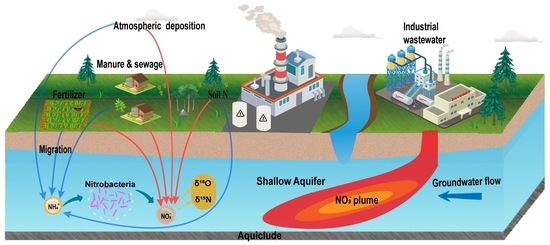
Groundwater nitrate (NO3) pollution, caused by anthropogenic activities, poses a global threat to water security. The mixing of multiple nitrate pollution sources and the associated biogeochemical reactions may create a complex chemical background, which renders traditional hydrochemical methods and single δ15N isotope analysis approaches limited in accurately identifying pollution sources and quantifying their contribution ratios. Accordingly, we adopted an integrated framework incorporating hydrochemistry, isotopes, and the MixSIAR model. Within this framework, results from different components mutually validate each other, helping to achieve more accurate source identification and contribution quantification. Results revealed severe nitrate contamination with striking spatial heterogeneity: concentrations were significantly higher in the eastern region (9.3–1890.7 mg·L−1, Mean: 472.8 mg·L−1) than in the western region (8.5–204.1 mg·L−1, Mean: 52.0 mg·L−1). Hydrochemical and δ18O-NO3 evidence identified nitrification as the dominant nitrogen transformation process. Critically, the MixSIAR model quantified drastically different source contributions between the two regions. In the eastern industrial zone, industrial wastewater was the predominant source (61.3%), followed by manure and sewage (18.5%). In contrast, in the western agricultural area, natural and agricultural sources dominated, with soil nitrogen contributing 43.9% and chemical fertilizer 31.7%. The findings pinpoint specific pollution drivers for each region, offering a robust scientific basis for formulating differentiated and effective nitrate pollution control strategies.

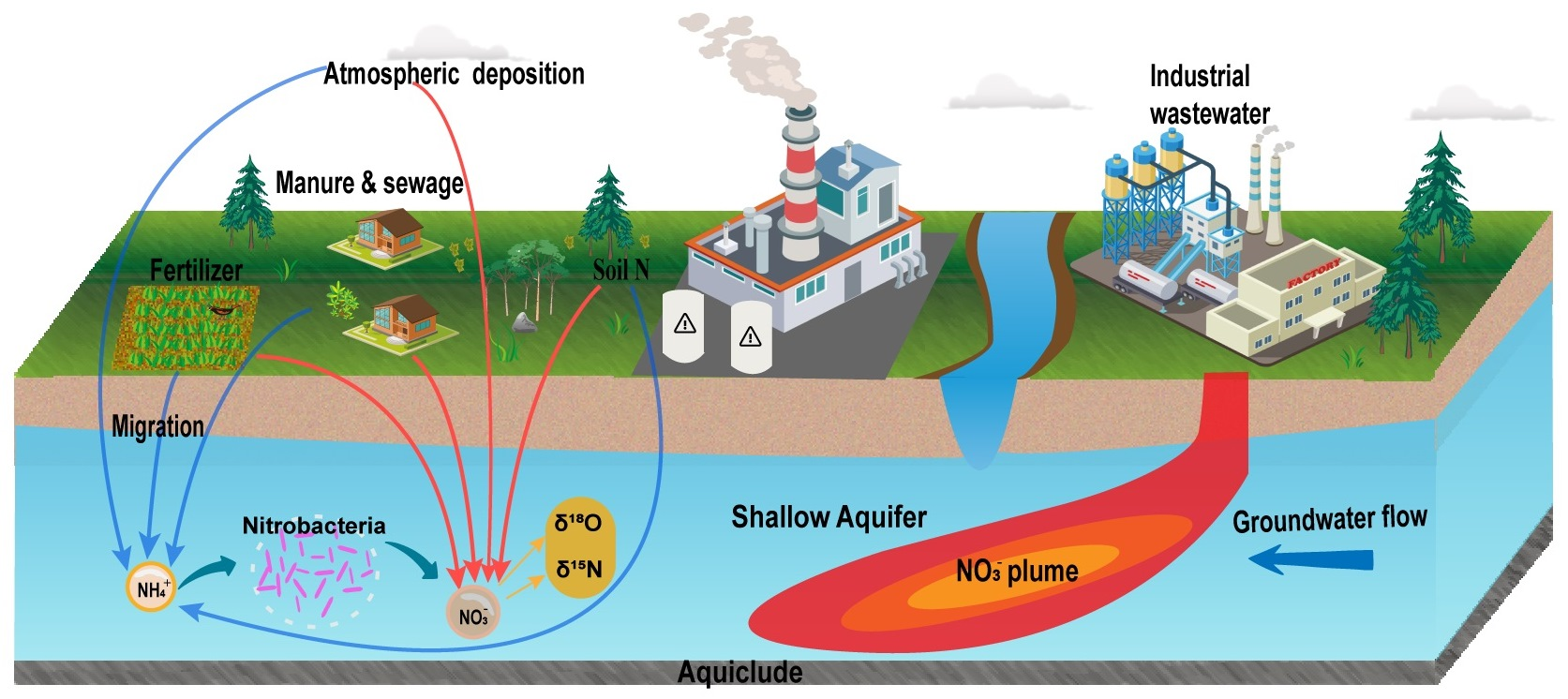
Graphical Abstract

1. Introduction

Groundwater, as a critical freshwater resource for maintaining ecological balance and human survival, serves as an important drinking water source in over 400 cities and vast rural areas of China [1]. However, alongside intensive agriculture and industrialization, nitrate (NO3) has become a global groundwater pollutant due to its high solubility, chemical stability, and strong mobility [2,3,4]. The World Health Organization and the United States Environmental Protection Agency limit NO3-N in drinking water to 10 mg·L−1 [5]. Excessive NO3 in drinking water can cause health hazards, including blue baby syndrome and cancers [6]. Given its long-term persistence in oxidizing groundwater environments [7], once pollution exceeds the environmental self-purification threshold, it can disrupt the ecological balance of groundwater and threaten drinking water safety [8,9]. Therefore, effective nitrate remediation is urgent, and accurately tracing its sources is essential for the orderly implementation of groundwater nitrate pollution control and remediation. Existing research indicates that nitrate sources in groundwater are complex and can be categorized into point sources and non-point sources [10]. The point sources primarily stem from livestock and poultry breeding, manure and sewage (M&S), and industrial wastewater (IW), whereas the non-point sources mainly include soil nitrogen (SN), chemical fertilizer (CF) and atmospheric deposition (AD) [2,11]. Aiming at the nitrate pollution issue caused by the synergistic impacts of multiple pollution sources, nitrate and ammonium released from different sources undergo nitrification and denitrification along distinct seepage paths. These biogeochemical reactions induce significant nitrogen and oxygen isotope fractionation during nitrogen migration and transformation, and the pollutants subsequently converge and undergo mixing processes. The mixed polluted groundwater partially loses its initial isotopic characteristics, posing fundamental challenges to qualitative identification and quantitative calculation [12,13]. Therefore, we adopted an integrated approach combining hydrochemical analysis, multi-isotope tracing, and a Bayesian mixing model to identify nitrate sources and quantify their respective contributions.
Traditional hydrochemical methods, relying on ion correlations, have limited discriminatory power in multi-source mixed pollution scenarios [14]. Researchers found that distinct δ15N-NO3 isotopic signatures exist among different nitrate sources, which has allowed the single nitrogen isotope to be used to distinguish nitrate derived from soil nitrogen, domestic sewage, and chemical fertilizers. However, overlaps in their isotopic signatures lead to inaccuracies in nitrate source apportionment [15,16,17]. To overcome these limitations, the dual-isotope technique of nitrate (δ15N-NO3 and δ18O-NO3) has emerged. The incorporation of δ18O-NO3 significantly improves the differentiation of isotopic signatures among nitrate from different sources. By coupling fingerprint information from both nitrogen and oxygen dimensions, it significantly enhances source discrimination capabilities [10,18]. Further integration with water stable isotopes (δ2H-H2O, δ18O-H2O) and hydrochemical indicators can effectively reveal nitrogen transformation processes and constrain source end-members, forming the mainstream qualitative tracing framework [19,20,21,22,23]. However, translating qualitative identification into precise quantification of multi-source contribution proportions remains a methodological bottleneck in nitrate pollution research. Early quantitative models (e.g., IsoSource), primarily based on mass balance, struggled to handle complexities such as the wide isotopic distribution caused by isotope fractionation (e.g., nitrification and denitrification) [24,25,26]. Emerging Bayesian mixing models (MixSIAR), by incorporating a probabilistic framework, can simultaneously account for source signature variability, fractionation effects, and mixing uncertainty, providing a powerful tool for quantitative source apportionment in complex systems. Therefore, integrating hydrochemical analysis, multi-isotope tracing, and Bayesian mixing models to form a comprehensive “identification-transformation-quantification” analytical framework represents the emerging methodological direction in current nitrate source tracing research.
This study focused on the Yongning River riparian area in the Naxi District, Luzhou City, located in the Sichuan Basin of southwestern China. The area features both concentrated industrial zones and dispersed agricultural land. Surveys indicate severe nitrate contamination in groundwater, but clear understanding of dominant pollution sources and their contribution proportions is lacking. Accordingly, this study aims to: (1) employ a combination of hydrochemical and multi-isotope (δ15N-NO3, δ18O-NO3, δ2H-H2O, δ18O-H2O) approaches to clarify nitrate pollution sources and key nitrogen transformation processes in the study area; (2) apply the MixSIAR model to quantitatively estimate the contribution proportions of different sources (soil nitrogen, chemical fertilizers, manure and sewage, industrial wastewater, and atmospheric deposition) to groundwater nitrate. The research findings aim to provide precise scientific evidence for groundwater nitrate pollution prevention and control in the region.

2. Materials and Methods

2.1. Study Area

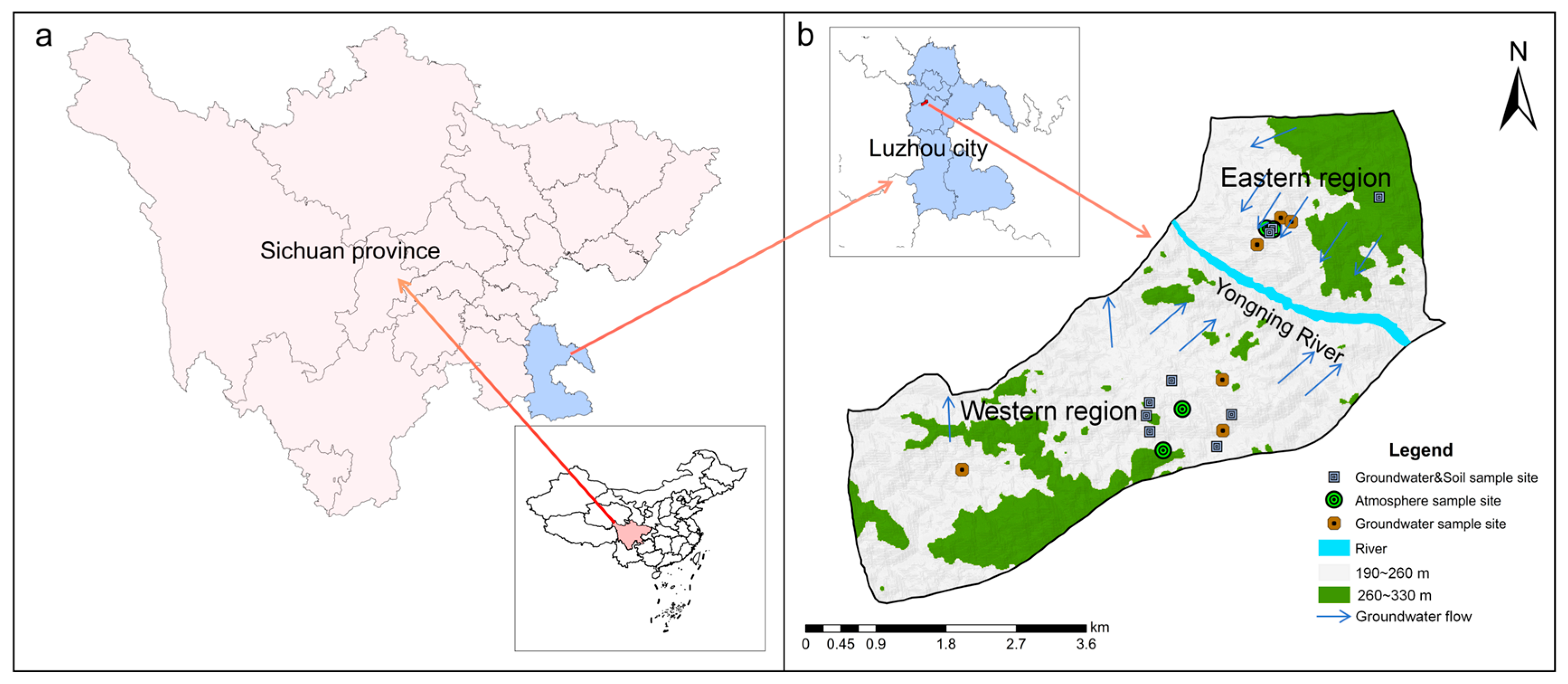
The study area is located in Naxi District, Luzhou City, on the southern edge of the Sichuan Basin (Figure 1). It experiences a subtropical humid monsoon climate, with an average annual temperature of approximately 12 °C and abundant precipitation (average annual rainfall of 909.4 mm), concentrated primarily in summer. The terrain slopes from higher elevations in the south to lower elevations in the north, with elevations ranging from 190 m to 305 m. The phreatic aquifer in the study area is dominated by the Jurassic Upper Shaximiao Formation, which is also widely distributed outside the study area. With an average thickness of approximately 40 m, the aquifer is composed of mudstone intercalated with sandstone, and the mudstones are generally enriched in calcium-bearing carbonates (calcite), while the groundwater depth ranges from 5 to 15 m. Groundwater occurrence types mainly consist of bedrock fissure water and porous water in unconsolidated sediments. The study area is divided into eastern and western parts by the Yongning River, and the Yangtze River flows through the upper part of the western section and the left side of the eastern section. Groundwater in the western part flows from southwest to northeast and discharges into the Yongning River and the Yangtze River, whereas groundwater in the eastern part flows from northeast to southwest and also drains into the two rivers. Industrial and chemical parks are concentrated in the eastern region, while the western part is predominantly characterized by agriculture and scattered residential areas, and Industrial wastewater infiltrates into the aquifer indirectly through the ground surface. Groundwater in the aquifers on both sides discharges into the Yongning River.

2.2. Sampling and Analyses

In this study, field sampling was conducted in June 2024, including the collection of groundwater samples and samples from potential nitrate sources. The 15 shallow groundwater samples were collected from agricultural irrigation wells and groundwater monitoring wells across the study area. These wells were selected to cover the main hydrogeological units and major land-use types, agricultural land, construction land, and wasteland, rendering them representative. Groundwater level variations induced by seasonal changes were relatively small. To ensure sample representativeness, each well was purged for a minimum of 15 min prior to sample collection. Samples for cations, anions and isotopes were filtered through a 0.22 μm membrane filter on the sampling day and then collected in 500 mL high-density polyethylene bottles rinsed three times with distilled water. Potential nitrate source samples included SN samples (n = 7), M&S samples (n = 2), AD samples (n = 4), and IW samples (n = 3). SN samples were collected from surface soil at a depth of 0–30 cm. At each sampling site, the five-point sampling method was adopted: samples collected from five different positions at the same site were mixed uniformly to ensure representativeness, and then the mixed samples were placed in sealed bags for preservation. M&S samples were collected from human excrement-related sources, specifically septic tanks and domestic sewage outlets in the study area. After collection, all M&S samples were filtered through a 0.22 μm membrane filter and then transferred into 50 mL amber glass bottles for storage to avoid light interference. AD samples were collected by atmospheric deposition sampling, using 47 mm quartz fiber filters to capture atmospheric deposition substances. After the sampling was completed, the quartz filter was folded with the collection side facing inward to prevent the collected substances from falling off or being contaminated, and then placed into a sealed bag. IW samples were collected from industrial wastewater storage tanks in industrial parks within the study area. Similar to M&S samples, IW samples were filtered through a 0.22 μm membrane filter immediately after collection, and then stored in 50 mL amber glass bottles. All collected samples were stored in a portable refrigerator at −4 °C during transportation and storage to maintain sample stability and avoid changes in δ15N and δ18O values. All these samples were used for the analysis of δ15N-NO3 and δ18O-NO3 isotopic compositions. The specific distribution of sampling points is shown in Figure 1.
In situ measurements of dissolved oxygen (DO), pH, electrical conductivity (EC), and oxidation-reduction potential (ORP) were measured using a calibrated Portable Multi-Parameter Meter (HQ40d, Hach, Loveland, Colorado, USA). The concentrations of HCO3 and CO32− were immediately measured via hydrochloric acid titration according to standard protocols. The major cations (Na+, K+, Ca2+, Mg2+) and major anions (Cl, SO42−, NO3) in the samples were determined using Ion Chromatograph (930, Metrohm, Herisau, Switzerland). We first used standard solutions to establish standard curves for anions and cations at concentrations of 10, 30, 50, 70, and 100 mg·L−1, and then, 50 mL of undiluted raw sample was injected into the ion chromatograph (IC) to determine the concentrations of anions and cations successively. Each sample was measured in triplicate, and the average value was adopted. For samples with concentrations exceeding the upper limit of the standard curves, they were diluted by 10 or 50 times to obtain accurate concentrations. The analytical precision for anions and cations was controlled within ±0.2 mg·L−1.
The δ15N-NO3 and δ18O-NO3 values were obtained by denitrifying bacteria method using Isotope Ratio Mass Spectrometer (MAT 253, Thermo, Bremen, Germany). In this method, denitrifying bacteria lacking N2O reductase convert NO3 to N2O; the resulting N2O is automatically purified by a trace gas analysis system and analyzed using an isotope ratio mass spectrometer under a high-purity He atmosphere. The δ15N and δ18O of NO3 are compared with the atmospheric N2 and Vienna Standard Mean Ocean water (VSMOW). The analytical uncertainty of δ15N-NO3 and δ18O-NO3 values was ±0.5 ‰ [27]. The δ18O-H2O and δ2H-H2O were determined using Isotope Ratio Mass Spectrometer (MAT 253, Thermo, Bremen, Germany). The reference standards include VSMOW (δD: 0‰, δ18O: 0‰), AP-31 (δD: −149.7‰, δ18O: −18.8‰), and PW2015 (δD: −34.5‰, δ18O: −5.3‰, internal standard). High-purity He (>99.999%) was used as carrier gas at 80 mL/min; high-purity H2 and CO served as reference gases. The pyrolysis furnace was set at 1400 °C, and column temperature at 85 °C. For IRMS: emission current 1.5 mA, acceleration voltage 3 kV, vacuum 1.4 × 10⁻⁶ mBar, injection volume 0.1 μL. Sample values were calibrated using linear regression of the first and last three standards. Intermediate standards were used to monitor instrument performance. The reported as values relative to Vienna Standard Mean Ocean water (VSMOW). The analytical precision was ±0.2‰ for δ18O-H2O and ±1‰ for δ2H-H2O.
The results of δ15N-NO3, δ18O-NO3, δ2H-H2O, δ18O-H2O values were calculated as follows [28]:
δ ( ) = R sample R standard 1 × 1000
where Rsample and Rstandard are the isotope ratios of the samples and standards (15N/14N, 18O/16O, 2H/1H) respectively.

2.3. Bayesian Mixing Model

To quantitatively estimate the proportional contributions of various pollution sources, the MixSIAR model, which is based on Bayesian theory (operating in the R language environment), was employed [29]. The model can be represented as follows (Equation (2)):
X i j = k = 1 k P k ( S j k + C j k ) + ε i j
S j k ~ N ( μ j k , ω j k 2 )
C j k ~ N ( λ j k , τ j k 2 )
ε i j ~ N ( 0 , σ j 2 )
where Xij is the isotope signature j of groundwater sample i, Pk is the contribution rate of pollution source k; Sjk is the isotope j of source k; Cjk is the fractionation coefficient of isotope j of pollution source k; εij is a residual that represents other unquantified changes between individual samples, and is distributed with mean 0 and standard deviation of σj.
Inputs to the MixSIAR model comprised three elements. First, the mixture data consisted of the measured δ15N-NO3 and δ18O-NO3 values from groundwater samples. Second, the source end-members were defined by the mean and standard deviation of these isotopes for five potential sources, among which AD, M&S, IW, and SN were derived from direct source sampling, and chemical fertilizers were derived from a review of local literature. Third, the fractionation factors were assigned. The hydrochemical and isotopic assessment (Section 3.2.1) indicated a strongly oxidizing environment with minimal denitrification. Accordingly, the fractionation coefficients for both nitrogen and oxygen isotopes were set to zero.
Non-informative priors were used in the model. The Markov Chain Monte Carlo (MCMC) run length was set to 200,000 iterations, with the first 20,000 iterations discarded as a burn-in period to ensure chain convergence. The results were presented as the posterior distribution means and 95% confidence intervals for each source’s contribution.

2.4. Statistical Analyses

Descriptive statistics and Pearson correlation analysis were performed using Origin 2025 software.

3. Results and Discussion

3.1. Hydrogeochemical Characteristics and Spatial Differentiation of Nitrate

The mean, range, median, and standard deviation (SD) of the physicochemical variables (DO, ORP, pH, EC) and major ions (Na+, K+, Ca2+, Mg2+, Cl, SO42−, NO3, HCO3) of the groundwater samples are summarized in Table 1. According to these results, pH across both regions exhibited weakly acidic to near-neutral conditions (pH 5.70–7.90), with notable spatial heterogeneity. The eastern region showed pH values of 6.40–7.90 (mean 7.06), while the western region exhibited slightly more acidic conditions (5.70–7.44, mean 6.64). Both DO and ORP demonstrated significant variability, with eastern region values ranging from 2.68 to 7.18 mg·L−1 (mean 5.04 mg·L−1) for DO and 12.10–194.00 mV (mean 134.03 mV) for ORP, compared to western region ranges of 1.57–7.04 mg·L−1 (mean 4.52 mg·L−1) for DO and 58.70–240.30 mV (mean 148.78 mV) for ORP collectively indicating strongly oxidizing conditions throughout the study area, with significantly higher EC values in the eastern region compared to the west.
Groundwater hydrogeochemistry in the study area exhibits distinct spatial patterns between the western and eastern regions. In the western region, HCO3 dominates as the primary anion, with the abundance order HCO3 > SO42− > NO3 > Cl, while Ca2+ is the predominant cation, following the sequence Ca2+ > Na+ > Mg2+ > K+. In contrast, the eastern region also features HCO3 as the main anion, but the anion abundance shifts to NO3 > HCO3 > SO42− > Cl, with cations ordered as Na+ > Ca2+ > Mg2+ > K+. Notably, NO3 exhibits the highest average concentration among anions in the eastern groundwater. This phenomenon may be attributed to the presence of nitrate production enterprises. High concentrations of NO3 exist in industrial wastewater from chemical production. Leakage of such wastewater gradually infiltrates into the underground aquifer through the surface, resulting in a significant increase in NO3 levels in wells near the production base. These findings underscore the combined influence of anthropogenic activities and natural geological processes on groundwater composition in the study area.
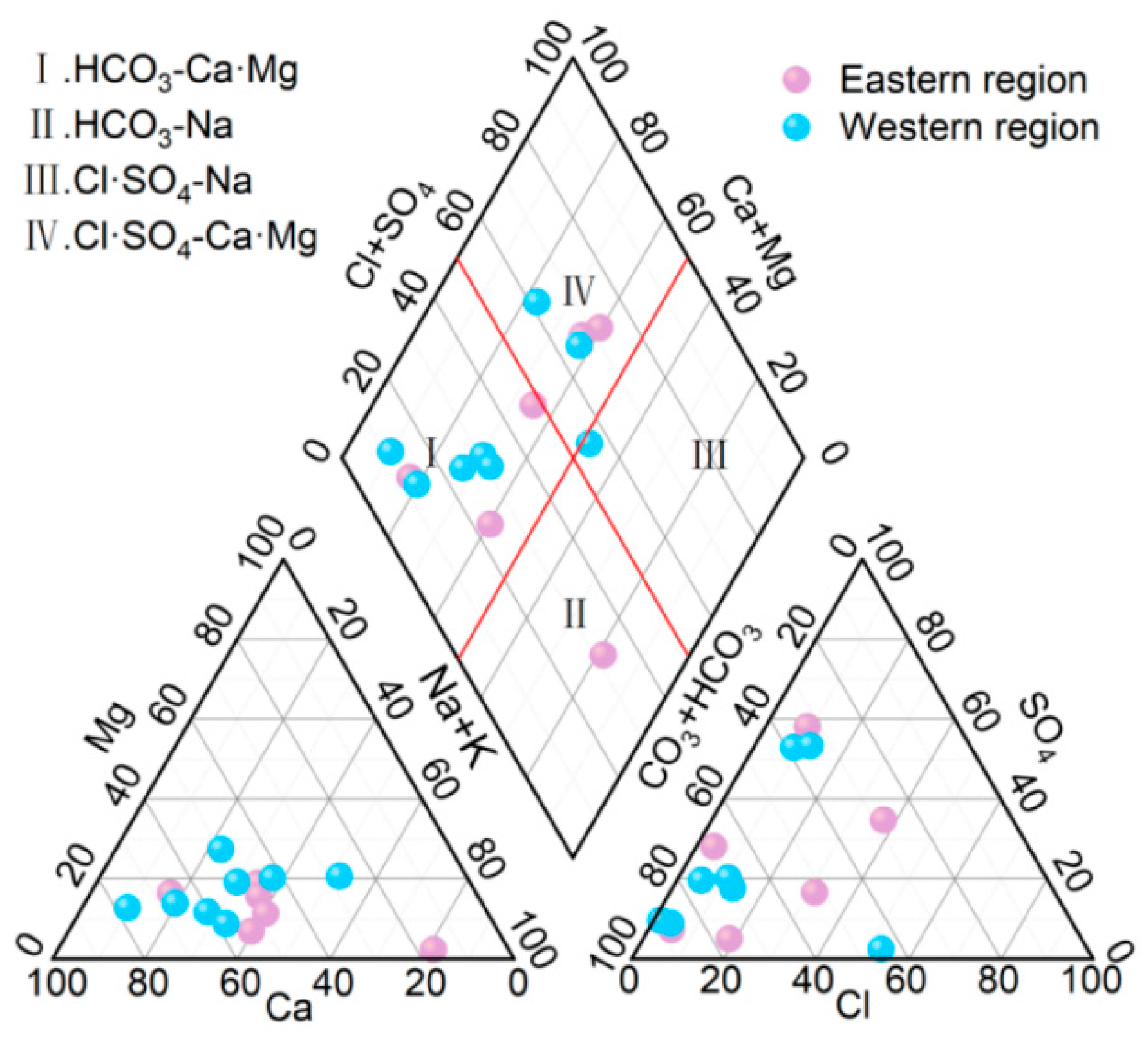
The hydrochemical characteristics of groundwater in the study area were analyzed using Piper trilinear diagrams (Figure 2). The majority of groundwater samples plot in the HCO3-Ca·Mg zone of the Piper diagram, suggesting water-rock interactions dominated by carbonate mineral (particularly calcite) dissolution. A minor proportion of samples display Cl·SO4-Ca·Mg type, potentially influenced by anthropogenic activities such as agricultural fertilization with ammonium sulfate compounds and the discharge of domestic wastewater [30]. Notably, one single sample from the Chemical Industry Park in the eastern region is HCO3-Na type, with this anomalous composition likely attributable to leakage of sodium-containing raw materials or products during industrial chemical production process.
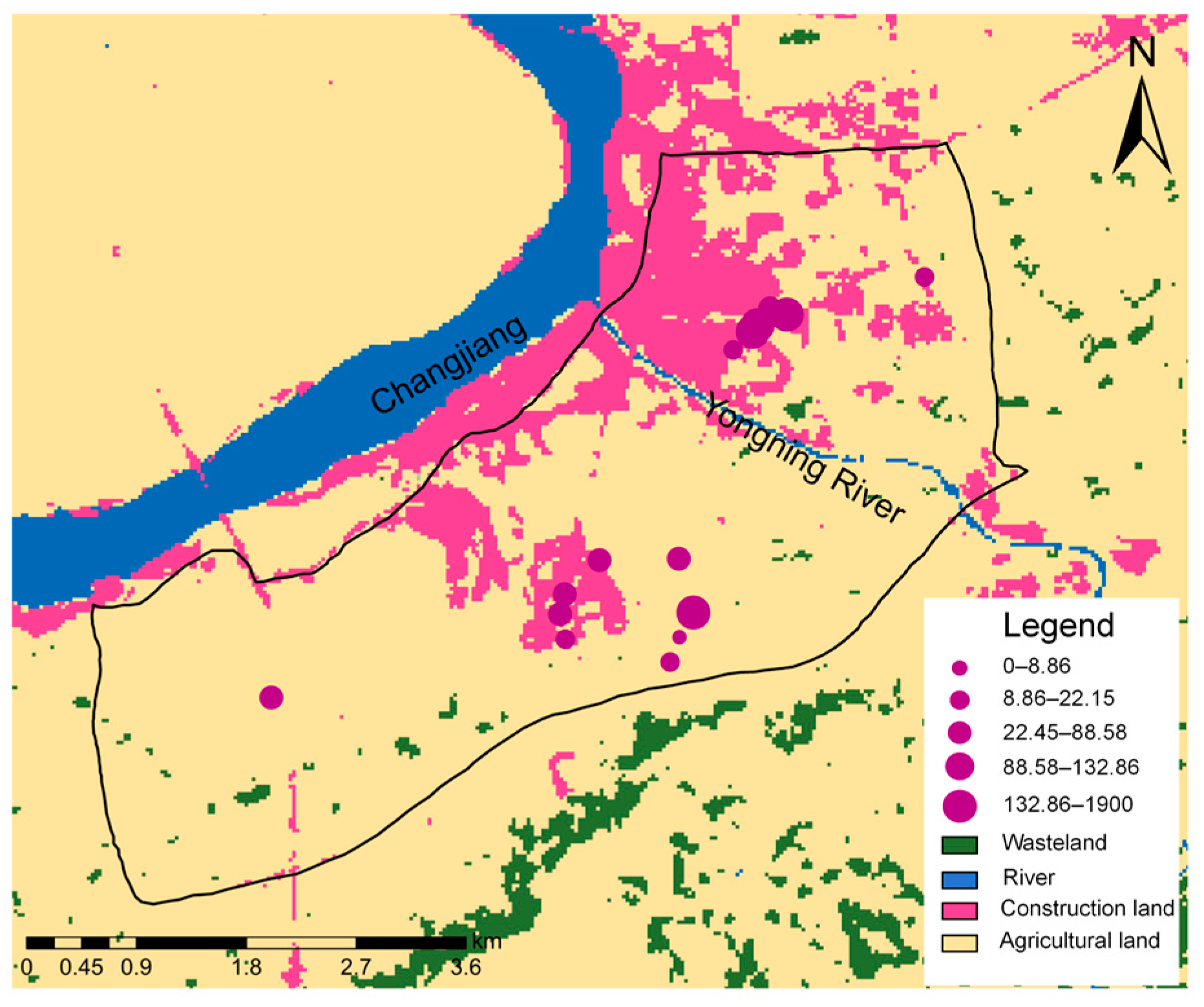
The study area exhibits pronounced spatial heterogeneity in groundwater NO3 contamination, with significantly higher concentrations observed in the eastern region (9.25–1890.74 mg·L−1) compared to the western region (8.50–204.09 mg·L−1). Notably, 46.7% of sampling wells surpassed the World Health Organization drinking water standards (>50 mg·L−1), comprising 4 wells in the western region and 3 wells in the eastern region (Figure 3). The spatial distribution of NO3 pollution exhibits distinct clustering patterns, with peak concentrations in the eastern region primarily sourced from groundwater wells within the chemical industrial park. In contrast, the high nitrate concentrations in the western region are primarily located in agricultural activity areas. These findings indicate that there is a phenomenon of NO3 pollution within the study area, with particularly severe pollution in the eastern region, where industrial activities appear to be the dominant contributing factor compared to agricultural influences in the western region.
The spatial distribution of NO3 contamination in the study area’s groundwater exhibits strong correlations with land use patterns. The chemical industry park in the eastern region demonstrates the most severe NO3 pollution, with two sampling wells showing exceptionally high concentrations ranging from 724.21 to 1890.74 mg·L−1. The western region presents a different contamination profile, where farmland groundwater consistently contains higher NO3 concentrations compared to residential areas, reflecting the dominant influence of agricultural activities. These findings demonstrate that industrial operations constitute the primary nitrate source in the eastern region, while agricultural practices drive contamination in the western region.
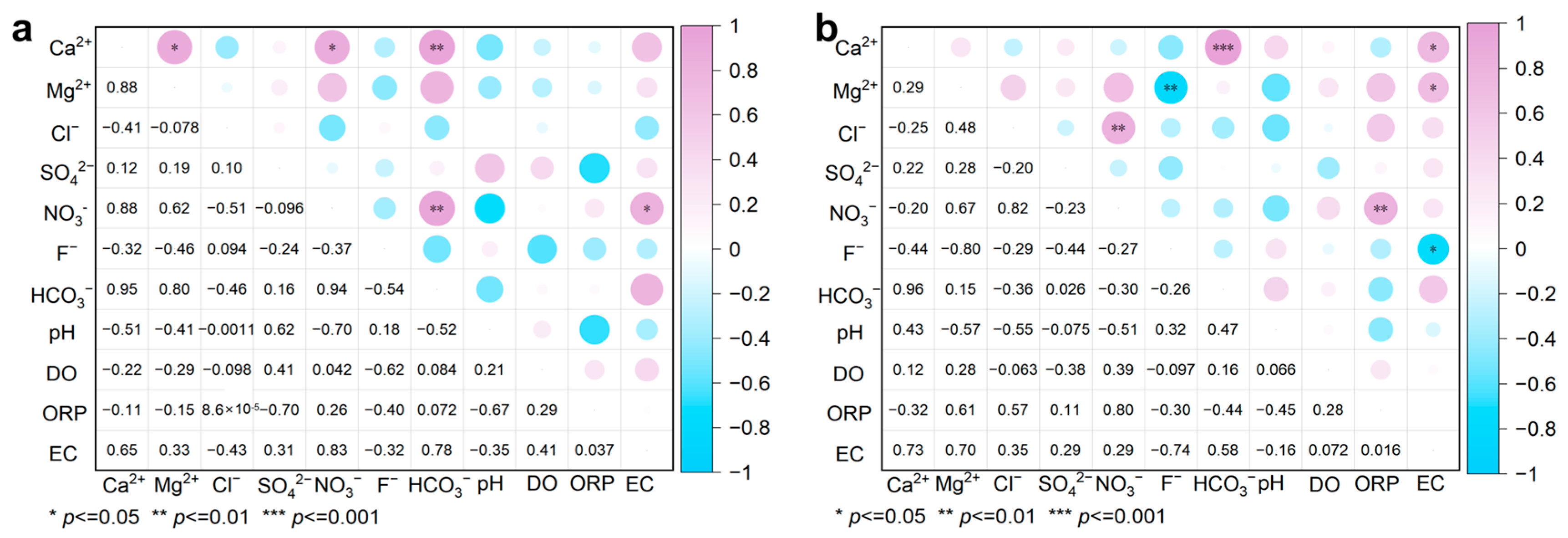
The hydrogeochemical correlation analysis reveals distinct nitrate contamination patterns. In the eastern region (Figure 4a), the strong positive correlations between Ca2+ and Mg2+ (R = 0.88) and between Ca2+ and HCO3 (R = 0.95) reveal the contribution of the long-term water-rock interactions to groundwater chemistry. The particularly strong association between NO3 and Ca2+, Mg2+ implies substantial influence from chemical fertilizer containing these cations [31]. Conversely, in the western region (Figure 4b), the remarkably high correlation between NO3 and Cl (R = 0.82) points to potential manure and sewage contributions to groundwater NO3 levels [32], as these waste sources typically contain both ions in comparable ratios. However, correlation alone is insufficient to verify pollution sources, which will be further analyzed in subsequent sections using isotopic evidence. The significant negative correlation between NO3 and pH (R = −0.70, R = −0.51) suggests an underlying biogeochemical mechanism. Acidic conditions reduce soil’s adsorption capacity, thereby enhancing nitrate mobility [33]. These differential correlation patterns highlight region-specific nitrate pollution mechanisms within the study area.

3.2. Nitrogen Transformation Processes and Identification of Nitrate Sources

3.2.1. Nitrogen Transformation Processes

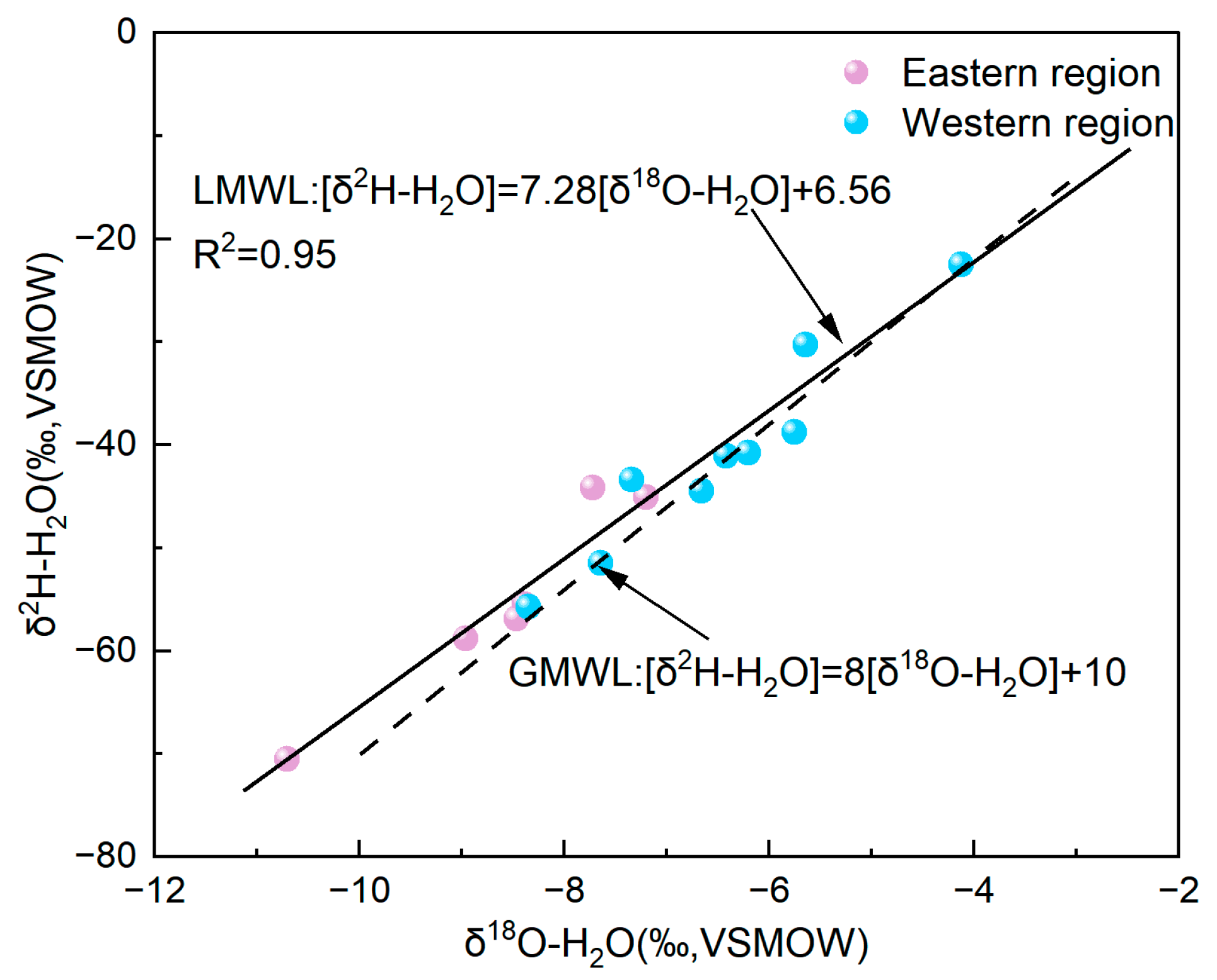
Stable isotopes (δ2H and δ18O) serve as valuable tracers for identifying groundwater recharge sources. Groundwater samples in the study area exhibit a range of stable isotope values: δ2H from −58.0‰ to −22.9‰ and δ18O from −10.71‰ to −3.83‰, reflecting mixing of meteoric recharge and localized evaporation effects. Figure 5 shows the relationship between δ18O-H2O and δ2H-H2O in groundwater. The local meteoric water line (LMWL: δ2H-H2O = 7.28 δ18O-H2O + 6.56 R2 = 0.95) falls near the Global Meteoric Water Line (GMWL: δ2H-H2O = 8 δ18O-H2O + 10), with deviations attributable to regional climatic influences on isotopic fractionation, including temperature, humidity, and precipitation variations. This correlation confirms atmospheric precipitation as the predominant recharge source for groundwater [34], providing critical information for subsequent NO3 source identification through isotopic signatures.
The dual-isotopic signatures of NO315N-NO3 and δ18O-NO3) serve as valuable tracers for NO3 source identification, yet we need careful consideration of biogeochemical processes that may modify these values. In shallow aquifer systems, microbial-mediated N transformation, particularly nitrification and denitrification, can substantially alter the original isotopic signatures of NO3 sources [12]. Therefore, a thorough understanding of nitrogen cycling, particularly nitrification and denitrification, is essential for accurate interpretation of NO3 isotopes [35].
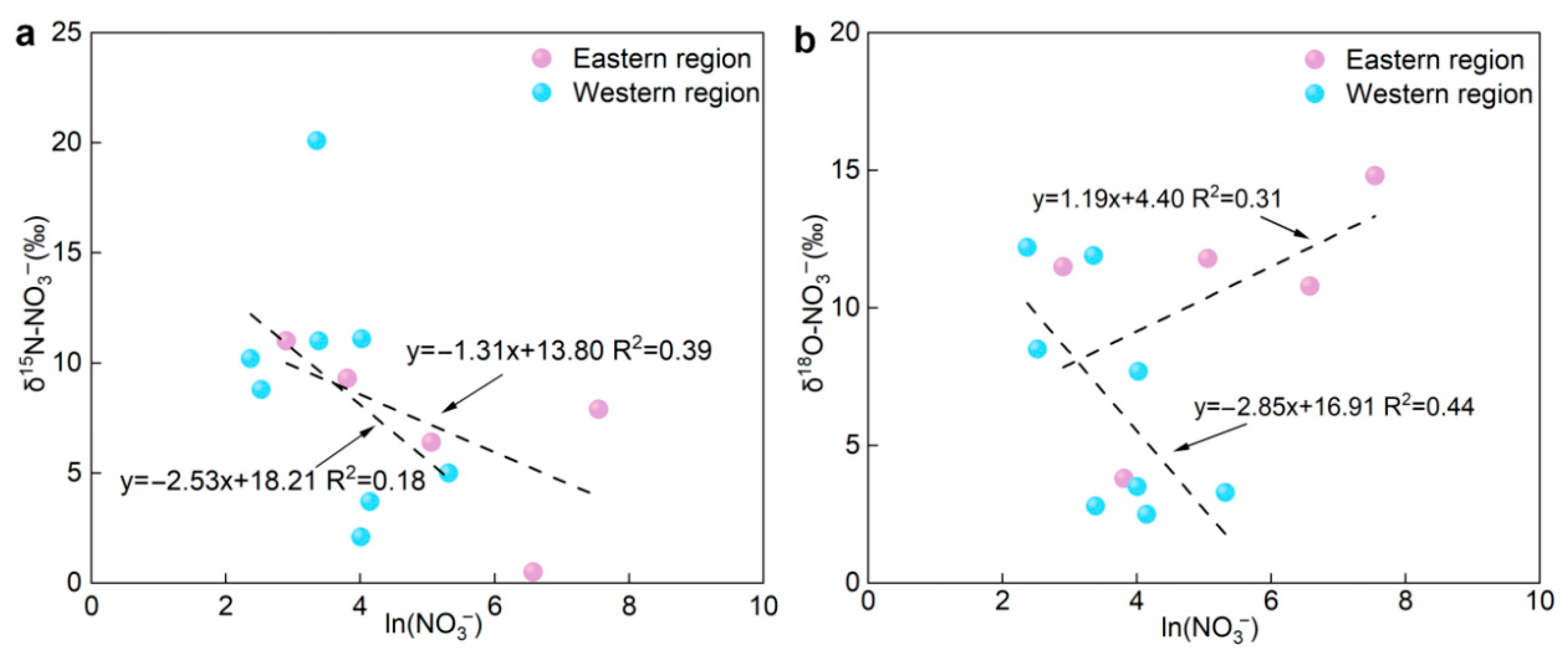
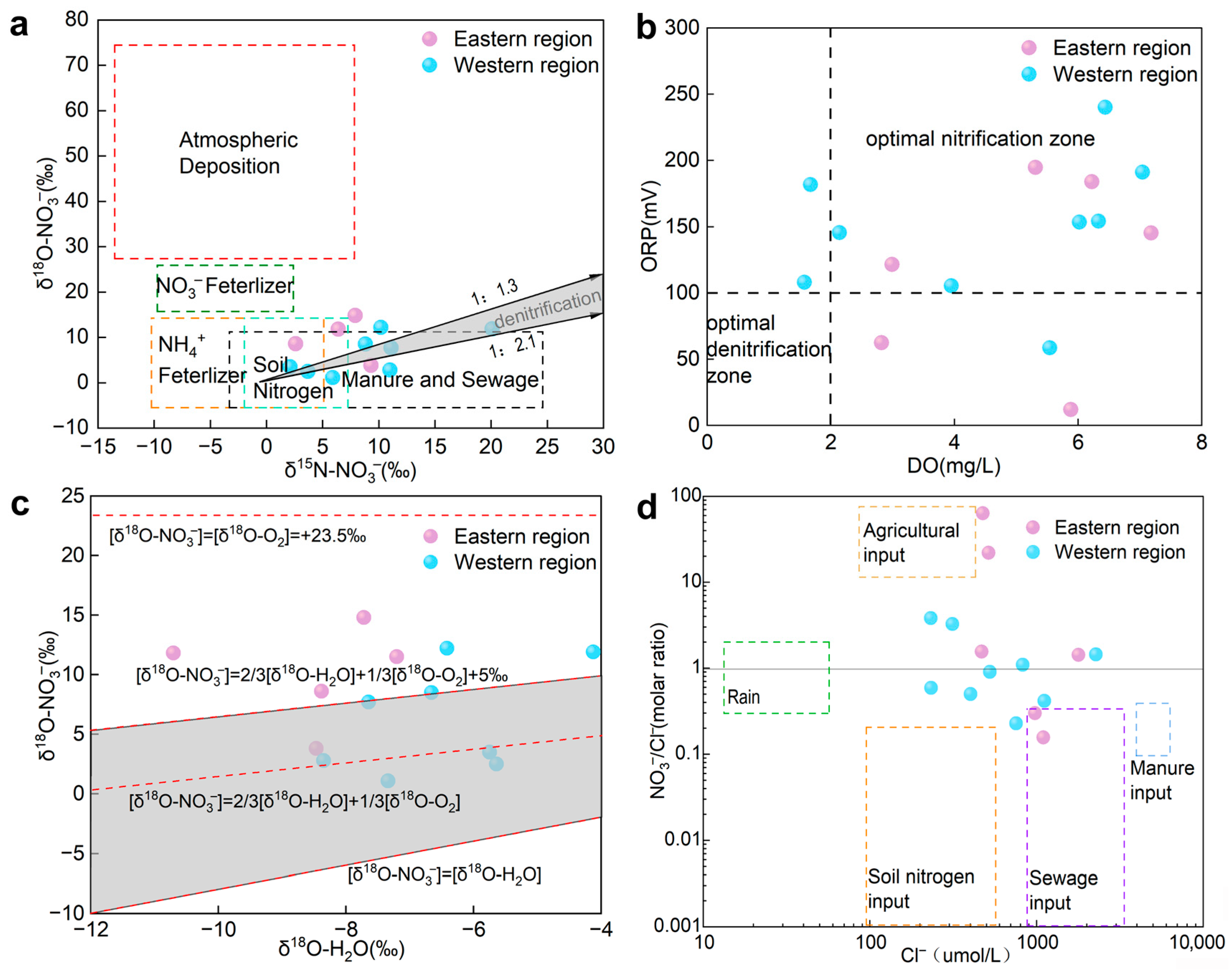
Denitrification is a microbially mediated process that reduces NO3 to nitrogen gases (N2 or N2O), concurrently decreasing NO3 concentration while enriching the residual nitrate in δ15N [36]. This biogeochemical process can be identified through combined hydrochemical and isotopic analyses, where distinct negative linear correlations of both δ15N-NO3 and δ18O-NO3 with ln(NO3) typically indicate significant denitrification in groundwater systems. As shown in Figure 6a, while both regions exhibit negative δ15N-NO3 versus ln(NO3) relationships, these correlations are statistically weak. As can be seen from Figure 6b, the δ18O-NO3 demonstrates divergent regional trends, showing a weak positive correlation with ln(NO3) in the eastern region but a weak negative correlation in the western region, consistent with previous observations [37]. Notably, active denitrification typically produces characteristic δ15N-NO3 to δ18O-NO3 enrichment ratios ranging from 1:1.3 to 1:2.1 [38,39]. As can be seen from Figure 7a, three points in the western region plot within the denitrification zone, suggesting possible localized activity. However, comprehensive assessment requires supplementary hydrochemical indicators, particularly DO and ORP, which serve as robust denitrification proxies [31,40]. The measured DO concentrations (eastern mean 5.04 mg·L−1; western mean 4.52 mg·L−1) consistently exceed the 2 mg·L−1 threshold for significant denitrification [41,42,43], while ORP values (12.10–240.3 mV) confirm prevailing oxidative conditions fundamentally incompatible with substantial denitrification (Figure 7b). Consequently, denitrification is not the dominant nitrogen transformation process in the study area, warranting the approximation of isotopic fractionation coefficients as zero in subsequent MixSIAR model [44,45,46].
Nitrification, the microbial-mediated oxidation of NH4+ to NO3 under aerobic conditions, proceeds via two sequential steps: nitrosation (NH4+→NO2) and nitrification (NO2→NO3) [47]. In the study area’s subtropical humid monsoon climate, optimal temperatures significantly enhance nitrification rates through multiple pathways. During this process, the oxygen composition of NO3 derives from two sources: approximately two-thirds originates from water molecules (H2O) and one-third from atmospheric O2 [48], and the empirical value of atmospheric O2 is +23.5‰ [49]. This stoichiometric ratio represents a simplified model, as natural conditions introduce complexities including abiotic oxygen exchange and microbial respiration effects on δ18O values. These factors can alter oxygen incorporation, potentially increasing the proportion of aqueous-derived oxygen atoms in NO3 beyond the theoretical two-thirds. Nevertheless, the δ18O-NO3 values can be determined using the following theoretical expression (Equation (3)):
δ 18 O Ν O 3 = 2 3 δ 18 O H 2 O + 1 3 δ 18 O O 2
The values of δ18O-H2O in groundwater range from −10.706‰ to −3.825‰, making the δ18O-NO3 theoretical values range between +0.626‰ and +5.283‰. However, the measured δ18O values may be up to 5‰ higher than the calculated theoretical values [50]. As shown in Figure 7c, most of the δ18O-NO3 values in the western region are within the nitrification range and far lower than the atmospheric oxygen line of NO3, while the δ18O-NO3 values in the eastern region are higher than the theoretical line, which can be attributed to the high input δ18O-NO3 values, microbial respiration, and evaporation can also lead to the enrichment of δ18O in groundwater [48].

3.2.2. Source Identification Based on Dual Isotopes and Ionic Ratios

Cl is stable in groundwater and can often be used as a stable tracer to identify different sources, such as Cl containing minerals from natural sources, M&S, CF and IW from anthropogenic sources [51]. The relationship between NO3/Cl ratio and Cl concentration shown in Figure 7d can be used to distinguish NO3 from M&S, SN and CF. The higher Cl and lower NO3/Cl values in the eastern region indicate that NO3 mainly comes from M&S [41,52], and NO3 in samples with NO3/Cl values far exceeding 1 may come from product leakage in the chemical industry park. In both regions, NO3/Cl ratios ranged from 1 to 10, indicating mixed source pollution, while the NO3/Cl ratios are less than 1 with low Cl indicates that NO3 mainly comes from SN [21]. Samples from both regions that are not within a specific range may be the result of mixed effects from multiple sources [53,54].
In addition, δ15N and δ18O values provide direct evidence for the identification of NO3 sources in groundwater. δ15N values in the study area range from 2.1‰ to 20.1‰, and δ18O values range from 1.1‰ to 14.8‰. According to previous studies and the measured data in the study area [50,51,55], the values of δ15N and δ18O from the main NO3 sources in the study area are shown in Table 2.
The distinct δ15N and δ18O ranges of different sources (Table 2) allow for qualitative identification of major nitrate sources using a dual-isotope plot. As can be seen from Figure 7a, the sample points mainly fall in the areas of SN, M&S, and CF, indicating their primary contribution to NO3 sources. Although the dual-isotopes show that some samples are near the M&S terminal, the final mixed signal δ18O-NO3 may be the result of the physical and chemical interaction between IW and local nitrification products, which makes the isotope scatters fall within the range of M&S. Few samples fall in the AD range, indicating its limited influence on the pollution.

3.3. Quantitative Analysis of Nitrate Sources Based on MixSIAR Model

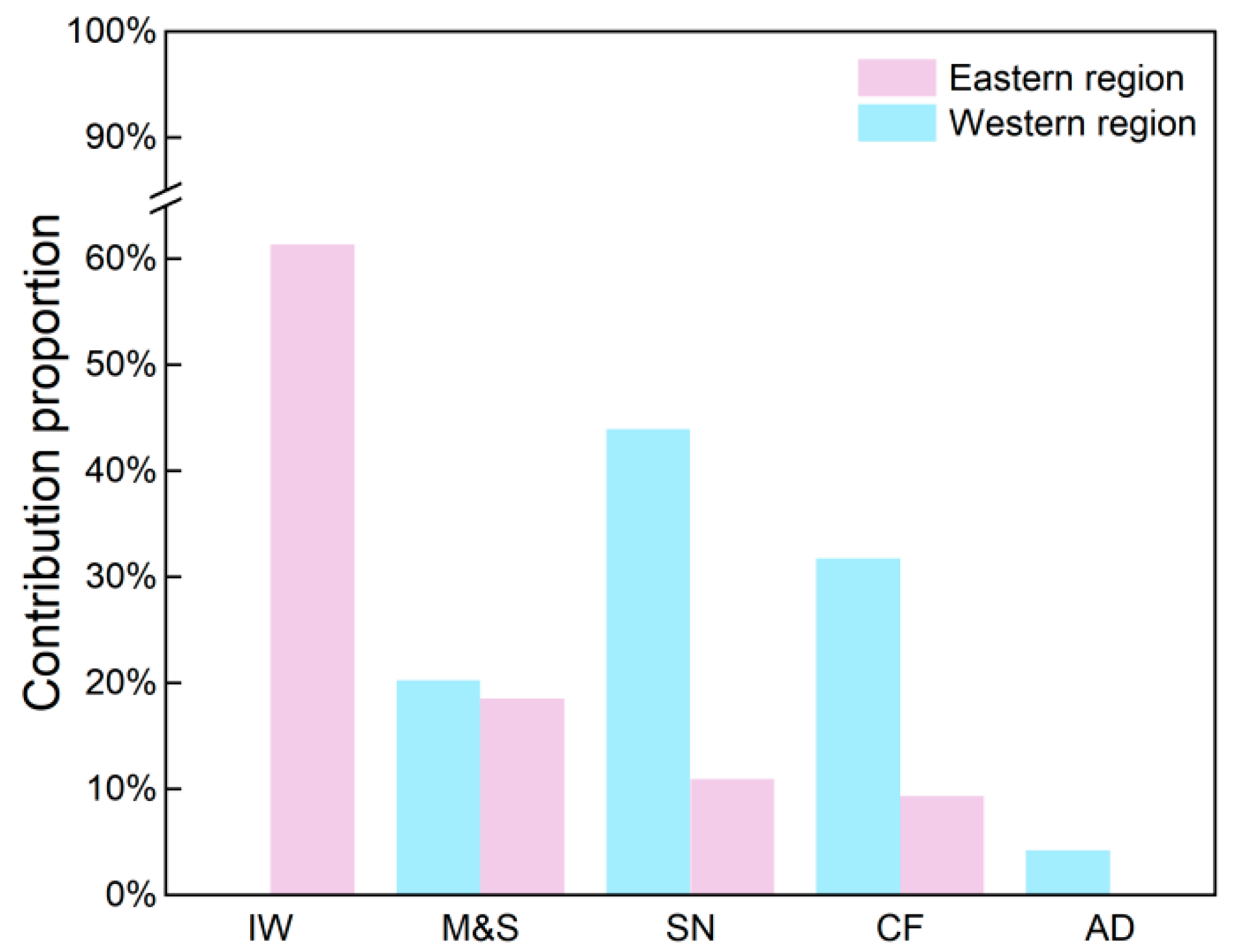
Building upon the aforementioned qualitative insights, the MixSIAR model was applied to perform quantitative source apportionment separately for the eastern and western regions. The MixSIAR results revealed distinctly different pollution source structures between the two regions (Figure 8).
SN accounted for the highest proportion of nitrate in groundwater in the western region, with a contribution rate of 43.9%, followed by CF (31.7%), M&S (20.2%), and atmospheric deposition (4.1%). Notably, SN accounts for the largest proportion in agricultural areas. A possible reason is that the isotopic signatures of SN and CF overlap to some extent, making it impossible to accurately distinguish them when calculating their contribution rates. IW accounted for the highest proportion of nitrate in the groundwater in the eastern region, and its contribution rate is 61.3%, followed by M&S (18.5%), SN (10.9%) and CF (9.3%). The nitrate in the groundwater of the eastern region is mainly affected by anthropogenic activities, whereas in the western region, it is primarily controlled by agricultural practices. In the eastern region, NO3 chemical production enterprises are mainly distributed, which leads to serious NO3 pollution of groundwater. By integrating Cl data and spatial distribution of NO3, the MixSIAR model corrected the misjudgment caused by isotope overlap, and the findings ultimately point to industrial wastewater leakage as the principal source. This quantitative result aligns with the agricultural land use in the western region, where soil nitrogen and chemical fertilizer collectively constitute the dominant nitrate sources.

4. Conclusions

This study established an integrated framework coupling in situ hydrogeochemistry, multi-isotope tracers (δ15N, δ18O, δ2H), and MixSIAR model to identify the NO3 sources and quantify groundwater NO3 source apportionment. Groundwater NO3 pollution is severe and exhibits significant spatial heterogeneity, with extremely high concentrations in the eastern region primarily driven by industrial point sources (chemical industrial parks), while moderate to low levels of pollution in the western region are mainly associated with agricultural non-point sources (soil nitrogen and fertilizers). Hydrochemical and isotopic evidence indicates that nitrification is the dominant nitrogen transformation process in the study area, where the oxidizing environment suppresses denitrification and creates favorable conditions for stable isotope-based source tracing. Quantitative apportionment via the MixSIAR model reveals that soil nitrogen (43.9%) and chemical fertilizers (31.7%) are the primary contributors in the western region, whereas industrial wastewater (61.3%) overwhelmingly dominates in the eastern region.
Based on the above findings, the following management recommendations are proposed: In the eastern industrial zone, priority should be given to strengthening leak-proof supervision in industrial parks and enhancing wastewater treatment. In the western agricultural area, it is essential to promote soil testing and formulated fertilization, optimize irrigation management, and implement non-point source pollution prevention and control measures.
This study has limitations that suggest valuable future research directions. First, only one sampling campaign was conducted in this study, which fails to characterize the annual variation in nitrate. Future studies will increase sampling frequency and spatial coverage to better characterize the temporal variations and detailed spatial distributions of nitrate sources. Second, insufficient collection of samples from potential nitrate sources in the study area resulted in considerable overlap in the isotopic signatures of different nitrate end-members (e.g., soil nitrogen and chemical fertilizers), thereby introducing uncertainties into the estimated contribution proportions of each source. Finally, regarding the fractionation factors associated with nitrogen cycling and transformation required for the MixSIAR model, this study only adopted qualitative analysis. Therefore, future research should focus on the following aspects: first, long-term and large-scale groundwater and end-member sampling should be conducted in the study area to accurately characterize the spatiotemporal variations in nitrate pollution and precisely distinguish the isotopic signatures of different end-members; second, multiple isotopic tracers (e.g., B, Sr) should be adopted to improve source identification accuracy with consideration of isotope fractionation induced by biogeochemical nitrogen cycling; finally, accurate isotope fractionation factors should be determined via laboratory experiments to ensure the reliability of the calculated contribution proportions of different nitrate sources.

Author Contributions

Z.Y.: Writing—original draft, Formal analysis, Investigation, Software, Methodology. Y.Y.: Investigation, Validation, Funding acquisition. Y.W.: Conceptualization, Funding acquisition. C.G.: Data Curation, Investigation, Writing—review & editing, Conceptualization. C.Z.: Investigation, Writing—review & editing. X.T.: Visualization. Y.L.: Investigation. All authors have read and agreed to the published version of the manuscript.

Funding

This work was supported by the National Major Science and Technology Projects of China (No. 2023YFC3706002), the National Natural Science Foundation of China (Nos. 42172284, 42277189), Liao Ning Revitalization Talents Program (XLYC1807259), and Young and Middle-aged Scientific and Technological Innovation Talents Project of Shenyang (RC230297).

Data Availability Statement

The original contributions presented in this study are included in the article material. Further inquiries can be directed to the corresponding author.

Acknowledgments

We thank the reviewers, and the editor for their comments on the manuscript.

Conflicts of Interest

The authors declare that they have no known competing financial interests or personal relationships that could have appeared to influence the work reported in this paper.

References

  1. Qiu, J. China faces up to groundwater crisis. Nature 2010, 466, 308. [Google Scholar] [CrossRef] [PubMed]
  2. Xuan, Y.; Liu, G.; Zhang, Y.; Cao, Y. Factor affecting nitrate in a mixed land-use watershed of southern China based on dual nitrate isotopes, sources or transformations? J. Hydrol. 2022, 604, 127220. [Google Scholar] [CrossRef]
  3. Zhang, Q.; Li, P.; Lyu, Q.; Ren, X.; He, S. Groundwater contamination risk assessment using a modified DRATICL model and pollution loading: A case study in the Guanzhong Basin of China. Chemosphere 2022, 291, 132695. [Google Scholar] [CrossRef]
  4. Zhang, Y.; Shi, P.; Li, F.; Wei, A.; Song, J.; Ma, J. Quantification of nitrate sources and fates in rivers in an irrigated agricultural area using environmental isotopes and a Bayesian isotope mixing model. Chemosphere 2018, 208, 493–501. [Google Scholar] [CrossRef] [PubMed]
  5. World Health Organization. Guidelines for Drinking-Water Quality; World Health Organization: Geneva, Switzerland, 1993. [Google Scholar]
  6. Temkin, A.; Evans, S.; Manidis, T.; Campbell, C.; Naidenko, O.V. Exposure-based assessment and economic valuation of adverse birth outcomes and cancer risk due to nitrate in United States drinking water. Environ. Res. 2019, 176, 108442. [Google Scholar] [CrossRef]
  7. Gao, H.; Wang, G.; Fan, Y.; Wu, J.; Yao, M.; Zhu, X.; Guo, X.; Long, B.; Zhao, J. Tracing groundwater nitrate sources in an intensive agricultural region integrated of a self-organizing map and end-member mixing model tool. Sci. Rep. 2024, 14, 16873. [Google Scholar] [CrossRef]
  8. Briand, C.; Sebilo, M.; Louvat, P.; Chesnot, T.; Vaury, V.; Schneider, M.; Plagnes, V. Legacy of contaminant N sources to the NO3 signature in rivers: A combined isotopic (δ15N-NO3, δ18O-NO3, δ11B) and microbiological investigation. Sci. Rep. 2017, 7, srep41703. [Google Scholar] [CrossRef] [PubMed]
  9. Panagopoulos, G.; Bekiari, V.; Lambrakis, N.; Avramidis, P.; Nicolaou, C.; Koroniotis, D.; Poulios, C. Hydrogeological and Hydrochemical Research of the Vocha Alluvial Aquifer, Korinthia Perfecture, Greece. In Proceedings of the 14th International Multidisciplinary Scientific Geoconference (SGEM), Albena, Bulgaria, 17–26 June 2014; pp. 481–486. [Google Scholar]
  10. Yi, Q.; Zhang, Y.; Xie, K.; Chen, Q.; Zheng, F.; Tonina, D.; Shi, W.; Chen, C. Tracking nitrogen pollution sources in plain watersheds by combining high-frequency water quality monitoring with tracing dual nitrate isotopes. J. Hydrol. 2020, 581, 124439. [Google Scholar] [CrossRef]
  11. Cui, R.; Zhang, D.; Hu, W.; Zhao, X.; Yan, H.; Liu, G.; Chen, A. Nitrogen in soil, manure and sewage has become a major challenge in controlling nitrate pollution in groundwater around plateau lakes, Southwest China. J. Hydrol. 2023, 620, 129541. [Google Scholar] [CrossRef]
  12. Torres-Martinez, J.A.; Mora, A.; Knappett, P.S.K.; Ornelas-Soto, N.; Mahlknecht, J. Tracking nitrate and sulfate sources in groundwater of an urbanized valley using a multi-tracer approach combined with a Bayesian isotope mixing model. Water Res. 2020, 182, 115962. [Google Scholar] [CrossRef]
  13. Xuan, Y.; Tang, C.; Cao, Y. Mechanisms of nitrate accumulation in highly urbanized rivers: Evidence from multi-isotopes in the Pearl River Delta, China. J. Hydrol. 2020, 587, 124924. [Google Scholar] [CrossRef]
  14. Meghdadi, A.; Javar, N. Quantification of spatial and seasonal variations in the proportional contribution of nitrate sources using a multi-isotope approach and Bayesian isotope mixing model. Environ. Pollut. 2018, 235, 207–222. [Google Scholar] [CrossRef]
  15. Kohl, D.H.; Shearer, G.B.; Commoner, B. Fertilizer nitrogen: Contribution to nitrate in surface water in a corn belt watershed. Science 1971, 174, 1331–1334. [Google Scholar] [CrossRef] [PubMed]
  16. Huang, X.-Y.; Zhang, D.; Zhao, Z.-Q.; Liu, Y.-T.; Meng, H.-Q.; Zou, S.; Ma, B.-J.; Feng, Q.-Y. Determining hydrogeological and anthropogenic controls on N pollution in groundwater beneath piedmont alluvial fans using multi-isotope data. J. Geochem. Explor. 2021, 229, 106844. [Google Scholar] [CrossRef]
  17. Niu, C.; Zhai, T.; Zhang, Q.; Wang, H.; Xiao, L. Research Advances in the Analysis of Nitrate Pollution Sources in a Freshwater Environment Using δ15N-NO3 and δ18O-NO3. Int. J. Environ. Res. Public Health 2021, 18, 11805. [Google Scholar] [CrossRef]
  18. Li, M.; Shi, G.; Li, Y.; Yan, X.; Sun, X.; Yang, D.; Li, S.; Dong, H.; Zhou, Y.; Wang, X.; et al. Isotopic Constraints on Sources and Transformations of Nitrate in the Mount Everest Proglacial Water. Environ. Sci. Technol. 2023, 57, 20844–20853. [Google Scholar] [CrossRef]
  19. Ding, K.; Zhang, Y.; Zhang, H.; Yu, C.; Li, X.; Zhang, M.; Zhang, Z.; Yang, Y. Tracing nitrate origins and transformation processes in groundwater of the Hohhot Basin’s Piedmont strong runoff zone through dual isotopes and hydro-chemical analysis. Sci. Total Environ. 2024, 919, 170799. [Google Scholar] [CrossRef]
  20. Antonio Torres-Martinez, J.; Mora, A.; Mahlknecht, J.; Kaown, D.; Barcelo, D. Determining nitrate and sulfate pollution sources and transformations in a coastal aquifer impacted by seawater intrusion-A multi-isotopic approach combined with self-organizing maps and a Bayesian mixing model. J. Hazard. Mater. 2021, 417, 126103. [Google Scholar] [CrossRef]
  21. Guo, Z.; Yan, C.; Wang, Z.; Xu, F.; Yang, F. Quantitative identification of nitrate sources in a coastal peri-urban watershed using hydrogeochemical indicators and dual isotopes together with the statistical approaches. Chemosphere 2020, 243, 125364. [Google Scholar] [CrossRef]
  22. Pasten-Zapata, E.; Ledesma-Ruiz, R.; Harter, T.; Ramirez, A.I.; Mahlknecht, J. Assessment of sources and fate of nitrate in shallow groundwater of an agricultural area by using a multi-tracer approach. Sci. Total Environ. 2014, 470, 855–864. [Google Scholar] [CrossRef]
  23. Zhao, Z.; He, X.; Chen, S.; Ning, L.; Chen, K.; Wang, Y. Quantifying the environmental fate and source of nitrate contamination using dual-isotope tracing coupled with nitrogen cascade model on the basin scale. J. Hazard. Mater. 2025, 482, 136594. [Google Scholar] [CrossRef]
  24. Ji, X.; Shu, L.; Chen, W.; Chen, Z.; Shang, X.; Yang, Y.; Dahlgren, R.A.; Zhang, M. Nitrate pollution source apportionment, uncertainty and sensitivity analysis across a rural-urban river network based on δ15N/δ18O-NO3 isotopes and SIAR modeling. J. Hazard. Mater. 2022, 438, 129480. [Google Scholar] [CrossRef]
  25. Zhang, M.; Zhi, Y.; Shi, J.; Wu, L. Apportionment and uncertainty analysis of nitrate sources based on the dual isotope approach and a Bayesian isotope mixing model at the watershed scale. Sci. Total Environ. 2018, 639, 1175–1187. [Google Scholar] [CrossRef] [PubMed]
  26. Phillips, D.L.; Gregg, J.W. Source partitioning using stable isotopes: Coping with too many sources. Oecologia 2003, 136, 261–269. [Google Scholar] [CrossRef] [PubMed]
  27. Sigman, D.M.; Casciotti, K.L.; Andreani, M.; Barford, C.; Galanter, M.; Böhlke, J.K. A bacterial method for the nitrogen isotopic analysis of nitrate in seawater and freshwater. Anal. Chem. 2001, 73, 4145–4153. [Google Scholar] [CrossRef]
  28. Liu, C.-Q.; Li, S.-L.; Lang, Y.-C.; Xiao, H.-Y. Using δ15N- and δ18O-values to identify nitrate sources in karst ground water, Guiyang, Southwest China. Environ. Sci. Technol. 2006, 40, 6928–6933. [Google Scholar] [CrossRef]
  29. Stock, B.C.; Jackson, A.L.; Ward, E.J.; Parnell, A.C.; Phillips, D.L.; Semmens, B.X. Analyzing mixing systems using a new generation of Bayesian tracer mixing models. PeerJ 2018, 6, e5096. [Google Scholar] [CrossRef] [PubMed]
  30. Zhu, A.; Chen, J.; Gao, L.; Shimizu, Y.; Liang, D.; Yi, M.; Cao, L. Combined microbial and isotopic signature approach to identify nitrate sources and transformation processes in groundwater. Chemosphere 2019, 228, 721–734. [Google Scholar] [CrossRef] [PubMed]
  31. Liu, Y.; Zhang, Y.; Lv, H.; Zhao, L.; Wang, X.; Yang, Z.; Li, R.; Chen, W.; Song, G.; Gu, H. Research on the traceability and treatment of nitrate pollution in groundwater: A comprehensive review. Environ. Geochem. Health 2025, 47, 107. [Google Scholar] [CrossRef]
  32. Zhang, J.; Liao, Z.; Jin, J.; Ni, Y.; Xu, J.; Wang, M.; Wang, Z.; Zhao, Y.; Zhang, Y. Traceability of Phreatic Groundwater Contaminants and the Threat to Human Health: A Case Study in the Tabu River Basin, North China. Sustainability 2024, 16, 6328. [Google Scholar] [CrossRef]
  33. Zheng, J.; Guo, X.; Cai, Y.; Liu, J.; Wang, D.; Gao, X.; Tan, B. Source apportionment and health risks of nitrate pollution in shallow groundwater in the agricultural Northern Xiaoxing’ an Mountains region of China. J. Hydrol.-Reg. Stud. 2025, 59, 102394. [Google Scholar] [CrossRef]
  34. Zhang, Q.; Wang, H. Assessment of sources and transformation of nitrate in the alluvial-pluvial fan region of north China using a multi-isotope approach. J. Environ. Sci. 2020, 89, 9–22. [Google Scholar] [CrossRef] [PubMed]
  35. Gutierrez, M.; Biagioni, R.N.; Teresa Alarcon-Herrera, M.; Rivas-Lucero, B.A. An overview of nitrate sources and operating processes in arid and semiarid aquifer systems. Sci. Total Environ. 2018, 624, 1513–1522. [Google Scholar] [CrossRef]
  36. Granger, J.; Sigman, D.M.; Lehmann, M.F.; Tortell, P.D. Nitrogen and oxygen isotope fractionation during dissimilatory nitrate reduction by denitrifying bacteria. Limnol. Oceanogr. 2008, 53, 2533–2545. [Google Scholar] [CrossRef]
  37. He, S.; Li, P.; Su, F.; Wang, D.; Ren, X. Identification and apportionment of shallow groundwater nitrate pollution in Weining Plain, northwest China, using hydrochemical indices, nitrate stable isotopes, and the new Bayesian stable isotope mixing model (MixSIAR). Environ. Pollut. 2022, 298, 118852. [Google Scholar] [CrossRef] [PubMed]
  38. Rogers, K.M.; van der Raaij, R.; Phillips, A.; Stewart, M. A national isotope survey to define the sources of nitrate contamination in New Zealand freshwaters. J. Hydrol. 2023, 617, 129131. [Google Scholar] [CrossRef]
  39. Wei, X.; Zhou, Y.; Ran, L.; Chen, M.; Zou, J.; Fan, Z.; Fu, Y. Sources and Transformation of Nitrate in Shallow Groundwater in the Three Gorges Reservoir Area: Hydrogeochemistry and Isotopes. Water 2024, 16, 3299. [Google Scholar] [CrossRef]
  40. Chai, H.; Xiang, Y.; Chen, R.; Shao, Z.; Gu, L.; Li, L.; He, Q. Enhanced simultaneous nitrification and denitrification in treating low carbon-to-nitrogen ratio wastewater: Treatment performance and nitrogen removal pathway. Bioresour. Technol. 2019, 280, 51–58. [Google Scholar] [CrossRef]
  41. Zheng, W.; Wang, S. Extreme precipitation accelerates the contribution of nitrate sources from anthropogenetic activities to groundwater in a typical headwater area of the North China Plain. J. Hydrol. 2021, 603, 127110. [Google Scholar] [CrossRef]
  42. Niu, X.; Jia, X.; Yang, X.; Wang, J.; Wei, X.; Wu, L.; Shao, M. Tracing the Sources and Fate of NO3 in the Vadose Zone—Groundwater System of a Thousand-Year-Cultivated Region. Environ. Sci. Technol. 2022, 56, 9335–9345. [Google Scholar] [CrossRef]
  43. Kong, X.; Shen, Y.-J.; Cao, B. Nitrate source and transformation processes in river water and groundwater in seasonal freezing and thawing region. J. Hydrol.-Reg. Stud. 2025, 58, 102254. [Google Scholar] [CrossRef]
  44. Kim, S.-H.; Lee, D.-H.; Kim, M.-S.; Rhee, H.-P.; Hur, J.; Shin, K.-H. Systematic tracing of nitrate sources in a complex river catchment: An integrated approach using stable isotopes and hydrological models. Water Res. 2023, 235, 119755. [Google Scholar] [CrossRef] [PubMed]
  45. Li, J.; Zhu, D.; Zhang, S.; Yang, G.; Zhao, Y.; Zhou, C.; Lin, Y.; Zou, S. Application of the hydrochemistry, stable isotopes and MixSIAR model to identify nitrate sources and transformations in surface water and groundwater of an intensive agricultural karst wetland in Guilin, China. Ecotoxicol. Environ. Saf. 2022, 231, 113205. [Google Scholar] [CrossRef]
  46. Nyilitya, B.; Mureithi, S.; Bauters, M.; Boeckx, P. Nitrate source apportionment in the complex Nyando tropical river basin in Kenya. J. Hydrol. 2021, 594, 125926. [Google Scholar] [CrossRef]
  47. Denk, T.R.A.; Mohn, J.; Decock, C.; Lewicka-Szczebak, D.; Harris, E.; Butterbach-Bahl, K.; Kiese, R.; Wolf, B. The nitrogen cycle: A review of isotope effects and isotope modeling approaches. Soil Biol. Biochem. 2017, 105, 121–137. [Google Scholar] [CrossRef]
  48. Snider, D.M.; Spoelstra, J.; Schiff, S.L.; Venkiteswaran, J.J. Stable Oxygen Isotope Ratios of Nitrate Produced from Nitrification: 18O-Labeled Water Incubations of Agricultural and Temperate Forest Soils. Environ. Sci. Technol. 2010, 44, 5358–5364. [Google Scholar] [CrossRef]
  49. Kroopnick, P.; Craig, H. Atmospheric oxygen: Isotopic composition and solubility fractionation. Science 1972, 175, 54–55. [Google Scholar] [CrossRef] [PubMed]
  50. Xue, D.; Botte, J.; De Baets, B.; Accoe, F.; Nestler, A.; Taylor, P.; Van Cleemput, O.; Berglund, M.; Boeckx, P. Present limitations and future prospects of stable isotope methods for nitrate source identification in surface- and groundwater. Water Res. 2009, 43, 1159–1170. [Google Scholar] [CrossRef]
  51. Saka, D.; Adu-Gyamfi, J.; Skrzypek, G.; Antwi, E.O.; Heng, L.; Torres-Martinez, J.A. Disentangling nitrate pollution sources and apportionment in a tropical agricultural ecosystem using a multi-stable isotope model. Environ. Pollut. 2023, 328, 121589. [Google Scholar] [CrossRef]
  52. Ji, X.; Shu, L.; Li, J.; Zhao, C.; Chen, W.; Chen, Z.; Shang, X.; Dahlgren, R.A.; Yang, Y.; Zhang, M. Research papers Tracing nitrate sources and transformations using Δ17O, d15N, and d18O-NO3 in a coastal plain river network of eastern China. J. Hydrol. 2022, 610, 127829. [Google Scholar] [CrossRef]
  53. Antonio Torres-Martinez, J.; Mora, A.; Mahlknecht, J.; Daessle, L.W.; Cervantes-Aviles, P.A.; Ledesma-Ruiz, R. Estimation of nitrate pollution sources and transformations in groundwater of an intensive livestock-agricultural area (Comarca Lagunera), combining major ions, stable isotopes and MixSIAR model. Environ. Pollut. 2021, 269, 115445. [Google Scholar] [CrossRef] [PubMed]
  54. Wang, J.; Hao, X.; Liu, X.; Ouyang, W.; Li, T.; Cui, X.; Pei, J.; Zhang, S.; Zhu, W.; Jin, R. Groundwater-surface water exchange affects nitrate fate in a seasonal freeze-thaw watershed: Sources, migration and removal. J. Hydrol. 2025, 654, 132803. [Google Scholar] [CrossRef]
  55. Qi, S.; Feng, Q.; Zhu, M.; Shu, H.; Liu, W.; Yang, L.; Yin, Z.; Zhang, C. Source apportionment of nitrates in different aquifers in an arid region, northwestern China. J. Clean. Prod. 2022, 374, 133969. [Google Scholar] [CrossRef]
Figure 1. Location of the study area (a) and Groundwater sampling points (b).
Hydrology 13 00084 g001
Figure 2. Piper trilinear diagram showing the chemical composition of groundwater.
Hydrology 13 00084 g002
Figure 3. Spatial distribution of NO3 in groundwater.
Hydrology 13 00084 g003
Figure 4. Correlation heatmap of NO3 concentration. The heatmap displays pairwise correlations among hydrogeochemical parameters of the groundwater samples. The upper triangle indicates the significance levels using colour shading and asterisks, where a single asterisk (*) represents p ≤ 0.05 and a double asterisk (**) indicates p ≤ 0.01 and a triple asterisk (***) indicates p ≤ 0.001. The lower triangle shows the corresponding Spearman correlation coefficients. The bottom row and rightmost column represent the correlations between each parameter and NO3 concentration. (a) Eastern region. (b) Western region.
Hydrology 13 00084 g004
Figure 5. Isotopic composition (δ2H-H2O and δ18O-H2O) of groundwater as compared to the Global Meteoric Water Line (GMWL) and Local Meteoric Water Line (LMWL).
Hydrology 13 00084 g005
Figure 6. Relationship between ln(NO3) and δ15N-NO3 (a). Relationship between ln(NO3) and δ18O-NO3 (b).
Hydrology 13 00084 g006
Figure 7. Dual-isotope (δ15N-NO3 and δ18O-NO3) distribution and different rectangles represent different NO3 sources (a). Plots of DO versus ORP (b). Relationship between δ18O-H2O and δ18O-NO3 in groundwater (c). Relationship between the molar ratio of NO3/Cl and Cl in groundwater (d).
Hydrology 13 00084 g007
Figure 8. Proportional contributions (%) of potential nitrate sources in the eastern and western regions, estimated using the MixSIAR model. IW, M&S, SN, CF and AD denote industrial wastewater, manure & sewage, soil nitrogen, chemical fertilizer, and atmospheric deposition, respectively.
Hydrology 13 00084 g008
Table 1. The statistical characteristics of the hydrochemical compositions of the study area.
ParametersEastern Region (n = 6)Western Region (n = 9)
MaxMinMeanSDMaxMinMeanSD
pH-7.96.47.060.617.445.76.640.66
ECμS·cm−13560202.11329.181181.7865799.3487.37195.86
ORPmV194.912.1134.0365.56240.358.7148.7853.62
DOmg·L−17.182.685.041.827.041.574.522.22
Na+mg·L−167415.46142.67260.5851.9512.1524.0512.87
K+mg·L−121.441.5210.537.9315.340.415.024.82
Ca2+mg·L−1208.4320.2103.4766.5212016.656.1933.53
Mg2+mg·L−152.54.7925.0415.6222.93.4515.515.64
Clmg·L−1173.8515.6954.461.3780.478.2226.2222.93
SO42−mg·L−1252.064.6392.5191.83131.384.0252.939.19
NO3mg·L−11890.749.25472.86746.28204.098.552.0260.72
Table 2. Dual isotopic signatures of nitrate sources.
RegionSourceδ15N (‰)δ18O (‰)
MeanSDMeanSD
Eastern regionSoil Nitrogen2.543.024.654.26
Chemical Fertilizer−0.370.222.921.69
Manure and Sewage16.34.285.013.07
Industrial Wastewater7.261.3717.641.75
Western regionAtmospheric Deposition−4.991.2948.4511.23
Soil Nitrogen3.542.514.444.85
Chemical Fertilizer−0.370.222.921.69
Manure and Sewage8.712.3019.370.20
Disclaimer/Publisher’s Note: The statements, opinions and data contained in all publications are solely those of the individual author(s) and contributor(s) and not of MDPI and/or the editor(s). MDPI and/or the editor(s) disclaim responsibility for any injury to people or property resulting from any ideas, methods, instructions or products referred to in the content.