3.1. Impact of RCH and SLR on FWL and SWI Extent in Island Aquifers
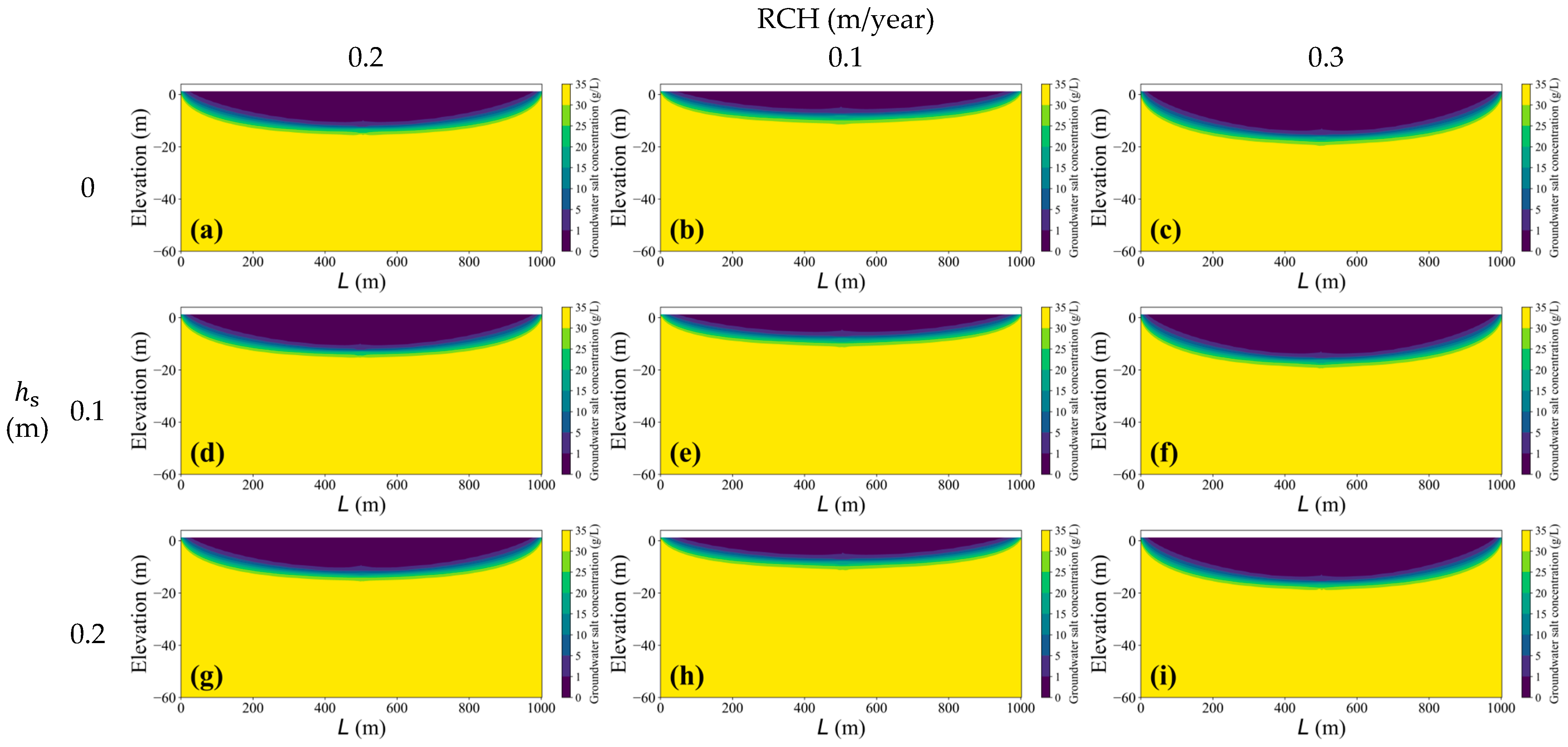
The distribution of groundwater concentrations under different RCH and sea level conditions, prior to the construction of the cutoff wall, is shown in
Figure 4. It can be observed that the subsurface freshwater resource forms a lens-shaped body in all profiles, with its thickness ranging from a maximum at the island’s center to zero at the shoreline, and the width of the freshwater–saltwater transition zone gradually increases from the island center toward the shoreline, which is consistent with published theoretical solutions [
44]. Moreover,
Figure 4 shows that in the absence of the cutoff wall, the FWL is more sensitive to RCH than to SLR. A decrease in RCH from 0.2 to 0.1 m/year causes a significant shrinkage of the lens, while an increase to 0.3 m/year causes a noticeable expansion. In contrast, a rise in
from 0 to 0.2 m results in only a minor reduction in lens size.
Table 3 shows a summary of steady-state indicator values for the island aquifer at the baseline case. These reference values are provided to facilitate interpretation of the relative change plots by establishing a consistent benchmark against which scenario-based deviations can be quantitatively evaluated.
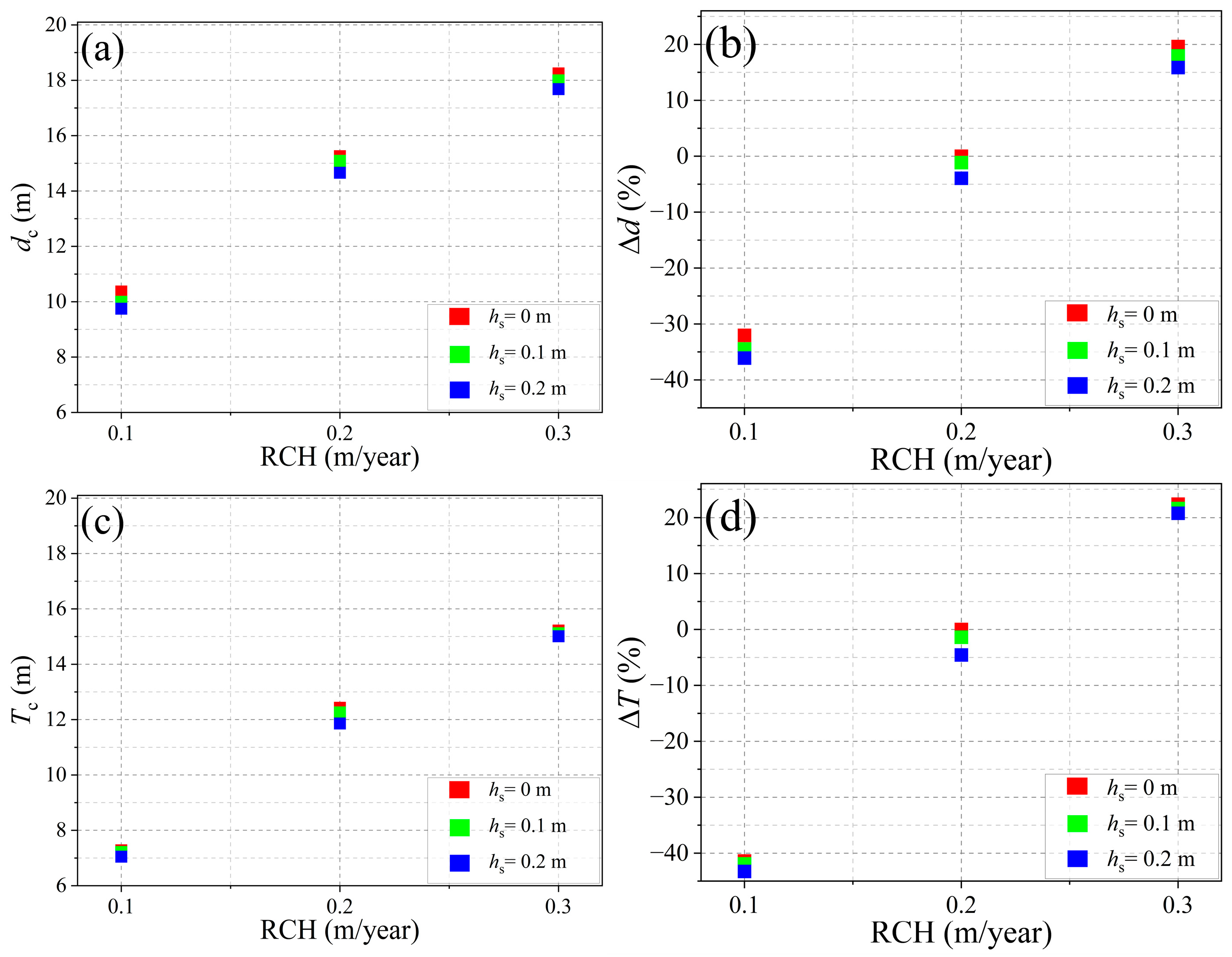
Figure 5 presents the indicator values that quantify FWL thickness and depth under different SLR and RCH scenarios in the absence of the cutoff wall, and
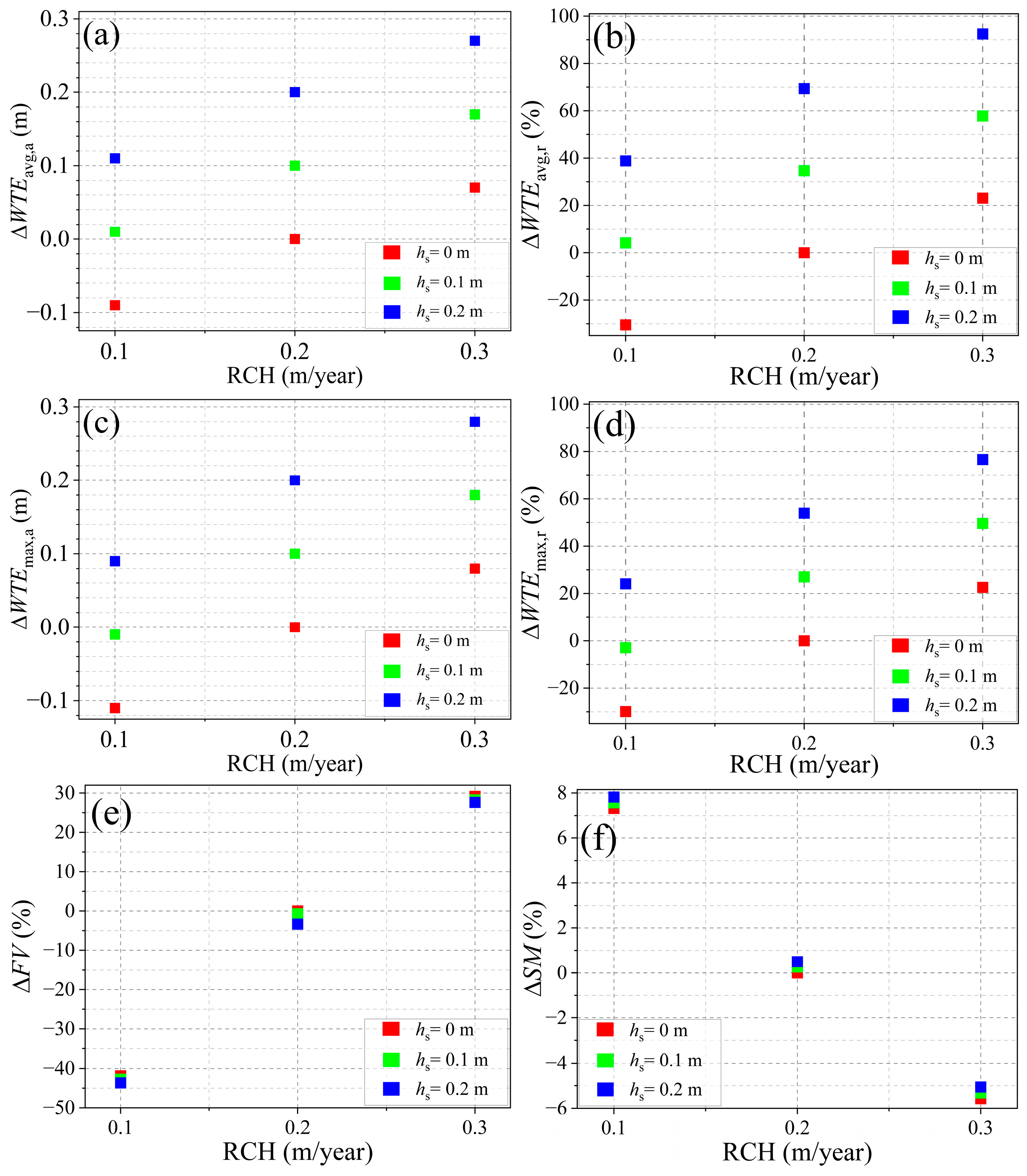
Figure 6 shows the corresponding WTE and SWI indicator values. All indicator values in
Figure 5 and
Figure 6 are calculated relative to the corresponding indicator values in the baseline scenario (
= 0 m, RCH = 0.2 m/year) for comparison.
As shown in
Figure 5, in the absence of the cutoff wall, progressive growth is observed in both
and
as RCH increases from 0.1 to 0.3 m/year when
is given. For instance, at
= 0 m,
rises from 10.37 m to 15.26 m to 18.25 m, while
expands from 7.28 m to 12.43 m to 15.22 m, with similar trends occurring at higher sea levels (
= 0.1 m and 0.2 m). However, the FWL system exhibits significantly higher sensitivity to reductions in RCH than to increases. Specifically, when comparing against baseline conditions (
= 0 m, RCH = 0.2 m/year), a decrease in RCH to 0.1 m/year causes substantial declines of 32.02% in FWL depth and 41.40% in FWL thickness, but increasing RCH to 0.3 m/year results in comparatively smaller increases of just 19.61% for FWL depth and 22.42% for FWL thickness under the same sea level conditions (
= 0 m). In contrast, SLR consistently reduces FWL metrics; for instance, at RCH = 0.2 m/year,
declines from 15.26 m (
= 0 m) to 15.09 m (
= 0.1 m) to 14.66 m (
= 0.2 m), while
drops from 12.43 m (
= 0 m) to 12.26 m (
= 0.1 m) to 11.86 m (
= 0.2 m).
Figure 5 also intuitively indicates that the FWL metrics,
,
,
, and
, are predominantly controlled by RCH, where for a given RCH, these indicator values cluster tightly, showing minimal variation across different SLR scenarios. This demonstrates that RCH fluctuations have a stronger influence on the FWL than SLR. For instance, when RCH is held constant at 0.2 m/year, a
0.1 m/year variation in RCH at
= 0 m leads to significant changes in FWL dynamics: a 0.1 m/year decrease in RCH reduces FWL depth by 32.02% and thickness by 41.40%, while a 0.1 m/year increase in RCH raises FWL depth by 19.61% and thickness by 22.42%. In contrast, SLR changing from 0 m to 0.2 m at RCH = 0.2 m/year results in minor FWL depth declines by 1.12% (at
= 0.1 m) and 3.94% (at
= 0.2 m), while FWL thickness decreases by 1.38% (at
= 0.1 m) and 4.55% (at
= 0.2 m). These results highlight the greater sensitivity of FWL to RCH fluctuations than to SLR.
The results for
,
,
and
under different combinations of SLR and RCH (
Figure 6a–d) reveal that: (1) Both SLR and intensified RCH increase average and maximum WTE in island aquifers, but SLR plays a more significant role in affecting WTE than RCH. For instance, compared to the case of RCH = 0.2 m/year and
= 0 m, a
0.1 m/year RCH variation and the sea level keeping unchanged cause modest WTE changes (30.48% decrease in average WTE and 29.90% decrease in maximum WTE for RCH = 0.1 m/year; 23.08% and 22.58% increases respectively for RCH = 0.3 m/year), whereas SLR changing from 0 m to 0.2 m at RCH = 0.2 m/year drives fairly larger shifts, with average WTE rising by 34.69% (
= 0.1 m) and 69.39% (
= 0.2 m), while maximum WTE decreases by 27.00% (
= 0.1 m) and 53.95% (
= 0.2 m). (2) WTE rise precisely matches SLR magnitude if RCH remains constant. For instance, at RCH = 0.2 m/year, both average and maximum WTE increase by 0.10 m at
= 0.1 m and by 0.20 m at
= 0.2 m relative to the scenario (RCH = 0.2 m/year,
= 0 m). (3) Average WTE exhibits greater sensitivity to SLR and RCH variations than maximum WTE, which is evident from the comparative analysis of
and
, highlighting the differential response of these parameters to hydrological forcing.
In
Figure 6e,f, it is interesting to observe that although both RCH recession and SLR contribute to declines in fresh groundwater volume and increases in aquifer salt mass, RCH fluctuations impose a more significant impact than SLR. For instance, compared to the case of RCH = 0.2 m/year and
= 0 m, a
0.1 m/year RCH variation (with sea level held constant) causes larger changes in fresh groundwater volume and aquifer salt mass:
drops by 41.86% and
rises by 7.32% at RCH = 0.1 m/year, while
increases by 29.15% and
declines by 5.57% at RCH = 0.3 m/year. In contrast, SLR changing from 0 m to 0.2 m at RCH = 0.2 m/year drives smaller shifts:
decreases by 0.72% at
= 0.1 m and 3.36% at
= 0.2 m, while
increases by just 0.26% at
= 0.1 m and 0.50% at
= 0.2 m. That also indicates that fresh groundwater volume and aquifer salt mass respond more strongly to reductions in RCH than to increases.
The simulation results of specified hydrogeological scenarios in
Figure 5 and
Figure 6, overall, show that in the absence of the cutoff wall, both SLR and RCH fluctuations significantly influence groundwater dynamics and SWI extent in island aquifers. In particular, RCH fluctuations have a more pronounced impact than SLR on FWL depth, thickness, fresh groundwater volume and aquifer salt mass, and FWL depth, thickness, fresh groundwater volume and aquifer salt mass exhibit greater sensitivity to RCH reductions than increases, which is consistent with established theoretical solutions [
5,
6,
45]. Compared to RCH, SLR plays a dominant role in driving WTE changes, with WTE rising linearly in proportion to SLR magnitude under constant RCH. This differential response explains why FWL metrics (depth, thickness), fresh groundwater volume, and aquifer salt mass show larger variations under RCH fluctuations but smaller shifts under SLR, where SLR-induced WTE rise enhances the hydraulic gradient and partially counteracts SWI progression.
3.2. Impact of RCH on Cutoff Wall Performance in FWL Development and SWI Mitigation
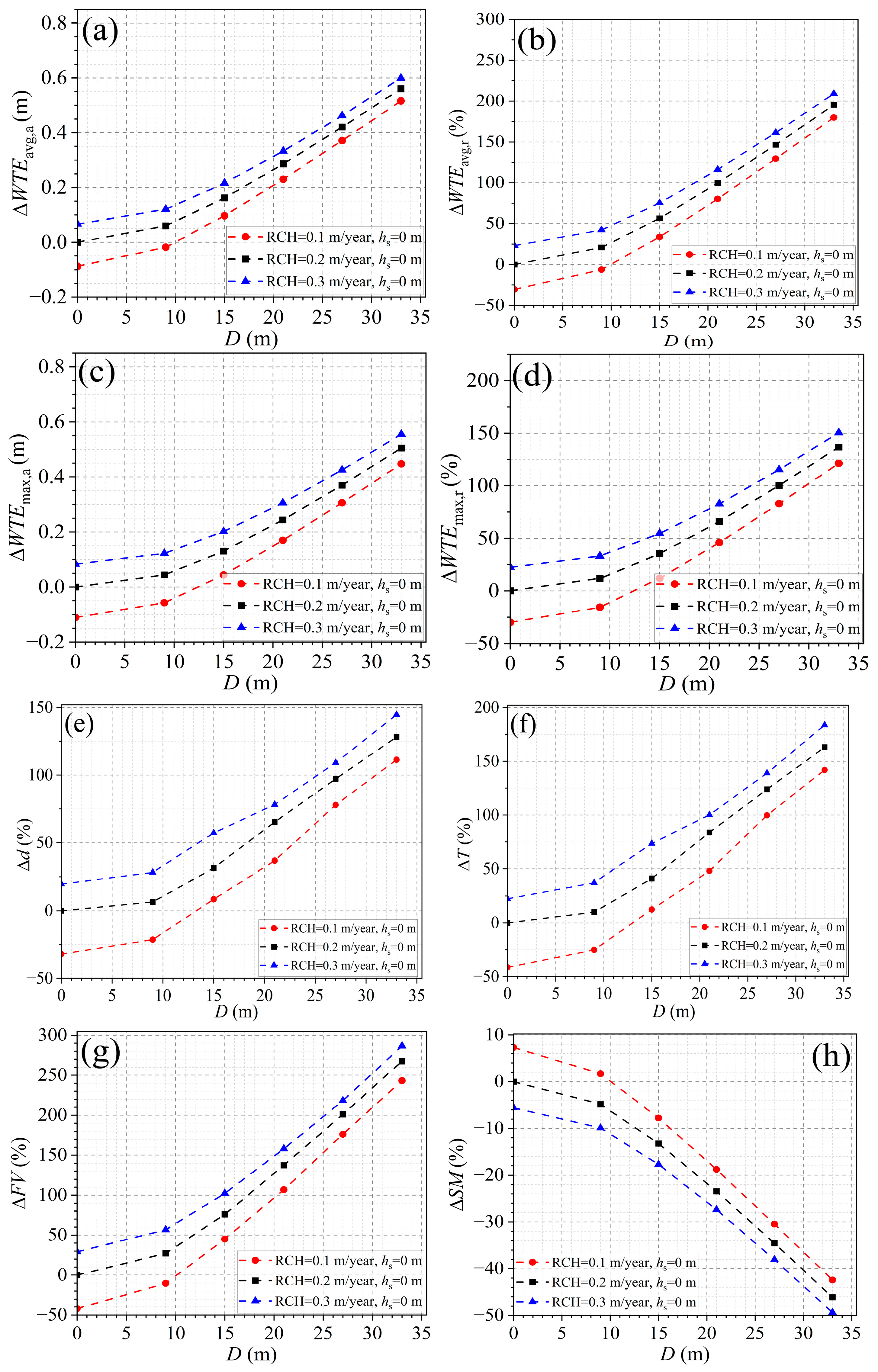
Figure 7 presents how RCH influences the performance of the cutoff wall in FWL development and SWI mitigation in IAECW, under a constant sea level of 0 m.
Figure 7a–
Figure 7d, respectively, depicts the profiles of
,
,
, and
plotted against D for varying RCH conditions.
Figure 7a and
Figure 7c, respectively, shows that in all RCH cases, the
and
profiles experience a gradual increase up to
D of 9 m before rising more sharply with further deepening of the cutoff wall, with larger RCH conditions consistently producing higher values of both
and
than smaller RCH. It is also noted that both
and
curves initially exhibit wide separation across RCH conditions, but this separation progressively narrows with increasing
D (
Figure 7a,c).
The
(
Figure 7b) and
profiles (
Figure 7d) mimic the trends observed in their absolute counterparts (
and
, respectively). When
D extends from 0 m to 9 m, and to 33 m,
grows from −30.49% to −6.26%, and to 179.92% at RCH = 0.1 m/year; from 0% to 20.92%, and to 195.42% at RCH = 0.2 m/year; and from 23.08% to 42.17%, and to 208.98% at RCH = 0.3 m/year. Similarly,
D extends from 0 m to 9 m, and to 33 m,
climbs from −29.90% to −15.52%, and to 121.31% at RCH = 0.1 m/year; from 0% to 11.93%, and to 136.79% at RCH = 0.2 m/year; and from 22.58% to 33.19%, and to 150.47% at RCH = 0.3 m/year.
The observations in
Figure 7a–d demonstrate that: (1) in all cases of RCH, the deeper cutoff wall leads to greater lift of WTE, with particularly enhanced efficiency of increasing the seaward hydraulic gradient when its depth exceeds the natural FWL depth (see
Figure 5a). (2) For any given
D, higher RCH results in more pronounced increases in both average and maximum WTE in IAECW systems than lower RCH, because greater volumetric water recharge enhances hydraulic head build-up upstream of the cutoff wall, and in the meantime, the cutoff wall traps excessive recharge. (3) RCH is the primary control on WTE increases for shallow cutoff walls (e.g.,
D < 15 m), but its influence diminishes with cutoff wall depth increasing. The progressive narrowing of intervals among curves demonstrates that
D gradually supersedes RCH as the dominant factor governing WTE lift in deeper wall configurations. (4) Relative to pre-construction conditions, cutoff walls induce greater relative WTE increases in low-RCH IAECW systems than in high-RCH cases, underscoring their greater efficacy in lifting WTE in low-RCH island aquifers, and thus greater resilience enhanced against SWI. (5) Under all RCH conditions, average WTE in IAECW exhibits stronger relative growth than maximum WTE, suggesting that the cutoff wall promotes more uniform hydraulic head increase by effectively redistributing water across the enclosed area.
Figure 7e and
Figure 7f, respectively, illustrates that, across all RCH conditions, both
and
increase with
D, where higher RCH values produce greater
and
values. The growth in
and
is gradual for
D < 9 m, but becomes sharp once the cutoff wall extends deeper beyond that depth. The separation between the
(or
) curves under different RCH conditions is initially wide, but they narrow as
D increases. This narrowing occurs because the
(or
) curves for lower RCH conditions rise more rapidly than those for higher RCH, and the curves almost approach parallelism at greater depths (
D > 27 m). Specifically, with
D extending from 0 m to 33 m,
progresses from −32.02% to 111.30% (RCH = 0.1 m/year), from 0% to 128.16% (RCH = 0.2 m/year), and from 19.61% to 144.60% (RCH = 0.3 m/year). Similarly, with
D increasing from 0 m to 33 m,
increases from −41.40% to 141.86% (RCH = 0.1 m/year), from 0% to 163.02% (RCH = 0.2 m/year), and from 22.42% to 183.61% (RCH = 0.3 m/year).
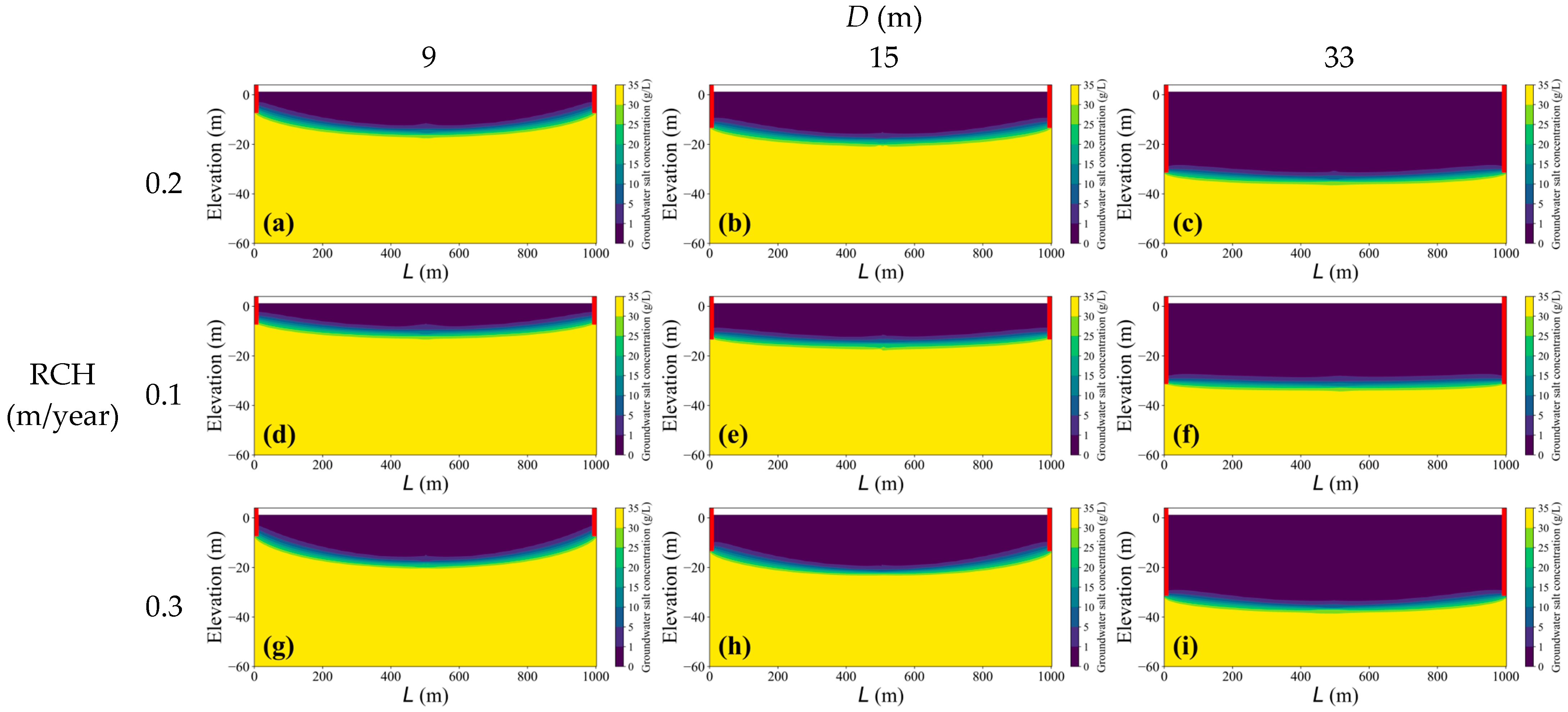
Figure 8 displays the responses of groundwater salt concentration and FWL to RCH fluctuations (RCH = 0.2 m/year for
Figure 8a–c; RCH = 0.1 m/year for
Figure 8d–f; RCH = 0.3 m/year for
Figure 8g–i) for IAECW cases with three different cutoff wall depths (
D = 9, 15, and 33 m). The results indicate that: (1) in all cases of RCH, deeper walls (particularly beyond natural FWL depth) robustly enhance FWL depth and thickness in IAECW; (2) the influence of RCH on the cutoff wall’s capacity to promote FWL depth and thickness diminishes with D increasing, eventually leveling off; (3) low-RCH aquifers respond more sensitively to cutoff walls’ depth, experiencing larger
or
changes per unit D. This underscores the higher efficiency of cutoff walls in enhancing FWL depth and thickness under low-RCH environments compared to high-RCH ones.
In
Figure 7g,
profiles in all RCH cases increase with
D, with higher RCH leading to larger
values.
profiles rise slowly up to
D = 9 m before steepening as the cutoff wall extends deeper. The initial wide separation among
curves progressively narrows and the curves beyond
D = 25 m become almost parallel to each other. With
D increasing from 0 m to 9 m, and to 33 m,
increases from −41.86% to −10.38%, and to 243.08% at RCH = 0.1 m/year; from 0 to 27.14%, and to 267.60% at RCH = 0.2 m/year; and from 29.15% to 56.72%, and to 286.53% at RCH = 0.3 m/year. These reveal that: (1) in all cases of RCH, deeper cutoff wall enhances freshwater storage in island aquifers, with particularly high efficiency occurring when
D exceeds the natural FWL depth (see
Figure 5a), beyond which freshwater volume shows near-linear growth with increasing
D; (2) for a given
D, island aquifers with higher RCH can store more freshwater than those with lower RCH; (3) the influence of RCH on the cutoff wall’s performance in freshwater storage depends on
D, showing pronounced effects at shallow depths (e.g.,
D < 9 m), but progressively diminishes and levels off as
D increases to sufficient depth; (4) for a given increase in
D, lower RCH cases exhibit greater changes in
, demonstrating that cutoff walls provide more substantial freshwater storage efficiency in low-RCH IAECW compared to high-RCH ones.
Figure 7h shows that the
profiles negatively correlate with increasing
D across all RCH conditions, with higher RCH resulting in smaller
values.
profiles decline gradually at
D = 0~9 m before undergoing a sharp decline. The initial wide separation among
curves progressively narrows and the curves become almost parallel to each other at
D > 25 m. To be specific, as
D increases from 0 m to 9 m, and to 33 m,
declines from 7.32% to 1.70%, and to −42.40% at RCH = 0.1 m/year; from 0 to −4.83%, and to −46.12% at RCH = 0.2 m/year; and from −5.57% to −9.90%, and to −49.35% at RCH = 0.3 m/year. These indicate that: (1) in all cases of RCH, deeper walls more effectively reduce aquifer salt mass and mitigate aquifer salinization, with particularly high efficiency occurring when
D exceeds the natural FWL depth, beyond which salt mass decreases nearly linearly with increasing
D; (2) for any given
D, higher RCH conditions enable greater salt removal compared to lower RCH scenarios; (3) the influence of RCH on salt removal efficacy varies with
D: its impact is most pronounced at shallow depths (
D < 9 m) but progressively diminishes and levels off beyond a critical depth; (4) low-RCH aquifers show greater responsiveness to cutoff wall installation (larger changes in
per unit
D increase), highlighting that walls provide greater salt removal in IAECW with lower RCH compared to those with higher RCH.
The observations in
Figure 7 and
Figure 8, in general, demonstrate that RCH imposes a substantial influence on the cutoff wall performance in FWL development and SWI mitigation in island aquifers. Under the same conditions of cutoff wall depth, compared to lower RCH scenarios, higher RCH can lead to more pronounced increases in average and maximum WTE, FWL depth and thickness, freshwater storage, and aquifer salt removal. The impact of RCH on cutoff wall performance is dependent on
D. RCH makes a significant difference to WTE increases, FWL development, freshwater storage and aquifer salt removal under shallow cutoff walls, but its influence diminishes with the cutoff wall extending deeper, eventually leveling off. Island aquifers characterized by lower RCH show greater responsiveness to cutoff wall installation, experiencing greater relative increases in WTE, FWL depth and thickness, freshwater storage and aquifer salt removal per unit
D increase. This indicates that cutoff walls provide higher efficiency in promoting FWL development and mitigating SWI extent in IAECW systems with lower RCH.
3.3. Impact of SLR on Cutoff Wall Performance in FWL Development and SWI Mitigation
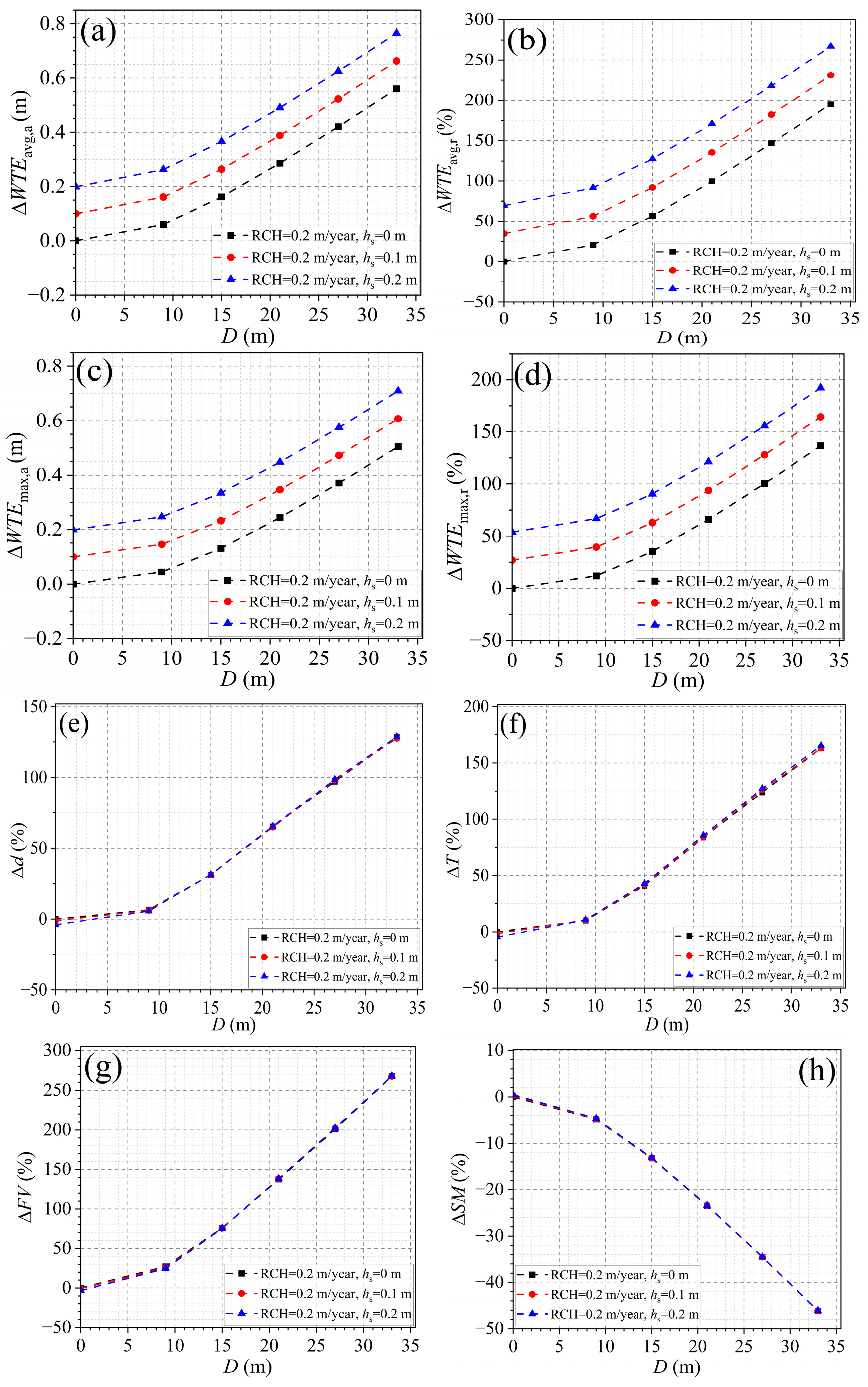
Figure 9 presents how SLR affects the performance of the cutoff wall in FWL development and SWI mitigation in island aquifers, under a constant RCH (i.e., 0.2 m/year).
Figure 9a–d depicts the profiles of
,
,
, and
, respectively, plotted against
D for different SLR conditions.
Figure 9a and
Figure 9c, respectively, shows that in all SLR cases, the
and
profiles experience a gradual increase up to
D of 9 m before rising more sharply with further deepening of the cutoff wall, and larger SLR magnitudes consistently produce higher values of both
and
than smaller SLR. Another notable observation is that both
and
profiles remain nearly parallel across all SLR conditions throughout the range of
D, with their separation approximately equal to the SLR magnitude. Specifically, as
D increases from 0 m to 9 m, and to 33 m,
grows from 0 m to 0.06 m, and to 0.56 m at
= 0 m; from 0.10 m to 0.16 m, and to 0.66 m at
= 0.1 m; and from 0.20 m to 0.26 m, and to 0.76 m at
= 0.2 m. With
D increasing from 0 m to 9 m, and to 33 m,
climbs from 0 m to 0.04 m, and to 0.50 m at
= 0 m; from 0.10 m to 0.15 m, and to 0.61 m at
= 0.1 m; and from 0.20 m to 0.25 m, and to 0.71 m at
= 0.2 m.
In
Figure 9b,d, the
and
profiles mimic the trends observed in their absolute counterparts
(
Figure 9a) and
(
Figure 9c), respectively. When
D extends from 0 m to 9 m, and to 33 m,
grows from 0% to 20.92%, and to 195.42% at
= 0 m; from 34.69% to 56.30%, and to 231.09% at
= 0.1 m; and from 69.39% to 91.67%, and to 266.82% at
= 0.2 m. Similarly, with
D increasing from 0 m to 9 m, and to 33 m,
climbs from 0% to 11.93%, and to 136.79% at
= 0 m; from 27.00% to 39.36%, and to 164.47% at
= 0.1 m; and from 53.95% to 66.75%, and to 192.22% at
= 0.2 m.
The observations in
Figure 9a–d demonstrate that: (1) a deeper cutoff wall leads to greater lift of WTE, with particularly enhanced efficiency when its depth exceeds the natural FWL depth; (2) larger SLR produces greater increases in WTE in the IAECW, and the impact of SLR on WTE in the IAECW is linearly dependent on SLR magnitude; (3) under all SLR conditions, average WTE in IAECW exhibits stronger relative growth than maximum WTE, indicating that the cutoff wall promotes more uniform hydraulic conditions by effectively redistributing water across the enclosed area.
Figure 9e and
Figure 9f, respectively, illustrates that, across all SLR conditions, both
and
increase with
D, and the
and
curves nearly overlap while rising linearly with
D beyond 9 m. Only minor differences are observed between various
conditions at
D < 9 m, where higher
yields slightly lower
and
profiles. Specifically, with
D extending from 0 m to 33 m,
progresses from 0% to 128.16% (
= 0 m), from −1.12% to 128.54% (
= 0.1 m), and from −3.94% to 128.69% (
= 0.2 m). Similarly,
increases from 0% to 163.02% (
= 0 m), from −1.38% to 163.09% (
= 0.1 m), and from −4.54% to 165.29% (
= 0.2 m).
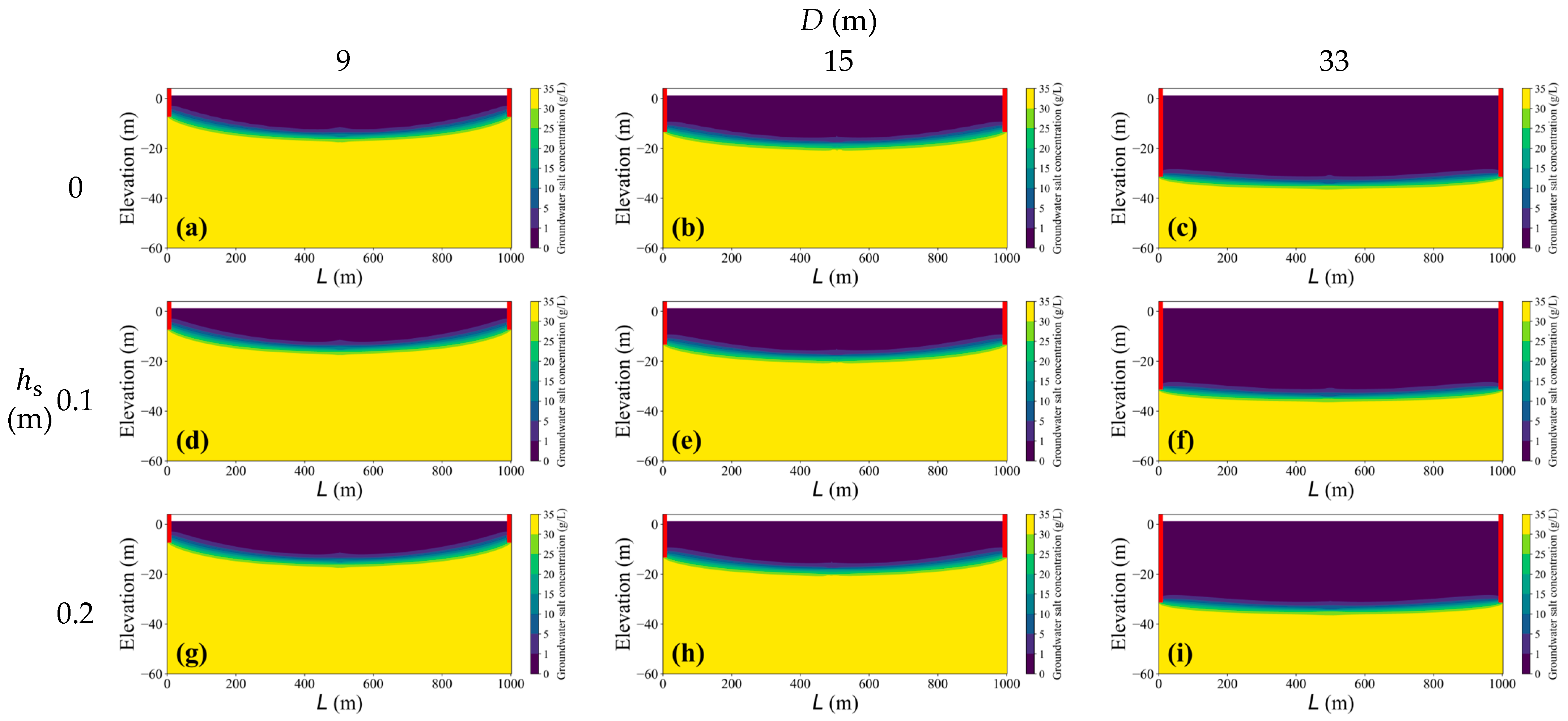
Figure 10 presents the responses of groundwater salt concentration and FWL to SLR (
= 0 m for
Figure 10a–c;
= 0.1 m for
Figure 10d–f;
= 0.2 m for
Figure 10g–i) for IAECW cases with three different cutoff wall depths (
D = 9, 15, and 33 m). These simulation results indicate that: (1) in all cases of SLR, deeper walls (particularly beyond natural FWL depth) robustly enhance FWL depth and thickness in IAECW; (2) the impact of SLR on the cutoff wall’s effectiveness in enhancing FWL depth and thickness is limited and contingent on wall depth. For walls shallower than the natural FWL depth, greater SLR leads to slightly smaller FWL depth and thickness compared to IAECW with lower SLR. Once the wall depth surpasses the natural FWL depth, the influence of SLR on the wall’s performance becomes negligible.
Likewise, in
Figure 9g,
profiles across all SLR cases increase with
D, showing only minor differences among various
conditions at
D = 0~9 m (higher
yields slightly lower
profiles), and the curves nearly overlap with each other, rising linearly with
D beyond 9 m.
Figure 9h reveals an opposite trend for
profiles, which decline with
D, exhibiting subtle variations among different
values at
D = 0~9 m (higher
resulting in slightly higher
profiles) until the curves become almost on top of each other and drop linearly along with increasing
D once
D exceeds 9 m. The
and
changes are described as follows.
As D increases from 0 m to 9 m, and to 33 m, at = 0 m, rises from 0 to 27.14%, and to 267.60% while declines from 0 to −4.83% to −46.12%; at = 0.1 m, changes from −0.72% to 25.82% to 267.41% while decreases from 0.26% to −4.74%, and to −46.09%; and at = 0.2 m, increases from −3.36% to 24.64%, and to 267.33% while drops from 0.50% to −4.65%, and to −46.06%. These indicate that: (1) across all cases of SLR, deeper cutoff walls more effectively enhance freshwater volume and reduce salt mass, especially when their depth exceeds the natural FWL depth, in which both freshwater storage and aquifer salt removal vary linearly with D; (2) SLR only affects the cutoff wall performance in freshwater storage and salt removal for D shallower than natural FWL depth, where larger SLR results in less freshwater storage and salt removal, but SLR’s impact becomes negligible once D surpasses natural FWL depth.
Overall, the observations in
Figure 9 and
Figure 10 demonstrate two key effects of SLR on cutoff wall performance in island aquifer settings. Larger SLR produces greater WTE increases in the IAECW, and this impact is stable and linearly dependent on SLR magnitude. However, SLR imposes a nearly negligible influence on the wall’s effectiveness in enhancing FWL depth, FWL thickness, freshwater storage, and aquifer salt removal. This is because SLR raises both the inland WTE and sea level, thereby preserving the relative head difference created by the cutoff wall, the primary driver for pushing the saltwater interface seaward. The key mechanisms for aquifer storing freshwater and flushing salt, namely recharge rate and the flow paths diverted by the wall, are independent of the absolute sea level. As a result, with SLR shifting the WTE upward, it does not diminish the cutoff wall’s capacity to actively enhance freshwater lens thickness, increase freshwater storage, or remove aquifer salt. This underscores that the wall’s utility is resilient to SLR.
3.4. Joint Impact of RCH and SLR on Cutoff Wall Performance in FWL Development and SWI Mitigation
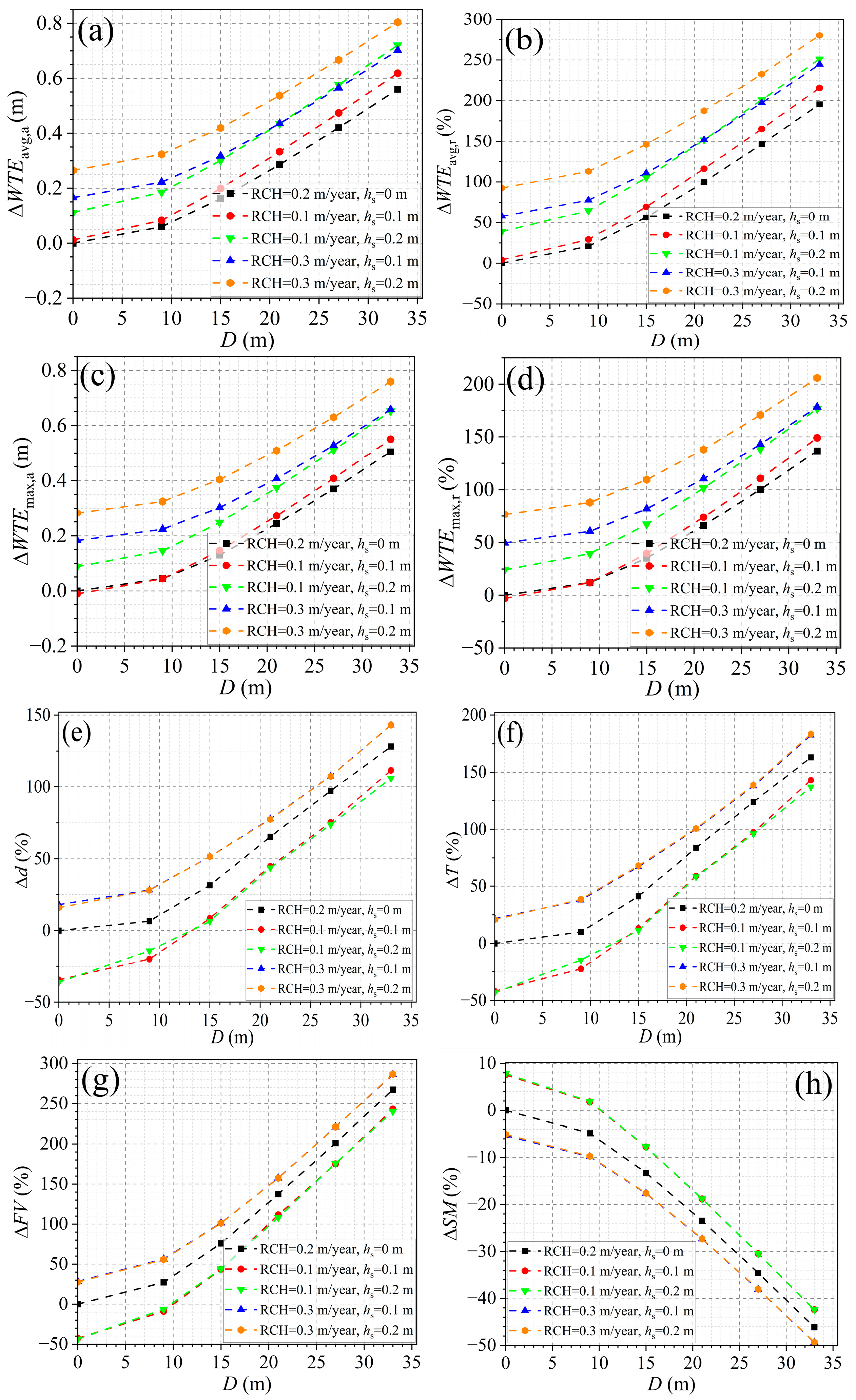
Figure 11 presents how RCH and SLR jointly affect the performance of the cutoff wall in FWL development and SWI mitigation in island aquifers.
Figure 11a–d depicts the profiles of
,
,
, and
as functions of
D for different combinations of RCH and SLR, respectively. In
Figure 11a,c, the
and
profiles rise with increasing
D, experiencing the gradual increase at shallow depths (
D < 9 m) and sharp increase once the cutoff wall extends deeper than 9 m. Among all cases examined herein, the scenario with RCH = 0.3 m/year and
= 0.2 m yields the highest
and
values across
D, and the baseline case (RCH = 0.2 m/year,
= 0 m) consistently produces the lowest values. Compared to the baseline case, the case with RCH = 0.1 m/year and
= 0.1 m shows slightly higher
values and nearly identical
values at shallow depths (
D < 9 m), beyond which both metrics increase more rapidly with
D. The remaining two cases, the scenario with RCH = 0.1 m/year,
= 0.2 m and the scenario with RCH = 0.3 m/year,
= 0.1 m, exhibit intermediate behaviors, with their
and
curves positioned between those previously mentioned cases. It is observed that the
and
curves for the case with RCH = 0.1 m/year and
= 0.2 m initially lie below those for RCH = 0.3 m/year and
= 0.1 m, but with
D increasing, the curves of RCH = 0.1 m/year,
= 0.2 m exhibit a much more remarkable rise, eventually converging to and even surpassing the corresponding curves for RCH = 0.3 m/year and
= 0.1 m under deeper cutoff wall conditions.
Figure 11b,d displays similar trends observed in
Figure 11a and
Figure 11c, respectively, but under the same conditions of RCH, SLR, and
D (
D > 0), the values of
are consistently greater than those of
.
The observations in
Figure 11a–d demonstrate that: (1) a combination of SLR and enhanced RCH promotes cutoff wall effectiveness in lifting both average and maximum WTE, a trend amplified by the magnitudes of both SLR and RCH increase; (2) in the combination of RCH fluctuations and SLR, RCH fluctuations play a dominant role in governing WTE in IAECW with small
D, but with
D increasing, the influence of SLR becomes more pronounced, eventually surpassing RCH as the dominant control on WTE under larger
D conditions; (3) SLR acts as a counteracting mechanism against the adverse impacts of reduced RCH on WTE in IAECW, which depends on
D and SLR magnitude. In other words, SLR can either partially or fully offset the negative impact caused by lower RCH; specifically, a full offset, where the WTE is maintained or elevated despite low RCH, is more likely to occur in IAECW with larger
D and/or higher SLR.
Figure 11e and
Figure 11f, respectively, demonstrates that, across all RCH and SLR combinations, the
and
profiles under the same RCH conditions follow nearly identical trends. These
and
profiles rise with increasing
D, climbing slowly at
D < 9 m but rising sharply once the cutoff wall extends deeper beyond 9 m, with higher RCH values producing greater
and
values. Initially,
(or
) curves under different RCH conditions diverge from each other, but with
D increasing, the curves for lower RCH conditions exhibit steeper growth rates compared to those under higher RCH conditions. This response progressively reduces the inter-curve separation, with the profiles becoming almost parallel when the cutoff wall reaches sufficient depth.
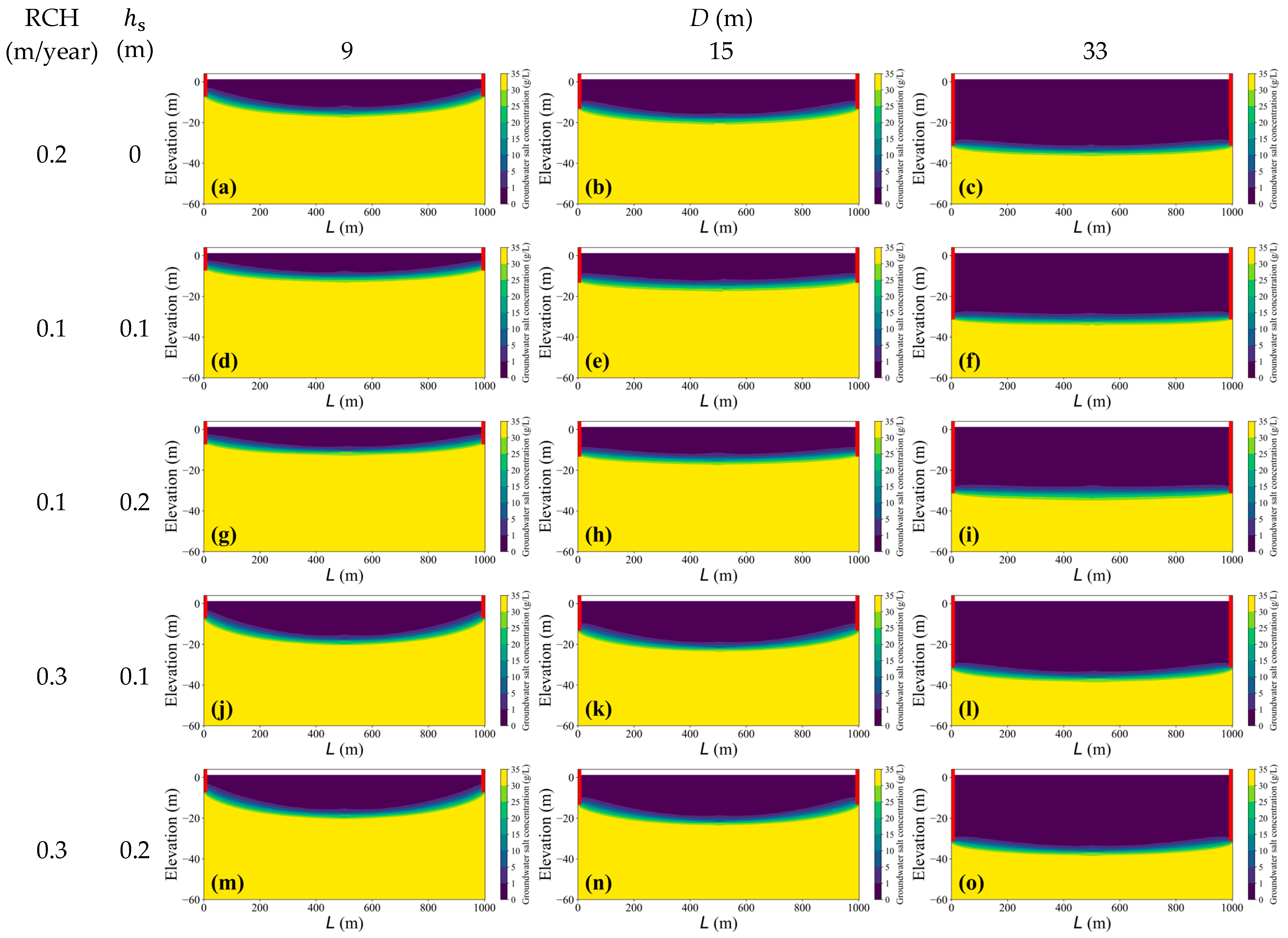
Figure 12 presents how groundwater salt concentration distribution and FWL respond to combined SLR and RCH fluctuations for three IAECW cases with different cutoff wall depths (
D = 9, 15, and 33 m).
These indicate that: (1) under simultaneous SLR and RCH fluctuations, SLR exerts a negligible influence on FWL depth and thickness in IAECW, with RCH emerging as the primary driver of lens geometry; (2) the sensitivity of cutoff wall performance to RCH variations diminishes as D increases, eventually leveling off; (3) lower-RCH aquifers respond more strongly to cutoff walls (larger or changes per unit D), again underscoring the higher efficiency of cutoff walls in low-RCH environments compared to high-RCH ones.
Figure 11g and
Figure 11h, respectively, illustrates that the
and
profiles under the same RCH conditions are almost identical, with higher RCH results in larger
values but smaller
values. In
Figure 11g,
profiles for all cases increase with
D, rising gradually up to
D = 9 m before steepening as the cutoff wall extends deeper. Initially, the curves are widely spaced but converge progressively, and become almost parallel to each other beyond
D = 25 m. In
Figure 11h, the
profiles decline with increasing
D across all cases, dropping slowly at
D = 0~9 m before undergoing a sharp decline at
D = 9~33 m. Similar to the
profiles, the distinct curves at shallow depth gradually cluster towards each other and approach near-parallel alignment beyond
D = 25 m.
The observations in
Figure 11g,h align with those seen in
Figure 7g,h and
Figure 9g,h, revealing that under simultaneous SLR and RCH fluctuations, RCH dominates freshwater storage and salt removal in IAECW, while SLR has a negligible impact. The influence of RCH on cutoff wall’s performance in freshwater storage and salt removal and how
D affects this influence are the same as findings in
Section 3.2. Furthermore, for any given SLR scenario, IAECW in lower-RCH environments exhibit greater changes in
and
per unit of wall depth, indicating a higher efficiency of cutoff walls in freshwater storage and salt removal in such settings compared to high-RCH IAECW.
Observations in
Figure 11 and
Figure 12, overall, reveal that both SLR and RCH significantly impact WTE in IAECW, but their relative influence depends on
D. In IAECW with shallow
D, RCH fluctuations dominate WTE variations, whereas SLR exerts a greater influence than RCH in systems with deep
D. Notably, SLR can partially or fully offset the WTE-lowering effect caused by reduced RCH in shallow IAECW, depending on SLR magnitude. Compared to RCH, SLR has negligible effects on FWL depth, FWL thickness, freshwater storage, and aquifer salt removal in IAECW. In contrast, RCH’s influence on these FWL and SWI metrics in IAECW is significant and depth-dependent: strongest at shallow depths, diminishing and leveling off as
D increases. In the presence of SLR, IAECW with lower RCH exhibit greater responsiveness to cutoff wall installation, showing larger relative increases in FWL depth, thickness, freshwater storage, and salt removal per unit increase in
D, indicating higher efficiency of cutoff walls in such settings.