1. Introduction
Groundwater represents one of the main sources of drinking water globally and is also used for agricultural and industrial purposes. Due to numerous human activities, groundwater pollution has become a global issue threatening the entire ecosystem [
1,
2,
3]. Volatile organic compounds (VOCs) are defined as organic pollutants with a boiling point between 50 °C and 260 °C at room temperature under atmospheric pressure. Among them, chlorinated volatile organic compounds (Cl-VOCs) stand out due to their pronounced toxicity, chemical stability, and low biodegradability [
4,
5]. Because of these characteristics, Cl
−VOCs are classified among the most hazardous pollutants and are regulated as highly harmful substances in many countries [
4,
5,
6]. Based on their molecular structure, Cl
−VOCs are divided into chlorinated alkanes (chloromethane, dichloromethane, chloroform, carbon tetrachloride, chloroethane, etc.), chlorinated alkenes (vinyl chloride, trichloroethylene, tetrachloroethylene), and chlorinated aromatic compounds (chlorobenzene, dichlorobenzene, etc.) [
4]. In addition to differences in structure and reactivity, these groups of compounds also vary in terms of toxicity levels and potential health risks they pose to humans.
According to the International Agency for Research on Cancer (IARC) trichloroethylene (TCE) has been classified as a Group 2A carcinogen, indicating its potential risk of causing cancer in humans [
5]. Furthermore, according to Dorsey et al. [
7], TCE can be absorbed through inhalation, skin contact, and ingestion, and exposure may cause neurological disorders, autoimmune diseases, and damage to multiple organs. It is considered particularly risky during pregnancy, as it may lead to foetal heart defects and developmental disorders [
8,
9]. Its chemical persistence, low solubility in water (1.07 g/L) [
10], and improper disposal contribute to long-term contamination at industrial waste disposal sites polluted with TCE. Such contaminated locations represent a serious risk for groundwater pollution, especially in areas with permeable soil layers and high groundwater levels. Additionally, TCE is a component of industrial cleaning agents and is widely used as a degreasing solvent, which explains its frequent occurrence as a water pollutant [
11,
12].
On the other hand, vinyl chloride (VC) is even more dangerous, as it belongs to group 1 according to IARC—indicating sufficient evidence of carcinogenicity in humans [
13,
14]. Chronic exposure to this substance may cause the so-called “vinyl chloride syndrome,” liver damage (particularly angiosarcoma), neurological and immunological disorders, as well as dermatological and vascular symptoms similar to scleroderma. Toxic effects also include insulin resistance and various neurological symptoms in individuals exposed to high concentrations [
8]. VC is a key precursor in the production of polyvinyl chloride (PVC) and represents a significant source of environmental contamination. It is released into the atmosphere, water, and soil during industrial processes, improper waste disposal, and landfill leachate, leading to both ecological and public health concerns [
8,
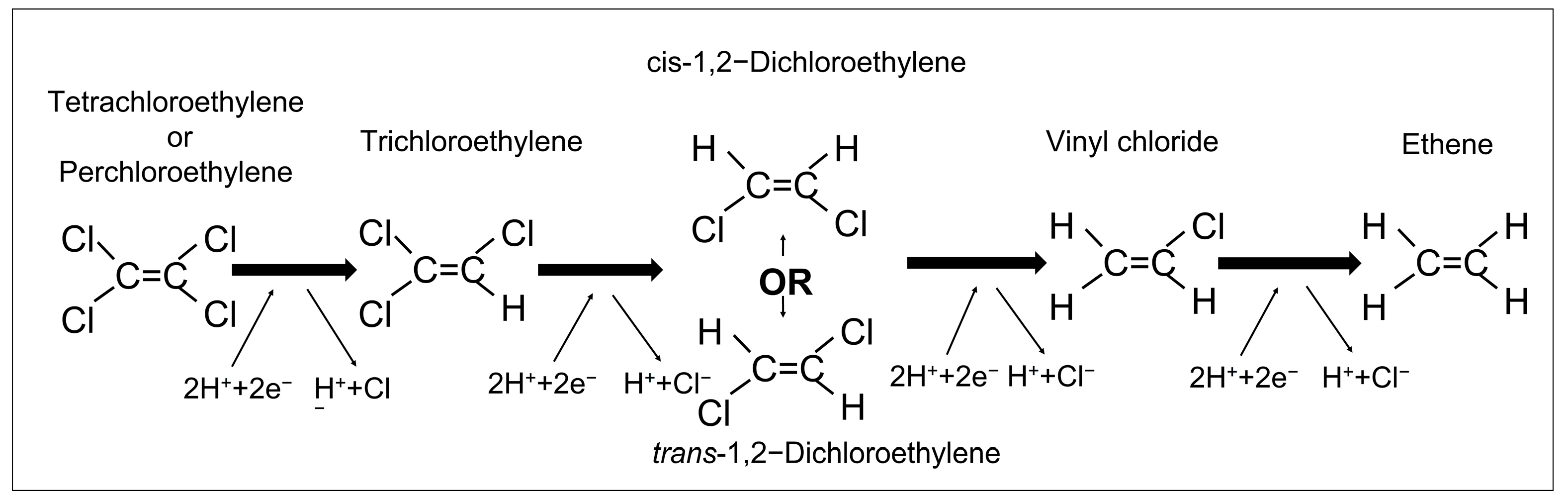
15]. The petrochemical industry is one of the main sources of VC emissions; although it quickly volatilizes in the atmosphere, it can reach groundwater as a product of anaerobic degradation of chlorinated solvents such as perchloroethylene (PCE) and TCE (
Figure 1), especially in organic-rich environments. Its high solubility further contributes to easy migration through soil, complicating remediation of contaminated sites, particularly near industrial facilities and landfills [
16,
17].
Numerous techniques have been employed for the removal of VC and TCE in drinking water treatment. In the
Supplementary Materials, Table S1 provides an overview of the techniques used for the removal of chlorinated alkenes, including TCE, VC, perchloroethylene (PCE), and cis-dichloroethylene (cis-DCE) [
11,
18,
19,
20,
21,
22,
23,
24,
25,
26,
27,
28,
29,
30,
31,
32]. Based on the literature review, it has been observed that electrochemical processes show significant potential for the removal of chlorinated VOCs. The efficiency of these processes varies considerably depending on the type of electrode, catalyst, and experimental conditions. Reported removal efficiencies for TCE range from 68.5% to over 98%, while for VC they range from 51% to over 90% under optimal experimental conditions. From this, it can be concluded that the efficiency of the process largely depends on experimental parameters, which may represent a limitation for their application under real-world conditions. Therefore, new research should focus on eliminating or minimizing these influencing factors and appropriately optimizing the process to achieve high removal efficiency of the mentioned compounds [
11,
18,
19,
20,
21,
22,
23,
24,
25].
In this study, preliminary research was carried out within the framework of the EUREKA project “Cost-effective and safe drinking water for everyone—Development of methodology for the improved protection and/or remediation of bank filtration water source zones (SAFEWAT)” (Ministry of Science, Technological Development and Innovation, Republic of Serbia). The project aims to investigate the potential application of electro-hydraulic barriers, i.e., an electrochemical treatment capable of removing chlorinated hydrocarbons (VC and TCE) from groundwater within the source protection zones of riverbank filtration systems located in alluvial aquifers. The research represents part of a broader multidisciplinary approach to addressing water supply challenges in the Danube region, with special emphasis on protecting bank filtration systems, which are increasingly threatened by river water quality degradation and intensive anthropogenic impacts from the hinterland. Particular focus in this work was placed on the conceptual implementation of electrochemical barriers within existing monitoring and observation well networks at such riverbank filtration sites, as a sustainable in situ solution that would enable continuous control and reduction in contaminant concentrations with minimal civil engineering interventions.
In situ, such an electrochemical barrier is envisioned as a series of vertical electrodes installed in existing riverbank piezometers along the groundwater flow path between possible sources of pollution and the river, creating a reactive zone where VC and TCE are degraded as the water migrates through the alluvial aquifer. To validate the approach, a laboratory prototype of an electrochemical reactor was developed, combining titanium electrodes and titanium electrodes coated with iridium and ruthenium (Ti/Ir+Ru). Within this system, the effects of reaction time, current intensity, electrode arrangement, and inter-electrode spacing on the removal efficiency of VC and TCE were investigated. These experiments were designed to enable optimization of the treatment in terms of contaminant removal, minimal energy consumption, and compliance with prescribed drinking water quality standards, both national and European levels.
Compared with previous investigations compiled in
Table S1, which predominantly focus on single chlorinated ethenes (most often TCE or PCE) and on relatively high influent concentrations in generic synthetic matrices, this study addresses a different and more site-specific problem setting. First, it targets the simultaneous removal of vinyl chloride (VC) and trichloroethylene (TCE) at low levels relevant for drinking-water-oriented riverbank filtration sites in alluvial aquifers of the Danube River basin. Second, it evaluates a simple and robust Ti/Ir+Ru–-Ti electrode configuration that is explicitly conceived as an in situ electro-hydraulic barrier that could be installed within existing piezometer networks along riverbank filtration well fields, with minimal civil engineering interventions. Third, the electrochemical performance assessment is directly linked to specific energy demand and treatment cost, providing a quantitative basis for evaluating practical feasibility.
The main objective of this study was to evaluate, at laboratory scale, this electrochemical barrier concept for the targeted removal of VC and TCE from groundwater representative of riverbank filtration well fields in alluvial aquifers. Specifically, we aimed to: (i) quantify VC and TCE removal kinetics and achievable effluent concentrations under drinking-water-relevant conditions; (ii) determine the influence of key operational and geometric parameters (current intensity, reaction time, active anode surface area, and inter-electrode distance) on treatment performance; (iii) identify the dominant controlling factors using multivariate/statistical analysis (PCA and Pearson correlations) to enable a process-based interpretation of VC/TCE removal performance; and (iv) assess compliance with Serbian and EU drinking-water criteria and estimate electrical energy demand and treatment cost to inform potential field implementation.
2. Materials and Methods
2.1. Sample Preparation for Electrochemical Treatment
Previous monitoring has shown that riverbank filtration systems abstracting groundwater from alluvial aquifers of the Danube River basin can be endangered by the presence of chlorinated hydrocarbons, amongst which the highly volatile VC is particularly prominent. Groundwater in urbanised parts of the Danube basin may be contaminated with TCE due to its widespread industrial use and improper disposal of TCE-containing waste. It is important to note that TCE, under the influence of microorganisms, can be transformed into more toxic degradation products such as VC, i.e., TCE is a precursor of VC [
33,
34,
35]. Therefore, the mere detection of VC may indicate the presence of TCE even if it is not currently directly detected, as it may have already partially degraded [
8]. This provided the rationale for examining the efficiency of the electrochemical treatment for TCE alongside VC.
To further enable the isolated evaluation of the electrochemical potential for VC and TCE degradation under controlled and reproducible conditions, the experiments were conducted using a synthetic water matrix. This approach minimizes the influence of variable constituents present in real groundwater and represents a necessary prerequisite for reliable process optimization and its subsequent application to real groundwater samples. To reproduce these field conditions under controlled laboratory settings, a synthetic groundwater matrix was prepared to mimic the ionic composition, conductivity and possible contaminant levels of riverbank filtration sources. A synthetic water matrix was initially prepared by dissolving 0.8 g/L NaHCO3 (Centrohem, Stara Pazova, Serbia, p.a. > 99%) and 0.4 g/L KCl (Centrohem, Stara Pazova, Serbia, p.a. > 99%). The addition of these salts resulted in an electrical conductivity of 1550–1700 µS/cm, corresponding to the range of water conductivities often found in riverbank filtration water sources. NaHCO3 and KCl were selected to represent the dominant ionic species controlling the electrical conductivity of the local groundwater, which is characterised by a bicarbonate–chloride type composition with HCO3− and Cl− as major anions and Na+, K+, Ca2+ and Mg2+ as the main cations. Conductivity is one of the key parameters for electrochemical treatments, since power consumption is directly related to the amount of dissolved ions/salts. After salt dissolution, the initial pH of the synthetic groundwater was 8.4 ± 0.1, which is consistent with the pH range measured in the alluvial groundwaters of the Danube riverbank. The chosen NaHCO3/KCl composition reproduces the natural bicarbonate buffering capacity and ionic strength of the local aquifer, while providing sufficient conductivity for stable electrochemical operation.
The synthetic groundwater intended for testing VC removal was spiked immediately prior to treatment to contain 25 µg/L VC (Sigma-Aldrich, St. Louis, MO, USA, >99.95%). Following the same principle, for testing TCE removal, TCE was added to the synthetic water matrix immediately before treatment at a concentration of 150 µg/L (Alkaloid Skopje, Macedonia, p.a. 100%), which is approximately twice the maximum allowable concentration (MAC = 70 µg/L for TCE) according to the current Serbian Regulation [
36]. For VC, the MAC is 0.5 µg/L according to both national and EU Directive (EU) 2020/2184 [
37]. These starting concentrations were chosen based on values reported in the available literature [
33,
34].
Real groundwater matrices were sampled from local bank filtration monitoring wells according to standard methods SRPS ISO 5667-11 2019, SRPS ISO 5667-1 2023, and SRPS ISO 5667-3 2024 [
38,
39,
40], which relate to the sampling of groundwaters, sampling programs and sample handling and preservation, respectively.
2.2. Experimental Device
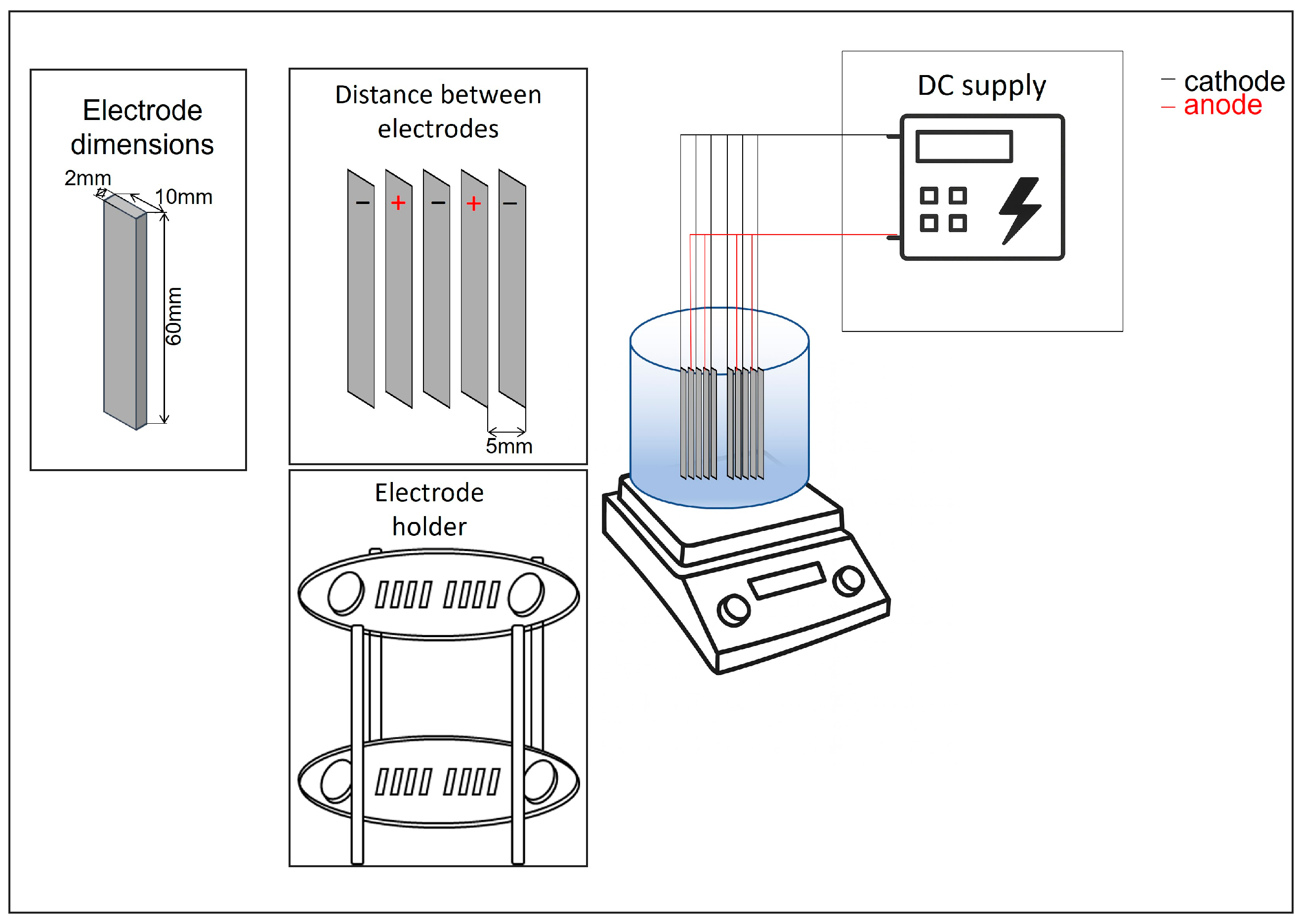
The batch reactor used in this study represents a laboratory-scale analogue of a single electro-barrier segment, operated under controlled conditions to quantify removal efficiency and energy demand prior to potential field implementation. The study was conducted in a batch electrochemical reactor made of borosilicate glass, with a total volume of 1000 mL. The system consisted of a DC power supply (DF 1730LCD, Wentronic, Braunschweig, Germany) with integrated potentiometric and galvanometric equipment, electrodes, a magnetic stirrer, and a magnetic core. The stirring speed was set to 900 revolutions per minute (rpm). The basic electrode configuration included four titanium anodes coated with a mixed-metal oxide (MMO) layer of IrO
2 and RuO
2 (Ti/Ir+Ru) often referred to as dimensionally stable anodes (DSA), and six uncoated titanium cathodes (Ti), with dimensions of 60 × 10 × 2 mm. The total active anode surface area (AAS) immersed in the synthetic matrix, in the setup that included the maximum number of electrodes participating in the electrolysis process, was 48 cm
2. The electrode holder for the electrochemical treatment is shown in
Figure 2. The selection of the electrode materials in this study was guided by their proven effectiveness in the electrochemical treatment of chlorinated organic compounds. Specifically, Ti/IrO
2–RuO
2 anodes enable efficient generation of electroactive chlorine species that play a key role in the indirect oxidation of Cl-VOC compounds, while titanium cathodes provide stable reductive conditions favourable for the dehalogenation of VC and TCE [
41]. According to studies by Kim and Bae [
42], Tang et al. [
43], and Wang et al. [
44], the selection of suitable electrode coating materials, such as tantalum (Ta
2O
5), tin (SnO
2), iridium (IrO
2), ruthenium (RuO
2) oxides, and their combinations significantly improves the electrocatalytic activity, stability, and energy efficiency of anodes. Moreover, Martínez-Huitle and Panizza [
45] emphasized that electrode materials based on mixtures of metal oxides, such as TiO
2, IrO
2, and RuO
2, in addition to exhibiting excellent electrocatalytic properties for chlorine evolution, also provide long-term stability and cost-effectiveness. To ensure reproducibility of the electrode surface, prior to each experiment all electrodes (both anodes and cathodes) were immersed in 5 M HCl solution (Merck, Darmstadt, Germany, p.a., 35%) for 10 min, followed by rinsing with water and drying. To prevent evaporation of VC and TCE, the electrochemical reactor was covered to eliminate headspace. Simultaneously, for each individual electrochemical treatment, an additional borosilicate glass reactor (1000 mL) was set up under the same conditions (stirring at 900 rpm, no headspace) but without the application of current, serving as a control. The volume of the treated synthetic water matrix, as well as the control, was 550 mL. In each experimental series, a control reactor without applied current was operated in parallel under identical conditions (same synthetic groundwater, electrode arrangement, and mixing), in order to quantify potential losses of VC and TCE due to volatilisation or sorption on reactor walls in the absence of electrochemical treatment. The results of the control experiments (E2–E12) showed that the volatilisation losses of VC reached up to 8.6%, while a maximum loss of 4.2% was observed for TCE. In the E1 experiment, which involved a prolonged treatment time of 60 min, slightly higher losses were recorded due to the extended exposure period (VC: 16%, TCE: 7.7%). The more pronounced volatilisation of VC is expected and can be attributed to its significantly higher volatility compared to TCE, which is directly related to the differences in their Henry’s law constants [
46]. Overall, the observed losses in the control experiments were generally comparable to, or slightly higher than, the analytical variability of the GC–MS method, particularly for VC at prolonged treatment times. For TCE, the method accuracy ranged from 93–120% with relative standard deviations (RSD) of 1.3–7.6%, while for VC the accuracy ranged from 82–115% with RSD values of 3.4–9%. Nevertheless, the substantially higher removals observed during the electrochemical treatments clearly indicate that the decreases in VC and TCE concentrations were predominantly driven by electrochemical degradation rather than by physical losses due to volatilisation or sorption.
According to available literature data, there is insufficient information on the application of electrochemical treatment for VC, while for TCE, the electrochemical degradation times reported in previous studies ranged from 60 to 290 min, depending on the applied current intensity (30 mA, 60 mA, 90 mA, and 120 mA) [
11,
47,
48]. Based on this, in order to monitor the removal dynamics and the effect of reaction time on process efficiency, an initial treatment was carried out for 60 min at a current intensity of 60 mA, with samples taken after 10, 20, 30, 45, and 60 min. The results obtained under this parameter setup formed the basis for further research development. After determining the reaction time required to achieve satisfactory treatment efficiency, the investigations continued with the analysis of the influence of the electric field, i.e., different applied current intensities. In the next phase, the experimental focus was on studying the geometric characteristics of the system, including the arrangement and distance between electrodes (DBE). An overview of the conducted electrochemical treatments is presented in
Table 1.
Experiments E2–E5 were conducted with the same electrode configuration as E1, but with different applied currents (10–60 mA) and shorter fixed treatment time of 20 min, in order to identify the optimal operating conditions. Experiments E6–E12 were performed at 20 mA for 20 min while systematically varying the number of anodes/cathodes and the inter-electrode spacing (0.5–2.5 cm) to evaluate geometric effects on VC and TCE removal. All experiments were performed in triplicate, and the results presented in this study represent mean values. Standard deviation (SD) error bars are included in the graphical representations and were below 5.5% in all cases, indicating good reproducibility of the experimental data.
2.3. Chemicals
A standard solution of VC in methanol (2000 μg/mL) supplied by Sigma Aldrich (St. Louis, MO, USA) (CAS Number: 75-01-4), a standard solution of TCE (1460 mg/mL) supplied by Alkaloid Skopje (Skopje, Macedonia) (CAS Number: 79-01-6), and an internal standard of fluorobenzene at a concentration of 2000 μg/mL in methanol supplied by AccuStandard (New Haven, CT, USA) (CAS Number: 462-06-6) were used. Calibration solutions and spiking solutions were prepared in methanol of 99% purity (J. T. Baker, Phillipsburg, NJ, USA). For the preparation of the synthetic matrix, ultrapure water was used, obtained with a Labconco system (resistivity at 25 °C of 16 MΩ∙cm).
2.4. Analytical Methods
The analysis of VC and TCE content was performed using a “Purge and Trap” sample preparation system Lumin (15-2500-074, Teledyne Tekmar, Mason, OH, USA), directly coupled with a gas chromatograph (Agilent Technologies 7890A, Santa Clara, CA, USA) equipped with a mass spectrometer detector (Agilent Technologies 5975C, Santa Clara, CA, USA). The conditions of the “Purge and Trap” system were as follows: helium gas purge time of 11 min, desorption temperature of 250 °C, desorption time of 2 min, and trap bake-out temperature of 280 °C for 3 min. Chromatographic conditions: initial temperature of 35 °C (5 min), then increased at a rate of 15 °C/min to 100 °C (0 min), and then at a rate of 25 °C/min to 225 °C (3 min). The injector temperature was 110 °C, and the detector temperature was 280 °C, using a DB-5MS column (30 m × 0.25 mm × 0.25 µm). For the analysis of vinyl chloride and trichloroethylene, 5 mL of water sample was injected into the “Purge and Trap” system with the addition of the internal standard fluorobenzene at a concentration of 10 µg/L. The calibration range for vinyl chloride was 0.5–100 µg/L, while for trichloroethylene the calibration range was 1–200 µg/L. The method was validated by determining the method detection limit (MDL) and the practical quantification limit (PQL), and each sample was analysed in triplicate.
Table 2 provides an overview of the identification parameters of the selected compounds using gas chromatography.
The pH value and sample temperature were measured using a WTW inoLab pH laboratory meter equipped with a temperature sensor (Xylem Analytics Germany Sales GmbH & Co. KG, Weilheim, Germany), in accordance with the SRPS H.Z1.111:1987 method [
49]. The electrical conductivity of groundwater during the experiment was measured using a laboratory conductometer (Hanna conductometer, model HI 933000, (Graz, Austria), Cond 3210 with a Tetracon 325 WTW electrode, Xylem Analytics Germany Sales GmbH & Co. KG, Weilheim, Germany) in accordance with the SRPS EN 27888:1993 method [
50].
Statistical analyses were performed using the software PAST 5.2.2 (University of Oslo, Oslo, Norway) [
51]. All response variables used for statistical analyses (vinyl chloride and trichloroethylene removal efficiencies, %VC and %TCE) represent mean values calculated from triplicate measurements. Principal Component Analysis (PCA) was applied to evaluate multivariate relationships between operational parameters and the efficiency of VC and TCE removal during electrochemical treatment. The data matrix comprised removal efficiencies (%VC and %TCE) together with key operational variables, including applied current intensity (I), treatment time (t), active anode surface area (AAS), and inter-electrode distance (DBE). Prior to PCA, all variables were standardized using z-score transformation (mean = 0, standard deviation = 1) to eliminate scale effects and ensure equal contribution of variables with different units. PCA was therefore conducted on the correlation matrix. Univariate normality of the response variables was assessed using the Shapiro–Wilk test, complemented by visual inspection of histograms and normal probability (Q–Q) plots. Several variables deviated from a normal distribution, reflecting the bounded and skewed nature of removal efficiency data. As PCA was applied in an exploratory manner and based on standardized variables, no further distributional transformation was imposed. The suitability of the dataset for PCA was evaluated using Bartlett’s test of sphericity and the Kaiser–Meyer–Olkin (KMO) measure of sampling adequacy. Bartlett’s test confirmed that the variables were sufficiently correlated to justify multivariate analysis (
p < 0.05). The KMO value indicated limited sampling adequacy, suggesting that the correlation structure was not dominated by strong common latent factors. Accordingly, PCA results were interpreted as exploratory and primarily intended for pattern recognition and visualization of multivariate relationships rather than for latent factor inference. In addition to PCA, Pearson’s correlation analysis was employed to quantify linear relationships between operational parameters and removal efficiencies, supporting the interpretation of the effects of electrode configuration and operating conditions on electrochemical treatment performance. Given the observed deviations from normality and the limited sample size, correlation coefficients were interpreted descriptively. To assess the robustness of the observed associations under non-normal data distributions, Spearman’s rank correlation coefficients were additionally examined, yielding trends consistent with those obtained using Pearson’s correlation.
2.5. Estimation of Electrical Energy Consumption
The electrical energy cost (
EE) was calculated using the following equation:
where
U is the voltage (V),
I is the current (A),
t is the treatment time (h),
c is the electricity price (RSD/kWh),
V is the volume of treated water (m
3), and 1000 is the conversion factor from Wh to kWh.
For the calculation of electricity costs, the tariff corresponding to the green tariff zone for a single-rate electricity meter was applied, amounting to 7.9706 RSD/kWh, in accordance with the current electricity pricing scheme for households in the Republic of Serbia. It is important to note that electricity costs represent practically the only operational costs of the process, apart from initial capital investments (electrodes, power supply, and maintenance), which further enhances the attractiveness of these technologies for real in situ applications.
3. Results and Discussion
3.1. Effect of Reaction Time on Removal Performance
Energy consumption during electrochemical treatment is directly linked to reaction time [
52], since prolonged treatment increases both energy and electrode consumption, which in turn directly affects the overall operational costs of the process [
53]. Based on this, it can be concluded that optimizing reaction time is crucial for achieving energy- and cost-efficient electrochemical treatment, as extending the duration of the process does not necessarily improve removal efficiency, but significantly increases energy use, electrode wear, and total operational costs.
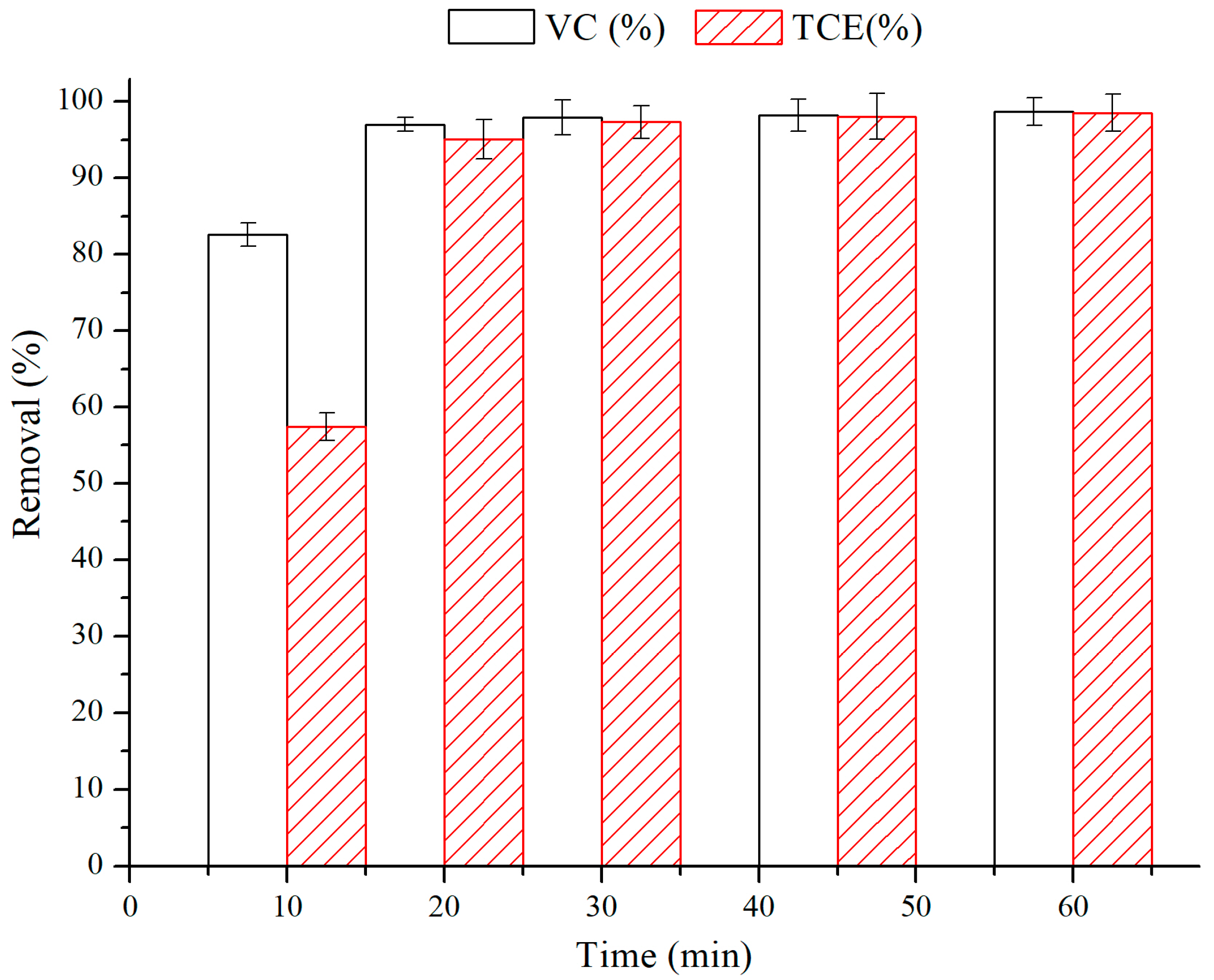
The results show that after 10 min of electrochemical treatment, the VC concentration decreased by 15 μg/L, while within the same time interval the TCE concentration decreased by 83 μg/L. When these absolute reductions are recalculated into relative values, i.e., removal efficiency, it is observed that VC achieved a higher efficiency (83%) compared to TCE (57%). This observation can be explained by the fact that the initial TCE concentration was approximately six times higher than that of VC, which contributed to a more pronounced absolute reduction but a relatively lower efficiency during the first 10 min of treatment.
However, after 20 min, the VC concentration was reduced by 97%, while for TCE the reduction was 95%. After 60 min, the treatment efficiency reached about 99% for VC and 98.5% for TCE (
Figure 3). These findings indicate that after 20 min of treatment, further increases in efficiency are minimal for both compounds, and extending treatment time is not energy-efficient since it brings only negligible improvements. Based on the obtained results, it can be concluded that TCE degrades faster than VC in electrochemical systems. This conclusion is consistent with previously published studies, which emphasize that a higher degree of chlorination in Cl-VOC molecules, such as in the case of TCE compared to VC leads to more favourable reduction potentials and greater thermodynamic feasibility for electrochemical dehalogenation [
54,
55]. Although increasing the current strength significantly improves TCE removal, it is important to point out that the application of higher currents leads to higher energy consumption, which affects the overall economic profitability of the process [
44]. Additionally, at higher anode loads, the formation of oxidation byproducts such as chlorate and perchlorate is possible, which is clearly documented in the literature [
56]. The analysis of potential by-products within this research was not carried out, and this aspect represents a methodological limitation that should be taken into account when planning further research.
3.2. Effect of Current Intensity
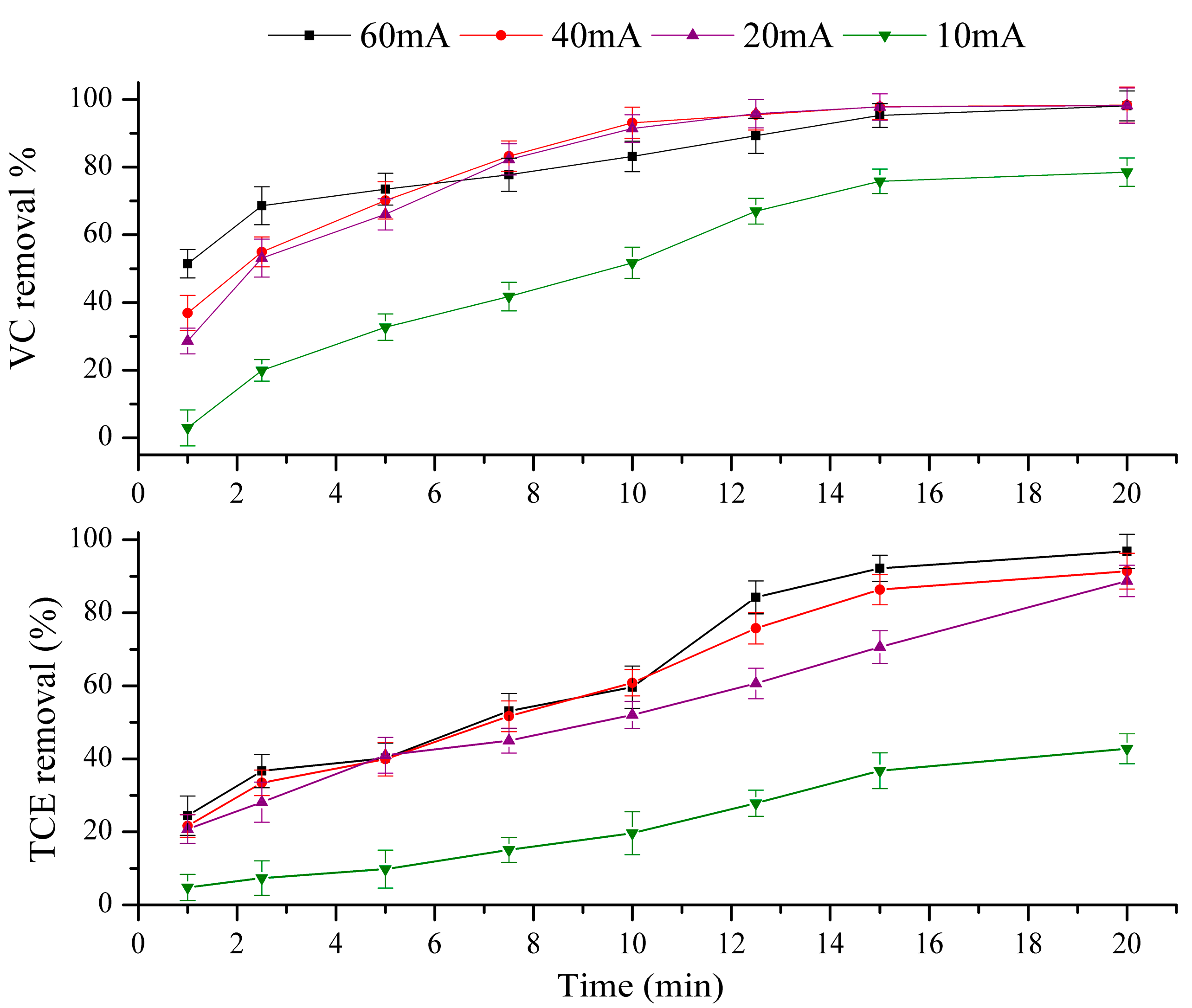
Based on the investigation of reaction time, it was determined that the optimal duration for VC and TCE removal is 20 min. Therefore, when examining the influence of current intensity (10 mA, 20 mA, 40 mA, and 60 mA), the changes in pollutant concentrations were monitored at shorter time intervals (1, 2.5, 5, 7.5, 10, 12.5, 15, and 20 min) in order to obtain a more detailed insight into the dynamics and degradation rates during treatment (
Figure 4).
The obtained results clearly show that changes in current intensity significantly affect the efficiency of electrochemical TCE removal, while this effect is less pronounced for VC. Specifically, for VC, final removal efficiencies of 98%, 97%, 94%, and 78% were achieved at 60, 40, 20, and 10 mA, respectively. Based on these values, it can be concluded that there is no significant difference in efficiency between 60 mA, 40 mA, and 20 mA. On the other hand, it can be assumed that high removal efficiency can also be achieved at lower currents, but a longer treatment time is required to reach maximum efficiency. In contrast, for TCE, removal efficiencies of 97%, 91%, 89%, and 43% were obtained at 60, 40, 20, and 10 mA, respectively, indicating a much higher sensitivity of this compound to current intensity. Studies have shown that TCE degradation is more efficient at higher current densities, which is associated with the more intensive generation of hydroxyl radicals and active chlorine on inert anodes [
46,
48,
57,
58]. These reactive species enable the oxidation of complex chlorinated compounds such as TCE. In contrast, the less chlorinated VC exhibits higher removal efficiency at lower current densities, due to reductive dehalogenation on the Ti cathode [
59]. These conclusions correlate with changes in pH values (see
Section 3.5). The detected increase in pH during VC treatment indicates cathodic reduction of water and the presence of OH
− ions [
52], while the slight pH change observed during TCE treatment points to the dominance of indirect oxidation via chlorine species formed on Ti/Ir+Ru anodes (see
Section 3.5) [
20,
42,
60].
3.3. Effect of Electrode Arrangement
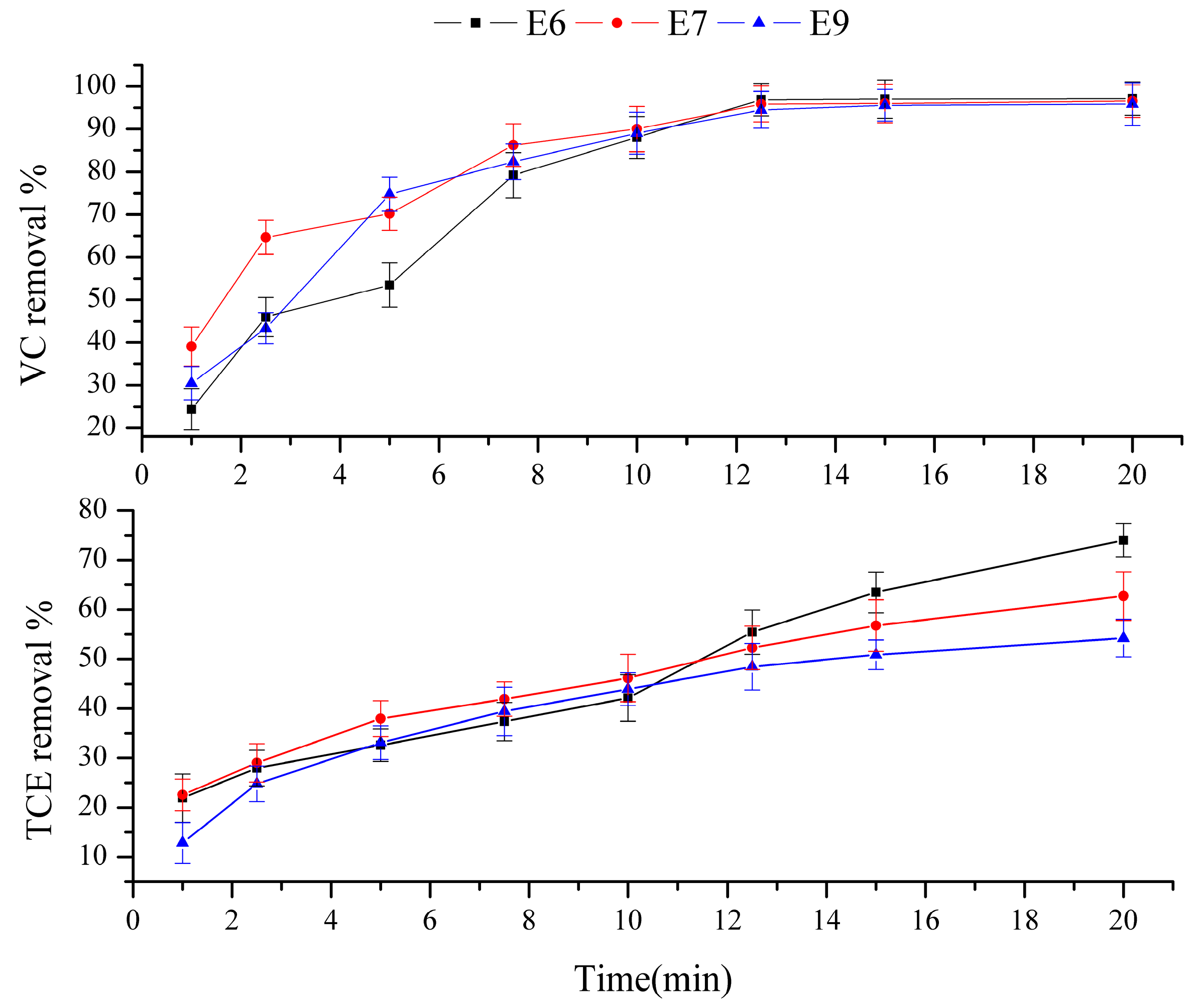
Taking into account the achieved efficiencies and the explanations previously discussed, treatments were conducted for 20 min at a current of 20 mA, since high efficiencies were achieved for both compounds (VC—94.5% and TCE—89%).
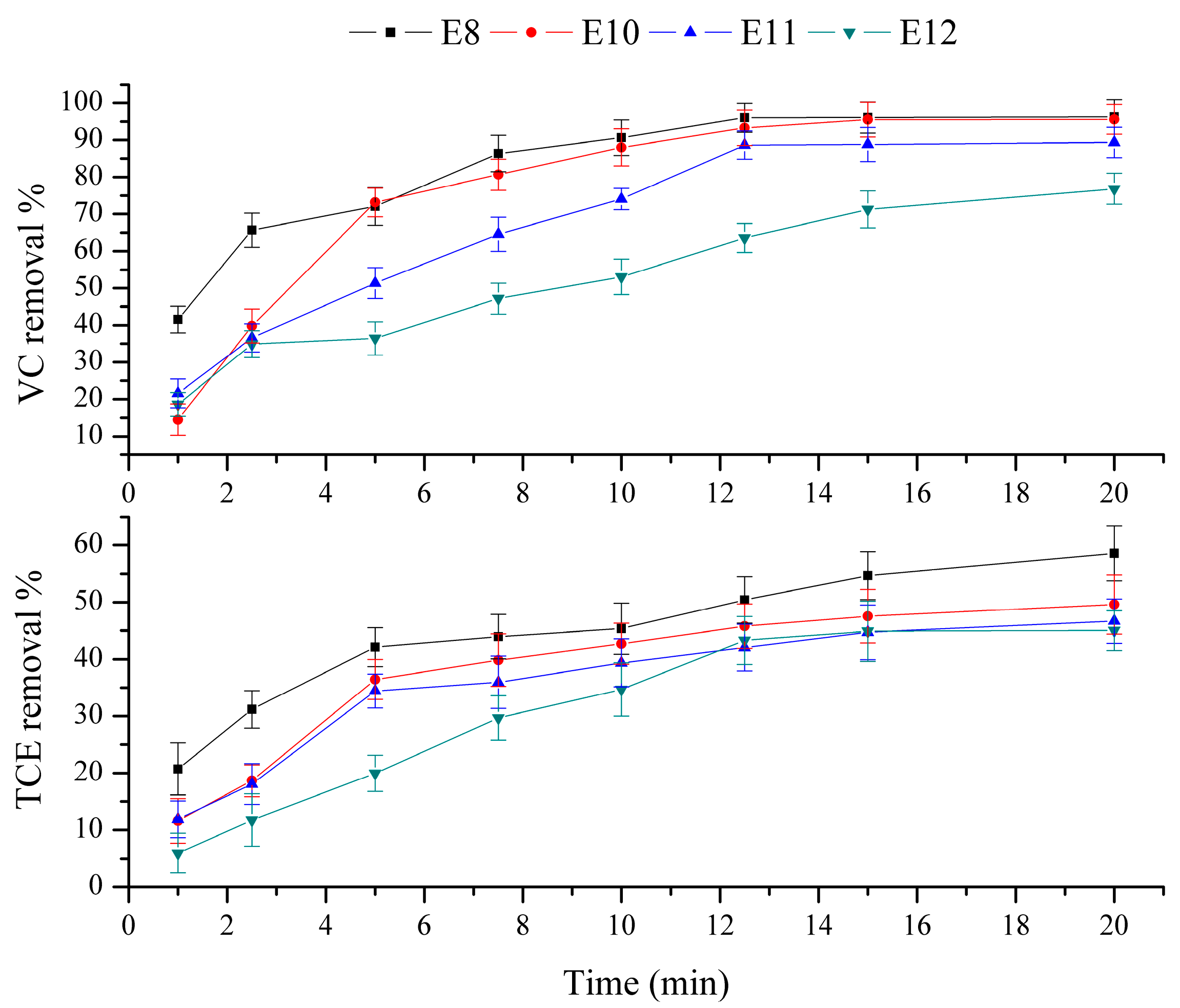
To optimize the number of electrodes and evaluate the effect of their arrangement and spacing on the efficiency of VC and TCE electrochemical treatment, experiments E6, E7, E8, E9, E10, E11, and E12 were performed (
Figure 5 and
Figure 6). In experiments E6, E7, and E9, the distance between electrodes was 0.5 cm. In experiment E6, four cathodes and four anodes were applied, with the total active anode surface reduced from 48 cm
2 to 36 cm
2. Experiment E7 was conducted with four cathodes and two anodes, with a total active anode surface area of 24 cm
2. In experiment E9, two cathodes and two anodes were used, with the anode surface area reduced to only 12 cm
2. Experiment E8 was designed analogously to experiment E7, but with the electrode spacing increased to 1 cm. Similarly, experiment E10 corresponded to the setup of experiment E9, but with a spacing of 1 cm. In experiments E11 and E12, the same number of electrodes as in E9 was maintained (two cathodes and two anodes, total anode surface area 12 cm
2), but the electrode spacing was further increased to 2 cm in E11 and 2.5 cm in E12.
For VC, very high removal efficiencies were achieved in experiments with 0.5 cm electrode spacing: 97% in E6 (4 cathodes, 4 anodes), 96% in E7 (4 cathodes, 2 anodes), and 96% in E9 (2 cathodes, 2 anodes). These values indicate that reducing the number of electrodes and active anode surface area (from 36 cm2 to 12 cm2) does not significantly affect the removal efficiency of this compound. It was also observed that there is no major difference in VC removal efficiency when the electrode spacing was increased to 1 cm in E8 and E10. However, when the spacing was increased to 2 cm (E11) and 2.5 cm (E12), the removal efficiency dropped to 89% and 77%, respectively, indicating that electrode distance has a greater impact on VC degradation than the number and surface area of electrodes themselves.
In contrast, for TCE, a pronounced decrease in removal efficiency was observed with the reduction of active anode surface area: 74% in E6, 63% in E7, and only 54% in E9. This confirms that efficient degradation of more complex, highly chlorinated molecules such as TCE requires more intensive generation of reactive oxidative species, which is achieved through a greater number and surface area of electrodes. The effect of electrode spacing was observed in experiments E9–E12, where the anode surface area was kept constant (12 cm2), while the spacing between electrodes was gradually increased (from 0.5 to 2.5 cm), resulting in a decrease in TCE removal efficiency from 54% to 45%.
A joint analysis of the results from experiments E6 to E12 reveals a clear difference in the behaviour of VC and TCE depending on electrode configuration and spacing. For highly chlorinated compounds such as TCE, reducing the active electrode surface directly decreases the availability of active sites for generating reactive species, thereby reducing degradation efficiency [
48,
57]. These statements are consistent with the obtained results. Furthermore, according to Lei et al. [
44] and Yu et al. [
55], the higher degree of chlorination in TCE shifts the reduction potential toward more positive values, increasing the need for more intensive generation of oxidative agents for successful degradation. In contrast, the simpler structure of VC allows for its efficient removal even under conditions of reduced electrode number and total active surface area. Additionally, increasing electrode spacing resulted in a decline in removal efficiency for both VC and TCE, which is consistent with the findings of Rajić et al. [
48,
57], who demonstrated that increased electrolyte resistance and reduced ion transfer significantly limit the electrochemical activity of the system.
3.4. Dominant Factors Influencing Electrochemical Treatment Performance
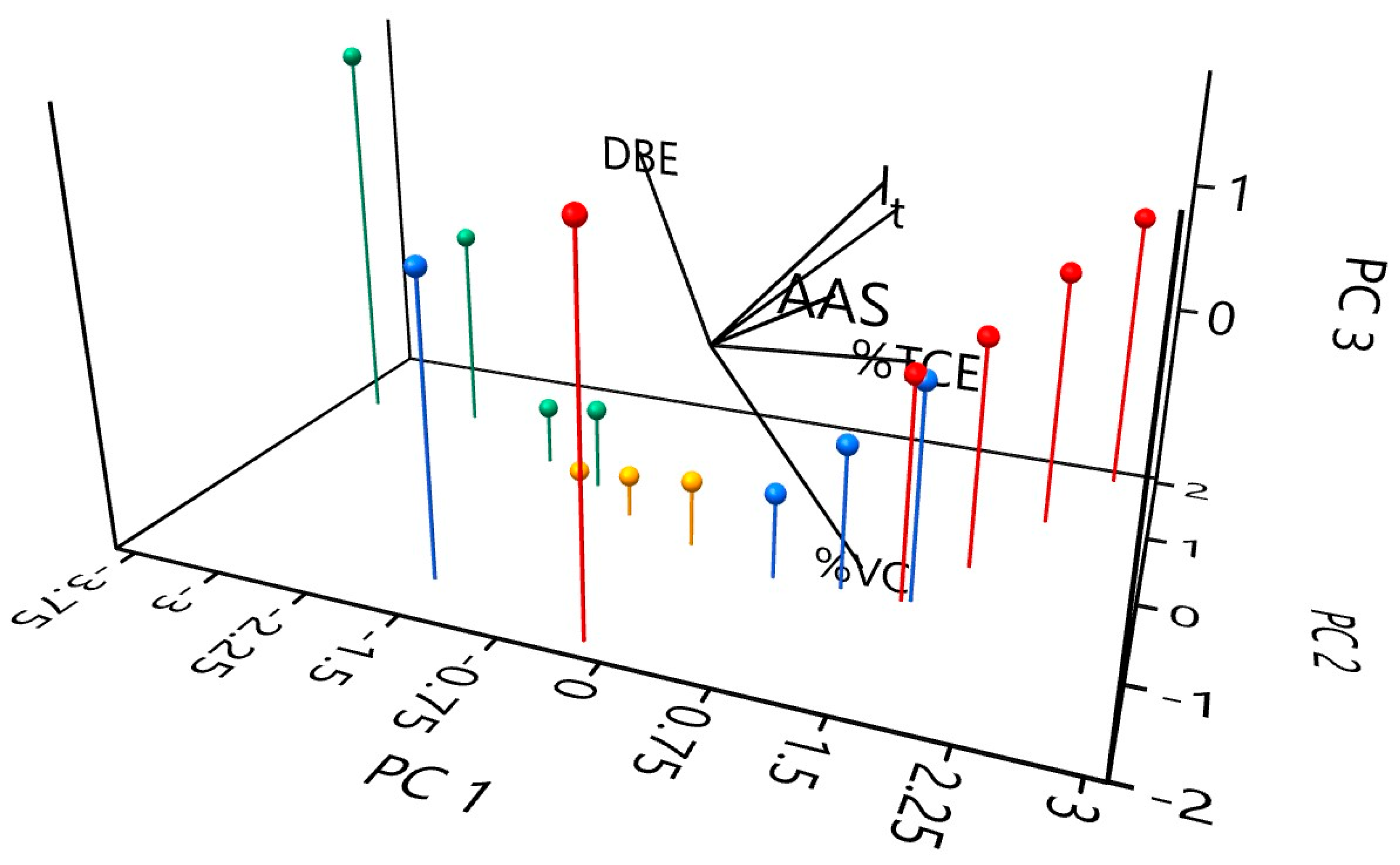
Principal Component Analysis (PCA) was applied to assess the influence of key parameters on the efficiency of VC and TCE removal by electrochemical treatment. PCA reduced the dimensionality of the dataset, which comprised six variables, including four operational parameters (t, I, AAS, DBE) and two output variables related to process efficiency (%VC and %TCE), to three principal axes (
Figure 7,
Table 3). The first three components explained 88.5% of the total data variability. The first principal component (PC1) accounts for 58.34% of the variance and is primarily determined by the applied current (loading = 0.4218), active anode surface area (0.4308), and, most notably, TCE removal efficiency (0.506). This component therefore represents the axis of overall electrochemical reactivity of the system and confirms that current intensity and anodic processes are the dominant factors governing TCE oxidation. The second principal component (PC2), explaining an additional 15.57% of the variance, is mainly associated with reaction time (loading = 0.7113) and distance between electrodes (0.4725). PC2 thus reflects temporal and geometric effects that influence the progression of the electrochemical process. Although these parameters affect reaction kinetics and mass transfer, their contribution to the final removal efficiency of both VC and TCE is secondary compared to the influence of current loading captured by PC1. A third component (PC3, 14.60% of variance) clearly differentiates the behaviour of VC and TCE (loading for %VC = −0.7073), reflecting their distinct removal mechanisms. VC removal is primarily governed by reductive dehalogenation processes at the cathode, whereas TCE removal is dominated by oxidative pathways involving reactive chlorine species and hydroxyl radicals generated at the inert anode. This separation emphasizes that, despite being treated within the same electrochemical system, VC and TCE respond differently to operational conditions due to their contrasting physicochemical and electrochemical properties.
Taken together, the PCA results confirm that applied current is the key operational parameter for achieving high TCE removal efficiency, while active anode surface area and electrode configuration play a secondary but still relevant role within the investigated range. Reaction time and distance between electrodes mainly influence process dynamics rather than the ultimate removal efficiency. Given the limited sampling adequacy indicated by the KMO measure, PCA was interpreted in an exploratory manner, and its results are primarily intended to support pattern recognition and mechanistic interpretation rather than latent factor inference. Nevertheless, the PCA outcomes are fully consistent with the experimental observations and provide a coherent multivariate framework for understanding the behaviour of the system.
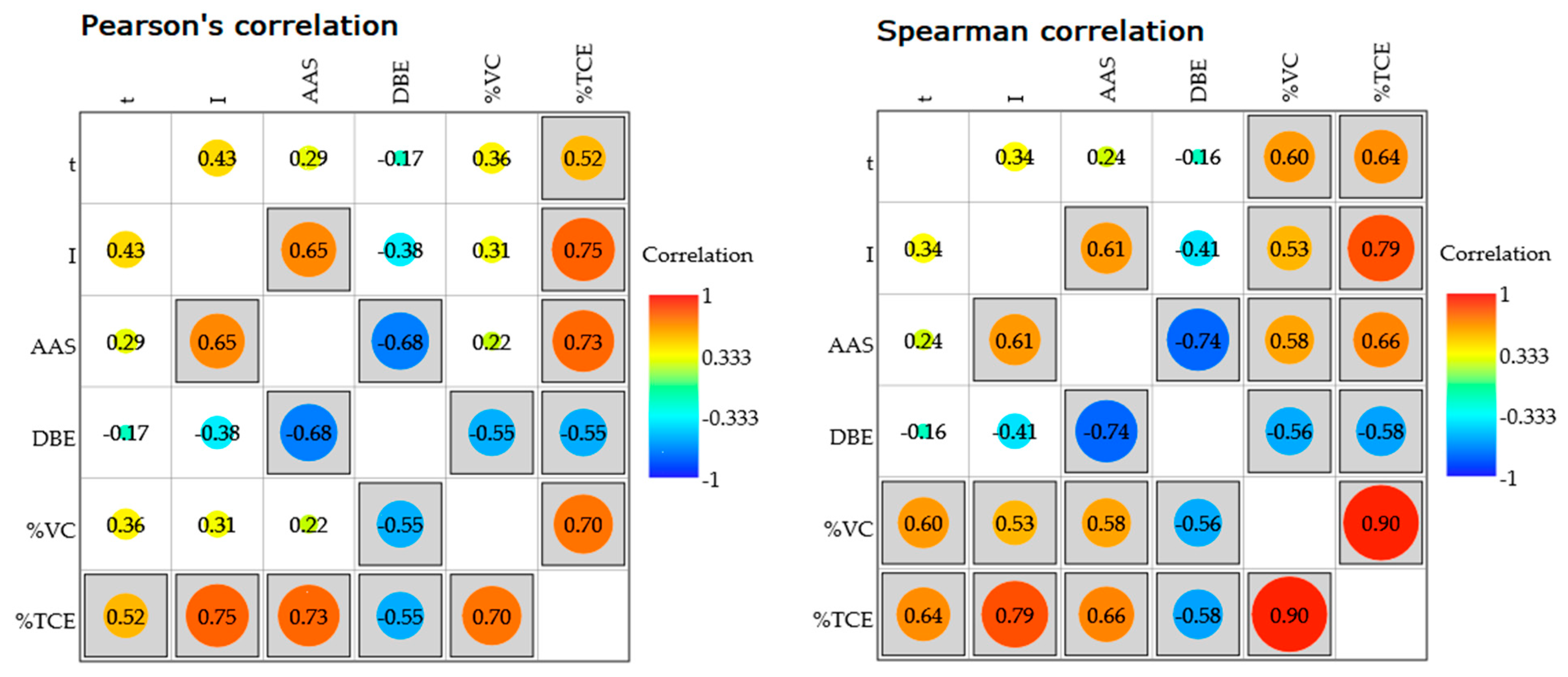
In addition to PCA, Pearson correlation analysis was also conducted to further assess the interrelationships among key variables. In the correlation matrix (
Figure 8), positive correlations are represented by orange dots, while negative correlations are shown as blue dots. The colour intensity and symbol size are proportional to the absolute values of the correlation coefficients, such that darker and larger dots indicate stronger statistical relationships between the analysed variables. Correlations highlighted with light grey boxes are statistically significant (
p < 0.05). This visualization enables clearer distinction between weak and strong correlations and facilitates the interpretation of how individual operational parameters influence the efficiency of VC and TCE removal. The results clearly reveal distinct correlation patterns for VC and TCE. The removal efficiency of VC shows a moderate positive correlation with reaction time (r = 0.364), while the correlation with applied current is weaker (r = 0.311). The active anode surface area (AAS) exhibits a low but positive influence (r = 0.215), whereas the DBE shows a moderate negative correlation (r = −0.547), confirming that increased electrode spacing adversely affects VC removal. In contrast, TCE removal efficiency exhibits a very strong positive correlation with applied current (r = 0.749) and AAS (r = 0.733), while its correlation with reaction time is moderate (r = 0.525). DBE has a strong negative effect on the TCE degradation process (r = −0.554), which is consistent with experimental observations showing decreased removal efficiency at larger electrode spacings.
Given the observed deviations from normality and the limited number of experimental runs, Spearman’s rank correlation coefficients were additionally evaluated to assess the robustness of these associations under non-normal data distributions (
Figure 8, right). The Spearman analysis revealed trends consistent with those obtained using Pearson’s correlation, confirming that the identified relationships are stable and not driven by distributional assumptions or isolated outliers. Pearson’s correlation was therefore retained to describe linear relationships, while Spearman’s correlation supports the directional consistency of the observed effects.
Overall, Pearson correlation analysis confirms that current intensity and active anode surface area are the key factors governing TCE removal, whereas reaction time plays a more dominant role in VC removal, with a comparatively smaller influence of current. DBE exerts a consistently negative effect on the removal of both compounds, which is more pronounced in the case of TCE. These findings are fully consistent with the electrochemical mechanisms involved and reinforce the conclusions drawn from PCA and experimental observations.
3.5. Changes in pH, Temperature, Electrical Conductivity and Chloride as Indicators of the Mechanisms and Intensity of Treatment
During the electrochemical treatment of water contaminated with VC and TCE, characteristic changes in pH, temperature, and electrical conductivity (EC) were observed, which further confirm the dominant removal mechanisms of these compounds as well as the overall process intensity (see
Table 4).
In experiments focused on VC removal, a pronounced increase in pH was recorded, particularly in E1 and E2, where pH rise from an initial 8.40 to as high as 10.97 and 10.05. This change indicates intensive cathodic water reduction with the generation of OH
− ions, which is consistent with findings reported in the literature [
43]. In the case of TCE treatment, the increase in pH was more moderate (up to 9.6 in E1), suggesting that in this case, indirect oxidation via chlorine species formed on Ti/Ir+Ru anodes is the dominant mechanism. In addition, an increase in temperature was observed, particularly in experiments with higher current intensities and longer reaction times (e.g., E1 and E2), where the temperature increased from 22 °C to as high as 48 °C and 38.9 °C, respectively. This increase is the result of Joule heating due to current flow through the solution and highlights the need for careful control of thermal conditions during potential application in real systems [
42]. Changes in electrical conductivity further confirm the intensity of electrochemical reactions. In most experiments, an increase in EC values was observed for VC from ~1650 µS/cm to nearly 2000 µS/cm (e.g., E1: 1666 to 1968 µS/cm) indicating ion formation and accumulation during the process. For TCE, an increase in EC was also noted, reflecting activation of anodic reactions and generation of oxidative intermediates. Such trends confirm observations from previous studies analysing the relationship between electrochemical conditions and conductivity changes [
43].
Accordingly, the decrease in chloride concentration observed in all experiments is a consequence of the intense anodic oxidation of Cl
− to Cl
2, HOCl/OCl
−, and subsequently to chlorate and perchlorate (ClO
3−, ClO
4−), which are not detected by standard chloride analysis methods [
27,
46]. In addition, a portion of the generated Cl
2 escapes into the gas phase, particularly at higher currents and elevated temperatures, further contributing to the overall reduction of dissolved chloride ions [
54]. These processes provide additional evidence for the distinct dominant degradation pathways of VC and TCE, namely intense cathodic reduction for VC (C
2H
3Cl + e
− + H
+ → C
2H
4 + Cl
−) and indirect oxidation for TCE (Anodic oxidation of chloride: 2Cl
− → Cl
2 + 2e
−; formation of active chlorine in solution: Cl
2 + H
2O ↔ HOCl + H
+ + Cl
−).
Such behavior is consistent with literature reports indicating that TCE is reduced on Ti/MMO cathodes via a sequential hydrodechlorination pathway to DCE, VC, ethylene and ethane, with the simultaneous release of Cl
− ions [
58,
60,
61]. Under sufficiently negative cathodic potentials, these intermediates do not accumulate to a significant extent, and ethylene/ethane and Cl
− dominate among the detected products [
62,
63,
64]. In contrast, VC exhibits a higher tendency toward direct cathodic reduction and faster removal, indicating the dominant role of electrodechlorination [
61,
64].
Although changes in pH, electrical conductivity, temperature, and chloride concentration provide strong indirect evidence of the dominant electrochemical pathways involved in VC and TCE degradation, direct identification of all reaction intermediates and by-products was not performed in this study. Therefore, the proposed degradation mechanisms are based on a combination of experimentally observed trends and well-established electrochemical processes reported in the literature for similar systems. This limitation represents a constraint of the present study, but also constitutes a basis for future research, which will focus on detailed by-product analysis and quantitative confirmation of the proposed reaction pathways.
3.6. Comparison with Regulatory Standards and Assessment of Treatment Cost-Effectiveness
In order to identify the most suitable electrochemical treatment to protect water sources from potential VC and TCE contamination, the final concentrations obtained after electrochemical treatment were compared with the limit values defined by the Serbian Regulation on the Hygienic Safety of Drinking Water (Official Gazette of the Republic of Serbia, No. 28/2019) [
36] and Directive (EU) 2020/2184 [
37] on the quality of water intended for human consumption. In parallel with the regulatory assessment, the electrical energy cost per cubic meter of treated water was estimated to evaluate the economic feasibility of the most efficient treatment options.
Understanding the energy requirements of water treatment processes represents a key step in assessing the interconnections between access to clean water and energy transition, while highlighting trade-offs and potential synergies among different sustainable development goals [
65]. Wang et al. [
41] emphasize that energy consumption plays a crucial role in the applicability of electrochemical technologies, while also noting that such treatments are often more cost-effective and environmentally friendly compared to conventional biological processes.
For VC, following treatment E4 (20 min treatment time, applied current of 20 mA), the measured concentration was 0.48 µg/L, which is below the maximum allowable concentration (MAC) defined by both the Serbian Regulation on the Hygienic Safety of Drinking Water (Official Gazette RS, Nos. 42/98, 44/99, 28/19) [
36] and Directive (EU) 2020/2184 (MAC = 0.5 µg/L) [
37]. However, in experiments investigating the influence of active anode surface area and DBE on process efficiency (E6–E12), despite achieving high overall removal efficiencies, the final VC concentration exceeded the limit value of 0.5 µg/L in all cases. These results indicate that changes in electrode configuration and surface area alone, although effective in terms of overall removal, are not sufficient to ensure full compliance with drinking water quality standards for VC.
In addition, treatment E4 was applied to a real groundwater matrix spiked with an initial VC concentration of 26.5 µg/L. After treatment, the VC concentration was below the detection limit (<0.34 µg/L), indicating that the electrochemical process successfully reduced VC levels below the regulatory threshold even in a real groundwater matrix with more complex chemical composition. This confirms the applicability of the electrochemical treatment under field-relevant conditions.
For TCE, according to the current Serbian Regulation on the Hygienic Safety of Drinking Water (Official Gazette RS, Nos. 42/98, 44/99, 28/19), the MAC is 70 µg/L [
36]. This criterion was met even after treatment E9, which employed a minimal active anode surface area of only 12 cm
2 (configuration: two anodes and two cathodes; inter-electrode distance: 0.5 cm). This configuration was also applied to the real groundwater sample, where the obtained results showed strong agreement with laboratory data, confirming the stability and reproducibility of the process under natural conditions.
However, Directive (EU) 2020/2184 establishes a considerably stricter standard for TCE, with a maximum allowable concentration of 10 µg/L, which is seven times lower than the national limit [
37]. Compliance with this criterion was achieved only after treatment E2, conducted at an applied current of 60 mA and a treatment time of 20 min. This clearly indicates that meeting stricter European standards requires more intensive operating conditions than those sufficient for compliance with national regulations.
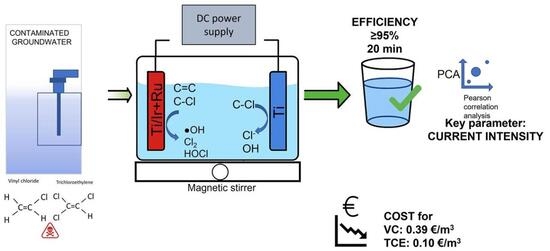
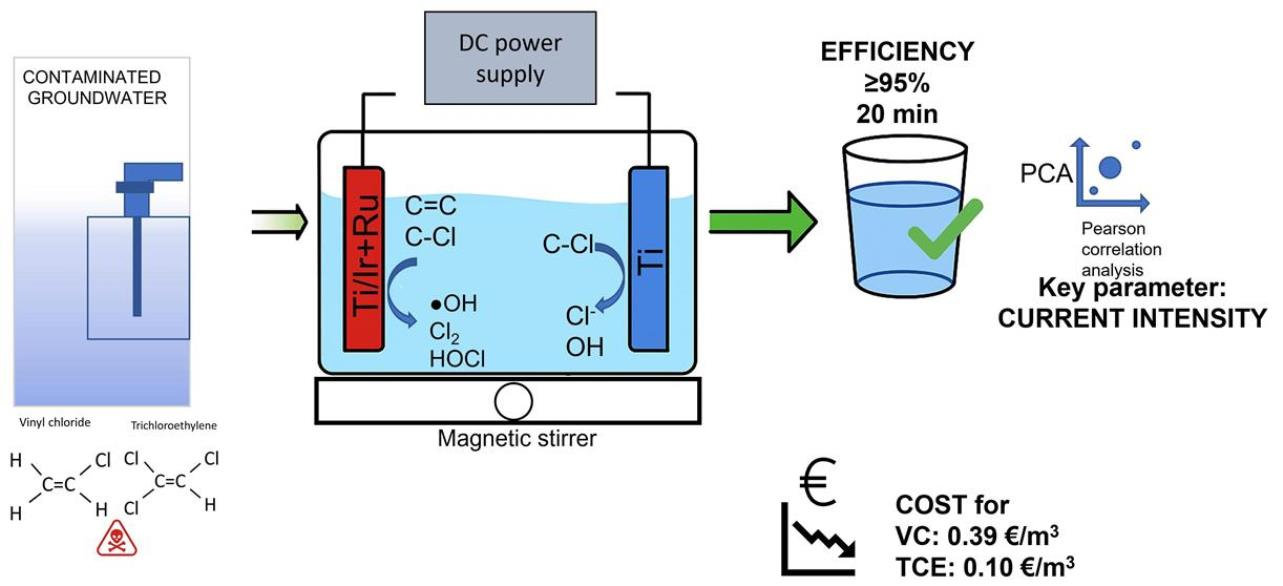
The cost assessment of electrochemical treatments for VC and TCE was performed for the treatments that complied with Serbian regulatory requirements (E4 for VC and E9 for TCE). Based on the calculations, the estimated cost of electrochemical treatment was 45.54 RSD/m3 of treated water (0.39 EUR/m3) for VC and 11.83 RSD/m3 (0.10 EUR/m3) for TCE. Considering both the achieved removal efficiencies and the calculated costs, it can be concluded that the investigated electrochemical treatments are not only technically effective but also economically viable. Their low energy consumption, combined with the fact that electricity represents virtually the only operational cost, makes them a competitive and applicable technology for the removal of highly toxic chlorinated compounds in industrial and municipal water treatment systems.
4. Conclusions
A laboratory investigation was carried out to investigate the use of an in situ electrochemical barrier system for protecting riverbank filtration-based water sources from contamination by VC and TCE. Experimental results showed that for these pollutants, a high removal efficiency (≥95%) can only be achieved after 20 min of treatment in the reactor configurations investigated. VC exhibited a higher tendency toward cathodic reductive dehalogenation, while effective degradation of TCE was conditioned by the generation of oxidative agents on the Ti/Ir+Ru anodes. The configuration and distance between electrodes significantly impacted process efficiency, especially for TCE, whose more complex structure requires more intensive oxidative conditions.
The statistical analyses confirmed that the removal efficiency of VC and TCE by electrochemical treatment primarily depends on current intensity, while reaction time has a moderate but consistent effect. The active surface area of the anode and electrode spacing were of limited significance under the examined conditions, with TCE showing a stronger dependence on current and anode surface area, whereas for VC, reaction time played a greater role. A cost assessment based on measured voltage–current–time profiles indicated that the estimated electricity costs for laboratory-scale treatment are approximately 0.39 €/m3 for VC and 0.10 €/m3 for TCE. These values represent the costs of electricity, which are the only operational expenses after the initial investment.
This present work was limited to batch experiments performed at laboratory scale, and was mainly carried out in synthetic groundwater matrices. Long-term performance, by-product formation and hydrogeological constraints were not investigated and must be addressed in future pilot- and field-scale studies. Within these limitations, the results of this study provide a solid basis for further development of electrochemical barrier concepts and serve as a starting point for designing and testing in situ applications for the cost-effective protection of riverbank filtration-based water sources in the Danube region and similar settings.



 ,
,