
Article

Towards a Near-Real-Time Water Stress Monitoring System in Tropical Heterogeneous Landscapes Using Remote Sensing Data

1
Department of Water Resources, Faculty of Environmental Sciences, King Abdulaziz University, Jeddah 21589, Saudi Arabia
2
Department of Food Crop Production Technology, Politeknik Negeri Banyuwangi, Banyuwangi 68461, Indonesia
3
Aerospace Information Research Institute, Chinese Academy of Sciences, Beijing 100101, China
4
Laboratory of Ecohydraulics & Inland Water Management, Department of Ichthyology and Aquatic Environment, University of Thessaly, 38446 N. Ionia Magnisias, Greece
5
Department of Geoinformation in Environmental Management, CI-HEAM/Mediterranean Agronomic Institute of Chania, 73100 Chania, Greece
6
Department of Applied Geosciences, Faculty of Science, German University of Technology in Oman, Muscat 1816, Oman
*
Author to whom correspondence should be addressed.
Hydrology 2025, 12(12), 325; https://doi.org/10.3390/hydrology12120325
Submission received: 29 October 2025 / Revised: 1 December 2025 / Accepted: 8 December 2025 / Published: 10 December 2025

Abstract

This study presents a near-real-time water stress monitoring framework for tropical heterogeneous landscapes by integrating optical and radar remote sensing data within the Google Earth Engine platform. Five complementary indices, vertical transmit/vertical receive–vertical transmit/horizontal receive (VV/VH) ratio, Dual Polarimetric Radar Vegetation Index (DpRVI), Normalized Difference Water Index (NDWI), Normalized Difference Moisture Index (NDMI), and Ratio Drought Index (RDI), were analyzed across three contrasting agricultural systems: paddy, sugarcane, and rubber, revealing distinct phenological and water stress dynamics. Radar-derived structural indices captured patterns of biomass accumulation and canopy development, with VV/VH values ranging from 4.2 to 12.3 in paddy and 5.4 to 6.0 in rubber. In parallel, optical moisture indices detected crop physiological stress; for instance, NDMI dropped from 0.26 to 0.06 during drought in sugarcane. Cross-index analyses demonstrated strong complementarity; synchronized VV/VH and RDI peaks characterized paddy inundation, whereas lagged NDMI–VV/VH responses captured stress-induced defoliation in rubber trees. Temporal profiling established crop-specific diagnostic signatures, with DpRVI peaking at 0.75 in paddy, gradual RDI decline in sugarcane, and NDMI values of 0.2–0.3 in rubber. The framework provides spatially explicit, temporally continuous, and cost-effective monitoring to support irrigation, drought early warning, and agricultural planning. Multi-year validation and field-based calibration are recommended for operational implementation.

1. Introduction

In tropical regions with varied landscapes, keeping track of water stress is essential for sustainable farming, maintaining healthy ecosystems, and managing water resources [1,2], especially as climate change and water shortages become more prevalent. Understanding the socioeconomic effects of agricultural drought is paramount for developing resilient strategies [3]. Consequently, the integration of remote sensing, GIS, and machine learning has become indispensable for effective water resources management in these agricultural regions [4]. In this regard, gaining insight into the seasonal changes in soil moisture is vital for agriculture and water management in Banyuwangi, Indonesia, an area known for its diverse farming practices and distinct wet and dry seasons.
Soil moisture plays a pivotal role in regulating water availability for plants, governing physiological processes, and sustaining ecosystem productivity [5,6,7,8]. In Indonesia, soil moisture generally reaches its maximum during the wet season (October–March) and declines to its minimum during the dry season (March–September). These dynamics are strongly associated with rainfall variability, with consistently low soil moisture observed in the dry season, even when air temperatures do not coincide with their minimum levels [9,10]. In Banyuwangi, rainfall serves as the primary determinant of soil moisture, exerting direct influence on crop productivity and drought risk [10]. Consequently, systematic monitoring of soil moisture is essential not only for assessing plant water status but also for evaluating drought conditions and understanding the broader impacts of climate change on agricultural systems and the surrounding environment.
Remote sensing technologies have become powerful tools for assessing water stress across different spatial and temporal scales, offering timely, non-invasive, and cost-effective solutions for monitoring plant and ecosystem water status [11,12,13]. These approaches facilitate the monitoring of water stress through a variety of indicators, including vegetation indices such as Normalized Difference Vegetation Index (NDVI), Soil-Adjusted Vegetation Index (SAVI), and Normalized Difference Water Index (NDWI), thermal-based indices such as the Crop Water Stress Index (CWSI), and microwave-derived metrics of vegetation water content (VWC) [12,13,14,15]. Various approaches have been employed, ranging from the use of specific radiometric indices for temporal evapotranspiration estimation [16] to complex energy balance models like METRIC and SEBAL, which have proven effective in regional evapotranspiration assessment [17]. Advances in multispectral and hyperspectral imaging, in combination with thermal infrared observations, have substantially improved the ability to capture spatially and temporally explicit information on crop and ecosystem water status [12,18]. Collectively, these remote sensing approaches enable the detection of subtle variations in plant water status, soil moisture dynamics, and ecosystem resilience across diverse landscapes, including agricultural fields, forests, and mixed-use environments. However, despite their widespread global application, the integrated use of these indices in tropical agricultural mosaics is still limited, particularly in regions where irrigated rice, sugarcane, and rubber plantations coexist and exhibit distinct phenological and moisture-driven characteristics.
However, relying solely on optical data can be insufficient due to cloud limitations frequent in the tropics. Recent research highlights the advantages of utilizing microwave data alongside optical sensors for more robust vegetation monitoring, as demonstrated in coastal ecosystems [19]. Furthermore, precise monitoring in heterogeneous landscapes requires a comprehensive understanding of environmental dynamics. This includes assessing land use/land cover changes using advanced machine learning techniques [20], as well as analyzing climatic trends such as microclimate variations [21] and rainfall-driven factors that influence soil and water conditions [22]. Despite these advancements, the integrated use of these indices in tropical agricultural mosaics is still limited, particularly in regions where irrigated rice, sugarcane, and rubber plantations coexist.
Traditional ground-based measurements of soil moisture and plant water status are valued for their accuracy but face several significant limitations. These methods, including gravimetric, volumetric, and potentiometric techniques, often provide only point-based data, resulting in limited spatial coverage that makes it difficult to capture variability across large or heterogeneous landscapes [23,24]. Operational costs can be high due to the need for specialized equipment, labor-intensive fieldwork, and frequent maintenance, especially when deploying networks of sensors or conducting repeated manual sampling [24,25].
Recent advances in cloud-based geospatial platforms like Google Earth Engine (GEE) have revolutionized near-real-time environmental monitoring by providing access to vast archives of open access satellite data, such as Sentinel-1, Sentinel-2, Landsat, MODIS, and ECOSTRESS, without the need for extensive field validation. GEE and similar platforms offer high-speed parallel processing, machine learning capabilities, and user-friendly APIs, enabling rapid analysis and visualization of large-scale geospatial data for applications including vegetation monitoring, drought assessment, flood mapping, and land use supervision [26,27,28,29]. These platforms democratize access to powerful computational resources, allowing users to process and analyze petabytes of satellite imagery efficiently, even without specialized hardware or advanced coding skills [27,28,29].
Despite substantial advances in remote sensing, several key challenges in monitoring soil moisture stress across tropical agricultural landscapes remain unresolved. Existing systems still lack a multi-sensor framework that can reliably combine radar-based soil moisture indicators and water indices under persistent cloud cover. Understanding of how these indices behave across different phenological stages of rice, sugarcane, and rubber is also limited, and operational near-real-time tools for tracking spatiotemporal soil moisture stress in mixed cropping systems are largely absent. These limitations lead to the central research problem of determining how radar and optical indices can be effectively integrated to capture fine-scale, crop-specific water stress signals in heterogeneous tropical environments.
This study develops and implements a near-real-time water stress monitoring framework tailored to the heterogeneous tropical landscapes of Banyuwangi, Indonesia. Leveraging the computational power and extensive satellite archives of GEE, we integrate optical data from Sentinel-2 to derive canopy moisture-sensitive indices such as Normalized Difference Moisture Index (NDMI) and Normalized Difference Water Index (NDWI), together with radar backscatter from Sentinel-1 to estimate surface soil moisture. By synergistically combining these multi-sensor indicators, the framework produces a composite assessment capable of capturing nuanced spatiotemporal water stress dynamics across diverse agricultural types, including irrigated rice, sugarcane, and rubber plantations. Ultimately, the goal is to provide a scalable and accessible tool that supports timely agricultural planning, drought mitigation, and sustainable water resource management in the region.

2. Materials and Methods

2.1. Study Area Description

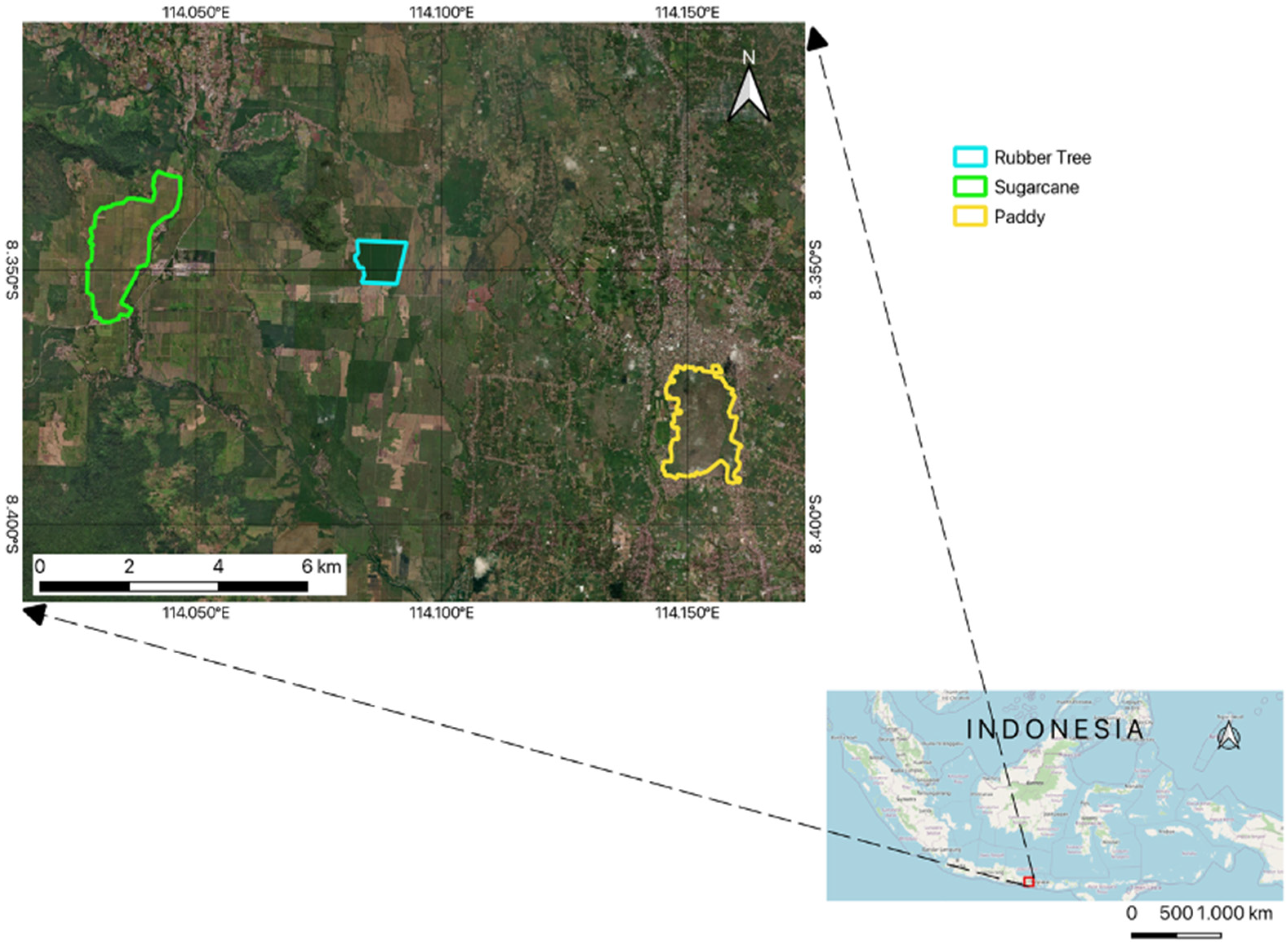
The study area (Figure 1) is in Banyuwangi Regency, located at the easternmost tip of Java Island, Indonesia, bordered by the Indian Ocean to the south and the Bali Strait to the east [30,31]. Geographically, it lies between 7°43′–8°46′ S and 113°53′–114°38′ E. The region features diverse topography, including coastal areas, lowland plains, hilly terrain, and mountainous zones, which together form a unique landscape and high ecological diversity [30,31].
Geomorphological studies have identified at least 15 distinct landforms in Banyuwangi, ranging from low-lying coastal plains vulnerable to tsunami hazards to hilly and mountainous areas susceptible to landslides [30]. Coastal zones are dominated by alluvial deposits, while the western part of the regency is composed of conglomerate and breccia formations, resulting in heterogeneous aquifer systems and hydrological conditions [31]. This geomorphological variability strongly influences land use, disaster risk, water resources, and tourism potential across the region.
Land use in Banyuwangi includes primary and secondary forests, plantation forests, mangroves, croplands, paddy fields, plantations, settlements, shrubs, water bodies, fishponds, and barren lands [32]. In recent decades, land use has shifted significantly, with declines in secondary forests, mangroves, and rice fields, accompanied by expansions of settlements, shrubs, and aquaculture ponds [32]. Agricultural land is increasingly under pressure from rapid development, particularly conversion to settlements, industrial warehousing, and trade services in areas with high accessibility and proximity to water sources [33]. The eastern coastal zone exemplifies this land use diversity, consisting of mangroves, croplands, mixed farming systems, settlements, and aquaculture ponds [34]. These dynamics, combined with pronounced seasonal rainfall variability, make Banyuwangi a representative case of tropical heterogeneous landscapes. Such conditions underscore the importance of developing near-real-time water stress monitoring systems using remote sensing data, as proposed in this study [35].

2.2. Data Collection and Methodology

2.2.1. Data Preparation

Table 1 and Table 2 summarize the remote sensing datasets utilized in this study, including both radar (Sentinel-1) and optical (Sentinel-2) imagery. The combination of these datasets enabled the synergistic extraction of structural and moisture-related indices essential for multi-sensor water stress monitoring across the study area.

2.2.2. Sentinel-1 Preprocessing

a. 
Thermal noise removal
Thermal noise removal is crucial in various imaging and sensing applications, such as synthetic aperture radar (SAR) and thermal infrared imagery, to improve data quality and measurement accuracy [36]. It significantly reduces residual noise, especially in cross-polarization channels. Removing thermal noise from channel intensities and correcting complex data improves the estimation of key parameters for different land cover types [37].
Thermal noise removal in Sentinel-1 SAR data is typically performed by subtracting a noise estimate from the measured backscatter intensity. The general equation for thermal noise removal is as follows:
σ 0 c o r r e c t e d = σ 0 m e a s u r e d σ 0 n o i s e
where σ 0 c o r r e c t e d is the observed backscatter (sigma nought), and σ 0 n o i s e is the estimated thermal noise equivalent sigma nought (NESZ) provided in the Sentinel-1 product annotations [36,37].
b. 
Radiometric calibration
Radiometric calibration is the process of converting the digital number (DN) output from a sensor into a physical quantity such as reflectance or radiance, ensuring that remote sensing data are quantitatively accurate and comparable across different conditions and sensors [38,39]. It is essential for applications such as vegetation monitoring, land cover mapping, and quantitative remote sensing analysis [39,40]. The general radiometric calibration equation is often expressed as follows:
R e f l e c t a n c e   ( o r   R a d i a n c e ) = a × D N + b
where a is the calibration coefficient (slope), and b is the offset (intercept), both determined through calibration procedures using known reference targets or sources [39,41].
c. 
Temporal smoothing
Temporal smoothing, also known as time-series filtering, is used to reduce noise and fluctuations in time-series data by averaging or filtering values across time. A common and simple temporal smoothing equation is the moving average, given by
y t = 1 N   i = 0 N 1 x t i
where y t is the smoothed value at time t , x t i are the original data points, and N is the window size. More advanced methods, such as those based on diffusion equations, use the following:
u t = D 2 u 2 t
where u is the signal, t is time, x is the spatial or temporal index, and D is the diffusion coefficient; this can be extended to time-fractional diffusion for more flexible smoothing [42].
Other approaches include Bayesian smoothing, which uses recursive equations to estimate the smoothed state of a system over time, and time-causal scale-space representations, which apply kernels (such as the Gaussian or time-causal limit kernel) to ensure that smoothing is both causal and multi-scale [43,44].
d. 
Geometric terrain correction
Geometric terrain correction is a process used to correct distortions in remote sensing images (such as SAR or optical imagery) caused by variations in terrain elevation, ensuring that each pixel is accurately geolocated on the Earth’s surface. The correction uses a digital elevation model (DEM) to reconstruct the imaging geometry and map image coordinates to ground coordinates, typically through a transformation equation that relates the sensor’s line-of-sight, the DEM elevation, and the geodetic position [45]. The general form of the geometric terrain correction equation is as follows:
( X , Y ) = f ( s e n s o r   p a r a m e t e r s ,   D E M ,   i m a g i n g   g e o m e t r y )
where ( X , Y ) are the corrected ground coordinates, and the function f incorporates the sensor’s position, viewing angle, and the elevation from the DEM to account for terrain-induced shifts [45]. This process often involves rigorous geometric modelling, such as range-Doppler equations for SAR or collinearity equations for optical sensors, to ensure accurate geocoding. The corrected images are essential for quantitative analysis, such as land cover classification or biophysical parameter retrieval, as they preserve the spatial integrity of the data [45]. The accuracy of geometric terrain correction depends on the quality and resolution of the DEM used in the process.

2.2.3. Sentinel-2 Preprocessing

a. 
Atmospheric correction
Atmospheric correction for Sentinel-2 involves removing the effects of atmospheric gases, aerosols, and water vapor from satellite measurements to retrieve accurate surface reflectance (Bottom-Of-Atmosphere, BOA) values. A widely used approach is the Empirical Line Model (ELM), which applies a linear regression between ground reflectance and at-sensor radiance for selected targets, resulting in the following equation:
R e f l e c t a n c e = a × R a d i a n c e + b
where a and b are calibration coefficients derived from ground reference targets [46]. This method is implemented in several processors, such as Sen2Cor, which converts Top-Of-Atmosphere (TOA) reflectance (Level-1C) to BOA reflectance (Level-2A) using radiative transfer models and auxiliary data on atmospheric conditions [47,48].
b. 
Cloud and cloud-shadow masking
Cloud and cloud-shadow masking in Sentinel-2 imagery is essential for ensuring the quality of remote sensing data, and several algorithms and equations are used for this purpose. Deep learning models, such as CloudS2Mask, use neural networks trained on large labelled datasets to classify each pixel as clear, cloud, or cloud shadow, leveraging both spectral and contextual information for improved performance [49].
S2cloudless is a machine learning-based algorithm specifically designed for cloud and cloud-shadow masking in Sentinel-2 imagery. It uses a gradient boosting classifier trained on labelled Sentinel-2 data to predict the probability that each pixel is covered by cloud, based on spectral features from the visible and near-infrared bands. The core equation for S2cloudless is as follows:
P ( c l o u d ) = f ( B 1 ,   B 2 ,   ,   B 12 )
where P ( c l o u d ) is the predicted probability of cloud presence, f is the trained machine learning model, and B 1 B 12 are the reflectance values from Sentinel-2’s spectral bands. A pixel is classified as cloud if P(cloud) exceeds a user-defined threshold (commonly 0.5), resulting in a binary cloud mask. S2cloudless does not natively detect cloud shadows, but its output can be combined with geometric and radiometric rules to estimate cloud-shadow locations [50].
c. 
Band resampling
Band resampling is the process of transforming data from one set of spectral bands or sampling intervals to another, commonly used in remote sensing to match the spectral resolution of different sensors or to reduce data dimensionality. A typical approach involves applying a filter or interpolation function to the original band data, often represented by the following equation:
R _ r e s a m p l e d ( λ ) = w _ i ( λ ) × R _ o r i g i n a l ( λ _ i )
where R _ r e s a m p l e d ( λ ) is the reflectance at the resampled wavelength, R _ o r i g i n a l ( λ _ i ) are the original reflectance values at wavelengths λ _ i , and w _ i ( λ ) are the weights (often derived from the sensor’s spectral response function or a user-defined filter) that determine the contribution of each original band to the resampled value [51].

2.2.4. Index Calculation

a. 
DpRVI
The Dual Polarimetric Radar Vegetation Index (DpRVI) is a synthetic aperture radar (SAR)-based vegetation index designed for dual-polarization data. DpRVI is calculated using the degree of polarization and eigenvalue analysis of the dual-polarimetric SAR covariance matrix, providing a robust, cloud-independent vegetation index for crop and land cover monitoring.
The standard equation for DpRVI is as follows:
D p R V I = 1 m × β
where
  • m = Degree of polarization;
  • β = Measure of scattering dominance (ratio of the largest eigenvalue to the total power [52].
b. 
VV/VH Ratio
The VV/VH ratio, derived from Sentinel-1 Synthetic Aperture Radar (SAR) data, is a widely used metric for monitoring vegetation, crop phenology, and land cover. It leverages the different sensitivities of VV (vertical transmit/vertical receive) and VH (vertical transmit/horizontal receive) polarizations to vegetation structure and moisture. The VV/VH ratio is calculated as follows:
V V / V H = σ 0 _ V V / σ 0 _ V H
where σ 0 _ V V NI and σ 0 _ V H are the backscatter coefficients (in linear scale, not dB) for VV and VH polarizations, respectively [53,54].
c. 
NDMI
The Normalized Difference Moisture Index (NDMI) is a remote sensing index used to assess vegetation water content and moisture conditions. The standard equation for NDMI is as follows:
N D M I = ( N I R S W I R ) / ( N I R + S W I R )
where NIR is the reflectance in the near-infrared band, and SWIR is the reflectance in the shortwave infrared band [55,56]. NDMI is sensitive to changes in leaf and canopy water content, making it useful for monitoring drought, crop health, forest conditions, and fuel moisture for wildfire risk [56,57]. Higher NDMI values generally indicate greater vegetation moisture, while lower values suggest drier conditions or water stress. NDMI is closely related to other indices like NDVI and NBR, and is often used in combination with them for improved vegetation and moisture monitoring [58,59].
d. 
RDI ratio drought index
For Sentinel-2 data, the Ratio Drought Index (RDI) is a soil moisture and drought index specifically designed to use the near-infrared (NIR) and red bands, which are available on Sentinel-2. The RDI equation is as follows:
R D I = ( N I R R e d ) / ( N I R + R e d )
where NIR is the reflectance from the Sentinel-2 NIR band (typically Band 8), and Red is the reflectance from the Sentinel-2 red band (typically Band 4) [60]. This index is constructed by analyzing the spectral properties of soil and vegetation at different water levels in the NIR-red feature space, making it suitable for drought monitoring in areas with varying vegetation cover.
e. 
NDWI
The Normalized Difference Water Index (NDWI) is a remote sensing index designed to estimate vegetation liquid water content or to map surface water features. The classic NDWI equation is as follows:
N D W I = ( N I R S W I R ) / ( N I R + S W I R )
where NIR is the reflectance in the near-infrared band (typically around 0.86 μm), and SWIR is the reflectance in the shortwave infrared band (typically around 1.24 μm) [61,62]. NDWI is sensitive to changes in vegetation water content because water absorption is stronger in the SWIR region, while the NIR region is less affected by water content. This index is less sensitive to atmospheric effects than NDVI and is widely used for monitoring vegetation water status, mapping water bodies, and supporting agricultural and environmental applications [61,62].

2.3. Flowchart

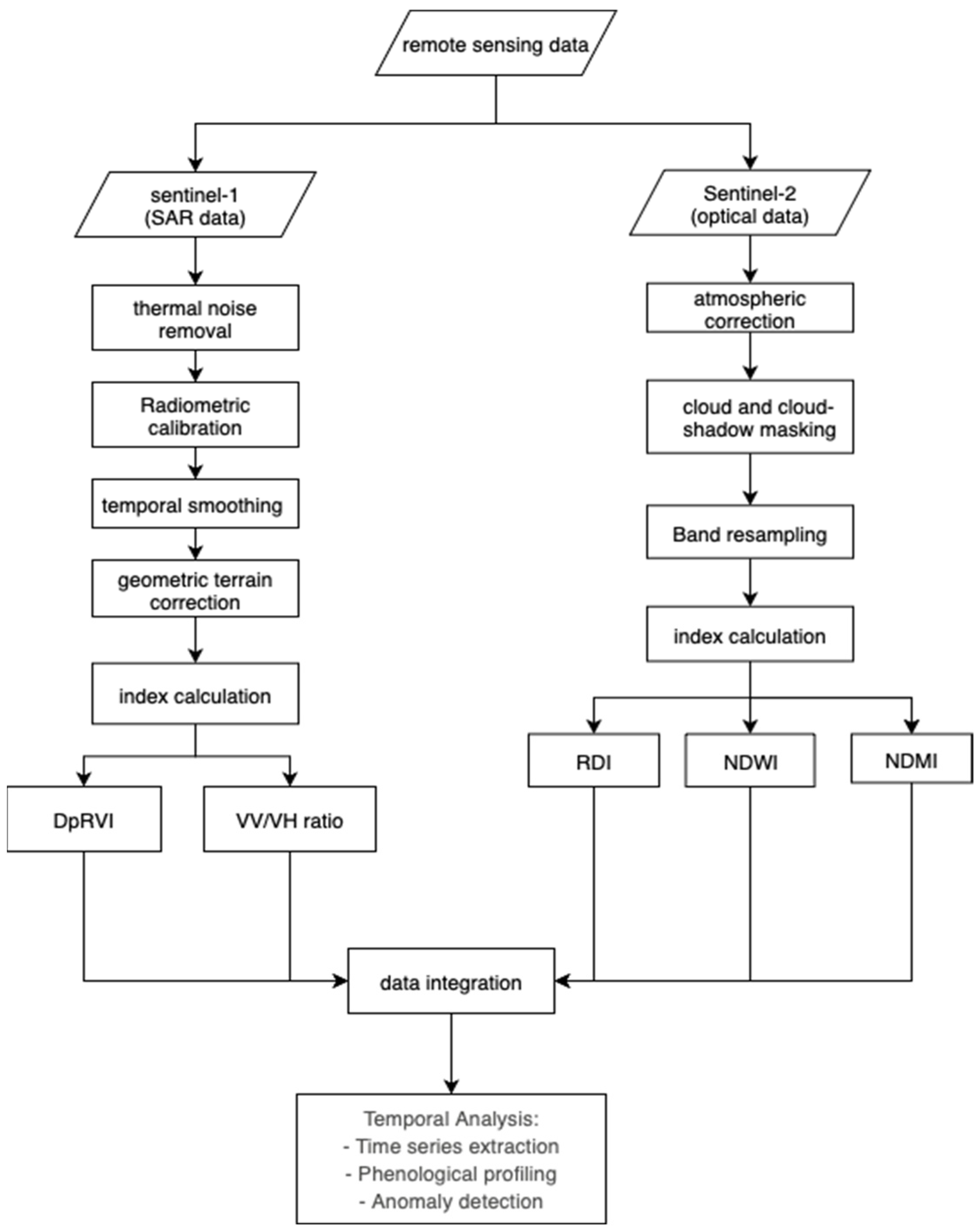
Figure 2 illustrates the overall workflow of the proposed multi-sensor water stress monitoring framework. The flowchart outlines the sequential processes, including data acquisition, preprocessing, index computation, multi-sensor integration, and temporal analysis, implemented within the Google Earth Engine (GEE) environment.
Each index was selected based on its specific sensitivity to either canopy water content or structural changes that occur during the phenological development of rice, sugarcane, and rubber. NDWI and NDMI provide direct optical measurements of leaf and canopy moisture, whereas RDI emphasizes short-term variations in surface wetness that respond rapidly to rainfall and drying events. In contrast, VV/VH and DpRVI capture radar backscatter changes associated with crop architecture, plant density, and canopy roughness, allowing observations to continue during periods of cloud cover when optical data are limited. These complementary sensitivities motivated the use of all five indices to ensure that both moisture-driven and structure-driven components of water stress were represented in the analysis. Methodologically, the novelty of this study lies in the synergistic integration of these specific optical and SAR indices to construct a robust time-series analysis in a cloud-prone tropical environment. This framework moves beyond single-sensor limitations, enabling the cross-examination of moisture and structural signals to distinguish between hydrological drying, phenology-driven changes, and crop-specific stress responses in near real time.

3. Results

3.1. VV/VH Ratio

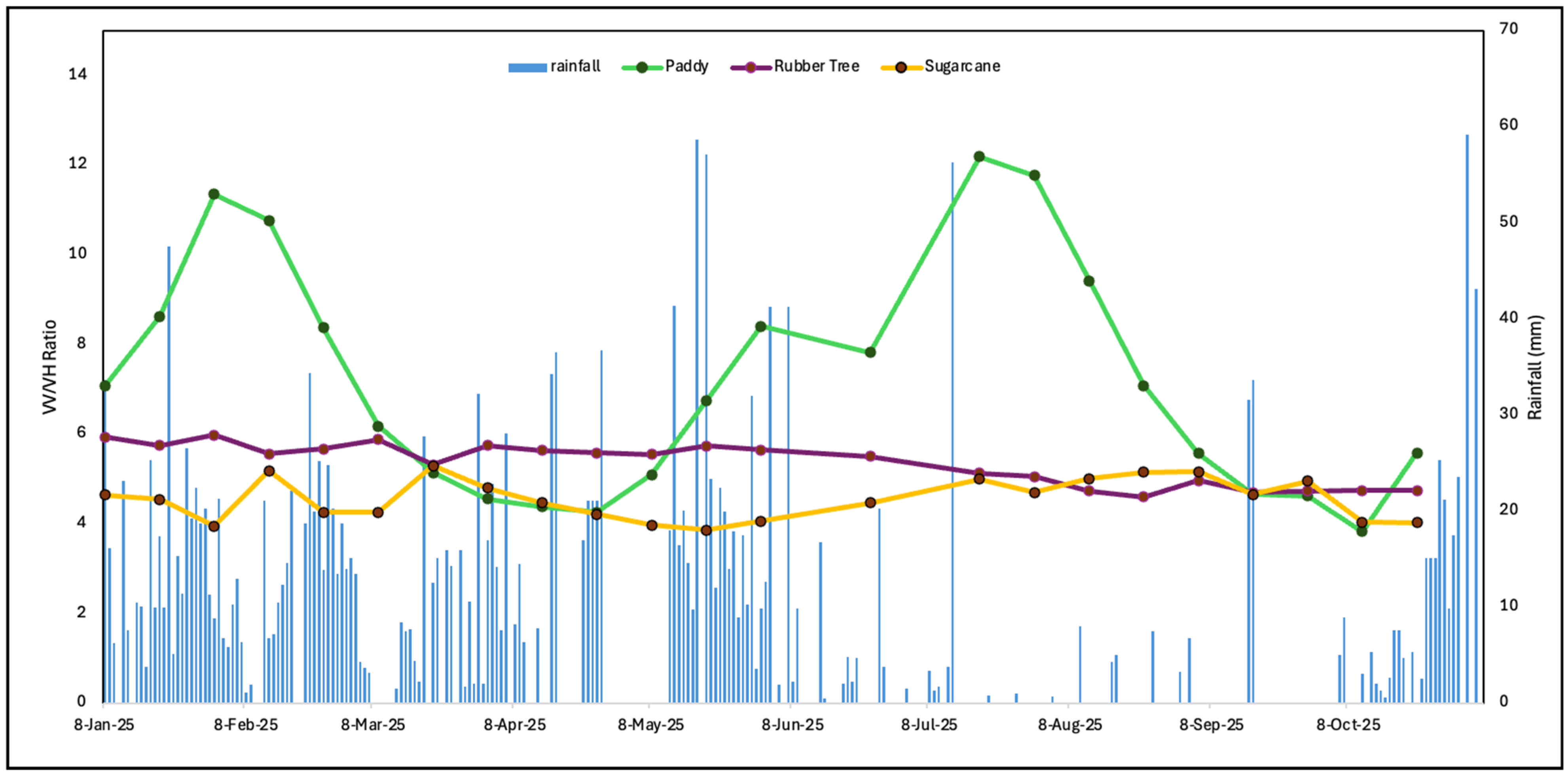
The VV/VH ratio demonstrates high sensitivity to both the structural characteristics of vegetation and the presence of surface water, making it an effective indicator for capturing phenological variations among different crop types. As illustrated in Figure 3, the ratio reveals distinct temporal patterns that correspond to the biophysical and hydrological properties of each vegetation class: annual (rice), semi-perennial (sugarcane), and perennial (rubber trees).
In rice fields (Figure 3 green line), the temporal pattern of the VV/VH ratio exhibits a clear cyclic trend that is tightly coupled with the local precipitation regime. In the early vegetative phase (early January to early February), the VV/VH ratio increases sharply from around 7.5 to a peak of approximately 12.3. This peak coincides with the highest rainfall intensity observed during the wet season (blue bars in Figure 3), which facilitates the necessary land preparation and field inundation. The high VV/VH values confirm that the radar signal is dominated by double-bounce scattering from the interaction between the vertical rice stems and the underlying water surface [63,64]. Subsequently, as rainfall intensity fluctuates but generally persists through February and March, the ratio declines drastically to around 4.2–4.5. This inverse trend, where VV/VH drops despite the presence of rain, indicates that the vigorous vegetative growth and canopy closure have begun to mask the water surface, shifting the dominant backscatter mechanism to volume scattering (VH).
During the generative to maturation phase (April to June), the ratio stabilizes at lower values. However, from late June onward, the ratio increases markedly to approximately 12.1. Notably, this resurgence occurs during a period of significantly reduced rainfall (dry season), as shown by the minimal precipitation bars in Figure 3. This confirms that the rise in VV/VH is driven by field drainage/drying prior to harvest and plant senescence, rather than rainfall accumulation. Collectively, the synchronization between the rainfall data and the VV/VH profile validates the index’s capability to distinguish between hydrological flooding (planting phase) and phenological drying (harvest phase).
For sugarcane (Figure 3, yellow line), the VV/VH ratio exhibits a stable trend with a gradual upward progression, reaching about 4.8–5.0 by mid-July. Unlike rice, the sugarcane signal shows remarkable stability against the high volatility of rainfall events observed in January and February. This suggests that the dense, vertically structured canopy of sugarcane effectively attenuates surface moisture signals, making the VV/VH ratio a robust indicator of biomass accumulation regardless of weather conditions. The observed gradual increase reflects progressive stem elongation and canopy densification, confirming the sensor’s all-weather monitoring capability.
Similarly, rubber trees (Figure 3 purple line) display the highest temporal stability, maintaining values between 5.5 and 6.0. Despite the intense rainfall events recorded at the beginning of the year, the VV/VH ratio for rubber remained essentially flat. This lack of correlation with precipitation spikes indicates that the signal is saturated by volume scattering from the persistent, multi-layered canopy of the perennial trees, and is minimally affected by soil moisture changes. This consistency highlights the suitability of the VV/VH ratio as a reliable baseline indicator for canopy stability in perennial vegetation systems.

3.2. DpRVI

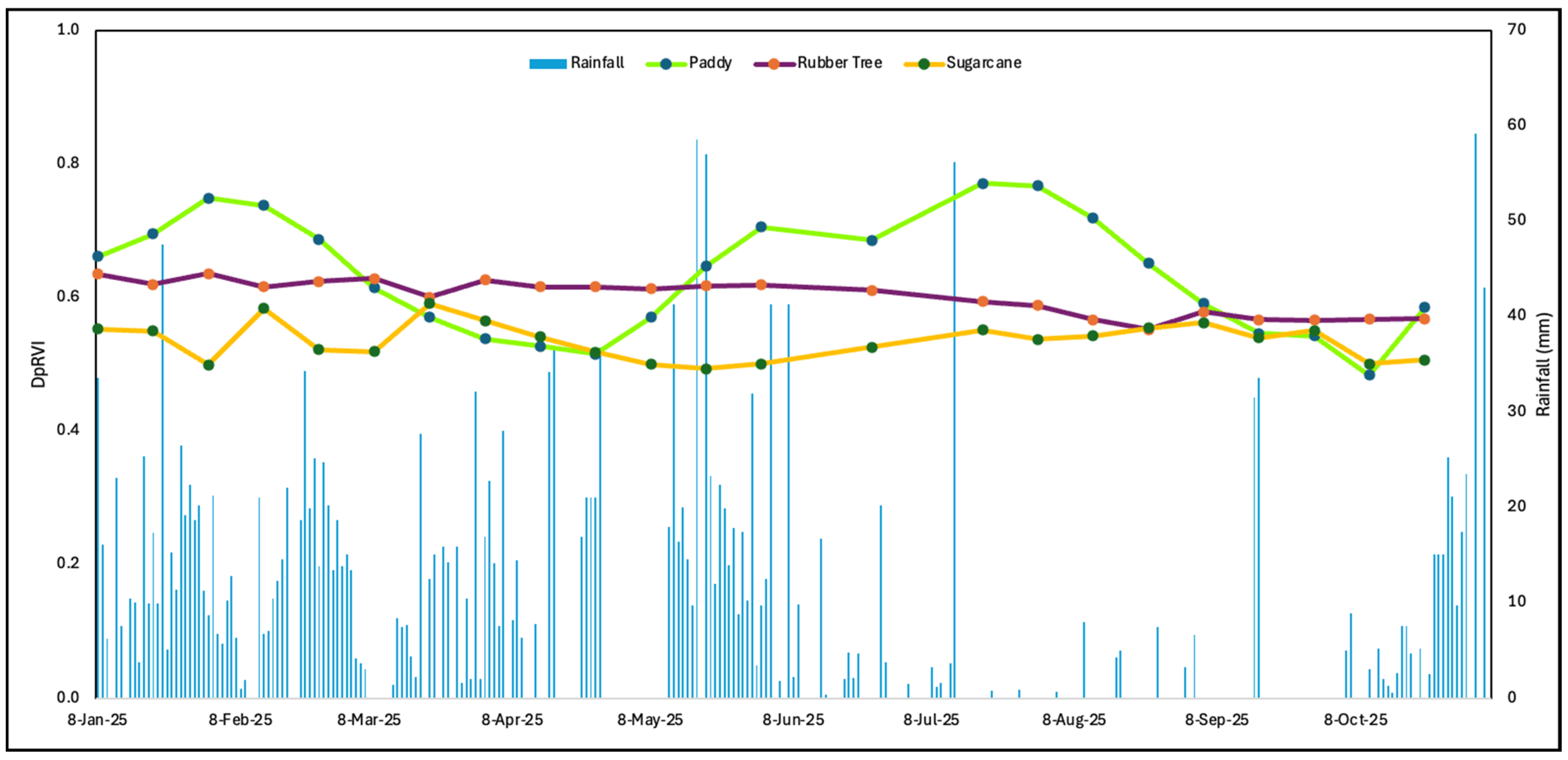
The Dual-polarimetric Radar Vegetation Index (DpRVI) effectively differentiates the temporal dynamics of rice, sugarcane, and rubber trees by capturing distinct variations in their canopy structure and biomass. As shown in Figure 4, where DpRVI is overlaid with CHIRPS-derived daily rainfall, the analysis reveals unique phenological signatures that respond differently to hydrological inputs.
Paddy (green line) exhibits the most dynamic profile, consistent with its rapid life cycle and interaction with surface water. Its DpRVI value increases to a peak of approximately 0.75 in late January. Notably, this peak occurs during the period of highest rainfall intensity (blue bars), indicating that the dense, random canopy of the tillering stage effectively maximizes volume scattering even in the presence of background moisture [65,66]. This is followed by a sharp decline to approximately 0.51 by late April as the crop enters the reproductive phase, where the emergence of organized vertical stems reduces randomness. Subsequently, the index gradually rises again, reflecting the increasing structural heterogeneity from panicle development during maturation [67,68].
Sugarcane (yellow line) presents an intermediate and more gradual trajectory, demonstrating resilience to weather fluctuations. Its DpRVI values show a steady increase from a low of approximately 0.49 in May to 0.55 by July. This trend is strongly correlated with continuous biomass accumulation and is notably independent of the rainfall variability observed in the earlier months [69,70]. This suggests that as the cane elongates and canopy density increases, the signal becomes dominated by vegetation structure rather than soil moisture variations [71].
Rubber trees (purple line) serve as a stable baseline throughout the observation period. Their DpRVI values remain consistently high, fluctuating only within a narrow range of 0.59 to 0.63. This stability is characteristic of a mature, perennial canopy that undergoes minimal seasonal structural variation. Crucially, the flat trend line persists even during heavy rainfall events in January and February, confirming that the C-band signal is saturated by the dense canopy and does not penetrate to the wet soil floor [72] (Santos et al., 2024). This highlights the utility of DpRVI as a robust metric for monitoring perennial vegetation health irrespective of short-term meteorological noise.

3.3. NDWI

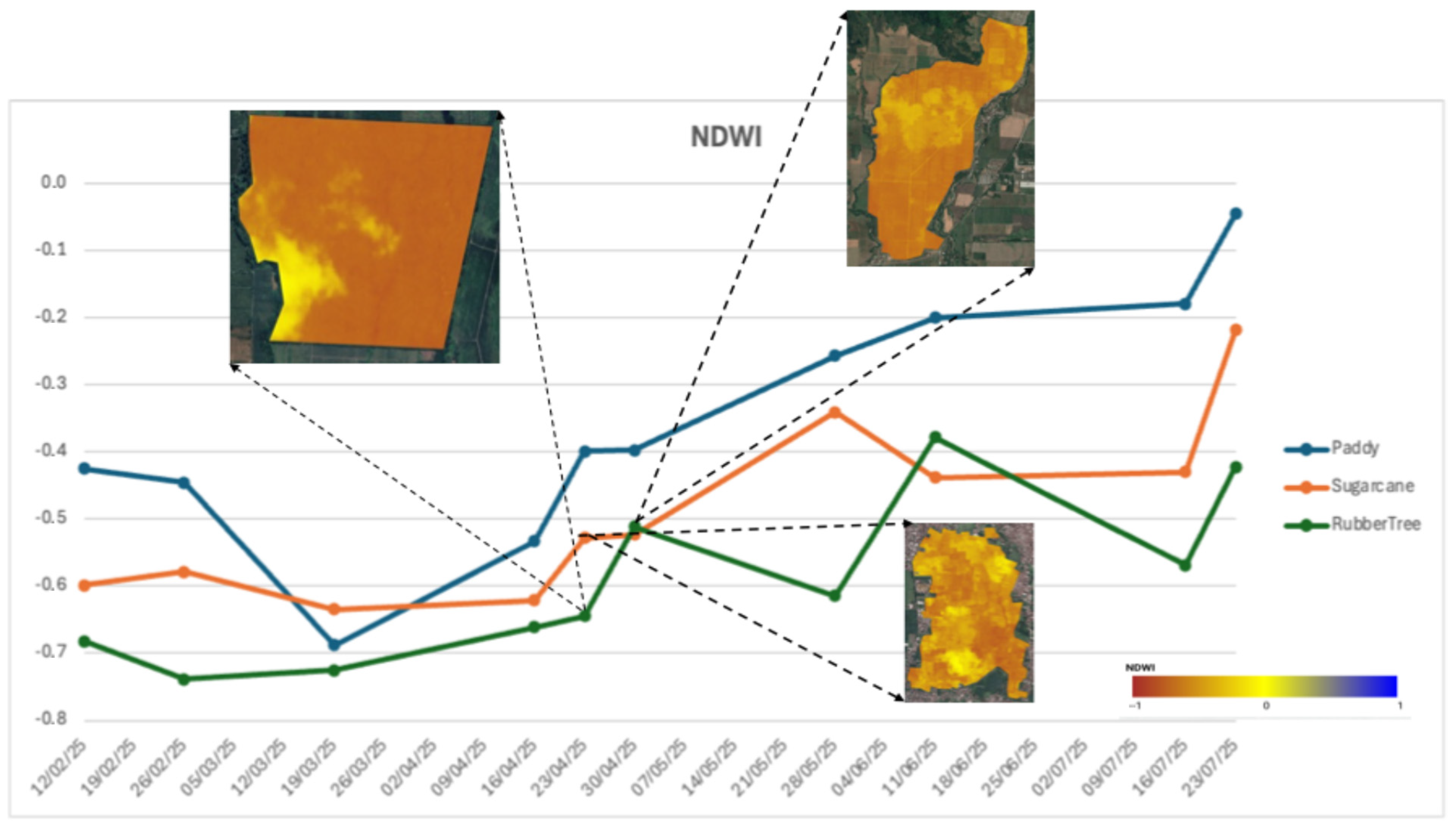
The temporal dynamics of the Normalized Difference Water Index (NDWI), an indicator highly sensitive to liquid water content within the plant canopy, reveal distinct hydrological signatures for rice, sugarcane, and rubber trees. The analysis effectively differentiates the water-use patterns associated with the agronomic calendar of a flooded seasonal crop (paddy), the gradual development of a plantation crop (sugarcane), and the relative stability of permanent tree cover (rubber). According to Figure 5, Paddy displays a pronounced cyclical pattern, sugarcane shows a monotonic increase corresponding to biomass accumulation, and rubber trees provide a stable baseline punctuated by seasonal fluctuations.
Paddy exhibits the most dynamic profile, directly reflecting its cultivation cycle in flooded conditions. The series begins with a relatively high NDWI value of approximately −0.4, likely influenced by the initial inundation of the field. This is followed by a significant decline to its lowest point (−0.7) by late March, as the influence of the soil signal becomes dominant before full canopy closure is achieved. Subsequently, the index shows a strong and consistent increase throughout the vegetative growth phase from April to July, indicating rapid canopy development and high water storage in the foliage and stems as the crop approaches its generative phase.
Sugarcane demonstrates a clear and more gradual growth trend. Its NDWI value begins at approximately −0.6 and remains relatively stable until mid-April, corresponding to a slow initial establishment phase. From late April onwards, the index increases steadily and significantly. This upward trend strongly correlates with the stem elongation, or grand growth, period, during which the crop accumulates substantial biomass and canopy water content. This pattern reflects a continuous increase in hydration status throughout the season.
Rubber trees serve as a stable baseline, representing the response of permanent vegetation. In contrast to the annual crops, its NDWI values are consistently the lowest, a characteristic attributable to the influence of woody structural components on the spectral signal. The profile is marked by high temporal stability, with the exception of a sharp decline in late May followed by a rapid recovery in early June. This transient event likely signifies a response to short-term water stress or a distinct phenological phase, such as partial defoliation, rather than a change in overall.

3.4. NDMI

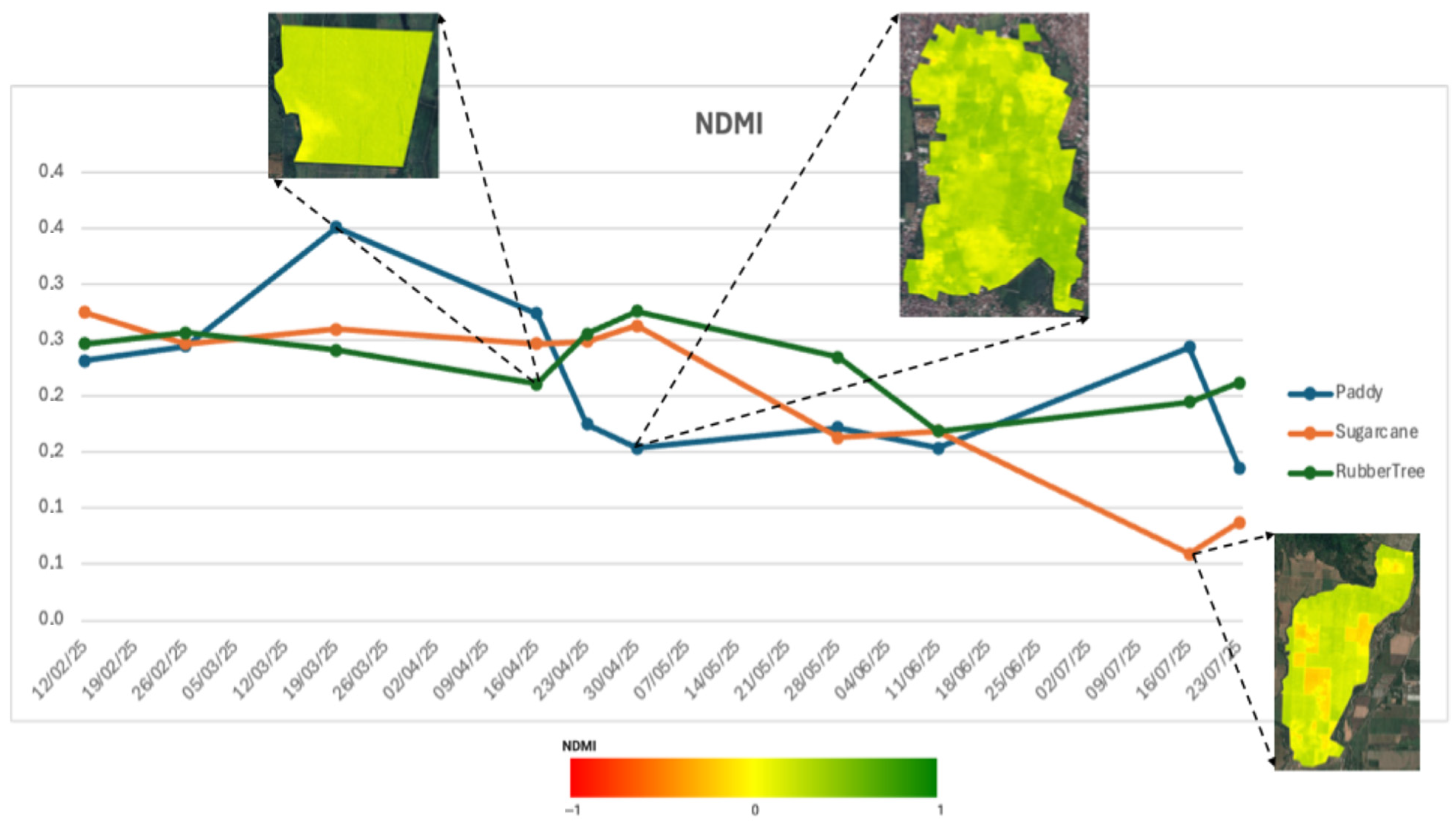
The Normalized Difference Moisture Index (NDMI), which is sensitive to water content within the plant canopy structure, effectively captures the distinct internal moisture dynamics of rice, sugarcane, and rubber trees. Figure 6 reveals that each crop type possesses a unique temporal signature corresponding to its specific phenological development. Paddy exhibits a pronounced rise-and-fall pattern tied to its vegetative and reproductive phases. In contrast, sugarcane is uniquely characterized by a gradual, monotonic decline, indicating its ripening process. Rubber trees provide a stable baseline, reflecting the consistent moisture content of perennial vegetation.
Paddy displays a highly dynamic profile that directly mirrors its phenological stages. The NDMI value increases sharply to a peak in mid-March, which aligns with the maximum vegetative growth phase when leaf biomass and canopy water content are at their highest. This is followed by a drastic decline as the plant transitions to the reproductive phase, diverting water and energy resources to grain filling, which reduces overall leaf moisture. The index remains low during maturation until a final sharp drop signifies the plant’s natural senescence and drying process prior to harvest.
Sugarcane is distinguished by a slow but consistent downward trend throughout the season. While its initial NDMI value is comparable to the other crops, it declines steadily from April to July. This signature is characteristic of sugarcane maturation, where an increase in sucrose (sugar) concentration within the stalks proportionally reduces the plant’s overall water content. This inverse relationship makes the declining NDMI trend a reliable indicator of the ripening process.
Rubber trees, as expected from permanent vegetation, exhibit the most stable pattern. Their NDMI values fluctuate within a narrow range of approximately 0.2 to 0.3 throughout the observation period. This stability reflects a mature canopy structure with a consistent water content that does not undergo the significant phenological shifts seen in annual crops. Minor fluctuations observed are likely responses to environmental variables such as seasonal rainfall, reinforcing its role as a stable baseline.

3.5. RDI

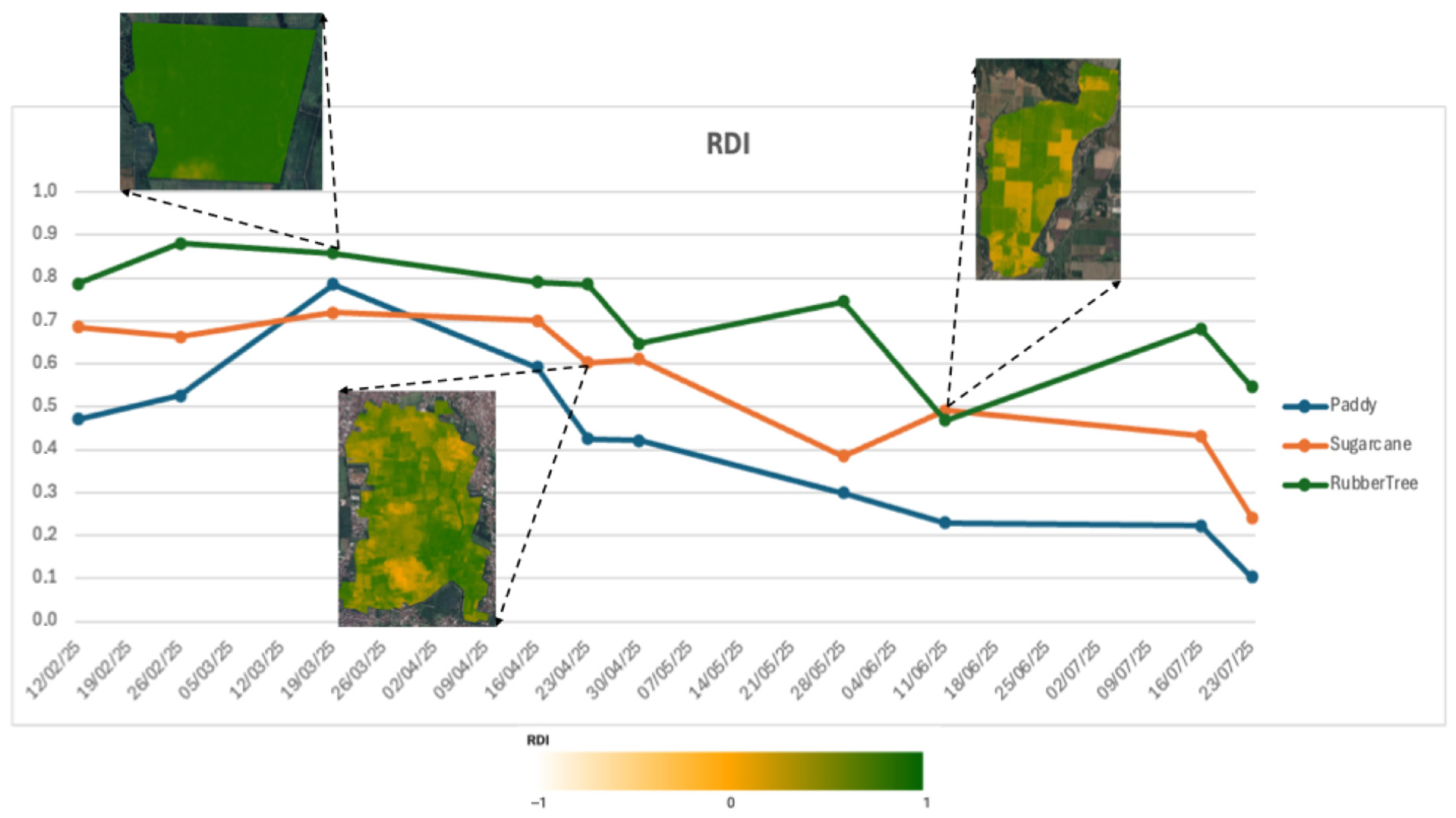
The Ratio Drought Index (RDI), a metric sensitive to moisture availability and vegetation water stress, effectively differentiates the hydrological cycles of rice, sugarcane, and rubber trees. Figure 7 depicts three distinct signatures corresponding to the unique water management and physiological characteristics of each land cover type. Paddy exhibits a highly dynamic, cyclical pattern directly governed by its flood-irrigation schedule. Sugarcane is uniquely characterized by a gradual, monotonic decline, indicating a physiological drying process linked to maturation. In contrast, rubber trees provide a stable, high-value baseline, representing a non-stressed, mature ecosystem.
Paddy demonstrates a profile intricately linked to its water-intensive cultivation cycle. The RDI begins high, reflecting the initial flooded or waterlogged conditions of the field. This is followed by a sharp decline as the crop canopy develops, altering the surface-moisture signature. The index then rises again during the peak vegetative stage, when the dense canopy holds substantial moisture. The cycle concludes with a dramatic plummet in the final phase, a direct result of field drainage and plant senescence (drying out) in preparation for harvest.
Sugarcane is distinguished by a prolonged and gradual decline in its RDI value throughout the maturation period. This signature is a direct indicator of the ripening process, reflecting a key physiological change within the plant. As the crop matures, it accumulates high concentrations of sucrose (sugar) within its stalks, which proportionally reduces the plant’s overall water content. This physiological drying makes the declining RDI trend a robust marker for sugarcane maturation.
Rubber trees serve as a stable baseline, maintaining consistently high RDI values throughout the observation period. This indicates sufficient and stable moisture availability, characteristic of a mature, perennial ecosystem with a well-developed root system and canopy that regulates the local microclimate. The minor fluctuations observed are likely responses to short-term variations in seasonal rainfall, reinforcing its role as a benchmark for non-stressed vegetation.

3.6. Cross-Index and Cross-Crop Comparative Analysis

3.6.1. Temporal Dynamics of DpRVI and NDMI in Paddy Fields

This analysis identifies how DpRVI and NDMI respond to changes in soil moisture, inundation, and plant physiological conditions. DpRVI, derived from C-band dual-polarization radar data, quantifies the structural complexity and total aboveground biomass of vegetation, capturing variations in canopy geometry and density. In contrast, NDMI, derived from optical bands sensitive to shortwave infrared and near-infrared reflectance, primarily indicates vegetation water content and surface moisture conditions. Together, these indices provide complementary insights: DpRVI reflects vegetation structure and biomass accumulation, while NDMI captures variations in canopy moisture and inundation.
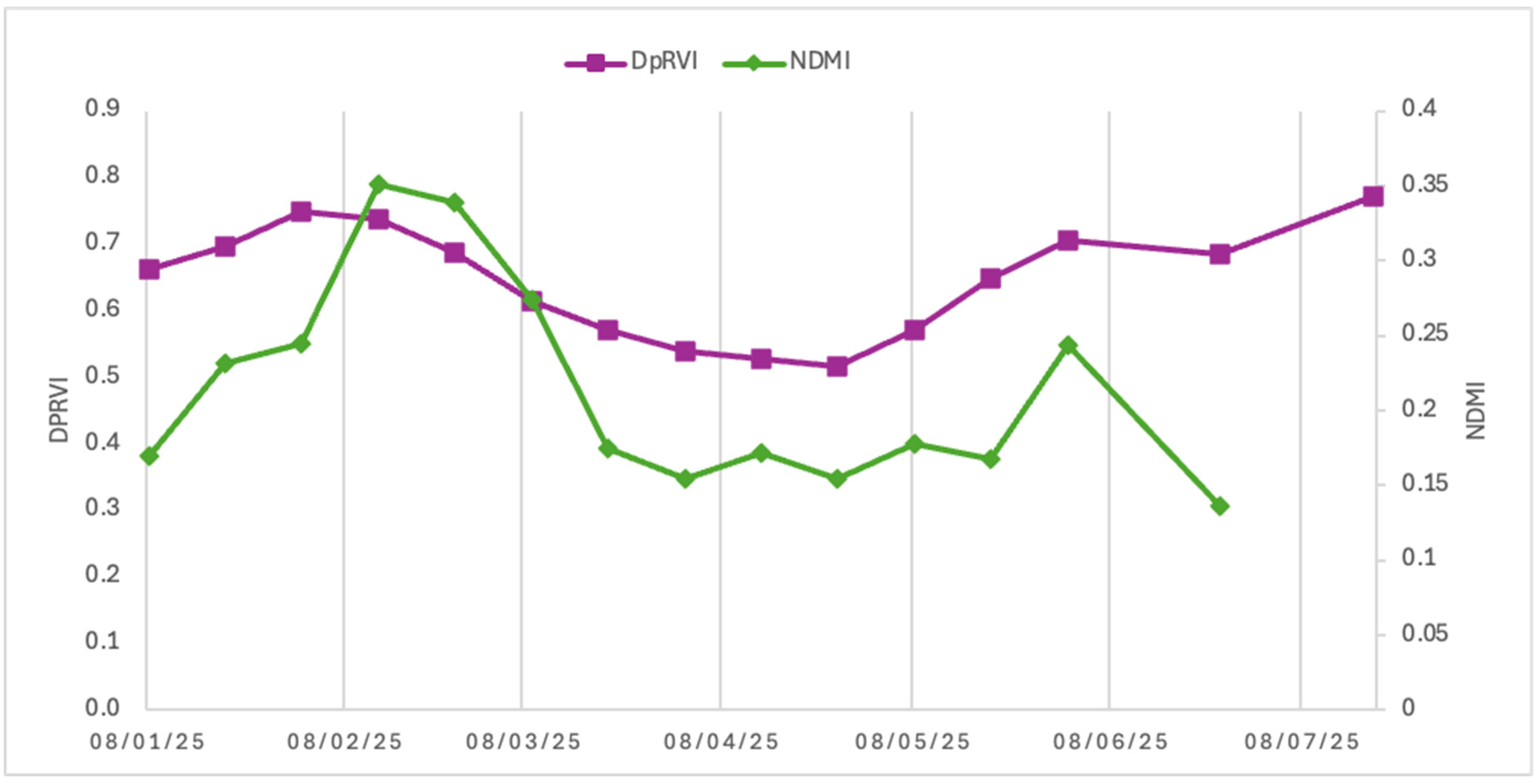
It can be seen from Figure 8 that observations commenced in early January (8 January), corresponding to the land preparation or fallow phase. At this stage, NDMI exhibited a low initial value (≈0.17), signifying dry soil conditions with minimal surface moisture.
By early February (8 February), NDMI sharply increased to its seasonal peak (≈0.36), corresponding to the flooding or inundation phase during field preparation for rice transplanting. This pronounced increase reflects the substantial rise in surface water content. Concurrently, DpRVI showed a modest increase (to ≈0.75), likely attributable to enhanced radar backscatter from the transition between dry soil and water surfaces.
The transplanting phase was estimated to occur in early March (8 March). During this period, the two indices exhibited contrasting behaviors. NDMI remained elevated (≈0.33), consistent with sustained inundation, whereas DpRVI dropped markedly to ≈0.61. This decline reflects the typical radar response during early vegetative growth, when young rice seedlings possess low structural biomass, and the radar signal is dominated by smooth water surfaces producing specular reflection, thus reducing backscatter intensity.
From April (8 April) to June (8 June), the crop entered the active vegetative and early reproductive phases. DpRVI exhibited a steady and continuous increase from ≈0.51 in April to ≈0.70 in June, indicating progressive biomass accumulation through tillering, stem elongation, and canopy closure. Conversely, NDMI decreased and stabilized at relatively low values (≈0.15–0.18), suggesting that the optical response was now dominated by the canopy rather than open water, as the flooded conditions subsided and plant transpiration became the primary moisture source. The divergence here illustrates the fusion logic: the crop is growing structurally (Radar UP), but the standing water is receding (Optical DOWN), accurately characterizing the transition from flooded to aerobic soil conditions.
The final phase, encompassing senescence and harvest, occurred between June and July (8 July). This period displayed the most pronounced divergence between the two indices. NDMI dropped sharply to its lowest value (≈0.13), a spectral signature characteristic of senescence, reflecting chlorophyll degradation, leaf desiccation, and field drainage prior to harvest. In contrast, DpRVI reached its maximum (≈0.77), emphasizing that radar backscatter is primarily sensitive to structural biomass rather than chlorophyll or leaf water content. The peak DpRVI values correspond to the culmination of plant structural development, as panicles are fully filled immediately before harvest. This confirms that the NDMI drop was a managed phenological drying event (ripening), not drought stress, as the biomass signal (DpRVI) remained intact until harvest.

3.6.2. VV/VH–RDI Relationship in Paddy Fields

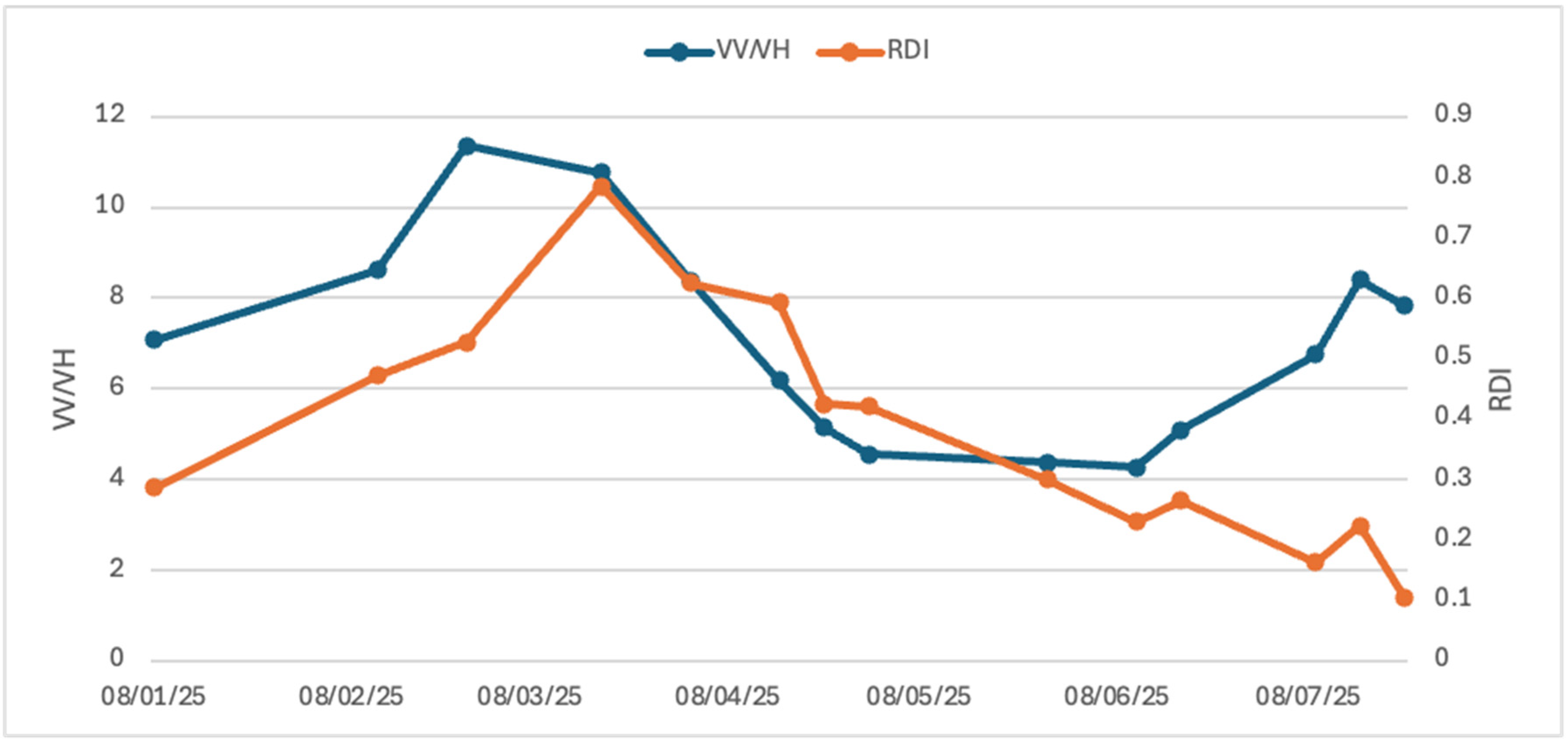
The temporal relationship between the radar backscatter ratio (VV/VH) and the optical Radar Drought Index (RDI) demonstrates a highly complementary behavior, with each index capturing distinct yet interconnected aspects of the paddy growth cycle. RDI, derived from optical spectral bands, serves as a proxy for surface moisture and drought stress, where high values indicate wet conditions (low water stress) and low values signify dry conditions (high water stress). In contrast, the VV/VH ratio, obtained from dual-polarized C-band radar data, primarily represents the physical structure and biomass density of vegetation. Its response is inversely related to vegetation development: high VV/VH values correspond to low biomass or flooded bare soil, whereas low VV/VH values indicate high biomass and complex canopy structures.
As shown in Figure 9, during the land preparation and vegetative growth phases (January–June), the indices exhibit synchronized yet contrasting trends in their physical meaning. At the beginning of the season, both low RDI (≈0.28) and high VV/VH (≈7.0) values reflect dry and bare soil conditions. By February–March, both indices sharply increase; RDI peaks at ≈0.76 and VV/VH at ≈11.4, indicating massive inundation for rice transplanting.
The flooded surface absorbs shortwave infrared radiation, elevating RDI, while smooth water surfaces produce specular reflection, minimizing cross-polarized backscatter (VH) and thus inflating the VV/VH ratio. As the crop progresses through the vegetative and early reproductive stages (March–June), VV/VH declines steadily from 11.4 to ≈4.2, signaling exponential biomass growth and canopy closure that enhance volumetric scattering (VH). Concurrently, RDI decreases from ≈0.76 to ≈0.22 as the field gradually dries, reflecting reduced surface water and a transition to canopy-dominated optical responses.
In the maturation and harvest phase (June–July), the two indices diverge markedly, each capturing different components of the senescence process. RDI continues to decline to ≈0.10, marking the period of maximum drought stress as plants lose chlorophyll, leaf moisture decreases, and irrigation is halted for harvest preparation. Conversely, VV/VH begins to rise again (from ≈4.2 to ≈8.4), reflecting structural degradation of senescing plants and the eventual removal of biomass during harvest.
The reduction in volume scattering (VH) increases the VV/VH ratio toward levels typical of bare or post-harvest conditions. Collectively, these dynamics highlight the complementary diagnostic power of optical and radar indices: RDI effectively traces hydrological conditions and water management practices, while VV/VH robustly tracks structural biomass variations independent of moisture content, together forming a synergistic foundation for near-real-time water stress monitoring in paddy ecosystems.

3.6.3. Detection of True Water Stress: DpRVI and NDMI in Sugarcane

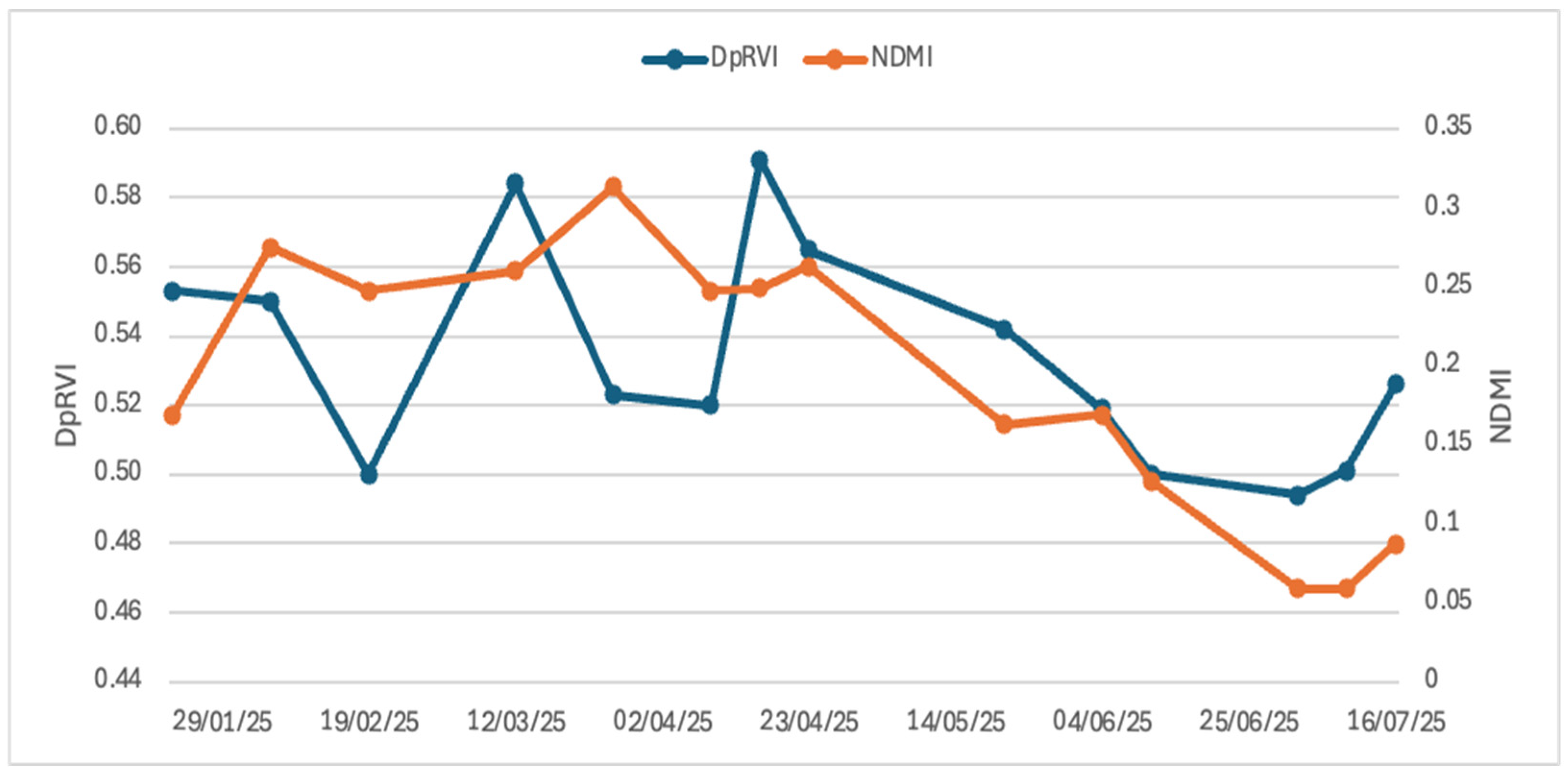
The temporal dynamics of DpRVI (biomass) and NDMI (vegetation water content), such as those shown in Figure 10, were analyzed to evaluate how sugarcane responds to environmental stress and water availability over its extended growth cycle. By comparing radar-based structural indicators (DpRVI) with optical moisture-sensitive indices (NDMI), it is possible to detect periods of inconsistent growth, drought stress, and biomass loss, which are critical for understanding potential yield impacts.
During the initial phase, from January to April, both DpRVI and NDMI exhibited substantial fluctuations. This instability indicates that sugarcane failed to achieve consistent vegetative growth, likely due to highly variable environmental conditions. The temporal pattern reflects irregular biomass accumulation and moisture dynamics, suggesting that the crop was unable to establish a stable canopy structure and maintain adequate hydration during this period.
A critical stage occurred between April and June, corresponding to an extreme drought period. NDMI sharply declined to its minimum (≈0.06 from ≈0.26), signaling severe water stress. Notably, this stress had a destructive effect on biomass: DpRVI dropped concomitantly from ≈0.59 to ≈0.49, indicating structural damage caused by wilting and leaf loss. By the end of the six-month observation period, DpRVI in July (≈0.52) remained almost identical to its initial value in January (≈0.55), demonstrating a failure in net biomass accumulation and severe growth regression that would likely result in substantial yield reduction. The simultaneous decline of both indices confirms a true water stress event. The stress was severe enough to cause physical wilting and structural biomass loss, not just stomatal closure.

3.6.4. VV/VH–NDMI Relationship in Rubber Trees

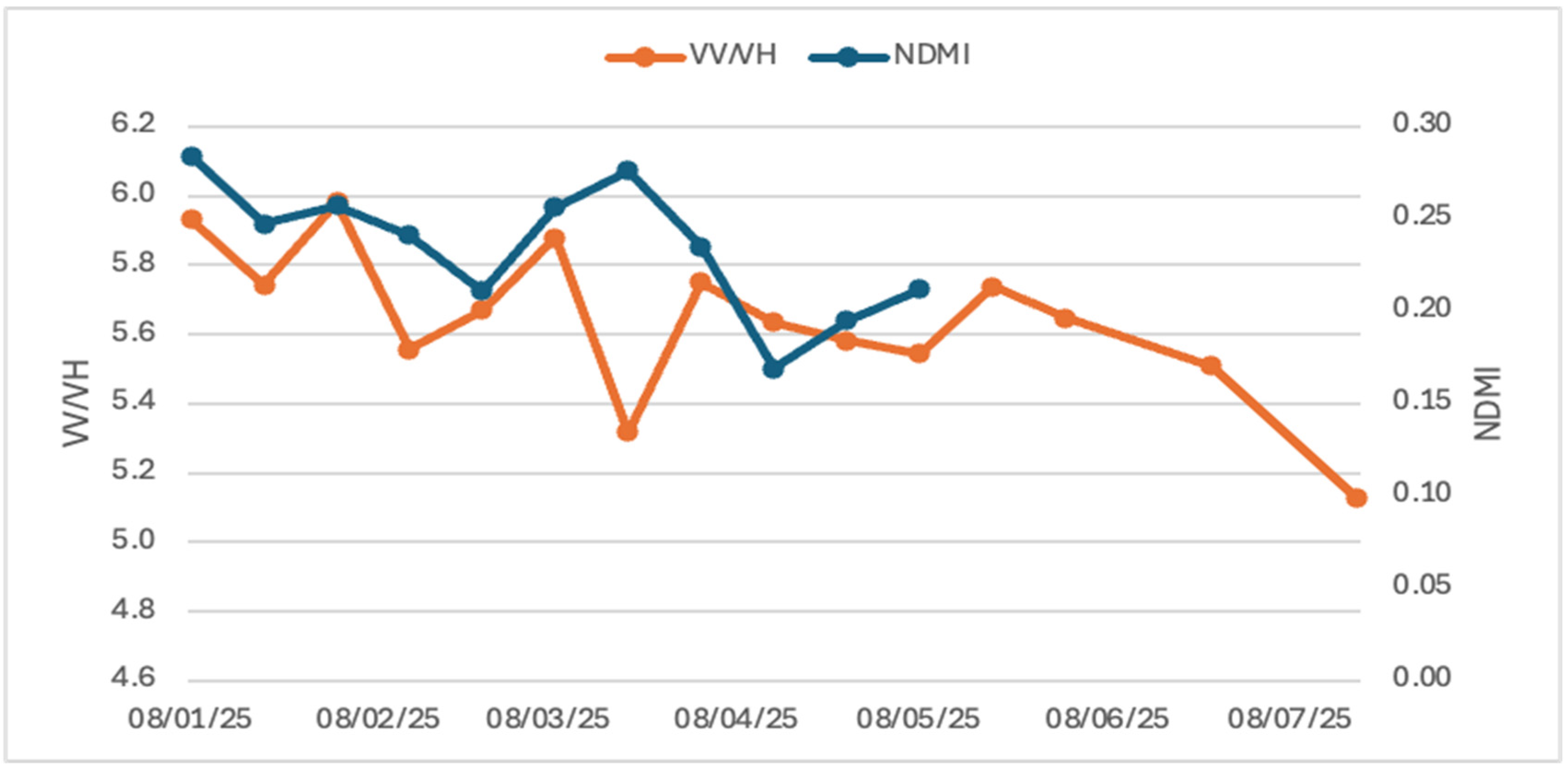
The temporal analysis (Figure 11) aims to evaluate the complementary relationship between the optical moisture index (NDMI, blue line) and the radar structural ratio (VV/VH, orange line) for monitoring the phenology of rubber trees. Rubber trees respond to water deficits through leaf shedding (defoliation), a process that is expected to be detected as (1) a decline in NDMI due to leaf water stress, followed by (2) an increase in VV/VH as the canopy thins, reducing volumetric backscatter (VH). By comparing these indices, it is possible to capture both physiological stress signals and structural canopy responses, which are critical for assessing drought impacts in perennial crops.
During the initial observation period, from January to April, the data exhibited fluctuations but were dominated by a gradual decline in NDMI (≈0.28 to ≈0.17), indicating the onset and intensification of seasonal water stress. This trend reflects the progressive reduction in leaf water content as environmental conditions became increasingly dry, while VV/VH remained relatively stable, suggesting that canopy structure had not yet undergone substantial alteration.
A critical phenological response was observed between May and June. Following sustained low NDMI values (≈0.20–0.22), VV/VH exhibited a clear increase (from ≈5.5 to ≈5.7), demonstrating a lagged inverse relationship that accurately captures defoliation induced by water stress. The thinning canopy reduces volumetric backscatter, causing the VV/VH ratio to rise as the tree adapts to conserve water. It should be noted that the July data point represents a significant anomaly: the simultaneous decline of NDMI (≈0.10) and VV/VH (≈5.1) to the lowest values in the series is biophysically implausible, indicating extreme drought co-occurring with maximum canopy density, and is likely caused by data contamination. Nevertheless, the main trends observed in May–June validate the synergy between NDMI and VV/VH in detecting water stress and corresponding defoliation responses in rubber trees.

4. Discussion

4.1. Limitations of Single-Index Monitoring in Tropical Landscapes

Monitoring water stress in tropical regions is particularly challenging due to persistent cloud cover, rapid crop turnover, and the coexistence of multiple land use types within a single satellite pixel. Many indices, such as NDVI, VCI, or TCI, are sensitive to specific environmental factors and may not capture the full complexity of tropical ecosystems, especially where land cover is highly heterogeneous or where seasonal and spatial variability is pronounced [72,73,74,75,76]. For example, indices like NDVI can saturate in dense forests, making it difficult to distinguish changes in vegetation structure or biomass, while others like TCI may perform poorly during certain phenological stages or in areas with abundant rainfall [72,76]. Studies consistently find that combining multiple indices or using composite indices improves spatial accuracy, reduces overestimation of change, and better captures the diverse drivers of ecosystem dynamics in tropical regions [74,75,77].
Despite these advancements, the findings of this study reveal that single-index monitoring remains inadequate for operational drought or water stress detection in tropical agroecosystems such as Banyuwangi. Each individual index exhibited context-specific limitations when applied to mixed land covers. For instance, optical indices like NDMI and NDWI suffered from temporal discontinuity during the November–March cumulonimbus period, leading to data gaps of up to 40–50%. Meanwhile, RDI occasionally misclassified flooded paddy fields as vegetation water stress due to their sensitivity to soil background effects. Similarly, radar-based indices such as VV/VH and DpRVI demonstrated signal saturation under dense canopies of sugarcane and rubber, obscuring late-season stress responses.
These inconsistencies highlight the pitfalls of interpreting single-index trajectories in isolation. In landscapes characterized by overlapping hydrological and phenological processes, such as simultaneous flooding, leaf flushing, and canopy closure, a single radar or optical equation inevitably conflates structural and physiological signals. The results presented in Figure 3, Figure 4, Figure 5, Figure 6 and Figure 7 clearly demonstrate that no single index maintained both temporal continuity and thematic reliability throughout the study period. This reinforces the argument that a multi-sensor, multi-index framework is not merely advantageous but essential for robust water stress monitoring under tropical conditions.

4.2. Radar–Optical Complementarity: Structural vs. Physiological Signals

Radar (SAR) and optical remote sensing offer complementary insights into vegetation dynamics by capturing fundamentally different types of signals: structural versus physiological. Radar-based indices, such as VV/VH ratios and the Dual Polarization Radar Vegetation Index (DpRVI), are primarily sensitive to the physical structure, geometry, and biomass of vegetation. These indices provide reliable information under varying illumination or cloud-covered conditions, making them particularly effective for monitoring canopy architecture, plant height, and vegetation density, features that often indicate early structural adjustments to stress [78,79,80]. In contrast, optical indices such as the Normalized Difference Moisture Index (NDMI) are directly linked to physiological parameters, including leaf water content, chlorophyll concentration, and photosynthetic activity, which reflect the plant’s functional status and short-term responses to environmental variability. While optical data excel at detecting physiological fluctuations, they are often constrained by cloud contamination and signal saturation in dense tropical canopies.
By fusing radar’s structural sensitivity with optical data’s physiological responsiveness, a more complete understanding of crop conditions can be achieved, one that captures both the physical architecture and the dynamic health of vegetation across complex and rapidly changing tropical environments [79,80]. The results of this study clearly demonstrate this complementarity. The radar-derived VV/VH ratio and DpRVI effectively characterized crop structural evolution and biomass accumulation throughout the growing cycle, particularly during phases when optical data were unavailable due to cloud cover. DpRVI showed strong sensitivity to plant area index, vegetation water content, and dry biomass, confirming its potential for tracking growth dynamics and phenological transitions even under persistently cloudy conditions [52,81,82].
In contrast, the NDMI and the Rainfall Deficit Index (RDI) captured variations in canopy moisture and atmospheric drought, reflecting the plant’s physiological response to water stress. When analyzed together, these indices provided a coherent picture of the interaction between structure and function. For instance, radar indices (VV/VH, DpRVI) captured the gradual decline in structural integrity that often follows prolonged moisture deficit, while optical and meteorological indices (NDMI, RDI) detected the onset and severity of physiological stress. This complementary behavior was particularly evident across the studied crops: in paddy, VV/VH captured early flooding and canopy closure, while NDMI traced internal water content during grain filling; in sugarcane, DpRVI revealed canopy densification concurrent with a steady NDMI decline, indicating ripening-related drying; and in rubber, radar responses lagged behind NDMI decreases, suggesting that structural radar signals respond later than physiological optical signals to drought-induced leaf senescence.

4.3. Cross-Index Logic and Conditional Rules for Reliable Stress Detection

Multi-index and multi-sensor fusion significantly improves the detection and monitoring of drought and vegetation stress compared to single-index or single-sensor approaches. By integrating optical, thermal, radar, and meteorological indicators, fusion frameworks can capture complementary physiological and structural responses while reducing uncertainties associated with cloud contamination, signal saturation, or narrow spectral sensitivity [83,84,85]. Previous studies have shown that combining vegetation, temperature, soil moisture, and precipitation indices through weighted averaging or machine learning improves spatial–temporal sensitivity and early drought detection across heterogeneous landscapes [83,86].
However, rather than relying on complex processing workflows, this study develops a transparent, rule-based fusion approach directly informed by the phenological patterns observed in our own results (Figure 8, Figure 9, Figure 10 and Figure 11). These patterns reveal specific cross-index behaviors that cannot be inferred from literature alone and therefore justify the tailored logic used in this framework.
In paddy fields, our time-series analysis (Figure 8) shows that NDMI decreases sharply shortly after transplanting due to high surface-water reflectance, which would be misinterpreted as drought if assessed in isolation. At the same time, NDWI and VV/VH remain high (Figure 9), indicating flooding and rapid canopy development. To prevent this false-drought classification, a False-Drought Filter was implemented: IF (NDMI < 0.2) AND (VV/VH > 9), THEN status = Flooded/Healthy. This rule, derived entirely from the early-season peak in VV/VH, ensured that early vegetative growth was not misclassified as water stress.
For sugarcane, the multi-year series (Figure 10) shows that NDMI naturally declines during ripening, even under adequate soil moisture. When such declines coincide with stable or increasing DpRVI, the condition represents physiological ripening, not hydrological stress. Conversely, simultaneous decreases in NDMI and DpRVI accurately marked true drought onset during the April–June dry spell. This Ripening Differentiation Rule directly links fusion logic to observed crop phenology.
A similar rule emerged from rubber plantations (Figure 11), where the VV/VH ratio remains structurally stable (≈5.5–6.0) throughout the year. Here, transient NDWI dips caused by atmospheric disturbances were ignored when the radar structural baseline stayed constant, a canopy stability baseline that minimizes false alarms in perennial systems.

4.4. Temporal Efficiency and Operational Readiness

Achieving high temporal efficiency is essential for reliable stress monitoring in tropical agroecosystems, where rapid hydrological changes and persistent cloud cover often disrupt observation continuity. Optical-only systems typically rely on cloud-free composites with revisit intervals of 24–32 days, which delay stress detection and limit operational responsiveness. By integrating radar and optical data within a unified framework, this study effectively reduced the revisit interval to six days, matching the Sentinel-1 acquisition cycle while preserving the physiological sensitivity of optical indices. Such frequent updates enable continuous monitoring of vegetation dynamics, allowing early identification of water stress and supporting timely irrigation or management decisions.
In this study, the six-day Sentinel-1 revisit cycle proved particularly critical in maintaining temporal continuity during periods of persistent cloud cover. As shown in Figure 8, Figure 9, Figure 10 and Figure 11, several optical indices (NDMI and NDWI) exhibited missing observations during the January–March wet season and again in the June dry season due to cloud obstruction. Despite these gaps, the radar-based indicators (VV/VH and DpRVI) continued to provide uninterrupted updates every six days, allowing stress trajectories to be tracked without temporal breaks. For example, early-season flooding in paddy fields and the onset of the April–June stress period in sugarcane were both detected in the radar signal one full cycle (6–12 days) earlier than in the optical indices. This direct evidence from our dataset demonstrates that radar–optical fusion improves not only the theoretical revisit interval but also the effective temporal efficiency of stress monitoring under real tropical atmospheric conditions.
A 6-day revisit interval, enabled by combining satellites like Sentinel-1 and Sentinel-2, offers significant advantages for both temporal efficiency and operational readiness in environmental monitoring. This frequent coverage facilitates rapid detection of land disturbances and vegetation changes, reducing the time lag between event occurrence and confirmation. Mean detection lags can be as short as 3–5 days, and alert maps can be updated every few days, enabling near-real-time response to environmental threats [87]. The increased revisit frequency also improves the continuity and completeness of data, minimizing gaps due to cloud cover or missing acquisitions, and enhances the accuracy and smoothness of time-series products, particularly in cloud-prone tropical regions [88].
Operationally, systems leveraging such frequent revisits can be integrated into automated alerting or decision-support platforms, providing up-to-date probability maps for drought or crop stress management [87,88]. These systems are computationally efficient, as recent algorithmic developments enable faster processing and reduced confirmation times compared with traditional compositing approaches [89]. Overall, a six-day revisit cycle substantially enhances the capacity for continuous, near-real-time environmental monitoring, bridging the gap between scientific observation and operational application in agricultural and hydrological management [87,88,89].

5. Conclusions

This study successfully established a near-real-time water stress monitoring framework for tropical heterogeneous landscapes by synergizing multi-sensor remote sensing data within the Google Earth Engine (GEE) platform. By integrating the all-weather capability of Sentinel-1 (Radar) with the hydrological sensitivity of Sentinel-2 (Optical), the proposed system overcomes the persistent limitation of cloud cover that hinders traditional monitoring in equatorial regions. The framework uses a transparent, rule-based fusion logic to differentiate true water stress from natural phenological transitions, ensuring high interpretability and reliability across paddy, sugarcane, and rubber trees.
The comparative analysis of five indices (VV/VH, DpRVI, NDWI, NDMI, and RDI) provided complementary insights into structural and physiological crop responses. Radar indices (VV/VH and DpRVI) proved robust for monitoring biomass accumulation and canopy stability, while optical indices (NDWI and NDMI) offered critical snapshots of canopy moisture during clear-sky windows. The conditional rule-based fusion approach effectively minimized false positive alerts, distinguishing events such as early-season paddy flooding or sugarcane ripening from genuine water deficits.
The operational scalability of the system is a key strength. The pixel-based, cloud-native workflow is agnostic to field geometry, administrative boundaries, and irregular plot shapes, allowing for seamless upscaling from regency to provincial or national levels. Demonstrated processing efficiency confirms that the system can support near-real-time monitoring for complex agrarian landscapes, providing timely inputs for irrigation management, drought mitigation, and agricultural planning.
Future research should focus on extending the framework across multiple growing seasons to establish robust phenological baselines and assess performance under varying climate scenarios. Incorporation of additional high-resolution soil moisture or thermal datasets could further refine stress detection. Moving toward semi-automated pattern recognition or hybrid approaches may also enhance scalability to diverse crop types and mixed landscapes. Together with field validation and stakeholder engagement, these efforts will strengthen the operational readiness of this system as a resilient tool for safeguarding food security in climate-vulnerable tropical regions.

Author Contributions

Conceptualization, M.E. and A.H.; Methodology, A.H. and M.E.; Validation, A.H., W.T. and A.P.; Formal analysis, A.H.; Investigation, A.P. and W.T.; writing—original draft preparation, A.H.; writing—review and editing, M.E. All authors have read and agreed to the published version of the manuscript.

Funding

This project was funded by the Deanship of Scientific Research (DSR) at King Abdulaziz University, Jeddah, Saudi Arabia under grant no. (DSR: 42-155-2025). The authors, therefore, acknowledge with thanks DSR for the technical and financial support.

Data Availability Statement

The dataset and code will be available on request.

Conflicts of Interest

The authors declare no conflict of interest.

References

  1. Shao, H.; Chu, L.-Y.; Jaleel, C.; Manivannan, P.; Panneerselvam, R.; Shao, M. Understanding Water Deficit Stress-Induced Changes in the Basic Metabolism of Higher Plants—Biotechnologically and Sustainably Improving Agriculture and the Ecoenvironment in Arid Regions of the Globe. Crit. Rev. Biotechnol. 2009, 29, 131–151. [Google Scholar] [CrossRef]
  2. Rosa, L. Adapting Agriculture to Climate Change via Sustainable Irrigation: Biophysical Potentials and Feedbacks. Environ. Res. Lett. 2022, 17, 063008. [Google Scholar] [CrossRef]
  3. Tesfay, Y.; Bantigegn, S.; Belay, M.; Halwani, H.A.; Purohit, S.; Elhag, M. Understanding Drought: Agricultural and Socioeconomic Effects in Tekeze Watershed, Northern Ethiopia. Earth Syst. Environ. 2025, 9, 1289–1309. [Google Scholar] [CrossRef]
  4. Subyani, A. Geostatistical Study of Annual and Seasonal Mean Rainfall Patterns in Southwest Saudi Arabia/Distribution Géostatistique de La Pluie Moyenne Annuelle et Saisonnière Dans Le Sud-Ouest de l’Arabie Saoudite. Hydrol. Sci. J. 2004, 49, 817. [Google Scholar] [CrossRef]
  5. Fu, Z.; Ciais, P.; Feldman, A.; Gentine, P.; Makowski, D.; Prentice, I.; Stoy, P.; Bastos, A.; Wigneron, J. Critical Soil Moisture Thresholds of Plant Water Stress in Terrestrial Ecosystems. Sci. Adv. 2022, 8, eabq7827. [Google Scholar] [CrossRef]
  6. Scharwies, J.; Dinneny, J. Water Transport, Perception, and Response in Plants. J. Plant Res. 2019, 132, 311–324. [Google Scholar] [CrossRef]
  7. Vennam, R.R.; Ramamoorthy, P.; Poudel, S.; Reddy, K.; Henry, W.; Bheemanahalli, R. Developing Functional Relationships between Soil Moisture Content and Corn Early-Season Physiology, Growth, and Development. Plants 2023, 12, 2471. [Google Scholar] [CrossRef] [PubMed]
  8. Wang, C.; Fu, B.; Zhang, L.; Xu, Z. Soil Moisture–Plant Interactions: An Ecohydrological Review. J. Soils Sediments 2018, 19, 1–9. [Google Scholar] [CrossRef]
  9. Ariyanto, D.; Priswita, R.; Komariah; Sumani; Senge, M. Determining the Season Pattern Based on Soil Moisture under Tropical Monsoon Climate. IOP Conf. Ser. Earth Environ. Sci. 2020, 423, 012061. [Google Scholar] [CrossRef]
  10. Ranomahera, M.R.R.; Nugroho, B.; Riajaya, P.; Putra, R.P. Using Global Climate Indices to Predict Rainfall and Sugarcane Productivity in Drylands of Banyuwangi, East Java, Indonesia. Indones. J. Agric. Sci. 2020, 21, 78–88. [Google Scholar] [CrossRef]
  11. Ahmad, U.; Alvino, A.; Marino, S. A Review of Crop Water Stress Assessment Using Remote Sensing. Remote Sens. 2021, 13, 4155. [Google Scholar] [CrossRef]
  12. Gerhards, M.; Schlerf, M.; Mallick, K.; Udelhoven, T. Challenges and Future Perspectives of Multi-/Hyperspectral Thermal Infrared Remote Sensing for Crop Water-Stress Detection: A Review. Remote Sens. 2019, 11, 1240. [Google Scholar] [CrossRef]
  13. Le, T.; Harper, R.; Dell, B. Application of Remote Sensing in Detecting and Monitoring Water Stress in Forests. Remote Sens. 2023, 15, 3360. [Google Scholar] [CrossRef]
  14. Dong, H.; Dong, J.; Sun, S.; Bai, T.; Zhao, D.; Yin, Y.; Shen, X.; Wang, Y.; Zhang, Z.; Wang, Y. Crop Water Stress Detection Based on UAV Remote Sensing Systems. Agric. Water Manag. 2024, 303, 109059. [Google Scholar] [CrossRef]
  15. Torres-Quezada, E.; Fuentes-Peñailillo, F.; Gutter, K.; Rondón, F.; Marmolejos, J.M.; Maurer, W.; Bisonó, A. Remote Sensing and Soil Moisture Sensors for Irrigation Management in Avocado Orchards: A Practical Approach for Water Stress Assessment in Remote Agricultural Areas. Remote Sens. 2025, 17, 708. [Google Scholar] [CrossRef]
  16. Hussain, S.; Bahrawi, J.; Awais, M.; Elhag, M. Understanding the Role of the Radiometric Indices in Temporal Evapotranspiration Estimation in Arid Environments. Desalination Water Treat. 2022, 256, 221–234. [Google Scholar] [CrossRef]
  17. Adem, E.; Boteva, S.; Zhang, L.; Elhag, M. Estimation of Evapotranspiration Based on METRIC and SEBAL Model Using Remote Sensing, near Al-Jouf, Saudi Arabia. Desalination Water Treat. 2023, 290, 94–103. [Google Scholar] [CrossRef]
  18. Ihuoma, S.; Madramootoo, C. Recent Advances in Crop Water Stress Detection. Comput. Electron. Agric. 2017, 141, 267–275. [Google Scholar] [CrossRef]
  19. Aljahdali, M.H.; Adisu, B.; Adem, E.; Chaabani, A.; Boteva, S.; Zhang, L.; Elhag, M. Monitoring of Mangrove Forests Vegetation Based on Optical versus Microwave Data: A Case Study Western Coast of Saudi Arabia. Open Geosci. 2024, 16, 20220573. [Google Scholar] [CrossRef]
  20. Baccari, N.; Hamza, M.H.; Slama, T.; Sebei, A.; Ouerghi, S.; Elsheikh, R.; Rebai, N.; Hasanean, H.; Almazroui, M.; Elhag, M. Assessment of Machine Learning Techniques in Mapping Land Use/Land Cover Changes in a Semi-Arid Environment. Earth Syst. Environ. 2025, 9, 519–539. [Google Scholar] [CrossRef]
  21. Shahbandeh, M.; Elhag, M. Microclimate Changes and Trend Analysis of Remotely Sensed Environmental Parameters in West Asia Semi-Arid Region. Environ. Dev. Sustain. 2024, 26, 14433–14447. [Google Scholar] [CrossRef]
  22. Elhag, M.; Hamza, M.H.; Ouerghi, S.; Elsheikh, R.; Zhang, L.; Diani, K. From Data to Action: Rainfall Factor-Based Soil Erosion Assessment in Arid Regions Through Integrated Geospatial Modeling. Water 2025, 17, 1692. [Google Scholar] [CrossRef]
  23. Jonard, F.; Bogena, H.; Caterina, D.; Garré, S.; Klotzsche, A.; Monerris, A.; Schwank, M.; Hebel, C. Ground-Based Soil Moisture Determination. In Observation and Measurement of Ecohydrological Processes; Springer: Berlin/Heidelberg, Germany, 2019. [Google Scholar] [CrossRef]
  24. Mukhlisin, M.; Astuti, H.; Wardihani, E.; Matlan, S. Techniques for Ground-Based Soil Moisture Measurement: A Detailed Overview. Arab. J. Geosci. 2021, 14, 2032. [Google Scholar] [CrossRef]
  25. Nagahage, E.A.A.D.; Nagahage, I.; Fujino, T. Calibration and Validation of a Low-Cost Capacitive Moisture Sensor to Integrate the Automated Soil Moisture Monitoring System. Agriculture 2019, 9, 141. [Google Scholar] [CrossRef]
  26. Ghosh, S.; Kumar, D.; Kumari, R. Cloud-Based Large-Scale Data Retrieval, Mapping, and Analysis for Land Monitoring Applications with Google Earth Engine (GEE). Environ. Chall. 2022, 9, 100605. [Google Scholar] [CrossRef]
  27. Gomes, V.; Queiroz, G.; Ferreira, K. An Overview of Platforms for Big Earth Observation Data Management and Analysis. Remote Sens. 2020, 12, 1253. [Google Scholar] [CrossRef]
  28. Gorelick, N.; Hancher, M.; Dixon, M.; Ilyushchenko, S.; Thau, D.; Moore, R. Google Earth Engine: Planetary-Scale Geospatial Analysis for Everyone. Remote Sens. Environ. 2017, 202, 18–27. [Google Scholar] [CrossRef]
  29. Tamiminia, H.; Salehi, B.; Mahdianpari, M.; Quackenbush, L.; Adeli, S.; Brisco, B. Google Earth Engine for Geo-Big Data Applications: A Meta-Analysis and Systematic Review. Isprs J. Photogramm. Remote Sens. 2020, 164, 152–170. [Google Scholar] [CrossRef]
  30. Irawan, L.; Panoto, D.; Febrianto, A.; Azizah, V.; Farihah, S.; Aufaristama, M.; Mapa, M. Multi-Hazard Detection in the Southern Part of Banyuwangi Regency Using a Geomorphological Approach. Jàmbá J. Disaster Risk Stud. 2024, 16, a1586. [Google Scholar] [CrossRef] [PubMed]
  31. Neysa, P.; Hendrayana, H.; Pranantya, P.A. Preliminary Hydrogeology Conceptual Model of the East Banyuwangi Coastal Plain Area, East Java Province. IOP Conf. Ser. Earth Environ. Sci. 2025, 1451, 012016. [Google Scholar] [CrossRef]
  32. Wahyuni, N.; Hasyim, A.; Soemarno, S. Dynamic of the Land Use and Land Cover Change in Banyuwangi Regency from 1995–2019. J. Wasian 2021, 8, 121–132. [Google Scholar] [CrossRef]
  33. Firmansyah, F.; Pratomoatmojo, N.; Kurniawati, U.; Susetyo, C.; Pamungkas, A.; Idajati, H. Sustainable Agricultural Land Use Determination Modelling in Banyuwangi. IOP Conf. Ser. Earth Environ. Sci. 2018, 202, 012046. [Google Scholar] [CrossRef]
  34. Alrassi, F.; Salim, E.; Nina, A.; Alwi, L.; Danoedoro, P.; Kamal, M. GEOBIA for Land Use Mapping Using Worldview2 Image in Bengkak Village Coastal, Banyuwangi Regency, East Java. IOP Conf. Ser. Earth Environ. Sci. 2016, 47, 012009. [Google Scholar] [CrossRef]
  35. Holik, A.; Erwanto, Z.; Hardiyanti, S.A. Google Earth Engine for Assessing Land Use and Land Cover Change in Banyuwangi Regency. In Proceedings of the 4th International Conference on Applied Science and Technology on Engineering Science—iCAST-ES, Samarinda, Indonesia, 23–24 October 2021; Volume 1, pp. 416–422. [Google Scholar] [CrossRef]
  36. Park, J.-W.; Korosov, A.; Babiker, M.; Sandven, S.; Won, J.-S. Efficient Thermal Noise Removal for Sentinel-1 TOPSAR Cross-Polarization Channel. IEEE Trans. Geosci. Remote Sens. 2018, 56, 1555–1565. [Google Scholar] [CrossRef]
  37. Mascolo, L.; Cloude, S.; Lopez-Sanchez, J. Model-Based Decomposition of Dual-Pol SAR Data: Application to Sentinel-1. IEEE Trans. Geosci. Remote Sens. 2021, 60, 5220119. [Google Scholar] [CrossRef]
  38. Chen, B.; Wu, A.; Hui, W.; Rao, P.; Feng, X.; Chen, F.; Han, C.; Ying, Q.; Wu, Y.; Liu, M.; et al. Radiometric Calibration Using Artificial Intelligence: Constituting Uniform Observing Systems for Infrared Satellites. IEEE Trans. Geosci. Remote Sens. 2025, 63, 5001616. [Google Scholar] [CrossRef]
  39. Guo, Y.; Senthilnath, J.; Wu, W.; Zhang, X.; Zeng, Z.; Huang, H. Radiometric Calibration for Multispectral Camera of Different Imaging Conditions Mounted on a UAV Platform. Sustainability 2019, 11, 978. [Google Scholar] [CrossRef]
  40. Wang, C.; Myint, S. A Simplified Empirical Line Method of Radiometric Calibration for Small Unmanned Aircraft Systems-Based Remote Sensing. IEEE J. Sel. Top. Appl. Earth Obs. Remote Sens. 2015, 8, 1876–1885. [Google Scholar] [CrossRef]
  41. Iqbal, F.; Lucieer, A.; Barry, K. Simplified Radiometric Calibration for UAS-Mounted Multispectral Sensor. Eur. J. Remote Sens. 2018, 51, 301–313. [Google Scholar] [CrossRef]
  42. Li, Y.; Liu, F.; Turner, I.; Li, T. Time-Fractional Diffusion Equation for Signal Smoothing. Appl. Math. Comput. 2018, 326, 108–116. [Google Scholar] [CrossRef]
  43. Särkkä, S.; García-Fernández, Á. Temporal Parallelization of Bayesian Smoothers. IEEE Trans. Autom. Control 2019, 66, 299–306. [Google Scholar] [CrossRef]
  44. Lindeberg, T. A Time-Causal and Time-Recursive Scale-Covariant Scale-Space Representation of Temporal Signals and Past Time. Biol. Cybern. 2022, 117, 21–59. [Google Scholar] [CrossRef]
  45. Loew, A.; Mauser, W. Generation of Geometrically and Radiometrically Terrain Corrected SAR Image Products. Remote Sens. Environ. 2007, 106, 337–349. [Google Scholar] [CrossRef]
  46. Ariza, A.; Irizar, M.R.; Bayer, S. Empirical Line Model for the Atmospheric Correction of Sentinel-2A MSI Images in the Caribbean Islands. Eur. J. Remote Sens. 2018, 51, 765–776. [Google Scholar] [CrossRef]
  47. Main-Knorn, M.; Pflug, B.; Louis, J.; Debaecker, V.; Müller-Wilm, U.; Gascon, F. Sen2Cor for Sentinel-2. In Proceedings of the Image and Signal Processing for Remote Sensing XXIII, Warsaw, Poland, 11–14 September 2017. [Google Scholar] [CrossRef]
  48. Sola, I.; García-Martín, A.; Sandonís-Pozo, L.; Álvarez-Mozos, J.; Pérez-Cabello, F.; González-Audícana, M.; Llovería, R. Assessment of Atmospheric Correction Methods for Sentinel-2 Images in Mediterranean Landscapes. Int. J. Appl. Earth Obs. Geoinf. 2018, 73, 63–76. [Google Scholar] [CrossRef]
  49. Wright, N.; Duncan, J.M.A.; Callow, J.; Thompson, S.; George, R. CloudS2Mask: A Novel Deep Learning Approach for Improved Cloud and Cloud Shadow Masking in Sentinel-2 Imagery. Remote Sens. Environ. 2024, 306, 114122. [Google Scholar] [CrossRef]
  50. Domnich, M.; Sünter, I.; Trofimov, H.; Wold, O.; Harun, F.; Kostiukhin, A.; Järveoja, M.; Veske, M.; Tamm, T.; Voormansik, K.; et al. KappaMask: AI-Based Cloudmask Processor for Sentinel-2. Remote Sens. 2021, 13, 4100. [Google Scholar] [CrossRef]
  51. Adjorlolo, C.; Mutanga, O.; Cho, M.; Ismail, R. Spectral Resampling Based on User-Defined Inter-Band Correlation Filter: C3 and C4 Grass Species Classification. Int. J. Appl. Earth Obs. Geoinf. 2013, 21, 535–544. [Google Scholar] [CrossRef]
  52. Mandal, D.; Kumar, V.; Kumar, V.; Ratha, D.; Dey, S.; Bhattacharya, A.; Lopez-Sanchez, J.; Mcnairn, H.; Rao, Y. Dual Polarimetric Radar Vegetation Index for Crop Growth Monitoring Using Sentinel-1 SAR Data. Remote Sens. Environ. 2020, 247, 111954. [Google Scholar] [CrossRef]
  53. Ballester-Berman, J.; Rastoll-Gimenez, M. Sensitivity Analysis of Sentinel-1 Backscatter to Oil Palm Plantations at Pluriannual Scale: A Case Study in Gabon, Africa. Remote Sens. 2021, 13, 2075. [Google Scholar] [CrossRef]
  54. Soudani, K.; Delpierre, N.; Berveiller, D.; Hmimina, G.; Vincent, G.; Morfin, A.; Dufrene, E. Potential of C-Band Synthetic Aperture Radar Sentinel-1 Time-Series for the Monitoring of Phenological Cycles in a Deciduous Forest. Int. J. Appl. Earth Obs. Geoinf. 2021, 104, 102505. [Google Scholar] [CrossRef]
  55. Ji, L.; Zhang, L.; Wylie, B.; Rover, J. On the Terminology of the Spectral Vegetation Index (NIR − SWIR)/(NIR + SWIR). Int. J. Remote Sens. 2011, 32, 6901–6909. [Google Scholar] [CrossRef]
  56. Srinet, R.; Nandy, S.; Patel, N. Estimating Leaf Area Index and Light Extinction Coefficient Using Random Forest Regression Algorithm in a Tropical Moist Deciduous Forest, India. Ecol. Inform. 2019, 52, 94–102. [Google Scholar] [CrossRef]
  57. Wang, L.; Hunt, E.; Qu, J.; Hao, X.; Daughtry, C. Remote Sensing of Fuel Moisture Content from Ratios of Narrow-Band Vegetation Water and Dry-Matter Indices. Remote Sens. Environ. 2013, 129, 103–110. [Google Scholar] [CrossRef]
  58. Herbei, M.; Popescu, C.; Bertici, R.; Sala, F. Estimation of Sunflower Crop Production Based on Remote Sensing Techniques. AgroLife Sci. J. 2023, 12, 87–96. [Google Scholar] [CrossRef]
  59. Herbei, M.; Jurjescu, A.L.; Sala, F. Evaluation of the Wheat Crop and Production Estimation Based on Remote Sensing. Life Sci. Sustain. Dev. 2023, 4, 93–100. [Google Scholar] [CrossRef]
  60. Dong, Z.; Wang, L.; Gao, M.; Zhu, X.; Feng, W.; Li, N. Ratio Drought Index (RDI): A Soil Moisture Index Based on New NIR-Red Triangle Space. Int. J. Remote Sens. 2023, 45, 6976–6989. [Google Scholar] [CrossRef]
  61. Gao, B. Normalized Difference Water Index for Remote Sensing of Vegetation Liquid Water from Space. In Proceedings of the SPIE’s 1995 Symposium on OE/Aerospace Sensing and Dual Use Photonics, Orlando, FL, USA, 17–21 April 1995; Volume 2480. [Google Scholar] [CrossRef]
  62. Gao, B. NDWI—A Normalized Difference Water Index for Remote Sensing of Vegetation Liquid Water from Space. Remote Sens. Environ. 1996, 58, 257–266. [Google Scholar] [CrossRef]
  63. Liu, X.; Shao, Y.; Li, K.; Liu, Z.; Liu, L.; Xiao, X. Backscattering Statistics of Indoor Full-Polarization Scatterometric and Synthetic Aperture Radar Measurements of a Rice Field. Remote Sens. 2023, 15, 965. [Google Scholar] [CrossRef]
  64. Pierdicca, N.; Pulvirenti, L.; Boni, G.; Squicciarino, G.; Chini, M. Mapping Flooded Vegetation Using COSMO-SkyMed: Comparison With Polarimetric and Optical Data Over Rice Fields. IEEE J. Sel. Top. Appl. Earth Obs. Remote Sens. 2017, 10, 2650–2662. [Google Scholar] [CrossRef]
  65. dela Torre, D.M.G.; Gao, J.; Macinnis-Ng, C. Remote Sensing-Based Estimation of Rice Yields Using Various Models: A Critical Review. Geo-Spat. Inf. Sci. 2021, 24, 580–603. [Google Scholar] [CrossRef]
  66. Mansaray, L.R.; Kabba, V.T.S.; Zhang, L.; Bebeley, H.A. Optimal Multi-Temporal Sentinel-1A SAR Imagery for Paddy Rice Field Discrimination; a Recommendation for Operational Mapping Initiatives. Remote Sens. Appl. Soc. Environ. 2021, 22, 100533. [Google Scholar] [CrossRef]
  67. Gaur, P.; Tahlani, P.; Tripathy, R.; Bhattacharya, B.K.; Ray, S.S. Identification of Rice Crop Phenology Using Scatsat-1 Ku-Band Scatterometer in Punjab and Haryana. Int. Arch. Photogramm. Remote Sens. Spat. Inf. Sci.—ISPRS Arch. Int. Soc. Photogramm. Remote Sens. 2019, 42, 549–555. [Google Scholar] [CrossRef]
  68. Haldar, D.; Panda, A.; Kumar, S.; Chauhan, P. Monitoring Important Phenological Stages of Rice with Multi-Season Rice Crop Profile Using Indian SCATSAT-1 Data. Med Discov. 2023, 2, 1034. [Google Scholar] [CrossRef]
  69. den Besten, N.; Dunne, S.S.; Mahmud, A.; Jackson, D.; Aouizerats, B.; de Jeu, R.; Burger, R.; Houborg, R.; McGlinchey, M.; van der Zaag, P. Understanding Sentinel-1 Backscatter Response to Sugarcane Yield Variability and Waterlogging. Remote Sens. Environ. 2023, 290, 113555. [Google Scholar] [CrossRef]
  70. Molijn, R. Space-Based SAR and Optical Remote Sensing for Productivity Monitoring and Mapping of Sugarcane. Ph.D. Thesis, University of Campinas, Campinas, Brazil, 2020. [Google Scholar]
  71. Steele-Dunne, S.C.; McNairn, H.; Monsivais-Huertero, A.; Judge, J.; Liu, P.W.; Papathanassiou, K. Radar Remote Sensing of Agricultural Canopies: A Review. IEEE J. Sel. Top. Appl. Earth Obs. Remote Sens. 2017, 10, 2249–2273. [Google Scholar] [CrossRef]
  72. Santos, E.P.D.; Silva, D.D.D.; Amaral, C.H.D. Vegetation Cover Monitoring in Tropical Regions Using SAR-C Dual-Polarization Index: Seasonal and Spatial Influences. Int. J. Remote Sens. 2021, 42, 7581–7609. [Google Scholar] [CrossRef]
  73. Rankine, C.; Sánchez-Azofeifa, G.; Guzmán, J.; Espírito-Santo, M.; Sharp, I. Comparing MODIS and Near-Surface Vegetation Indexes for Monitoring Tropical Dry Forest Phenology along a Successional Gradient Using Optical Phenology Towers. Environ. Res. Lett. 2017, 12, 105007. [Google Scholar] [CrossRef]
  74. Schultz, M.; Clevers, J.; Carter, S.; Verbesselt, J.; Avitabile, V.; Quang, H.V.; Herold, M. Performance of Vegetation Indices from Landsat Time Series in Deforestation Monitoring. Int. J. Appl. Earth Obs. Geoinf. 2016, 52, 318–327. [Google Scholar] [CrossRef]
  75. Wei, W.; Zhang, J.; Zhou, L.; Xie, B.; Zhou, J.-J.; Li, C. Comparative Evaluation of Drought Indices for Monitoring Drought Based on Remote Sensing Data. Environ. Sci. Pollut. Res. 2021, 28, 20408–20425. [Google Scholar] [CrossRef]
  76. Zou, L.; Cao, S.; Sánchez-Azofeifa, A. Evaluating the Utility of Various Drought Indices to Monitor Meteorological Drought in Tropical Dry Forests. Int. J. Biometeorol. 2020, 64, 701–711. [Google Scholar] [CrossRef]
  77. Liu, Q.; Zhang, S.; Zhang, H.; Bai, Y.; Zhang, J. Monitoring Drought Using Composite Drought Indices Based on Remote Sensing. Sci. Total Environ. 2020, 711, 134585. [Google Scholar] [CrossRef] [PubMed]
  78. Xiong, X.; Jin, G.; Xu, Q.; Zhang, H.; Wang, L.; Wu, K. Robust Registration Algorithm for Optical and SAR Images Based on Adjacent Self-Similarity Feature. IEEE Trans. Geosci. Remote Sens. 2022, 60, 5233117. [Google Scholar] [CrossRef]
  79. Ye, Y.; Yang, C.; Gong, G.; Yang, P.; Quan, D.; Li, J. Robust Optical and SAR Image Matching Using Attention-Enhanced Structural Features. IEEE Trans. Geosci. Remote Sens. 2024, 62, 5610212. [Google Scholar] [CrossRef]
  80. Ye, Y.; Liu, W.; Zhou, L.; Peng, T.; Xu, Q. An Unsupervised SAR and Optical Image Fusion Network Based on Structure-Texture Decomposition. IEEE Geosci. Remote Sens. Lett. 2022, 19, 4028305. [Google Scholar] [CrossRef]
  81. Jain, S.; Khati, U.; Kumar, V. Dual Polarimetric Information for Biomass Estimation of Crop. In Proceedings of the 2024 IEEE India Geoscience and Remote Sensing Symposium (InGARSS), Goa, India, 2–5 December 2024; pp. 1–4. [Google Scholar] [CrossRef]
  82. Selvaraj, S.; Bargiel, D.; Htitiou, A.; Gerighausen, H. Analyzing Temporal Characteristics of Winter Catch Crops Using Sentinel-1 Time Series. Remote Sens. 2024, 16, 3737. [Google Scholar] [CrossRef]
  83. Ghazaryan, G.; Dubovyk, O.; Graw, V.; Kussul, N.; Schellberg, J. Local-Scale Agricultural Drought Monitoring with Satellite-Based Multi-Sensor Time-Series. GIScience Remote Sens. 2020, 57, 704–718. [Google Scholar] [CrossRef]
  84. Jiao, W.; Tian, C.; Chang, Q.; Novick, K.; Wang, L. A New Multi-Sensor Integrated Index for Drought Monitoring. Agric. For. Meteorol. 2019, 268, 74–85. [Google Scholar] [CrossRef]
  85. Jiao, W.; Wang, L.; Novick, K.; Chang, Q. A New Station-Enabled Multi-Sensor Integrated Index for Drought Monitoring. J. Hydrol. 2019, 574, 169–180. [Google Scholar] [CrossRef]
  86. Jones, S.; Ayanlade, T.; Fallen, B.; Jubery, T.; Singh, A.; Ganapathysubramanian, B.; Sarkar, S.; Singh, A. Multi-sensor and Multi-temporal High-throughput Phenotyping for Monitoring and Early Detection of Water-limiting Stress in Soybean. Plant Phenome J. 2024, 7, e70009. [Google Scholar] [CrossRef]
  87. Shang, R.; Zhu, Z.; Qiu, S.; Yang, Z.; Li, T.; Yang, X. Near-Real-Time Monitoring of Land Disturbance with Harmonized Landsats 7–8 and Sentinel-2 Data. Remote Sens. Environ. 2022, 278, 113073. [Google Scholar] [CrossRef]
  88. Verger, A.; Baret, F.; Weiss, M. Near Real-Time Vegetation Monitoring at Global Scale. IEEE J. Sel. Top. Appl. Earth Obs. Remote Sens. 2014, 7, 3473–3481. [Google Scholar] [CrossRef]
  89. Ye, S.; Rogan, J.; Zhu, Z.; Eastman, R. A Near-Real-Time Approach for Monitoring Forest Disturbance Using Landsat Time Series: Stochastic Continuous Change Detection. Remote Sens. Environ. 2021, 252, 112167. [Google Scholar] [CrossRef]
Figure 1. Study area.
Hydrology 12 00325 g001
Figure 2. Data processing workflow.
Hydrology 12 00325 g002
Figure 3. The plot of the VV/VH ratio.
Hydrology 12 00325 g003
Figure 4. The plot of the DpRVI.
Hydrology 12 00325 g004
Figure 5. The plot of the NDWI.
Hydrology 12 00325 g005
Figure 6. The plot of the NDMI.
Hydrology 12 00325 g006
Figure 7. The plot of the RDI.
Hydrology 12 00325 g007
Figure 8. Temporal co-variation of DpRVI and NDMI for paddy fields.
Hydrology 12 00325 g008
Figure 9. Temporal co-variation of VV/VH ratio and RDI for paddy fields.
Hydrology 12 00325 g009
Figure 10. The plot of the temporal dynamics of DpRVI and NDMI in sugarcane.
Hydrology 12 00325 g010
Figure 11. The plot of the VV/VH–NDMI relationship in rubber trees.
Hydrology 12 00325 g011
Table 1. The characteristics of Sentinel-1 data.
ParameterSentinel-1
GRD
Reference image Sentinel-1 GRD median composite
Downloaded images 15 images
Band wave C-band (5.405 GHz, λ ≈ 5.6 cm)
Orbit Ascending
Sub SwathIW (Interferometric Wide swath)
PolarizationVV, VH
Resolution10 m
Table 2. The characteristics of Sentinel-2 data.
ParameterSentinel-2
Acquisition period1 January 2025–31 July 2025
Bands/Band waveB2, B3, B4, B5, B6, B7, B8, B8A, B11, B12, NDMI, RDI, NDWI
Resolution10–20 m
Cloud coverage (%)filter < 50% per image
PlatformSentinel-2A/2B
Processing levelL2A (Surface Reflectance)
Disclaimer/Publisher’s Note: The statements, opinions and data contained in all publications are solely those of the individual author(s) and contributor(s) and not of MDPI and/or the editor(s). MDPI and/or the editor(s) disclaim responsibility for any injury to people or property resulting from any ideas, methods, instructions or products referred to in the content.