
Article

Flash Drought Assessment: Insights from a Selection of Mediterranean Islands, Greece
by
Chrysoula Katsora
1,*,
Evangelos Leivadiotis
2,
Nektaria Papadopoulou
1,
Isavela Monioudi
1,
Efthymia Kostopoulou
3,
Petros Gaganis
4,
Aris Psilovikos
2 and
Ourania Tzoraki
1,*
1
Coastal Morphodynamics, Coastal Management and Marine Geology Lab, Department of Marine Sciences (DMR), University of the Aegean, 81100 Mitilini, Greece
2
Laboratory of Ecohydraulics & Inland Water Management, Department of Ichthyology & Aquatic Environment, University of Thessaly, Fytokou St., 38446 Nea Ionia, Greece
3
Department of Geography, University of the Aegean, 81100 Mitilini, Greece
4
Department of Environment, University of the Aegean, 81100 Mitilini, Greece
*
Authors to whom correspondence should be addressed.
Hydrology 2025, 12(11), 308; https://doi.org/10.3390/hydrology12110308
Submission received: 1 October 2025 / Revised: 12 November 2025 / Accepted: 14 November 2025 / Published: 18 November 2025
(This article belongs to the Section Hydrology–Climate Interactions)

Abstract

Flash droughts are a significant natural hazard, characterized by rapid onset and potential to cause substantial economic and environmental impacts. This study utilizes ERA5 soil moisture data to identify and define historical flash drought (FD) events in the Northeastern Aegean islands (specifically Chios, Lemnos, Lesvos and Samos). Hourly soil moisture data, spanning from 1990 to the present, covering three soil layers (0–7 cm, 7–28 cm and 28–100 cm), were analyzed and mapped onto a 0.1° × 0.1° grid with a native resolution of approximately 9 km. Additionally, the Standardized Precipitation Evapotranspiration Index (SPEI) was applied to the island of Lesvos, using precipitation and average temperature data from the local meteorological stations. The number and characteristics of these events—including frequency, duration, decline rate, magnitude, intensity, recovery rate and recovery duration—were produced to construct a regional overview of FD risk across the Northeastern Aegean Islands. These results reveal a considerable variability in the spatial, seasonal and temporal distribution of past FD events. Furthermore, this study highlights the value of using satellite-derived soil moisture data for identifying FD events and demonstrates that analyzing this data with field temperature and precipitation measurements enables a more localized and accurate interpretation of past events. This approach facilitates the definition of FD “hotspot” areas, which, when combined with further investigation, can lead to the development of a predictive FD model.

1. Introduction

Drought is a natural hazard characterized by a prolonged period of abnormally dry conditions—typically involving precipitation deficit and/or temperature extremes—that lead to a deficiency of water resources accompanied by declining soil moisture levels. It is not merely a physical event, but rather the result of complex interactions between climate, hydro(geo)logy, ecosystems, and human societies, considered as a complicated phenomenon that is not possible to avoid, and likely to occur in any season and various regions [1]. This natural phenomenon—often referred to as conventional or traditional drought [2]—is typically characterized by slow development and its severe impacts can manifest months or even years after the event has officially ended [3]. Due to the complex and multifaceted nature of drought, precise identification and monitoring of key characteristics such as onset, termination, duration, intensity, magnitude (severity) and spatial extent remain challenging, as well as the development of comprehensive drought indices [4].
In contrast with traditional drought, the term “flash drought” (FD)—found in the literature since 2002 [5]—represents an extreme form of drought event marked by rapid intensification, short duration, and high intensity. Initially, the concept of FD was closely linked to agricultural drought and its impact on crop yields, often lacking precise quantitative indicators. For instance, Svoboda et al. (2002) described flash drought as: “rapid crop deterioration due to the adverse effects of a severe heat wave and short-term dryness, leading to a rapid onset of drought and associated impacts…” [6]. The definition later evolved to include specific meteorological characteristics, as Senay et al. (2008) provided a widely adopted definition, suggesting that FD is: “a short-term, yet severe [drought] event, characterized by moisture deficits and abnormally high temperatures” [7]. Hunt et al. (2009) had further added a crucial quantitative mechanism proposing that: “a flash drought is the result of a synoptic meteorological pattern where potential evapotranspiration (ET) greatly exceeds precipitation for a period no less than 3 weeks such that available water in a previously moist (0–50 cm) soil profile decreases by more than 50%” [8]. Following the devastating 2012 drought in the United States, which resulted in over $30 billion in economic losses [9], the term “flash drought” has gained widespread usage to describe rapid, intense, and severe short—duration drought events observed globally [10,11]. While there is not a universally accepted definition, the key characteristics of FDs [12] include:
  • Substantial precipitation deficits, characterized by prolonged periods of below-average rainfall.
  • Abnormally high evapotranspiration, as elevated temperatures and increased atmospheric demand result in rapid soil moisture depletion.
Koster et al. [13] highlighted that precipitation deficits, rather than evapotranspiration, were the primary drivers of FD development within their study region. Regardless of perspective, a conventional drought typically progresses from its onset to the termination, defined either by the end of its impacts or a return to average hydrometeorological conditions. However, defining the onset and termination of FDs is more challenging due to their rapid development and variable duration.
While rapid intensification is the defining feature of FDs, they may also mark the early phase of a longer drought or represent a period of accelerated intensification within an ongoing drought event. Soil moisture dynamics play a crucial role in the onset of FDs, as they are strongly influenced by variations in hydroclimatic variables such as precipitation, temperature, and evapotranspiration, as well as soil and plant characteristics. Several studies have suggested that the 40th percentile of soil moisture can serve as a threshold for drought initiation, with soil drying typically beginning below this level. Furthermore, soil moisture levels falling below the 20th percentile have been associated with substantial ecological impacts, indicating a transition into a more severe drought state [14,15,16].
FDs have emerged as a critical area of research in recent years, with numerous studies exploring their characteristics under current and future climate conditions, in areas such as the USA, Russia, China, South Africa and Mediterranean countries [17,18,19,20,21]. While some research focuses on defining FDs, others [22,23,24] investigate their spatial and temporal variability, as well as their ecological impacts.
Anthropogenic forcings such as climate crisis, land use and/or land-cover change, and unsustainable water consumption practices can exacerbate the impacts of FDs [25,26]. These impacts include major disruptions to vegetation growth and increased risks of compound extreme events, such as heatwaves and wildfires.
Global warming significantly influences the terrestrial water cycle, contributing to increased frequency, duration and severity of agricultural and hydrological droughts. Projections indicate that these trends will intensify in warmer future climates [27]. Climate crisis has already been linked to an increase in both the frequency and severity of FDs in recent years, even in typically humid or vegetated regions such as Central and Northern Europe [28,29]. Due to their abrupt onset, FDs often allow little time for preparedness or mitigation posing serious challenges for affected communities and ecosystems. Understanding and mitigating the impacts of FDs is therefore essential to reducing their long-term socioeconomic consequences. Since FDs are regional phenomena that can cover large areas within short timeframes, both their rapid intensification and spatial extent are considered equally critical characteristics [30].
Geographic and climatic factors also play a crucial role in FD development. Christian et al. [31] analyzed global trends in FD events under a range of greenhouse gas emission scenarios—including extreme, low-end, and medium pathways. Their projections indicate a significant global increase in FD risk over cropland areas. Particularly, under the most extreme emissions scenario, by 2100, the largest increases in annual FD risk are projected for North America to rise from 32% in 2015 to 49% and for Europe from 32% to 53%.
However, the frequency and drivers of FDs may vary significantly across regions [32]. A critical knowledge gap exists regarding the regional-scale characteristics, causes and impacts of FDs in “hotspot” regions [24,33], as the relationship between temperature (T) and evapotranspiration (ET) is complex and regionally variable. There is a growing need to monitor and analyze FD patterns, as this will support preparedness and enhance resilience to future extreme weather events [20].
The Mediterranean basin indicates a “hotspot” region for FDs due to its complex geography, climate, and topography, as well as its location at the convergence of tropical and mid-latitude weather systems [33]. Previous studies have identified and analyzed FD events in Spain, Sicily (Italy), and Thessaly (Greece) [34,35,36]. These studies underscore the crucial need for continuous and accurate data by utilizing a combination of indices like the Standardized Precipitation Evapotranspiration Index (SPEI), Evaporative Demand Drought Index (EDDI), and Standardized Precipitation Index (SPI), along with satellite data.
While ground-based rain gauges provide precise, point-specific data, they suffer from limited spatial coverage and discontinuous time series, especially in complex terrains [37]. In many regions, including Greece, outdated infrastructure and sparse observational networks [38] hinder accurate FD monitoring. Satellite-based precipitation estimates offer a solution by providing continuous, large-scale observations [39]. However, their accuracy can be inconsistent, particularly in mountainous and coastal areas, where it is difficult to detect localized rainfall. Additionally, challenges remain regarding differences in data resolution and uncertainties in precipitation modeling [40].
This study aims to fill the regional knowledge gap that currently lacks a systematic assessment of the fine-scale characteristics, spatial heterogeneity, and seasonality of FD in the Northeastern Aegean Islands, a region uniquely characterized by complex geological climates and scarce data [41]. Therefore it utilizes ERA5 (fifth generation European Centre for Medium-Range Weather Forecasts reanalysis) soil moisture data to identify and define historical FD events in the Northeastern Aegean islands, aiming to produce a comprehensive regional overview. By leveraging the continuous, large-scale coverage of the ERA5 reanalysis product, the study overcame the typical spatial and temporal data limitations encountered when relying solely on sparse local gauge networks. For a more localized assessment, the SPEI, derived from locally measured precipitation and temperature data, was used focusing on Lesvos Island, specifically due to the availability and accessibility of local data.

2. Materials and Methods

2.1. Study Area

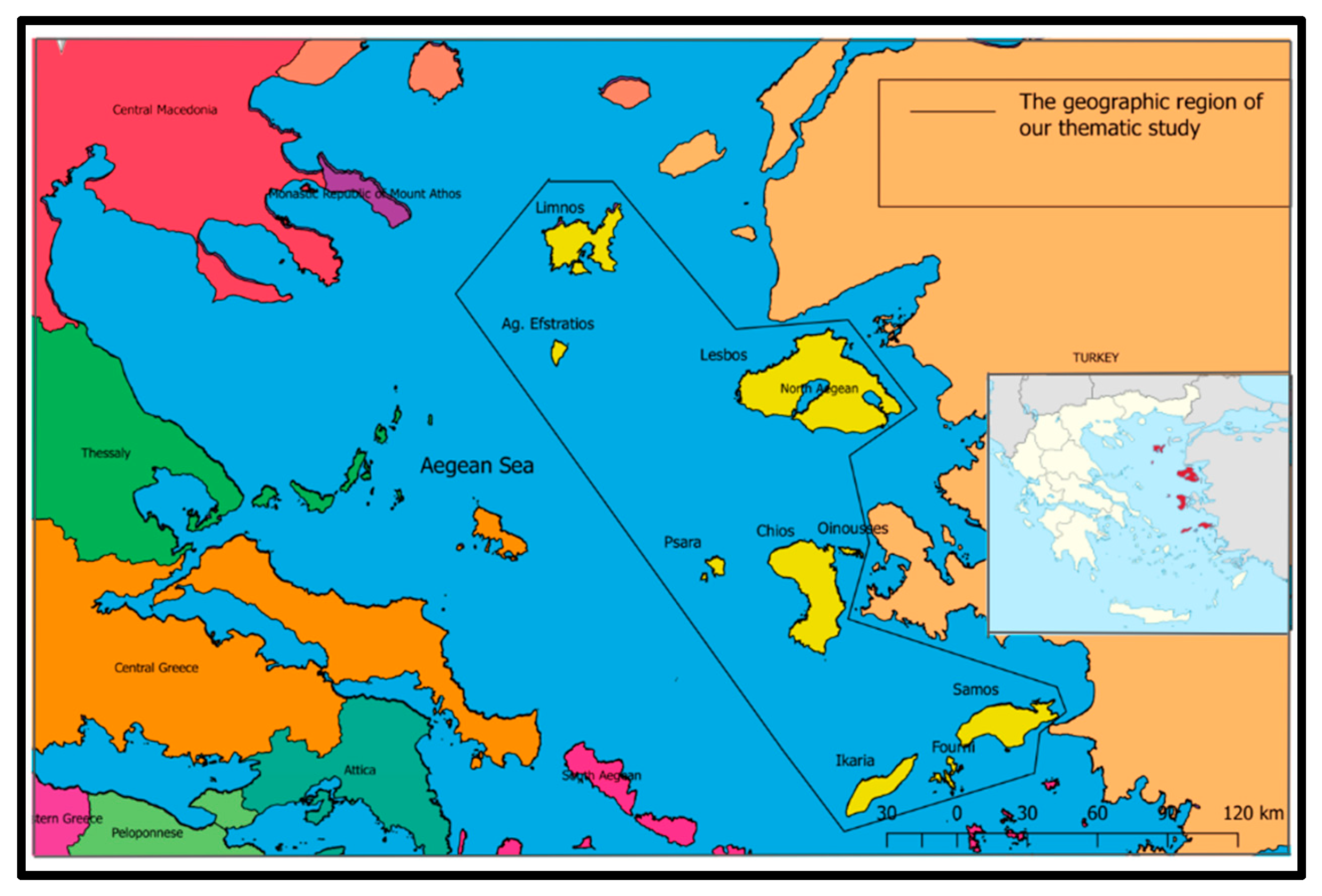
The Northeastern Aegean Islands, located at the eastern boundary of the Aegean Sea, form a scattered group of islands comprising a total land area of approximately 2139 km2. This group includes the islands of Agios Efstratios, Chios, Fournoi, Ikaria, Lesvos, Lemnos, Oinousses, Psara, and Samos (Figure 1). Regarding the region’s demographics and economic profile, the population was recorded at 194,943 in 2021, representing a 2.6% decline since 2011 [42]. The region’s gross domestic product (GDP) was estimated at 2.5 billion Euros in 2018, accounting for 1.4% of Greece’s total economic output. The relative low GDP per capita, approximately 67% of the European Union (EU) average, categorizes the region among the economically disadvantaged areas within the EU.
Due to their position, these islands are the result of a complex and dynamic geological history, characterized by ongoing tectonic activity, a diverse range of rock formations and the influence of past volcanic events [43]. Metamorphic rocks, such as schists, gneisses and marbles indicate a history of intense heat and pressure, whereas sedimentary rocks, including limestones, sandstones and conglomerates reflect periods of marine deposition and volcanic rocks provide strong evidence of past volcanic activity. These features create a geologically complex and tectonically active region, resulting in the formation of faults-bounded basins and mountain ranges across the islands. Characterized by significant mountainous terrain often descending sharply to the coast, these islands also feature highly varied coastlines, from extensive sandy beaches and dunes to rugged cliffs and sheltered bays. Despite the predominance of mountains, fertile plains and valleys on all islands support significant agricultural activities.
Particularly, the landscape of Lesvos is characterized by heterogenous vegetation cover, including extensive olive groves, Mediterranean maquis, phrygana and pine as well as deciduous oak forests. Various types of irrigated and non-irrigated agricultural systems also contribute to the island’s landcover. Prolonged and intensive cultivation has significantly affected soil quality, leading to degradation in specific areas and subsequent changes in land use patterns. Steep slopes, which cover approximately 63% of Lesvos, are a major factor contributing to erosion, in conjunction with climatic influences. In semi-arid regions, severe soil erosion is commonly observed on steep slopes, whereas slightly to moderately eroded soils are more typical in sub-humid regions with comparable topography.
In Lemnos, land use is predominantly characterized by the cultivation of cereals, vineyards, olive trees, legumes and other crops. Extensive areas are also dedicated to pastures and grazing supporting the island’s dominant livestock populations, primarily sheep and goats. The natural vegetation comprises sparse forests of oaks and other drought-resistant species, as well macchia and phrygana shrublands. Additionally, coastal wetlands and sand dunes are important components of the natural landscape.
Chios is characterized by a varied topography that supports a diverse but predominantly agricultural land use, interspersed with areas of natural vegetation and urban development. Agricultural land is dominated by mastic cultivation, citrus groves, olives, fig and almond trees, vineyards, as well as vegetables and cereals. Natural vegetation consists mainly of pine forests, macchia and phrygana in natural vegetation.
Samos is characterized by a diverse land use comprising agriculture, significant forest cover, and natural vegetation, in addition to urban and semi-urban areas. Agricultural activities are primarily dominated by vineyards, olives, citrus groves, figs, vegetables and fruits, while the natural vegetation is mainly composed of pine forests, macchia and phrygana.
Recent studies have classified the North Aegean region as a high-risk area for desertification [44], with widespread soil erosion observed across various locations. This degradation is primarily linked to the region’s Mediterranean climate (Csa, according to the Köppen–Geiger classification), which is characterized by hot, dry summers and limited precipitation—conditions that predispose the landscape to water stress. In addition, peak monthly mean temperatures in July and August frequently exceed 28 °C (82 °F) and consequently high thermal energy, coupled with strong solar exposure (often 11–12 h of daily sunshine), creates an extremely high atmospheric evaporative demand. This contrasts with the precipitation pattern as the total annual rainfall is highly variable across the islands, typically ranging between 600 mm and 750 mm per year, primarily concentrated in the autumn and winter months. Rainfall during the summer is negligible (often less than 10 mm per month for islands like Samos), leading to a pronounced seasonal water deficit [45]. This period of highest thermal demand aligns directly with the absolute minimum of water availability, creating conditions highly conducive to the rapid onset of FDs.
Under future climate change scenarios, these climatic stressors are expected to intensify, increasing the likelihood of extreme hydroclimatic events such as FDs. Soil degradation in the region is further exacerbated by anthropogenic and natural factors, including overgrazing, wildfires, and erosion along coastal zones, mainly, due to storm surges and sea level rise (SLR). The cumulative impact of these disturbances amplifies the region’s ecological, demographic and economical vulnerability.
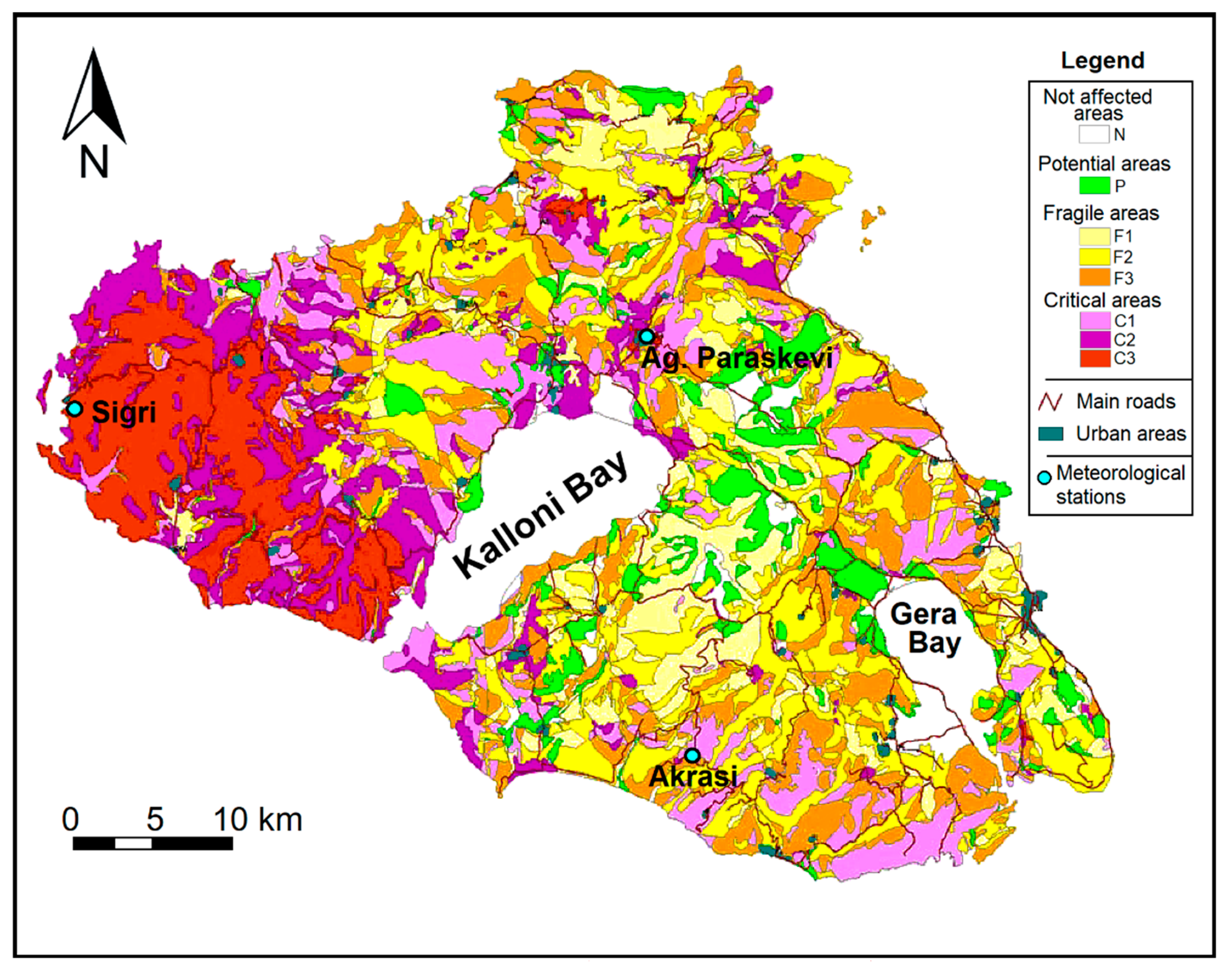
The high susceptibility of the island of Lesvos to desertification (Figure 2)—according to the Medalus model, developed by the European Communities, in 1999 [44]—is demonstrated by its environmental classification as a critical (37%) and fragile (52.4%) region. The critical areas (C1, C2, and C3), (on the western part) are characterized by badly degraded, very shallow (depth 0–15 cm) to shallow (15–30 cm) soils that are severely eroded and poorly vegetated. Low rainfall and extreme weather, as well as anthropogenic practices (burning and overgrazing) are considered to further accelerate desertification. The fragile areas (F1, F2, and F3), (on the north and eastern part), are highly sensitive to degradation, which is likely to accelerate due to climate change or changes in land use. The soils in this zone are moderately shallow (30–50 cm) to moderately deep (50–100 cm), well-vegetated with olive trees, pine, or oak forests. Potential environmentally sensitive areas (7%) are mainly confined to relatively deep soils that are nearly flat to gently sloping, featuring good vegetation cover and sensitive to degradation under significant changes in climate or human activity. Non-threatened areas are rare (3.6%), with very deep soils and nearly flat terrain as well as a very deep groundwater table.

2.2. SM Method

Following an extensive literature review, the widely used Soil Moisture (SM) Percentile Method [46] has been selected for identifying the past FD events in Northeastern Aegean islands. The study centered on soil moisture of the upper 1 m of the soil layer, namely, in three soil layers 0–7 cm, 7–28 cm, and 28–100 cm, because that specific area is considerably responsive to hydrological short-term variations and is greatly related to vegetation stress at the onset of FDs. Use of shallow to intermediate soil layers is in line with conventional procedures because these layers reflect the most rapid response to anomalies of rain and evapotranspiration demands [47]. Verified to be reliable in Greek Mediterranean environments, ERA5 Land has extensively been applied to drought monitoring, further supporting its suitability for that regional-specific study.
The required SM data came from the ERA5 Land reanalysis dataset, of the Copernicus Climate Change Service (C3S), produced by the European Centre for Medium Range Weather Forecasts (ECMWF), providing a consistent open dataset of atmospheric variables from 1950 to the present, such as temperature, atmospheric pressure, wind velocity, humidity and precipitation, captured from satellites, radiosondes and surface stations [48]. ERA5 data is freely accessible through the ECMWF’s Copernicus Climate Data Store (CDS), enabling registered users to download data for specific regions and time periods, via the CDS web interface or API. According to Khorrami [49] ERA5-Land precipitation dataset has better performance over the Aegean region.
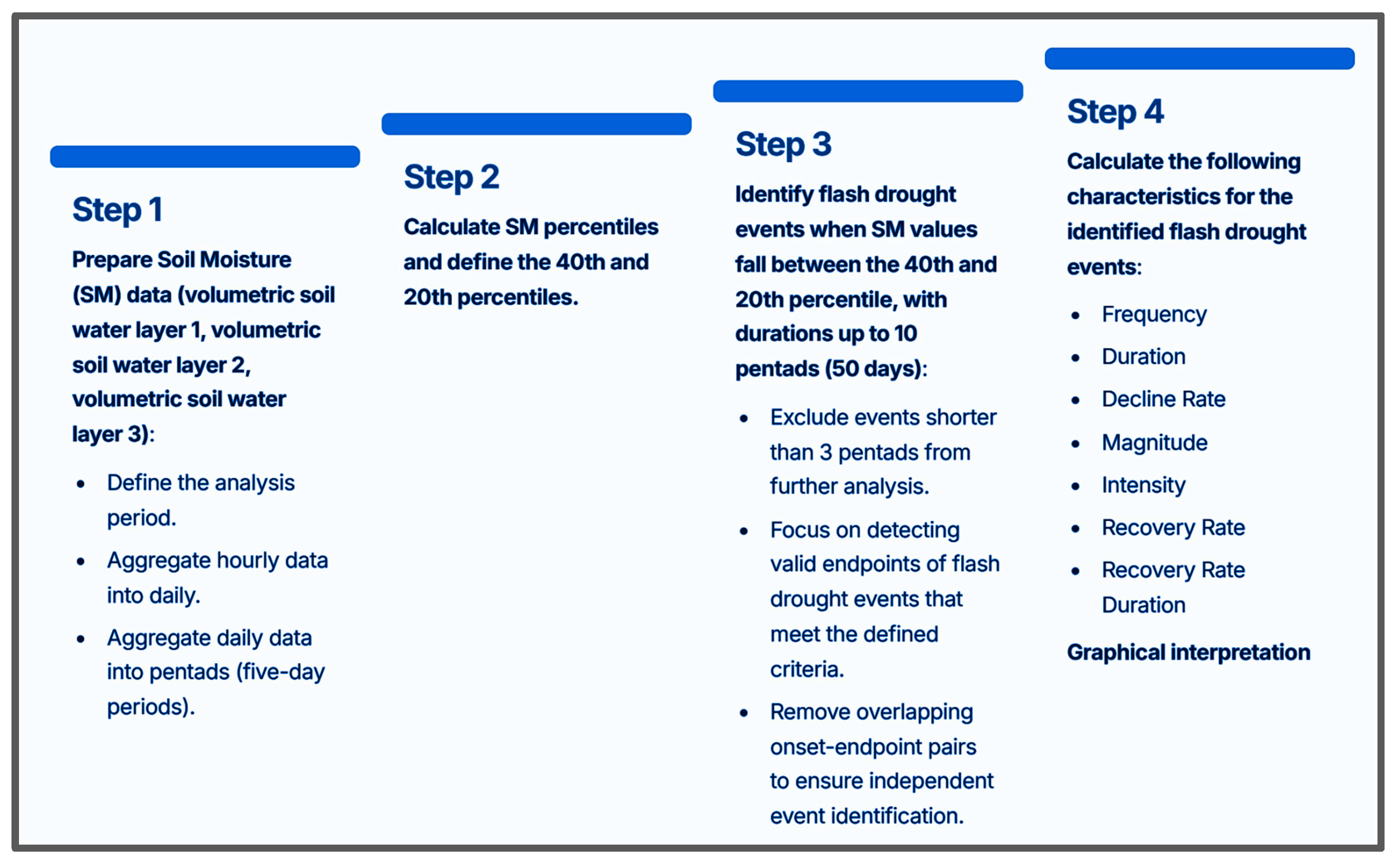
In general, the spatial resolution of 0.1° (approximately 9 km per cell), allows for detailed analysis of atmospheric processes and provides a long-term perspective on climate variability and change. With its high resolution and physically consistent modeling of land surface procedures, ERA5 Land offered a robust basis for monitoring rapid soil desiccation processes in Northeastern Aegean Islands. For the period between 1990 and 2024, volumetric soil moisture (m3·m−3) was aggregated into everyday values that were further used to access the frequency, extent and advancement of FDs. The methodology employed, illustrated in Figure 3, began with downloading the desired SM data (accessed between January and March 2025), by using the geographical coordinates of the islands under investigation.
The next step was preparing the data for the R environment by defining the analysis period, aggregating hourly data to daily averages, organizing data into pentads and subsequently calculating pentad averages. A pentad is a five-day period widely used in meteorology and climatology to analyze weather data and trends, as it can capture short-term weather fluctuations while also offering a broader perspective than daily data. For instance, analyzing a region’s average temperature using pentads provides a more detailed understanding of seasonal variations and potential temperature anomalies than monthly averages [14].
Following the methodology used in prior FD studies [14,50], the root zone SM data over a pentad scale had been averaged for analysis in this study. These particular data helped to mitigate short-term fluctuations in SM caused by minor precipitation events and minimized daily variability. The SM percentile—a simple and robust method that contextualizes current SM conditions within the framework of average SM and its variability at a specific location [50] has been used in order to identify FDs, enhancing the temporal and spatial comparability of the results. These have been calculated by:
S M = ( M 1 / N ) 100
where SM refers to SM percentile for the target pentad, M1 indicates rank of the SM for the target pentad, the preceding pentad, as well as the following pentad, sorted from smallest to largest across all years and N stands for total number of SM data points across all years. The value M1 was set to a sliding window of 3 pentads. This configuration was adopted because, according to the relevant literature [15,51], FD events with durations less than 3 pentads cannot be taken into consideration for analysis. The sensitivity analysis supported this value as when M1 was set to 2 the identification results remained unchanged but when this was set to 4 significant changes were observed.
FDs were identified from SM percentiles and its depletion rates with established methods. Onset was identified when 5-day average root-zone soil moisture (0–100 cm) dropped from above the 40th percentile to below the 20th percentile with a decline rate of at least the 5th percentile every pentad [12]. For the classification as a FD, conditions had to last for at least 3 pentads (15 days)—as it has been discussed already—differentiating from short-duration fluctuations. In case their duration was only 4 pentads, they have been excluded from any further analysis. Termination was identified when soil moisture recovered above the 20th percentile and remained above this percentile for at least 1 pentad. To better capture hydroclimatic features of the Northeastern Aegean islands, an absolute soil moisture decrease of at least 0.01 m3·m−3 has been imposed in order to avoid false alarms in normally dry regions. This two-criteria system thereby guarantees rapid strengthening (the “flash” part) and prolonged moisture stress (the “drought” state) with operational definitions. The 40th–20th percentile band, corresponding to approximately a 5th percentile deterioration over a week, covers key levels of vegetation water stress thresholds while still echoing regional climate variations.
Following this, the 40th and 20th percentiles have been computed, as according to the chosen definition and the past FD events were identified based on the criteria that SM values should fall between the 40th and 20th percentiles and the event duration should not be higher than 12 pentads (60 days)—a condition aligned with literature [10,12]. Once the onset and termination of FDs—in terms of actual dates and pentads—were determined their characteristics, including duration, magnitude, intensity and frequency have been calculated and assigned into cells through specific R scripts, as follows:
  • Frequency (F): The number of FD events per grid cell identified over the study period (1990–2024).
  • Decline Rate (DR): The steepest depletion speed during the intensification stage, expressed as the maximum 5-day percentile drop.
  • Duration (D): The number of pentads between onset and termination of a FD event. This represents the event length (days) from onset (<40th percentile) to termination (>20th percentile) and is divided by 5 to be given in days, for ensuring better understanding.
  • Magnitude (M): The mean of the sum of the absolute difference between the SM value corresponding at the 20th percentile and each of the SM values defined within the analysis time (duration of the FD event). This is the total soil moisture deficit per event, measured as the cumulative anomaly from onset to termination in m3·m−3.
  • Intensity (I): Average severity per day, computed as M/D (Magnitude divided by Duration in days).
Moreover, the post-flash phase has been examined, using two indicators, in terms of recovery duration, i.e., time elapsed before soil moisture remained over the 20th percentile for five consecutive pentads, as well as recovery rate, i.e., rate of soil moisture replenishment from its minimum level before being confirmed for initial recovery:
  • Recovery Duration (RD): Refers to the time (given in days) from the minimum soil moisture to confirmed recovery.
  • Recovery Rate (RR): Indicates the soil moisture increases per unit time, defined as the difference between the minimum soil moisture and corresponding recovery value divided by RD (in days).
In such a way, in total, seven complementary indicators have been used to describe the FD dynamics in the Northeastern Aegean Islands, namely: frequency, decline rate, duration, magnitude, intensity, recovery duration and recovery rate. Together, these indicators provide a comprehensive picture of the spatial distribution, intensity, and temporal progression of FDs in the Northeastern Aegean Islands.
The results, initially produced in tabular form, were used as input data in ArcGIS Pro 3.3 software. The data, corresponding to specific numbered cells defined automatically by the ERA5 grid, were then processed to create a graphical interpretation of the spatial distribution of the FD indicators. Spatial analysis and visualization were achieved using the Inverse Distance Weighting (IDW) interpolation method, which was applied to estimate continuous values across the islands from the discrete cell data. For the final map output, the indicator values were segmented into classes using the “Natural Breaks (Jenks)” classification method. This rigorous methodology enabled the effective visualization and mapping of these indicators’ spatial distribution across the studied regions.

2.3. SPEI Method

Specifically for Lesvos, the SPEI—used widely for drought monitoring and impact assessment—has been additionally utilized in order to produce a more detailed localized assessment. This dimensionless index considers both meteorological and hydrological factors and provides a more holistic assessment of drought conditions compared to indices solely reliant on precipitation. SPEI represents, in general, the climatic water balance, calculated as the difference between Precipitation (P) and Potential Evapotranspiration (PET), with PET estimated using the Thornthwaite method. Following data preparation, ensuring data continuity, defining the analysis period as a time series, and subsequently organizing the data into pentads, the SPEI was determined, by using the SPEI R package (R4.3.2.) and selecting the recommended log-logistic probability distribution [52]. According to the chosen definition, the past FD events were identified by applying the following criteria: (a) SPEI values between −2.00 and −1.28, and (b) a duration (difference between onset and termination) of up to 60 days (12 pentads). The final steps involved graphical interpretation of the identified FD events and the calculation of their basic characteristics, including magnitude, intensity, decline rate and frequency. The criterion used for identifying the persistence phase of the FDs in this study—SPEI values between −2.00 and −1.28—was selected based on the widely accepted drought severity classification derived from the Standardized Precipitation Index (SPI) and adopted for the SPEI [53,54]. By setting the upper threshold at −1.28 ensures the event reaches at least the level of Severe Drought and confirms that the event has intensified significantly beyond simply moderate or abnormally dry conditions. The setting of the lower threshold at −2.00, ensures that only events reaching or exceeding Exceptional Drought severity are considered for the most severe persistence phase of the FD event. This thresholding strategy allows us to isolate the most climatically significant and impactful FD events for local validation.
The essential data for SPEI calculations were obtained from three meteorological stations on the island of Lesvos—Agia Paraskevi (39°14′55″ N, 26°16′13″ E in 94 m altitude), Akrasi (39°01′42″ N, 26°18′23″ E in 362 m altitude), and Sigri (39°12′40″ N, 25°51′20″ E in 26 m altitude). The 34-year duration for the analysis period was selected to optimize data continuity while maintaining consistency with the temporal boundaries established for the SM method.

3. Results

3.1. SM Results

The subsequent paragraphs present the study’s findings on identified FD events, structured around the spatial and seasonal analysis. The former details the specific characteristics of FD events (frequency, duration, magnitude, intensity, etc.) as they relate to each individual island studied (Lesvos, Lemnos, Chios, Samos–Ikaria) when the later compares the observed FD characteristics across all islands throughout the different seasons (Spring, Summer, and Autumn).
The spatial and the temporal analysis of the following sections reveal significant information concerning where these events had taken place and when these actually occurred.

3.1.1. Spatial Analysis

Based on research conducted on all the islands of the study area from 1990 to 2024, FD events were identified and their characteristics were computed.
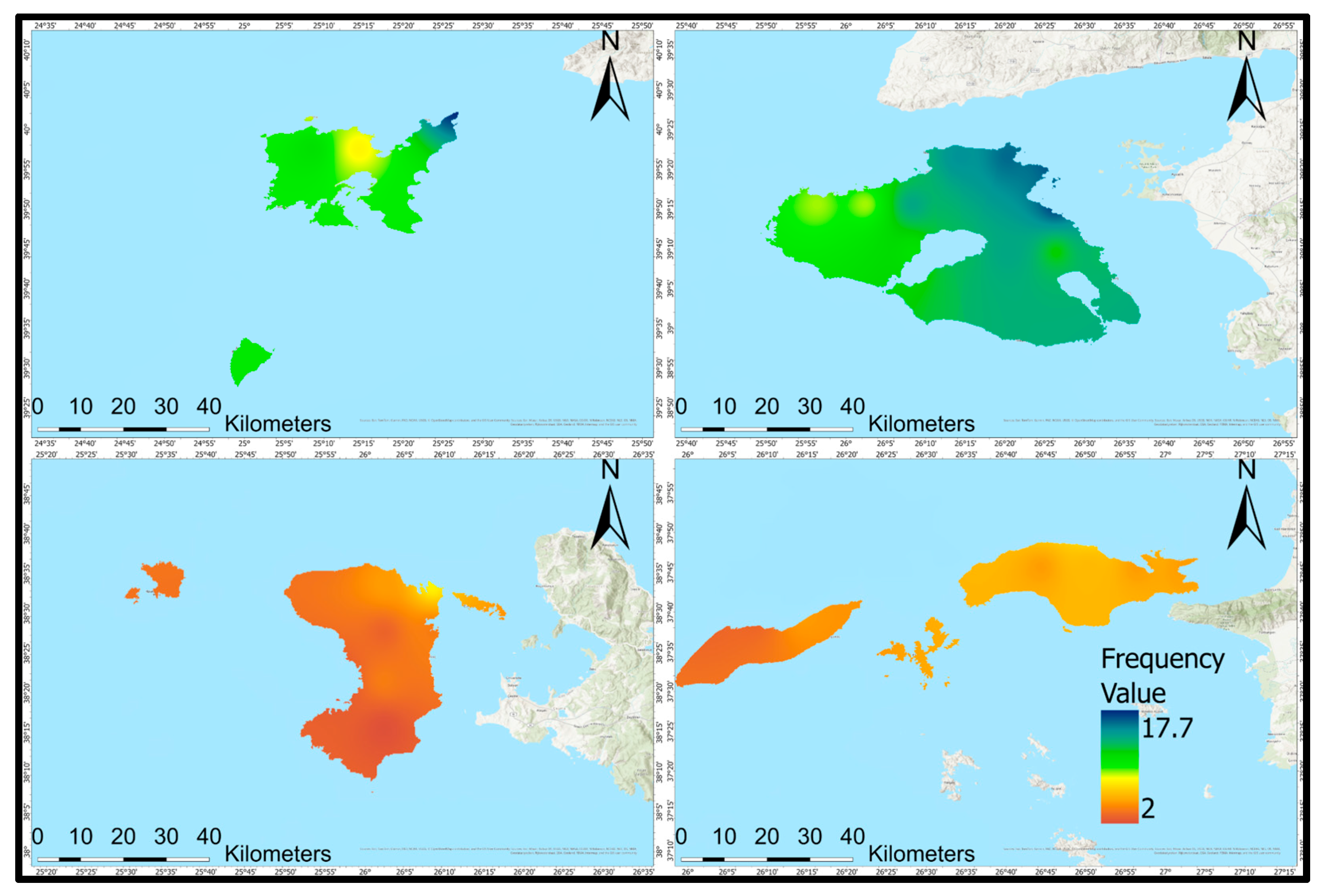
The provided data reveals significant spatial trends concerning both the frequency and duration of FD events across the study area (Figure 4 and Figure 5, respectively). The Frequency of FD events (Figure 4) recorded ranges between 2 and 18. There is a clear overall trend of increasing values when moving from south to north across the studied islands, as the northern islands (Lemnos and Lesvos) recorded the maximum values and the central (Chios) and southern islands (Samos–Ikaria) recorded the lowest one, a trend observed when moving from west to the east. The highest individual frequency values were specifically found in the northeastern part of Lesvos.
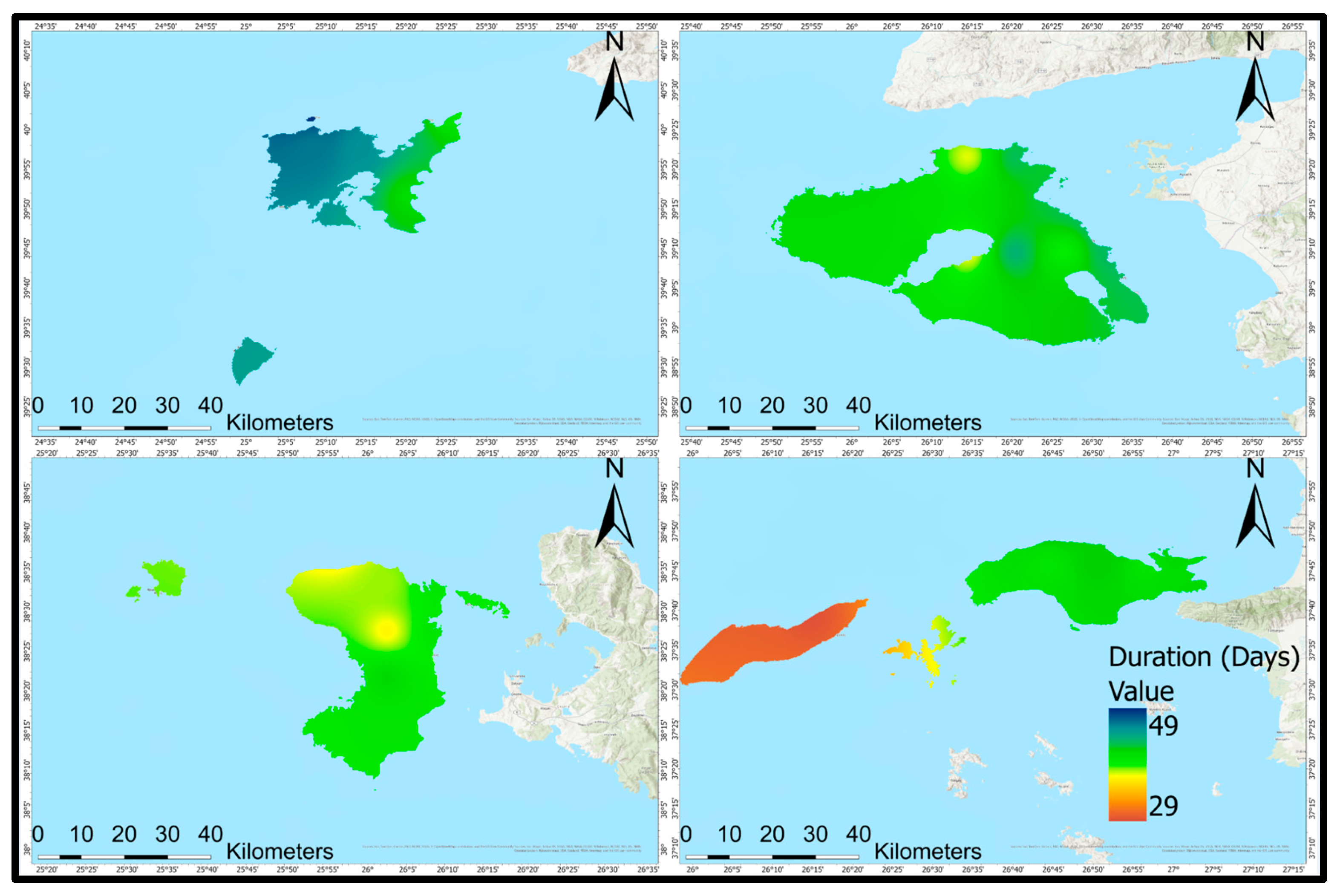
The Duration of the identified FDs (Figure 5) ranges between 5.8 and 10 pentads (equivalent to 29 and 50 days). A clear decreasing trend in duration is observed when moving from the north to the south, as the longer events occurred in the northern islands (Lemnos and Lesvos) and the shortest ones in the southern island group (Ikaria and Samos). Chios (central island) has FDs comparable to Lesvos.
In summary, the northern islands (Lemnos and Lesvos) are characterized by both the highest frequency and the longest FD durations, making them the most susceptible region to prolonged events.
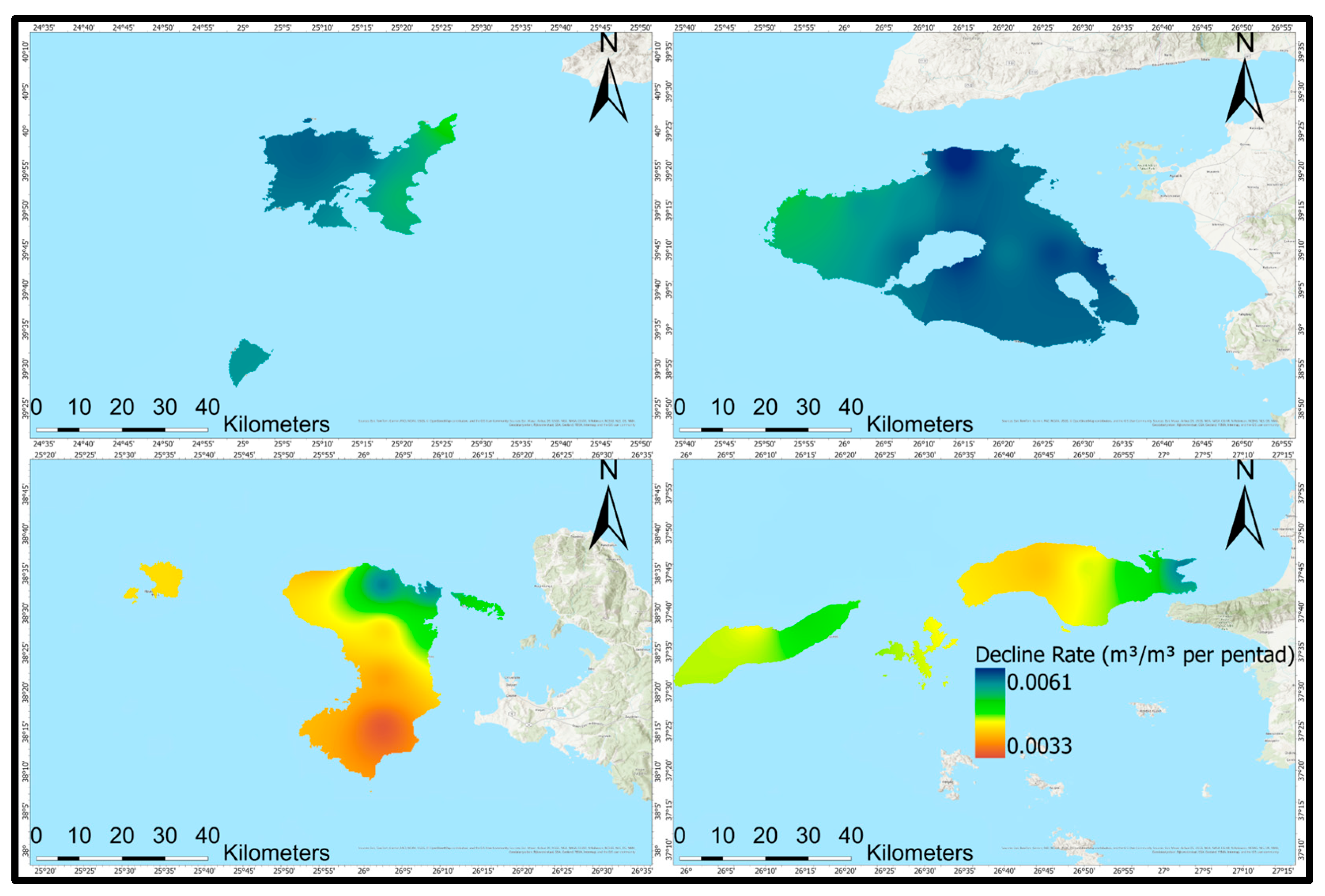
The Decline Rate of an FD indicates how quickly soil moisture drops, signifying the speed of drought onset with a higher value meaning that the drought develops more rapidly. These values (Figure 6) range between 0.0032 and 0.0062 m3 m−3 per pentad. The maximum values were consistently found on the northern islands (Lemnos and Lesvos), confirming that FDs start most rapidly in the northern part of the study area. The minimum values were found on the western parts of the southern and central islands (Samos–Ikaria and Chios). This distribution reinforces that the northern islands are not only more frequent and longer-duration FD hotspots but also areas where the onset speed (flash component) is most extreme.
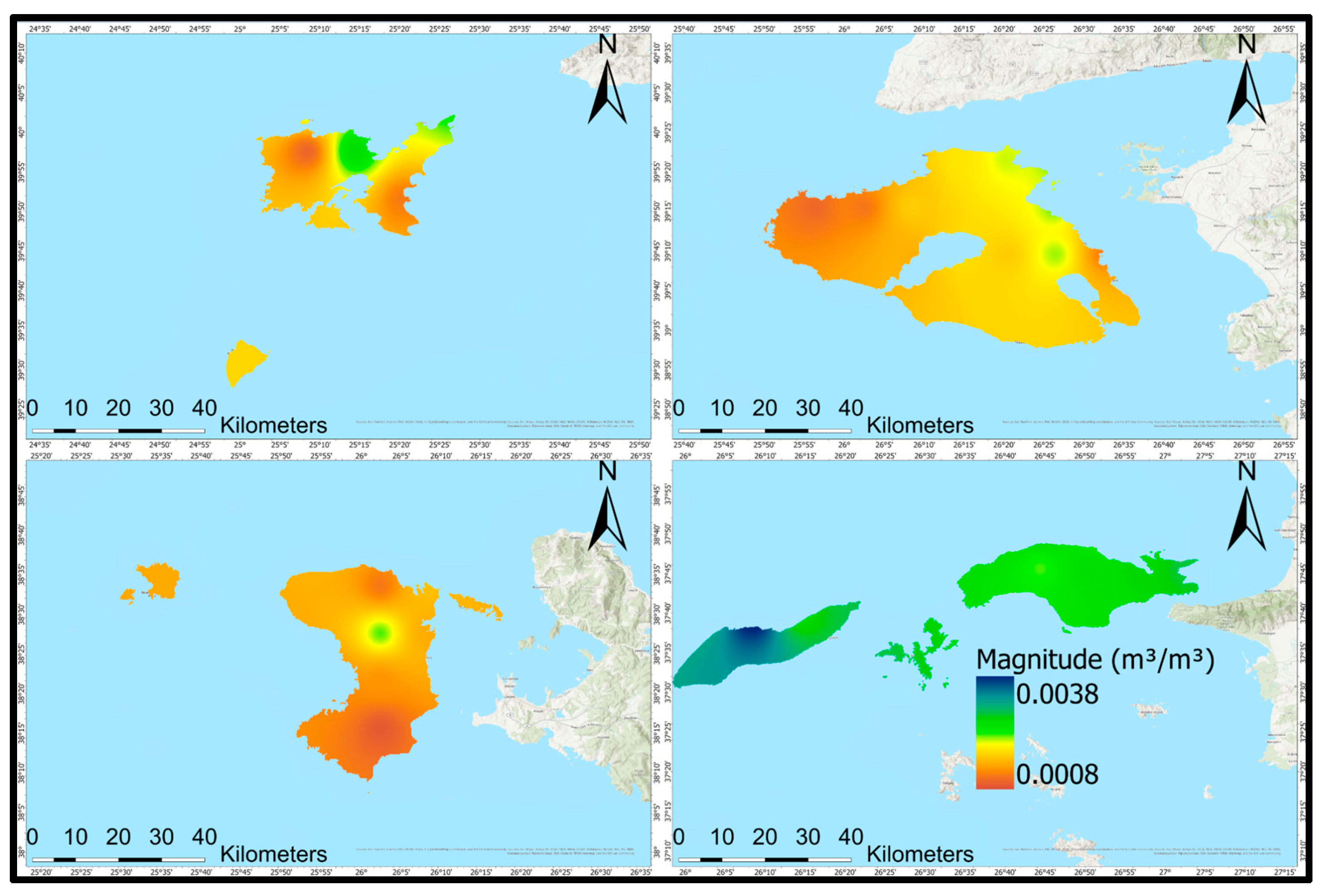
The values for flash drought Magnitude (overall severity) range between 0.0009 and 0.0040 (Figure 7). Unlike the inverse trend seen with frequency and duration, the highest magnitudes are concentrated in the southern island group (Samos–Ikaria, with values up to 0.0040), indicating that while these islands have fewer events, those that occur tend to be the most severe. The northern and central islands (Chios, Lemnos and Lesvos) have some regions with high magnitude values as they register peaks of 0.0022, 0.0023, and 0.0040 m3·m−3 respectively. This distribution highlights the critical finding that vulnerability shifts depending on the metric. The northern islands (Lemnos and Lesvos) lead in frequency and duration, but the southern islands (Samos–Ikaria) pose the greatest risk in terms of absolute severity (magnitude).
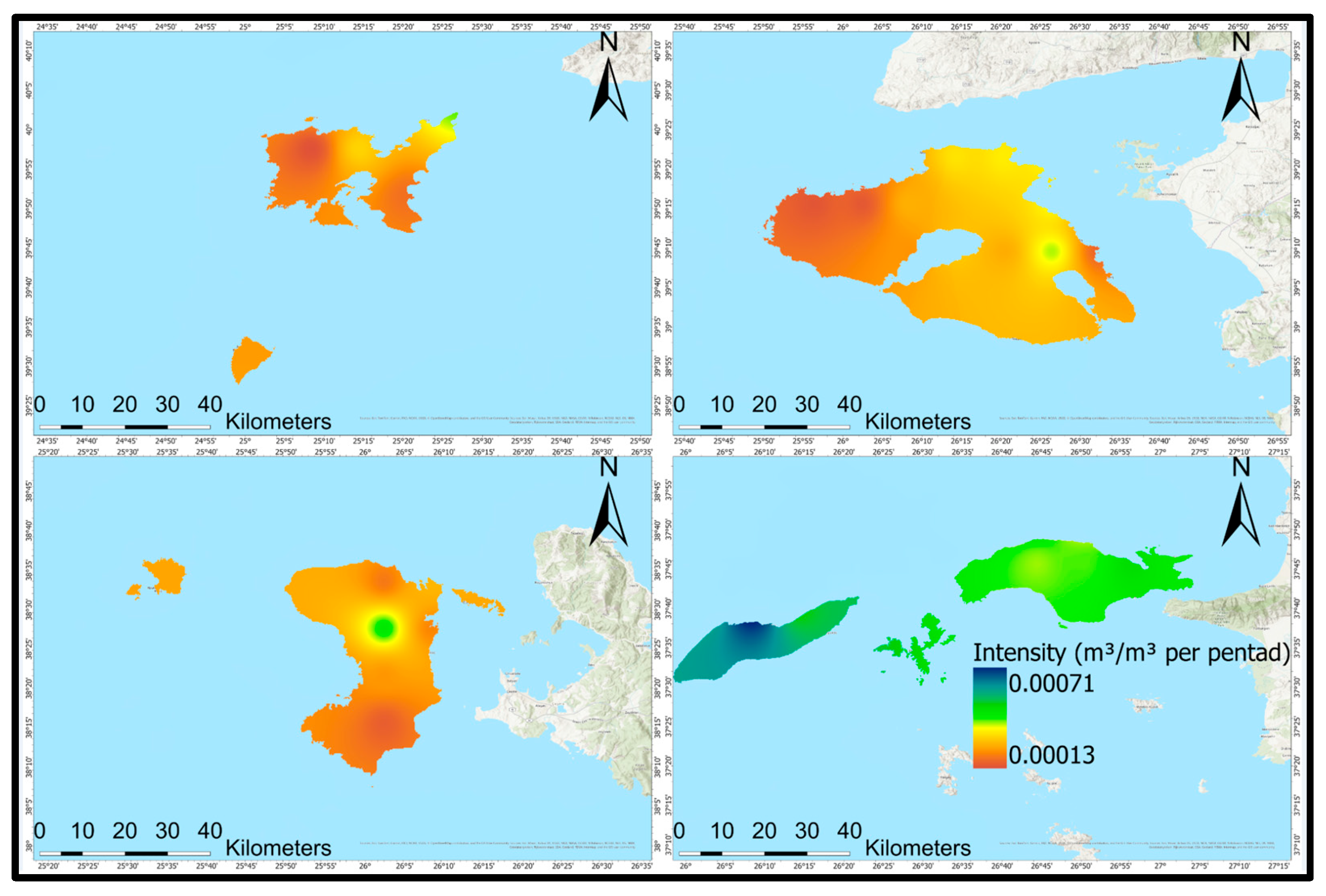
The analysis of FD Magnitude (overall severity) and Intensity (rate of development) reveals that their spatial distribution patterns are closely related, reinforcing the physical link between rapid onset and high impact. According to the definitions of the previous section, magnitude is directly connected to intensity and this spatial correlation is confirmed in the maps (Magnitude, Figure 7; Intensity, Figure 8). The spatial distribution of both metrics follows a similar pattern across the islands, with high-intensity areas typically coinciding with high-magnitude areas.
Intensity values range narrowly between 0.0001 and 0.0007 m3·m−3 per pentad across the region. Samos–Ikaria recorded the highest intensity values, while the remaining islands (Chios, Lemnos and Lesvos) presented similar, lower values. This confirms that the severe events found in the south (Samos–Ikaria) are also characterized by the most rapid onset. The central mountainous areas of Chios and an area on Lesvos above the capital of Mytilini (a low-altitude area) emerged as high-intensity hotspots. The exception to the strong correlation pattern is seen in the low-altitude, central parts of Lemnos, where intensity decreases despite moderate magnitude. The driving mechanism for rapid drying is highly localized and complex, likely influenced by microclimates and specific soil characteristics rather than elevation alone.
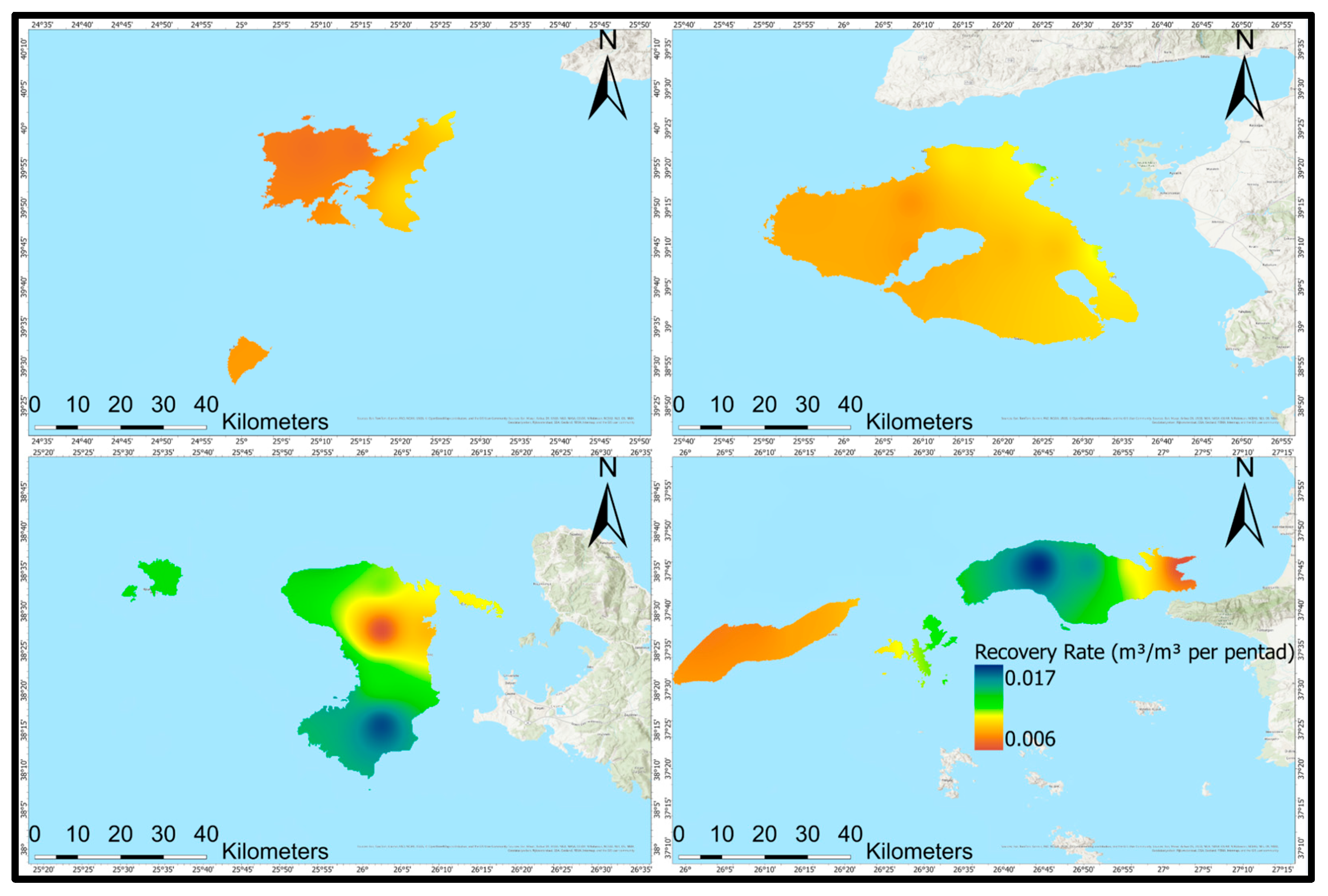
The spatial distribution of the Recovery Rate (Figure 9) reflects the resilience of the islands, showing how quickly they return to normal conditions following a FD event. This characteristic ranges generally between 0.011 and 0.017 m3·m−3 per pentad. The analysis reveals a distinct geographical pattern tied to the North–South grouping. In such a way, Samos–Ikaria and Chios present the highest recovery rates in their western parts, indicating that the western, often flatter or more open, regions of the southern and central islands bounce back most quickly from a FD event. Conversely, Lemnos and Lesvos present the lowest recovery rates on their eastern parts, indicating a lower resilience in the east of the northern islands, leading to drought conditions lingering longer.
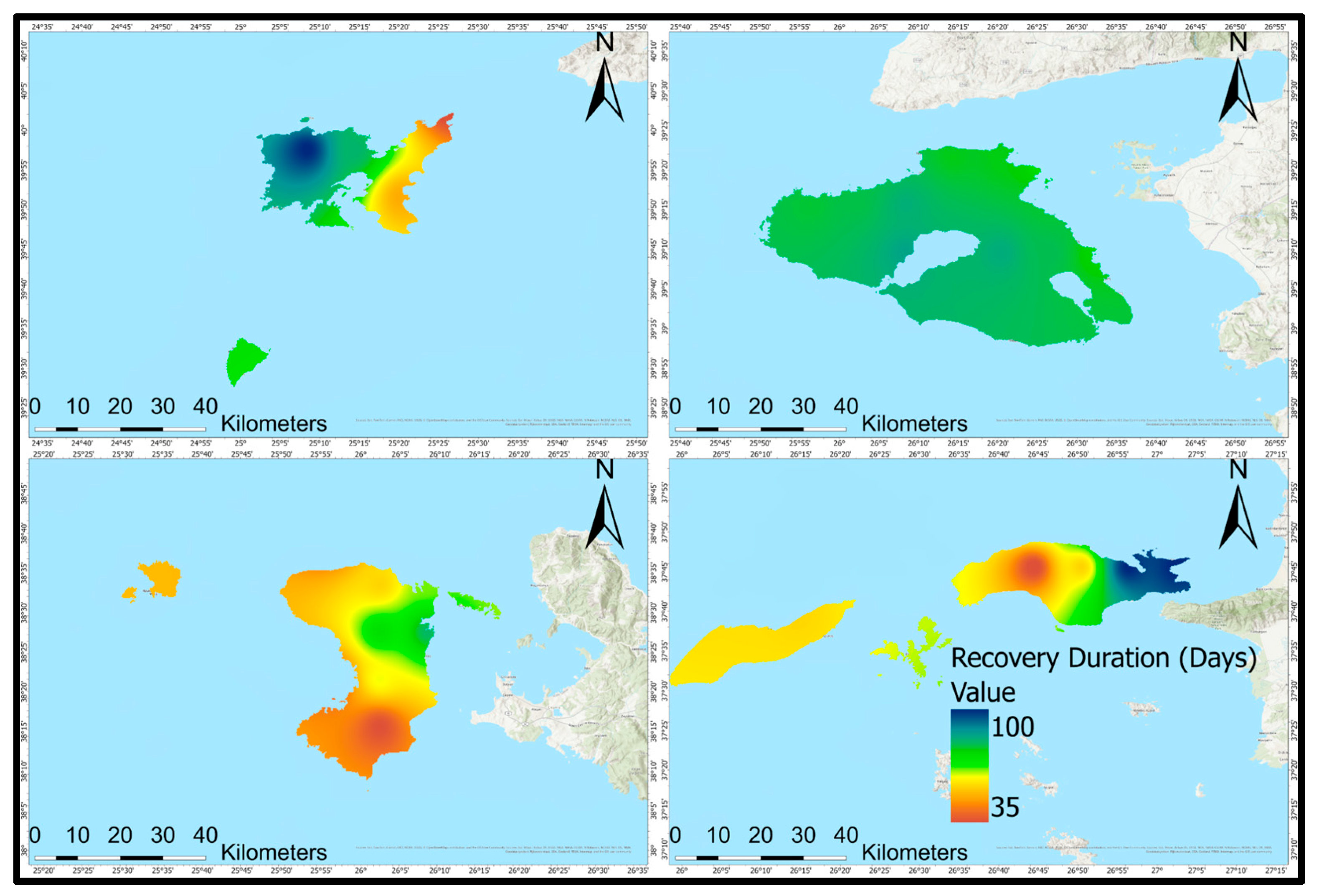
Figure 10 illustrates the Recovery Duration of FDs, showing the time needed for conditions to return to normal, measured in pentads and converted to days. Recovery duration is highly variable, ranging between 7.4 and 19.8 pentads (equivalent to 37 and 100 days). Lemnos and Samos define the extremes, with regions taking up to 100 days to recover. The highest values (slowest recovery) are clearly visible on the western part of Lemnos and the eastern part of Samos, confirming that these areas are significantly less resilient to FD impacts. Lesvos presents values ranging between 14.1 and 17 pentads (approximately 70 to 85 days), indicating a substantial but generally more moderate recovery period compared to the extremes of Lemnos and Samos. Chios exhibits the full range of possible variations, suggesting that recovery time is highly dependent on local soil and topographic conditions within the island itself. This distribution highlights that low resilience is a major factor in the western part of Lemnos and the eastern part of Samos.

3.1.2. Seasonal Analysis

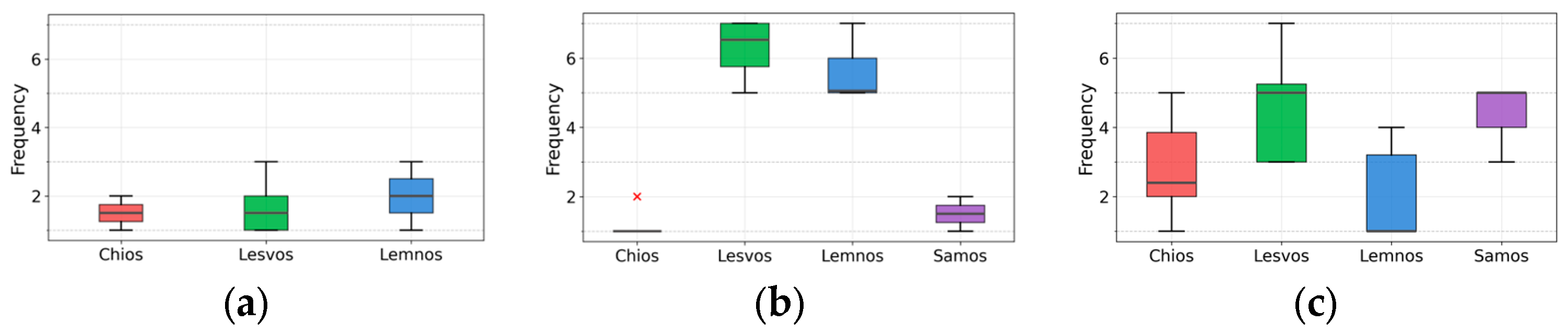
The box plots in Figure 11, Figure 12, Figure 13, Figure 14, Figure 15, Figure 16 and Figure 17 displaying the main indicators of FD events across the main study regions (Chios, Lesvos, Lemnos and Samos–Ikaria) allow for a visual comparison of their distribution, median, and seasonal variability. Samos–Ikaria Island group recorded no events in spring, while all islands had FD events identified in both summer and autumn. In spring, Lemnos shows the highest median frequency of FDs, followed by Lesvos and Chios (Figure 11a). This indicates that Lemnos and Lesvos typically experience more events during this season. Lemnos also displays the greatest year-to-year variability, with its frequency fluctuating significantly. The median frequencies for all three regions drop significantly in the summer compared to those in spring (Figure 11b), indicating less variability. Chios and Lesvos have similar, low median frequencies, while Lemnos has a slightly higher median. The number of events is more consistent in the summer, although these are less frequent overall. The median frequencies for all regions increase again in autumn (Figure 11c). Lemnos has the highest median, followed by Lesvos and then Chios and Samos. All regions show a wider distribution of frequencies in autumn compared to summer. The events are characterized by noticeable inter-annual variability, particularly in Lemnos and Lesvos.
Overall, the highest frequencies are recorded in Lemnos during spring and summer and in Lesvos during autumn. While Lesvos has similar frequencies in spring and summer, they double in autumn. Chios shows the most variability, with a frequency of 0.5 in spring, 0 in summer, and 1.8 in autumn. Samos experiences no FDs in spring, fewer than two in summer, and more than double that amount in autumn. This seasonal pattern suggests that Lesvos and Samos have similar FD frequency behaviors in summer and autumn.
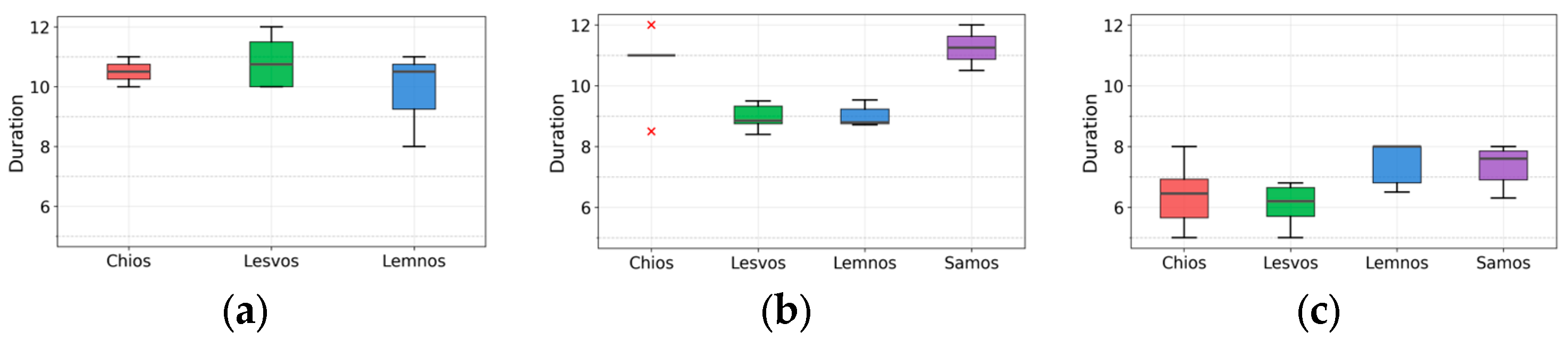
The three box plots, in Figure 12, illustrate the duration of FD events in different regions (Chios, Lesvos, Lemnos and Samos) across spring, summer and autumn. The y-axis on each plot represents duration in pentads. In spring (Figure 12a) Lesvos shows the highest median duration, followed closely by Lemnos, when Chios has the lowest and Samos as previously mentioned has no FD events. FDs last longest in Lesvos and Lemnos and shorter in Chios during the spring. Lemnos has the widest range, indicating the greatest variability in event duration. This means that the duration of FDs in Lemnos can fluctuate significantly from year to year. Lesvos and Chios have a much smaller spread, indicating more consistent durations. In summer (Figure 12b) the median duration drops significantly for all regions compared to spring. Lesvos and Lemnos have similarly low median durations. Chios has a slightly higher median, but all are much lower than in spring. All regions show very little variability in summer duration, suggesting that events, while not long, are very consistent in their duration. In autumn (Figure 12c) the median duration increases again for all regions, with Lemnos having the highest median, followed by Lesvos, Chios and finally Samos. This suggests that FDs that begin in autumn tend to be the longest. Both Lemnos and Lesvos show a wide range of durations in autumn, with Lemnos having a particularly large spread. This indicates that autumn FD durations are showing large interannual variability.
Overall, duration is highly variable across all seasons (spring, summer, and autumn), with autumn being the season when all islands experience their longest duration FD events.
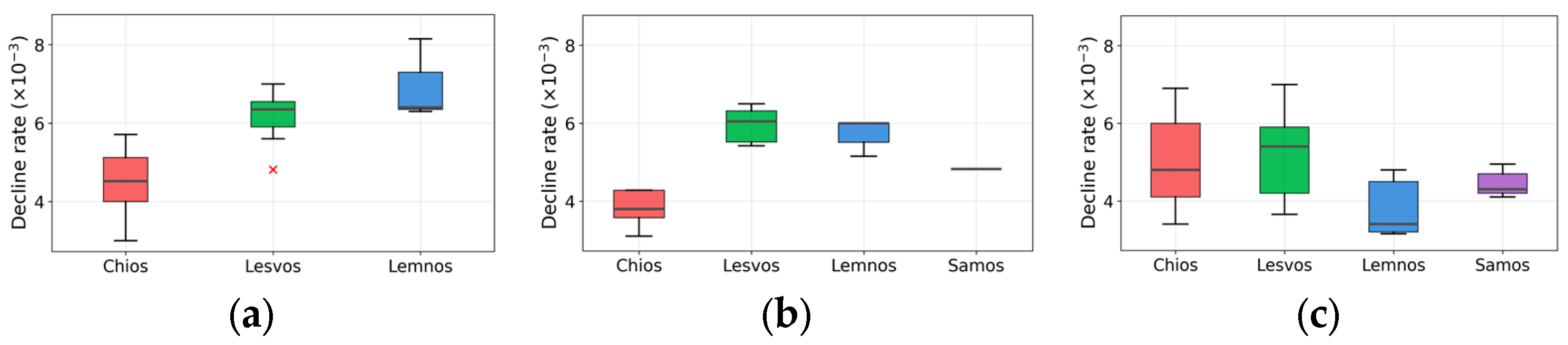
In terms of Decline Rate, Samos has no FDs in spring (Figure 13a) and all other regions suggest a consistent decline rate, indicating a stable trend. The median decline rate in Lesvos is the highest in the spring, while Lemnos has the second-highest median rate and Chios has the lowest. In summer (Figure 13b) Lesvos and Lemnos have the highest median decline rates, which are also very similar to each other. The decline rate in Chios drops considerably, making it the lowest among the four. Both Lesvos and Lemnos show a decline rate in summer which is very consistent. Lesvos shows the highest median decline rate, indicating that FDs on this island tend to develop most rapidly in autumn (Figure 13c). Chios has the second-highest median decline rate, while Samos and Lemnos have the lowest median rates. In terms of variability, Lesvos and Chios have a wide spread suggesting that the autumn decline rate can fluctuate significantly from one event to the next.
For all islands there is an increasing trend from spring to autumn. Lesvos and Lemnos consistently exhibit higher median decline rates than the other regions, indicating that FDs tend to develop more rapidly on these islands. Chios generally has a lower decline rate in all seasons, while Samos shows a consistently low decline rate. The highest overall median decline rates for all regions occur in summer, and for Lesvos and Lemnos are particularly notable, possibly linked to their common geological and weather conditions. In conclusion, summer is the season when FDs are most likely to develop rapidly on these islands.
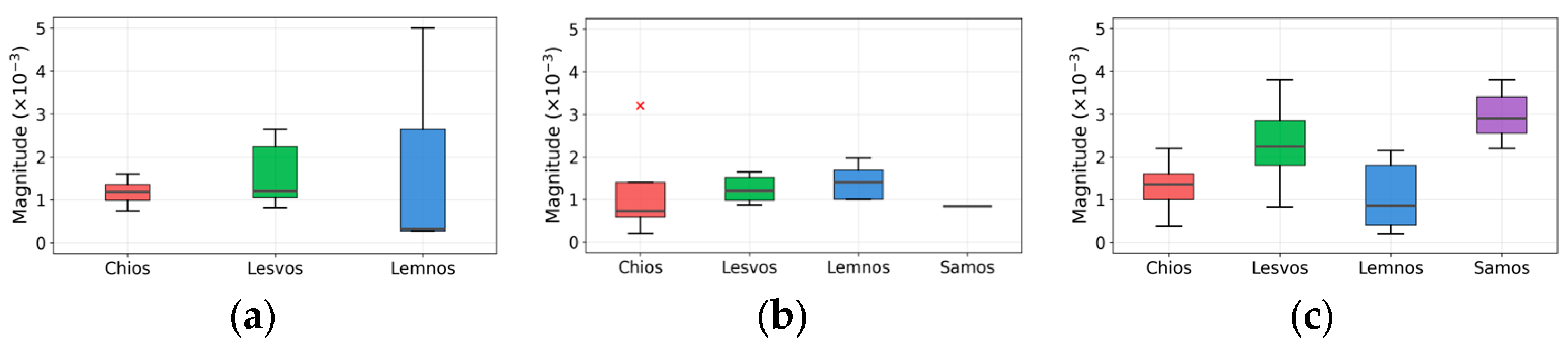
Lesvos and Lemnos generally experience a higher magnitude of FDs in spring (Figure 14a) compared to Chios. The highest median magnitude is found in Lemnos, (followed by Lesvos, and then Chios). For Lesvos and Lemnos a wide range of magnitude values and high variability in the severity of FDs during this season can be found. In summer (Figure 14b) Lesvos and Lemnos have similar median magnitudes, considerably greater than that of Chios. Samos has a very low median magnitude—that is why it is barely visible on the chart—suggesting that it experiences the lowest FD magnitudes in summer. The variability in summer magnitude is much lower for all regions compared to spring, as indicated by the lower values of the box plots. The median magnitudes for all regions increase significantly in autumn (Figure 14c). Lemnos and Samos show the highest median magnitudes, with Lemnos having a slightly higher one. Lesvos and Chios have lower median magnitudes, although they are still higher than in summer. The variability in autumn magnitude is high, particularly in Lemnos and Samos, as shown by the wide spread of their respective box plots.
Lemnos and Lesvos consistently experience higher magnitude FDs across all three seasons compared to Chios and Samos. This island has the lowest magnitude in summer, but its magnitude increases significantly in autumn, where it has one of the highest values. The highest overall magnitudes for all regions are observed during autumn, indicating that FDs occurring in this season are generally the most severe. The variability in magnitude is highest in spring and autumn, with more consistent (but generally lower) magnitudes in summer.
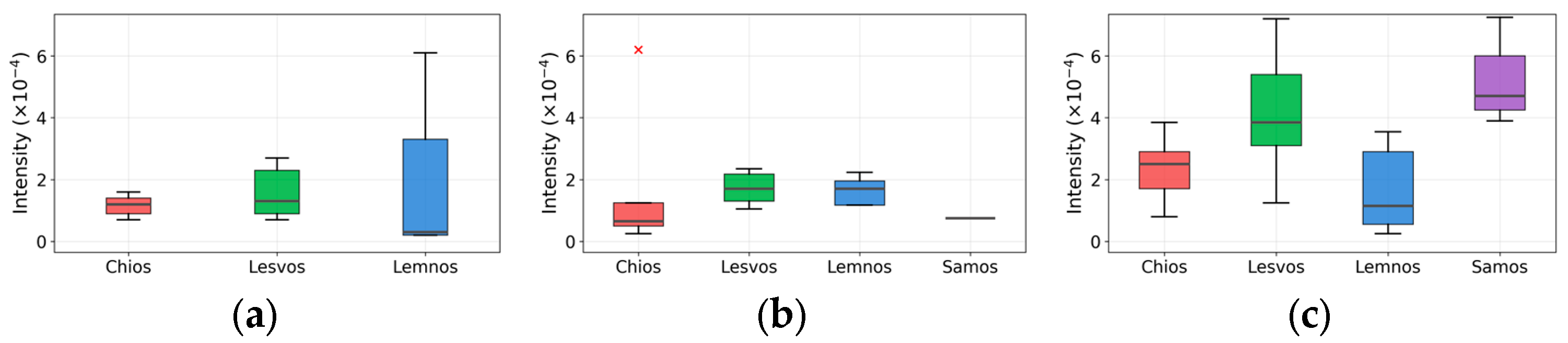
Intensity trends mirror those of magnitude with Lesvos and Lemnos generally experiencing a higher intensity of FDs in spring (Figure 15a) compared to Chios. The highest median intensity is found in Lemnos, followed by Lesvos and then Chios. The box values for Lesvos and Lemnos are relatively high, indicating a wide range of intensity values and high variability in the rate of FD development during this season. Lemnos and Lesvos have similar median intensities in summer (Figure 15b), with Lesvos’s median being slightly higher. Both are considerably greater than that of Chios. Samos has a very low median intensity, suggesting that it experiences the lowest FD intensities in summer. As it can be seen in this figure, the variability in summer intensity is much lower for all regions compared to spring. Concerning autumn (Figure 15c) the median intensities for all regions increase significantly. Lemnos and Samos show the highest median intensities, with Lemnos having a slightly higher one. Lesvos and Chios have lower median intensities, although they are still higher than in summer. The variability in autumn intensity is high, particularly in Lemnos and Samos, as shown by the wide spread of their box plots.
Lemnos and Lesvos consistently experience higher intensity FD events across all three seasons compared to Chios and Samos. Samos has the lowest intensity in summer; however, its intensity increases significantly in autumn, reaching one of the highest values among the islands. The highest overall intensities for all regions are observed during autumn, indicating that FDs occurring in this season are generally the most severe, linked possibly to the season’s high ET demand. The variability in intensity is highest in spring and autumn, with more consistent (but generally lower) intensities in summer.
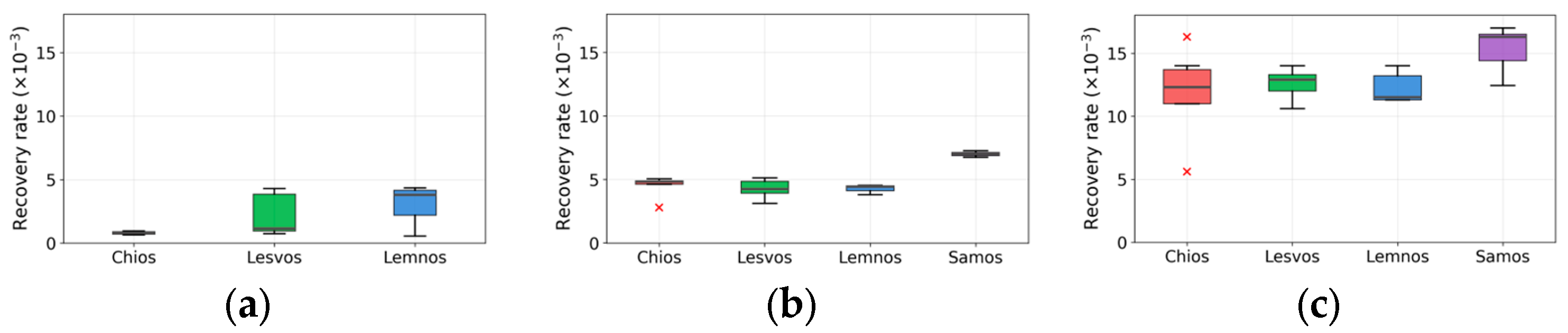
In terms of recovery rate, Lesvos and Lemnos show significantly higher values in spring (Figure 16a) than Chios. This suggests that FDs in Lesvos and Lemnos tend to end more quickly and the return to normal conditions is fast. Lemnos shows the greatest range of recovery rates, indicating high variability from one event to the next. The recovery in Lesvos is more consistent, while Chios has a very low and narrow range of values. Lemnos has the highest median recovery rate in summer (Figure 16b), followed by Lesvos. Chios and Samos have similar, low recovery rates, indicating that their FDs end most quickly during the summer. The variability in summer is generally low across all regions. Samos shows the highest median recovery rate in autumn (Figure 16c), surpassing all other regions and seasons. Lemnos has the second-highest median, followed by Lesvos and Chios. The variability in autumn is high for all regions, and Lemnos demonstrates consistently a high value across all three seasons, suggesting a strong ability for the region to recover from FDs. Samos has a very high recovery rate in autumn, but its rate is very low in summer.
Chios consistently shows the lowest recovery rates across all seasons, indicating that FDs in this region tend to last longer. Lesvos follows a pattern similar to Lemnos, with high values in spring and autumn and slightly lower rates in summer. The overall highest recovery rates for all regions occur in autumn, indicating that this season is most conducive to a rapid end to FD events, possibly linked to either the seasonal decrease in temperature and/or the seasonal increase in precipitation.
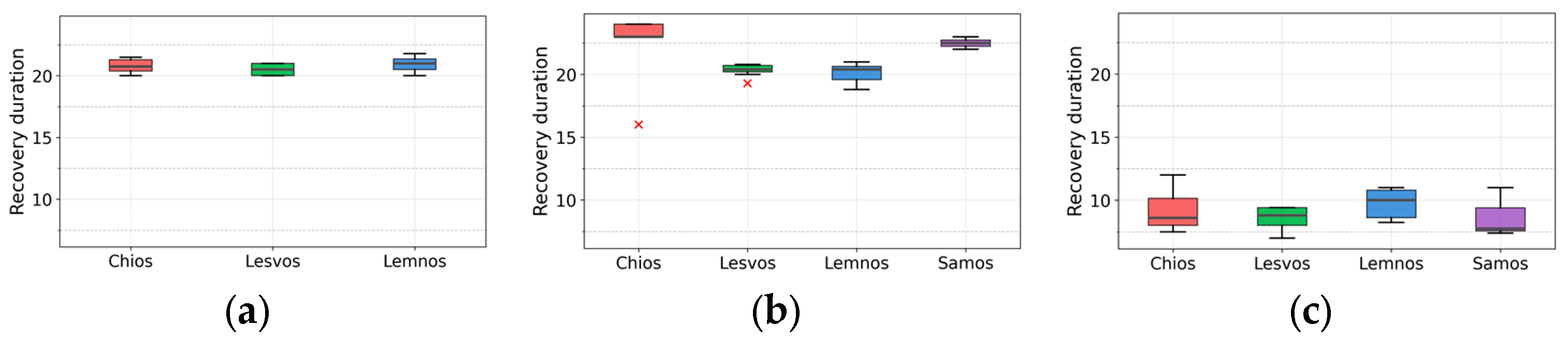
Concerning recovery duration in spring (Figure 17a) Chios has the highest median value, suggesting that FDs on this island tend to be longer. Lesvos has a lower median and Lemnos has the lowest one, indicating that these regions recover more quickly from FDs in this season. Lemnos shows the greatest range of recovery durations, indicating high variability from one event to the next. In summer (Figure 17b), Chios has the highest median recovery duration, indicating that it takes the longest for FDs to end on this island. Lesvos and Lemnos have lower and very similar median recovery durations and Samos has the lowest, suggesting the fastest recoveries. The variability in summer values is generally low across all regions. In autumn, Lemnos has the highest median value (Figure 17c), followed by Lesvos and Chios. Samos has the lowest median recovery duration. The variability in autumn values is high for all regions, as shown by the wide spread of their box plots.
The overall recovery duration for all regions is higher in spring and autumn, while it is the lowest in summer. Chios consistently shows the longest recovery duration in spring and summer, suggesting that FDs tend to persist. Lemnos and Lesvos have similar value patterns, and they generally recover more quickly than Chios in spring and summer. Samos shows the shortest recovery duration in both summer and autumn, indicating a fast recovery from FDs.
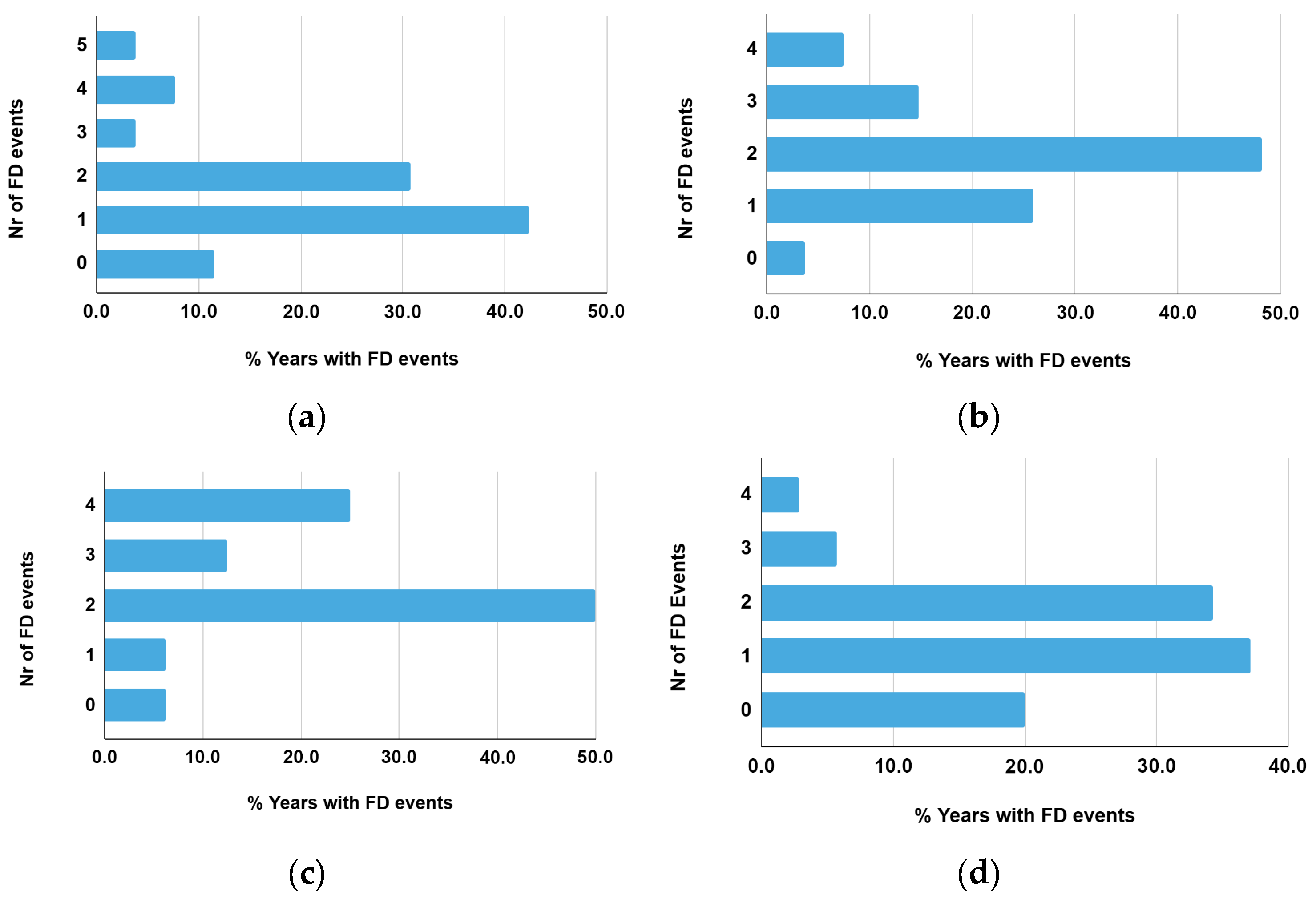
A comparison of event frequency shows significant variation across the islands, as the occurrence of past FD events is highly dependent on both the specific year and the geographic location (Figure 18). The percentage of years without a detected FD event ranged from as low as 4% for Lemnos to as high as 20% for the Samos–Ikaria island group. Two FD events are typical for the majority of years in Lesvos and Lemnos, while Chios and Samos–Ikaria experience usually one per year. In a single year, Chios had recorded the highest number of events—five events—among all the islands, while the others peaked at four. Further investigation is necessary to link and analyze the temperature and precipitation variations, as well as any heat anomalies, that occurred during the particular time periods with the biggest number of FD events.

3.2. SPEI Results

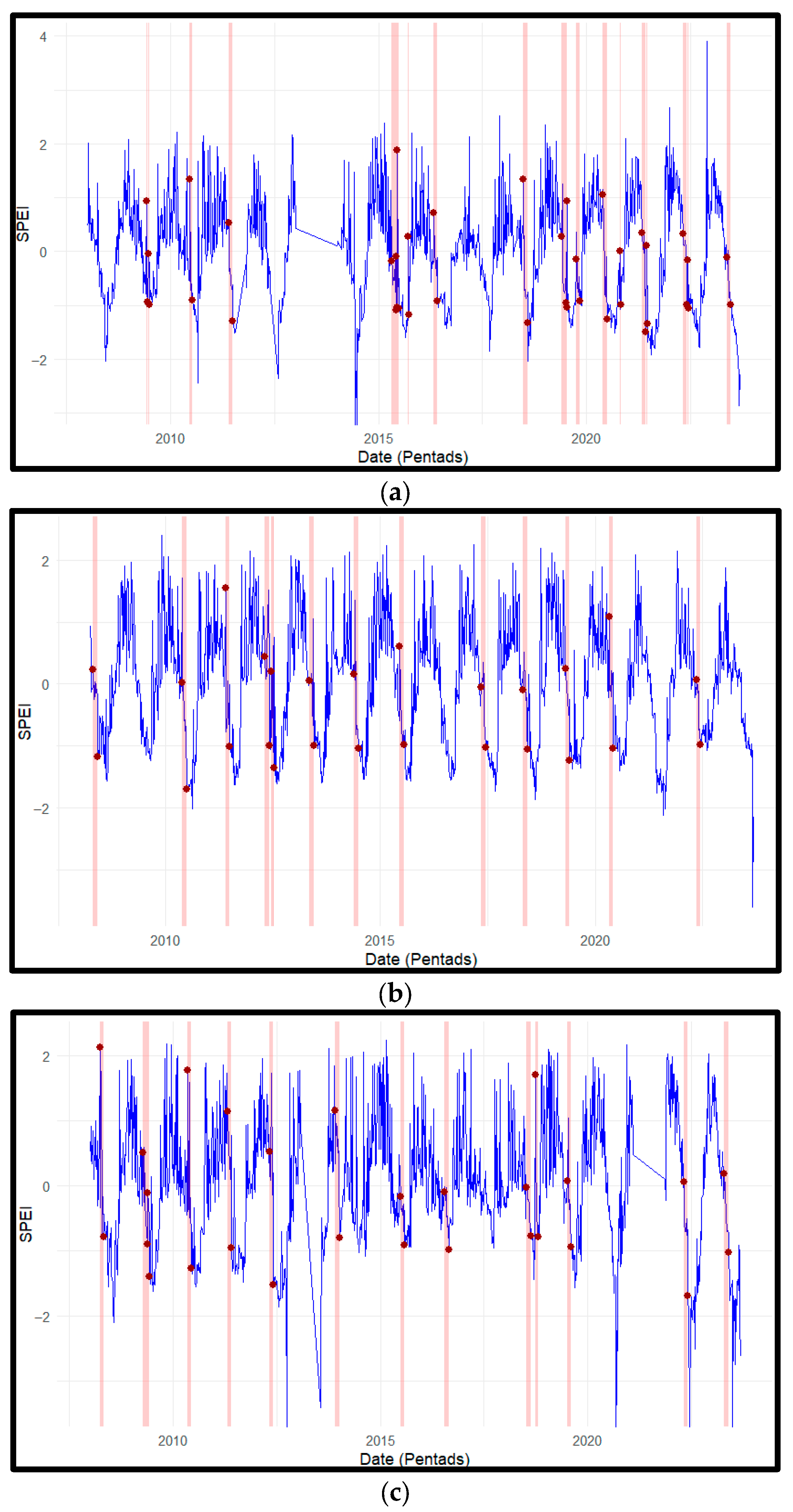
In order to provide a localized perspective on historical FD events on Lesvos, we employed the SPEI methodology. The results of this analysis are presented visually in Figure 19, with a corresponding analytical outline detailed in the following sections.
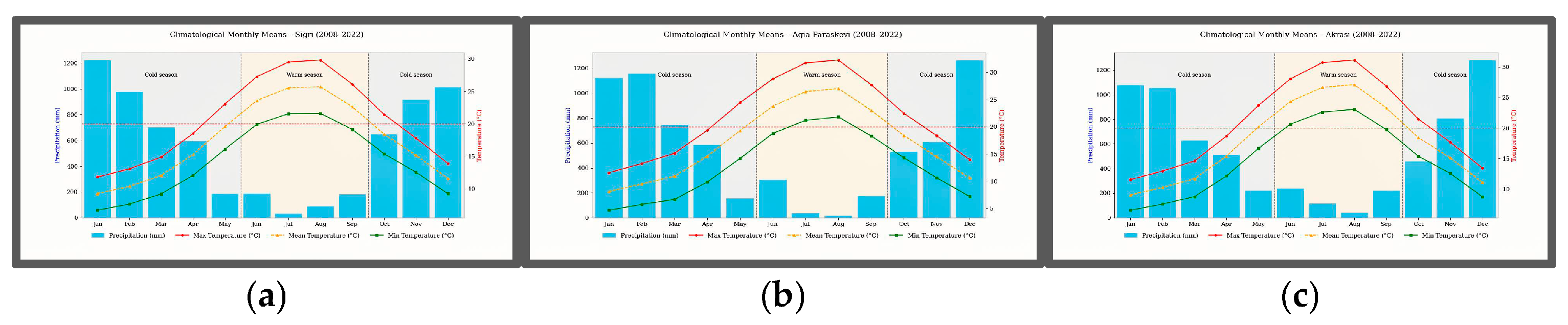
At the Agia Paraskevi meteorological station, 13 FD events were identified between 2008 and 2022 (Figure 19a). This includes two events in 2015 and 2019, one event in most other years, and none in 2012, 2013, 2014, or 2017. The duration of these events varied from 4 pentads (20 days) to 8.0 pentads (41 days), with longer durations being more common. The events typically started in late spring to early summer and persisted through the summer months, aligned with the very low mean precipitation and the high mean temperatures observed in those months, as detailed in Figure 20a.
The intensity of these FDs ranged from the lowest value in 2022 to the highest in 2015, clearly demonstrating that interannual variability dominates over any long-term trend. Magnitude, which varied from the lowest in 2022 to a peak in 2018, also showed no clear trend. The high magnitude in 2018, coinciding with high intensity, indicates a particularly severe and rapid-onset event, when in contrast, the 2022 event was less severe and slower to develop. The interannual variability in both intensity and magnitude highlights the influence of year-to-year climate fluctuations on FD characteristics, with no evidence of a systematic change in severity or rapidity over the study period.
The study at Akrasi (Figure 19b) identified one FD event in most years between 2008 and 2022, with two events in 2012 and none in 2009, 2016, or 2021. Most of these events had a consistent duration of around 8.0 pentads (41 days), with a few exceptions lasting 6.0 or 9.0 pentads. The onset dates were primarily in late April and May, with the events persisting through June and July, aligned with the climatological data shown in Figure 20b. Intensity values ranged from the lowest in 2008 to the highest in 2014, showing no distinct trend. Similarly, magnitude fluctuated between the lowest in 2008 and the highest in 2015, also without a clear trend. The 2015 event stands out with both the highest magnitude and a relatively high intensity, suggesting a severe and rapid-onset flash drought. Further investigation on precipitation and temperature values could potentially provide the driving force behind the observed FD event and its characteristics.
In Sigri (Figure 19c), two FD events were identified in 2009 and 2018, with single events in most other years between 2008 and 2023. No events were recorded in 2013, 2017, 2020, or 2021. The duration of these events was more variable, ranging from 4.2 to 9.0 pentads, without a single dominant length. Onset dates were broadly distributed from late April to December, indicating a wider window for onset timing and FD development (Figure 20c). Intensity values ranged from the lowest in 2023 to the highest in 2018, demonstrating significant differences in the rate of development, indicating a broad spectrum of severity. The 2018 event was particularly extreme, with the highest intensity and magnitude. In contrast, the 2023 event was the weakest. The 2015 and 2018 events suggest a positive relationship between high intensity and high magnitude; however, this requires formal statistical analysis for confirmation. In terms of event duration there is not a clear connection either concerning intensity or magnitude.

4. Discussion

Using the approach—the SM methodology—described in the previous sections, the seasonal spatio-temporal patterns and trends of FDs in the Northeastern Aegean islands were analyzed over the period 1990–2024. This comprehensive analysis employed the SM method as its foundation. Additionally, only for the island of Lesvos, the SPEI was utilized in order to produce a localized analysis. This index was selected because it has been widely used globally to assess drought effects on both agricultural and environmental systems [55], consistently demonstrating superior performance compared to many other common drought indices. As FDs are primarily characterized by their severe environmental and agricultural impacts, the SPEI offers a more valuable picture of these effects than other drought metrics. However, the calculation and use of SPEI were limited in our research, due to the primary challenge of data availability and typical discontinuities in the meteorological time series, particularly in remote areas like the studied islands. This inherent data challenge prevented the SPEI from being used as the explicit foundation for the full regional study.
To address the critical issues of data availability and continuity, the SM method was adopted, leveraging the widely utilized ERA5 metadata. While this approach ensures necessary temporal and spatial coverage, it is essential to acknowledge the inherent limitations linked to this reanalysis product in specific regional contexts.
We acknowledge that uncertainties in the ERA5 dataset arise from disparities in the underlying land-surface models and data assimilation techniques [40,41]. Furthermore, the accuracy is complicated by the dependence of soil temperature memory on background aridity [35], which unevenly affects drying rates and the depletion of root zone soil moisture (RZSM).
Crucially, the assumption of the ERA5 model presents a source of local uncertainty: the calculated soil moisture is the average across three layers (0–7 cm, 7–28 cm, and 28–100 cm). This model structure poorly aligns with the hydrological reality of the Aegean islands where soils are typically very thin (often less than 20 cm), meaning the shallow soil moisture is strongly dependent on short-run meteorological conditions. The local hydrological complexity is further exacerbated by the fact that in summer months, overexploitation for irrigation demands often results in the shallow aquifer being completely drained. Finally, the ability to fully validate the SM method locally is compounded by the total absence of measured soil moisture data across the Northeastern Aegean islands.
Furthermore, the accuracy is complicated by the dependence of soil temperature memory on background aridity. This is particularly relevant, given findings that significant uncertainties are associated with FD occurrences and rate of intensification when using two distinct FD indicators (e.g., evaporative stress and root zone soil moisture estimates) in the ERA5 dataset across a majority of the globe.
Unlike the established meteorological indices that classify conventional drought into distinct categories (e.g., Moderate, Severe, Extreme), a direct, analogous classification system for FD metrics does not currently exist. To overcome this limitation, the scientific community relies on a multi-metric approach. In the current study, this is addressed by using distinct characteristics—intensity, duration, and magnitude—as continuous variables. This methodology allows for a quantitative assessment of the FD event’s developmental speed, longevity, and overall severity, thereby providing a nuanced characterization that circumvents the current classification limitation. This study’s spatial analysis (Figure 4, Figure 5, Figure 6, Figure 7, Figure 8, Figure 9 and Figure 10) identified the most vulnerable areas for FD development across the islands, while the seasonal analysis (Figure 11, Figure 12, Figure 13, Figure 14, Figure 15, Figure 16 and Figure 17) detailed how event characteristics change throughout the seasons. All islands recorded FD events in summer and autumn; conversely Samos uniquely had no events identified in spring. In general, FDs are generally longest in autumn, followed by spring, and are shortest in summer.
The comparative study on FD characteristics for the Chios, Lemnos, Lesvos, and Ikaria-Samos islands portrays different patterns for each island regarding their frequency, intensity, and recovery process. The results for Chios Island portray that FD events in Chios occur relatively often for a short period of time (7.8 pentads), characterized by slow water depletion (Decline Rate = 0.0044 m3·m−3 per pentad) and a swift recovery process (Recovery Rate = 0.010 m3·m−3 per pentad), denoting a resilient hydro-climatic system. The FD characteristics for Lemnos also indicate that FDs occur frequently (11 events lasting for 8.9 pentads on average), similar in Intensity (0.0003 m3·m−3 per pentad) to the Chios ones, with the slowest recovery process (17.25 pentads), denoting that it is characterized by longer hydro-stress periods. The FD characteristics for Lesvos show that this island recorded the highest frequency (13 drought events), for a shorter period (8.3 pentads) and by a Decline Rate of 0.0056 m3·m−3 per pentad, on average. The recovery process is slow (15.85 pentads) and less effective (Recovery Rate = 0.0075 m3·m−3 per pentad) and, therefore, indicative of gradual drying and vulnerability to drought conditions. For the group of Samos–Ikaria, FD events occur less frequently (5.5 events), characterized by the highest intensity (0.0005 m3·m−3 per pentad) and are distinguished by its swift onset and recovery process (Decline Rate = 0.005 m3·m−3 per pentad and Recovery Rate = 0.011 m3·m−3 per pentad).
The northern and eastern parts of Lesvos are the most vulnerable, experiencing the highest frequency, longest durations, highest magnitude, intensity, and recovery rates. The duration of these events is long across all seasons, showing high variability. The northeastern part of Lemnos experiences the most frequent and most severe FD events. Conversely, the western part is vulnerable due to events that are both the longest in duration and the slowest to recover. Compared to the other islands, the longest-duration FDs across all seasons as well as of highest variability the longest-duration FDs across all seasons and shows the highest variability can be found here. The highest number of FD events was detected in the northeastern part of Chios, when the central part is the most vulnerable in terms of overall severity (high magnitude). This island has the shortest FD durations in spring and autumn, making it less susceptible to prolonged events. Finally, Samos is vulnerable to frequent, long-lasting, rapid, and severe FD events compared to the other islands, with its southeastern part standing out as a hotspot for frequent, rapidly declining, and severe FD events. Samos exhibits no events in spring, short duration events in summer, and longer duration FDs in autumn. The longest recovery duration can be found for all islands in summer, followed by spring and autumn. This pattern is linked to the climatic conditions of this region, as autumn is the wet period, summer is completely dry, and spring conditions are determined by whether the preceding winter was wet or dry. To clarify the correlation between local climatic conditions and FDs, further investigation must be conducted in order to identify the main driver that causes FDs.
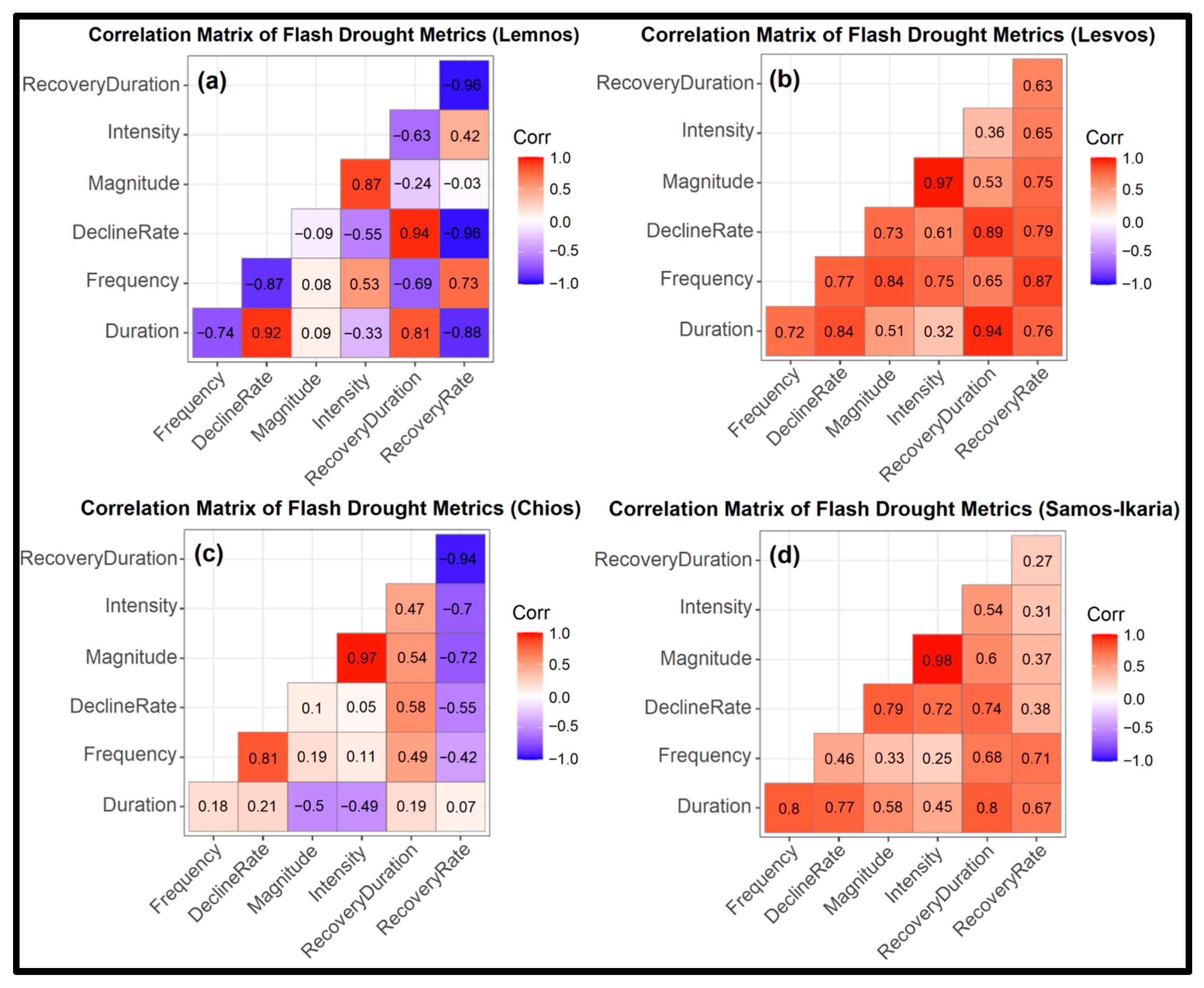
The correlation analysis for FD metrics (Figure 21) presents highly varying patterns for attribute interactions across the study region, underscoring the strong influence of local conditions on the evolution of FD events.
Correlations in Chios are predominantly weak to moderate, denoting largely uncorrelated drought process characteristics. The highest positive correlation is found only between Intensity and Magnitude (r = 0.97). The recovery duration and recovery rate are strongly negatively correlated (r = −0.94), meaning the longer the drought recovery periods, the lower the actual recovery rates. Lemnos exhibits a mix of both strong positive and strong negative correlations, denoting complex drought process characteristics. Frequent FDs also tend to be long in duration (r = 0.73). Droughts of larger dimensions tend to exhibit greater intensity (r = 0.87). Strong negative correlations between Decline Rate and Recovery Duration (r = −0.96) and Frequency and Recovery Duration (r = −0.87) show that both rapid and frequent droughts are penalized by a slow and prolonged recovery. Correlations on Lesvos are invariably strong and mostly positive across almost all drought attributes, denoting strongly linked drought process characteristics. This systematic coupling suggests that factors driving the drought are highly coherent across the island. Intense droughts are also characterized by the fastest soil moisture Decline Rate (r = 0.97). Frequent droughts also tend to be larger in overall severity (r = 0.84). Droughts lasting longer periods also exhibit faster recovery rates, indicating that the system quickly rebounds after prolonged stress (r = 0.94). Samos–Ikaria group displays moderate to high positive correlations among the development metrics, indicating events that hit hard and fast but recover quickly. Strong positive links exist between Magnitude and Intensity (r = 0.90) and between Decline Rate and Magnitude (r = 0.86), confirming a systematic rapid onset. Recovery Duration and Recovery Rate remain inversely correlated (r = −0.91), suggesting fast rebound dynamics after short but intense droughts. The key takeaway from these results is the high variability observed in all FD characteristics. This variability in the spatio-temporal distribution is, therefore, not unusual within the broader Mediterranean region, a conclusion supported by the limited existing research on FDs from Spain [20], Italy [21], and Greece [22]. This complexity may be driven by the combination of geomorphology, the vegetation cover, the ratio of irrigated-non irrigated land and local climatic conditions, but this requires further investigation, as well as climate change.
Global climate models project that the Mediterranean Basin will face increasing temperature and decreasing summer precipitation leading to higher atmospheric evaporative demand [37,55]. This projected increase in water-demand and water-stress conditions means the frequency and severity of FD events are expected to intensify in the future. While direct attribution of observed FD trends was beyond the scope of this work, the findings are highly consistent with established global climate change projections for this region. The performed time series analysis showed no statistically significant linear trend in FD frequency or intensity, and the results are dominated by interannual variability and significant peaks, that could possibly be a signature of a climate system under stress. The increase in the number of years with FD events, coupled with the observed extreme magnitude events (e.g., Sigri in 2018), strongly suggests a climatic influence. Our methodology, by isolating the high-intensity, rapid-onset components of drought, provides a critical baseline against which future climate change impacts can be locally evaluated. By isolating the high-intensity, rapid-onset components of historical FDs, we establish the specific geographical “hotspots” (e.g., northeastern Lesvos) that are pre-conditioned for amplified FD risk as regional temperatures continue to rise. The identification and analysis of vulnerable areas—“hotspots”, coupled with the study of past events and their characteristics, forms a crucial foundation for effective risk management. Understanding the nature of past FDs in specific areas is the essential first step toward monitoring them. By monitoring these events, a scientific framework is established that allows for a predictive model to be built, and subsequently, an early warning system to be developed. This approach mirrors successful operational systems like the Flash Drought Monitor (FDM) [56], developed by the University of Saragossa in Spain, that allows the operational tracking of FDs in Spain at near-real time using observational meteorological data from automated weather stations [57]. This methodology can be used for FD risk assessments in regions with similar geological and climatic complexity as well as sparse observational networks (broader Mediterranean and Black Sea regions). To implement this framework, the required data must be acquired: Soil Moisture data can be acquired from ERA5, and the data for the localized SPEI analysis can be obtained from local meteorological stations. If these ground stations are unavailable or have discontinuous data, then other sources, such as satellite data, can be used as alternatives.

5. Conclusions

This study successfully demonstrated the applicability of two distinct methods for identifying and characterizing historical FD events within the Northeastern Aegean islands. While both methodologies proved viable and had inherent limitations, they offered crucial complementarity, as the SPEI method offered good capabilities for localized analysis using ground station data and the SM method provided distinct advantages in delivering a detailed spatial distribution of events across the entire island group. This combined approach allowed for a comprehensive assessment that neither index could achieve alone.
The research, based on the SM method, had successfully identified the temporal and spatial distribution of FD events and their key characteristics, which were then used to pinpoint the most vulnerable areas. The northern and eastern parts of Lesvos experienced the highest frequency of events, along with the longest durations, and the highest values for magnitude, intensity and recovery rates. The northeastern part of Lemnos experienced the most frequent and most severe FD events. However, the western part of this island recorded events that were both the longest in duration and took the longest to recover from. The highest number of FD events was detected in the northeastern part of Chios, while in terms of magnitude, the central part of this island is the most vulnerable area. Samos is vulnerable to FD events that are frequent, last long, decline rapidly and reach low magnitude and intensity. The smaller islands of this group exhibit a moderate risk, while Ikaria shows a low to moderate vulnerability to severe and frequent flash droughts, with vulnerability decreasing from west to east. Ultimately, the southeastern part of Samos and the small islands stand out as “hotspots” for frequent, rapidly declining, and severe FD events.
The correlation analysis for the FD metrics of the study region reveals a clear spatial gradient in FD behavior: Lesvos and Lemnos exhibit systematic, coupled drought behavior with high inter-variable coherence, when Chios and Samos–Ikaria show more variable and event-driven relationships, underscoring the dominant role of local climatic and hydrological conditions in shaping the evolution and recovery of FD across the Northeastern Aegean islands.
The main findings of the research using the SPEI method suggest that the characteristics of FD events vary significantly across the three locations on Lesvos Island. Sigri, located at the lowest altitude, experienced the most frequent and severe FD events (in terms of magnitude and intensity), particularly during the summer and autumn. Agia Paraskevi showed a moderate frequency with higher magnitudes in summer, while Akrasi had a similar frequency but with generally lower magnitudes and a higher occurrence in Spring. This highlights the seasonal and interannual variability of FD characteristics even within a single island and defines “hotspot” areas.
Determining these “hotspot” areas is essential for implementing targeted and adaptive measures to mitigate FD impacts. These “hotspot” areas should be prioritized for adaptive management and drought-resilient agricultural practices.
The historical vulnerability profile established in this study provides the essential foundation for climate change risk assessment as the analysis of past events is the necessary first step toward developing the regional adaptive strategies required in the face of ongoing global warming. Given the consensus that FD frequency and severity are expected to intensify across Europe [31], future research should specifically focus on attributing the interannual variability of FD events to key climatic drivers (e.g., heat anomalies, North Atlantic Oscillation indices) in order to specify the mechanisms leading to the most severe historical events. The established historical baseline and the defined FD “hotspots” should be integrated into predictive climate models to develop tailored, sub-seasonal to seasonal early warning systems that forecast how FD risk will evolve under various climate change scenarios.
The successful quantitative framework developed—by combining the large-scale ERA5 Soil Moisture data with localized SPEI analysis—offers a robust and adaptable template for FD assessment in data-scarce, climatically sensitive environments. Our methodology can be a transferable protocol for FD risk assessment in islands and coastal areas with similar complex geological and sparse observational networks, such as the broader Mediterranean and Black Sea regions.
Ultimately, the study underscores the importance of continuous monitoring and advanced modeling techniques to better predict and manage FD risks across the Mediterranean region. An early warning FD system, similar to Spain’s FDM could be developed and tested for this specific Aegean region.

Author Contributions

Writing—original draft, C.K.; Software—E.L.; Data acquisition—N.P.; Writing—review and editing, I.M., E.K., P.G., A.P. and O.T. All authors have read and agreed to the published version of the manuscript.

Funding

This research received no external funding.

Data Availability Statement

Due to the large size of the database, the data reported in this study are available upon request.

Acknowledgments

During the preparation of this manuscript, the author(s) used R 4.3.2, for the purposes of creating the analyzing scripts, ArcGIS Pro 3.3 for mapping and Gemini 2.5 as well as Grammarly, for spelling and grammar corrections. The authors have reviewed and edited the output and take full responsibility for the content of this publication.

Conflicts of Interest

The authors declare no conflicts of interest.

Abbreviations

The following abbreviations are used in this manuscript:
C3SCopernicus Climate Change Service
CsaHot Summer Mediterranean
DDuration
DRDecline Rate
ECMWFEuropean Centre for Medium Range Weather Forecasts
EDDIEvaporative Demand Drought Index
FFrequency
FDFlash Drought
FDMFlash Drought Monitor
IIntensity
MMagnitude
NAFZNorth Anatolian Fault Zone
PETPotential Evapotranspiration
RDRecovery Duration
RRRecovery Rate
SLRSea Level Rise
SMSoil Moisture
SPEIStandard Precipitation Evapotranspiration Index
SPIStandard Precipitation Index

References

  1. Mishra, A.K.; Singh, V.P. A review of drought concepts. J. Hydrol. 2010, 391, 202–216. [Google Scholar] [CrossRef]
  2. Wilhite, D.A.; Glantz, M.H. Understanding the Drought Phenomenon: The Role of Definitions. Water Int. 1985, 10, 111–120. [Google Scholar] [CrossRef]
  3. McKee, T.B.; Doesken, N.J.; Kleist, J. The relationship of drought frequency and duration to time scales. In Proceedings of the Eighth Conference on Applied Climatology, Anaheim, CA, USA, 17–22 January 1993. [Google Scholar]
  4. Hao, Z.; Singth, V.P. Drought characterization from a multivariate perspective: A review. J. Hydrol. 2015, 527, 668–678. [Google Scholar] [CrossRef]
  5. Christian, J.I.; Basara, J.B.; Otkin, J.A.; Hunt, E.D. Regional characteristics of flash droughts across the United States. Environ. Res. Commun. 2019, 1, 125004. [Google Scholar] [CrossRef]
  6. Svoboda, M.; LeComte, D.; Hayes, M.; Heim, R.; Gleason, K.; Angel, J.; Rippey, B.; Tinker, R.; Palecki, M.; Stooksbury, D. The drought monitor. Bull. Am. Meteorol. Soc. 2002, 83, 1181–1190. [Google Scholar] [CrossRef]
  7. Senay, G.B.; Budde, M.E.; Senay, S.A. Remote sensing-based estimation of evapotranspiration and drought conditions in the Central United States. Remote Sens. Environ. 2008, 112, 345–385. [Google Scholar]
  8. Hunt, E.D.; Hubbard, K.G.; Wilhite, D.A.; Arkebauer, T.J.; Dutcher, A.L. The development and evaluation of a soil moisture index. Int. J. Climatol. 2009, 29, 747–759. [Google Scholar] [CrossRef]
  9. NOAA. National Centers for Environmental Information (NCEI) U.S. Billion-Dollar Weather and Climate Disasters. 2025. Available online: https://www.ncei.noaa.gov/access/billions/ (accessed on 5 July 2025).
  10. Caloiero, T.; Veltri, S.; Caloiero, P.; Frustaci, F. Drought Analysis in Europe and in the Mediterranean Basin Using the Standardized Precipitation Index. Water 2018, 10, 1043. [Google Scholar] [CrossRef]
  11. Christian, J.I.; Basara, J.B.; Hobbins, M.; Hoell, A.; Otkin, J.A.; Ford, T.W.; Cravens, A.E.; Powlen, K.A.; Wang, H.; Mishra, V. Flash drought: A state of the science review. WIREs Water. 2024, 11, e1714. [Google Scholar] [CrossRef]
  12. Lisonbee, J.; Woloszyn, M.; Skumanich, M. Making sense of flash drought: Definitions, indicators, and where we go from here. J. Appl. Serv. Climatol. 2021, 2021, 1–19. [Google Scholar] [CrossRef]
  13. Koster, R.D.; Schubert, S.D.; Wang, H.; Mahanama, S.P.; DeAngelis, A.M. Flash Drought as Captured by Reanalysis Data: Disentangling the Contributions of Precipitation Deficit and Excess Evapotranspiration. J. Hydrometeorol. 2019, 20, 1241–1258. [Google Scholar] [CrossRef]
  14. Ford, T.W.; Labosier, C.F. Meteorological conditions associated with the onset of flash drought in the Eastern United States. Agric. For. Meteorol. 2017, 247, 414–423. [Google Scholar] [CrossRef]
  15. Otkin, J.A.; Svoboda, M.; Hunt, E.D.; Ford, T.W.; Anderson, M.C.; Hain, C.; Basara, J.B. Flash droughts: A review and assessment of the challenges imposed by rapid—Onset droughts in the United States. Bull. Am. Meteorol. Soc. 2018, 99, 911–919. [Google Scholar] [CrossRef]
  16. Zhu, Y.; Yang, P.; Huang, H.; Xia, J.; Chen, Y.; Li, Z.; Shi, X. How about the flash drought events and their impacts on vegetation in Central Asia. Clim. Dyn. 2024, 62, 7073–7093. [Google Scholar] [CrossRef]
  17. Zeng, Z.; Wu, W.; Peñuelas, J.; Li, Y.; Jiao, W.; Li, Z.; Ren, X.; Wang, K.; Ge, Q. Increased risk of flash droughts with raised concurrent hot and dry extremes under global warming. Clim. Atmos. Sci. 2023, 6, 134. [Google Scholar] [CrossRef]
  18. Ayugi, B.O.; Ullah, I.; Chung, E.-S. Observed flash drought to persist in future over southern Africa. Sci. Total Environ. 2024, 951, 177–187. [Google Scholar] [CrossRef]
  19. Christian, J.I.; Basara, J.B.; Hunt, E.D.; Otkin, J.A.; Xiao, X. Flash drought development and cascading impacts associated with the 2010 Russian heatwave. Environ. Res. Lett. 2020, 15, 094078. [Google Scholar] [CrossRef]
  20. Noquera, I.; Dominguez-Castro, F.; Vicente-Serrano, S.M. Characteristics and trends of flash droughts in Spain 1961–2018. Ann. N. Y. Acad. Sci. 2020, 1472, 155–172. [Google Scholar] [CrossRef]
  21. Raposo, V.D.M.B.; Costa, V.A.F.; Rodrigues, A.F. A review of recent developments on drought characterization, propagation and Influential Factors. Sci. Total Environ. 2019, 898, 165550. [Google Scholar] [CrossRef]
  22. Yao, T.; Liu, S.; Hu, S.; Mo, X. Evaluation of ecosystem’s response to flash drought in water-limited regions of China. Environ. Res. Lett. 2024, 19, 124093. [Google Scholar] [CrossRef]
  23. Neelam, M.; Hain, C.R. Flash Droughts Characteristics: Onset, Duration and Extent at Watershed Scales. Res. Lett. 2024, 51, 1–11. [Google Scholar] [CrossRef]
  24. Zheng, X.; Huang, S.; Peng, J.; Leng, G.; Huang, Q.; Fang, W.; Guo, Y. Flash droughts identification based on an improved framework and their contrasting impacts on vegetation over the Loess Plateau, China. Water Resour. Res. 2022, 58, e2021WR031464. [Google Scholar] [CrossRef]
  25. Nguyen, H.; Wheeler, M.C.; Otkin, J.A.; Nguyen-Huy, T.; Cowan, T. Climatology and Composite Evolution of Flash Drought over Australia and its vegetation impacts. J. Hydrometeorol. 2023, 24, 1087–1101. [Google Scholar] [CrossRef]
  26. Shah, J.; Hari, V.; Rakovec, O.; Markonis, Y.; Samaniego, L.; Mishra, V.; Hanel, M.; Hinz, C.; Kumar, R. Increasing footprint of climate warming on flash droughts occurrence in Europe. Environ. Res. Lett. 2022, 17, 064017. [Google Scholar] [CrossRef]
  27. Christian, J.I.; Basara, J.B.; Hunt, E.D.; Otkin, J.A.; Furtado, J.C.; Mishra, V.; Xiao, X.; Randall, R.M. Global distribution, trends, and drivers of flash drought occurrence. Nat. Commun. 2021, 12, 6330. [Google Scholar] [CrossRef] [PubMed]
  28. Alencar, H.L.; Paton, E.N. How do we identify flash droughts? A case study in Central European Croplands. Hydrol. Res. 2022, 53, 1150. [Google Scholar] [CrossRef]
  29. Spinoni, J.; Naumann, G.; Vogt, J. Pan-European seasonal trends and recent changes of drought frequency and severity. Glob. Planet. Change 2017, 148, 113–130. [Google Scholar] [CrossRef]
  30. Otkin, J.A.; Zhong, Y.; Hunt, E.D.; Christian, J.I.; Basara, J.B.; Nguyen, H.; Anderson, M.C. Development of a flash drought intensity index. Atmosphere 2021, 12, 741. [Google Scholar] [CrossRef]
  31. Christian, J.I.; Martin, E.R.; Basara, J.B.; Furtado, J.C. Global projections of flash drought show increased risk in a warming climate. Communic. Earth Environ. 2023, 4, 165. [Google Scholar] [CrossRef]
  32. Noguera, I.; Vicente-Serrano, S.M.; Domínguez-Castro, F. The rise of atmospheric evaporative demand is increasing flash droughts in Spain during the warm season. Geophys. Res. Lett. 2022, 49, e2021GL097703. [Google Scholar] [CrossRef]
  33. Sehgal, V.; Gaur, N.; Mohanty, B.P. Global flash drought monitoring using surface soil moisture. Water Resour. Res. 2021, 57, e2021WR02990. [Google Scholar] [CrossRef]
  34. Noguera, I.; Dominguez-Castro, F.; Vicente-Serrano, S.M. Flash Drought Response to Precipitation and Atmospheric Evaporative Demand in Spain. Atmosphere 2021, 12, 165. [Google Scholar] [CrossRef]
  35. Mossie Aschale, T.; Buonacera, G.; Palazzolo, N.; Cancelliere, A.; Peres, D.J. An historical flash drought analysis in Sicily based on ERA5 Reanalysis evapotranspiration and soil moisture data. In Proceedings of the Conference: European Geosciences Union General Assembly 2024 (EGU24), Vienna, Austria, 14–19 April 2024. [Google Scholar]
  36. Leivadiotis, V.; Psilovikos, A. The characteristics of flash droughts across Thessaly, Central Greece, from 1990 to 2024. In Proceedings of the Conference: XIII World Congress of the European Water Resources Association (EWRA 2025): “New Challenges in Understanding and Managing Water-Related Risks in a Changing Environment”, Palermo, Sicily, 24–28 June 2025; Volume 1, pp. 167–168. [Google Scholar]
  37. Mastrantonas, N.; Herrera-Lormendez, P.; Magnusson, L.; Pappenberger, F.; Matschullat, J. Extreme precipitation events in the Mediterranean: Spatiotemporal characteristics and connection to large-scale atmospheric flow patterns. Int. J. Clim. 2021, 41, 2710–2728. [Google Scholar] [CrossRef]
  38. Alhammoud, B.; Claud, C.; Funatsu, B.; Béranger, K.; Chaboureau, J.-P. Patterns of Precipitation and Convection Occurrence over the Mediterranean Basin Derived from a Decade of Microwave Satellite Observations. Atmosphere 2014, 5, 370–398. [Google Scholar] [CrossRef]
  39. Pendergrass, A.G.; Meehl, G.A.; Pulwarty, R.; Hobbins, M.; Hoell, A.; Ahakouchak, A.; Bonfils, C.J.W.; Gallant, A.J.E.; Hoerling, M.; Hoffmann, D.; et al. Flash droughts present a new challenge for subseasonal—To—Seasonal prediction. Nat. Clim. Change 2020, 10, 191–199. [Google Scholar] [CrossRef]
  40. Kofidou, M.; Stathopoulos, S.; Gemitzi, A. Review on spatial downscaling of satellite derived precipitation estimates. Environ. Earth Sci. 2023, 82, 424. [Google Scholar] [CrossRef]
  41. Zhang, Y.; Ye, A.; Nguyen, P.; Analui, B.; Sorooshian, S.; Hsu, K. Error Characteristics and Scale Dependence of Current Satellite Precipitation Estimates Products in Hydrological Modeling. Remote Sens. 2021, 13, 3061. [Google Scholar] [CrossRef]
  42. Available online: https://www.pvaigaiou.gov.gr/dyn/userfiles/files/pdf-diavouleysh/PESPKA_B_AIGAIOU.pdf (accessed on 25 March 2025).
  43. Borsi, S.; Ferrara, G.; Innocenti, F.; Mazzuoli, R. Geochronology and petrology of recent volcanics in the eastern Aegean Sea (West Anatolia and Lesvos Island). Bull. Volcanol. 1972, 36, 473–496. [Google Scholar] [CrossRef]
  44. Kosmas, C.; Ferrara, A.; Briassouli, H.; Imeson, A. Methodology for mapping Environmentally Sensitive Areas (ESAs) to Desertification. In The Medalus Project Mediterranean Desertification; Kosmas, C., Kirkby, M., Geeson, N., Eds.; European Union: Brussels, Belgium, 1999; pp. 31–47. ISBN 92-828-6349-2. [Google Scholar]
  45. Zerefos, C.; Xoplaki, E.; Kapsomenakis, J.; Solomos, S.; Poupkou, A.; Gerasopoulos, E. Past, Present, and Future Climates in the Mediterranean. In Environmental Sustainability in the Mediterranean Region. Springer Geography; Ferreira, C.S.S., Destouni, G., Kalantari, Z., Eds.; Springer: Cham, Switzerland, 2024. [Google Scholar] [CrossRef]
  46. Liu, Y.; Zhu, Y.; Ren, L.; Otkin, J.; Hunt, E.; Yang, X.; Yuan, F.; Jiang, S. Two Different Methods for Flash Drought Identification: Comparison of Their Strengths and Limitations. J. Hydromet. 2020, 21, 691–704. [Google Scholar] [CrossRef]
  47. Muñoz Sabater, J. ERA5 Land hourly data from 1950 to present. Copernicus Climate Change Service (C3S). Clim. Data Store 2019, 10, 2025. [Google Scholar] [CrossRef]
  48. Seneviratne, S.I.; Corti, T.; Davin, E.L.; Hirschi, M.; Jaeger, E.B.; Lehner, I.; Orlowsky, B.; Teuling, A.J. Investigating soil moisture–climate interactions in a changing climate: A review. Earth Sci. Rev. 2010, 99, 125–161. [Google Scholar] [CrossRef]
  49. Khorrami, B.; Sahin, O.G.; Gunduz, O. Comprehensive comparison of different gridded precipitation products over geographic regions of Türkiye. J. Appl. Remote Sens. 2024, 18, 034503. [Google Scholar] [CrossRef]
  50. Yuan, X.; Wang, L.; Wu, P.; Ji, P.; Sheffield, J.; Zhang, M. Anthropogenic shift towards higher risk of flash drought over China. Nat. Commun. 2019, 10, 4661. [Google Scholar] [CrossRef] [PubMed]
  51. Retalis, A.; Katsanos, D.; Michaelides, S.; Tymvios, F. Evaluation of high-resolution satellite precipitation data over the Mediterranean Region. In Precipitation Science; Elsevier: Amsterdam, The Netherlands, 2022; pp. 159–175. [Google Scholar]
  52. Available online: https://cran.r-project.org/web/packages/SPEI/SPEI.pdf (accessed on 8 December 2024).
  53. Guttman, N.B. Comparing the Palmer Drought Index and the Standardized Precipitation Index. J. Am. Water Resour. Assoc. 1998, 34, 113–121. [Google Scholar] [CrossRef]
  54. Vincente-Serrano, S.M.; Bequeria, S.; Lopez-Moreno, J.I. A multiscalar drought index sensitive to global warming: The Standardized PrecipitationEvapotranspiration Index (SPEI). J. Clim. 2010, 23, 1696–1718. [Google Scholar] [CrossRef]
  55. Tramblay, Y.; Koutroulis, A.; Samaniego, L.; Vicente-Serrano, S.M.; Volaire, F.; Boone, A.; Le Page, M.; Llasat, M.C.; Albergel, C.; Burak, S.; et al. Challenges for Drought Assessment in the Mediterranean Region under Future Climate Scenarios. Earth Sci. Rev. 2020, 210, 103348. [Google Scholar] [CrossRef]
  56. Noguera, I.; Dominguez-Castro, F.; Vicente-Serrano, S.M.; Reig, F. Near-real time flash drought monitoring system and dataset for Spain. Data Brief 2023, 47, 108908. [Google Scholar] [CrossRef]
  57. Noguera, I.C. Flash Drought in Spain: From Methods to Early Warning. Ph.D. Thesis, University of Saragossa, Zaragoza, Spain, 2023. [Google Scholar]
Figure 1. The study area of the Northeastern Aegean islands (yellow colored). In the small icon the position of the study area within Greece is given [42].
Hydrology 12 00308 g001
Figure 2. Map of areas subject to desertification for the island of Lesvos (European Communities, 1999) with classification (modified from [44]).
Hydrology 12 00308 g002
Figure 3. Methodology for identifying FDs based on SM data (volumetric soil water layer 1: 0–7 cm, volumetric soil water layer 2: 7–28 cm, and volumetric soil water layer 3: 28–100 cm).
Hydrology 12 00308 g003
Figure 4. Frequency spatial distribution.
Hydrology 12 00308 g004
Figure 5. Duration spatial distribution.
Hydrology 12 00308 g005
Figure 6. Decline Rate spatial distribution.
Hydrology 12 00308 g006
Figure 7. Magnitude spatial distribution.
Hydrology 12 00308 g007
Figure 8. Intensity spatial distribution.
Hydrology 12 00308 g008
Figure 9. Recovery Rate spatial distribution.
Hydrology 12 00308 g009
Figure 10. Recovery Duration spatial distribution.
Hydrology 12 00308 g010
Figure 11. Frequency variation and seasonality of Chios (red), Lesvos (green), Lemnos (blue), Samos (purple): (a) spring; (b) summer; (c) autumn.
Hydrology 12 00308 g011
Figure 12. Duration variation and seasonality of Chios (red), Lesvos (green), Lemnos (blue), Samos (purple): (a) spring; (b) summer; (c) autumn.
Hydrology 12 00308 g012
Figure 13. Decline rate variation and seasonality of Chios (red), Lesvos (green), Lemnos (blue), Samos (purple): (a) spring; (b) summer; (c) autumn.
Hydrology 12 00308 g013
Figure 14. Magnitude variation and seasonality of Chios (red), Lesvos (green), Lemnos (blue), Samos (purple): (a) spring; (b) summer; (c) autumn.
Hydrology 12 00308 g014
Figure 15. Intensity variation and seasonality of Chios (red), Lesvos (green), Lemnos (blue), Samos (purple): (a) spring; (b) summer; (c) autumn.
Hydrology 12 00308 g015
Figure 16. Recovery rate variation and seasonality of Chios (red), Lesvos (green), Lemnos (blue), Samos (purple): (a) spring; (b) summer; (c) autumn.
Hydrology 12 00308 g016
Figure 17. Recovery duration variation and seasonality of Chios (red), Lesvos (green), Lemnos (blue), Samos (purple): (a) spring; (b) summer; (c) autumn.
Hydrology 12 00308 g017
Figure 18. Distribution of detected FD events per year (in percentage): (a) Chios; (b) Lemnos; (c) Lesvos; (d) Samos–Ikaria.
Hydrology 12 00308 g018
Figure 19. SPEI method results for (a) Agia Paraskevi; (b) Akrasi; (c) Sigri (with blue color the SPEI values; with red dots the onset and termination of the FD events and with red line the duration of these events).
Hydrology 12 00308 g019
Figure 20. Climatological monthly means (2008–2022) for (a) Agia Paraskevi; (b) Akrasi; (c) Sigri.
Hydrology 12 00308 g020
Figure 21. Correlation matrices for FD metrics of Northeastern Aegean islands; (a) Lemnos; (b) Lesvos; (c) Chios; (d) Samos–Ikaria.
Hydrology 12 00308 g021
Disclaimer/Publisher’s Note: The statements, opinions and data contained in all publications are solely those of the individual author(s) and contributor(s) and not of MDPI and/or the editor(s). MDPI and/or the editor(s) disclaim responsibility for any injury to people or property resulting from any ideas, methods, instructions or products referred to in the content.